RURALEDUCATION; EDUCATINGTHE RURALINDIA: A SCENARIO.
Omprakash H.M. Principal
Dr. S.R.K. College of Education
Narayanapet – 509 210
Mahabubangar (Dist) A.P. INDIA.
Omprakash_dhanush@rediffmail.com
www.nanoteaching.com
Abstract: India has the largest education system in the world after China.
However, issues of Quality education and access remain challenges in some
parts of the Country. The role of education in facilitating social and economic
progress is well accepted. Access to education is critical to access emerging
opportunities that accompany economic growth. Keeping in view of this
accepted fact there has been a major thrust on education since independence,
but as far as ensuring quality education in rural India is concerned it has always
been one of the biggest challenges for the governments.
India’s rural areas have been left behind in the wake of high growth in
other cities in India. One cause of rural poverty is the inability for children in
rural areas to obtain basic education. India aspires for universal compulsory
primary Education, with its challenges of keeping poor children in school and
maintaining quality of education in rural areas, has been difficult to achieve. It is
essential to convince everyone in rural India that educating himself, children,
parents, and even neighborhoods’ must be. One way of spreading the
education must be encourage every student and share the knowledge with
each other. Here rural education requires special attention to achieve rural
education policy.
Introduction: Education is recognized as one of the keys to fighting poverty, but despite the
awareness of that fact too many children in rural India of which is poverty itself which forces families
to put children to work or into other situations because they cannot afford to keep them at home
and in school. In addition, some social customs deny education to girls, and children who are
orphaned are almost always placed in situations that reduce their chances for education.
Some of the objectives of rural education are as follows.
•To serve as a national advocate and representative for rural education at all levels: Local – State –
Regional – National.
•To provide Co-ordination, at the national level, for rural education programs and activities.
•To provide leadership for rural education – related conferences and workshops.
•To provide a forum for all those involved in public education in rural areas – including teachers,
administrators, board members, and members of the rural community at large whereby they may
come together professionally and exchange ideas.
•To promote state, regional and local delivery systems which bring about efficient and effective
education for children in rural areas.
•To encourage the collection and dissemination of promising practices, statistical data, and other
appropriate information relating to rural education as well as co-ordinating the sharing of services
and resources among educational organizations and agencies.
•To encourage colleges and universities to develop materials and resources specifically for rural
schools and to train personnel to work more effectively in small schools.
•To stimulate discussion, research, and policy development regarding equal educational
opportunities for all students.
•To stress the need for public or private agencies to develop specific educational materials and
technology appropriate to children in rural areas.
Importance of Rural Education: Different components that constitute rural
education infrastructure are evaluated for their relative importance in the delivery
of effective learning management of schooling has been traditionally controlled by
the mainstream state and district administrations. The last two decades have been
the emergence of a number of education – specific support institutions, such as the
district primary education programme (DPEP) and Sarve Shisksha Abhiyam (SSA)
State Implementation Societies, State Council of Educational Research and Training
(SCERT), State Institutes of Educational Management and Training (SIEMAT), District
Institutes of Education and Training (DIET), Block Resource Centers (BRC), Cluster
Resource Centers (CRC), and in rural areas, Village Education Committees (VEC).
Eighty-seven percent of the schools in India are in the country’s villages,
government statistics and independent surveys have revealed that over 90 percent
of the rural schools at elementary level are run by the government.
0
5
10
15
20
25
1 2 3 4 5 6 7 8 9 10 11
Grades
Millions
Boys
Girls
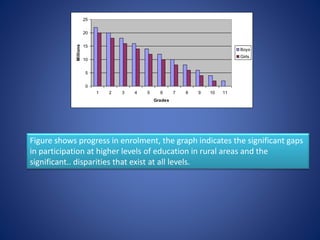
Figure shows progress in enrolment, the graph indicates the significant gaps
in participation at higher levels of education in rural areas and the
significant.. disparities that exist at all levels.
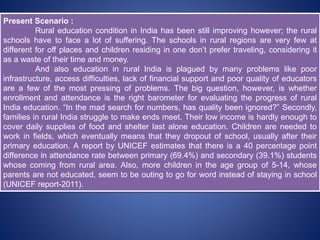
Present Scenario :
Rural education condition in India has been still improving however; the rural
schools have to face a lot of suffering. The schools in rural regions are very few at
different for off places and children residing in one don’t prefer traveling, considering it
as a waste of their time and money.
And also education in rural India is plagued by many problems like poor
infrastructure, access difficulties, lack of financial support and poor quality of educators
are a few of the most pressing of problems. The big question, however, is whether
enrollment and attendance is the right barometer for evaluating the progress of rural
India education. “In the mad search for numbers, has quality been ignored?” Secondly,
families in rural India struggle to make ends meet. Their low income is hardly enough to
cover daily supplies of food and shelter last alone education. Children are needed to
work in fields, which eventually means that they dropout of school, usually after their
primary education. A report by UNICEF estimates that there is a 40 percentage point
difference in attendance rate between primary (69.4%) and secondary (39.1%) students
whose coming from rural area. Also, more children in the age group of 5-14, whose
parents are not educated, seem to be outing to go for word instead of staying in school
(UNICEF report-2011).
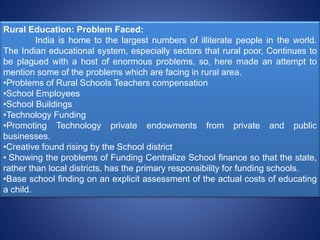
Rural Education: Problem Faced:
India is home to the largest numbers of illiterate people in the world.
The Indian educational system, especially sectors that rural poor, Continues to
be plagued with a host of enormous problems, so, here made an attempt to
mention some of the problems which are facing in rural area.
•Problems of Rural Schools Teachers compensation
•School Employees
•School Buildings
•Technology Funding
•Promoting Technology private endowments from private and public
businesses.
•Creative found rising by the School district
• Showing the problems of Funding Centralize School finance so that the state,
rather than local districts, has the primary responsibility for funding schools.
•Base school finding on an explicit assessment of the actual costs of educating
a child.
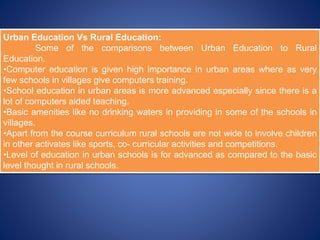
Urban Education Vs Rural Education:
Some of the comparisons between Urban Education to Rural
Education.
•Computer education is given high importance in urban areas where as very
few schools in villages give computers training.
•School education in urban areas is more advanced especially since there is a
lot of computers aided teaching.
•Basic amenities like no drinking waters in providing in some of the schools in
villages.
•Apart from the course curriculum rural schools are not wide to involve children
in other activates like sports, co- curricular activities and competitions.
•Level of education in urban schools is for advanced as compared to the basic
level thought in rural schools.
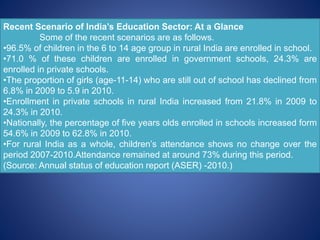
Recent Scenario of India’s Education Sector: At a Glance
Some of the recent scenarios are as follows.
•96.5% of children in the 6 to 14 age group in rural India are enrolled in school.
•71.0 % of these children are enrolled in government schools, 24.3% are
enrolled in private schools.
•The proportion of girls (age-11-14) who are still out of school has declined from
6.8% in 2009 to 5.9 in 2010.
•Enrollment in private schools in rural India increased from 21.8% in 2009 to
24.3% in 2010.
•Nationally, the percentage of five years olds enrolled in schools increased form
54.6% in 2009 to 62.8% in 2010.
•For rural India as a whole, children’s attendance shows no change over the
period 2007-2010.Attendance remained at around 73% during this period.
(Source: Annual status of education report (ASER) -2010.)
Conclusion:
India has the second largest education system in the world after china. The scale of
operation involved to ensure quality of Education for all in the country is unique and challenging. At
the same time, the nature of problems affecting the education system are so diverse and often
deep rooted that the solution cannot lie in the alternation of any one single factors –it is not about
just shortage of money or just shortage of trained teachers or lock of political will; all these
undeniably contribute to the problems, affecting the country’s systems.
Every village is not provided with school which means that students have to go to other
villages to get education. Owing to this parents usually do not send their daughters to school,
leading to a failure in achieving rural education in India. Poverty is another setback, Government
schools are not as good and private schools are expensive. Drop-out –rate of the secondary level is
extremely high in Villages .Quality related issues are far powerful than poverty Education and text
books should be made interesting. For rural students textbooks related this culture, this traditions
and values should also be there so as to create their interest in studies. There is a different
between city and village student not in terms of brain or development but their initial environment,
skills, learning ability availability of infrastructure and access to different but how it is going to be
taught would make the difference.
However, there is a need to look at the entire self of problems and deal with the issue
holistically taking into consideration, the specific contest of different sections of the society. It will
also require a constant and strong central support for policy, Strategy, technical assistance, and
monitoring and evaluation combined with increased decentralization with in government, stronger
public-private partnership, and improved accountability relationship between the service providers,
policy makers, and the target population.
References:
•http://www.yanta.org/componet/content/article
•http://www..bihortimes.in/vewersvoice/2012/Dec
•http://www.jagranjosh.com/ogneal-Kniwledge/rural-educational
•http://vst.vc/yodates/indias-rural-education-an-oppartinity
•http://www.mapxotindia.com/my-india/education/india-needs-education
•http://en.wikipedia.org/woki/Rural-education
•http://en.wokipedia.org/wiki/National-Rural-Education-Association
•http://education.nic.in /co. 50years /g/u/9FloutizaI.htm
•http://www.couterwoornts org /sikand211012.him
http://en.wikipedia.org/woki/Education-in-India

Rural education Nepal

  • 1.
    RURALEDUCATION; EDUCATINGTHE RURALINDIA:A SCENARIO. Omprakash H.M. Principal Dr. S.R.K. College of Education Narayanapet – 509 210 Mahabubangar (Dist) A.P. INDIA. Omprakash_dhanush@rediffmail.com www.nanoteaching.com
  • 2.
    Abstract: India hasthe largest education system in the world after China. However, issues of Quality education and access remain challenges in some parts of the Country. The role of education in facilitating social and economic progress is well accepted. Access to education is critical to access emerging opportunities that accompany economic growth. Keeping in view of this accepted fact there has been a major thrust on education since independence, but as far as ensuring quality education in rural India is concerned it has always been one of the biggest challenges for the governments. India’s rural areas have been left behind in the wake of high growth in other cities in India. One cause of rural poverty is the inability for children in rural areas to obtain basic education. India aspires for universal compulsory primary Education, with its challenges of keeping poor children in school and maintaining quality of education in rural areas, has been difficult to achieve. It is essential to convince everyone in rural India that educating himself, children, parents, and even neighborhoods’ must be. One way of spreading the education must be encourage every student and share the knowledge with each other. Here rural education requires special attention to achieve rural education policy.
  • 3.
    Introduction: Education isrecognized as one of the keys to fighting poverty, but despite the awareness of that fact too many children in rural India of which is poverty itself which forces families to put children to work or into other situations because they cannot afford to keep them at home and in school. In addition, some social customs deny education to girls, and children who are orphaned are almost always placed in situations that reduce their chances for education. Some of the objectives of rural education are as follows. •To serve as a national advocate and representative for rural education at all levels: Local – State – Regional – National. •To provide Co-ordination, at the national level, for rural education programs and activities. •To provide leadership for rural education – related conferences and workshops. •To provide a forum for all those involved in public education in rural areas – including teachers, administrators, board members, and members of the rural community at large whereby they may come together professionally and exchange ideas. •To promote state, regional and local delivery systems which bring about efficient and effective education for children in rural areas. •To encourage the collection and dissemination of promising practices, statistical data, and other appropriate information relating to rural education as well as co-ordinating the sharing of services and resources among educational organizations and agencies. •To encourage colleges and universities to develop materials and resources specifically for rural schools and to train personnel to work more effectively in small schools. •To stimulate discussion, research, and policy development regarding equal educational opportunities for all students. •To stress the need for public or private agencies to develop specific educational materials and technology appropriate to children in rural areas.
  • 4.
    Importance of RuralEducation: Different components that constitute rural education infrastructure are evaluated for their relative importance in the delivery of effective learning management of schooling has been traditionally controlled by the mainstream state and district administrations. The last two decades have been the emergence of a number of education – specific support institutions, such as the district primary education programme (DPEP) and Sarve Shisksha Abhiyam (SSA) State Implementation Societies, State Council of Educational Research and Training (SCERT), State Institutes of Educational Management and Training (SIEMAT), District Institutes of Education and Training (DIET), Block Resource Centers (BRC), Cluster Resource Centers (CRC), and in rural areas, Village Education Committees (VEC). Eighty-seven percent of the schools in India are in the country’s villages, government statistics and independent surveys have revealed that over 90 percent of the rural schools at elementary level are run by the government.
  • 5.
    0 5 10 15 20 25 1 2 34 5 6 7 8 9 10 11 Grades Millions Boys Girls Figure shows progress in enrolment, the graph indicates the significant gaps in participation at higher levels of education in rural areas and the significant.. disparities that exist at all levels.
  • 6.
    Present Scenario : Ruraleducation condition in India has been still improving however; the rural schools have to face a lot of suffering. The schools in rural regions are very few at different for off places and children residing in one don’t prefer traveling, considering it as a waste of their time and money. And also education in rural India is plagued by many problems like poor infrastructure, access difficulties, lack of financial support and poor quality of educators are a few of the most pressing of problems. The big question, however, is whether enrollment and attendance is the right barometer for evaluating the progress of rural India education. “In the mad search for numbers, has quality been ignored?” Secondly, families in rural India struggle to make ends meet. Their low income is hardly enough to cover daily supplies of food and shelter last alone education. Children are needed to work in fields, which eventually means that they dropout of school, usually after their primary education. A report by UNICEF estimates that there is a 40 percentage point difference in attendance rate between primary (69.4%) and secondary (39.1%) students whose coming from rural area. Also, more children in the age group of 5-14, whose parents are not educated, seem to be outing to go for word instead of staying in school (UNICEF report-2011).
  • 7.
    Rural Education: ProblemFaced: India is home to the largest numbers of illiterate people in the world. The Indian educational system, especially sectors that rural poor, Continues to be plagued with a host of enormous problems, so, here made an attempt to mention some of the problems which are facing in rural area. •Problems of Rural Schools Teachers compensation •School Employees •School Buildings •Technology Funding •Promoting Technology private endowments from private and public businesses. •Creative found rising by the School district • Showing the problems of Funding Centralize School finance so that the state, rather than local districts, has the primary responsibility for funding schools. •Base school finding on an explicit assessment of the actual costs of educating a child.
  • 8.
    Urban Education VsRural Education: Some of the comparisons between Urban Education to Rural Education. •Computer education is given high importance in urban areas where as very few schools in villages give computers training. •School education in urban areas is more advanced especially since there is a lot of computers aided teaching. •Basic amenities like no drinking waters in providing in some of the schools in villages. •Apart from the course curriculum rural schools are not wide to involve children in other activates like sports, co- curricular activities and competitions. •Level of education in urban schools is for advanced as compared to the basic level thought in rural schools.
  • 9.
    Recent Scenario ofIndia’s Education Sector: At a Glance Some of the recent scenarios are as follows. •96.5% of children in the 6 to 14 age group in rural India are enrolled in school. •71.0 % of these children are enrolled in government schools, 24.3% are enrolled in private schools. •The proportion of girls (age-11-14) who are still out of school has declined from 6.8% in 2009 to 5.9 in 2010. •Enrollment in private schools in rural India increased from 21.8% in 2009 to 24.3% in 2010. •Nationally, the percentage of five years olds enrolled in schools increased form 54.6% in 2009 to 62.8% in 2010. •For rural India as a whole, children’s attendance shows no change over the period 2007-2010.Attendance remained at around 73% during this period. (Source: Annual status of education report (ASER) -2010.)
  • 10.
    Conclusion: India has thesecond largest education system in the world after china. The scale of operation involved to ensure quality of Education for all in the country is unique and challenging. At the same time, the nature of problems affecting the education system are so diverse and often deep rooted that the solution cannot lie in the alternation of any one single factors –it is not about just shortage of money or just shortage of trained teachers or lock of political will; all these undeniably contribute to the problems, affecting the country’s systems. Every village is not provided with school which means that students have to go to other villages to get education. Owing to this parents usually do not send their daughters to school, leading to a failure in achieving rural education in India. Poverty is another setback, Government schools are not as good and private schools are expensive. Drop-out –rate of the secondary level is extremely high in Villages .Quality related issues are far powerful than poverty Education and text books should be made interesting. For rural students textbooks related this culture, this traditions and values should also be there so as to create their interest in studies. There is a different between city and village student not in terms of brain or development but their initial environment, skills, learning ability availability of infrastructure and access to different but how it is going to be taught would make the difference. However, there is a need to look at the entire self of problems and deal with the issue holistically taking into consideration, the specific contest of different sections of the society. It will also require a constant and strong central support for policy, Strategy, technical assistance, and monitoring and evaluation combined with increased decentralization with in government, stronger public-private partnership, and improved accountability relationship between the service providers, policy makers, and the target population.
  • 11.