Manthan Topic: Stepping Stones
Stepping Stones
Enhancing the quality of primary education in India
Team Details
Abhay Kant
Ritu Gupta
Sandeep Kumar
Seema Bhambhani
Shubhi Jindal
I I dia today, % of our childre ever start school. % do ’t co plete pri ary schools.
A d 0% do ’t co plete school this is the ajor co cer
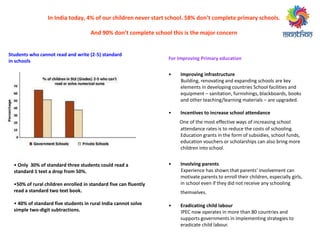
Students who cannot read and write (2-5) standard
in schools
• Only 30% of standard three students could read a
standard 1 text a drop from 50%.
•50% of rural children enrolled in standard five can fluently
read a standard two text book.
• 40% of standard five students in rural India cannot solve
simple two-digit subtractions.
For Improving Primary education
• Improving infrastructure
Building, renovating and expanding schools are key
elements in developing countries School facilities and
equipment – sanitation, furnishings, blackboards, books
and other teaching/learning materials – are upgraded.
• Incentives to increase school attendance
One of the most effective ways of increasing school
attendance rates is to reduce the costs of schooling.
Education grants in the form of subsidies, school funds,
education vouchers or scholarships can also bring more
children into school.
• Involving parents
Experience has shown that parents' involvement can
motivate parents to enroll their children, especially girls,
in school even if they did not receive any schooling
themselves.
• Eradicating child labour
IPEC now operates in more than 80 countries and
supports governments in implementing strategies to
eradicate child labour.
A proper primary education teaches literacy and numeracy; the ability to read and work with numbers will benefit children
into adulthood. These children will grow up to be farmers or small business owners (see Microfinance), mothers or fathers;
even basic literacy and numeracy will increase their efficiency and ability to learn. Indeed, Jamison, Jamison & Hanushek
006 fou d that highe le els of edu atio ualit i eased a ou t ’s ate of te h ologi al p og ess. The sa e pape
confirmed that higher levels of education quality increased growth rates of national income.
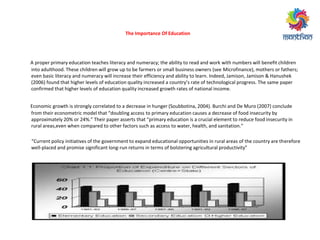
Economic growth is strongly correlated to a decrease in hunger (Soubbotina, 2004). Burchi and De Muro (2007) conclude
f o thei e o o et i odel that dou li g a ess to p i a edu atio auses a de ease of food i se u it
app o i atel 0% o %. Thei pape asse ts that p i a edu atio is a u ial ele e t to edu e food i se u it i
u al a eas,e e he o pa ed to othe fa to s su h as a ess to ate , health, a d sa itatio .
Cu e t poli i itiati es of the go e e t to e pa d edu atio al oppo tu ities i u al a eas of the ou t a e therefore
well-placed and promise significant long- u etu s i te s of olste i g ag i ultu al p odu ti it
The Importance Of Education
The Gender Gap
• “pe ial atte tio ust e gi e to de easi g the ge de gap i edu atio . As Roseg a t a d Cli e 00 ote, Wo e 's
education affects nearly every dimension of development, from lowering fertility rates to raising productivity and improving
e i o e tal a age e t. Yet i ost ou t ies e see a ge de gap i edu atio , ith less gi ls i s hool a d fo less
time.
• International Food Policy Research Institute [IFPRI] studies in Egypt and Mozambique estimate that ensuring women finish
primary school reduces the proportion of the population below the poverty line by 33.7% and 23.2% respectively. Along
with other studies, these two studies show that female education has much larger impact on poverty than other factors,
such as male education (IFPRI, 2009).
Education in Rural and Developing Areas
On relative cost-effectiveness of education in developing regions, King (1991) advises that anything beyond general
secondary education and 'a minimum exposure to pedagogical theory' is not cost-effective. King also suggests a focus on
basic and sufficient resources; that is, don't plan for high quality buildings and furniture, TVs, and computers if the students
do ’t e e ha e halk oa ds. Co i i g p a ti al easo i g like Ki g’s ith the e og itio that o lo g-term solution to
hunger and food insecurity could achieve success without improving education, we decided to focus on improving the
quality of primary education while offering the hope of secondary education as well. Parents are more likely to send their
children to school if they see primary education as a stepping stone to greater achievement and success. When primary
education quality improves, resulting in an increased earning capacity and thus greater freedom to look beyond simply
growing enough food to eat, secondary education will become a more viable option.
Cluster Schools
Our goals for education will be realized through the implementation of regionally-designed variations of the
cluster-school system. The physical building of schools will be a smaller component of this plan, since the problem
in most impoverished areas is not lack of schools, but low attendance rates (Jenkner & Hillman, 2004). Rather, we
will focus on improving school quality and relevancy of material taught, and on increasing attendance through our
other plans .
Cluster school systems have been implemented with great success in some Southeast Asian and Latin American
countries. Thailand turned to a cluster system for rural schools in the 1960s with extraordinary results. In 1960,
only 33.5% of those 25 or older had completed 4 years of primary school; by 1980 69% had. This occurred while
Thailand's population was nearly doubling (26 to 44 million). By the early 1980s, 96% of primary school-age
children were attending primary school (Schwille & Wheeler, 1991).
Cluster Schools
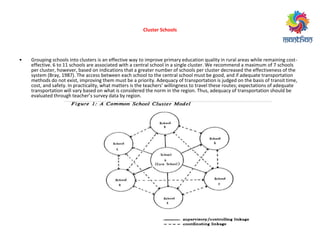
• Grouping schools into clusters is an effective way to improve primary education quality in rural areas while remaining cost-
effective. 6 to 11 schools are associated with a central school in a single cluster. We recommend a maximum of 7 schools
per cluster, however, based on indications that a greater number of schools per cluster decreased the effectiveness of the
system (Bray, 1987). The access between each school to the central school must be good, and if adequate transportation
methods do not exist, improving them must be a priority. Adequacy of transportation is judged on the basis of transit time,
ost, a d safet . I p a ti alit , hat atte s is the tea he s’ illi g ess to t a el these outes; e pe tatio s of ade uate
transportation will vary based on what is considered the norm in the region. Thus, adequacy of transportation should be
e aluated th ough tea he ’s su e data egio .
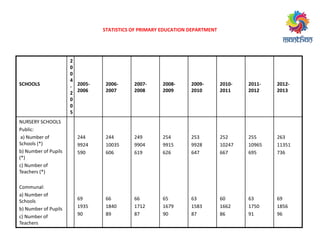
STATISTICS OF PRIMARY EDUCATION DEPARTMENT
SCHOOLS
2
0
0
4
-
2
0
0
5
2005-
2006
2006-
2007
2007-
2008
2008-
2009
2009-
2010
2010-
2011
2011-
2012
2012-
2013
NURSERY SCHOOLS
Public:
a) Number of
Schools (*)
b) Number of Pupils
(*)
c) Number of
Teachers (*)
Communal:
a) Number of
Schools
b) Number of Pupils
c) Number of
Teachers
244
9924
590
69
1935
90
244
10035
606
66
1840
89
249
9904
619
66
1712
87
254
9915
626
65
1679
90
253
9928
647
63
1583
87
252
10247
667
60
1662
86
255
10965
695
63
1750
91
263
11351
736
69
1856
96
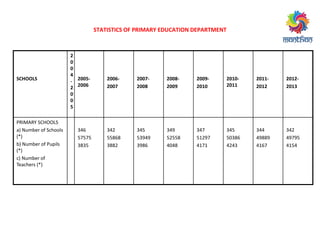
STATISTICS OF PRIMARY EDUCATION DEPARTMENT
SCHOOLS
2
0
0
4
-
2
0
0
5
2005-
2006
2006-
2007
2007-
2008
2008-
2009
2009-
2010
2010-
2011
2011-
2012
2012-
2013
PRIMARY SCHOOLS
a) Number of Schools
(*)
b) Number of Pupils
(*)
c) Number of
Teachers (*)
346
57575
3835
342
55868
3882
345
53949
3986
349
52558
4048
347
51297
4171
345
50386
4243
344
49889
4167
342
49795
4154
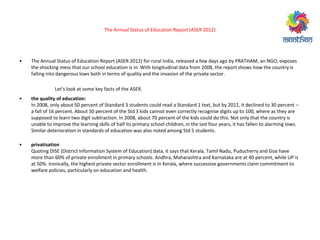
The Annual Status of Education Report (ASER 2012)
• The Annual Status of Education Report (ASER 2012) for rural India, released a few days ago by PRATHAM, an NGO, exposes
the shocking mess that our school education is in. With longitudinal data from 2008, the report shows how the country is
falling into dangerous lows both in terms of quality and the invasion of the private sector.
Let’s look at so e ke fa ts of the A“ER.
• the quality of education:
In 2008, only about 50 percent of Standard 3 students could read a Standard 1 text, but by 2012, it declined to 30 percent –
a fall of 16 percent. About 50 percent of the Std 3 kids cannot even correctly recognise digits up to 100, where as they are
supposed to learn two digit subtraction. In 2008, about 70 percent of the kids could do this. Not only that the country is
unable to improve the learning skills of half its primary school children, in the last four years, it has fallen to alarming lows.
Similar deterioration in standards of education was also noted among Std 5 students.
• privatisation
Quoting DISE (District Information System of Education) data, it says that Kerala, Tamil Nadu, Puducherry and Goa have
more than 60% of private enrollment in primary schools. Andhra, Maharashtra and Karnataka are at 40 percent, while UP is
at 50%. Ironically, the highest private sector enrollment is in Kerala, where successive governments claim commitment to
welfare policies, particularly on education and health.
Conclusions and recommendations
The study has raised many issues that have serious implication for quality improvement
in primary education. Some of these issues are discussed below.
a) There is a clear evidence to suggest that achievement levels tend to decline as the
children move along the educational hierarchy. This is true of both the English and
mathematics test. This shows that schools are not able to cope with the teaching
lea i g load as the pupils’ p og ess th ough a ious g ades.
b) The te po al o pa iso of lea e s’ pe fo a e has sho so e gai s i the fi st
few years of DPEP. While this a welcome outcome and confirms the broader
direction of reforms, it also raised many questions about the negative/decline in
achievement level in certain other districts. While the contextuality of the district is
an important parameter of planning, the implementation processes should also be
reviewed to isolate the factors, which have facilitated/impeded the trends in learning
outcome.
c) The students from privately managed schools perform better as compared to the
students from government and aided schools, although the evidence is limited. It is
also clear that despite better performance, even the private schools are far away from
achieving the goals set up by the MLLs.
Co ti ue……
In conclusion, it is pertinent to note that the assessment studies undertaken in the recent
years have brought to focus many issues which require immediate attention. These efforts
will go a long way in developing local specific strategies and help the system to develop
an integrated model of UEE, where the focus is not only on removing supply side
constrains by providing more teachers, facilities, instructional materials etc., but also in
identifying the critical inputs that optimise the learning outcomes in a given situation.

lasers

  • 1.
    Manthan Topic: SteppingStones Stepping Stones Enhancing the quality of primary education in India Team Details Abhay Kant Ritu Gupta Sandeep Kumar Seema Bhambhani Shubhi Jindal
  • 2.
    I I diatoday, % of our childre ever start school. % do ’t co plete pri ary schools. A d 0% do ’t co plete school this is the ajor co cer Students who cannot read and write (2-5) standard in schools • Only 30% of standard three students could read a standard 1 text a drop from 50%. •50% of rural children enrolled in standard five can fluently read a standard two text book. • 40% of standard five students in rural India cannot solve simple two-digit subtractions. For Improving Primary education • Improving infrastructure Building, renovating and expanding schools are key elements in developing countries School facilities and equipment – sanitation, furnishings, blackboards, books and other teaching/learning materials – are upgraded. • Incentives to increase school attendance One of the most effective ways of increasing school attendance rates is to reduce the costs of schooling. Education grants in the form of subsidies, school funds, education vouchers or scholarships can also bring more children into school. • Involving parents Experience has shown that parents' involvement can motivate parents to enroll their children, especially girls, in school even if they did not receive any schooling themselves. • Eradicating child labour IPEC now operates in more than 80 countries and supports governments in implementing strategies to eradicate child labour.
  • 3.
    A proper primaryeducation teaches literacy and numeracy; the ability to read and work with numbers will benefit children into adulthood. These children will grow up to be farmers or small business owners (see Microfinance), mothers or fathers; even basic literacy and numeracy will increase their efficiency and ability to learn. Indeed, Jamison, Jamison & Hanushek 006 fou d that highe le els of edu atio ualit i eased a ou t ’s ate of te h ologi al p og ess. The sa e pape confirmed that higher levels of education quality increased growth rates of national income. Economic growth is strongly correlated to a decrease in hunger (Soubbotina, 2004). Burchi and De Muro (2007) conclude f o thei e o o et i odel that dou li g a ess to p i a edu atio auses a de ease of food i se u it app o i atel 0% o %. Thei pape asse ts that p i a edu atio is a u ial ele e t to edu e food i se u it i u al a eas,e e he o pa ed to othe fa to s su h as a ess to ate , health, a d sa itatio . Cu e t poli i itiati es of the go e e t to e pa d edu atio al oppo tu ities i u al a eas of the ou t a e therefore well-placed and promise significant long- u etu s i te s of olste i g ag i ultu al p odu ti it The Importance Of Education
  • 4.
    The Gender Gap •“pe ial atte tio ust e gi e to de easi g the ge de gap i edu atio . As Roseg a t a d Cli e 00 ote, Wo e 's education affects nearly every dimension of development, from lowering fertility rates to raising productivity and improving e i o e tal a age e t. Yet i ost ou t ies e see a ge de gap i edu atio , ith less gi ls i s hool a d fo less time. • International Food Policy Research Institute [IFPRI] studies in Egypt and Mozambique estimate that ensuring women finish primary school reduces the proportion of the population below the poverty line by 33.7% and 23.2% respectively. Along with other studies, these two studies show that female education has much larger impact on poverty than other factors, such as male education (IFPRI, 2009).
  • 5.
    Education in Ruraland Developing Areas On relative cost-effectiveness of education in developing regions, King (1991) advises that anything beyond general secondary education and 'a minimum exposure to pedagogical theory' is not cost-effective. King also suggests a focus on basic and sufficient resources; that is, don't plan for high quality buildings and furniture, TVs, and computers if the students do ’t e e ha e halk oa ds. Co i i g p a ti al easo i g like Ki g’s ith the e og itio that o lo g-term solution to hunger and food insecurity could achieve success without improving education, we decided to focus on improving the quality of primary education while offering the hope of secondary education as well. Parents are more likely to send their children to school if they see primary education as a stepping stone to greater achievement and success. When primary education quality improves, resulting in an increased earning capacity and thus greater freedom to look beyond simply growing enough food to eat, secondary education will become a more viable option. Cluster Schools Our goals for education will be realized through the implementation of regionally-designed variations of the cluster-school system. The physical building of schools will be a smaller component of this plan, since the problem in most impoverished areas is not lack of schools, but low attendance rates (Jenkner & Hillman, 2004). Rather, we will focus on improving school quality and relevancy of material taught, and on increasing attendance through our other plans . Cluster school systems have been implemented with great success in some Southeast Asian and Latin American countries. Thailand turned to a cluster system for rural schools in the 1960s with extraordinary results. In 1960, only 33.5% of those 25 or older had completed 4 years of primary school; by 1980 69% had. This occurred while Thailand's population was nearly doubling (26 to 44 million). By the early 1980s, 96% of primary school-age children were attending primary school (Schwille & Wheeler, 1991).
  • 6.
    Cluster Schools • Groupingschools into clusters is an effective way to improve primary education quality in rural areas while remaining cost- effective. 6 to 11 schools are associated with a central school in a single cluster. We recommend a maximum of 7 schools per cluster, however, based on indications that a greater number of schools per cluster decreased the effectiveness of the system (Bray, 1987). The access between each school to the central school must be good, and if adequate transportation methods do not exist, improving them must be a priority. Adequacy of transportation is judged on the basis of transit time, ost, a d safet . I p a ti alit , hat atte s is the tea he s’ illi g ess to t a el these outes; e pe tatio s of ade uate transportation will vary based on what is considered the norm in the region. Thus, adequacy of transportation should be e aluated th ough tea he ’s su e data egio .
  • 7.
    STATISTICS OF PRIMARYEDUCATION DEPARTMENT SCHOOLS 2 0 0 4 - 2 0 0 5 2005- 2006 2006- 2007 2007- 2008 2008- 2009 2009- 2010 2010- 2011 2011- 2012 2012- 2013 NURSERY SCHOOLS Public: a) Number of Schools (*) b) Number of Pupils (*) c) Number of Teachers (*) Communal: a) Number of Schools b) Number of Pupils c) Number of Teachers 244 9924 590 69 1935 90 244 10035 606 66 1840 89 249 9904 619 66 1712 87 254 9915 626 65 1679 90 253 9928 647 63 1583 87 252 10247 667 60 1662 86 255 10965 695 63 1750 91 263 11351 736 69 1856 96
  • 8.
    STATISTICS OF PRIMARYEDUCATION DEPARTMENT SCHOOLS 2 0 0 4 - 2 0 0 5 2005- 2006 2006- 2007 2007- 2008 2008- 2009 2009- 2010 2010- 2011 2011- 2012 2012- 2013 PRIMARY SCHOOLS a) Number of Schools (*) b) Number of Pupils (*) c) Number of Teachers (*) 346 57575 3835 342 55868 3882 345 53949 3986 349 52558 4048 347 51297 4171 345 50386 4243 344 49889 4167 342 49795 4154
  • 9.
    The Annual Statusof Education Report (ASER 2012) • The Annual Status of Education Report (ASER 2012) for rural India, released a few days ago by PRATHAM, an NGO, exposes the shocking mess that our school education is in. With longitudinal data from 2008, the report shows how the country is falling into dangerous lows both in terms of quality and the invasion of the private sector. Let’s look at so e ke fa ts of the A“ER. • the quality of education: In 2008, only about 50 percent of Standard 3 students could read a Standard 1 text, but by 2012, it declined to 30 percent – a fall of 16 percent. About 50 percent of the Std 3 kids cannot even correctly recognise digits up to 100, where as they are supposed to learn two digit subtraction. In 2008, about 70 percent of the kids could do this. Not only that the country is unable to improve the learning skills of half its primary school children, in the last four years, it has fallen to alarming lows. Similar deterioration in standards of education was also noted among Std 5 students. • privatisation Quoting DISE (District Information System of Education) data, it says that Kerala, Tamil Nadu, Puducherry and Goa have more than 60% of private enrollment in primary schools. Andhra, Maharashtra and Karnataka are at 40 percent, while UP is at 50%. Ironically, the highest private sector enrollment is in Kerala, where successive governments claim commitment to welfare policies, particularly on education and health.
  • 10.
    Conclusions and recommendations Thestudy has raised many issues that have serious implication for quality improvement in primary education. Some of these issues are discussed below. a) There is a clear evidence to suggest that achievement levels tend to decline as the children move along the educational hierarchy. This is true of both the English and mathematics test. This shows that schools are not able to cope with the teaching lea i g load as the pupils’ p og ess th ough a ious g ades. b) The te po al o pa iso of lea e s’ pe fo a e has sho so e gai s i the fi st few years of DPEP. While this a welcome outcome and confirms the broader direction of reforms, it also raised many questions about the negative/decline in achievement level in certain other districts. While the contextuality of the district is an important parameter of planning, the implementation processes should also be reviewed to isolate the factors, which have facilitated/impeded the trends in learning outcome. c) The students from privately managed schools perform better as compared to the students from government and aided schools, although the evidence is limited. It is also clear that despite better performance, even the private schools are far away from achieving the goals set up by the MLLs.
  • 11.
    Co ti ue…… Inconclusion, it is pertinent to note that the assessment studies undertaken in the recent years have brought to focus many issues which require immediate attention. These efforts will go a long way in developing local specific strategies and help the system to develop an integrated model of UEE, where the focus is not only on removing supply side constrains by providing more teachers, facilities, instructional materials etc., but also in identifying the critical inputs that optimise the learning outcomes in a given situation.