Prolonged & Obstructed Labor
Rupture Uterus
Prolonged Labor
• when combined duration of first and second
stage of labor (excluding latent phase) is more
than 18hrs in primi and >12hrs in multiparous
women, is called prolonged labor .
• Second stage is defined prolonged when it is
>2hrs in primi & >1 hr. in multi.
• The prolongation denotes either delay in
cervical dilatation and/or inadequate
descent of presenting part.
• Incidence of prolonged labor:-
- 8% in primigravda
- 2% in multigravida
Causes of Prolonged Labor
Fault in any one or combination of basic
elements involved in labor
- Fault in power
- Fault in passage
- Fault in passenger
• Fault in power -
Abnormal or Inadequate uterine contraction
- Incoordinate uterine contraction
- Inability to beardown
• Fault in passage
- Full bladder
- Contracted pelvis
- Pelvic tumor (e.g.fibroid)
• Fault in passenger
-Malposition (op), Malpresentation (Face)
- Congenital anomaly of fetus (hydrocephalus)
- Deflexed head with poor uterine contraction
• Others
- Injudious early administration of sedative and
analgesic before actual labor begins
Dangers of Prolong Labor
• Fetal – The fetal risk increased due to
combined effect of hypxia & infection
 Intra uterine hypoxia
 Low Apgor score at birth
 Infection
 Intracranial hemorrage
 ↑ fetal morbidity & mortality
• Maternal Risks-
 Maternal distress
 Postpartum Hemorrhage
 Trauma to genital tract- cervical tear
- Rupture uterus
- ↑ operative delivery
 Puerperal sepsis / Subinvolution
 Undue stretching of the perineal muscles – which
may cause prolapse later
 ↑ Morbidity and Mortality
- Use partography in all labor to diagnose abnormality
early and timely intervention, optimally by alert and
action line.
- Early detection of factors producing prolong labor and
appropriate timely treatment.
Prevention of prolonged labor
Treatment
• Evaluate maternal and fetal condition from history,
general examination and obstetrical examination
and start supportive resuscitation.
• If there is Fetal Distress in 1st
stage of labor, CPD,
Malpresentation or failed augmentation → CS
• If inefficient uterine contraction → Augmentation of
labor by ARM and oxytocin.
Obstructed Labor
• Definition – Labor is said to be obstructed
when inspite of good uterine contraction
the progress of labor comes to standstill
due to mechanical obstruction.
• Incidence – 1-5% in referral hospital
Causes of obstructed labor
Important Common causes are:-
 Contracted Pelvis and CPD
 Malpresentation ( Shoulder, braw, mentoposteriar)
 Malposition ( DTA, OP )
Less Common causes are:-
 Fetal anomalies – Hydrocephalus, fetal ascitis,
conjoined twin.
 Soft tissue tumor –fibroid , ovarian
 Scarred cervix from previous amputation
Course of Labor in Obstructed labor
• During labor uterine contraction increases in
intensity, duration and frequency to overcome
obstruction
• With each contraction some retraction of upper
segment occur → Upper segment becomes
progressively thicker and shorter (tonic contraction)
• The passive lower segment progressively stretches
and become thinner to accommodate the fetus
driven from upper segment
• A circular groove is formed between the active upper
segment and passive distended lower segment called
pathological retraction ring (Bandle’s Ring)
• In primigravida → further uterine contraction ceases and
uterus subsequently becomes inert.
• In multigravida → the uterus continue to contract
vigrously .there is progressive rise of Bandle’s Ring
upward and ultimately lower segment rupture if baby is
not delivered promptly.
Clinical features of obstructed labor
 Patient is in agony due to continuous pain & restless
 Features of exhaustion – Tachycardia
- Perspiration
- Dehydration
- Ketoacidosis, L. respiration
 P/A Examination
- Bladder may be full
- Bandle’s Ring is visible
- Upper segment of uterus hard tonically contracted & tender
- Lower segment distended & tender
- Fetal parts may not be well defined
- FHS usually absent or bradycardia
P/V Examination
- Edematous Vulva
- Hot and Dry vagina
- Offensive vaginal discharge
- Cervix almost fully dilated
- Membranes are absent
- Presenting part may be impacted in pelvis
- Cause of obstructed labor is reveals
Prevention
 Antenatal detection of high risk pregnancy likely
to produce prolong labor such as big size baby,
short stature women , CPD, malpresentation &
malposition.
 Routine Partography and timely intervention of a
prolonged labor due to mechanical factor can
prevent obstructed labor.
Treatment of obstructed labor
 Correction of dehydration and acidosis with 1-3
liter NS or RL infusion.
 Vaginal swab to be taken for C/S
 Arrange blood in anticipation of PPH.
 Broad Spectrum antibiotic
 Obstetrical Management
Obstetrical Management
 If baby alive (rare ) → CS
 If baby is dead
- Destructive operation is an option if obstetrician Experience
- Otherwise do CS
- After Every case of operative vaginal delivery →
*vaginal, cervical tear and rupture uterus must be excluded.
*Oxytocin must be given
* Indwelling catheter for 7-10 days
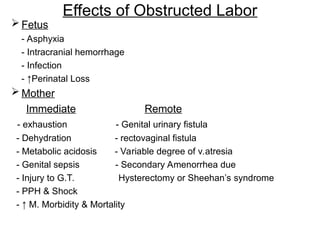
Effects of Obstructed Labor
 Fetus
- Asphyxia
- Intracranial hemorrhage
- Infection
- ↑Perinatal Loss
 Mother
Immediate Remote
- exhaustion - Genital urinary fistula
- Dehydration - rectovaginal fistula
- Metabolic acidosis - Variable degree of v.atresia
- Genital sepsis - Secondary Amenorrhea due
- Injury to G.T. Hysterectomy or Sheehan’s syndrome
- PPH & Shock
- ↑ M. Morbidity & Mortality
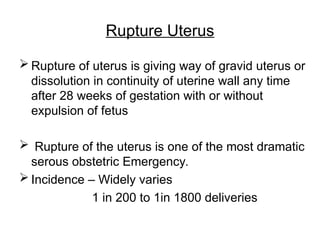
Rupture Uterus
 Rupture of uterus is giving way of gravid uterus or
dissolution in continuity of uterine wall any time
after 28 weeks of gestation with or without
expulsion of fetus
 Rupture of the uterus is one of the most dramatic
serous obstetric Emergency.
 Incidence – Widely varies
1 in 200 to 1in 1800 deliveries
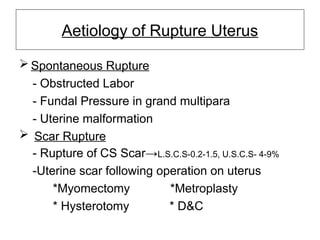
Aetiology of Rupture Uterus
 Spontaneous Rupture
- Obstructed Labor
- Fundal Pressure in grand multipara
- Uterine malformation
 Scar Rupture
- Rupture of CS Scar→L.S.C.S-0.2-1.5, U.S.C.S- 4-9%
-Uterine scar following operation on uterus
*Myomectomy *Metroplasty
* Hysterotomy * D&C
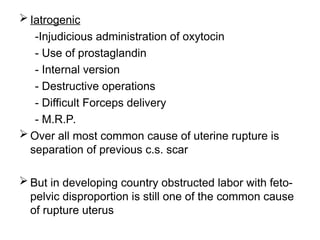
 Iatrogenic
-Injudicious administration of oxytocin
- Use of prostaglandin
- Internal version
- Destructive operations
- Difficult Forceps delivery
- M.R.P.
 Over all most common cause of uterine rupture is
separation of previous c.s. scar
 But in developing country obstructed labor with feto-
pelvic disproportion is still one of the common cause
of rupture uterus
Types of Rupture Uterus
 Complete Rupture- when uterine cavity communicate
directly with peritoneal cavity.
- Spontaneous rupture is more often complete.
 Incomplete Rupture- when uterine cavity is separated
from peritoneal cavity by visceral
peritoneum or broad ligament.
- Traumatic is usually incomplete
 Scar Dehiscence - When there is separation of
previous scar with intact peritoneum.
Site of Rupture
• Lower segment – Most common occurs in
previous CS, obstructed labor, which may extent
to lateral site & extends upward.
• Upper Segment – Occurs in previous classical
CS, Previous scar in upper segment & other
muscular pathology.
Diagnosis
• Rupture During Pregnancy
Typically
- Acute abdominal pain
- Features of shock & intrabdominal hemorrhage
- Easily palpable fetal parts
- Absent fetal heart sound
- Contracted uterus is felt on one side
Atypically
- Incomplete rupture producing localized abdominal pain & tenderness
- Frank signs of hemorrhage & shock develop slowly
- It may confuse with accidental hemorrhage
Rupture in Labor
• H/o vigorous uterine contraction followed by sudden
bursting pain→ cessation of L. pains
• Signs of internal hemorrhage depending on severity
→ Shock , abdominal tenderness, guarding
• P/A → Fetal parts are easily palpable together with
hard retracted uterus can be felt.
• Vaginal Examination
- Reveals bleeding through the cervical os
- Recession of presenting part in complete rupture
- Cervix hangs like a curtain
- Hematuria may be present
Management
• I.V. line, Antibiotics, Arrange blood
• Laparotomy along with blood transfusion when the
∆ of rupture uterus is made
• In case of ruptured C.S. scar, low parity, women &
rupture wound is clear cut, condition stable
→Repair
• Patient with high parity, edges of rupture are
ragged and irregular, anatomy is distorted
→Hysterectomy to be.
Causes of Mortality
• Hemorrhage
• Shock
• Sepsis
• Mortality in intacted uterus rupture is more than
scarred uterus
• Mortality is more (3%) in classical scar than lower
segment scar rupture (1%).
prolonged labour obstructed labour, rupture uterus

prolonged labour obstructed labour, rupture uterus

  • 1.
    Prolonged & ObstructedLabor Rupture Uterus
  • 2.
    Prolonged Labor • whencombined duration of first and second stage of labor (excluding latent phase) is more than 18hrs in primi and >12hrs in multiparous women, is called prolonged labor . • Second stage is defined prolonged when it is >2hrs in primi & >1 hr. in multi.
  • 3.
    • The prolongationdenotes either delay in cervical dilatation and/or inadequate descent of presenting part. • Incidence of prolonged labor:- - 8% in primigravda - 2% in multigravida
  • 4.
    Causes of ProlongedLabor Fault in any one or combination of basic elements involved in labor - Fault in power - Fault in passage - Fault in passenger
  • 5.
    • Fault inpower - Abnormal or Inadequate uterine contraction - Incoordinate uterine contraction - Inability to beardown • Fault in passage - Full bladder - Contracted pelvis - Pelvic tumor (e.g.fibroid)
  • 6.
    • Fault inpassenger -Malposition (op), Malpresentation (Face) - Congenital anomaly of fetus (hydrocephalus) - Deflexed head with poor uterine contraction • Others - Injudious early administration of sedative and analgesic before actual labor begins
  • 7.
    Dangers of ProlongLabor • Fetal – The fetal risk increased due to combined effect of hypxia & infection  Intra uterine hypoxia  Low Apgor score at birth  Infection  Intracranial hemorrage  ↑ fetal morbidity & mortality
  • 8.
    • Maternal Risks- Maternal distress  Postpartum Hemorrhage  Trauma to genital tract- cervical tear - Rupture uterus - ↑ operative delivery  Puerperal sepsis / Subinvolution  Undue stretching of the perineal muscles – which may cause prolapse later  ↑ Morbidity and Mortality
  • 9.
    - Use partographyin all labor to diagnose abnormality early and timely intervention, optimally by alert and action line. - Early detection of factors producing prolong labor and appropriate timely treatment. Prevention of prolonged labor
  • 10.
    Treatment • Evaluate maternaland fetal condition from history, general examination and obstetrical examination and start supportive resuscitation. • If there is Fetal Distress in 1st stage of labor, CPD, Malpresentation or failed augmentation → CS • If inefficient uterine contraction → Augmentation of labor by ARM and oxytocin.
  • 11.
    Obstructed Labor • Definition– Labor is said to be obstructed when inspite of good uterine contraction the progress of labor comes to standstill due to mechanical obstruction. • Incidence – 1-5% in referral hospital
  • 12.
    Causes of obstructedlabor Important Common causes are:-  Contracted Pelvis and CPD  Malpresentation ( Shoulder, braw, mentoposteriar)  Malposition ( DTA, OP ) Less Common causes are:-  Fetal anomalies – Hydrocephalus, fetal ascitis, conjoined twin.  Soft tissue tumor –fibroid , ovarian  Scarred cervix from previous amputation
  • 13.
    Course of Laborin Obstructed labor • During labor uterine contraction increases in intensity, duration and frequency to overcome obstruction • With each contraction some retraction of upper segment occur → Upper segment becomes progressively thicker and shorter (tonic contraction) • The passive lower segment progressively stretches and become thinner to accommodate the fetus driven from upper segment
  • 14.
    • A circulargroove is formed between the active upper segment and passive distended lower segment called pathological retraction ring (Bandle’s Ring) • In primigravida → further uterine contraction ceases and uterus subsequently becomes inert. • In multigravida → the uterus continue to contract vigrously .there is progressive rise of Bandle’s Ring upward and ultimately lower segment rupture if baby is not delivered promptly.
  • 15.
    Clinical features ofobstructed labor  Patient is in agony due to continuous pain & restless  Features of exhaustion – Tachycardia - Perspiration - Dehydration - Ketoacidosis, L. respiration  P/A Examination - Bladder may be full - Bandle’s Ring is visible - Upper segment of uterus hard tonically contracted & tender - Lower segment distended & tender - Fetal parts may not be well defined - FHS usually absent or bradycardia
  • 16.
    P/V Examination - EdematousVulva - Hot and Dry vagina - Offensive vaginal discharge - Cervix almost fully dilated - Membranes are absent - Presenting part may be impacted in pelvis - Cause of obstructed labor is reveals
  • 17.
    Prevention  Antenatal detectionof high risk pregnancy likely to produce prolong labor such as big size baby, short stature women , CPD, malpresentation & malposition.  Routine Partography and timely intervention of a prolonged labor due to mechanical factor can prevent obstructed labor.
  • 18.
    Treatment of obstructedlabor  Correction of dehydration and acidosis with 1-3 liter NS or RL infusion.  Vaginal swab to be taken for C/S  Arrange blood in anticipation of PPH.  Broad Spectrum antibiotic  Obstetrical Management
  • 19.
    Obstetrical Management  Ifbaby alive (rare ) → CS  If baby is dead - Destructive operation is an option if obstetrician Experience - Otherwise do CS - After Every case of operative vaginal delivery → *vaginal, cervical tear and rupture uterus must be excluded. *Oxytocin must be given * Indwelling catheter for 7-10 days
  • 20.
    Effects of ObstructedLabor  Fetus - Asphyxia - Intracranial hemorrhage - Infection - ↑Perinatal Loss  Mother Immediate Remote - exhaustion - Genital urinary fistula - Dehydration - rectovaginal fistula - Metabolic acidosis - Variable degree of v.atresia - Genital sepsis - Secondary Amenorrhea due - Injury to G.T. Hysterectomy or Sheehan’s syndrome - PPH & Shock - ↑ M. Morbidity & Mortality
  • 21.
    Rupture Uterus  Ruptureof uterus is giving way of gravid uterus or dissolution in continuity of uterine wall any time after 28 weeks of gestation with or without expulsion of fetus  Rupture of the uterus is one of the most dramatic serous obstetric Emergency.  Incidence – Widely varies 1 in 200 to 1in 1800 deliveries
  • 22.
    Aetiology of RuptureUterus  Spontaneous Rupture - Obstructed Labor - Fundal Pressure in grand multipara - Uterine malformation  Scar Rupture - Rupture of CS Scar→L.S.C.S-0.2-1.5, U.S.C.S- 4-9% -Uterine scar following operation on uterus *Myomectomy *Metroplasty * Hysterotomy * D&C
  • 23.
     Iatrogenic -Injudicious administrationof oxytocin - Use of prostaglandin - Internal version - Destructive operations - Difficult Forceps delivery - M.R.P.  Over all most common cause of uterine rupture is separation of previous c.s. scar  But in developing country obstructed labor with feto- pelvic disproportion is still one of the common cause of rupture uterus
  • 24.
    Types of RuptureUterus  Complete Rupture- when uterine cavity communicate directly with peritoneal cavity. - Spontaneous rupture is more often complete.  Incomplete Rupture- when uterine cavity is separated from peritoneal cavity by visceral peritoneum or broad ligament. - Traumatic is usually incomplete  Scar Dehiscence - When there is separation of previous scar with intact peritoneum.
  • 25.
    Site of Rupture •Lower segment – Most common occurs in previous CS, obstructed labor, which may extent to lateral site & extends upward. • Upper Segment – Occurs in previous classical CS, Previous scar in upper segment & other muscular pathology.
  • 26.
    Diagnosis • Rupture DuringPregnancy Typically - Acute abdominal pain - Features of shock & intrabdominal hemorrhage - Easily palpable fetal parts - Absent fetal heart sound - Contracted uterus is felt on one side Atypically - Incomplete rupture producing localized abdominal pain & tenderness - Frank signs of hemorrhage & shock develop slowly - It may confuse with accidental hemorrhage
  • 27.
    Rupture in Labor •H/o vigorous uterine contraction followed by sudden bursting pain→ cessation of L. pains • Signs of internal hemorrhage depending on severity → Shock , abdominal tenderness, guarding • P/A → Fetal parts are easily palpable together with hard retracted uterus can be felt. • Vaginal Examination - Reveals bleeding through the cervical os - Recession of presenting part in complete rupture - Cervix hangs like a curtain - Hematuria may be present
  • 28.
    Management • I.V. line,Antibiotics, Arrange blood • Laparotomy along with blood transfusion when the ∆ of rupture uterus is made • In case of ruptured C.S. scar, low parity, women & rupture wound is clear cut, condition stable →Repair • Patient with high parity, edges of rupture are ragged and irregular, anatomy is distorted →Hysterectomy to be.
  • 29.
    Causes of Mortality •Hemorrhage • Shock • Sepsis • Mortality in intacted uterus rupture is more than scarred uterus • Mortality is more (3%) in classical scar than lower segment scar rupture (1%).