Uniform Standards for the
Universal Design of Fitness
Equipment (UDFE)
 Beneficial Designs, Inc. – Minden, NV
 Peter W. Axelson, M.S.M.E.
 Seanna L. Kringen, M.S.
Why Standardization?
Assistive Technology
Standards (ATS)
 Provide clinicians and consumers with objective
information
 Allow government agencies to set minimum
performance requirements
 Promote safe and quality products
 International standards reduce trade barriers
 Standards are under constant revisions due to
changing technology
Standards Organizations
 International Standards Organization
(ISO)
 Rehabilitation Engineering and
Assistive Technology Society of North
America (RESNA) – ANSI acredited
 ASTM
RESNA Standards Used as a
Model
 RESNA Assistive Technology
Standards (ATS) Committees
develop standards:
 Minimum safety criteria
 Minimum performance criteria
RESNA ATS Board
 Oversees RESNA Standards Committees for:
 Wheelchairs
 Wheelchair and Related Seating
 Wheelchairs and Transportation
 Assistive Technologies for Persons with Visual
Impairments and Hearing and Visual Impairments
 Support Surfaces (mattress/overlay)
 Adaptive Sports Equipment
 Emergency Stair Travel Devises
RESNA Committees
 Consumers, organizations representing
people with disabilities, researchers,
practitioners, and manufacturers
 Develop objective minimum safety and
performance test methods
 Repeatable
 Reproducible
RESNA Standards
 Based on applicable ISO Standards
 Drafted, reviewed and voted on for
committee approval
 2/3 vote for approval
 Funded in part by:
 PVA – Research and Education Program for
Wheelchair Standards
 RESNA – Balloting and Membership
 Beneficial Designs
RESNA Draft Standards
 RESNA WC-1: 2009 Wheelchairs – Volume
1: Requirements and Test Methods for
Wheelchairs (Including Scooters)
 RESNA WC-2: 2009 Wheelchairs – Volume
2: Additional Requirements for Wheelchairs
(Including Scooters) with Electrical Systems
RESNA National Standards
 RESNA WC-1: 2000 Wheelchairs –
Volume 1, Section 19: Wheelchairs used
as seats in motor vehicles
 RESNA ASE-1: 2007 Adaptive Sports
Equipment – Volume 1: Winter Sports
Equipment
Universal Design of Fitness
Equipment (UDFE) Standards
 Accessible “mainstream” fitness
equipment – user friendly
 Health benefits
 Social benefits
 Increase access by persons with
impairment
 Decrease cost of accessible fitness
equipment
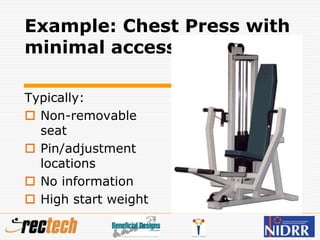
Example: Chest Press with
minimal access
Typically:
 Non-removable
seat
 Pin/adjustment
locations
 No information
 High start weight
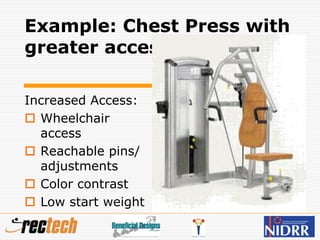
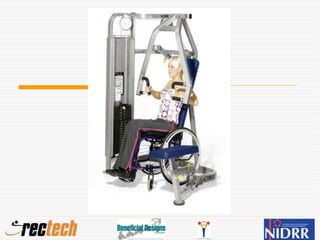
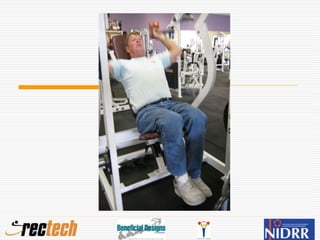
Example: Chest Press with
greater access
Increased Access:
 Wheelchair
access
 Reachable pins/
adjustments
 Color contrast
 Low start weight
Americans with Disabilities
Act (ADA)
 Title III applies to public accommodations
 People of all abilities:
Access fitness centers
Access fitness equipment
 Including those with disability
 Physical
 Sensory
 Cognitive
Accessible Fitness
Equipment Milestones
 Beneficial Designs
NIH/NICHD SBIR Phase I grant
 United States Guidelines
 Universal Design of Fitness Equipment
(UDFE) (2006)
 Inclusive Fitness Initiative (IFI)
 United Kingdom Guidelines
 IFI Standards Stage Two (2006)
RecTech Mission
Increase fitness and recreation:
 ACCESS
 PARTICIPATION
 ADHERENCE
Promote HEALTH and FUNCTION
RecTech
NIDRR Rehab Engineering
Research Center (2007)
Using technology to promote more
healthy, active lifestyles for people
with disabilities
Development Project to harmonize
UK and US Guidelines -
Uniform Standards for
Accessible Fitness Equipment
Specific Aims
 Evaluate and refine the draft
Universal Design of Fitness
Equipment (UDFE) Guidelines
 Develop a UDFE Standard by
participating in ASTM
Compare the UK and US
Guidelines
 IFI (UK)/UDFE (US- Beneficial Designs)
 General Requirements
 Strength Equipment
 Cardiovascular Equipment
UDFE/UK Harmonization
Score Developed
 1= equivalent guidelines
 2= similar (both objective)
 3= not equal (objective v subjective)
 x= missing criteria
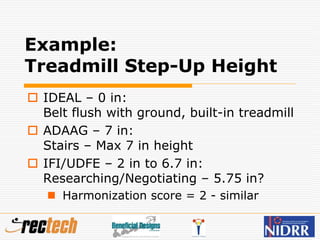
Example:
Treadmill Step-Up Height
 IDEAL – 0 in:
Belt flush with ground, built-in treadmill
 ADAAG – 7 in:
Stairs – Max 7 in height
 IFI/UDFE – 2 in to 6.7 in:
Researching/Negotiating – 5.75 in?
 Harmonization score = 2 - similar
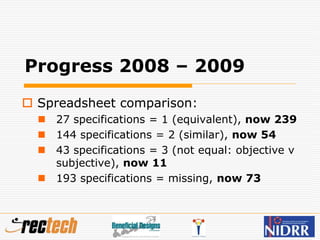
Progress 2008 – 2009
 Spreadsheet comparison:
 27 specifications = 1 (equivalent), now 239
 144 specifications = 2 (similar), now 54
 43 specifications = 3 (not equal: objective v
subjective), now 11
 193 specifications = missing, now 73
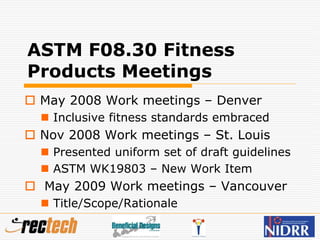
ASTM F08.30 Fitness
Products Meetings
 May 2008 Work meetings – Denver
 Inclusive fitness standards embraced
 Nov 2008 Work meetings – St. Louis
 Presented uniform set of draft guidelines
 ASTM WK19803 – New Work Item
 May 2009 Work meetings – Vancouver
 Title/Scope/Rationale
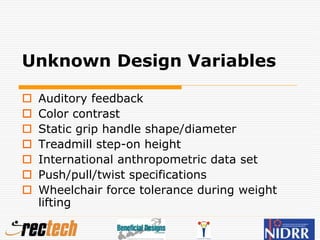
Unknown Design Variables
 Auditory feedback
 Color contrast
 Static grip handle shape/diameter
 Treadmill step-on height
 International anthropometric data set
 Push/pull/twist specifications
 Wheelchair force tolerance during weight
lifting
Auditory Feedback
Research
 IFI currently conducting research in
the UK
 Auditory feedback options for people
with vision impairment
 Issues: privacy, non-intrusive to other
gym members
Color Contrast Research
 IFI algorithm
 Complicated to perform in field
 ASTM standard for tile color
 Spectrophotometric equipment –
expensive
 Need easy, low-cost method
 ADA – 70% color contrast
 Evaluating feasibility of Spotmeter use
Accessibility of Fitness
Equipment for People
using Wheelchairs
 Seat support
 Lateral access
 Facing in or out
 Seat removal
 Weight pin – Adjustment forces
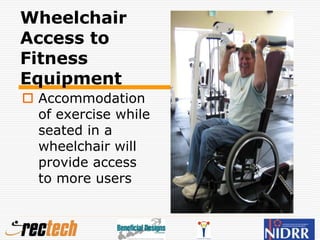
Wheelchair
Access to
Fitness
Equipment
 Accommodation
of exercise while
seated in a
wheelchair will
provide access
to more users
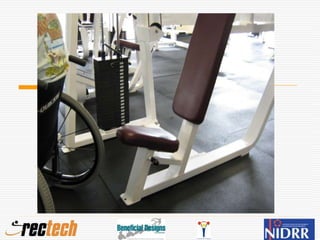
Removablity of the
Seating Support
 Fixed Seating
 Removable Seating
 Swing away Seating
 Adjustable height Seating
 Increments of adjustment
 Range of adjustment
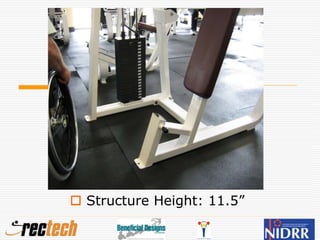
 Structure Height: 11.5”
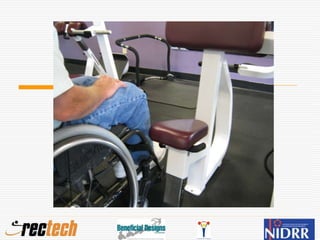
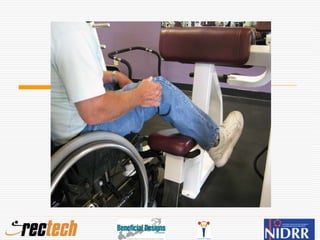
Front Approach Fitness
Equipment
 Transfer often required
 Difficulty getting leg across seat
for transfer
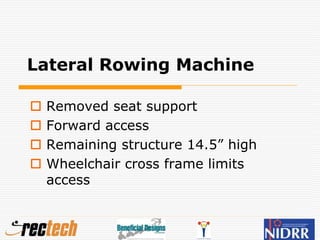
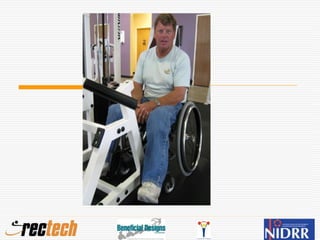
Lateral Rowing Machine
 Removed seat support
 Forward access
 Remaining structure 14.5” high
 Wheelchair cross frame limits
access
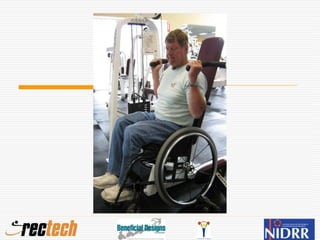
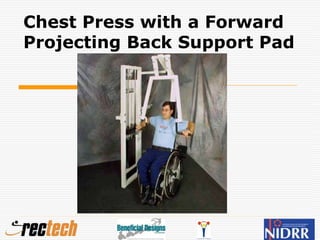
Chest Press with a Forward
Projecting Back Support Pad
Fitness Equipment
Seating Supports – Data
Collection
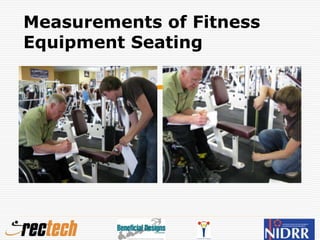
 Width
 Thickness
 Angle
 Depth
 Shape
 Height
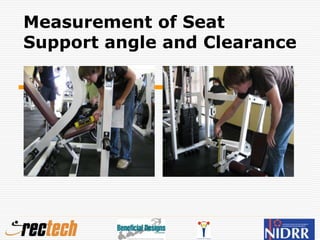
 Lateral clearance for transfer
 Removability and height of
remaining structure
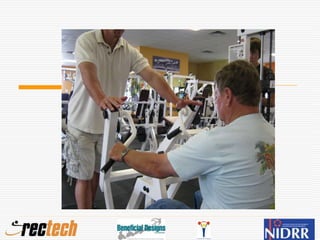
Measurements of Fitness
Equipment Seating
Measurement of Seat
Support angle and Clearance
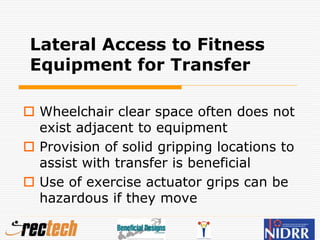
Lateral Access to Fitness
Equipment for Transfer
 Wheelchair clear space often does not
exist adjacent to equipment
 Provision of solid gripping locations to
assist with transfer is beneficial
 Use of exercise actuator grips can be
hazardous if they move
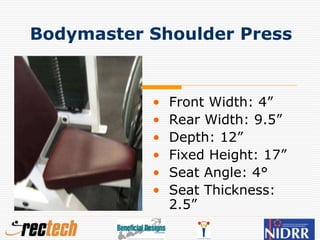
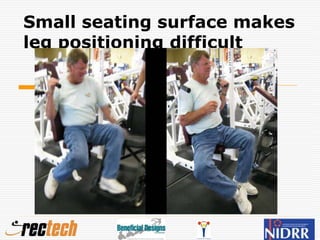
• Front Width: 4”
• Rear Width: 9.5”
• Depth: 12”
• Fixed Height: 17”
• Seat Angle: 4°
• Seat Thickness:
2.5”
Bodymaster Shoulder Press
Small seating surface makes
leg positioning difficult
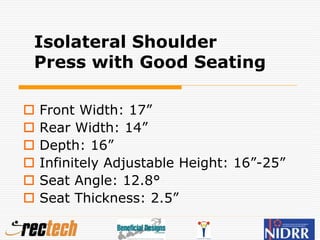
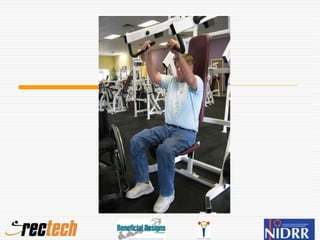
Isolateral Shoulder
Press with Good Seating
 Front Width: 17”
 Rear Width: 14”
 Depth: 16”
 Infinitely Adjustable Height: 16”-25”
 Seat Angle: 12.8°
 Seat Thickness: 2.5”
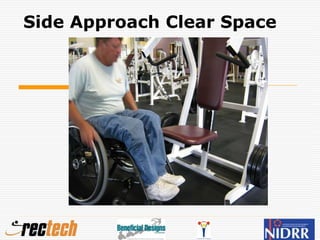
Side Approach Clear Space
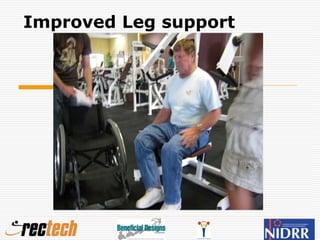
Improved Leg support
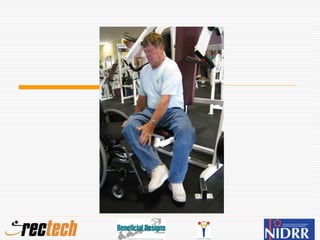
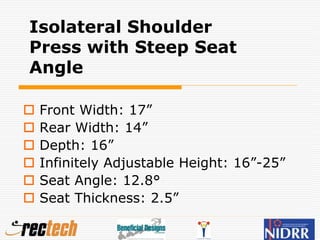
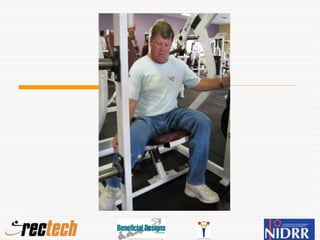
Isolateral Shoulder
Press with Steep Seat
Angle
 Front Width: 17”
 Rear Width: 14”
 Depth: 16”
 Infinitely Adjustable Height: 16”-25”
 Seat Angle: 12.8°
 Seat Thickness: 2.5”
Effect of Fitness Equipment
Design on Strength and
Stability of Wheelchairs
Peter Axelson – Design Engineer
Seanna Kringen - Standards Writer
Joey Gmuender – Project Assistant
Stability of Wheelchair
Users while using
Fitness Equipment
Biomechanics of
Exercise Affecting
Stability
 Amount of force required
 Angle of applied force
 Speed of force application
 User characteristics
 Wheelchair characteristics
User Characteristics
Affecting Stability
 Weight
 Height
 Overall
 Sitting
 Shoulder
Rearward Wheelchair
Stability
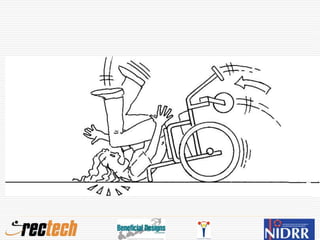
 The forces exerted on a wheelchair
when the user is exercising can
sometimes cause an instability,
causing the user to tip over
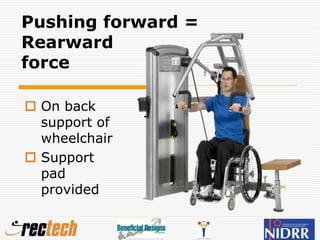
Pushing forward =
Rearward
force
 On back
support of
wheelchair
 Support
pad
provided
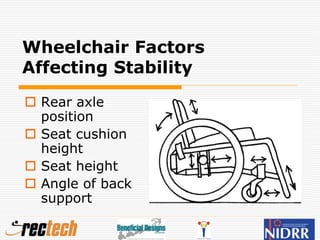
Wheelchair Factors
Affecting Stability
 Rear axle
position
 Seat cushion
height
 Seat height
 Angle of back
support
Axle Position Types
 Fixed – Inline with back support
 Adjustable – A set of holes fore
and aft for the user to choose
 Infinite – A slot that allows the
axle to be positioned anywhere
inside of it
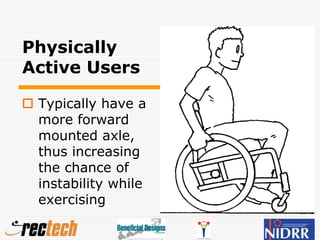
 Typically have a
more forward
mounted axle,
thus increasing
the chance of
instability while
exercising
Physically
Active Users
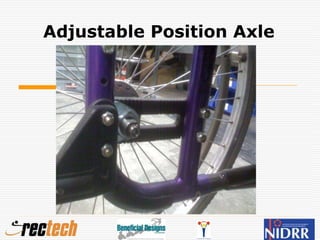
Adjustable Position Axle
Investigation of Shoulder
Height and Weight on
Rearward Stability
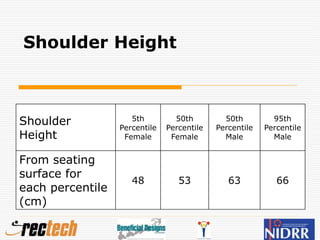
Shoulder Height
Shoulder
Height
5th
Percentile
Female
50th
Percentile
Female
50th
Percentile
Male
95th
Percentile
Male
From seating
surface for
each percentile
(cm)
48 53 63 66
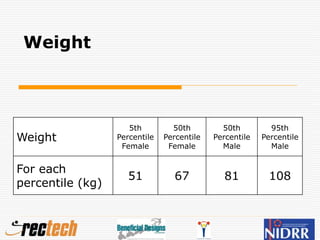
Weight
5th
Percentile
Female
50th
Percentile
Female
50th
Percentile
Male
95th
Percentile
Male
For each
percentile (kg)
51 67 81 108
Weight
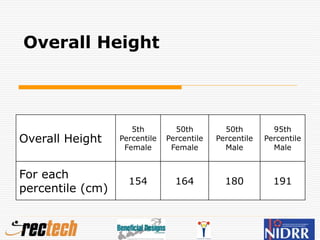
Overall Height
Overall Height
5th
Percentile
Female
50th
Percentile
Female
50th
Percentile
Male
95th
Percentile
Male
For each
percentile (cm)
154 164 180 191
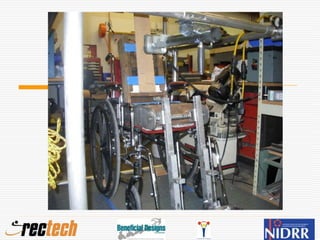
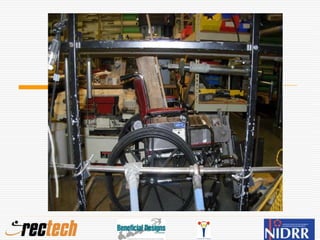
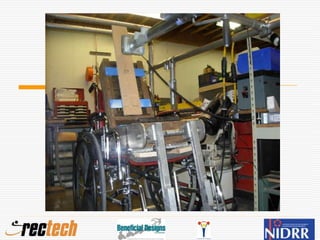
Test Setup for Measuring
Force to Tip
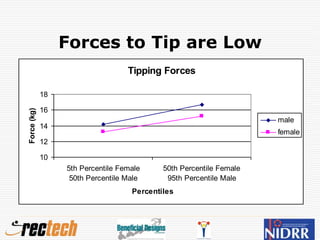
Forces to Tip are Low
Tipping Forces
10
12
14
16
18
5th Percentile Female
50th Percentile Male
50th Percentile Female
95th Percentile Male
Percentiles
Force
(kg)
male
female
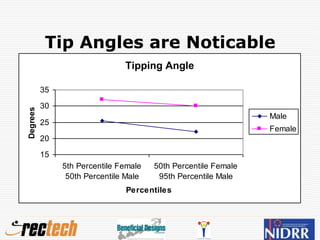
Tip Angles are Noticable
Tipping Angle
15
20
25
30
35
5th Percentile Female
50th Percentile Male
50th Percentile Female
95th Percentile Male
Percentiles
Degrees
Male
Female
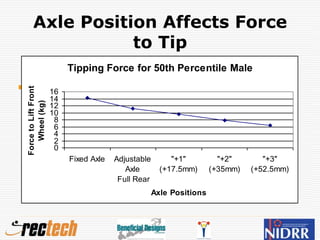
Axle Position Affects Force
to Tip
Tipping Force for 50th Percentile Male
0
2
4
6
8
10
12
14
16
Fixed Axle Adjustable
Axle
Full Rear
"+1"
(+17.5mm)
"+2"
(+35mm)
"+3"
(+52.5mm)
Axle Positions
Force
to
Lift
Front
Wheel
(kg)
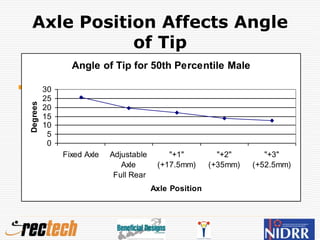
Axle Position Affects Angle
of Tip
Angle of Tip for 50th Percentile Male
0
5
10
15
20
25
30
Fixed Axle Adjustable
Axle
Full Rear
"+1"
(+17.5mm)
"+2"
(+35mm)
"+3"
(+52.5mm)
Axle Position
Degrees
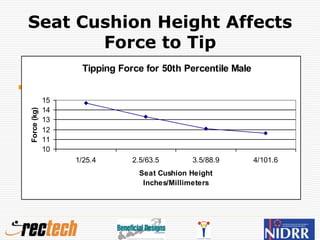
Seat Cushion Height Affects
Force to Tip
Tipping Force for 50th Percentile Male
10
11
12
13
14
15
1/25.4 2.5/63.5 3.5/88.9 4/101.6
Seat Cushion Height
Inches/Millimeters
Force
(kg)
Stability of Wheelchair
Users using Fitness
Equipment
 Factors:
 User weight
 User sitting height
 Fore-aft wheelchair axle position
Shoulder Height
 The taller the shoulder height of
the user, the easier it is to tip
over backwards
Fore-aft Wheelchair
Axle Position
 The further forward the axle
position, the easier the wheelchair
can tip to the rear
 The further rearward the axle
position, the more stable the
wheelchair will be to the rear
Integrity of a Typical
Wheelchair when Using
Vertical Lift Exercise
Equipment
Investigation – Wheelchair
Loading Capacity
Question/Concern Raised
 What would happen to a
wheelchair if it was loaded during
exercise with weight beyond its
maximum rating of 250 lbs?
Common Wheelchair
Warning
Weight Training
<<Manufacturer>> does not recommend the use of
its wheelchairs as a weight training apparatus.
<<Manufacturer>> wheelchairs have not been
designed or tested as a seat for any kind of weight
training. If occupant uses said wheelchair as a
weight training apparatus, <<Manufacturer>> shall
not be liable for bodily injury or damage to the
wheelchair and the warranty is void.
Test Protocol
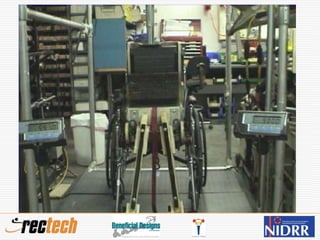
 A test dummy was setup in a
wheelchair and loaded with steel
plates
 A fairly generic steel frame, folding
wheelchair commonly used in
hospitals and airports was used
Test Dummy Load
 Test dummy fully loaded
 Weight: rear 342.5 lb, front 474.5 lb
 Total weight: 817.0 lb
 Ram used to further load test dummy
 Weight: rear 591.0 lb, front 900.0 lb
 Total weight: 1491 lb
Results – Overall Integrity
of the Wheelchair Intact
 Welds and structural joints
unchanged
 Front caster angle changed
 from 21° to 24°
 Seat material stretched
Conclusion
 Loading this particular wheelchair
beyond its specified maximum
payload as may be experienced
during weight lifting was found to not
catastrophically effect the wheelchair
Current Safety Methods
 Usually the best way for a person
using a wheelchair to access this type
of equipment is through the use of a
guide or spotter
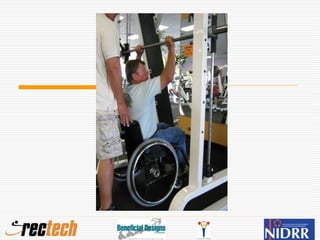
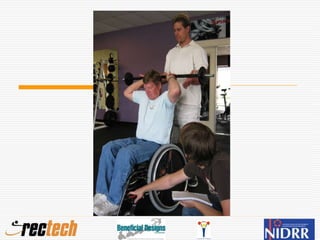
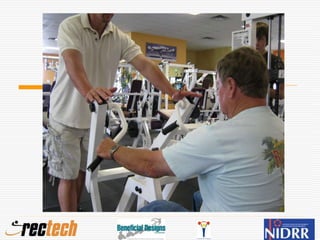
Safety Methods
 Weighing down the front of the
wheelchair
 Locking down the front of the
wheelchair with a strap or hook
 A back support device or pad
 Personal assistance from a
trainer
Next Steps for UDFE
Standards
 Research unknown variables
 Develop other sections
 Elliptical
 Rowing machine
 Ergometer
 Promote the ASTM process
Future Goals
 Disability training for fitness staff
 Inclusive fitness programs
 Accessible gym layout
 User friendly labeling
NIDRR
 This project was partially supported by
award #H133E070029 from the U.S.
Department of Education, National
Institute on Disability and Rehabilitation
Research.
NIH
 Beneficial Designs’ Phase I of this project
was was funded by the National Center
for Medical Rehabilitation Research in the
National Institute of Child Health and
Human Development at the National
Institutes of Health through Small
Business Innovation Research Phase I
grant # 1 R43 HD049236-01.
Paralyzed Veterans of
America – PVA Research
 Beneficial Designs – Peter Axelson, with
the assistance of his staff, is supported to
travel and participate in RESNA - national
and ISO – International Standards
Organization wheelchair standards
meetings to develop, write and update
wheelchair standard test procedures for
manual and powered wheelchairs.
Beneficial Designs, Inc.
 Research/Design/Education
 Improving access for people of all
abilities
peter@beneficialdesigns.com
seanna@beneficialdesigns.com
Minden, Nevada
www.beneficialdesigns.com
standards@beneficialdesigns.com
775.783.8822 voice
775.783.8823 fax
Working toward universal access
through research, design & education

axelson5.pdf

  • 1.
    Uniform Standards forthe Universal Design of Fitness Equipment (UDFE)  Beneficial Designs, Inc. – Minden, NV  Peter W. Axelson, M.S.M.E.  Seanna L. Kringen, M.S.
  • 2.
  • 3.
    Assistive Technology Standards (ATS) Provide clinicians and consumers with objective information  Allow government agencies to set minimum performance requirements  Promote safe and quality products  International standards reduce trade barriers  Standards are under constant revisions due to changing technology
  • 4.
    Standards Organizations  InternationalStandards Organization (ISO)  Rehabilitation Engineering and Assistive Technology Society of North America (RESNA) – ANSI acredited  ASTM
  • 5.
    RESNA Standards Usedas a Model  RESNA Assistive Technology Standards (ATS) Committees develop standards:  Minimum safety criteria  Minimum performance criteria
  • 6.
    RESNA ATS Board Oversees RESNA Standards Committees for:  Wheelchairs  Wheelchair and Related Seating  Wheelchairs and Transportation  Assistive Technologies for Persons with Visual Impairments and Hearing and Visual Impairments  Support Surfaces (mattress/overlay)  Adaptive Sports Equipment  Emergency Stair Travel Devises
  • 7.
    RESNA Committees  Consumers,organizations representing people with disabilities, researchers, practitioners, and manufacturers  Develop objective minimum safety and performance test methods  Repeatable  Reproducible
  • 8.
    RESNA Standards  Basedon applicable ISO Standards  Drafted, reviewed and voted on for committee approval  2/3 vote for approval  Funded in part by:  PVA – Research and Education Program for Wheelchair Standards  RESNA – Balloting and Membership  Beneficial Designs
  • 9.
    RESNA Draft Standards RESNA WC-1: 2009 Wheelchairs – Volume 1: Requirements and Test Methods for Wheelchairs (Including Scooters)  RESNA WC-2: 2009 Wheelchairs – Volume 2: Additional Requirements for Wheelchairs (Including Scooters) with Electrical Systems
  • 10.
    RESNA National Standards RESNA WC-1: 2000 Wheelchairs – Volume 1, Section 19: Wheelchairs used as seats in motor vehicles  RESNA ASE-1: 2007 Adaptive Sports Equipment – Volume 1: Winter Sports Equipment
  • 11.
    Universal Design ofFitness Equipment (UDFE) Standards  Accessible “mainstream” fitness equipment – user friendly  Health benefits  Social benefits  Increase access by persons with impairment  Decrease cost of accessible fitness equipment
  • 12.
    Example: Chest Presswith minimal access Typically:  Non-removable seat  Pin/adjustment locations  No information  High start weight
  • 13.
    Example: Chest Presswith greater access Increased Access:  Wheelchair access  Reachable pins/ adjustments  Color contrast  Low start weight
  • 14.
    Americans with Disabilities Act(ADA)  Title III applies to public accommodations  People of all abilities: Access fitness centers Access fitness equipment  Including those with disability  Physical  Sensory  Cognitive
  • 15.
    Accessible Fitness Equipment Milestones Beneficial Designs NIH/NICHD SBIR Phase I grant  United States Guidelines  Universal Design of Fitness Equipment (UDFE) (2006)  Inclusive Fitness Initiative (IFI)  United Kingdom Guidelines  IFI Standards Stage Two (2006)
  • 16.
    RecTech Mission Increase fitnessand recreation:  ACCESS  PARTICIPATION  ADHERENCE Promote HEALTH and FUNCTION
  • 17.
    RecTech NIDRR Rehab Engineering ResearchCenter (2007) Using technology to promote more healthy, active lifestyles for people with disabilities Development Project to harmonize UK and US Guidelines -
  • 18.
    Uniform Standards for AccessibleFitness Equipment Specific Aims  Evaluate and refine the draft Universal Design of Fitness Equipment (UDFE) Guidelines  Develop a UDFE Standard by participating in ASTM
  • 19.
    Compare the UKand US Guidelines  IFI (UK)/UDFE (US- Beneficial Designs)  General Requirements  Strength Equipment  Cardiovascular Equipment
  • 20.
    UDFE/UK Harmonization Score Developed 1= equivalent guidelines  2= similar (both objective)  3= not equal (objective v subjective)  x= missing criteria
  • 21.
    Example: Treadmill Step-Up Height IDEAL – 0 in: Belt flush with ground, built-in treadmill  ADAAG – 7 in: Stairs – Max 7 in height  IFI/UDFE – 2 in to 6.7 in: Researching/Negotiating – 5.75 in?  Harmonization score = 2 - similar
  • 22.
    Progress 2008 –2009  Spreadsheet comparison:  27 specifications = 1 (equivalent), now 239  144 specifications = 2 (similar), now 54  43 specifications = 3 (not equal: objective v subjective), now 11  193 specifications = missing, now 73
  • 23.
    ASTM F08.30 Fitness ProductsMeetings  May 2008 Work meetings – Denver  Inclusive fitness standards embraced  Nov 2008 Work meetings – St. Louis  Presented uniform set of draft guidelines  ASTM WK19803 – New Work Item  May 2009 Work meetings – Vancouver  Title/Scope/Rationale
  • 24.
    Unknown Design Variables Auditory feedback  Color contrast  Static grip handle shape/diameter  Treadmill step-on height  International anthropometric data set  Push/pull/twist specifications  Wheelchair force tolerance during weight lifting
  • 25.
    Auditory Feedback Research  IFIcurrently conducting research in the UK  Auditory feedback options for people with vision impairment  Issues: privacy, non-intrusive to other gym members
  • 26.
    Color Contrast Research IFI algorithm  Complicated to perform in field  ASTM standard for tile color  Spectrophotometric equipment – expensive  Need easy, low-cost method  ADA – 70% color contrast  Evaluating feasibility of Spotmeter use
  • 27.
    Accessibility of Fitness Equipmentfor People using Wheelchairs  Seat support  Lateral access  Facing in or out  Seat removal  Weight pin – Adjustment forces
  • 28.
    Wheelchair Access to Fitness Equipment  Accommodation ofexercise while seated in a wheelchair will provide access to more users
  • 29.
    Removablity of the SeatingSupport  Fixed Seating  Removable Seating  Swing away Seating  Adjustable height Seating  Increments of adjustment  Range of adjustment
  • 31.
  • 34.
    Front Approach Fitness Equipment Transfer often required  Difficulty getting leg across seat for transfer
  • 37.
    Lateral Rowing Machine Removed seat support  Forward access  Remaining structure 14.5” high  Wheelchair cross frame limits access
  • 40.
    Chest Press witha Forward Projecting Back Support Pad
  • 42.
    Fitness Equipment Seating Supports– Data Collection  Width  Thickness  Angle  Depth  Shape  Height  Lateral clearance for transfer  Removability and height of remaining structure
  • 43.
  • 44.
    Measurement of Seat Supportangle and Clearance
  • 45.
    Lateral Access toFitness Equipment for Transfer  Wheelchair clear space often does not exist adjacent to equipment  Provision of solid gripping locations to assist with transfer is beneficial  Use of exercise actuator grips can be hazardous if they move
  • 46.
    • Front Width:4” • Rear Width: 9.5” • Depth: 12” • Fixed Height: 17” • Seat Angle: 4° • Seat Thickness: 2.5” Bodymaster Shoulder Press
  • 47.
    Small seating surfacemakes leg positioning difficult
  • 48.
    Isolateral Shoulder Press withGood Seating  Front Width: 17”  Rear Width: 14”  Depth: 16”  Infinitely Adjustable Height: 16”-25”  Seat Angle: 12.8°  Seat Thickness: 2.5”
  • 49.
  • 51.
  • 53.
    Isolateral Shoulder Press withSteep Seat Angle  Front Width: 17”  Rear Width: 14”  Depth: 16”  Infinitely Adjustable Height: 16”-25”  Seat Angle: 12.8°  Seat Thickness: 2.5”
  • 56.
    Effect of FitnessEquipment Design on Strength and Stability of Wheelchairs Peter Axelson – Design Engineer Seanna Kringen - Standards Writer Joey Gmuender – Project Assistant
  • 57.
    Stability of Wheelchair Userswhile using Fitness Equipment
  • 58.
    Biomechanics of Exercise Affecting Stability Amount of force required  Angle of applied force  Speed of force application  User characteristics  Wheelchair characteristics
  • 59.
    User Characteristics Affecting Stability Weight  Height  Overall  Sitting  Shoulder
  • 60.
    Rearward Wheelchair Stability  Theforces exerted on a wheelchair when the user is exercising can sometimes cause an instability, causing the user to tip over
  • 62.
    Pushing forward = Rearward force On back support of wheelchair  Support pad provided
  • 63.
    Wheelchair Factors Affecting Stability Rear axle position  Seat cushion height  Seat height  Angle of back support
  • 64.
    Axle Position Types Fixed – Inline with back support  Adjustable – A set of holes fore and aft for the user to choose  Infinite – A slot that allows the axle to be positioned anywhere inside of it
  • 65.
     Typically havea more forward mounted axle, thus increasing the chance of instability while exercising Physically Active Users
  • 66.
  • 67.
    Investigation of Shoulder Heightand Weight on Rearward Stability
  • 68.
  • 69.
  • 70.
  • 71.
    Test Setup forMeasuring Force to Tip
  • 75.
    Forces to Tipare Low Tipping Forces 10 12 14 16 18 5th Percentile Female 50th Percentile Male 50th Percentile Female 95th Percentile Male Percentiles Force (kg) male female
  • 76.
    Tip Angles areNoticable Tipping Angle 15 20 25 30 35 5th Percentile Female 50th Percentile Male 50th Percentile Female 95th Percentile Male Percentiles Degrees Male Female
  • 77.
    Axle Position AffectsForce to Tip Tipping Force for 50th Percentile Male 0 2 4 6 8 10 12 14 16 Fixed Axle Adjustable Axle Full Rear "+1" (+17.5mm) "+2" (+35mm) "+3" (+52.5mm) Axle Positions Force to Lift Front Wheel (kg)
  • 78.
    Axle Position AffectsAngle of Tip Angle of Tip for 50th Percentile Male 0 5 10 15 20 25 30 Fixed Axle Adjustable Axle Full Rear "+1" (+17.5mm) "+2" (+35mm) "+3" (+52.5mm) Axle Position Degrees
  • 79.
    Seat Cushion HeightAffects Force to Tip Tipping Force for 50th Percentile Male 10 11 12 13 14 15 1/25.4 2.5/63.5 3.5/88.9 4/101.6 Seat Cushion Height Inches/Millimeters Force (kg)
  • 80.
    Stability of Wheelchair Usersusing Fitness Equipment  Factors:  User weight  User sitting height  Fore-aft wheelchair axle position
  • 81.
    Shoulder Height  Thetaller the shoulder height of the user, the easier it is to tip over backwards
  • 82.
    Fore-aft Wheelchair Axle Position The further forward the axle position, the easier the wheelchair can tip to the rear  The further rearward the axle position, the more stable the wheelchair will be to the rear
  • 83.
    Integrity of aTypical Wheelchair when Using Vertical Lift Exercise Equipment Investigation – Wheelchair Loading Capacity
  • 84.
    Question/Concern Raised  Whatwould happen to a wheelchair if it was loaded during exercise with weight beyond its maximum rating of 250 lbs?
  • 85.
    Common Wheelchair Warning Weight Training <<Manufacturer>>does not recommend the use of its wheelchairs as a weight training apparatus. <<Manufacturer>> wheelchairs have not been designed or tested as a seat for any kind of weight training. If occupant uses said wheelchair as a weight training apparatus, <<Manufacturer>> shall not be liable for bodily injury or damage to the wheelchair and the warranty is void.
  • 86.
    Test Protocol  Atest dummy was setup in a wheelchair and loaded with steel plates  A fairly generic steel frame, folding wheelchair commonly used in hospitals and airports was used
  • 87.
    Test Dummy Load Test dummy fully loaded  Weight: rear 342.5 lb, front 474.5 lb  Total weight: 817.0 lb  Ram used to further load test dummy  Weight: rear 591.0 lb, front 900.0 lb  Total weight: 1491 lb
  • 89.
    Results – OverallIntegrity of the Wheelchair Intact  Welds and structural joints unchanged  Front caster angle changed  from 21° to 24°  Seat material stretched
  • 90.
    Conclusion  Loading thisparticular wheelchair beyond its specified maximum payload as may be experienced during weight lifting was found to not catastrophically effect the wheelchair
  • 91.
    Current Safety Methods Usually the best way for a person using a wheelchair to access this type of equipment is through the use of a guide or spotter
  • 93.
    Safety Methods  Weighingdown the front of the wheelchair  Locking down the front of the wheelchair with a strap or hook  A back support device or pad  Personal assistance from a trainer
  • 96.
    Next Steps forUDFE Standards  Research unknown variables  Develop other sections  Elliptical  Rowing machine  Ergometer  Promote the ASTM process
  • 97.
    Future Goals  Disabilitytraining for fitness staff  Inclusive fitness programs  Accessible gym layout  User friendly labeling
  • 98.
    NIDRR  This projectwas partially supported by award #H133E070029 from the U.S. Department of Education, National Institute on Disability and Rehabilitation Research.
  • 99.
    NIH  Beneficial Designs’Phase I of this project was was funded by the National Center for Medical Rehabilitation Research in the National Institute of Child Health and Human Development at the National Institutes of Health through Small Business Innovation Research Phase I grant # 1 R43 HD049236-01.
  • 100.
    Paralyzed Veterans of America– PVA Research  Beneficial Designs – Peter Axelson, with the assistance of his staff, is supported to travel and participate in RESNA - national and ISO – International Standards Organization wheelchair standards meetings to develop, write and update wheelchair standard test procedures for manual and powered wheelchairs.
  • 101.
    Beneficial Designs, Inc. Research/Design/Education  Improving access for people of all abilities peter@beneficialdesigns.com seanna@beneficialdesigns.com Minden, Nevada www.beneficialdesigns.com standards@beneficialdesigns.com 775.783.8822 voice 775.783.8823 fax Working toward universal access through research, design & education