@sometorin
Implementing Authorization
@sometorin@sometorin
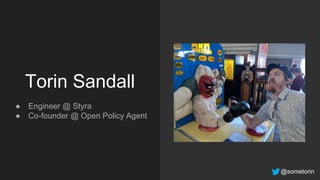
Torin Sandall
● Engineer @ Styra
● Co-founder @ Open Policy Agent
@sometorin
"Undifferentiated Heavy Lifting"
- Jeff Bezos (Amazon CEO, 2006)
@sometorin
Authorization is heavy lifting.
@sometorin
...but every app needs authorization.
@sometorin
Rethink how you implement authorization.
@sometorin
Ship secure projects faster.
@sometorin
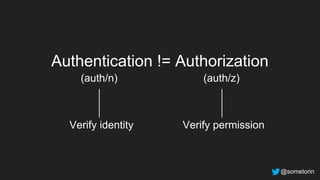
Authentication != Authorization
Verify identity Verify permission
(auth/n) (auth/z)
@sometorin
Authentication standards
{
"iss": https://example.com
"sub": bob
"aud": retail
"nbf": 123456789,
"exp": 123456789,
"amr": ["password", "otp"]
}
<saml:Assertion>
<saml:Subject>
<saml:NameID abcdef>
</saml:NameID>
<saml:SubjectConfirmation
Method="urn:...:bearer">
<saml:SubjectConfirmation
Data NotOnOrAfter=../>
</saml:SubjectConfirmation>
<saml:Conditions>...
spiffe://acmecorp/a/b/c
SAML OpenID Connect SPIFFE
Enterprise Consumer Infrastructure
@sometorin
Authentication verifies identity & produces attributes.
Human
Machine
Authentication Verified Identity
{
iss: acmecorp
sub: bob
aud: retail
nbf: 123456789
exp: 123456789
amr: [
password
otp
]
}
credentials
@sometorin@sometorin
Attribute
semantics are
beyond the
scope of the
specification.
### 2.2. Path
The path component of a SPIFFE ID allows for the
unique identification of a given workload. The
meaning behind the path is left open ended and the
responsibility of the administrator to define.
Paths MAY be hierarchical - similar to filesystem
paths. The specific meaning of paths is reserved as
an exercise to the implementer and are outside the
SVID specification. However some examples and
conventions are expressed below.
2. ID Token [...]
The definition of particular values to be used in the amr
Claim is beyond the scope of this specification. Parties
using this claim will need to agree upon the meanings of
the values used, which may be context-specific. [...]
ID Tokens MAY contain other Claims.
@sometorin
App must decide how identity attributes
map to functionality, privileges, etc.
@sometorin@sometorin
What about OAuth?
RFC 6749
The OAuth 2.0 Authorization Framework
Abstract
The OAuth 2.0 authorization framework enables a
third-party application to obtain limited access to
an HTTP service, either on behalf of a resource owner
by orchestrating an approval interaction between the
resource owner and the HTTP service, or by allowing
the third-party application to obtain access on its
own behalf.
@sometorin@sometorin
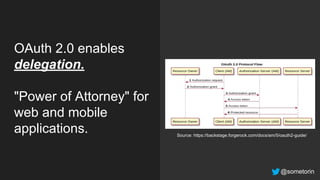
OAuth 2.0 enables
delegation.
"Power of Attorney" for
web and mobile
applications. Source: https://backstage.forgerock.com/docs/am/5/oauth2-guide/
@sometorin@sometorin
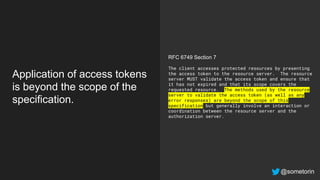
Application of access tokens
is beyond the scope of the
specification.
RFC 6749 Section 7
The client accesses protected resources by presenting
the access token to the resource server. The resource
server MUST validate the access token and ensure that
it has not expired and that its scope covers the
requested resource. The methods used by the resource
server to validate the access token (as well as any
error responses) are beyond the scope of this
specification but generally involve an interaction or
coordination between the resource server and the
authorization server.
@sometorin
How does the app decide what to do
with incoming requests, identity
attributes, and access tokens?
@sometorin
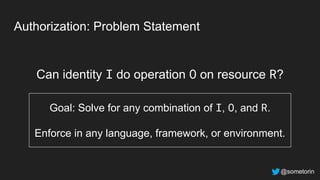
Can identity I do operation O on resource R?
Authorization: Problem Statement
@sometorin
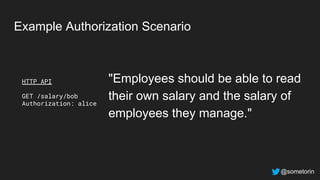
Example Authorization Scenario
"Employees should be able to read
their own salary and the salary of
employees they manage."
HTTP API
GET /salary/bob
Authorization: alice
@sometorin
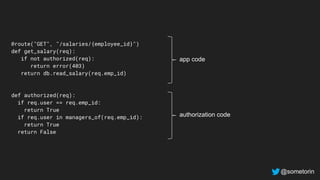
@route("GET", "/salaries/{employee_id}")
def get_salary(req):
if not authorized(req):
return error(403)
return db.read_salary(req.emp_id)
def authorized(req):
if req.user == req.emp_id:
return True
if req.user in managers_of(req.emp_id):
return True
return False
app code
authorization code
@sometorin
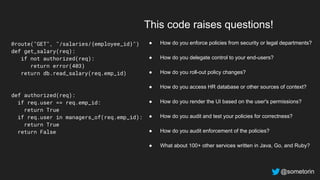
@route("GET", "/salaries/{employee_id}")
def get_salary(req):
if not authorized(req):
return error(403)
return db.read_salary(req.emp_id)
def authorized(req):
if req.user == req.emp_id:
return True
if req.user in managers_of(req.emp_id):
return True
return False
This code raises questions!
● How do you enforce policies from security or legal departments?
● How do you delegate control to your end-users?
● How do you roll-out policy changes?
● How do you access HR database or other sources of context?
● How do you render the UI based on the user's permissions?
● How do you audit and test your policies for correctness?
● How do you audit enforcement of the policies?
● What about 100+ other services written in Java, Go, and Ruby?
@sometorin
Can identity I do operation O on resource R?
Authorization: Problem Statement
Goal: Solve for any combination of I, O, and R.
Enforce in any language, framework, or environment.
@sometorin
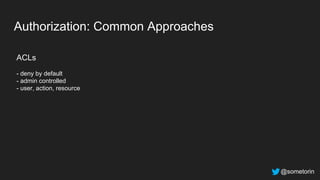
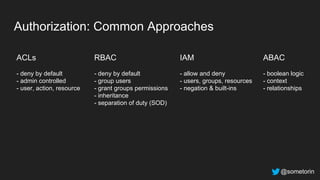
Authorization: Common Approaches
ACLs
- deny by default
- admin controlled
- user, action, resource
@sometorin
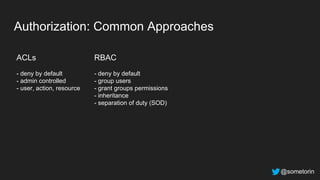
RBAC
- deny by default
- group users
- grant groups permissions
- inheritance
- separation of duty (SOD)
Authorization: Common Approaches
ACLs
- deny by default
- admin controlled
- user, action, resource
@sometorin
RBAC
- deny by default
- group users
- grant groups permissions
- inheritance
- separation of duty (SOD)
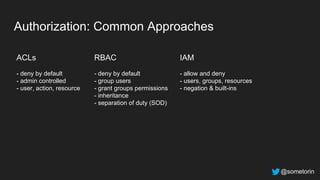
Authorization: Common Approaches
IAM
- allow and deny
- users, groups, resources
- negation & built-ins
ACLs
- deny by default
- admin controlled
- user, action, resource
@sometorin
RBAC
- deny by default
- group users
- grant groups permissions
- inheritance
- separation of duty (SOD)
Authorization: Common Approaches
IAM
- allow and deny
- users, groups, resources
- negation & built-ins
ACLs
- deny by default
- admin controlled
- user, action, resource
ABAC
- boolean logic
- context
- relationships
@sometorin
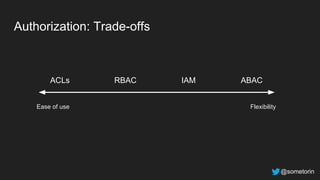
Authorization: Trade-offs
ACLs RBAC IAM ABAC
Ease of use Flexibility
@sometorin
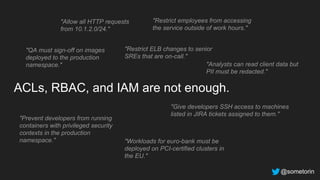
ACLs, RBAC, and IAM are not enough.
"QA must sign-off on images
deployed to the production
namespace." "Analysts can read client data but
PII must be redacted."
"Restrict employees from accessing
the service outside of work hours."
"Allow all HTTP requests
from 10.1.2.0/24."
"Restrict ELB changes to senior
SREs that are on-call."
"Give developers SSH access to machines
listed in JIRA tickets assigned to them."
"Prevent developers from running
containers with privileged security
contexts in the production
namespace." "Workloads for euro-bank must be
deployed on PCI-certified clusters in
the EU."
@sometorin
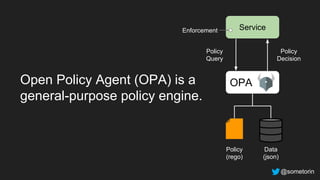
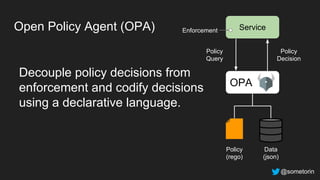
Open Policy Agent (OPA) is a
general-purpose policy engine.
Service
OPA
Policy
(rego)
Data
(json)
Policy
Query
Policy
Decision
Enforcement
@sometorin
Service
OPA
Policy
(rego)
Data
(json)
Policy
Query
Policy
Decision
Enforcement
Decouple policy decisions from
enforcement and codify decisions
using a declarative language.
Open Policy Agent (OPA)
@sometorin
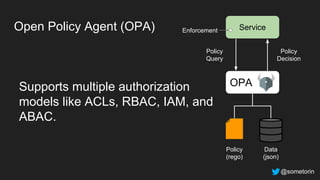
Open Policy Agent (OPA) Service
OPA
Policy
(rego)
Data
(json)
Policy
Query
Policy
Decision
Enforcement
Supports multiple authorization
models like ACLs, RBAC, IAM, and
ABAC.
@sometorin
Demo
@sometorin
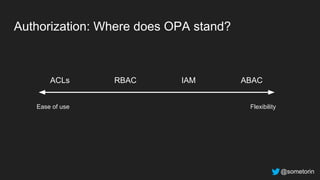
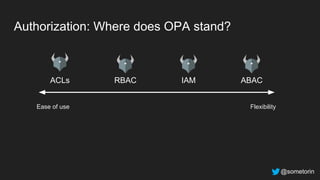
Authorization: Where does OPA stand?
ACLs RBAC IAM ABAC
Ease of use Flexibility
@sometorin
Authorization: Where does OPA stand?
ACLs RBAC IAM ABAC
Ease of use Flexibility
@sometorin
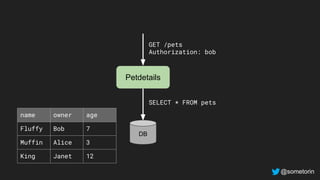
Petdetails
GET /pets
Authorization: bob
SELECT * FROM pets
DB
name owner age
Fluffy Bob 7
Muffin Alice 3
King Janet 12
@sometorin
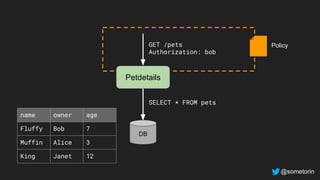
Petdetails
GET /pets
Authorization: bob
SELECT * FROM pets
DB
Policy
name owner age
Fluffy Bob 7
Muffin Alice 3
King Janet 12
@sometorin
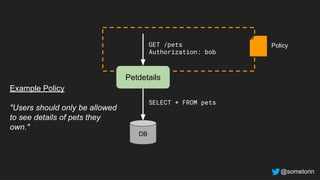
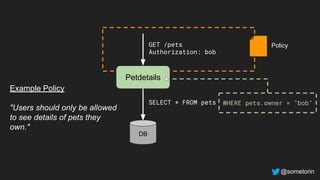
Petdetails
GET /pets
Authorization: bob
SELECT * FROM pets
DB
Policy
Example Policy
"Users should only be allowed
to see details of pets they
own."
@sometorin
SELECT * FROM pets
Petdetails
GET /pets
Authorization: bob
DB
Policy
WHERE pets.owner = "bob"
Example Policy
"Users should only be allowed
to see details of pets they
own."
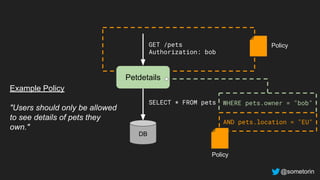
@sometorin
SELECT * FROM pets
Petdetails
GET /pets
Authorization: bob
DB
Policy
WHERE pets.owner = "bob"
AND pets.location = "EU"
Policy
Example Policy
"Users should only be allowed
to see details of pets they
own."
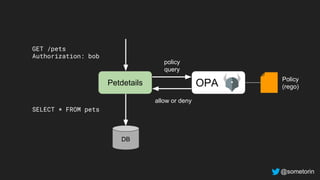
@sometorin
Petdetails OPA
policy
query
allow or deny
DB
GET /pets
Authorization: bob
SELECT * FROM pets
Policy
(rego)
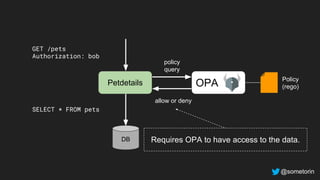
@sometorin
Petdetails OPA
allow or deny
DB Requires OPA to have access to the data.
GET /pets
Authorization: bob
SELECT * FROM pets
policy
query
Policy
(rego)
@sometorin
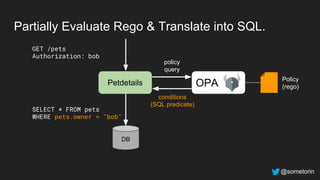
Petdetails OPA
conditions
(SQL predicate)
DB
GET /pets
Authorization: bob
SELECT * FROM pets
WHERE pets.owner = "bob"
policy
query
Policy
(rego)
Partially Evaluate Rego & Translate into SQL.
@sometorin
Demo
@sometorin
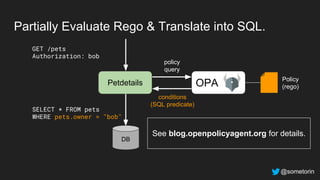
Petdetails OPA
conditions
(SQL predicate)
DB
GET /pets
Authorization: bob
SELECT * FROM pets
WHERE pets.owner = "bob"
policy
query
Policy
(rego)
Partially Evaluate Rego & Translate into SQL.
See blog.openpolicyagent.org for details.
@sometorin
Authorization is heavy lifting.
@sometorin@sometorin
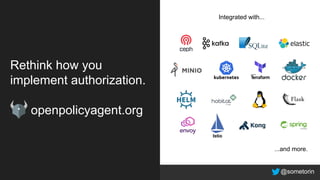
Rethink how you
implement authorization.
openpolicyagent.org
Integrated with...
...and more.
@sometorin
Thank you!
open-policy-agent/opa
slack.openpolicyagent.org
tsandall/kubecon-shanghai-2018

Implementing Authorization