YEARLY SCHEME OF WORK
ENGLISH YEAR 2
HISYAMUDDIN SUHAILI
SK KAMPUNG BUDA
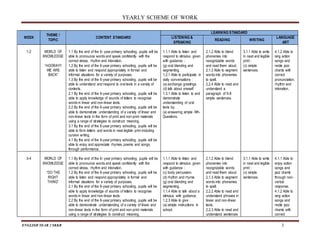
YEARLY SCHEME OF WORK
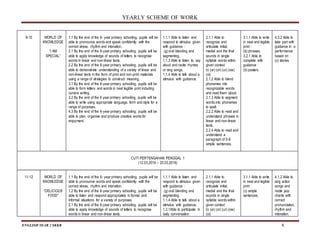
ENGLISH YEAR 2 SKKB 1
WEEK
THEME /
TOPIC
CONTENT STANDARD
LEARNING STANDARD
LISTENING &
SPEAKING
READING WRITING
LANGUAGE
ART
1-2 WORLD OF
KNOWLEDGE
“HOORAY!!
WE ARE
BACK”
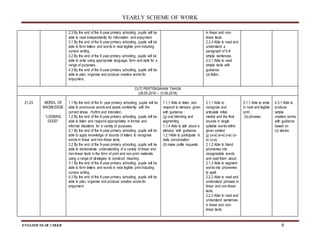
1.1 By the end of the 6- year primary schooling, pupils will be
able to pronounce words and speak confidently with the
correct stress, rhythm and intonation.
1.2 By the end of the 6-year primary schooling, pupils will be
able to listen and respond appropriately in formal and
informal situations for a variety of purposes.
1.3 By the end of the 6-year primary schooling, pupils will be
able to understand and respond to oral texts in a variety of
contexts.
2.1 By the end of the 6-year primary schooling, pupils will be
able to apply knowledge of sounds of letters to recognise
words in linear and non-linear texts.
2.2 By the end of the 6-year primary schooling, pupils will be
able to demonstrate understanding of a variety of linear and
non-linear texts in the form of print and non-print materials
using a range of strategies to construct meaning.
3.1 By the end of the 6-year primary schooling, pupils will be
able to form letters and words in neat legible print including
cursive writing.
4.1 By the end of the 6-year primary schooling, pupils will be
able to enjoy and appreciate rhymes, poems and songs,
through performance.
1.1.1 Able to listen and
respond to stimulus given
with guidance :
(g) oral blending and
segmenting.
1.2.1 Able to participate in
daily conversations :
(a) exchange greetings
(d) talk about oneself
1.3.1 Able to listen to and
demonstrate
understanding of oral
texts by:
(a) answering simple Wh-
Questions.
2.1.2 Able to blend
phonemes into
recognizable words
and read them aloud.
2.1.3 Able to segment
words into phonemes
to spell.
2.2.4 Able to read and
understand a
paragraph of 5-8
simple sentences.
3.1.1 Able to write
in neat and legible
print :
(c) simple
sentences.
4.1.2 Able to
sing action
songs and
recite jazz
chants with
correct
pronunciation,
rhythm and
intonation.
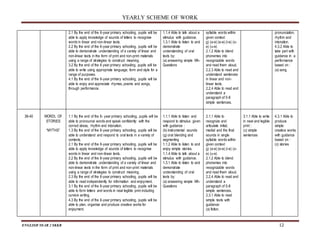
3-4 WORLD OF
KNOWLEDGE
“DO THE
RIGHT
THING”
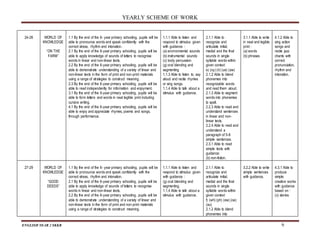
1.1 By the end of the 6- year primary schooling, pupils will be
able to pronounce words and speak confidently with the
correct stress, rhythm and intonation.
1.2 By the end of the 6-year primary schooling, pupils will be
able to listen and respond appropriately in formal and
informal situations for a variety of purposes.
2.1 By the end of the 6-year primary schooling, pupils will be
able to apply knowledge of sounds of letters to recognise
words in linear and non-linear texts.
2.2 By the end of the 6-year primary schooling, pupils will be
able to demonstrate understanding of a variety of linear and
non-linear texts in the form of print and non-print materials
using a range of strategies to construct meaning.
1.1.1 Able to listen and
respond to stimulus given
with guidance :
(c) body percussion.
(d) rhythm and rhyme.
(g) oral blending and
segmenting.
1.1.4 Able to talk about a
stimulus with guidance.
1.2.3 Able to give :
(a) simple instructions in
school.
2.1.2 Able to blend
phonemes into
recognizable words
and read them aloud.
2.1.3 Able to segment
words into phonemes
to spell.
2.2.2 Able to read and
understand phrases in
linear and non-linear
texts.
2.2.3 Able to read and
understand sentences
3.1.1 Able to write
in neat and legible
print :
(c) simple
sentences.
4.1.1 Able to
enjoy action
songs and
jazz chants
through non-
verbal
response.
4.1.2 Able to
sing action
songs and
recite jazz
chants with
correct
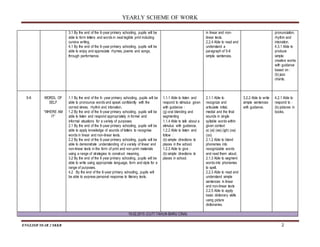
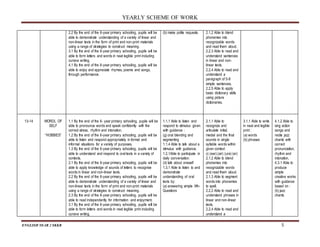
YEARLY SCHEME OF WORK
ENGLISH YEAR 2 SKKB 2
3.1 By the end of the 6-year primary schooling, pupils will be
able to form letters and words in neat legible print including
cursive writing.
4.1 By the end of the 6-year primary schooling, pupils will be
able to enjoy and appreciate rhymes, poems and songs,
through performance.
in linear and non-
linear texts.
2.2.4 Able to read and
understand a
paragraph of 5-8
simple sentences.
pronunciation,
rhythm and
intonation.
4.3.1 Able to
produce
simple
creative works
with guidance
based on :
(b) jazz
chants.
5-6 WORDL OF
SELF
“WHERE AM
I?”
1.1 By the end of the 6- year primary schooling, pupils will be
able to pronounce words and speak confidently with the
correct stress, rhythm and intonation.
1.2 By the end of the 6-year primary schooling, pupils will be
able to listen and respond appropriately in formal and
informal situations for a variety of purposes.
2.1 By the end of the 6-year primary schooling, pupils will be
able to apply knowledge of sounds of letters to recognise
words in linear and non-linear texts.
2.2 By the end of the 6-year primary schooling, pupils will be
able to demonstrate understanding of a variety of linear and
non-linear texts in the form of print and non-print materials
using a range of strategies to construct meaning.
3.2 By the end of the 6 year primary schooling, pupils will be
able to write using appropriate language, form and style for a
range of purposes.
4.2 By the end of the 6-year primary schooling, pupils will
be able to express personal response to literary texts.
1.1.1 Able to listen and
respond to stimulus given
with guidance :
(g) oral blending and
segmenting
1.1.4 Able to talk about a
stimulus with guidance.
1.2.2 Able to listen and
follow :
(b) simple directions to
places in the school.
1.2.3 Able to give :
(b) simple directions to
places in school.
2.1.1 Able to
recognize and
articulate initial,
medial and the final
sounds in single
syllable words within
given context
a) (ai) (ee) (igh) (oa)
(oo)
2.1.2 Able to blend
phonemes into
recognizable words
and read them aloud.
2.1.3 Able to segment
words into phonemes
to spell.
2.2.3 Able to read and
understand simple
sentences in linear
and non-linear texts
2.2.5 Able to apply
basic dictionary skills
using picture
dictionaries.
3.2.2 Able to write
simple sentences
with guidance.
4.2.1 Able to
respond to :
(b) pictures in
books.
19.02.2015 (CUTI TAHUN BARU CINA)
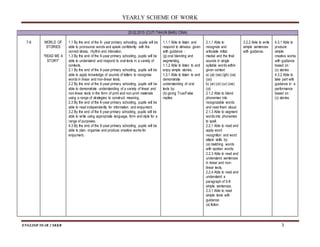
YEARLY SCHEME OF WORK
ENGLISH YEAR 2 SKKB 3
20.02.2015 (CUTI TAHUN BARU CINA)
7-8 WORLD OF
STORIES
“READ ME A
STORY”
1.1 By the end of the 6- year primary schooling, pupils will be
able to pronounce words and speak confidently with the
correct stress, rhythm and intonation.
1.3 By the end of the 6-year primary schooling, pupils will be
able to understand and respond to oral texts in a variety of
contexts.
2.1 By the end of the 6-year primary schooling, pupils will be
able to apply knowledge of sounds of letters to recognise
words in linear and non-linear texts.
2.2 By the end of the 6-year primary schooling, pupils will be
able to demonstrate understanding of a variety of linear and
non-linear texts in the form of print and non-print materials
using a range of strategies to construct meaning.
2.3 By the end of the 6-year primary schooling, pupils will be
able to read independently for information and enjoyment.
3.2 By the end of the 6 year primary schooling, pupils will be
able to write using appropriate language, form and style for a
range of purposes.
4.3 By the end of the 6-year primary schooling, pupils will be
able to plan, organise and produce creative works for
enjoyment.
1.1.1 Able to listen and
respond to stimulus given
with guidance :
(g) oral blending and
segmenting.
1.1.2 Able to listen to and
enjoy simple stories.
1.3.1 Able to listen to and
demonstrate
understanding of oral
texts by:
(b) giving True/False
replies
2.1.1 Able to
recognize and
articulate initial,
medial and the final
sounds in single
syllable words within
given context
a) (ai) (ee) (igh) (oa)
(oo)
b) (ar) (or) (ur) (ow)
(oi)
2.1.2 Able to blend
phonemes into
recognizable words
and read them aloud.
2.1.3 Able to segment
words into phonemes
to spell.
2.2.1 Able to read and
apply word
recognition and word
attack skills by:
(a) matching words
with spoken words.
2.2.3 Able to read and
understand sentences
in linear and non-
linear texts.
2.2.4 Able to read and
understand a
paragraph of 5-8
simple sentences.
2.3.1 Able to read
simple texts with
guidance:
(a) fiction.
3.2.2 Able to write
simple sentences
with guidance.
4.3.1 Able to
produce
simple
creative works
with guidance
based on :
(c) stories
4.3.2 Able to
take part with
guidance in a
performance
based on :
(c) stories.
YEARLY SCHEME OF WORK
ENGLISH YEAR 2 SKKB 4
9-10 WORLD OF
KNOWLEDGE
“I AM
SPECIAL”
1.1 By the end of the 6- year primary schooling, pupils will be
able to pronounce words and speak confidently with the
correct stress, rhythm and intonation.
2.1 By the end of the 6-year primary schooling, pupils will be
able to apply knowledge of sounds of letters to recognise
words in linear and non-linear texts.
2.2 By the end of the 6-year primary schooling, pupils will be
able to demonstrate understanding of a variety of linear and
non-linear texts in the form of print and non-print materials
using a range of strategies to construct meaning.
3.1 By the end of the 6-year primary schooling, pupils will be
able to form letters and words in neat legible print including
cursive writing.
3.2 By the end of the 6 year primary schooling, pupils will be
able to write using appropriate language, form and style for a
range of purposes.
4.3 By the end of the 6-year primary schooling, pupils will be
able to plan, organise and produce creative works for
enjoyment.
1.1.1 Able to listen and
respond to stimulus given
with guidance :
(g) oral blending and
segmenting.
1.1.3 Able to listen to, say
aloud and recite rhymes
or sing songs.
1.1.4 Able to talk about a
stimulus with guidance.
2.1.1 Able to
recognize and
articulate initial,
medial and the final
sounds in single
syllable words within
given context
b) (ar) (or) (ur) (ow)
(oi)
2.1.2 Able to blend
phonemes into
recognizable words
and read them aloud.
2.1.3 Able to segment
words into phonemes
to spell.
2.2.2 Able to read and
understand phrases in
linear and non-linear
texts.
2.2.4 Able to read and
understand a
paragraph of 5-8
simple sentences.
3.1.1 Able to write
in neat and legible
print :
(b) phrases.
3.2.1 Able to
complete with
guidance :
(b) posters
4.3.2 Able to
take part with
guidance in a
performance
based on :
(c) stories.
CUTI PERTENGAHAN PENGGAL 1
(12.03.2016 – 20.03.2016)
11-12 WORLD OF
KNOWLEDGE
“DELICIOUS
FOOD”
1.1 By the end of the 6- year primary schooling, pupils will be
able to pronounce words and speak confidently with the
correct stress, rhythm and intonation.
1.2 By the end of the 6-year primary schooling, pupils will be
able to listen and respond appropriately in formal and
informal situations for a variety of purposes.
2.1 By the end of the 6-year primary schooling, pupils will be
able to apply knowledge of sounds of letters to recognise
words in linear and non-linear texts.
1.1.1 Able to listen and
respond to stimulus given
with guidance :
(g) oral blending and
segmenting.
1.1.4 Able to talk about a
stimulus with guidance.
1.2.1Able to participate in
daily conversation:
2.1.1 Able to
recognize and
articulate initial,
medial and the final
sounds in single
syllable words within
given context
b) (ar) (or) (ur) (ow)
(oi)
3.1.1 Able to write
in neat and legible
print :
(c) simple
sentences.
4.1.2 Able to
sing action
songs and
recite jazz
chants with
correct
pronunciation,
rhythm and
intonation.
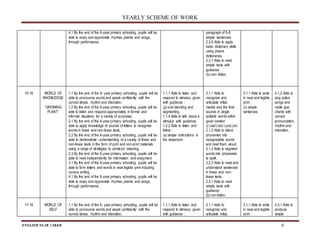
YEARLY SCHEME OF WORK
ENGLISH YEAR 2 SKKB 5
2.2 By the end of the 6-year primary schooling, pupils will be
able to demonstrate understanding of a variety of linear and
non-linear texts in the form of print and non-print materials
using a range of strategies to construct meaning.
3.1 By the end of the 6-year primary schooling, pupils will be
able to form letters and words in neat legible print including
cursive writing.
4.1 By the end of the 6-year primary schooling, pupils will be
able to enjoy and appreciate rhymes, poems and songs,
through performance.
(b) make polite requests. 2.1.2 Able to blend
phonemes into
recognizable words
and read them aloud.
2.2.3 Able to read and
understand sentences
in linear and non-
linear texts.
2.2.4 Able to read and
understand a
paragraph of 5-8
simple sentences.
2.2.5 Able to apply
basic dictionary skills
using picture
dictionaries.
13-14 WORDL OF
SELF
“HOBBIES”
1.1 By the end of the 6- year primary schooling, pupils will be
able to pronounce words and speak confidently with the
correct stress, rhythm and intonation.
1.2 By the end of the 6-year primary schooling, pupils will be
able to listen and respond appropriately in formal and
informal situations for a variety of purposes.
1.3 By the end of the 6-year primary schooling, pupils will be
able to understand and respond to oral texts in a variety of
contexts.
2.1 By the end of the 6-year primary schooling, pupils will be
able to apply knowledge of sounds of letters to recognise
words in linear and non-linear texts.
2.2 By the end of the 6-year primary schooling, pupils will be
able to demonstrate understanding of a variety of linear and
non-linear texts in the form of print and non-print materials
using a range of strategies to construct meaning.
2.3 By the end of the 6-year primary schooling, pupils will be
able to read independently for information and enjoyment.
3.1 By the end of the 6-year primary schooling, pupils will be
able to form letters and words in neat legible print including
cursive writing.
1.1.1 Able to listen and
respond to stimulus given
with guidance :
(g) oral blending and
segmenting
1.1.4 Able to talk about a
stimulus with guidance.
1.2.1Able to participate in
daily conversation:
(d) talk about oneself
1.3.1 Able to listen to and
demonstrate
understanding of oral
texts by:
(a) answering simple Wh-
Questions
2.1.1 Able to
recognize and
articulate initial,
medial and the final
sounds in single
syllable words within
given context
c) (ear) (air) (ure) (er)
2.1.2 Able to blend
phonemes into
recognizable words
and read them aloud.
2.1.3 Able to segment
words into phonemes
to spell.
2.2.2 Able to read and
understand phrases in
linear and non-linear
texts.
2.2.4 Able to read and
understand a
3.1.1 Able to write
in neat and legible
print :
(a) words
(b) phrases
4.1.2 Able to
sing action
songs and
recite jazz
chants with
correct
pronunciation,
rhythm and
intonation.
4.3.1 Able to
produce
simple
creative works
with guidance
based on :
(b) jazz
chants
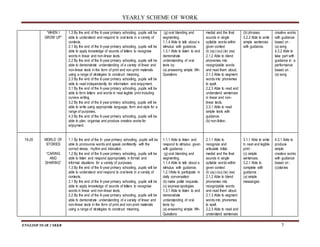
YEARLY SCHEME OF WORK
ENGLISH YEAR 2 SKKB 6
4.1 By the end of the 6-year primary schooling, pupils will be
able to enjoy and appreciate rhymes, poems and songs,
through performance.
paragraph of 5-8
simple sentences.
2.2.5 Able to apply
basic dictionary skills
using picture
dictionaries.
2.3.1 Able to read
simple texts with
guidance:
(b) non- fiction.
15-16 WORLD OF
KNOWLEDGE
“GROWING
PLANT”
1.1 By the end of the 6- year primary schooling, pupils will be
able to pronounce words and speak confidently with the
correct stress, rhythm and intonation.
1.2 By the end of the 6-year primary schooling, pupils will be
able to listen and respond appropriately in formal and
informal situations for a variety of purposes.
2.1 By the end of the 6-year primary schooling, pupils will be
able to apply knowledge of sounds of letters to recognise
words in linear and non-linear texts.
2.2 By the end of the 6-year primary schooling, pupils will be
able to demonstrate understanding of a variety of linear and
non-linear texts in the form of print and non-print materials
using a range of strategies to construct meaning.
2.3 By the end of the 6-year primary schooling, pupils will be
able to read independently for information and enjoyment.
3.1 By the end of the 6-year primary schooling, pupils will be
able to form letters and words in neat legible print including
cursive writing.
4.1 By the end of the 6-year primary schooling, pupils will be
able to enjoy and appreciate rhymes, poems and songs,
through performance.
1.1.1 Able to listen and
respond to stimulus given
with guidance :
(g) oral blending and
segmenting.
1.1.4 Able to talk about a
stimulus with guidance.
1.2.2 Able to listen and
follow :
(a) simple instructions in
the classroom.
2.1.1 Able to
recognize and
articulate initial,
medial and the final
sounds in single
syllable words within
given context
c) (ear) (air) (ure) (er)
2.1.2 Able to blend
phonemes into
recognizable words
and read them aloud.
2.1.3 Able to segment
words into phonemes
to spell.
2.2.3 Able to read and
understand sentences
in linear and non-
linear texts.
2.3.1 Able to read
simple texts with
guidance:
(b) non-fiction.
3.1.1 Able to write
in neat and legible
print :
(c) simple
sentences
4.1.2 Able to
sing action
songs and
recite jazz
chants with
correct
pronunciation,
rhythm and
intonation.
17-18 WORLD OF
SELF
1.1 By the end of the 6- year primary schooling, pupils will be
able to pronounce words and speak confidently with the
correct stress, rhythm and intonation.
1.1.1 Able to listen and
respond to stimulus given
with guidance :
2.1.1 Able to
recognize and
articulate initial,
3.1.1 Able to write
in neat and legible
print :
4.3.1 Able to
produce
simple
YEARLY SCHEME OF WORK
ENGLISH YEAR 2 SKKB 7
“WHEN I
GROW UP”
1.3 By the end of the 6-year primary schooling, pupils will be
able to understand and respond to oral texts in a variety of
contexts.
2.1 By the end of the 6-year primary schooling, pupils will be
able to apply knowledge of sounds of letters to recognise
words in linear and non-linear texts.
2.2 By the end of the 6-year primary schooling, pupils will be
able to demonstrate understanding of a variety of linear and
non-linear texts in the form of print and non-print materials
using a range of strategies to construct meaning.
2.3 By the end of the 6-year primary schooling, pupils will be
able to read independently for information and enjoyment.
3.1 By the end of the 6-year primary schooling, pupils will be
able to form letters and words in neat legible print including
cursive writing.
3.2 By the end of the 6 year primary schooling, pupils will be
able to write using appropriate language, form and style for a
range of purposes.
4.3 By the end of the 6-year primary schooling, pupils will be
able to plan, organise and produce creative works for
enjoyment.
(g) oral blending and
segmenting.
1.1.4 Able to talk about a
stimulus with guidance.
1.3.1 Able to listen to and
demonstrate
understanding of oral
texts by:
(a) answering simple Wh-
Questions
medial and the final
sounds in single
syllable words within
given context
d) (ay) (ou) (ie) (ea)
2.1.2 Able to blend
phonemes into
recognizable words
and read them aloud.
2.1.3 Able to segment
words into phonemes
to spell.
2.2.3 Able to read and
understand sentences
in linear and non-
linear texts.
2.3.1 Able to read
simple texts with
guidance:
(b) non-fiction.
(b) phrases
3.2.2 Able to write
simple sentences
with guidance.
creative works
with guidance
based on :
(a) song
4.3.2 Able to
take part with
guidance in a
performance
based on :
(a) song
19-20 WORLD OF
STORIES
“CARING
AND
SHARING”
1.1 By the end of the 6- year primary schooling, pupils will be
able to pronounce words and speak confidently with the
correct stress, rhythm and intonation.
1.2 By the end of the 6-year primary schooling, pupils will be
able to listen and respond appropriately in formal and
informal situations for a variety of purposes.
1.3 By the end of the 6-year primary schooling, pupils will be
able to understand and respond to oral texts in a variety of
contexts.
2.1 By the end of the 6-year primary schooling, pupils will be
able to apply knowledge of sounds of letters to recognise
words in linear and non-linear texts.
2.2 By the end of the 6-year primary schooling, pupils will be
able to demonstrate understanding of a variety of linear and
non-linear texts in the form of print and non-print materials
using a range of strategies to construct meaning.
1.1.1 Able to listen and
respond to stimulus given
with guidance :
(g) oral blending and
segmenting.
1.1.4 Able to talk about a
stimulus with guidance.
1.2.1Able to participate in
daily conversation:
(b) make polite requests.
(c) express apologies
1.3.1 Able to listen to and
demonstrate
understanding of oral
texts by:
(a) answering simple Wh-
Questions
2.1.1 Able to
recognize and
articulate initial,
medial and the final
sounds in single
syllable words within
given context
d) (ay) (ou) (ie) (ea)
2.1.2 Able to blend
phonemes into
recognizable words
and read them aloud.
2.1.3 Able to segment
words into phonemes
to spell.
2.2.3 Able to read and
understand sentences
3.1.1 Able to write
in neat and legible
print :
(c) simple
sentences.
3.2.1 Able to
complete with
guidance :
(a) simple
messanges
4.3.1 Able to
produce
simple
creative works
with guidance
based on :
(c)stories
YEARLY SCHEME OF WORK
ENGLISH YEAR 2 SKKB 8
2.3 By the end of the 6-year primary schooling, pupils will be
able to read independently for information and enjoyment.
3.1 By the end of the 6-year primary schooling, pupils will be
able to form letters and words in neat legible print including
cursive writing.
3.2 By the end of the 6 year primary schooling, pupils will be
able to write using appropriate language, form and style for a
range of purposes.
4.3 By the end of the 6-year primary schooling, pupils will be
able to plan, organise and produce creative works for
enjoyment.
in linear and non-
linear texts.
2.2.4 Able to read and
understand a
paragraph of 5-8
simple sentences.
2.3.1 Able to read
simple texts with
guidance:
(a) fiction.
CUTI PERTENGAHAN TAHUN
(28.05.2016 – 12.06.2016)
21-23 WORDL OF
KNOWLEDGE
“LOOKING
GOOD”
1.1 By the end of the 6- year primary schooling, pupils will be
able to pronounce words and speak confidently with the
correct stress, rhythm and intonation.
1.2 By the end of the 6-year primary schooling, pupils will be
able to listen and respond appropriately in formal and
informal situations for a variety of purposes.
2.1 By the end of the 6-year primary schooling, pupils will be
able to apply knowledge of sounds of letters to recognise
words in linear and non-linear texts.
2.2 By the end of the 6-year primary schooling, pupils will be
able to demonstrate understanding of a variety of linear and
non-linear texts in the form of print and non-print materials
using a range of strategies to construct meaning.
3.1 By the end of the 6-year primary schooling, pupils will be
able to form letters and words in neat legible print including
cursive writing.
4.3 By the end of the 6-year primary schooling, pupils will be
able to plan, organise and produce creative works for
enjoyment.
1.1.1 Able to listen and
respond to stimulus given
with guidance :
(g) oral blending and
segmenting
1.1.4 Able to talk about a
stimulus with guidance.
1.2.1Able to participate in
daily conversation:
(b) make polite requests
2.1.1 Able to
recognize and
articulate initial,
medial and the final
sounds in single
syllable words within
given context
g) (a-e) (e-e) (i-e) (o-
e) (u-e)
2.1.2 Able to blend
phonemes into
recognizable words
and read them aloud.
2.1.3 Able to segment
words into phonemes
to spell.
2.2.2 Able to read and
understand phrases in
linear and non-linear
texts.
2.2.3 Able to read and
understand sentences
in linear and non-
linear texts.
3.1.1 Able to write
in neat and legible
print :
(b) phrases
4.3.1 Able to
produce
simple
creative works
with guidance
based on :
(c) stories
YEARLY SCHEME OF WORK
ENGLISH YEAR 2 SKKB 9
24-26 WORLD OF
KNOWLEDGE
“ON THE
FARM”
1.1 By the end of the 6- year primary schooling, pupils will be
able to pronounce words and speak confidently with the
correct stress, rhythm and intonation.
2.1 By the end of the 6-year primary schooling, pupils will be
able to apply knowledge of sounds of letters to recognise
words in linear and non-linear texts.
2.2 By the end of the 6-year primary schooling, pupils will be
able to demonstrate understanding of a variety of linear and
non-linear texts in the form of print and non-print materials
using a range of strategies to construct meaning.
2.3 By the end of the 6-year primary schooling, pupils will be
able to read independently for information and enjoyment.
3.1 By the end of the 6-year primary schooling, pupils will be
able to form letters and words in neat legible print including
cursive writing.
4.1 By the end of the 6-year primary schooling, pupils will be
able to enjoy and appreciate rhymes, poems and songs,
through performance.
1.1.1 Able to listen and
respond to stimulus given
with guidance :
(a) environmental sounds
(b) instrumental sounds
(c) body percussion
(g) oral blending and
segmenting
1.1.3 Able to listen to, say
aloud and recite rhymes
or sing songs.
1.1.4 Able to talk about a
stimulus with guidance.
2.1.1 Able to
recognize and
articulate initial,
medial and the final
sounds in single
syllable words within
given context
e) (oy) (ir) (ue) (aw)
2.1.2 Able to blend
phonemes into
recognizable words
and read them aloud.
2.1.3 Able to segment
words into phonemes
to spell.
2.2.3 Able to read and
understand sentences
in linear and non-
linear texts.
2.2.4 Able to read and
understand a
paragraph of 5-8
simple sentences.
2.3.1 Able to read
simple texts with
guidance:
(b) non-fiction.
3.1.1 Able to write
in neat and legible
print :
(a) words
(b) phrases
4.1.2 Able to
sing action
songs and
recite jazz
chants with
correct
pronunciation,
rhythm and
intonation.
27-29 WORLD OF
KNOWLEDGE
“GOOD
DEEDS”
1.1 By the end of the 6- year primary schooling, pupils will be
able to pronounce words and speak confidently with the
correct stress, rhythm and intonation.
2.1 By the end of the 6-year primary schooling, pupils will be
able to apply knowledge of sounds of letters to recognise
words in linear and non-linear texts.
2.2 By the end of the 6-year primary schooling, pupils will be
able to demonstrate understanding of a variety of linear and
non-linear texts in the form of print and non-print materials
using a range of strategies to construct meaning.
1.1.1 Able to listen and
respond to stimulus given
with guidance :
(g) oral blending and
segmenting.
1.1.4 Able to talk about a
stimulus with guidance.
2.1.1 Able to
recognize and
articulate initial,
medial and the final
sounds in single
syllable words within
given context
f) (wh) (ph) (ew) (oe)
(au)
2.1.2 Able to blend
phonemes into
3.2.2 Able to write
simple sentences
with guidance.
4.3.1 Able to
produce
simple
creative works
with guidance
based on :
(c) stories
YEARLY SCHEME OF WORK
ENGLISH YEAR 2 SKKB 10
2.3 By the end of the 6-year primary schooling, pupils will be
able to read independently for information and enjoyment.
3.2 By the end of the 6 year primary schooling, pupils will be
able to write using appropriate language, form and style for a
range of purposes.
4.3 By the end of the 6-year primary schooling, pupils will be
able to plan, organise and produce creative works for
enjoyment.
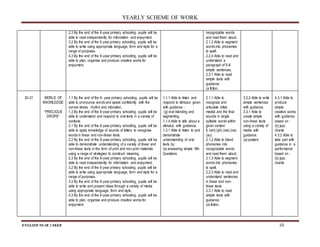
recognizable words
and read them aloud.
2.1.3 Able to segment
words into phonemes
to spell.
2.2.4 Able to read and
understand a
paragraph of 5-8
simple sentences.
2.3.1 Able to read
simple texts with
guidance:
(a fiction.
30-31 WORLD OF
KNOWLEDGE
“PRECIOUS
DROPS”
1.1 By the end of the 6- year primary schooling, pupils will be
able to pronounce words and speak confidently with the
correct stress, rhythm and intonation.
1.3 By the end of the 6-year primary schooling, pupils will be
able to understand and respond to oral texts in a variety of
contexts.
2.1 By the end of the 6-year primary schooling, pupils will be
able to apply knowledge of sounds of letters to recognise
words in linear and non-linear texts.
2.2 By the end of the 6-year primary schooling, pupils will be
able to demonstrate understanding of a variety of linear and
non-linear texts in the form of print and non-print materials
using a range of strategies to construct meaning.
2.3 By the end of the 6-year primary schooling, pupils will be
able to read independently for information and enjoyment.
3.2 By the end of the 6 year primary schooling, pupils will be
able to write using appropriate language, form and style for a
range of purposes.
3.3 By the end of the 6-year primary schooling, pupils will be
able to write and present ideas through a variety of media
using appropriate language, form and style.
4.3 By the end of the 6-year primary schooling, pupils will be
able to plan, organise and produce creative works for
enjoyment.
1.1.1 Able to listen and
respond to stimulus given
with guidance :
(g) oral blending and
segmenting.
1.1.4 Able to talk about a
stimulus with guidance.
1.3.1 Able to listen to and
demonstrate
understanding of oral
texts by:
(a) answering simple Wh-
Questions
2.1.1 Able to
recognize and
articulate initial,
medial and the final
sounds in single
syllable words within
given context
f) (wh) (ph) (ew) (oe)
(au)
2.1.2 Able to blend
phonemes into
recognizable words
and read them aloud.
2.1.3 Able to segment
words into phonemes
to spell.
2.2.3 Able to read and
understand sentences
in linear and non-
linear texts.
2.3.1 Able to read
simple texts with
guidance:
(a) fiction.
3.2.2 Able to write
simple sentences
with guidance.
3.3.1 Able to
create simple
non-linear texts
using a variety of
media with
guidance:
(a) posters
4.3.1 Able to
produce
simple
creative works
with guidance
based on :
(b) jazz
chants
4.3.2 Able to
take part with
guidance in a
performance
based on :
(b) jazz
chants
YEARLY SCHEME OF WORK
ENGLISH YEAR 2 SKKB 11
32-34 WORLD OF
KNOWLEDGE
“SAVE THE
SEA
CREATURE”
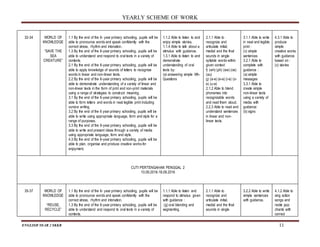
1.1 By the end of the 6- year primary schooling, pupils will be
able to pronounce words and speak confidently with the
correct stress, rhythm and intonation.
1.3 By the end of the 6-year primary schooling, pupils will be
able to understand and respond to oral texts in a variety of
contexts.
2.1 By the end of the 6-year primary schooling, pupils will be
able to apply knowledge of sounds of letters to recognise
words in linear and non-linear texts.
2.2 By the end of the 6-year primary schooling, pupils will be
able to demonstrate understanding of a variety of linear and
non-linear texts in the form of print and non-print materials
using a range of strategies to construct meaning.
3.1 By the end of the 6-year primary schooling, pupils will be
able to form letters and words in neat legible print including
cursive writing.
3.2 By the end of the 6 year primary schooling, pupils will be
able to write using appropriate language, form and style for a
range of purposes.
3.3 By the end of the 6-year primary schooling, pupils will be
able to write and present ideas through a variety of media
using appropriate language, form and style.
4.3 By the end of the 6-year primary schooling, pupils will be
able to plan, organise and produce creative works for
enjoyment.
1.1.2 Able to listen to and
enjoy simple stories.
1.1.4 Able to talk about a
stimulus with guidance.
1.3.1 Able to listen to and
demonstrate
understanding of oral
texts by:
(a) answering simple Wh-
Questions
2.1.1 Able to
recognize and
articulate initial,
medial and the final
sounds in single
syllable words within
given context
f) (wh) (ph) (ew) (oe)
(au)
g) (a-e) (e-e) (i-e) (o-
e) (u-e)
2.1.2 Able to blend
phonemes into
recognizable words
and read them aloud.
2.2.3 Able to read and
understand sentences
in linear and non-
linear texts.
3.1.1 Able to write
in neat and legible
print :
(c) simple
sentences
3.2.1 Able to
complete with
guidance :
(a) simple
messages
3.3.1 Able to
create simple
non-linear texts
using a variety of
media with
guidance:
(b) signs
4.3.1 Able to
produce
simple
creative works
with guidance
based on :
(c) stories
CUTI PERTENGAHAN PENGGAL 2
10.09.2016-18.09.2016
35-37 WORLD OF
KNOWLEDGE
“REUSE,
RECYCLE”
1.1 By the end of the 6- year primary schooling, pupils will be
able to pronounce words and speak confidently with the
correct stress, rhythm and intonation.
1.3 By the end of the 6-year primary schooling, pupils will be
able to understand and respond to oral texts in a variety of
contexts.
1.1.1 Able to listen and
respond to stimulus given
with guidance :
(g) oral blending and
segmenting.
2.1.1 Able to
recognize and
articulate initial,
medial and the final
sounds in single
3.2.2 Able to write
simple sentences
with guidance.
4.1.2 Able to
sing action
songs and
recite jazz
chants with
correct
YEARLY SCHEME OF WORK
ENGLISH YEAR 2 SKKB 12
2.1 By the end of the 6-year primary schooling, pupils will be
able to apply knowledge of sounds of letters to recognise
words in linear and non-linear texts.
2.2 By the end of the 6-year primary schooling, pupils will be
able to demonstrate understanding of a variety of linear and
non-linear texts in the form of print and non-print materials
using a range of strategies to construct meaning.
3.2 By the end of the 6 year primary schooling, pupils will be
able to write using appropriate language, form and style for a
range of purposes.
4.1 By the end of the 6-year primary schooling, pupils will be
able to enjoy and appreciate rhymes, poems and songs,
through performance.
1.1.4 Able to talk about a
stimulus with guidance.
1.3.1 Able to listen to and
demonstrate
understanding of oral
texts by:
(a) answering simple Wh-
Questions
syllable words within
given context
g) (a-e) (e-e) (i-e) (o-
e) (u-e)
2.1.2 Able to blend
phonemes into
recognizable words
and read them aloud.
2.2.3 Able to read and
understand sentences
in linear and non-
linear texts.
2.2.4 Able to read and
understand a
paragraph of 5-8
simple sentences.
pronunciation,
rhythm and
intonation.
4.3.2 Able to
take part with
guidance in a
performance
based on :
(a) song
38-40 WORDL OF
STORIES
“MYTHS”
1.1 By the end of the 6- year primary schooling, pupils will be
able to pronounce words and speak confidently with the
correct stress, rhythm and intonation.
1.3 By the end of the 6-year primary schooling, pupils will be
able to understand and respond to oral texts in a variety of
contexts.
2.1 By the end of the 6-year primary schooling, pupils will be
able to apply knowledge of sounds of letters to recognise
words in linear and non-linear texts.
2.2 By the end of the 6-year primary schooling, pupils will be
able to demonstrate understanding of a variety of linear and
non-linear texts in the form of print and non-print materials
using a range of strategies to construct meaning.
2.3 By the end of the 6-year primary schooling, pupils will be
able to read independently for information and enjoyment.
3.1 By the end of the 6-year primary schooling, pupils will be
able to form letters and words in neat legible print including
cursive writing.
4.3 By the end of the 6-year primary schooling, pupils will be
able to plan, organise and produce creative works for
enjoyment.
1.1.1 Able to listen and
respond to stimulus given
with guidance :
(b) instrumental sounds
(g) oral blending and
segmenting
1.1.2 Able to listen to and
enjoy simple stories.
1.1.4 Able to talk about a
stimulus with guidance.
1.3.1 Able to listen to and
demonstrate
understanding of oral
texts by:
(a) answering simple Wh-
Questions
2.1.1 Able to
recognize and
articulate initial,
medial and the final
sounds in single
syllable words within
given context
g) (a-e) (e-e) (i-e) (o-
e) (u-e)
2.1.2 Able to blend
phonemes into
recognizable words
and read them aloud.
2.2.4 Able to read and
understand a
paragraph of 5-8
simple sentences.
2.3.1 Able to read
simple texts with
guidance:
(a) fiction.
3.1.1 Able to write
in neat and legible
print :
(c) simple
sentences
4.3.1 Able to
produce
simple
creative works
with guidance
based on :
(c) stories
YEARLY SCHEME OF WORK
ENGLISH YEAR 2 SKKB 13
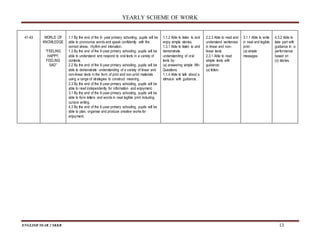
41-43 WORLD OF
KNOWLEDGE
“FEELING
HAPPY,
FEELING
SAD”
1.1 By the end of the 6- year primary schooling, pupils will be
able to pronounce words and speak confidently with the
correct stress, rhythm and intonation.
1.3 By the end of the 6-year primary schooling, pupils will be
able to understand and respond to oral texts in a variety of
contexts.
2.2 By the end of the 6-year primary schooling, pupils will be
able to demonstrate understanding of a variety of linear and
non-linear texts in the form of print and non-print materials
using a range of strategies to construct meaning.
2.3 By the end of the 6-year primary schooling, pupils will be
able to read independently for information and enjoyment.
3.1 By the end of the 6-year primary schooling, pupils will be
able to form letters and words in neat legible print including
cursive writing.
4.3 By the end of the 6-year primary schooling, pupils will be
able to plan, organise and produce creative works for
enjoyment.
1.1.2 Able to listen to and
enjoy simple stories.
1.3.1 Able to listen to and
demonstrate
understanding of oral
texts by:
(a) answering simple Wh-
Questions
1.1.4 Able to talk about a
stimulus with guidance.
2.2.3 Able to read and
understand sentences
in linear and non-
linear texts.
2.3.1 Able to read
simple texts with
guidance:
(a) fiction.
3.1.1 Able to write
in neat and legible
print :
(a) simple
messages
4.3.2 Able to
take part with
guidance in a
performance
based on :
(c) stories.
YEARLY SCHEME OF WORK
ENGLISH YEAR 2 SKKB 14
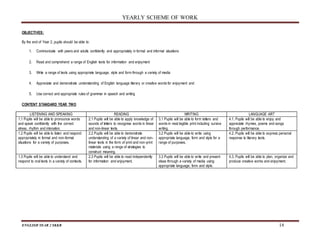
OBJECTIVES:
By the end of Year 2, pupils should be able to:
1. Communicate with peers and adults confidently and appropriately in formal and informal situations
2. Read and comprehend a range of English texts for information and enjoyment
3. Write a range of texts using appropriate language, style and form through a variety of media
4. Appreciate and demonstrate understanding of English language literary or creative words for enjoyment and
5. Use correct and appropriate rules of grammar in speech and writing
CONTENT STANDARD YEAR TWO
LISTENING AND SPEAKING READING WRITING LANGUAGE ART
1.1 Pupils will be able to pronounce words
and speak confidently with the correct
stress, rhythm and intonation.
2.1 Pupils will be able to apply knowledge of
sounds of letters to recognise words in linear
and non-linear texts.
3.1 Pupils will be able to form letters and
words in neat legible print including cursive
writing.
4.1. Pupils will be able to enjoy and
appreciate rhymes, poems and songs
through performance.
1.2 Pupils will be able to listen and respond
appropriately in formal and non-formal
situations for a variety of purposes.
2.2 Pupils will be able to demonstrate
understanding of a variety of linear and non-
linear texts in the form of print and non-print
materials using a range of strategies to
construct meaning.
3.2 Pupils will be able to write using
appropriate language, form and style for a
range of purposes.
4.2. Pupils will be able to express personal
response to literary texts.
1.3 Pupils will be able to understand and
respond to oral texts in a variety of contexts.
2.3 Pupils will be able to read independently
for information and enjoyment.
3.3 Pupils will be able to write and present
ideas through a variety of media using
appropriate language, form and style.
4.3. Pupils will be able to plan, organize and
produce creative works and enjoyment.

Rpt bi year 2 kssr

  • 1.
    YEARLY SCHEME OFWORK ENGLISH YEAR 2 HISYAMUDDIN SUHAILI SK KAMPUNG BUDA
  • 2.
    YEARLY SCHEME OFWORK ENGLISH YEAR 2 SKKB 1 WEEK THEME / TOPIC CONTENT STANDARD LEARNING STANDARD LISTENING & SPEAKING READING WRITING LANGUAGE ART 1-2 WORLD OF KNOWLEDGE “HOORAY!! WE ARE BACK” 1.1 By the end of the 6- year primary schooling, pupils will be able to pronounce words and speak confidently with the correct stress, rhythm and intonation. 1.2 By the end of the 6-year primary schooling, pupils will be able to listen and respond appropriately in formal and informal situations for a variety of purposes. 1.3 By the end of the 6-year primary schooling, pupils will be able to understand and respond to oral texts in a variety of contexts. 2.1 By the end of the 6-year primary schooling, pupils will be able to apply knowledge of sounds of letters to recognise words in linear and non-linear texts. 2.2 By the end of the 6-year primary schooling, pupils will be able to demonstrate understanding of a variety of linear and non-linear texts in the form of print and non-print materials using a range of strategies to construct meaning. 3.1 By the end of the 6-year primary schooling, pupils will be able to form letters and words in neat legible print including cursive writing. 4.1 By the end of the 6-year primary schooling, pupils will be able to enjoy and appreciate rhymes, poems and songs, through performance. 1.1.1 Able to listen and respond to stimulus given with guidance : (g) oral blending and segmenting. 1.2.1 Able to participate in daily conversations : (a) exchange greetings (d) talk about oneself 1.3.1 Able to listen to and demonstrate understanding of oral texts by: (a) answering simple Wh- Questions. 2.1.2 Able to blend phonemes into recognizable words and read them aloud. 2.1.3 Able to segment words into phonemes to spell. 2.2.4 Able to read and understand a paragraph of 5-8 simple sentences. 3.1.1 Able to write in neat and legible print : (c) simple sentences. 4.1.2 Able to sing action songs and recite jazz chants with correct pronunciation, rhythm and intonation. 3-4 WORLD OF KNOWLEDGE “DO THE RIGHT THING” 1.1 By the end of the 6- year primary schooling, pupils will be able to pronounce words and speak confidently with the correct stress, rhythm and intonation. 1.2 By the end of the 6-year primary schooling, pupils will be able to listen and respond appropriately in formal and informal situations for a variety of purposes. 2.1 By the end of the 6-year primary schooling, pupils will be able to apply knowledge of sounds of letters to recognise words in linear and non-linear texts. 2.2 By the end of the 6-year primary schooling, pupils will be able to demonstrate understanding of a variety of linear and non-linear texts in the form of print and non-print materials using a range of strategies to construct meaning. 1.1.1 Able to listen and respond to stimulus given with guidance : (c) body percussion. (d) rhythm and rhyme. (g) oral blending and segmenting. 1.1.4 Able to talk about a stimulus with guidance. 1.2.3 Able to give : (a) simple instructions in school. 2.1.2 Able to blend phonemes into recognizable words and read them aloud. 2.1.3 Able to segment words into phonemes to spell. 2.2.2 Able to read and understand phrases in linear and non-linear texts. 2.2.3 Able to read and understand sentences 3.1.1 Able to write in neat and legible print : (c) simple sentences. 4.1.1 Able to enjoy action songs and jazz chants through non- verbal response. 4.1.2 Able to sing action songs and recite jazz chants with correct
  • 3.
    YEARLY SCHEME OFWORK ENGLISH YEAR 2 SKKB 2 3.1 By the end of the 6-year primary schooling, pupils will be able to form letters and words in neat legible print including cursive writing. 4.1 By the end of the 6-year primary schooling, pupils will be able to enjoy and appreciate rhymes, poems and songs, through performance. in linear and non- linear texts. 2.2.4 Able to read and understand a paragraph of 5-8 simple sentences. pronunciation, rhythm and intonation. 4.3.1 Able to produce simple creative works with guidance based on : (b) jazz chants. 5-6 WORDL OF SELF “WHERE AM I?” 1.1 By the end of the 6- year primary schooling, pupils will be able to pronounce words and speak confidently with the correct stress, rhythm and intonation. 1.2 By the end of the 6-year primary schooling, pupils will be able to listen and respond appropriately in formal and informal situations for a variety of purposes. 2.1 By the end of the 6-year primary schooling, pupils will be able to apply knowledge of sounds of letters to recognise words in linear and non-linear texts. 2.2 By the end of the 6-year primary schooling, pupils will be able to demonstrate understanding of a variety of linear and non-linear texts in the form of print and non-print materials using a range of strategies to construct meaning. 3.2 By the end of the 6 year primary schooling, pupils will be able to write using appropriate language, form and style for a range of purposes. 4.2 By the end of the 6-year primary schooling, pupils will be able to express personal response to literary texts. 1.1.1 Able to listen and respond to stimulus given with guidance : (g) oral blending and segmenting 1.1.4 Able to talk about a stimulus with guidance. 1.2.2 Able to listen and follow : (b) simple directions to places in the school. 1.2.3 Able to give : (b) simple directions to places in school. 2.1.1 Able to recognize and articulate initial, medial and the final sounds in single syllable words within given context a) (ai) (ee) (igh) (oa) (oo) 2.1.2 Able to blend phonemes into recognizable words and read them aloud. 2.1.3 Able to segment words into phonemes to spell. 2.2.3 Able to read and understand simple sentences in linear and non-linear texts 2.2.5 Able to apply basic dictionary skills using picture dictionaries. 3.2.2 Able to write simple sentences with guidance. 4.2.1 Able to respond to : (b) pictures in books. 19.02.2015 (CUTI TAHUN BARU CINA)
  • 4.
    YEARLY SCHEME OFWORK ENGLISH YEAR 2 SKKB 3 20.02.2015 (CUTI TAHUN BARU CINA) 7-8 WORLD OF STORIES “READ ME A STORY” 1.1 By the end of the 6- year primary schooling, pupils will be able to pronounce words and speak confidently with the correct stress, rhythm and intonation. 1.3 By the end of the 6-year primary schooling, pupils will be able to understand and respond to oral texts in a variety of contexts. 2.1 By the end of the 6-year primary schooling, pupils will be able to apply knowledge of sounds of letters to recognise words in linear and non-linear texts. 2.2 By the end of the 6-year primary schooling, pupils will be able to demonstrate understanding of a variety of linear and non-linear texts in the form of print and non-print materials using a range of strategies to construct meaning. 2.3 By the end of the 6-year primary schooling, pupils will be able to read independently for information and enjoyment. 3.2 By the end of the 6 year primary schooling, pupils will be able to write using appropriate language, form and style for a range of purposes. 4.3 By the end of the 6-year primary schooling, pupils will be able to plan, organise and produce creative works for enjoyment. 1.1.1 Able to listen and respond to stimulus given with guidance : (g) oral blending and segmenting. 1.1.2 Able to listen to and enjoy simple stories. 1.3.1 Able to listen to and demonstrate understanding of oral texts by: (b) giving True/False replies 2.1.1 Able to recognize and articulate initial, medial and the final sounds in single syllable words within given context a) (ai) (ee) (igh) (oa) (oo) b) (ar) (or) (ur) (ow) (oi) 2.1.2 Able to blend phonemes into recognizable words and read them aloud. 2.1.3 Able to segment words into phonemes to spell. 2.2.1 Able to read and apply word recognition and word attack skills by: (a) matching words with spoken words. 2.2.3 Able to read and understand sentences in linear and non- linear texts. 2.2.4 Able to read and understand a paragraph of 5-8 simple sentences. 2.3.1 Able to read simple texts with guidance: (a) fiction. 3.2.2 Able to write simple sentences with guidance. 4.3.1 Able to produce simple creative works with guidance based on : (c) stories 4.3.2 Able to take part with guidance in a performance based on : (c) stories.
  • 5.
    YEARLY SCHEME OFWORK ENGLISH YEAR 2 SKKB 4 9-10 WORLD OF KNOWLEDGE “I AM SPECIAL” 1.1 By the end of the 6- year primary schooling, pupils will be able to pronounce words and speak confidently with the correct stress, rhythm and intonation. 2.1 By the end of the 6-year primary schooling, pupils will be able to apply knowledge of sounds of letters to recognise words in linear and non-linear texts. 2.2 By the end of the 6-year primary schooling, pupils will be able to demonstrate understanding of a variety of linear and non-linear texts in the form of print and non-print materials using a range of strategies to construct meaning. 3.1 By the end of the 6-year primary schooling, pupils will be able to form letters and words in neat legible print including cursive writing. 3.2 By the end of the 6 year primary schooling, pupils will be able to write using appropriate language, form and style for a range of purposes. 4.3 By the end of the 6-year primary schooling, pupils will be able to plan, organise and produce creative works for enjoyment. 1.1.1 Able to listen and respond to stimulus given with guidance : (g) oral blending and segmenting. 1.1.3 Able to listen to, say aloud and recite rhymes or sing songs. 1.1.4 Able to talk about a stimulus with guidance. 2.1.1 Able to recognize and articulate initial, medial and the final sounds in single syllable words within given context b) (ar) (or) (ur) (ow) (oi) 2.1.2 Able to blend phonemes into recognizable words and read them aloud. 2.1.3 Able to segment words into phonemes to spell. 2.2.2 Able to read and understand phrases in linear and non-linear texts. 2.2.4 Able to read and understand a paragraph of 5-8 simple sentences. 3.1.1 Able to write in neat and legible print : (b) phrases. 3.2.1 Able to complete with guidance : (b) posters 4.3.2 Able to take part with guidance in a performance based on : (c) stories. CUTI PERTENGAHAN PENGGAL 1 (12.03.2016 – 20.03.2016) 11-12 WORLD OF KNOWLEDGE “DELICIOUS FOOD” 1.1 By the end of the 6- year primary schooling, pupils will be able to pronounce words and speak confidently with the correct stress, rhythm and intonation. 1.2 By the end of the 6-year primary schooling, pupils will be able to listen and respond appropriately in formal and informal situations for a variety of purposes. 2.1 By the end of the 6-year primary schooling, pupils will be able to apply knowledge of sounds of letters to recognise words in linear and non-linear texts. 1.1.1 Able to listen and respond to stimulus given with guidance : (g) oral blending and segmenting. 1.1.4 Able to talk about a stimulus with guidance. 1.2.1Able to participate in daily conversation: 2.1.1 Able to recognize and articulate initial, medial and the final sounds in single syllable words within given context b) (ar) (or) (ur) (ow) (oi) 3.1.1 Able to write in neat and legible print : (c) simple sentences. 4.1.2 Able to sing action songs and recite jazz chants with correct pronunciation, rhythm and intonation.
  • 6.
    YEARLY SCHEME OFWORK ENGLISH YEAR 2 SKKB 5 2.2 By the end of the 6-year primary schooling, pupils will be able to demonstrate understanding of a variety of linear and non-linear texts in the form of print and non-print materials using a range of strategies to construct meaning. 3.1 By the end of the 6-year primary schooling, pupils will be able to form letters and words in neat legible print including cursive writing. 4.1 By the end of the 6-year primary schooling, pupils will be able to enjoy and appreciate rhymes, poems and songs, through performance. (b) make polite requests. 2.1.2 Able to blend phonemes into recognizable words and read them aloud. 2.2.3 Able to read and understand sentences in linear and non- linear texts. 2.2.4 Able to read and understand a paragraph of 5-8 simple sentences. 2.2.5 Able to apply basic dictionary skills using picture dictionaries. 13-14 WORDL OF SELF “HOBBIES” 1.1 By the end of the 6- year primary schooling, pupils will be able to pronounce words and speak confidently with the correct stress, rhythm and intonation. 1.2 By the end of the 6-year primary schooling, pupils will be able to listen and respond appropriately in formal and informal situations for a variety of purposes. 1.3 By the end of the 6-year primary schooling, pupils will be able to understand and respond to oral texts in a variety of contexts. 2.1 By the end of the 6-year primary schooling, pupils will be able to apply knowledge of sounds of letters to recognise words in linear and non-linear texts. 2.2 By the end of the 6-year primary schooling, pupils will be able to demonstrate understanding of a variety of linear and non-linear texts in the form of print and non-print materials using a range of strategies to construct meaning. 2.3 By the end of the 6-year primary schooling, pupils will be able to read independently for information and enjoyment. 3.1 By the end of the 6-year primary schooling, pupils will be able to form letters and words in neat legible print including cursive writing. 1.1.1 Able to listen and respond to stimulus given with guidance : (g) oral blending and segmenting 1.1.4 Able to talk about a stimulus with guidance. 1.2.1Able to participate in daily conversation: (d) talk about oneself 1.3.1 Able to listen to and demonstrate understanding of oral texts by: (a) answering simple Wh- Questions 2.1.1 Able to recognize and articulate initial, medial and the final sounds in single syllable words within given context c) (ear) (air) (ure) (er) 2.1.2 Able to blend phonemes into recognizable words and read them aloud. 2.1.3 Able to segment words into phonemes to spell. 2.2.2 Able to read and understand phrases in linear and non-linear texts. 2.2.4 Able to read and understand a 3.1.1 Able to write in neat and legible print : (a) words (b) phrases 4.1.2 Able to sing action songs and recite jazz chants with correct pronunciation, rhythm and intonation. 4.3.1 Able to produce simple creative works with guidance based on : (b) jazz chants
  • 7.
    YEARLY SCHEME OFWORK ENGLISH YEAR 2 SKKB 6 4.1 By the end of the 6-year primary schooling, pupils will be able to enjoy and appreciate rhymes, poems and songs, through performance. paragraph of 5-8 simple sentences. 2.2.5 Able to apply basic dictionary skills using picture dictionaries. 2.3.1 Able to read simple texts with guidance: (b) non- fiction. 15-16 WORLD OF KNOWLEDGE “GROWING PLANT” 1.1 By the end of the 6- year primary schooling, pupils will be able to pronounce words and speak confidently with the correct stress, rhythm and intonation. 1.2 By the end of the 6-year primary schooling, pupils will be able to listen and respond appropriately in formal and informal situations for a variety of purposes. 2.1 By the end of the 6-year primary schooling, pupils will be able to apply knowledge of sounds of letters to recognise words in linear and non-linear texts. 2.2 By the end of the 6-year primary schooling, pupils will be able to demonstrate understanding of a variety of linear and non-linear texts in the form of print and non-print materials using a range of strategies to construct meaning. 2.3 By the end of the 6-year primary schooling, pupils will be able to read independently for information and enjoyment. 3.1 By the end of the 6-year primary schooling, pupils will be able to form letters and words in neat legible print including cursive writing. 4.1 By the end of the 6-year primary schooling, pupils will be able to enjoy and appreciate rhymes, poems and songs, through performance. 1.1.1 Able to listen and respond to stimulus given with guidance : (g) oral blending and segmenting. 1.1.4 Able to talk about a stimulus with guidance. 1.2.2 Able to listen and follow : (a) simple instructions in the classroom. 2.1.1 Able to recognize and articulate initial, medial and the final sounds in single syllable words within given context c) (ear) (air) (ure) (er) 2.1.2 Able to blend phonemes into recognizable words and read them aloud. 2.1.3 Able to segment words into phonemes to spell. 2.2.3 Able to read and understand sentences in linear and non- linear texts. 2.3.1 Able to read simple texts with guidance: (b) non-fiction. 3.1.1 Able to write in neat and legible print : (c) simple sentences 4.1.2 Able to sing action songs and recite jazz chants with correct pronunciation, rhythm and intonation. 17-18 WORLD OF SELF 1.1 By the end of the 6- year primary schooling, pupils will be able to pronounce words and speak confidently with the correct stress, rhythm and intonation. 1.1.1 Able to listen and respond to stimulus given with guidance : 2.1.1 Able to recognize and articulate initial, 3.1.1 Able to write in neat and legible print : 4.3.1 Able to produce simple
  • 8.
    YEARLY SCHEME OFWORK ENGLISH YEAR 2 SKKB 7 “WHEN I GROW UP” 1.3 By the end of the 6-year primary schooling, pupils will be able to understand and respond to oral texts in a variety of contexts. 2.1 By the end of the 6-year primary schooling, pupils will be able to apply knowledge of sounds of letters to recognise words in linear and non-linear texts. 2.2 By the end of the 6-year primary schooling, pupils will be able to demonstrate understanding of a variety of linear and non-linear texts in the form of print and non-print materials using a range of strategies to construct meaning. 2.3 By the end of the 6-year primary schooling, pupils will be able to read independently for information and enjoyment. 3.1 By the end of the 6-year primary schooling, pupils will be able to form letters and words in neat legible print including cursive writing. 3.2 By the end of the 6 year primary schooling, pupils will be able to write using appropriate language, form and style for a range of purposes. 4.3 By the end of the 6-year primary schooling, pupils will be able to plan, organise and produce creative works for enjoyment. (g) oral blending and segmenting. 1.1.4 Able to talk about a stimulus with guidance. 1.3.1 Able to listen to and demonstrate understanding of oral texts by: (a) answering simple Wh- Questions medial and the final sounds in single syllable words within given context d) (ay) (ou) (ie) (ea) 2.1.2 Able to blend phonemes into recognizable words and read them aloud. 2.1.3 Able to segment words into phonemes to spell. 2.2.3 Able to read and understand sentences in linear and non- linear texts. 2.3.1 Able to read simple texts with guidance: (b) non-fiction. (b) phrases 3.2.2 Able to write simple sentences with guidance. creative works with guidance based on : (a) song 4.3.2 Able to take part with guidance in a performance based on : (a) song 19-20 WORLD OF STORIES “CARING AND SHARING” 1.1 By the end of the 6- year primary schooling, pupils will be able to pronounce words and speak confidently with the correct stress, rhythm and intonation. 1.2 By the end of the 6-year primary schooling, pupils will be able to listen and respond appropriately in formal and informal situations for a variety of purposes. 1.3 By the end of the 6-year primary schooling, pupils will be able to understand and respond to oral texts in a variety of contexts. 2.1 By the end of the 6-year primary schooling, pupils will be able to apply knowledge of sounds of letters to recognise words in linear and non-linear texts. 2.2 By the end of the 6-year primary schooling, pupils will be able to demonstrate understanding of a variety of linear and non-linear texts in the form of print and non-print materials using a range of strategies to construct meaning. 1.1.1 Able to listen and respond to stimulus given with guidance : (g) oral blending and segmenting. 1.1.4 Able to talk about a stimulus with guidance. 1.2.1Able to participate in daily conversation: (b) make polite requests. (c) express apologies 1.3.1 Able to listen to and demonstrate understanding of oral texts by: (a) answering simple Wh- Questions 2.1.1 Able to recognize and articulate initial, medial and the final sounds in single syllable words within given context d) (ay) (ou) (ie) (ea) 2.1.2 Able to blend phonemes into recognizable words and read them aloud. 2.1.3 Able to segment words into phonemes to spell. 2.2.3 Able to read and understand sentences 3.1.1 Able to write in neat and legible print : (c) simple sentences. 3.2.1 Able to complete with guidance : (a) simple messanges 4.3.1 Able to produce simple creative works with guidance based on : (c)stories
  • 9.
    YEARLY SCHEME OFWORK ENGLISH YEAR 2 SKKB 8 2.3 By the end of the 6-year primary schooling, pupils will be able to read independently for information and enjoyment. 3.1 By the end of the 6-year primary schooling, pupils will be able to form letters and words in neat legible print including cursive writing. 3.2 By the end of the 6 year primary schooling, pupils will be able to write using appropriate language, form and style for a range of purposes. 4.3 By the end of the 6-year primary schooling, pupils will be able to plan, organise and produce creative works for enjoyment. in linear and non- linear texts. 2.2.4 Able to read and understand a paragraph of 5-8 simple sentences. 2.3.1 Able to read simple texts with guidance: (a) fiction. CUTI PERTENGAHAN TAHUN (28.05.2016 – 12.06.2016) 21-23 WORDL OF KNOWLEDGE “LOOKING GOOD” 1.1 By the end of the 6- year primary schooling, pupils will be able to pronounce words and speak confidently with the correct stress, rhythm and intonation. 1.2 By the end of the 6-year primary schooling, pupils will be able to listen and respond appropriately in formal and informal situations for a variety of purposes. 2.1 By the end of the 6-year primary schooling, pupils will be able to apply knowledge of sounds of letters to recognise words in linear and non-linear texts. 2.2 By the end of the 6-year primary schooling, pupils will be able to demonstrate understanding of a variety of linear and non-linear texts in the form of print and non-print materials using a range of strategies to construct meaning. 3.1 By the end of the 6-year primary schooling, pupils will be able to form letters and words in neat legible print including cursive writing. 4.3 By the end of the 6-year primary schooling, pupils will be able to plan, organise and produce creative works for enjoyment. 1.1.1 Able to listen and respond to stimulus given with guidance : (g) oral blending and segmenting 1.1.4 Able to talk about a stimulus with guidance. 1.2.1Able to participate in daily conversation: (b) make polite requests 2.1.1 Able to recognize and articulate initial, medial and the final sounds in single syllable words within given context g) (a-e) (e-e) (i-e) (o- e) (u-e) 2.1.2 Able to blend phonemes into recognizable words and read them aloud. 2.1.3 Able to segment words into phonemes to spell. 2.2.2 Able to read and understand phrases in linear and non-linear texts. 2.2.3 Able to read and understand sentences in linear and non- linear texts. 3.1.1 Able to write in neat and legible print : (b) phrases 4.3.1 Able to produce simple creative works with guidance based on : (c) stories
  • 10.
    YEARLY SCHEME OFWORK ENGLISH YEAR 2 SKKB 9 24-26 WORLD OF KNOWLEDGE “ON THE FARM” 1.1 By the end of the 6- year primary schooling, pupils will be able to pronounce words and speak confidently with the correct stress, rhythm and intonation. 2.1 By the end of the 6-year primary schooling, pupils will be able to apply knowledge of sounds of letters to recognise words in linear and non-linear texts. 2.2 By the end of the 6-year primary schooling, pupils will be able to demonstrate understanding of a variety of linear and non-linear texts in the form of print and non-print materials using a range of strategies to construct meaning. 2.3 By the end of the 6-year primary schooling, pupils will be able to read independently for information and enjoyment. 3.1 By the end of the 6-year primary schooling, pupils will be able to form letters and words in neat legible print including cursive writing. 4.1 By the end of the 6-year primary schooling, pupils will be able to enjoy and appreciate rhymes, poems and songs, through performance. 1.1.1 Able to listen and respond to stimulus given with guidance : (a) environmental sounds (b) instrumental sounds (c) body percussion (g) oral blending and segmenting 1.1.3 Able to listen to, say aloud and recite rhymes or sing songs. 1.1.4 Able to talk about a stimulus with guidance. 2.1.1 Able to recognize and articulate initial, medial and the final sounds in single syllable words within given context e) (oy) (ir) (ue) (aw) 2.1.2 Able to blend phonemes into recognizable words and read them aloud. 2.1.3 Able to segment words into phonemes to spell. 2.2.3 Able to read and understand sentences in linear and non- linear texts. 2.2.4 Able to read and understand a paragraph of 5-8 simple sentences. 2.3.1 Able to read simple texts with guidance: (b) non-fiction. 3.1.1 Able to write in neat and legible print : (a) words (b) phrases 4.1.2 Able to sing action songs and recite jazz chants with correct pronunciation, rhythm and intonation. 27-29 WORLD OF KNOWLEDGE “GOOD DEEDS” 1.1 By the end of the 6- year primary schooling, pupils will be able to pronounce words and speak confidently with the correct stress, rhythm and intonation. 2.1 By the end of the 6-year primary schooling, pupils will be able to apply knowledge of sounds of letters to recognise words in linear and non-linear texts. 2.2 By the end of the 6-year primary schooling, pupils will be able to demonstrate understanding of a variety of linear and non-linear texts in the form of print and non-print materials using a range of strategies to construct meaning. 1.1.1 Able to listen and respond to stimulus given with guidance : (g) oral blending and segmenting. 1.1.4 Able to talk about a stimulus with guidance. 2.1.1 Able to recognize and articulate initial, medial and the final sounds in single syllable words within given context f) (wh) (ph) (ew) (oe) (au) 2.1.2 Able to blend phonemes into 3.2.2 Able to write simple sentences with guidance. 4.3.1 Able to produce simple creative works with guidance based on : (c) stories
  • 11.
    YEARLY SCHEME OFWORK ENGLISH YEAR 2 SKKB 10 2.3 By the end of the 6-year primary schooling, pupils will be able to read independently for information and enjoyment. 3.2 By the end of the 6 year primary schooling, pupils will be able to write using appropriate language, form and style for a range of purposes. 4.3 By the end of the 6-year primary schooling, pupils will be able to plan, organise and produce creative works for enjoyment. recognizable words and read them aloud. 2.1.3 Able to segment words into phonemes to spell. 2.2.4 Able to read and understand a paragraph of 5-8 simple sentences. 2.3.1 Able to read simple texts with guidance: (a fiction. 30-31 WORLD OF KNOWLEDGE “PRECIOUS DROPS” 1.1 By the end of the 6- year primary schooling, pupils will be able to pronounce words and speak confidently with the correct stress, rhythm and intonation. 1.3 By the end of the 6-year primary schooling, pupils will be able to understand and respond to oral texts in a variety of contexts. 2.1 By the end of the 6-year primary schooling, pupils will be able to apply knowledge of sounds of letters to recognise words in linear and non-linear texts. 2.2 By the end of the 6-year primary schooling, pupils will be able to demonstrate understanding of a variety of linear and non-linear texts in the form of print and non-print materials using a range of strategies to construct meaning. 2.3 By the end of the 6-year primary schooling, pupils will be able to read independently for information and enjoyment. 3.2 By the end of the 6 year primary schooling, pupils will be able to write using appropriate language, form and style for a range of purposes. 3.3 By the end of the 6-year primary schooling, pupils will be able to write and present ideas through a variety of media using appropriate language, form and style. 4.3 By the end of the 6-year primary schooling, pupils will be able to plan, organise and produce creative works for enjoyment. 1.1.1 Able to listen and respond to stimulus given with guidance : (g) oral blending and segmenting. 1.1.4 Able to talk about a stimulus with guidance. 1.3.1 Able to listen to and demonstrate understanding of oral texts by: (a) answering simple Wh- Questions 2.1.1 Able to recognize and articulate initial, medial and the final sounds in single syllable words within given context f) (wh) (ph) (ew) (oe) (au) 2.1.2 Able to blend phonemes into recognizable words and read them aloud. 2.1.3 Able to segment words into phonemes to spell. 2.2.3 Able to read and understand sentences in linear and non- linear texts. 2.3.1 Able to read simple texts with guidance: (a) fiction. 3.2.2 Able to write simple sentences with guidance. 3.3.1 Able to create simple non-linear texts using a variety of media with guidance: (a) posters 4.3.1 Able to produce simple creative works with guidance based on : (b) jazz chants 4.3.2 Able to take part with guidance in a performance based on : (b) jazz chants
  • 12.
    YEARLY SCHEME OFWORK ENGLISH YEAR 2 SKKB 11 32-34 WORLD OF KNOWLEDGE “SAVE THE SEA CREATURE” 1.1 By the end of the 6- year primary schooling, pupils will be able to pronounce words and speak confidently with the correct stress, rhythm and intonation. 1.3 By the end of the 6-year primary schooling, pupils will be able to understand and respond to oral texts in a variety of contexts. 2.1 By the end of the 6-year primary schooling, pupils will be able to apply knowledge of sounds of letters to recognise words in linear and non-linear texts. 2.2 By the end of the 6-year primary schooling, pupils will be able to demonstrate understanding of a variety of linear and non-linear texts in the form of print and non-print materials using a range of strategies to construct meaning. 3.1 By the end of the 6-year primary schooling, pupils will be able to form letters and words in neat legible print including cursive writing. 3.2 By the end of the 6 year primary schooling, pupils will be able to write using appropriate language, form and style for a range of purposes. 3.3 By the end of the 6-year primary schooling, pupils will be able to write and present ideas through a variety of media using appropriate language, form and style. 4.3 By the end of the 6-year primary schooling, pupils will be able to plan, organise and produce creative works for enjoyment. 1.1.2 Able to listen to and enjoy simple stories. 1.1.4 Able to talk about a stimulus with guidance. 1.3.1 Able to listen to and demonstrate understanding of oral texts by: (a) answering simple Wh- Questions 2.1.1 Able to recognize and articulate initial, medial and the final sounds in single syllable words within given context f) (wh) (ph) (ew) (oe) (au) g) (a-e) (e-e) (i-e) (o- e) (u-e) 2.1.2 Able to blend phonemes into recognizable words and read them aloud. 2.2.3 Able to read and understand sentences in linear and non- linear texts. 3.1.1 Able to write in neat and legible print : (c) simple sentences 3.2.1 Able to complete with guidance : (a) simple messages 3.3.1 Able to create simple non-linear texts using a variety of media with guidance: (b) signs 4.3.1 Able to produce simple creative works with guidance based on : (c) stories CUTI PERTENGAHAN PENGGAL 2 10.09.2016-18.09.2016 35-37 WORLD OF KNOWLEDGE “REUSE, RECYCLE” 1.1 By the end of the 6- year primary schooling, pupils will be able to pronounce words and speak confidently with the correct stress, rhythm and intonation. 1.3 By the end of the 6-year primary schooling, pupils will be able to understand and respond to oral texts in a variety of contexts. 1.1.1 Able to listen and respond to stimulus given with guidance : (g) oral blending and segmenting. 2.1.1 Able to recognize and articulate initial, medial and the final sounds in single 3.2.2 Able to write simple sentences with guidance. 4.1.2 Able to sing action songs and recite jazz chants with correct
  • 13.
    YEARLY SCHEME OFWORK ENGLISH YEAR 2 SKKB 12 2.1 By the end of the 6-year primary schooling, pupils will be able to apply knowledge of sounds of letters to recognise words in linear and non-linear texts. 2.2 By the end of the 6-year primary schooling, pupils will be able to demonstrate understanding of a variety of linear and non-linear texts in the form of print and non-print materials using a range of strategies to construct meaning. 3.2 By the end of the 6 year primary schooling, pupils will be able to write using appropriate language, form and style for a range of purposes. 4.1 By the end of the 6-year primary schooling, pupils will be able to enjoy and appreciate rhymes, poems and songs, through performance. 1.1.4 Able to talk about a stimulus with guidance. 1.3.1 Able to listen to and demonstrate understanding of oral texts by: (a) answering simple Wh- Questions syllable words within given context g) (a-e) (e-e) (i-e) (o- e) (u-e) 2.1.2 Able to blend phonemes into recognizable words and read them aloud. 2.2.3 Able to read and understand sentences in linear and non- linear texts. 2.2.4 Able to read and understand a paragraph of 5-8 simple sentences. pronunciation, rhythm and intonation. 4.3.2 Able to take part with guidance in a performance based on : (a) song 38-40 WORDL OF STORIES “MYTHS” 1.1 By the end of the 6- year primary schooling, pupils will be able to pronounce words and speak confidently with the correct stress, rhythm and intonation. 1.3 By the end of the 6-year primary schooling, pupils will be able to understand and respond to oral texts in a variety of contexts. 2.1 By the end of the 6-year primary schooling, pupils will be able to apply knowledge of sounds of letters to recognise words in linear and non-linear texts. 2.2 By the end of the 6-year primary schooling, pupils will be able to demonstrate understanding of a variety of linear and non-linear texts in the form of print and non-print materials using a range of strategies to construct meaning. 2.3 By the end of the 6-year primary schooling, pupils will be able to read independently for information and enjoyment. 3.1 By the end of the 6-year primary schooling, pupils will be able to form letters and words in neat legible print including cursive writing. 4.3 By the end of the 6-year primary schooling, pupils will be able to plan, organise and produce creative works for enjoyment. 1.1.1 Able to listen and respond to stimulus given with guidance : (b) instrumental sounds (g) oral blending and segmenting 1.1.2 Able to listen to and enjoy simple stories. 1.1.4 Able to talk about a stimulus with guidance. 1.3.1 Able to listen to and demonstrate understanding of oral texts by: (a) answering simple Wh- Questions 2.1.1 Able to recognize and articulate initial, medial and the final sounds in single syllable words within given context g) (a-e) (e-e) (i-e) (o- e) (u-e) 2.1.2 Able to blend phonemes into recognizable words and read them aloud. 2.2.4 Able to read and understand a paragraph of 5-8 simple sentences. 2.3.1 Able to read simple texts with guidance: (a) fiction. 3.1.1 Able to write in neat and legible print : (c) simple sentences 4.3.1 Able to produce simple creative works with guidance based on : (c) stories
  • 14.
    YEARLY SCHEME OFWORK ENGLISH YEAR 2 SKKB 13 41-43 WORLD OF KNOWLEDGE “FEELING HAPPY, FEELING SAD” 1.1 By the end of the 6- year primary schooling, pupils will be able to pronounce words and speak confidently with the correct stress, rhythm and intonation. 1.3 By the end of the 6-year primary schooling, pupils will be able to understand and respond to oral texts in a variety of contexts. 2.2 By the end of the 6-year primary schooling, pupils will be able to demonstrate understanding of a variety of linear and non-linear texts in the form of print and non-print materials using a range of strategies to construct meaning. 2.3 By the end of the 6-year primary schooling, pupils will be able to read independently for information and enjoyment. 3.1 By the end of the 6-year primary schooling, pupils will be able to form letters and words in neat legible print including cursive writing. 4.3 By the end of the 6-year primary schooling, pupils will be able to plan, organise and produce creative works for enjoyment. 1.1.2 Able to listen to and enjoy simple stories. 1.3.1 Able to listen to and demonstrate understanding of oral texts by: (a) answering simple Wh- Questions 1.1.4 Able to talk about a stimulus with guidance. 2.2.3 Able to read and understand sentences in linear and non- linear texts. 2.3.1 Able to read simple texts with guidance: (a) fiction. 3.1.1 Able to write in neat and legible print : (a) simple messages 4.3.2 Able to take part with guidance in a performance based on : (c) stories.
  • 15.
    YEARLY SCHEME OFWORK ENGLISH YEAR 2 SKKB 14 OBJECTIVES: By the end of Year 2, pupils should be able to: 1. Communicate with peers and adults confidently and appropriately in formal and informal situations 2. Read and comprehend a range of English texts for information and enjoyment 3. Write a range of texts using appropriate language, style and form through a variety of media 4. Appreciate and demonstrate understanding of English language literary or creative words for enjoyment and 5. Use correct and appropriate rules of grammar in speech and writing CONTENT STANDARD YEAR TWO LISTENING AND SPEAKING READING WRITING LANGUAGE ART 1.1 Pupils will be able to pronounce words and speak confidently with the correct stress, rhythm and intonation. 2.1 Pupils will be able to apply knowledge of sounds of letters to recognise words in linear and non-linear texts. 3.1 Pupils will be able to form letters and words in neat legible print including cursive writing. 4.1. Pupils will be able to enjoy and appreciate rhymes, poems and songs through performance. 1.2 Pupils will be able to listen and respond appropriately in formal and non-formal situations for a variety of purposes. 2.2 Pupils will be able to demonstrate understanding of a variety of linear and non- linear texts in the form of print and non-print materials using a range of strategies to construct meaning. 3.2 Pupils will be able to write using appropriate language, form and style for a range of purposes. 4.2. Pupils will be able to express personal response to literary texts. 1.3 Pupils will be able to understand and respond to oral texts in a variety of contexts. 2.3 Pupils will be able to read independently for information and enjoyment. 3.3 Pupils will be able to write and present ideas through a variety of media using appropriate language, form and style. 4.3. Pupils will be able to plan, organize and produce creative works and enjoyment.