Resource Public Key
Infrastructure
A Step Towards a More Secure
Internet Routing Infrastructure
Andrew Gallo
The Basics
• The Internet is a self organizing network of
networks.
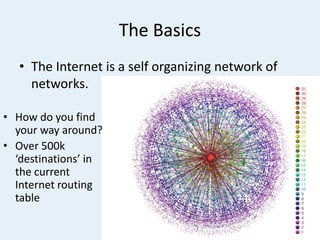
• How do you find
your way around?
• Over 500k
‘destinations’ in
the current
Internet routing
table
BGP to the Rescue
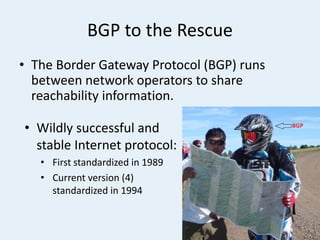
• The Border Gateway Protocol (BGP) runs
between network operators to share
reachability information.
• Wildly successful and
stable Internet protocol:
• First standardized in 1989
• Current version (4)
standardized in 1994
BGP – a protocol built on trust
• Very few mechanisms in BGP for security
– MD5 hash for session passwords
– TTL security
– ACLs
• These mechanisms protect the control plane
but say nothing about the payload.
• About the time of BGP standardization, table
size 20k routes and < 1500ASNs
(source:http://www.cisco.com/web/about/ac123/ac147/archived_issues/ipj_4-1/bgp_routing_table.html)
What about Identity – who is who
• No hierarchical addressing or routing on the
Internet backbone
• Any address can appear at any location
• Opposite of the predecessor mass
communications network – PSTN
• Solved the problem of decoupling location and
identity
• Created the problem table size (different talk) and
topology integrity – anyone can claim to be any
address
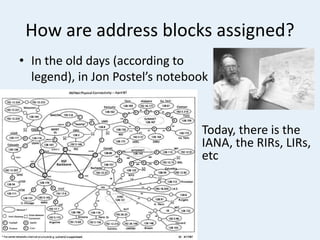
How are address blocks assigned?
• In the old days (according to
legend), in Jon Postel’s notebook
Today, there is the
IANA, the RIRs, LIRs,
etc
If that’s how they’re assigned, how are
they Validated?
• They aren’t. There is nothing in BGP or its
operation that prevents anyone from claiming
to be any address.
• There is no relationship between prefix, ASN,
organization, etc.
• Current state- use Internet Routing Registry
(IRR) (eg, RADB), whois data, to filter improper
advertisements.
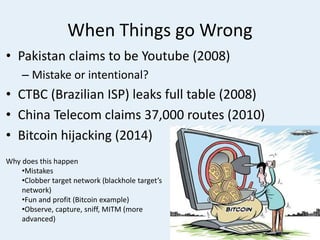
When Things go Wrong
• Pakistan claims to be Youtube (2008)
– Mistake or intentional?
• CTBC (Brazilian ISP) leaks full table (2008)
• China Telecom claims 37,000 routes (2010)
• Bitcoin hijacking (2014)
Why does this happen
•Mistakes
•Clobber target network (blackhole target’s
network)
•Fun and profit (Bitcoin example)
•Observe, capture, sniff, MITM (more
advanced)
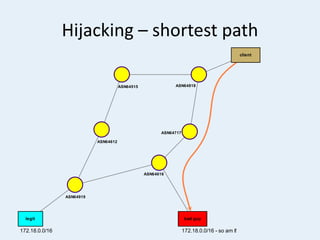
Hijacking – shortest path
ASN64515
ASN64612
ASN64616
ASN64717
ASN64818
ASN64919
legit
172.18.0.0/16
client
bad guy
172.18.0.0/16 - so am I!
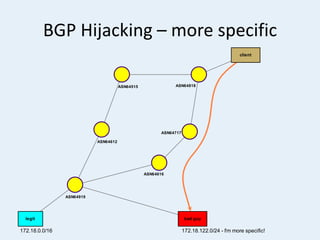
BGP Hijacking – more specific
ASN64515
ASN64612
ASN64616
ASN64717
ASN64818
ASN64919
legit
172.18.0.0/16
client
bad guy
172.18.122.0/24 - I'm more specific!
Current State of the Art
• Rely on filtering (whois data, LOAs)
– Semi-automated and error prone
• (poor input data)
• Detect
– BGP monitoring services
• BGPMon
• Cyclpos
• Thousand Eyes
• Mitigate
– Call your upstream
– Post to NANOG (haha)
– Advertise more specific networks (as done with YouTube)
RPKI is the Answer
(to some of the issues)
• Resource Public Key Infrastructure
– Relatively new technology
– Cryptographically assures an ASN is authorized to
announce prefixes
• Extension to X.509 to carry IP prefix
information
– Route Origin Attestation (ROA)
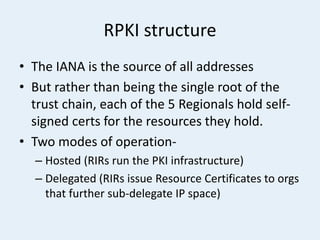
RPKI structure
• The IANA is the source of all addresses
• But rather than being the single root of the
trust chain, each of the 5 Regionals hold self-
signed certs for the resources they hold.
• Two modes of operation-
– Hosted (RIRs run the PKI infrastructure)
– Delegated (RIRs issue Resource Certificates to orgs
that further sub-delegate IP space)
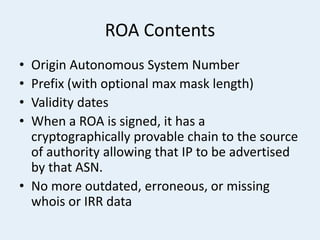
ROA Contents
• Origin Autonomous System Number
• Prefix (with optional max mask length)
• Validity dates
• When a ROA is signed, it has a
cryptographically provable chain to the source
of authority allowing that IP to be advertised
by that ASN.
• No more outdated, erroneous, or missing
whois or IRR data
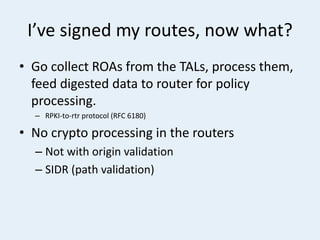
I’ve signed my routes, now what?
• Go collect ROAs from the TALs, process them,
feed digested data to router for policy
processing.
– RPKI-to-rtr protocol (RFC 6180)
• No crypto processing in the routers
– Not with origin validation
– SIDR (path validation)
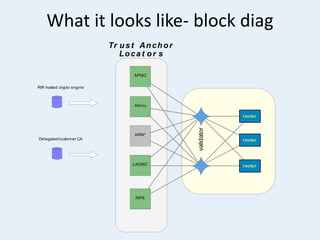
What it looks like- block diag
APNIC
Afrinic
ARIN*
LACNIC
RIPE
Tr us t Anchor
Loca t or s
router
router
router
validator
RIR hosted crypto engine
Delegated/customer CA
Three Route States
• Valid
– Prefix is covered by a valid ROA
• Unknown
– No ROA exists for this prefix
• Invalid
– Unauthorized announcement
• Mismatch between authorized ASN and originating ASN,
split origin
• More specific announcement than valid ROA allows
• Expired ROA
What to do with this data
• With 95% of the table in an unknown state,
probably nothing
• In a fully deployed RPKI environment, do you
– Reject unknown, invalid routes?
– Set LOCALPREF low??
– Set Community, put in a VRF?
• Still under operational development
• Study RFC 6483
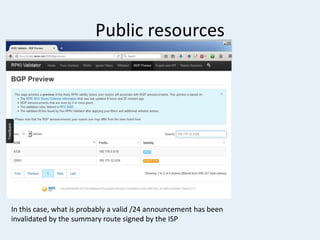
Public resources
In this case, what is probably a valid /24 announcement has been
invalidated by the summary route signed by the ISP
More public resources
rpki@lr1.ham1.de> show route 72.52.2.0/24
inet.0: 511848 destinations, 511849 routes (511848 active, 0 holddown, 0 hidden)
+ = Active Route, - = Last Active, * = Both
72.52.2.0/24 *[BGP/170] 1d 11:54:16, localpref 90, from 79.141.168.1
AS path: 33926 32787 45757 I, validation-state: invalid
> to 193.34.50.1 via em0.0
agallo@foghorn:~$ whois -h whois.bgpmon.net " --roa 33926 72.52.2.0/24"
2 - Not Valid: Invalid Origin ASN, expected 32787
agallo@foghorn:~$ whois -h whois.bgpmon.net " --roa 32787 72.52.2.0/24"
0 - Valid
------------------------
ROA Details
------------------------
Origin ASN: AS32787
Not valid Before: 2012-09-25 04:00:00
Not valid After: 2022-09-25 04:00:00 Expires in 7y256d16h34m26.2000000178814s
Trust Anchor: rpki.arin.net
Prefixes: 209.200.128.0/18 (max length /32)
72.52.0.0/18 (max length /32)
2606:6c00::/32 (max length /64)
So, we’ve solved everything, right?
• RPKI provides origin validation only
• See SIDR working group for path validation
• Still some work to be done on RPKI
– Secure transport of the RPKI data
– Operational best practices
– And, the best part……
RPKI introduces vulnerabilities
• TALs become valuable targets
– Wasn’t the decentralized design of the Internet a
reaction to the PSTN (either explicitly or implicitly)
– How do I trust the prefixes the TALs are using are
properly originated?
• Bootstrap problem of using the network itself to
validate its own topology (Gödel strikes the Internet?)
Slow adoption
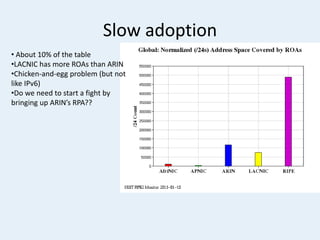
• About 10% of the table
•LACNIC has more ROAs than ARIN
•Chicken-and-egg problem (but not
like IPv6)
•Do we need to start a fight by
bringing up ARIN’s RPA??
Don’t Speak BGP, you’re not off the
hook
• Your space can still hijacked or clobbered by a
fat finger
• Using hosted applications (what the kids call
The Cloud) – look at the Bitcoin hijacking case
• Ask your providers about RPKI plans
• Demand your resources be protected
– Not if, but when will the be protected
Resources
• RIPE
– https://www.ripe.net/lir-services/resource-management/certification/tools-and-resources
• Public RIPE Validator
– http://mvuy10.labs.lacnic.net:8080
• Publically accessible routers
– 193.34.50.25
– 193.34.50.26
THANK YOU
• Contact info
– Andrew Gallo
– @akg1330
– agallo@gmail.com

Resource Public Key Infrastructure - A Step Towards a More Secure Internet Routing Infrastructure

  • 1.
    Resource Public Key Infrastructure AStep Towards a More Secure Internet Routing Infrastructure Andrew Gallo
  • 2.
    The Basics • TheInternet is a self organizing network of networks. • How do you find your way around? • Over 500k ‘destinations’ in the current Internet routing table
  • 3.
    BGP to theRescue • The Border Gateway Protocol (BGP) runs between network operators to share reachability information. • Wildly successful and stable Internet protocol: • First standardized in 1989 • Current version (4) standardized in 1994
  • 4.
    BGP – aprotocol built on trust • Very few mechanisms in BGP for security – MD5 hash for session passwords – TTL security – ACLs • These mechanisms protect the control plane but say nothing about the payload. • About the time of BGP standardization, table size 20k routes and < 1500ASNs (source:http://www.cisco.com/web/about/ac123/ac147/archived_issues/ipj_4-1/bgp_routing_table.html)
  • 5.
    What about Identity– who is who • No hierarchical addressing or routing on the Internet backbone • Any address can appear at any location • Opposite of the predecessor mass communications network – PSTN • Solved the problem of decoupling location and identity • Created the problem table size (different talk) and topology integrity – anyone can claim to be any address
  • 6.
    How are addressblocks assigned? • In the old days (according to legend), in Jon Postel’s notebook Today, there is the IANA, the RIRs, LIRs, etc
  • 7.
    If that’s howthey’re assigned, how are they Validated? • They aren’t. There is nothing in BGP or its operation that prevents anyone from claiming to be any address. • There is no relationship between prefix, ASN, organization, etc. • Current state- use Internet Routing Registry (IRR) (eg, RADB), whois data, to filter improper advertisements.
  • 8.
    When Things goWrong • Pakistan claims to be Youtube (2008) – Mistake or intentional? • CTBC (Brazilian ISP) leaks full table (2008) • China Telecom claims 37,000 routes (2010) • Bitcoin hijacking (2014) Why does this happen •Mistakes •Clobber target network (blackhole target’s network) •Fun and profit (Bitcoin example) •Observe, capture, sniff, MITM (more advanced)
  • 9.
    Hijacking – shortestpath ASN64515 ASN64612 ASN64616 ASN64717 ASN64818 ASN64919 legit 172.18.0.0/16 client bad guy 172.18.0.0/16 - so am I!
  • 10.
    BGP Hijacking –more specific ASN64515 ASN64612 ASN64616 ASN64717 ASN64818 ASN64919 legit 172.18.0.0/16 client bad guy 172.18.122.0/24 - I'm more specific!
  • 11.
    Current State ofthe Art • Rely on filtering (whois data, LOAs) – Semi-automated and error prone • (poor input data) • Detect – BGP monitoring services • BGPMon • Cyclpos • Thousand Eyes • Mitigate – Call your upstream – Post to NANOG (haha) – Advertise more specific networks (as done with YouTube)
  • 12.
    RPKI is theAnswer (to some of the issues) • Resource Public Key Infrastructure – Relatively new technology – Cryptographically assures an ASN is authorized to announce prefixes • Extension to X.509 to carry IP prefix information – Route Origin Attestation (ROA)
  • 13.
    RPKI structure • TheIANA is the source of all addresses • But rather than being the single root of the trust chain, each of the 5 Regionals hold self- signed certs for the resources they hold. • Two modes of operation- – Hosted (RIRs run the PKI infrastructure) – Delegated (RIRs issue Resource Certificates to orgs that further sub-delegate IP space)
  • 14.
    ROA Contents • OriginAutonomous System Number • Prefix (with optional max mask length) • Validity dates • When a ROA is signed, it has a cryptographically provable chain to the source of authority allowing that IP to be advertised by that ASN. • No more outdated, erroneous, or missing whois or IRR data
  • 15.
    I’ve signed myroutes, now what? • Go collect ROAs from the TALs, process them, feed digested data to router for policy processing. – RPKI-to-rtr protocol (RFC 6180) • No crypto processing in the routers – Not with origin validation – SIDR (path validation)
  • 16.
    What it lookslike- block diag APNIC Afrinic ARIN* LACNIC RIPE Tr us t Anchor Loca t or s router router router validator RIR hosted crypto engine Delegated/customer CA
  • 17.
    Three Route States •Valid – Prefix is covered by a valid ROA • Unknown – No ROA exists for this prefix • Invalid – Unauthorized announcement • Mismatch between authorized ASN and originating ASN, split origin • More specific announcement than valid ROA allows • Expired ROA
  • 18.
    What to dowith this data • With 95% of the table in an unknown state, probably nothing • In a fully deployed RPKI environment, do you – Reject unknown, invalid routes? – Set LOCALPREF low?? – Set Community, put in a VRF? • Still under operational development • Study RFC 6483
  • 19.
    Public resources In thiscase, what is probably a valid /24 announcement has been invalidated by the summary route signed by the ISP
  • 20.
    More public resources rpki@lr1.ham1.de>show route 72.52.2.0/24 inet.0: 511848 destinations, 511849 routes (511848 active, 0 holddown, 0 hidden) + = Active Route, - = Last Active, * = Both 72.52.2.0/24 *[BGP/170] 1d 11:54:16, localpref 90, from 79.141.168.1 AS path: 33926 32787 45757 I, validation-state: invalid > to 193.34.50.1 via em0.0 agallo@foghorn:~$ whois -h whois.bgpmon.net " --roa 33926 72.52.2.0/24" 2 - Not Valid: Invalid Origin ASN, expected 32787 agallo@foghorn:~$ whois -h whois.bgpmon.net " --roa 32787 72.52.2.0/24" 0 - Valid ------------------------ ROA Details ------------------------ Origin ASN: AS32787 Not valid Before: 2012-09-25 04:00:00 Not valid After: 2022-09-25 04:00:00 Expires in 7y256d16h34m26.2000000178814s Trust Anchor: rpki.arin.net Prefixes: 209.200.128.0/18 (max length /32) 72.52.0.0/18 (max length /32) 2606:6c00::/32 (max length /64)
  • 21.
    So, we’ve solvedeverything, right? • RPKI provides origin validation only • See SIDR working group for path validation • Still some work to be done on RPKI – Secure transport of the RPKI data – Operational best practices – And, the best part……
  • 22.
    RPKI introduces vulnerabilities •TALs become valuable targets – Wasn’t the decentralized design of the Internet a reaction to the PSTN (either explicitly or implicitly) – How do I trust the prefixes the TALs are using are properly originated? • Bootstrap problem of using the network itself to validate its own topology (Gödel strikes the Internet?)
  • 23.
    Slow adoption • About10% of the table •LACNIC has more ROAs than ARIN •Chicken-and-egg problem (but not like IPv6) •Do we need to start a fight by bringing up ARIN’s RPA??
  • 24.
    Don’t Speak BGP,you’re not off the hook • Your space can still hijacked or clobbered by a fat finger • Using hosted applications (what the kids call The Cloud) – look at the Bitcoin hijacking case • Ask your providers about RPKI plans • Demand your resources be protected – Not if, but when will the be protected
  • 25.
    Resources • RIPE – https://www.ripe.net/lir-services/resource-management/certification/tools-and-resources •Public RIPE Validator – http://mvuy10.labs.lacnic.net:8080 • Publically accessible routers – 193.34.50.25 – 193.34.50.26
  • 26.
    THANK YOU • Contactinfo – Andrew Gallo – @akg1330 – agallo@gmail.com

Editor's Notes

  • #3 Define destinations as prefixes – ie networks such as 172.16.0.0/16 There are over 500k v4 destinations and about 20k v6 prefixes; depending on how your connected to other networks, this could represent well over a million paths.
  • #5 Why BGP and not something else – BGP is very policy driven. Lots of knobs for operators to turn to determine what is sent and what to do with what is received
  • #6 Decoupling location --- local number portability, multihoming. LERG LERG LERG
  • #10 Bad guy can be either wil
  • #21 Add resource slide for 193.34.50.25 and 193.34.50.26.