International Journal of Computer Applications Technology and Research
Volume 4– Issue 8, 599 - 603, 2015, ISSN: 2319–8656.
www.ijcat.com 599
Route Update Overhead Reduction in MANETS Using
Node Clustering
Anoop Abraham Eapen
Dept. of C.S.E,
Mangalam College of Engineering
Kottayam, Kerala, India
Vinodh P Vijayan
Dept. of C.S.E,
Mangalam College of Engineering
Kottayam, Kerala, India
.
Abstract: Most of the routing protocols used in Mobile Adhoc Networks (MANET) require update the route information to neighbour
or any other nodes. These route update overhead degrade the performance of routing algorithms as there is a significant routing
overhead. Proposed is a technique to reduce route update overhead through the minimization of the routing delay. The aim is to reduce
the network congestion and minimize the complexities that are commonly faced by Mobile Adhoc Networks. Here, a clustering
mechanism is introduced, which clusters the arriving nodes in the Mobile Adhoc Network. The election strategy is required to elect a
particular node from the group of nodes in the cluster to act as the cluster head, based on the resources that are possessed by that node.
Experimental results indicate reduced time and routing packets in this scheme
Keywords: MANET, PSR, Clustering, Routing, Neighborhood Trimming.
1. INTRODUCTION
The Mobile Adhoc Network or MANETS, is commonly used
in different areas such as military communications. The
concept of MANET was introduced in the year 1972. At that
time they were introduced as Packet Radio Networks. Later,
the second generation of MANETS was known as Survivable
Adaptive Networks. They are used where speed and ease of
deployment are a concern and where there is fewer
infrastructures. Although there were many advantages that
were associated with MANETS, they often posed different
problems. Some of these issues include:
1. Routing
The nodes within a wireless network can be mobile.
They are able to change their location any time. So
the process of sending packet from one node to
another node within the network poses an issue, as
the receiver may already have moved out of that
particular network or might have failed.
2. Power:
The mobile nodes that are present within the
network has limited transmission power. So, we
cannot expect all nodes to be active all the time.
Any node within the network can fail at any time.
3. Security:
In a wireless network there exists a problem of
s
e
c
urity. The packets that are transmitted from one
node to another may get dropped due to network
congestion or due to node failure. It is a serious
issue as far as a network is concerned.
4. Quality of Service:
Quality of service is never a fixed measure as far as
MANETS are concerned. There are different nodes
with different capabilities in the network. Some may
fail during the operation or might leave the network.
So, QoS is a variable measure.
The adhoc networks, i.e, MANETS are self-organizing and
adaptive and they are able to adapt to changes within the
network. The network performance can be further improved
by localized grouping/clustering, which is explained. The
paper is divided into four parts. The related works, the
mechanisms used, evaluation and results.
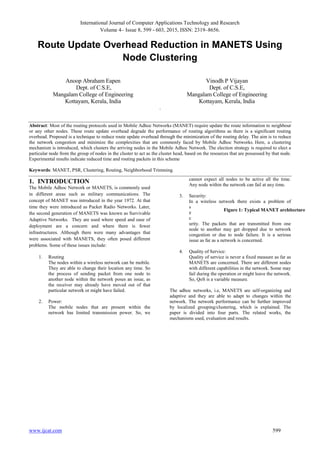
Figure 1: Typical MANET architecture
International Journal of Computer Applications Technology and Research
Volume 4– Issue 8, 599 - 603, 2015, ISSN: 2319–8656.
www.ijcat.com 600
2. R
ELA
TED
WO
RK
There
have
been
differen
t works associated with routing in MANETS. Due to the
dynamic nature of MANETS, implementation of any static
schemes was not feasible. Technologies that enable the
operation of MANETS were also studied in different
approaches [2]
. To address the concept of mobility in
MANETS, a special mechanism was introduced called
VANETS. VANETS introduced the concept of geographic
location based routing in vehicular networks, which helped to
locate nodes by GPS [3]. Another routing scheme, ExOR [5]
also focused on routing of packets in multi hop environments.
There proactive as well as reactive routing protocols, i.e, table
driven or dynamic in nature. Different routing protocols such
as the The route path update was one of the major issues,
which were associated with routing. Any node may arrive or
leave to or from a network. The route path update is essential
as one node present in the network may send a packet to
another node, which might have already left the network
earlier. PSR [1] proposed a route update scheme, where each
node that is present within the network broadcasted the
information to every other node that is present within the
network. PSR was compared with other routing protocols
such as the OLSR [6] and DSR [7]. For successful
transmission of packets, each node should have an idea
regarding the node to which it is transmitting the packet. In
order to make this possible, route update messages need to be
sent to the other nodes. This can have a negative impact on
the network itself. In a large network, when all the nodes
broadcast their route path updates, it may lead to network
congestion. Periodic updates can be used, where the nodes
periodically
update their
route paths.
This can lead
to much
congestion
within the
network
during that period.
Another way is to
carry out differential
updates. i.e, the nodes only send the route update message,
only when a significant update occurs, which was proposed
along with PSR. These ideas were proposed earlier, so as to
reduce network congestion, so as to reduce the network
overhead. However, this can be further improved by adopting
the clustering mechanism which is proposed here.
3. EXISTING SYSTEM
The existing system focuses on Proactive Source
Routing protocol. Here, a breadth first spanning tree is
maintained regarding the nodes in the network. The
main focus of this scheme is to reduce the routing
overhead in MANETS. The tree structure is periodically
updated and broadcasted in each periodic update.
Opportunistic data forwarding is also used here, by
which the best neighboring node is allowed to forward
the packets to the destination. PSR functions on the
basis of a timer driven approach, where the information
is broadcasted periodically among the nodes. There are
different mobile nodes present within a network.
Whenever a node wants to transmit a packet, it is
forwarded to the destination with the use of the PSR.
Besides the opportunistic data forwarding strategy, the
PSR introduces the concepts of route update,
neighborhood trimming and streamlined differential
updates. The route update is done on a periodic basis.
Figure 3: Cluster & Cluster head
Figure 2: Breadth first spanning tree
1
2 3 4
5 6
International Journal of Computer Applications Technology and Research
Volume 4– Issue 8, 599 - 603, 2015, ISSN: 2319–8656.
www.ijcat.com 601
The neighborhood trimming is carried out so as to
remove the unnecessary or failed nodes form the tree
structure. Hello messages are usually broadcasted
between a node and its neighbors. If a neighbor does
not respond, then it can be deemed to be lost.
The routing information is stored in the routing table.
When a node leaves a network or if a particular node
fails, supposing that the node is the receiver for the
message, the sender will send assuming that the
receiver is still online. So solve this problem, periodic
route update broadcast messages are transmitted
between the nodes. So, if hundred nodes are present in
the network, then each node will have to transmit ninety
nine route update broadcast messages, so as to ensure
that all the nodes are aware of the status of every other
node. This is done on a periodic basis. During that time,
the route path update messages that are transmitted will
produce increased network traffic, leading to network
congestion. Differential updates are performed, so as to
reduce the number of messages transmitted. i.e,
depending on the change, the message will be
broadcasted. This overhead can be further reduced, if
nodes are made to manage themselves as small groups.
.
4. PROPOSED SYSTEM
4.1 Clustering with PSR
Here, a clustering mechanism is proposed, which is used to
further reduce the problem of network congestion that was
prevalent within the existing PSR. i.e, the route path update
messages were broadcasted on a periodic basis in the previous
scheme so as to maintain the network information. Here,
groups/clusters are formed so as to reduce the route path
update overhead. Each cluster consists of the following:
4.2 Cluster Head:
The role of the cluster head is to maintain the cluster. The
cluster head is elected by using the BBCMS[9]
election
algorithm. The cluster changes are locally informed to all the
nodes within the cluster, so that the failure of a cluster head
will not render the cluster ineffective. The election algorithm
considers several parameters based on which the cluster head
is elected.
4.3 Sub Nodes:
The remaining nodes within the cluster constitute the sub
nodes. They broadcast their updates, if any (due to differential
update), to the local group only. Hence it is assured the
network cannot get congested easily with update broadcast
messages as in earlier setup.
4.4 BBCMS
The cluster head has to be elected from the available nodes.
Any node cannot be declared as the cluster head. The cluster
head is selected on the basis of certain parameters that are
specified within the algorithm. They include:
4.4.1 Belief Value(B):
It is defined as how much a node is trusted by its
neighboring nodes. The belief value is a way of
measuring how stable, a particular node is.
4.4.2 Connectivity(C):
Defined as the number of neighbors of a node
within a 2d hop.
4.4.3 Battery Power(b):
The cluster head should have fairly enough battery
power to carry out its activities. If the battery power
of a node is too low, it may go offline or may fail,
as a cluster head. So, battery power is considered
for the cluster head election criteria.
4.4.4 Max Value(M):
Max Value is defined as the total number of nodes
that can exist within a cluster
4.4.5 Stability:
The stability of a node is calculated on the basis of
the following parameters:
 Distance:
The distance between the two nodes can be
found out by using the distance formula.
 Average distance:
The average distance between a node and its
neighbors in the cluster.
 Mobility:
It’s the difference between value of average
distances between two points
MTA= A
 Weight Factor:
The weight factor is the value that is assigned
to each parameter, based on which the global
weight is calculated.
 Global Weight:
Global weight of the node is the weight that is
calculated by considering all the above
parameters, which will be used in the cluster
head election process. It is calculated as:
WB[i]: Partial weight factor for belief value
Wb[i]: Partial weight factor for battery
WC[i]: Partial weight factor for node connectivity
WM[i]: Partial weight factor for Max Value
WS[i]: Partial weight factor for Stability
FB[i]: Belief Value
FC[i]: Connectivity
Fb[i]: Battery Power
International Journal of Computer Applications Technology and Research
Volume 4– Issue 8, 599 - 603, 2015, ISSN: 2319–8656.
www.ijcat.com 602
4.4.6 Steps in BBCMS algorithm:
1. Random number generation:
A random number generator is used so as to assign
random values to the nodes that are present within
the MANET. Random values are assigned to the
nodes so as to simulate different characteristics of
the nodes.
2. Cluster creation:
The cluster is created based on the availability of
the nodes. Initially, the one node available is
considered, and clusters are formed mainly
considering the max value set. If it exceeds the max
value, then a new cluster is added.
3. Cluster head election:
Cluster head election is carried out by considering
the weight that is calculated for the nodes. The node
with the minimum weight factor is made as the
cluster head.
4. New node arrival:
When a new node arrives, the weight of the node is
compared with the existing cluster head. If the
weight is more, then it is made as the cluster head.
In this approach, however, we change the cluster
head only if it fails or leaves the cluster so as to
reduce the unnecessary complexity associated with
the election and reelection.
5. Battery threshold:
The battery power of the cluster head is compared
with the threshold value. If it is found to be lower,
then the cluster head is reelected.
6. Certificate revocation:
In this scenario a new security certificate is issued
to the newly arriving nodes joining the cluster.
5. EXPERIMENTAL RESULTS
The experimentation was carried out in order to carry out the
comparative study of this approach with PSR in reducing the
route update overhead. This section deals with the system and
tools used as well as the experimental methodologies adopted
for this evaluation.
5.1 System & Tools used
The simulation of the network was developed in java. The
implementation was simulated with the help of provision of
random values assigned to simulate the network environment.
The mobile node parameters such as battery power, mobility
etc were assigned by the use of a random function. The
database was created using MySQL and was deployed with
the help of Wamp Server. Netbeans was the development
platform used. The system used was running Windows 7 64
bit os with an Intel core i5 processor and 12GB of RAM.
5.2 Evaluation
The system was evaluated by comparing with the existing
PSR approach. In the existing PSR approach, the nodes were
distributed randomly in the network and the message passing
overhead was high. A test bed was developed in order to
simulate this environment. In the first approach, the nodes
were distributed in the network. If at all any node had to leave
the network, it would have to send the route path update
broadcast message to all the remaining nodes that was present
in the entire network. The time to send the update message
was calculated in milliseconds. It may vary depending upon
the performance of the simulated system. In an actual
scenario, it will depend upon network performance. The
number of route path update broadcast messages was also
calculated.
In the second simulation, the PSR with cluster mechanism
was employed. Based on the random values that were
assigned to the nodes by the random generator function, the
BBCMS clustering algorithm was used to create clusters of
nodes. The BFST structure of the PSR was maintained here.
The cluster heads are also elected, on the basis of the
parameters specified by the algorithm. Whenever a node
leaves a cluster, the information is broadcasted to the
corresponding cluster heads as well as the nodes within the
cluster.
The cluster head is then reelected on the basis of the
parameters specified by the algorithm. Once the election is
done, the information is broadcasted to all the remaining
cluster heads that are present within the network. The failure
of a cluster head will thus not affect the topology of the
network, as the information is broadcasted to all the cluster
head nodes on a periodic basis. The node that has left the
cluster may rejoin any other cluster any time. When that
happens, the information will be broadcasted to the cluster
heads.
5.3 Results
The evaluation yielded that the time required to perform the
update operation was reduced from the previous PSR
approach, by using the clustering mechanism, as the total
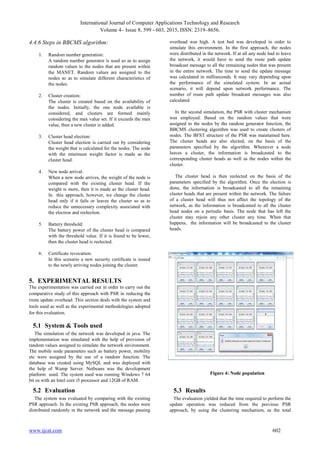
Figure 4: Node population
International Journal of Computer Applications Technology and Research
Volume 4– Issue 8, 599 - 603, 2015, ISSN: 2319–8656.
www.ijcat.com 603
number of messages to be transmitted was reduced. Since the
exchange of messages was primarily between the cluster head
nodes, the total number of packets that was necessary for the
transmission of broadcast information was reduced. Since
less number of packets were to be transmitted, the route path
update operation also completed faster in the PSR with cluster
approach.
6. CONCLUSION
The route path update overhead in MANETS is of great
importance, as it degrades network performance. The nodes
that are present within the network are arranged in a
hierarchical form to be aware of other nodes that are present
in the network so as to communicate effectively between the
nodes. The clustering applied in the hierarchical network
improves the network management by limiting the route
update packet with in the cluster. The performance of the
Network is improved however overall system is dependent on
the frequency of cluster head failures. But in the case of a
large network consisting of many nodes, this mechanism will
ensure that the route path update overhead will be minimized
and network congestion problems can be avoided.
7. FUTURE WORK
The system has proposed clustering mechanism in network to
reduce the route update overhead. The cluster head failure is
one of the major problems that are associated with this
approach. To mitigate this, a live node monitoring approach
can be employed, so as to detect any chances of failure
corresponding to any head nodes, which are present in the
cluster. The cluster heads can also be assigned more
responsibilities, other than the transmission of the update
packets.
8. REFERENCES
[1] Zehua Wang, Yuanzhu Chen, and Cheng Li, “PSR: A
light weight Proactive Source Routing Protocol for
Mobile Adhoc Networks, IEEE 2014
[2] I. Chlamtac, M. Conti, and J.-N. Liu, “Mobile ad hoc
networking: Imperatives and challenges,” Ad Hoc Netw.,
vol. 1, no. 1, pp. 13–64, Jul. 2003.
[3] M. Al-Rabayah and R. Malaney, “A new scalable hybrid
routing protocol for VANETs,” IEEE Trans. Veh.
Technol., vol. 61, no. 6, pp. 2625–2635, Jul. 2012.
[4] Y. P. Chen, J. Zhang, and I. Marsic, “Link-layer-and-
above diversity in multi-hop wireless networks,” IEEE
Commun. Mag., vol. 47, no. 2, pp. 118–124, Feb. 2009.
[5] S. Biswas and R. Morris, “ExOR: Opportunistic multi-
hop routing for wireless networks,” in Proc. ACM
Conf. SIGCOMM, Philadelphia, PA, USA, Aug. 2005,
pp. 133–144.
[6] T. Clausen and P. Jacquet, “Optimized Link State
Routing Protocol (OLSR),” RFC 3626, Oct. 2003.
[7] D. B. Johnson, Y.-C. Hu, and D. A. Maltz, “On The
Dynamic Source
Routing Protocol (DSR) for mobile ad hoc networks for
IPv4,” RFC 4728,Feb. 2007.
[8] C. E. Perkins and P. Bhagwat, “Highly dynamic
Destination-Sequenced Distance-Vector Routing
(DSDV) for mobile computers,” Comput. Commun.
Rev., vol. 24, pp. 234–244, Oct. 1994.
[9] Heenavarsheney, Pradeep Kumar, “Secure
Communication Architecture Based On “BBCMS”
Clustering Algorithm for Mobile Adhoc Network”
IJITEE vol.3 Isuue 2, July 2013.
Figure 5: Time taken to send packets for PSR and PSR with
cluster
Figure 6: No of broadcast packets for PSR and PSR
with cluster
International Journal of Computer Applications Technology and Research
Volume 4– Issue 8, 599 - 603, 2015, ISSN: 2319–8656.
www.ijcat.com 604

Route Update Overhead Reduction in MANETS Using Node Clustering

  • 1.
    International Journal ofComputer Applications Technology and Research Volume 4– Issue 8, 599 - 603, 2015, ISSN: 2319–8656. www.ijcat.com 599 Route Update Overhead Reduction in MANETS Using Node Clustering Anoop Abraham Eapen Dept. of C.S.E, Mangalam College of Engineering Kottayam, Kerala, India Vinodh P Vijayan Dept. of C.S.E, Mangalam College of Engineering Kottayam, Kerala, India . Abstract: Most of the routing protocols used in Mobile Adhoc Networks (MANET) require update the route information to neighbour or any other nodes. These route update overhead degrade the performance of routing algorithms as there is a significant routing overhead. Proposed is a technique to reduce route update overhead through the minimization of the routing delay. The aim is to reduce the network congestion and minimize the complexities that are commonly faced by Mobile Adhoc Networks. Here, a clustering mechanism is introduced, which clusters the arriving nodes in the Mobile Adhoc Network. The election strategy is required to elect a particular node from the group of nodes in the cluster to act as the cluster head, based on the resources that are possessed by that node. Experimental results indicate reduced time and routing packets in this scheme Keywords: MANET, PSR, Clustering, Routing, Neighborhood Trimming. 1. INTRODUCTION The Mobile Adhoc Network or MANETS, is commonly used in different areas such as military communications. The concept of MANET was introduced in the year 1972. At that time they were introduced as Packet Radio Networks. Later, the second generation of MANETS was known as Survivable Adaptive Networks. They are used where speed and ease of deployment are a concern and where there is fewer infrastructures. Although there were many advantages that were associated with MANETS, they often posed different problems. Some of these issues include: 1. Routing The nodes within a wireless network can be mobile. They are able to change their location any time. So the process of sending packet from one node to another node within the network poses an issue, as the receiver may already have moved out of that particular network or might have failed. 2. Power: The mobile nodes that are present within the network has limited transmission power. So, we cannot expect all nodes to be active all the time. Any node within the network can fail at any time. 3. Security: In a wireless network there exists a problem of s e c urity. The packets that are transmitted from one node to another may get dropped due to network congestion or due to node failure. It is a serious issue as far as a network is concerned. 4. Quality of Service: Quality of service is never a fixed measure as far as MANETS are concerned. There are different nodes with different capabilities in the network. Some may fail during the operation or might leave the network. So, QoS is a variable measure. The adhoc networks, i.e, MANETS are self-organizing and adaptive and they are able to adapt to changes within the network. The network performance can be further improved by localized grouping/clustering, which is explained. The paper is divided into four parts. The related works, the mechanisms used, evaluation and results. Figure 1: Typical MANET architecture
  • 2.
    International Journal ofComputer Applications Technology and Research Volume 4– Issue 8, 599 - 603, 2015, ISSN: 2319–8656. www.ijcat.com 600 2. R ELA TED WO RK There have been differen t works associated with routing in MANETS. Due to the dynamic nature of MANETS, implementation of any static schemes was not feasible. Technologies that enable the operation of MANETS were also studied in different approaches [2] . To address the concept of mobility in MANETS, a special mechanism was introduced called VANETS. VANETS introduced the concept of geographic location based routing in vehicular networks, which helped to locate nodes by GPS [3]. Another routing scheme, ExOR [5] also focused on routing of packets in multi hop environments. There proactive as well as reactive routing protocols, i.e, table driven or dynamic in nature. Different routing protocols such as the The route path update was one of the major issues, which were associated with routing. Any node may arrive or leave to or from a network. The route path update is essential as one node present in the network may send a packet to another node, which might have already left the network earlier. PSR [1] proposed a route update scheme, where each node that is present within the network broadcasted the information to every other node that is present within the network. PSR was compared with other routing protocols such as the OLSR [6] and DSR [7]. For successful transmission of packets, each node should have an idea regarding the node to which it is transmitting the packet. In order to make this possible, route update messages need to be sent to the other nodes. This can have a negative impact on the network itself. In a large network, when all the nodes broadcast their route path updates, it may lead to network congestion. Periodic updates can be used, where the nodes periodically update their route paths. This can lead to much congestion within the network during that period. Another way is to carry out differential updates. i.e, the nodes only send the route update message, only when a significant update occurs, which was proposed along with PSR. These ideas were proposed earlier, so as to reduce network congestion, so as to reduce the network overhead. However, this can be further improved by adopting the clustering mechanism which is proposed here. 3. EXISTING SYSTEM The existing system focuses on Proactive Source Routing protocol. Here, a breadth first spanning tree is maintained regarding the nodes in the network. The main focus of this scheme is to reduce the routing overhead in MANETS. The tree structure is periodically updated and broadcasted in each periodic update. Opportunistic data forwarding is also used here, by which the best neighboring node is allowed to forward the packets to the destination. PSR functions on the basis of a timer driven approach, where the information is broadcasted periodically among the nodes. There are different mobile nodes present within a network. Whenever a node wants to transmit a packet, it is forwarded to the destination with the use of the PSR. Besides the opportunistic data forwarding strategy, the PSR introduces the concepts of route update, neighborhood trimming and streamlined differential updates. The route update is done on a periodic basis. Figure 3: Cluster & Cluster head Figure 2: Breadth first spanning tree 1 2 3 4 5 6
  • 3.
    International Journal ofComputer Applications Technology and Research Volume 4– Issue 8, 599 - 603, 2015, ISSN: 2319–8656. www.ijcat.com 601 The neighborhood trimming is carried out so as to remove the unnecessary or failed nodes form the tree structure. Hello messages are usually broadcasted between a node and its neighbors. If a neighbor does not respond, then it can be deemed to be lost. The routing information is stored in the routing table. When a node leaves a network or if a particular node fails, supposing that the node is the receiver for the message, the sender will send assuming that the receiver is still online. So solve this problem, periodic route update broadcast messages are transmitted between the nodes. So, if hundred nodes are present in the network, then each node will have to transmit ninety nine route update broadcast messages, so as to ensure that all the nodes are aware of the status of every other node. This is done on a periodic basis. During that time, the route path update messages that are transmitted will produce increased network traffic, leading to network congestion. Differential updates are performed, so as to reduce the number of messages transmitted. i.e, depending on the change, the message will be broadcasted. This overhead can be further reduced, if nodes are made to manage themselves as small groups. . 4. PROPOSED SYSTEM 4.1 Clustering with PSR Here, a clustering mechanism is proposed, which is used to further reduce the problem of network congestion that was prevalent within the existing PSR. i.e, the route path update messages were broadcasted on a periodic basis in the previous scheme so as to maintain the network information. Here, groups/clusters are formed so as to reduce the route path update overhead. Each cluster consists of the following: 4.2 Cluster Head: The role of the cluster head is to maintain the cluster. The cluster head is elected by using the BBCMS[9] election algorithm. The cluster changes are locally informed to all the nodes within the cluster, so that the failure of a cluster head will not render the cluster ineffective. The election algorithm considers several parameters based on which the cluster head is elected. 4.3 Sub Nodes: The remaining nodes within the cluster constitute the sub nodes. They broadcast their updates, if any (due to differential update), to the local group only. Hence it is assured the network cannot get congested easily with update broadcast messages as in earlier setup. 4.4 BBCMS The cluster head has to be elected from the available nodes. Any node cannot be declared as the cluster head. The cluster head is selected on the basis of certain parameters that are specified within the algorithm. They include: 4.4.1 Belief Value(B): It is defined as how much a node is trusted by its neighboring nodes. The belief value is a way of measuring how stable, a particular node is. 4.4.2 Connectivity(C): Defined as the number of neighbors of a node within a 2d hop. 4.4.3 Battery Power(b): The cluster head should have fairly enough battery power to carry out its activities. If the battery power of a node is too low, it may go offline or may fail, as a cluster head. So, battery power is considered for the cluster head election criteria. 4.4.4 Max Value(M): Max Value is defined as the total number of nodes that can exist within a cluster 4.4.5 Stability: The stability of a node is calculated on the basis of the following parameters:  Distance: The distance between the two nodes can be found out by using the distance formula.  Average distance: The average distance between a node and its neighbors in the cluster.  Mobility: It’s the difference between value of average distances between two points MTA= A  Weight Factor: The weight factor is the value that is assigned to each parameter, based on which the global weight is calculated.  Global Weight: Global weight of the node is the weight that is calculated by considering all the above parameters, which will be used in the cluster head election process. It is calculated as: WB[i]: Partial weight factor for belief value Wb[i]: Partial weight factor for battery WC[i]: Partial weight factor for node connectivity WM[i]: Partial weight factor for Max Value WS[i]: Partial weight factor for Stability FB[i]: Belief Value FC[i]: Connectivity Fb[i]: Battery Power
  • 4.
    International Journal ofComputer Applications Technology and Research Volume 4– Issue 8, 599 - 603, 2015, ISSN: 2319–8656. www.ijcat.com 602 4.4.6 Steps in BBCMS algorithm: 1. Random number generation: A random number generator is used so as to assign random values to the nodes that are present within the MANET. Random values are assigned to the nodes so as to simulate different characteristics of the nodes. 2. Cluster creation: The cluster is created based on the availability of the nodes. Initially, the one node available is considered, and clusters are formed mainly considering the max value set. If it exceeds the max value, then a new cluster is added. 3. Cluster head election: Cluster head election is carried out by considering the weight that is calculated for the nodes. The node with the minimum weight factor is made as the cluster head. 4. New node arrival: When a new node arrives, the weight of the node is compared with the existing cluster head. If the weight is more, then it is made as the cluster head. In this approach, however, we change the cluster head only if it fails or leaves the cluster so as to reduce the unnecessary complexity associated with the election and reelection. 5. Battery threshold: The battery power of the cluster head is compared with the threshold value. If it is found to be lower, then the cluster head is reelected. 6. Certificate revocation: In this scenario a new security certificate is issued to the newly arriving nodes joining the cluster. 5. EXPERIMENTAL RESULTS The experimentation was carried out in order to carry out the comparative study of this approach with PSR in reducing the route update overhead. This section deals with the system and tools used as well as the experimental methodologies adopted for this evaluation. 5.1 System & Tools used The simulation of the network was developed in java. The implementation was simulated with the help of provision of random values assigned to simulate the network environment. The mobile node parameters such as battery power, mobility etc were assigned by the use of a random function. The database was created using MySQL and was deployed with the help of Wamp Server. Netbeans was the development platform used. The system used was running Windows 7 64 bit os with an Intel core i5 processor and 12GB of RAM. 5.2 Evaluation The system was evaluated by comparing with the existing PSR approach. In the existing PSR approach, the nodes were distributed randomly in the network and the message passing overhead was high. A test bed was developed in order to simulate this environment. In the first approach, the nodes were distributed in the network. If at all any node had to leave the network, it would have to send the route path update broadcast message to all the remaining nodes that was present in the entire network. The time to send the update message was calculated in milliseconds. It may vary depending upon the performance of the simulated system. In an actual scenario, it will depend upon network performance. The number of route path update broadcast messages was also calculated. In the second simulation, the PSR with cluster mechanism was employed. Based on the random values that were assigned to the nodes by the random generator function, the BBCMS clustering algorithm was used to create clusters of nodes. The BFST structure of the PSR was maintained here. The cluster heads are also elected, on the basis of the parameters specified by the algorithm. Whenever a node leaves a cluster, the information is broadcasted to the corresponding cluster heads as well as the nodes within the cluster. The cluster head is then reelected on the basis of the parameters specified by the algorithm. Once the election is done, the information is broadcasted to all the remaining cluster heads that are present within the network. The failure of a cluster head will thus not affect the topology of the network, as the information is broadcasted to all the cluster head nodes on a periodic basis. The node that has left the cluster may rejoin any other cluster any time. When that happens, the information will be broadcasted to the cluster heads. 5.3 Results The evaluation yielded that the time required to perform the update operation was reduced from the previous PSR approach, by using the clustering mechanism, as the total Figure 4: Node population
  • 5.
    International Journal ofComputer Applications Technology and Research Volume 4– Issue 8, 599 - 603, 2015, ISSN: 2319–8656. www.ijcat.com 603 number of messages to be transmitted was reduced. Since the exchange of messages was primarily between the cluster head nodes, the total number of packets that was necessary for the transmission of broadcast information was reduced. Since less number of packets were to be transmitted, the route path update operation also completed faster in the PSR with cluster approach. 6. CONCLUSION The route path update overhead in MANETS is of great importance, as it degrades network performance. The nodes that are present within the network are arranged in a hierarchical form to be aware of other nodes that are present in the network so as to communicate effectively between the nodes. The clustering applied in the hierarchical network improves the network management by limiting the route update packet with in the cluster. The performance of the Network is improved however overall system is dependent on the frequency of cluster head failures. But in the case of a large network consisting of many nodes, this mechanism will ensure that the route path update overhead will be minimized and network congestion problems can be avoided. 7. FUTURE WORK The system has proposed clustering mechanism in network to reduce the route update overhead. The cluster head failure is one of the major problems that are associated with this approach. To mitigate this, a live node monitoring approach can be employed, so as to detect any chances of failure corresponding to any head nodes, which are present in the cluster. The cluster heads can also be assigned more responsibilities, other than the transmission of the update packets. 8. REFERENCES [1] Zehua Wang, Yuanzhu Chen, and Cheng Li, “PSR: A light weight Proactive Source Routing Protocol for Mobile Adhoc Networks, IEEE 2014 [2] I. Chlamtac, M. Conti, and J.-N. Liu, “Mobile ad hoc networking: Imperatives and challenges,” Ad Hoc Netw., vol. 1, no. 1, pp. 13–64, Jul. 2003. [3] M. Al-Rabayah and R. Malaney, “A new scalable hybrid routing protocol for VANETs,” IEEE Trans. Veh. Technol., vol. 61, no. 6, pp. 2625–2635, Jul. 2012. [4] Y. P. Chen, J. Zhang, and I. Marsic, “Link-layer-and- above diversity in multi-hop wireless networks,” IEEE Commun. Mag., vol. 47, no. 2, pp. 118–124, Feb. 2009. [5] S. Biswas and R. Morris, “ExOR: Opportunistic multi- hop routing for wireless networks,” in Proc. ACM Conf. SIGCOMM, Philadelphia, PA, USA, Aug. 2005, pp. 133–144. [6] T. Clausen and P. Jacquet, “Optimized Link State Routing Protocol (OLSR),” RFC 3626, Oct. 2003. [7] D. B. Johnson, Y.-C. Hu, and D. A. Maltz, “On The Dynamic Source Routing Protocol (DSR) for mobile ad hoc networks for IPv4,” RFC 4728,Feb. 2007. [8] C. E. Perkins and P. Bhagwat, “Highly dynamic Destination-Sequenced Distance-Vector Routing (DSDV) for mobile computers,” Comput. Commun. Rev., vol. 24, pp. 234–244, Oct. 1994. [9] Heenavarsheney, Pradeep Kumar, “Secure Communication Architecture Based On “BBCMS” Clustering Algorithm for Mobile Adhoc Network” IJITEE vol.3 Isuue 2, July 2013. Figure 5: Time taken to send packets for PSR and PSR with cluster Figure 6: No of broadcast packets for PSR and PSR with cluster
  • 6.
    International Journal ofComputer Applications Technology and Research Volume 4– Issue 8, 599 - 603, 2015, ISSN: 2319–8656. www.ijcat.com 604