International Journal of Scientific Research and Engineering Development-– Volume 3 Issue 4, July –Aug 2020
Available at www.ijsred.com
ISSN : 2581-7175 ©IJSRED: All Rights are Reserved Page 96
Romanks1992
Ensuring the Adaptive Path for the Routing in 5g Wireless
Network
Mr. Basavaraju S
Asst. Prof, Dept. of ISE
E-Mail:basavarajuise@gmail.com
Brindavan College of Engineering, Bangalore-63
----------------------------------------************************----------------------------------
Abstract:
In this Paper, the idea to ensure the adaptive nature of the routing tables maintained in the memory.
Whenever the routing protocol detects the new path for transferring of packets to the destination node
using 5g network it has to update the information to the memory. So the proposed idea is to save the
routing information in the cache memory rather than in the ram. Whenever the re-routing take place to
same route no need to broadcast the route once again so the client machine can fetch the information from
the cache which is the fastest memory.
Keywords — Routing, DSR, Cache, Broadcast
----------------------------------------************************----------------------------------
In today’s world the proposed of networking
is essential for every aspect of the work. So only the
network is not sufficient for the process to run. We
need the network which is going to work faster and
which delivers the packets to the destination with
trusted and accuracy. The network can be a wired
and a wireless network. The problem with wired
network is it has to maintain physically. It is also
not going to work faster. So the introduce of the
wireless protocol made the networking feature to an
extern extent.
Ad hoc wireless network consists of mobile
nodes (hosts), that are connected by wireless links
Steering conventions utilized for customary wired
system can't be legitimately applied in impromptu
remote systems because of their exceptionally
unique geography, nonappearance of built up
foundation for brought together organization, data
transmission imperatives, asset limitations.
II. Related Work
Research on packet routing in wireless networks
of mobile hosts dates back at least to 1973 when the U.S.
Defense Advanced Research Projects Agency began the
DARPA Packet Radio Network (PRNET) project and its
successor the Survivable Adaptive Networks (SURAN)
project .
PRNET supports the automatic set up and
maintenance of packet switched communication routes
in a network of moderately mobile hosts communicating
via radios. The PRNET routing protocol uses a form of
distance vector routing, with each node broadcasting a
routing update packet (called a packet-radio organization
packet, or PROP, in PRNET) every 7.5 seconds.
The header of every information parcel contains the
source and goal hub addresses, the quantity of bounces
taken so distant from the source, and the quantity of
RESEARCH ARTICLE OPEN ACCESS
International Journal of Scientific Research and Engineering Development-– Volume 3 Issue 4, July –Aug 2020
Available at www.ijsred.com
ISSN : 2581-7175 ©IJSRED: All Rights are Reserved Page 97
jumps staying to arrive at the goal (in light of the
sender's steering table). Hubs indiscriminately get all
parcels and may refresh their steering tables dependent
on this header data. The information connect convention
utilizes jump by-bounce affirmations, utilizing either
express (dynamic) affirmations or uninvolved
affirmations from these indiscriminately gotten bundles.
The novice radio network has additionally
worked widely with steering in remote systems of now
and then) portable hosts [14], holding a yearly bundle
radio PC organizing gathering supported by the
American Radio Relay League (ARRL) since 1981.
Novice bundle radio systems administration initially
utilized just source steering with express source courses
developed by the client, albeit some had thought about
an increasingly unique source directing plan . A
framework known as NET/ROM was likewise evolved
to permit the steering choices to be computerized,
utilizing a type of separation vector directing convention
as opposed to source steering. NET/ROM additionally
permits refreshing of its directing table dependent on the
source address data in the headers of parcels that it gets.
III. Issues in Designing Routing Protocol for 5g
Wireless Networks
The major challenges faced are mobility of nodes, resource
constraints, error-prone channel state and hidden and exposed
terminal problem.
1. Nodes Mobility
On going session suffers frequent path breaks due
to movement of nodes.
Movement of intermediate nodes in the path or
movement of end nodes.
Routing protocol mush be able to perform
efficient and effective mobility management.
2. Bandwidth Constraint
 Abundant bandwidth is available in wired
networks due to advent of fiber optics and
wavelength division multiplexing (WDM).
 In wireless network, radio band is limited.
3. Fault Tolerant
 The wireless links have time-varying
characteristics in terms of link capacity
and link-error probability.
 Hence routing protocol interacts with
MAC layer to find alternate routes through
better-quality links.
 Transmission results in collision of data
and control packets.
4. Hidden and Exposed Terminal Problems
• Hidden terminal problem refers to collision
of packets at a receiving node due to
simultaneous transmission of those nodes
that are not within in direct transmission
range of the sender, but are within the range
of receiver.
• Solution for this problem include MACA,
MACAW, FAMA, DBTA.
• MACA uses two way handshake control
protocol called RTS-CTS protocol
exchange.
Fig 3.1 Hidden Terminal Problem
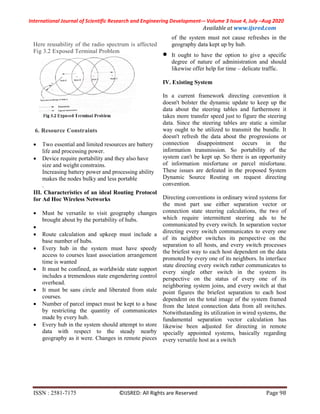
5. Exposed terminal problem:
Inability of a node which is blocked thanks
to transmission by a close-by transmitting node to
transmit to a different node.
International Journal of Scientific Research and Engineering Development-– Volume 3 Issue 4, July –Aug 2020
Available at www.ijsred.com
ISSN : 2581-7175 ©IJSRED: All Rights are Reserved Page 98
Here reusability of the radio spectrum is affected
Fig 3.2 Exposed Terminal Problem
6. Resource Constraints
 Two essential and limited resources are battery
life and processing power.
 Device require portability and they also have
size and weight constrains.
Increasing battery power and processing ability
makes the nodes bulky and less portable
.
III. Characteristics of an ideal Routing Protocol
for Ad Hoc Wireless Networks
 Must be versatile to visit geography changes
brought about by the portability of hubs.

 Route calculation and upkeep must include a
base number of hubs.
 Every hub in the system must have speedy
access to courses least association arrangement
time is wanted
 It must be confined, as worldwide state support
includes a tremendous state engendering control
overhead.
 It must be sans circle and liberated from stale
courses.
 Number of parcel impact must be kept to a base
by restricting the quantity of communicates
made by every hub.
 Every hub in the system should attempt to store
data with respect to the steady nearby
geography as it were. Changes in remote pieces
of the system must not cause refreshes in the
geography data kept up by hub.
 It ought to have the option to give a specific
degree of nature of administration and should
likewise offer help for time – delicate traffic.
IV. Existing System
In a current framework directing convention it
doesn't bolster the dynamic update to keep up the
data about the steering tables and furthermore it
takes more transfer speed just to figure the steering
data. Since the steering tables are static a similar
way ought to be utilized to transmit the bundle. It
doesn't refresh the data about the progressions or
connection disappointment occurs in the
information transmission. So portability of the
system can't be kept up. So there is an opportunity
of information misfortune or parcel misfortune.
These issues are defeated in the proposed System
Dynamic Source Routing on request directing
convention.
Directing conventions in ordinary wired systems for
the most part use either separation vector or
connection state steering calculations, the two of
which require intermittent steering ads to be
communicated by every switch. In separation vector
directing every switch communicates to every one
of its neighbor switches its perspective on the
separation to all hosts, and every switch processes
the briefest way to each host dependent on the data
promoted by every one of its neighbors. In interface
state directing every switch rather communicates to
every single other switch in the system its
perspective on the status of every one of its
neighboring system joins, and every switch at that
point figures the briefest separation to each host
dependent on the total image of the system framed
from the latest connection data from all switches.
Notwithstanding its utilization in wired systems, the
fundamental separation vector calculation has
likewise been adjusted for directing in remote
specially appointed systems, basically regarding
every versatile host as a switch
International Journal of Scientific Research and Engineering Development-– Volume 3 Issue 4, July –Aug 2020
Available at www.ijsred.com
ISSN : 2581-7175 ©IJSRED: All Rights are Reserved Page 99
V. Proposed System
In Dynamic Source Routing Protocol Designed to
confine the data transfer capacity devoured by
control bundles. It takes out occasional table-update
messages. It additionally is reference point less and
consequently doesn't require intermittent hi bundle.
Hi parcels are utilized by hub to illuminate its
neighbors regarding its quality
Basic approach:
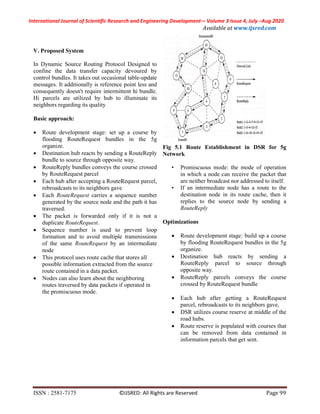
 Route development stage: set up a course by
flooding RouteRequest bundles in the 5g
organize.
 Destination hub reacts by sending a RouteReply
bundle to source through opposite way.
 RouteReply bundles conveys the course crossed
by RouteRequest parcel
 Each hub after accepting a RouteRequest parcel,
rebroadcasts to its neighbors gave
 Each RouteRequest carries a sequence number
generated by the source node and the path it has
traversed.
 The packet is forwarded only if it is not a
duplicate RouteRequest.
 Sequence number is used to prevent loop
formation and to avoid multiple transmissions
of the same RouteRequest by an intermediate
node
 This protocol uses route cache that stores all
possible information extracted from the source
route contained in a data packet.
 Nodes can also learn about the neighboring
routes traversed by data packets if operated in
the promiscuous mode.
Fig 5.1 Route Establishment in DSR for 5g
Network
• Promiscuous mode: the mode of operation
in which a node can receive the packet that
are neither broadcast nor addressed to itself.
• If an intermediate node has a route to the
destination node in its route cache, then it
replies to the source node by sending a
RouteReply
Optimizations
 Route development stage: build up a course
by flooding RouteRequest bundles in the 5g
organize.
 Destination hub reacts by sending a
RouteReply parcel to source through
opposite way.
 RouteReply parcels conveys the course
crossed by RouteRequest bundle
 Each hub after getting a RouteRequest
parcel, rebroadcasts to its neighbors gave,
 DSR utilizes course reserve at middle of the
road hubs.
 Route reserve is populated with courses that
can be removed from data contained in
information parcels that get sent.
International Journal of Scientific Research and Engineering Development-– Volume 3 Issue 4, July –Aug 2020
Available at www.ijsred.com
ISSN : 2581-7175 ©IJSRED: All Rights are Reserved Page 100
 By working in the indiscriminate mode, a
middle of the road hub finds out about
course breaks.
 Information picked up is utilized to refresh
the course reserve so the dynamic courses
don't utilize broken connections.
 During system segments, influenced hubs
starts RouteRequest parcel.
 An exponential back off calculation is
utilized to keep away from visit
RouteRequest flooding in the system when
dest is in another disjoint set.
 DSR additionally permits piggy-sponsorship
of an information bundle on RouteRequest.
 Each bundle conveys total way to its goal.
 RouteError message is created if the hub in
the way moves away.
Fig 5.2 Route Maintenance in DSR in 5g Network
Advantages:
• Eliminates need of intermittent flooding of
update messages.
• Intermediate hubs utilizes course reserve
data to decrease control overhead.
Disadvantages:
• Route support instrument doesn't locally fix
a messed up joins.
• Stale course store information could bring
about irregularities
• Connection arrangement delay is higher.
• Performance debases quickly with
expanding portability.
VI. Conclusion
This paper has presented a protocol for routing
packets between wireless mobile hosts in 5g Networks.
Unlike routing protocols using distance vector or link
state algorithms, our protocol uses dynamic source
routing which adapts quickly to routing changes when
host movement is frequent, yet requires little or no
overhead during periods in which hosts move less
frequently. Based on results from a packet-level
simulation of mobile hosts operating in an ad hoc
network, the protocol performs well over a variety of
host movement simulated, the overhead of the protocol
is quite low, falling to just 1% of total data packets
transmitted for moderate movement rates in a network of
24 mobile hosts. In all cases, the difference in length
between the routes used and the optimal route lengths is
negligible, and in most cases, route lengths are on
average within a factor of 1.02 of optimal.
We are currently expanding our simulations to
incorporate some additional optimizations and to
quantify the effects of the individual optimizations on
the behavior and performance of the 5g network
Protocol.
References
[1] David F. Bantz and Fr´ed´eric J. Bauchot. Wireless
LAN design alternatives. IEEE Network, 8(2):43–53,
March/April 1994.
[2] Vaduvur Bharghavan, Alan Demers, Scott Shenker,
and Lixia Zhang. MACAW: A media access protocol
for wireless LAN’s. In Proceedings of the
SIGCOMM ’94 Conference on Communications
Architectures, Protocols and Applications, pages
212–225, August 1994.
[3] Rober t T. Braden, editor. Requirements for Internet
hosts—communication layers. Internet Request For
Comments RFC 1122, October 1989.
[4] Roy C. Dixon and Daniel A. Pitt. Addressing,
bridging, and source routing. IEEE Network,
2(1):25–32, January 1988.
[5] Deborah Estrin, Daniel Zappala, Tony Li, Yakov
Rekhter, and Kannan Varadhan. Source Demand
Routing:
[6] Packet format and forwarding specification (version
1). Internet Draft, January 1995. Work in progress.
[7] Daniel M. Frank. Transmission of IP datagrams over
NET/ROMnetworks. In ARRL Amateur Radio 7th
International Journal of Scientific Research and Engineering Development-– Volume 3 Issue 4, July –Aug 2020
Available at www.ijsred.com
ISSN : 2581-7175 ©IJSRED: All Rights are Reserved Page 101
Computer Networking Conference, pages 65–70,
October 1988.
[8] Bdale Garbee. Thoughts on the issues of address
resolution and routing in amateur packet radio
TCP/IP networks.In ARRL Amateur Radio 6th
Computer Networking Conference, pages 56–58,
August 1987.

Ensuring the Adaptive Path for the Routing in 5g Wireless Network

  • 1.
    International Journal ofScientific Research and Engineering Development-– Volume 3 Issue 4, July –Aug 2020 Available at www.ijsred.com ISSN : 2581-7175 ©IJSRED: All Rights are Reserved Page 96 Romanks1992 Ensuring the Adaptive Path for the Routing in 5g Wireless Network Mr. Basavaraju S Asst. Prof, Dept. of ISE E-Mail:basavarajuise@gmail.com Brindavan College of Engineering, Bangalore-63 ----------------------------------------************************---------------------------------- Abstract: In this Paper, the idea to ensure the adaptive nature of the routing tables maintained in the memory. Whenever the routing protocol detects the new path for transferring of packets to the destination node using 5g network it has to update the information to the memory. So the proposed idea is to save the routing information in the cache memory rather than in the ram. Whenever the re-routing take place to same route no need to broadcast the route once again so the client machine can fetch the information from the cache which is the fastest memory. Keywords — Routing, DSR, Cache, Broadcast ----------------------------------------************************---------------------------------- In today’s world the proposed of networking is essential for every aspect of the work. So only the network is not sufficient for the process to run. We need the network which is going to work faster and which delivers the packets to the destination with trusted and accuracy. The network can be a wired and a wireless network. The problem with wired network is it has to maintain physically. It is also not going to work faster. So the introduce of the wireless protocol made the networking feature to an extern extent. Ad hoc wireless network consists of mobile nodes (hosts), that are connected by wireless links Steering conventions utilized for customary wired system can't be legitimately applied in impromptu remote systems because of their exceptionally unique geography, nonappearance of built up foundation for brought together organization, data transmission imperatives, asset limitations. II. Related Work Research on packet routing in wireless networks of mobile hosts dates back at least to 1973 when the U.S. Defense Advanced Research Projects Agency began the DARPA Packet Radio Network (PRNET) project and its successor the Survivable Adaptive Networks (SURAN) project . PRNET supports the automatic set up and maintenance of packet switched communication routes in a network of moderately mobile hosts communicating via radios. The PRNET routing protocol uses a form of distance vector routing, with each node broadcasting a routing update packet (called a packet-radio organization packet, or PROP, in PRNET) every 7.5 seconds. The header of every information parcel contains the source and goal hub addresses, the quantity of bounces taken so distant from the source, and the quantity of RESEARCH ARTICLE OPEN ACCESS
  • 2.
    International Journal ofScientific Research and Engineering Development-– Volume 3 Issue 4, July –Aug 2020 Available at www.ijsred.com ISSN : 2581-7175 ©IJSRED: All Rights are Reserved Page 97 jumps staying to arrive at the goal (in light of the sender's steering table). Hubs indiscriminately get all parcels and may refresh their steering tables dependent on this header data. The information connect convention utilizes jump by-bounce affirmations, utilizing either express (dynamic) affirmations or uninvolved affirmations from these indiscriminately gotten bundles. The novice radio network has additionally worked widely with steering in remote systems of now and then) portable hosts [14], holding a yearly bundle radio PC organizing gathering supported by the American Radio Relay League (ARRL) since 1981. Novice bundle radio systems administration initially utilized just source steering with express source courses developed by the client, albeit some had thought about an increasingly unique source directing plan . A framework known as NET/ROM was likewise evolved to permit the steering choices to be computerized, utilizing a type of separation vector directing convention as opposed to source steering. NET/ROM additionally permits refreshing of its directing table dependent on the source address data in the headers of parcels that it gets. III. Issues in Designing Routing Protocol for 5g Wireless Networks The major challenges faced are mobility of nodes, resource constraints, error-prone channel state and hidden and exposed terminal problem. 1. Nodes Mobility On going session suffers frequent path breaks due to movement of nodes. Movement of intermediate nodes in the path or movement of end nodes. Routing protocol mush be able to perform efficient and effective mobility management. 2. Bandwidth Constraint  Abundant bandwidth is available in wired networks due to advent of fiber optics and wavelength division multiplexing (WDM).  In wireless network, radio band is limited. 3. Fault Tolerant  The wireless links have time-varying characteristics in terms of link capacity and link-error probability.  Hence routing protocol interacts with MAC layer to find alternate routes through better-quality links.  Transmission results in collision of data and control packets. 4. Hidden and Exposed Terminal Problems • Hidden terminal problem refers to collision of packets at a receiving node due to simultaneous transmission of those nodes that are not within in direct transmission range of the sender, but are within the range of receiver. • Solution for this problem include MACA, MACAW, FAMA, DBTA. • MACA uses two way handshake control protocol called RTS-CTS protocol exchange. Fig 3.1 Hidden Terminal Problem 5. Exposed terminal problem: Inability of a node which is blocked thanks to transmission by a close-by transmitting node to transmit to a different node.
  • 3.
    International Journal ofScientific Research and Engineering Development-– Volume 3 Issue 4, July –Aug 2020 Available at www.ijsred.com ISSN : 2581-7175 ©IJSRED: All Rights are Reserved Page 98 Here reusability of the radio spectrum is affected Fig 3.2 Exposed Terminal Problem 6. Resource Constraints  Two essential and limited resources are battery life and processing power.  Device require portability and they also have size and weight constrains. Increasing battery power and processing ability makes the nodes bulky and less portable . III. Characteristics of an ideal Routing Protocol for Ad Hoc Wireless Networks  Must be versatile to visit geography changes brought about by the portability of hubs.   Route calculation and upkeep must include a base number of hubs.  Every hub in the system must have speedy access to courses least association arrangement time is wanted  It must be confined, as worldwide state support includes a tremendous state engendering control overhead.  It must be sans circle and liberated from stale courses.  Number of parcel impact must be kept to a base by restricting the quantity of communicates made by every hub.  Every hub in the system should attempt to store data with respect to the steady nearby geography as it were. Changes in remote pieces of the system must not cause refreshes in the geography data kept up by hub.  It ought to have the option to give a specific degree of nature of administration and should likewise offer help for time – delicate traffic. IV. Existing System In a current framework directing convention it doesn't bolster the dynamic update to keep up the data about the steering tables and furthermore it takes more transfer speed just to figure the steering data. Since the steering tables are static a similar way ought to be utilized to transmit the bundle. It doesn't refresh the data about the progressions or connection disappointment occurs in the information transmission. So portability of the system can't be kept up. So there is an opportunity of information misfortune or parcel misfortune. These issues are defeated in the proposed System Dynamic Source Routing on request directing convention. Directing conventions in ordinary wired systems for the most part use either separation vector or connection state steering calculations, the two of which require intermittent steering ads to be communicated by every switch. In separation vector directing every switch communicates to every one of its neighbor switches its perspective on the separation to all hosts, and every switch processes the briefest way to each host dependent on the data promoted by every one of its neighbors. In interface state directing every switch rather communicates to every single other switch in the system its perspective on the status of every one of its neighboring system joins, and every switch at that point figures the briefest separation to each host dependent on the total image of the system framed from the latest connection data from all switches. Notwithstanding its utilization in wired systems, the fundamental separation vector calculation has likewise been adjusted for directing in remote specially appointed systems, basically regarding every versatile host as a switch
  • 4.
    International Journal ofScientific Research and Engineering Development-– Volume 3 Issue 4, July –Aug 2020 Available at www.ijsred.com ISSN : 2581-7175 ©IJSRED: All Rights are Reserved Page 99 V. Proposed System In Dynamic Source Routing Protocol Designed to confine the data transfer capacity devoured by control bundles. It takes out occasional table-update messages. It additionally is reference point less and consequently doesn't require intermittent hi bundle. Hi parcels are utilized by hub to illuminate its neighbors regarding its quality Basic approach:  Route development stage: set up a course by flooding RouteRequest bundles in the 5g organize.  Destination hub reacts by sending a RouteReply bundle to source through opposite way.  RouteReply bundles conveys the course crossed by RouteRequest parcel  Each hub after accepting a RouteRequest parcel, rebroadcasts to its neighbors gave  Each RouteRequest carries a sequence number generated by the source node and the path it has traversed.  The packet is forwarded only if it is not a duplicate RouteRequest.  Sequence number is used to prevent loop formation and to avoid multiple transmissions of the same RouteRequest by an intermediate node  This protocol uses route cache that stores all possible information extracted from the source route contained in a data packet.  Nodes can also learn about the neighboring routes traversed by data packets if operated in the promiscuous mode. Fig 5.1 Route Establishment in DSR for 5g Network • Promiscuous mode: the mode of operation in which a node can receive the packet that are neither broadcast nor addressed to itself. • If an intermediate node has a route to the destination node in its route cache, then it replies to the source node by sending a RouteReply Optimizations  Route development stage: build up a course by flooding RouteRequest bundles in the 5g organize.  Destination hub reacts by sending a RouteReply parcel to source through opposite way.  RouteReply parcels conveys the course crossed by RouteRequest bundle  Each hub after getting a RouteRequest parcel, rebroadcasts to its neighbors gave,  DSR utilizes course reserve at middle of the road hubs.  Route reserve is populated with courses that can be removed from data contained in information parcels that get sent.
  • 5.
    International Journal ofScientific Research and Engineering Development-– Volume 3 Issue 4, July –Aug 2020 Available at www.ijsred.com ISSN : 2581-7175 ©IJSRED: All Rights are Reserved Page 100  By working in the indiscriminate mode, a middle of the road hub finds out about course breaks.  Information picked up is utilized to refresh the course reserve so the dynamic courses don't utilize broken connections.  During system segments, influenced hubs starts RouteRequest parcel.  An exponential back off calculation is utilized to keep away from visit RouteRequest flooding in the system when dest is in another disjoint set.  DSR additionally permits piggy-sponsorship of an information bundle on RouteRequest.  Each bundle conveys total way to its goal.  RouteError message is created if the hub in the way moves away. Fig 5.2 Route Maintenance in DSR in 5g Network Advantages: • Eliminates need of intermittent flooding of update messages. • Intermediate hubs utilizes course reserve data to decrease control overhead. Disadvantages: • Route support instrument doesn't locally fix a messed up joins. • Stale course store information could bring about irregularities • Connection arrangement delay is higher. • Performance debases quickly with expanding portability. VI. Conclusion This paper has presented a protocol for routing packets between wireless mobile hosts in 5g Networks. Unlike routing protocols using distance vector or link state algorithms, our protocol uses dynamic source routing which adapts quickly to routing changes when host movement is frequent, yet requires little or no overhead during periods in which hosts move less frequently. Based on results from a packet-level simulation of mobile hosts operating in an ad hoc network, the protocol performs well over a variety of host movement simulated, the overhead of the protocol is quite low, falling to just 1% of total data packets transmitted for moderate movement rates in a network of 24 mobile hosts. In all cases, the difference in length between the routes used and the optimal route lengths is negligible, and in most cases, route lengths are on average within a factor of 1.02 of optimal. We are currently expanding our simulations to incorporate some additional optimizations and to quantify the effects of the individual optimizations on the behavior and performance of the 5g network Protocol. References [1] David F. Bantz and Fr´ed´eric J. Bauchot. Wireless LAN design alternatives. IEEE Network, 8(2):43–53, March/April 1994. [2] Vaduvur Bharghavan, Alan Demers, Scott Shenker, and Lixia Zhang. MACAW: A media access protocol for wireless LAN’s. In Proceedings of the SIGCOMM ’94 Conference on Communications Architectures, Protocols and Applications, pages 212–225, August 1994. [3] Rober t T. Braden, editor. Requirements for Internet hosts—communication layers. Internet Request For Comments RFC 1122, October 1989. [4] Roy C. Dixon and Daniel A. Pitt. Addressing, bridging, and source routing. IEEE Network, 2(1):25–32, January 1988. [5] Deborah Estrin, Daniel Zappala, Tony Li, Yakov Rekhter, and Kannan Varadhan. Source Demand Routing: [6] Packet format and forwarding specification (version 1). Internet Draft, January 1995. Work in progress. [7] Daniel M. Frank. Transmission of IP datagrams over NET/ROMnetworks. In ARRL Amateur Radio 7th
  • 6.
    International Journal ofScientific Research and Engineering Development-– Volume 3 Issue 4, July –Aug 2020 Available at www.ijsred.com ISSN : 2581-7175 ©IJSRED: All Rights are Reserved Page 101 Computer Networking Conference, pages 65–70, October 1988. [8] Bdale Garbee. Thoughts on the issues of address resolution and routing in amateur packet radio TCP/IP networks.In ARRL Amateur Radio 6th Computer Networking Conference, pages 56–58, August 1987.