Brief – Roundtable on Taking
Forward Agricultural Priority in
kenya Agricultural Priority Actions in
NCCP (26th July 2013)
Preamble (2/3)
• Roundtable held between MEWNR and CCAFS on the
26th July 2013 at the Sarova Panafric Hotel, which
was based on the UNFCCC and CCAFS East Africa:
i. appreciation of NCCAP ownership across
stakeholders and need of participation in its
implementation and resource mobilization
ii) Common understanding that implementation of
the NCCP require active participation and
contribution from research community
2
Preamble (3/3)
• In attendance
i. Government
ii. Research institutions
iii. Civil society organizations,
iv. Farmer Organizations
v. Private Sector
• Four presentations were given, followed by plenary
discussion:
– providing insights on areas of partnership and
collaboration
– leading to agreeing on a strategy towards supporting
NCCAP implementation
3
NCCAP Implementation (4/6)
• The process was developed through a multi-
stakeholder engagement process, with financial
support from various development partners
• Key prioritized actions by sectors, for
example, include:
– Risk and vulnerability assessments of the different
agricultural value chains (agriculture)
– Up scaling of key agricultural actions like weather index
based insurance, promotion of drought tolerant high value
crops (agriculture)
4
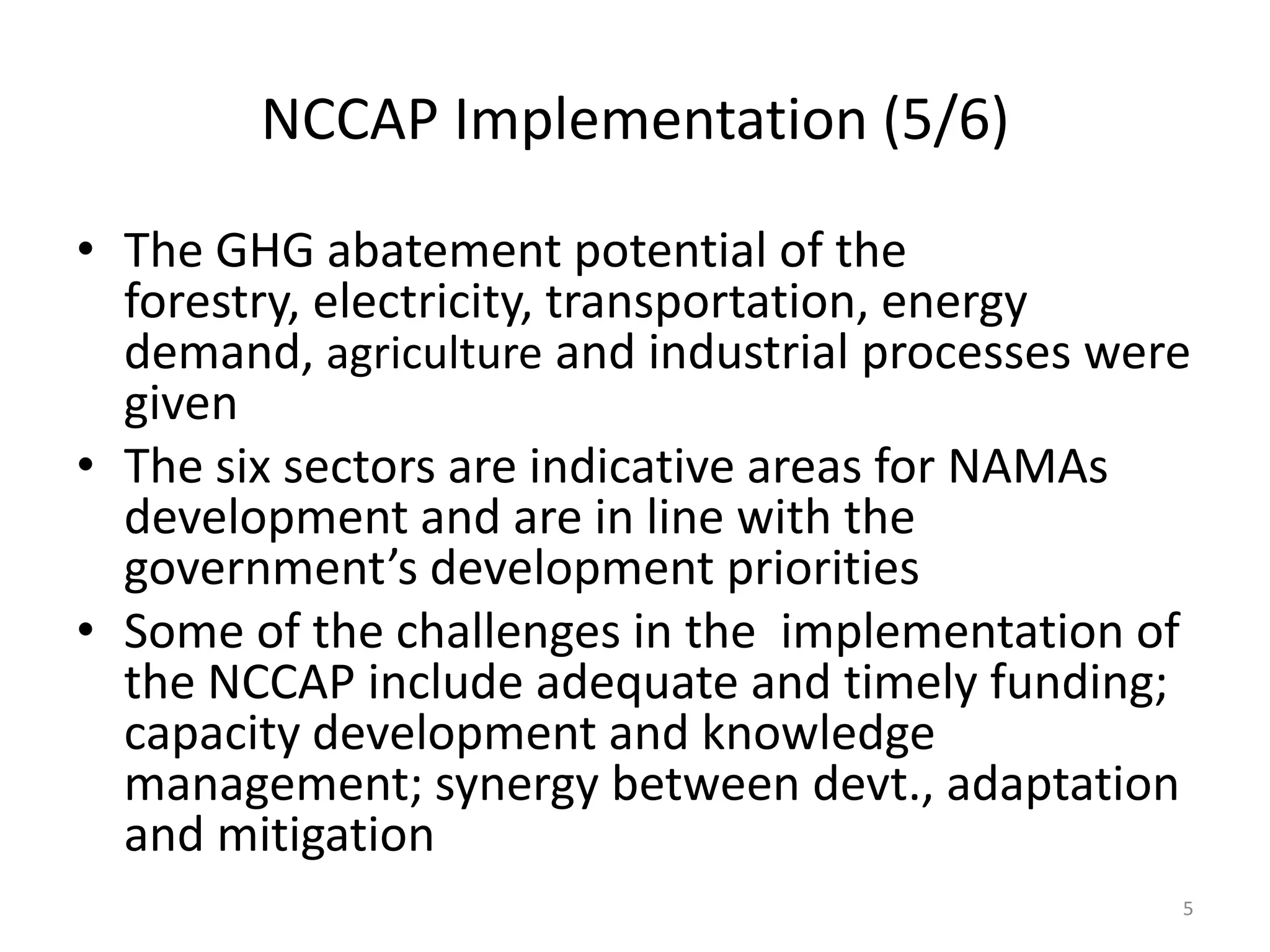
NCCAP Implementation (5/6)
• The GHG abatement potential of the
forestry, electricity, transportation, energy
demand, agriculture and industrial processes were
given
• The six sectors are indicative areas for NAMAs
development and are in line with the
government’s development priorities
• Some of the challenges in the implementation of
the NCCAP include adequate and timely funding;
capacity development and knowledge
management; synergy between devt., adaptation
and mitigation
5
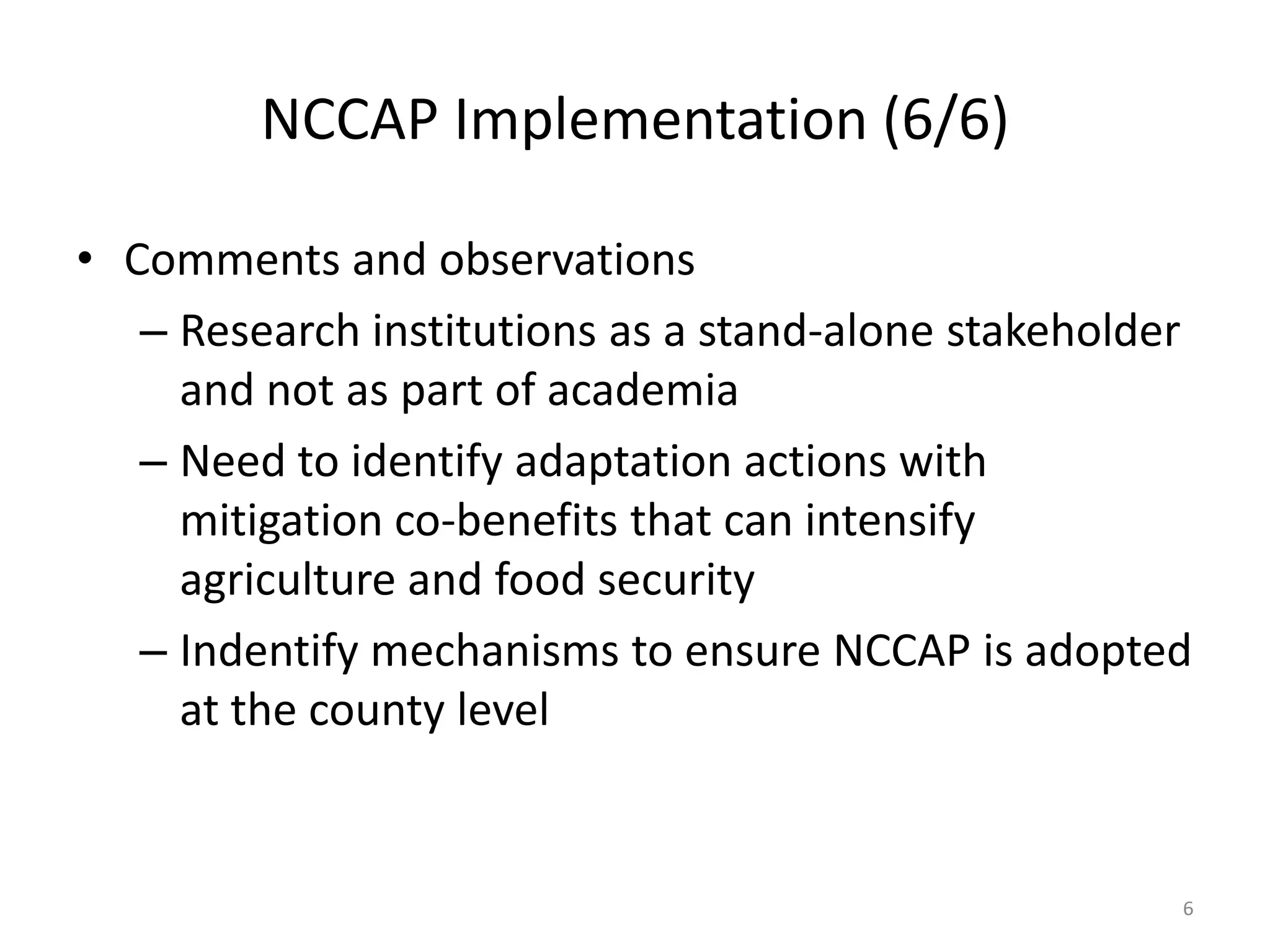
NCCAP Implementation (6/6)
• Comments and observations
– Research institutions as a stand-alone stakeholder
and not as part of academia
– Need to identify adaptation actions with
mitigation co-benefits that can intensify
agriculture and food security
– Indentify mechanisms to ensure NCCAP is adopted
at the county level
6
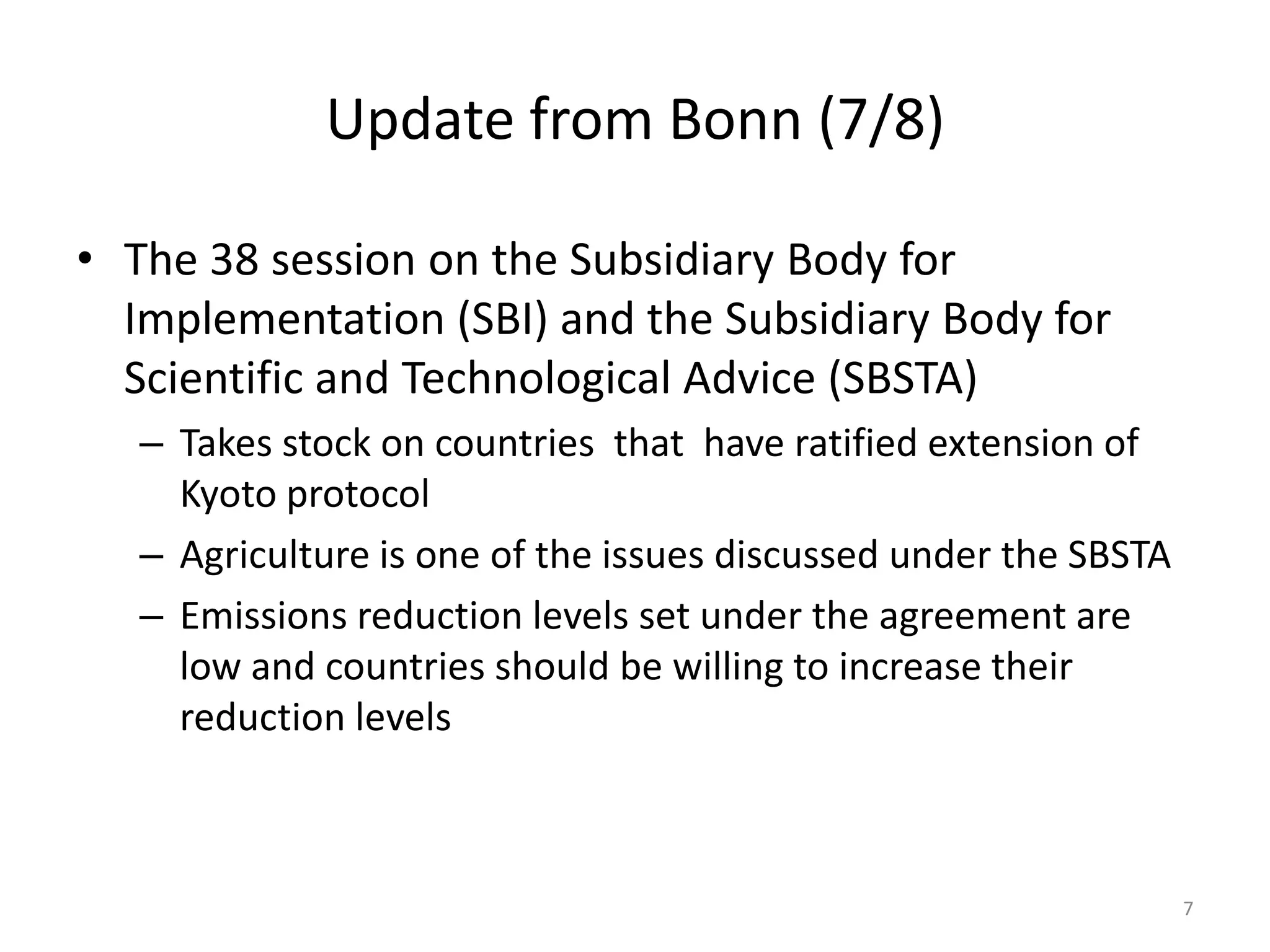
Update from Bonn (7/8)
• The 38 session on the Subsidiary Body for
Implementation (SBI) and the Subsidiary Body for
Scientific and Technological Advice (SBSTA)
– Takes stock on countries that have ratified extension of
Kyoto protocol
– Agriculture is one of the issues discussed under the SBSTA
– Emissions reduction levels set under the agreement are
low and countries should be willing to increase their
reduction levels
7
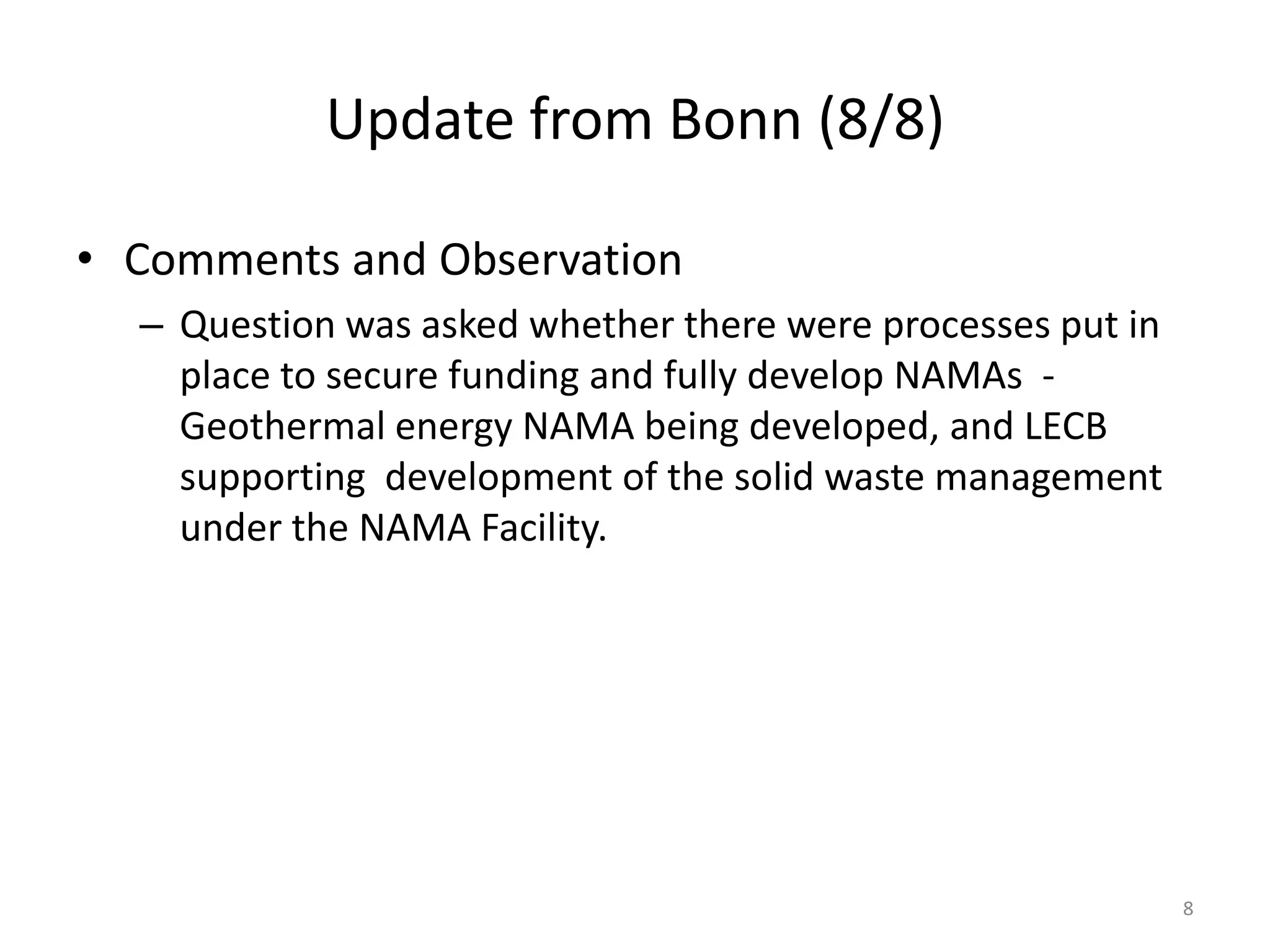
Update from Bonn (8/8)
• Comments and Observation
– Question was asked whether there were processes put in
place to secure funding and fully develop NAMAs -
Geothermal energy NAMA being developed, and LECB
supporting development of the solid waste management
under the NAMA Facility.
8
9
Overview of Agricultural Related Aspects in
NCCAP (9/10)
• Livestock contributes to approx. 30% of the total emissions –
hence agric. Important in climate change mitigation
• Mitigation options in the livestock sector were not provided in
NCCAP
• Low carbon resilient actions in agriculture include: agro
forestry, limited use if fire in crop lands and range
management, strategic food reserves, livestock diversification
etc.
• The MALF has a pilot project on carbon credit, based on
reduced emissions per unit of milk produced
• There exists a challenge on targeting adaptation and
mitigation: focus-reduce emissions but maintain food security
Overview of Agricultural Related Aspects in
NCCAP (10/10)
• Comments and observations
– How can rearrangement of landscape, which is
required in climate smart agriculture, e achieved?
– Revert to traditional /local breeds verses breed for
low emitting animals??
– Align adaptation options along the agro-ecological
zones
– Cultural change in dietary options to reduce
carbon foot prints
10
Moving Forward in Agricultural Adaptation
and Mitigation (11/13)
• Climate Smart Agric.-actions in agriculture and
food sector that:
– build food security
– help adaption to to changing climate
– help manage climate risk/mitigation
11
Moving Forward in Agricultural Adaptation
and Mitigation (12/13)
• Some case studies were examined on:
– Policies/national strategies – CSA major aim
– Policies and national climate plan which have a
negative impact on the community
– Climate risk management
– Case studies on agricultural initiatives that have a
strong link to climate adaptation and mitigation
12
• Out come of the meeting:
– The key outcome of the meeting was the agreement
to hold a National Adaptation Planning event for
Agriculture on 16th – 17th September 2013.
– The proposed outcome of the September meeting will
be a key resolution on how to take the NCCAP forward
in the agriculture sector
– The meeting agreed to create thematic working
groups which would focus on identifying mechanisms
for supporting the implementation of Agricultural
components of the NCCAP) and define a national
vision for Climate Smart Agriculture (CSA)
13
Moving Forward in Agricultural Adaptation
and Mitigation (13/13)

Roundtable on taking forward agricultural priority

  • 1.
    Brief – Roundtableon Taking Forward Agricultural Priority in kenya Agricultural Priority Actions in NCCP (26th July 2013)
  • 2.
    Preamble (2/3) • Roundtableheld between MEWNR and CCAFS on the 26th July 2013 at the Sarova Panafric Hotel, which was based on the UNFCCC and CCAFS East Africa: i. appreciation of NCCAP ownership across stakeholders and need of participation in its implementation and resource mobilization ii) Common understanding that implementation of the NCCP require active participation and contribution from research community 2
  • 3.
    Preamble (3/3) • Inattendance i. Government ii. Research institutions iii. Civil society organizations, iv. Farmer Organizations v. Private Sector • Four presentations were given, followed by plenary discussion: – providing insights on areas of partnership and collaboration – leading to agreeing on a strategy towards supporting NCCAP implementation 3
  • 4.
    NCCAP Implementation (4/6) •The process was developed through a multi- stakeholder engagement process, with financial support from various development partners • Key prioritized actions by sectors, for example, include: – Risk and vulnerability assessments of the different agricultural value chains (agriculture) – Up scaling of key agricultural actions like weather index based insurance, promotion of drought tolerant high value crops (agriculture) 4
  • 5.
    NCCAP Implementation (5/6) •The GHG abatement potential of the forestry, electricity, transportation, energy demand, agriculture and industrial processes were given • The six sectors are indicative areas for NAMAs development and are in line with the government’s development priorities • Some of the challenges in the implementation of the NCCAP include adequate and timely funding; capacity development and knowledge management; synergy between devt., adaptation and mitigation 5
  • 6.
    NCCAP Implementation (6/6) •Comments and observations – Research institutions as a stand-alone stakeholder and not as part of academia – Need to identify adaptation actions with mitigation co-benefits that can intensify agriculture and food security – Indentify mechanisms to ensure NCCAP is adopted at the county level 6
  • 7.
    Update from Bonn(7/8) • The 38 session on the Subsidiary Body for Implementation (SBI) and the Subsidiary Body for Scientific and Technological Advice (SBSTA) – Takes stock on countries that have ratified extension of Kyoto protocol – Agriculture is one of the issues discussed under the SBSTA – Emissions reduction levels set under the agreement are low and countries should be willing to increase their reduction levels 7
  • 8.
    Update from Bonn(8/8) • Comments and Observation – Question was asked whether there were processes put in place to secure funding and fully develop NAMAs - Geothermal energy NAMA being developed, and LECB supporting development of the solid waste management under the NAMA Facility. 8
  • 9.
    9 Overview of AgriculturalRelated Aspects in NCCAP (9/10) • Livestock contributes to approx. 30% of the total emissions – hence agric. Important in climate change mitigation • Mitigation options in the livestock sector were not provided in NCCAP • Low carbon resilient actions in agriculture include: agro forestry, limited use if fire in crop lands and range management, strategic food reserves, livestock diversification etc. • The MALF has a pilot project on carbon credit, based on reduced emissions per unit of milk produced • There exists a challenge on targeting adaptation and mitigation: focus-reduce emissions but maintain food security
  • 10.
    Overview of AgriculturalRelated Aspects in NCCAP (10/10) • Comments and observations – How can rearrangement of landscape, which is required in climate smart agriculture, e achieved? – Revert to traditional /local breeds verses breed for low emitting animals?? – Align adaptation options along the agro-ecological zones – Cultural change in dietary options to reduce carbon foot prints 10
  • 11.
    Moving Forward inAgricultural Adaptation and Mitigation (11/13) • Climate Smart Agric.-actions in agriculture and food sector that: – build food security – help adaption to to changing climate – help manage climate risk/mitigation 11
  • 12.
    Moving Forward inAgricultural Adaptation and Mitigation (12/13) • Some case studies were examined on: – Policies/national strategies – CSA major aim – Policies and national climate plan which have a negative impact on the community – Climate risk management – Case studies on agricultural initiatives that have a strong link to climate adaptation and mitigation 12
  • 13.
    • Out comeof the meeting: – The key outcome of the meeting was the agreement to hold a National Adaptation Planning event for Agriculture on 16th – 17th September 2013. – The proposed outcome of the September meeting will be a key resolution on how to take the NCCAP forward in the agriculture sector – The meeting agreed to create thematic working groups which would focus on identifying mechanisms for supporting the implementation of Agricultural components of the NCCAP) and define a national vision for Climate Smart Agriculture (CSA) 13 Moving Forward in Agricultural Adaptation and Mitigation (13/13)