Financing Options for Nationally Appropriate
Mitigation Actions (NAMAs) Development
Armine Avagyan
28-30 October 2015, Asia LEDS Partnership Regional Workshop,
Mobilizing Investment for Low-Emission Development in Asia’s
Agriculture Sector: Crop Production and Processing
Outline
1. Concept of Nationally Appropriate Mitigation Actions (NAMAs)
2. Step by step development of NAMAs in agriculture and land use sectors
3. Financing of NAMAs
4. FAO online learning tool on NAMAs in agriculture
NAMAs key characteristics
In line with
national
sustainable
development
priorities
Reduce
emissions
enhance GHG
removals
Measurable,
reportable and
verifiable
Can receive
support from
domestic
and/or
international
sources
NAMAs
In the UNFCCC’s Bali Action Plan
(2007), it was decided to launch
mitigation actions for developing
countries “ […] Nationally
appropriate mitigation actions by
developing country Parties in the
context of sustainable development,
supported and enabled by
technology, financing and capacity
building, in a measurable, reportable
and verifiable manner.”
(Decision 1/CP.13, paragraph 1 (b)
(ii))
NAMAs benefits
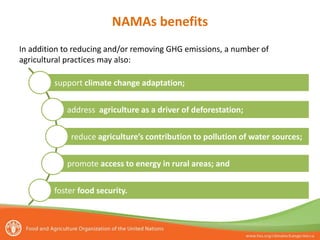
In addition to reducing and/or removing GHG emissions, a number of
agricultural practices may also:
support climate change adaptation;
address agriculture as a driver of deforestation;
reduce agriculture’s contribution to pollution of water sources;
promote access to energy in rural areas; and
foster food security.
NAMAs sectorial distribution
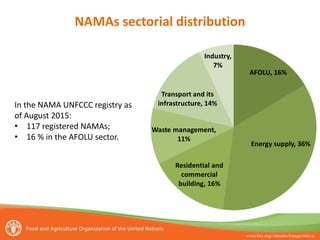
In the NAMA UNFCCC registry as
of August 2015:
• 117 registered NAMAs;
• 16 % in the AFOLU sector.
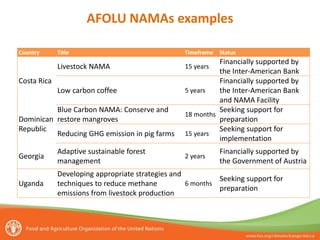
AFOLU NAMAs examples
Country Title Timeframe Status
Costa Rica
Livestock NAMA 15 years
Financially supported by
the Inter-American Bank
Low carbon coffee 5 years
Financially supported by
the Inter-American Bank
and NAMA Facility
Dominican
Republic
Blue Carbon NAMA: Conserve and
restore mangroves
18 months
Seeking support for
preparation
Reducing GHG emission in pig farms 15 years
Seeking support for
implementation
Georgia
Adaptive sustainable forest
management
2 years
Financially supported by
the Government of Austria
Uganda
Developing appropriate strategies and
techniques to reduce methane
emissions from livestock production
6 months
Seeking support for
preparation
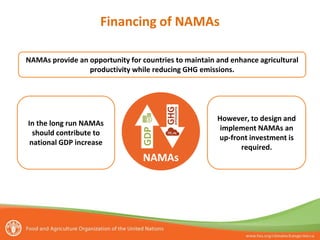
Financing of NAMAs
NAMAs provide an opportunity for countries to maintain and enhance agricultural
productivity while reducing GHG emissions.
In the long run NAMAs
should contribute to
national GDP increase
However, to design and
implement NAMAs an
up-front investment is
required.
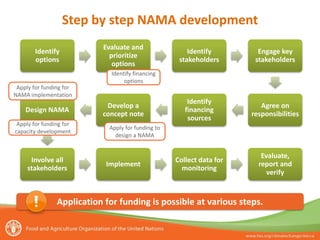
Step by step NAMA development
Identify
options
Evaluate and
prioritize
options
Identify
stakeholders
Engage key
stakeholders
Agree on
responsibilities
Identify
financing
sources
Develop a
concept note
Design NAMA
Involve all
stakeholders
Implement
Collect data for
monitoring
Evaluate,
report and
verify
Application for funding is possible at various steps.
Identify financing
options
Apply for funding to
design a NAMA
Apply for funding for
NAMA implementation
Apply for funding for
capacity development
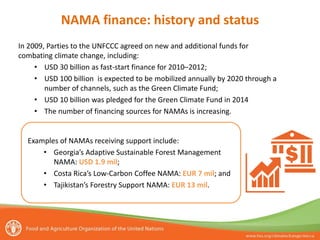
NAMA finance: history and status
In 2009, Parties to the UNFCCC agreed on new and additional funds for
combating climate change, including:
• USD 30 billion as fast-start finance for 2010–2012;
• USD 100 billion is expected to be mobilized annually by 2020 through a
number of channels, such as the Green Climate Fund;
• USD 10 billion was pledged for the Green Climate Fund in 2014
• The number of financing sources for NAMAs is increasing.
Examples of NAMAs receiving support include:
• Georgia’s Adaptive Sustainable Forest Management
NAMA: USD 1.9 mil;
• Costa Rica’s Low-Carbon Coffee NAMA: EUR 7 mil; and
• Tajikistan’s Forestry Support NAMA: EUR 13 mil.
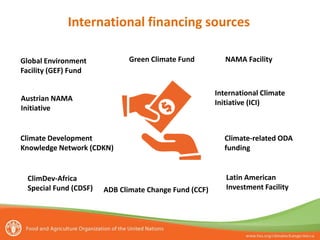
International financing sources
Green Climate Fund NAMA Facility
Austrian NAMA
Initiative
Global Environment
Facility (GEF) Fund
International Climate
Initiative (ICI)
Latin American
Investment Facility
Climate-related ODA
funding
ADB Climate Change Fund (CCF)
ClimDev-Africa
Special Fund (CDSF)
Climate Development
Knowledge Network (CDKN)
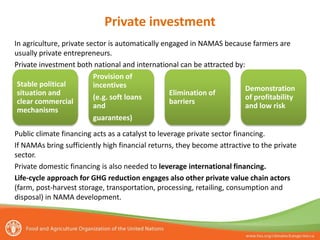
In agriculture, private sector is automatically engaged in NAMAS because farmers are
usually private entrepreneurs.
Private investment both national and international can be attracted by:
Public climate financing acts as a catalyst to leverage private sector financing.
If NAMAs bring sufficiently high financial returns, they become attractive to the private
sector.
Private domestic financing is also needed to leverage international financing.
Life-cycle approach for GHG reduction engages also other private value chain actors
(farm, post-harvest storage, transportation, processing, retailing, consumption and
disposal) in NAMA development.
Stable political
situation and
clear commercial
mechanisms
Provision of
incentives
(e.g. soft loans
and
guarantees)
Elimination of
barriers
Demonstration
of profitability
and low risk
Private investment
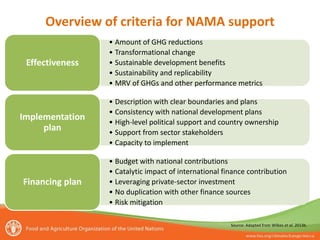
Overview of criteria for NAMA support
• Amount of GHG reductions
• Transformational change
• Sustainable development benefits
• Sustainability and replicability
• MRV of GHGs and other performance metrics
Effectiveness
• Description with clear boundaries and plans
• Consistency with national development plans
• High-level political support and country ownership
• Support from sector stakeholders
• Capacity to implement
Implementation
plan
• Budget with national contributions
• Catalytic impact of international finance contribution
• Leveraging private-sector investment
• No duplication with other finance sources
• Risk mitigation
Financing plan
Source: Adapted from Wilkes et al. 2013b.
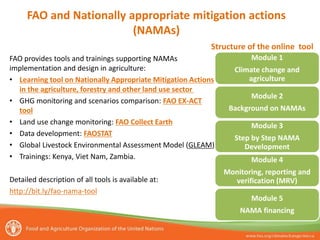
FAO and Nationally appropriate mitigation actions
(NAMAs)
Module 1
Climate change and
agriculture
Module 2
Background on NAMAs
Module 3
Step by Step NAMA
Development
Module 4
Monitoring, reporting and
verification (MRV)
Module 5
NAMA financing
Structure of the online tool
FAO provides tools and trainings supporting NAMAs
implementation and design in agriculture:
• Learning tool on Nationally Appropriate Mitigation Actions
in the agriculture, forestry and other land use sector
• GHG monitoring and scenarios comparison: FAO EX-ACT
tool
• Land use change monitoring: FAO Collect Earth
• Data development: FAOSTAT
• Global Livestock Environmental Assessment Model (GLEAM)
• Trainings: Kenya, Viet Nam, Zambia.
Detailed description of all tools is available at:
http://bit.ly/fao-nama-tool
Thank you for your attention
Contact:
micca@fao.org,
armine.avagyan@fao.org

Financing Options for Nationally Appropriate Mitigation Actions (NAMAs) Development

  • 1.
    Financing Options forNationally Appropriate Mitigation Actions (NAMAs) Development Armine Avagyan 28-30 October 2015, Asia LEDS Partnership Regional Workshop, Mobilizing Investment for Low-Emission Development in Asia’s Agriculture Sector: Crop Production and Processing
  • 2.
    Outline 1. Concept ofNationally Appropriate Mitigation Actions (NAMAs) 2. Step by step development of NAMAs in agriculture and land use sectors 3. Financing of NAMAs 4. FAO online learning tool on NAMAs in agriculture
  • 3.
    NAMAs key characteristics Inline with national sustainable development priorities Reduce emissions enhance GHG removals Measurable, reportable and verifiable Can receive support from domestic and/or international sources NAMAs In the UNFCCC’s Bali Action Plan (2007), it was decided to launch mitigation actions for developing countries “ […] Nationally appropriate mitigation actions by developing country Parties in the context of sustainable development, supported and enabled by technology, financing and capacity building, in a measurable, reportable and verifiable manner.” (Decision 1/CP.13, paragraph 1 (b) (ii))
  • 4.
    NAMAs benefits In additionto reducing and/or removing GHG emissions, a number of agricultural practices may also: support climate change adaptation; address agriculture as a driver of deforestation; reduce agriculture’s contribution to pollution of water sources; promote access to energy in rural areas; and foster food security.
  • 5.
    NAMAs sectorial distribution Inthe NAMA UNFCCC registry as of August 2015: • 117 registered NAMAs; • 16 % in the AFOLU sector.
  • 6.
    AFOLU NAMAs examples CountryTitle Timeframe Status Costa Rica Livestock NAMA 15 years Financially supported by the Inter-American Bank Low carbon coffee 5 years Financially supported by the Inter-American Bank and NAMA Facility Dominican Republic Blue Carbon NAMA: Conserve and restore mangroves 18 months Seeking support for preparation Reducing GHG emission in pig farms 15 years Seeking support for implementation Georgia Adaptive sustainable forest management 2 years Financially supported by the Government of Austria Uganda Developing appropriate strategies and techniques to reduce methane emissions from livestock production 6 months Seeking support for preparation
  • 7.
    Financing of NAMAs NAMAsprovide an opportunity for countries to maintain and enhance agricultural productivity while reducing GHG emissions. In the long run NAMAs should contribute to national GDP increase However, to design and implement NAMAs an up-front investment is required.
  • 8.
    Step by stepNAMA development Identify options Evaluate and prioritize options Identify stakeholders Engage key stakeholders Agree on responsibilities Identify financing sources Develop a concept note Design NAMA Involve all stakeholders Implement Collect data for monitoring Evaluate, report and verify Application for funding is possible at various steps. Identify financing options Apply for funding to design a NAMA Apply for funding for NAMA implementation Apply for funding for capacity development
  • 9.
    NAMA finance: historyand status In 2009, Parties to the UNFCCC agreed on new and additional funds for combating climate change, including: • USD 30 billion as fast-start finance for 2010–2012; • USD 100 billion is expected to be mobilized annually by 2020 through a number of channels, such as the Green Climate Fund; • USD 10 billion was pledged for the Green Climate Fund in 2014 • The number of financing sources for NAMAs is increasing. Examples of NAMAs receiving support include: • Georgia’s Adaptive Sustainable Forest Management NAMA: USD 1.9 mil; • Costa Rica’s Low-Carbon Coffee NAMA: EUR 7 mil; and • Tajikistan’s Forestry Support NAMA: EUR 13 mil.
  • 10.
    International financing sources GreenClimate Fund NAMA Facility Austrian NAMA Initiative Global Environment Facility (GEF) Fund International Climate Initiative (ICI) Latin American Investment Facility Climate-related ODA funding ADB Climate Change Fund (CCF) ClimDev-Africa Special Fund (CDSF) Climate Development Knowledge Network (CDKN)
  • 11.
    In agriculture, privatesector is automatically engaged in NAMAS because farmers are usually private entrepreneurs. Private investment both national and international can be attracted by: Public climate financing acts as a catalyst to leverage private sector financing. If NAMAs bring sufficiently high financial returns, they become attractive to the private sector. Private domestic financing is also needed to leverage international financing. Life-cycle approach for GHG reduction engages also other private value chain actors (farm, post-harvest storage, transportation, processing, retailing, consumption and disposal) in NAMA development. Stable political situation and clear commercial mechanisms Provision of incentives (e.g. soft loans and guarantees) Elimination of barriers Demonstration of profitability and low risk Private investment
  • 12.
    Overview of criteriafor NAMA support • Amount of GHG reductions • Transformational change • Sustainable development benefits • Sustainability and replicability • MRV of GHGs and other performance metrics Effectiveness • Description with clear boundaries and plans • Consistency with national development plans • High-level political support and country ownership • Support from sector stakeholders • Capacity to implement Implementation plan • Budget with national contributions • Catalytic impact of international finance contribution • Leveraging private-sector investment • No duplication with other finance sources • Risk mitigation Financing plan Source: Adapted from Wilkes et al. 2013b.
  • 13.
    FAO and Nationallyappropriate mitigation actions (NAMAs) Module 1 Climate change and agriculture Module 2 Background on NAMAs Module 3 Step by Step NAMA Development Module 4 Monitoring, reporting and verification (MRV) Module 5 NAMA financing Structure of the online tool FAO provides tools and trainings supporting NAMAs implementation and design in agriculture: • Learning tool on Nationally Appropriate Mitigation Actions in the agriculture, forestry and other land use sector • GHG monitoring and scenarios comparison: FAO EX-ACT tool • Land use change monitoring: FAO Collect Earth • Data development: FAOSTAT • Global Livestock Environmental Assessment Model (GLEAM) • Trainings: Kenya, Viet Nam, Zambia. Detailed description of all tools is available at: http://bit.ly/fao-nama-tool
  • 14.
    Thank you foryour attention Contact: micca@fao.org, armine.avagyan@fao.org