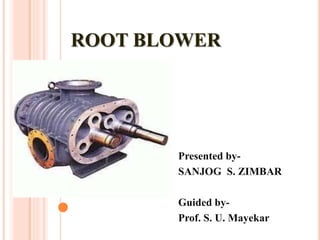
ROOT BLOWER
Presented by-
SANJOG S. ZIMBAR
Guided by-
Prof. S. U. Mayekar
CONTENT
 INTRODUCTION
 HISTORY
 TYPES OF ROOT BLOWER
 DIFFERENCE
 CONSTRUCTION
 WORKING
 ADVANTAGES
 DISADVAVATAGE
 APPLICATION
INTRODUCTION
 Root type supercharger or Root Blower is positive
displacement lobe Pump.
 Which operates by pumping the fluid with the pair of
meshing lobes.
 Fluid is trapped around the lobes and carried from
the intake side to the exhaust.
 Frequently used supercharger in engine, where is
drive directly from the crankshaft via a belt, chain or
gears.
HISTORY
 It is named after the American inventors brothers
“Philander” and “Francis Marion Roots”.
 basic design in 1860 as an Air pump for use in blast
furnaces.
 In 1900 “Gottlieb Daimler “ making the root type
supercharger in patented engine design.
 Commonly called as “Huffers”. Which is used in
gasoline burning engines.
TYPES OF ROOT BLOWER
TWIN LOBE BLOWER THREE LOBE BLOWER
TWO LOBE BLOWER VS THREE LOBE BLOWER
Two lobe blower Three lobe blower
More reverse flow pressure variation
period
Less reverse flow pressure variation
period
Peak value is higher. Peak value is also lower
More noise vibration and pressure
pulsation.
Limited noise, vibration & pressure
pulsation
Life is comparetivly less. Life is more .
Less air flow delivery. Deliver large air flow .
Less efficiency. High efficiency.
CONSTRUCTION
 Major parts:
 Rotary vane 1
 Pump body
 Rotary vane 2
 Intake port
 Discharge port
o Two rotor are assembled with casing two side
plates and keep small gap.
o No contact rotation bet. The casing & two rotors &
two side plates.
o When motor output to drive rotor & start working.
WORKING
 Root blower consists two lobe rotors & rotate in
synchronous & opposite direction.
 Continue to turn & suction a quantity of gas bet. the
rotating rotors.
 Each rotor come into contact with the internal
surface of the casing.
 Creates a chamber in which the gas is trapped.
 As the rotation continues, the trapped gas moves
along until it reaches the position of the discharging
port.
CONTINUE…
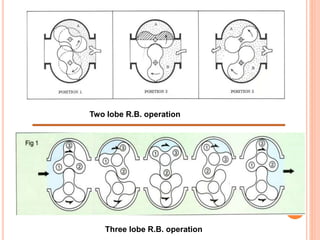
 Two lobes makes six intake and & exhaust cycle
per revolution in three lobe R.B.
 It is determine by its operating speed.
 Independent on the inlet and outlet ports.
 The process as follows:
 Air intake
 Enclose by rotor and casing
 Air discharge
Two lobe R.B. operation
Three lobe R.B. operation
ROOTS-BLOWER ADVANTAGES
 A roots-blower quickly attains the full number of
revolutions;
 The power demand in the partial-load range is
lower.
ROOTS-BLOWER DISADVANTAGES
 Wear on the conveyor pipe and breakage of the
conveying material will be greater;
 To minimise the expensive noise dampening equipment
will be necessary.
 Not to exceed the operating pressures, a control device
must be installed.
 Filter cleaning of the conveying air is required.
 After a longer period of use, the capacity losses.
APPLICATION
 Passenger automobile application.
 Used on two stroke diesel engine.
 Typically used in application where a large volume
of air must be moved across a relatively small
pressure differential.
 Low vacuum application.
THANK YOU…!

Root blower

  • 1.
    ROOT BLOWER Presented by- SANJOGS. ZIMBAR Guided by- Prof. S. U. Mayekar
  • 2.
    CONTENT  INTRODUCTION  HISTORY TYPES OF ROOT BLOWER  DIFFERENCE  CONSTRUCTION  WORKING  ADVANTAGES  DISADVAVATAGE  APPLICATION
  • 3.
    INTRODUCTION  Root typesupercharger or Root Blower is positive displacement lobe Pump.  Which operates by pumping the fluid with the pair of meshing lobes.  Fluid is trapped around the lobes and carried from the intake side to the exhaust.  Frequently used supercharger in engine, where is drive directly from the crankshaft via a belt, chain or gears.
  • 4.
    HISTORY  It isnamed after the American inventors brothers “Philander” and “Francis Marion Roots”.  basic design in 1860 as an Air pump for use in blast furnaces.  In 1900 “Gottlieb Daimler “ making the root type supercharger in patented engine design.  Commonly called as “Huffers”. Which is used in gasoline burning engines.
  • 5.
    TYPES OF ROOTBLOWER TWIN LOBE BLOWER THREE LOBE BLOWER
  • 6.
    TWO LOBE BLOWERVS THREE LOBE BLOWER Two lobe blower Three lobe blower More reverse flow pressure variation period Less reverse flow pressure variation period Peak value is higher. Peak value is also lower More noise vibration and pressure pulsation. Limited noise, vibration & pressure pulsation Life is comparetivly less. Life is more . Less air flow delivery. Deliver large air flow . Less efficiency. High efficiency.
  • 7.
    CONSTRUCTION  Major parts: Rotary vane 1  Pump body  Rotary vane 2  Intake port  Discharge port o Two rotor are assembled with casing two side plates and keep small gap. o No contact rotation bet. The casing & two rotors & two side plates. o When motor output to drive rotor & start working.
  • 8.
    WORKING  Root blowerconsists two lobe rotors & rotate in synchronous & opposite direction.  Continue to turn & suction a quantity of gas bet. the rotating rotors.  Each rotor come into contact with the internal surface of the casing.  Creates a chamber in which the gas is trapped.  As the rotation continues, the trapped gas moves along until it reaches the position of the discharging port.
  • 9.
    CONTINUE…  Two lobesmakes six intake and & exhaust cycle per revolution in three lobe R.B.  It is determine by its operating speed.  Independent on the inlet and outlet ports.  The process as follows:  Air intake  Enclose by rotor and casing  Air discharge
  • 10.
    Two lobe R.B.operation Three lobe R.B. operation
  • 11.
    ROOTS-BLOWER ADVANTAGES  Aroots-blower quickly attains the full number of revolutions;  The power demand in the partial-load range is lower.
  • 12.
    ROOTS-BLOWER DISADVANTAGES  Wearon the conveyor pipe and breakage of the conveying material will be greater;  To minimise the expensive noise dampening equipment will be necessary.  Not to exceed the operating pressures, a control device must be installed.  Filter cleaning of the conveying air is required.  After a longer period of use, the capacity losses.
  • 13.
    APPLICATION  Passenger automobileapplication.  Used on two stroke diesel engine.  Typically used in application where a large volume of air must be moved across a relatively small pressure differential.  Low vacuum application.
  • 14.