Positive Displacement Machines
Reciprocating and rotary machines
 Function of a compressor (gas/often air)
 Efficient machine – minimum input of mechanical work
 Types
 Reciprocating positive displacement machines (pulsating in action limiting flow rate)
 Rotary positive displacement machines (continuous action, small, light, simple)
 Reciprocating – low mass rate of flow + high pressure ratios (500 bar +)
 Rotary – high mass rate of flow + low pressure ratios – scavenging and supercharging
of engines, exhausting, vacuum pumping (9 bar)
 Forms – single stage or – multi stage
 Air or water cooling
 Properties at inlet and outlet are average values taken over the cycle
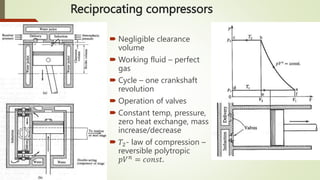
Reciprocating compressors
 Negligible clearance
volume
 Working fluid – perfect
gas
 Cycle – one crankshaft
revolution
 Operation of valves
 Constant temp, pressure,
zero heat exchange, mass
increase/decrease
 𝑇2- law of compression –
reversible polytropic
𝑝𝑉𝑛 = 𝑐𝑜𝑛𝑠𝑡.
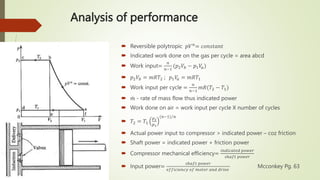
Analysis of performance
 Reversible polytropic 𝑝𝑉𝑛
= 𝑐𝑜𝑛𝑠𝑡𝑎𝑛𝑡
 Indicated work done on the gas per cycle = area abcd
 Work input=
𝑛
𝑛−1
(𝑝2𝑉𝑏 − 𝑝1𝑉
𝑎)
 𝑝2𝑉𝑏 = 𝑚𝑅𝑇2 ; 𝑝1𝑉
𝑎 = 𝑚𝑅𝑇1
 Work input per cycle =
𝑛
𝑛−1
𝑚𝑅(𝑇2 − 𝑇1)
 𝑚 - rate of mass flow thus indicated power
 Work done on air = work input per cycle X number of cycles
 𝑇2 = 𝑇1
𝑝2
𝑝1
(𝑛−1) 𝑛
 Actual power input to compressor > indicated power – coz friction
 Shaft power = indicated power + friction power
 Compressor mechanical efficiency=
𝑖𝑛𝑑𝑖𝑐𝑎𝑡𝑒𝑑 𝑝𝑜𝑤𝑒𝑟
𝑠ℎ𝑎𝑓𝑡 𝑝𝑜𝑤𝑒𝑟
 Input power=
𝑠ℎ𝑎𝑓𝑡 𝑝𝑜𝑤𝑒𝑟
𝑒𝑓𝑓𝑖𝑐𝑖𝑒𝑛𝑐𝑦 𝑜𝑓 𝑚𝑜𝑡𝑜𝑟 𝑎𝑛𝑑 𝑑𝑟𝑖𝑣𝑒
Mcconkey Pg. 63
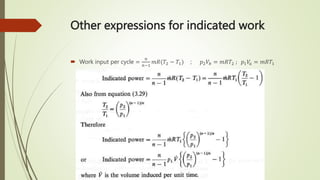
Other expressions for indicated work
 Work input per cycle =
𝑛
𝑛−1
𝑚𝑅(𝑇2 − 𝑇1) ; 𝑝2𝑉𝑏 = 𝑚𝑅𝑇2 ; 𝑝1𝑉
𝑎 = 𝑚𝑅𝑇1
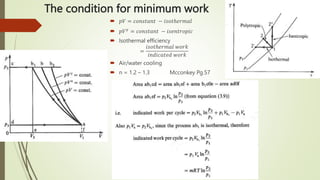
The condition for minimum work
 𝑝𝑉 = 𝑐𝑜𝑛𝑠𝑡𝑎𝑛𝑡 − 𝑖𝑠𝑜𝑡ℎ𝑒𝑟𝑚𝑎𝑙
 𝑝𝑉𝛾
= 𝑐𝑜𝑛𝑠𝑡𝑎𝑛𝑡 − 𝑖𝑠𝑒𝑛𝑡𝑟𝑜𝑝𝑖𝑐
 Isothermal efficiency
=
𝑖𝑠𝑜𝑡ℎ𝑒𝑟𝑚𝑎𝑙 𝑤𝑜𝑟𝑘
𝑖𝑛𝑑𝑖𝑐𝑎𝑡𝑒𝑑 𝑤𝑜𝑟𝑘
 Air/water cooling
 n = 1.2 – 1.3 Mcconkey Pg.57
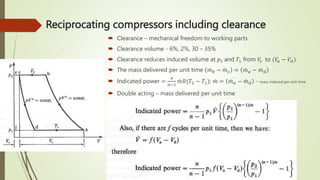
Reciprocating compressors including clearance
 Clearance – mechanical freedom to working parts
 Clearance volume - 6%, 2%, 30 – 35%
 Clearance reduces induced volume at 𝑝1 and 𝑇1 from 𝑉
𝑠 to (𝑉
𝑎 − 𝑉𝑑)
 The mass delivered per unit time 𝑚𝑏 − 𝑚𝑐 = 𝑚𝑎 − 𝑚𝑑
 Indicated power =
𝑛
𝑛−1
𝑚𝑅(𝑇2 − 𝑇1); 𝑚 = 𝑚𝑎 − 𝑚𝑑 - mass induced per unit time
 Double acting – mass delivered per unit time
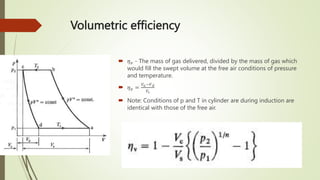
Volumetric efficiency
 𝜂𝑣 - The mass of gas delivered, divided by the mass of gas which
would fill the swept volume at the free air conditions of pressure
and temperature.
 𝜂𝑣 =
𝑉𝑎−𝑉𝑑
𝑉𝑠
 Note: Conditions of p and T in cylinder are during induction are
identical with those of the free air.
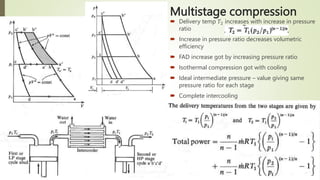
Multistage compression
 Delivery temp 𝑇2 increases with increase in pressure
ratio
 Increase in pressure ratio decreases volumetric
efficiency
 FAD increase got by increasing pressure ratio
 Isothermal compression got with cooling
 Ideal intermediate pressure – value giving same
pressure ratio for each stage
 Complete intercooling
Rotary machines
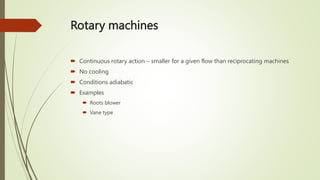
 Continuous rotary action – smaller for a given flow than reciprocating machines
 No cooling
 Conditions adiabatic
 Examples
 Roots blower
 Vane type
Roots blower
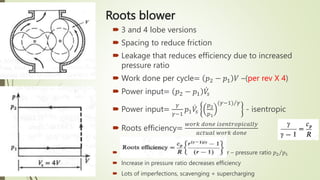
 3 and 4 lobe versions
 Spacing to reduce friction
 Leakage that reduces efficiency due to increased
pressure ratio
 Work done per cycle= 𝑝2 − 𝑝1 𝑉 –(per rev X 4)
 Power input= 𝑝2 − 𝑝1 𝑉
𝑠
 Power input=
𝛾
𝛾−1
𝑝1𝑉
𝑠
𝑝2
𝑝1
(𝛾−1) 𝛾
- isentropic
 Roots efficiency=
𝑤𝑜𝑟𝑘 𝑑𝑜𝑛𝑒 𝑖𝑠𝑒𝑛𝑡𝑟𝑜𝑝𝑖𝑐𝑎𝑙𝑙𝑦
𝑎𝑐𝑡𝑢𝑎𝑙 𝑤𝑜𝑟𝑘 𝑑𝑜𝑛𝑒
 r – pressure ratio 𝑝2 𝑝1
 Increase in pressure ratio decreases efficiency
 Lots of imperfections, scavenging + supercharging
Vane type
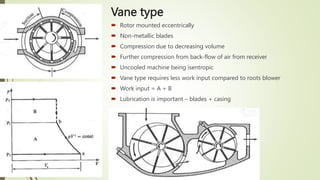
 Rotor mounted eccentrically
 Non-metallic blades
 Compression due to decreasing volume
 Further compression from back-flow of air from receiver
 Uncooled machine being isentropic
 Vane type requires less work input compared to roots blower
 Work input = A + B
 Lubrication is important – blades + casing
Vacuum pumps
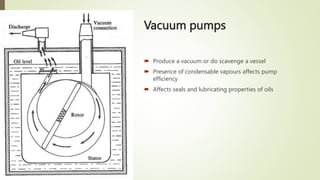
 Produce a vacuum or do scavenge a vessel
 Presence of condensable vapours affects pump
efficiency
 Affects seals and lubricating properties of oils
Ref
 T. D. Eastop and A. Mcconkey. Applied Thermodynamics for Engineering Technologists. 5th
Edition
NOTE:
 The term "polytropic" was originally coined to describe any reversible process on
any open or closed system of gas or vapor which involves both heat and work
transfer, such that a specified combination of properties were maintained constant
throughout the process.
 The polytropic process can describe gas expansion and compression, which include
heat transfer.
 It obeys the relation: 𝑝𝑉𝑛= 𝑐𝑜𝑛𝑠𝑡𝑎𝑛𝑡

3. Positive Displacement Machines.pptx

  • 1.
  • 2.
    Reciprocating and rotarymachines  Function of a compressor (gas/often air)  Efficient machine – minimum input of mechanical work  Types  Reciprocating positive displacement machines (pulsating in action limiting flow rate)  Rotary positive displacement machines (continuous action, small, light, simple)  Reciprocating – low mass rate of flow + high pressure ratios (500 bar +)  Rotary – high mass rate of flow + low pressure ratios – scavenging and supercharging of engines, exhausting, vacuum pumping (9 bar)  Forms – single stage or – multi stage  Air or water cooling  Properties at inlet and outlet are average values taken over the cycle
  • 3.
    Reciprocating compressors  Negligibleclearance volume  Working fluid – perfect gas  Cycle – one crankshaft revolution  Operation of valves  Constant temp, pressure, zero heat exchange, mass increase/decrease  𝑇2- law of compression – reversible polytropic 𝑝𝑉𝑛 = 𝑐𝑜𝑛𝑠𝑡.
  • 4.
    Analysis of performance Reversible polytropic 𝑝𝑉𝑛 = 𝑐𝑜𝑛𝑠𝑡𝑎𝑛𝑡  Indicated work done on the gas per cycle = area abcd  Work input= 𝑛 𝑛−1 (𝑝2𝑉𝑏 − 𝑝1𝑉 𝑎)  𝑝2𝑉𝑏 = 𝑚𝑅𝑇2 ; 𝑝1𝑉 𝑎 = 𝑚𝑅𝑇1  Work input per cycle = 𝑛 𝑛−1 𝑚𝑅(𝑇2 − 𝑇1)  𝑚 - rate of mass flow thus indicated power  Work done on air = work input per cycle X number of cycles  𝑇2 = 𝑇1 𝑝2 𝑝1 (𝑛−1) 𝑛  Actual power input to compressor > indicated power – coz friction  Shaft power = indicated power + friction power  Compressor mechanical efficiency= 𝑖𝑛𝑑𝑖𝑐𝑎𝑡𝑒𝑑 𝑝𝑜𝑤𝑒𝑟 𝑠ℎ𝑎𝑓𝑡 𝑝𝑜𝑤𝑒𝑟  Input power= 𝑠ℎ𝑎𝑓𝑡 𝑝𝑜𝑤𝑒𝑟 𝑒𝑓𝑓𝑖𝑐𝑖𝑒𝑛𝑐𝑦 𝑜𝑓 𝑚𝑜𝑡𝑜𝑟 𝑎𝑛𝑑 𝑑𝑟𝑖𝑣𝑒 Mcconkey Pg. 63
  • 5.
    Other expressions forindicated work  Work input per cycle = 𝑛 𝑛−1 𝑚𝑅(𝑇2 − 𝑇1) ; 𝑝2𝑉𝑏 = 𝑚𝑅𝑇2 ; 𝑝1𝑉 𝑎 = 𝑚𝑅𝑇1
  • 6.
    The condition forminimum work  𝑝𝑉 = 𝑐𝑜𝑛𝑠𝑡𝑎𝑛𝑡 − 𝑖𝑠𝑜𝑡ℎ𝑒𝑟𝑚𝑎𝑙  𝑝𝑉𝛾 = 𝑐𝑜𝑛𝑠𝑡𝑎𝑛𝑡 − 𝑖𝑠𝑒𝑛𝑡𝑟𝑜𝑝𝑖𝑐  Isothermal efficiency = 𝑖𝑠𝑜𝑡ℎ𝑒𝑟𝑚𝑎𝑙 𝑤𝑜𝑟𝑘 𝑖𝑛𝑑𝑖𝑐𝑎𝑡𝑒𝑑 𝑤𝑜𝑟𝑘  Air/water cooling  n = 1.2 – 1.3 Mcconkey Pg.57
  • 7.
    Reciprocating compressors includingclearance  Clearance – mechanical freedom to working parts  Clearance volume - 6%, 2%, 30 – 35%  Clearance reduces induced volume at 𝑝1 and 𝑇1 from 𝑉 𝑠 to (𝑉 𝑎 − 𝑉𝑑)  The mass delivered per unit time 𝑚𝑏 − 𝑚𝑐 = 𝑚𝑎 − 𝑚𝑑  Indicated power = 𝑛 𝑛−1 𝑚𝑅(𝑇2 − 𝑇1); 𝑚 = 𝑚𝑎 − 𝑚𝑑 - mass induced per unit time  Double acting – mass delivered per unit time
  • 8.
    Volumetric efficiency  𝜂𝑣- The mass of gas delivered, divided by the mass of gas which would fill the swept volume at the free air conditions of pressure and temperature.  𝜂𝑣 = 𝑉𝑎−𝑉𝑑 𝑉𝑠  Note: Conditions of p and T in cylinder are during induction are identical with those of the free air.
  • 9.
    Multistage compression  Deliverytemp 𝑇2 increases with increase in pressure ratio  Increase in pressure ratio decreases volumetric efficiency  FAD increase got by increasing pressure ratio  Isothermal compression got with cooling  Ideal intermediate pressure – value giving same pressure ratio for each stage  Complete intercooling
  • 10.
    Rotary machines  Continuousrotary action – smaller for a given flow than reciprocating machines  No cooling  Conditions adiabatic  Examples  Roots blower  Vane type
  • 11.
    Roots blower  3and 4 lobe versions  Spacing to reduce friction  Leakage that reduces efficiency due to increased pressure ratio  Work done per cycle= 𝑝2 − 𝑝1 𝑉 –(per rev X 4)  Power input= 𝑝2 − 𝑝1 𝑉 𝑠  Power input= 𝛾 𝛾−1 𝑝1𝑉 𝑠 𝑝2 𝑝1 (𝛾−1) 𝛾 - isentropic  Roots efficiency= 𝑤𝑜𝑟𝑘 𝑑𝑜𝑛𝑒 𝑖𝑠𝑒𝑛𝑡𝑟𝑜𝑝𝑖𝑐𝑎𝑙𝑙𝑦 𝑎𝑐𝑡𝑢𝑎𝑙 𝑤𝑜𝑟𝑘 𝑑𝑜𝑛𝑒  r – pressure ratio 𝑝2 𝑝1  Increase in pressure ratio decreases efficiency  Lots of imperfections, scavenging + supercharging
  • 12.
    Vane type  Rotormounted eccentrically  Non-metallic blades  Compression due to decreasing volume  Further compression from back-flow of air from receiver  Uncooled machine being isentropic  Vane type requires less work input compared to roots blower  Work input = A + B  Lubrication is important – blades + casing
  • 13.
    Vacuum pumps  Producea vacuum or do scavenge a vessel  Presence of condensable vapours affects pump efficiency  Affects seals and lubricating properties of oils
  • 14.
    Ref  T. D.Eastop and A. Mcconkey. Applied Thermodynamics for Engineering Technologists. 5th Edition NOTE:  The term "polytropic" was originally coined to describe any reversible process on any open or closed system of gas or vapor which involves both heat and work transfer, such that a specified combination of properties were maintained constant throughout the process.  The polytropic process can describe gas expansion and compression, which include heat transfer.  It obeys the relation: 𝑝𝑉𝑛= 𝑐𝑜𝑛𝑠𝑡𝑎𝑛𝑡