Modern Day GreeceBy Terri Gregory
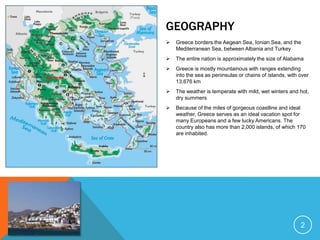
GeographyGreece borders the Aegean Sea, Ionian Sea, and the Mediterranean Sea, between Albania and Turkey
The entire nation is approximately the size of Alabama
Greece is mostly mountainous with ranges extending into the sea as peninsulas or chains of islands, with over 13,676 km
The weather is temperate with mild, wet winters and hot, dry summers
Because of the miles of gorgeous coastline and ideal weather, Greece serves as an ideal vacation spot for many Europeans and a few lucky Americans. The country also has more than 2,000 islands, of which 170 are inhabited. 2
Population and GovernmentPopulation is 10,737,428 currently with a median age of 42.  This is a slightly older population.  For comparison, the median age in the United States is 36.
Government is a parliamentary republic, with a President that is elected by the Parliament (currently Karolos Papoulias), who serves for five years and is eligible for two terms.   A Prime Minister (currently Yeoryios Papandreou) heads an elected cabinet.
Greece has a capitalist economy with tourism providing 15% of GDP. Immigrants make up nearly one-fifth of the work force, mainly in unskilled jobs. Greece is a major beneficiary of European Union aid, due to a recession in 2009 and the world financial crisis. Public debt, inflation, and unemployment are above the European average while per capita income is one of the lowest of the EU countries; debt and unemployment rose in 2009 and eroding public finances has led to increased financial instability. Athens faces challenges to reforms through opposition from the country's powerful labor unions and the general public. Greek labor unions are not afraid to strike and unrest may challenge reforms, and could possibly lead to rioting and violence.
The Greek economy depends heavily on tourism. Most of the industry is located in the Greater Athens area and is focused on agriculture, tourism, construction, and shipping.  Greece adopted the Euro in 2002.  There is a focus to reform Greece’s failing economy because Greece’s economic woes affect all members of the European Union.  3
Social & Economic LevelsSince the 19th century, upward mobility has been easier for Greeks with every generation.  Greece does not have a rigid class system and has become even more flexible as incomes reach higher levels among the middle class.
Greek society is fairly traditional with an emphasis on family and maintaining its societal role, even in the economic sector.  Many Greeks, rich and poor alike, own their own home, and real estate is almost always passed down through the generations. Non-home owners are considered impoverished, and neighbors ask questions regarding the family's inability to take care of its children and future generations.

Modern Day Greece by Terri Gregory

  • 1.
    Modern Day GreeceByTerri Gregory
  • 2.
    GeographyGreece borders theAegean Sea, Ionian Sea, and the Mediterranean Sea, between Albania and Turkey
  • 3.
    The entire nationis approximately the size of Alabama
  • 4.
    Greece is mostlymountainous with ranges extending into the sea as peninsulas or chains of islands, with over 13,676 km
  • 5.
    The weather istemperate with mild, wet winters and hot, dry summers
  • 6.
    Because of themiles of gorgeous coastline and ideal weather, Greece serves as an ideal vacation spot for many Europeans and a few lucky Americans. The country also has more than 2,000 islands, of which 170 are inhabited. 2
  • 7.
    Population and GovernmentPopulationis 10,737,428 currently with a median age of 42. This is a slightly older population. For comparison, the median age in the United States is 36.
  • 8.
    Government is aparliamentary republic, with a President that is elected by the Parliament (currently Karolos Papoulias), who serves for five years and is eligible for two terms. A Prime Minister (currently Yeoryios Papandreou) heads an elected cabinet.
  • 9.
    Greece has acapitalist economy with tourism providing 15% of GDP. Immigrants make up nearly one-fifth of the work force, mainly in unskilled jobs. Greece is a major beneficiary of European Union aid, due to a recession in 2009 and the world financial crisis. Public debt, inflation, and unemployment are above the European average while per capita income is one of the lowest of the EU countries; debt and unemployment rose in 2009 and eroding public finances has led to increased financial instability. Athens faces challenges to reforms through opposition from the country's powerful labor unions and the general public. Greek labor unions are not afraid to strike and unrest may challenge reforms, and could possibly lead to rioting and violence.
  • 10.
    The Greek economydepends heavily on tourism. Most of the industry is located in the Greater Athens area and is focused on agriculture, tourism, construction, and shipping. Greece adopted the Euro in 2002. There is a focus to reform Greece’s failing economy because Greece’s economic woes affect all members of the European Union. 3
  • 11.
    Social & EconomicLevelsSince the 19th century, upward mobility has been easier for Greeks with every generation. Greece does not have a rigid class system and has become even more flexible as incomes reach higher levels among the middle class.
  • 12.
    Greek society isfairly traditional with an emphasis on family and maintaining its societal role, even in the economic sector. Many Greeks, rich and poor alike, own their own home, and real estate is almost always passed down through the generations. Non-home owners are considered impoverished, and neighbors ask questions regarding the family's inability to take care of its children and future generations.