The Rise and the Decline
of the Roman Empire
Mark Lester B. Liquigan, PhD
Roman Empire
The Roman Empire, one of the most powerful empires in
history, rose and fell over centuries due to a complex mix of
internal and external factors.
The Rise of the Roman Empire
1. Foundation and Early Republic: Rome started as a
small city-state in central Italy around 753 BCE. It was
initially a monarchy, but in 509 BCE, it became a republic,
governed by elected officials, which allowed citizens a
degree of political participation.
2. Expansion and Military Power: Rome expanded
aggressively through warfare, conquering the Italian
peninsula by 264 BCE and later much of the
Mediterranean. The Punic Wars (264-146 BCE) against
Carthage marked a turning point, as Rome emerged as
the dominant Mediterranean power.
3. Political Reforms and Leadership: Leaders like Julius
Caesar and Augustus (Octavian) played critical roles.
Caesar’s reforms and conquests increased Rome’s wealth
and territory, but his assassination in 44 BCE led to a civil
war. Augustus, his adopted son, emerged victorious,
establishing the Roman Empire in 27 BCE and ushering in
a period of relative peace and prosperity known as the Pax
Romana.
4. Administrative and Legal Innovations: The Romans
developed advanced infrastructure (roads, aqueducts,
cities), a professional army, and a codified legal system
that maintained control over vast territories and diverse
populations.
The Decline of the Roman Empire
1. Economic Troubles and Overexpansion: As the
empire grew, so did its costs. Maintaining vast
territories became financially challenging, and the
economy struggled due to heavy taxes, inflation, and
reliance on slave labor.
2. Political Instability and Corruption: The government
suffered from corruption, civil wars, and frequent
changes in leadership, with many emperors being
assassinated or deposed.
3. Military Decline and Barbarian Invasions: The
Roman military weakened over time due to internal
conflicts, reliance on mercenaries, and lack of
discipline. This left the empire vulnerable to invasions
by various "barbarian" groups, such as the Visigoths,
Vandals, and Huns.
4. The Division of the Empire: In 285 CE, Emperor
Diocletian split the empire into Eastern and Western
halves for easier management. The Western Roman
Empire, which included Rome, faced more challenges
and declined more quickly than the Eastern (Byzantine)
Empire.
5. Fall of the Western Empire: In 476 CE, the last
Roman emperor in the West, Romulus Augustulus, was
overthrown by the Germanic leader Odoacer. This event
is widely considered the end of the Western Roman
Empire, though the Eastern Roman Empire continued for
nearly a thousand years as the Byzantine Empire.
Legacy
• Despite its fall, the Roman Empire
profoundly influenced Western
civilization, leaving legacies in law,
governance, architecture, language,
and culture. Its decline also reshaped
Europe, leading to the medieval period
and the eventual rise of modern
nations.
Key Contributions
The Roman Empire's contributions have had a lasting
impact on many aspects of modern society, from law and
government to architecture and language.
1. Law and Legal System
The Romans developed a comprehensive legal system that
laid the groundwork for modern law. The Roman Law,
particularly the Justinian Code (Corpus Juris Civilis),
became a foundational reference for legal systems in many
countries, especially in Europe.
2. Government and Political Ideas
Rome’s model of republican government, with a Senate,
elected officials, and checks and balances, heavily
influenced the development of democratic principles.
The concept of citizenship was advanced by Rome,
establishing that individuals, regardless of background,
could earn rights and privileges as Roman citizens, paving
the way for inclusive civic rights.
3. Architecture and Engineering
Romans excelled in architecture and engineering, creating
lasting structures like aqueducts, roads, amphitheaters,
and baths. The use of concrete, arches, and domes
allowed them to build large, durable structures that
inspired modern buildings.
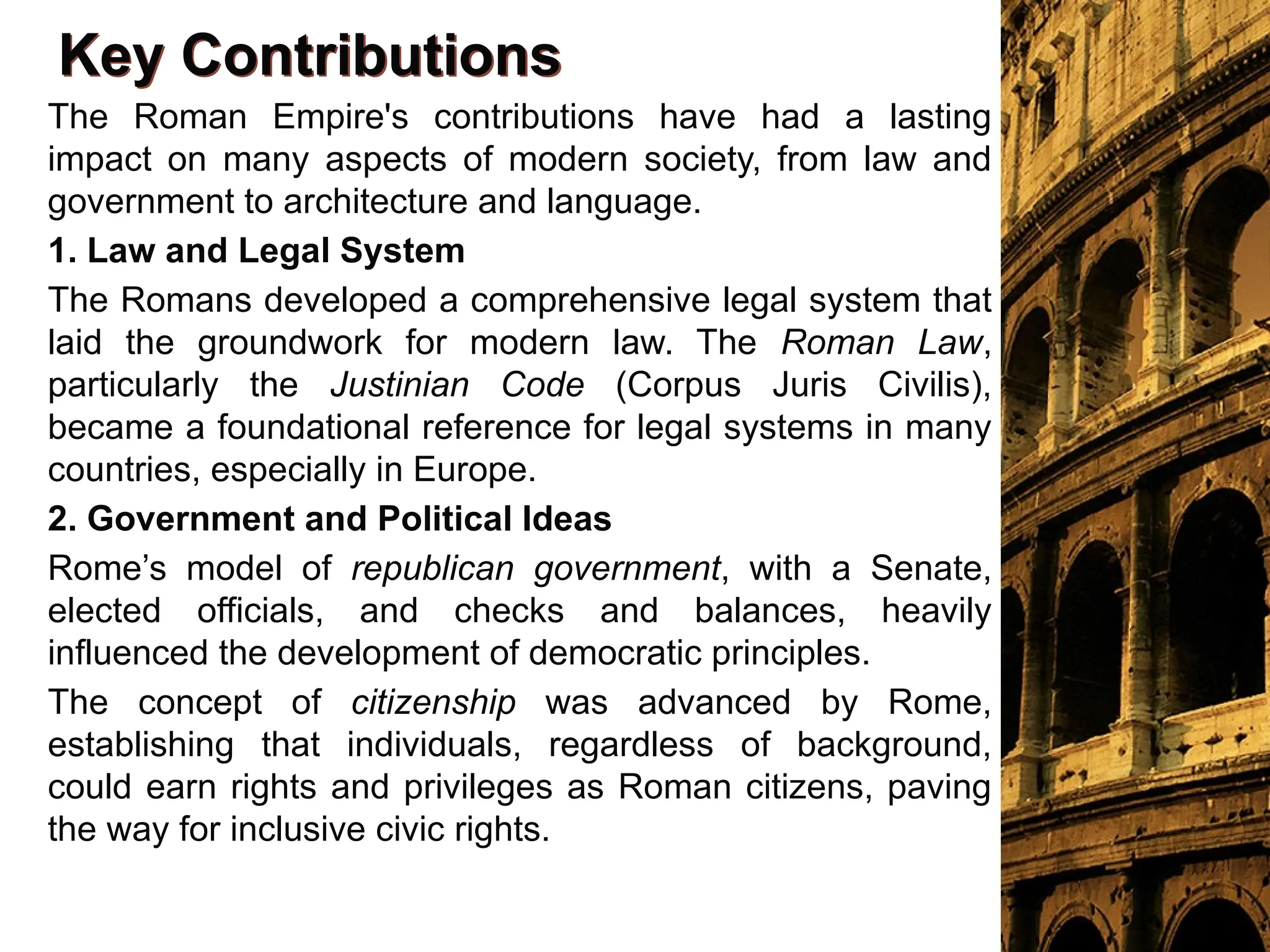
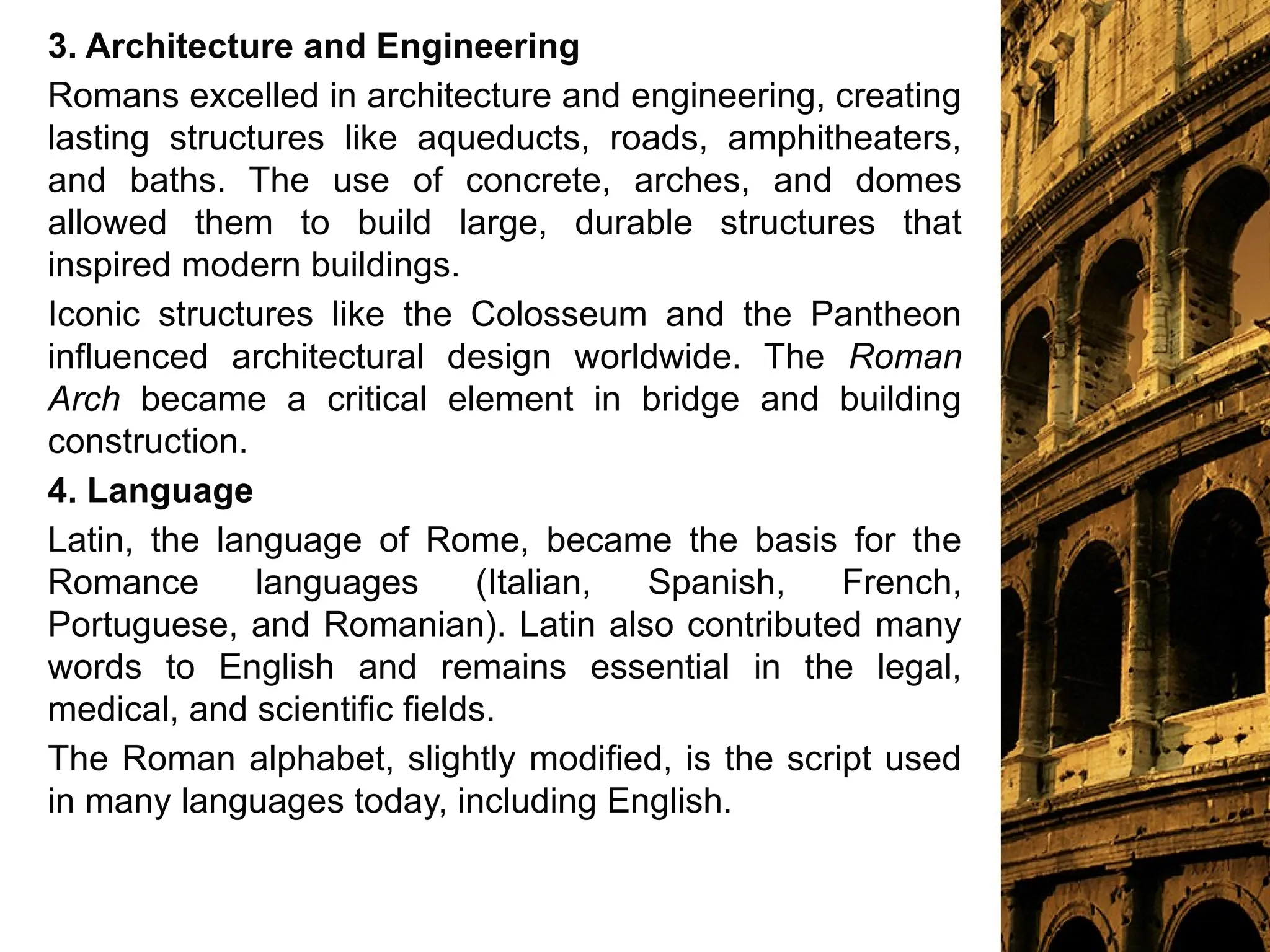
Iconic structures like the Colosseum and the Pantheon
influenced architectural design worldwide. The Roman
Arch became a critical element in bridge and building
construction.
4. Language
Latin, the language of Rome, became the basis for the
Romance languages (Italian, Spanish, French,
Portuguese, and Romanian). Latin also contributed many
words to English and remains essential in the legal,
medical, and scientific fields.
The Roman alphabet, slightly modified, is the script used
in many languages today, including English.
5. Calendar
The Julian calendar, introduced by Julius Caesar in 45
BCE, was a significant improvement over previous
systems. It became the basis for the Gregorian calendar,
which is still in use today.
The names of the months and the concept of leap years
originated from Roman innovations in timekeeping.
6. Infrastructure and Urban Planning
Romans built an extensive network of roads, many of
which remain in use or serve as the foundation of modern
roads. The phrase "All roads lead to Rome" reflects the
connectivity they created across the empire.
Roman cities were designed with a grid layout, central
forums, public buildings, and extensive water supply and
sanitation systems, setting the template for future urban
development.
7. Military Organization and Strategy
The Roman army was highly organized and disciplined,
introducing advanced techniques in battlefield tactics,
engineering, and logistics that influenced military
strategies well beyond their time.
The structure of a professional army with a clear hierarchy
and rigorous training set standards for modern military
organization.
8. Religion and Cultural Exchange
The spread of Christianity was facilitated by the Roman
Empire. Initially persecuted, Christians eventually found
acceptance under Emperor Constantine, who converted to
Christianity and declared it a state religion.
Rome’s expansion and assimilation of diverse cultures
encouraged the exchange of ideas, art, and religion,
leading to a rich blend of Greco-Roman and local
traditions that influenced Western culture.
9. Philosophy, Literature, and Education
Romans contributed to philosophy, building upon Greek
ideas, especially through the Stoics, like Seneca, who
emphasized personal ethics and resilience.
Roman literature, with authors like Virgil, Ovid, and
Cicero, left an enduring literary heritage that remains part
of Western education.
Roman schooling systems and emphasis on rhetoric, law,
and philosophy became the foundation for Western
education models.
10. Art and Sculpture
Romans advanced realistic portraiture in sculpture, with a
focus on capturing individual characteristics, which
influenced European art for centuries.
Their use of mosaics, frescoes, and paintings to decorate
public and private spaces also inspired artistic traditions in
later societies.

The Rise and the Decline of the Roman Empire.pptx

  • 1.
    The Rise andthe Decline of the Roman Empire Mark Lester B. Liquigan, PhD
  • 2.
    Roman Empire The RomanEmpire, one of the most powerful empires in history, rose and fell over centuries due to a complex mix of internal and external factors. The Rise of the Roman Empire 1. Foundation and Early Republic: Rome started as a small city-state in central Italy around 753 BCE. It was initially a monarchy, but in 509 BCE, it became a republic, governed by elected officials, which allowed citizens a degree of political participation. 2. Expansion and Military Power: Rome expanded aggressively through warfare, conquering the Italian peninsula by 264 BCE and later much of the Mediterranean. The Punic Wars (264-146 BCE) against Carthage marked a turning point, as Rome emerged as the dominant Mediterranean power.
  • 3.
    3. Political Reformsand Leadership: Leaders like Julius Caesar and Augustus (Octavian) played critical roles. Caesar’s reforms and conquests increased Rome’s wealth and territory, but his assassination in 44 BCE led to a civil war. Augustus, his adopted son, emerged victorious, establishing the Roman Empire in 27 BCE and ushering in a period of relative peace and prosperity known as the Pax Romana. 4. Administrative and Legal Innovations: The Romans developed advanced infrastructure (roads, aqueducts, cities), a professional army, and a codified legal system that maintained control over vast territories and diverse populations.
  • 4.
    The Decline ofthe Roman Empire 1. Economic Troubles and Overexpansion: As the empire grew, so did its costs. Maintaining vast territories became financially challenging, and the economy struggled due to heavy taxes, inflation, and reliance on slave labor. 2. Political Instability and Corruption: The government suffered from corruption, civil wars, and frequent changes in leadership, with many emperors being assassinated or deposed. 3. Military Decline and Barbarian Invasions: The Roman military weakened over time due to internal conflicts, reliance on mercenaries, and lack of discipline. This left the empire vulnerable to invasions by various "barbarian" groups, such as the Visigoths, Vandals, and Huns.
  • 5.
    4. The Divisionof the Empire: In 285 CE, Emperor Diocletian split the empire into Eastern and Western halves for easier management. The Western Roman Empire, which included Rome, faced more challenges and declined more quickly than the Eastern (Byzantine) Empire. 5. Fall of the Western Empire: In 476 CE, the last Roman emperor in the West, Romulus Augustulus, was overthrown by the Germanic leader Odoacer. This event is widely considered the end of the Western Roman Empire, though the Eastern Roman Empire continued for nearly a thousand years as the Byzantine Empire.
  • 6.
    Legacy • Despite itsfall, the Roman Empire profoundly influenced Western civilization, leaving legacies in law, governance, architecture, language, and culture. Its decline also reshaped Europe, leading to the medieval period and the eventual rise of modern nations.
  • 7.
    Key Contributions The RomanEmpire's contributions have had a lasting impact on many aspects of modern society, from law and government to architecture and language. 1. Law and Legal System The Romans developed a comprehensive legal system that laid the groundwork for modern law. The Roman Law, particularly the Justinian Code (Corpus Juris Civilis), became a foundational reference for legal systems in many countries, especially in Europe. 2. Government and Political Ideas Rome’s model of republican government, with a Senate, elected officials, and checks and balances, heavily influenced the development of democratic principles. The concept of citizenship was advanced by Rome, establishing that individuals, regardless of background, could earn rights and privileges as Roman citizens, paving the way for inclusive civic rights.
  • 8.
    3. Architecture andEngineering Romans excelled in architecture and engineering, creating lasting structures like aqueducts, roads, amphitheaters, and baths. The use of concrete, arches, and domes allowed them to build large, durable structures that inspired modern buildings. Iconic structures like the Colosseum and the Pantheon influenced architectural design worldwide. The Roman Arch became a critical element in bridge and building construction. 4. Language Latin, the language of Rome, became the basis for the Romance languages (Italian, Spanish, French, Portuguese, and Romanian). Latin also contributed many words to English and remains essential in the legal, medical, and scientific fields. The Roman alphabet, slightly modified, is the script used in many languages today, including English.
  • 9.
    5. Calendar The Juliancalendar, introduced by Julius Caesar in 45 BCE, was a significant improvement over previous systems. It became the basis for the Gregorian calendar, which is still in use today. The names of the months and the concept of leap years originated from Roman innovations in timekeeping. 6. Infrastructure and Urban Planning Romans built an extensive network of roads, many of which remain in use or serve as the foundation of modern roads. The phrase "All roads lead to Rome" reflects the connectivity they created across the empire. Roman cities were designed with a grid layout, central forums, public buildings, and extensive water supply and sanitation systems, setting the template for future urban development.
  • 10.
    7. Military Organizationand Strategy The Roman army was highly organized and disciplined, introducing advanced techniques in battlefield tactics, engineering, and logistics that influenced military strategies well beyond their time. The structure of a professional army with a clear hierarchy and rigorous training set standards for modern military organization. 8. Religion and Cultural Exchange The spread of Christianity was facilitated by the Roman Empire. Initially persecuted, Christians eventually found acceptance under Emperor Constantine, who converted to Christianity and declared it a state religion. Rome’s expansion and assimilation of diverse cultures encouraged the exchange of ideas, art, and religion, leading to a rich blend of Greco-Roman and local traditions that influenced Western culture.
  • 11.
    9. Philosophy, Literature,and Education Romans contributed to philosophy, building upon Greek ideas, especially through the Stoics, like Seneca, who emphasized personal ethics and resilience. Roman literature, with authors like Virgil, Ovid, and Cicero, left an enduring literary heritage that remains part of Western education. Roman schooling systems and emphasis on rhetoric, law, and philosophy became the foundation for Western education models. 10. Art and Sculpture Romans advanced realistic portraiture in sculpture, with a focus on capturing individual characteristics, which influenced European art for centuries. Their use of mosaics, frescoes, and paintings to decorate public and private spaces also inspired artistic traditions in later societies.