Romantic Poets
Yesha Bhatt
Department of English, MK Bhavnagar University
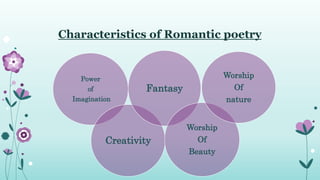
Characteristics of Romantic poetry
Power
of
Imagination
Creativity
Fantasy
Worship
Of
Beauty
Worship
Of
nature
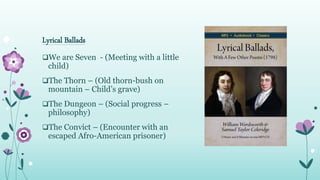
Lyrical Ballads
We are Seven - (Meeting with a little
child)
The Thorn – (Old thorn-bush on
mountain – Child’s grave)
The Dungeon – (Social progress –
philosophy)
The Convict – (Encounter with an
escaped Afro-American prisoner)
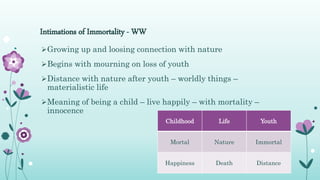
Intimations of Immortality - WW
Childhood Life Youth
Mortal Nature Immortal
Happiness Death Distance
Growing up and loosing connection with nature
Begins with mourning on loss of youth
Distance with nature after youth – worldly things –
materialistic life
Meaning of being a child – live happily – with mortality –
innocence
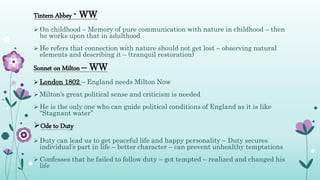
Tintern Abbey - WW
 On childhood – Memory of pure communication with nature in childhood – then
he works upon that in adulthood
 He refers that connection with nature should not get lost – observing natural
elements and describing it – (tranquil restoration)
Sonnet on Milton – WW
 London 1802 – England needs Milton Now
 Milton’s great political sense and criticism is needed
 He is the only one who can guide political conditions of England as it is like
“Stagnant water”
Ode to Duty
 Duty can lead us to get peaceful life and happy personality – Duty secures
individual’s part in life – better character – can prevent unhealthy temptations
 Confesses that he failed to follow duty – got tempted – realized and changed his
life
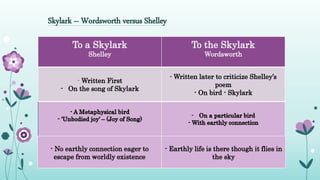
To a Skylark
Shelley
To the Skylark
Wordsworth
-
Skylark – Wordsworth versus Shelley
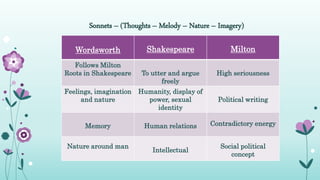
Wordsworth Shakespeare Milton
Follows Milton
Roots in Shakespeare To utter and argue
freely
High seriousness
Feelings, imagination
and nature
Humanity, display of
power, sexual
identity
Political writing
Memory Human relations Contradictory energy
Nature around man
Intellectual
Social political
concept
Sonnets – (Thoughts – Melody – Nature – Imagery)
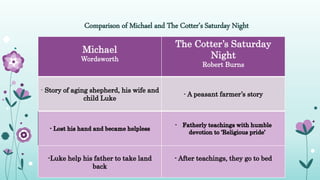
Michael
Wordsworth
The Cotter’s Saturday
Night
Robert Burns
-
Comparison of Michael and The Cotter’s Saturday Night
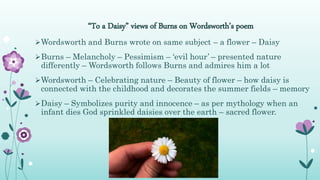
“To a Daisy” views of Burns on Wordsworth’s poem
Wordsworth and Burns wrote on same subject – a flower – Daisy
Burns – Melancholy – Pessimism – ‘evil hour’ – presented nature
differently – Wordsworth follows Burns and admires him a lot
Wordsworth – Celebrating nature – Beauty of flower – how daisy is
connected with the childhood and decorates the summer fields – memory
Daisy – Symbolizes purity and innocence – as per mythology when an
infant dies God sprinkled daisies over the earth – sacred flower.
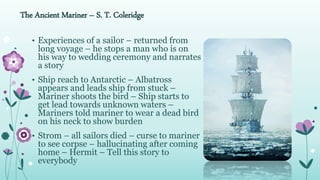
The Ancient Mariner – S. T. Coleridge
• Experiences of a sailor – returned from
long voyage – he stops a man who is on
his way to wedding ceremony and narrates
a story
• Ship reach to Antarctic – Albatross
appears and leads ship from stuck –
Mariner shoots the bird – Ship starts to
get lead towards unknown waters –
Mariners told mariner to wear a dead bird
on his neck to show burden
• Strom – all sailors died – curse to mariner
to see corpse – hallucinating after coming
home – Hermit – Tell this story to
everybody
Lectures on Shakespeare
• Lectures on Shakespeare 1811-1812 (12 lec)
• Lectures on Shakespeare 1818-1819 (6 lec)
• Lectures on Shakespeare, Milton, Dante, Spenser, Ariosto and
Cervantes, 1819
• A Portion of Lecture 3: Thursday, 25 February 1819 (Troilus
and Cressida)
• Coleridge focused on a handful of plays: Hamlet, The
Tempest, Richard II, Othello, Romeo and Juliet, Love’s Labour’s
Lost and Macbeth, and with the narrative poems. He
admired King Lear and Antony and Cleopatra,
but hated Measure for Measure
Thank you

Romantic poets works

  • 1.
    Romantic Poets Yesha Bhatt Departmentof English, MK Bhavnagar University
  • 2.
    Characteristics of Romanticpoetry Power of Imagination Creativity Fantasy Worship Of Beauty Worship Of nature
  • 3.
    Lyrical Ballads We areSeven - (Meeting with a little child) The Thorn – (Old thorn-bush on mountain – Child’s grave) The Dungeon – (Social progress – philosophy) The Convict – (Encounter with an escaped Afro-American prisoner)
  • 4.
    Intimations of Immortality- WW Childhood Life Youth Mortal Nature Immortal Happiness Death Distance Growing up and loosing connection with nature Begins with mourning on loss of youth Distance with nature after youth – worldly things – materialistic life Meaning of being a child – live happily – with mortality – innocence
  • 5.
    Tintern Abbey -WW  On childhood – Memory of pure communication with nature in childhood – then he works upon that in adulthood  He refers that connection with nature should not get lost – observing natural elements and describing it – (tranquil restoration) Sonnet on Milton – WW  London 1802 – England needs Milton Now  Milton’s great political sense and criticism is needed  He is the only one who can guide political conditions of England as it is like “Stagnant water” Ode to Duty  Duty can lead us to get peaceful life and happy personality – Duty secures individual’s part in life – better character – can prevent unhealthy temptations  Confesses that he failed to follow duty – got tempted – realized and changed his life
  • 6.
    To a Skylark Shelley Tothe Skylark Wordsworth - Skylark – Wordsworth versus Shelley
  • 7.
    Wordsworth Shakespeare Milton FollowsMilton Roots in Shakespeare To utter and argue freely High seriousness Feelings, imagination and nature Humanity, display of power, sexual identity Political writing Memory Human relations Contradictory energy Nature around man Intellectual Social political concept Sonnets – (Thoughts – Melody – Nature – Imagery)
  • 8.
    Michael Wordsworth The Cotter’s Saturday Night RobertBurns - Comparison of Michael and The Cotter’s Saturday Night
  • 9.
    “To a Daisy”views of Burns on Wordsworth’s poem Wordsworth and Burns wrote on same subject – a flower – Daisy Burns – Melancholy – Pessimism – ‘evil hour’ – presented nature differently – Wordsworth follows Burns and admires him a lot Wordsworth – Celebrating nature – Beauty of flower – how daisy is connected with the childhood and decorates the summer fields – memory Daisy – Symbolizes purity and innocence – as per mythology when an infant dies God sprinkled daisies over the earth – sacred flower.
  • 10.
    The Ancient Mariner– S. T. Coleridge • Experiences of a sailor – returned from long voyage – he stops a man who is on his way to wedding ceremony and narrates a story • Ship reach to Antarctic – Albatross appears and leads ship from stuck – Mariner shoots the bird – Ship starts to get lead towards unknown waters – Mariners told mariner to wear a dead bird on his neck to show burden • Strom – all sailors died – curse to mariner to see corpse – hallucinating after coming home – Hermit – Tell this story to everybody
  • 11.
    Lectures on Shakespeare •Lectures on Shakespeare 1811-1812 (12 lec) • Lectures on Shakespeare 1818-1819 (6 lec) • Lectures on Shakespeare, Milton, Dante, Spenser, Ariosto and Cervantes, 1819 • A Portion of Lecture 3: Thursday, 25 February 1819 (Troilus and Cressida) • Coleridge focused on a handful of plays: Hamlet, The Tempest, Richard II, Othello, Romeo and Juliet, Love’s Labour’s Lost and Macbeth, and with the narrative poems. He admired King Lear and Antony and Cleopatra, but hated Measure for Measure
  • 12.