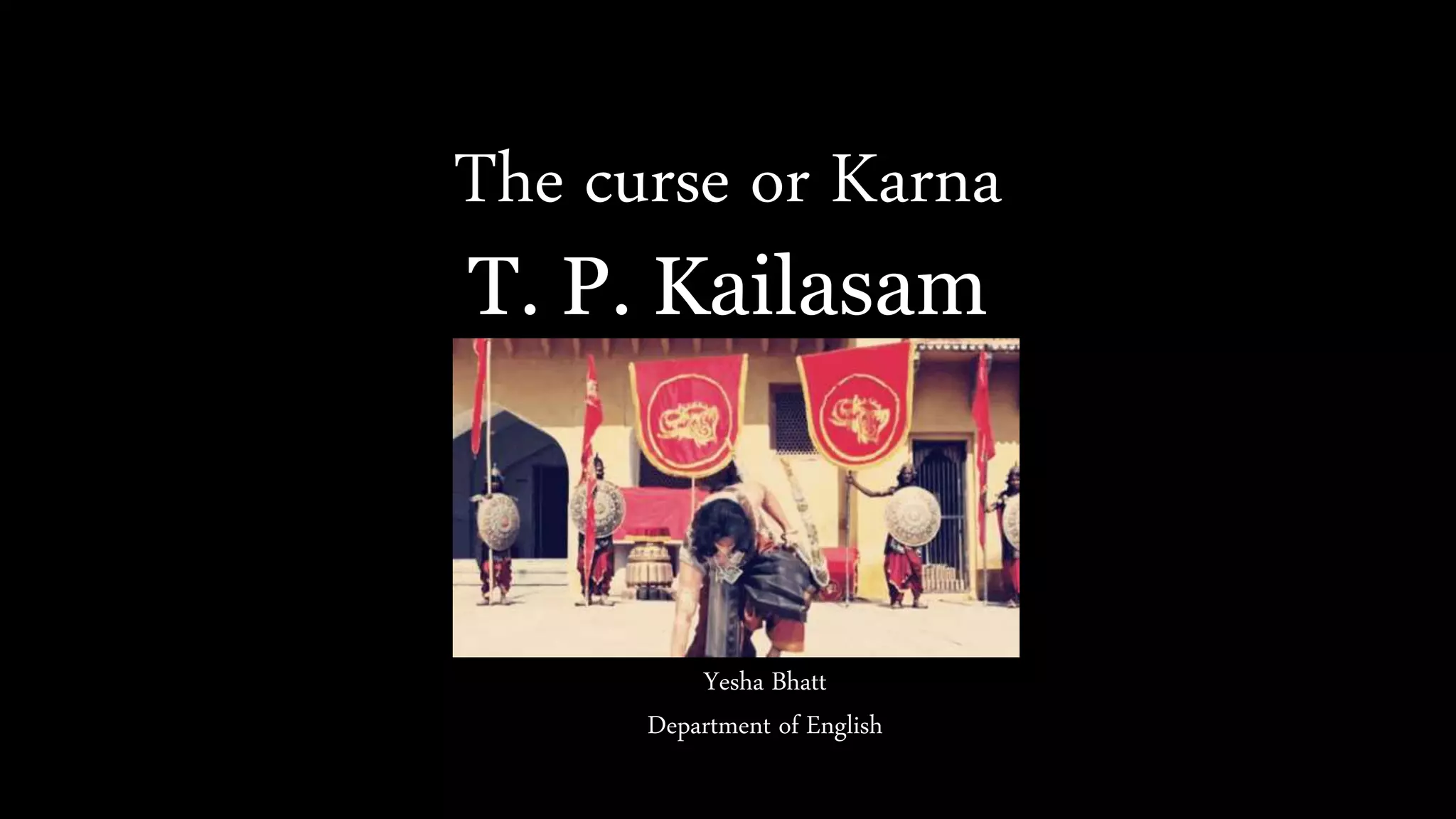
The curse or Karna
T. P. Kailasam
Yesha Bhatt
Yesha Bhatt
Department of English
T. P. Kailasam 1884 - 1946
• Tyagraj Paramasiva Iyer
Kailasam
• A playwright and prominent
writer of Kannada literature.
• The father of humorous plays
• Called "Kannadakke Obbane
Kailasam" meaning "One and
Only Kailasam for Kannada".
• He introduced simple, realistic
sets for drama
• Known for wit and satirical
commentary on society
The Curse or Karna
• An impression of Sophocles in five acts
• First published: 10th September, 1946
• Re-published: 29th July, 1969
• Life of Karna – a Tragic character of
Mahabharata
• “Even he used classical themes,
his purpose was contemporary” –
Dr. S. Radhakrishnan, Vice-
president of India (1960)
• “My love for thee reveals to me
that Fate hath wove thy life and
death in threads of Tragedy” -
Raama
Brief
overview
• Act I –
S I – Karna leaves Aashram
S II - Karna and Raama (Parshuram cursed Karna) -
Aashram
• Act II – Competition at Hastinapur – The Royal stadium
• Act III- Draupadi Swayamvara – Palace of Panchal (35-36)
S I – Draupadi insulted Anga
S ll – Anga recalls the curse he has
• Act lV – Cheerharan – Karna tried to save Draupadi –
Falls in the arms of Bheemsena
• Act V – Battle field of Kurukshetra
S l - Karna’s encounter with Kunti
S ll – Arjuna and Karna’s fight - Death
Deconstruction of myth in The Curse
• Parshuram in myths vs Raama in The Curse
• Parshuram’s guilt in The Curse (Tragic life of Karna)
• Draupadi in Myths vs Paanchaalee in The Curse
• Duryodhana in Myths vs Suyodhana in The Curse
• Suyodhana’s question and explanation to
Bheeshma’s Pratigya
• All Acts end with same dialogue – “Poor, Honest,
Anga..”
• Approach of all characters to Anga
Class-conflict and caste-conflict
• Parshuram: Dedicated to Brahmins
• Draunacharya: Dedicated to Kshatriyas
• Royal battles: only with Royal blood (Kings)
• Karna: not a Brahmin, Not a Kshatriya, Not a
king
• Karna’s implied identity – Sootha
• Education – Battles – Marriage – Respect –
Kingship
• A worthy man excluded by all because of his
(low) birth
Karna with special reference to the concept of
subaltern.
• It refers to the populations that are socially,
politically and geographically outside of the
hegemonic power structure of the colony and of
the colonial homeland.
• Karna- The tragic character with tragic fate –
Illegitimate, Abandoned, lowborn
• Marginalised by Gurus, Warriors, princess
Paanchaalee, Kings
• He was just able to speak – “A Brahmin’s Curse”
• His identity was of marginalised people, he
deserved to be at centre, the struggle and society
caused his death
Unsung hero of
Mahabharata
• More credible than all Pandavas –
Daanveer, Noble, Humble, Powerful
• In Kurukshetra he was defeated by
Krishna’s trick and Indra’s trick
• The only one who followed Dharma
throughout the life
• Self-made man
• Valued relation – Parents – Kunti –
Duryodhan
• Krishna considered him as the most
powerful than all Pandavas, even Arjun
• Wanted to be known as Radheya
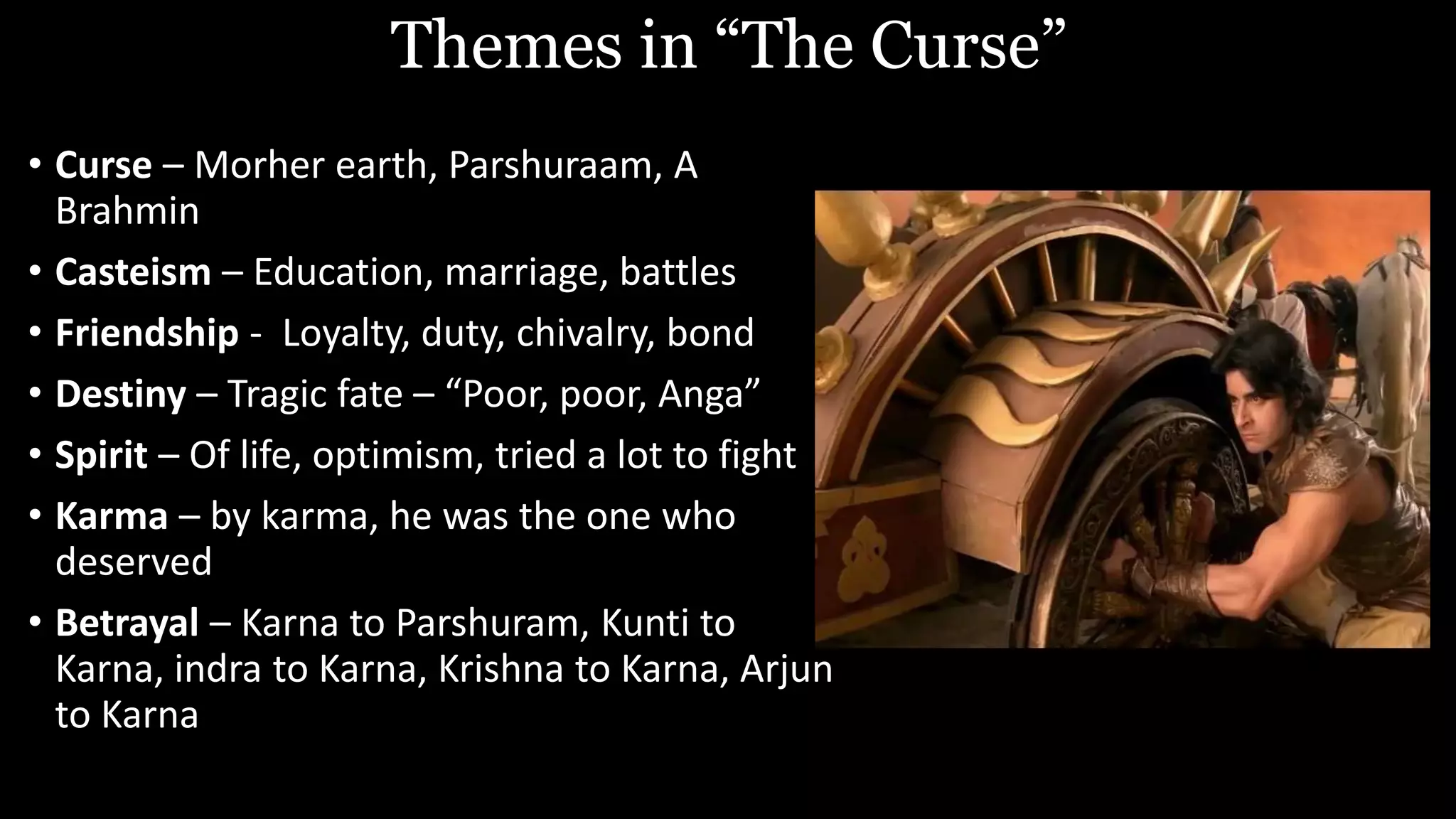
Themes in “The Curse”
• Curse – Morher earth, Parshuraam, A
Brahmin
• Casteism – Education, marriage, battles
• Friendship - Loyalty, duty, chivalry, bond
• Destiny – Tragic fate – “Poor, poor, Anga”
• Spirit – Of life, optimism, tried a lot to fight
• Karma – by karma, he was the one who
deserved
• Betrayal – Karna to Parshuram, Kunti to
Karna, indra to Karna, Krishna to Karna, Arjun
to Karna
The curse or Karna.pptx

The curse or Karna.pptx

  • 1.
    The curse orKarna T. P. Kailasam Yesha Bhatt Yesha Bhatt Department of English
  • 2.
    T. P. Kailasam1884 - 1946 • Tyagraj Paramasiva Iyer Kailasam • A playwright and prominent writer of Kannada literature. • The father of humorous plays • Called "Kannadakke Obbane Kailasam" meaning "One and Only Kailasam for Kannada". • He introduced simple, realistic sets for drama • Known for wit and satirical commentary on society
  • 3.
    The Curse orKarna • An impression of Sophocles in five acts • First published: 10th September, 1946 • Re-published: 29th July, 1969 • Life of Karna – a Tragic character of Mahabharata • “Even he used classical themes, his purpose was contemporary” – Dr. S. Radhakrishnan, Vice- president of India (1960) • “My love for thee reveals to me that Fate hath wove thy life and death in threads of Tragedy” - Raama
  • 4.
    Brief overview • Act I– S I – Karna leaves Aashram S II - Karna and Raama (Parshuram cursed Karna) - Aashram • Act II – Competition at Hastinapur – The Royal stadium • Act III- Draupadi Swayamvara – Palace of Panchal (35-36) S I – Draupadi insulted Anga S ll – Anga recalls the curse he has • Act lV – Cheerharan – Karna tried to save Draupadi – Falls in the arms of Bheemsena • Act V – Battle field of Kurukshetra S l - Karna’s encounter with Kunti S ll – Arjuna and Karna’s fight - Death
  • 5.
    Deconstruction of mythin The Curse • Parshuram in myths vs Raama in The Curse • Parshuram’s guilt in The Curse (Tragic life of Karna) • Draupadi in Myths vs Paanchaalee in The Curse • Duryodhana in Myths vs Suyodhana in The Curse • Suyodhana’s question and explanation to Bheeshma’s Pratigya • All Acts end with same dialogue – “Poor, Honest, Anga..” • Approach of all characters to Anga
  • 6.
    Class-conflict and caste-conflict •Parshuram: Dedicated to Brahmins • Draunacharya: Dedicated to Kshatriyas • Royal battles: only with Royal blood (Kings) • Karna: not a Brahmin, Not a Kshatriya, Not a king • Karna’s implied identity – Sootha • Education – Battles – Marriage – Respect – Kingship • A worthy man excluded by all because of his (low) birth
  • 7.
    Karna with specialreference to the concept of subaltern. • It refers to the populations that are socially, politically and geographically outside of the hegemonic power structure of the colony and of the colonial homeland. • Karna- The tragic character with tragic fate – Illegitimate, Abandoned, lowborn • Marginalised by Gurus, Warriors, princess Paanchaalee, Kings • He was just able to speak – “A Brahmin’s Curse” • His identity was of marginalised people, he deserved to be at centre, the struggle and society caused his death
  • 8.
    Unsung hero of Mahabharata •More credible than all Pandavas – Daanveer, Noble, Humble, Powerful • In Kurukshetra he was defeated by Krishna’s trick and Indra’s trick • The only one who followed Dharma throughout the life • Self-made man • Valued relation – Parents – Kunti – Duryodhan • Krishna considered him as the most powerful than all Pandavas, even Arjun • Wanted to be known as Radheya
  • 9.
    Themes in “TheCurse” • Curse – Morher earth, Parshuraam, A Brahmin • Casteism – Education, marriage, battles • Friendship - Loyalty, duty, chivalry, bond • Destiny – Tragic fate – “Poor, poor, Anga” • Spirit – Of life, optimism, tried a lot to fight • Karma – by karma, he was the one who deserved • Betrayal – Karna to Parshuram, Kunti to Karna, indra to Karna, Krishna to Karna, Arjun to Karna