HAIKU
•Is a traditionalform of Japanese
Poetry.
•It has 1 stanza that has 3 lines.
Line 1 and 3 have 5 syllables.
Line 2 has 7 syllables. The line
usually do not rhyme.
9.
EXAMPLE
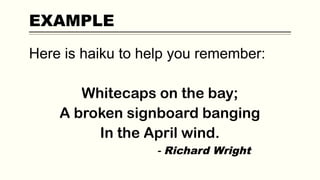
Here is haikuto help you remember:
Whitecaps on the bay;
A broken signboard banging
In the April wind.
- Richard Wright
10.
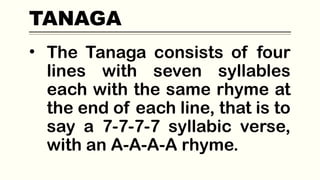
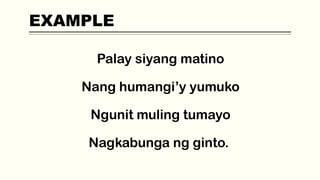
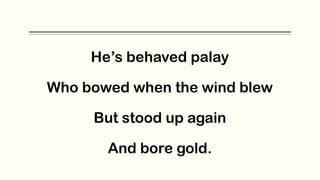
TANAGA
• is anindigenous type
of Filipino poem, that is
used traditionally in the
Tagalog language.
11.
TANAGA
• The Tanagaconsists of four
lines with seven syllables
each with the same rhyme at
the end of each line, that is to
say a 7-7-7-7 syllabic verse,
with an A-A-A-A rhyme.
SONNET
- A 14-lineverse form
usually having one of
several conventional
rhyme schemes.
17.
SIX TYPES OFSONNET
• Italian Sonnet
• Shakespearean Sonnet
• Spenserian Sonnet
• Miltonic Sonnet
• Terza Rima Sonnet
• Curtal Sonnet
18.
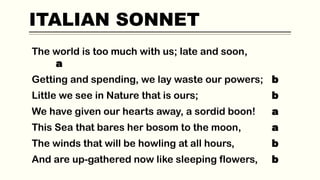
ITALIAN SONNET
The worldis too much with us; late and soon,
a
Getting and spending, we lay waste our powers; b
Little we see in Nature that is ours; b
We have given our hearts away, a sordid boon! a
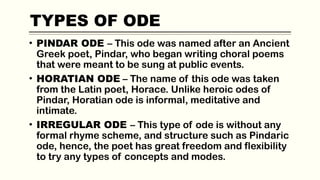
This Sea that bares her bosom to the moon, a
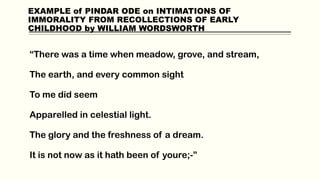
The winds that will be howling at all hours, b
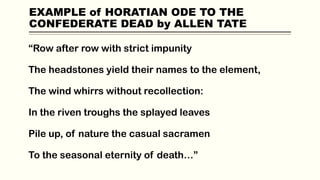
And are up-gathered now like sleeping flowers, b
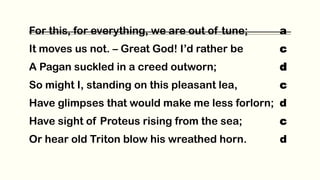
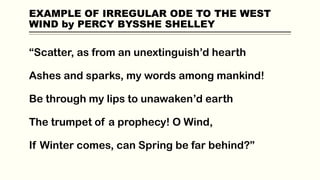
19.
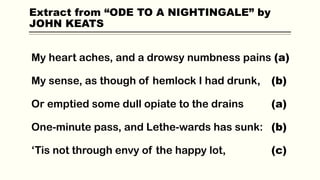
For this, foreverything, we are out of tune; a
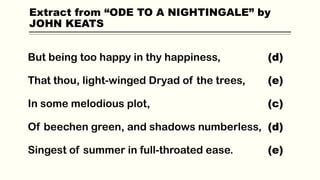
It moves us not. – Great God! I’d rather be c
A Pagan suckled in a creed outworn; d
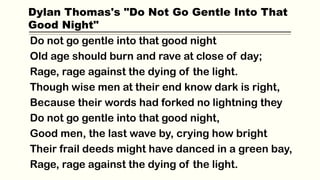
So might I, standing on this pleasant lea, c
Have glimpses that would make me less forlorn; d
Have sight of Proteus rising from the sea; c
Or hear old Triton blow his wreathed horn. d
20.
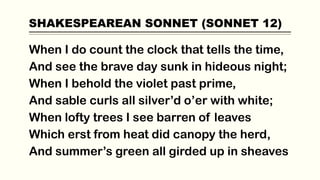
SHAKESPEAREAN SONNET (SONNET12)
When I do count the clock that tells the time,
And see the brave day sunk in hideous night;
When I behold the violet past prime,
And sable curls all silver’d o’er with white;
When lofty trees I see barren of leaves
Which erst from heat did canopy the herd,
And summer’s green all girded up in sheaves
21.
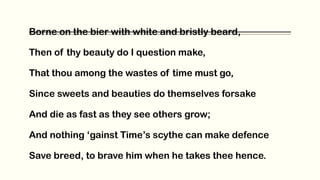
Borne on thebier with white and bristly beard,
Then of thy beauty do I question make,
That thou among the wastes of time must go,
Since sweets and beauties do themselves forsake
And die as fast as they see others grow;
And nothing ‘gainst Time’s scythe can make defence
Save breed, to brave him when he takes thee hence.
22.
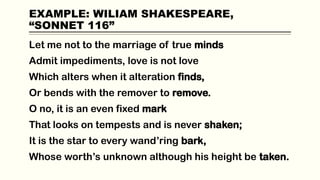
EXAMPLE: WILIAM SHAKESPEARE,
“SONNET116”
Let me not to the marriage of true minds
Admit impediments, love is not love
Which alters when it alteration finds,
Or bends with the remover to remove.
O no, it is an even fixed mark
That looks on tempests and is never shaken;
It is the star to every wand’ring bark,
Whose worth’s unknown although his height be taken.
23.
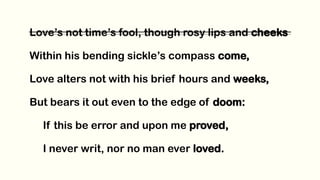
Love’s not time’sfool, though rosy lips and cheeks
Within his bending sickle’s compass come,
Love alters not with his brief hours and weeks,
But bears it out even to the edge of doom:
If this be error and upon me proved,
I never writ, nor no man ever loved.
24.
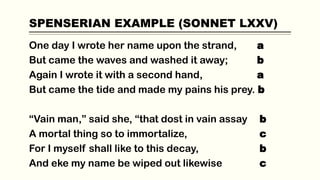
SPENSERIAN EXAMPLE (SONNETLXXV)
One day I wrote her name upon the strand, a
But came the waves and washed it away; b
Again I wrote it with a second hand, a
But came the tide and made my pains his prey. b
“Vain man,” said she, “that dost in vain assay b
A mortal thing so to immortalize, c
For I myself shall like to this decay, b
And eke my name be wiped out likewise c
25.
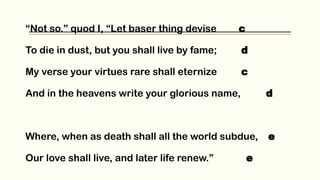
“Not so.” quodI, “Let baser thing devise c
To die in dust, but you shall live by fame; d
My verse your virtues rare shall eternize c
And in the heavens write your glorious name, d
Where, when as death shall all the world subdue, e
Our love shall live, and later life renew.” e
26.
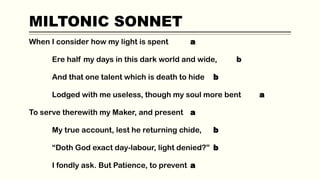
MILTONIC SONNET
When Iconsider how my light is spent a
Ere half my days in this dark world and wide, b
And that one talent which is death to hide b
Lodged with me useless, though my soul more bent a
To serve therewith my Maker, and present a
My true account, lest he returning chide, b
“Doth God exact day-labour, light denied?” b
I fondly ask. But Patience, to prevent a
27.
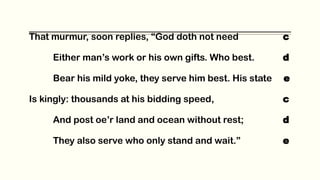
That murmur, soonreplies, “God doth not need c
Either man’s work or his own gifts. Who best. d
Bear his mild yoke, they serve him best. His state e
Is kingly: thousands at his bidding speed, c
And post oe’r land and ocean without rest; d
They also serve who only stand and wait.” e
28.
TERZA RIMA EXAMPLE
Owild Wind, thou breath of Autumn’s being,
Thou, from whose unseen presence the leaves dead
Are driven, like ghosts from an enchanter fleeing.
Yellow, and black, and pale, and hectic red,
Pestilence-stricken multitudes: O thou,
Who charlottes to their dark wintry bed
29.
The winged seeds,where they lie cold and low,
Each like a corpse within its grave, until
Thine azure sister of the Spring shall blow
Her clarion o’er the dreaming earth, and fill
(Driving sweet buds like flocks to feed in air)
With living hues and odours plain and hill:
Wild Spirit, which art moving everywhere:
Destroyer and Preserver: hear, O hear!
30.
PIED BEAUTY POEMby GERARD MANLEY
HOPKINS
Glory be to God for dappled things –
For skies of couple-colour as a brinded cow;
For rose-moles all in stipple upon trout that swim;
Fresh-firecoal chesnut-falls; finches’ wings;
Landscape plotted and piece – fold, fallow, and plough;
And all trades, their gear and tackle and trim.
31.
All things counter,original, spare, strange;
Whatever is fickle, freckled (who knows how?)
With swift, slow; sweet, sour; adazzle, dim;
He fathers-forth whose beauty is past change;
Praise him.
32.
EPIC
- A long,serious poem
that tells the story of a
heroic figure.
33.
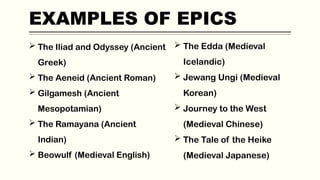
EXAMPLES OF EPICS
The Iliad and Odyssey (Ancient
Greek)
The Aeneid (Ancient Roman)
Gilgamesh (Ancient
Mesopotamian)
The Ramayana (Ancient
Indian)
Beowulf (Medieval English)
The Edda (Medieval
Icelandic)
Jewang Ungi (Medieval
Korean)
Journey to the West
(Medieval Chinese)
The Tale of the Heike
(Medieval Japanese)
34.
BALLAD
- Is asong or
songlike poem that
tells a story.
35.
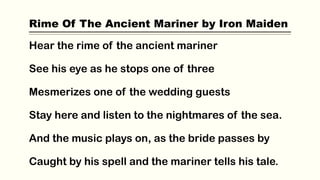
Rime Of TheAncient Mariner by Iron Maiden
Hear the rime of the ancient mariner
See his eye as he stops one of three
Mesmerizes one of the wedding guests
Stay here and listen to the nightmares of the sea.
And the music plays on, as the bride passes by
Caught by his spell and the mariner tells his tale.
36.
Driven south tothe land of the snow and ice
To a place where nobody's been
Through the snow fog flies on the albatross
Hailed in God's name, hoping good luck it brings.
And the ship sails on, back to the North
Through the fog and ice and the albatross follows on.
37.
The mariner killsthe bird of good omen
His shipmates cry against what he's done
But when the fog clears, they justify him
And make themselves a part of the crime.
Sailing on and on and north across the sea
Sailing on and on and north 'til all is calm.
The albatross begins with its vengeance
A terrible curse a thirst has begun
His shipmates blame bad luck on the mariner
About his neck, the dead bird is hung.
38.
And the cursegoes on and on at sea
And the curse goes on and on for them and me.
"Day after day, day after day,
we stuck nor breath nor motion
as idle as a painted ship upon a painted ocean
Water, water everywhere and
all the boards did shrink
Water, water everywhere nor any drop to drink."
There calls the mariner
There comes a ship over the line
But how can she sail with no wind in her sails and no tide.
39.
See...onward she comes
Onwardshe nears out of the sun
See, she has no crew
She has no life, wait but here's two.
Death and she Life in Death,
They throw their dice for the crew
She wins the mariner and he belongs to her now.
Then, crew one by one
they drop down dead, two hundred men
She, she, Life in Death.
She lets him live, her chosen one.
40.
"One after oneby the star dogged moon,
too quick for groan or sigh
each turned his face with a ghastly pang
and cursed me with his eye
four times fifty living men
(and I heard nor sigh nor groan)
with heavy thump, a lifeless lump,
they dropped down one by one."
41.
The curse itlives on in their eyes
The mariner wished he'd die
Along with the sea creatures
But they lived on, so did he.
and by the light of the moon
He prays for their beauty not doom
With heart he blesses them
God's creatures all of them too.
42.
Then the spellstarts to break
The albatross falls from his neck
Sinks down like lead into the sea
Then down in falls comes the rain.
Hear the groans of the long dead seamen
See them stir and they start to rise
Bodies lifted by good spirits
None of them speak and they're lifeless in their eyes
And revenge is still sought, penance starts again
Cast into a trance and the nightmare carries on.
43.
Now the curseis finally lifted
And the mariner sights his home
spirits go from he long dead bodies
Form their own light and the mariner's left alone.
And then a boat came sailing towards him
It was a joy he could not believe
The pilot's boat, his son and the hermit,
Penance of life will fall onto him.
And the ship sinks like lead into the sea
And the hermit shrives the mariner of his sins.
44.
The mariner's boundto tell of his story
To tell this tale wherever he goes
To teach God's word by his own example
That we must love all things that God made.
And the wedding guest's a sad and wiser man
And the tale goes on and on and on.
45.
ELEGY
- Is apoem that
mourns the death of a
person or laments
something lost.
46.
“O Captain! MyCaptain!” by Walt Whirtman
O Captain! My Captain! Our fearful trip is done;
The ship has weather’d every rack, the prize we sought is won;
The port is near, the bells I hear, the people all exulting,
While follow eyes the steady keel, the vessel grim and daring:
But O heart! Heart! Heart! Heart!
O the bleeding drops of red,
Where on the deck my Captain lies,
Fallen cold and dead.
47.
ODE
- A lyricpoem in the
form of an address to
a particular subject.
48.
TYPES OF ODE
•PINDAR ODE – This ode was named after an Ancient
Greek poet, Pindar, who began writing choral poems
that were meant to be sung at public events.
• HORATIAN ODE – The name of this ode was taken
from the Latin poet, Horace. Unlike heroic odes of
Pindar, Horatian ode is informal, meditative and
intimate.
• IRREGULAR ODE – This type of ode is without any
formal rhyme scheme, and structure such as Pindaric
ode, hence, the poet has great freedom and flexibility
to try any types of concepts and modes.
49.
EXAMPLE of PINDARODE on INTIMATIONS OF
IMMORALITY FROM RECOLLECTIONS OF EARLY
CHILDHOOD by WILLIAM WORDSWORTH
“There was a time when meadow, grove, and stream,
The earth, and every common sight
To me did seem
Apparelled in celestial light.
The glory and the freshness of a dream.
It is not now as it hath been of youre;-”
50.
EXAMPLE of HORATIANODE TO THE
CONFEDERATE DEAD by ALLEN TATE
“Row after row with strict impunity
The headstones yield their names to the element,
The wind whirrs without recollection:
In the riven troughs the splayed leaves
Pile up, of nature the casual sacramen
To the seasonal eternity of death…”
51.
EXAMPLE OF IRREGULARODE TO THE WEST
WIND by PERCY BYSSHE SHELLEY
“Scatter, as from an unextinguish’d hearth
Ashes and sparks, my words among mankind!
Be through my lips to unawaken’d earth
The trumpet of a prophecy! O Wind,
If Winter comes, can Spring be far behind?”
52.
Extract from “ODETO A NIGHTINGALE” by
JOHN KEATS
My heart aches, and a drowsy numbness pains (a)
My sense, as though of hemlock I had drunk, (b)
Or emptied some dull opiate to the drains (a)
One-minute pass, and Lethe-wards has sunk: (b)
‘Tis not through envy of the happy lot, (c)
53.
But being toohappy in thy happiness, (d)
That thou, light-winged Dryad of the trees, (e)
In some melodious plot, (c)
Of beechen green, and shadows numberless, (d)
Singest of summer in full-throated ease. (e)
Extract from “ODE TO A NIGHTINGALE” by
JOHN KEATS
54.
VILLANELLE
- A verseform of French
origin consisting of 19
lines arranged in five
tercets and quatrain.
55.
Do not gogentle into that good night
Old age should burn and rave at close of day;
Rage, rage against the dying of the light.
Though wise men at their end know dark is right,
Because their words had forked no lightning they
Do not go gentle into that good night,
Good men, the last wave by, crying how bright
Their frail deeds might have danced in a green bay,
Rage, rage against the dying of the light.
Dylan Thomas's "Do Not Go Gentle Into That
Good Night"
56.
Wild men whocaught and sang the sun in flight,
And learn, too late, they grieved it on its way,
Do not go gentle into that good night,
Grave men, near death, who see with blinding sight
Blind eyes could blaze like meteors and be gay,
Rage, rage against the dying of the light.
57.
And you, myfather, there on the sad height,
Curse, bless, me now with your fierce tears, I pray.
Do not go gentle into that good night,
Rage, rage against the dying of the light.
58.
BLANK VERSE
- Isa type of poetry that
contains no rhymes but has
rules about line length and
structure.
59.
THE BALL POEMby JOHN BERRYMAN
What is the boy now, who has lost his ball,
What, what is he do? I saw it go!
Merrily bouncing, down the street, and then
Merrily over-there it is in the water!
#6 NOTE:
To change the image on this slide, select the picture and delete it. Then click the Pictures icon in the placeholder to insert your own image.