Wordsworth &
Coleridge
Yesha Bhatt
Department of English, M. K. Bhavnagar
University
Romantic poets
William Wordsworth
Samuel Taylor Coleridge
John keats
Percy Shelley
Lord Byron
Romantic poetry
Romantic poetry is the poetry of
the Romantic era, an artistic, literary,
musical and intellectual movement that
originated in Europe towards the end of the
18th century. It involved a reaction against
prevailing Enlightenment ideas of the 18th
century, and lasted approximately from 1800
to 1850.
2
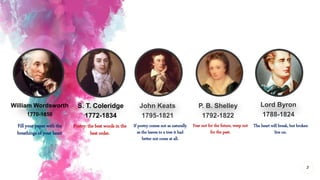
William Wordsworth
1770-1850
Fill your paper with the
breathings of your heart
Poetry: the best words in the
best order.
If poetry comes not as naturally
as the leaves to a tree it had
better not come at all.
Fear not for the future, weep not
for the past.
The heart will break, but broken
live on.
3
S. T. Coleridge
1772-1834
P. B. Shelley
1792-1822
John Keats
1795-1821
Lord Byron
1788-1824
William Wordsworth
Wordsworth’s philosophy toward human life is very simple
that man is not apart from nature, but is the very “life of her
life.”
4
Childhood and Philosophy - “Intimations of
Immorality from recollections of Early
Childhood” and “The Retreat”
Plain teaching - “Tintern Abbey”, “The
Rainbow”, “Ode to Duty” and “Intimation
of Immorality”
Rustic life - “Michael,” “The Solitary
Reaper,” “to a Highland Girl,” “Stepping
Westward,”
Autobiographical work - “The Prelude”
Nature - “The Prelude”
Samuel Taylor Coleridge
5
He was an extra precocious child, who
could read at the age of threes, and
before he was five, he had read the Bible
and the Arabian Nights.
He has three divisions of his works, the
poetic, the critical and the philosophical.
Poems: “A Day Dreamer,” “The Devil’s
Thoughts,” “The Suicide’s Argument,”
and “The Wanderings of Cain”, “The
Rime of The Ancient Mariner”,
“Christabel” and “Kubla Khan”
Prose:“Biographia Literaria”, “Lectures
on Shakespeare”, “Aids to Reflection”.
Your Logo or Name Here
John Keats
6
“Nothing ever becomes real
'til it is experienced.”
Works: “Ode to a Nightingale,”
“Ode on a Grecian Urn,” “Ode to
Psyche,” “Ode on Melancholy,”
and “Ode to Indolence.”
Negative capability: We do need
philosophies, codes, world
views—we have to have those
things to survive. But we also
have to be able to suspend
them, because they are filtering
models. They can only tell us
what we put into them to begin
with. They can therefore keep
us, according to Keats, from
seeing something new.
George Gordon Byron
“The great object of life is sensation- to
feel that we exist, even though in pain.”
Works: “Childe Harold’s Pilgrimage”, “Don
Juan”, “The Bride of Abydos”, “The Corsair”,
7
Percy Bysshe Shelly
“Our sweetest songs are those of saddest thought.”
 Shelley’s work was not widely read in his lifetime
outside a small circle of friends, poets and
critics. Most of his poetry, drama and fiction was
published in editions of 250 copies which
generally sold poorly.
 Shelley also wrote prose fiction and a quantity of
essays on political, social, and philosophical
issues. Much of this poetry and prose wasn’t
published in his lifetime, or only published in
expurgated form, due to the risk of prosecution
for political and religious libel.
• Works: “Ozymandias”, “To a Skylark”, “Ode to
the West Wind”, “The Triumph of Life”
8
Thank You

Romantic poets

  • 1.
    Wordsworth & Coleridge Yesha Bhatt Departmentof English, M. K. Bhavnagar University
  • 2.
    Romantic poets William Wordsworth SamuelTaylor Coleridge John keats Percy Shelley Lord Byron Romantic poetry Romantic poetry is the poetry of the Romantic era, an artistic, literary, musical and intellectual movement that originated in Europe towards the end of the 18th century. It involved a reaction against prevailing Enlightenment ideas of the 18th century, and lasted approximately from 1800 to 1850. 2
  • 3.
    William Wordsworth 1770-1850 Fill yourpaper with the breathings of your heart Poetry: the best words in the best order. If poetry comes not as naturally as the leaves to a tree it had better not come at all. Fear not for the future, weep not for the past. The heart will break, but broken live on. 3 S. T. Coleridge 1772-1834 P. B. Shelley 1792-1822 John Keats 1795-1821 Lord Byron 1788-1824
  • 4.
    William Wordsworth Wordsworth’s philosophytoward human life is very simple that man is not apart from nature, but is the very “life of her life.” 4 Childhood and Philosophy - “Intimations of Immorality from recollections of Early Childhood” and “The Retreat” Plain teaching - “Tintern Abbey”, “The Rainbow”, “Ode to Duty” and “Intimation of Immorality” Rustic life - “Michael,” “The Solitary Reaper,” “to a Highland Girl,” “Stepping Westward,” Autobiographical work - “The Prelude” Nature - “The Prelude”
  • 5.
    Samuel Taylor Coleridge 5 Hewas an extra precocious child, who could read at the age of threes, and before he was five, he had read the Bible and the Arabian Nights. He has three divisions of his works, the poetic, the critical and the philosophical. Poems: “A Day Dreamer,” “The Devil’s Thoughts,” “The Suicide’s Argument,” and “The Wanderings of Cain”, “The Rime of The Ancient Mariner”, “Christabel” and “Kubla Khan” Prose:“Biographia Literaria”, “Lectures on Shakespeare”, “Aids to Reflection”.
  • 6.
    Your Logo orName Here John Keats 6 “Nothing ever becomes real 'til it is experienced.” Works: “Ode to a Nightingale,” “Ode on a Grecian Urn,” “Ode to Psyche,” “Ode on Melancholy,” and “Ode to Indolence.” Negative capability: We do need philosophies, codes, world views—we have to have those things to survive. But we also have to be able to suspend them, because they are filtering models. They can only tell us what we put into them to begin with. They can therefore keep us, according to Keats, from seeing something new.
  • 7.
    George Gordon Byron “Thegreat object of life is sensation- to feel that we exist, even though in pain.” Works: “Childe Harold’s Pilgrimage”, “Don Juan”, “The Bride of Abydos”, “The Corsair”, 7
  • 8.
    Percy Bysshe Shelly “Oursweetest songs are those of saddest thought.”  Shelley’s work was not widely read in his lifetime outside a small circle of friends, poets and critics. Most of his poetry, drama and fiction was published in editions of 250 copies which generally sold poorly.  Shelley also wrote prose fiction and a quantity of essays on political, social, and philosophical issues. Much of this poetry and prose wasn’t published in his lifetime, or only published in expurgated form, due to the risk of prosecution for political and religious libel. • Works: “Ozymandias”, “To a Skylark”, “Ode to the West Wind”, “The Triumph of Life” 8
  • 9.