@2011 Mihail L. Sichitiu 1
Android Introduction
Platform Overview
@2011 Mihail L. Sichitiu 2
What is Android?
 Android is a software
stack for mobile devices
that includes an
operating system,
middleware and key
applications.
@2011 Mihail L. Sichitiu 3
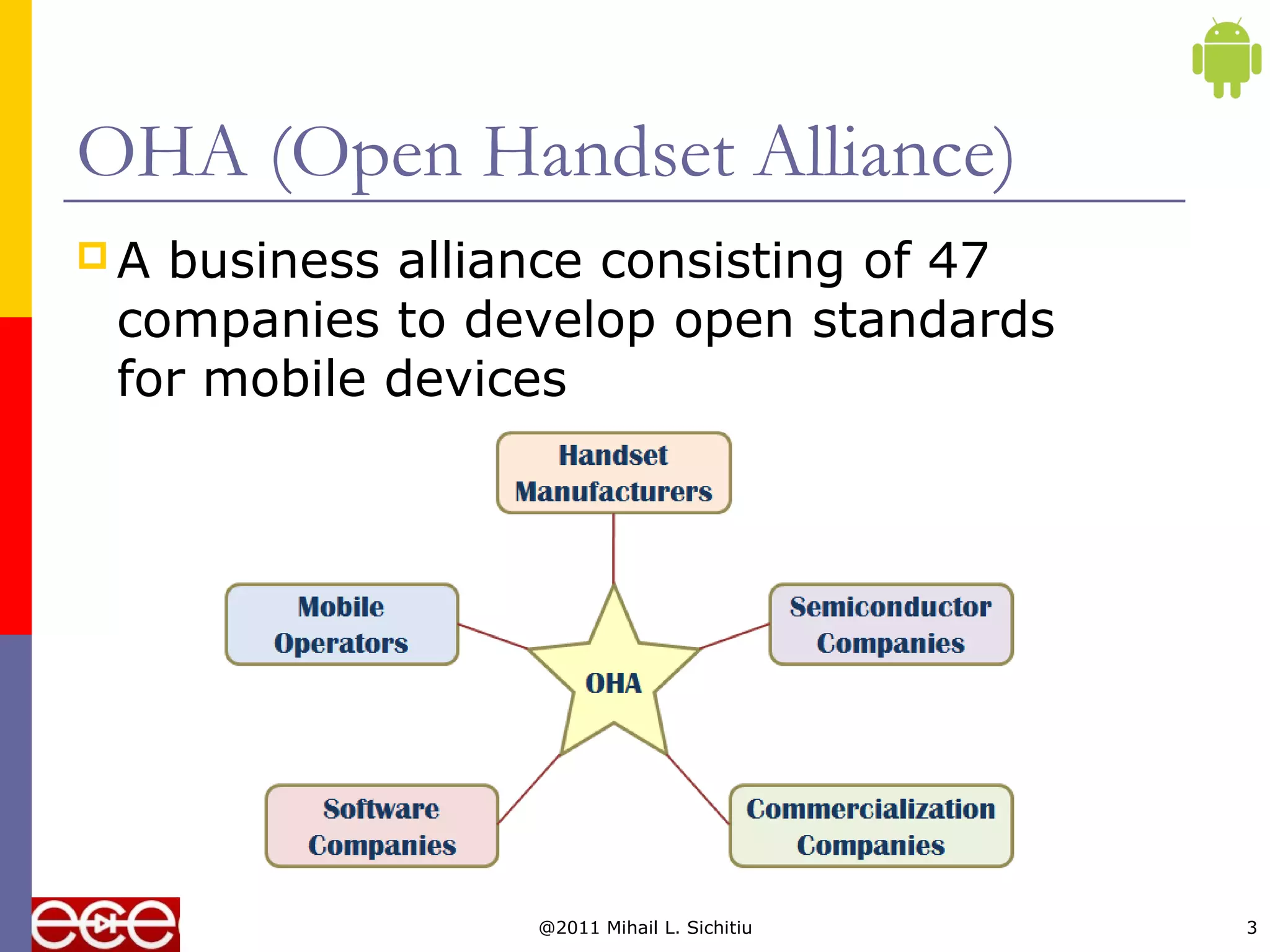
OHA (Open Handset Alliance)
 A business alliance consisting of 47
companies to develop open standards
for mobile devices
@2011 Mihail L. Sichitiu 4
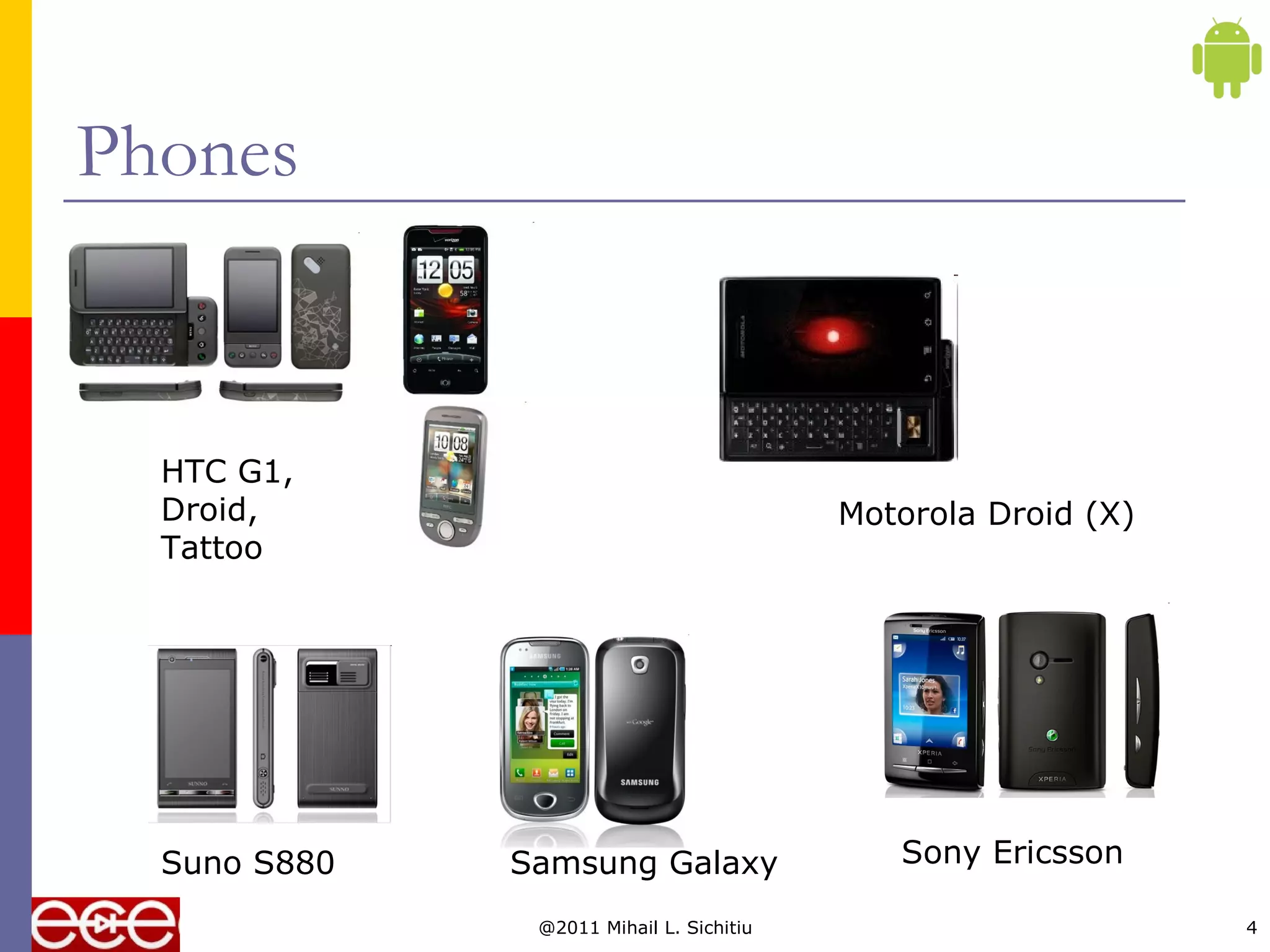
Phones
HTC G1,
Droid,
Tattoo
Motorola Droid (X)
Suno S880 Samsung Galaxy Sony Ericsson
@2011 Mihail L. Sichitiu 5
Tablets
Velocity Micro Cruz Gome FlyTouch Acer beTouch
Dawa D7
Toshiba Android
SmartBook
Cisco Android Tablet
@2011 Mihail L. Sichitiu 6
MarketShare
Feb’10 May’10 Apr’11
RIM 42.1% 41.7% 29%
Apple 25.4% 24.4% 25%
Google 9% 13% 33%
Microsoft 15.1% 13.2% 7.7%
Palm 5.4% 4.8% 2.9%
@2011 Mihail L. Sichitiu 7
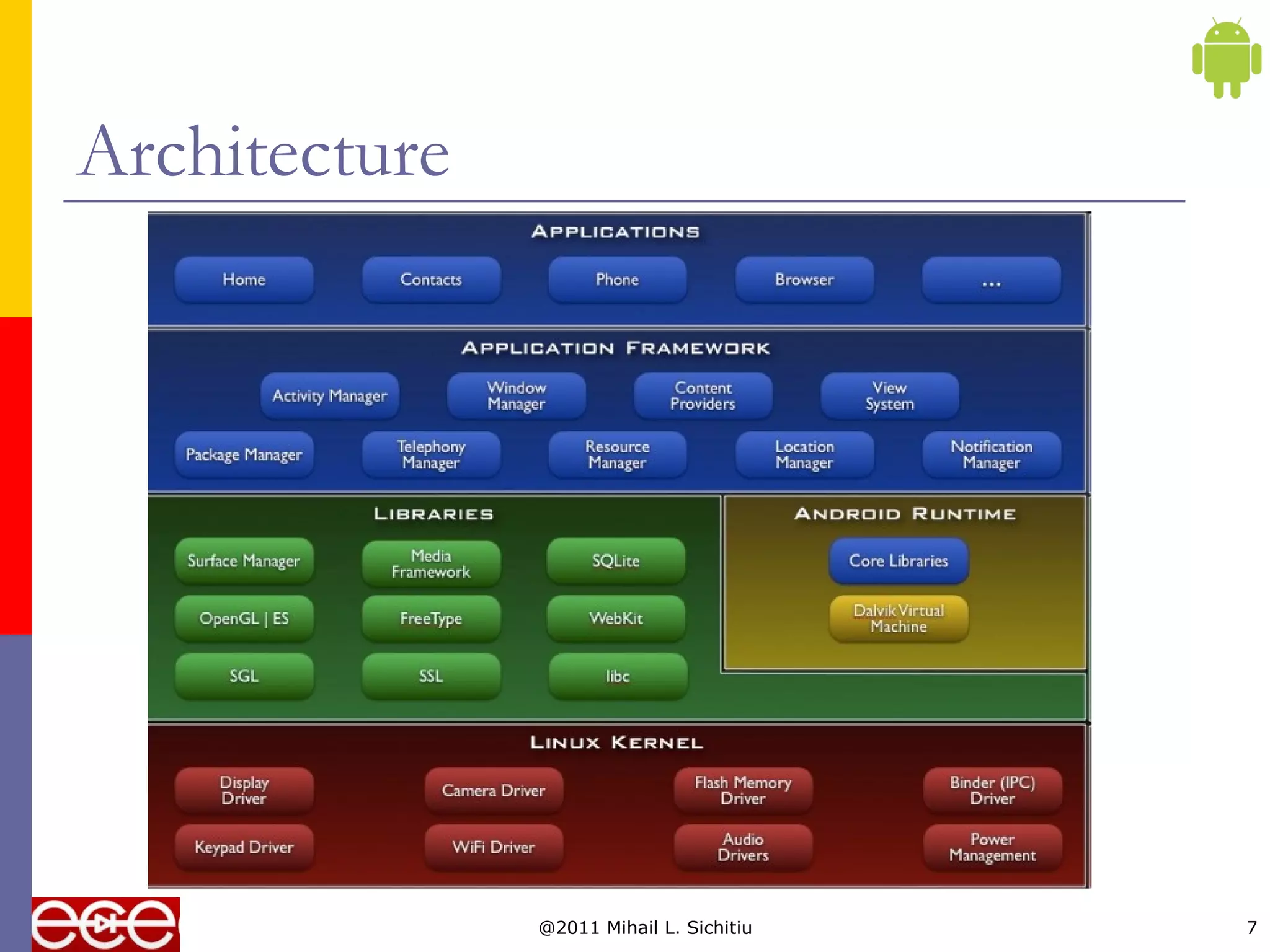
Architecture
@2011 Mihail L. Sichitiu 8
Android S/W Stack - Application
 Android provides a set of core applications:
 Email Client
 SMS Program
 Calendar
 Maps
 Browser
 Contacts
 Etc
 All applications are written using the Java language.
@2011 Mihail L. Sichitiu 9
Android S/W Stack –
App Framework
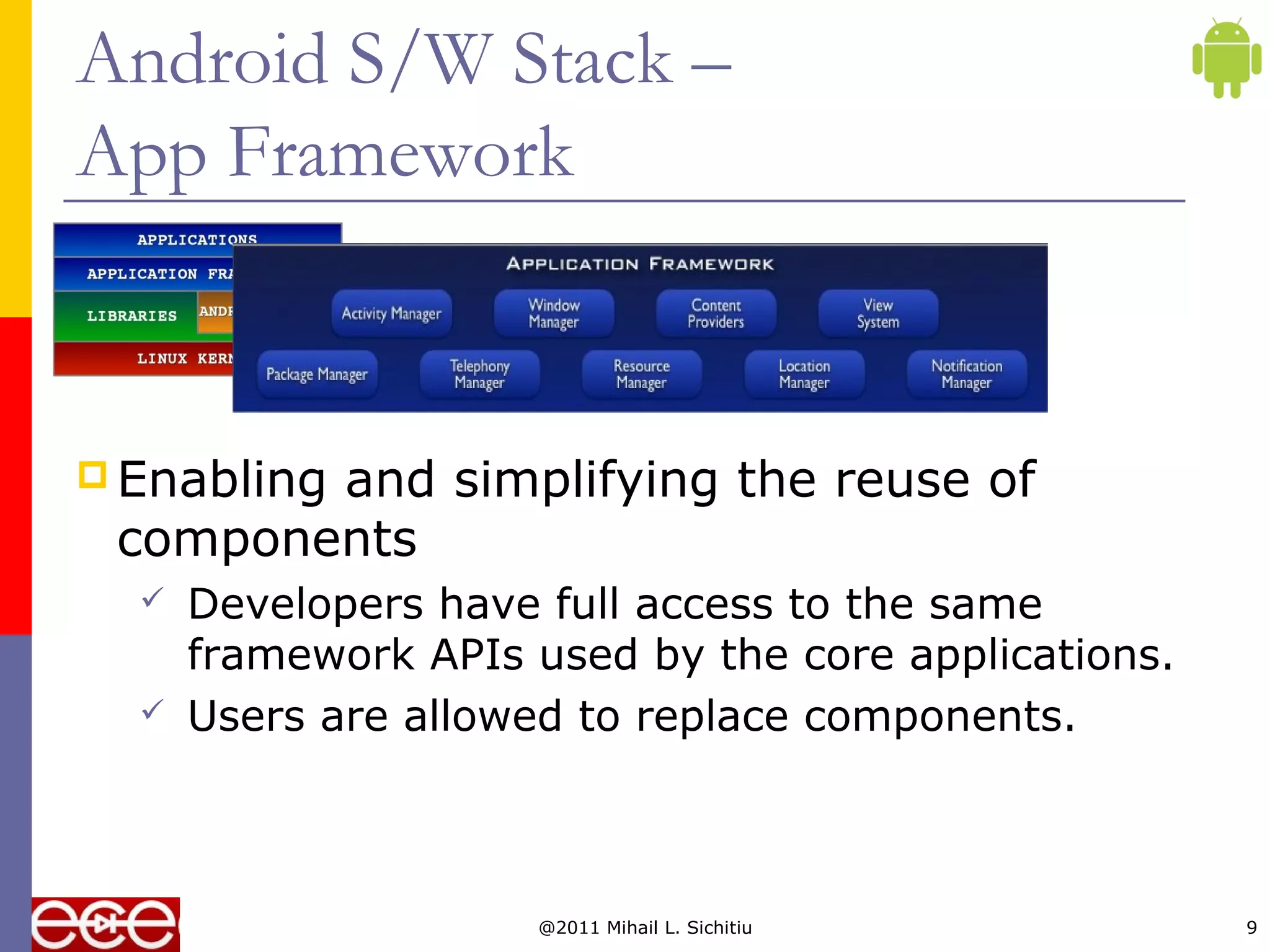
 Enabling and simplifying the reuse of
components
 Developers have full access to the same
framework APIs used by the core applications.
 Users are allowed to replace components.
@2011 Mihail L. Sichitiu 10
Android S/W Stack –
App Framework (Cont)
 Features
Feature Role
View
System
Used to build an application, including lists, grids, text
boxes, buttons, and embedded web browser
Content
Provider
Enabling applications to access data from other
applications or to share their own data
Resource
Manager
Providing access to non-code resources (localized strings,
graphics, and layout files)
Notification
Manager
Enabling all applications to display customer alerts in the
status bar
Activity
Manager
Managing the lifecycle of applications and providing
a common navigation backstack
@2011 Mihail L. Sichitiu 11
Android S/W Stack - Libraries
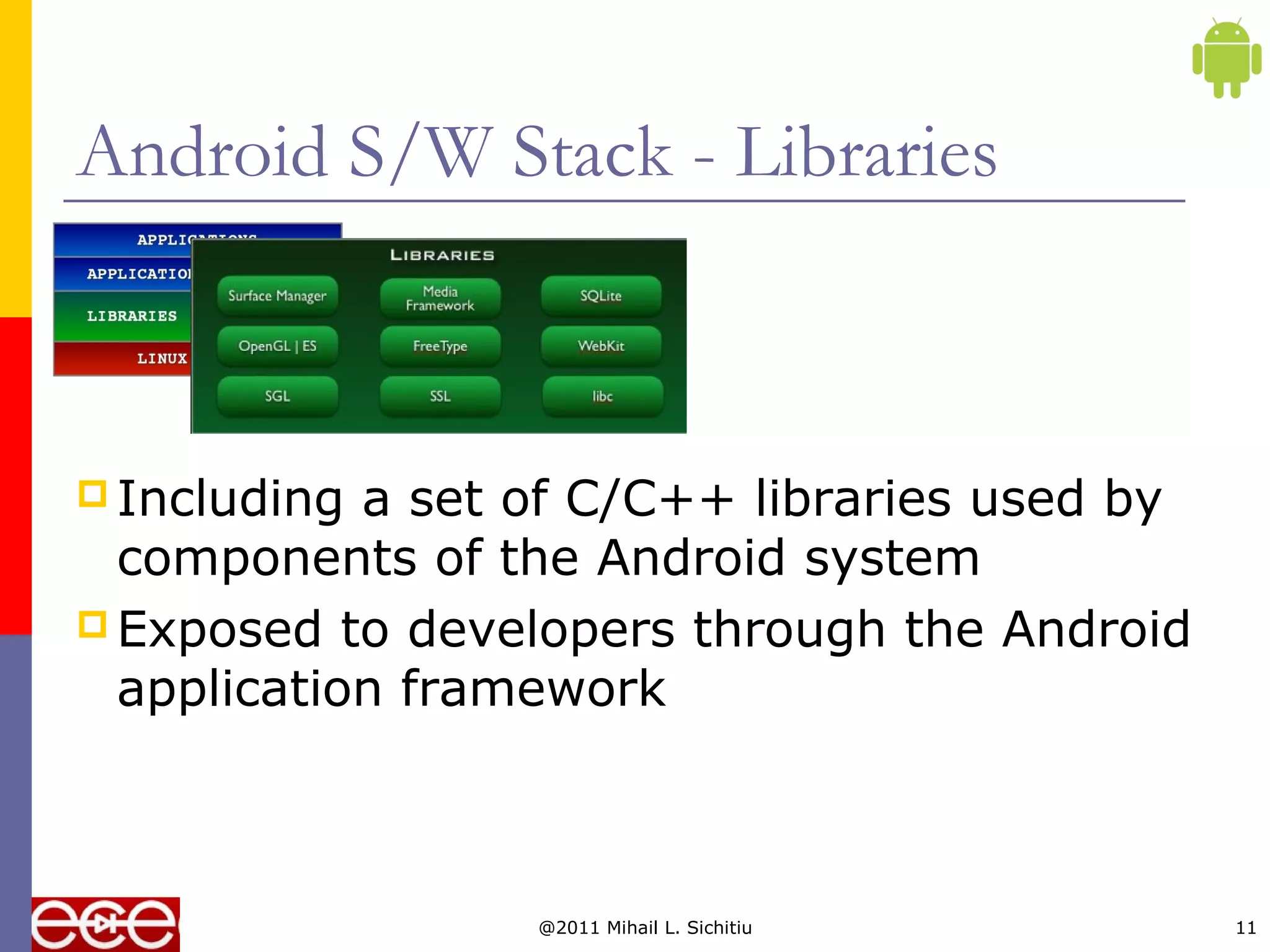
 Including a set of C/C++ libraries used by
components of the Android system
 Exposed to developers through the Android
application framework
@2011 Mihail L. Sichitiu 12
Android S/W Stack - Runtime
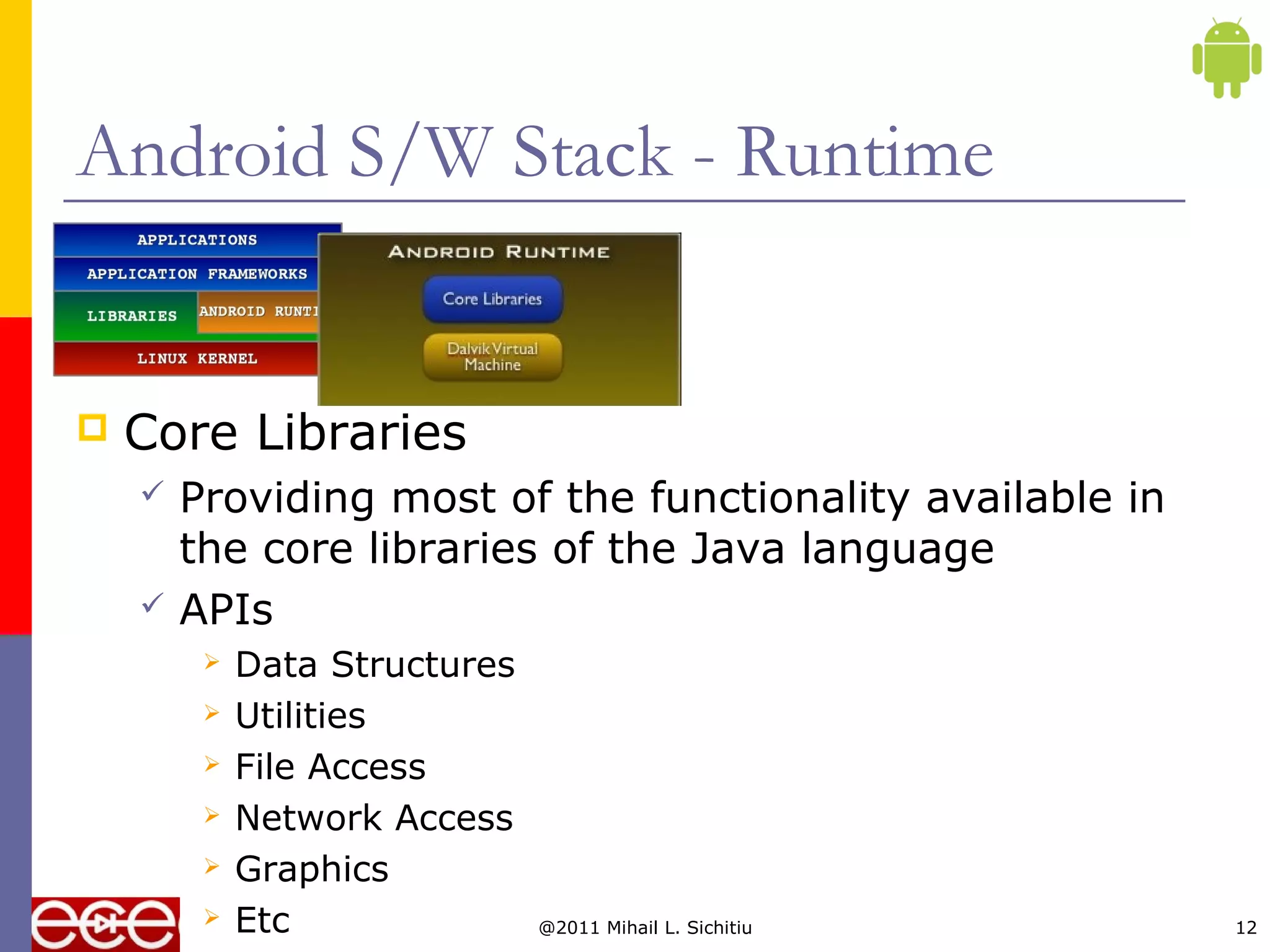
 Core Libraries
 Providing most of the functionality available in
the core libraries of the Java language
 APIs
 Data Structures
 Utilities
 File Access
 Network Access
 Graphics
 Etc
@2011 Mihail L. Sichitiu 13
Android S/W Stack – Runtime
(Cont)
 Dalvik Virtual Machine
 Providing environment on which every Android
application runs
 Each Android application runs in its own process,
with its own instance of the Dalvik VM.
 Dalvik has been written such that a device can run
multiple VMs efficiently.
 Register-based virtual machine
@2011 Mihail L. Sichitiu 14
Android S/W Stack – Runtime
(Cont)
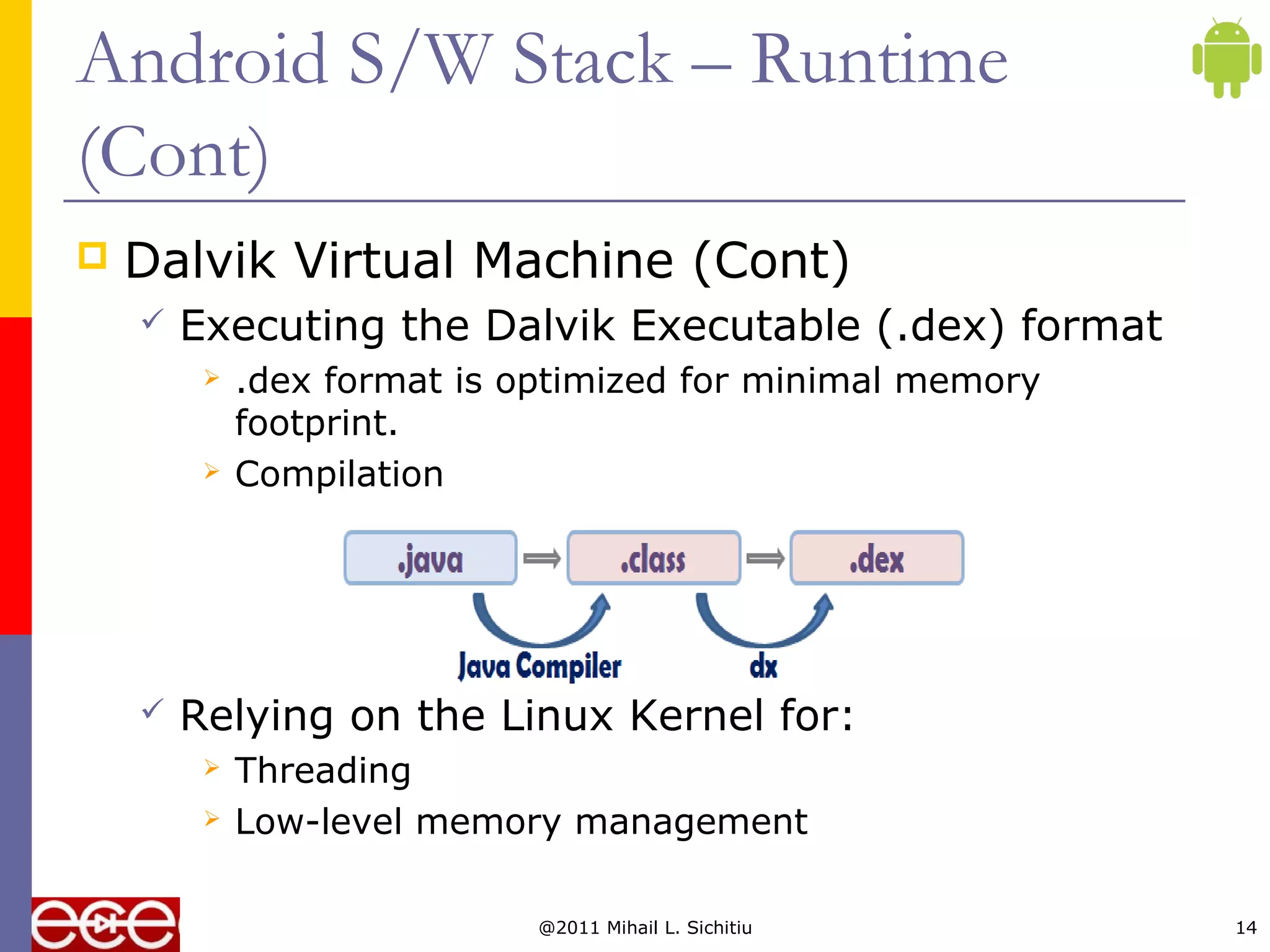
 Dalvik Virtual Machine (Cont)
 Executing the Dalvik Executable (.dex) format
 .dex format is optimized for minimal memory
footprint.
 Compilation
 Relying on the Linux Kernel for:
 Threading
 Low-level memory management
@2011 Mihail L. Sichitiu 15
Android S/W Stack – Linux Kernel
 Relying on Linux Kernel 2.6 for core system services
 Memory and Process Management
 Network Stack
 Driver Model
 Security
 Providing an abstraction layer between the H/W and the rest
of the S/W stack

Rola azab

  • 1.
    @2011 Mihail L.Sichitiu 1 Android Introduction Platform Overview
  • 2.
    @2011 Mihail L.Sichitiu 2 What is Android?  Android is a software stack for mobile devices that includes an operating system, middleware and key applications.
  • 3.
    @2011 Mihail L.Sichitiu 3 OHA (Open Handset Alliance)  A business alliance consisting of 47 companies to develop open standards for mobile devices
  • 4.
    @2011 Mihail L.Sichitiu 4 Phones HTC G1, Droid, Tattoo Motorola Droid (X) Suno S880 Samsung Galaxy Sony Ericsson
  • 5.
    @2011 Mihail L.Sichitiu 5 Tablets Velocity Micro Cruz Gome FlyTouch Acer beTouch Dawa D7 Toshiba Android SmartBook Cisco Android Tablet
  • 6.
    @2011 Mihail L.Sichitiu 6 MarketShare Feb’10 May’10 Apr’11 RIM 42.1% 41.7% 29% Apple 25.4% 24.4% 25% Google 9% 13% 33% Microsoft 15.1% 13.2% 7.7% Palm 5.4% 4.8% 2.9%
  • 7.
    @2011 Mihail L.Sichitiu 7 Architecture
  • 8.
    @2011 Mihail L.Sichitiu 8 Android S/W Stack - Application  Android provides a set of core applications:  Email Client  SMS Program  Calendar  Maps  Browser  Contacts  Etc  All applications are written using the Java language.
  • 9.
    @2011 Mihail L.Sichitiu 9 Android S/W Stack – App Framework  Enabling and simplifying the reuse of components  Developers have full access to the same framework APIs used by the core applications.  Users are allowed to replace components.
  • 10.
    @2011 Mihail L.Sichitiu 10 Android S/W Stack – App Framework (Cont)  Features Feature Role View System Used to build an application, including lists, grids, text boxes, buttons, and embedded web browser Content Provider Enabling applications to access data from other applications or to share their own data Resource Manager Providing access to non-code resources (localized strings, graphics, and layout files) Notification Manager Enabling all applications to display customer alerts in the status bar Activity Manager Managing the lifecycle of applications and providing a common navigation backstack
  • 11.
    @2011 Mihail L.Sichitiu 11 Android S/W Stack - Libraries  Including a set of C/C++ libraries used by components of the Android system  Exposed to developers through the Android application framework
  • 12.
    @2011 Mihail L.Sichitiu 12 Android S/W Stack - Runtime  Core Libraries  Providing most of the functionality available in the core libraries of the Java language  APIs  Data Structures  Utilities  File Access  Network Access  Graphics  Etc
  • 13.
    @2011 Mihail L.Sichitiu 13 Android S/W Stack – Runtime (Cont)  Dalvik Virtual Machine  Providing environment on which every Android application runs  Each Android application runs in its own process, with its own instance of the Dalvik VM.  Dalvik has been written such that a device can run multiple VMs efficiently.  Register-based virtual machine
  • 14.
    @2011 Mihail L.Sichitiu 14 Android S/W Stack – Runtime (Cont)  Dalvik Virtual Machine (Cont)  Executing the Dalvik Executable (.dex) format  .dex format is optimized for minimal memory footprint.  Compilation  Relying on the Linux Kernel for:  Threading  Low-level memory management
  • 15.
    @2011 Mihail L.Sichitiu 15 Android S/W Stack – Linux Kernel  Relying on Linux Kernel 2.6 for core system services  Memory and Process Management  Network Stack  Driver Model  Security  Providing an abstraction layer between the H/W and the rest of the S/W stack