*Introduction to
Android App
Development
*
*Android is a software based stand and operating system
for mobile devices.
*It is placed on Linux Kernel.
*It is developed by Google and later the Open Handset
Alliance(OHA).
*Java language is mainly used to write the code.
*
*Google acquired the startup company Android Inc. in
2005 to start the development of the Android Platform.
In late 2007, a group of industry leaders came together
around the Android Platform to form the Open Handset
Alliance.
*The Android SDK was first issued as an “early look”
release in November 2007.
*In September 2008 T-Mobile announced the availability
of the T-Mobile G1, the first smartphone based on the
Android Platform.
*A few days after that, Google announced the
availability of Android SDK Release Candidate 1.0.
*In October 2008, Google made the source code of the
Android Platform available under Apache’s open source
license.
*
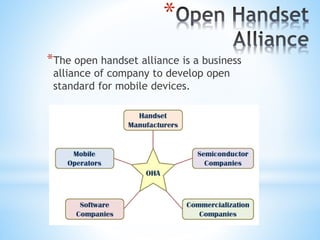
*The open handset alliance is a business
alliance of company to develop open
standard for mobile devices.
*
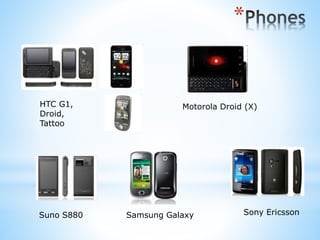
HTC G1,
Droid,
Tattoo
Motorola Droid (X)
Suno S880 Samsung Galaxy Sony Ericsson
*
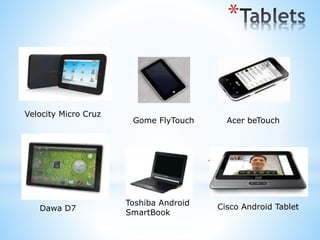
Velocity Micro Cruz
Gome FlyTouch Acer beTouch
Dawa D7
Toshiba Android
SmartBook
Cisco Android Tablet
*
*
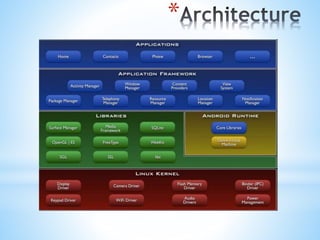
* The software stack is divided in to 4 layers:
1) The Application Layer
2) The application framework
3) The libraries and run time
4) The kernel
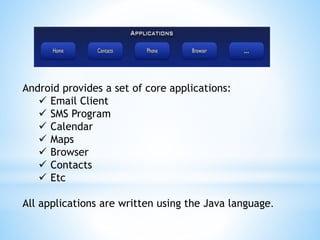
Android provides a set of core applications:
 Email Client
 SMS Program
 Calendar
 Maps
 Browser
 Contacts
 Etc
All applications are written using the Java language.
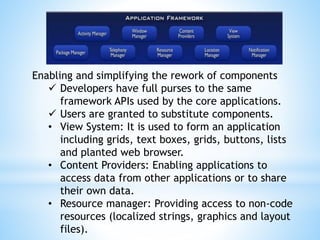
Enabling and simplifying the rework of components
 Developers have full purses to the same
framework APIs used by the core applications.
 Users are granted to substitute components.
• View System: It is used to form an application
including grids, text boxes, grids, buttons, lists
and planted web browser.
• Content Providers: Enabling applications to
access data from other applications or to share
their own data.
• Resource manager: Providing access to non-code
resources (localized strings, graphics and layout
files).
*Notification Manager: Enabling all applications to
display customer alerts in the status bar.
*Activity Manager: Managing the lifecycle of
applications and providing a common navigation
backstack.
*Package manager: It is use to retrieve the data about
installed packages on device.
*Window manager: It is use to views and layouts.
*Technology manager: It is use to handle settings of
network connection and all information about services
on device.
*Location manager: It fires alerts when user enters or
leaves a specified geographical location.
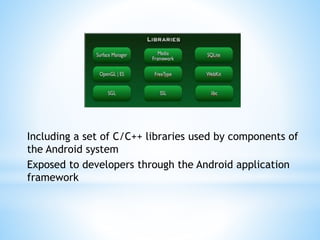
Including a set of C/C++ libraries used by components of
the Android system
Exposed to developers through the Android application
framework
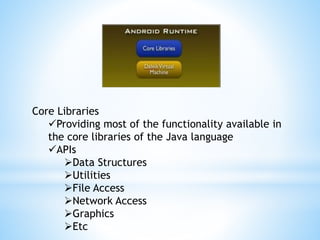
Core Libraries
Providing most of the functionality available in
the core libraries of the Java language
APIs
Data Structures
Utilities
File Access
Network Access
Graphics
Etc
Dalvik Virtual Machine
Providing environment on which every Android
application runs
Each Android application runs in its own
process, with its own instance of the Dalvik
VM.
Dalvik has been written such that a device
can run multiple VMs efficiently.
Register-based virtual machine
Dalvik Virtual Machine (Cont)
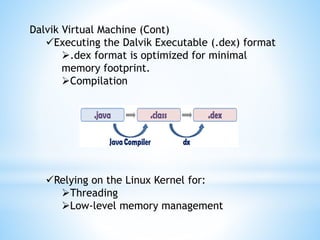
Executing the Dalvik Executable (.dex) format
.dex format is optimized for minimal
memory footprint.
Compilation
Relying on the Linux Kernel for:
Threading
Low-level memory management
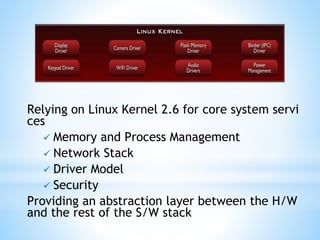
Relying on Linux Kernel 2.6 for core system servi
ces
 Memory and Process Management
 Network Stack
 Driver Model
 Security
Providing an abstraction layer between the H/W
and the rest of the S/W stack
*
*https://www.androidauthority.com/what-is-
android-328076/
*https://www.androidpit.com/what-is-android
*https://www.tutorialspoint.com/android/andr
oid_architecture.htm
*https://developer.android.com/guide/platfor
m/index.html

Introduction to android app development

  • 1.
  • 2.
    * *Android is asoftware based stand and operating system for mobile devices. *It is placed on Linux Kernel. *It is developed by Google and later the Open Handset Alliance(OHA). *Java language is mainly used to write the code.
  • 3.
    * *Google acquired thestartup company Android Inc. in 2005 to start the development of the Android Platform. In late 2007, a group of industry leaders came together around the Android Platform to form the Open Handset Alliance. *The Android SDK was first issued as an “early look” release in November 2007. *In September 2008 T-Mobile announced the availability of the T-Mobile G1, the first smartphone based on the Android Platform. *A few days after that, Google announced the availability of Android SDK Release Candidate 1.0. *In October 2008, Google made the source code of the Android Platform available under Apache’s open source license.
  • 4.
    * *The open handsetalliance is a business alliance of company to develop open standard for mobile devices.
  • 5.
    * HTC G1, Droid, Tattoo Motorola Droid(X) Suno S880 Samsung Galaxy Sony Ericsson
  • 6.
    * Velocity Micro Cruz GomeFlyTouch Acer beTouch Dawa D7 Toshiba Android SmartBook Cisco Android Tablet *
  • 7.
  • 8.
    * The softwarestack is divided in to 4 layers: 1) The Application Layer 2) The application framework 3) The libraries and run time 4) The kernel
  • 9.
    Android provides aset of core applications:  Email Client  SMS Program  Calendar  Maps  Browser  Contacts  Etc All applications are written using the Java language.
  • 10.
    Enabling and simplifyingthe rework of components  Developers have full purses to the same framework APIs used by the core applications.  Users are granted to substitute components. • View System: It is used to form an application including grids, text boxes, grids, buttons, lists and planted web browser. • Content Providers: Enabling applications to access data from other applications or to share their own data. • Resource manager: Providing access to non-code resources (localized strings, graphics and layout files).
  • 11.
    *Notification Manager: Enablingall applications to display customer alerts in the status bar. *Activity Manager: Managing the lifecycle of applications and providing a common navigation backstack. *Package manager: It is use to retrieve the data about installed packages on device. *Window manager: It is use to views and layouts. *Technology manager: It is use to handle settings of network connection and all information about services on device. *Location manager: It fires alerts when user enters or leaves a specified geographical location.
  • 12.
    Including a setof C/C++ libraries used by components of the Android system Exposed to developers through the Android application framework
  • 13.
    Core Libraries Providing mostof the functionality available in the core libraries of the Java language APIs Data Structures Utilities File Access Network Access Graphics Etc
  • 14.
    Dalvik Virtual Machine Providingenvironment on which every Android application runs Each Android application runs in its own process, with its own instance of the Dalvik VM. Dalvik has been written such that a device can run multiple VMs efficiently. Register-based virtual machine
  • 15.
    Dalvik Virtual Machine(Cont) Executing the Dalvik Executable (.dex) format .dex format is optimized for minimal memory footprint. Compilation Relying on the Linux Kernel for: Threading Low-level memory management
  • 16.
    Relying on LinuxKernel 2.6 for core system servi ces  Memory and Process Management  Network Stack  Driver Model  Security Providing an abstraction layer between the H/W and the rest of the S/W stack
  • 17.