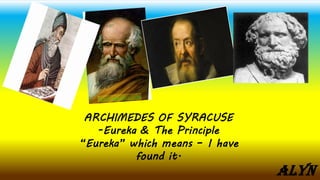
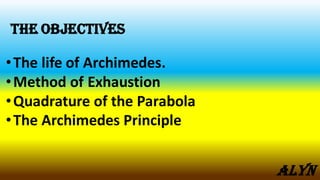
ARCHIMEDES OF SYRACUSE
-Eureka & The Principle
“Eureka” which means – I have
found it.
ALYN
The Objectives
•The life of Archimedes.
•Method of Exhaustion
•Quadrature of the Parabola
•The Archimedes Principle
ALYN
ALYN
The Life of Archimedes
(c.287-212 BCE)
ALYN
Archimedes
• Greek mathematician who
studied at Alexandria in the 3rd
Century BCE was Archimedes,
although he was born, died and
lived most of his life in
Syracuse, Sicily (a Hellenic Greek
colony in Magna Graecia).
ALYN
Archimedes
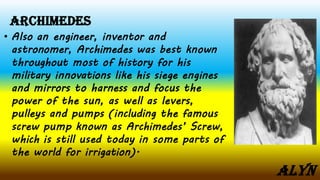
• Also an engineer, inventor and
astronomer, Archimedes was best known
throughout most of history for his
military innovations like his siege engines
and mirrors to harness and focus the
power of the sun, as well as levers,
pulleys and pumps (including the famous
screw pump known as Archimedes’ Screw,
which is still used today in some parts of
the world for irrigation).
ALYN
Archimedes
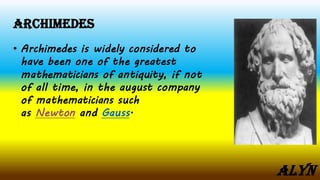
• Archimedes is widely considered to
have been one of the greatest
mathematicians of antiquity, if not
of all time, in the august company
of mathematicians such
as Newton and Gauss.
ISAAC NEWTON
-Math & Calculus-
• Physicist, mathematician,
astronomer, natural philosopher,
alchemist and theologian,
Newton is considered by many
to be one of the most
influential men in human
history.
Sir Isaac Newton (1643-1727)
ALYN
CARL FRIEDRICH GAUSS
-The Prince of Mathematics-
ALYN
Carl Friedrich Gauss (1777-1855)
• sometimes referred to as the “Prince of
Mathematicians” and the “greatest
mathematician since antiquity”. He has
had a remarkable influence in many fields
of mathematics and science and is
ranked as one of history’s most
influential mathematicians.
•Method of Exhaustion
ALYN
Approximation of the area of circle by
Archimedes’ method of exhaustion
• Archimedes produced formulas to calculate the
areas of regular shapes, using a revolutionary
method of capturing new shapes by using shapes
he already understood. For example, to estimate
the area of a circle, he constructed a larger
polygon outside the circle and a smaller one
inside it. He first enclosed the circle in a
triangle, then in a square, pentagon, hexagon,
etc, etc, each time approximating the area of
the circle more closely. By this so-called
“method of exhaustion” (or simply “Archimedes’
Method”), he effectively homed in on a value
for one of the most important numbers in all of
mathematics, π. His estimate was between
31⁄7 (approximately 3.1429) and
310⁄71 (approximately 3.1408), which compares
well with its actual value of approximately
3.1416. ALYN
• Interestingly, Archimedes seemed quite aware
that a range was all that could be established
and that the actual value might never be known.
His method for estimating π was taken to the
extreme by Ludoph van Ceulen in the 16th
Century, who used a polygon with an
extraordinary 4,611,686,018,427,387,904 sides
to arrive at a value of π correct to 35 digits.
We now know that π is in fact an irrational
number, whose value can never be known with
complete accuracy.
ALYN
Quadrature of the Parabola
ALYN
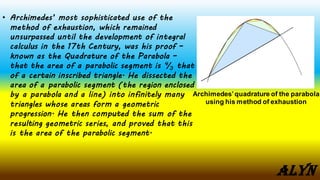
Archimedes’quadrature of the parabola
using his method of exhaustion
• Archimedes’ most sophisticated use of the
method of exhaustion, which remained
unsurpassed until the development of integral
calculus in the 17th Century, was his proof –
known as the Quadrature of the Parabola –
that the area of a parabolic segment is 4⁄3 that
of a certain inscribed triangle. He dissected the
area of a parabolic segment (the region enclosed
by a parabola and a line) into infinitely many
triangles whose areas form a geometric
progression. He then computed the sum of the
resulting geometric series, and proved that this
is the area of the parabolic segment.
ALYN
Archimedes’quadrature of the
parabola using his method of
exhaustion
• In fact, Archimedes had perhaps the most prescient
view of the concept of infinity of all the Greek
mathematicians. Generally speaking, the Greeks’
preference for precise, rigorous proofs and their
distrust of paradoxes meant that they completely
avoided the concept of actual infinity. Even Euclid,
in his proof of the infinitude of prime numbers,
was careful to conclude that there are “more
primes than any given finite number” i.e. a kind of
“potential infinity” rather than the “actual
infinity” of, for example, the number of points on
a line. Archimedes, however, in the “Archimedes
Palimpsest”, went further than any other Greek
mathematician when, on compared two infinitely
large sets, he noted that they had an equal number
of members, thus for the first time considering
actual infinity, a concept not seriously considered
again until Georg Cantor in the 19th Century. ALYN
GEORG CANTOR –
THE MAN WHO FOUNDED SET
THEORY
• The German Georg Cantor was an
outstanding violinist, but an even
more outstanding mathematician. He
was born in Saint Petersburg, Russia,
where he lived until he was eleven.
Thereafter, the family moved to
Germany, and Cantor received his
remaining education at Darmstradt,
Zürich, Berlin and (almost inevitably)
Göttingen before marrying and
settling at the University of Halle,
where he was to spend the rest of
his career.
•
Georg Cantor (1845-1918)
ALYN
Archimedes showed that the volume
and surface area of a sphere are two-
thirds that of its circumscribing
cylinder
• The discovery of which Archimedes claimed to be
most proud was that of the relationship
between a sphere and a circumscribing cylinder
of the same height and diameter. He calculated
the volume of a sphere as 4⁄3πr3, and that of a
cylinder of the same height and diameter as
2πr3. The surface area was 4πr2 for the
sphere, and 6πr2 for the cylinder (including its
two bases). Therefore, it turns out that the
sphere has a volume equal to two-thirds that
of the cylinder, and a surface area also equal to
two-thirds that of the cylinder. Archimedes was
so pleased with this result that a sculpted
sphere and cylinder were supposed to have been
placed on his tomb of at his request.
ALYN
The Archimedes Principle
ALYN
• Despite his important contributions to
pure mathematics, though, Archimedes
is probably best remembered for the
anecdotal story of his discovery of a
method for determining the volume of
an object with an irregular shape.
ALYN
Eureka! Eureka!
An experiment to demonstrate
Archimedes’Principle
• King Hieron of Syracuse had asked
Archimedes to find out if the
royal goldsmith had cheated him
by putting silver in his new gold
crown, but Archimedes clearly
could not melt it down in order
to measure it and establish its
density, so he was forced to
search for an alternative solution.
ALYN
• While taking his bath on day, he noticed that
that the level of the water in the tub rose as he
got in, and he had the sudden inspiration that he
could use this effect to determine the volume
(and therefore the density) of the crown. In his
excitement, he apparently rushed out of the bath
and ran naked through the streets shouting,
“Eureka! Eureka!” (“I found it! I found it!”).
This gave rise to what has become known as
Archimedes’ Principle: an object is immersed in a
fluid is buoyed up by a force equal to the weight
of the fluid displaced by the object. ALYN
Give me a place to stand on
and I will move the Earth
ALYN
• Another well-known quotation attributed to Archimedes
is: “Give me a place to stand on and I will move the
Earth”, meaning that, if he had a fulcrum and a lever
long enough, he could move the Earth by his own
effort, and his work on centres of gravity was very
important for future developments in mechanics.
• According to legend, Archimedes was killed by a Roman
soldier after the capture of the city of Syracuse. He
was contemplating a mathematical diagram in the sand
and enraged the soldier by refusing to go to meet the
Roman general until he had finished working on the
problem. His last words are supposed to have been “Do
not disturb my circles!”
ALYN
THAT’S ALL THANK YOUUUU ♥
ALYN

Hellenistic Mathematics -Archimedes

  • 1.
    ARCHIMEDES OF SYRACUSE -Eureka& The Principle “Eureka” which means – I have found it. ALYN
  • 2.
    The Objectives •The lifeof Archimedes. •Method of Exhaustion •Quadrature of the Parabola •The Archimedes Principle ALYN
  • 3.
    ALYN The Life ofArchimedes (c.287-212 BCE)
  • 4.
    ALYN Archimedes • Greek mathematicianwho studied at Alexandria in the 3rd Century BCE was Archimedes, although he was born, died and lived most of his life in Syracuse, Sicily (a Hellenic Greek colony in Magna Graecia).
  • 6.
    ALYN Archimedes • Also anengineer, inventor and astronomer, Archimedes was best known throughout most of history for his military innovations like his siege engines and mirrors to harness and focus the power of the sun, as well as levers, pulleys and pumps (including the famous screw pump known as Archimedes’ Screw, which is still used today in some parts of the world for irrigation).
  • 7.
    ALYN Archimedes • Archimedes iswidely considered to have been one of the greatest mathematicians of antiquity, if not of all time, in the august company of mathematicians such as Newton and Gauss.
  • 8.
    ISAAC NEWTON -Math &Calculus- • Physicist, mathematician, astronomer, natural philosopher, alchemist and theologian, Newton is considered by many to be one of the most influential men in human history. Sir Isaac Newton (1643-1727) ALYN
  • 9.
    CARL FRIEDRICH GAUSS -ThePrince of Mathematics- ALYN Carl Friedrich Gauss (1777-1855) • sometimes referred to as the “Prince of Mathematicians” and the “greatest mathematician since antiquity”. He has had a remarkable influence in many fields of mathematics and science and is ranked as one of history’s most influential mathematicians.
  • 10.
  • 11.
    Approximation of thearea of circle by Archimedes’ method of exhaustion • Archimedes produced formulas to calculate the areas of regular shapes, using a revolutionary method of capturing new shapes by using shapes he already understood. For example, to estimate the area of a circle, he constructed a larger polygon outside the circle and a smaller one inside it. He first enclosed the circle in a triangle, then in a square, pentagon, hexagon, etc, etc, each time approximating the area of the circle more closely. By this so-called “method of exhaustion” (or simply “Archimedes’ Method”), he effectively homed in on a value for one of the most important numbers in all of mathematics, π. His estimate was between 31⁄7 (approximately 3.1429) and 310⁄71 (approximately 3.1408), which compares well with its actual value of approximately 3.1416. ALYN
  • 12.
    • Interestingly, Archimedesseemed quite aware that a range was all that could be established and that the actual value might never be known. His method for estimating π was taken to the extreme by Ludoph van Ceulen in the 16th Century, who used a polygon with an extraordinary 4,611,686,018,427,387,904 sides to arrive at a value of π correct to 35 digits. We now know that π is in fact an irrational number, whose value can never be known with complete accuracy. ALYN
  • 13.
    Quadrature of theParabola ALYN
  • 14.
    Archimedes’quadrature of theparabola using his method of exhaustion • Archimedes’ most sophisticated use of the method of exhaustion, which remained unsurpassed until the development of integral calculus in the 17th Century, was his proof – known as the Quadrature of the Parabola – that the area of a parabolic segment is 4⁄3 that of a certain inscribed triangle. He dissected the area of a parabolic segment (the region enclosed by a parabola and a line) into infinitely many triangles whose areas form a geometric progression. He then computed the sum of the resulting geometric series, and proved that this is the area of the parabolic segment. ALYN
  • 15.
    Archimedes’quadrature of the parabolausing his method of exhaustion • In fact, Archimedes had perhaps the most prescient view of the concept of infinity of all the Greek mathematicians. Generally speaking, the Greeks’ preference for precise, rigorous proofs and their distrust of paradoxes meant that they completely avoided the concept of actual infinity. Even Euclid, in his proof of the infinitude of prime numbers, was careful to conclude that there are “more primes than any given finite number” i.e. a kind of “potential infinity” rather than the “actual infinity” of, for example, the number of points on a line. Archimedes, however, in the “Archimedes Palimpsest”, went further than any other Greek mathematician when, on compared two infinitely large sets, he noted that they had an equal number of members, thus for the first time considering actual infinity, a concept not seriously considered again until Georg Cantor in the 19th Century. ALYN
  • 16.
    GEORG CANTOR – THEMAN WHO FOUNDED SET THEORY • The German Georg Cantor was an outstanding violinist, but an even more outstanding mathematician. He was born in Saint Petersburg, Russia, where he lived until he was eleven. Thereafter, the family moved to Germany, and Cantor received his remaining education at Darmstradt, Zürich, Berlin and (almost inevitably) Göttingen before marrying and settling at the University of Halle, where he was to spend the rest of his career. • Georg Cantor (1845-1918) ALYN
  • 17.
    Archimedes showed thatthe volume and surface area of a sphere are two- thirds that of its circumscribing cylinder • The discovery of which Archimedes claimed to be most proud was that of the relationship between a sphere and a circumscribing cylinder of the same height and diameter. He calculated the volume of a sphere as 4⁄3πr3, and that of a cylinder of the same height and diameter as 2πr3. The surface area was 4πr2 for the sphere, and 6πr2 for the cylinder (including its two bases). Therefore, it turns out that the sphere has a volume equal to two-thirds that of the cylinder, and a surface area also equal to two-thirds that of the cylinder. Archimedes was so pleased with this result that a sculpted sphere and cylinder were supposed to have been placed on his tomb of at his request. ALYN
  • 18.
  • 19.
    • Despite hisimportant contributions to pure mathematics, though, Archimedes is probably best remembered for the anecdotal story of his discovery of a method for determining the volume of an object with an irregular shape. ALYN
  • 20.
    Eureka! Eureka! An experimentto demonstrate Archimedes’Principle • King Hieron of Syracuse had asked Archimedes to find out if the royal goldsmith had cheated him by putting silver in his new gold crown, but Archimedes clearly could not melt it down in order to measure it and establish its density, so he was forced to search for an alternative solution. ALYN
  • 21.
    • While takinghis bath on day, he noticed that that the level of the water in the tub rose as he got in, and he had the sudden inspiration that he could use this effect to determine the volume (and therefore the density) of the crown. In his excitement, he apparently rushed out of the bath and ran naked through the streets shouting, “Eureka! Eureka!” (“I found it! I found it!”). This gave rise to what has become known as Archimedes’ Principle: an object is immersed in a fluid is buoyed up by a force equal to the weight of the fluid displaced by the object. ALYN
  • 22.
    Give me aplace to stand on and I will move the Earth ALYN
  • 23.
    • Another well-knownquotation attributed to Archimedes is: “Give me a place to stand on and I will move the Earth”, meaning that, if he had a fulcrum and a lever long enough, he could move the Earth by his own effort, and his work on centres of gravity was very important for future developments in mechanics. • According to legend, Archimedes was killed by a Roman soldier after the capture of the city of Syracuse. He was contemplating a mathematical diagram in the sand and enraged the soldier by refusing to go to meet the Roman general until he had finished working on the problem. His last words are supposed to have been “Do not disturb my circles!” ALYN
  • 24.
    THAT’S ALL THANKYOUUUU ♥ ALYN