Copyright ©2012 Pearson Inc.
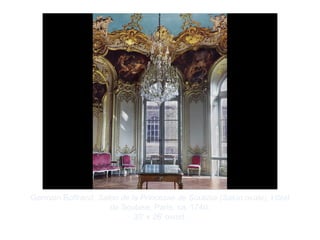
Germain Boffrand. Salon de la Princesse de Soubise (Salon ovale), Hôtel
de Soubise, Paris. ca. 1740.
33' x 26' ovoid.
Copyright ©2012 Pearson Inc.
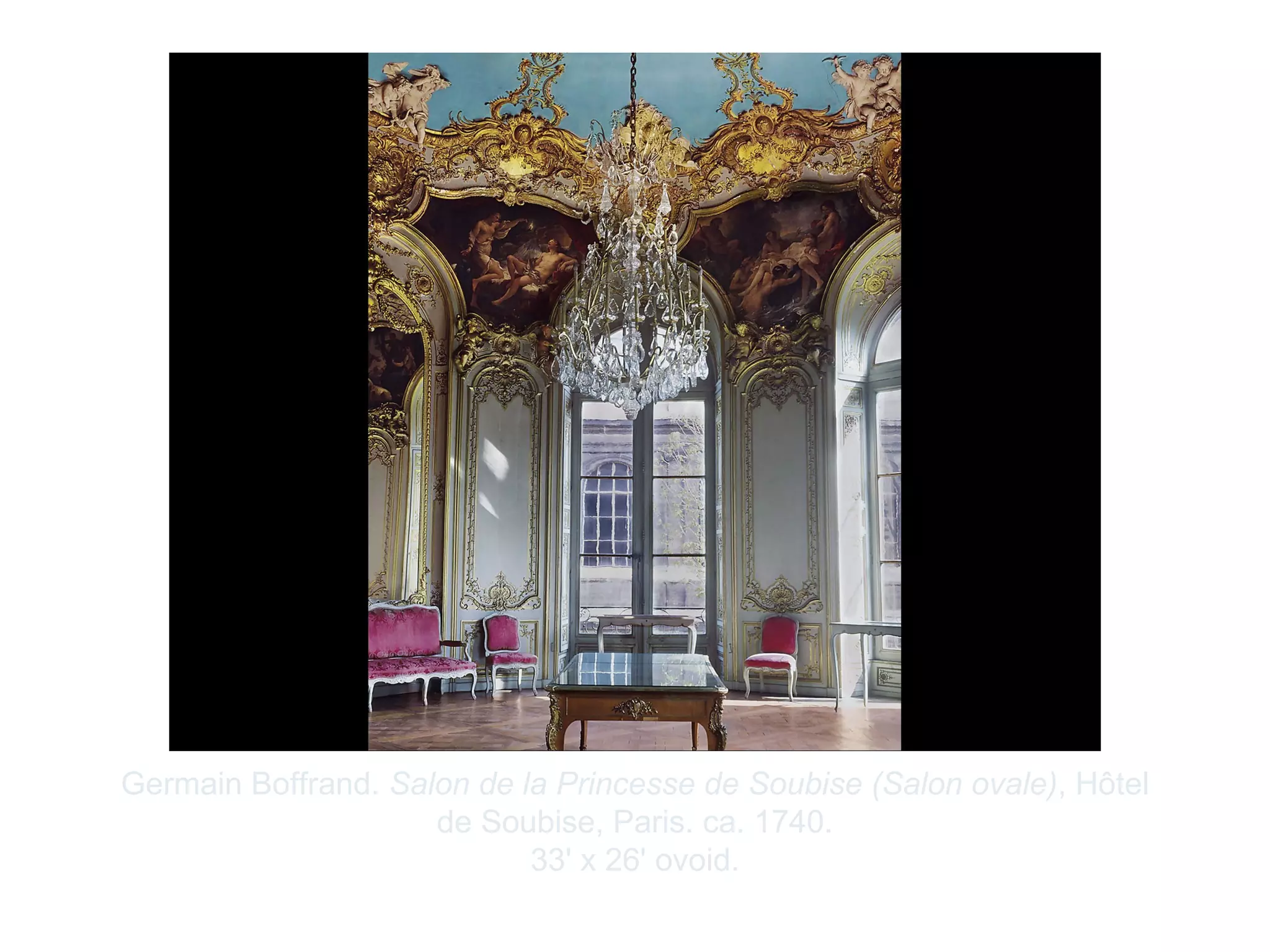
Charles-Joseph Natoire. Salon de la Princesse de Soubise, Hôtel de
Soubise, Paris: Cupid and Psyche, painted section of ceiling. 1738.
5’ 7-3/4" × 8’ 6-3/8”.
Copyright ©2012 Pearson Inc.
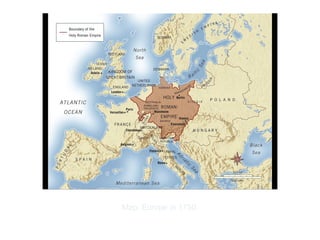
Map: Europe in 1750.
The Rococo
What is the Rococo?
• Rococo Painting in France: The Fete Galante and the Art of
Love — The subject matter is frivolous, emphasizing the pursuit of
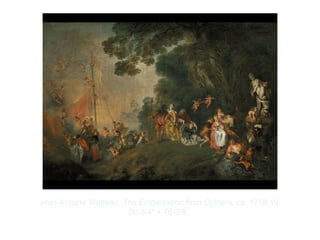
pleasure, particularly love. Watteau painted celebrations or parties
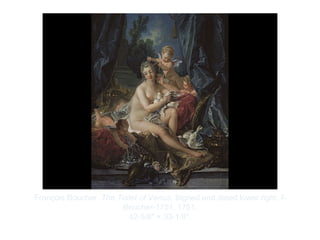
enjoyed by an elite group in a pastoral or garden setting. Boucher was
notorious for painting nude goddesses and Fragonard suggests erotic
intrigue in his most famous painting.
• Rococo Architecture and Landscape Design in Central
Europe and England — Architecture took on a curvilinear style
embodied by Neumann and Tiepolo in Bavaria. Frederick I of Prussia
favored ostentation and extravagance, his son, Frederick the Great,
lavished attention on his palace highlighted by gilded stucco
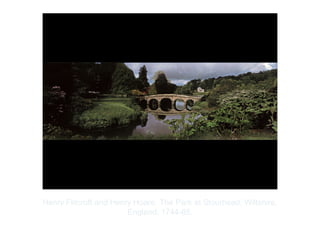
decorations. The English garden has walkways that are serpentine as
opposed to the geometrical layout of the French garden.
Copyright ©2012 Pearson Inc.
Jean-Antoine Watteau. The Embarkation from Cythera. ca. 1718-19.
50-3/4" × 76-3/8”.
Copyright ©2012 Pearson Inc.
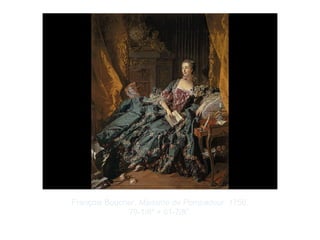
François Boucher. Madame de Pompadour. 1756.
79-1/8" × 61-7/8”.
Copyright ©2012 Pearson Inc.
François Boucher. The Toilet of Venus. Signed and dated lower right: f-
Boucher-1751. 1751.
42-5/8" × 33-1/8”.
Copyright ©2012 Pearson Inc.
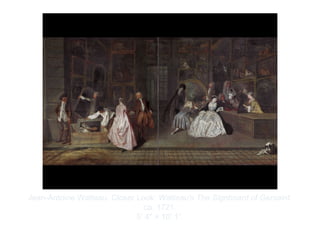
Jean-Antoine Watteau. Closer Look: Watteau's The Signboard of Gersaint.
ca. 1721.
5’ 4" × 10’ 1”.
Copyright ©2012 Pearson Inc.
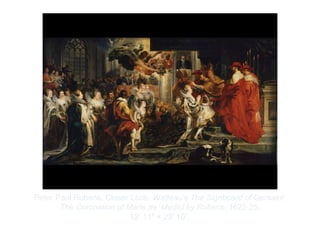
Peter Paul Rubens. Closer Look: Watteau's The Signboard of Gersaint:
The Coronation of Marie de’ Medici by Rubens. 1622-25.
12’ 11" × 23’ 10”.
Copyright ©2012 Pearson Inc.
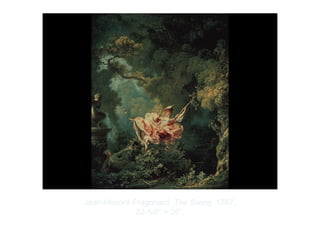
Jean-Honoré Fragonard. The Swing. 1767.
32-5/8" × 26”.
Copyright ©2012 Pearson Inc.
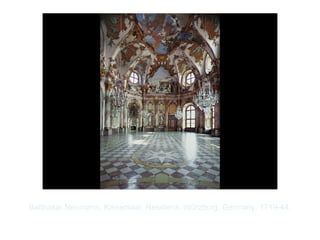
Balthasar Neumann. Kaisersaal, Residenz, Würzburg, Germany. 1719-44.
Copyright ©2012 Pearson Inc.
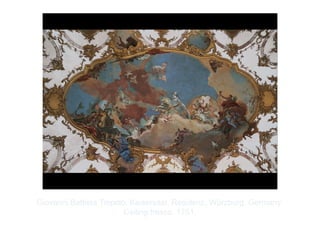
Giovanni Battista Tiepolo. Kaisersaal, Residenz, Würzburg, Germany:
Ceiling fresco. 1751.
Copyright ©2012 Pearson Inc.
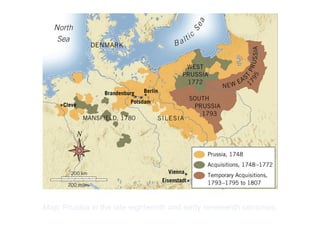
Map: Prussia in the late eighteenth and early nineteenth centuries.
Copyright ©2012 Pearson Inc.
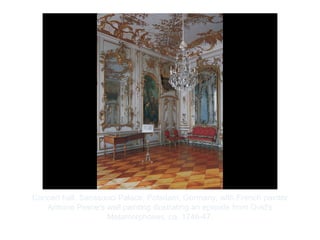
Concert hall, Sanssouci Palace, Potsdam, Germany, with French painter
Antoine Pesne's wall painting illustrating an episode from Ovid's
Metamorphoses. ca. 1746-47.
Copyright ©2012 Pearson Inc.
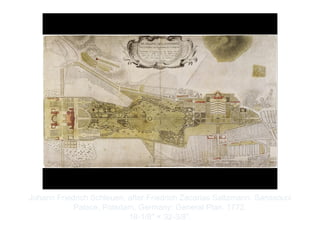
Johann Friedrich Schleuen, after Friedrich Zacarias Saltzmann. Sanssouci
Palace, Potsdam, Germany: General Plan. 1772.
18-1/8" × 32-3/8”.
Copyright ©2012 Pearson Inc.
Henry Flitcroft and Henry Hoare. The Park at Stourhead, Wiltshire,
England. 1744-65.
Copyright ©2012 Pearson Inc.
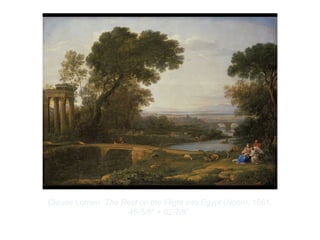
Claude Lorrain. The Rest on the Flight into Egypt (Noon). 1661.
45-5/8" × 62-7/8”.
Copyright ©2012 Pearson Inc.
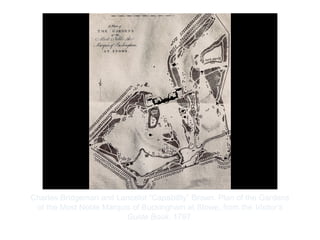
Charles Bridgeman and Lancelot “Capability” Brown. Plan of the Gardens
of the Most Noble Marquis of Buckingham at Stowe, from the Visitor’s
Guide Book. 1797.
The Philosophes
Who are the philosophes?
• Denis Diderot and the Encyclopedie — The crowning
achievement of the philosophes edited by Diderot and Jean le Rond
d’Alembert and intended “to change the general way of thinking.”
• Jean-Jacques Rousseau and the Cost of the Social
Contract — Rousseau contributed to the Encyclopedie and believed
in the natural goodness of humankind which is corrupted by society and
the growth of civilization.
• Voltaire and French Satire — Voltaire championed freedom of
thought, including the freedom to be absolutely pessimistic, a theme
that dominates Candide.
• Art Criticism and Theory — Diderot began reviewing the Paris
Salons for a private newsletter and the separation of “fine arts” from
“liberal arts” commenced.
• Discussion Question: What were the ideals of the Philosophes? Were
they generally realized in Rococo culture?
Copyright ©2012 Pearson Inc.
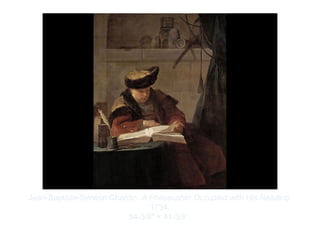
Jean-Baptiste-Siméon Chardin. A Philosopher Occupied with His Reading.
1734.
54-3/8" × 41-3/8”.
Copyright ©2012 Pearson Inc.
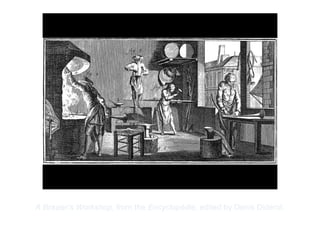
A Brazier’s Workshop, from the Encyclopédie, edited by Denis Diderot.
Copyright ©2012 Pearson Inc.
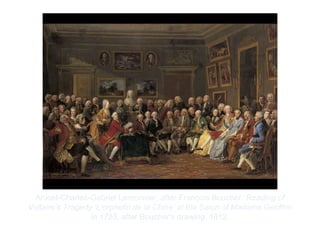
Anicet-Charles-Gabriel Lemonnier, after François Boucher. Reading of
Voltaire’s Tragedy ‘L’orphelin de la Chine’ at the Salon of Madame Geoffrin
in 1755, after Boucher's drawing. 1812.
Copyright ©2012 Pearson Inc.
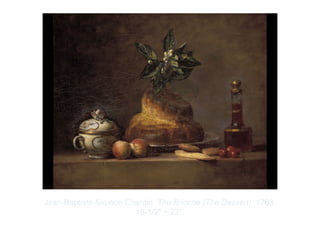
Jean-Baptiste-Siméon Chardin. The Brioche (The Dessert). 1763.
18-1/2" × 22”.
Rococo and Classical Music
What are the characteristics of Classical music?
• The Symphonic Orchestra — This ensemble was larger than
previously and divided into separate sections according to type of
instruments. The Symphonic Form was developed.
• The String Quartets of Joseph Haydn — This ensemble was the
first of the new Classical genres and featured two violins, a viola, an a
cello.
• Wolfgang Amadeus Mozart: Classical Complexity —
Mozart’s music was generally regarded as overly complicated for a
popular audience to absorb such as Symphony No. 40.
• The Popularization of Opera — This form announced the death of
the Rococo. Opera buffa emerged and Mozart united opera seria with
opera buffa.
• Discussion Question: How does string quartet music differ from that for
a symphonic orchestra? Why is there need for each?
Copyright ©2012 Pearson Inc.
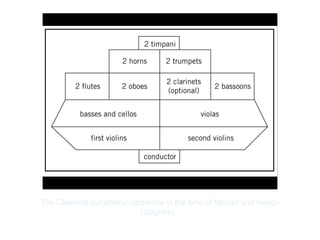
The Classical symphonic orchestra in the time of Mozart and Haydn
(diagram).
Copyright ©2012 Pearson Inc.
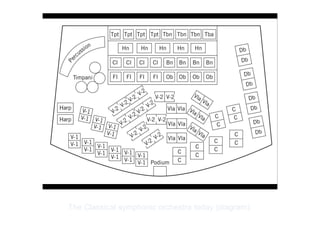
The Classical symphonic orchestra today (diagram).
Copyright ©2012 Pearson Inc.
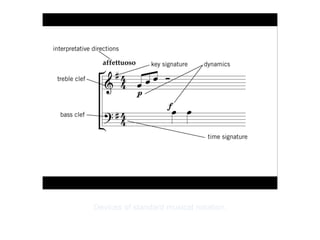
Devices of standard musical notation.
Copyright ©2012 Pearson Inc.
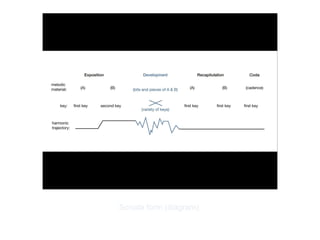
Sonata form (diagram).
 Active Listening Guide: Haydn: Symphony No.
94, III
MyArtsLabChapter 25 – The Rococo and the Enlightenment On the Continent
Copyright ©2012 Pearson Inc.
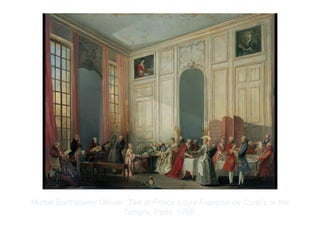
Michel Barthélémy Ollivier. Tea at Prince Louis-François de Conti’s in the
Temple, Paris. 1766.
 Active Listening Guide: Mozart: Symphony No.
40 in G Minor, I
MyArtsLabChapter 25 – The Rococo and the Enlightenment On the Continent
Copyright ©2012 Pearson Inc.
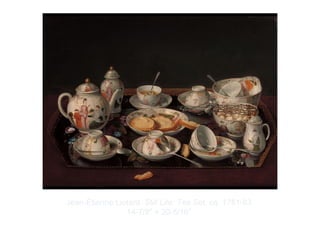
Jean-Étienne Liotard. Still Life: Tea Set. ca. 1781-83.
14-7/8" × 20-5/16”.
China and Europe: Cross-Cultural Contact
How did China and the West influence one another?
• The Arts in the Qing Dynasty — Western conventions were
expressed as artists created images for export to both the West and
Japan though traditional Chinese art was valued.
• Celebrating Tradition: The Great Jade Carving — An
enormous piece of jade was discovered near Khotan and the Quianlong
emperor realized its propagandistic value. He commissioned the
subject depicting a mythical emperor taming a flood.
Copyright ©2012 Pearson Inc.
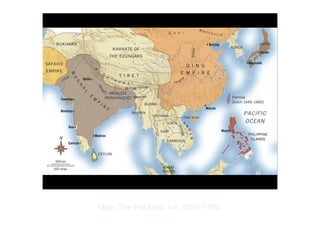
Map: The Far East, ca. 1600-1799.
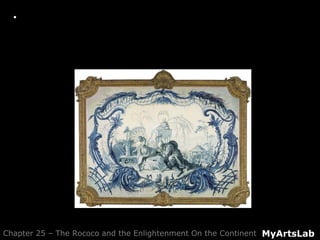
 Closer Look: Europe’s Chinoiserie Craze.
MyArtsLabChapter 25 – The Rococo and the Enlightenment On the Continent
Copyright ©2012 Pearson Inc.
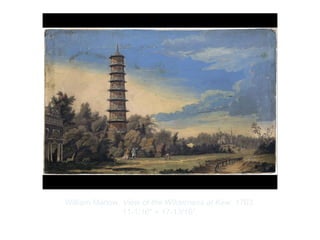
William Marlow. View of the Wilderness at Kew. 1763.
11-1/16" × 17-13/16”.
Copyright ©2012 Pearson Inc.
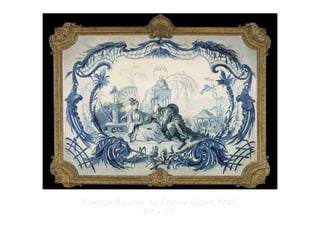
François Boucher. Le Chinois Galant. 1742.
41" × 57”.
Copyright ©2012 Pearson Inc.
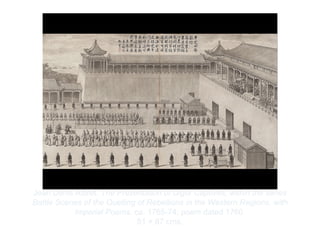
Jean Denis Attiret. The Presentation of Uigur Captives, within the series
Battle Scenes of the Quelling of Rebellions in the Western Regions, with
Imperial Poems. ca. 1765-74; poem dated 1760.
51 × 87 cms.
Copyright ©2012 Pearson Inc.
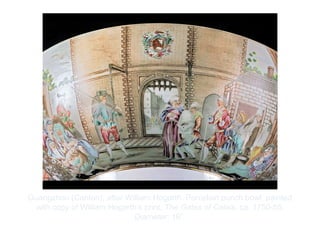
Guangzhou (Canton), after William Hogarth. Porcelain punch bowl, painted
with copy of William Hogarth’s print, The Gates of Calais. ca. 1750-55.
Diameter: 16”.
Copyright ©2012 Pearson Inc.
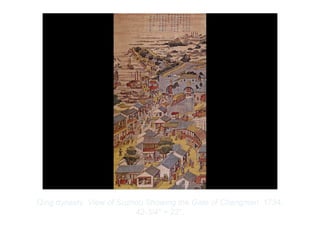
Qing dynasty. View of Suzhou Showing the Gate of Changmen. 1734.
42-3/4" × 22”.
Copyright ©2012 Pearson Inc.
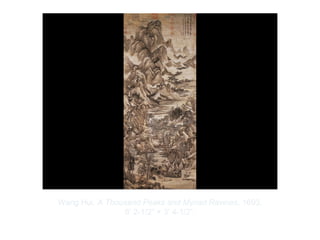
Wang Hui. A Thousand Peaks and Myriad Ravines. 1693.
8’ 2-1/2" × 3’ 4-1/2”.
Copyright ©2012 Pearson Inc.
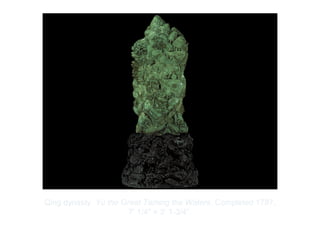
Qing dynasty. Yu the Great Taming the Waters. Completed 1787.
7’ 1/4" × 3’ 1-3/4”.
Copyright ©2012 Pearson Inc.
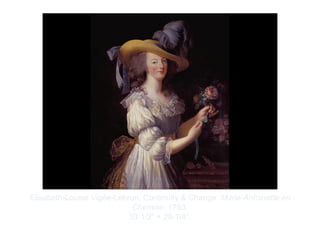
Elisabeth-Louise Vigée-Lebrun. Continuity & Change: Marie-Antoinette en
Chemise. 1783.
33-1/2" × 28-1/4”.
Copyright ©2012 Pearson Inc.
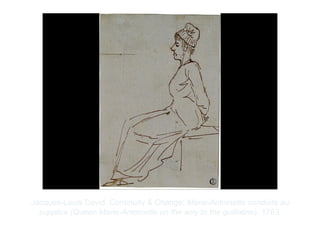
Jacques-Louis David. Continuity & Change: Marie-Antoinette conduite au
supplice (Queen Marie-Antoinette on the way to the guillotine). 1783.

Sayre2e ch25 integrated_lecture_pp_ts-150666

  • 1.
    Copyright ©2012 PearsonInc. Germain Boffrand. Salon de la Princesse de Soubise (Salon ovale), Hôtel de Soubise, Paris. ca. 1740. 33' x 26' ovoid.
  • 2.
    Copyright ©2012 PearsonInc. Charles-Joseph Natoire. Salon de la Princesse de Soubise, Hôtel de Soubise, Paris: Cupid and Psyche, painted section of ceiling. 1738. 5’ 7-3/4" × 8’ 6-3/8”.
  • 3.
    Copyright ©2012 PearsonInc. Map: Europe in 1750.
  • 4.
    The Rococo What isthe Rococo? • Rococo Painting in France: The Fete Galante and the Art of Love — The subject matter is frivolous, emphasizing the pursuit of pleasure, particularly love. Watteau painted celebrations or parties enjoyed by an elite group in a pastoral or garden setting. Boucher was notorious for painting nude goddesses and Fragonard suggests erotic intrigue in his most famous painting. • Rococo Architecture and Landscape Design in Central Europe and England — Architecture took on a curvilinear style embodied by Neumann and Tiepolo in Bavaria. Frederick I of Prussia favored ostentation and extravagance, his son, Frederick the Great, lavished attention on his palace highlighted by gilded stucco decorations. The English garden has walkways that are serpentine as opposed to the geometrical layout of the French garden.
  • 5.
    Copyright ©2012 PearsonInc. Jean-Antoine Watteau. The Embarkation from Cythera. ca. 1718-19. 50-3/4" × 76-3/8”.
  • 6.
    Copyright ©2012 PearsonInc. François Boucher. Madame de Pompadour. 1756. 79-1/8" × 61-7/8”.
  • 7.
    Copyright ©2012 PearsonInc. François Boucher. The Toilet of Venus. Signed and dated lower right: f- Boucher-1751. 1751. 42-5/8" × 33-1/8”.
  • 8.
    Copyright ©2012 PearsonInc. Jean-Antoine Watteau. Closer Look: Watteau's The Signboard of Gersaint. ca. 1721. 5’ 4" × 10’ 1”.
  • 9.
    Copyright ©2012 PearsonInc. Peter Paul Rubens. Closer Look: Watteau's The Signboard of Gersaint: The Coronation of Marie de’ Medici by Rubens. 1622-25. 12’ 11" × 23’ 10”.
  • 10.
    Copyright ©2012 PearsonInc. Jean-Honoré Fragonard. The Swing. 1767. 32-5/8" × 26”.
  • 11.
    Copyright ©2012 PearsonInc. Balthasar Neumann. Kaisersaal, Residenz, Würzburg, Germany. 1719-44.
  • 12.
    Copyright ©2012 PearsonInc. Giovanni Battista Tiepolo. Kaisersaal, Residenz, Würzburg, Germany: Ceiling fresco. 1751.
  • 13.
    Copyright ©2012 PearsonInc. Map: Prussia in the late eighteenth and early nineteenth centuries.
  • 14.
    Copyright ©2012 PearsonInc. Concert hall, Sanssouci Palace, Potsdam, Germany, with French painter Antoine Pesne's wall painting illustrating an episode from Ovid's Metamorphoses. ca. 1746-47.
  • 15.
    Copyright ©2012 PearsonInc. Johann Friedrich Schleuen, after Friedrich Zacarias Saltzmann. Sanssouci Palace, Potsdam, Germany: General Plan. 1772. 18-1/8" × 32-3/8”.
  • 16.
    Copyright ©2012 PearsonInc. Henry Flitcroft and Henry Hoare. The Park at Stourhead, Wiltshire, England. 1744-65.
  • 17.
    Copyright ©2012 PearsonInc. Claude Lorrain. The Rest on the Flight into Egypt (Noon). 1661. 45-5/8" × 62-7/8”.
  • 18.
    Copyright ©2012 PearsonInc. Charles Bridgeman and Lancelot “Capability” Brown. Plan of the Gardens of the Most Noble Marquis of Buckingham at Stowe, from the Visitor’s Guide Book. 1797.
  • 19.
    The Philosophes Who arethe philosophes? • Denis Diderot and the Encyclopedie — The crowning achievement of the philosophes edited by Diderot and Jean le Rond d’Alembert and intended “to change the general way of thinking.” • Jean-Jacques Rousseau and the Cost of the Social Contract — Rousseau contributed to the Encyclopedie and believed in the natural goodness of humankind which is corrupted by society and the growth of civilization. • Voltaire and French Satire — Voltaire championed freedom of thought, including the freedom to be absolutely pessimistic, a theme that dominates Candide.
  • 20.
    • Art Criticismand Theory — Diderot began reviewing the Paris Salons for a private newsletter and the separation of “fine arts” from “liberal arts” commenced. • Discussion Question: What were the ideals of the Philosophes? Were they generally realized in Rococo culture?
  • 21.
    Copyright ©2012 PearsonInc. Jean-Baptiste-Siméon Chardin. A Philosopher Occupied with His Reading. 1734. 54-3/8" × 41-3/8”.
  • 22.
    Copyright ©2012 PearsonInc. A Brazier’s Workshop, from the Encyclopédie, edited by Denis Diderot.
  • 23.
    Copyright ©2012 PearsonInc. Anicet-Charles-Gabriel Lemonnier, after François Boucher. Reading of Voltaire’s Tragedy ‘L’orphelin de la Chine’ at the Salon of Madame Geoffrin in 1755, after Boucher's drawing. 1812.
  • 24.
    Copyright ©2012 PearsonInc. Jean-Baptiste-Siméon Chardin. The Brioche (The Dessert). 1763. 18-1/2" × 22”.
  • 25.
    Rococo and ClassicalMusic What are the characteristics of Classical music? • The Symphonic Orchestra — This ensemble was larger than previously and divided into separate sections according to type of instruments. The Symphonic Form was developed. • The String Quartets of Joseph Haydn — This ensemble was the first of the new Classical genres and featured two violins, a viola, an a cello. • Wolfgang Amadeus Mozart: Classical Complexity — Mozart’s music was generally regarded as overly complicated for a popular audience to absorb such as Symphony No. 40.
  • 26.
    • The Popularizationof Opera — This form announced the death of the Rococo. Opera buffa emerged and Mozart united opera seria with opera buffa. • Discussion Question: How does string quartet music differ from that for a symphonic orchestra? Why is there need for each?
  • 27.
    Copyright ©2012 PearsonInc. The Classical symphonic orchestra in the time of Mozart and Haydn (diagram).
  • 28.
    Copyright ©2012 PearsonInc. The Classical symphonic orchestra today (diagram).
  • 29.
    Copyright ©2012 PearsonInc. Devices of standard musical notation.
  • 30.
    Copyright ©2012 PearsonInc. Sonata form (diagram).
  • 31.
     Active ListeningGuide: Haydn: Symphony No. 94, III MyArtsLabChapter 25 – The Rococo and the Enlightenment On the Continent
  • 32.
    Copyright ©2012 PearsonInc. Michel Barthélémy Ollivier. Tea at Prince Louis-François de Conti’s in the Temple, Paris. 1766.
  • 33.
     Active ListeningGuide: Mozart: Symphony No. 40 in G Minor, I MyArtsLabChapter 25 – The Rococo and the Enlightenment On the Continent
  • 34.
    Copyright ©2012 PearsonInc. Jean-Étienne Liotard. Still Life: Tea Set. ca. 1781-83. 14-7/8" × 20-5/16”.
  • 35.
    China and Europe:Cross-Cultural Contact How did China and the West influence one another? • The Arts in the Qing Dynasty — Western conventions were expressed as artists created images for export to both the West and Japan though traditional Chinese art was valued. • Celebrating Tradition: The Great Jade Carving — An enormous piece of jade was discovered near Khotan and the Quianlong emperor realized its propagandistic value. He commissioned the subject depicting a mythical emperor taming a flood.
  • 36.
    Copyright ©2012 PearsonInc. Map: The Far East, ca. 1600-1799.
  • 37.
     Closer Look:Europe’s Chinoiserie Craze. MyArtsLabChapter 25 – The Rococo and the Enlightenment On the Continent
  • 38.
    Copyright ©2012 PearsonInc. William Marlow. View of the Wilderness at Kew. 1763. 11-1/16" × 17-13/16”.
  • 39.
    Copyright ©2012 PearsonInc. François Boucher. Le Chinois Galant. 1742. 41" × 57”.
  • 40.
    Copyright ©2012 PearsonInc. Jean Denis Attiret. The Presentation of Uigur Captives, within the series Battle Scenes of the Quelling of Rebellions in the Western Regions, with Imperial Poems. ca. 1765-74; poem dated 1760. 51 × 87 cms.
  • 41.
    Copyright ©2012 PearsonInc. Guangzhou (Canton), after William Hogarth. Porcelain punch bowl, painted with copy of William Hogarth’s print, The Gates of Calais. ca. 1750-55. Diameter: 16”.
  • 42.
    Copyright ©2012 PearsonInc. Qing dynasty. View of Suzhou Showing the Gate of Changmen. 1734. 42-3/4" × 22”.
  • 43.
    Copyright ©2012 PearsonInc. Wang Hui. A Thousand Peaks and Myriad Ravines. 1693. 8’ 2-1/2" × 3’ 4-1/2”.
  • 44.
    Copyright ©2012 PearsonInc. Qing dynasty. Yu the Great Taming the Waters. Completed 1787. 7’ 1/4" × 3’ 1-3/4”.
  • 45.
    Copyright ©2012 PearsonInc. Elisabeth-Louise Vigée-Lebrun. Continuity & Change: Marie-Antoinette en Chemise. 1783. 33-1/2" × 28-1/4”.
  • 46.
    Copyright ©2012 PearsonInc. Jacques-Louis David. Continuity & Change: Marie-Antoinette conduite au supplice (Queen Marie-Antoinette on the way to the guillotine). 1783.

Editor's Notes

  • #2 Germain Boffrand. Salon de la Princesse de Soubise (Salon ovale) , Hôtel de Soubise, Paris. ca. 1740. 33' x 26' ovoid.
  • #3 Charles-Joseph Natoire. Salon de la Princesse de Soubise , Hôtel de Soubise, Paris: Cupid and Psyche , painted section of ceiling. 1738. 5’ 7-3/4" × 8’ 6-3/8”.
  • #4 Map: Europe in 1750.
  • #5 The Rococo is a decorative style of art that originated in the hôtels and salons of Paris. It is characterized by S- and C-curves, shell, wing, scroll, and plant tendril forms, and cartouches. Parisian court life was conducted in the Rococo salons of the city’s hostesses, where philosophes, artists, and intellectuals gathered, and where there was a continuing tension between the aims and values of the French monarchy and the Enlightenment views of the philosophes. On the one hand, artists, such as Jean-Antoine Watteau, captured the court’s Rococo style in paintings of fêtes galantes. How would you characterize the emotional content of Watteau’s fêtes galantes? How is this emotional content carried forward in the paintings of François Boucher and his pupil, Jean-Honoré Fragonard? Across the royal courts of Europe, the Rococo style of the French court was widely emulated. In Germany at Würzburg, the architect Balthasar Neumann and the painter Giovanni Tiepolo created an elaborate Rococo interior for the prince-bishop’s Residenz. In Prussia, Frederick the Great decorated his country palace of Sanssouci in a Rococo style. The palace’s surrounding gardens forsook the straight and geometrical layout of the French garden, substituting the new English garden design. What are the characteristics of the English garden?
  • #6 Jean-Antoine Watteau. The Embarkation from Cythera . ca. 1718-19. 50-3/4" × 76-3/8”.
  • #7 François Boucher. Madame de Pompadour . 1756. 79-1/8" × 61-7/8”.
  • #8 François Boucher. The Toilet of Venus . Signed and dated lower right: f-Boucher-1751 . 1751. 42-5/8" × 33-1/8”.
  • #9 Jean-Antoine Watteau. Closer Look: Watteau's The Signboard of Gersaint . ca. 1721. 5’ 4" × 10’ 1”.
  • #10 Peter Paul Rubens. Closer Look: Watteau's The Signboard of Gersaint: The Coronation of Marie de’ Medici by Rubens . 1622-25. 12’ 11" × 23’ 10”.
  • #11 Jean-Honoré Fragonard. The Swing . 1767. 32-5/8" × 26”.
  • #12 Balthasar Neumann. Kaisersaal, Residenz, Würzburg, Germany. 1719-44.
  • #13 Giovanni Battista Tiepolo. Kaisersaal, Residenz, Würzburg, Germany: Ceiling fresco. 1751.
  • #14 Map: Prussia in the late eighteenth and early nineteenth centuries.
  • #15 Concert hall, Sanssouci Palace, Potsdam, Germany, with French painter Antoine Pesne's wall painting illustrating an episode from Ovid's Metamorphoses. ca. 1746-47.
  • #16 Johann Friedrich Schleuen, after Friedrich Zacarias Saltzmann. Sanssouci Palace, Potsdam, Germany: General Plan. 1772. 18-1/8" × 32-3/8”.
  • #17 Henry Flitcroft and Henry Hoare. The Park at Stourhead, Wiltshire, England. 1744-65.
  • #18 Claude Lorrain. The Rest on the Flight into Egypt (Noon) . 1661. 45-5/8" × 62-7/8”.
  • #19 Charles Bridgeman and Lancelot “Capability” Brown. Plan of the Gardens of the Most Noble Marquis of Buckingham at Stowe, from the Visitor’s Guide Book . 1797.
  • #20 In France, the philosophes carried the ideals of the Enlightenment forward, often in open opposition to the absolutist French court. What were the primary sources of the conflict between the philosophes and the French court? The philosophes were mostly Deists, who accepted the idea that God created the universe but did not have much, if anything, to do with its day-to-day workings. What was the guiding principle of Diderot’s Encyclopédie? In what ways was Jean-Jacques Rousseau’s profoundly personal autobiography, Confessions, antagonistic to Enlightenment ideals? How, nevertheless, did his other writings—like Émile and The Social Contract—influence Enlightenment thinking? Finally, the satirist Voltaire challenged all the forms of absolutism and fanaticism that he saw in the world, especially in his satirical narrative Candide. How would you compare Voltaire’s satires to those of his English contemporaries such as Jonathan Swift and Alexander Pope? The philosophes also contributed to the development of art criticism and theory. In his critical reviews called Salons, Diderot declared Boucher’s work depraved. Why did he champion the paintings of Jean-Baptiste-Siméon Chardin? It was at this time that the fine arts began to distinguish themselves from the liberal arts, and that Gotthold Ephraim Lessing distinguished between the visual arts and poetry in his treatise Laocoön. What, according to Lessing, distinguishes the one from the other?
  • #22 Jean-Baptiste-Siméon Chardin. A Philosopher Occupied with His Reading . 1734. 54-3/8" × 41-3/8”.
  • #23 A Brazier’s Workshop , from the Encyclopédie , edited by Denis Diderot.
  • #24 Anicet-Charles-Gabriel Lemonnier, after François Boucher. Reading of Voltaire’s Tragedy ‘L’orphelin de la Chine’ at the Salon of Madame Geoffrin in 1755 , after Boucher's drawing. 1812.
  • #25 Jean-Baptiste-Siméon Chardin. The Brioche (The Dessert) . 1763. 18-1/2" × 22”.
  • #26 Rococo musical taste centered on light, airy tunes with intricate and complex rhythms generally played on the harpsichord in what came to be known as the style galant. François Couperin and Jean-Philippe Rameau were its chief proponents. Classical music is very different and developed in opposition to the Rococo style. It shares with Greek and Roman art the essential features of symmetry, proportion, balance, formal unity, and clarity. The symphony orchestra, the primary vehicle of Classical music, was first conceived by Johann Stamitz in the 1740s. What are the major structural divisions of the Classical symphony? Two of the greatest composers of symphonies were Joseph Haydn and Wolfgang Amadeus Mozart. Haydn was also instrumental in developing the form of the string quartet. Mozart was able to bring competing musical elements into a state of classical balance like no composer before him, but why was it criticized in his own day? Mozart also synthesized the two contrasting types of opera most popular at the time: opera seria and opera buffa. What is the difference between the two? Mozart called the new form opera giocoso and used it in four operas, of which Don Giovanni is a good example. How does the popularity of opera reflect the decline of the Rococo?
  • #28 The Classical symphonic orchestra in the time of Mozart and Haydn (diagram).
  • #29 The Classical symphonic orchestra today (diagram).
  • #30 Devices of standard musical notation.
  • #31 Sonata form (diagram).
  • #33 Michel Barthélémy Ollivier. Tea at Prince Louis-François de Conti’s in the Temple , Paris. 1766.
  • #35 Jean-Étienne Liotard. Still Life: Tea Set . ca. 1781-83. 14-7/8" × 20-5/16”.
  • #36 Trade with China brought luxury goods from Asia to European markets in vast quantities, creating a widespread taste in Europe for “things Chinese”—chinoiserie. How would you define chinoiserie? European thinkers such as Rousseau and Voltaire thought that China offered a model of exemplary government, and Samuel Johnson believed that the West should adopt the Chinese civil-service examination system. During the Qing dynasty, the West influenced China as well. What Western art technique did the Jesuit priest Giuseppe Castiglione introduce to the court of the Qianlong emperor? Traders also introduced Western conventions of representation as they gave Chinese artisans images for reproduction on ceramic ware and other luxury goods destined for Europe. But the Qianlong emperor valued traditional Chinese art above all else. His court painters copied the masters of the Song era, and the emperor modeled his giant jade carving of Yu the Great Taming the Waters on Song precedents.
  • #37 Map: The Far East, ca. 1600-1799.
  • #39 William Marlow. View of the Wilderness at Kew . 1763. 11-1/16" × 17-13/16”.
  • #40 François Boucher. Le Chinois Galant . 1742. 41" × 57”.
  • #41 Jean Denis Attiret. The Presentation of Uigur Captives, within the series Battle Scenes of the Quelling of Rebellions in the Western Regions, with Imperial Poems . ca. 1765-74; poem dated 1760. 51 × 87 cms.
  • #42 Guangzhou (Canton), after William Hogarth. Porcelain punch bowl, painted with copy of William Hogarth’s print, The Gates of Calais . ca. 1750-55. Diameter: 16”.
  • #43 Qing dynasty. View of Suzhou Showing the Gate of Changmen . 1734. 42-3/4" × 22”.
  • #44 Wang Hui. A Thousand Peaks and Myriad Ravines . 1693. 8’ 2-1/2" × 3’ 4-1/2”.
  • #45 Qing dynasty. Yu the Great Taming the Waters . Completed 1787. 7’ 1/4" × 3’ 1-3/4”.
  • #46 Elisabeth-Louise Vigée-Lebrun. Continuity & Change: Marie-Antoinette en Chemise . 1783. 33-1/2" × 28-1/4”.
  • #47 Jacques-Louis David. Continuity & Change: Marie-Antoinette conduite au supplice (Queen Marie-Antoinette on the way to the guillotine) . 1783.