Rock Fragmentation
Analysis using
Granulometric Software
A presentation by
Romil Mishra
PhD Candidate
Department of Mining Engineering
IIT (ISM) Dhanbad)
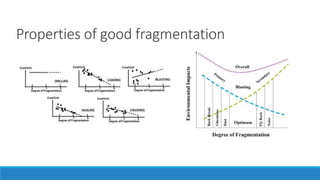
Properties of good fragmentation
Optimum rock fragmentation
 The rock fragmentation obtained as an outcome of
blasting operations is said to be optimum, when it
contains maximum percentage of fragments in the
desired range of size.
 The Desired size usually means the size that is
demanded and can be effectively utilized by the
consumers for further operations devoid of any
processing.
 The optimum size for different consumers is
different.
Optimum rock fragmentation can be achieved by
optimizing the controllable parameters and
should be designed in such a manner that the
uncontrollable parameters do not affect the
fragmentation much.
Quantification of Rock fragmentation
 Mean Fragment Size or D50 particle size: It denotes the particular size of the rock (in mm) below which 50%
of the fragments (by weight) in the imaged muck pile lie.
 Percent passing from 500 mm sieve size: It is the percentage of material in the muckpile which are below
500 mm size.
Methods of fragmentation analysis
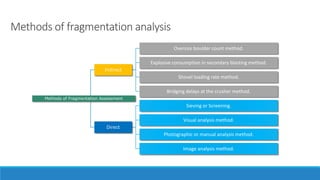
Methods of Fragmentation Assessment
Indirect
Oversize boulder count method.
Explosive consumption in secondary blasting method.
Shovel loading rate method.
Bridging delays at the crusher method.
Direct
Sieving or Screening.
Visual analysis method.
Photographic or manual analysis method.
Image analysis method.
WipFrag Image Analysis Software
 Granulometry software
 It utilizes the technique of measurement of fragmentation with the help of digital scaled images
of blasted muck pile.
 These images are then transferred to the WipFrag system for analysis
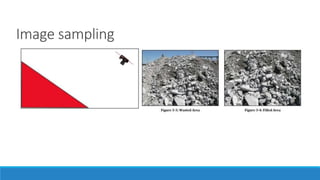
Image sampling
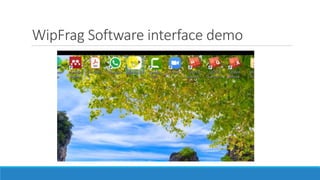
WipFrag Software interface demo
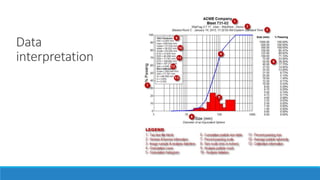
Data
interpretation
Fragalyst
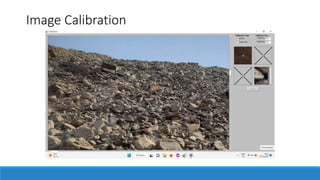
Image Calibration
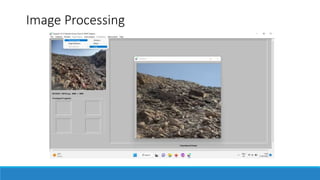
Image Processing
Image Resizing
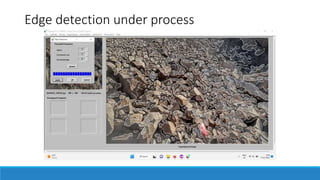
Edge detection
Edge detection under process
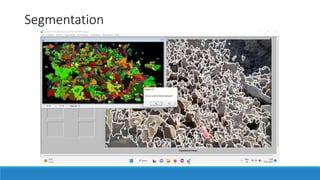
Segmentation
Manual editing
Segmentation after Manual editing
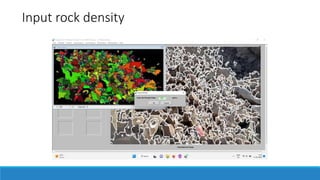
Input rock density
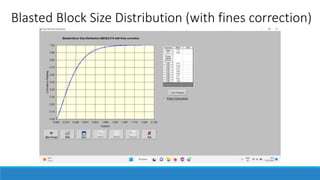
Blasted Block Size Distribution
Blasted Block Size Distribution (with fines correction)
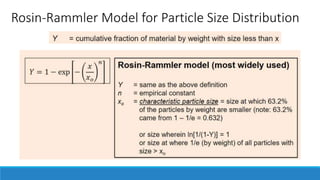
Rosin-Rammler Model for Particle Size Distribution
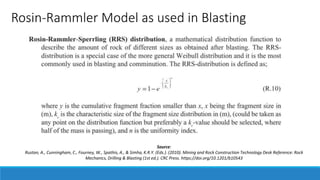
Rosin-Rammler Model as used in Blasting
Source:
Rustan, A., Cunningham, C., Fourney, W., Spathis, A., & Simha, K.R.Y. (Eds.). (2010). Mining and Rock Construction Technology Desk Reference: Rock
Mechanics, Drilling & Blasting (1st ed.). CRC Press. https://doi.org/10.1201/b10543
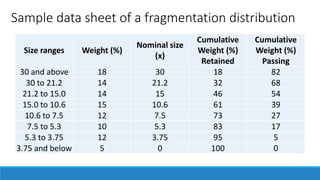
Size ranges Weight (%)
Nominal size
(x)
Cumulative
Weight (%)
Retained
Cumulative
Weight (%)
Passing
30 and above 18 30 18 82
30 to 21.2 14 21.2 32 68
21.2 to 15.0 14 15 46 54
15.0 to 10.6 15 10.6 61 39
10.6 to 7.5 12 7.5 73 27
7.5 to 5.3 10 5.3 83 17
5.3 to 3.75 12 3.75 95 5
3.75 and below 5 0 100 0
Sample data sheet of a fragmentation distribution
Rock Fragmentation Analysis.pptx

Rock Fragmentation Analysis.pptx

  • 1.
    Rock Fragmentation Analysis using GranulometricSoftware A presentation by Romil Mishra PhD Candidate Department of Mining Engineering IIT (ISM) Dhanbad)
  • 2.
    Properties of goodfragmentation
  • 3.
    Optimum rock fragmentation The rock fragmentation obtained as an outcome of blasting operations is said to be optimum, when it contains maximum percentage of fragments in the desired range of size.  The Desired size usually means the size that is demanded and can be effectively utilized by the consumers for further operations devoid of any processing.  The optimum size for different consumers is different. Optimum rock fragmentation can be achieved by optimizing the controllable parameters and should be designed in such a manner that the uncontrollable parameters do not affect the fragmentation much.
  • 4.
    Quantification of Rockfragmentation  Mean Fragment Size or D50 particle size: It denotes the particular size of the rock (in mm) below which 50% of the fragments (by weight) in the imaged muck pile lie.  Percent passing from 500 mm sieve size: It is the percentage of material in the muckpile which are below 500 mm size.
  • 5.
    Methods of fragmentationanalysis Methods of Fragmentation Assessment Indirect Oversize boulder count method. Explosive consumption in secondary blasting method. Shovel loading rate method. Bridging delays at the crusher method. Direct Sieving or Screening. Visual analysis method. Photographic or manual analysis method. Image analysis method.
  • 6.
    WipFrag Image AnalysisSoftware  Granulometry software  It utilizes the technique of measurement of fragmentation with the help of digital scaled images of blasted muck pile.  These images are then transferred to the WipFrag system for analysis
  • 7.
  • 8.
  • 9.
  • 10.
  • 11.
  • 12.
  • 13.
  • 14.
  • 15.
  • 16.
  • 17.
  • 18.
  • 19.
  • 20.
    Blasted Block SizeDistribution
  • 21.
    Blasted Block SizeDistribution (with fines correction)
  • 22.
    Rosin-Rammler Model forParticle Size Distribution
  • 23.
    Rosin-Rammler Model asused in Blasting Source: Rustan, A., Cunningham, C., Fourney, W., Spathis, A., & Simha, K.R.Y. (Eds.). (2010). Mining and Rock Construction Technology Desk Reference: Rock Mechanics, Drilling & Blasting (1st ed.). CRC Press. https://doi.org/10.1201/b10543
  • 24.
    Size ranges Weight(%) Nominal size (x) Cumulative Weight (%) Retained Cumulative Weight (%) Passing 30 and above 18 30 18 82 30 to 21.2 14 21.2 32 68 21.2 to 15.0 14 15 46 54 15.0 to 10.6 15 10.6 61 39 10.6 to 7.5 12 7.5 73 27 7.5 to 5.3 10 5.3 83 17 5.3 to 3.75 12 3.75 95 5 3.75 and below 5 0 100 0 Sample data sheet of a fragmentation distribution