• Silicates mineralgroup
• Silicates are the most common and most important petrogenic
minerals, particularly feldspars, amphiboles, pyroxenes, olivine, micas
and clay minerals.
-Their main characteristics are:
• difficult to melt and often have very complex chemical composition
because of isomorphic replacement. Most silicate minerals are formed
by crystallization of magma at high temperatures, and in metamorphic
processes at high temperature and high pressure.
• Silicate minerals are classified according to the structure with main
feature of strong relationship between major oxygen ions, and minor
silicon ions.
4.
Silicates mineral group
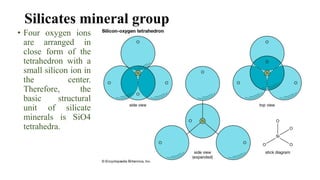
•Four oxygen ions
are arranged in
close form of the
tetrahedron with a
small silicon ion in
the center.
Therefore, the
basic structural
unit of silicate
minerals is SiO4
tetrahedra.
5.
• Structure
• Thebasic structural unit of all silicate minerals is the silicon tetrahedron in which one silicon atom is
surrounded by and bonded to (i.e., coordinated with) four oxygen atoms, each at the corner of a regular
tetrahedron. These SiO4 tetrahedral units can share oxygen atoms and be linked in a variety of ways, which
results in different structures
• The topology of these structures forms the basis for silicate classification. For example,
• nesosilicates are minerals whose structure are made up of independent silicate tetrahedrons.
• Sorosilicates are silicate minerals consisting of double tetrahedral groups in which one oxygen atom is shared
by two tetrahedrons.
• Cyclosilicates, in contrast, are arranged in rings made up of three, four, or six tetrahedral units.
• Inosilicates show a single-chain structure wherein each tetrahedron shares two oxygen atoms.
• Phyllosilicates have a sheet structure in which each tetrahedron shares one oxygen atom with each of three
other tetrahedrons.
• Tectosilicates show a three-dimensional network of tetrahedrons, with each tetrahedral unit sharing all of its
oxygen atoms.
Silicates miner
6.
• Silicate mineralsare put together by binding siliconeoxygen tetrahedra to each
other and to other ions in a fairly small number of ways. Even this number
represents only variations on the theme of combining ionic and covalent bonds.
The ionic bonding of tetrahedra involves another atom, a cation which usually
carries a +2charge. This ion is situated between the corners of two tetrahedra
where it can receive one electron from the nearest oxygen in each. The covalent
bonding of tetrahedra involves actually sharing one oxygen atom between two
adjacent tetrahedra. One of the extra electrons of the shared oxygen is used by one
silicon, and the other electron is used by the other. Between these two extreme
cases, there are a number of different cases of bonding two, three, four, six or more
of the SiO4 tetrahedra,
• so that there are seven different major structural types of silicate minerals. These
are the following:
Silicates mineral group
7.
Nesosilicates [SiO4]⁴-
• Inthe structure of nesosilicates, SiO4 tetrahedra are not directly connected with
mutual oxygen ion, only by interstitial cations. The simplest structure in nesosilicates
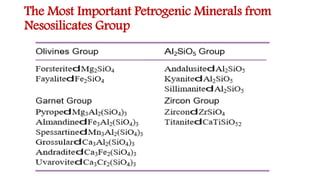
have mineral forsterite Mg2[SiO4]. The most important minerals from the
nesosilicates are shown in Table below. Olivine with little iron is closer to forsterite
with greenish color. The same with more iron is closer to fayalite with dark green
color. Olivine crystallizes in orthorhombic system and hardness of 7-6.5 (depending
on the isomorphous replacement of Mg with Fe). It forms by crystallization of
magma at high temperatures (pyrogen minerals). In normal atmospheric conditions,
it has low resistance to weathering and easily subjected to metamorphism in the
mineral serpentine (olivine serpentinization), talc or actinolite.
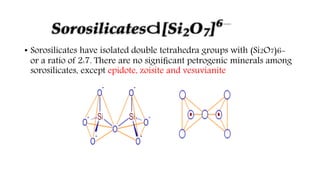
• Sorosilicates haveisolated double tetrahedra groups with (Si2O7)6-
or a ratio of 2:7. There are no significant petrogenic minerals among
sorosilicates, except epidote, zoisite and vesuvianite
10.
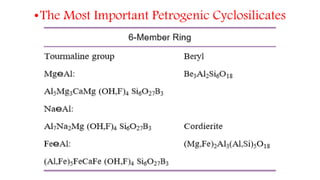
• Cyclosilicates, orring silicates, have linked
tetrahedra with (SixO3x)2x or a ratio of 1:3.
These groups of minerals exist as three-
member [Si3O9)6-]. four-member (Si4O12)8-
and six member [Si6O18)12-]. rings.
• 1. Three-member ring Benitoite - BaTi(SiO3)3
• 2. Four-member ring Axinite
{(Ca,Fe,Mn)3Al2(BO3)(Si4O12)(OH)}
• 3. Six-member ring Beryl/Emerald
{Be3Al2(SiO3)6 Cordierite
{(Mg,Fe)2Al3(Si5AlO18)}
Inosilicates
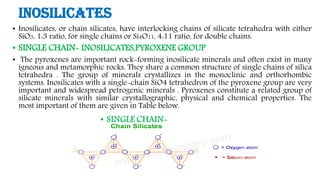
• Inosilicates, orchain silicates, have interlocking chains of silicate tetrahedra with either
SiO3, 1:3 ratio, for single chains or Si4O11, 4:11 ratio, for double chains.
• SINGLE CHAIN- INOSILICATES,PYROXENE GROUP
• The pyroxenes are important rock-forming inosilicate minerals and often exist in many
igneous and metamorphic rocks. They share a common structure of single chains of silica
tetrahedra . The group of minerals crystallizes in the monoclinic and orthorhombic
systems. Inosilicates with a single-chain SiO4 tetrahedron of the pyroxene group are very
important and widespread petrogenic minerals . Pyroxenes constitute a related group of
silicate minerals with similar crystallographic, physical and chemical properties. The
most important of them are given in Table below.
13.
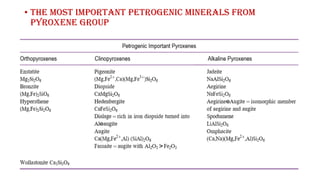
• The MostImportant Petrogenic Minerals from
Pyroxene Group
14.
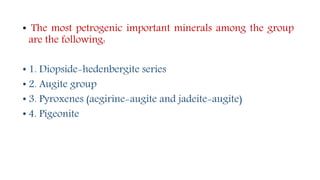
• The mostpetrogenic important minerals among the group
are the following:
• 1. Diopside-hedenbergite series
• 2. Augite group
• 3. Pyroxenes (aegirine-augite and jadeite-augite)
• 4. Pigeonite
15.
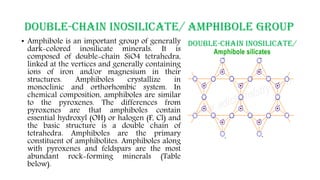
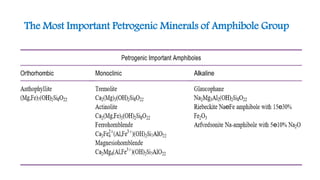
DOUBLE-CHAIN INOSILICATE/ AMPHIBOLEGROUP
• Amphibole is an important group of generally
dark-colored inosilicate minerals. It is
composed of double-chain SiO4 tetrahedra,
linked at the vertices and generally containing
ions of iron and/or magnesium in their
structures. Amphiboles crystallize in
monoclinic and orthorhombic system. In
chemical composition, amphiboles are similar
to the pyroxenes. The differences from
pyroxenes are that amphiboles contain
essential hydroxyl (OH) or halogen (F, Cl) and
the basic structure is a double chain of
tetrahedra. Amphiboles are the primary
constituent of amphibolites. Amphiboles along
with pyroxenes and feldspars are the most
abundant rock-forming minerals (Table
below).
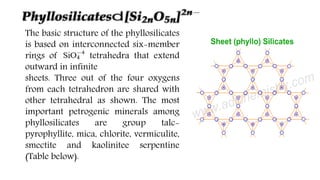
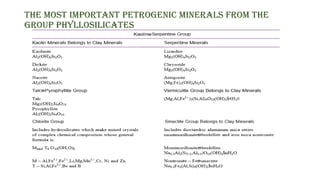
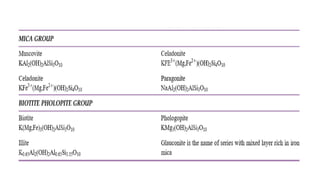
The basic structureof the phyllosilicates
is based on interconnected six-member
rings of tetrahedra that extend
outward in infinite
sheets. Three out of the four oxygens
from each tetrahedron are shared with
other tetrahedral as shown. The most
important petrogenic minerals among
phyllosilicates are group talc-
pyrophyllite, mica, chlorite, vermiculite,
smectite and kaolinitee serpentine
(Table below).

![Nesosilicates [SiO4]⁴-
• In the structure of nesosilicates, SiO4 tetrahedra are not directly connected with
mutual oxygen ion, only by interstitial cations. The simplest structure in nesosilicates
have mineral forsterite Mg2[SiO4]. The most important minerals from the
nesosilicates are shown in Table below. Olivine with little iron is closer to forsterite
with greenish color. The same with more iron is closer to fayalite with dark green
color. Olivine crystallizes in orthorhombic system and hardness of 7-6.5 (depending
on the isomorphous replacement of Mg with Fe). It forms by crystallization of
magma at high temperatures (pyrogen minerals). In normal atmospheric conditions,
it has low resistance to weathering and easily subjected to metamorphism in the
mineral serpentine (olivine serpentinization), talc or actinolite.](https://image.slidesharecdn.com/15002-250702122409-0470d604/85/Silicate-minerals-with-groups-in-categories-pdf-7-320.jpg)
![• Cyclosilicates, or ring silicates, have linked
tetrahedra with (SixO3x)2x or a ratio of 1:3.
These groups of minerals exist as three-
member [Si3O9)6-]. four-member (Si4O12)8-
and six member [Si6O18)12-]. rings.
• 1. Three-member ring Benitoite - BaTi(SiO3)3
• 2. Four-member ring Axinite
{(Ca,Fe,Mn)3Al2(BO3)(Si4O12)(OH)}
• 3. Six-member ring Beryl/Emerald
{Be3Al2(SiO3)6 Cordierite
{(Mg,Fe)2Al3(Si5AlO18)}](https://image.slidesharecdn.com/15002-250702122409-0470d604/85/Silicate-minerals-with-groups-in-categories-pdf-10-320.jpg)