The document presents a new image encryption algorithm utilizing chaotic cryptography that incorporates multiple stages of confusion and diffusion through a dual permutation process and various XOR operations. It employs the Arnold Cat Map and Lorenz system for pixel permutation and key generation, ultimately demonstrating increased security against attacks as evidenced by various analysis tests, including key space and information entropy measures. The proposed method is characterized by high confusion and diffusion, enhancing the overall efficiency of image encryption.
![Bulletin of Electrical Engineering and Informatics
Vol. 10, No. 4, August 2021, pp. 2100~2109
ISSN: 2302-9285, DOI: 10.11591/eei.v10i4.2924 2100
Journal homepage: http://beei.org
Image confusion and diffusion based on multi-chaotic system
and mix-column
Amal Abdulbaqi Maryoosh, Zahraa Salah Dhaif, Raniah Ali Mustafa
Computer Science Department, Collage of Education, Mustansiriyah University, Baghdad, Iraq
Article Info ABSTRACT
Article history:
Received Mar 3, 2021
Revised May 13, 2021
Accepted Jun 17, 2021
In this paper, a new image encryption algorithm based on chaotic
cryptography was proposed. The proposed scheme was based on multiple
stages of confusion and diffusion. The diffusion process was implemented
twice, first, by permuting the pixels of the plain image by using an Arnold cat
map and, the second time by permuting the plain image pixels via the
proposed permutation algorithm. The confusion process was performed many
times, by performing the XOR operation between the two resulted from
permuted images, subtracted a random value from all pixels of the image, as
well as by implementing the mix column on the resulted image, and by used
the Lorenz key to obtain the encrypted image. The security analysis tests that
used to exam the results of this encryption method were information entropy,
key space analysis, correlation, histogram analysis UACI, and NPCR have
shown that the suggested algorithm has been resistant against different types
of attacks.
Keywords:
Arnold cat map
Image encryption
Image permutation
Lorenz system
Mix-column
This is an open access article under the CC BY-SA license.
Corresponding Author:
Amal Abdulbaqi Maryoosh
Department of Computer Science
Collage of Education
Mustansiriyah University, Baghdad, Iraq
Email: amalmaryoosh@uomustansiriyah.edu.iq
1. INTRODUCTION
Due to the rapid growth of IT and computer networks, massive quantities of data are being
interchanged over different network types. The main portion of transmitted digital data, that has been either
private or confidential, needs the security techniques to provide wanted protection. Thus, security became a
significant case during the transmission and storage of digital data [1]. Recently, numerous image encryption
algorithms that were based on chaos theory have been designed and implemented, because of the desirable
features which make them appropriate for image encryption such as pseudorandomness, arbitrary behavior,
and sensitivity to control parameters and initial conditions [2].
Recently, several studies have emerged in the field of image encryption using chaotic systems such
as, Narendra K. et al. [1] who have proposed algorithm for the encryption of gray-level images by the use of
a confidential key of 128-bits size. At first, image quality was degraded by mixing up procedure. The
resulting image was separated to key dependent dynamic blocks and, furthermore, those blocks were
exceeded by key dependent substitution and diffusion procedures. A total of sixteen rounds were utilized in
the encryption algorithm. Apeksha Waghmare et al. [3] designed a cryptographic algorithm that was based
on ACM and logistic map. They used the cat map for the permutation operation and the Logistic map for the
key generation. Ekhlas A. and Tayseer K. [4] proposed a novel chaotic permutation and substitution
technique for image encryption. In this algorithm they made a combination of the block cipher and the
chaotic map. The proposed algorithm was utilized to encrypt and decrypt a block of 500 bytes. Every block](https://image.slidesharecdn.com/392942-210818025826/85/Image-confusion-and-diffusion-based-on-multi-chaotic-system-and-mix-column-1-320.jpg)
![Bulletin of Electrical Engineering and Informatics
Vol. 10, No. 4, August 2021, pp. 2100~2109
ISSN: 2302-9285, DOI: 10.11591/eei.v10i4.2924 2100
Journal homepage: http://beei.org
Image confusion and diffusion based on multi-chaotic system
and mix-column
Amal Abdulbaqi Maryoosh, Zahraa Salah Dhaif, Raniah Ali Mustafa
Computer Science Department, Collage of Education, Mustansiriyah University, Baghdad, Iraq
Article Info ABSTRACT
Article history:
Received Mar 3, 2021
Revised May 13, 2021
Accepted Jun 17, 2021
In this paper, a new image encryption algorithm based on chaotic
cryptography was proposed. The proposed scheme was based on multiple
stages of confusion and diffusion. The diffusion process was implemented
twice, first, by permuting the pixels of the plain image by using an Arnold cat
map and, the second time by permuting the plain image pixels via the
proposed permutation algorithm. The confusion process was performed many
times, by performing the XOR operation between the two resulted from
permuted images, subtracted a random value from all pixels of the image, as
well as by implementing the mix column on the resulted image, and by used
the Lorenz key to obtain the encrypted image. The security analysis tests that
used to exam the results of this encryption method were information entropy,
key space analysis, correlation, histogram analysis UACI, and NPCR have
shown that the suggested algorithm has been resistant against different types
of attacks.
Keywords:
Arnold cat map
Image encryption
Image permutation
Lorenz system
Mix-column
This is an open access article under the CC BY-SA license.
Corresponding Author:
Amal Abdulbaqi Maryoosh
Department of Computer Science
Collage of Education
Mustansiriyah University, Baghdad, Iraq
Email: amalmaryoosh@uomustansiriyah.edu.iq
1. INTRODUCTION
Due to the rapid growth of IT and computer networks, massive quantities of data are being
interchanged over different network types. The main portion of transmitted digital data, that has been either
private or confidential, needs the security techniques to provide wanted protection. Thus, security became a
significant case during the transmission and storage of digital data [1]. Recently, numerous image encryption
algorithms that were based on chaos theory have been designed and implemented, because of the desirable
features which make them appropriate for image encryption such as pseudorandomness, arbitrary behavior,
and sensitivity to control parameters and initial conditions [2].
Recently, several studies have emerged in the field of image encryption using chaotic systems such
as, Narendra K. et al. [1] who have proposed algorithm for the encryption of gray-level images by the use of
a confidential key of 128-bits size. At first, image quality was degraded by mixing up procedure. The
resulting image was separated to key dependent dynamic blocks and, furthermore, those blocks were
exceeded by key dependent substitution and diffusion procedures. A total of sixteen rounds were utilized in
the encryption algorithm. Apeksha Waghmare et al. [3] designed a cryptographic algorithm that was based
on ACM and logistic map. They used the cat map for the permutation operation and the Logistic map for the
key generation. Ekhlas A. and Tayseer K. [4] proposed a novel chaotic permutation and substitution
technique for image encryption. In this algorithm they made a combination of the block cipher and the
chaotic map. The proposed algorithm was utilized to encrypt and decrypt a block of 500 bytes. Every block](https://image.slidesharecdn.com/392942-210818025826/75/Image-confusion-and-diffusion-based-on-multi-chaotic-system-and-mix-column-1-2048.jpg)
![Bulletin of Electr Eng & Inf ISSN: 2302-9285
Image confusion and diffusion based on multi-chaotic system and mix-column (Amal Abdulbaqi Maryoosh)
2101
was initially permuted through utilizing the hyper-chaotic map and thereafter the result was substituted by
utilizing the 1-D Bernoulli map. Eventually, the resulted block has been XORed with the key block. Qi
Zhang et al. [5] implemented an algorithm for image encryption based upon chaotic sequences that have been
created by the Lorenz system. Kayhan C. and Erol K. [6] was proposed an innovative image encryption
method based on the Lorenz chaotic system and pixel shuffling. For the pixel shuffling process, they have
used two initial vectors, one of columns and another of rows. Firstly, they performed the XOR operation
between the initial column vector and image columns, then XORed the initial row with image rows to
generate encrypted image. Ali Soleymani et al. [7] presented a new encryption system for images security
depending on ACM and Henon maps. The system used ACM for a bit- and pixel-level permutation cases on
the plain and encrypted images, while the Henon map created cipher images and specified parameters for
permutations. Sura F. [8] proposed a novel system for grayscale image encryption. She divided the image
evenly into four blocks, every one of the blocks was rotated 90o
in a clockwise orientation. The confusion
was implemented by generating a permutation sequence, and the diffusion was implemented by generating a
masking sequence for the alteration of image pixel values. Four various chaotic map variants were utilized,
one for every block and those were Cross map, Quadratic map, the Ikeda map, and Chebyshev map. Finally,
through commingle the 4 encrypted blocks, the cipher-image has been acquired. Ibtisam A. and Sarab M. [9]
suggested a colored image encryption scheme based on a combination of 1D logistic and Sine chaotic maps.
Behrang Chaboki and Ali Shakiba [10] proposed a chaotic-based image encryption algorithm, they used
chaotic coupled lattice mapping for permutation and use a sorting approach to construct the diffusion matrix.
Arwa Benlashram et al. [11] were used image pixel shuffling and the 3D chaotic map to propose a new
method of image encryption. Ahmed M. Elshamy et al. [12] proposed a hybrid encryption technique for
image encryption by using the Baker map, the Arnold cat map, and the Henon map, they applied each to a
single channel. Ehsan Hasanzadeh and Mahdi Yaghoobi [13] were used S-box, fractals, and hyper chaotic
dynamical systems to propose a colored image encryption method. Muna KH. and Sura Mazin [14] proposed
an algorithm for image encryption by using the ElGamal public key algorithm and the 3D Arnold cat map.
Using the proposed 2D chaotic map and discrete wavelet transform (DWT), Ibrahim Yasser et al. [15]
proposed a new method for image encryption.
By combining the chaotic scheme with mix-column, a new color image encryption algorithm is
proposed in this paper. This algorithm increases the security and efficiency of image encryption via high
confusion that provided by XOR operation, mixcloumn and, the Lorenz system and high diffusion that was
provided by the permutation method and ACM. The remainder of this paper has been organized in the
following manner. The methods that were used in the proposed algorithm will be explained in section 2. The
proposed system has been explained in detail in section 3. Section 4 demonstrates the security analysis.
Finally, in section 5, the conclusions are presented.
2. CHAOTIC SYSTEM
This paper used two chaotic systems, which are, Arnold cat map [16] and the Lorenz system [17]
that were employed in the proposed system for the key generation.
2.1. Arnold cat map
Arnold's cat map is a two-dimension chaotic map which can be utilized to alter the position of the
pixel of the image without eliminating any information from that image [18], This 2-D transformation
depends upon a matrix that has a determinant of 1, making this conversion reversible and described as [19]:
𝐼 = [
𝑥′
𝑦′] = [
1 𝑃
𝑄 𝑃𝑄 + 1
] [
𝑥
𝑦] 𝑚𝑜𝑑 𝑛 (1)
Where, 𝑃 and 𝑄 are integers and (𝑥, 𝑦) is the original position which has been mapped to the new position
(𝑥’, 𝑦’). This conversion is utilized for the randomization of the original arrangement of bits or pixels in an
image. Yet, after enough reiteration, the original image has been reconstructed. Inverse mapping using (2) is
a decryption phase procedure to convert the scrambled image to the input image. The number of repetitions
in the permutation phase should be equal to the number of repetitions of the reverse transmutation [20]. In (2)
shows the reverse mapping:
𝐼′
= [
𝑥
𝑦] = [
𝑃𝑄 + 1 −𝑃
−𝑄 1
] [
𝑥′
𝑦′] 𝑚𝑜𝑑 𝑛 (2)](https://image.slidesharecdn.com/392942-210818025826/85/Image-confusion-and-diffusion-based-on-multi-chaotic-system-and-mix-column-2-320.jpg)
![ ISSN: 2302-9285
Bulletin of Electr Eng & Inf, Vol. 10, No. 4, August 2021 : 2100 – 2109
2102
2.2. Lorenz system
The Lorenz system, which initially has been researched by E. Lorenz in 1963, is a dynamic scheme
which has been described through the following non-linear scheme of ordinary differential equations (ODEs) [21]:
𝑥′
= 𝛼(𝑦 − 𝑥)
𝑦′
= (𝛽𝑥 − 𝑦 − 𝑥𝑧) (3)
𝑧′
= (𝑥𝑦 − γ𝑧)
The actual numbers α, β, γ have been known as control parameters, while x, y, z have been known as the
status variables. As shown in Figure 1, the scheme presents a periodic behavior for parameters value α=10,
γ=8/3 and β=28.
Figure 1. The plot of the Lorenz system along x–y–z axis, for α=10, γ=8/3, β=28
3. PROPOSED SCHEME
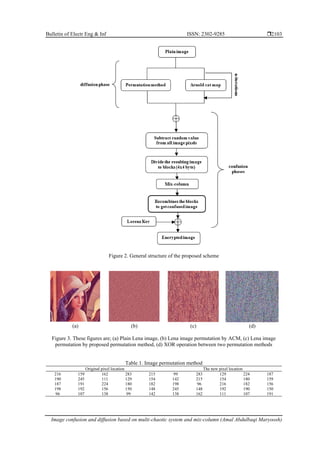
The proposed scheme contains six major steps, which conitain multiple steps of diffusion and
confusion, that are:
a. The first stage is the diffusion process, which will be implemented twice. In the first one, the plain image
is permuted by ACM that has been explained in the section (2.1), and in the second one is the plain image
is permuted by the proposed permutation method which will be explained in the section (3.1).
b. The second stage is the confusion which will be implemented four times. The first one, is by
implementing XOR operation between the results of the two permutation output. The second one, is by
subtracting the random value in the range of [0-255] from all image pixels and this value is saved in a
parameter will be used with chaotic parameters as a key. The third one, divides the resulting image to
many blocks each block in size 16-byte and implement mix-column for each one. After that, collecting
the blocks to generate the resulting image. Finally, implements the XOR operation between the resulting
image and the Lorenz key to generate the encrypted image. Figure 2 illustrates the structure of the
proposed model.
3.1. Permutation method
The permutation is a very important stage for impeding the rising correlation amongst image pixels
to increment the encrypted image security. In this method, we relied on scrambling columns and rows
depending on the sum invariance of row and column through a circular shift process. In the beginning, the
plain image is divided into three bands (red, green, and blue) and shift each row in each band by the total sum
of the row and column's pixel values and save the result in a variable, then implementing the same method in
each column and saving the result in another variable has been performed. After that, transpose operation has
been implemented for each band and the previous steps have been repeated for each row and column in each
band, then, collecting the bands to generate the resulting image. Table 1 illustrate the permutation method of
5x5 sub-image and Figure 3 shows Lena image permutation by ACM, permutes Lena image by the
permutation method, and XOR operation between two methods.](https://image.slidesharecdn.com/392942-210818025826/85/Image-confusion-and-diffusion-based-on-multi-chaotic-system-and-mix-column-3-320.jpg)
![ ISSN: 2302-9285
Bulletin of Electr Eng & Inf, Vol. 10, No. 4, August 2021 : 2100 – 2109
2104
3.2. Mix-column
In this scheme, the mix-column transformation matrix has been implemented in the AES algorithm
which has been explained in detail by [22]. The mix-column transformation is applied to a block of columns
one by one. It is performed by transforming each column of four bytes and takes it as input, which contains 4
bytes, and outputs a totally different 4 bytes by transforming the original column. Each byte in the product
matrix is the summation products of bytes of one row and one column. The resultant matrix is the same as the
input block size. Figure 4 explains the mix-column transformation process and Figure 5 shows the mix-
column implementation of Lena's image.
(a) (b)
Figure 4. The mix-column transformation process Figure 5. These figures are; (a) Lena plain image, (b)
mix-column implementation on Lena image
3.3 Proposed algorithm
In this section, the encryption and decryption algorithm will be explained:
a. Encryption algorithm
Input: plain image (img), Lorenz_key
Output: encrypted image (c)
Step1: read a colored image (img)
Step2: p1 ← ACM(img)
Step3: for i ← 1:m
for j ← 1:n
r ← circular_shift (img)
end
end
t ← transpose (r)
for i ← 1:m
for j ← 1:n
p2 ← circular_shift (t)
end
end
Step4: x ← XOR (p1, p2)
Step5: rand ← (random value [0,255])
s ← x - rand
Step6: divided (s) to blocks in size 4 x 4
Step7: for i 1:4
for j 1:4
M ← Mix-column(s)
end
end
Step8: k collects the blocks
Step9: c XOR (Lorenz_key, k)
b. Decryption algorithm
Input: encrypted image (c), Lorenz_key
Output: plain image (img)](https://image.slidesharecdn.com/392942-210818025826/85/Image-confusion-and-diffusion-based-on-multi-chaotic-system-and-mix-column-5-320.jpg)
![Bulletin of Electr Eng & Inf ISSN: 2302-9285
Image confusion and diffusion based on multi-chaotic system and mix-column (Amal Abdulbaqi Maryoosh)
2105
Step1: read an encrypted image (c)
Step2: k XOR (Lorenz_key, c)
Step3: divided (k) to blocks in size 4 x 4
Step4: for i ← 1:4
for j ← 1:4
M ← Inv_Mix-column(k)
end
end
Step5: b collect the blocks
Step6: s ← b + rand
Step7: t1 ← Inv_transpose (s)
for i ← 1:m
for j ← 1:n
p1 ← Inv_circular_shift (t1)
end
end
Step8: p2 ← Inv_ACM(s)
Step9: x ← XOR (p1, p2)
4. RESULTS AND DISCUSSION
In this section, we review the results of the series of tests to proof the efficiency of the proposed
method. The evaluation consists of many practical experiments. The experiments are performed via
MATLAB R2013a on a computer with Intel Core i7 CPU 1.99 GHz, 8 GB of RAM.
4.1. Key space analyses
Key space size is the aggregate number of various keys which may be utilized in the encryption and
decryption. The key space has to be large enough in order to resist against robust attacks, which makes the
finding of the key very hard for the attackers. In the systems that were based on chaotic systems, key space
increases by increasing the number of parameters and the chaotic system size. In this approach, the key space
is (1014
)6
which is nearly equal to 2279
and it's sufficient to resist each type of brute-force attacks. Table 2
shows the key space compared to some related works.
Table 2. Key space comparison
schemes
Ehsan H. et
al. [13]
Narendra K.
et al. [1]
Ünal Ç. et al.
[2]
Ekhlas A. et
al. [4]
Kayhan Ç. et
al. [6]
Proposed
scheme
Key space >
2128
2128
1098
2213
1045
2279
4.2. Information entropy analysis
One of the very important measures to compute the randomness is information entropy. It can be
computed by:
𝐻(𝑚) = ∑ 𝑝(𝑚𝑖) log2
1
𝑝(𝑚𝑖)
2𝑛−1
𝑖=0 (4)
In (4), m is a sample, n is the number of samples, and p (m) is the likelihood of symbol m. The ideal
value of H (m) can be obtained according to (4) is 8, this indicates that random information in the image [23].
The values of information entropy that has been obtained from the proposed system are closer to eight, this
shows that the suggested scheme has good randomness. Table 3 shows the values of information entropy for
the different plain images and Table 4 shown the information entropy comparison with some of the related
works.
4.3 Correlation analysis
The correlation among contiguous pixels in the normal image is always strong, and the correlation
coefficient values are so close to 1. For this reason, the correlation must be decreased significantly in an
efficient encryption algorithm and the value extremely close to 0 [21]. The correlation coefficients can be
calculated for three orientations, which are diagonal, horizontal, and vertical shown in below.](https://image.slidesharecdn.com/392942-210818025826/85/Image-confusion-and-diffusion-based-on-multi-chaotic-system-and-mix-column-6-320.jpg)
![ ISSN: 2302-9285
Bulletin of Electr Eng & Inf, Vol. 10, No. 4, August 2021 : 2100 – 2109
2106
𝑟𝑥𝑦 =
𝑐𝑜𝑣(𝑥,𝑦)
√𝐷(𝑥)√𝐷(𝑦)
(5)
𝐸(𝑥) =
1
𝑁
∑ 𝑥𝑖
𝑁
𝑖=1 (6)
𝐷(𝑥) =
1
𝑁
∑ (𝑥𝑖
𝑁
𝑖=1 − 𝐸(𝑥))2
(7)
Table 3. Entropy of the plain and encrypted image information
Images
Entropy
Plain image Encrypted image
Flower 7.7666 7.9989
Tree 7.6659 7.9989
Splash 7.3795 7.9990
Sky 7.9339 7.9992
Lena 7.7599 7.9992
Garden 7.7955 7.9989
Pepper 7.7124 7.9989
Birds 7.7472 7.9990
Horse 7.6143 7.9991
Cat 7.6596 7.9990
Table 4. Information entropy comparison for Lena image
Schemes Ehsan H. et al. [13] Arwa B. et al. [11] Ekhlas A. et al. [4] Kayhan Ç. et al. [6] Proposed Scheme
Entropy 7.9992 7.9901 7.9988 7.9993 7.9992
In (5), x and y represent values of 2 contiguous pixels in an image. Figure 6 illustrates the diagonal,
horizontal, and vertical correlation coefficients in the plain and encrypted Lena image, and Table 5 displays
the results of the correlation for different plain and encrypted images. Table 6 lists the comparison of the
correlation coefficients with some of the related works.
Figure 6. The correlation of two neighboring pixels in the plain and encrypted Lena image](https://image.slidesharecdn.com/392942-210818025826/85/Image-confusion-and-diffusion-based-on-multi-chaotic-system-and-mix-column-7-320.jpg)
![Bulletin of Electr Eng & Inf ISSN: 2302-9285
Image confusion and diffusion based on multi-chaotic system and mix-column (Amal Abdulbaqi Maryoosh)
2107
Table 5. The correlation coefficient of encrypted images
Images
Correlation
Horizontal Vertical Diagonal
Flower -0.0060 0.0047 0.00007
Pepper 0.0035 0.0012 0.0057
Lena 0.0048 -0.0016 0.0040
Birds 0.0034 0.0061 0.00009
Garden -0.00024 -0.0019 0.0066
Horse 0.00007 0.0042 -0.00002
Tree 0.0078 -0.0072 0.0064
Sky -0.00001 -0.0036 0.0011
Cat -0.00002 0.0035 0.0041
splash -0.0026 -0.0027 0.00002
Table 6. Correlation coefficient comparison
Correlation Ehsan H. et al. [13] Arwa B. et al. [11] Ekhlas A. et al. [4] Proposed scheme
Horizontal 0.0204 - 0.0127 -0.0002 0.0048
Vertical -0.0124 - 0.0242 0.0008 -0.0016
Diagonal -0.0895 NA 0.0087 0.0040
4.4. Resisting differential attack analysis
In cryptography, a pixel from a plain image is compared to a pixel from a cipher image to obtain
the beneficial relation, that moreover defines the secret key. This type of analysis has been known as the
differential attack cryptanalyses [24]. This study used the number of unified averaged modified intensity
(UACI) values and the pixels change rate to determine the effect of changing a small portion of the pixels in
the normal image of the encrypted image (NPCR). The NPCR index can be used to estimate the number of
pixels in the original image that have the same location in the encrypted image, and it is determined as
follows:
𝑁𝑃𝐶𝑅 =
∑ 𝑑(𝑖,𝑗)
𝑖,𝑗
𝑤×ℎ
× 100% (8)
Where, the image width (w) and height (h), C1(i, j) & C2(i, j) are two encrypted images whose corresponding
plain images I1(i, j) & I2(i, j) have only 1-pixel value variation. D(i, j)=0, if C1(i, j)=C2(i, j); otherwise
D(i, j)=1.
The UACI index is utilized for knowing the influence of the encrypted image in the case where one-
pixel has been changed in the plain image, and it has been determined according to:
𝑈𝐴𝐶𝐼 =
1
𝑤×ℎ
(∑
|𝐶1(𝑖,𝑗)−𝐶2(𝑖,𝑗)|
255
𝑖,𝑗 ) × 100% (9)
The optimum value of UACI and NPCR are 33.46 and 99.61 [25]. In this paper we implement
NPCR and UACI measures on ten colored images and the results of two indicators are near to idealistic
value. Table 7 shown the results of UACI and NPCR in the suggested scheme. Table 8 shows the UACI and
NPCR comparison with some of the related works.
Table 7. UACI and NPCR indicator of plain and encrypted images
Images UACI NPCR
Flower 33.59 99.60
Tree 34.01 99.58
Splash 33.98 99.62
Sky 33.81 99.61
Lena 32.51 99.62
Garden 33.35 99.61
Pepper 34.10 99.61
Birds 33.76 99.61
Horse 33.37 99.61
Table 8. UACI and NPCR indicator comparison
Indicators Ehsan H. et al. [13] Arwa B. et al. [11] Kayhan Ç. et al. [6] Ekhlas A. et al. [4] Proposed scheme
UACI 33.42 33.60 6.0158 33.39 32.51
NPCR 99.61 99.65 17.92 99.49 99.62](https://image.slidesharecdn.com/392942-210818025826/85/Image-confusion-and-diffusion-based-on-multi-chaotic-system-and-mix-column-8-320.jpg)
![ ISSN: 2302-9285
Bulletin of Electr Eng & Inf, Vol. 10, No. 4, August 2021 : 2100 – 2109
2108
4.5. Histogram analysis
The histogram analysis has been utilized in order to explain the diffusion and confusion
characteristics of the encryption algorithm. Figure 7 shows the difference in the image distribution between
the plain and encrypted tree images.
(a) (b) (c)
(d) (e) (f)
Figure. 7. Histogram analysis; (a), (b) and (c) are the histogram of (red, green and blue) of plain tree
image, (d), (e) and (f) are the histogram of (red, green and blue) of encrypted tree image
5. CONCLUSION
In the present paper, a new image encryption algorithm was suggested to provide a high security
level of image encryption, based upon the combinations of permutation method, the chaotic system and mix-
column. Whereas the random permutation method provides a high level of diffusion, and mix-column
process provides high confusion. Also, the use of the chaotic system offers high randomness, key sensitivity,
and confusion. The effectiveness of this method has been confirmed by the experimental results above. It can
be seen that according to these results, the suggested system shows high resistance against the statistical and
differential attack types.
ACKNOWLEDGEMENTS
The authors would like to thank Mustansiriyah University (www.uomustansiriyah.edu.iq) Baghdad,
Iraq for its support in the present work.
REFERENCES
[1] N. K. Pareek, V. Patidar, and K. K. Sud b, "Diffusion–substitution based gray image encryption scheme", Digital
Signal Processing, vol. 23, No. 3, pp. 894-901, 2013, doi: 10.1016/j.dsp.2013.01.005.
[2] Ü. Çavușoǧlu, S. Kaçar, I. Pehlivan, and A. Zengin, "Secure image encryption algorithm design using a novel chaos
based S-Box", Chaos Solitons and Fractals, vol. 95, pp. 92–101, 2017, doi: 10.1016/j.chaos.2016.12.018.
[3] A. Waghmare, A. Bhagat, A. Surve and S. Kalgutkar, "Chaos Based Image Encryption and Decryption",
International Journal of Advanced Research in Computer and Communication Engineering, Vol. 5, Issue 4, April
2016.
[4] E. A. Albahrani and T. K. Alshekly, "New Chaotic Substation and Permutation Method for Image Encryption",
International Journal of Applied Information Systems (IJAIS), Vol. 12, No. 4, pp. 34-39, July 2017, doi:
10.5120/ijais2017451698.
[5] Q. Zhang, Y. Guo, W. Li and Q. Ding, "Image Encryption Method Based on Discrete Lorenz Chaotic Sequences",
Journal of Information Hiding and Multimedia Signal Processing, Vol. 7, Number 3, pp. 576-586 May, 2016.](https://image.slidesharecdn.com/392942-210818025826/85/Image-confusion-and-diffusion-based-on-multi-chaotic-system-and-mix-column-9-320.jpg)
![Bulletin of Electr Eng & Inf ISSN: 2302-9285
Image confusion and diffusion based on multi-chaotic system and mix-column (Amal Abdulbaqi Maryoosh)
2109
[6] K. Celİk and E. Kurt, "A new image encryption algorithm based on lorenz system," 2016 8th International
Conference on Electronics, Computers and Artificial Intelligence (ECAI), 2016, pp. 1-6, doi:
10.1109/ECAI.2016.7861097.
[7] A. Soleymani, M. J. Nordin and E. Sundararajan, "A Chaotic Cryptosystem for Images Based on Henon and Arnold
Cat Map", Hindawi Publishing Corporation the Scientific World Journal, Vol. 2014, doi:
https://doi.org/10.1155/2014/536930.
[8] S. F. Yousif, "Grayscale image confusion and diffusion based on multiple chaotic maps," 2018 1st International
Scientific Conference of Engineering Sciences - 3rd Scientific Conference of Engineering Science (ISCES), 2018,
pp. 114-119, doi: 10.1109/ISCES.2018.8340538.
[9] Ibtisam A. Taqi and Sarab M. Hameed, “A new Color Image Encryption based on multi Chaotic Maps”, Iraqi
Journal of Science, Vol. 59, No.4B, pp: 2117-2127, 2018, doi: 10.24996/ijs.2018.59.4B.17.
[10] Behrang Chaboki and Ali Shakiba, “An image encryption algorithm with a novel chaotic coupled mapped lattice and
chaotic image scrambling technique”, Indonesian Journal of Electrical Engineering and Computer Science, Vol. 21,
No. 2, pp: 1103-1112, 2021, doi: 10.11591/ijeecs.v21.i2.pp1103-1112.
[11] Arwa Benlashram, Maryam Al-Ghamdi, Rawan AlTalhi and Pr. Kaouther Laabidi “A novel approach of image
encryption using pixel shuffling and 3D chaotic map”, Journal of Physics: Conference Series, 2020, doi:
10.1088/1742-6596/1447/1/012009.
[12] Ahmed M. Elshamy, et al., “Color Image Encryption Technique Based on Chaos”, 16th International Learning &
Technology Conference 2019, Procedia Computer Science 163, pp. 49–53, 2019, doi:
https://doi.org/10.1016/j.procs.2019.12.085.
[13] Ehsan Hasanzadeh and Mahdi Yaghoobi, “A novel color image encryption algorithm based on substitution box and
hyper-chaotic system with fractal keys”, Multimedia Tools and Applications, 2019. doi: 10.1007/s11042-019-08342-1.
[14] Muna K H. Al naamee and Sura Mazin Ali, “Improved El Gamal public key cryptosystem using 3D chaotic maps”,
Bulletin of Electrical Engineering and Informatics, vol. 10, no. 1, pp. 404-411, February 2021, doi:
https://doi.org/10.11591/eei.v10i1.2124.
[15] Ibrahim Yasser, et al., “A New Image Encryption Scheme Based on Hybrid Chaotic Maps”, Hindawi, Complexity,
Volume 2020, doi: https://doi.org/10.1155/2020/9597619.
[16] E. Hariyanto and R. Rahim, "Arnold’s Cat Map Algorithm in Digital Image Encryption," International Journal of
Science and Research (IJSR), Volume 5 Issue 10, pp. 1363-1365, October 2016. doi: 10.21275/ART20162488.
[17] Jianghong Bao and Qigui Yang, “Period of the discrete Arnold cat map and general cat map”, Nonlinear Dyn,
70:1365–1375, 2012. doi: 10.1007/s11071-012-0539-3.
[18] A M H Pardede, et al., “Digital Image Security Application with Arnold Cat Map (ACM)”, IOP Conf. Series:
Journal of Physics: Conf. Series. Vol: 1114, no: 1, p. 012059, 2018. doi: 10.1088/1742-6596/1114/1/012059.
[19] Anak Agung, et al., “Chaos-Based Image Encryption Using Arnold’s Cat Map Confusion and Henon Map
Diffusion”, Advances in Science, Technology and Engineering Systems Journal, vol. 6, no. 1, pp. 316-326, 2021.
[20] Tu Li, et al., “A new image encryption algorithm based on optimized Lorenz chaotic system”, Concurrency
Computat Pract Exper, 2020. doi: https://doi.org/10.1002/cpe.5902.
[21] O. M. Al-Hazaimeh, Mohammad Fawaz Al-Jamal, and Nouh Alhindawi, "Image encryption algorithm based on
Lorenz chaotic map with dynamic secret keys", Neural Computing and Applications, Augest 2017. doi:
10.1007/s00521-017-3195-1.
[22] William Stallings, "Cryptography and Network Security", principles and practice 5th
edition, Pearson Education,
Inc., 2011.
[23] L. Hongjun and W. Xingyuan,"Color image encryption based on one-time keys and robust chaotic maps,"
Computers and Mathematics with Applications 59, pp. 3320_3327, 2010. doi:
https://doi.org/10.1016/j.camwa.2010.03.017.
[24] L. Xu, ZhiLi, Jian Li, and Wei Hua, "A novel bit-level image encryption algorithm based on chaoticmaps", Optics
and Lasersin Engineering 78, pp. 7–25, 2016. doi: https://doi.org/10.1016/j.optlaseng.2015.09.007.
[25] G. Ye, et al., "A Chaotic Image Encryption Algorithm Based on Information Entropy, "International Journal of
Bifurcation and Chaos, Vol. 28, No. 1, pp. 1-11, 2018. doi: https://doi.org/10.1142/S0218127418500104.](https://image.slidesharecdn.com/392942-210818025826/85/Image-confusion-and-diffusion-based-on-multi-chaotic-system-and-mix-column-10-320.jpg)


