ْ‫ح‬‫ه‬‫الر‬ ِ ‫ه‬
‫اَّلل‬ ِ‫م‬ْ‫س‬ِ‫ب‬
‫يم‬ ِ‫ح‬‫ه‬‫الر‬ ِ‫ن‬َ‫م‬
Presented to: Dr. Sajid Ali
Department: Information Sciences
Semester: 1st
Date: 25/01/2022
Topic: Robotics
Presentation No. 01
1. What Is Robotics?
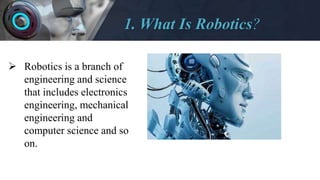
 Robotics is a branch of
engineering and science
that includes electronics
engineering, mechanical
engineering and
computer science and so
on.
2. Definition Of Robotics?
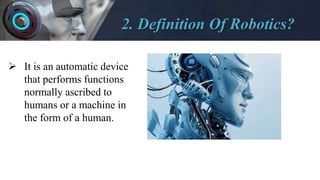
 It is an automatic device
that performs functions
normally ascribed to
humans or a machine in
the form of a human.
3. Purpose of Robot:
 Purpose of robots to perform tasks done traditionally
by human beings.
 Robots are widely used in such industries as
automobile manufacture to perform simple
repetitive tasks.
4. History of Robotics
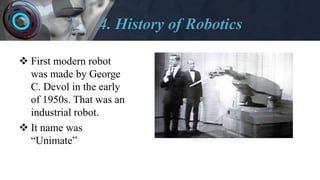
 First modern robot
was made by George
C. Devol in the early
of 1950s. That was an
industrial robot.
 It name was
“Unimate”
4. History of Robotics
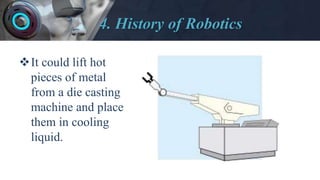
It could lift hot
pieces of metal
from a die casting
machine and place
them in cooling
liquid.
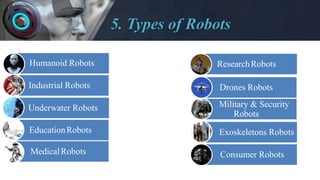
5. Types of Robots
Humanoid Robots
Industrial Robots
ResearchRobots
MedicalRobots
Military & Security
Robots
Underwater Robots
Exoskeletons Robots
EducationRobots
Consumer Robots
Drones Robots
5. Types Of Robots
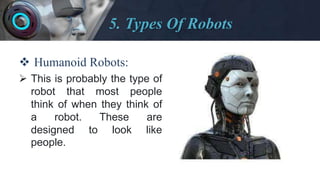
 Humanoid Robots:
 This is probably the type of
robot that most people
think of when they think of
a robot. These are
designed to look like
people.
5. Types Of Robots
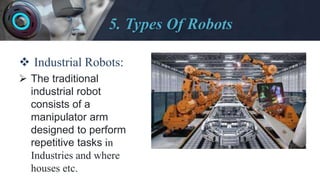
 Industrial Robots:
 The traditional
industrial robot
consists of a
manipulator arm
designed to perform
repetitive tasks in
Industries and where
houses etc.
5. Types Of Robots
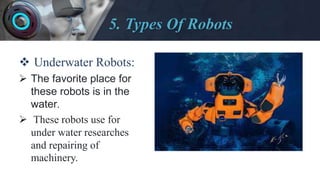
 Underwater Robots:
 The favorite place for
these robots is in the
water.
 These robots use for
under water researches
and repairing of
machinery.
5. Types Of Robots
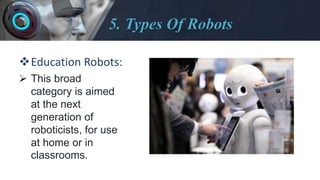
Education Robots:
 This broad
category is aimed
at the next
generation of
roboticists, for use
at home or in
classrooms.
5. Types Of Robots
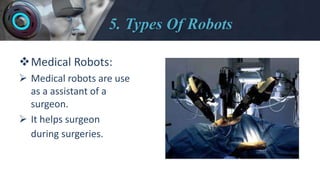
Medical Robots:
 Medical robots are use
as a assistant of a
surgeon.
 It helps surgeon
during surgeries.
5. Types Of Robots
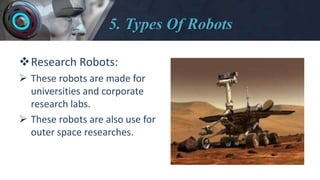
Research Robots:
 These robots are made for
universities and corporate
research labs.
 These robots are also use for
outer space researches.
5. Types Of Robots
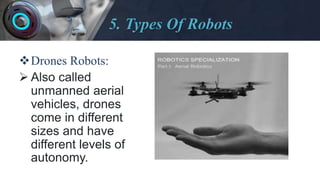
Drones Robots:
 Also called
unmanned aerial
vehicles, drones
come in different
sizes and have
different levels of
autonomy.
5. Types Of Robots
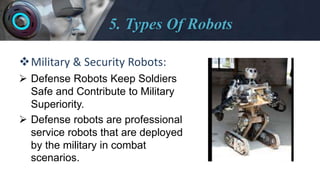
Military & Security Robots:
 Defense Robots Keep Soldiers
Safe and Contribute to Military
Superiority.
 Defense robots are professional
service robots that are deployed
by the military in combat
scenarios.
5. Types Of Robots
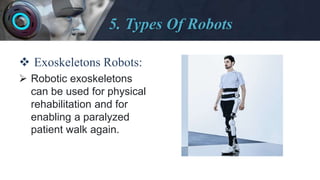
 Exoskeletons Robots:
 Robotic exoskeletons
can be used for physical
rehabilitation and for
enabling a paralyzed
patient walk again.
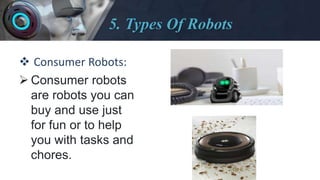
5. Types Of Robots
 Consumer Robots:
 Consumer robots
are robots you can
buy and use just
for fun or to help
you with tasks and
chores.
6. Laws of Robotics:
1. First Law:
A robot may not harm a human being, or,
through inaction, allow a human being to come to harm.
2. Second Law:
A robot must obey the orders given to it by
human beings, except where such orders would conflict
with the First Law.
3. Third Law:
A robot must protect its own existence, as long
as such protection does not conflict with the First or
Second Law.
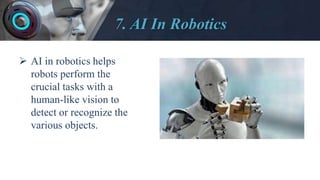
7. AI In Robotics
 AI in robotics helps
robots perform the
crucial tasks with a
human-like vision to
detect or recognize the
various objects.
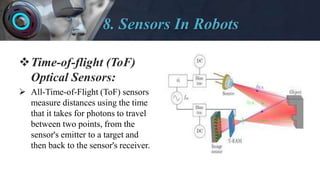
8. Sensors In Robots
Time-of-flight (ToF)
Optical Sensors:
 All-Time-of-Flight (ToF) sensors
measure distances using the time
that it takes for photons to travel
between two points, from the
sensor's emitter to a target and
then back to the sensor's receiver.
8. Sensors In Robots
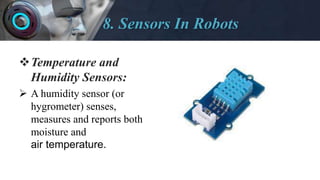
Temperature and
Humidity Sensors:
 A humidity sensor (or
hygrometer) senses,
measures and reports both
moisture and
air temperature.
8. Sensors In Robots
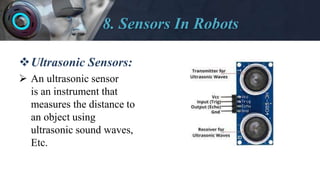
Ultrasonic Sensors:
 An ultrasonic sensor
is an instrument that
measures the distance to
an object using
ultrasonic sound waves,
Etc.
9. Programming Languages In Robots
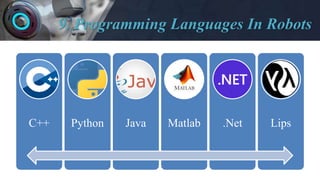
C++ Python Java Matlab .Net Lips
10. Control of Robots
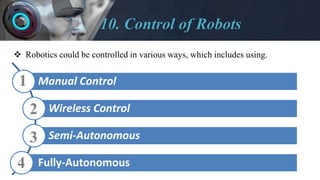
Manual Control
Wireless Control
Semi-Autonomous
Fully-Autonomous
 Robotics could be controlled in various ways, which includes using.
1
2
3
4
11. How Dose A Robot Work?
 A robot is made up of the very same components. A basic
typical robot has a movable physical structure, a motor of
some sort, a sensor system, a power supply and a computer
"brain" that controls all of these elements.
12. Advantages of Robots
 They Increase Production
 They're More Accurate than Humans
 They Make Fewer Mistakes
 They Reduce Wastage
 They're More Reliable than Humans
 They Can Work 24/7
 They Save Time
 They Don't Complain
 And many more
13. Disadvantages of Robots
 They Lead Humans To Lose Their Jobs
 The Perform Relatively Few Tasks
 They Have No Emotions
 They’re Expensive To Install And Run
 They Suffer Expensive Faults And Repairs
 They Cause Cybersecurity Issues
Our Team
Hammad
Ur
Rehman
Our Team
Rana
Babar
Our Team
Amish
Ejaz
Our Team
M.
Aurangzaib
Our Team
Hammad
Ur
Rehman
Rana
Babar
Amish
Ejaz
M.
Aurangzaib
THANK YOU

Robots2

  • 2.
    ْ‫ح‬‫ه‬‫الر‬ ِ ‫ه‬ ‫اَّلل‬ِ‫م‬ْ‫س‬ِ‫ب‬ ‫يم‬ ِ‫ح‬‫ه‬‫الر‬ ِ‫ن‬َ‫م‬
  • 3.
    Presented to: Dr.Sajid Ali Department: Information Sciences Semester: 1st Date: 25/01/2022 Topic: Robotics Presentation No. 01
  • 4.
    1. What IsRobotics?  Robotics is a branch of engineering and science that includes electronics engineering, mechanical engineering and computer science and so on.
  • 5.
    2. Definition OfRobotics?  It is an automatic device that performs functions normally ascribed to humans or a machine in the form of a human.
  • 6.
    3. Purpose ofRobot:  Purpose of robots to perform tasks done traditionally by human beings.  Robots are widely used in such industries as automobile manufacture to perform simple repetitive tasks.
  • 7.
    4. History ofRobotics  First modern robot was made by George C. Devol in the early of 1950s. That was an industrial robot.  It name was “Unimate”
  • 8.
    4. History ofRobotics It could lift hot pieces of metal from a die casting machine and place them in cooling liquid.
  • 9.
    5. Types ofRobots Humanoid Robots Industrial Robots ResearchRobots MedicalRobots Military & Security Robots Underwater Robots Exoskeletons Robots EducationRobots Consumer Robots Drones Robots
  • 10.
    5. Types OfRobots  Humanoid Robots:  This is probably the type of robot that most people think of when they think of a robot. These are designed to look like people.
  • 11.
    5. Types OfRobots  Industrial Robots:  The traditional industrial robot consists of a manipulator arm designed to perform repetitive tasks in Industries and where houses etc.
  • 12.
    5. Types OfRobots  Underwater Robots:  The favorite place for these robots is in the water.  These robots use for under water researches and repairing of machinery.
  • 13.
    5. Types OfRobots Education Robots:  This broad category is aimed at the next generation of roboticists, for use at home or in classrooms.
  • 14.
    5. Types OfRobots Medical Robots:  Medical robots are use as a assistant of a surgeon.  It helps surgeon during surgeries.
  • 15.
    5. Types OfRobots Research Robots:  These robots are made for universities and corporate research labs.  These robots are also use for outer space researches.
  • 16.
    5. Types OfRobots Drones Robots:  Also called unmanned aerial vehicles, drones come in different sizes and have different levels of autonomy.
  • 17.
    5. Types OfRobots Military & Security Robots:  Defense Robots Keep Soldiers Safe and Contribute to Military Superiority.  Defense robots are professional service robots that are deployed by the military in combat scenarios.
  • 18.
    5. Types OfRobots  Exoskeletons Robots:  Robotic exoskeletons can be used for physical rehabilitation and for enabling a paralyzed patient walk again.
  • 19.
    5. Types OfRobots  Consumer Robots:  Consumer robots are robots you can buy and use just for fun or to help you with tasks and chores.
  • 20.
    6. Laws ofRobotics: 1. First Law: A robot may not harm a human being, or, through inaction, allow a human being to come to harm. 2. Second Law: A robot must obey the orders given to it by human beings, except where such orders would conflict with the First Law. 3. Third Law: A robot must protect its own existence, as long as such protection does not conflict with the First or Second Law.
  • 21.
    7. AI InRobotics  AI in robotics helps robots perform the crucial tasks with a human-like vision to detect or recognize the various objects.
  • 22.
    8. Sensors InRobots Time-of-flight (ToF) Optical Sensors:  All-Time-of-Flight (ToF) sensors measure distances using the time that it takes for photons to travel between two points, from the sensor's emitter to a target and then back to the sensor's receiver.
  • 23.
    8. Sensors InRobots Temperature and Humidity Sensors:  A humidity sensor (or hygrometer) senses, measures and reports both moisture and air temperature.
  • 24.
    8. Sensors InRobots Ultrasonic Sensors:  An ultrasonic sensor is an instrument that measures the distance to an object using ultrasonic sound waves, Etc.
  • 25.
    9. Programming LanguagesIn Robots C++ Python Java Matlab .Net Lips
  • 26.
    10. Control ofRobots Manual Control Wireless Control Semi-Autonomous Fully-Autonomous  Robotics could be controlled in various ways, which includes using. 1 2 3 4
  • 27.
    11. How DoseA Robot Work?  A robot is made up of the very same components. A basic typical robot has a movable physical structure, a motor of some sort, a sensor system, a power supply and a computer "brain" that controls all of these elements.
  • 28.
    12. Advantages ofRobots  They Increase Production  They're More Accurate than Humans  They Make Fewer Mistakes  They Reduce Wastage  They're More Reliable than Humans  They Can Work 24/7  They Save Time  They Don't Complain  And many more
  • 29.
    13. Disadvantages ofRobots  They Lead Humans To Lose Their Jobs  The Perform Relatively Few Tasks  They Have No Emotions  They’re Expensive To Install And Run  They Suffer Expensive Faults And Repairs  They Cause Cybersecurity Issues
  • 30.
  • 31.
  • 32.
  • 33.
  • 34.
  • 35.