ROBOTS IN EDUCATION
Presentation
On
Presented by:
Madan Bhusal
WHAT CAN WE LEARN FROM
ROBOTS?
 There are various reasons you should take
the step in getting your children to learn
robotics and get along with the technological
advancement as it advances rapidly.
 Robotics programs develop problem-solving
skills and creativity.
 Robotics teaches science and math concepts.
 Robotics is fun.
 An Introduction to Programming.
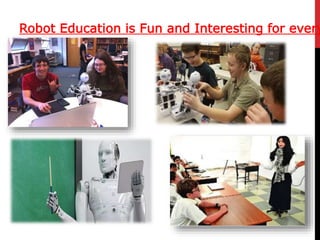
Robot Education is Fun and Interesting for every
How do robots help
students?
The robot can teach reading and writing skills as
well as many other subjects such as science,
technology, engineering, math, programming,
geometry and art. Whether via voice, vision or
touch, NAO offers a wide range of possible
interactions and fun, educational applications
specifically written to meet the needs of autistic
children. NAO’s easy to use interface enables
teachers and parents to exchange and update
information and create tailor-made sessions for
each individual child. The NAO also offers tools for
performance analysis, recording data and creating
The Use of Robotics in Education
Over the last few years, interest in educational utilization of
robotics has increased and several attempts have been made
worldwide to introduce robotics in school education from
kindergarten to high secondary school, mostly in science and
technology subjects.• Robotics in Science Education
• When used properly in schools the robots form the basis of
a cross curriculum activity, an ideal resource that can be
used to teach:
• Mathematics,
• Scientific principles,
• Design and Technology,
• ICT (computer programming).
Why is robotics education
important?
• By having to control a physical robot and seeing
what goes wrong, students learn what robots
can and can't do.
• They also learn the need for precise instructions.
• Robotics helps address the growing demand for
teaching science, technology, engineering and
math in schools.
• https://www.youtube.com/watch?v=TfuwSdoBg
nk&fbclid=IwAR0CnuJvYJlr47pWGU6TSWkoRz_x
PBN61a99r-6hLozXNvusqRIRb9ka17g
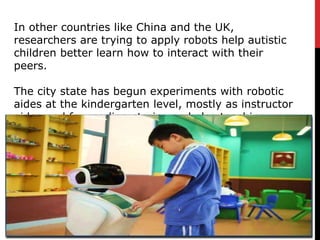
In other countries like China and the UK,
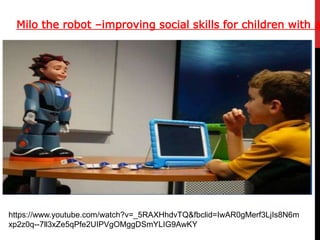
researchers are trying to apply robots help autistic
children better learn how to interact with their
peers.
The city state has begun experiments with robotic
aides at the kindergarten level, mostly as instructor
aides and for reading stories and also teaching
social interactions.
Milo the robot –improving social skills for children with a
https://www.youtube.com/watch?v=_5RAXHhdvTQ&fbclid=IwAR0gMerf3LjIs8N6m
xp2z0q--7ll3xZe5qPfe2UIPVgOMggDSmYLIG9AwKY
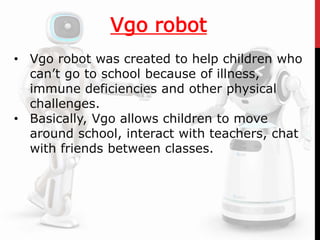
Vgo robot
• Vgo robot was created to help children who
can’t go to school because of illness,
immune deficiencies and other physical
challenges.
• Basically, Vgo allows children to move
around school, interact with teachers, chat
with friends between classes.
Conclusion
• Robot are becoming more and more active in
everyday life. They are part of our daily life and
especially in kids life.
• In fact, kids played with toys robots since their
young age. Thanks to the advance in technology,
robot are not only toys for kids but they are part
of their education by helping them in their school
work.
• The most important point to remember is that they
help autism children to be considered as normal
children. They make their life easier.
Robots in education

Robots in education

  • 1.
  • 2.
    WHAT CAN WELEARN FROM ROBOTS?  There are various reasons you should take the step in getting your children to learn robotics and get along with the technological advancement as it advances rapidly.  Robotics programs develop problem-solving skills and creativity.  Robotics teaches science and math concepts.  Robotics is fun.  An Introduction to Programming.
  • 3.
    Robot Education isFun and Interesting for every
  • 4.
    How do robotshelp students? The robot can teach reading and writing skills as well as many other subjects such as science, technology, engineering, math, programming, geometry and art. Whether via voice, vision or touch, NAO offers a wide range of possible interactions and fun, educational applications specifically written to meet the needs of autistic children. NAO’s easy to use interface enables teachers and parents to exchange and update information and create tailor-made sessions for each individual child. The NAO also offers tools for performance analysis, recording data and creating
  • 5.
    The Use ofRobotics in Education Over the last few years, interest in educational utilization of robotics has increased and several attempts have been made worldwide to introduce robotics in school education from kindergarten to high secondary school, mostly in science and technology subjects.• Robotics in Science Education • When used properly in schools the robots form the basis of a cross curriculum activity, an ideal resource that can be used to teach: • Mathematics, • Scientific principles, • Design and Technology, • ICT (computer programming).
  • 6.
    Why is roboticseducation important? • By having to control a physical robot and seeing what goes wrong, students learn what robots can and can't do. • They also learn the need for precise instructions. • Robotics helps address the growing demand for teaching science, technology, engineering and math in schools. • https://www.youtube.com/watch?v=TfuwSdoBg nk&fbclid=IwAR0CnuJvYJlr47pWGU6TSWkoRz_x PBN61a99r-6hLozXNvusqRIRb9ka17g
  • 7.
    In other countrieslike China and the UK, researchers are trying to apply robots help autistic children better learn how to interact with their peers. The city state has begun experiments with robotic aides at the kindergarten level, mostly as instructor aides and for reading stories and also teaching social interactions.
  • 8.
    Milo the robot–improving social skills for children with a https://www.youtube.com/watch?v=_5RAXHhdvTQ&fbclid=IwAR0gMerf3LjIs8N6m xp2z0q--7ll3xZe5qPfe2UIPVgOMggDSmYLIG9AwKY
  • 9.
    Vgo robot • Vgorobot was created to help children who can’t go to school because of illness, immune deficiencies and other physical challenges. • Basically, Vgo allows children to move around school, interact with teachers, chat with friends between classes.
  • 10.
    Conclusion • Robot arebecoming more and more active in everyday life. They are part of our daily life and especially in kids life. • In fact, kids played with toys robots since their young age. Thanks to the advance in technology, robot are not only toys for kids but they are part of their education by helping them in their school work. • The most important point to remember is that they help autism children to be considered as normal children. They make their life easier.