CODINGANDROBOTICS
CODING
A simple set of instructions given to the computer (Using a language it
understands) to perform a certain function, for example, pressing a button
on a phone.
CURRICULUMSEQUENCE
Our curriculum is structured in such a way that there is a flow from Basic, to
Standard, to Advanced Modules to enable a process-based learning and
understanding for all learners.
We don’t promise Heaven that a Grade One learner will learn about Data Science or
Software Engineering.
Our Curriulum flows from Basic Level to Advanced modules that the learner can
understand and implement.
We also have an Online Management Information System that has different
modules: One of them is “Learner Self Placed Sessions” that learners can access our
Coding Materials, Online Lessons that enable learners to practice from home.
Coding Programs for Kids
1 Structured Courses
Well-designed programs tailored for different age groups.
2 Scratch Junior
For Grade 1 to 3
3 Scratch 3
For Grade 4 to 7
4 Grade 8 +
Python, Website, Android, Java
CODINGTOOLS
Block Based
Text Based
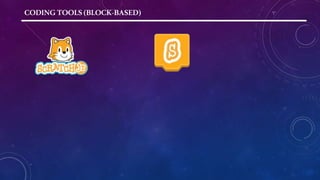
CODINGTOOLS(BLOCK-BASED)
CODINGTOOLS(TEXT-BASED)
IMPORTANCEOFCODING
1. Adaptive Mind Learning Techniques – Interacting wth different programming
tools to enable multiple functionality.
2. Learning Catalytics – Group Learning which is important for interpersonal skills.
3. Digital Fluency – They become professionals at an early age.
4. Online Safety – To avoid vulnerabilities like Cyber Bullying
5. Design Thinking
6. Process Based Mentality
7. Digital Business Skills
8. Computational Thinking etc.
EVALUATION
There will be periodic exams to evaluate understanding of certain
concepts, which will be minimal.
Coding is purely evaluated using PROJECTS. The teacher will give
scenarios/ problems to which the student will develop projects that
solve their problems.
Learners will have LinkeIn accounts that will connect them to Tech
Companies, such as Google, and GitHub Accounts where they will be
uploading their complete projects.
CERTIFICATION
Upon successful completion of each level/ module, each student will be
issued with a certificate. This will be available in our Management
Information System platform.
CAREERSINCODING
Coding will equip learners with hands-on skills that spark their interest in
certain career pathways, especially when they begin specialization in their
senior years in Grade 10 and above. Such careers include:
1) Data Analysts
2) Game Developers
3) Web Developers (FRONT-END AND BACK-END)
4) Android Development
5) UI/UX(DESIGNERS)
ROBOTICS
A field of study, research and engineering that deals with the design,
construction, operation and use of robots.
Robots are machines designed to perform tasks typically done by humans.
They can be autonomous or operated by human input and can range from
simple automated devices to advanced, highly ntelligent systems.
The field of robotics encompasses various disciplines such as Mechanical
Engineering, Electrical Engineering, Computer Science among others. It
involves the integration of sensors, actuators, and computational intelligence
to create systems that can sense, think and act in the physical world.
APPLICATIONS OFROBOTICS
Manufacturing – Assembly, welding, painting and packaging.
Healthcare – Can assist in surgery, patient care and rehabilitation.
Agriculture – Harvesting and monitoring crops etc.
The potential applications of robotics are diverse and continue to expand
as technology advances.
ROBOTICS MODULES FOR KIDS
1. Robot Building kits – They contain all the necessary components, e.g.
motors, sensors etc. to build a robot.
2. Programming Tools – Visual Programming interfaces or block-based
coding to teach kids the basics of coding logic and commands to
control their robots.
3. Sensors and Actuators – Modules may incorporate various sensors,
(e.g. light, touch, distance) and actuators e.g. motors to teach kids
about input and output mechanisms in robotics.
ROBOTICSTOOLS
Arduino Microcontroller Humidity Sensor Infrared Sensor
Smoke Sensor Temperature Sensor Ultrasonic Sensor
1. Arduino Microcontroller– Controls all the sensors, that is, each sensor passes it’s
information to the microcontroller, which decodes them so that the result can be
displayed in the computer’s screen for interpretation.
2. Humidity Sensor – For checking humidity e.g. Growing Mushrooms.
3. Infrared (Motion) Sensor – For detecting movements of people, animals and
objects.
4. Smoke Sensor – For detecting smoke incase there is anything burning.
5. Temperature Sensor – For measuring environment temperature e.g. incubation of
eggs, growing mushrooms.
6. Ultrasonic Sensor – For measuring distance between two points e.g. Used by the
visually impaired citizens to detect obstacles like walls.
BENEFITS OFROBOTICS FORKIDS
1. STEM Learning – Robotics education introduces kids to concepts in STEM in
a hands-on and engaging way. Kids learn about mechanics, electronics,
software and problem solving.
2. Critical Thinking and Problem Solving – Working with robots encourages
kids to think critically and analytically as they troubleshoot and solve
technical challenges.
3. Collaboration and Teamwork – Many robotics programs involve team-based
activities, teaching kids how to collaborate, communicate, and work
effectively with others.
4. Computer Programming Skills– Robotics often involves coding and programming
robots to perform specific tasks.
5. Creativity and Innovation – Building and designing robots encourages creativity
and innovation as kids explore different ways to accomplish a task or solve a
problem.
6. Confidence and Resilience– Overcoming challenges in robotics projects fosters a
sense of accomplishment and confidence in kid’s abilities. They learn to persevere
through setbacks, refine their designs, and see the tangible results of their efforts.
7. Real World Applications – Robotics provides a bridge between theoretical
concepts and real world applications, allowing kids to see how the principles they
learn in the classroom can be applied to tangible, practical tasks.
8. Future Career Opportunities– Exposure to Robotics at a young age can
spark interest in technology-related careers such as engineering, computer
science, research, or innovation.
9. 21st Century Skills – Robotics education aligns with the development of 21st
century skills such as adaptability, technological literacy, and complex
problem-solving, which are increasingly important in a rapidly evolving and
technology-driven global landscape.
10. Fun and Engaging Learning– Robotics provides an enjoyable, hands-on
approach to learning that captivates kids’ natural curiosity and enthusiasm.
VOTEOFTHANKS

Coding And Robotics Presentation 1.4 2024.pptx

  • 1.
  • 2.
    CODING A simple setof instructions given to the computer (Using a language it understands) to perform a certain function, for example, pressing a button on a phone.
  • 3.
    CURRICULUMSEQUENCE Our curriculum isstructured in such a way that there is a flow from Basic, to Standard, to Advanced Modules to enable a process-based learning and understanding for all learners. We don’t promise Heaven that a Grade One learner will learn about Data Science or Software Engineering. Our Curriulum flows from Basic Level to Advanced modules that the learner can understand and implement. We also have an Online Management Information System that has different modules: One of them is “Learner Self Placed Sessions” that learners can access our Coding Materials, Online Lessons that enable learners to practice from home.
  • 4.
    Coding Programs forKids 1 Structured Courses Well-designed programs tailored for different age groups. 2 Scratch Junior For Grade 1 to 3 3 Scratch 3 For Grade 4 to 7 4 Grade 8 + Python, Website, Android, Java
  • 5.
  • 6.
  • 7.
  • 8.
    IMPORTANCEOFCODING 1. Adaptive MindLearning Techniques – Interacting wth different programming tools to enable multiple functionality. 2. Learning Catalytics – Group Learning which is important for interpersonal skills. 3. Digital Fluency – They become professionals at an early age. 4. Online Safety – To avoid vulnerabilities like Cyber Bullying 5. Design Thinking 6. Process Based Mentality 7. Digital Business Skills 8. Computational Thinking etc.
  • 9.
    EVALUATION There will beperiodic exams to evaluate understanding of certain concepts, which will be minimal. Coding is purely evaluated using PROJECTS. The teacher will give scenarios/ problems to which the student will develop projects that solve their problems. Learners will have LinkeIn accounts that will connect them to Tech Companies, such as Google, and GitHub Accounts where they will be uploading their complete projects.
  • 10.
    CERTIFICATION Upon successful completionof each level/ module, each student will be issued with a certificate. This will be available in our Management Information System platform.
  • 11.
    CAREERSINCODING Coding will equiplearners with hands-on skills that spark their interest in certain career pathways, especially when they begin specialization in their senior years in Grade 10 and above. Such careers include: 1) Data Analysts 2) Game Developers 3) Web Developers (FRONT-END AND BACK-END) 4) Android Development 5) UI/UX(DESIGNERS)
  • 12.
    ROBOTICS A field ofstudy, research and engineering that deals with the design, construction, operation and use of robots. Robots are machines designed to perform tasks typically done by humans. They can be autonomous or operated by human input and can range from simple automated devices to advanced, highly ntelligent systems. The field of robotics encompasses various disciplines such as Mechanical Engineering, Electrical Engineering, Computer Science among others. It involves the integration of sensors, actuators, and computational intelligence to create systems that can sense, think and act in the physical world.
  • 13.
    APPLICATIONS OFROBOTICS Manufacturing –Assembly, welding, painting and packaging. Healthcare – Can assist in surgery, patient care and rehabilitation. Agriculture – Harvesting and monitoring crops etc. The potential applications of robotics are diverse and continue to expand as technology advances.
  • 14.
    ROBOTICS MODULES FORKIDS 1. Robot Building kits – They contain all the necessary components, e.g. motors, sensors etc. to build a robot. 2. Programming Tools – Visual Programming interfaces or block-based coding to teach kids the basics of coding logic and commands to control their robots. 3. Sensors and Actuators – Modules may incorporate various sensors, (e.g. light, touch, distance) and actuators e.g. motors to teach kids about input and output mechanisms in robotics.
  • 15.
    ROBOTICSTOOLS Arduino Microcontroller HumiditySensor Infrared Sensor Smoke Sensor Temperature Sensor Ultrasonic Sensor
  • 16.
    1. Arduino Microcontroller–Controls all the sensors, that is, each sensor passes it’s information to the microcontroller, which decodes them so that the result can be displayed in the computer’s screen for interpretation. 2. Humidity Sensor – For checking humidity e.g. Growing Mushrooms. 3. Infrared (Motion) Sensor – For detecting movements of people, animals and objects. 4. Smoke Sensor – For detecting smoke incase there is anything burning. 5. Temperature Sensor – For measuring environment temperature e.g. incubation of eggs, growing mushrooms. 6. Ultrasonic Sensor – For measuring distance between two points e.g. Used by the visually impaired citizens to detect obstacles like walls.
  • 17.
    BENEFITS OFROBOTICS FORKIDS 1.STEM Learning – Robotics education introduces kids to concepts in STEM in a hands-on and engaging way. Kids learn about mechanics, electronics, software and problem solving. 2. Critical Thinking and Problem Solving – Working with robots encourages kids to think critically and analytically as they troubleshoot and solve technical challenges. 3. Collaboration and Teamwork – Many robotics programs involve team-based activities, teaching kids how to collaborate, communicate, and work effectively with others.
  • 18.
    4. Computer ProgrammingSkills– Robotics often involves coding and programming robots to perform specific tasks. 5. Creativity and Innovation – Building and designing robots encourages creativity and innovation as kids explore different ways to accomplish a task or solve a problem. 6. Confidence and Resilience– Overcoming challenges in robotics projects fosters a sense of accomplishment and confidence in kid’s abilities. They learn to persevere through setbacks, refine their designs, and see the tangible results of their efforts. 7. Real World Applications – Robotics provides a bridge between theoretical concepts and real world applications, allowing kids to see how the principles they learn in the classroom can be applied to tangible, practical tasks.
  • 19.
    8. Future CareerOpportunities– Exposure to Robotics at a young age can spark interest in technology-related careers such as engineering, computer science, research, or innovation. 9. 21st Century Skills – Robotics education aligns with the development of 21st century skills such as adaptability, technological literacy, and complex problem-solving, which are increasingly important in a rapidly evolving and technology-driven global landscape. 10. Fun and Engaging Learning– Robotics provides an enjoyable, hands-on approach to learning that captivates kids’ natural curiosity and enthusiasm.
  • 20.