Robotics in
Orthodontics
Dr.Umar Mohamed
Contents
• INTRODUCTION
• HISTORY
• ROBOTICS IN ORTHODONTICS
• WIRE BENDING ROBOT
• WIRE BENDING ROBOT FOR LINGUAL ORTHODONTICS
• ROBOT FOR APPLIANCE FABRICATION
• INVISALIGN AUTOMATED MANUFACTURING
• DIGITAL FABRICATION OF SPLINTS
• NANO ROBOTS IN ORTHODONTICS
• ROLE OF ROBOTICS IN RESEARCH
• CONCLUSION
• REFERENCES
Introduction
• The discipline of orthodontics ,since its very
inception has strived to improve the efficacy and
efficiency of orthodontics appliance through
improvement in appliance design.
History
• Ancient civilization
• In the medieval period(1136-1206) Al-Jazari
• In the renaissance Italy (1452-1519)
• The first electronic autonomous Robots(1948-1949) -
William Grey Walter . Elmer and Elsie
• The first truly modern Robot- George Devol in 1954
Unimate
• In 1985 PUMA 560 –place needle for a brain biopsy
using CT
• In 1988 PROBOT- prostatic surgery
• The ROBODOC in 1992 was used to mill out precise
fittings in the femur for hip replacement.
• The word robot was introduced to the public by the
Czech interwar writer Karel Čapek in his play R.U.R.
(Rossum's Universal Robots), published in 1920.
• The robot institute of America in 1979 defined Robot
as “A re proggramable, multifunctional manipulator
designed to move material,parts,tools or specialized
devices through various programmed motion for
the performance of variety of tasks .
Robotics in Orthodontics
• Complex tasks with precison
• Robotics devices transcend –accuracy and
efficiency
• Clinician have more time for diagnosis and
treatment planning rather than spending time on
cumbersome wire bending and appliance
fabrication
• Scanning Solid objects with great accuracy and
ability to manipulate 3d Images that are produced
using softwares
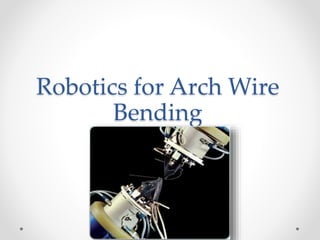
Robotics for Arch Wire
Bending
SURE SMILE SYSTEM
• Designed to reduced errors in treatment resulting
from appliance management
• Suresmile incorperates intraoral scanning
,conebeam CT, special alloy arch wires and
precision robotic wire bending ,along
Clinical procedures
Dentition is prepared by scanning using Orascanner
Structured white light
CBCT scans
• OraScan is intergrated with conventional
photographs and x ray.
• OraScan software
The arch wire geometry is automatically calculated in
three dimension for the bracket positions on the target
arch.
the orthodontist selects the appropriate cross-section ,
material , and force output from the computer menu.
Electronic prescription of arch wire and customized
bracket positions
• Treatment plan is sent –Suresmile precision
appliance center
• New OraScan for finishing wires
The current accuracy of the
system
• Orascanner -6 unblured images/sec
3500 3D points per image
accuracy of each point =50 microns
Linear error of scan is .1mm per tooth
• Wire bending –bending postioning erroe is_+1
• angular/torsional error is _+ 1 degree
• Digital bracket placement= accurate to +25
microns
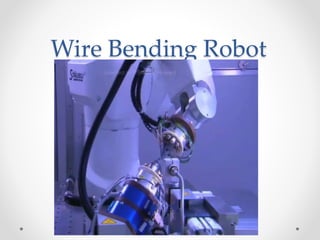
Wire Bending Robot
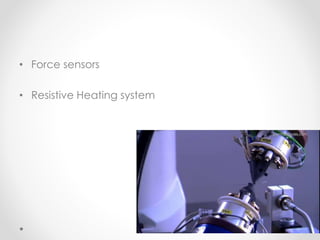
• Force sensors
• Resistive Heating system
Magazine holding straight arch wires
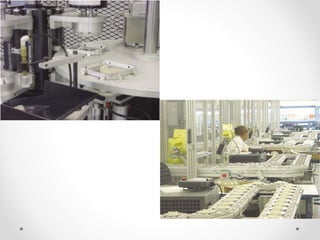
Conveyor belt system for mass production of arch wires
Orametrix wire bending
robot system
Efficiency and Effectiveness of SureSmile”,
Alana K. Saxe, DMD; Lenore J. Louie, MSc, DMD; James
Mah, DDS, MSc, DMSc
The research shows that the SureSmile process results in a lower
mean ABO OGS score and a reduced treatment time than
conventional approaches with great potential to both decrease
treatment time and improve quality.
• In 1999 AJODO Wiechmann et all reported the use
robotic arch fabrication method developed by
Orametrix system for the use customized lingual
brackets and archwire system
Wire bending Robot for
lingual orthodontics
LAMDA Robotic wire bending
system
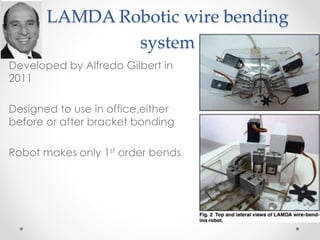
• Developed by Alfredo Gilbert in
2011
• Designed to use in office,either
before or after bracket bonding
• Robot makes only 1st order bends
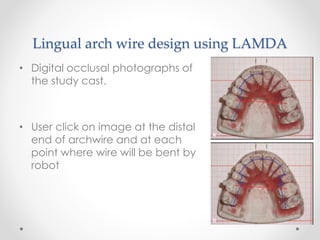
Lingual arch wire design using LAMDA
• Digital occlusal photographs of
the study cast.
• User click on image at the distal
end of archwire and at each
point where wire will be bent by
robot
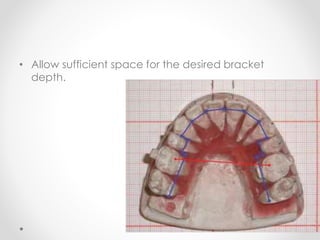
• Allow sufficient space for the desired bracket
depth.
• Lamda software assigns x and y coordinates to
each point using pixels as unit measurements .
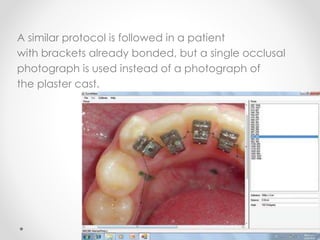
A similar protocol is followed in a patient
with brackets already bonded, but a single occlusal
photograph is used instead of a photograph of
the plaster cast.
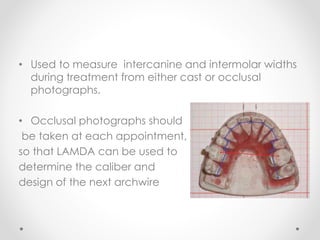
• Used to measure intercanine and intermolar widths
during treatment from either cast or occlusal
photographs.
• Occlusal photographs should
be taken at each appointment,
so that LAMDA can be used to
determine the caliber and
design of the next archwire
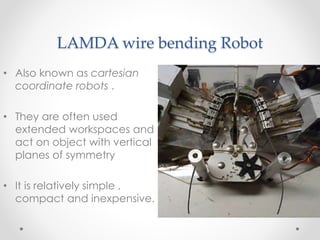
LAMDA wire bending Robot
• Also known as cartesian
coordinate robots .
• They are often used
extended workspaces and
act on object with vertical
planes of symmetry
• It is relatively simple ,
compact and inexpensive.
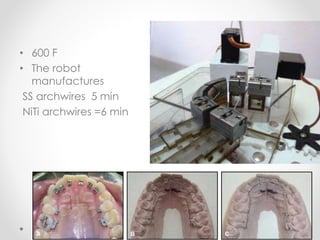
• 600 F
• The robot
manufactures
SS archwires 5 min
NiTi archwires =6 min
The LAMDA wire-bending robot is much simpler than the robots
used in commercially outsourced systems, since it manufactures
only 1st-order bends.
Although this requires the use of the Hiro bracketpositioning
system3 for 2nd- and 3rd-order bends,
it makes the unit affordable for a solo practitioner.In addition, the
orthodontist is able to regulate the process at any time
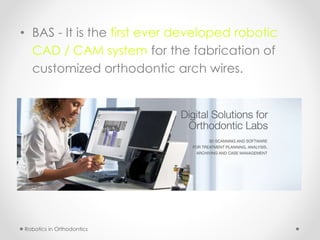
• BAS - It is the first ever developed robotic
CAD / CAM system for the fabrication of
customized orthodontic arch wires.
Robotics in Orthodontics
• Prof. Helge Fischer-Brandies
invented this in 1984 and his
co-worker Dr. Wolfgang
Orthuber, together with an
engineering company
developed this hardware and
software.
Robotics in Orthodontics
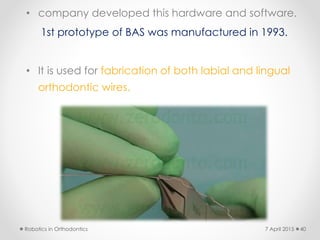
• company developed this hardware and software.
1st prototype of BAS was manufactured in 1993.
• It is used for fabrication of both labial and lingual
orthodontic wires.
Robotics in Orthodontics 407 April 2015
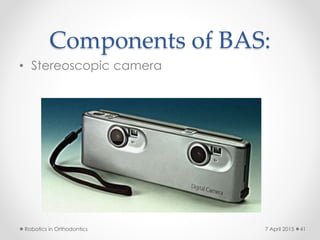
Components of BAS:
• Stereoscopic camera
Robotics in Orthodontics 417 April 2015
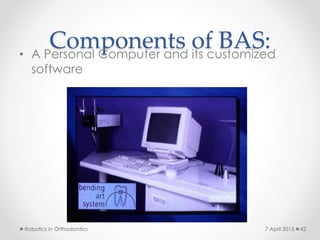
Components of BAS:• A Personal Computer and its customized
software
Robotics in Orthodontics 427 April 2015
Components of BAS:
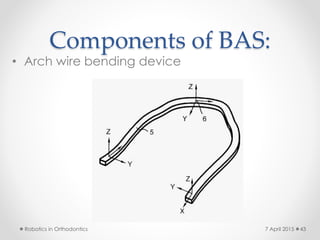
• Arch wire bending device
Robotics in Orthodontics 437 April 2015
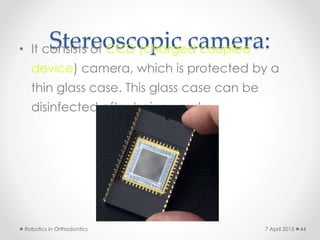
Stereoscopic camera:• It consists of CCD (charged coupled
device) camera, which is protected by a
thin glass case. This glass case can be
disinfected after being used.
Robotics in Orthodontics 447 April 2015
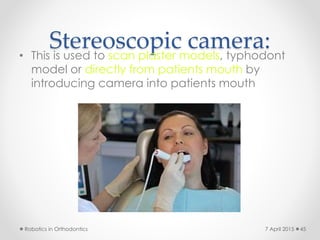
Stereoscopic camera:• This is used to scan plaster models, typhodont
model or directly from patients mouth by
introducing camera into patients mouth
Robotics in Orthodontics 457 April 2015
Procedure
–
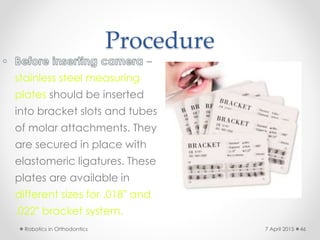
stainless steel measuring
plates should be inserted
into bracket slots and tubes
of molar attachments. They
are secured in place with
elastomeric ligatures. These
plates are available in
different sizes for .018” and
.022” bracket system.
Robotics in Orthodontics 467 April 2015
Procedure
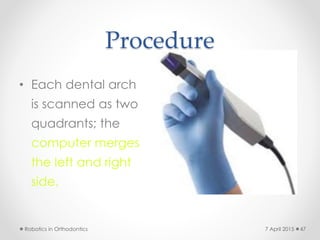
• Each dental arch
is scanned as two
quadrants; the
computer merges
the left and right
side.
Robotics in Orthodontics 477 April 2015
Procedure
• It takes 4 sec/quadrant. Within this time the
mirror of camera moves two times forward and
backward
o Forward -110º
o Backward - 80º
• It scans using a white light (not laser) and takes
20 min to capture and format the image
Robotics in Orthodontics 487 April 2015
Arch wire bending component
• Head of bending machine has 3
components.
, which clamps any arch wire
bending or torquing,
, which clamps any wire during
torquing and
, configurated as partial cone.Robotics in Orthodontics 497 April 2015
Arch wire bending
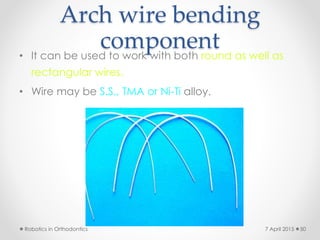
component• It can be used to work with both round as well as
rectangular wires.
• Wire may be S.S., TMA or Ni-Ti alloy.
Robotics in Orthodontics 507 April 2015
Arch wire bending
component
• Bending process starts after programming all
desired bends.
• The time taken to complete the bending process is
5-7 min.
Robotics in Orthodontics 517 April 2015
Advantages of BAS and Indications
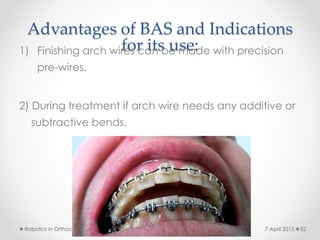
for its use:1) Finishing arch wires can be made with precision
pre-wires.
2) During treatment if arch wire needs any additive or
subtractive bends.
Robotics in Orthodontics 527 April 2015
Advantages of BAS and Indications
for its use:
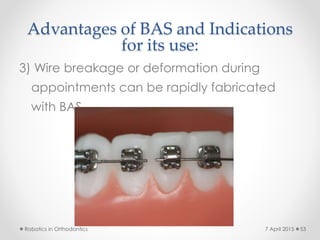
3) Wire breakage or deformation during
appointments can be rapidly fabricated
with BAS.
Robotics in Orthodontics 537 April 2015
Advantages of BAS and Indications
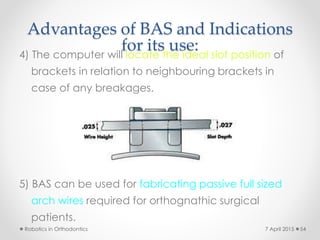
for its use:4) The computer will locate the ideal slot position of
brackets in relation to neighbouring brackets in
case of any breakages.
5) BAS can be used for fabricating passive full sized
arch wires required for orthognathic surgical
patients.
Robotics in Orthodontics 547 April 2015
Advantages of BAS and Indications
for its use:
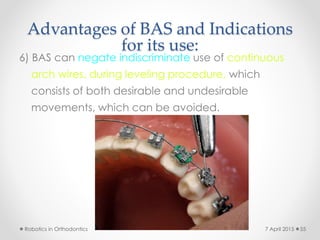
6) BAS can negate indiscriminate use of continuous
arch wires, during leveling procedure, which
consists of both desirable and undesirable
movements, which can be avoided.
Robotics in Orthodontics 557 April 2015
Advantages of BAS and Indications for
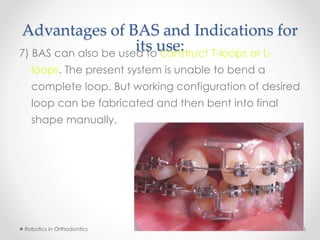
its use:7) BAS can also be used to construct T-loops or L-
loops. The present system is unable to bend a
complete loop. But working configuration of desired
loop can be fabricated and then bent into final
shape manually.
Robotics in Orthodontics 567 April 2015
Advantages of BAS and Indications
for its use:
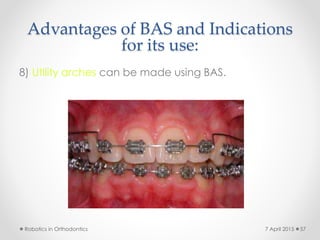
8) Utility arches can be made using BAS.
Robotics in Orthodontics 577 April 2015
Advantages of BAS and Indications
for its use:
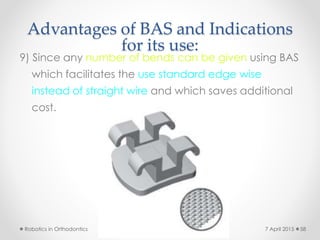
9) Since any number of bends can be given using BAS
which facilitates the use standard edge wise
instead of straight wire and which saves additional
cost.
Robotics in Orthodontics 587 April 2015
Advantages of BAS and Indications
for its use:
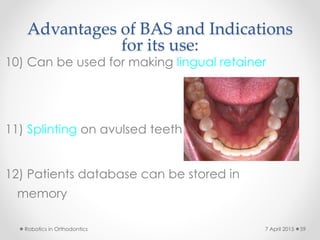
10) Can be used for making lingual retainer
11) Splinting on avulsed teeth
12) Patients database can be stored in
memory
Robotics in Orthodontics 597 April 2015
Shortcomings of BAS
1. Time required for insertion of the measuring plates
for their identification. This can be rectified by
keeping standardized markers on orthodontic
brackets.
2. Though it is designed accurately we cannot
precisely predict the tooth movement to applied
forces, so clinical judgment is still vital.
3. Steel wire material presently used (recommended
by BAS) deform very readily.
Robotics in Orthodontics 607 April 2015
Invisalign automated
manufacturing process
• Requires from 6-40 sequential appliances per arch.
• Instead, Align Technology uses stereolithography
technology to create its reference models, making
the orthodontic industry the first to bring on-demand
digital manufacturing to commercial production
Nanorobotics in
Orthodontics
• Nanotechnology refers to the science and
engineering activities at the level of atoms and
molecules
• Nanomedicine is the process of diagnosing treating
and preventing disease and traumatic injury of
relieving pain and of preserving and improving
human health through the use of Nano scale
structured materials biotechnology and genetic
engineering and eventually complex molecular
machine systems and Nano robots using molecular
tools and molecular knowledge of human body
• Nanorobots would constitute any smart struture
capable of actuation sensing signaling, information
processing ,intelligence manipulation and swarm
behavior at nano scale

Robotics in orthodontics

  • 1.
  • 2.
    Contents • INTRODUCTION • HISTORY •ROBOTICS IN ORTHODONTICS • WIRE BENDING ROBOT • WIRE BENDING ROBOT FOR LINGUAL ORTHODONTICS • ROBOT FOR APPLIANCE FABRICATION • INVISALIGN AUTOMATED MANUFACTURING • DIGITAL FABRICATION OF SPLINTS • NANO ROBOTS IN ORTHODONTICS • ROLE OF ROBOTICS IN RESEARCH • CONCLUSION • REFERENCES
  • 3.
    Introduction • The disciplineof orthodontics ,since its very inception has strived to improve the efficacy and efficiency of orthodontics appliance through improvement in appliance design.
  • 4.
    History • Ancient civilization •In the medieval period(1136-1206) Al-Jazari • In the renaissance Italy (1452-1519) • The first electronic autonomous Robots(1948-1949) - William Grey Walter . Elmer and Elsie • The first truly modern Robot- George Devol in 1954 Unimate
  • 5.
    • In 1985PUMA 560 –place needle for a brain biopsy using CT • In 1988 PROBOT- prostatic surgery • The ROBODOC in 1992 was used to mill out precise fittings in the femur for hip replacement.
  • 6.
    • The wordrobot was introduced to the public by the Czech interwar writer Karel Čapek in his play R.U.R. (Rossum's Universal Robots), published in 1920. • The robot institute of America in 1979 defined Robot as “A re proggramable, multifunctional manipulator designed to move material,parts,tools or specialized devices through various programmed motion for the performance of variety of tasks .
  • 7.
  • 8.
    • Complex taskswith precison • Robotics devices transcend –accuracy and efficiency • Clinician have more time for diagnosis and treatment planning rather than spending time on cumbersome wire bending and appliance fabrication
  • 9.
    • Scanning Solidobjects with great accuracy and ability to manipulate 3d Images that are produced using softwares
  • 11.
    Robotics for ArchWire Bending
  • 12.
    SURE SMILE SYSTEM •Designed to reduced errors in treatment resulting from appliance management • Suresmile incorperates intraoral scanning ,conebeam CT, special alloy arch wires and precision robotic wire bending ,along
  • 13.
    Clinical procedures Dentition isprepared by scanning using Orascanner Structured white light CBCT scans
  • 14.
    • OraScan isintergrated with conventional photographs and x ray. • OraScan software
  • 15.
    The arch wiregeometry is automatically calculated in three dimension for the bracket positions on the target arch. the orthodontist selects the appropriate cross-section , material , and force output from the computer menu. Electronic prescription of arch wire and customized bracket positions
  • 16.
    • Treatment planis sent –Suresmile precision appliance center • New OraScan for finishing wires
  • 17.
    The current accuracyof the system • Orascanner -6 unblured images/sec 3500 3D points per image accuracy of each point =50 microns Linear error of scan is .1mm per tooth • Wire bending –bending postioning erroe is_+1 • angular/torsional error is _+ 1 degree • Digital bracket placement= accurate to +25 microns
  • 18.
  • 21.
    • Force sensors •Resistive Heating system
  • 22.
    Magazine holding straightarch wires Conveyor belt system for mass production of arch wires
  • 23.
  • 24.
    Efficiency and Effectivenessof SureSmile”, Alana K. Saxe, DMD; Lenore J. Louie, MSc, DMD; James Mah, DDS, MSc, DMSc The research shows that the SureSmile process results in a lower mean ABO OGS score and a reduced treatment time than conventional approaches with great potential to both decrease treatment time and improve quality.
  • 26.
    • In 1999AJODO Wiechmann et all reported the use robotic arch fabrication method developed by Orametrix system for the use customized lingual brackets and archwire system
  • 27.
    Wire bending Robotfor lingual orthodontics
  • 28.
    LAMDA Robotic wirebending system • Developed by Alfredo Gilbert in 2011 • Designed to use in office,either before or after bracket bonding • Robot makes only 1st order bends
  • 29.
    Lingual arch wiredesign using LAMDA • Digital occlusal photographs of the study cast. • User click on image at the distal end of archwire and at each point where wire will be bent by robot
  • 30.
    • Allow sufficientspace for the desired bracket depth.
  • 31.
    • Lamda softwareassigns x and y coordinates to each point using pixels as unit measurements .
  • 32.
    A similar protocolis followed in a patient with brackets already bonded, but a single occlusal photograph is used instead of a photograph of the plaster cast.
  • 33.
    • Used tomeasure intercanine and intermolar widths during treatment from either cast or occlusal photographs. • Occlusal photographs should be taken at each appointment, so that LAMDA can be used to determine the caliber and design of the next archwire
  • 34.
    LAMDA wire bendingRobot • Also known as cartesian coordinate robots . • They are often used extended workspaces and act on object with vertical planes of symmetry • It is relatively simple , compact and inexpensive.
  • 35.
    • 600 F •The robot manufactures SS archwires 5 min NiTi archwires =6 min
  • 36.
    The LAMDA wire-bendingrobot is much simpler than the robots used in commercially outsourced systems, since it manufactures only 1st-order bends. Although this requires the use of the Hiro bracketpositioning system3 for 2nd- and 3rd-order bends, it makes the unit affordable for a solo practitioner.In addition, the orthodontist is able to regulate the process at any time
  • 38.
    • BAS -It is the first ever developed robotic CAD / CAM system for the fabrication of customized orthodontic arch wires. Robotics in Orthodontics
  • 39.
    • Prof. HelgeFischer-Brandies invented this in 1984 and his co-worker Dr. Wolfgang Orthuber, together with an engineering company developed this hardware and software. Robotics in Orthodontics
  • 40.
    • company developedthis hardware and software. 1st prototype of BAS was manufactured in 1993. • It is used for fabrication of both labial and lingual orthodontic wires. Robotics in Orthodontics 407 April 2015
  • 41.
    Components of BAS: •Stereoscopic camera Robotics in Orthodontics 417 April 2015
  • 42.
    Components of BAS:•A Personal Computer and its customized software Robotics in Orthodontics 427 April 2015
  • 43.
    Components of BAS: •Arch wire bending device Robotics in Orthodontics 437 April 2015
  • 44.
    Stereoscopic camera:• Itconsists of CCD (charged coupled device) camera, which is protected by a thin glass case. This glass case can be disinfected after being used. Robotics in Orthodontics 447 April 2015
  • 45.
    Stereoscopic camera:• Thisis used to scan plaster models, typhodont model or directly from patients mouth by introducing camera into patients mouth Robotics in Orthodontics 457 April 2015
  • 46.
    Procedure – stainless steel measuring platesshould be inserted into bracket slots and tubes of molar attachments. They are secured in place with elastomeric ligatures. These plates are available in different sizes for .018” and .022” bracket system. Robotics in Orthodontics 467 April 2015
  • 47.
    Procedure • Each dentalarch is scanned as two quadrants; the computer merges the left and right side. Robotics in Orthodontics 477 April 2015
  • 48.
    Procedure • It takes4 sec/quadrant. Within this time the mirror of camera moves two times forward and backward o Forward -110º o Backward - 80º • It scans using a white light (not laser) and takes 20 min to capture and format the image Robotics in Orthodontics 487 April 2015
  • 49.
    Arch wire bendingcomponent • Head of bending machine has 3 components. , which clamps any arch wire bending or torquing, , which clamps any wire during torquing and , configurated as partial cone.Robotics in Orthodontics 497 April 2015
  • 50.
    Arch wire bending component•It can be used to work with both round as well as rectangular wires. • Wire may be S.S., TMA or Ni-Ti alloy. Robotics in Orthodontics 507 April 2015
  • 51.
    Arch wire bending component •Bending process starts after programming all desired bends. • The time taken to complete the bending process is 5-7 min. Robotics in Orthodontics 517 April 2015
  • 52.
    Advantages of BASand Indications for its use:1) Finishing arch wires can be made with precision pre-wires. 2) During treatment if arch wire needs any additive or subtractive bends. Robotics in Orthodontics 527 April 2015
  • 53.
    Advantages of BASand Indications for its use: 3) Wire breakage or deformation during appointments can be rapidly fabricated with BAS. Robotics in Orthodontics 537 April 2015
  • 54.
    Advantages of BASand Indications for its use:4) The computer will locate the ideal slot position of brackets in relation to neighbouring brackets in case of any breakages. 5) BAS can be used for fabricating passive full sized arch wires required for orthognathic surgical patients. Robotics in Orthodontics 547 April 2015
  • 55.
    Advantages of BASand Indications for its use: 6) BAS can negate indiscriminate use of continuous arch wires, during leveling procedure, which consists of both desirable and undesirable movements, which can be avoided. Robotics in Orthodontics 557 April 2015
  • 56.
    Advantages of BASand Indications for its use:7) BAS can also be used to construct T-loops or L- loops. The present system is unable to bend a complete loop. But working configuration of desired loop can be fabricated and then bent into final shape manually. Robotics in Orthodontics 567 April 2015
  • 57.
    Advantages of BASand Indications for its use: 8) Utility arches can be made using BAS. Robotics in Orthodontics 577 April 2015
  • 58.
    Advantages of BASand Indications for its use: 9) Since any number of bends can be given using BAS which facilitates the use standard edge wise instead of straight wire and which saves additional cost. Robotics in Orthodontics 587 April 2015
  • 59.
    Advantages of BASand Indications for its use: 10) Can be used for making lingual retainer 11) Splinting on avulsed teeth 12) Patients database can be stored in memory Robotics in Orthodontics 597 April 2015
  • 60.
    Shortcomings of BAS 1.Time required for insertion of the measuring plates for their identification. This can be rectified by keeping standardized markers on orthodontic brackets. 2. Though it is designed accurately we cannot precisely predict the tooth movement to applied forces, so clinical judgment is still vital. 3. Steel wire material presently used (recommended by BAS) deform very readily. Robotics in Orthodontics 607 April 2015
  • 61.
    Invisalign automated manufacturing process •Requires from 6-40 sequential appliances per arch. • Instead, Align Technology uses stereolithography technology to create its reference models, making the orthodontic industry the first to bring on-demand digital manufacturing to commercial production
  • 65.
  • 66.
    • Nanotechnology refersto the science and engineering activities at the level of atoms and molecules • Nanomedicine is the process of diagnosing treating and preventing disease and traumatic injury of relieving pain and of preserving and improving human health through the use of Nano scale structured materials biotechnology and genetic engineering and eventually complex molecular machine systems and Nano robots using molecular tools and molecular knowledge of human body
  • 67.
    • Nanorobots wouldconstitute any smart struture capable of actuation sensing signaling, information processing ,intelligence manipulation and swarm behavior at nano scale

Editor's Notes

  • #9 Recent advances in 3d imaging ,computer management and manipulation of complex 3d data and robotics have opened new avenues in Orthodontic Rx
  • #10 Put LATEST JCO PICTURES
  • #13 It provides 3D visualization tools for diagnosis,monitoring and patient communication along with precision appliances .
  • #14 A hand held device that captures real time in vivo images of the dentition. Structured white light- to take images in rapid succesion, CBCT cannot be used in pregnant patients or patient with those large crownss .large metal restoration such as amalgam or gold foil.
  • #15 Combines captured images into accurate 3d representation of dentition which can be viewd at suresmile workstation from wide variety of perspectives.
  • #16 In the final phase of digital treatment planning ,individual teeth are viewed close up……. After the geometry of the digital archwire has been finished ,
  • #19 Design configuration of the wire bending robot includes
  • #22 Consists of forces sensor r
  • #29 Research and development of smile center dental specialities mexico
  • #31 The postion of any point can be modified by rightclicking the point ad dragging it to the desired position
  • #35 Gantry robots like the one used in the LAMDA system have the ability to move an endeffector (the device or tool at the end of a roboticarm) in multiple planes of space with great precision,though with limited degrees of freedom. Cartesian-axes of control are linear and at right angles to each other
  • #67 A nanometer is a billionth of a meter ie 1/80000 of the diameter of a human hair .