1
Presented by: Dr. Zeba Siddiqui
Rama Dental College Hospital and Research Centre
INTRODUCTION
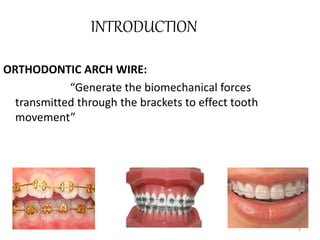
ORTHODONTIC ARCH WIRE:
“Generate the biomechanical forces
transmitted through the brackets to effect tooth
movement”
2
3
ARCHWIRES
 Optiflex archwire
 Bio force archwire
 Super cable archwire
 Graded nickel titanium archwires
 Formable nickel titanium wires
 Nitrogen coated archwires
 Multi force/Trifocal Nitanium Archwire
 Titanium niobium wire
 Timolium titanium wire
 Combined archwire
4
5
Fiber reinforced composite archwire
Coated arch wires
Retranol
Menzamium
Vapor-parylene Coated Wires
QCM
Esthetic Retainers
OPTIFLEX ARCHWIRE
6
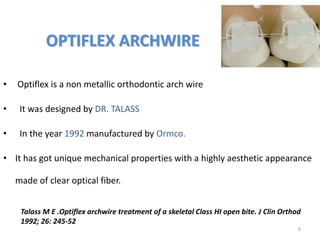
• Optiflex is a non metallic orthodontic arch wire
• It was designed by DR. TALASS
• In the year 1992 manufactured by Ormco.
• It has got unique mechanical properties with a highly aesthetic appearance
made of clear optical fiber.
Talass M E .Optiflex archwire treatment of a skeletal Class HI open bite. J Clin Orthod
1992; 26: 245-52
7
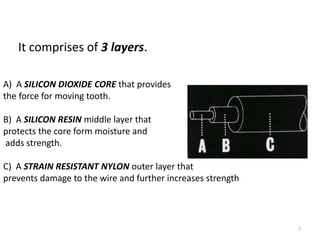
It comprises of 3 layers.
A) A SILICON DIOXIDE CORE that provides
the force for moving tooth.
B) A SILICON RESIN middle layer that
protects the core form moisture and
adds strength.
C) A STRAIN RESISTANT NYLON outer layer that
prevents damage to the wire and further increases strength
ADVANTAGES
 It is the most aesthetic orthodontic archwire.
 It is completely stain resistant, and will not stain or loose its clear look even after
several weeks in mouth.
 Its effective in moving teeth using light continuous force
 It is very flexible, has an extremely wide range of actions
 When indicated it can be tied with electrometric ligatures to severely
malaligned teeth without fear of fracturing the arch wire.
 Due to superior properties Optiflex can be used with any bracket system
8
9
Precaution’s while using Optiflex archwires
1) Optiflex archwires should be tied into brackets with elastomeric ligatures. Metal
ligatures should never be used since they will fracture the glass core.
2) Sharp bends similar to those placed in a metal wire should never be attempted
with Optiflex, as these bends will immediately fracture the glass core.
3) Using instruments with sharp edges, like the scaler etc should be avoided instead
a gentle finger pressure is used to insert the archwire into the slot.
4) To cut the end of the archwire distal to the molar, it is recommended to the use
the mini distal end cutter which is designed to cut all 3 layer’s of optiflex.
CLINICAL APPLICATIONS
1) It is used in adult patients who wish that their braces not be really visible for
reasons related to personal concern’s or professional consideration.
2) Can be used as initial archwire in cases with moderate amounts of crowding
in one or both arches.
3) Ideal for non extraction cases and also cases with no partially edentulous
areas
4) Optiflex can be used in presurgical stage in cases which require orthognathic
intervention as a part of the treatment. Optiflex is available in a pack of ten 6
inch straight length wires of .017” and .021” sizes
10
References:
1. Supercable and the SPEED system by Berger J, Byloff FK, Waram T j clin orthod 1998
Apr;32(4):246-53
2. Alignment efficiency of superelastic coaxial nickel-titanium vs superelastic single-stranded
nickel-titanium in relieving mandibular anterior crowding A randomized controlled
prospective study by Biju Sebastiana (Angle Orthod. 2012;82:703–708.)
11
SUPER CABLE
In 1993, Hanson combined the mechanical advantages of
multistranded cables with the material properties of
superelastic wires to create a superelastic nickel titanium
coaxial wire. This wire, called super cable
 It comprises seven individual strands that are Woven together
in a long, gentle spiral to maximize flexibility and minimize force
delivery.
12
SUPER CABLE
PROPERTIES
• Improved treatment efficiency
• Simplified mechanotherapy
• Elimination of archwire bending.
• Flexibility and ease of engagement regardless of crowding
13
• No evidence of anchorage loss.
• A light, continuous level of force, preventing any adverse
response of the supporting periodontium.
• Minimal patient discomfort after initial archwire placement.
• Fewer patient visits, due to longer archwire activation.
14
DISADVANTAGES
• Tendency of wire ends to fray if not cut with sharp instruments.
• Tendency of archwires to break and unravel in extraction spaces
• Inability to accommodate bends, steps, or helices.
• Tendency of wire ends to migrate distally and occasionally irritate
soft tissues as severely crowded or displaced teeth begin to align.
15
16
FORMABLE NICKEL TITANIUM WIRES
• By Ortho Organizers
• Nitanium Total Control Archwire
• Superelastic bendable Nickel Titanium archwire
• Accepts 1st, 2nd and 3rd order bends permanently
• Low friction wire.
17
GRADED NICKEL TITANIUM ARCHWIRES
• By introducing variable TTR within same archwire.
• This takes the form of graded force delivery within the same
aligning archwire
• The heat treatment of selected sections of the archwire by
means of different electric current delivered by electric pliers
modified the values of the deactivation forces by varying the
amount of austenite present in the alloy.
• e.g : Bioforce Sentalloy.
18
• Exhibits superelasticity at different stress levels at different
locations in same archwire.
• 80g of force – in central incisor region.
• 320g of force – in molar region.
‘Neosentalloy’ archwire marketed by GAC*, has three force
levels for single arch dimensions
19
References:
1. Effect of coating on properties of esthetic orthodontic nickel-titanium wires by
Masahiro Iijimaa; Takeshi Mugurumab; William A. Brantleyc; Han-Cheol Choed; Angle
Orthodontist, Vol 82, No 2, 2012
20
BIOFORCE WIRE
Introduced by GAC
 It was possible to produce variation in force
delivery between archwires of identical
dimension
 This was possible by specifying transition temperatures within
given ranges. And were graded as thermodynamic arch wires.
 This property was further advanced to produce variable transition
temperatures within the same archwire
 This arch wire was called Bioforce archwire
21
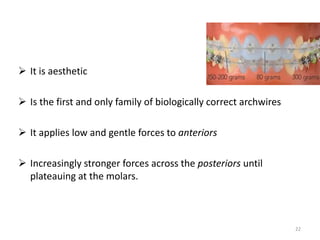
 It is aesthetic
 Is the first and only family of biologically correct archwires
 It applies low and gentle forces to anteriors
 Increasingly stronger forces across the posteriors until
plateauing at the molars.
22
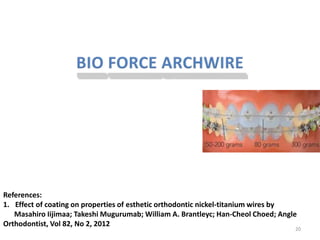
• Beginning at approximately 100 grams
• increasing to approximately 300 grams
• It provides the right force to each tooth
• There by it Reducing the number of wire changes & Providing
greater patient comfort
23
CLINICAL APPLICATIONS:
During initial stages when anterior torque is needed,
use of an relatively large size (i.e. 0.018x0.025) can be given
without the fear of significant root resorption.
During later stages of treatment i.e.
 If the posterior occlusion is not settled in
 rotations have not been fully corrected or
 the bite opening is taking a long time because of the heavy
musculature.
These are the good reasons to give an Bioforce arch wire as the
undesirable effects of the applied force-producing mechanisms
will be minimized. 24
25
BIO TWIST NITI
• The bio twist Niti is a 0.021 x 0.025 pre-form rectangular arch
wire formed with multiple strands of titanium super elastic wire.
• This multistrand structure gives the wire low force and low
stiffness with excellent flexibility, and the rectangular shape allows
significant engagement of the slot.
26
Bio twist wire is great for use at the beginning of treatment during
the unraveling stage because it will facilitate leveling and aligning
while also controlling torque.
This wire can also be used at the end of treatment when the
retention of torque is important but it will allow movement from
forces, such as vertical elastics.
MULTI FORCE/TRIFOCAL NITANIUM
ARCHWIRE
• The anterior region consists of light
super elastic forces; the bicuspid region
is engineered to produce a graduating
amount of super elastic force as it
travels toward the posterior region
• The posterior region exhibits the
highest force and is designed to bend
and then return to original.
27
TITANIUM NIOBIUM WIRE
References:
1. Titanium-niobium, a new finishing wire alloy. By Michel dalstra, Gabriella
denes, birte melsen J.Clin orthod res. 2000 feb;3(1):6-14
2. A comparative evaluation of metallurgical properties of stainless steel and tma
wires with Tiolium and titanium niobium archwires by r devaki vijayalakshmi,ks
nagachandran, pradeep kummi, p jayakumar (indian j dent res,20(4),2009
28
TITANIUM NIOBIUM WIRE
 It was introduced in early 1995 by DR ROHIT SACHDEVA &
Manufactured by Ormco
PROPERTIES:
 Ti- Nb is soft and easy to form, yet it has the same working
range of stainless steel.
 Its stiffness is 20% lower than TMA and 70% lower than
stainless steel.
 Ti-Nb wire have a larger plastic range, similar activation and
deactivation curves and relatively low spring back.
29
30
• Its bending stiffness corresponding to 48% lower than that of
stainless steel and a spring back 14% lower than that of stainless
steel.
• We can easily make creative bends and avoid excessive force
levels of a steel wire.
• The stiffness of ti-nb in torsion is only 36% of steel,
yet the spring back of ti-nb in torsional mode is Slightly higher
than stainless steel
• This property makes it possible to utilize the ti-nb wire for even
the major third order corrections.
CLINICAL APPLICATIONS
The low spring back and high formability of the titanium-
niobium archwire allows creation of finishing bends
Hence, this wire can be used as an finishing archwire.
( J. Clin orthod res. 2000 feb;3(1):6-14).
31
TIMOLIUM TITANIUM ARCHWIRE
References:
1. A comparative evaluation of metallurgical properties of stainless steel and tma
wires with Tiolium and titanium niobium archwires by r devaki vijayalakshmi, ks
nagachandran, pradeep kummi, p jayakumar (indian j dent res,20(4),2009
• 2.Mechanical Properties and Surface Characteristics of Three Archwire Vinod
Krishnan, MDSa; K. Jyothindra Kumar, MDS, M. Orth RCS, MDO RCPS, FDS RCS
Alloys (Angle Orthod 2004;74:825–831.)
32
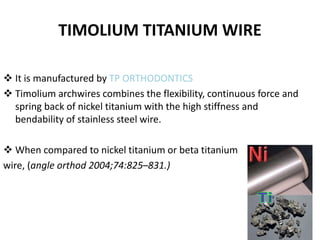
TIMOLIUM TITANIUM WIRE
 It is manufactured by TP ORTHODONTICS
 Timolium archwires combines the flexibility, continuous force and
spring back of nickel titanium with the high stiffness and
bendability of stainless steel wire.
 When compared to nickel titanium or beta titanium
wire, (angle orthod 2004;74:825–831.)
33
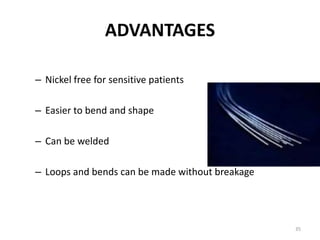
Timolium outperforms in the following:
– More resistant to breakage
– Smoother for reduced friction
– Brightly polished and aesthetically pleasing
34
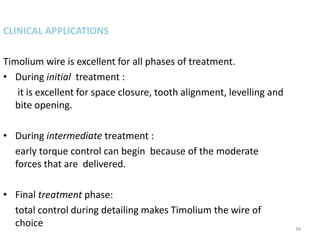
ADVANTAGES
– Nickel free for sensitive patients
– Easier to bend and shape
– Can be welded
– Loops and bends can be made without breakage
35
36
CLINICAL APPLICATIONS
Timolium wire is excellent for all phases of treatment.
• During initial treatment :
it is excellent for space closure, tooth alignment, levelling and
bite opening.
• During intermediate treatment :
early torque control can begin because of the moderate
forces that are delivered.
• Final treatment phase:
total control during detailing makes Timolium the wire of
choice
COMBINED WIRES
The key to success in a multi attachment straight wire system is
 To have the ability to use light tipping movements in combination
with rigid translation
 To be able to vary the location of either,
 at any time the need arises during treatment.
They used three specific combined wires for the technique
1. Dual Flex-1
2. Dual Flex-2, and
3. Dual Flex-3 (Lancer Orthodontics).
37
References:
1. Dual-Flex Archwires by JAMES L. CANNON, DDS, MS JCO VOLUME 18 : NUMBER 09 : PAGES
(648-649) 1984
38
The Dual Flex-1
 It consists of a anterior section made of 0.016-inch round
Titanal and a posterior section made of 0.016-inch round
steel.
 The flexible front part easily aligns the anterior teeth and the
rigid posterior part maintains the anchorage and molar
control by means of the “V” bend, mesial to the molars.
 It is used at the beginning of treatment.
The Dual Flex-2: It consists of a flexible anterior segment composed of an
0.016 ´ 0.022-inch rectangular Titanal and a rigid posterior segment of
round 0.018-inch steel.
The Dual Flex-3: This however, consists of a flexible anterior part of an 0.017 ´
0.025-inch Titanal rectangular wire and a posterior part of 0.018 square
steel wire.
The Dual Flex-2 and 3 wires establish anterior anchorage and control molar
rotation during the closure of posterior spaces. They also initiate the
anterior torque. 39
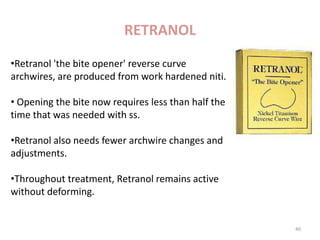
•Retranol 'the bite opener' reverse curve
archwires, are produced from work hardened niti.
• Opening the bite now requires less than half the
time that was needed with ss.
•Retranol also needs fewer archwire changes and
adjustments.
•Throughout treatment, Retranol remains active
without deforming.
• Available in round and rectangular, upper and
lower arch forms
RETRANOL
40
MENZAMIUM WIRE
• The stainless steel is fabricated in patented high pressure
melting process where manganese and nitrogen replace
allergic component of Ni.
• It is ideal for nickel sensitive patient. It is also corrosion
resistant and durable.
41
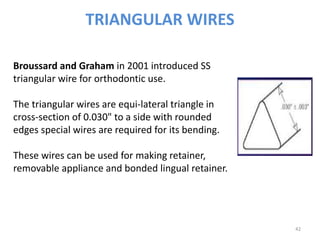
Broussard and Graham in 2001 introduced SS
triangular wire for orthodontic use.
The triangular wires are equi-lateral triangle in
cross-section of 0.030" to a side with rounded
edges special wires are required for its bending.
These wires can be used for making retainer,
removable appliance and bonded lingual retainer.
TRIANGULAR WIRES
42
Esthetic Archwires
43
44
• GOLDBERG et al (1992) first reported the fabrication of fiber
reinforced composites (FRC) using Bis-GMA resin & S2 glass
fibers, but these wires were brittle & susceptible for intra oral
breakage.
• BURSTONE et al (2011) introduced a self-reinforced polymer
(SRP) polyphenylene thermoplastic archwires which showed a
flexibility comparable to NiTi and beta titanium archwires at
thin cross sections without experiencing stress relaxation.
45
Coating on archwire material have been introduced to
 Enhance esthetics
 Decrease friction.
 These wires are designed to be esthetically more acceptable by the
patient.
 Can blend with the tooth color and also of ceramic brackets.
Normally the coating is 0.002” thick.
COATED METAL ARCHWIRES
46
Coated metal archwires are nickel-titanium or stainless steel
wires treated with
Polytetrafluoroethylene (PTFE)
Epoxy resin
Parylene-polymer
Palladium / Rhodium covering to impart an enamel
hue.
Currently, the two most common aesthetic archwires -
coated with either PTFE or epoxy-resin
TEFLON COATED ARCHWIRES
47
• PTFE coating is applied to an orthodontic wire by thermal
spraying.
• Finely heated materials are sprayed in a molten condition onto a
surface to form a coating.
• DuPont Co brand name Teflon®, is a synthetic polymer consisting
carbon and fluorine
• Due to the strength of the carbon-fluorine bonds, PTFE is
nonreactive, heat-resistant, and hydrophobic.
• Most importantly, it has low coefficient of friction, making it ideal
for use as a non-stick sliding action of parts is needed.
TEFLON COATED STAINLESS STEEL WIRES
48
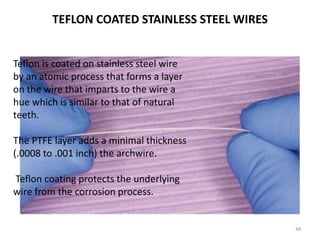
Teflon is coated on stainless steel wire
by an atomic process that forms a layer
on the wire that imparts to the wire a
hue which is similar to that of natural
teeth.
The PTFE layer adds a minimal thickness
(.0008 to .001 inch) the archwire.
Teflon coating protects the underlying
wire from the corrosion process.
This coating is subject to flaws that may
occur during clinical use.
• PTFE-coated copper-nickel titanium and stainless steel wires
are supplied by Rocky Mountain Orthodontics as part of its
aesthetic FLI® series of products.
• Though PTFE has an extremely low coefficient of friction, it is
used primarily for aesthetic purposes.
• Round FLI wires have a three-quarter circumferential coating,
and rectangular wires are coated only on the labial surface to
reduce the effect on sliding mechanics 49
EPOXY RESIN COATED ARCHWIRES
• Epoxy-resin coating is applied to an orthodontic archwire by
electrostatic coating, or E-coating.
• Electrostatic coating is a process that uses electrostatically charged
particles to more efficiently coat a workpiece.
• The epoxy coating does add a more significant thickness (.002 inch) to
the archwire.
• Epoxy-coated nickel-titanium and stainless steel wires are supplied by
G&H® Orthodontics as part of its UltraestheticTM series of tooth-
colored archwires 50
51
The coating wraps around all sides of the wire and extends beyond
the second molar.
As such, the coating often separates from the archwire due to
mastication and activation of digestive enzymes.
Research indicates that 25% of the epoxy coating is lost within the
first month in vivo.
Metal primer allows better cohesion between the archwire and
coating.
All current metal primers contain toxins, and these primers do not
have FDA approval for use in the mouth.
COMPOSITE PLASTICS
• One promising approach involves the use of composites which can be
a mixture of ceramic fibers that are embedded in a linear or cross
linked polymeric matrix
• Such an archwire could be made with a tooth-coloured appearance
and with stiffness properties similar to metallic archwires.
• In Orthodontics, composite prototypes of archwires, ligatures and
brackets have been made from
• S-2 glass fibers (a ceramic)
• Acrylic Resins 52
• Studies designed to examine the mechanical properties,
viscoelastic losses, water sorption, hydrolytic stability, sliding
mechanics and post processing formability of composite wires
has shown strong support for their clinical viability.
• There are numerous processes for the fabrication of
continuous fiber-reinforced composite parts.
53
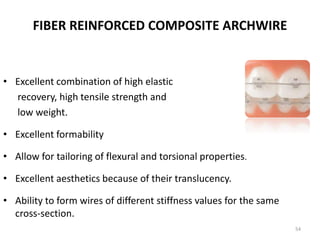
FIBER REINFORCED COMPOSITE ARCHWIRE
• Excellent combination of high elastic
recovery, high tensile strength and
low weight.
• Excellent formability
• Allow for tailoring of flexural and torsional properties.
• Excellent aesthetics because of their translucency.
• Ability to form wires of different stiffness values for the same
cross-section.
54
• This would facilitate the practice of Constant Cross-section
Orthodontics.
• Ability to directly bond attachments to these wires
• Eliminating the need for soldering and electrical resistance
welding
• Such wires can also be directly bonded to teeth, obviating the
need for brackets (i.e. When anchorage from a large number of
teeth is required) 55
Recent Reports on Fiber Reinforced Composite Archwires
 ZUFALL & KUSY et al, AO (2000)
They compared the frictional characteristics of composite
archwires against stainless steel and ceramic brackets
They found composite archwires had higher kinetic coefficients
of friction than stainless steel but lower than nickel-Titanium or
beta titanium.
56
Zufall S W, Kusy R P. Sliding mechanics of coated composite wires and the development
of an engineering model for binding. Angle Orthod 2000; 70: 34-47.
• They also noted abrasive wear of composite at high forces.
• Which lead to release of glass fiber within the oral cavity
• This then lead them to test the use of coating material i.e. Poly(chloro-p-
xylylele) and also an addition of 10 micron thick layer of parylene
This material when coated proved to be
 Wear resistant
 Low in friction
 Eliminated the abrasive wear &
 Consequent release of glass fiber from the wire
Thus judged to improve the clinical acceptability of the composite wires
57
FABRICATION OF FIBER REINFORCED COMPOSITES (FRC) :
Produced in Two Steps
1. The amount, distribution and wetting of the fibers by the
resin are closely controlled in the first step.
2. In second step, the composite is formed into the desired
final shape.
58
• Of the many fiber reinforced composite technologies, pultrusion
is one, which could tend itself to the fabrication of archwires.
• Pultrusions with small clinically relevant round or rectangular
cross sections potentially could be used for continuous lengths
of wires. .
• This continuous molding process produces long, straight
structural members of constant cross-sectional area
Two important process associated with fabrication of FRCs:
• Pultrusion.
• Beta staging
59
A. PULTRUSION:
 Process of manufacturing components having continuous lengths
and a constant cross sectional shape such as in Archwires.
 The fiber bundles are pulled through an extruder simultaneous
with the extrusion of a polymer. The fiber bundle is impregnated by
the polymer, producing a continuous length of fiber-reinforced
composite
 With the use of this process of photopultrusion, arch wire
prototypes have been constructed with stiffness ranging from that
of nickel titanium to that of β-titanium wires.
60
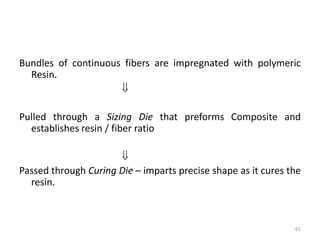
Bundles of continuous fibers are impregnated with polymeric
Resin.

Pulled through a Sizing Die that preforms Composite and
establishes resin / fiber ratio

Passed through Curing Die – imparts precise shape as it cures the
resin.
61
B. BETA STAGING:
• During pultrusion an intervening process in which partially
cured resin and its bundles of continuous fibers are deformed
into another form (e.g., : Preformed archwire) after which
curing is completed.
• Preformed arch wires and rectangular cross section is possible
by this process.
62
• When the fiber and resin contents are equal, springback is
greater than 95%, so that the energy applied at wire insertion
may be retrieved months later without significant loss.
• At this same fiber-resin content the total water sorption is only
1.5% by weight, so that dimensional stability is good and stains
and odours are minimized
63
Properties of Experimental Prototypes
1. Tooth colored.
2. Vary in stiffness from that of most flaccid multistranded wire to
nearly that of -Ti archwire.
These characteristics can be varied during manufacture without
any change in wire slot engagement by pultrusion.
64
3. Mechanical tests show that
- Such archwires are elastic until failure occurs.
- When failure does occur the wire looses its stiffness but remains
intact.
When compared with NiTi resilience and springback are comparable.
4. Specifics of other characteristics such as formability, weldability and
frictional coefficients are unknown at this time. Low coefficients of
friction and enhanced biocompatibility should be possible by
modifying surface chemistry of polymer.
5. Like the advanced metal wires, their shape is very difficult to change
once the manufacturing process is completed which leads to a
number of practical problems for clinical applications.
65
CLINICAL APPLICATION
According to Zufall and Kusy study,(Angle Orthod 2000; 70: 34-47) :
• The composite archwire retained sufficient resilience to function
during initial stage of orthodontic treatment and also
• During intermediate stages of orthodontic treatment
66
According to Burstone and Kuhlberg (JCO 2000; 36: 271-9.):
• Described that a new fiber reinforced composite called "Splint-It"
which incorporates S2 glass fibers in a bis GMA matrix
• This is available in various configurations such as rope, woven strip
and unidirectional strip
• These materials are only partly polymerized during manufacture
(pre-pregs), which makes them flexible, adaptable and easily
contourable over the teeth.
67
Burstone C.J., Kuhlberg A.J. Fiber-reinforced composites in orthodontics. JCO 2000; 36: 271-
9.
Later they are completely polymerized and can be bonded directly to
teeth.
It can also be used for various purposes such as post treatment retention,
as full arches or sectional arches, and to reinforce anchorage by joining
teeth together.
A particular advantage is that due to direct bondability to teeth, they can
obviate the need for brackets in specific situations
68
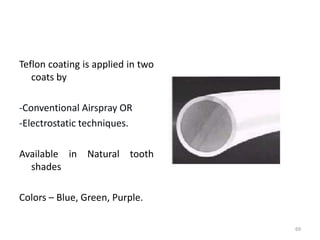
Teflon coating is applied in two
coats by
-Conventional Airspray OR
-Electrostatic techniques.
Available in Natural tooth
shades
Colors – Blue, Green, Purple.
69
1. LEE WHITE WIRE:
• Manufacturers – Lee pharmaceuticals.
• Epoxy Coated Archwire, tooth colored.
• Superior wear resistance and color stability of 6-8 weeks.
Nickel titanium Preformed arches
Stainless steel
2. FILAFLEX
Manufacturer – American Orthodontics
• High tensile stainless steel core
• Durable tooth colored plastic coating 70
3. ORTHOCOSMETIC ELASTINOL
Manufacturer – Masel Orthodontics
 Esthetically coated high performance NiTi superelastic
archwire
 Esthetic coating – Blends exceptionally well with ceramic or
plastic brackets
 Doesn’t stain or discolor and resists cracking or chipping
71
4. Nitanium Tooth Toned Archwire:
• Manufacturer : Ortho Organizers
• Superelastic Ni-Ti wire with special plastic and friction reducing tooth
colored coatings.
• Blend with Natural dentition, Ceramic, Plastic and composite
brackets.
• Maintains its original color.
• Delivers gentle constant force.
• Sizes
Round – 0.014”, 0.016”, 0.018”
Rectangular : 0.016” x 0.022, 0.018” x 0.025”
72
NITROGEN COATED ARCHWIRES:
Appearance of Titanium alloys is not esthetic ,several methods
of surface hardening as well as several coatings have been
developed.
Implanting Nitrogen on surface of NiTi alloys by Ion
implantation process – NITRIDING.
73
ADVANTAGES:
• Make Titanium more esthetically pleasing giving it gold like aspect.
• Hardens surface.
• Reduces friction.
• Reduces Nickel release into mouth.
• e.g : Bioforce Ionguard - 3m Nitrogen coating.
74
• The IONGUARD process actually alters the wire’s surface to
provide a dramatically reduced coefficient of friction for sliding
mechanics that are better than the same size stainless steel wire
and half the friction of competitive NiTi wire.
• It also seals the occlusal surface of the wire to eliminate
breakage and reduce nickel leaching.
• Except for surface of the wire, none of the wire’s unique
properties is changed.
75
VAPOR-PARYLENE COATED WIRES
76
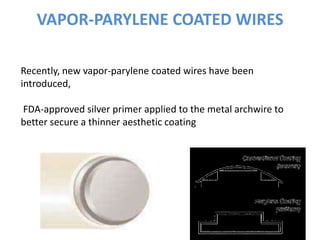
Recently, new vapor-parylene coated wires have been
introduced,
FDA-approved silver primer applied to the metal archwire to
better secure a thinner aesthetic coating
77
Elayyan et al. - a randomized clinical trial of epoxy resin–coated
nickel titanium wire
Retrieved coated wire produced lower force values (three-point
bending test) than as-received coated wire
25% of the coating was peeled off within 33 days in vivo.
Eur J Orthod. 2008;30:661–667.
Woowa
78
A new esthetic nickel-titanium wires
Woowa (DanyHarvest,Seoul,SouthKorea)
Woowa has a double-layered coating structure (inner layer:
silver and platinum coating; outer layer: special polymer
parylene coating)
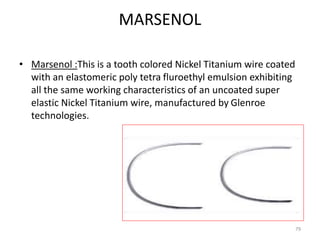
MARSENOL
• Marsenol :This is a tooth colored Nickel Titanium wire coated
with an elastomeric poly tetra fluroethyl emulsion exhibiting
all the same working characteristics of an uncoated super
elastic Nickel Titanium wire, manufactured by Glenroe
technologies.
79
POLYNORBOGEN
80
It is a shape memory plastic developed in Japan. The glass
transition temperature is 35°C.
Once the temperature exceeds the transition temperature; it
begins to display an elastic property and then returns to its
original shape.
 At 50°C, it can be stretched to 2 to 3 times its original
length.
ORGANIC POLYMER WIRE
81
Made from 1.6mm diameter round poly ethylene terephthalate.
This material can be bent with plier but will return to its original
shape if not heat treated for few sec at temperature less than
230°. These wires are used for esthetic retainers
DISADVANTAGES OF ESTHETIC ARCH WIRES
Coated white Colored Wires are routinely succumbed to
- Forces of mastication.
- Enzyme activity of oral cavity.
Uncoated Transparent Wires:
· Poor mechanical properties
82
An investigation of the frictional properties of composite wires
against several orthodontic brackets showed that
reinforcement fibers were abrasively worn from the wire
surfaces when tests were conducted at normal forces or
angulations
This potential release of glass fibers within the oral cavity was
considered unacceptable, and a polymeric surface coating was
suggested as a potential remedy.
83
DISADVANTAGES OF AESTHETIC WIRES
84
Coated metal archwires with circumferential coating deliver
statistically lower loading and unloading force levels than
uncoated wires of the same nominal sizes.
The lower force levels of coated wires may be attributed to:
(1) the thick aesthetic coating having a negative effect on the
load deflection properties, or
(2) A manufacturer’s use of a smaller diameter wire to
compensate for the thick coating, particularly for epoxy-coated
archwires.
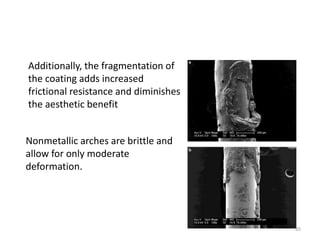
Additionally, the fragmentation of
the coating adds increased
frictional resistance and diminishes
the aesthetic benefit
Nonmetallic arches are brittle and
allow for only moderate
deformation.
85
Excess deformation or forceful grip with pliers can lead to
permanent deformation and irreversible cracks, referred to as
“craze lines.”
These clear arches are restricted with regard to torque, detailing,
and changes in arch width.
They are currently not suitable for patients requiring consolidation
or anteroposterior correction.
86
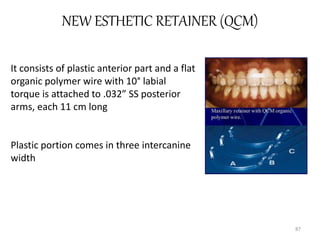
NEW ESTHETIC RETAINER (QCM)
87
It consists of plastic anterior part and a flat
organic polymer wire with 10° labial
torque is attached to .032” SS posterior
arms, each 11 cm long
Plastic portion comes in three intercanine
width
88
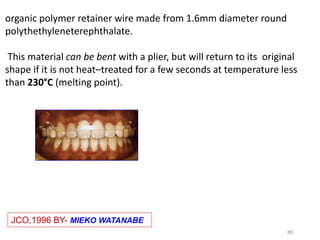
JCO,1996 BY- MIEKO WATANABE
organic polymer retainer wire made from 1.6mm diameter round
polythethyleneterephthalate.
This material can be bent with a plier, but will return to its original
shape if it is not heat–treated for a few seconds at temperature less
than 230°C (melting point).
89
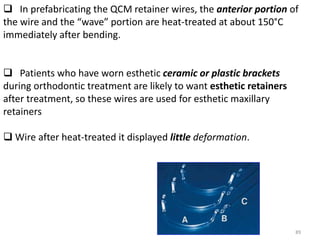
 In prefabricating the QCM retainer wires, the anterior portion of
the wire and the “wave” portion are heat-treated at about 150°C
immediately after bending.
 Patients who have worn esthetic ceramic or plastic brackets
during orthodontic treatment are likely to want esthetic retainers
after treatment, so these wires are used for esthetic maxillary
retainers
 Wire after heat-treated it displayed little deformation.
90
QMC WITH METAL POSTERIOR PORTION
1 2
3
91
QMC WITH ACTIVATIONLOOP
TANDEM WIRE
• THE TANDEM WIRE TECHNIQUE
The Tandem wire technique uses two wires in
tandem , one in the straightwire slot & the other in the lightwire
slot( 0.018 inch SS round wire in the gingival slot in tandem with
a 0.018 x 0.018 inch Niti wire in the straightwire slot). The rigid
SS wire is called the vertical stabilizing archwire & has bite-
opening bends to control the vertical position of the incisors.
92
• The tandem system acts as a superb levelling &
torquing appliance and can be used in different
combinations:
• Light-wire torquing auxillary with mandibular
tandem.
• Double tandems
• Maxillary tandem & mandibular straight-wire
• Tandem wire segments in premolar & molar
teeth with anterior intrusion arches and/or
lightwire bite-opening
93
BIDIMENSIONAL WIRE TECHNIQUE
• In this technique, non-preadjusted 0.022x0.028-
inch brackets are used for all the teeth, and a
0.016”x0.022” archwire is used with a 90 degree
twist immediately distal to the lateral incisors, so as
to form a 0.022x0.016-inch ribbon segment that
fills the anterior brackets and two 0.016x0.022-inch
edgewise segments that fit into the buccal brackets
with a clearance of 0.006 inch.
• This is actually a ‘‘bidimensional-wire’’ technique.
94
CONCLUSION
• As time passed scientifically based orthodontics evolved and
we see from that time much new innovation in material
science have supped-up with new treatment approarch and
modalities.
• The urge to make treatment still more comfortable and less
time consuming have led us to the introduction of new
orthodontic materials and products.
• Further research in the field will one day provide us with a
programmed archwire that will adapt itself at different stages
of treatment and surely take orthodontics to new horizon.
95
REFERENCES:
1. William R. Proffit -Contemporary Orthodontics, 5th edition,
2. Graber Thomas M., .Vanarsdall. Jr. Robert L. – Orthodontics, Current Principles and
techniques
3. Titanium-niobium, a new finishing wire alloy. By Michel dalstra, Gabriella denes, birte
melsen Clin orthod res. 2000 feb;3(1):6-14
4. A comparative evaluation of metallurgical properties of stainless steel and tma wires with
Tiolium and titanium niobium archwires by r devaki vijayalakshmi,ks nagachandran, pradeep
kummi, p jayakumar (indian j dent res,20(4),2009
5. A comparative evaluation of metallurgical properties of stainless steel and tma wires with
Tiolium and titanium niobium archwires by r devaki vijayalakshmi,ks nagachandran, pradeep
kummi, p jayakumar (indian j dent res,20(4),2009
6. Mechanical Properties and Surface Characteristics of Three Archwire Vinod Krishnan,
MDSa; K. Jyothindra Kumar, MDS, M. Orth RCS, MDO RCPS, FDS RCS Alloys (Angle Orthod
2004;74:825–.)
7. Supercable and the SPEED system by Berger J, Byloff FK, Waram T j clin orthod 1998
Apr;32(4):246-53
8. Alignment efficiency of superelastic coaxial nickel-titanium vs superelastic single-stranded
nickel-titanium in relieving mandibular anterior crowding A randomized controlled
prospective study by Biju Sebastiana (Angle Orthod. 2012;82:703–708.)
96
09. Dual-Flex Archwires by JAMES L. CANNON, DDS, MS JCO VOLUME 18 : NUMBER 09 :
PAGES (648-649) 1984
10.Effect of coating on properties of esthetic orthodontic nickel-titanium wires by Masahiro
Iijimaa; Takeshi Mugurumab; William A. Brantleyc; Han-Cheol Choed; Angle
Orthodontist, Vol 82, No 2, 2012
11.Talass M E .Optiflex archwire treatment of a skeletal Class HI open bite. J Clin Orthod
1992; 26: 245-52.
12. Effect of coating on properties of esthetic orthodontic nickel-titanium wires by Masahiro
Iijimaa; Takeshi Mugurumab; William A. Brantleyc; Han-Cheol Choed; Angle
Orthodontist, Vol 82, No 2, 2012
13. Zufall S W, Kusy R P. Sliding mechanics of coated composite wires and the development
of an engineering model for binding. Angle Orthod 2000; 70: 34-47.
14. Burstone C.J., Kuhlberg A.J. Fiber-reinforced composites in orthodontics. JCO 2000; 36:
271-9.
15. Fiber Reinforced Composite Arch-Wires in Orthodontics:Function Meets Esthetics by
Ashima Valiathan and Siddhartha Dhar 97

Recent advances in arch wires.pptx

  • 1.
    1 Presented by: Dr.Zeba Siddiqui Rama Dental College Hospital and Research Centre
  • 2.
    INTRODUCTION ORTHODONTIC ARCH WIRE: “Generatethe biomechanical forces transmitted through the brackets to effect tooth movement” 2
  • 3.
  • 4.
    ARCHWIRES  Optiflex archwire Bio force archwire  Super cable archwire  Graded nickel titanium archwires  Formable nickel titanium wires  Nitrogen coated archwires  Multi force/Trifocal Nitanium Archwire  Titanium niobium wire  Timolium titanium wire  Combined archwire 4
  • 5.
    5 Fiber reinforced compositearchwire Coated arch wires Retranol Menzamium Vapor-parylene Coated Wires QCM Esthetic Retainers
  • 6.
    OPTIFLEX ARCHWIRE 6 • Optiflexis a non metallic orthodontic arch wire • It was designed by DR. TALASS • In the year 1992 manufactured by Ormco. • It has got unique mechanical properties with a highly aesthetic appearance made of clear optical fiber. Talass M E .Optiflex archwire treatment of a skeletal Class HI open bite. J Clin Orthod 1992; 26: 245-52
  • 7.
    7 It comprises of3 layers. A) A SILICON DIOXIDE CORE that provides the force for moving tooth. B) A SILICON RESIN middle layer that protects the core form moisture and adds strength. C) A STRAIN RESISTANT NYLON outer layer that prevents damage to the wire and further increases strength
  • 8.
    ADVANTAGES  It isthe most aesthetic orthodontic archwire.  It is completely stain resistant, and will not stain or loose its clear look even after several weeks in mouth.  Its effective in moving teeth using light continuous force  It is very flexible, has an extremely wide range of actions  When indicated it can be tied with electrometric ligatures to severely malaligned teeth without fear of fracturing the arch wire.  Due to superior properties Optiflex can be used with any bracket system 8
  • 9.
    9 Precaution’s while usingOptiflex archwires 1) Optiflex archwires should be tied into brackets with elastomeric ligatures. Metal ligatures should never be used since they will fracture the glass core. 2) Sharp bends similar to those placed in a metal wire should never be attempted with Optiflex, as these bends will immediately fracture the glass core. 3) Using instruments with sharp edges, like the scaler etc should be avoided instead a gentle finger pressure is used to insert the archwire into the slot. 4) To cut the end of the archwire distal to the molar, it is recommended to the use the mini distal end cutter which is designed to cut all 3 layer’s of optiflex.
  • 10.
    CLINICAL APPLICATIONS 1) Itis used in adult patients who wish that their braces not be really visible for reasons related to personal concern’s or professional consideration. 2) Can be used as initial archwire in cases with moderate amounts of crowding in one or both arches. 3) Ideal for non extraction cases and also cases with no partially edentulous areas 4) Optiflex can be used in presurgical stage in cases which require orthognathic intervention as a part of the treatment. Optiflex is available in a pack of ten 6 inch straight length wires of .017” and .021” sizes 10
  • 11.
    References: 1. Supercable andthe SPEED system by Berger J, Byloff FK, Waram T j clin orthod 1998 Apr;32(4):246-53 2. Alignment efficiency of superelastic coaxial nickel-titanium vs superelastic single-stranded nickel-titanium in relieving mandibular anterior crowding A randomized controlled prospective study by Biju Sebastiana (Angle Orthod. 2012;82:703–708.) 11
  • 12.
    SUPER CABLE In 1993,Hanson combined the mechanical advantages of multistranded cables with the material properties of superelastic wires to create a superelastic nickel titanium coaxial wire. This wire, called super cable  It comprises seven individual strands that are Woven together in a long, gentle spiral to maximize flexibility and minimize force delivery. 12
  • 13.
    SUPER CABLE PROPERTIES • Improvedtreatment efficiency • Simplified mechanotherapy • Elimination of archwire bending. • Flexibility and ease of engagement regardless of crowding 13
  • 14.
    • No evidenceof anchorage loss. • A light, continuous level of force, preventing any adverse response of the supporting periodontium. • Minimal patient discomfort after initial archwire placement. • Fewer patient visits, due to longer archwire activation. 14
  • 15.
    DISADVANTAGES • Tendency ofwire ends to fray if not cut with sharp instruments. • Tendency of archwires to break and unravel in extraction spaces • Inability to accommodate bends, steps, or helices. • Tendency of wire ends to migrate distally and occasionally irritate soft tissues as severely crowded or displaced teeth begin to align. 15
  • 16.
  • 17.
    FORMABLE NICKEL TITANIUMWIRES • By Ortho Organizers • Nitanium Total Control Archwire • Superelastic bendable Nickel Titanium archwire • Accepts 1st, 2nd and 3rd order bends permanently • Low friction wire. 17
  • 18.
    GRADED NICKEL TITANIUMARCHWIRES • By introducing variable TTR within same archwire. • This takes the form of graded force delivery within the same aligning archwire • The heat treatment of selected sections of the archwire by means of different electric current delivered by electric pliers modified the values of the deactivation forces by varying the amount of austenite present in the alloy. • e.g : Bioforce Sentalloy. 18
  • 19.
    • Exhibits superelasticityat different stress levels at different locations in same archwire. • 80g of force – in central incisor region. • 320g of force – in molar region. ‘Neosentalloy’ archwire marketed by GAC*, has three force levels for single arch dimensions 19
  • 20.
    References: 1. Effect ofcoating on properties of esthetic orthodontic nickel-titanium wires by Masahiro Iijimaa; Takeshi Mugurumab; William A. Brantleyc; Han-Cheol Choed; Angle Orthodontist, Vol 82, No 2, 2012 20
  • 21.
    BIOFORCE WIRE Introduced byGAC  It was possible to produce variation in force delivery between archwires of identical dimension  This was possible by specifying transition temperatures within given ranges. And were graded as thermodynamic arch wires.  This property was further advanced to produce variable transition temperatures within the same archwire  This arch wire was called Bioforce archwire 21
  • 22.
     It isaesthetic  Is the first and only family of biologically correct archwires  It applies low and gentle forces to anteriors  Increasingly stronger forces across the posteriors until plateauing at the molars. 22
  • 23.
    • Beginning atapproximately 100 grams • increasing to approximately 300 grams • It provides the right force to each tooth • There by it Reducing the number of wire changes & Providing greater patient comfort 23
  • 24.
    CLINICAL APPLICATIONS: During initialstages when anterior torque is needed, use of an relatively large size (i.e. 0.018x0.025) can be given without the fear of significant root resorption. During later stages of treatment i.e.  If the posterior occlusion is not settled in  rotations have not been fully corrected or  the bite opening is taking a long time because of the heavy musculature. These are the good reasons to give an Bioforce arch wire as the undesirable effects of the applied force-producing mechanisms will be minimized. 24
  • 25.
    25 BIO TWIST NITI •The bio twist Niti is a 0.021 x 0.025 pre-form rectangular arch wire formed with multiple strands of titanium super elastic wire. • This multistrand structure gives the wire low force and low stiffness with excellent flexibility, and the rectangular shape allows significant engagement of the slot.
  • 26.
    26 Bio twist wireis great for use at the beginning of treatment during the unraveling stage because it will facilitate leveling and aligning while also controlling torque. This wire can also be used at the end of treatment when the retention of torque is important but it will allow movement from forces, such as vertical elastics.
  • 27.
    MULTI FORCE/TRIFOCAL NITANIUM ARCHWIRE •The anterior region consists of light super elastic forces; the bicuspid region is engineered to produce a graduating amount of super elastic force as it travels toward the posterior region • The posterior region exhibits the highest force and is designed to bend and then return to original. 27
  • 28.
    TITANIUM NIOBIUM WIRE References: 1.Titanium-niobium, a new finishing wire alloy. By Michel dalstra, Gabriella denes, birte melsen J.Clin orthod res. 2000 feb;3(1):6-14 2. A comparative evaluation of metallurgical properties of stainless steel and tma wires with Tiolium and titanium niobium archwires by r devaki vijayalakshmi,ks nagachandran, pradeep kummi, p jayakumar (indian j dent res,20(4),2009 28
  • 29.
    TITANIUM NIOBIUM WIRE It was introduced in early 1995 by DR ROHIT SACHDEVA & Manufactured by Ormco PROPERTIES:  Ti- Nb is soft and easy to form, yet it has the same working range of stainless steel.  Its stiffness is 20% lower than TMA and 70% lower than stainless steel.  Ti-Nb wire have a larger plastic range, similar activation and deactivation curves and relatively low spring back. 29
  • 30.
    30 • Its bendingstiffness corresponding to 48% lower than that of stainless steel and a spring back 14% lower than that of stainless steel. • We can easily make creative bends and avoid excessive force levels of a steel wire. • The stiffness of ti-nb in torsion is only 36% of steel, yet the spring back of ti-nb in torsional mode is Slightly higher than stainless steel • This property makes it possible to utilize the ti-nb wire for even the major third order corrections.
  • 31.
    CLINICAL APPLICATIONS The lowspring back and high formability of the titanium- niobium archwire allows creation of finishing bends Hence, this wire can be used as an finishing archwire. ( J. Clin orthod res. 2000 feb;3(1):6-14). 31
  • 32.
    TIMOLIUM TITANIUM ARCHWIRE References: 1.A comparative evaluation of metallurgical properties of stainless steel and tma wires with Tiolium and titanium niobium archwires by r devaki vijayalakshmi, ks nagachandran, pradeep kummi, p jayakumar (indian j dent res,20(4),2009 • 2.Mechanical Properties and Surface Characteristics of Three Archwire Vinod Krishnan, MDSa; K. Jyothindra Kumar, MDS, M. Orth RCS, MDO RCPS, FDS RCS Alloys (Angle Orthod 2004;74:825–831.) 32
  • 33.
    TIMOLIUM TITANIUM WIRE It is manufactured by TP ORTHODONTICS  Timolium archwires combines the flexibility, continuous force and spring back of nickel titanium with the high stiffness and bendability of stainless steel wire.  When compared to nickel titanium or beta titanium wire, (angle orthod 2004;74:825–831.) 33
  • 34.
    Timolium outperforms inthe following: – More resistant to breakage – Smoother for reduced friction – Brightly polished and aesthetically pleasing 34
  • 35.
    ADVANTAGES – Nickel freefor sensitive patients – Easier to bend and shape – Can be welded – Loops and bends can be made without breakage 35
  • 36.
    36 CLINICAL APPLICATIONS Timolium wireis excellent for all phases of treatment. • During initial treatment : it is excellent for space closure, tooth alignment, levelling and bite opening. • During intermediate treatment : early torque control can begin because of the moderate forces that are delivered. • Final treatment phase: total control during detailing makes Timolium the wire of choice
  • 37.
    COMBINED WIRES The keyto success in a multi attachment straight wire system is  To have the ability to use light tipping movements in combination with rigid translation  To be able to vary the location of either,  at any time the need arises during treatment. They used three specific combined wires for the technique 1. Dual Flex-1 2. Dual Flex-2, and 3. Dual Flex-3 (Lancer Orthodontics). 37 References: 1. Dual-Flex Archwires by JAMES L. CANNON, DDS, MS JCO VOLUME 18 : NUMBER 09 : PAGES (648-649) 1984
  • 38.
    38 The Dual Flex-1 It consists of a anterior section made of 0.016-inch round Titanal and a posterior section made of 0.016-inch round steel.  The flexible front part easily aligns the anterior teeth and the rigid posterior part maintains the anchorage and molar control by means of the “V” bend, mesial to the molars.  It is used at the beginning of treatment.
  • 39.
    The Dual Flex-2:It consists of a flexible anterior segment composed of an 0.016 ´ 0.022-inch rectangular Titanal and a rigid posterior segment of round 0.018-inch steel. The Dual Flex-3: This however, consists of a flexible anterior part of an 0.017 ´ 0.025-inch Titanal rectangular wire and a posterior part of 0.018 square steel wire. The Dual Flex-2 and 3 wires establish anterior anchorage and control molar rotation during the closure of posterior spaces. They also initiate the anterior torque. 39
  • 40.
    •Retranol 'the biteopener' reverse curve archwires, are produced from work hardened niti. • Opening the bite now requires less than half the time that was needed with ss. •Retranol also needs fewer archwire changes and adjustments. •Throughout treatment, Retranol remains active without deforming. • Available in round and rectangular, upper and lower arch forms RETRANOL 40
  • 41.
    MENZAMIUM WIRE • Thestainless steel is fabricated in patented high pressure melting process where manganese and nitrogen replace allergic component of Ni. • It is ideal for nickel sensitive patient. It is also corrosion resistant and durable. 41
  • 42.
    Broussard and Grahamin 2001 introduced SS triangular wire for orthodontic use. The triangular wires are equi-lateral triangle in cross-section of 0.030" to a side with rounded edges special wires are required for its bending. These wires can be used for making retainer, removable appliance and bonded lingual retainer. TRIANGULAR WIRES 42
  • 43.
  • 44.
    44 • GOLDBERG etal (1992) first reported the fabrication of fiber reinforced composites (FRC) using Bis-GMA resin & S2 glass fibers, but these wires were brittle & susceptible for intra oral breakage. • BURSTONE et al (2011) introduced a self-reinforced polymer (SRP) polyphenylene thermoplastic archwires which showed a flexibility comparable to NiTi and beta titanium archwires at thin cross sections without experiencing stress relaxation.
  • 45.
    45 Coating on archwirematerial have been introduced to  Enhance esthetics  Decrease friction.  These wires are designed to be esthetically more acceptable by the patient.  Can blend with the tooth color and also of ceramic brackets. Normally the coating is 0.002” thick.
  • 46.
    COATED METAL ARCHWIRES 46 Coatedmetal archwires are nickel-titanium or stainless steel wires treated with Polytetrafluoroethylene (PTFE) Epoxy resin Parylene-polymer Palladium / Rhodium covering to impart an enamel hue. Currently, the two most common aesthetic archwires - coated with either PTFE or epoxy-resin
  • 47.
    TEFLON COATED ARCHWIRES 47 •PTFE coating is applied to an orthodontic wire by thermal spraying. • Finely heated materials are sprayed in a molten condition onto a surface to form a coating. • DuPont Co brand name Teflon®, is a synthetic polymer consisting carbon and fluorine • Due to the strength of the carbon-fluorine bonds, PTFE is nonreactive, heat-resistant, and hydrophobic. • Most importantly, it has low coefficient of friction, making it ideal for use as a non-stick sliding action of parts is needed.
  • 48.
    TEFLON COATED STAINLESSSTEEL WIRES 48 Teflon is coated on stainless steel wire by an atomic process that forms a layer on the wire that imparts to the wire a hue which is similar to that of natural teeth. The PTFE layer adds a minimal thickness (.0008 to .001 inch) the archwire. Teflon coating protects the underlying wire from the corrosion process. This coating is subject to flaws that may occur during clinical use.
  • 49.
    • PTFE-coated copper-nickeltitanium and stainless steel wires are supplied by Rocky Mountain Orthodontics as part of its aesthetic FLI® series of products. • Though PTFE has an extremely low coefficient of friction, it is used primarily for aesthetic purposes. • Round FLI wires have a three-quarter circumferential coating, and rectangular wires are coated only on the labial surface to reduce the effect on sliding mechanics 49
  • 50.
    EPOXY RESIN COATEDARCHWIRES • Epoxy-resin coating is applied to an orthodontic archwire by electrostatic coating, or E-coating. • Electrostatic coating is a process that uses electrostatically charged particles to more efficiently coat a workpiece. • The epoxy coating does add a more significant thickness (.002 inch) to the archwire. • Epoxy-coated nickel-titanium and stainless steel wires are supplied by G&H® Orthodontics as part of its UltraestheticTM series of tooth- colored archwires 50
  • 51.
    51 The coating wrapsaround all sides of the wire and extends beyond the second molar. As such, the coating often separates from the archwire due to mastication and activation of digestive enzymes. Research indicates that 25% of the epoxy coating is lost within the first month in vivo. Metal primer allows better cohesion between the archwire and coating. All current metal primers contain toxins, and these primers do not have FDA approval for use in the mouth.
  • 52.
    COMPOSITE PLASTICS • Onepromising approach involves the use of composites which can be a mixture of ceramic fibers that are embedded in a linear or cross linked polymeric matrix • Such an archwire could be made with a tooth-coloured appearance and with stiffness properties similar to metallic archwires. • In Orthodontics, composite prototypes of archwires, ligatures and brackets have been made from • S-2 glass fibers (a ceramic) • Acrylic Resins 52
  • 53.
    • Studies designedto examine the mechanical properties, viscoelastic losses, water sorption, hydrolytic stability, sliding mechanics and post processing formability of composite wires has shown strong support for their clinical viability. • There are numerous processes for the fabrication of continuous fiber-reinforced composite parts. 53
  • 54.
    FIBER REINFORCED COMPOSITEARCHWIRE • Excellent combination of high elastic recovery, high tensile strength and low weight. • Excellent formability • Allow for tailoring of flexural and torsional properties. • Excellent aesthetics because of their translucency. • Ability to form wires of different stiffness values for the same cross-section. 54
  • 55.
    • This wouldfacilitate the practice of Constant Cross-section Orthodontics. • Ability to directly bond attachments to these wires • Eliminating the need for soldering and electrical resistance welding • Such wires can also be directly bonded to teeth, obviating the need for brackets (i.e. When anchorage from a large number of teeth is required) 55
  • 56.
    Recent Reports onFiber Reinforced Composite Archwires  ZUFALL & KUSY et al, AO (2000) They compared the frictional characteristics of composite archwires against stainless steel and ceramic brackets They found composite archwires had higher kinetic coefficients of friction than stainless steel but lower than nickel-Titanium or beta titanium. 56 Zufall S W, Kusy R P. Sliding mechanics of coated composite wires and the development of an engineering model for binding. Angle Orthod 2000; 70: 34-47.
  • 57.
    • They alsonoted abrasive wear of composite at high forces. • Which lead to release of glass fiber within the oral cavity • This then lead them to test the use of coating material i.e. Poly(chloro-p- xylylele) and also an addition of 10 micron thick layer of parylene This material when coated proved to be  Wear resistant  Low in friction  Eliminated the abrasive wear &  Consequent release of glass fiber from the wire Thus judged to improve the clinical acceptability of the composite wires 57
  • 58.
    FABRICATION OF FIBERREINFORCED COMPOSITES (FRC) : Produced in Two Steps 1. The amount, distribution and wetting of the fibers by the resin are closely controlled in the first step. 2. In second step, the composite is formed into the desired final shape. 58
  • 59.
    • Of themany fiber reinforced composite technologies, pultrusion is one, which could tend itself to the fabrication of archwires. • Pultrusions with small clinically relevant round or rectangular cross sections potentially could be used for continuous lengths of wires. . • This continuous molding process produces long, straight structural members of constant cross-sectional area Two important process associated with fabrication of FRCs: • Pultrusion. • Beta staging 59
  • 60.
    A. PULTRUSION:  Processof manufacturing components having continuous lengths and a constant cross sectional shape such as in Archwires.  The fiber bundles are pulled through an extruder simultaneous with the extrusion of a polymer. The fiber bundle is impregnated by the polymer, producing a continuous length of fiber-reinforced composite  With the use of this process of photopultrusion, arch wire prototypes have been constructed with stiffness ranging from that of nickel titanium to that of β-titanium wires. 60
  • 61.
    Bundles of continuousfibers are impregnated with polymeric Resin.  Pulled through a Sizing Die that preforms Composite and establishes resin / fiber ratio  Passed through Curing Die – imparts precise shape as it cures the resin. 61
  • 62.
    B. BETA STAGING: •During pultrusion an intervening process in which partially cured resin and its bundles of continuous fibers are deformed into another form (e.g., : Preformed archwire) after which curing is completed. • Preformed arch wires and rectangular cross section is possible by this process. 62
  • 63.
    • When thefiber and resin contents are equal, springback is greater than 95%, so that the energy applied at wire insertion may be retrieved months later without significant loss. • At this same fiber-resin content the total water sorption is only 1.5% by weight, so that dimensional stability is good and stains and odours are minimized 63
  • 64.
    Properties of ExperimentalPrototypes 1. Tooth colored. 2. Vary in stiffness from that of most flaccid multistranded wire to nearly that of -Ti archwire. These characteristics can be varied during manufacture without any change in wire slot engagement by pultrusion. 64
  • 65.
    3. Mechanical testsshow that - Such archwires are elastic until failure occurs. - When failure does occur the wire looses its stiffness but remains intact. When compared with NiTi resilience and springback are comparable. 4. Specifics of other characteristics such as formability, weldability and frictional coefficients are unknown at this time. Low coefficients of friction and enhanced biocompatibility should be possible by modifying surface chemistry of polymer. 5. Like the advanced metal wires, their shape is very difficult to change once the manufacturing process is completed which leads to a number of practical problems for clinical applications. 65
  • 66.
    CLINICAL APPLICATION According toZufall and Kusy study,(Angle Orthod 2000; 70: 34-47) : • The composite archwire retained sufficient resilience to function during initial stage of orthodontic treatment and also • During intermediate stages of orthodontic treatment 66
  • 67.
    According to Burstoneand Kuhlberg (JCO 2000; 36: 271-9.): • Described that a new fiber reinforced composite called "Splint-It" which incorporates S2 glass fibers in a bis GMA matrix • This is available in various configurations such as rope, woven strip and unidirectional strip • These materials are only partly polymerized during manufacture (pre-pregs), which makes them flexible, adaptable and easily contourable over the teeth. 67 Burstone C.J., Kuhlberg A.J. Fiber-reinforced composites in orthodontics. JCO 2000; 36: 271- 9.
  • 68.
    Later they arecompletely polymerized and can be bonded directly to teeth. It can also be used for various purposes such as post treatment retention, as full arches or sectional arches, and to reinforce anchorage by joining teeth together. A particular advantage is that due to direct bondability to teeth, they can obviate the need for brackets in specific situations 68
  • 69.
    Teflon coating isapplied in two coats by -Conventional Airspray OR -Electrostatic techniques. Available in Natural tooth shades Colors – Blue, Green, Purple. 69
  • 70.
    1. LEE WHITEWIRE: • Manufacturers – Lee pharmaceuticals. • Epoxy Coated Archwire, tooth colored. • Superior wear resistance and color stability of 6-8 weeks. Nickel titanium Preformed arches Stainless steel 2. FILAFLEX Manufacturer – American Orthodontics • High tensile stainless steel core • Durable tooth colored plastic coating 70
  • 71.
    3. ORTHOCOSMETIC ELASTINOL Manufacturer– Masel Orthodontics  Esthetically coated high performance NiTi superelastic archwire  Esthetic coating – Blends exceptionally well with ceramic or plastic brackets  Doesn’t stain or discolor and resists cracking or chipping 71
  • 72.
    4. Nitanium ToothToned Archwire: • Manufacturer : Ortho Organizers • Superelastic Ni-Ti wire with special plastic and friction reducing tooth colored coatings. • Blend with Natural dentition, Ceramic, Plastic and composite brackets. • Maintains its original color. • Delivers gentle constant force. • Sizes Round – 0.014”, 0.016”, 0.018” Rectangular : 0.016” x 0.022, 0.018” x 0.025” 72
  • 73.
    NITROGEN COATED ARCHWIRES: Appearanceof Titanium alloys is not esthetic ,several methods of surface hardening as well as several coatings have been developed. Implanting Nitrogen on surface of NiTi alloys by Ion implantation process – NITRIDING. 73
  • 74.
    ADVANTAGES: • Make Titaniummore esthetically pleasing giving it gold like aspect. • Hardens surface. • Reduces friction. • Reduces Nickel release into mouth. • e.g : Bioforce Ionguard - 3m Nitrogen coating. 74
  • 75.
    • The IONGUARDprocess actually alters the wire’s surface to provide a dramatically reduced coefficient of friction for sliding mechanics that are better than the same size stainless steel wire and half the friction of competitive NiTi wire. • It also seals the occlusal surface of the wire to eliminate breakage and reduce nickel leaching. • Except for surface of the wire, none of the wire’s unique properties is changed. 75
  • 76.
    VAPOR-PARYLENE COATED WIRES 76 Recently,new vapor-parylene coated wires have been introduced, FDA-approved silver primer applied to the metal archwire to better secure a thinner aesthetic coating
  • 77.
    77 Elayyan et al.- a randomized clinical trial of epoxy resin–coated nickel titanium wire Retrieved coated wire produced lower force values (three-point bending test) than as-received coated wire 25% of the coating was peeled off within 33 days in vivo. Eur J Orthod. 2008;30:661–667.
  • 78.
    Woowa 78 A new estheticnickel-titanium wires Woowa (DanyHarvest,Seoul,SouthKorea) Woowa has a double-layered coating structure (inner layer: silver and platinum coating; outer layer: special polymer parylene coating)
  • 79.
    MARSENOL • Marsenol :Thisis a tooth colored Nickel Titanium wire coated with an elastomeric poly tetra fluroethyl emulsion exhibiting all the same working characteristics of an uncoated super elastic Nickel Titanium wire, manufactured by Glenroe technologies. 79
  • 80.
    POLYNORBOGEN 80 It is ashape memory plastic developed in Japan. The glass transition temperature is 35°C. Once the temperature exceeds the transition temperature; it begins to display an elastic property and then returns to its original shape.  At 50°C, it can be stretched to 2 to 3 times its original length.
  • 81.
    ORGANIC POLYMER WIRE 81 Madefrom 1.6mm diameter round poly ethylene terephthalate. This material can be bent with plier but will return to its original shape if not heat treated for few sec at temperature less than 230°. These wires are used for esthetic retainers
  • 82.
    DISADVANTAGES OF ESTHETICARCH WIRES Coated white Colored Wires are routinely succumbed to - Forces of mastication. - Enzyme activity of oral cavity. Uncoated Transparent Wires: · Poor mechanical properties 82
  • 83.
    An investigation ofthe frictional properties of composite wires against several orthodontic brackets showed that reinforcement fibers were abrasively worn from the wire surfaces when tests were conducted at normal forces or angulations This potential release of glass fibers within the oral cavity was considered unacceptable, and a polymeric surface coating was suggested as a potential remedy. 83
  • 84.
    DISADVANTAGES OF AESTHETICWIRES 84 Coated metal archwires with circumferential coating deliver statistically lower loading and unloading force levels than uncoated wires of the same nominal sizes. The lower force levels of coated wires may be attributed to: (1) the thick aesthetic coating having a negative effect on the load deflection properties, or (2) A manufacturer’s use of a smaller diameter wire to compensate for the thick coating, particularly for epoxy-coated archwires.
  • 85.
    Additionally, the fragmentationof the coating adds increased frictional resistance and diminishes the aesthetic benefit Nonmetallic arches are brittle and allow for only moderate deformation. 85
  • 86.
    Excess deformation orforceful grip with pliers can lead to permanent deformation and irreversible cracks, referred to as “craze lines.” These clear arches are restricted with regard to torque, detailing, and changes in arch width. They are currently not suitable for patients requiring consolidation or anteroposterior correction. 86
  • 87.
    NEW ESTHETIC RETAINER(QCM) 87 It consists of plastic anterior part and a flat organic polymer wire with 10° labial torque is attached to .032” SS posterior arms, each 11 cm long Plastic portion comes in three intercanine width
  • 88.
    88 JCO,1996 BY- MIEKOWATANABE organic polymer retainer wire made from 1.6mm diameter round polythethyleneterephthalate. This material can be bent with a plier, but will return to its original shape if it is not heat–treated for a few seconds at temperature less than 230°C (melting point).
  • 89.
    89  In prefabricatingthe QCM retainer wires, the anterior portion of the wire and the “wave” portion are heat-treated at about 150°C immediately after bending.  Patients who have worn esthetic ceramic or plastic brackets during orthodontic treatment are likely to want esthetic retainers after treatment, so these wires are used for esthetic maxillary retainers  Wire after heat-treated it displayed little deformation.
  • 90.
    90 QMC WITH METALPOSTERIOR PORTION 1 2 3
  • 91.
  • 92.
    TANDEM WIRE • THETANDEM WIRE TECHNIQUE The Tandem wire technique uses two wires in tandem , one in the straightwire slot & the other in the lightwire slot( 0.018 inch SS round wire in the gingival slot in tandem with a 0.018 x 0.018 inch Niti wire in the straightwire slot). The rigid SS wire is called the vertical stabilizing archwire & has bite- opening bends to control the vertical position of the incisors. 92
  • 93.
    • The tandemsystem acts as a superb levelling & torquing appliance and can be used in different combinations: • Light-wire torquing auxillary with mandibular tandem. • Double tandems • Maxillary tandem & mandibular straight-wire • Tandem wire segments in premolar & molar teeth with anterior intrusion arches and/or lightwire bite-opening 93
  • 94.
    BIDIMENSIONAL WIRE TECHNIQUE •In this technique, non-preadjusted 0.022x0.028- inch brackets are used for all the teeth, and a 0.016”x0.022” archwire is used with a 90 degree twist immediately distal to the lateral incisors, so as to form a 0.022x0.016-inch ribbon segment that fills the anterior brackets and two 0.016x0.022-inch edgewise segments that fit into the buccal brackets with a clearance of 0.006 inch. • This is actually a ‘‘bidimensional-wire’’ technique. 94
  • 95.
    CONCLUSION • As timepassed scientifically based orthodontics evolved and we see from that time much new innovation in material science have supped-up with new treatment approarch and modalities. • The urge to make treatment still more comfortable and less time consuming have led us to the introduction of new orthodontic materials and products. • Further research in the field will one day provide us with a programmed archwire that will adapt itself at different stages of treatment and surely take orthodontics to new horizon. 95
  • 96.
    REFERENCES: 1. William R.Proffit -Contemporary Orthodontics, 5th edition, 2. Graber Thomas M., .Vanarsdall. Jr. Robert L. – Orthodontics, Current Principles and techniques 3. Titanium-niobium, a new finishing wire alloy. By Michel dalstra, Gabriella denes, birte melsen Clin orthod res. 2000 feb;3(1):6-14 4. A comparative evaluation of metallurgical properties of stainless steel and tma wires with Tiolium and titanium niobium archwires by r devaki vijayalakshmi,ks nagachandran, pradeep kummi, p jayakumar (indian j dent res,20(4),2009 5. A comparative evaluation of metallurgical properties of stainless steel and tma wires with Tiolium and titanium niobium archwires by r devaki vijayalakshmi,ks nagachandran, pradeep kummi, p jayakumar (indian j dent res,20(4),2009 6. Mechanical Properties and Surface Characteristics of Three Archwire Vinod Krishnan, MDSa; K. Jyothindra Kumar, MDS, M. Orth RCS, MDO RCPS, FDS RCS Alloys (Angle Orthod 2004;74:825–.) 7. Supercable and the SPEED system by Berger J, Byloff FK, Waram T j clin orthod 1998 Apr;32(4):246-53 8. Alignment efficiency of superelastic coaxial nickel-titanium vs superelastic single-stranded nickel-titanium in relieving mandibular anterior crowding A randomized controlled prospective study by Biju Sebastiana (Angle Orthod. 2012;82:703–708.) 96
  • 97.
    09. Dual-Flex Archwiresby JAMES L. CANNON, DDS, MS JCO VOLUME 18 : NUMBER 09 : PAGES (648-649) 1984 10.Effect of coating on properties of esthetic orthodontic nickel-titanium wires by Masahiro Iijimaa; Takeshi Mugurumab; William A. Brantleyc; Han-Cheol Choed; Angle Orthodontist, Vol 82, No 2, 2012 11.Talass M E .Optiflex archwire treatment of a skeletal Class HI open bite. J Clin Orthod 1992; 26: 245-52. 12. Effect of coating on properties of esthetic orthodontic nickel-titanium wires by Masahiro Iijimaa; Takeshi Mugurumab; William A. Brantleyc; Han-Cheol Choed; Angle Orthodontist, Vol 82, No 2, 2012 13. Zufall S W, Kusy R P. Sliding mechanics of coated composite wires and the development of an engineering model for binding. Angle Orthod 2000; 70: 34-47. 14. Burstone C.J., Kuhlberg A.J. Fiber-reinforced composites in orthodontics. JCO 2000; 36: 271-9. 15. Fiber Reinforced Composite Arch-Wires in Orthodontics:Function Meets Esthetics by Ashima Valiathan and Siddhartha Dhar 97