ROOT TORQUING AUXILIARIES
ARUN BOSCO JERALD
2018 BATCH
CONTENTS
• Introduction
• Historical background
• The Torquing Auxiliary with Spurs
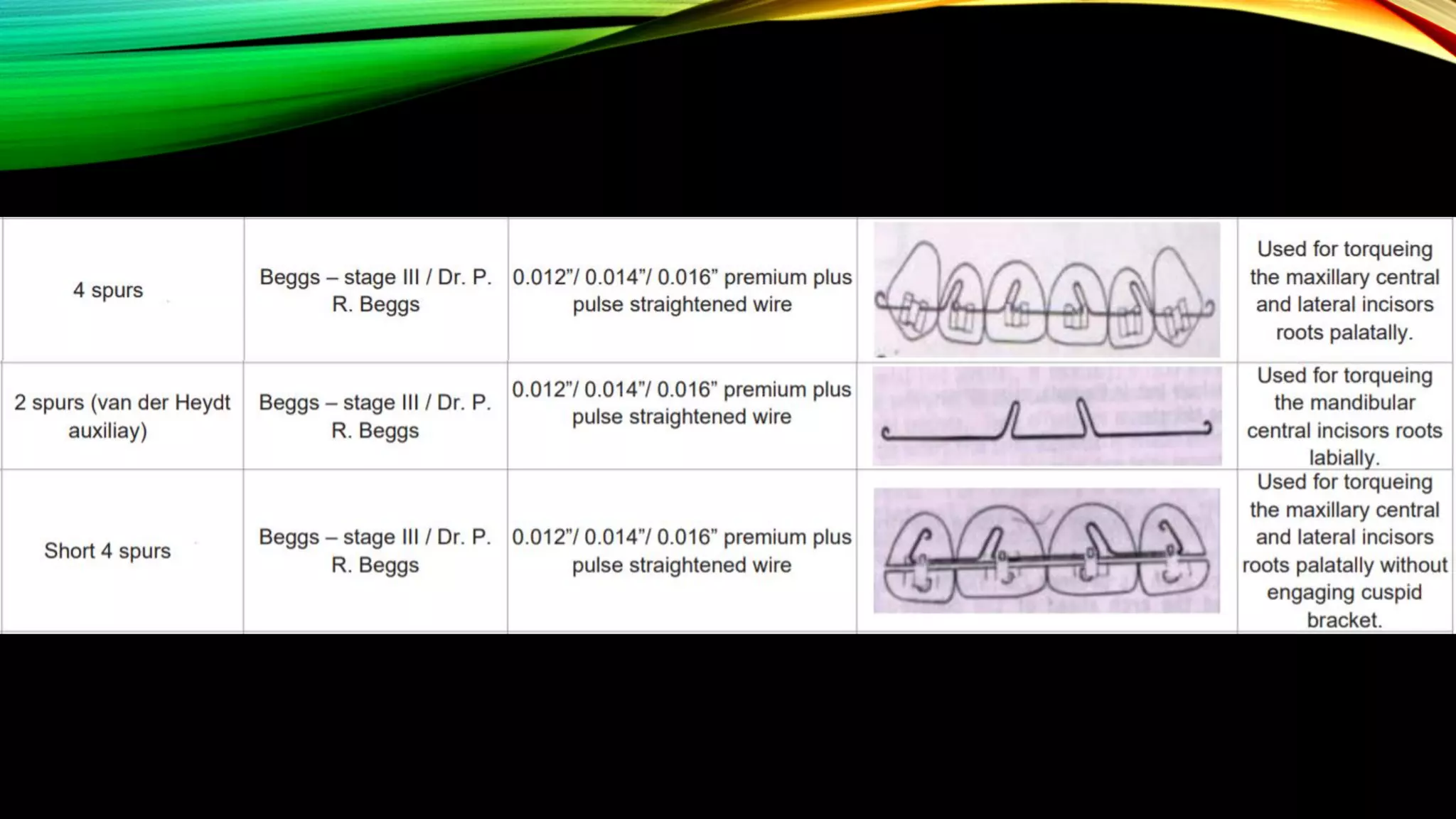
• Four spurs
• 2 spurs (van der Heydt auxiliay)
• Short 4 spurs
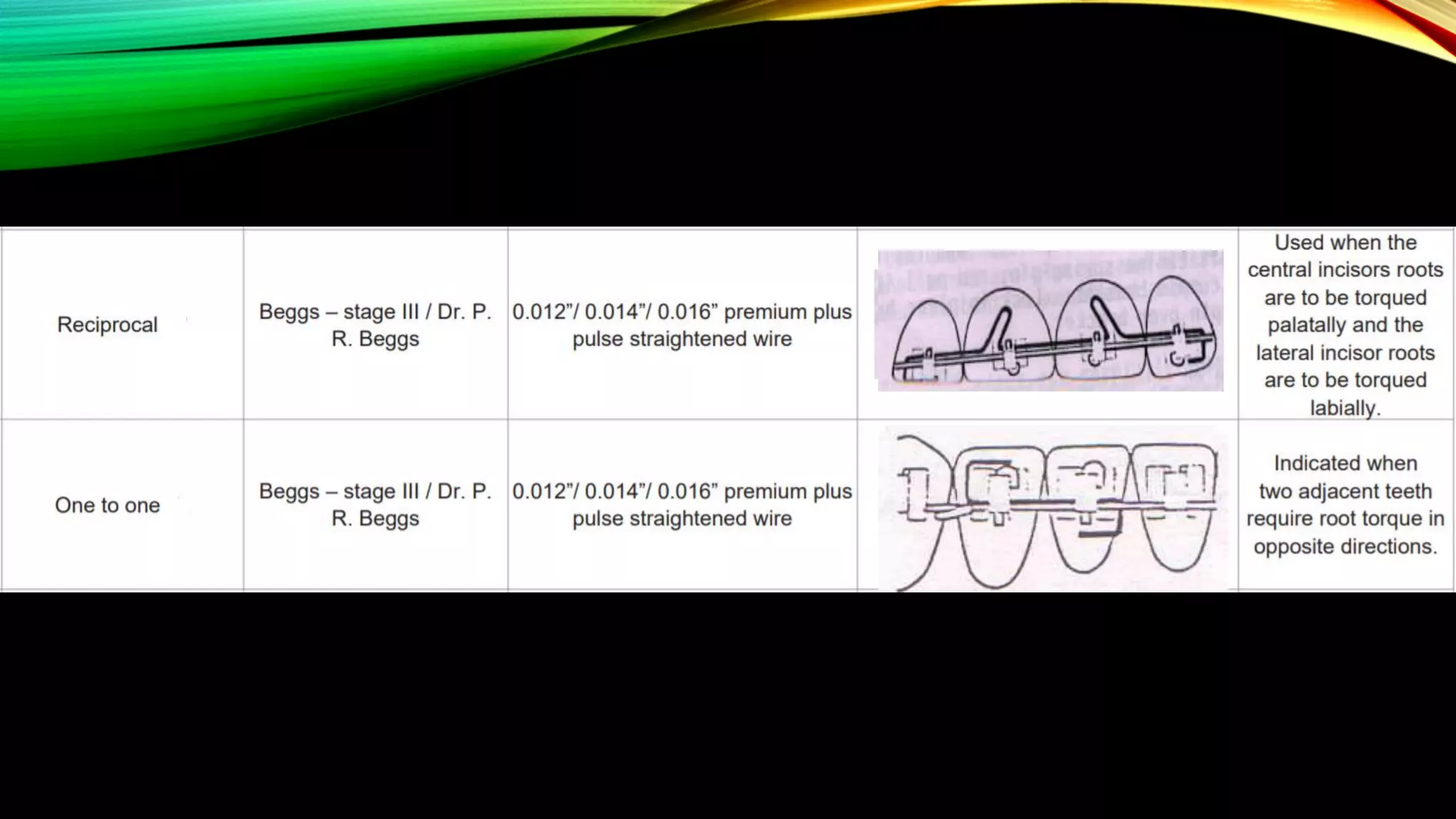
• Reciprocal
• One to one reciprocal torquing auxiliary
• SPEC auxiliary
• Reverse torqueing auxiliary
• Brandt type
• Udder type
• Tan auxiliary
• Pre–wound torquing auxiliary (rat trap)
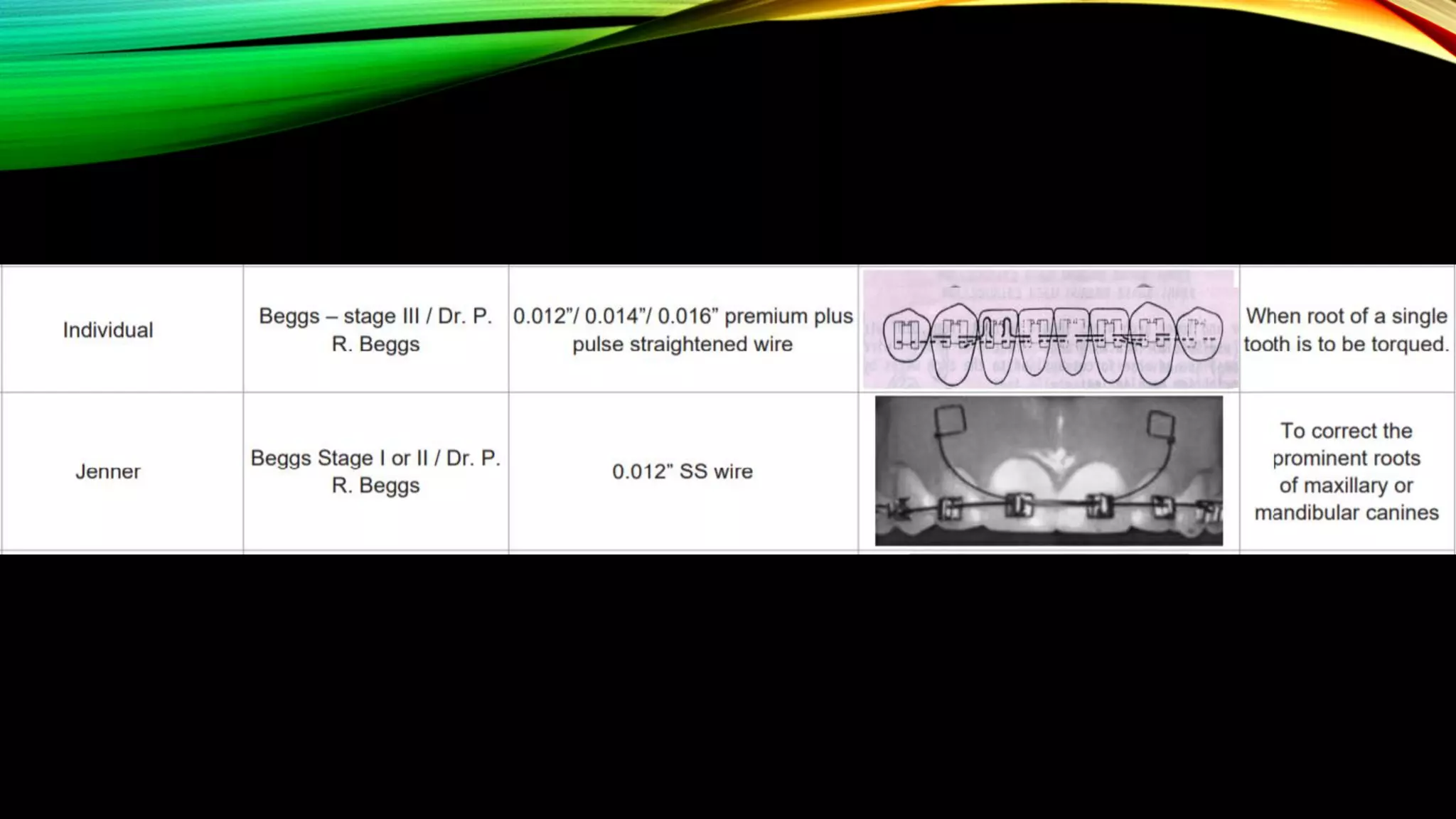
• Single root-torquing auxiliary
• Individual torquing auxiliary
• Jenner auxiliary
• Labial root torque only on the lateral incisors
• Buccal root torque on the molars
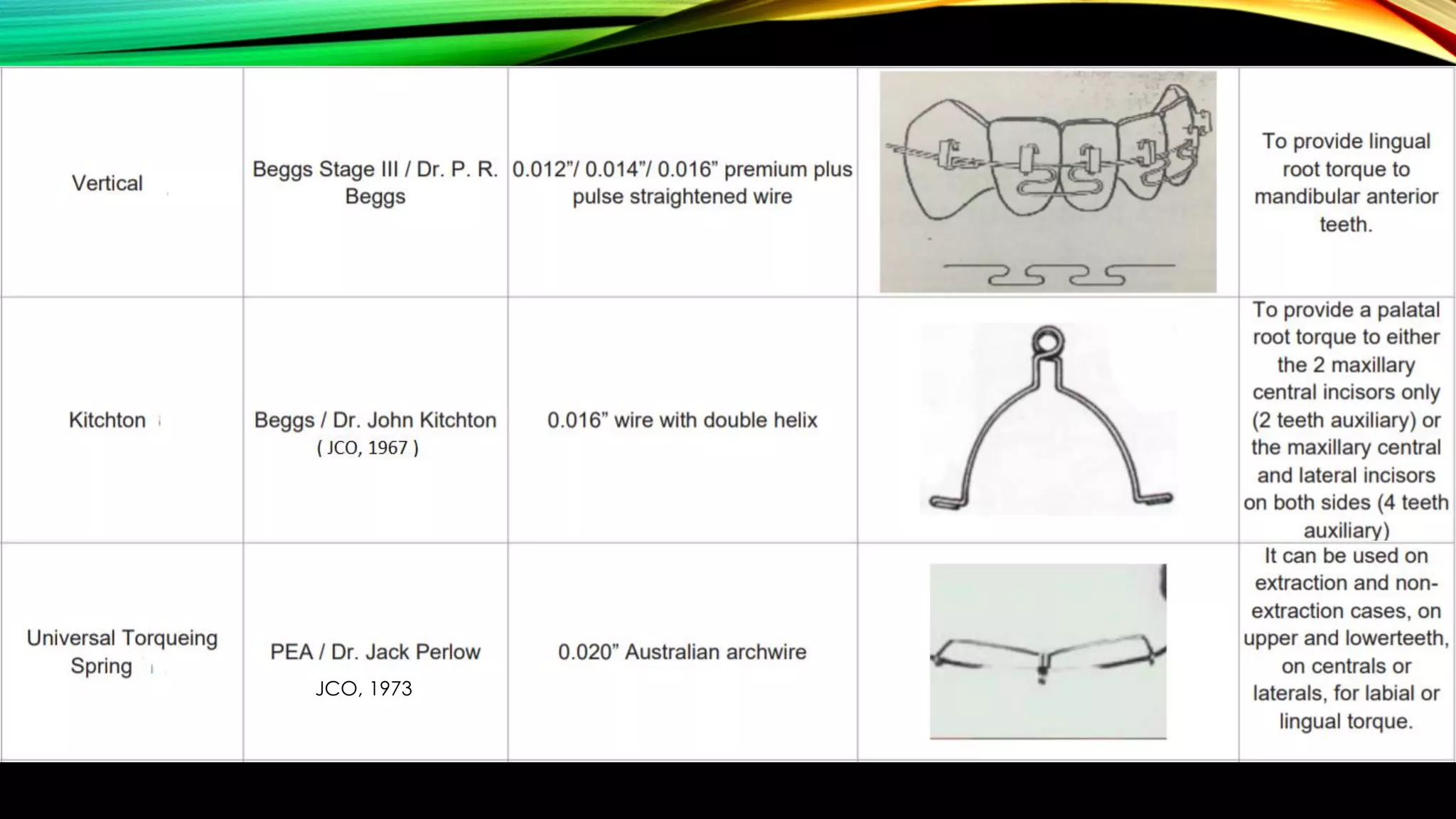
• Vertical auxiliary
• Kitchton auxiliary
• Universal Torquing Spring
• Individual tooth Auxiliary
• Uprighting Torquing Auxiliary
• Warren springs
• Burstone's torquing auxiliary
• Torquing Flaps
• Side Winder Spring
• Torquing Bar
• Mollenhauer’s Aligning Auxiliary (MAA)
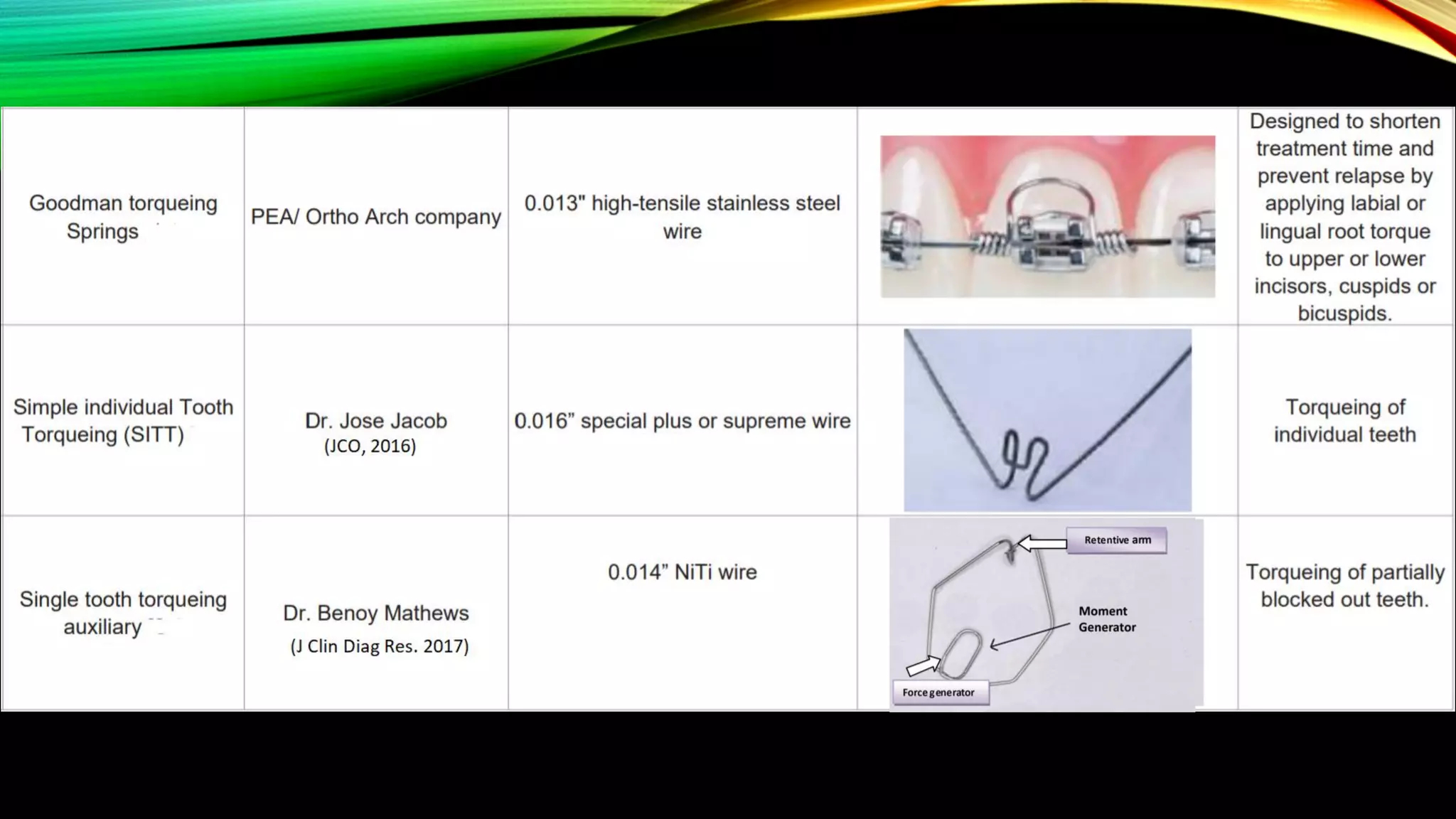
• Goodman torqueing Springs
• Simple individual Tooth Torqueing (SITT)
• Single tooth torqueing auxiliary
• Conclusion
• References
INTRODUCTION
• Torque is a vital ingredient in the achievement of optimal esthetics,
function and health of teeth and surrounding tissues, as also in
stability of the treatment results.
• The word "torque" IiteraIly means "twist".
• In orthodontic parlance, the term is used in two ways.
• When we say that the archwire is torqued for lingual root torque, it
refers to a twist in the rectangular archwire and then to the tooth
displacement obtained from such a twist
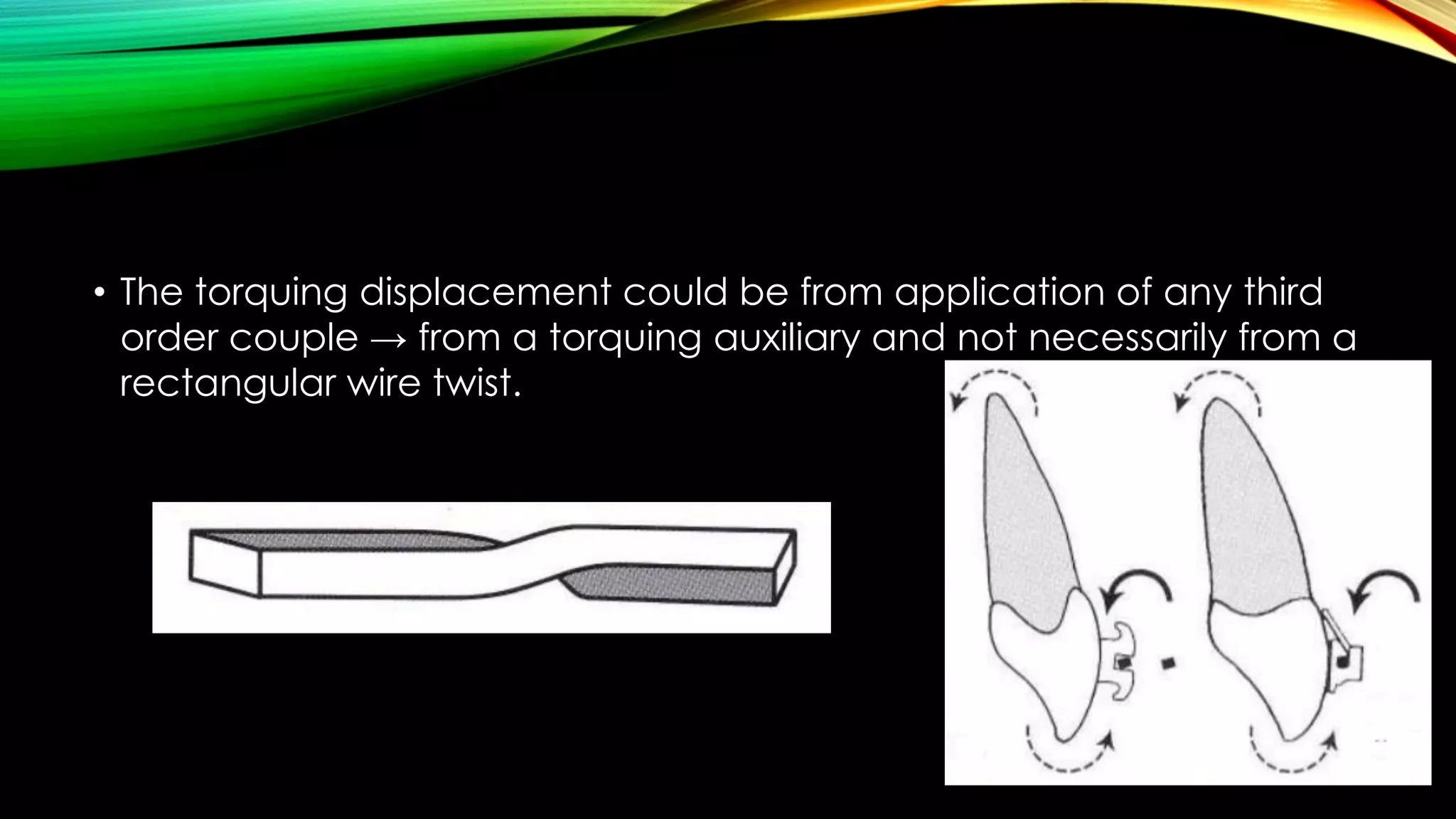
• The torquing displacement could be from application of any third
order couple → from a torquing auxiliary and not necessarily from a
rectangular wire twist.
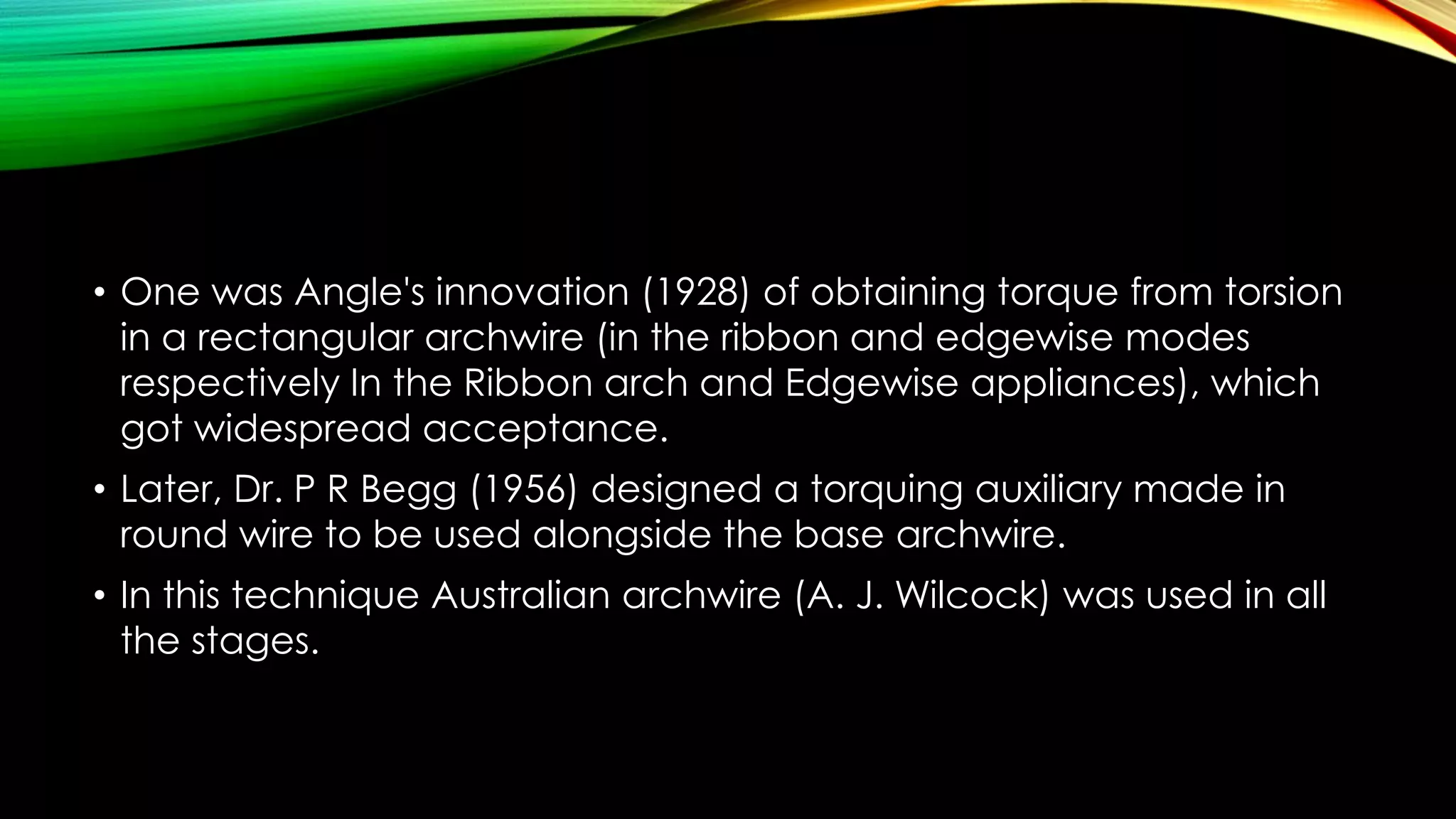
• In the latter context, torque actually would mean
the facio-lingual rotation of a tooth around its
mesio-distal axis that passes through the Centre of
Resistance.
• In common usage, however, it is generally implied
that the crown of the rotating tooth is restricted
from getting displaced, permitting only a facio-
lingual displacement of the root
HISTORICAL BACKGROUND
• The pioneers in Orthodontics realized the importance of torque
from early days, and endeavored to incorporate torque control in
their appliances.
• Two early appliances attempting such control viz. that of Calvin
Case and the Pin and tube appliance of Angle did not become
popular; but the subsequent developments gave orthodontic
specialty two main mechanisms of applying torque.
• One was Angle's innovation (1928) of obtaining torque from torsion
in a rectangular archwire (in the ribbon and edgewise modes
respectively In the Ribbon arch and Edgewise appliances), which
got widespread acceptance.
• Later, Dr. P R Begg (1956) designed a torquing auxiliary made in
round wire to be used alongside the base archwire.
• In this technique Australian archwire (A. J. Wilcock) was used in all
the stages.
• For torque, he used different torquing auxiliaries, instead of relying
on the torsion of the wire (third order bend).
• He used various torquing auxiliaries for torque forces in which force
levels differed by
• the number of coils used
• degree of activation and
• the dimension of the wire
• Andrews (1972) totally changed the concept of incorporating
torque separately by introducing his fully programmed bracket
system (Straight Wire Appliance-SWA) in which he incorporated slot
sitting features and even inclined the base of bracket to reduce
bending of archwire.
• Proffit (1986) quoted a force of 75-125 gm being suitable for
torquing movements.
• The lower end of the range was considered suitable for teeth with
small root area, whilst higher forces would be appropriate for teeth
with larger roots.
• Kesling (1986) combined Angle’s edgewise bracket system with the
differential force concept of Begg for his Tip Edge system
(Preadjusted Edgewise).
• In this system, each bracket had the requirement of a torquing
auxiliary for achieving the final prescription similar to Begg
philosophy.
• Further later, next generations of SWA; Roth philosophy and MBT
prescription used the inbuilt features at the base of the bracket
instead of using any kind of auxiliary.
• Conceptually, the special feature of the Begg appliance in
separating the root moving forces from the archwire forces gives it
a unique advantage, as pointed out by Kesling.
• The reactions generated by the former are spread through the
archwire on to the entire arch, rather than predominantly
expressing on the adjacent teeth.
• The root torquing auxiliaries developed by Dr. Begg viz. the ’Spur’
design (having four, two, or six spurs) and the 'Mouse-trap' for
lingual root torque, and the 'Udder arch' for labial root torque have
stood the test of time.
• Many other ingenious designs like the Vander Hydt, Kitchton and
ART (anterior root torquing) auxiliaries were introduced
subsequently.
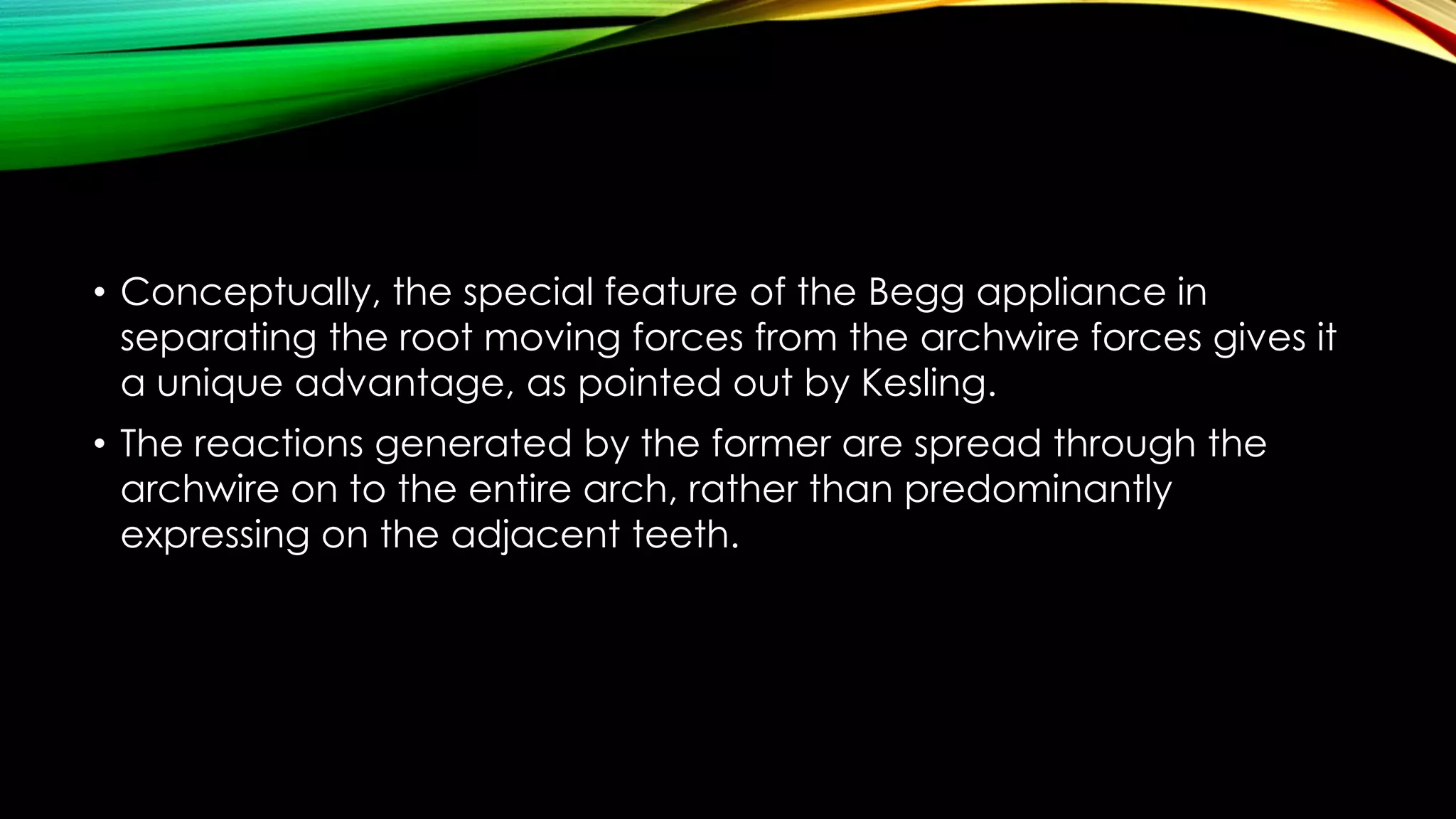
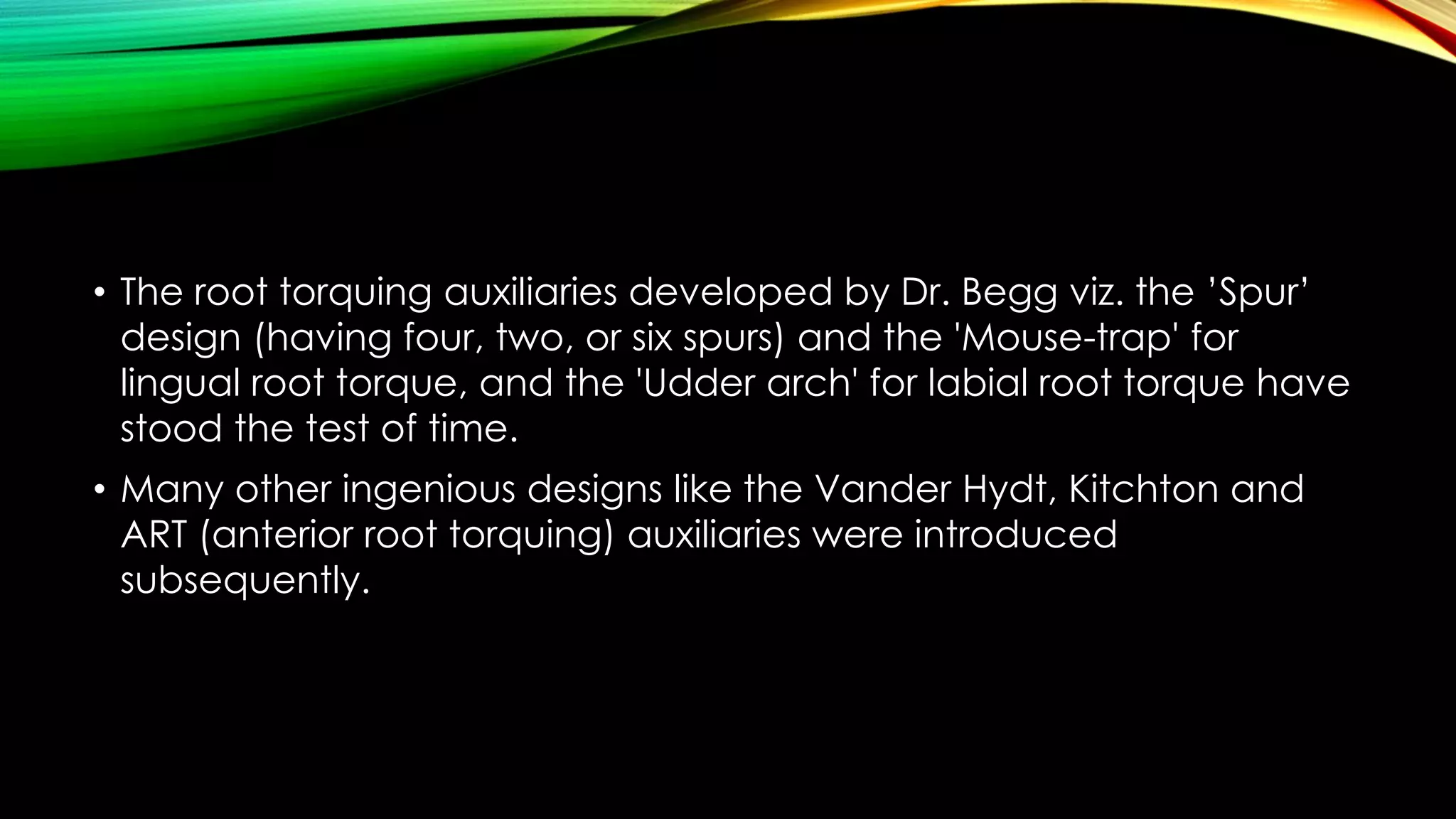
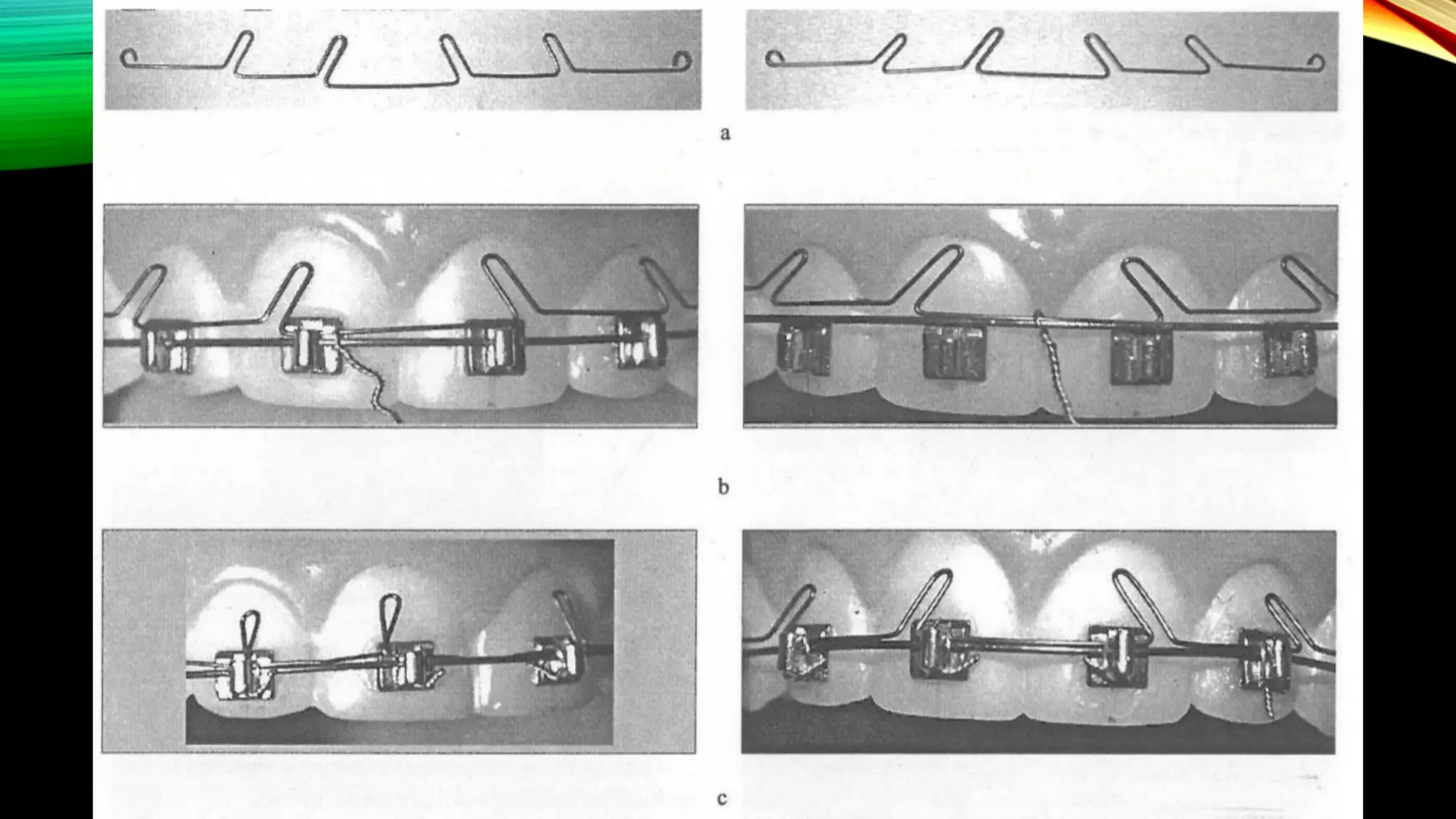
THE TORQUING AUXILIARY WITH SPURS
• The auxiliary bent into a small circle, when fixed in the mouth, is
spread out along the wider anterior curvature of the archwire.
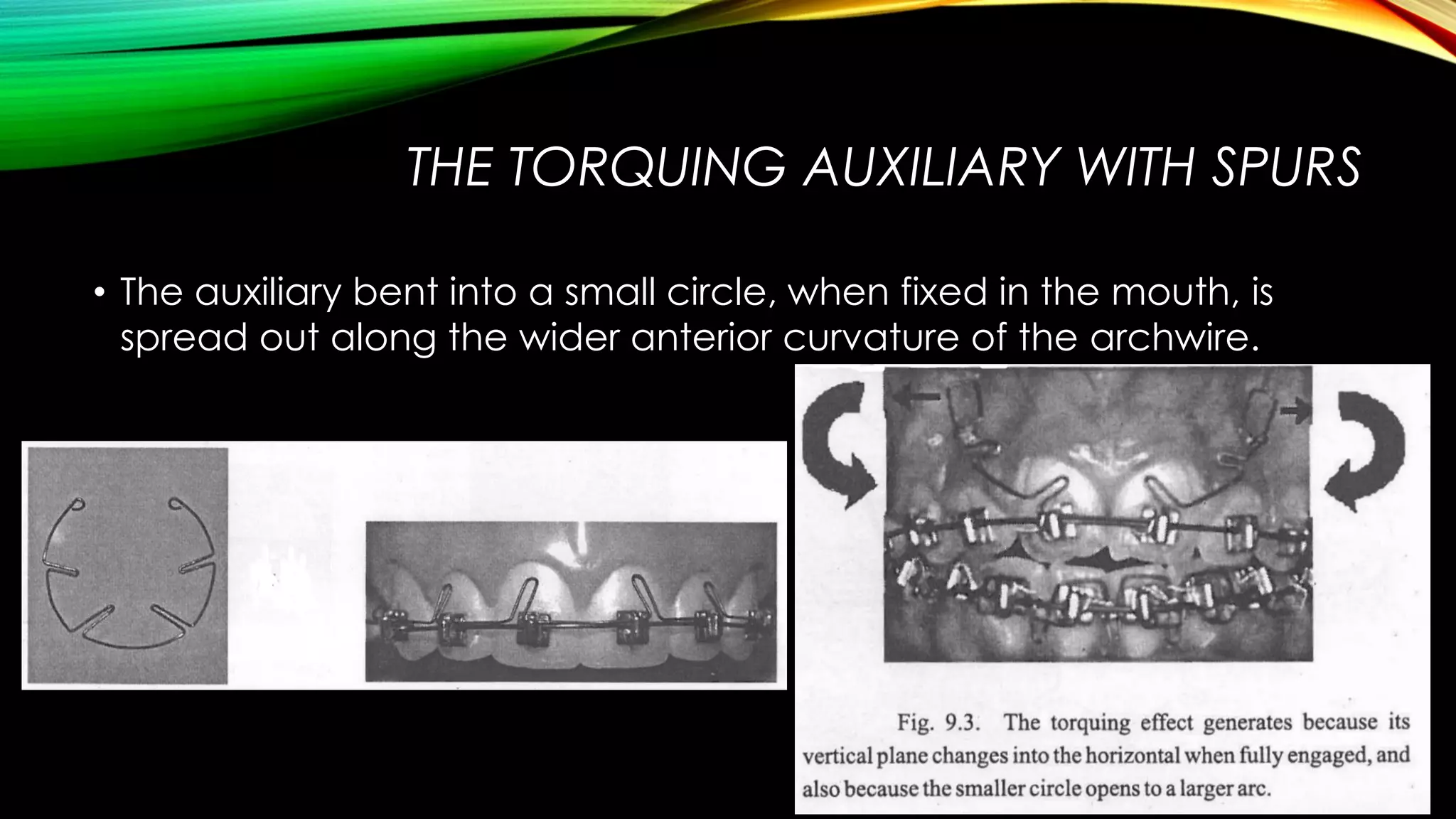
• The lingual torqueing effect is on account of two factors
• Firstly, the vertical plane in which the torquing auxiliary orients when
fitted on the two central incisors is changed to the horizontal plane
of the archwire when fully tied to it.
• Secondly, when the torquing auxiliary is opened to the larger arc of
anterior portion of the archwire, it rolls inwards.
• Both these effects force the tips of the spurs to press in a lingual
direction against the gingival portion of the crowns.
• Reciprocally, their inter-spur spans of the auxiliary tend to lift away
in a labial direction.
• Thus a force couple is created.
• The labial forces are resisted by the bracket slots and the base
archwire to which the auxiliary is tied, thus accentuating the action
of the lingual root moving forces
• The auxiliary is now made from 0.012” Premium Plus wire(preferably
pulse straightened) unlike in 0.014” or 0.016” Special Plus wire
previously used.
• Considering identical activations, a short spur will produce much
greater force that will drop rapidly when the teeth start getting
torqued; a longer spur will produce a gentler and more constant
force.
• On an average, the length of the spur should be kept at about
5mm; but it should be varied depending on the clinical crown
height, leaving it about 1mm short of the gum to facilitate proper
hygiene
• Inclination of the spurs to the horizontal (occlusal) plane is kept 0°
• The auxiliary, being made of a lesser diameter wire, is likely to deform
more than the previous heavy auxiliaries when engaged in all the
brackets.
• Thus, the angle of the spur from the inter-spur span opens up and the
legs of the spur tend to converge and may even cross each other
on tying the auxiliary in the mouth.
• This is remedied by slightly over angulating the spur and by keeping
the legs a little divergent.
• On placing in the mouth, the tips of the spurs will move to the
mesio-distal center of the crowns, and the legs also will become
parallel.
• For the same reason, the distal leg of every spur is kept slightly
shorter by about 0.5 mm, so that the distal leg does not project
incisally to the main archwire on tying
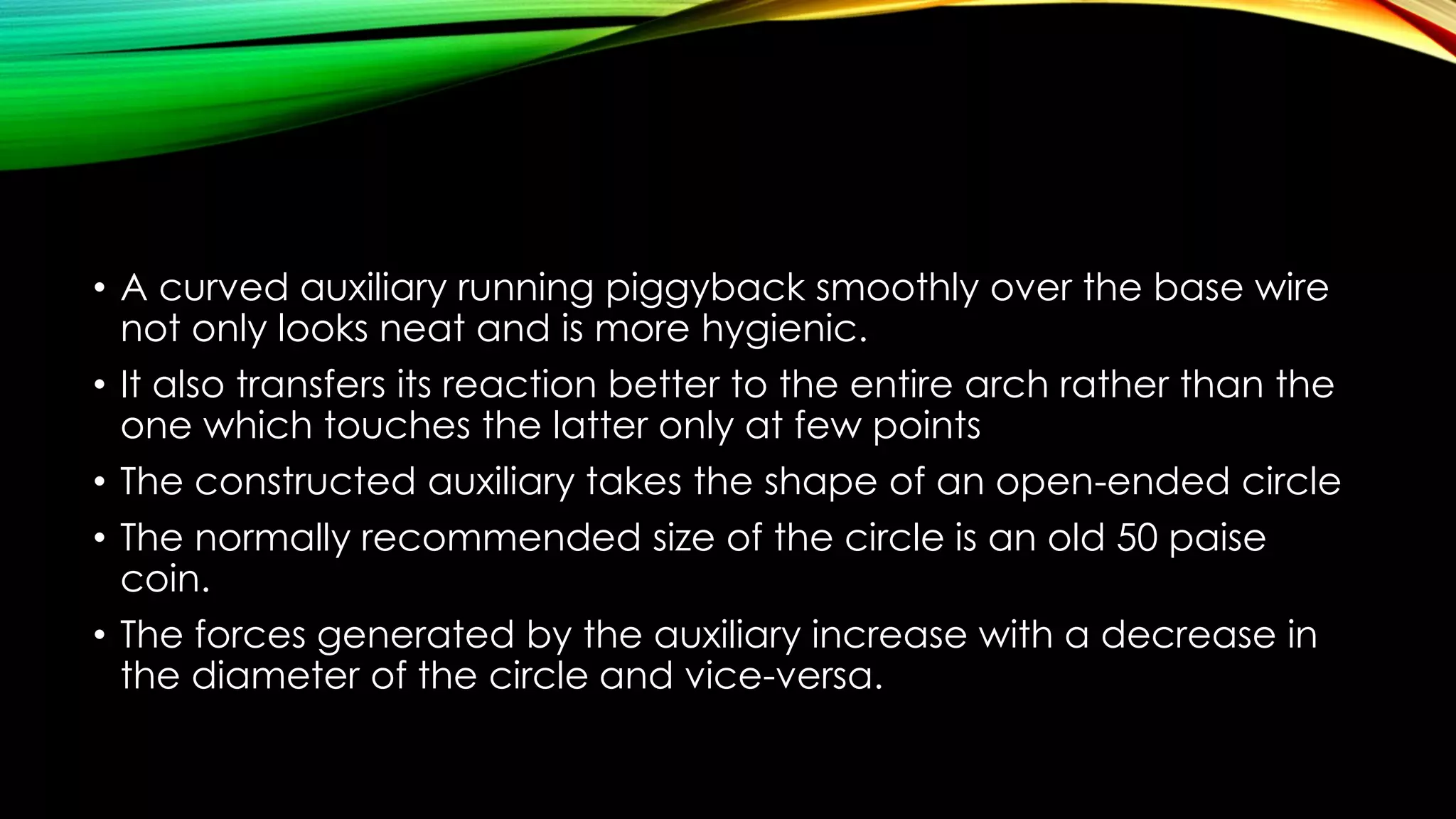
• The inter-spur span is curved as recommended by Kesling
• If it is kept straight or angulated midway it does not rest entirely on
the base wire but starts projecting away.
• This is because the tied torquing auxiliary has to follow the shape of
anterior curvature of the archwire.
• A straight or angulated inter-spur span cannot assume a perfect
curvature
• A curved auxiliary running piggyback smoothly over the base wire
not only looks neat and is more hygienic.
• It also transfers its reaction better to the entire arch rather than the
one which touches the latter only at few points
• The constructed auxiliary takes the shape of an open-ended circle
• The normally recommended size of the circle is an old 50 paise
coin.
• The forces generated by the auxiliary increase with a decrease in
the diameter of the circle and vice-versa.
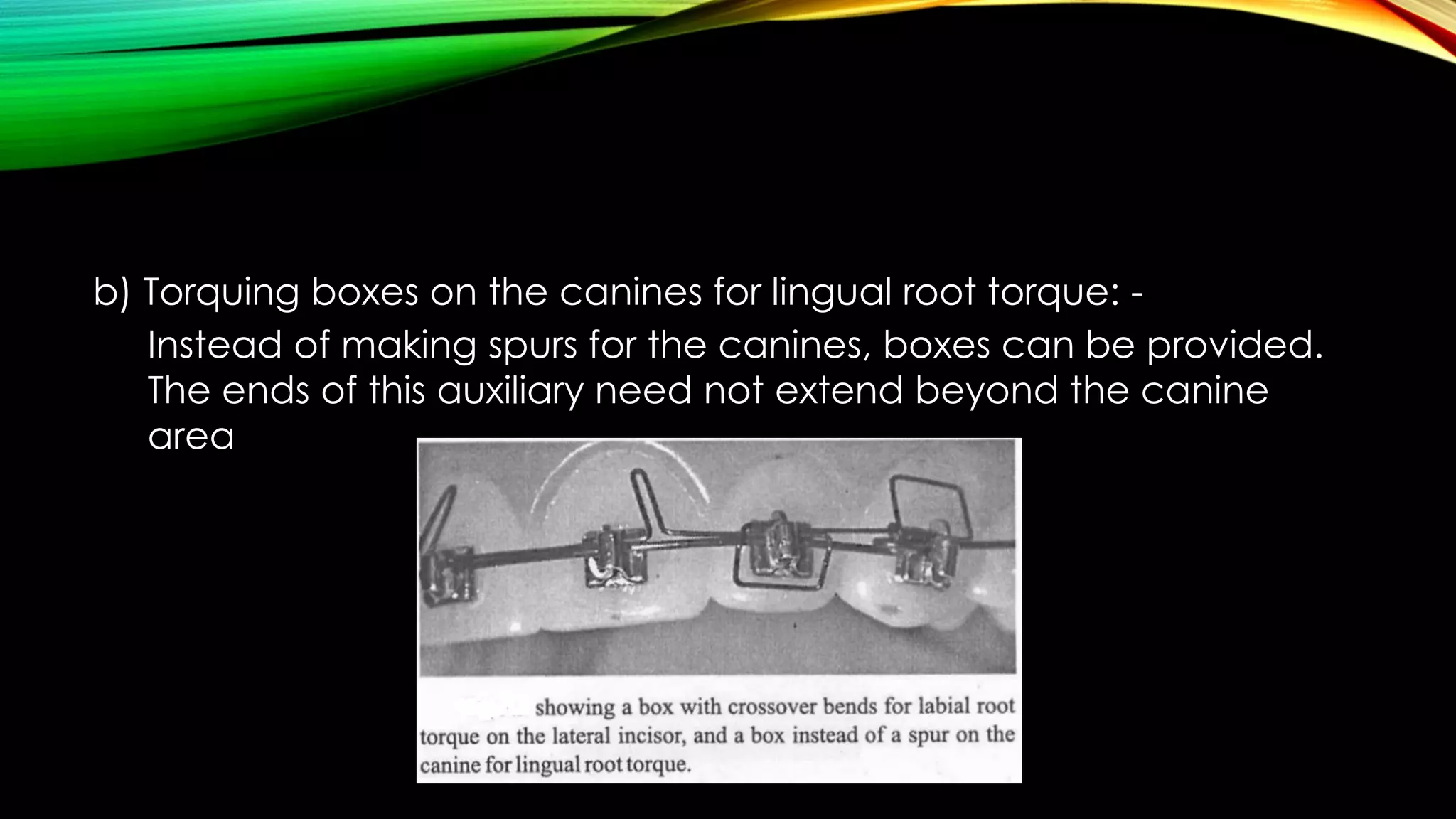
Modifications
a) Reverse (labial) torque on one or both the lateral incisors: -
Boxes at right angle to the plane of the spurs are made to lie at
the incisal area of the lateral incisor(s).
Crossover bends are made on either side of the lateral incisor
bracket to permit the auxiliary to pass over the base wire
b) Torquing boxes on the canines for lingual root torque: -
Instead of making spurs for the canines, boxes can be provided.
The ends of this auxiliary need not extend beyond the canine
area
RECIPROCAL TORQUEING AUXILIARY (‘SPEC’ DESIGN)
• This torquing mechanism is employed when two adjacent teeth
require root torque in opposite directions.
• An instanding lateral incisor needing labial root torque for its bodily
correction, and the adjacent canine needing lingual root torque
because its root is very prominent.
• The ‘Spec’ auxiliary made in lighter 0.009” or 0.010” size wires could
be used for controlling the root movements during the first and
second stages.
• Very often, the canine is mesially angulated, and is thus likely to
obstruct labial movement of the lateral incisor root.
• A light uprighting spring must be simultaneously placed on the
canine to remove such interference.
• If needed for the stage III, it should be made in 0.012” size wire.
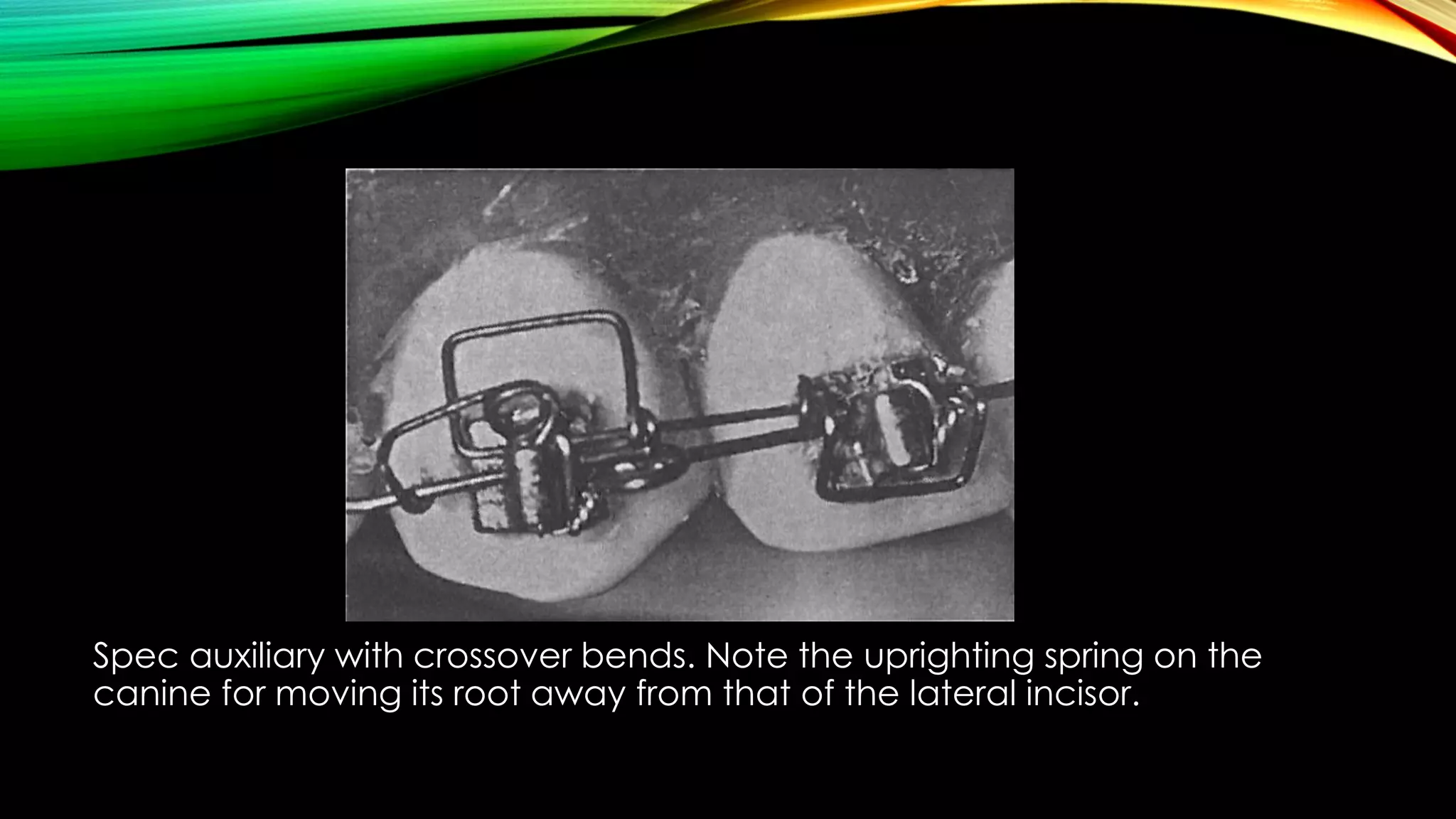
• The box on the tooth requiring labial root torque is placed incisal to
the main wire, while the box on the other tooth requiring lingual
root torque sits piggyback on the main wire.
• Hence a crossover bend is required between the two adjacent
teeth because the auxiliary has to cross over the mainwire.
• Varying the angulation between the planes of the two boxes can
control the force generated by the auxiliary.
Spec auxiliary with crossover bends. Note the uprighting spring on the
canine for moving its root away from that of the lateral incisor.
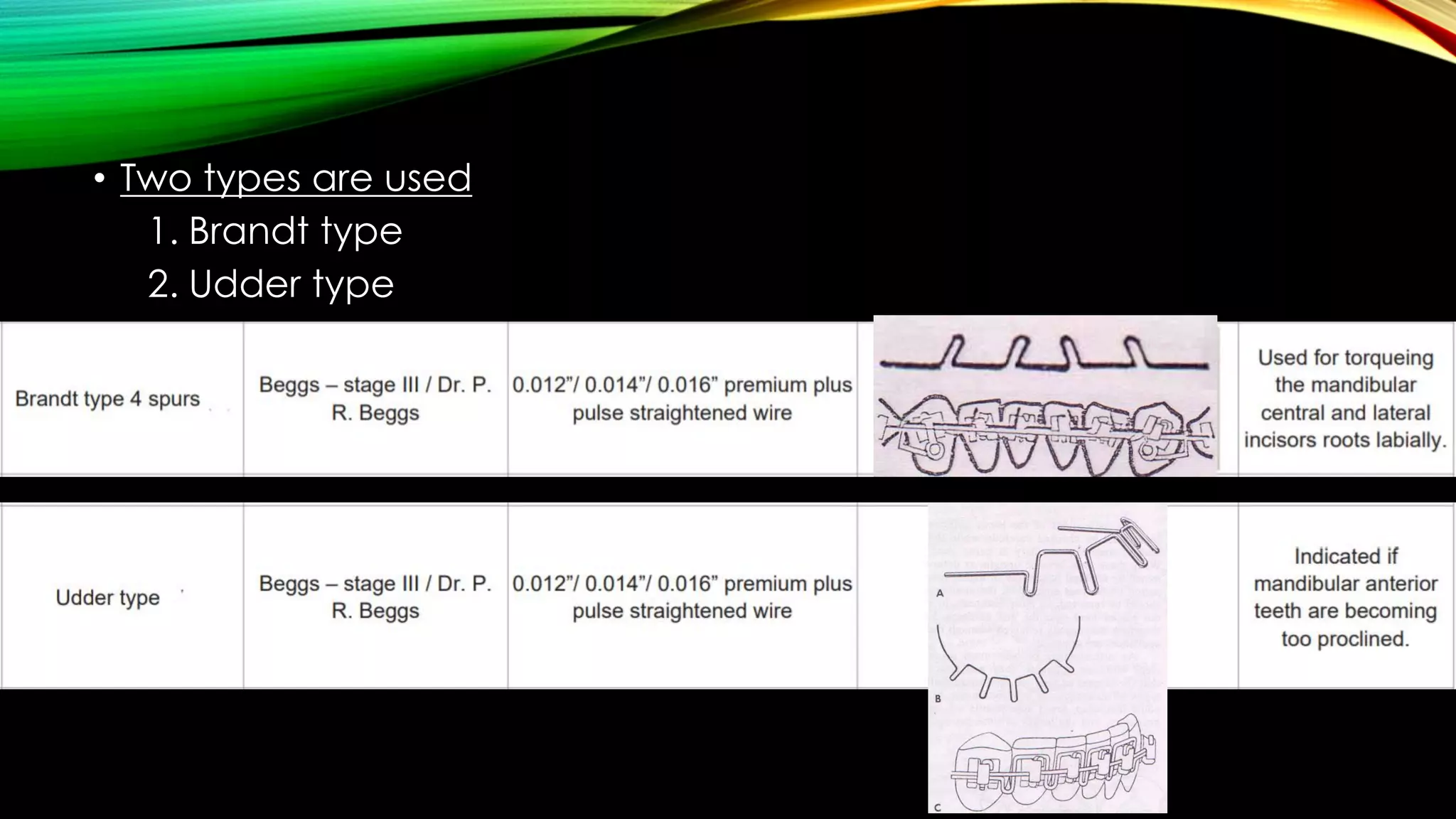
REVERSE TORQUEING AUXILIARY
• Reverse root torquing auxiliary has the objective of repositioning
the mandibular incisor roots and bringing them forward in a
controlled manner
• Indications
1. Bimaxillary proclination or class II div. 1
2. Almost all non-extraction cases
3. To increase the mandibular anchorage
• Two types are used
1. Brandt type
2. Udder type
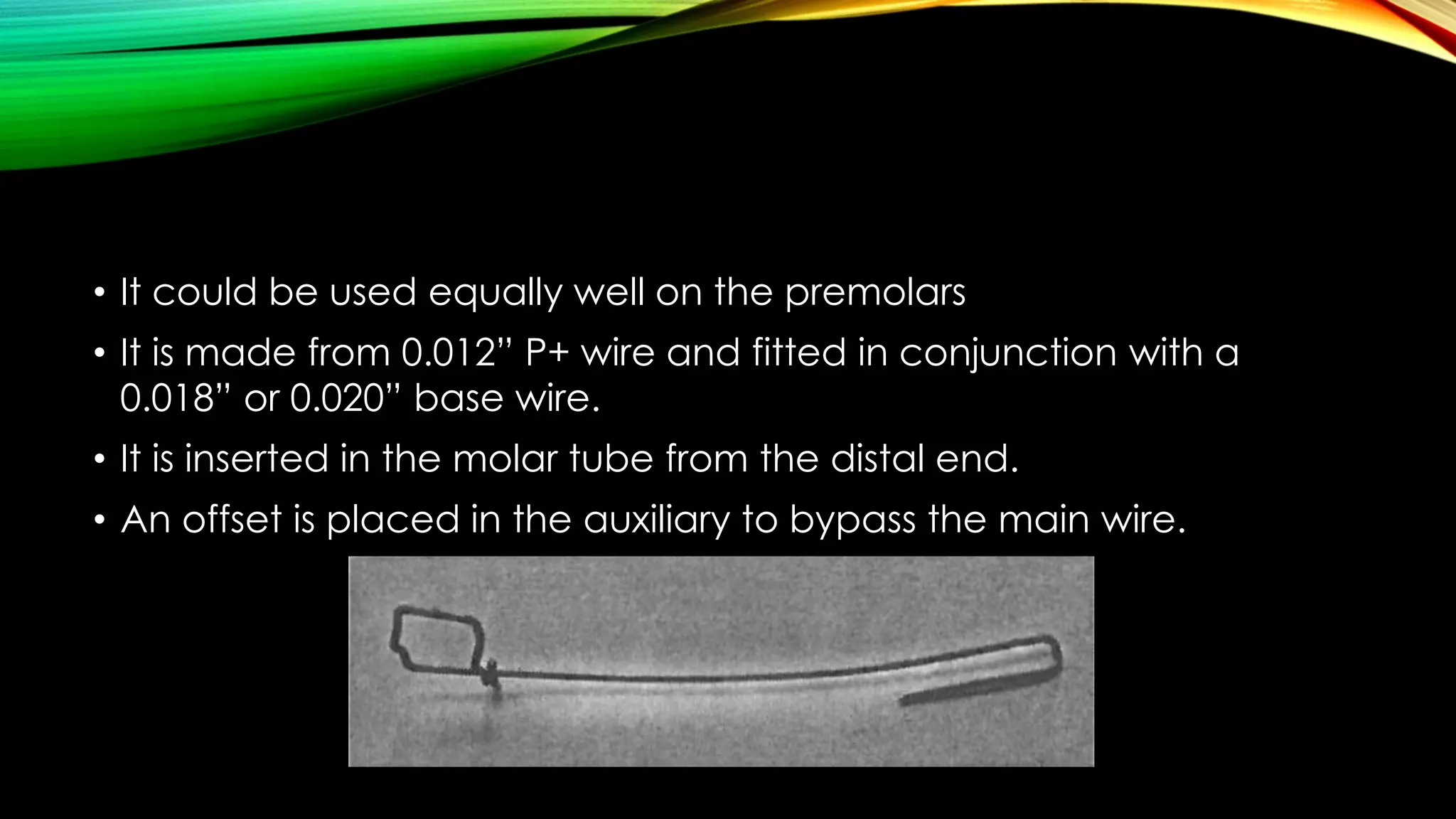
TAN AUXILIARY
• Reverse torqueing auxiliary for controlling the roots of canines or
premolars
• Franciskus Tan (J Clin Orth, 1987)
• It was described for the labial root movement of a palatally
impacted maxillary canine, whose crown has been aligned but the
root is still placed palatally and needs labial root torque.
• However, if required for lingual root torque in other situations, it is
simply inverted.
• It could be used equally well on the premolars
• It is made from 0.012” P+ wire and fitted in conjunction with a
0.018” or 0.020” base wire.
• It is inserted in the molar tube from the distal end.
• An offset is placed in the auxiliary to bypass the main wire.
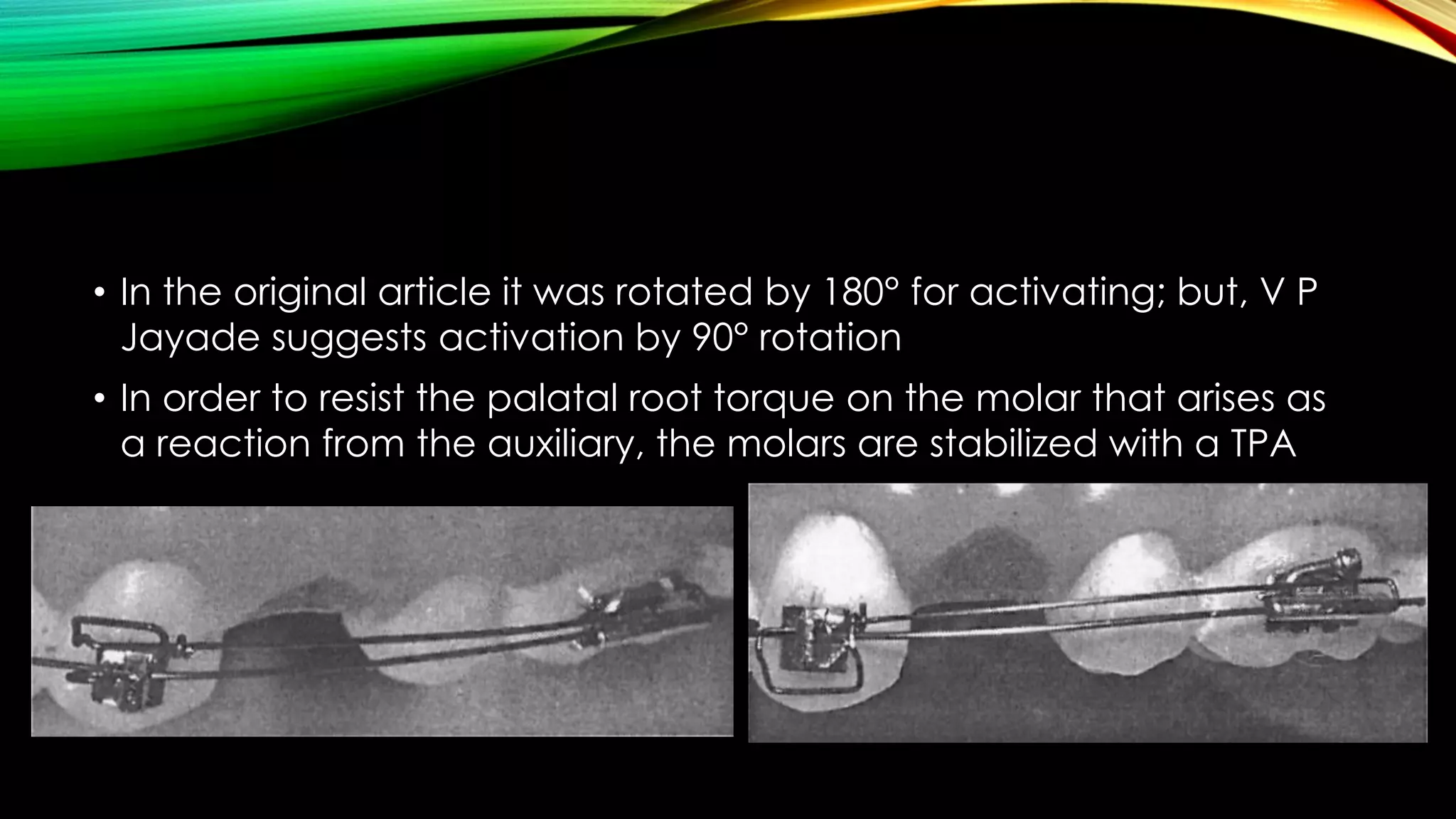
• In the original article it was rotated by 180° for activating; but, V P
Jayade suggests activation by 90° rotation
• In order to resist the palatal root torque on the molar that arises as
a reaction from the auxiliary, the molars are stabilized with a TPA
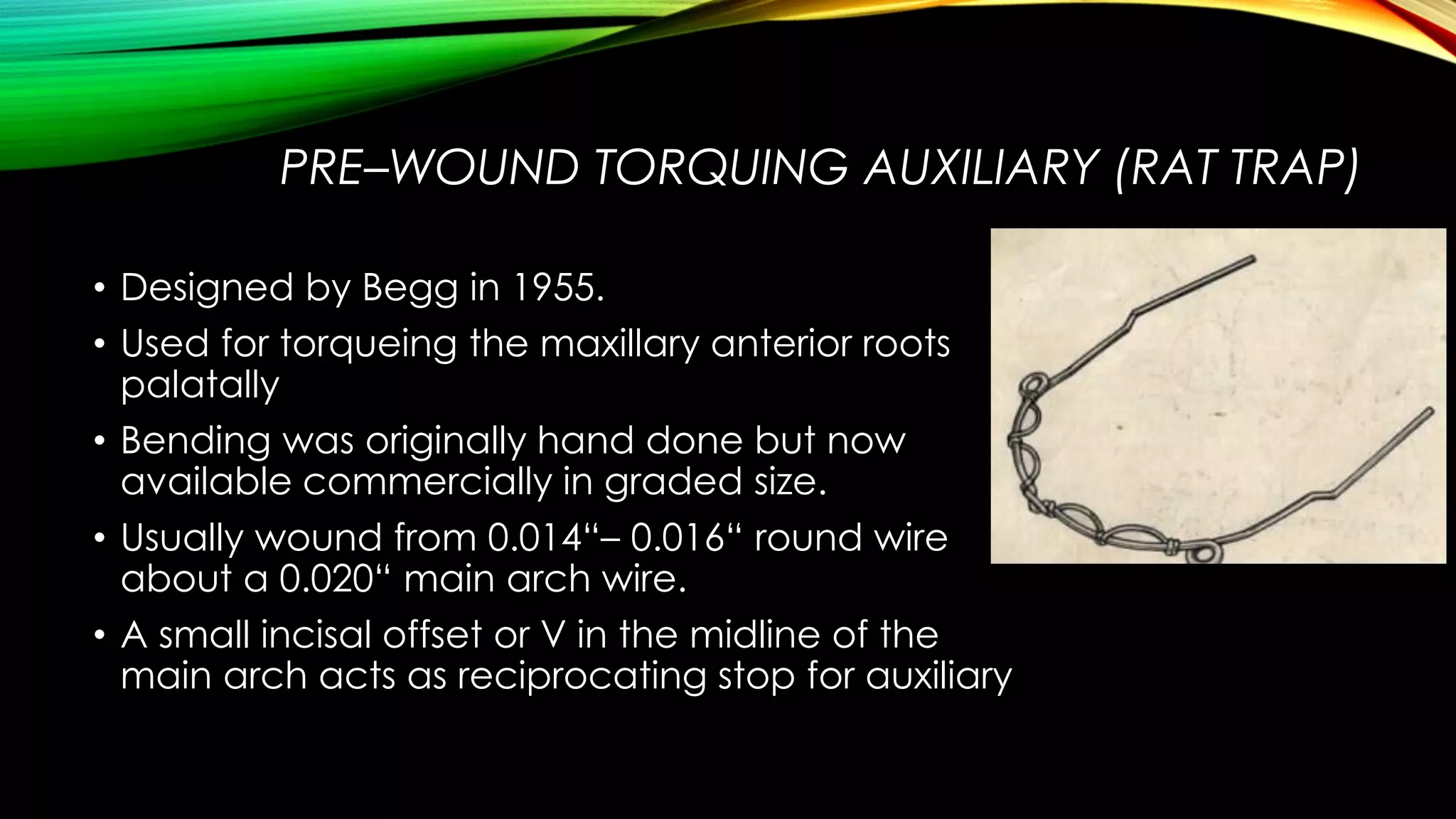
PRE–WOUND TORQUING AUXILIARY (RAT TRAP)
• Designed by Begg in 1955.
• Used for torqueing the maxillary anterior roots
palatally
• Bending was originally hand done but now
available commercially in graded size.
• Usually wound from 0.014“– 0.016“ round wire
about a 0.020“ main arch wire.
• A small incisal offset or V in the midline of the
main arch acts as reciprocating stop for auxiliary
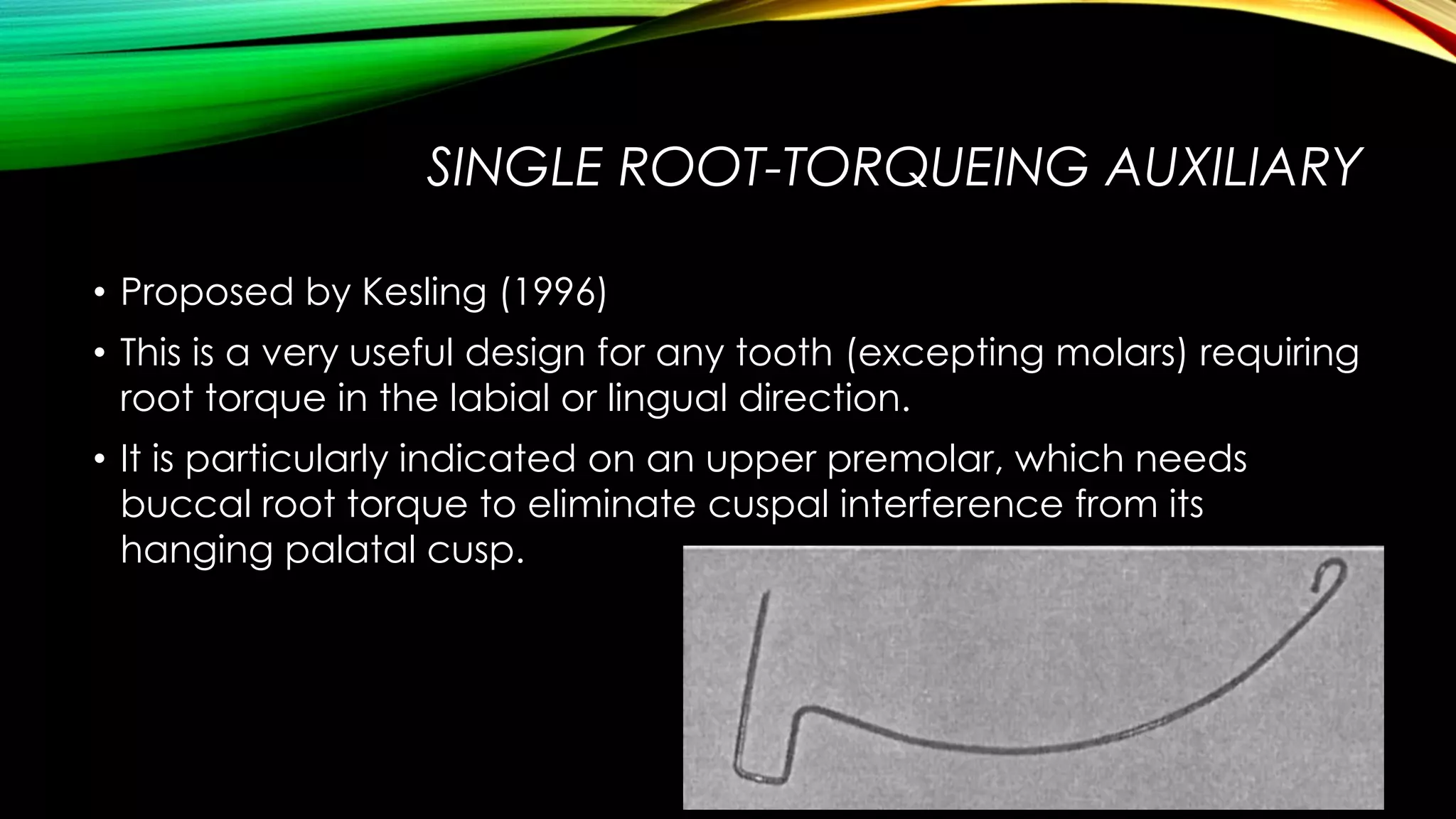
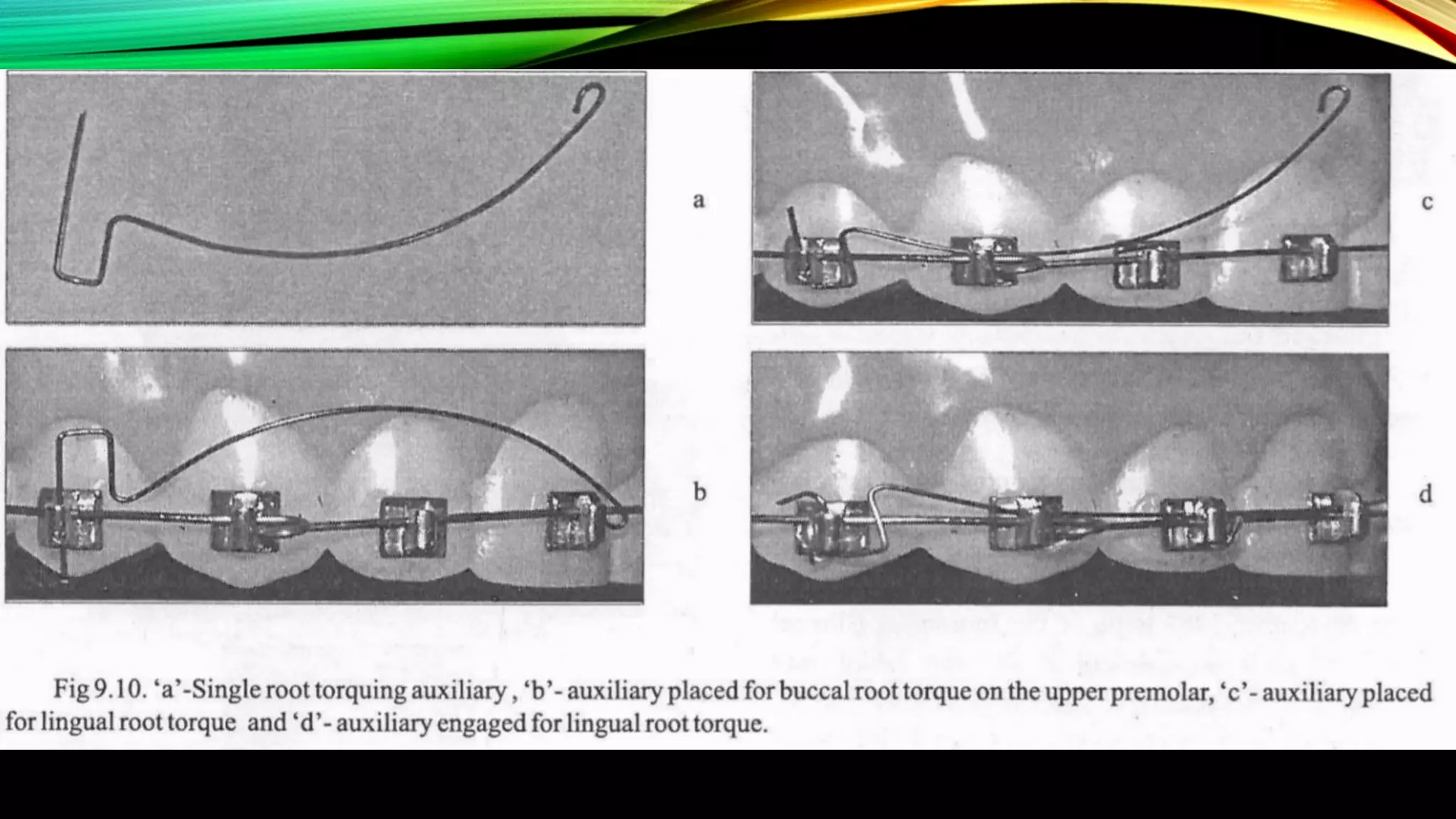
SINGLE ROOT-TORQUEING AUXILIARY
• Proposed by Kesling (1996)
• This is a very useful design for any tooth (excepting molars) requiring
root torque in the labial or lingual direction.
• It is particularly indicated on an upper premolar, which needs
buccal root torque to eliminate cuspal interference from its
hanging palatal cusp.
• It is convenient to place the long arm of the auxiliary piggyback
over the main archwire since it need not be untied, but it could lie
occlusal to the base wire in the slot as well.
• The long arm should extend to three to four adjacent teeth when
engaged in the brackets.
• The long arm always faces mesially for the premolar teeth
• Depending on how the curvature is pointing before the auxiliary is
tied, the torque generated will have lingual (palatal) or buccal root
moving effect.
• For example, the auxiliary fitted with its convexity facing upwards
will have a buccal root torquing effect on the upper premolars, but
the effect will be for lingual root torque on the lowers, and vice-
versa.
• The effect is transmitted by the vertical extension of the auxiliary
through the bracket pillar onto the tooth; unlike most other
auxiliaries, which exert force directly on the tooth surface.
• The long arm could face either mesially or distally on the anterior
teeth, and the action will depend on how the curvature of the long
arm relates to the base archwire.
• The auxiliary is usually made in 0.012 size Premium Plus wire, but
could be made in thinner wires for smaller teeth like the lower
incisors.
• The force generated by it can be varied by changing acuity of the
curvature.
• More acute the curve, greater is the force generated.
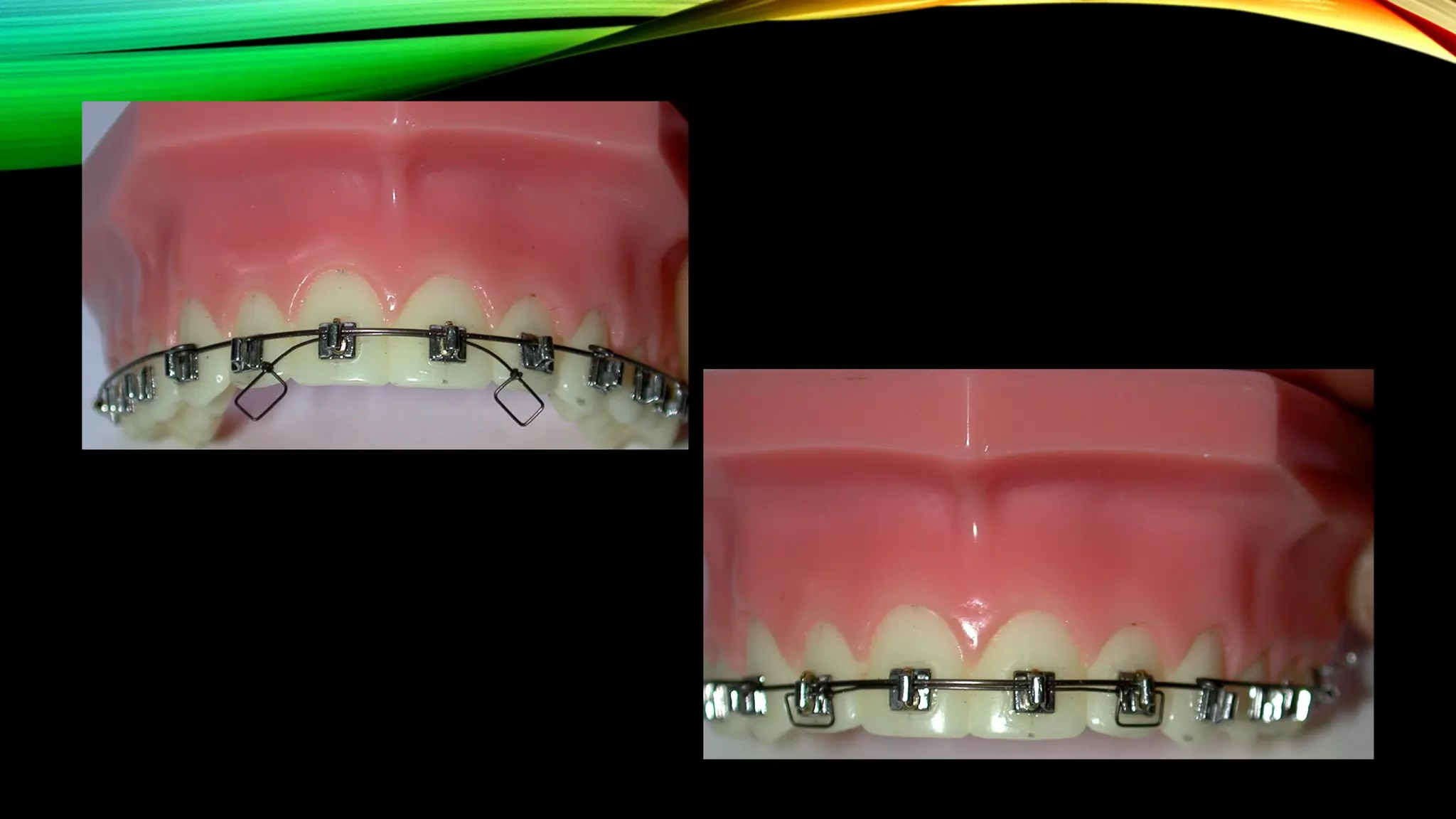
LABIAL ROOT TORQUE ONLY ON THE LATERAL INCISORS
• This design is similar to the Jenner auxiliary.
• However, it is shorter, made from 0.012” size wire and is placed with
the convexity of the auxiliary facing gingivally.
• The auxiliary is engaged first in the incisor brackets and the main
wire is then engaged piggyback.
• The boxes extend labially on the incisal area of the crowns.
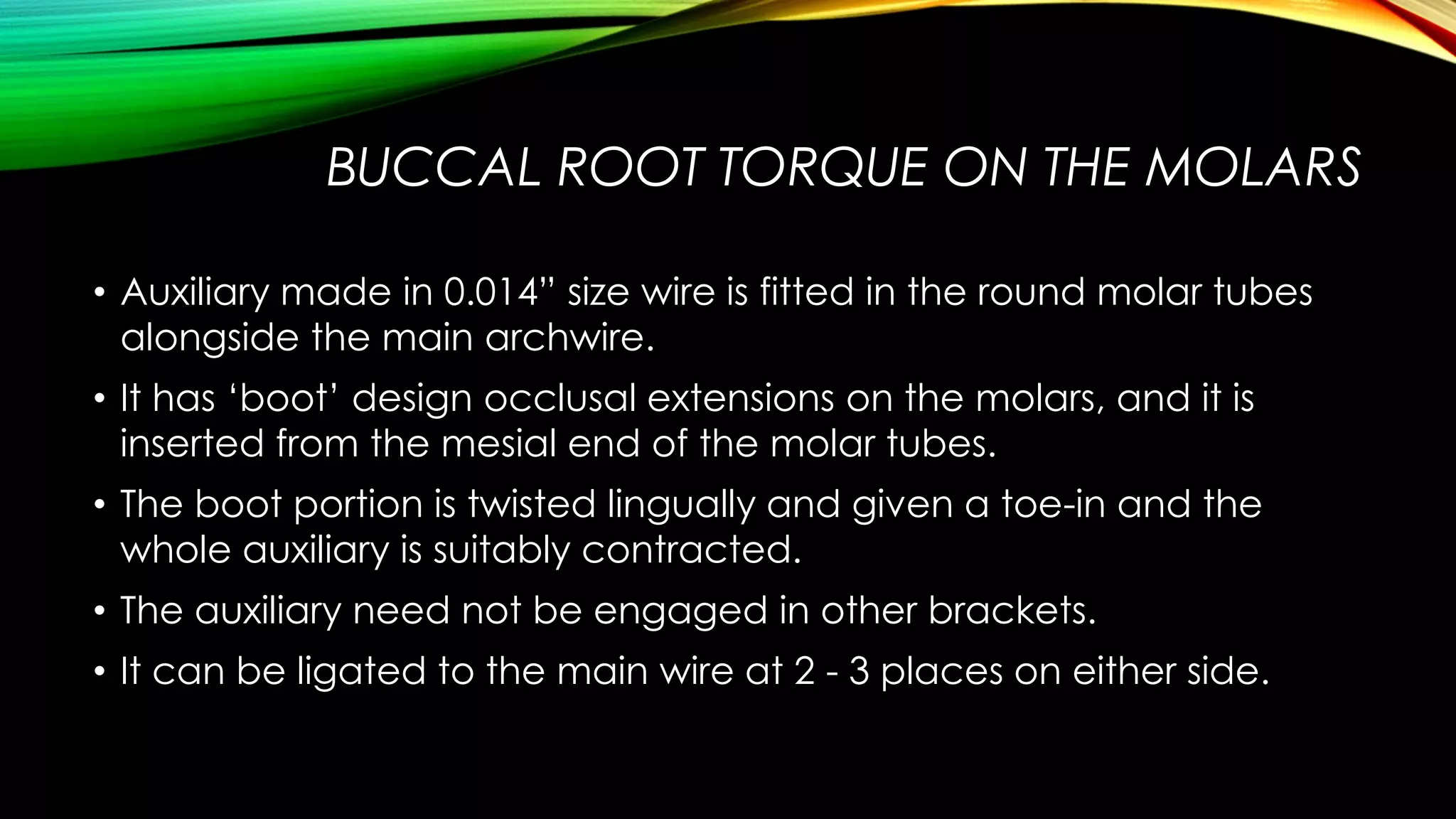
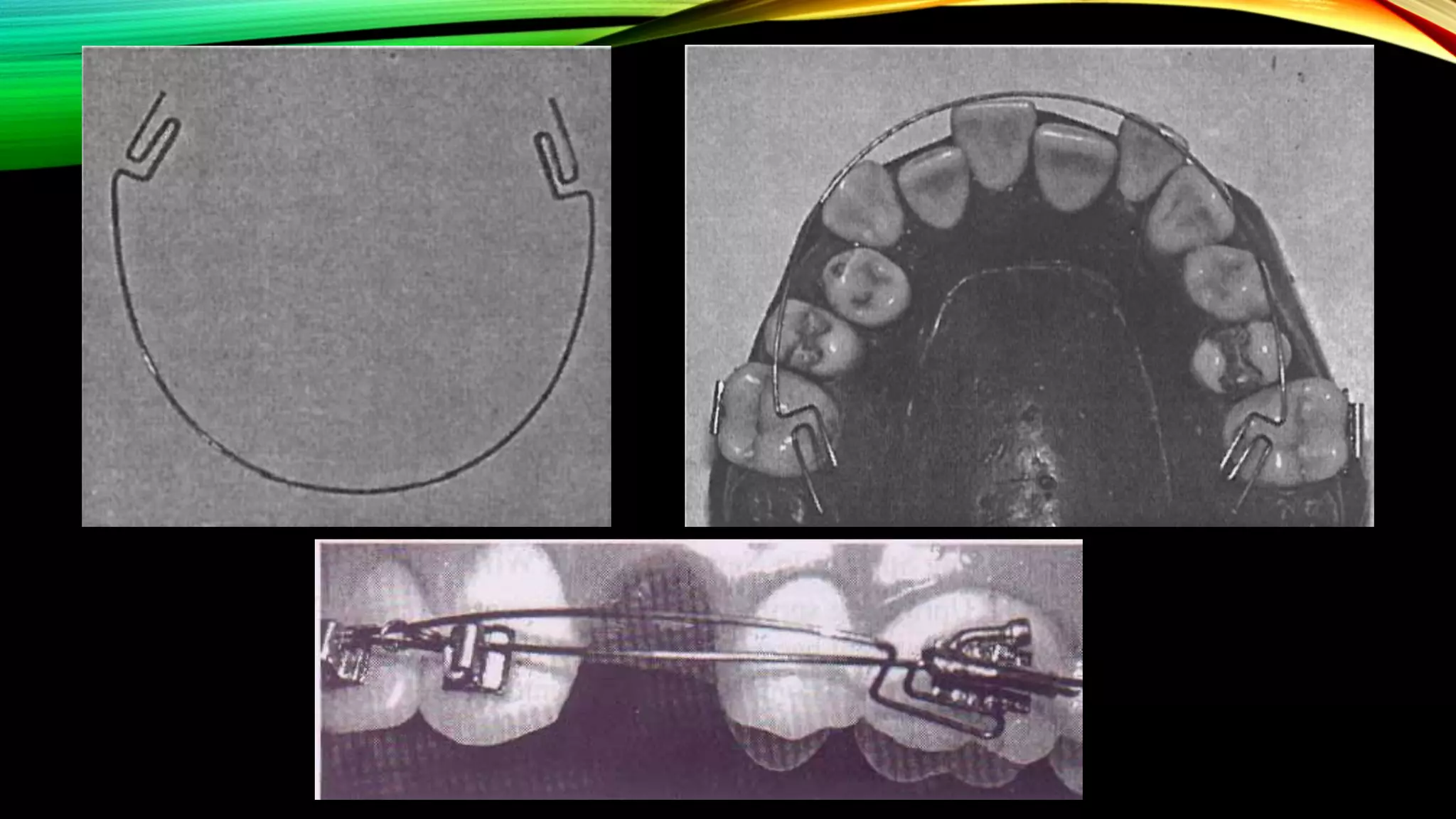
BUCCAL ROOT TORQUE ON THE MOLARS
• Auxiliary made in 0.014” size wire is fitted in the round molar tubes
alongside the main archwire.
• It has ‘boot’ design occlusal extensions on the molars, and it is
inserted from the mesial end of the molar tubes.
• The boot portion is twisted lingually and given a toe-in and the
whole auxiliary is suitably contracted.
• The auxiliary need not be engaged in other brackets.
• It can be ligated to the main wire at 2 - 3 places on either side.
JCO, 1973
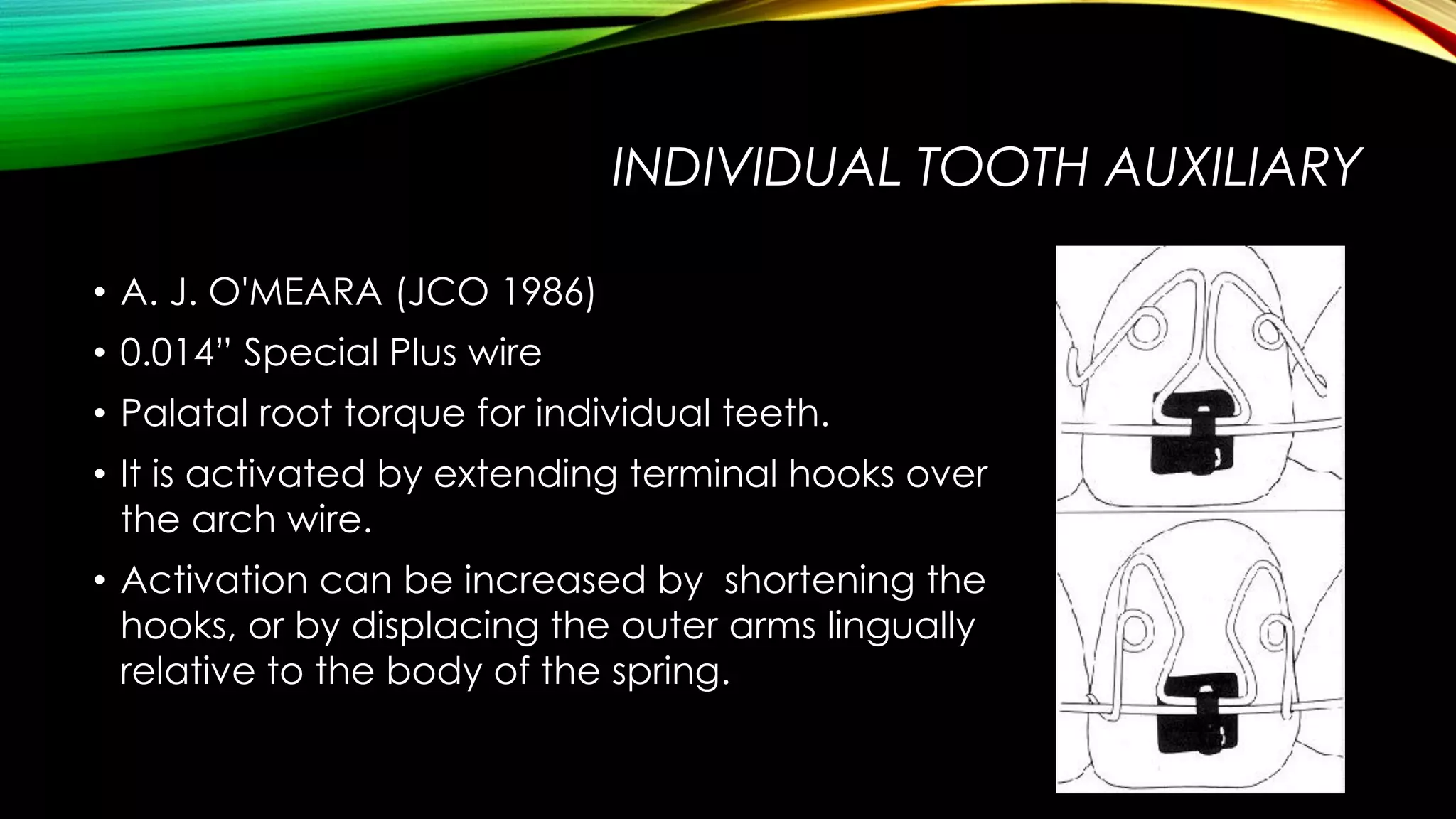
INDIVIDUAL TOOTH AUXILIARY
• A. J. O'MEARA (JCO 1986)
• 0.014” Special Plus wire
• Palatal root torque for individual teeth.
• It is activated by extending terminal hooks over
the arch wire.
• Activation can be increased by shortening the
hooks, or by displacing the outer arms lingually
relative to the body of the spring.
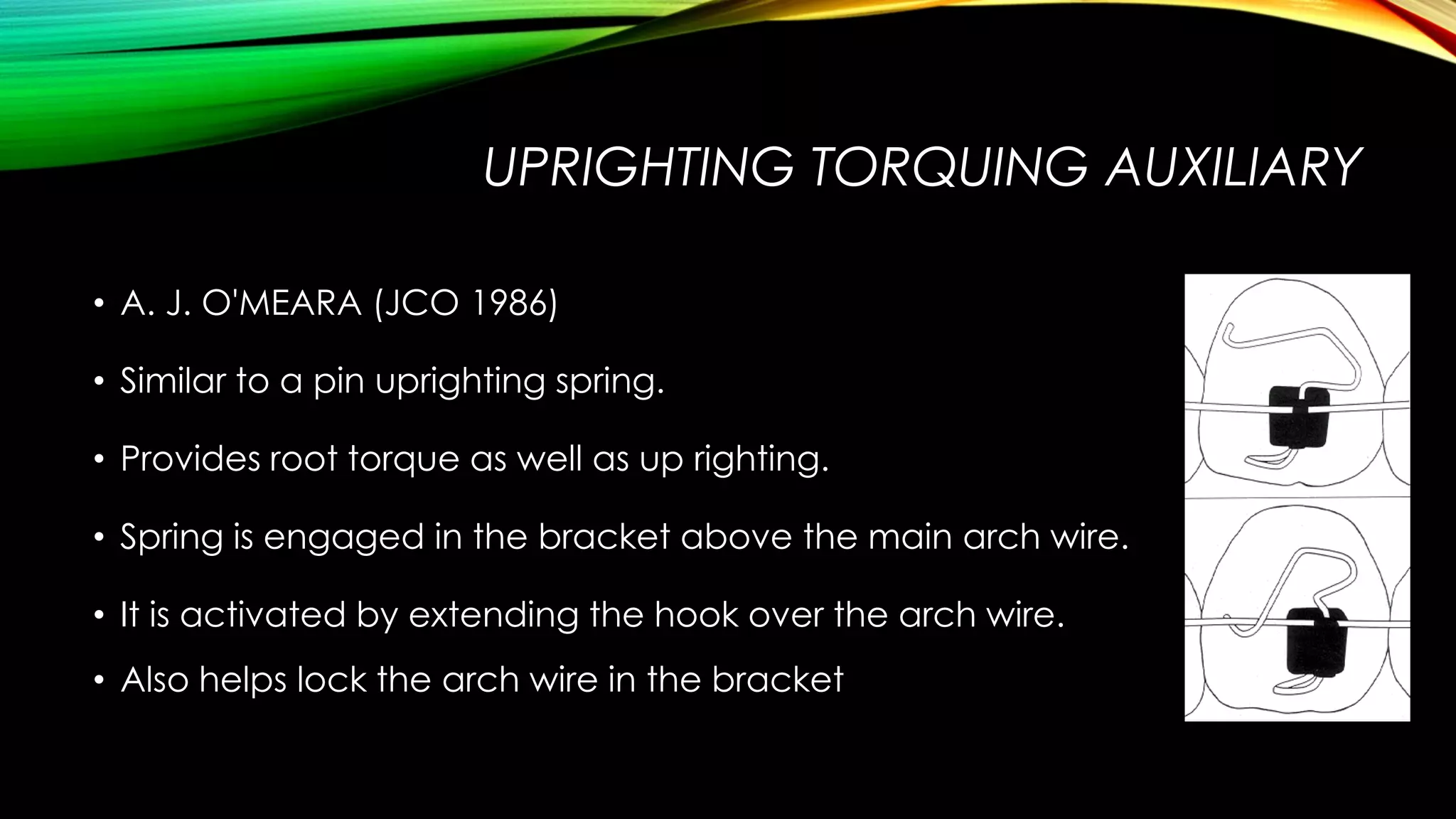
UPRIGHTING TORQUING AUXILIARY
• A. J. O'MEARA (JCO 1986)
• Similar to a pin uprighting spring.
• Provides root torque as well as up righting.
• Spring is engaged in the bracket above the main arch wire.
• It is activated by extending the hook over the arch wire.
• Also helps lock the arch wire in the bracket
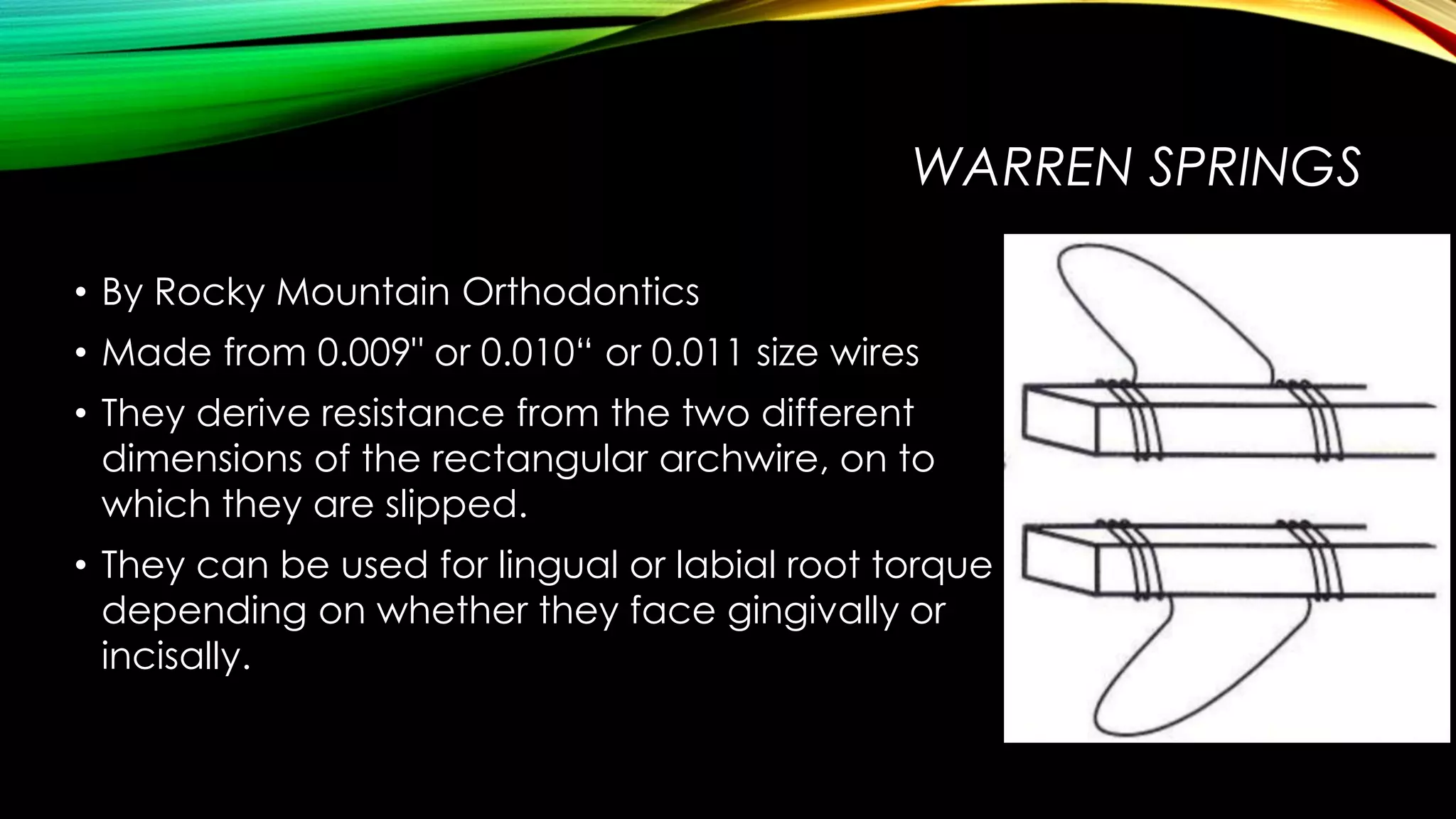
WARREN SPRINGS
• By Rocky Mountain Orthodontics
• Made from 0.009" or 0.010“ or 0.011 size wires
• They derive resistance from the two different
dimensions of the rectangular archwire, on to
which they are slipped.
• They can be used for lingual or labial root torque
depending on whether they face gingivally or
incisally.
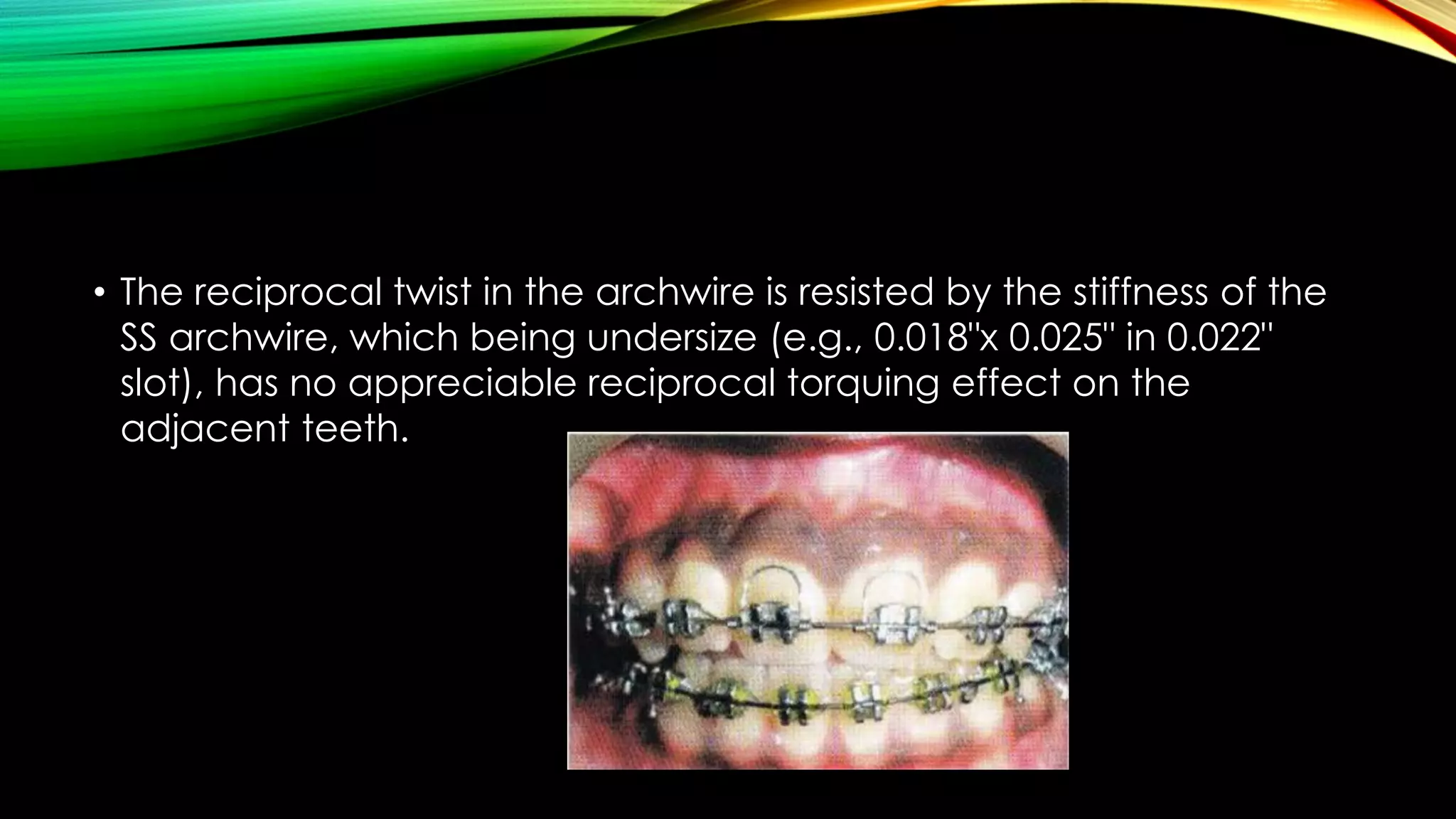
• The reciprocal twist in the archwire is resisted by the stiffness of the
SS archwire, which being undersize (e.g., 0.018"x 0.025" in 0.022"
slot), has no appreciable reciprocal torquing effect on the
adjacent teeth.
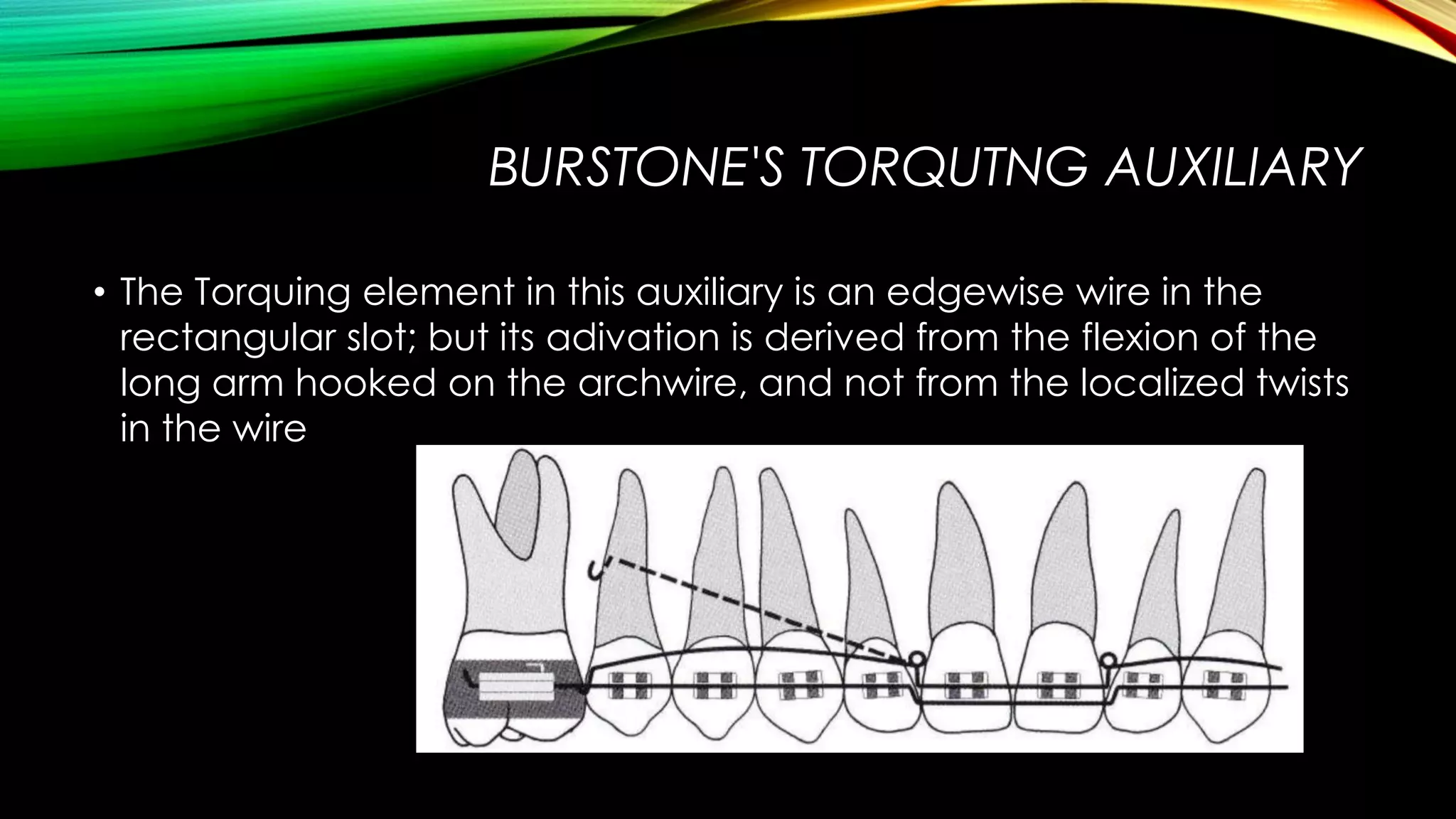
BURSTONE'S TORQUTNG AUXILIARY
• The Torquing element in this auxiliary is an edgewise wire in the
rectangular slot; but its adivation is derived from the flexion of the
long arm hooked on the archwire, and not from the localized twists
in the wire
• Particularly useful in Class II division 2 cases in which maxillary
central incisors need a large amount of torque
• It is made in near full size edgewise SS or TMA rectangular wires
(0.017"x 0.025" in 0.018" slot and 0.019"x 0,025" in 0.022" slot).
• Proffit: 0.021 × 0.025 in 0.022 slot
• If made in SS, helices are added to reduce the force deflection
rate.
• The long arms provide the torquing effect when the end loops are
brought occlusally to engage on to the archwire
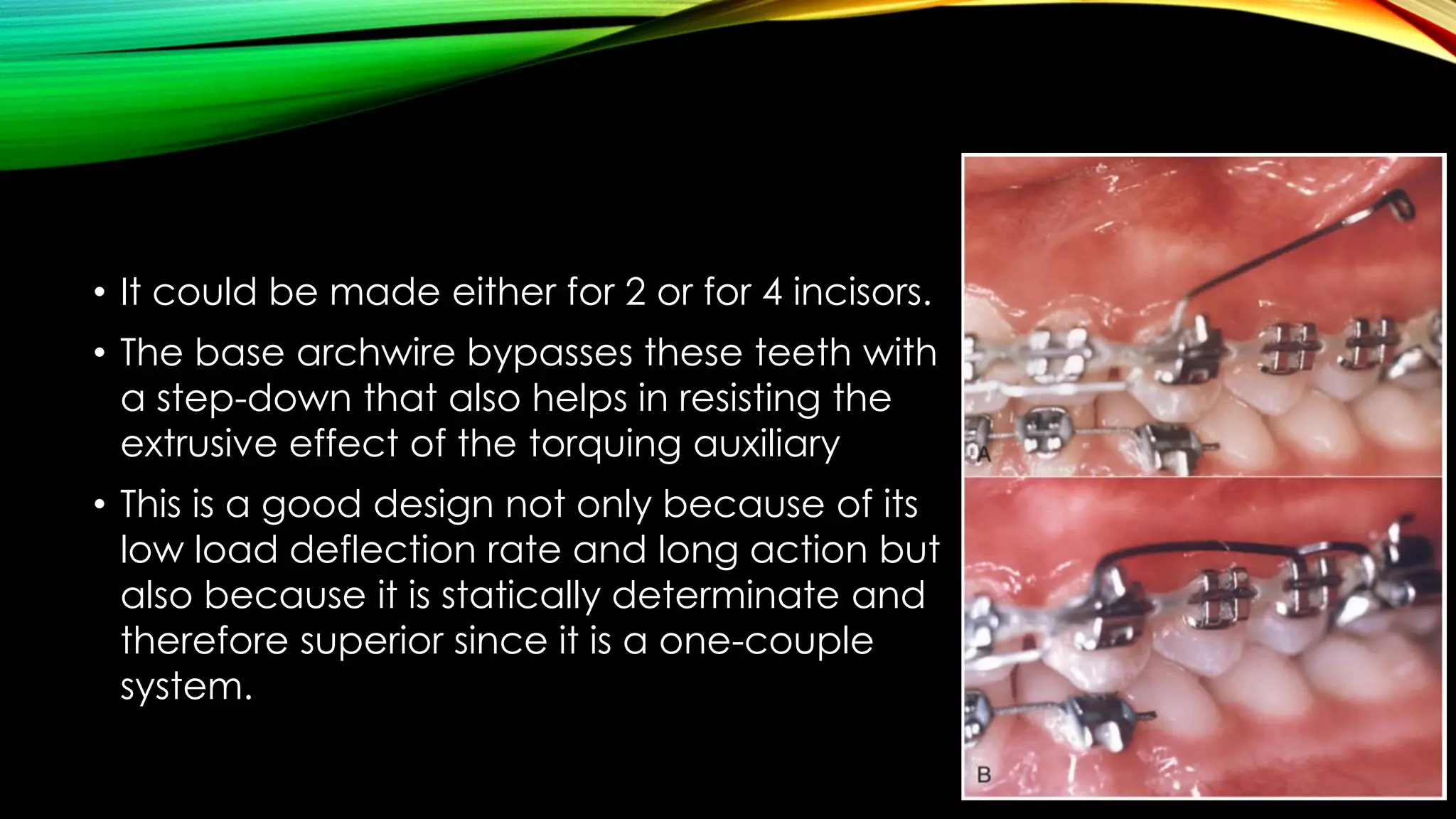
• It could be made either for 2 or for 4 incisors.
• The base archwire bypasses these teeth with
a step-down that also helps in resisting the
extrusive effect of the torquing auxiliary
• This is a good design not only because of its
low load deflection rate and long action but
also because it is statically determinate and
therefore superior since it is a one-couple
system.
Kesling P C, AJODO, 1988
Kesling P C, AJODO, 1989
Kesling P C, JCO, 1999
MOLLENHAUER’S ALIGNING AUXILIARY (MAA)
• Mollenhauer B, Aust Orth J, 1990
• 0.009” supreme grade wire
• Development
• Precursor “Spec” in 0.010” wire; Forces generated were relatively
high.
• 0.009” Supreme wire become available in 1984.
• Initially used as aligning wire (AOJ’87) then
as aligning rectangles- MAA (AOJ’90)
Requirements
1) Ultra light root moving forces. Hence
a) 0.009” wire
b) reciprocal torque not more than 450
2) Yet, wire must be resilient to resist deformation.
Hence supreme grade, preferably pulse straightened.
3) Strong base wire to resist the vertical and transverse reactive
forces. Hence 0.018” Premium plus.
4) Thickest possible lock pins or hook pins
(e.g. Ceramaflex pin) for transmitting
lingual root torque to teeth ( since
auxiliaries are kept incisally for better
hygiene).
Advantages of MAA according to Mollenhauer
1. Efficacy of intrusion and retraction.
2. Reciprocability of torque ( on in-standing laterals or palatally
placed canines). Hence periodontal benefits ( gingival
dehiscence prevented).
3. Early root control with short stage III
4. Possibility of cortical bone growth ( at point A and point B).
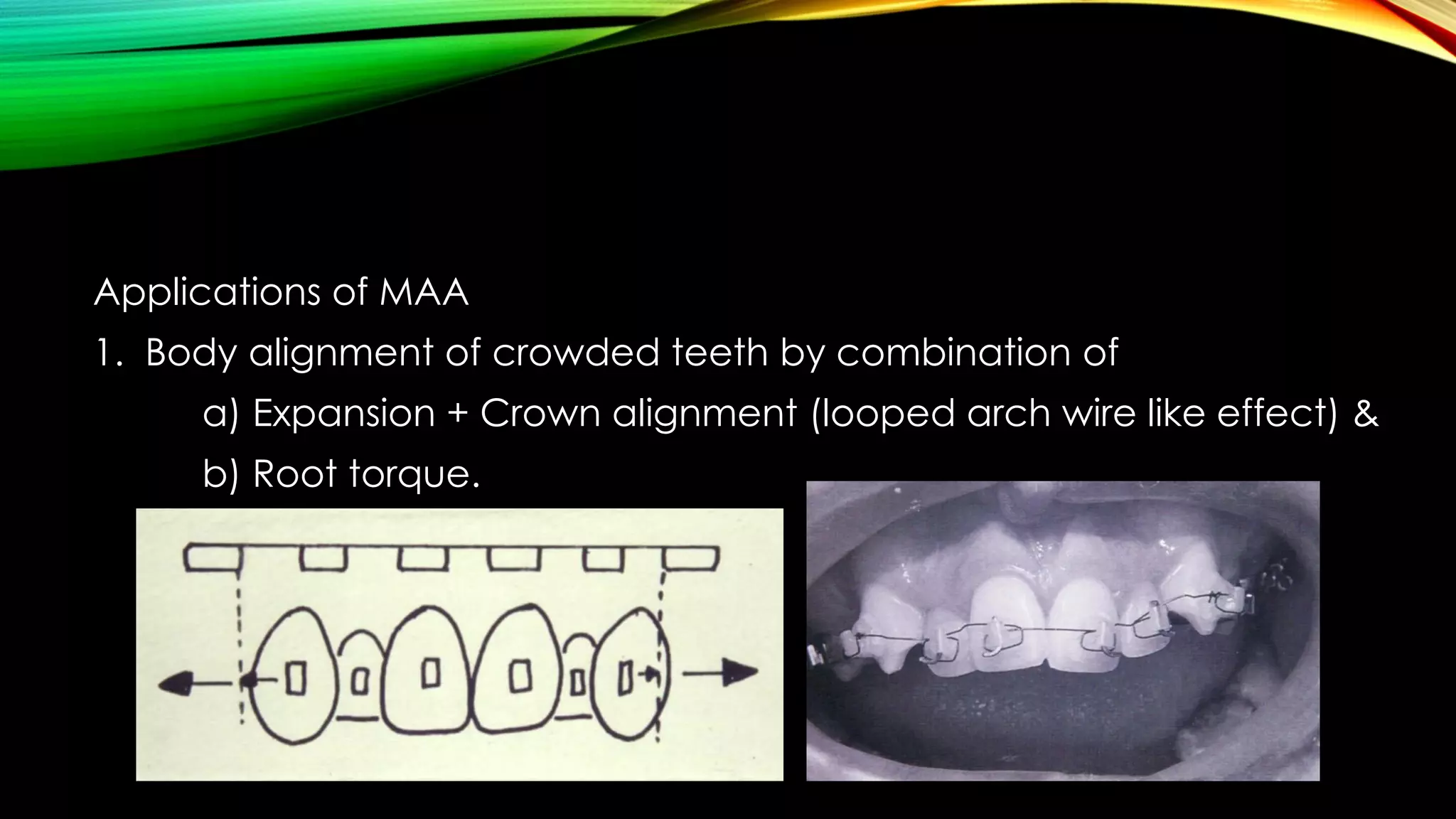
Applications of MAA
1. Body alignment of crowded teeth by combination of
a) Expansion + Crown alignment (looped arch wire like effect) &
b) Root torque.
2) After stage I as braking mechanics
( by bending more positive torque)
3) For labial root torque on
a) Lower incisor in class II
b) Upper incisor in class III (For cortical bone development)
4) MAA- tip for controlling Mesio-distal angulation of root apices in
stage I
Modification of MAA
• With available pins holding down the boxes for lingual root torque
was difficult.
• So, torquing action of MAA is directly applied on gingival surface of
teeth.
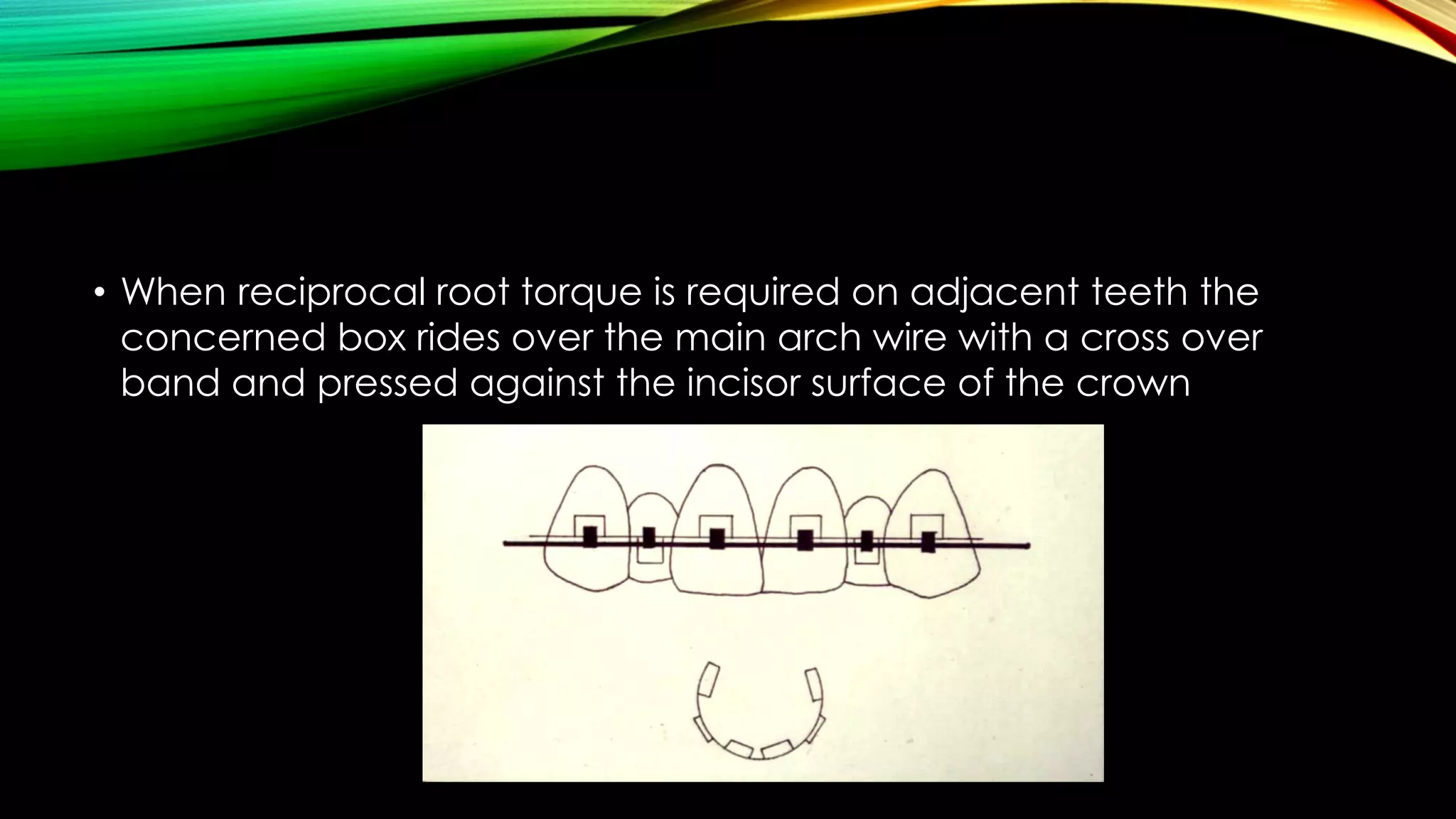
• For this base wire is engaged first and MAA is engaged piggy back
• When reciprocal root torque is required on adjacent teeth the
concerned box rides over the main arch wire with a cross over
band and pressed against the incisor surface of the crown
CONCLUSION
• Torque is probably one of the most important and potent forces of
orthodontic treatment mechanism.
• With proper understanding and systemic technical approach, it is
not difficult to accomplish.
• The operator’s ability to control torque properly will mean the
difference between artistically treated cases that has all esthetic
beauty desired in a finished denture and an ordinary tooth
straightening accomplishment that contains very few of these
desirable features.
• The auxiliaries provide adequate forces which can be easily
controlled by the clinician thus providing aesthetic results.
• After proper knowledge and practice, it depends upon the
operator to decide which auxiliary to use.
• With the continuously evolving techniques and introduction of 3rd
generation Straight wire appliance, the torque has now been
incorporated into the brackets (either in face or base)
• Thus the need of different auxiliary has reduced thereby reducing
the extra bulk of wire in the mouth and thus decreasing the
chances of plaque accumulation and facilitating good oral
hygiene.
• Still some clinicians sometimes depend on these torquing auxiliaries
to provide torque to a single tooth as it has more control on the
tooth and provide a light continuous force.
REFERENCES
• Dr. Vijay P. Jayade, Dr. Chetan V. Jayade, REFINED BEGG FOR MODERN TIMES,
September 2001
• Dr. Vijay P. Jayade, Dr. Chetan V. Jayade, Essentials of Orthodontic Biomechanics
• William R. Proffit, Contemporary Orthodontics, 6th edition, 2019
• Chakraborty P, Mathur P, Mahajan S and Tandon R, Torquing Auxiliaries - A Review. SF J
Oral Med Dent Health. 2020; 1(1): 1002.
• Begg PR. Differential force in orthodontic treatment. Am J Orthod.1956;42:481- 510.
• Mollenhauer B. An aligning auxiliary for ribbon arch brackets: Rectangular boxes from
ultrafine high tensile wires. Aust Orthod J. 1990;11:219-26.
• Kesling CK. Improving incisor torque control with nickel titanium torque bars. J Clin
Orthod.1999;33:224-30
• Ivor M. D’Souza, Kiran Kumar H.C., K. Sadashiva Shetty, V. Kishore, The Rat Trap Lingual
Torquing Auxiliary, JCO, Dec 2013

The Root Torqueing Auxiliaries in Orthodontics

  • 1.
    ROOT TORQUING AUXILIARIES ARUNBOSCO JERALD 2018 BATCH
  • 2.
    CONTENTS • Introduction • Historicalbackground • The Torquing Auxiliary with Spurs • Four spurs • 2 spurs (van der Heydt auxiliay) • Short 4 spurs • Reciprocal • One to one reciprocal torquing auxiliary • SPEC auxiliary • Reverse torqueing auxiliary • Brandt type • Udder type • Tan auxiliary • Pre–wound torquing auxiliary (rat trap) • Single root-torquing auxiliary • Individual torquing auxiliary • Jenner auxiliary • Labial root torque only on the lateral incisors
  • 3.
    • Buccal roottorque on the molars • Vertical auxiliary • Kitchton auxiliary • Universal Torquing Spring • Individual tooth Auxiliary • Uprighting Torquing Auxiliary • Warren springs • Burstone's torquing auxiliary • Torquing Flaps • Side Winder Spring • Torquing Bar • Mollenhauer’s Aligning Auxiliary (MAA) • Goodman torqueing Springs • Simple individual Tooth Torqueing (SITT) • Single tooth torqueing auxiliary • Conclusion • References
  • 4.
    INTRODUCTION • Torque isa vital ingredient in the achievement of optimal esthetics, function and health of teeth and surrounding tissues, as also in stability of the treatment results. • The word "torque" IiteraIly means "twist". • In orthodontic parlance, the term is used in two ways. • When we say that the archwire is torqued for lingual root torque, it refers to a twist in the rectangular archwire and then to the tooth displacement obtained from such a twist
  • 5.
    • The torquingdisplacement could be from application of any third order couple → from a torquing auxiliary and not necessarily from a rectangular wire twist.
  • 6.
    • In thelatter context, torque actually would mean the facio-lingual rotation of a tooth around its mesio-distal axis that passes through the Centre of Resistance. • In common usage, however, it is generally implied that the crown of the rotating tooth is restricted from getting displaced, permitting only a facio- lingual displacement of the root
  • 7.
    HISTORICAL BACKGROUND • Thepioneers in Orthodontics realized the importance of torque from early days, and endeavored to incorporate torque control in their appliances. • Two early appliances attempting such control viz. that of Calvin Case and the Pin and tube appliance of Angle did not become popular; but the subsequent developments gave orthodontic specialty two main mechanisms of applying torque.
  • 8.
    • One wasAngle's innovation (1928) of obtaining torque from torsion in a rectangular archwire (in the ribbon and edgewise modes respectively In the Ribbon arch and Edgewise appliances), which got widespread acceptance. • Later, Dr. P R Begg (1956) designed a torquing auxiliary made in round wire to be used alongside the base archwire. • In this technique Australian archwire (A. J. Wilcock) was used in all the stages.
  • 9.
    • For torque,he used different torquing auxiliaries, instead of relying on the torsion of the wire (third order bend). • He used various torquing auxiliaries for torque forces in which force levels differed by • the number of coils used • degree of activation and • the dimension of the wire
  • 10.
    • Andrews (1972)totally changed the concept of incorporating torque separately by introducing his fully programmed bracket system (Straight Wire Appliance-SWA) in which he incorporated slot sitting features and even inclined the base of bracket to reduce bending of archwire. • Proffit (1986) quoted a force of 75-125 gm being suitable for torquing movements. • The lower end of the range was considered suitable for teeth with small root area, whilst higher forces would be appropriate for teeth with larger roots.
  • 11.
    • Kesling (1986)combined Angle’s edgewise bracket system with the differential force concept of Begg for his Tip Edge system (Preadjusted Edgewise). • In this system, each bracket had the requirement of a torquing auxiliary for achieving the final prescription similar to Begg philosophy. • Further later, next generations of SWA; Roth philosophy and MBT prescription used the inbuilt features at the base of the bracket instead of using any kind of auxiliary.
  • 12.
    • Conceptually, thespecial feature of the Begg appliance in separating the root moving forces from the archwire forces gives it a unique advantage, as pointed out by Kesling. • The reactions generated by the former are spread through the archwire on to the entire arch, rather than predominantly expressing on the adjacent teeth.
  • 13.
    • The roottorquing auxiliaries developed by Dr. Begg viz. the ’Spur’ design (having four, two, or six spurs) and the 'Mouse-trap' for lingual root torque, and the 'Udder arch' for labial root torque have stood the test of time. • Many other ingenious designs like the Vander Hydt, Kitchton and ART (anterior root torquing) auxiliaries were introduced subsequently.
  • 14.
    THE TORQUING AUXILIARYWITH SPURS • The auxiliary bent into a small circle, when fixed in the mouth, is spread out along the wider anterior curvature of the archwire.
  • 15.
    • The lingualtorqueing effect is on account of two factors • Firstly, the vertical plane in which the torquing auxiliary orients when fitted on the two central incisors is changed to the horizontal plane of the archwire when fully tied to it. • Secondly, when the torquing auxiliary is opened to the larger arc of anterior portion of the archwire, it rolls inwards.
  • 16.
    • Both theseeffects force the tips of the spurs to press in a lingual direction against the gingival portion of the crowns. • Reciprocally, their inter-spur spans of the auxiliary tend to lift away in a labial direction. • Thus a force couple is created. • The labial forces are resisted by the bracket slots and the base archwire to which the auxiliary is tied, thus accentuating the action of the lingual root moving forces
  • 17.
    • The auxiliaryis now made from 0.012” Premium Plus wire(preferably pulse straightened) unlike in 0.014” or 0.016” Special Plus wire previously used. • Considering identical activations, a short spur will produce much greater force that will drop rapidly when the teeth start getting torqued; a longer spur will produce a gentler and more constant force. • On an average, the length of the spur should be kept at about 5mm; but it should be varied depending on the clinical crown height, leaving it about 1mm short of the gum to facilitate proper hygiene
  • 18.
    • Inclination ofthe spurs to the horizontal (occlusal) plane is kept 0° • The auxiliary, being made of a lesser diameter wire, is likely to deform more than the previous heavy auxiliaries when engaged in all the brackets. • Thus, the angle of the spur from the inter-spur span opens up and the legs of the spur tend to converge and may even cross each other on tying the auxiliary in the mouth.
  • 20.
    • This isremedied by slightly over angulating the spur and by keeping the legs a little divergent. • On placing in the mouth, the tips of the spurs will move to the mesio-distal center of the crowns, and the legs also will become parallel. • For the same reason, the distal leg of every spur is kept slightly shorter by about 0.5 mm, so that the distal leg does not project incisally to the main archwire on tying
  • 21.
    • The inter-spurspan is curved as recommended by Kesling • If it is kept straight or angulated midway it does not rest entirely on the base wire but starts projecting away. • This is because the tied torquing auxiliary has to follow the shape of anterior curvature of the archwire. • A straight or angulated inter-spur span cannot assume a perfect curvature
  • 23.
    • A curvedauxiliary running piggyback smoothly over the base wire not only looks neat and is more hygienic. • It also transfers its reaction better to the entire arch rather than the one which touches the latter only at few points • The constructed auxiliary takes the shape of an open-ended circle • The normally recommended size of the circle is an old 50 paise coin. • The forces generated by the auxiliary increase with a decrease in the diameter of the circle and vice-versa.
  • 24.
    Modifications a) Reverse (labial)torque on one or both the lateral incisors: - Boxes at right angle to the plane of the spurs are made to lie at the incisal area of the lateral incisor(s). Crossover bends are made on either side of the lateral incisor bracket to permit the auxiliary to pass over the base wire
  • 25.
    b) Torquing boxeson the canines for lingual root torque: - Instead of making spurs for the canines, boxes can be provided. The ends of this auxiliary need not extend beyond the canine area
  • 28.
    RECIPROCAL TORQUEING AUXILIARY(‘SPEC’ DESIGN) • This torquing mechanism is employed when two adjacent teeth require root torque in opposite directions. • An instanding lateral incisor needing labial root torque for its bodily correction, and the adjacent canine needing lingual root torque because its root is very prominent. • The ‘Spec’ auxiliary made in lighter 0.009” or 0.010” size wires could be used for controlling the root movements during the first and second stages.
  • 29.
    • Very often,the canine is mesially angulated, and is thus likely to obstruct labial movement of the lateral incisor root. • A light uprighting spring must be simultaneously placed on the canine to remove such interference. • If needed for the stage III, it should be made in 0.012” size wire.
  • 30.
    • The boxon the tooth requiring labial root torque is placed incisal to the main wire, while the box on the other tooth requiring lingual root torque sits piggyback on the main wire. • Hence a crossover bend is required between the two adjacent teeth because the auxiliary has to cross over the mainwire. • Varying the angulation between the planes of the two boxes can control the force generated by the auxiliary.
  • 31.
    Spec auxiliary withcrossover bends. Note the uprighting spring on the canine for moving its root away from that of the lateral incisor.
  • 32.
    REVERSE TORQUEING AUXILIARY •Reverse root torquing auxiliary has the objective of repositioning the mandibular incisor roots and bringing them forward in a controlled manner • Indications 1. Bimaxillary proclination or class II div. 1 2. Almost all non-extraction cases 3. To increase the mandibular anchorage
  • 33.
    • Two typesare used 1. Brandt type 2. Udder type
  • 34.
    TAN AUXILIARY • Reversetorqueing auxiliary for controlling the roots of canines or premolars • Franciskus Tan (J Clin Orth, 1987) • It was described for the labial root movement of a palatally impacted maxillary canine, whose crown has been aligned but the root is still placed palatally and needs labial root torque. • However, if required for lingual root torque in other situations, it is simply inverted.
  • 35.
    • It couldbe used equally well on the premolars • It is made from 0.012” P+ wire and fitted in conjunction with a 0.018” or 0.020” base wire. • It is inserted in the molar tube from the distal end. • An offset is placed in the auxiliary to bypass the main wire.
  • 36.
    • In theoriginal article it was rotated by 180° for activating; but, V P Jayade suggests activation by 90° rotation • In order to resist the palatal root torque on the molar that arises as a reaction from the auxiliary, the molars are stabilized with a TPA
  • 37.
    PRE–WOUND TORQUING AUXILIARY(RAT TRAP) • Designed by Begg in 1955. • Used for torqueing the maxillary anterior roots palatally • Bending was originally hand done but now available commercially in graded size. • Usually wound from 0.014“– 0.016“ round wire about a 0.020“ main arch wire. • A small incisal offset or V in the midline of the main arch acts as reciprocating stop for auxiliary
  • 38.
    SINGLE ROOT-TORQUEING AUXILIARY •Proposed by Kesling (1996) • This is a very useful design for any tooth (excepting molars) requiring root torque in the labial or lingual direction. • It is particularly indicated on an upper premolar, which needs buccal root torque to eliminate cuspal interference from its hanging palatal cusp.
  • 39.
    • It isconvenient to place the long arm of the auxiliary piggyback over the main archwire since it need not be untied, but it could lie occlusal to the base wire in the slot as well. • The long arm should extend to three to four adjacent teeth when engaged in the brackets. • The long arm always faces mesially for the premolar teeth • Depending on how the curvature is pointing before the auxiliary is tied, the torque generated will have lingual (palatal) or buccal root moving effect.
  • 40.
    • For example,the auxiliary fitted with its convexity facing upwards will have a buccal root torquing effect on the upper premolars, but the effect will be for lingual root torque on the lowers, and vice- versa. • The effect is transmitted by the vertical extension of the auxiliary through the bracket pillar onto the tooth; unlike most other auxiliaries, which exert force directly on the tooth surface.
  • 42.
    • The longarm could face either mesially or distally on the anterior teeth, and the action will depend on how the curvature of the long arm relates to the base archwire. • The auxiliary is usually made in 0.012 size Premium Plus wire, but could be made in thinner wires for smaller teeth like the lower incisors. • The force generated by it can be varied by changing acuity of the curvature. • More acute the curve, greater is the force generated.
  • 45.
    LABIAL ROOT TORQUEONLY ON THE LATERAL INCISORS • This design is similar to the Jenner auxiliary. • However, it is shorter, made from 0.012” size wire and is placed with the convexity of the auxiliary facing gingivally. • The auxiliary is engaged first in the incisor brackets and the main wire is then engaged piggyback. • The boxes extend labially on the incisal area of the crowns.
  • 47.
    BUCCAL ROOT TORQUEON THE MOLARS • Auxiliary made in 0.014” size wire is fitted in the round molar tubes alongside the main archwire. • It has ‘boot’ design occlusal extensions on the molars, and it is inserted from the mesial end of the molar tubes. • The boot portion is twisted lingually and given a toe-in and the whole auxiliary is suitably contracted. • The auxiliary need not be engaged in other brackets. • It can be ligated to the main wire at 2 - 3 places on either side.
  • 49.
  • 50.
    INDIVIDUAL TOOTH AUXILIARY •A. J. O'MEARA (JCO 1986) • 0.014” Special Plus wire • Palatal root torque for individual teeth. • It is activated by extending terminal hooks over the arch wire. • Activation can be increased by shortening the hooks, or by displacing the outer arms lingually relative to the body of the spring.
  • 51.
    UPRIGHTING TORQUING AUXILIARY •A. J. O'MEARA (JCO 1986) • Similar to a pin uprighting spring. • Provides root torque as well as up righting. • Spring is engaged in the bracket above the main arch wire. • It is activated by extending the hook over the arch wire. • Also helps lock the arch wire in the bracket
  • 52.
    WARREN SPRINGS • ByRocky Mountain Orthodontics • Made from 0.009" or 0.010“ or 0.011 size wires • They derive resistance from the two different dimensions of the rectangular archwire, on to which they are slipped. • They can be used for lingual or labial root torque depending on whether they face gingivally or incisally.
  • 53.
    • The reciprocaltwist in the archwire is resisted by the stiffness of the SS archwire, which being undersize (e.g., 0.018"x 0.025" in 0.022" slot), has no appreciable reciprocal torquing effect on the adjacent teeth.
  • 54.
    BURSTONE'S TORQUTNG AUXILIARY •The Torquing element in this auxiliary is an edgewise wire in the rectangular slot; but its adivation is derived from the flexion of the long arm hooked on the archwire, and not from the localized twists in the wire
  • 55.
    • Particularly usefulin Class II division 2 cases in which maxillary central incisors need a large amount of torque • It is made in near full size edgewise SS or TMA rectangular wires (0.017"x 0.025" in 0.018" slot and 0.019"x 0,025" in 0.022" slot). • Proffit: 0.021 × 0.025 in 0.022 slot • If made in SS, helices are added to reduce the force deflection rate. • The long arms provide the torquing effect when the end loops are brought occlusally to engage on to the archwire
  • 56.
    • It couldbe made either for 2 or for 4 incisors. • The base archwire bypasses these teeth with a step-down that also helps in resisting the extrusive effect of the torquing auxiliary • This is a good design not only because of its low load deflection rate and long action but also because it is statically determinate and therefore superior since it is a one-couple system.
  • 57.
    Kesling P C,AJODO, 1988 Kesling P C, AJODO, 1989 Kesling P C, JCO, 1999
  • 58.
    MOLLENHAUER’S ALIGNING AUXILIARY(MAA) • Mollenhauer B, Aust Orth J, 1990 • 0.009” supreme grade wire • Development • Precursor “Spec” in 0.010” wire; Forces generated were relatively high. • 0.009” Supreme wire become available in 1984. • Initially used as aligning wire (AOJ’87) then as aligning rectangles- MAA (AOJ’90)
  • 59.
    Requirements 1) Ultra lightroot moving forces. Hence a) 0.009” wire b) reciprocal torque not more than 450 2) Yet, wire must be resilient to resist deformation. Hence supreme grade, preferably pulse straightened. 3) Strong base wire to resist the vertical and transverse reactive forces. Hence 0.018” Premium plus.
  • 60.
    4) Thickest possiblelock pins or hook pins (e.g. Ceramaflex pin) for transmitting lingual root torque to teeth ( since auxiliaries are kept incisally for better hygiene).
  • 61.
    Advantages of MAAaccording to Mollenhauer 1. Efficacy of intrusion and retraction. 2. Reciprocability of torque ( on in-standing laterals or palatally placed canines). Hence periodontal benefits ( gingival dehiscence prevented). 3. Early root control with short stage III 4. Possibility of cortical bone growth ( at point A and point B).
  • 62.
    Applications of MAA 1.Body alignment of crowded teeth by combination of a) Expansion + Crown alignment (looped arch wire like effect) & b) Root torque.
  • 63.
    2) After stageI as braking mechanics ( by bending more positive torque) 3) For labial root torque on a) Lower incisor in class II b) Upper incisor in class III (For cortical bone development) 4) MAA- tip for controlling Mesio-distal angulation of root apices in stage I
  • 64.
    Modification of MAA •With available pins holding down the boxes for lingual root torque was difficult. • So, torquing action of MAA is directly applied on gingival surface of teeth. • For this base wire is engaged first and MAA is engaged piggy back
  • 65.
    • When reciprocalroot torque is required on adjacent teeth the concerned box rides over the main arch wire with a cross over band and pressed against the incisor surface of the crown
  • 67.
    CONCLUSION • Torque isprobably one of the most important and potent forces of orthodontic treatment mechanism. • With proper understanding and systemic technical approach, it is not difficult to accomplish. • The operator’s ability to control torque properly will mean the difference between artistically treated cases that has all esthetic beauty desired in a finished denture and an ordinary tooth straightening accomplishment that contains very few of these desirable features.
  • 68.
    • The auxiliariesprovide adequate forces which can be easily controlled by the clinician thus providing aesthetic results. • After proper knowledge and practice, it depends upon the operator to decide which auxiliary to use. • With the continuously evolving techniques and introduction of 3rd generation Straight wire appliance, the torque has now been incorporated into the brackets (either in face or base)
  • 69.
    • Thus theneed of different auxiliary has reduced thereby reducing the extra bulk of wire in the mouth and thus decreasing the chances of plaque accumulation and facilitating good oral hygiene. • Still some clinicians sometimes depend on these torquing auxiliaries to provide torque to a single tooth as it has more control on the tooth and provide a light continuous force.
  • 70.
    REFERENCES • Dr. VijayP. Jayade, Dr. Chetan V. Jayade, REFINED BEGG FOR MODERN TIMES, September 2001 • Dr. Vijay P. Jayade, Dr. Chetan V. Jayade, Essentials of Orthodontic Biomechanics • William R. Proffit, Contemporary Orthodontics, 6th edition, 2019 • Chakraborty P, Mathur P, Mahajan S and Tandon R, Torquing Auxiliaries - A Review. SF J Oral Med Dent Health. 2020; 1(1): 1002. • Begg PR. Differential force in orthodontic treatment. Am J Orthod.1956;42:481- 510. • Mollenhauer B. An aligning auxiliary for ribbon arch brackets: Rectangular boxes from ultrafine high tensile wires. Aust Orthod J. 1990;11:219-26. • Kesling CK. Improving incisor torque control with nickel titanium torque bars. J Clin Orthod.1999;33:224-30 • Ivor M. D’Souza, Kiran Kumar H.C., K. Sadashiva Shetty, V. Kishore, The Rat Trap Lingual Torquing Auxiliary, JCO, Dec 2013