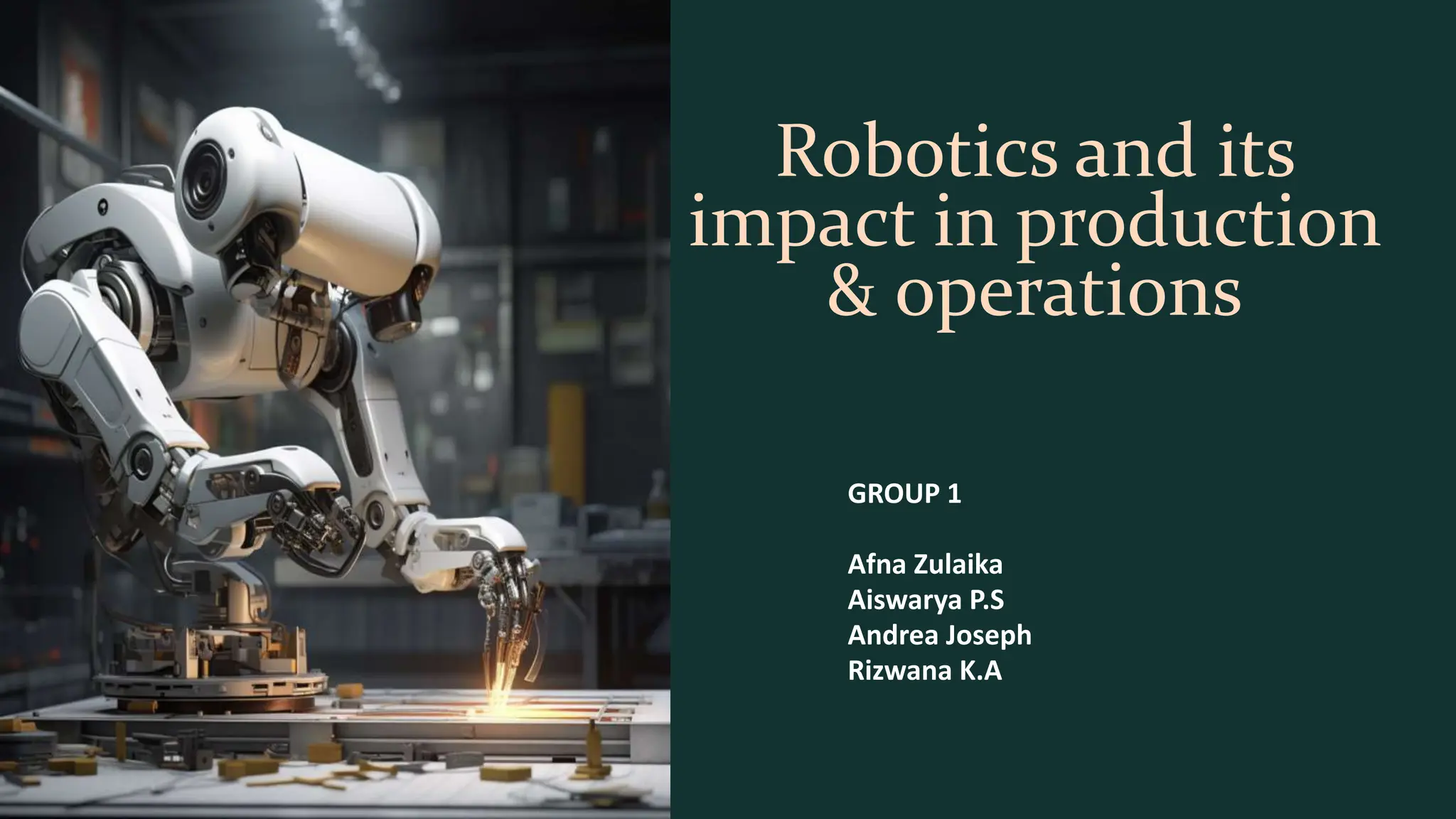
Robotics and its
impact in production
& operations
GROUP 1
Afna Zulaika
Aiswarya P.S
Andrea Joseph
Rizwana K.A
Introduction to Robotics
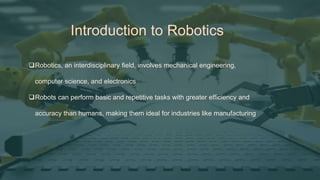
Robotics, an interdisciplinary field, involves mechanical engineering,
computer science, and electronics
Robots can perform basic and repetitive tasks with greater efficiency and
accuracy than humans, making them ideal for industries like manufacturing
Types of Robots used in Production
and Operations
Industrial Robots
These robots are used for
tasks such as welding,
painting, assembly, and
packaging.
Types of Robots used in Production
and Operations
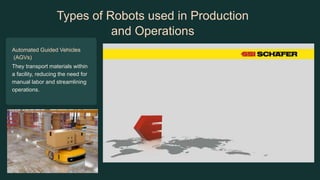
Automated Guided Vehicles
(AGVs)
They transport materials within
a facility, reducing the need for
manual labor and streamlining
operations.
Types of Robots used in Production
and Operations
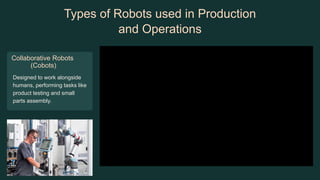
Collaborative Robots
(Cobots)
Designed to work alongside
humans, performing tasks like
product testing and small
parts assembly.
Types of Robots used in Production
and Operations
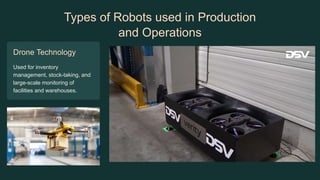
Drone Technology
Used for inventory
management, stock-taking, and
large-scale monitoring of
facilities and warehouses.
Application of Robotics in industry and
logistics
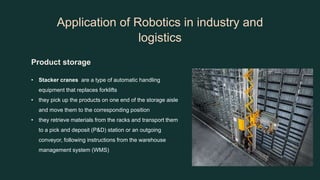
Product storage
• Stacker cranes are a type of automatic handling
equipment that replaces forklifts
• they pick up the products on one end of the storage aisle
and move them to the corresponding position
• they retrieve materials from the racks and transport them
to a pick and deposit (P&D) station or an outgoing
conveyor, following instructions from the warehouse
management system (WMS)
Application of Robotics in industry and
logistics
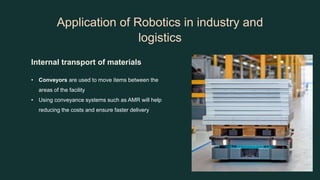
Internal transport of materials
• Conveyors are used to move items between the
areas of the facility
• Using conveyance systems such as AMR will help
reducing the costs and ensure faster delivery
Application of Robotics in industry and
logistics
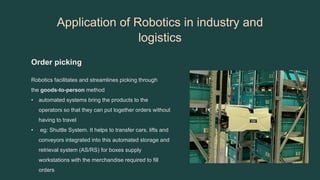
Order picking
Robotics facilitates and streamlines picking through
the goods-to-person method
• automated systems bring the products to the
operators so that they can put together orders without
having to travel
• eg: Shuttle System. It helps to transfer cars, lifts and
conveyors integrated into this automated storage and
retrieval system (AS/RS) for boxes supply
workstations with the merchandise required to fill
orders
Application of Robotics in industry and
logistics
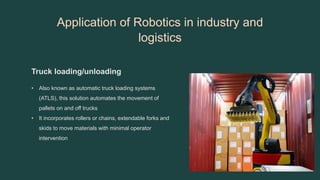
Truck loading/unloading
• Also known as automatic truck loading systems
(ATLS), this solution automates the movement of
pallets on and off trucks
• It incorporates rollers or chains, extendable forks and
skids to move materials with minimal operator
intervention
Benefits of Robotics in
Production and Operations
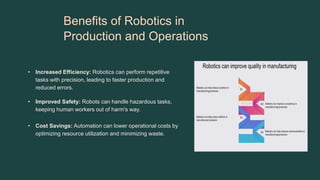
• Increased Efficiency: Robotics can perform repetitive
tasks with precision, leading to faster production and
reduced errors.
• Improved Safety: Robots can handle hazardous tasks,
keeping human workers out of harm's way.
• Cost Savings: Automation can lower operational costs by
optimizing resource utilization and minimizing waste.
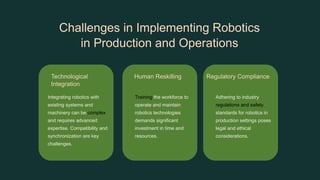
Challenges in Implementing Robotics
in Production and Operations
Technological
Integration
Integrating robotics with
existing systems and
machinery can be complex
and requires advanced
expertise. Compatibility and
synchronization are key
challenges.
Human Reskilling
Training the workforce to
operate and maintain
robotics technologies
demands significant
investment in time and
resources.
Regulatory Compliance
Adhering to industry
regulations and safety
standards for robotics in
production settings poses
legal and ethical
considerations.
Technological
Integration
Integrating robotics with
existing systems and
machinery can be complex
and requires advanced
expertise. Compatibility and
synchronization are key
challenges.
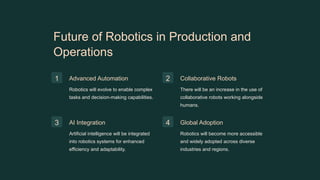
Future of Robotics in Production and
Operations
1 Advanced Automation
Robotics will evolve to enable complex
tasks and decision-making capabilities.
2 Collaborative Robots
There will be an increase in the use of
collaborative robots working alongside
humans.
3 AI Integration
Artificial intelligence will be integrated
into robotics systems for enhanced
efficiency and adaptability.
4 Global Adoption
Robotics will become more accessible
and widely adopted across diverse
industries and regions.
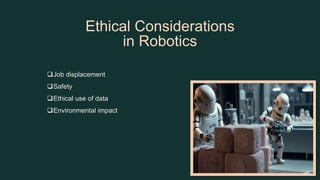
Ethical Considerations
in Robotics
Job displacement
Safety
Ethical use of data
Environmental impact
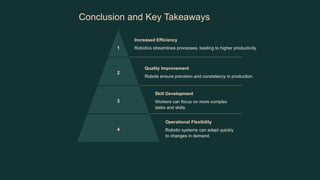
Conclusion and Key Takeaways
1
Increased Efficiency
Robotics streamlines processes, leading to higher productivity.
2
Quality Improvement
Robots ensure precision and consistency in production.
3
Skill Development
Workers can focus on more complex
tasks and skills.
4
Operational Flexibility
Robotic systems can adapt quickly
to changes in demand.
THANK YOU

Robotics in operations management for mbant

  • 1.
    Robotics and its impactin production & operations GROUP 1 Afna Zulaika Aiswarya P.S Andrea Joseph Rizwana K.A
  • 2.
    Introduction to Robotics Robotics,an interdisciplinary field, involves mechanical engineering, computer science, and electronics Robots can perform basic and repetitive tasks with greater efficiency and accuracy than humans, making them ideal for industries like manufacturing
  • 3.
    Types of Robotsused in Production and Operations Industrial Robots These robots are used for tasks such as welding, painting, assembly, and packaging.
  • 4.
    Types of Robotsused in Production and Operations Automated Guided Vehicles (AGVs) They transport materials within a facility, reducing the need for manual labor and streamlining operations.
  • 5.
    Types of Robotsused in Production and Operations Collaborative Robots (Cobots) Designed to work alongside humans, performing tasks like product testing and small parts assembly.
  • 6.
    Types of Robotsused in Production and Operations Drone Technology Used for inventory management, stock-taking, and large-scale monitoring of facilities and warehouses.
  • 7.
    Application of Roboticsin industry and logistics Product storage • Stacker cranes are a type of automatic handling equipment that replaces forklifts • they pick up the products on one end of the storage aisle and move them to the corresponding position • they retrieve materials from the racks and transport them to a pick and deposit (P&D) station or an outgoing conveyor, following instructions from the warehouse management system (WMS)
  • 8.
    Application of Roboticsin industry and logistics Internal transport of materials • Conveyors are used to move items between the areas of the facility • Using conveyance systems such as AMR will help reducing the costs and ensure faster delivery
  • 9.
    Application of Roboticsin industry and logistics Order picking Robotics facilitates and streamlines picking through the goods-to-person method • automated systems bring the products to the operators so that they can put together orders without having to travel • eg: Shuttle System. It helps to transfer cars, lifts and conveyors integrated into this automated storage and retrieval system (AS/RS) for boxes supply workstations with the merchandise required to fill orders
  • 10.
    Application of Roboticsin industry and logistics Truck loading/unloading • Also known as automatic truck loading systems (ATLS), this solution automates the movement of pallets on and off trucks • It incorporates rollers or chains, extendable forks and skids to move materials with minimal operator intervention
  • 11.
    Benefits of Roboticsin Production and Operations • Increased Efficiency: Robotics can perform repetitive tasks with precision, leading to faster production and reduced errors. • Improved Safety: Robots can handle hazardous tasks, keeping human workers out of harm's way. • Cost Savings: Automation can lower operational costs by optimizing resource utilization and minimizing waste.
  • 12.
    Challenges in ImplementingRobotics in Production and Operations Technological Integration Integrating robotics with existing systems and machinery can be complex and requires advanced expertise. Compatibility and synchronization are key challenges. Human Reskilling Training the workforce to operate and maintain robotics technologies demands significant investment in time and resources. Regulatory Compliance Adhering to industry regulations and safety standards for robotics in production settings poses legal and ethical considerations. Technological Integration Integrating robotics with existing systems and machinery can be complex and requires advanced expertise. Compatibility and synchronization are key challenges.
  • 13.
    Future of Roboticsin Production and Operations 1 Advanced Automation Robotics will evolve to enable complex tasks and decision-making capabilities. 2 Collaborative Robots There will be an increase in the use of collaborative robots working alongside humans. 3 AI Integration Artificial intelligence will be integrated into robotics systems for enhanced efficiency and adaptability. 4 Global Adoption Robotics will become more accessible and widely adopted across diverse industries and regions.
  • 15.
    Ethical Considerations in Robotics Jobdisplacement Safety Ethical use of data Environmental impact
  • 16.
    Conclusion and KeyTakeaways 1 Increased Efficiency Robotics streamlines processes, leading to higher productivity. 2 Quality Improvement Robots ensure precision and consistency in production. 3 Skill Development Workers can focus on more complex tasks and skills. 4 Operational Flexibility Robotic systems can adapt quickly to changes in demand.
  • 17.