



INVENTORY STRATEGY FOR PROCESSING INDEPENDENT
                   DEMAND
                              (A Study on Amul)


   Dissertation Submitted to Assam University, Silchar for the award of the

                     Degree of Business Administration


                                     By

                             SAGARDWIP DEY


                         Under the guidance of
                               DR D. GHOSH


            DEPARTMENT OF BUSINESS ADMINISTRATION

             JN SCHOOL OF MANAGEMENT STUDIES
                             ASSAMUNIVERSITY

                          SILCHAR – 788 011, INDIA

                                  MAY 2012
DEPARTMENT OF BUSINESS ADMINISTRATION

                                                              ASSAMUNIVERSITY

                                                                (A CentralUniversity)

                                                             SILCHAR-788011 (Assam)
                                              : 03842-270200, 270847


Dr .D.Ghosh


                                 CERTIFICATE


I certify that the work entitled “INVENTORY STRATEGY FOR PROCESSING
INDEPENDENT DEMAND” written and submitted by Sri Sagardwip Dey in partial
fulfillment of the requirement for the Degree of Master of Business Administration
is a work by him. Sri Sagardwip Dey is a very hard working and sincere student.


Dated, Silchar                       (DebomalyaGhosh)

The 16th May, 2012


                                                                                   4
Preface


I SAGARDWIP DEY declare that the project report titled “INVENTORY STRATEGY
FOR PROCESSING INDEPENDENT DEMAND” in Amul Silchar, carried out by me
under the supervision of Dr.D.Ghosh is the result of the original work done by me.

To the best of my knowledge and belief this report would not be submitted to any
other institution apart from Department of Business Administration of Assam
University or any other organization for using any purposes.

My special thanks are to Mr. Ajay Agarwal& my friends who helped me a lot in data
collection and their encouragement in the successful completion of my work.
For the Purpose of the research I have visited Amul’s warehouse, distributor &
retailers


Dated, Silchar                                  (Sagardwip Dey)
The 16th May 16, 2012


                                                                                 5
INDEX
ChaptersPage no.
   INTRODUCTION 6-7
   Introduction of study                                          7
   Objectives of study                                       7
   Scope of study                                                 7


   CONCEPTUAL & THEORITICAL FRAME                8-19
   Meaning & definition of inventory 9
   Classification of inventory                                              9
   Risk & cost associated with inventory                                    9
   Understanding inventory management                                   11
   Historical review of inventory management                            12
   Types of inventory                                                   13
   Inventory cost                                                       14
   Purpose of inventory management                                15
   Benefits of inventory management                                    15
   Inventory control techniques                                        16


   ORGANIZATION PROFILE20-50
Introduction 21
   Organization overview                                25
   Organization structure                                               28
   Production function                                            30
   Operation analysis                                                   30
   Amul supply chain              33
   Plant                                                     34


                                                                                6
Amul products                         36
Amul product history                        50


RESEARCH METHODOLOGY                  51-53
Research meaning                            52
Research design                            52
Nature of data                             52
Research type                               53
Sampling size & technique                   53


DATA ANALYSIS & INTERPRETATION        54-92
Inventory movement data                    55
Findings                                   91
Suggestions                                92
Conclusion                       92


APPENDIX                                   93-99
BIBILOGRAPHY                          100-101


                                                   7
CHAPTER – 1
INTRODUCTION


               8
INTRODUCTION OF THE STUDY
          This study is about the inventory management of Amul in Silchar town. Every
enterprise needs inventory for smooth running of its activities. It serves as a link between
the production and distribution process. The greater a time lag, the higher the requirement
of inventory the unforeseen fluctuation of inventory demand and supply of goods,
fluctuating inventory prices, necessitate the need for inventory management.

          The investment inventory constitutes the most significant part of the current
assets inventory of the under taking. Thus it is very essential to have a proper control and
management of inventory. Inventories cost account for nearly 55 percent of the cost of
production, as it is clear from an analysis of financial statements of large number of
private and public sector organizations. So, it essential to establish suitable procedures for
proper control of materials from the time of purchase order placed with supplier until
they have been consumed properly.

          This study is about how the distributors are managing their inventory, what are
the problems they are facing and what are the inventory techniques they are using to
maintain the inventory level.

OBJECTIVE OF THE STYDY

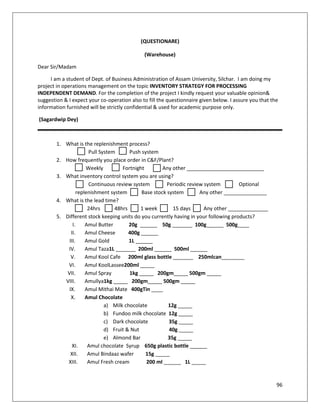
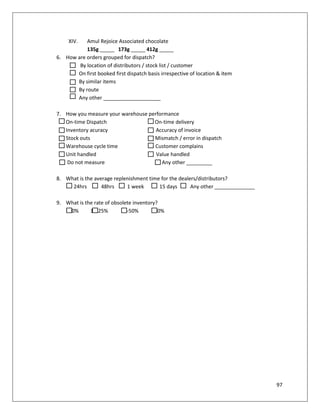
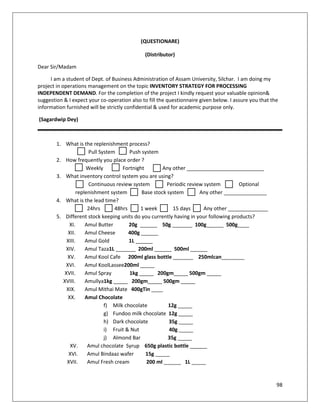
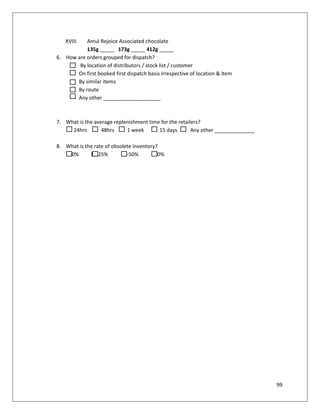
To understand the practical concept of Inventory Management &and analyze the
management technique used in managing the inventory.
To find the problems faced by retailers & distributors in selling and storing.
To collect the information about the movement of Inventory in the lower leg.

SCOPE OF THE STUDY
The study carried out in Silchar city so its scope is mainly limited to Silchar city.
It gives information about the size of the retail network.
It gives information about the services given by distributor to their retailer
It will served retailer &consumer in better manner.
It provides suggestions to the company to improve their inventory strategy.

                                                                                            9
CHAPTER – 2
CONCEPTUAL & THEORITICAL FRAME


                                 10
MEANING AND DEFINITION OF INVENTORY
The term inventory is originated from the French word Inventaire and the Latin
Inventariom which implies a list of things found. The term “inventory” has a wider
meaning then the term “Materials” or “store”.
According to the “Institute of Chartered Accountant of India” inventory means
“Tangible Property” held
       a) For sale in the ordinary course of business.
       b) In the process of production for sale.
       c) For rendering of services.


The term inventory refers to the stockpile of the products a firm is offering for sales and
the components that make up the product. Inventories are the stocks of the product of a
company, manufacturing for sale and the components that make up the product.
The various forms in which inventories exist in manufacturing company are (1) raw
material (2) work-in process, (3) finish goods and (4) store and spares. However, in
commercial parlance, inventory usually includes store, raw material, work-in process and
finish goods. The term inventory includes – raw material, work-in process, finish goods
packaging, spares and others stocked in order to meet an unexpected demand or
distribution in the future.


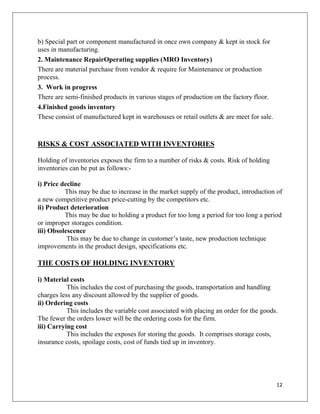
CLASSIFICATION OF INVENTORIES


                        Classificationof Inventory


Production        Work-in Progress         Finished goods     MRO inventory
Inventory


1. Production Inventory
In production inventory there are two types of productioninventory that are as follows:
a) Material, which are purchases from the market like raw material and readymade
Parts & components require for manufacturing of equipment.

                                                                                          11
b) Special part or component manufactured in once own company & kept in stock for
uses in manufacturing.
2. Maintenance RepairOperating supplies (MRO Inventory)
There are material purchase from vendor & require for Maintenance or production
process.
3. Work in progress
There are semi-finished products in various stages of production on the factory floor.
4.Finished goods inventory
These consist of manufactured kept in warehouses or retail outlets & are meet for sale.


RISKS & COST ASSOCIATED WITH INVENTORIES

Holding of inventories exposes the firm to a number of risks & costs. Risk of holding
inventories can be put as follows:-

i) Price decline
          This may be due to increase in the market supply of the product, introduction of
a new competitive product price-cutting by the competitors etc.
ii) Product deterioration
          This may be due to holding a product for too long a period for too long a period
or improper storages condition.
iii) Obsolescence
           This may be due to change in customer‟s taste, new production technique
improvements in the product design, specifications etc.

THE COSTS OF HOLDING INVENTORY

i) Material costs
           This includes the cost of purchasing the goods, transportation and handling
charges less any discount allowed by the supplier of goods.
ii) Ordering costs
           This includes the variable cost associated with placing an order for the goods.
The fewer the orders lower will be the ordering costs for the firm.
iii) Carrying cost
           This includes the exposes for storing the goods. It comprises storage costs,
insurance costs, spoilage costs, cost of funds tied up in inventory.


                                                                                          12
Understanding inventory management

Every management problem is a decision problem. Decision is an important task that all
organizations have to take. The allocation of resource is a common issue to all
organizations. Organizations have to acquire, allocate and control the factors of
production which are necessary for the achievement of the business‟s objectives.
Inventory management as one of the key activities of business logistics, has always been
a major preoccupation for the company‟s survival and growth.
The aim of inventory management is to hold inventories at the lowest possible cost, given
the objectives to ensure uninterrupted supplies for ongoing operations. When making
decisions on inventory, management has to find a compromise between the different cost
components, such as the costs of supplying inventory, inventory-holding costs and costs
resulting from insufficient inventories
According to Wild inventory control is the activity which organises the availability of
items to the customers. It coordinates the purchasing, manufacturing and distribution
functions to meet the marketing needs. This role includes the supply of current sales
items, new products, consumables; spare parts, obsolescent items and all other supplies.
Inventory enables a company to support the customer service, logistic or manufacturing
activities in situations where purchasing or manufacturing of the items is not able to
satisfy the demand. Lack of satisfaction could arise either because of the speed of
purchasing or manufacturing is too protracted, or because quantities cannot be provided
without stocks. Clodfelteradds that a good inventory control system offers the following
benefits:
    a) The proper relationship between sales and inventory can better be well maintained.
        Without inventory control procedures in place, the store or department can become
        overstocked or under stocked.
    b) Inventory control systems provide a business with information needed to take
        markdowns by identifying slow-selling merchandise. Discovering such items early
        in theseason will allow a business to reduce prices or make a change in marketing
        strategybefore consumer demand completely disappears.
    c) Merchandise control systems allow buyers to identify best-sellers early enough in
        theseason so that re-orders can be placed to increase total sales for the store or
        department.
    d) Merchandise shortages and shrinkage, can be identified using inventory
        controlsystems. Excessive shrinkage will indicate that more effective
        merchandising controlsneed to be implemented to reduce employee theft or
        shoplifting.Emphasizing the pertinence of the topic, in 2001, Gourdin noted that
        „inventory is onearea of logistics that has received a great deal of management
        attention over the pastdecade. Executives now realize that holding excessive
        stocks is simply too expensive.Therefore, a great deal of effort has been expended
        to eliminate unnecessary inventorywithout compromising customer service.
        However, there are numerous situations whereinventory simply must be held,
        particularly when meeting the needs of global customers.
                                                                                       13
Management‟s goal should be to hold only what is necessary to satisfy customer
requirements and manage it effectively‟ (Gourdin 2001:82).
Inventory problems preoccupy profit- making organizations and nonprofit institutions as
well. Inventories are common to agriculture, manufacturers, wholesalers, retailers,
hospitals, churches, prisons, zoos, universities and national, state and local governments.
Indeed, inventories are also relevant to the family unit in relation to clothing,
pharmaceutical products, food and so forth. This indicates how inventories are important
and deserve a serious attention in order to achieve organizational objectives.

Historical review of inventory management

Historically, inventory management has often meant too much inventory and too little
management or too little inventory and too much management. There can be severe
penalties for excesses in either direction. Inventory problems have proliferated as
technological progress has increased the organization‟s ability to produce goods in
greater quantities, faster and with multiple design variations. The public has compounded
the problem by its receptiveness to variations and frequent design changes .since the mid-
1980s the strategic benefits of inventory management and production planning and
scheduling have become obvious. The business press has highlighted thesuccess of
Japanese, European, North American firms in achieving unparalleled effectiveness and
efficiency in manufacturing and distribution. In recent years, many of the firms have
„raised the bar‟, yet again by coordinating with other firms in their supply chains. For
instance, instead of responding to unknown and variable demand, they share information
so that the variability of the demand they observe is significantly lower
Silver, Pyke and Peterson continue arguing that in the United States of
America and other Western Countries, productivity improvement was pursued through
reducing the amount of direct manufacturing labour expended per unit of output. This
was a valid strategy because of the high labour content in many manufactured products.
However, the proportion of unit cost due to labour has been steadily decreasing in recent
years. In fact, the ratio of purchased materials to sales (in dollars) reached 60 percent for
U.S. firms in 1985. Even large manufacturing firms, such as the U.S auto assemblers,
purchase up to 60 percent of the value of the product. This implies that management of
raw materials inventories is an area that shows great promise for productivity
improvement. Japanese firms received much deserved attention in the mid-to late 1980s
because of their remarkable performance on quality and inventory management. The
tremendous interest in Just-in-Time manufacturing (JIT) indicates that work-in-process
inventory management is also an area ripe for improvement.


                                                                                           14
Types of inventory

According to Stock and Lambert, inventories can be categorized into six distinct forms
that are:

   a) Cycle stock. Cycle stock is inventory that results from the replenishment process
      and is required in order to meet demand under conditions of certainty, that is,
      when the firm can predict demand and replenishment times (lead times) almost
      perfectly. For example, if the rate of sales for a constant 20 units per day and the
      lead time is always 10 days, no inventory beyond the cycle stock would be
      required. While assumptions of constant demand and lead time remove the
      complexities involved in inventory management, let‟s look at such an example to
      clarify the basic inventory principles.

   b) In-transit inventories. In-transit inventories are items that are en route from one
      location to another. They may be considered part of cycle stock even though they
      are not available for sale and /or shipment until after they arrive at the destination.
      For the calculation of inventory carrying costs, in-transit inventories should be
      considered as inventory at the place of shipment origin since the items are not
      available for the buyer, sale, or subsequent reshipment.


   c) Safety or buffer stock. Safety or buffer stock is held in excess of cycle stock
      because of uncertainty in demand or lead time. The notion is that a portion of
      average inventory should be devoted to cover short-range variations in demand
      and lead time. Average inventory at a stock-keeping location that experiences
      demand or lead time variability is equal to half the order quantity plus the safety
      stock.

   d) Speculation stock. Speculation stock is inventory held for reasons other than
      satisfying current demand. For example, materials may be purchased in volumes
      larger than necessary in order to receive quantity discounts, because of a
      forecasted price increase or materials shortage, or to protect against the possibility
      of a strike.


   e) Seasonal stock. Seasonal stock is a form of speculative stock that involves the
      accumulation of inventory before a season begins in order to maintain a stable
      labour force and stable production runs or, in the case of agricultural products,
      inventory accumulated as the result of a growing season that limits availability
      throughout the year.


                                                                                            15
f) Dead stock is inventory that no one wants, at least immediately. The question is
      why any organization would incur the costs associated with holding these items
      rather than simply disposing of them. One reason might be that management
      expects demand to resume at some point in the future. Alternatively, it may cost
      more to get rid of an item that it does to keep it. But the most compelling reason
      for maintaining these goods is customer service. Perhaps an important buyer has
      an occasional need for some of these items, so management keeps them on hand as
      a goodwill gesture.


Inventory costs

According to Gourdin there are three types of costs that must be considered in setting
inventory levels.

   a) Holding (or carrying) costs are costs such as storage, handling, insurance, taxes,
      obsolescence, theft and interest on funds financing the goods. These charges
      increase as inventory levels rise. In order to minimize carrying costs, management
      makes frequent orders of small quantities. Holding costs are commonly assessed
      as a percentage of unit value, i.e. 15 percent, 20 percent, rather than attempting to
      derive a monetary value for each of these costs individually. This practice is a
      reflection of the difficulty inherent in deriving a specific per-unit cost for, for
      example, obsolescence or theft.

   b) Ordering costs are those costs associated with placing an order, including expenses
      related to personnel in a purchasing department, communications and the handling
      of the related paperwork. Lowering these costs would be accomplished by placing
      a small number of orders, each for a large quantity. Unlike carrying costs, ordering
      costs are generally expressed as a monetary value per order.


   c) Stock-out costs include sales that are lost, both short and long term. These charges
      are probably the most difficult to compute, but arguably the most important
      because they represent the costs incurred by customers (internal or external) when
      inventory policies falter. Failure to understand these costs can lead management to
      maintain higher (or lower) inventory levels than customer requirements may
      justify.


                                                                                         16
PURPOSE OF INVENTORY MANAGEMENT
1. To maintain independence of operations
   Provide “optimal” amount of cushion between work centers
   Ensure smooth work flow
2. To allow flexibility in production scheduling
3. To meet variation in product demand
4. To provide a safeguard for variation in raw material or parts delivery time
   Protect against supply delivery problems (strikes, weather, natural disasters, war,
     etc.)
5. To take advantage of economic purchase-order size


BENEFITS OF INVENTORY MANAGEMENT
1.   Reduced stocking costs resulting from efficient matching of requirements to stock
2.   Re-order recommendations highlight urgent needs. Help prevent Stock-outs.
3.   Instant access to 24 month usage pattern aids decision making reveals trends. Old
data easily purged.
4.   Automatic capture on audit trail of all stock movement details helps resolve
5.    Instant month-end valuation of receipt, issues adjustment etc.
6.   Rapid stock and work-in progress evaluation.
7.   True multi-location without constraints.
8.   Easy monitoring of slow moving stocks.
9.   Automation of inventory checking cycles ensures that items are not forgotten.
Improves accuracy
10. Automatic tracking of scrap rates and recalculation of safety levels reduces effort,
improves control
11. ABC analysis system focused attention on high value stock holdings.


                                                                                     17
INVENTORY CONTROL TECHNIQUES


Inventory control techniques are employed by the inventory control organization within
the framework of one of the basic inventory models, viz. Fixed order quantity systems
or fixed order period system. Inventory control techniques represent the operational
aspect of inventory management and help realize the objectives inventory management
and control.
Several techniques of inventory control are in use and it depends on the
convenience of the firm to adopt of the techniques. What should be stressed,
however, is the need to cover all items of inventory and all stages, i.e. from the stage of
receipt from supplies to the stage of their use.
The techniques are most commonly used are the following,
      Economic Order Quantity (EOQ)
      Continuous Review
      Periodic Review Systems
      Hybrid system

Economic Order Quantity (EOQ)
How much to order –
Major decision area where focus on decision regarding how much Quantity to order at a
time is important case of inventory management. Number of techniques has been
developed to help managers in this decision. Most widely used technique is “Economic
order Quantity”. This represents the size of an order for which the total cost is
minimum economy in purchasing.
Total cost for this purpose consist 2 major costs –
a) Ordering cost or procurement cost.
b) Carrying / Holding cost. Where,

   These two types of cost are opposed to one another. The ordering cost decrease
while carrying cost increases with every increase in Qty of purchase order. So the
management has to take decision that there will be balance between 2 opposing cost to
have EOQ with minimum total cost.

How to calculate EOQ:-
1) Mathematical approach – calculate by formula.
 2 AB
  EOQ     =       --------   (in units)
                   C ×S


Where,

                                                                                         18
A = Annual usage in units
          B = Cost of placing an order
          C = cost per unit
          S = Carrying cost as a percentage of Aug inventory.
 If EOQ determined in terms of rupees where annual usage expressed in rupees by
 formula
 Annual usage = annual usage unit × unit cost.

Continuous Review
 A continuous review (Q) system, sometimes called a reorder point (ROP) system or
 fixed order-quantity system, tracks the inventory of an item each time withdrawal is
 made to determine whether it is time to reorder. In practice, these reviews are done are
 done frequently and are often continuous. At each review, a decision is made about an
 item‟s inventory position. If it is judged to be too low, the system triggers a new order.
 Inventory Position= On-Hand inventory + Scheduled receipt – Backorders
               IP = OH + SR – BO
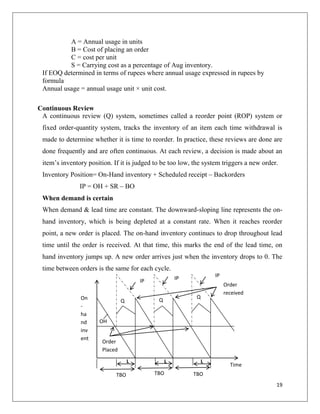
 When demand is certain
 When demand & lead time are constant. The downward-sloping line represents the on-
 hand inventory, which is being depleted at a constant rate. When it reaches reorder
 point, a new order is placed. The on-hand inventory continues to drop throughout lead
 time until the order is received. At that time, this marks the end of the lead time, on
 hand inventory jumps up. A new order arrives just when the inventory drops to 0. The
 time between orders is the same for each cycle.
                                                       IP            IP
                                        IP
                                                                          Order
                                                                          received
               On                                            Q
                                Q             Q
               -
               ha
               nd     OH
               inv
               ent
                       Order
               ory
                       Placed

                                    L              L             L
                                                                            Time
                             TBO             TBO            TBO
                                L             L              L                            19
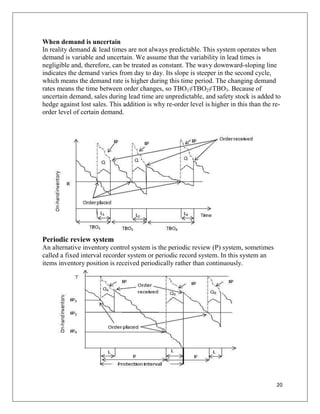
When demand is uncertain
In reality demand & lead times are not always predictable. This system operates when
demand is variable and uncertain. We assume that the variability in lead times is
negligible and, therefore, can be treated as constant. The wavy downward-sloping line
indicates the demand varies from day to day. Its slope is steeper in the second cycle,
which means the demand rate is higher during this time period. The changing demand
rates means the time between order changes, so TBO1≠TBO2≠TBO3. Because of
uncertain demand, sales during lead time are unpredictable, and safety stock is added to
hedge against lost sales. This addition is why re-order level is higher in this than the re-
order level of certain demand.


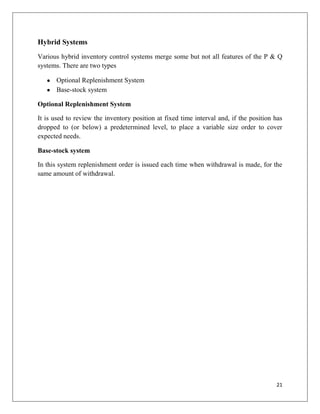
Periodic review system
An alternative inventory control system is the periodic review (P) system, sometimes
called a fixed interval recorder system or periodic record system. In this system an
items inventory position is received periodically rather than continuously.


                                                                                          20
Hybrid Systems
Various hybrid inventory control systems merge some but not all features of the P & Q
systems. There are two types

       Optional Replenishment System
       Base-stock system

Optional Replenishment System

It is used to review the inventory position at fixed time interval and, if the position has
dropped to (or below) a predetermined level, to place a variable size order to cover
expected needs.

Base-stock system

In this system replenishment order is issued each time when withdrawal is made, for the
same amount of withdrawal.


                                                                                        21
CHAPTER – 3
ORGANIZATION PROFILE


                       22
AMUL means "priceless" in Sanskrit. A quality control expert in Anand
suggested the brand name “Amul,” from the Sanskrit “Amoolya,” Variants, all meaning
"priceless", are found in several Indian languages. Amul products have been in use in
millions of homes since 1946. Amul Butter, Amul Milk Powder, Amul Ghee, Amulspray,
Amul Cheese, Amul Chocolates, AmulShrikhand, Amul Ice cream, NutrAmul, Amul
Milk and Amulya have made Amul a leading food brand in India. Today Amul is a
symbol of many things. Of high-quality products sold at reasonable prices, of the genesis
of a vast co-operative network, of the triumph of indigenous technology, of the marketing
savvy of a farmers' organization and have a proven model for dairy development.

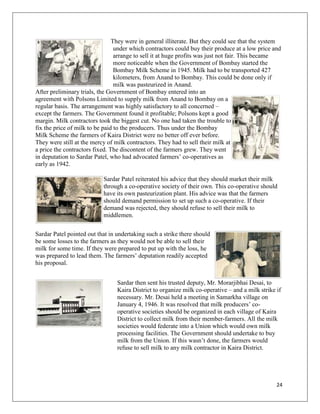
       Symbol of Amulis a ring of four hands, which are coordinated each other .The
actual meaning of this symbol is coordination of hand of different people by whom this
union is now at top.

First hand is for the farmers (producers), without whom
the organizationwould do not existed. Farmers are the
inspiration of the AMUL – the taste ofIndia.
Second hand is for the representatives of processors by
whom the raw milkprocessed into different finished
products.
Third hand is for marketers without whom the product
would have not been able toreach to the customer.
Fourth hand is for customers without whom the
organization could not carry onbecause they are the
people who consume the product. The union of
Amulwould nothave been the second biggest successful
company in the world without thecoordination of the above four hand


The Birth of Amul

Milk, The inspiration behind a revolution
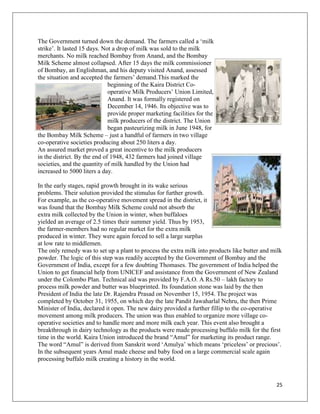
Over six decades ago the life of a farmer in Kaira was very much like that of
farmers anywhere else in India. His income was derived almost entirely from
seasonal crops. Many poor farmers faced starvation during off-seasons. Their
income from milch buffaloes was undependable. The milk marketing system
was controlled by contractors and middlemen. As milk is perishable, farmers
were compelled to sell their milk for whatever they were offered. Often they
had to sell cream and ghee at a throwaway price.


                                                                                         23
They were in general illiterate. But they could see that the system
                                 under which contractors could buy their produce at a low price and
                                 arrange to sell it at huge profits was just not fair. This became
                                 more noticeable when the Government of Bombay started the
                                 Bombay Milk Scheme in 1945. Milk had to be transported 427
                                 kilometers, from Anand to Bombay. This could be done only if
                                 milk was pasteurized in Anand.
After preliminary trials, the Government of Bombay entered into an
agreement with Polsons Limited to supply milk from Anand to Bombay on a
regular basis. The arrangement was highly satisfactory to all concerned –
except the farmers. The Government found it profitable; Polsons kept a good
margin. Milk contractors took the biggest cut. No one had taken the trouble to
fix the price of milk to be paid to the producers. Thus under the Bombay
Milk Scheme the farmers of Kaira District were no better off ever before.
They were still at the mercy of milk contractors. They had to sell their milk at
a price the contractors fixed. The discontent of the farmers grew. They went
in deputation to Sardar Patel, who had advocated farmers‟ co-operatives as
early as 1942.

                           Sardar Patel reiterated his advice that they should market their milk
                           through a co-operative society of their own. This co-operative should
                           have its own pasteurization plant. His advice was that the farmers
                           should demand permission to set up such a co-operative. If their
                           demand was rejected, they should refuse to sell their milk to
                           middlemen.


Sardar Patel pointed out that in undertaking such a strike there should
be some losses to the farmers as they would not be able to sell their
milk for some time. If they were prepared to put up with the loss, he
was prepared to lead them. The farmers‟ deputation readily accepted
his proposal.


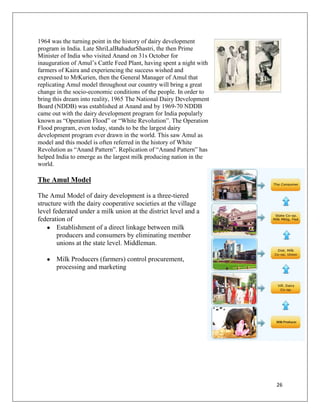
                                 Sardar then sent his trusted deputy, Mr. Morarjibhai Desai, to
                                 Kaira District to organize milk co-operative – and a milk strike if
                                 necessary. Mr. Desai held a meeting in Samarkha village on
                                 January 4, 1946. It was resolved that milk producers‟ co-
                                 operative societies should be organized in each village of Kaira
                                 District to collect milk from their member-farmers. All the milk
                                 societies would federate into a Union which would own milk
                                 processing facilities. The Government should undertake to buy
                                 milk from the Union. If this wasn‟t done, the farmers would
                                 refuse to sell milk to any milk contractor in Kaira District.


                                                                                                  24
The Government turned down the demand. The farmers called a „milk
strike‟. It lasted 15 days. Not a drop of milk was sold to the milk
merchants. No milk reached Bombay from Anand, and the Bombay
Milk Scheme almost collapsed. After 15 days the milk commissioner
of Bombay, an Englishman, and his deputy visited Anand, assessed
the situation and accepted the farmers‟ demand.This marked the
                              beginning of the Kaira District Co-
                              operative Milk Producers‟ Union Limited,
                              Anand. It was formally registered on
                              December 14, 1946. Its objective was to
                              provide proper marketing facilities for the
                              milk producers of the district. The Union
                              began pasteurizing milk in June 1948, for
the Bombay Milk Scheme – just a handful of farmers in two village
co-operative societies producing about 250 liters a day.
An assured market proved a great incentive to the milk producers
in the district. By the end of 1948, 432 farmers had joined village
societies, and the quantity of milk handled by the Union had
increased to 5000 liters a day.

In the early stages, rapid growth brought in its wake serious
problems. Their solution provided the stimulus for further growth.
For example, as the co-operative movement spread in the district, it
was found that the Bombay Milk Scheme could not absorb the
extra milk collected by the Union in winter, when buffaloes
yielded an average of 2.5 times their summer yield. Thus by 1953,
the farmer-members had no regular market for the extra milk
produced in winter. They were again forced to sell a large surplus
at low rate to middlemen.
The only remedy was to set up a plant to process the extra milk into products like butter and milk
powder. The logic of this step was readily accepted by the Government of Bombay and the
Government of India, except for a few doubting Thomases. The government of India helped the
Union to get financial help from UNICEF and assistance from the Government of New Zealand
under the Colombo Plan. Technical aid was provided by F.A.O. A Rs.50 – lakh factory to
process milk powder and butter was blueprinted. Its foundation stone was laid by the then
President of India the late Dr. Rajendra Prasad on November 15, 1954. The project was
completed by October 31, 1955, on which day the late Pandit Jawaharlal Nehru, the then Prime
Minister of India, declared it open. The new dairy provided a further fillip to the co-operative
movement among milk producers. The union was thus enabled to organize more village co-
operative societies and to handle more and more milk each year. This event also brought a
breakthrough in dairy technology as the products were made processing buffalo milk for the first
time in the world. Kaira Union introduced the brand “Amul” for marketing its product range.
The word “Amul” is derived from Sanskrit word „Amulya‟ which means „priceless‟ or precious‟.
In the subsequent years Amul made cheese and baby food on a large commercial scale again
processing buffalo milk creating a history in the world.


                                                                                               25
1964 was the turning point in the history of dairy development
program in India. Late ShriLalBahadurShastri, the then Prime
Minister of India who visited Anand on 31s October for
inauguration of Amul‟s Cattle Feed Plant, having spent a night with
farmers of Kaira and experiencing the success wished and
expressed to MrKurien, then the General Manager of Amul that
replicating Amul model throughout our country will bring a great
change in the socio-economic conditions of the people. In order to
bring this dream into reality, 1965 The National Dairy Development
Board (NDDB) was established at Anand and by 1969-70 NDDB
came out with the dairy development program for India popularly
known as “Operation Flood” or “White Revolution”. The Operation
Flood program, even today, stands to be the largest dairy
development program ever drawn in the world. This saw Amul as
model and this model is often referred in the history of White
Revolution as “Anand Pattern”. Replication of “Anand Pattern” has
helped India to emerge as the largest milk producing nation in the
world.

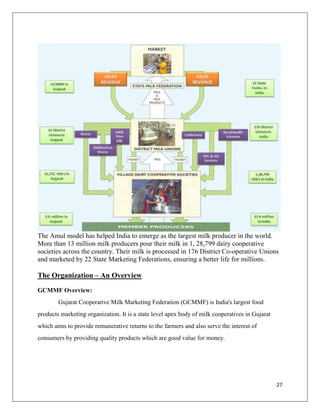
The Amul Model

The Amul Model of dairy development is a three-tiered
structure with the dairy cooperative societies at the village
level federated under a milk union at the district level and a
federation of
        Establishment of a direct linkage between milk
        producers and consumers by eliminating member
        unions at the state level. Middleman.

       Milk Producers (farmers) control procurement,
       processing and marketing


                                                                      26
The Amul model has helped India to emerge as the largest milk producer in the world.
More than 13 million milk producers pour their milk in 1, 28,799 dairy cooperative
societies across the country. Their milk is processed in 176 District Co-operative Unions
and marketed by 22 State Marketing Federations, ensuring a better life for millions.

The Organization – An Overview
GCMMF Overview:
        Gujarat Cooperative Milk Marketing Federation (GCMMF) is India's largest food
products marketing organization. It is a state level apex body of milk cooperatives in Gujarat
which aims to provide remunerative returns to the farmers and also serve the interest of
consumers by providing quality products which are good value for money.


                                                                                                 27
Gujarat Cooperative Milk Marketing Federation Ltd (GCMMF) is the largest
Organization in FMCG industry engaged in marketing of milk & milk products under the brand
names of AMUL and SAGAR with an annual turnover exceeding Rs 5000 crores.
          GCMMF is a unique organization. It's a body created by Farmers, managed by
competent professionals serving a very competitive and challenging consumer market. It is a true
testimony of synergistic national development through the practice of modern management
methods.


Vision:
          GCMMF will be an outstanding marketing organization, with specialization in
marketing of food and dairy products both fresh and long life with customer focus and IT
integrated. The network would consist of over 100 offices, 7500 stockiest covering at least every
Taluka. Head quarter servicing nearly 10 lakhs outlets with a turnover of Rs.10, 000 Cr and
serving several co-operatives. GCMMF shall also create markets for its products in neighboring
countries.


Mission:
          We at GCMMF endeavor to satisfy the taste and nutritional requirements of the
customer of the world through excellence in the marketing by our committed team. Through co-
operative networking, we are committed to offering quality product that provides best value for
money.


                                                                                               28
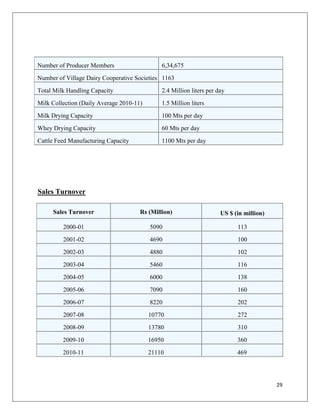
Number of Producer Members                    6,34,675

Number of Village Dairy Cooperative Societies 1163

Total Milk Handling Capacity                  2.4 Million liters per day

Milk Collection (Daily Average 2010-11)       1.5 Million liters

Milk Drying Capacity                          100 Mts per day

Whey Drying Capacity                          60 Mts per day

Cattle Feed Manufacturing Capacity            1100 Mts per day


Sales Turnover

     Sales Turnover                   Rs (Million)                    US $ (in million)

         2000-01                          5090                              113

         2001-02                          4690                              100

         2002-03                          4880                              102

         2003-04                          5460                              116

         2004-05                          6000                              138

         2005-06                          7090                              160

         2006-07                          8220                              202

         2007-08                          10770                             272

         2008-09                          13780                             310

         2009-10                          16950                             360

         2010-11                          21110                             469


                                                                                          29
Organization Structure:

Organization Structure is divided into two parts:

       External Organization Structure

       Internal Organization Structure


       External Organization Structure


External Organization Structure is the organization structure that affects the organization
from the outside.

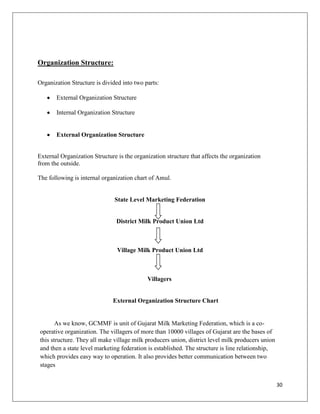
The following is internal organization chart of Amul.


                               State Level Marketing Federation


                                District Milk Product Union Ltd


                                Village Milk Product Union Ltd


                                            Villagers


                              External Organization Structure Chart


       As we know, GCMMF is unit of Gujarat Milk Marketing Federation, which is a co-
operative organization. The villagers of more than 10000 villages of Gujarat are the bases of
this structure. They all make village milk producers union, district level milk producers union
and then a state level marketing federation is established. The structure is line relationship,
which provides easy way to operation. It also provides better communication between two
stages


                                                                                                  30
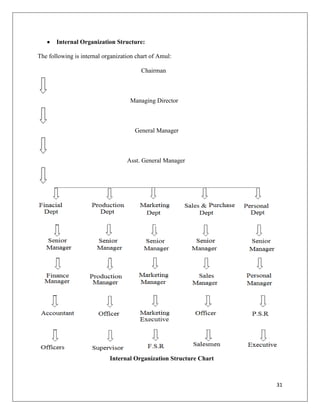
Internal Organization Structure:

The following is internal organization chart of Amul:

                                         Chairman


                                    Managing Director


                                      General Manager


                                   Asst. General Manager


                            Internal Organization Structure Chart


                                                                    31
Production Function:
        Expansion of the production technology and changes in technical field is going to bring
out revolution in the industry sector which eventually gives stand to study and favors the come
backing subject i.e. production and management.
        Production and operation management is planning, organizing, staffing, directing and
controlling of all the production system that portion of organization that converts inputs into
products and services. In general production system takes raw material, personnel, machines,
buildings and other resources and produce products and services.
        The core of production system is its conversion subsystem where in workers; raw
materials are used to convert inputs into products and services. This production department is at
heart of the firm, as it is able to produce low cost products and superior quality in timely
manners.
           Thus, there arises enormous need of giving due importance to this department as a
whole and a strong concrete base being foundation pillars of a manufacturing organization, if the
intention is to succeed domestically and globally.


Operating Analysis-

        Amul‟s only source of raw material is Village Milk societies. Milk is brought from such
village milk societies every morning and evening. This milk is then sent to the dairy plant. In the
dairy plant the milk is processed i.e. it is made free from germs.
·


                                                                                                32
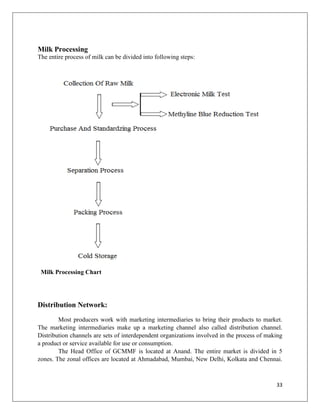
Milk Processing
The entire process of milk can be divided into following steps:


 Milk Processing Chart


Distribution Network:
        Most producers work with marketing intermediaries to bring their products to market.
The marketing intermediaries make up a marketing channel also called distribution channel.
Distribution channels are sets of interdependent organizations involved in the process of making
a product or service available for use or consumption.
        The Head Office of GCMMF is located at Anand. The entire market is divided in 5
zones. The zonal offices are located at Ahmadabad, Mumbai, New Delhi, Kolkata and Chennai.


                                                                                             33
Moreover there are 49 Depots located across the country and GCMMF caters to 13 Export
markets.
        A zero level of channel also called a direct marketing channel consists of a manufacturer
selling directly to the final customers. A one level channel; contains one selling intermediary
such as retailer to the final customers. A two level channel two intermediaries are typically
wholesaler and retailer. A three level channel are typically wholesaler, retailer and jobber in
between.
        GCMMF has an excellent distribution. It is its distribution channel, which has made it so
popular. GCMMF‟s products like milk and milk products are perishable. It becomes that much
important for them to have a good distribution.

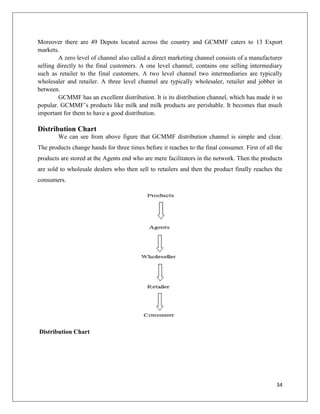
Distribution Chart
        We can see from above figure that GCMMF distribution channel is simple and clear.
The products change hands for three times before it reaches to the final consumer. First of all the
products are stored at the Agents end who are mere facilitators in the network. Then the products
are sold to wholesale dealers who then sell to retailers and then the product finally reaches the
consumers.


Distribution Chart


                                                                                                34
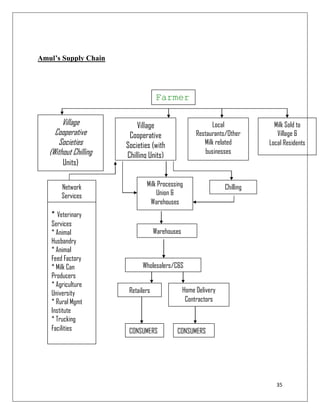
Amul’s Supply Chain


                                    Farmer
                                    s
        Village            Village                          Local             Milk Sold to
     Cooperative        Cooperative                   Restaurants/Other        Village &
      Societies        Societies (with                   Milk related       Local Residents
   (Without Chilling   Chilling Units)                    businesses
        Units)

       Network                 Milk Processing                   Chilling
       Services                    Union &                       Plants
                                Warehouses
   * Veterinary
   Services
   * Animal                         Warehouses
   Husbandry
   * Animal
   Feed Factory
   * Milk Can                Wholesalers/C&S
   Producers
   * Agriculture
   University           Retailers                Home Delivery
   * Rural Mgmt                                   Contractors
   Institute
   * Trucking
   Facilities           CONSUMERS           CONSUMERS


                                                                               35
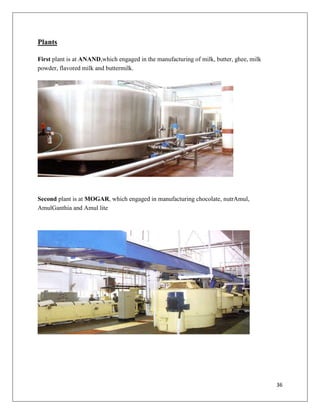
Plants

First plant is at ANAND,which engaged in the manufacturing of milk, butter, ghee, milk
powder, flavored milk and buttermilk.


Second plant is at MOGAR, which engaged in manufacturing chocolate, nutrAmul,
AmulGanthia and Amul lite


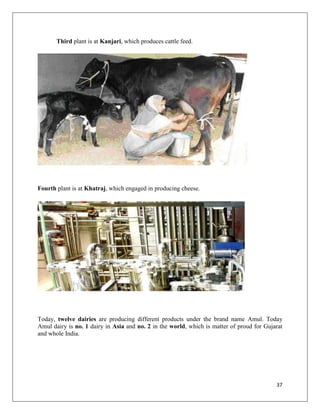
                                                                                         36
Third plant is at Kanjari, which produces cattle feed.


Fourth plant is at Khatraj, which engaged in producing cheese.


Today, twelve dairies are producing different products under the brand name Amul. Today
Amul dairy is no. 1 dairy in Asia and no. 2 in the world, which is matter of proud for Gujarat
and whole India.


                                                                                           37
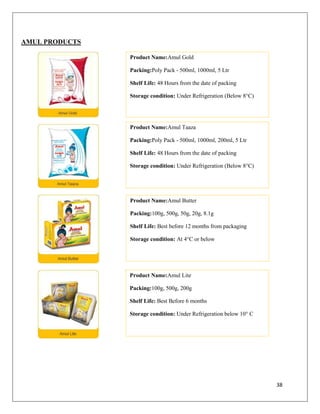
AMUL PRODUCTS

                Product Name:Amul Gold

                Packing:Poly Pack - 500ml, 1000ml, 5 Ltr

                Shelf Life: 48 Hours from the date of packing

                Storage condition: Under Refrigeration (Below 8°C)


                Product Name:Amul Taaza

                Packing:Poly Pack - 500ml, 1000ml, 200ml, 5 Ltr

                Shelf Life: 48 Hours from the date of packing

                Storage condition: Under Refrigeration (Below 8°C)


                Product Name:Amul Butter

                Packing:100g, 500g, 50g, 20g, 8.1g

                Shelf Life: Best before 12 months from packaging

                Storage condition: At 4°C or below


                Product Name:Amul Lite

                Packing:100g, 500g, 200g

                Shelf Life: Best Before 6 months

                Storage condition: Under Refrigeration below 10° C


                                                                     38
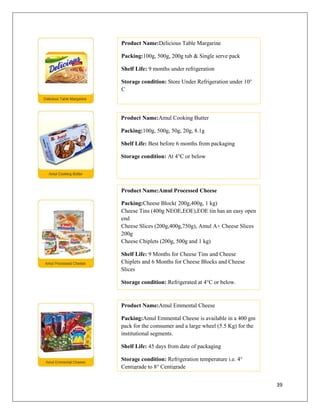
Product Name:Delicious Table Margarine

Packing:100g, 500g, 200g tub & Single serve pack

Shelf Life: 9 months under refrigeration

Storage condition: Store Under Refrigeration under 10°
C


Product Name:Amul Cooking Butter

Packing:100g, 500g, 50g, 20g, 8.1g

Shelf Life: Best before 6 months from packaging

Storage condition: At 4°C or below


Product Name:Amul Processed Cheese

Packing:Cheese Block( 200g,400g, 1 kg)
Cheese Tins (400g NEOE,EOE),EOE tin has an easy open
end
Cheese Slices (200g,400g,750g), Amul A+ Cheese Slices
200g
Cheese Chiplets (200g, 500g and 1 kg)

Shelf Life: 9 Months for Cheese Tins and Cheese
Chiplets and 6 Months for Cheese Blocks and Cheese
Slices

Storage condition: Refrigerated at 4°C or below.


Product Name:Amul Emmental Cheese

Packing:Amul Emmental Cheese is available in a 400 gm
pack for the comsumer and a large wheel (5.5 Kg) for the
institutional segments.

Shelf Life: 45 days from date of packaging

Storage condition: Refrigeration temperature i.e. 4°
Centigrade to 8° Centigrade


                                                           39
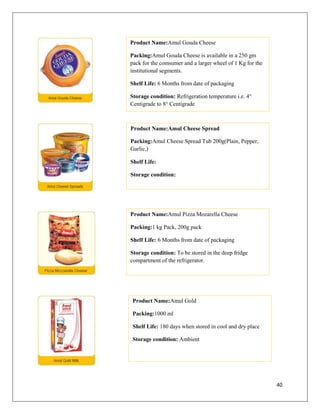
Product Name:Amul Gouda Cheese

Packing:Amul Gouda Cheese is available in a 250 gm
pack for the comsumer and a larger wheel of 1 Kg for the
institutional segments.

Shelf Life: 6 Months from date of packaging

Storage condition: Refrigeration temperature i.e. 4°
Centigrade to 8° Centigrade


Product Name:Amul Cheese Spread

Packing:Amul Cheese Spread Tub 200g(Plain, Pepper,
Garlic,)

Shelf Life:

Storage condition:


Product Name:Amul Pizza Mozarella Cheese

Packing:1 kg Pack, 200g pack

Shelf Life: 6 Months from date of packaging

Storage condition: To be stored in the deep fridge
compartment of the refrigerator.


 Product Name:Amul Gold

 Packing:1000 ml

 Shelf Life: 180 days when stored in cool and dry place

 Storage condition: Ambient


                                                           40
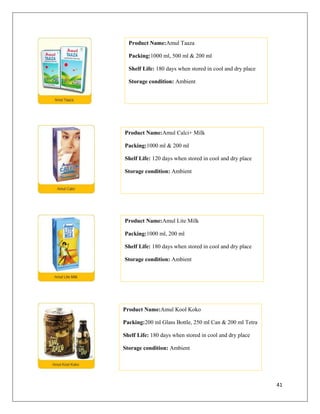
Product Name:Amul Taaza

  Packing:1000 ml, 500 ml & 200 ml

  Shelf Life: 180 days when stored in cool and dry place

  Storage condition: Ambient


Product Name:Amul Calci+ Milk

Packing:1000 ml & 200 ml

Shelf Life: 120 days when stored in cool and dry place

Storage condition: Ambient


Product Name:Amul Lite Milk

Packing:1000 ml, 200 ml

Shelf Life: 180 days when stored in cool and dry place

Storage condition: Ambient


Product Name:Amul Kool Koko

Packing:200 ml Glass Bottle, 250 ml Can & 200 ml Tetra

Shelf Life: 180 days when stored in cool and dry place

Storage condition: Ambient


                                                           41
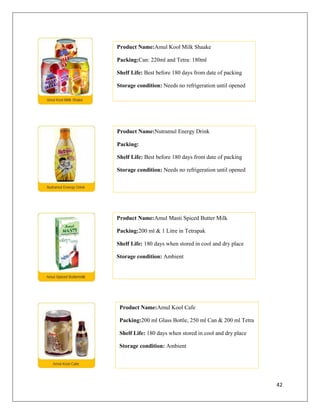
Product Name:Amul Kool Milk Shaake

Packing:Can: 220ml and Tetra: 180ml

Shelf Life: Best before 180 days from date of packing

Storage condition: Needs no refrigeration until opened


Product Name:Nutramul Energy Drink

Packing:

Shelf Life: Best before 180 days from date of packing

Storage condition: Needs no refrigeration until opened


Product Name:Amul Masti Spiced Butter Milk

Packing:200 ml & 1 Litre in Tetrapak

Shelf Life: 180 days when stored in cool and dry place

Storage condition: Ambient


 Product Name:Amul Kool Cafe

 Packing:200 ml Glass Bottle, 250 ml Can & 200 ml Tetra

 Shelf Life: 180 days when stored in cool and dry place

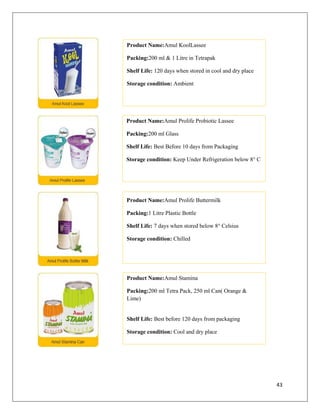
 Storage condition: Ambient


                                                          42
Product Name:Amul KoolLassee

Packing:200 ml & 1 Litre in Tetrapak

Shelf Life: 120 days when stored in cool and dry place

Storage condition: Ambient


Product Name:Amul Prolife Probiotic Lassee

Packing:200 ml Glass

Shelf Life: Best Before 10 days from Packaging

Storage condition: Keep Under Refrigeration below 8° C


Product Name:Amul Prolife Buttermilk

Packing:1 Litre Plastic Bottle

Shelf Life: 7 days when stored below 8° Celsius

Storage condition: Chilled


Product Name:Amul Stamina

Packing:200 ml Tetra Pack, 250 ml Can( Orange &
Lime)


Shelf Life: Best before 120 days from packaging

Storage condition: Cool and dry place


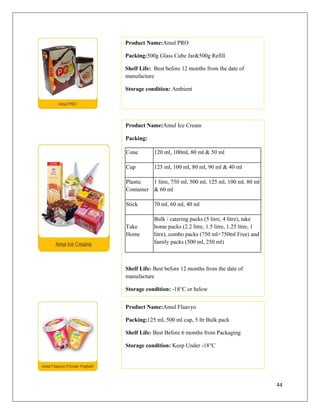
                                                         43
Product Name:Amul PRO

Packing:500g Glass Cube Jar&500g Refill

Shelf Life: Best before 12 months from the date of
manufacture

Storage condition: Ambient


Product Name:Amul Ice Cream

Packing:

Cone        120 ml, 100ml, 80 ml & 50 ml

Cup         125 ml, 100 ml, 80 ml, 90 ml & 40 ml

Plastic   1 litre, 750 ml, 500 ml, 125 ml, 100 ml, 80 ml
Container & 60 ml

Stick       70 ml, 60 ml, 40 ml

            Bulk / catering packs (5 litre, 4 litre), take
Take        home packs (2.2 litre, 1.5 litre, 1.25 litre, 1
Home        litre), combo packs (750 ml+750ml Free) and
            family packs (500 ml, 250 ml)


Shelf Life: Best before 12 months from the date of
manufacture

Storage condition: -18°C or below


Product Name:Amul Flaavyo

Packing:125 ml, 500 ml cup, 5 ltr Bulk pack

Shelf Life: Best Before 6 months from Packaging

Storage condition: Keep Under -18°C


                                                              44
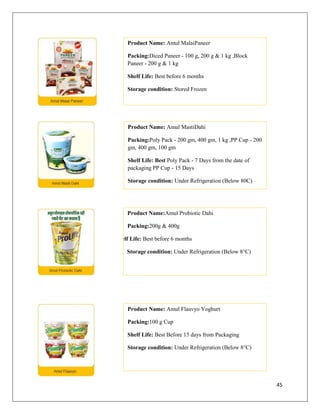
Product Name: Amul MalaiPaneer

     Packing:Diced Paneer - 100 g, 200 g & 1 kg ,Block
     Paneer - 200 g & 1 kg

     Shelf Life: Best before 6 months

     Storage condition: Stored Frozen


     Product Name: Amul MastiDahi

     Packing:Poly Pack - 200 gm, 400 gm, 1 kg ,PP Cup - 200
     gm, 400 gm, 100 gm

     Shelf Life: Best Poly Pack - 7 Days from the date of
     packaging PP Cup - 15 Days

     Storage condition: Under Refrigeration (Below 80C)


    Product Name:Amul Probiotic Dahi

    Packing:200g & 400g

Shelf Life: Best before 6 months

    Storage condition: Under Refrigeration (Below 8°C)


     Product Name: Amul Flaavyo Yoghurt

     Packing:100 g Cup

     Shelf Life: Best Before 15 days from Packaging

     Storage condition: Under Refrigeration (Below 8°C)


                                                              45
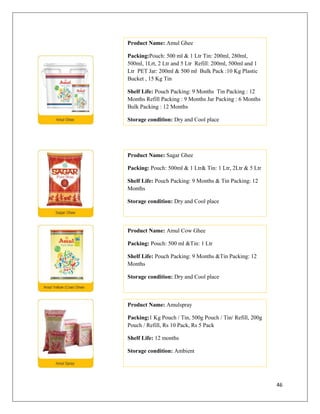
Product Name: Amul Ghee

Packing:Pouch: 500 ml & 1 Ltr Tin: 200ml, 280ml,
500ml, 1Lrt, 2 Ltr and 5 Ltr Refill: 200ml, 500ml and 1
Ltr PET Jar: 200ml & 500 ml Bulk Pack :10 Kg Plastic
Bucket , 15 Kg Tin

Shelf Life: Pouch Packing: 9 Months Tin Packing : 12
Months Refill Packing : 9 Months Jar Packing : 6 Months
Bulk Packing : 12 Months

Storage condition: Dry and Cool place


Product Name: Sagar Ghee

Packing: Pouch: 500ml & 1 Ltr& Tin: 1 Ltr, 2Ltr & 5 Ltr

Shelf Life: Pouch Packing: 9 Months & Tin Packing: 12
Months

Storage condition: Dry and Cool place


Product Name: Amul Cow Ghee

Packing: Pouch: 500 ml &Tin: 1 Ltr

Shelf Life: Pouch Packing: 9 Months &Tin Packing: 12
Months

Storage condition: Dry and Cool place


Product Name: Amulspray

Packing:1 Kg Pouch / Tin, 500g Pouch / Tin/ Refill, 200g
Pouch / Refill, Rs 10 Pack, Rs 5 Pack

Shelf Life: 12 months

Storage condition: Ambient


                                                           46
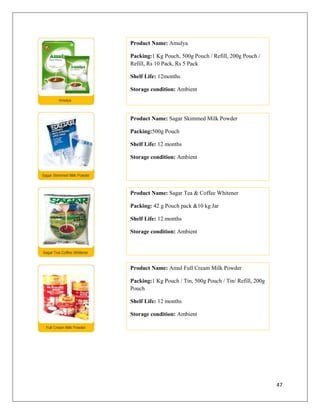
Product Name: Amulya

Packing:1 Kg Pouch, 500g Pouch / Refill, 200g Pouch /
Refill, Rs 10 Pack, Rs 5 Pack

Shelf Life: 12months

Storage condition: Ambient


Product Name: Sagar Skimmed Milk Powder

Packing:500g Pouch

Shelf Life: 12 months

Storage condition: Ambient


Product Name: Sagar Tea & Coffee Whitener

Packing: 42 g Pouch pack &10 kg Jar

Shelf Life: 12 months

Storage condition: Ambient


Product Name: Amul Full Cream Milk Powder

Packing:1 Kg Pouch / Tin, 500g Pouch / Tin/ Refill, 200g
Pouch

Shelf Life: 12 months

Storage condition: Ambient


                                                           47
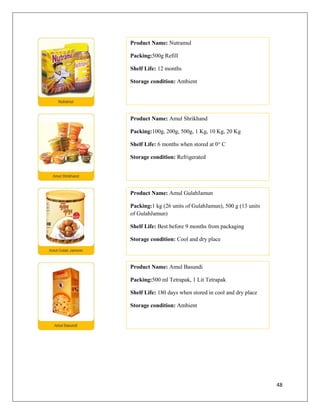
Product Name: Nutramul

Packing:500g Refill

Shelf Life: 12 months

Storage condition: Ambient


Product Name: Amul Shrikhand

Packing:100g, 200g, 500g, 1 Kg, 10 Kg, 20 Kg

Shelf Life: 6 months when stored at 0° C

Storage condition: Refrigerated


Product Name: Amul GulabJamun

Packing:1 kg (26 units of GulabJamun), 500 g (13 units
of GulabJamun)

Shelf Life: Best before 9 months from packaging

Storage condition: Cool and dry place


Product Name: Amul Basundi

Packing:500 ml Tetrapak, 1 Lit Tetrapak

Shelf Life: 180 days when stored in cool and dry place

Storage condition: Ambient


                                                         48
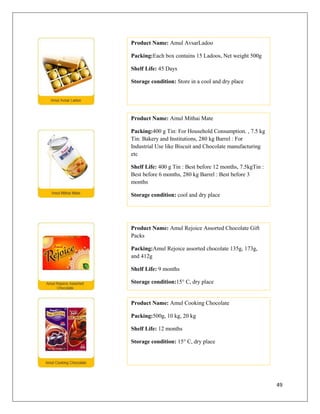
Product Name: Amul AvsarLadoo

Packing:Each box contains 15 Ladoos, Net weight 500g

Shelf Life: 45 Days

Storage condition: Store in a cool and dry place


Product Name: Amul Mithai Mate

Packing:400 g Tin: For Household Consumption. , 7.5 kg
Tin: Bakery and Institutions, 280 kg Barrel : For
Industrial Use like Biscuit and Chocolate manufacturing
etc

Shelf Life: 400 g Tin : Best before 12 months, 7.5kgTin :
Best before 6 months, 280 kg Barrel : Best before 3
months

Storage condition: cool and dry place


Product Name: Amul Rejoice Assorted Chocolate Gift
Packs

Packing:Amul Rejoice assorted chocolate 135g, 173g,
and 412g

Shelf Life: 9 months

Storage condition:15° C, dry place


Product Name: Amul Cooking Chocolate

Packing:500g, 10 kg, 20 kg

Shelf Life: 12 months

Storage condition: 15° C, dry place


                                                            49
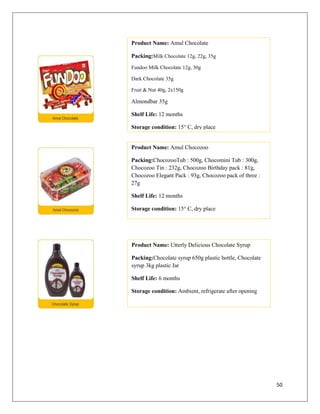
Product Name: Amul Chocolate

Packing:Milk Chocolate 12g, 22g, 35g
Fundoo Milk Chocolate 12g, 30g

Dark Chocolate 35g

Fruit & Nut 40g, 2x150g

Almondbar 35g

Shelf Life: 12 months

Storage condition: 15° C, dry place


Product Name: Amul Chocozoo

Packing:ChocozooTub : 500g, Chocomini Tub : 300g,
Chocozoo Tin : 232g, Chocozoo Birthday pack : 81g,
Chocozoo Elegant Pack : 93g, Chocozoo pack of three :
27g

Shelf Life: 12 months

Storage condition: 15° C, dry place


Product Name: Utterly Delicious Chocolate Syrup

Packing:Chocolate syrup 650g plastic bottle, Chocolate
syrup 3kg plastic Jar

Shelf Life: 6 months

Storage condition: Ambient, refrigerate after opening


                                                         50
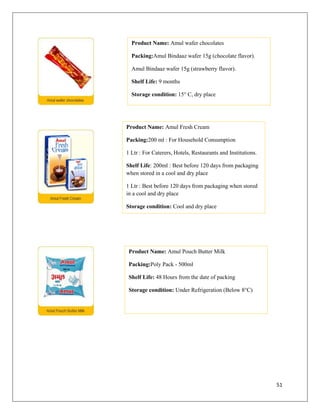
Product Name: Amul wafer chocolates

  Packing:Amul Bindaaz wafer 15g (chocolate flavor).

  Amul Bindaaz wafer 15g (strawberry flavor).

  Shelf Life: 9 months

  Storage condition: 15° C, dry place


Product Name: Amul Fresh Cream

Packing:200 ml : For Household Consumption

1 Ltr : For Caterers, Hotels, Restaurants and Institutions.

Shelf Life: 200ml : Best before 120 days from packaging
when stored in a cool and dry place

1 Ltr : Best before 120 days from packaging when stored
in a cool and dry place

Storage condition: Cool and dry place


 Product Name: Amul Pouch Butter Milk

 Packing:Poly Pack - 500ml

 Shelf Life: 48 Hours from the date of packing

 Storage condition: Under Refrigeration (Below 8°C)


                                                              51
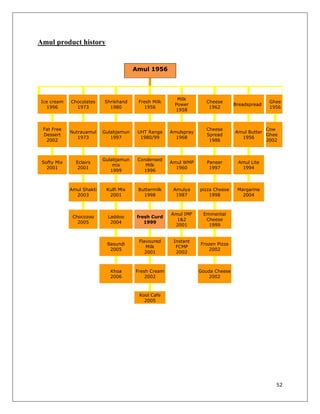
Amul product history


                                        Amul 1956


                                                        Milk
 Ice cream   Chocolates    Shrikhand     Fresh Milk                 Cheese                     Ghee
                                                       Power                     Breadspread
   1996        1973          1980          1956                      1962                      1956
                                                       1958


 Fat Free                                                           Cheese                   Cow
             Nutrauamul    Gulabjamun    UHT Range    Amulspray                  Amul Butter
 Dessert                                                            Spread                   Ghee
                1973          1997        1980/99       1968                       1956
  2002                                                               1986                    2002


                           Gulabjamun    Condensed
 Softy Mix     Eclairs                                Amul WMP       Paneer       Amul Lite
                               mix          Milk
   2001         2001                                    1960          1997         1994
                              1999         1996


             Amul Shakti    Kulfi Mix    Buttermilk    Amulya     pizza Cheese    Margarine
               2003          2001          1998         1987          1998          2004


                                                      Amul IMF     Emmental
              Chocozoo       Laddoo      fresh Curd
                                                        1&2         Cheese
                2005          2004          1999
                                                       2001          1999


                                         Flavoured     Instant
                            Basundi                               Frozen Pizza
                                            Milk        FCMP
                             2005                                    2002
                                            2001        2002


                             Khoa       Fresh Cream               Gouda Cheese
                             2006           2002                      2002


                                         Kool Cafe
                                           2005


                                                                                                 52
CHAPTER – 4
RESEARCH METHODOLOGY


                       53
Research Meaning:

        A sane inventory management is of great necessity in any business organizations. The
future of business organizations depends upon how the top management defines and considers
inventory in relationship with the company‟s objectives or service levels.
Knowing factors that push to a purchasing behavior and meeting customers‟ needs remain a
crucial matter for the growth and survival in nowadays competitive market. Baki et al add that
today‟s competitive marketing environment forces producers and customers to get closer to each
other. This means organizations should give a great importance to customers‟ needs and listen to
their voices, and suppliers and customers should be closer and closer to each other in order to
produce goods or services based on the customer needs. Therefore, manufacturers and service
producers need an effective planning and control system for a powerful coordination in between
all stages of the organizations (processes, and other). The implementation and the use of an
effective planning and control system in an organization improve productivity and performance
of distribution, while decreasing waiting times. The enterprise resource planning (ERP) systems
are examples of the most strategic tools, which provide robust tools for planning, coordination
and control of the processes in all organizations.

Research Design

      A research design is a plan that specifies the objectives of the study, method to be
 adopted in the data collection, tools in data analysis and hypothesis to be framed.
 “A research design is an arrangement of condition for collection and analysis of data in
 a manner that aims to combine relevance to research purpose with economy in
 procedure”.

Nature of Data

 The approach of this study consists of combining research into primary and secondary
 data. Secondary data, that is, the literature phase of the research has essentially been
 provided in the previous chapters. The theoretical part or the literature of the study is
 represented by the debate of various parameters relative to inventory management and
 customer service management. This is of a vital importance in the sense that it provides
 a measured explanation concerning inventory management and customer service
 management in a business logistics environment where globalization, technological
 innovation and changing societal expectations negatively or positively impact on the
 growth and survival of business organizations on one side and manufacturing industries
 logistics on the other.
 Primary data has also been analyzed in the form of an empirical study. In this phase,
 manufacturing industries in Gauteng Province (especially in Pretoria and Johannesburg)
 were included in the study. In light of the above, it has to be indicated that the
 respondents in this population (manufacturing industries in Gauteng Province) were
 precisely those dealing with inventory management and customer service management.


                                                                                              54
Employees or managers of business organizations that were approached were typically
in manufacturing industries logistics according to sectors.

Research Type

Descriptive research, also known as statistical research, describes data and characteristics about
the population or phenomenon being studied. Descriptive research answers the questions who,
what, where, when, "why" and how...
Although the data description is factual, accurate and systematic, the research cannot describe
what caused a situation. Thus, Descriptive research cannot be used to create a causal
relationship, where one variable affects another. In other words, descriptive research can be
said to have a low requirement for internal validity.
The description is used for frequencies, averages and other statistical calculations. Often the
best approach, prior to writing descriptive research, is to conduct a survey investigation.
Qualitative research often has the aim of description and researchers may follow-up with
examinations of why the observations exist and what the implications of the findings are.

Sampling Sizeandtechnique

Size of the sample:
     It refers to the number of items to be selected from the universe to constitute as a
sample. In these study 1 warehouse, 1 distributor & 25 retailers of Amul in Silchar has
been taken.

Sample design:
     The sampling technique used in this study is simple random sampling method.
This method is also called as the method of chance selection. Each and every item of
population has equal chance to be included in the sample.

Questionnaire:
     The questions are arranged logical sequence. The questionnaire consists of a
variety of questions presented to the employees for the response. Dichotomous
questions, multiple choice questions, rating scale questions were used in constructing
questionnaire.


                                                                                               55
CHAPTER – 4
DATA ANALYSIS AND INTERPRETATION


                                   56
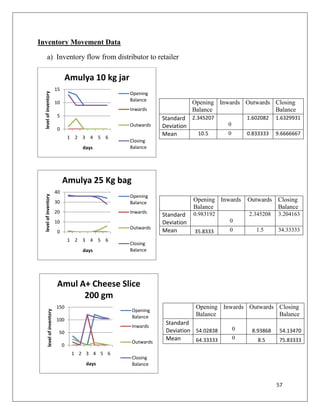
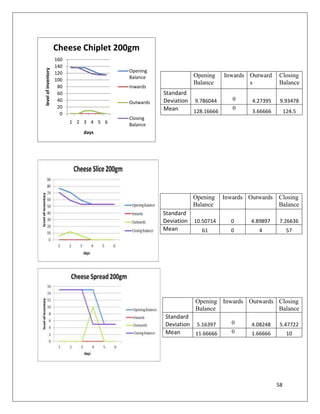
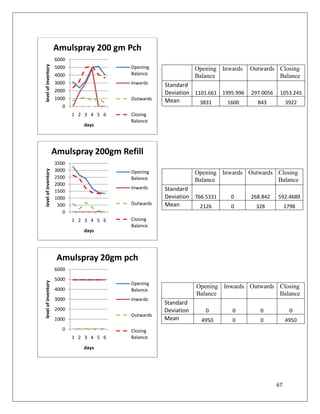
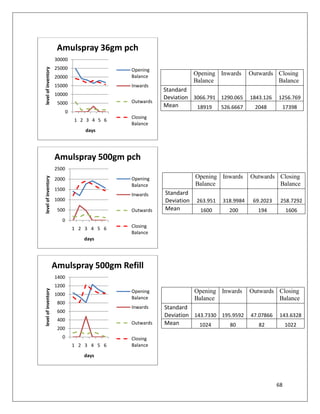
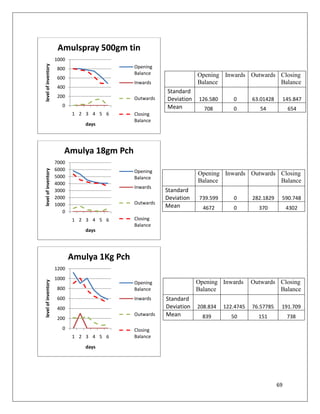
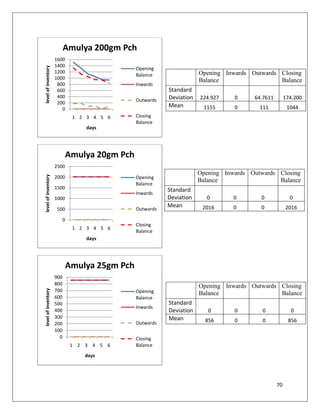
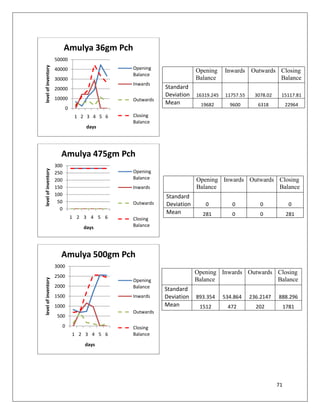
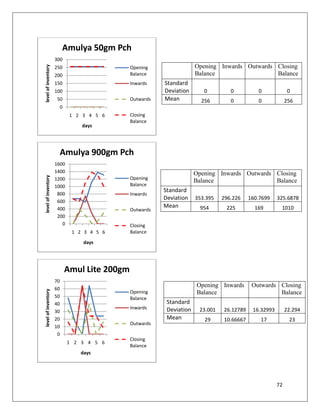
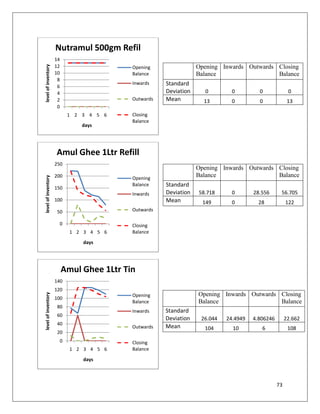
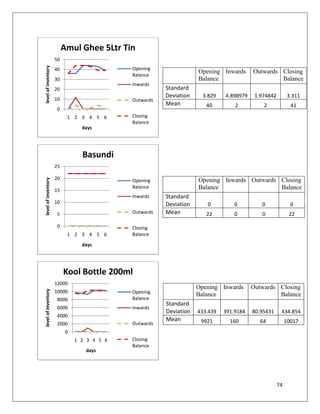
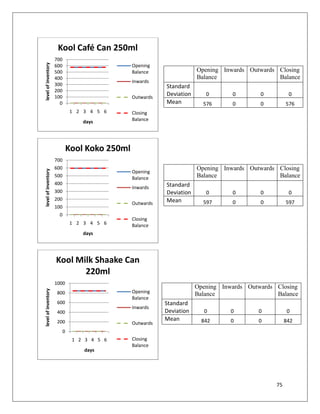
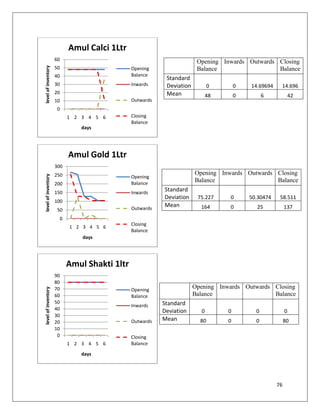
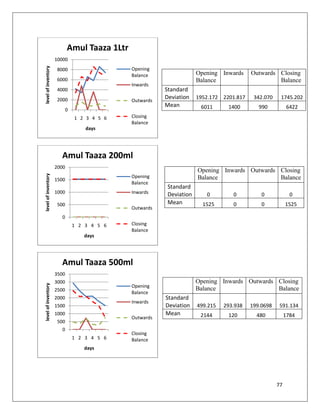
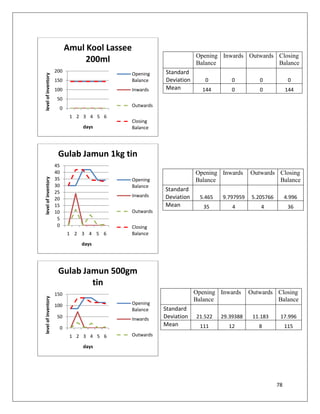
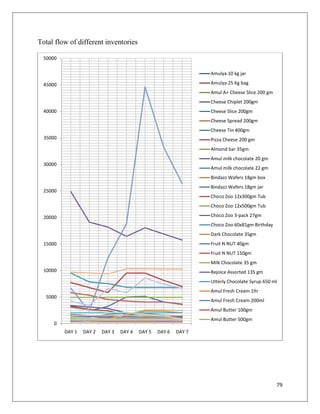
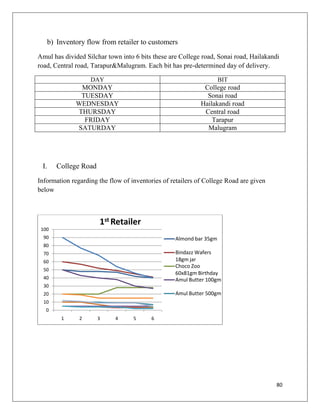
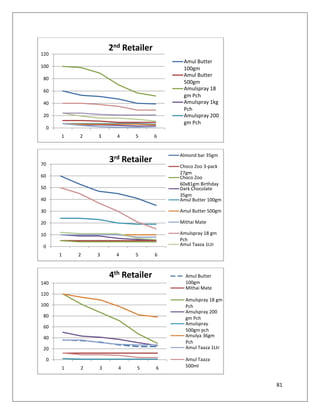
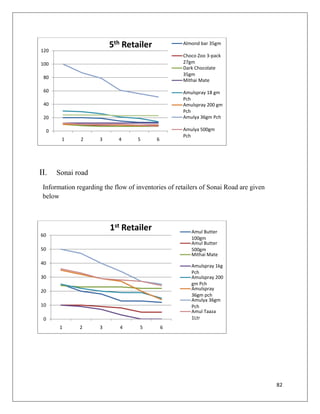
Inventory Movement Data

        a) Inventory flow from distributor to retailer

                                      Amulya 10 kg jar
                             15
  level of inventory


                                                         Opening
                                                         Balance
                             10                                                 Opening Inwards Outwards Closing
                                                         Inwards                Balance                  Balance
                              5
                                                                    Standard 2.345207              1.602082   1.6329931
                                                         Outwards   Deviation              0
                              0
                                                                    Mean       10.5        0       0.833333   9.6666667
                                      1 2 3 4 5 6
                                                         Closing
                                          days           Balance


                                  Amulya 25 Kg bag
                             40
  level of inventory


                                                         Opening
                             30                          Balance
                                                                                Opening Inwards    Outwards Closing
                                                                                Balance                     Balance
                             20                          Inwards
                                                                    Standard    0.983192           2.345208   3.204163
                             10                                     Deviation              0
                                                         Outwards
                              0                                     Mean        35.8333    0          1.5     34.33333
                                      1 2 3 4 5 6
                                                         Closing
                                          days           Balance


                              Amul A+ Cheese Slice
                                    200 gm
                             150                                                 Opening Inwards Outwards Closing
                                                         Opening
        level of inventory


                                                         Balance                 Balance                  Balance
                             100
                                                         Inwards
                                                                     Standard
                                                                     Deviation 54.02838        0    8.93868    54.13470
                              50
                                                                     Mean      64.33333        0       8.5     75.83333
                                                         Outwards
                                  0
                                       1 2 3 4 5 6
                                                         Closing
                                           days          Balance


                                                                                                              57
Cheese Chiplet 200gm
                     160
                     140
level of inventory


                     120                 Opening
                                         Balance                Opening    Inwards Outward    Closing
                     100
                                                                Balance            s          Balance
                      80                 Inwards
                      60                            Standard
                      40                            Deviation 9.786044        0     4.27395    9.93478
                                         Outwards
                      20                            Mean                      0
                       0                                      128.16666             3.66666        124.5
                                         Closing
                           1 2 3 4 5 6   Balance
                               days


                                                                Opening    Inwards Outwards Closing
                                                                Balance                     Balance
                                                    Standard
                                                    Deviation   10.50714     0      4.89897    7.26636
                                                    Mean          61         0        4             57


                                                                Opening Inwards Outwards Closing
                                                                Balance                  Balance
                                                    Standard
                                                    Deviation 5.16397        0      4.08248    5.47722
                                                    Mean      11.66666       0      1.66666         10


                                                                                              58
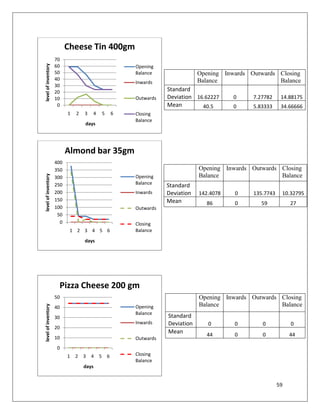
Cheese Tin 400gm
                     70
level of inventory


                     60                                    Opening
                     50                                    Balance                Opening Inwards Outwards Closing
                     40                                                           Balance                  Balance
                                                           Inwards
                     30
                     20                                               Standard
                     10                                    Outwards   Deviation 16.62227     0     7.27782     14.88175
                      0                                               Mean        40.5       0     5.83333     34.66666
                           1   2   3   4       5       6   Closing
                                                           Balance
                                   days


                           Almond bar 35gm
                     400
                     350                                                          Opening Inwards Outwards Closing
                                                                                  Balance                  Balance
level of inventory


                     300                                   Opening
                     250                                   Balance
                                                                      Standard
                     200                                   Inwards    Deviation   142.4078   0     135.7743    10.32795
                     150                                              Mean          86       0       59            27
                     100                                   Outwards
                      50
                       0                                   Closing
                            1 2 3 4 5 6                    Balance

                                   days


                      Pizza Cheese 200 gm
                     50                                                           Opening Inwards Outwards Closing
                                                                                  Balance                  Balance
level of inventory


                     40                                    Opening
                                                           Balance
                     30                                               Standard
                                                           Inwards    Deviation      0       0        0            0
                     20
                                                                      Mean          44       0        0            44
                     10                                    Outwards
                      0
                           1   2   3   4   5       6       Closing
                                                           Balance
                                   days


                                                                                                              59
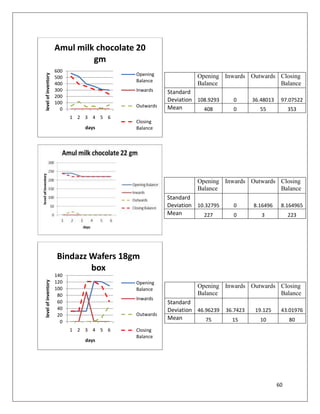
Amul milk chocolate 20
                              gm
                     600
                                         Opening
level of inventory


                     500                                      Opening Inwards Outwards Closing
                                         Balance
                     400                                      Balance                  Balance
                     300                 Inwards    Standard
                     200
                     100
                                                    Deviation 108.9293     0       36.48013    97.07522
                                         Outwards   Mean
                       0                                        408        0         55            353
                           1 2 3 4 5 6
                                         Closing
                               days      Balance


                                                              Opening Inwards Outwards Closing
                                                              Balance                  Balance
                                                    Standard
                                                    Deviation 10.32795     0       8.16496     8.164965
                                                    Mean        227        0          3            223


                     Bindazz Wafers 18gm
                             box
                     140
                     120
level of inventory


                                         Opening
                     100                 Balance
                                                              Opening Inwards Outwards Closing
                      80                                      Balance                  Balance
                                         Inwards
                      60                            Standard
                      40                            Deviation 46.96239   36.7423    19.125     43.01976
                      20                 Outwards
                                                    Mean         75        15        10            80
                       0
                           1 2 3 4 5 6   Closing
                                         Balance
                               days


                                                                                              60
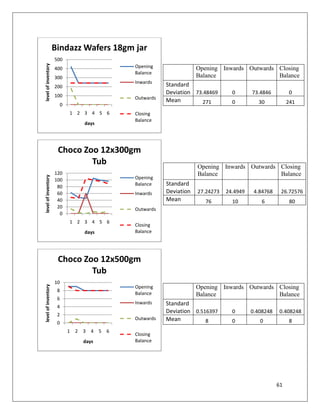
Bindazz Wafers 18gm jar
                     500
level of inventory


                     400                              Opening                Opening Inwards Outwards Closing
                                                      Balance
                     300                                                     Balance                  Balance
                                                      Inwards
                     200                                         Standard
                     100
                                                                 Deviation 73.48469       0       73.4846         0
                                                      Outwards   Mean
                          0                                                  271          0         30            241
                              1 2 3 4 5 6             Closing
                                                      Balance
                                      days


                      Choco Zoo 12x300gm
                              Tub                                            Opening Inwards Outwards Closing
                     120                                                     Balance                  Balance
level of inventory


                     100                              Opening
                      80                              Balance    Standard
                      60                              Inwards    Deviation   27.24273   24.4949    4.84768    26.72576
                      40                                         Mean          76         10          6            80
                      20                              Outwards
                       0
                              1 2 3 4 5 6
                                                      Closing
                                      days            Balance


                      Choco Zoo 12x500gm
                              Tub
                     10
level of inventory


                                                      Opening                Opening Inwards Outwards Closing
                      8
                                                      Balance                Balance                  Balance
                      6
                                                      Inwards    Standard
                      4
                                                                 Deviation 0.516397       0       0.408248   0.408248
                      2
                                                      Outwards   Mean
                      0                                                        8          0          0            8
                              1   2   3   4   5   6
                                                      Closing
                                      days            Balance


                                                                                                             61
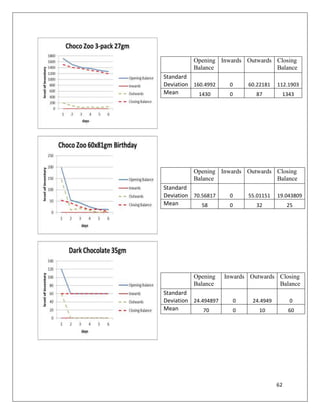
Opening Inwards Outwards Closing
          Balance                  Balance
Standard
Deviation 160.4992     0       60.22181   112.1903
Mean        1430       0         87        1343


          Opening Inwards Outwards Closing
          Balance                  Balance
Standard
Deviation 70.56817     0       55.01151   19.043809
Mean         58        0         32            25


          Opening     Inwards Outwards Closing
          Balance                      Balance
Standard
Deviation 24.494897        0    24.4949        0
Mean          70           0      10           60


                                          62
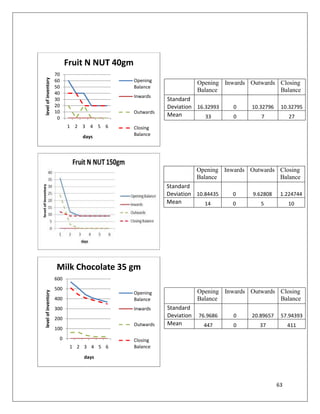
Fruit N NUT 40gm
                     70
level of inventory


                     60                          Opening                Opening Inwards Outwards Closing
                     50                          Balance
                     40
                                                                        Balance                  Balance
                                                 Inwards
                     30                                     Standard
                     20                                     Deviation 16.32993     0     10.32796    10.32795
                     10                          Outwards
                      0
                                                            Mean         33        0        7            27
                              1 2 3 4 5 6        Closing
                                  days           Balance


                                                                        Opening Inwards Outwards Closing
                                                                        Balance                  Balance
                                                            Standard
                                                            Deviation 10.84435     0     9.62808     1.224744
                                                            Mean         14        0        5            10


                     Milk Chocolate 35 gm
                     600
                     500
                                                                        Opening Inwards Outwards Closing
level of inventory


                                                 Opening
                     400                         Balance                Balance                  Balance
                     300                         Inwards    Standard
                     200
                                                            Deviation   76.9686    0     20.89657    57.94393
                                                 Outwards   Mean          447      0       37            411
                     100
                          0                      Closing
                               1 2 3 4 5 6       Balance

                                   days


                                                                                                    63
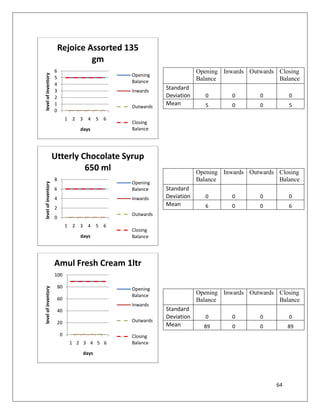
Rejoice Assorted 135
                                  gm
                     6                                              Opening Inwards Outwards Closing
level of inventory


                     5                       Opening
                                             Balance                Balance                  Balance
                     4
                     3                       Inwards
                                                        Standard
                     2                                  Deviation     0        0       0         0
                     1
                                             Outwards
                                                        Mean          5        0       0         5
                     0
                              1 2 3 4 5 6
                                             Closing
                                  days       Balance


                     Utterly Chocolate Syrup
                              650 ml                                Opening Inwards Outwards Closing
                     8
                                             Opening
                                                                    Balance                  Balance
level of inventory


                     6                       Balance    Standard
                     4                       Inwards    Deviation     0        0       0         0
                                                        Mean          6        0       0         6
                     2
                                             Outwards
                     0
                              1 2 3 4 5 6
                                             Closing
                                  days       Balance


                     Amul Fresh Cream 1ltr
                     100

                         80
level of inventory


                                             Opening
                                             Balance                Opening Inwards Outwards Closing
                         60                                         Balance                  Balance
                                             Inwards
                         40                             Standard
                                                        Deviation     0        0       0         0
                         20                  Outwards
                                                        Mean          89       0       0         89
                          0                  Closing
                               1 2 3 4 5 6   Balance

                                   days


                                                                                            64
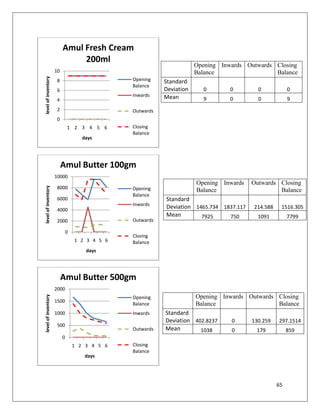
Amul Fresh Cream
                               200ml
                                                                       Opening Inwards Outwards Closing
                     10                                                Balance                  Balance
level of inventory


                     8                          Opening    Standard
                                                Balance
                     6                                     Deviation     0        0        0            0
                                                Inwards    Mean
                     4                                                   9        0        0            9
                     2                          Outwards
                     0
                              1 2 3 4 5 6       Closing
                                                Balance
                                     days


                          Amul Butter 100gm
                     10000
                                                                       Opening Inwards   Outwards Closing
                      8000
level of inventory


                                                Opening                Balance                    Balance
                                                Balance
                      6000                                 Standard
                                                Inwards
                      4000
                                                           Deviation 1465.734 1837.117   214.588    1516.305
                                                           Mean        7925     750        1091         7799
                      2000                      Outwards

                              0
                                                Closing
                                  1 2 3 4 5 6   Balance
                                      days


                          Amul Butter 500gm
                     2000
                                                                       Opening Inwards Outwards Closing
level of inventory


                                                Opening
                     1500
                                                Balance                Balance                  Balance
                     1000                       Inwards    Standard
                                                           Deviation 402.8237     0      130.259   297.1514
                      500
                                                Outwards   Mean        1038       0       179           859
                          0
                                  1 2 3 4 5 6   Closing
                                                Balance
                                      days


                                                                                                   65
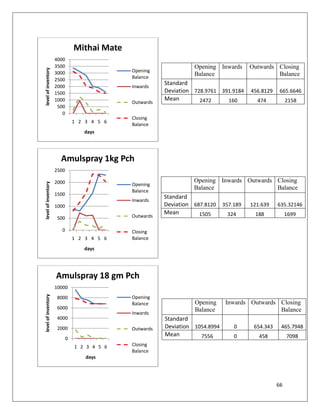
Mithai Mate
                     4000
                     3500                                          Opening Inwards       Outwards Closing
level of inventory


                     3000                     Opening
                                              Balance
                                                                   Balance                        Balance
                     2500
                     2000                     Inwards
                                                         Standard
                     1500                                Deviation 728.9761 391.9184     456.8129    665.6646
                     1000                                Mean        2472     160          474           2158
                                              Outwards
                      500
                        0
                                              Closing
                                1 2 3 4 5 6
                                              Balance
                                   days


                       Amulspray 1kg Pch
                     2500

                     2000                                          Opening Inwards Outwards Closing
level of inventory


                                              Opening
                                              Balance
                                                                   Balance                  Balance
                     1500
                                                         Standard
                                              Inwards
                     1000                                Deviation 687.8120    357.189   121.639    635.32146
                                                         Mean        1505       324       188            1699
                      500                     Outwards

                        0                     Closing
                                1 2 3 4 5 6   Balance

                                   days


                     Amulspray 18 gm Pch
                     10000
level of inventory


                      8000                    Opening
                                              Balance              Opening      Inwards Outwards Closing
                      6000                                         Balance                       Balance
                                              Inwards
                      4000                               Standard
                      2000                    Outwards   Deviation 1054.8994       0      654.343    465.7948
                                                         Mean        7556          0        458          7098
                            0
                                1 2 3 4 5 6   Closing
                                              Balance
                                    days


                                                                                                    66
Amulspray 200 gm Pch
                     6000
level of inventory


                     5000                 Opening                Opening Inwards   Outwards Closing
                     4000                 Balance
                                                                 Balance                    Balance
                     3000                 Inwards    Standard
                     2000                            Deviation 1101.661 1995.996   297.0056    1053.245
                     1000                 Outwards   Mean        3831     1600       843           3922
                        0
                            1 2 3 4 5 6   Closing
                                          Balance
                               days


                     Amulspray 200gm Refill
                     3500
                     3000
level of inventory


                                          Opening                Opening Inwards Outwards Closing
                     2500                 Balance                Balance                  Balance
                     2000
                                          Inwards    Standard
                     1500
                     1000                            Deviation 766.5331     0      268.842    592.4689
                      500                 Outwards   Mean        2126       0       328            1798
                        0
                            1 2 3 4 5 6   Closing
                                          Balance
                               days


                      Amulspray 20gm pch
                     6000
                     5000
level of inventory


                                          Opening
                     4000                                        Opening Inwards Outwards Closing
                                          Balance
                                                                 Balance                  Balance
                     3000                 Inwards
                                                     Standard
                     2000                            Deviation      0       0         0              0
                                          Outwards
                     1000                            Mean          4950     0         0            4950
                        0                 Closing
                            1 2 3 4 5 6   Balance

                               days


                                                                                              67
Amulspray 36gm pch
                     30000
                     25000
level of inventory


                                              Opening
                                              Balance
                                                                     Opening Inwards      Outwards Closing
                     20000
                                                                     Balance                       Balance
                     15000                    Inwards
                                                         Standard
                     10000
                                                         Deviation 3066.791 1290.065      1843.126   1256.769
                      5000                    Outwards
                                                         Mean       18919   526.6667        2048       17398
                            0
                                              Closing
                                1 2 3 4 5 6
                                              Balance
                                    days


                     Amulspray 500gm pch
                     2500
                                                                     Opening Inwards      Outwards Closing
level of inventory


                     2000                     Opening
                                              Balance                Balance                       Balance
                     1500
                                              Inwards    Standard
                     1000                                Deviation   263.951   318.9984    69.2023    258.7292
                      500                     Outwards   Mean          1600      200         194          1606
                        0
                                1 2 3 4 5 6   Closing
                                              Balance
                                   days


                     Amulspray 500gm Refill
                     1400
                     1200
level of inventory


                     1000
                                              Opening                Opening Inwards      Outwards Closing
                                              Balance                Balance                       Balance
                      800
                                              Inwards    Standard
                      600
                                                         Deviation 143.7330 195.9592      47.07866    143.6328
                      400
                                              Outwards   Mean        1024      80            82           1022
                      200
                        0                     Closing
                                1 2 3 4 5 6   Balance

                                   days


                                                                                                     68
Amulspray 500gm tin
                     1000
level of inventory


                     800                     Opening
                                             Balance                Opening Inwards Outwards Closing
                     600
                                             Inwards                Balance                  Balance
                     400
                                                        Standard
                     200                     Outwards   Deviation   126.580       0       63.01428        145.847
                        0                               Mean          708         0          54            654
                            1 2 3 4 5 6      Closing
                                             Balance
                                days


                        Amulya 18gm Pch
                     7000
                     6000
level of inventory


                                             Opening                Opening Inwards Outwards Closing
                     5000                    Balance
                     4000                                           Balance                  Balance
                                             Inwards
                     3000                               Standard
                     2000                               Deviation    739.599      0       282.1829    590.748
                     1000                    Outwards
                                                        Mean          4672        0         370            4302
                        0
                            1 2 3 4 5 6      Closing
                                             Balance
                                days


                            Amulya 1Kg Pch
                     1200
                     1000
level of inventory


                                             Opening                Opening Inwards       Outwards Closing
                     800                     Balance                Balance                        Balance
                     600                     Inwards    Standard
                     400                                Deviation   208.834    122.4745   76.57785    191.709
                                             Outwards   Mean          839        50         151            738
                     200
                        0                    Closing
                            1 2 3 4 5 6      Balance

                                days


                                                                                                     69
Amulya 200gm Pch
                     1600
                     1400
level of inventory


                                                 Opening
                     1200                                               Opening Inwards Outwards Closing
                                                 Balance
                     1000                                               Balance                  Balance
                      800                        Inwards
                      600                                   Standard
                      400                                   Deviation   224.927    0     64.7611        174.200
                                                 Outwards
                      200
                                                            Mean         1155      0       111           1044
                        0
                                1 2 3 4 5 6      Closing
                                                 Balance
                                    days


                               Amulya 20gm Pch
                     2500
                                                                        Opening Inwards Outwards Closing
level of inventory


                     2000                        Opening
                                                                        Balance                  Balance
                                                 Balance
                     1500                                   Standard
                                                 Inwards
                     1000                                   Deviation     0        0       0              0
                                                            Mean         2016      0       0            2016
                      500                        Outwards

                           0
                                                 Closing
                                1 2 3 4 5 6
                                                 Balance
                                    days


                               Amulya 25gm Pch
                     900
                     800                                                Opening Inwards Outwards Closing
                     700
level of inventory


                                                 Opening                Balance                  Balance
                     600                         Balance
                     500                                    Standard
                                                 Inwards
                     400                                    Deviation      0       0        0             0
                     300                                    Mean
                                                 Outwards                 856      0        0            856
                     200
                     100
                       0                         Closing
                                1 2 3 4 5 6      Balance

                                    days


                                                                                                   70
Amulya 36gm Pch
                     50000
level of inventory


                     40000                        Opening
                                                                         Opening     Inwards Outwards Closing
                                                  Balance
                     30000                                               Balance                      Balance
                                                  Inwards
                     20000                                   Standard
                                                             Deviation   16319.245   11757.55     3078.02    15117.81
                     10000                        Outwards
                                                             Mean         19682        9600        6318          22964
                               0
                                    1 2 3 4 5 6   Closing
                                                  Balance
                                        days


                       Amulya 475gm Pch
                     300
level of inventory


                     250                          Opening
                     200                          Balance                Opening Inwards Outwards Closing
                     150                          Inwards                Balance                  Balance
                     100                                     Standard
                      50                          Outwards   Deviation      0           0           0              0
                       0
                                                             Mean          281          0           0             281
                                   1 2 3 4 5 6    Closing
                                       days       Balance


                       Amulya 500gm Pch
                     3000
                                                                         Opening Inwards Outwards Closing
                     2500
                                                                         Balance                  Balance
level of inventory


                                                  Opening
                     2000                         Balance    Standard
                     1500                         Inwards    Deviation   893.354     534.864    236.2147    888.296
                     1000                                    Mean         1512        472         202            1781
                                                  Outwards
                      500
                           0                      Closing
                                   1 2 3 4 5 6    Balance

                                       days


                                                                                                            71
Amulya 50gm Pch
                     300
                                                                        Opening Inwards Outwards Closing
level of inventory


                     250                        Opening
                     200                        Balance                 Balance                  Balance
                     150                        Inwards    Standard
                     100                                   Deviation       0         0          0              0
                      50                        Outwards   Mean           256        0          0             256
                          0
                               1 2 3 4 5 6      Closing
                                                Balance
                                  days


                      Amulya 900gm Pch
                     1600
                     1400                                               Opening Inwards Outwards Closing
level of inventory


                     1200                       Opening
                                                                        Balance                  Balance
                     1000                       Balance
                                                           Standard
                      800                       Inwards
                                                           Deviation    353.395   296.226    160.7699    325.6878
                      600
                      400
                                                           Mean          954       225         169        1010
                                                Outwards
                      200
                        0                       Closing
                               1 2 3 4 5 6      Balance

                                   days


                              Amul Lite 200gm
                     70
                                                                        Opening Inwards       Outwards Closing
                     60
level of inventory


                                                Opening                 Balance                        Balance
                     50                         Balance
                     40                                     Standard
                                                Inwards     Deviation    23.001   26.12789    16.32993        22.294
                     30
                     20                                     Mean           29     10.66667       17            23
                                                Outwards
                     10
                      0
                                                Closing
                              1 2 3 4 5 6
                                                Balance
                                  days


                                                                                                         72
Nutramul 500gm Refil
                     14
                     12
level of inventory


                                            Opening                Opening Inwards Outwards Closing
                     10                     Balance                Balance                  Balance
                      8
                      6
                                            Inwards    Standard
                      4                                Deviation     0         0         0              0
                      2                     Outwards   Mean          13        0         0              13
                      0
                              1 2 3 4 5 6   Closing
                                            Balance
                                  days


                     Amul Ghee 1Ltr Refill
                     250
                                                                   Opening Inwards Outwards Closing
                     200                                           Balance                  Balance
level of inventory


                                            Opening
                     150
                                            Balance    Standard
                                            Inwards    Deviation   58.718      0       28.556      56.705
                     100                               Mean          149       0         28            122
                      50                    Outwards

                          0                 Closing
                              1 2 3 4 5 6   Balance

                                  days


                          Amul Ghee 1Ltr Tin
                     140
                     120
                                                                   Opening Inwards Outwards Closing
level of inventory


                                            Opening
                     100
                                            Balance                Balance                  Balance
                      80
                                            Inwards    Standard
                      60
                                                       Deviation    26.044   24.4949   4.806246        22.662
                      40
                                            Outwards   Mean          104       10         6             108
                      20
                          0                 Closing
                              1 2 3 4 5 6   Balance

                                  days


                                                                                                  73
Amul Ghee 5Ltr Tin
                     50
level of inventory


                     40                      Opening
                                                                    Opening Inwards      Outwards Closing
                                             Balance
                     30                                             Balance                       Balance
                                             Inwards
                     20                                 Standard
                                                        Deviation     3.829   4.898979    1.974842         3.311
                     10                      Outwards
                                                        Mean           40         2          2              41
                      0
                           1 2 3 4 5 6       Closing
                                             Balance
                                 days


                                 Basundi
                     25

                     20
level of inventory


                                             Opening                Opening Inwards Outwards Closing
                                             Balance                Balance                  Balance
                     15
                                             Inwards    Standard
                     10                                 Deviation      0          0         0               0
                      5                      Outwards   Mean           22         0         0              22

                      0                      Closing
                           1 2 3 4 5 6       Balance

                                 days


                          Kool Bottle 200ml
                     12000
                                                                    Opening Inwards      Outwards Closing
level of inventory


                     10000                   Opening
                                                                    Balance                       Balance
                      8000                   Balance
                                                        Standard
                      6000                   Inwards
                                                        Deviation   433.439   391.9184   80.95431     434.854
                      4000
                                                        Mean         9921       160         64            10017
                      2000                   Outwards
                           0
                               1 2 3 4 5 6   Closing
                                             Balance
                                  days


                                                                                                     74
Kool Café Can 250ml
                     700
level of inventory


                     600                         Opening
                     500                         Balance                Opening Inwards Outwards Closing
                     400                                                Balance                  Balance
                                                 Inwards
                     300                                    Standard
                     200
                     100                         Outwards
                                                            Deviation      0       0        0          0
                       0                                    Mean          576      0        0         576
                               1 2 3 4 5 6       Closing
                                   days          Balance


                               Kool Koko 250ml
                     700
                     600                                                Opening Inwards Outwards Closing
level of inventory


                                                 Opening
                     500                         Balance                Balance                  Balance
                     400                                    Standard
                                                 Inwards
                     300                                    Deviation      0       0        0          0
                     200                                    Mean
                                                 Outwards                 597      0        0         597
                     100
                       0
                                                 Closing
                               1 2 3 4 5 6       Balance
                                   days


                     Kool Milk Shaake Can
                            220ml
                     1000
                                                                        Opening Inwards Outwards Closing
level of inventory


                      800                        Opening
                                                                        Balance                  Balance
                                                 Balance
                      600                                   Standard
                                                 Inwards
                      400                                   Deviation     0        0       0           0
                      200
                                                            Mean          842      0       0          842
                                                 Outwards
                           0
                                1 2 3 4 5 6      Closing
                                                 Balance
                                   days


                                                                                                 75
Amul Calci 1Ltr
                     60                                                   Opening Inwards Outwards Closing
level of inventory


                     50                          Opening                  Balance                  Balance
                     40                          Balance
                                                             Standard
                     30                          Inwards     Deviation          0       0   14.69694    14.696
                     20                                      Mean              48       0         6             42
                     10                          Outwards
                      0
                              1 2 3 4 5 6        Closing
                                                 Balance
                                  days


                              Amul Gold 1Ltr
                     300
                     250                                                 Opening Inwards Outwards Closing
level of inventory


                                                 Opening
                                                 Balance
                                                                         Balance                  Balance
                     200
                     150                         Inwards
                                                            Standard
                                                            Deviation     75.227    0       50.30474    58.511
                     100
                                                 Outwards
                                                            Mean           164      0         25            137
                      50
                          0
                                                 Closing
                              1 2 3 4 5 6
                                                 Balance
                                  days


                              Amul Shakti 1ltr
                     90
                     80
                     70                                                  Opening Inwards Outwards Closing
level of inventory


                                                 Opening
                     60                          Balance                 Balance                  Balance
                     50                                     Standard
                                                 Inwards
                     40                                     Deviation      0        0         0             0
                     30
                     20                          Outwards   Mean           80       0         0             80
                     10
                      0                          Closing
                              1 2 3 4 5 6        Balance

                                  days


                                                                                                       76
Amul Taaza 1Ltr
                     10000
level of inventory


                      8000                    Opening
                                              Balance                 Opening Inwards     Outwards Closing
                      6000                                            Balance                      Balance
                                              Inwards
                      4000                               Standard
                      2000                    Outwards
                                                         Deviation    1952.172 2201.817    342.070    1745.202
                                                         Mean          6011      1400        990           6422
                            0
                                1 2 3 4 5 6   Closing
                                              Balance
                                    days


                       Amul Taaza 200ml
                     2000
                                                                      Opening Inwards Outwards Closing
level of inventory


                                              Opening                 Balance                  Balance
                     1500
                                              Balance
                                                          Standard
                     1000                     Inwards     Deviation      0         0          0             0
                      500                                 Mean          1525       0          0           1525
                                              Outwards
                        0
                                1 2 3 4 5 6   Closing
                                              Balance
                                   days


                       Amul Taaza 500ml
                     3500
                     3000                                             Opening Inwards Outwards Closing
level of inventory


                                              Opening
                     2500                                             Balance                  Balance
                                              Balance
                     2000                                Standard
                                              Inwards
                     1500                                Deviation    499.215   293.938   199.0698   591.134
                     1000                                Mean          2144      120        480           1784
                                              Outwards
                      500
                        0
                                              Closing
                                1 2 3 4 5 6   Balance
                                   days


                                                                                                     77
Amul Kool Lassee
                                                                        Opening Inwards Outwards Closing
                                   200ml                                Balance                  Balance
                     200                                    Standard
                                                 Opening
level of inventory


                     150                         Balance    Deviation       0         0          0             0
                     100                         Inwards    Mean          144         0          0            144
                      50
                                                 Outwards
                          0
                               1 2 3 4 5 6
                                                 Closing
                                   days          Balance


                      Gulab Jamun 1kg tin
                     45
                     40                                                 Opening Inwards      Outwards Closing
                     35
level of inventory


                                                 Opening                Balance                       Balance
                     30                          Balance
                     25                                     Standard
                                                 Inwards    Deviation     5.465   9.797959    5.205766        4.996
                     20
                     15                                     Mean           35         4          4             36
                     10                          Outwards
                      5
                      0                          Closing
                              1 2 3 4 5 6        Balance

                                  days


                      Gulab Jamun 500gm
                              tin
                     150                                                Opening Inwards      Outwards Closing
level of inventory


                                                                        Balance                       Balance
                     100                         Opening
                                                 Balance    Standard
                      50                         Inwards    Deviation   21.522    29.39388    11.183      17.996
                                                            Mean          111       12          8             115
                          0
                               1 2 3 4 5 6       Outwards

                                   days


                                                                                                         78
Total flow of different inventories

  50000

                                                                  Amulya 10 kg jar

  45000                                                           Amulya 25 Kg bag
                                                                  Amul A+ Cheese Slice 200 gm
                                                                  Cheese Chiplet 200gm
  40000                                                           Cheese Slice 200gm
                                                                  Cheese Spread 200gm
                                                                  Cheese Tin 400gm
  35000                                                           Pizza Cheese 200 gm
                                                                  Almond bar 35gm
                                                                  Amul milk chocolate 20 gm
  30000
                                                                  Amul milk chocolate 22 gm
                                                                  Bindazz Wafers 18gm box
                                                                  Bindazz Wafers 18gm jar
  25000
                                                                  Choco Zoo 12x300gm Tub
                                                                  Choco Zoo 12x500gm Tub

  20000                                                           Choco Zoo 3-pack 27gm
                                                                  Choco Zoo 60x81gm Birthday
                                                                  Dark Chocolate 35gm
  15000                                                           Fruit N NUT 40gm
                                                                  Fruit N NUT 150gm
                                                                  Milk Chocolate 35 gm
  10000                                                           Rejoice Assorted 135 gm
                                                                  Utterly Chocolate Syrup 650 ml
                                                                  Amul Fresh Cream 1ltr
   5000
                                                                  Amul Fresh Cream 200ml
                                                                  Amul Butter 100gm
                                                                  Amul Butter 500gm
      0
          DAY 1   DAY 2   DAY 3   DAY 4   DAY 5   DAY 6   DAY 7


                                                                                                79
b) Inventory flow from retailer to customers
Amul has divided Silchar town into 6 bits these are College road, Sonai road, Hailakandi
road, Central road, Tarapur&Malugram. Each bit has pre-determined day of delivery.

                   DAY                                              BIT
               MONDAY                                        College road
               TUESDAY                                        Sonai road
              WEDNESDAY                                     Hailakandi road
              THURSDAY                                       Central road
                FRIDAY                                          Tarapur
              SATURDAY                                        Malugram


 I.    College Road
Information regarding the flow of inventories of retailers of College Road are given
below


                      1st Retailer
 100
  90                                              Almond bar 35gm
  80
  70                                              Bindazz Wafers
  60                                              18gm jar
                                                  Choco Zoo
  50
                                                  60x81gm Birthday
  40                                              Amul Butter 100gm
  30
  20                                              Amul Butter 500gm
  10
   0
        1      2      3     4      5     6


                                                                                       80
2nd Retailer
120
                                         Amul Butter
100                                      100gm
                                         Amul Butter
 80
                                         500gm
 60                                      Amulspray 18
                                         gm Pch
 40                                      Amulspray 1kg
                                         Pch
 20                                      Amulspray 200
                                         gm Pch
     0
         1   2   3     4    5       6


                                        Almond bar 35gm
70
                     3rd Retailer
                                        Choco Zoo 3-pack
                                        27gm
60                                      Choco Zoo
                                        60x81gm Birthday
50                                      Dark Chocolate
                                        35gm
40                                      Amul Butter 100gm

30                                      Amul Butter 500gm

20                                      Mithai Mate

10                                      Amulspray 18 gm
                                        Pch
0                                       Amul Taaza 1Ltr

         1   2   3     4    5       6


                     4th Retailer         Amul Butter
140                                       100gm
                                          Mithai Mate
120
                                          Amulspray 18 gm
100                                       Pch
                                          Amulspray 200
 80                                       gm Pch
                                          Amulspray
 60
                                          500gm pch
 40                                       Amulya 36gm
                                          Pch
 20                                       Amul Taaza 1Ltr

     0                                    Amul Taaza
         1   2   3     4    5       6     500ml


                                                            81
5th Retailer              Almond bar 35gm
120
                                                    Choco Zoo 3-pack
100                                                 27gm
                                                    Dark Chocolate
                                                    35gm
 80
                                                    Mithai Mate

 60                                                 Amulspray 18 gm
                                                    Pch
 40                                                 Amulspray 200 gm
                                                    Pch
 20                                                 Amulya 36gm Pch

     0                                              Amulya 500gm
                                                    Pch
          1     2     3      4      5      6


II.      Sonai road
 Information regarding the flow of inventories of retailers of Sonai Road are given
 below


                          1st Retailer                 Amul Butter
60
                                                       100gm
                                                       Amul Butter
50                                                     500gm
                                                       Mithai Mate
40
                                                       Amulspray 1kg
                                                       Pch
30                                                     Amulspray 200
                                                       gm Pch
20                                                     Amulspray
                                                       36gm pch
                                                       Amulya 36gm
10                                                     Pch
                                                       Amul Taaza
 0                                                     1Ltr
          1     2     3      4      5          6


                                                                                      82
Cheese Slice 200gm
                     2nd Retailer
70                                                Amul milk chocolate
                                                  20 gm
60
                                                  Choco Zoo 3-pack
50                                                27gm
                                                  Amul Butter 100gm
40
                                                  Mithai Mate
30
                                                  Amulspray 36gm
20
                                                  pch
10                                                Amulya 18gm Pch

 0                                                Amulya 36gm Pch
     1   2       3        4       5           6


                     3rd Retailer                  Amulspray 18
35
                                                   gm Pch
30                                                 Amulspray 1kg
                                                   Pch
25
                                                   Amulspray 200
20                                                 gm Pch
                                                   Amulspray 36gm
15                                                 pch
10                                                 Amulya 36gm
                                                   Pch
 5                                                 Amul Taaza 1Ltr
 0
     1   2   3        4       5           6


40
                     4th Retailer                 Cheese Tin 400gm

35                                                Amul milk
30                                                chocolate 20 gm

25                                                Choco Zoo 3-pack
                                                  27gm
20
                                                  Amul Butter
15                                                100gm
10                                                Amul Taaza 1Ltr
 5
                                                  Amul Taaza 500ml
 0
     1   2   3        4       5       6


                                                                        83
5th Retailer              Amul milk chocolate
 40                                                         20 gm
                                                            Choco Zoo 60x81gm
 35
                                                            Birthday
 30                                                         Milk Chocolate 35
                                                            gm
 25                                                         Amul Butter 100gm
 20                                                         Kool Bottle 200ml
 15
                                                            Amul Gold 1Ltr
 10
                                                            Amul Taaza 1Ltr
  5
  0                                                         Gulab Jamun 1kg tin
          1       2       3         4       5       6


III.      Hailakandi road
  Information regarding the flow of inventories of retailers of HailakandiRoad are given
  below


                                  1st Retailer
 140
                                                             Amul Butter
 120                                                         100gm
                                                             Mithai Mate
 100

  80                                                         Amulspray 200gm
                                                             Refill
  60                                                         Amulya 18gm Pch

  40
                                                             Amulya 36gm Pch
  20
                                                             Amul Taaza 500ml
      0
              1       2       3         4       5       6


                                                                                       84
2nd Retailer                Cheese Tin
120
                                                             400gm
100                                                          Amulspray
                                                             200gm Refill
 80
                                                             Amulya 36gm
 60                                                          Pch
                                                             Amul Ghee 1Ltr
 40                                                          Refill
                                                             Amul Taaza 1Ltr
 20
                                                             Amul Taaza
     0
                                                             500ml
             1       2       3         4       5       6


40
                                 3rd Retailer
35                                                         Amulspray 500gm
                                                           pch
30
                                                           Amulya 1Kg Pch
25
20                                                         Amulya 500gm
                                                           Pch
15                                                         Amulya 900gm
10                                                         Pch
 5                                                         Amul Ghee 1Ltr
                                                           Refill
 0
         1       2       3         4       5       6


                                 4th Retailer               Cheese Tin
40                                                          400gm
                                                            Almond bar 35gm
35
30                                                          Choco Zoo 3-pack
                                                            27gm
25                                                          Milk Chocolate
20                                                          35 gm
                                                            Amul Butter
15                                                          100gm
                                                            Amul Butter
10                                                          500gm
                                                            Mithai Mate
 5
 0                                                          Amulspray 36gm
         1       2       3         4           5       6    pch


                                                                               85
5th Retailer               Cheese Chiplet
 40
                                                         200gm
 35
                                                         Amul Butter
 30                                                      100gm
 25                                                      Amul Butter
                                                         500gm
 20
                                                         Amulspray
 15                                                      36gm pch
 10                                                      Amulya 36gm
                                                         Pch
  5
                                                         Amul Taaza
  0                                                      1Ltr
        1     2           3        4       5       6


IV.    Central road
 Information regarding the flow of inventories of retailers of HailakandiRoad are given
 below


                              1st Retailer
                                                       Cheese Spread
 140                                                   200gm
                                                       Amul milk
 120
                                                       chocolate 20 gm
                                                       Amul Butter
 100
                                                       100gm
                                                       Amulspray 36gm
  80
                                                       pch
                                                       Amulspray
  60
                                                       500gm pch
                                                       Amulspray
  40
                                                       500gm tin
                                                       Amulya 36gm
  20
                                                       Pch
                                                       Amul Taaza 1Ltr
   0
        1     2       3        4       5       6


                                                                                      86
2nd Retailer                      Amul A+ Cheese Slice 200
                                                   gm
140                                                Cheese Tin 400gm

120                                                Amul milk chocolate 20 gm

100                                                Choco Zoo 3-pack 27gm

 80                                                Amul Butter 100gm

 60                                                Amul Butter 500gm

                                                   Mithai Mate
 40
                                                   Amulspray 36gm pch
 20
                                                   Amulya 1Kg Pch
     0
         1   2   3    4        5       6           Amulya 36gm Pch


70
                     3rd Retailer                   Amulspray 200 gm Pch

                                                    Amulspray 36gm pch
60
                                                    Amulspray 500gm pch
50
                                                    Amulspray 500gm tin
40
                                                    Amulya 1Kg Pch
30                                                  Amulya 36gm Pch

20                                                  Amulya 500gm Pch

10                                                  Amul Taaza 1Ltr

 0                                                  Amul Taaza 500ml

         1   2   3     4       5           6        Gulab Jamun 500gm tin


80
                     4th Retailer
                                                         Amul Butter
70
                                                         100gm
60                                                       Amulspray 1kg
50                                                       Pch
                                                         Amulspray 200
40
                                                         gm Pch
30                                                       Amulspray 36gm
20                                                       pch
                                                         Amulya 1Kg Pch
10
 0
         1   2   3         4       5           6


                                                                               87
Cheese Chiplet 200gm
                           5th Retailer
30                                               Cheese Tin 400gm

                                                 Choco Zoo 3-pack 27gm
25
                                                 Amul Butter 100gm
20                                               Amulspray 1kg Pch

15                                               Amulspray 200 gm Pch

                                                 Amulspray 200gm Refill
10
                                                 Amulya 1Kg Pch

 5                                               Amulya 500gm Pch

                                                 Amul Taaza 1Ltr
 0
                                                 Amul Taaza 500ml
         1       2     3   4    5     6


V.       Tarapur

Information regarding the flow of inventories of retailers of HailakandiRoad are given
below


160
                           1st Retailer
140

120

100

 80                                              Amul Butter 100gm
                                                 Mithai Mate
 60
                                                 Amulya 36gm Pch
 40

 20

     0
             1     2   3   4     5     6


                                                                                     88
60
                     2nd Retailer
50

40                                               Amulspray 1kg Pch

30                                               Amulspray 200 gm Pch
                                                 Amulspray 36gm pch
20
                                                 Amulya 36gm Pch
10                                               Amul Taaza 1Ltr

0
     1   2   3       4       5       6


60
                     3rd Retailer
50
                                                    Amul Butter 100gm
40
                                                    Amul Butter 500gm
30                                                  Mithai Mate

20                                                  Amulspray 1kg Pch
                                                    Amulya 1Kg Pch
10
                                                    Amul Taaza 1Ltr
0
     1   2       3       4       5           6


45
                     4th Retailer
40
35
30
25                                                Mithai Mate

20                                                Amulspray 36gm pch

15                                                Amul Taaza 1Ltr

10                                                Amul Taaza 500ml

5
0
     1   2   3       4           5       6


                                                                        89
30
                                5th Retailer
 25                                                     Amul A+ Cheese Slice
                                                        200 gm
 20                                                     Amul milk chocolate
                                                        20 gm
 15
                                                        Amul Butter 100gm
 10
                                                        Amul Butter 500gm
  5
                                                        Mithai Mate
  0
          1     2       3       4       5       6


VI.      Malugram

      Information regarding the flow of inventories of retailers of MalugramRoad are given
      below


 80
                                1th Retailer
 70                                                           Amul Butter
                                                              100gm
 60
                                                              Amulspray 1kg
 50
                                                              Pch
 40
                                                              Amulspray 36gm
 30                                                           pch
 20
                                                              Amulya 1Kg Pch
 10
  0
          1         2       3       4       5       6


                                                                                        90
2nd Retailer
30
                                                                    Cheese Tin
                                                                    400gm
25

20                                                                  Amul Ghee 1Ltr
                                                                    Refill
15
                                                                    Amul Taaza 1Ltr
10

5
                                                                    Amul Taaza
0                                                                   500ml
     1       2           3           4           5       6


                             3th Retailer                        Almond bar 35gm
35
                                                                 Choco Zoo 3-pack
30
                                                                 27gm
25                                                               Dark Chocolate
                                                                 35gm
20                                                               Mithai Mate
15
                                                                 Amulspray 18 gm
10                                                               Pch
                                                                 Amulspray 200 gm
 5                                                               Pch
 0                                                               Amul Taaza 1Ltr

     1       2       3           4           5       6


60
                             4nd Retailer
50

40
                                                             Amulspray 200 gm Pch
30                                                           Amulspray 36gm pch
20                                                           Amulya 36gm Pch
                                                             Amul Taaza 1Ltr
10

 0
     1   2       3           4           5       6


                                                                                      91
5nd Retailer
 140

 120

 100

  80
                                                             Cheese Tin 400gm
  60

  40                                                         Amul Butter 100gm

  20
                                                             Amulspray 36gm pch
   0
         1       2      3      4       5       6             Amulya 36gm Pch


Satisfaction level of retailers regarding the distribution of Amul products

             Are you satisfied with the distribution of amul products?

 14


 12


 10


  8


  6


  4


  2


  0
       Strongly agree       Agree   Neither agree nor disagree Disagree           Strongly Disagree


                                                                                                      92
Findings
  1. Warehouse
  a) They use Pull System of replenishment process.
  b) Generally they place order weekly but in case of shortage they place order on due
     date.
  c) They use optional replenishment system technique for inventory control.
  d) The lead time is three days.
  e) The orders grouped for dispatch is on the basis of location of distributors.
  f) They measure your warehouse performance on the basis of On-time Dispatch,
     On-time delivery, Inventory acuracy &Unit handled.
  g) The rate of obsolesce is less than 10%.


  2.   Distributor
  a)   They use Pull System of replenishment process.
  b)   They place order three times in a week.
  c)   They use periodic review system technique for inventory control.
  d)   The lead time is 24 hrs.
  e)   The orders grouped for dispatch is on the basis of location of retailers.
  f)   The rate of obsolesce is more than 10%.


  3.   Retailers
  a)   They use Pull System of replenishment process.
  b)   They place order one time in a week.
  c)   They use periodic review system technique for inventory control.
  d)   The lead time is one week.
  e)   The rate of obsolesce is more than 10%.

     The Overall findings are as follows:-
  1. The retailers are not satisfied with the distribution of Amul products.
  2. There is monopoly in the market due to the presence of only one distributor in the
     Silchar market.
  3. Amul warehouse is not providing all the SKU‟s regularly.


                                                                                      93
4. When there is excess of inventory, they use to dump their products in the lower leg
      (specially Amul Taza).
   5. As per Amul officials the obsolesce rate is less than 10%. But as per the distributor
      & retailers it is more than 10%.


Suggestions
   1. As the retailers are not satisfied with the distribution of Amul products, the
      efficiency level of distribution should be increased. And the distribution should be
      done more than once in a week.
   2. Proper forecasting should be done by Amul officials to overcome overstocking &
      stock out problem.
   3. They should provide regularly all those SKU‟s which they have already provided
      to the consumers.
   4. The Amul officials should take feedback from the retailers & consumers to
      understand their needs & wants.
   5. Amul officials should take strict steps to stop this monopoly.


Conclusion

Inventory is a quantity or store of goods that is held for some purpose or use (the term
may also be used as a verb, meaning to take inventory or to count all goods held in
inventory). Inaccurate inventory counts can cost you sales and delay shipments past the
promise date. Out-of stock items as well as overstocked items in inventory can be
devastating to your business. Additionally, an overstated or understated inventory
valuation can result in incorrectly reported assets within your financial statements.
Inventory Management offers comprehensive reporting capabilities to keep you on top of
inventory status. Centralized inventory management consolidates inventory information
by tracking lot numbers, on-hand levels and expiration dates, making the re-ordering
process more efficient. It also enables simultaneous tracking and documenting supplies
during studies to reduce redundant data entry and increase workflow efficiency.Sothe
biggest challenge Amul has to deal with was managing the continuous flow of all SKU‟s
in the Silchar market to have competitive edge over the competitors.


                                                                                        94
APPENDIX


           95
(QUESTIONARE)

                                              (Warehouse)

Dear Sir/Madam

     I am a student of Dept. of Business Administration of Assam University, Silchar. I am doing my
project in operations management on the topic INVENTORY STRATEGY FOR PROCESSING
INDEPENDENT DEMAND. For the completion of the project I kindly request your valuable opinion&
suggestion & I expect your co-operation also to fill the questionnaire given below. I assure you that the
information furnished will be strictly confidential & used for academic purpose only.

(Sagardwip Dey)


        1. What is the replenishment process?
                      Pull System      Push system
        2. How frequently you place order in C&F/Plant?
                     Weekly         Fortnight        Any other ___________________________
        3. What inventory control system you are using?
                      Continuous review system         Periodic review system         Optional
                 replenishment system       Base stock system        Any other _______________
        4. What is the lead time?
                      24hrs      48hrs      1 week       15 days       Any other ______________
        5. Different stock keeping units do you currently having in your following products?
               I.    Amul Butter       20g ______ 50g _______ 100g______ 500g____
              II.    Amul Cheese       400g ______
             III.    Amul Gold         1L ______
            IV.      Amul Taza1L _______ 200ml ______ 500ml ______
              V.     Amul Kool Cafe 200ml glass bottle _______ 250mlcan________
            VI.      Amul KoolLassee200ml _____
            VII.     Amul Spray        1kg _____ 200gm_____ 500gm _____
           VIII.     Amullya1kg _____ 200gm_____ 500gm _____
             IX.     Amul Mithai Mate 400gTin ____
              X.     Amul Chocolate
                             a) Milk chocolate         12g _____
                             b) Fundoo milk chocolate 12g _____
                             c) Dark chocolate          35g _____
                             d) Fruit & Nut             40g _____
                             e) Almond Bar             35g _____
               XI.    Amul chocolate Syrup 650g plastic bottle ______
              XII.    Amul Bindaaz wafer      15g _____
            XIII.     Amul Fresh cream        200 ml ______ 1L _____


                                                                                                        96
XIV.  Amul Rejoice Associated chocolate
           135g _____ 173g _____ 412g _____
6. How are orders grouped for dispatch?
        By location of distributors / stock list / customer
       On first booked first dispatch basis irrespective of location & item
       By similar items
       By route
       Any other ____________________

7. How you measure your warehouse performance
   On-time Dispatch                 On-time delivery
   Inventory acuracy                 Accuracy of invoice
   Stock outs                       Mismatch / error in dispatch
   Warehouse cycle time             Customer complains
   Unit handled                      Value handled
    Do not measure                     Any other _________

8. What is the average replenishment time for the dealers/distributors?
     24hrs        48hrs     1 week       15 days       Any other ______________

9. What is the rate of obsolete inventory?
   <10%      10-25%        25-50%       >50%


                                                                                  97
(QUESTIONARE)

                                              (Distributor)

Dear Sir/Madam

     I am a student of Dept. of Business Administration of Assam University, Silchar. I am doing my
project in operations management on the topic INVENTORY STRATEGY FOR PROCESSING
INDEPENDENT DEMAND. For the completion of the project I kindly request your valuable opinion&
suggestion & I expect your co-operation also to fill the questionnaire given below. I assure you that the
information furnished will be strictly confidential & used for academic purpose only.

(Sagardwip Dey)


        1. What is the replenishment process?
                      Pull System      Push system
        2. How frequently you place order ?
                     Weekly         Fortnight        Any other ___________________________
        3. What inventory control system you are using?
                      Continuous review system         Periodic review system         Optional
                 replenishment system       Base stock system        Any other _______________
        4. What is the lead time?
                      24hrs      48hrs      1 week       15 days       Any other ______________
        5. Different stock keeping units do you currently having in your following products?
             XI.     Amul Butter       20g ______ 50g _______ 100g______ 500g____
             XII.    Amul Cheese       400g ______
            XIII.    Amul Gold         1L ______
           XIV.      Amul Taza1L _______ 200ml ______ 500ml ______
            XV.      Amul Kool Cafe 200ml glass bottle _______ 250mlcan________
           XVI.      Amul KoolLassee200ml _____
           XVII.     Amul Spray        1kg _____ 200gm_____ 500gm _____
          XVIII.     Amullya1kg _____ 200gm_____ 500gm _____
            XIX.     Amul Mithai Mate 400gTin ____
            XX.      Amul Chocolate
                             f) Milk chocolate         12g _____
                             g) Fundoo milk chocolate 12g _____
                             h) Dark chocolate          35g _____
                             i) Fruit & Nut             40g _____
                             j) Almond Bar             35g _____
              XV.     Amul chocolate Syrup 650g plastic bottle ______
             XVI.     Amul Bindaaz wafer      15g _____
            XVII.     Amul Fresh cream        200 ml ______ 1L _____


                                                                                                        98
XVIII.  Amul Rejoice Associated chocolate
           135g _____ 173g _____ 412g _____
6. How are orders grouped for dispatch?
        By location of distributors / stock list / customer
       On first booked first dispatch basis irrespective of location & item
       By similar items
       By route
       Any other ____________________


7. What is the average replenishment time for the retailers?
     24hrs        48hrs     1 week       15 days        Any other ______________

8. What is the rate of obsolete inventory?
   <10%      10-25%        25-50%       >50%


                                                                                   99
(QUESTIONARE)

                                                (Retailers)

Dear Sir/Madam

     I am a student of Dept. of Business Administration of Assam University, Silchar. I am doing my
project in operations management on the topic INVENTORY STRATEGY FOR PROCESSING
INDEPENDENT DEMAND. For the completion of the project I kindly request your valuable opinion&
suggestion & I expect your co-operation also to fill the questionnaire given below. I assure you that the
information furnished will be strictly confidential & used for academic purpose only.

(Sagardwip Dey)


        1. What is the replenishment process?
                     Pull System       Push system
        2. How frequently you place order?
                   Weekly           Fortnight        Any other ___________________________
        3. What inventory control system you are using?
                     Continuous review system          Periodic review system        Optional
              replenishment system          Base stock system        Any other _______________
        4. What is the lead time?
                    24hrs       48hrs      1 week        15 days       Any other ______________
        5. What is the rate of obsolete inventory?
           <10%       10-25%       25-50%       >50%
        6. Product movement
           Products            Day1        Day2         Day3         Day4        Day5      Day6


                                                                                                       100
7. Are you satisfied with the distribution of amul products?
  Strongly agree          AgreeNeither agree nor disagree      Disagree
  Strongly Disagree


                                                                          101
BIBILOGRAPHY


               102
BOOKS
Chopra, Sunil and Peter Meindl, 2007,Supply Chain Management – Strategy, Planning
and Operation, 3rd Edition , Pearson Education.

KRAJEWSKI L J & RITZMAN L P, 2007,Operations management. Strategy and
Analysis, 8th edition, ADDISON-WESLEY.
Stevenson, William J, 2005, Production Operations Management. Boston, MA:
Irwin/McGraw Hill.
Bose D, 2006, Inventory Management, 4th Edition, PHI Private Limited.
Muller (2003), Essentials of inventory management, [online] Available:
http://www.books.co
Kothari C.R., 2004, Marketing Research, 2nd Edition, New Age international Publisher
WEBSITES
http://www.amul.com
http://www.scribd.com


                                                                                   103

Inventory strategy for processing independent demand a study on amul

  • 1.
    INVENTORY STRATEGY FORPROCESSING INDEPENDENT DEMAND (A Study on Amul) Dissertation Submitted to Assam University, Silchar for the award of the Degree of Business Administration By SAGARDWIP DEY Under the guidance of DR D. GHOSH DEPARTMENT OF BUSINESS ADMINISTRATION JN SCHOOL OF MANAGEMENT STUDIES ASSAMUNIVERSITY SILCHAR – 788 011, INDIA MAY 2012
  • 2.
    DEPARTMENT OF BUSINESSADMINISTRATION ASSAMUNIVERSITY (A CentralUniversity) SILCHAR-788011 (Assam) : 03842-270200, 270847 Dr .D.Ghosh CERTIFICATE I certify that the work entitled “INVENTORY STRATEGY FOR PROCESSING INDEPENDENT DEMAND” written and submitted by Sri Sagardwip Dey in partial fulfillment of the requirement for the Degree of Master of Business Administration is a work by him. Sri Sagardwip Dey is a very hard working and sincere student. Dated, Silchar (DebomalyaGhosh) The 16th May, 2012 4
  • 3.
    Preface I SAGARDWIP DEYdeclare that the project report titled “INVENTORY STRATEGY FOR PROCESSING INDEPENDENT DEMAND” in Amul Silchar, carried out by me under the supervision of Dr.D.Ghosh is the result of the original work done by me. To the best of my knowledge and belief this report would not be submitted to any other institution apart from Department of Business Administration of Assam University or any other organization for using any purposes. My special thanks are to Mr. Ajay Agarwal& my friends who helped me a lot in data collection and their encouragement in the successful completion of my work. For the Purpose of the research I have visited Amul’s warehouse, distributor & retailers Dated, Silchar (Sagardwip Dey) The 16th May 16, 2012 5
  • 4.
    INDEX ChaptersPage no. INTRODUCTION 6-7 Introduction of study 7 Objectives of study 7 Scope of study 7 CONCEPTUAL & THEORITICAL FRAME 8-19 Meaning & definition of inventory 9 Classification of inventory 9 Risk & cost associated with inventory 9 Understanding inventory management 11 Historical review of inventory management 12 Types of inventory 13 Inventory cost 14 Purpose of inventory management 15 Benefits of inventory management 15 Inventory control techniques 16 ORGANIZATION PROFILE20-50 Introduction 21 Organization overview 25 Organization structure 28 Production function 30 Operation analysis 30 Amul supply chain 33 Plant 34 6
  • 5.
    Amul products 36 Amul product history 50 RESEARCH METHODOLOGY 51-53 Research meaning 52 Research design 52 Nature of data 52 Research type 53 Sampling size & technique 53 DATA ANALYSIS & INTERPRETATION 54-92 Inventory movement data 55 Findings 91 Suggestions 92 Conclusion 92 APPENDIX 93-99 BIBILOGRAPHY 100-101 7
  • 6.
  • 7.
    INTRODUCTION OF THESTUDY This study is about the inventory management of Amul in Silchar town. Every enterprise needs inventory for smooth running of its activities. It serves as a link between the production and distribution process. The greater a time lag, the higher the requirement of inventory the unforeseen fluctuation of inventory demand and supply of goods, fluctuating inventory prices, necessitate the need for inventory management. The investment inventory constitutes the most significant part of the current assets inventory of the under taking. Thus it is very essential to have a proper control and management of inventory. Inventories cost account for nearly 55 percent of the cost of production, as it is clear from an analysis of financial statements of large number of private and public sector organizations. So, it essential to establish suitable procedures for proper control of materials from the time of purchase order placed with supplier until they have been consumed properly. This study is about how the distributors are managing their inventory, what are the problems they are facing and what are the inventory techniques they are using to maintain the inventory level. OBJECTIVE OF THE STYDY To understand the practical concept of Inventory Management &and analyze the management technique used in managing the inventory. To find the problems faced by retailers & distributors in selling and storing. To collect the information about the movement of Inventory in the lower leg. SCOPE OF THE STUDY The study carried out in Silchar city so its scope is mainly limited to Silchar city. It gives information about the size of the retail network. It gives information about the services given by distributor to their retailer It will served retailer &consumer in better manner. It provides suggestions to the company to improve their inventory strategy. 9
  • 8.
    CHAPTER – 2 CONCEPTUAL& THEORITICAL FRAME 10
  • 9.
    MEANING AND DEFINITIONOF INVENTORY The term inventory is originated from the French word Inventaire and the Latin Inventariom which implies a list of things found. The term “inventory” has a wider meaning then the term “Materials” or “store”. According to the “Institute of Chartered Accountant of India” inventory means “Tangible Property” held a) For sale in the ordinary course of business. b) In the process of production for sale. c) For rendering of services. The term inventory refers to the stockpile of the products a firm is offering for sales and the components that make up the product. Inventories are the stocks of the product of a company, manufacturing for sale and the components that make up the product. The various forms in which inventories exist in manufacturing company are (1) raw material (2) work-in process, (3) finish goods and (4) store and spares. However, in commercial parlance, inventory usually includes store, raw material, work-in process and finish goods. The term inventory includes – raw material, work-in process, finish goods packaging, spares and others stocked in order to meet an unexpected demand or distribution in the future. CLASSIFICATION OF INVENTORIES Classificationof Inventory Production Work-in Progress Finished goods MRO inventory Inventory 1. Production Inventory In production inventory there are two types of productioninventory that are as follows: a) Material, which are purchases from the market like raw material and readymade Parts & components require for manufacturing of equipment. 11
  • 10.
    b) Special partor component manufactured in once own company & kept in stock for uses in manufacturing. 2. Maintenance RepairOperating supplies (MRO Inventory) There are material purchase from vendor & require for Maintenance or production process. 3. Work in progress There are semi-finished products in various stages of production on the factory floor. 4.Finished goods inventory These consist of manufactured kept in warehouses or retail outlets & are meet for sale. RISKS & COST ASSOCIATED WITH INVENTORIES Holding of inventories exposes the firm to a number of risks & costs. Risk of holding inventories can be put as follows:- i) Price decline This may be due to increase in the market supply of the product, introduction of a new competitive product price-cutting by the competitors etc. ii) Product deterioration This may be due to holding a product for too long a period for too long a period or improper storages condition. iii) Obsolescence This may be due to change in customer‟s taste, new production technique improvements in the product design, specifications etc. THE COSTS OF HOLDING INVENTORY i) Material costs This includes the cost of purchasing the goods, transportation and handling charges less any discount allowed by the supplier of goods. ii) Ordering costs This includes the variable cost associated with placing an order for the goods. The fewer the orders lower will be the ordering costs for the firm. iii) Carrying cost This includes the exposes for storing the goods. It comprises storage costs, insurance costs, spoilage costs, cost of funds tied up in inventory. 12
  • 11.
    Understanding inventory management Everymanagement problem is a decision problem. Decision is an important task that all organizations have to take. The allocation of resource is a common issue to all organizations. Organizations have to acquire, allocate and control the factors of production which are necessary for the achievement of the business‟s objectives. Inventory management as one of the key activities of business logistics, has always been a major preoccupation for the company‟s survival and growth. The aim of inventory management is to hold inventories at the lowest possible cost, given the objectives to ensure uninterrupted supplies for ongoing operations. When making decisions on inventory, management has to find a compromise between the different cost components, such as the costs of supplying inventory, inventory-holding costs and costs resulting from insufficient inventories According to Wild inventory control is the activity which organises the availability of items to the customers. It coordinates the purchasing, manufacturing and distribution functions to meet the marketing needs. This role includes the supply of current sales items, new products, consumables; spare parts, obsolescent items and all other supplies. Inventory enables a company to support the customer service, logistic or manufacturing activities in situations where purchasing or manufacturing of the items is not able to satisfy the demand. Lack of satisfaction could arise either because of the speed of purchasing or manufacturing is too protracted, or because quantities cannot be provided without stocks. Clodfelteradds that a good inventory control system offers the following benefits: a) The proper relationship between sales and inventory can better be well maintained. Without inventory control procedures in place, the store or department can become overstocked or under stocked. b) Inventory control systems provide a business with information needed to take markdowns by identifying slow-selling merchandise. Discovering such items early in theseason will allow a business to reduce prices or make a change in marketing strategybefore consumer demand completely disappears. c) Merchandise control systems allow buyers to identify best-sellers early enough in theseason so that re-orders can be placed to increase total sales for the store or department. d) Merchandise shortages and shrinkage, can be identified using inventory controlsystems. Excessive shrinkage will indicate that more effective merchandising controlsneed to be implemented to reduce employee theft or shoplifting.Emphasizing the pertinence of the topic, in 2001, Gourdin noted that „inventory is onearea of logistics that has received a great deal of management attention over the pastdecade. Executives now realize that holding excessive stocks is simply too expensive.Therefore, a great deal of effort has been expended to eliminate unnecessary inventorywithout compromising customer service. However, there are numerous situations whereinventory simply must be held, particularly when meeting the needs of global customers. 13
  • 12.
    Management‟s goal shouldbe to hold only what is necessary to satisfy customer requirements and manage it effectively‟ (Gourdin 2001:82). Inventory problems preoccupy profit- making organizations and nonprofit institutions as well. Inventories are common to agriculture, manufacturers, wholesalers, retailers, hospitals, churches, prisons, zoos, universities and national, state and local governments. Indeed, inventories are also relevant to the family unit in relation to clothing, pharmaceutical products, food and so forth. This indicates how inventories are important and deserve a serious attention in order to achieve organizational objectives. Historical review of inventory management Historically, inventory management has often meant too much inventory and too little management or too little inventory and too much management. There can be severe penalties for excesses in either direction. Inventory problems have proliferated as technological progress has increased the organization‟s ability to produce goods in greater quantities, faster and with multiple design variations. The public has compounded the problem by its receptiveness to variations and frequent design changes .since the mid- 1980s the strategic benefits of inventory management and production planning and scheduling have become obvious. The business press has highlighted thesuccess of Japanese, European, North American firms in achieving unparalleled effectiveness and efficiency in manufacturing and distribution. In recent years, many of the firms have „raised the bar‟, yet again by coordinating with other firms in their supply chains. For instance, instead of responding to unknown and variable demand, they share information so that the variability of the demand they observe is significantly lower Silver, Pyke and Peterson continue arguing that in the United States of America and other Western Countries, productivity improvement was pursued through reducing the amount of direct manufacturing labour expended per unit of output. This was a valid strategy because of the high labour content in many manufactured products. However, the proportion of unit cost due to labour has been steadily decreasing in recent years. In fact, the ratio of purchased materials to sales (in dollars) reached 60 percent for U.S. firms in 1985. Even large manufacturing firms, such as the U.S auto assemblers, purchase up to 60 percent of the value of the product. This implies that management of raw materials inventories is an area that shows great promise for productivity improvement. Japanese firms received much deserved attention in the mid-to late 1980s because of their remarkable performance on quality and inventory management. The tremendous interest in Just-in-Time manufacturing (JIT) indicates that work-in-process inventory management is also an area ripe for improvement. 14
  • 13.
    Types of inventory Accordingto Stock and Lambert, inventories can be categorized into six distinct forms that are: a) Cycle stock. Cycle stock is inventory that results from the replenishment process and is required in order to meet demand under conditions of certainty, that is, when the firm can predict demand and replenishment times (lead times) almost perfectly. For example, if the rate of sales for a constant 20 units per day and the lead time is always 10 days, no inventory beyond the cycle stock would be required. While assumptions of constant demand and lead time remove the complexities involved in inventory management, let‟s look at such an example to clarify the basic inventory principles. b) In-transit inventories. In-transit inventories are items that are en route from one location to another. They may be considered part of cycle stock even though they are not available for sale and /or shipment until after they arrive at the destination. For the calculation of inventory carrying costs, in-transit inventories should be considered as inventory at the place of shipment origin since the items are not available for the buyer, sale, or subsequent reshipment. c) Safety or buffer stock. Safety or buffer stock is held in excess of cycle stock because of uncertainty in demand or lead time. The notion is that a portion of average inventory should be devoted to cover short-range variations in demand and lead time. Average inventory at a stock-keeping location that experiences demand or lead time variability is equal to half the order quantity plus the safety stock. d) Speculation stock. Speculation stock is inventory held for reasons other than satisfying current demand. For example, materials may be purchased in volumes larger than necessary in order to receive quantity discounts, because of a forecasted price increase or materials shortage, or to protect against the possibility of a strike. e) Seasonal stock. Seasonal stock is a form of speculative stock that involves the accumulation of inventory before a season begins in order to maintain a stable labour force and stable production runs or, in the case of agricultural products, inventory accumulated as the result of a growing season that limits availability throughout the year. 15
  • 14.
    f) Dead stockis inventory that no one wants, at least immediately. The question is why any organization would incur the costs associated with holding these items rather than simply disposing of them. One reason might be that management expects demand to resume at some point in the future. Alternatively, it may cost more to get rid of an item that it does to keep it. But the most compelling reason for maintaining these goods is customer service. Perhaps an important buyer has an occasional need for some of these items, so management keeps them on hand as a goodwill gesture. Inventory costs According to Gourdin there are three types of costs that must be considered in setting inventory levels. a) Holding (or carrying) costs are costs such as storage, handling, insurance, taxes, obsolescence, theft and interest on funds financing the goods. These charges increase as inventory levels rise. In order to minimize carrying costs, management makes frequent orders of small quantities. Holding costs are commonly assessed as a percentage of unit value, i.e. 15 percent, 20 percent, rather than attempting to derive a monetary value for each of these costs individually. This practice is a reflection of the difficulty inherent in deriving a specific per-unit cost for, for example, obsolescence or theft. b) Ordering costs are those costs associated with placing an order, including expenses related to personnel in a purchasing department, communications and the handling of the related paperwork. Lowering these costs would be accomplished by placing a small number of orders, each for a large quantity. Unlike carrying costs, ordering costs are generally expressed as a monetary value per order. c) Stock-out costs include sales that are lost, both short and long term. These charges are probably the most difficult to compute, but arguably the most important because they represent the costs incurred by customers (internal or external) when inventory policies falter. Failure to understand these costs can lead management to maintain higher (or lower) inventory levels than customer requirements may justify. 16
  • 15.
    PURPOSE OF INVENTORYMANAGEMENT 1. To maintain independence of operations  Provide “optimal” amount of cushion between work centers  Ensure smooth work flow 2. To allow flexibility in production scheduling 3. To meet variation in product demand 4. To provide a safeguard for variation in raw material or parts delivery time  Protect against supply delivery problems (strikes, weather, natural disasters, war, etc.) 5. To take advantage of economic purchase-order size BENEFITS OF INVENTORY MANAGEMENT 1. Reduced stocking costs resulting from efficient matching of requirements to stock 2. Re-order recommendations highlight urgent needs. Help prevent Stock-outs. 3. Instant access to 24 month usage pattern aids decision making reveals trends. Old data easily purged. 4. Automatic capture on audit trail of all stock movement details helps resolve 5. Instant month-end valuation of receipt, issues adjustment etc. 6. Rapid stock and work-in progress evaluation. 7. True multi-location without constraints. 8. Easy monitoring of slow moving stocks. 9. Automation of inventory checking cycles ensures that items are not forgotten. Improves accuracy 10. Automatic tracking of scrap rates and recalculation of safety levels reduces effort, improves control 11. ABC analysis system focused attention on high value stock holdings. 17
  • 16.
    INVENTORY CONTROL TECHNIQUES Inventorycontrol techniques are employed by the inventory control organization within the framework of one of the basic inventory models, viz. Fixed order quantity systems or fixed order period system. Inventory control techniques represent the operational aspect of inventory management and help realize the objectives inventory management and control. Several techniques of inventory control are in use and it depends on the convenience of the firm to adopt of the techniques. What should be stressed, however, is the need to cover all items of inventory and all stages, i.e. from the stage of receipt from supplies to the stage of their use. The techniques are most commonly used are the following, Economic Order Quantity (EOQ) Continuous Review Periodic Review Systems Hybrid system Economic Order Quantity (EOQ) How much to order – Major decision area where focus on decision regarding how much Quantity to order at a time is important case of inventory management. Number of techniques has been developed to help managers in this decision. Most widely used technique is “Economic order Quantity”. This represents the size of an order for which the total cost is minimum economy in purchasing. Total cost for this purpose consist 2 major costs – a) Ordering cost or procurement cost. b) Carrying / Holding cost. Where, These two types of cost are opposed to one another. The ordering cost decrease while carrying cost increases with every increase in Qty of purchase order. So the management has to take decision that there will be balance between 2 opposing cost to have EOQ with minimum total cost. How to calculate EOQ:- 1) Mathematical approach – calculate by formula. 2 AB EOQ = -------- (in units) C ×S Where, 18
  • 17.
    A = Annualusage in units B = Cost of placing an order C = cost per unit S = Carrying cost as a percentage of Aug inventory. If EOQ determined in terms of rupees where annual usage expressed in rupees by formula Annual usage = annual usage unit × unit cost. Continuous Review A continuous review (Q) system, sometimes called a reorder point (ROP) system or fixed order-quantity system, tracks the inventory of an item each time withdrawal is made to determine whether it is time to reorder. In practice, these reviews are done are done frequently and are often continuous. At each review, a decision is made about an item‟s inventory position. If it is judged to be too low, the system triggers a new order. Inventory Position= On-Hand inventory + Scheduled receipt – Backorders IP = OH + SR – BO When demand is certain When demand & lead time are constant. The downward-sloping line represents the on- hand inventory, which is being depleted at a constant rate. When it reaches reorder point, a new order is placed. The on-hand inventory continues to drop throughout lead time until the order is received. At that time, this marks the end of the lead time, on hand inventory jumps up. A new order arrives just when the inventory drops to 0. The time between orders is the same for each cycle. IP IP IP Order received On Q Q Q - ha nd OH inv ent Order ory Placed L L L Time TBO TBO TBO L L L 19
  • 18.
    When demand isuncertain In reality demand & lead times are not always predictable. This system operates when demand is variable and uncertain. We assume that the variability in lead times is negligible and, therefore, can be treated as constant. The wavy downward-sloping line indicates the demand varies from day to day. Its slope is steeper in the second cycle, which means the demand rate is higher during this time period. The changing demand rates means the time between order changes, so TBO1≠TBO2≠TBO3. Because of uncertain demand, sales during lead time are unpredictable, and safety stock is added to hedge against lost sales. This addition is why re-order level is higher in this than the re- order level of certain demand. Periodic review system An alternative inventory control system is the periodic review (P) system, sometimes called a fixed interval recorder system or periodic record system. In this system an items inventory position is received periodically rather than continuously. 20
  • 19.
    Hybrid Systems Various hybridinventory control systems merge some but not all features of the P & Q systems. There are two types Optional Replenishment System Base-stock system Optional Replenishment System It is used to review the inventory position at fixed time interval and, if the position has dropped to (or below) a predetermined level, to place a variable size order to cover expected needs. Base-stock system In this system replenishment order is issued each time when withdrawal is made, for the same amount of withdrawal. 21
  • 20.
  • 21.
    AMUL means "priceless"in Sanskrit. A quality control expert in Anand suggested the brand name “Amul,” from the Sanskrit “Amoolya,” Variants, all meaning "priceless", are found in several Indian languages. Amul products have been in use in millions of homes since 1946. Amul Butter, Amul Milk Powder, Amul Ghee, Amulspray, Amul Cheese, Amul Chocolates, AmulShrikhand, Amul Ice cream, NutrAmul, Amul Milk and Amulya have made Amul a leading food brand in India. Today Amul is a symbol of many things. Of high-quality products sold at reasonable prices, of the genesis of a vast co-operative network, of the triumph of indigenous technology, of the marketing savvy of a farmers' organization and have a proven model for dairy development. Symbol of Amulis a ring of four hands, which are coordinated each other .The actual meaning of this symbol is coordination of hand of different people by whom this union is now at top. First hand is for the farmers (producers), without whom the organizationwould do not existed. Farmers are the inspiration of the AMUL – the taste ofIndia. Second hand is for the representatives of processors by whom the raw milkprocessed into different finished products. Third hand is for marketers without whom the product would have not been able toreach to the customer. Fourth hand is for customers without whom the organization could not carry onbecause they are the people who consume the product. The union of Amulwould nothave been the second biggest successful company in the world without thecoordination of the above four hand The Birth of Amul Milk, The inspiration behind a revolution Over six decades ago the life of a farmer in Kaira was very much like that of farmers anywhere else in India. His income was derived almost entirely from seasonal crops. Many poor farmers faced starvation during off-seasons. Their income from milch buffaloes was undependable. The milk marketing system was controlled by contractors and middlemen. As milk is perishable, farmers were compelled to sell their milk for whatever they were offered. Often they had to sell cream and ghee at a throwaway price. 23
  • 22.
    They were ingeneral illiterate. But they could see that the system under which contractors could buy their produce at a low price and arrange to sell it at huge profits was just not fair. This became more noticeable when the Government of Bombay started the Bombay Milk Scheme in 1945. Milk had to be transported 427 kilometers, from Anand to Bombay. This could be done only if milk was pasteurized in Anand. After preliminary trials, the Government of Bombay entered into an agreement with Polsons Limited to supply milk from Anand to Bombay on a regular basis. The arrangement was highly satisfactory to all concerned – except the farmers. The Government found it profitable; Polsons kept a good margin. Milk contractors took the biggest cut. No one had taken the trouble to fix the price of milk to be paid to the producers. Thus under the Bombay Milk Scheme the farmers of Kaira District were no better off ever before. They were still at the mercy of milk contractors. They had to sell their milk at a price the contractors fixed. The discontent of the farmers grew. They went in deputation to Sardar Patel, who had advocated farmers‟ co-operatives as early as 1942. Sardar Patel reiterated his advice that they should market their milk through a co-operative society of their own. This co-operative should have its own pasteurization plant. His advice was that the farmers should demand permission to set up such a co-operative. If their demand was rejected, they should refuse to sell their milk to middlemen. Sardar Patel pointed out that in undertaking such a strike there should be some losses to the farmers as they would not be able to sell their milk for some time. If they were prepared to put up with the loss, he was prepared to lead them. The farmers‟ deputation readily accepted his proposal. Sardar then sent his trusted deputy, Mr. Morarjibhai Desai, to Kaira District to organize milk co-operative – and a milk strike if necessary. Mr. Desai held a meeting in Samarkha village on January 4, 1946. It was resolved that milk producers‟ co- operative societies should be organized in each village of Kaira District to collect milk from their member-farmers. All the milk societies would federate into a Union which would own milk processing facilities. The Government should undertake to buy milk from the Union. If this wasn‟t done, the farmers would refuse to sell milk to any milk contractor in Kaira District. 24
  • 23.
    The Government turneddown the demand. The farmers called a „milk strike‟. It lasted 15 days. Not a drop of milk was sold to the milk merchants. No milk reached Bombay from Anand, and the Bombay Milk Scheme almost collapsed. After 15 days the milk commissioner of Bombay, an Englishman, and his deputy visited Anand, assessed the situation and accepted the farmers‟ demand.This marked the beginning of the Kaira District Co- operative Milk Producers‟ Union Limited, Anand. It was formally registered on December 14, 1946. Its objective was to provide proper marketing facilities for the milk producers of the district. The Union began pasteurizing milk in June 1948, for the Bombay Milk Scheme – just a handful of farmers in two village co-operative societies producing about 250 liters a day. An assured market proved a great incentive to the milk producers in the district. By the end of 1948, 432 farmers had joined village societies, and the quantity of milk handled by the Union had increased to 5000 liters a day. In the early stages, rapid growth brought in its wake serious problems. Their solution provided the stimulus for further growth. For example, as the co-operative movement spread in the district, it was found that the Bombay Milk Scheme could not absorb the extra milk collected by the Union in winter, when buffaloes yielded an average of 2.5 times their summer yield. Thus by 1953, the farmer-members had no regular market for the extra milk produced in winter. They were again forced to sell a large surplus at low rate to middlemen. The only remedy was to set up a plant to process the extra milk into products like butter and milk powder. The logic of this step was readily accepted by the Government of Bombay and the Government of India, except for a few doubting Thomases. The government of India helped the Union to get financial help from UNICEF and assistance from the Government of New Zealand under the Colombo Plan. Technical aid was provided by F.A.O. A Rs.50 – lakh factory to process milk powder and butter was blueprinted. Its foundation stone was laid by the then President of India the late Dr. Rajendra Prasad on November 15, 1954. The project was completed by October 31, 1955, on which day the late Pandit Jawaharlal Nehru, the then Prime Minister of India, declared it open. The new dairy provided a further fillip to the co-operative movement among milk producers. The union was thus enabled to organize more village co- operative societies and to handle more and more milk each year. This event also brought a breakthrough in dairy technology as the products were made processing buffalo milk for the first time in the world. Kaira Union introduced the brand “Amul” for marketing its product range. The word “Amul” is derived from Sanskrit word „Amulya‟ which means „priceless‟ or precious‟. In the subsequent years Amul made cheese and baby food on a large commercial scale again processing buffalo milk creating a history in the world. 25
  • 24.
    1964 was theturning point in the history of dairy development program in India. Late ShriLalBahadurShastri, the then Prime Minister of India who visited Anand on 31s October for inauguration of Amul‟s Cattle Feed Plant, having spent a night with farmers of Kaira and experiencing the success wished and expressed to MrKurien, then the General Manager of Amul that replicating Amul model throughout our country will bring a great change in the socio-economic conditions of the people. In order to bring this dream into reality, 1965 The National Dairy Development Board (NDDB) was established at Anand and by 1969-70 NDDB came out with the dairy development program for India popularly known as “Operation Flood” or “White Revolution”. The Operation Flood program, even today, stands to be the largest dairy development program ever drawn in the world. This saw Amul as model and this model is often referred in the history of White Revolution as “Anand Pattern”. Replication of “Anand Pattern” has helped India to emerge as the largest milk producing nation in the world. The Amul Model The Amul Model of dairy development is a three-tiered structure with the dairy cooperative societies at the village level federated under a milk union at the district level and a federation of Establishment of a direct linkage between milk producers and consumers by eliminating member unions at the state level. Middleman. Milk Producers (farmers) control procurement, processing and marketing 26
  • 25.
    The Amul modelhas helped India to emerge as the largest milk producer in the world. More than 13 million milk producers pour their milk in 1, 28,799 dairy cooperative societies across the country. Their milk is processed in 176 District Co-operative Unions and marketed by 22 State Marketing Federations, ensuring a better life for millions. The Organization – An Overview GCMMF Overview: Gujarat Cooperative Milk Marketing Federation (GCMMF) is India's largest food products marketing organization. It is a state level apex body of milk cooperatives in Gujarat which aims to provide remunerative returns to the farmers and also serve the interest of consumers by providing quality products which are good value for money. 27
  • 26.
    Gujarat Cooperative MilkMarketing Federation Ltd (GCMMF) is the largest Organization in FMCG industry engaged in marketing of milk & milk products under the brand names of AMUL and SAGAR with an annual turnover exceeding Rs 5000 crores. GCMMF is a unique organization. It's a body created by Farmers, managed by competent professionals serving a very competitive and challenging consumer market. It is a true testimony of synergistic national development through the practice of modern management methods. Vision: GCMMF will be an outstanding marketing organization, with specialization in marketing of food and dairy products both fresh and long life with customer focus and IT integrated. The network would consist of over 100 offices, 7500 stockiest covering at least every Taluka. Head quarter servicing nearly 10 lakhs outlets with a turnover of Rs.10, 000 Cr and serving several co-operatives. GCMMF shall also create markets for its products in neighboring countries. Mission: We at GCMMF endeavor to satisfy the taste and nutritional requirements of the customer of the world through excellence in the marketing by our committed team. Through co- operative networking, we are committed to offering quality product that provides best value for money. 28
  • 27.
    Number of ProducerMembers 6,34,675 Number of Village Dairy Cooperative Societies 1163 Total Milk Handling Capacity 2.4 Million liters per day Milk Collection (Daily Average 2010-11) 1.5 Million liters Milk Drying Capacity 100 Mts per day Whey Drying Capacity 60 Mts per day Cattle Feed Manufacturing Capacity 1100 Mts per day Sales Turnover Sales Turnover Rs (Million) US $ (in million) 2000-01 5090 113 2001-02 4690 100 2002-03 4880 102 2003-04 5460 116 2004-05 6000 138 2005-06 7090 160 2006-07 8220 202 2007-08 10770 272 2008-09 13780 310 2009-10 16950 360 2010-11 21110 469 29
  • 28.
    Organization Structure: Organization Structureis divided into two parts: External Organization Structure Internal Organization Structure External Organization Structure External Organization Structure is the organization structure that affects the organization from the outside. The following is internal organization chart of Amul. State Level Marketing Federation District Milk Product Union Ltd Village Milk Product Union Ltd Villagers External Organization Structure Chart As we know, GCMMF is unit of Gujarat Milk Marketing Federation, which is a co- operative organization. The villagers of more than 10000 villages of Gujarat are the bases of this structure. They all make village milk producers union, district level milk producers union and then a state level marketing federation is established. The structure is line relationship, which provides easy way to operation. It also provides better communication between two stages 30
  • 29.
    Internal Organization Structure: Thefollowing is internal organization chart of Amul: Chairman Managing Director General Manager Asst. General Manager Internal Organization Structure Chart 31
  • 30.
    Production Function: Expansion of the production technology and changes in technical field is going to bring out revolution in the industry sector which eventually gives stand to study and favors the come backing subject i.e. production and management. Production and operation management is planning, organizing, staffing, directing and controlling of all the production system that portion of organization that converts inputs into products and services. In general production system takes raw material, personnel, machines, buildings and other resources and produce products and services. The core of production system is its conversion subsystem where in workers; raw materials are used to convert inputs into products and services. This production department is at heart of the firm, as it is able to produce low cost products and superior quality in timely manners. Thus, there arises enormous need of giving due importance to this department as a whole and a strong concrete base being foundation pillars of a manufacturing organization, if the intention is to succeed domestically and globally. Operating Analysis- Amul‟s only source of raw material is Village Milk societies. Milk is brought from such village milk societies every morning and evening. This milk is then sent to the dairy plant. In the dairy plant the milk is processed i.e. it is made free from germs. · 32
  • 31.
    Milk Processing The entireprocess of milk can be divided into following steps: Milk Processing Chart Distribution Network: Most producers work with marketing intermediaries to bring their products to market. The marketing intermediaries make up a marketing channel also called distribution channel. Distribution channels are sets of interdependent organizations involved in the process of making a product or service available for use or consumption. The Head Office of GCMMF is located at Anand. The entire market is divided in 5 zones. The zonal offices are located at Ahmadabad, Mumbai, New Delhi, Kolkata and Chennai. 33
  • 32.
    Moreover there are49 Depots located across the country and GCMMF caters to 13 Export markets. A zero level of channel also called a direct marketing channel consists of a manufacturer selling directly to the final customers. A one level channel; contains one selling intermediary such as retailer to the final customers. A two level channel two intermediaries are typically wholesaler and retailer. A three level channel are typically wholesaler, retailer and jobber in between. GCMMF has an excellent distribution. It is its distribution channel, which has made it so popular. GCMMF‟s products like milk and milk products are perishable. It becomes that much important for them to have a good distribution. Distribution Chart We can see from above figure that GCMMF distribution channel is simple and clear. The products change hands for three times before it reaches to the final consumer. First of all the products are stored at the Agents end who are mere facilitators in the network. Then the products are sold to wholesale dealers who then sell to retailers and then the product finally reaches the consumers. Distribution Chart 34
  • 33.
    Amul’s Supply Chain Farmer s Village Village Local Milk Sold to Cooperative Cooperative Restaurants/Other Village & Societies Societies (with Milk related Local Residents (Without Chilling Chilling Units) businesses Units) Network Milk Processing Chilling Services Union & Plants Warehouses * Veterinary Services * Animal Warehouses Husbandry * Animal Feed Factory * Milk Can Wholesalers/C&S Producers * Agriculture University Retailers Home Delivery * Rural Mgmt Contractors Institute * Trucking Facilities CONSUMERS CONSUMERS 35
  • 34.
    Plants First plant isat ANAND,which engaged in the manufacturing of milk, butter, ghee, milk powder, flavored milk and buttermilk. Second plant is at MOGAR, which engaged in manufacturing chocolate, nutrAmul, AmulGanthia and Amul lite 36
  • 35.
    Third plant isat Kanjari, which produces cattle feed. Fourth plant is at Khatraj, which engaged in producing cheese. Today, twelve dairies are producing different products under the brand name Amul. Today Amul dairy is no. 1 dairy in Asia and no. 2 in the world, which is matter of proud for Gujarat and whole India. 37
  • 36.
    AMUL PRODUCTS Product Name:Amul Gold Packing:Poly Pack - 500ml, 1000ml, 5 Ltr Shelf Life: 48 Hours from the date of packing Storage condition: Under Refrigeration (Below 8°C) Product Name:Amul Taaza Packing:Poly Pack - 500ml, 1000ml, 200ml, 5 Ltr Shelf Life: 48 Hours from the date of packing Storage condition: Under Refrigeration (Below 8°C) Product Name:Amul Butter Packing:100g, 500g, 50g, 20g, 8.1g Shelf Life: Best before 12 months from packaging Storage condition: At 4°C or below Product Name:Amul Lite Packing:100g, 500g, 200g Shelf Life: Best Before 6 months Storage condition: Under Refrigeration below 10° C 38
  • 37.
    Product Name:Delicious TableMargarine Packing:100g, 500g, 200g tub & Single serve pack Shelf Life: 9 months under refrigeration Storage condition: Store Under Refrigeration under 10° C Product Name:Amul Cooking Butter Packing:100g, 500g, 50g, 20g, 8.1g Shelf Life: Best before 6 months from packaging Storage condition: At 4°C or below Product Name:Amul Processed Cheese Packing:Cheese Block( 200g,400g, 1 kg) Cheese Tins (400g NEOE,EOE),EOE tin has an easy open end Cheese Slices (200g,400g,750g), Amul A+ Cheese Slices 200g Cheese Chiplets (200g, 500g and 1 kg) Shelf Life: 9 Months for Cheese Tins and Cheese Chiplets and 6 Months for Cheese Blocks and Cheese Slices Storage condition: Refrigerated at 4°C or below. Product Name:Amul Emmental Cheese Packing:Amul Emmental Cheese is available in a 400 gm pack for the comsumer and a large wheel (5.5 Kg) for the institutional segments. Shelf Life: 45 days from date of packaging Storage condition: Refrigeration temperature i.e. 4° Centigrade to 8° Centigrade 39
  • 38.
    Product Name:Amul GoudaCheese Packing:Amul Gouda Cheese is available in a 250 gm pack for the comsumer and a larger wheel of 1 Kg for the institutional segments. Shelf Life: 6 Months from date of packaging Storage condition: Refrigeration temperature i.e. 4° Centigrade to 8° Centigrade Product Name:Amul Cheese Spread Packing:Amul Cheese Spread Tub 200g(Plain, Pepper, Garlic,) Shelf Life: Storage condition: Product Name:Amul Pizza Mozarella Cheese Packing:1 kg Pack, 200g pack Shelf Life: 6 Months from date of packaging Storage condition: To be stored in the deep fridge compartment of the refrigerator. Product Name:Amul Gold Packing:1000 ml Shelf Life: 180 days when stored in cool and dry place Storage condition: Ambient 40
  • 39.
    Product Name:Amul Taaza Packing:1000 ml, 500 ml & 200 ml Shelf Life: 180 days when stored in cool and dry place Storage condition: Ambient Product Name:Amul Calci+ Milk Packing:1000 ml & 200 ml Shelf Life: 120 days when stored in cool and dry place Storage condition: Ambient Product Name:Amul Lite Milk Packing:1000 ml, 200 ml Shelf Life: 180 days when stored in cool and dry place Storage condition: Ambient Product Name:Amul Kool Koko Packing:200 ml Glass Bottle, 250 ml Can & 200 ml Tetra Shelf Life: 180 days when stored in cool and dry place Storage condition: Ambient 41
  • 40.
    Product Name:Amul KoolMilk Shaake Packing:Can: 220ml and Tetra: 180ml Shelf Life: Best before 180 days from date of packing Storage condition: Needs no refrigeration until opened Product Name:Nutramul Energy Drink Packing: Shelf Life: Best before 180 days from date of packing Storage condition: Needs no refrigeration until opened Product Name:Amul Masti Spiced Butter Milk Packing:200 ml & 1 Litre in Tetrapak Shelf Life: 180 days when stored in cool and dry place Storage condition: Ambient Product Name:Amul Kool Cafe Packing:200 ml Glass Bottle, 250 ml Can & 200 ml Tetra Shelf Life: 180 days when stored in cool and dry place Storage condition: Ambient 42
  • 41.
    Product Name:Amul KoolLassee Packing:200ml & 1 Litre in Tetrapak Shelf Life: 120 days when stored in cool and dry place Storage condition: Ambient Product Name:Amul Prolife Probiotic Lassee Packing:200 ml Glass Shelf Life: Best Before 10 days from Packaging Storage condition: Keep Under Refrigeration below 8° C Product Name:Amul Prolife Buttermilk Packing:1 Litre Plastic Bottle Shelf Life: 7 days when stored below 8° Celsius Storage condition: Chilled Product Name:Amul Stamina Packing:200 ml Tetra Pack, 250 ml Can( Orange & Lime) Shelf Life: Best before 120 days from packaging Storage condition: Cool and dry place 43
  • 42.
    Product Name:Amul PRO Packing:500gGlass Cube Jar&500g Refill Shelf Life: Best before 12 months from the date of manufacture Storage condition: Ambient Product Name:Amul Ice Cream Packing: Cone 120 ml, 100ml, 80 ml & 50 ml Cup 125 ml, 100 ml, 80 ml, 90 ml & 40 ml Plastic 1 litre, 750 ml, 500 ml, 125 ml, 100 ml, 80 ml Container & 60 ml Stick 70 ml, 60 ml, 40 ml Bulk / catering packs (5 litre, 4 litre), take Take home packs (2.2 litre, 1.5 litre, 1.25 litre, 1 Home litre), combo packs (750 ml+750ml Free) and family packs (500 ml, 250 ml) Shelf Life: Best before 12 months from the date of manufacture Storage condition: -18°C or below Product Name:Amul Flaavyo Packing:125 ml, 500 ml cup, 5 ltr Bulk pack Shelf Life: Best Before 6 months from Packaging Storage condition: Keep Under -18°C 44
  • 43.
    Product Name: AmulMalaiPaneer Packing:Diced Paneer - 100 g, 200 g & 1 kg ,Block Paneer - 200 g & 1 kg Shelf Life: Best before 6 months Storage condition: Stored Frozen Product Name: Amul MastiDahi Packing:Poly Pack - 200 gm, 400 gm, 1 kg ,PP Cup - 200 gm, 400 gm, 100 gm Shelf Life: Best Poly Pack - 7 Days from the date of packaging PP Cup - 15 Days Storage condition: Under Refrigeration (Below 80C) Product Name:Amul Probiotic Dahi Packing:200g & 400g Shelf Life: Best before 6 months Storage condition: Under Refrigeration (Below 8°C) Product Name: Amul Flaavyo Yoghurt Packing:100 g Cup Shelf Life: Best Before 15 days from Packaging Storage condition: Under Refrigeration (Below 8°C) 45
  • 44.
    Product Name: AmulGhee Packing:Pouch: 500 ml & 1 Ltr Tin: 200ml, 280ml, 500ml, 1Lrt, 2 Ltr and 5 Ltr Refill: 200ml, 500ml and 1 Ltr PET Jar: 200ml & 500 ml Bulk Pack :10 Kg Plastic Bucket , 15 Kg Tin Shelf Life: Pouch Packing: 9 Months Tin Packing : 12 Months Refill Packing : 9 Months Jar Packing : 6 Months Bulk Packing : 12 Months Storage condition: Dry and Cool place Product Name: Sagar Ghee Packing: Pouch: 500ml & 1 Ltr& Tin: 1 Ltr, 2Ltr & 5 Ltr Shelf Life: Pouch Packing: 9 Months & Tin Packing: 12 Months Storage condition: Dry and Cool place Product Name: Amul Cow Ghee Packing: Pouch: 500 ml &Tin: 1 Ltr Shelf Life: Pouch Packing: 9 Months &Tin Packing: 12 Months Storage condition: Dry and Cool place Product Name: Amulspray Packing:1 Kg Pouch / Tin, 500g Pouch / Tin/ Refill, 200g Pouch / Refill, Rs 10 Pack, Rs 5 Pack Shelf Life: 12 months Storage condition: Ambient 46
  • 45.
    Product Name: Amulya Packing:1Kg Pouch, 500g Pouch / Refill, 200g Pouch / Refill, Rs 10 Pack, Rs 5 Pack Shelf Life: 12months Storage condition: Ambient Product Name: Sagar Skimmed Milk Powder Packing:500g Pouch Shelf Life: 12 months Storage condition: Ambient Product Name: Sagar Tea & Coffee Whitener Packing: 42 g Pouch pack &10 kg Jar Shelf Life: 12 months Storage condition: Ambient Product Name: Amul Full Cream Milk Powder Packing:1 Kg Pouch / Tin, 500g Pouch / Tin/ Refill, 200g Pouch Shelf Life: 12 months Storage condition: Ambient 47
  • 46.
    Product Name: Nutramul Packing:500gRefill Shelf Life: 12 months Storage condition: Ambient Product Name: Amul Shrikhand Packing:100g, 200g, 500g, 1 Kg, 10 Kg, 20 Kg Shelf Life: 6 months when stored at 0° C Storage condition: Refrigerated Product Name: Amul GulabJamun Packing:1 kg (26 units of GulabJamun), 500 g (13 units of GulabJamun) Shelf Life: Best before 9 months from packaging Storage condition: Cool and dry place Product Name: Amul Basundi Packing:500 ml Tetrapak, 1 Lit Tetrapak Shelf Life: 180 days when stored in cool and dry place Storage condition: Ambient 48
  • 47.
    Product Name: AmulAvsarLadoo Packing:Each box contains 15 Ladoos, Net weight 500g Shelf Life: 45 Days Storage condition: Store in a cool and dry place Product Name: Amul Mithai Mate Packing:400 g Tin: For Household Consumption. , 7.5 kg Tin: Bakery and Institutions, 280 kg Barrel : For Industrial Use like Biscuit and Chocolate manufacturing etc Shelf Life: 400 g Tin : Best before 12 months, 7.5kgTin : Best before 6 months, 280 kg Barrel : Best before 3 months Storage condition: cool and dry place Product Name: Amul Rejoice Assorted Chocolate Gift Packs Packing:Amul Rejoice assorted chocolate 135g, 173g, and 412g Shelf Life: 9 months Storage condition:15° C, dry place Product Name: Amul Cooking Chocolate Packing:500g, 10 kg, 20 kg Shelf Life: 12 months Storage condition: 15° C, dry place 49
  • 48.
    Product Name: AmulChocolate Packing:Milk Chocolate 12g, 22g, 35g Fundoo Milk Chocolate 12g, 30g Dark Chocolate 35g Fruit & Nut 40g, 2x150g Almondbar 35g Shelf Life: 12 months Storage condition: 15° C, dry place Product Name: Amul Chocozoo Packing:ChocozooTub : 500g, Chocomini Tub : 300g, Chocozoo Tin : 232g, Chocozoo Birthday pack : 81g, Chocozoo Elegant Pack : 93g, Chocozoo pack of three : 27g Shelf Life: 12 months Storage condition: 15° C, dry place Product Name: Utterly Delicious Chocolate Syrup Packing:Chocolate syrup 650g plastic bottle, Chocolate syrup 3kg plastic Jar Shelf Life: 6 months Storage condition: Ambient, refrigerate after opening 50
  • 49.
    Product Name: Amulwafer chocolates Packing:Amul Bindaaz wafer 15g (chocolate flavor). Amul Bindaaz wafer 15g (strawberry flavor). Shelf Life: 9 months Storage condition: 15° C, dry place Product Name: Amul Fresh Cream Packing:200 ml : For Household Consumption 1 Ltr : For Caterers, Hotels, Restaurants and Institutions. Shelf Life: 200ml : Best before 120 days from packaging when stored in a cool and dry place 1 Ltr : Best before 120 days from packaging when stored in a cool and dry place Storage condition: Cool and dry place Product Name: Amul Pouch Butter Milk Packing:Poly Pack - 500ml Shelf Life: 48 Hours from the date of packing Storage condition: Under Refrigeration (Below 8°C) 51
  • 50.
    Amul product history Amul 1956 Milk Ice cream Chocolates Shrikhand Fresh Milk Cheese Ghee Power Breadspread 1996 1973 1980 1956 1962 1956 1958 Fat Free Cheese Cow Nutrauamul Gulabjamun UHT Range Amulspray Amul Butter Dessert Spread Ghee 1973 1997 1980/99 1968 1956 2002 1986 2002 Gulabjamun Condensed Softy Mix Eclairs Amul WMP Paneer Amul Lite mix Milk 2001 2001 1960 1997 1994 1999 1996 Amul Shakti Kulfi Mix Buttermilk Amulya pizza Cheese Margarine 2003 2001 1998 1987 1998 2004 Amul IMF Emmental Chocozoo Laddoo fresh Curd 1&2 Cheese 2005 2004 1999 2001 1999 Flavoured Instant Basundi Frozen Pizza Milk FCMP 2005 2002 2001 2002 Khoa Fresh Cream Gouda Cheese 2006 2002 2002 Kool Cafe 2005 52
  • 51.
    CHAPTER – 4 RESEARCHMETHODOLOGY 53
  • 52.
    Research Meaning: A sane inventory management is of great necessity in any business organizations. The future of business organizations depends upon how the top management defines and considers inventory in relationship with the company‟s objectives or service levels. Knowing factors that push to a purchasing behavior and meeting customers‟ needs remain a crucial matter for the growth and survival in nowadays competitive market. Baki et al add that today‟s competitive marketing environment forces producers and customers to get closer to each other. This means organizations should give a great importance to customers‟ needs and listen to their voices, and suppliers and customers should be closer and closer to each other in order to produce goods or services based on the customer needs. Therefore, manufacturers and service producers need an effective planning and control system for a powerful coordination in between all stages of the organizations (processes, and other). The implementation and the use of an effective planning and control system in an organization improve productivity and performance of distribution, while decreasing waiting times. The enterprise resource planning (ERP) systems are examples of the most strategic tools, which provide robust tools for planning, coordination and control of the processes in all organizations. Research Design A research design is a plan that specifies the objectives of the study, method to be adopted in the data collection, tools in data analysis and hypothesis to be framed. “A research design is an arrangement of condition for collection and analysis of data in a manner that aims to combine relevance to research purpose with economy in procedure”. Nature of Data The approach of this study consists of combining research into primary and secondary data. Secondary data, that is, the literature phase of the research has essentially been provided in the previous chapters. The theoretical part or the literature of the study is represented by the debate of various parameters relative to inventory management and customer service management. This is of a vital importance in the sense that it provides a measured explanation concerning inventory management and customer service management in a business logistics environment where globalization, technological innovation and changing societal expectations negatively or positively impact on the growth and survival of business organizations on one side and manufacturing industries logistics on the other. Primary data has also been analyzed in the form of an empirical study. In this phase, manufacturing industries in Gauteng Province (especially in Pretoria and Johannesburg) were included in the study. In light of the above, it has to be indicated that the respondents in this population (manufacturing industries in Gauteng Province) were precisely those dealing with inventory management and customer service management. 54
  • 53.
    Employees or managersof business organizations that were approached were typically in manufacturing industries logistics according to sectors. Research Type Descriptive research, also known as statistical research, describes data and characteristics about the population or phenomenon being studied. Descriptive research answers the questions who, what, where, when, "why" and how... Although the data description is factual, accurate and systematic, the research cannot describe what caused a situation. Thus, Descriptive research cannot be used to create a causal relationship, where one variable affects another. In other words, descriptive research can be said to have a low requirement for internal validity. The description is used for frequencies, averages and other statistical calculations. Often the best approach, prior to writing descriptive research, is to conduct a survey investigation. Qualitative research often has the aim of description and researchers may follow-up with examinations of why the observations exist and what the implications of the findings are. Sampling Sizeandtechnique Size of the sample: It refers to the number of items to be selected from the universe to constitute as a sample. In these study 1 warehouse, 1 distributor & 25 retailers of Amul in Silchar has been taken. Sample design: The sampling technique used in this study is simple random sampling method. This method is also called as the method of chance selection. Each and every item of population has equal chance to be included in the sample. Questionnaire: The questions are arranged logical sequence. The questionnaire consists of a variety of questions presented to the employees for the response. Dichotomous questions, multiple choice questions, rating scale questions were used in constructing questionnaire. 55
  • 54.
    CHAPTER – 4 DATAANALYSIS AND INTERPRETATION 56
  • 55.
    Inventory Movement Data a) Inventory flow from distributor to retailer Amulya 10 kg jar 15 level of inventory Opening Balance 10 Opening Inwards Outwards Closing Inwards Balance Balance 5 Standard 2.345207 1.602082 1.6329931 Outwards Deviation 0 0 Mean 10.5 0 0.833333 9.6666667 1 2 3 4 5 6 Closing days Balance Amulya 25 Kg bag 40 level of inventory Opening 30 Balance Opening Inwards Outwards Closing Balance Balance 20 Inwards Standard 0.983192 2.345208 3.204163 10 Deviation 0 Outwards 0 Mean 35.8333 0 1.5 34.33333 1 2 3 4 5 6 Closing days Balance Amul A+ Cheese Slice 200 gm 150 Opening Inwards Outwards Closing Opening level of inventory Balance Balance Balance 100 Inwards Standard Deviation 54.02838 0 8.93868 54.13470 50 Mean 64.33333 0 8.5 75.83333 Outwards 0 1 2 3 4 5 6 Closing days Balance 57
  • 56.
    Cheese Chiplet 200gm 160 140 level of inventory 120 Opening Balance Opening Inwards Outward Closing 100 Balance s Balance 80 Inwards 60 Standard 40 Deviation 9.786044 0 4.27395 9.93478 Outwards 20 Mean 0 0 128.16666 3.66666 124.5 Closing 1 2 3 4 5 6 Balance days Opening Inwards Outwards Closing Balance Balance Standard Deviation 10.50714 0 4.89897 7.26636 Mean 61 0 4 57 Opening Inwards Outwards Closing Balance Balance Standard Deviation 5.16397 0 4.08248 5.47722 Mean 11.66666 0 1.66666 10 58
  • 57.
    Cheese Tin 400gm 70 level of inventory 60 Opening 50 Balance Opening Inwards Outwards Closing 40 Balance Balance Inwards 30 20 Standard 10 Outwards Deviation 16.62227 0 7.27782 14.88175 0 Mean 40.5 0 5.83333 34.66666 1 2 3 4 5 6 Closing Balance days Almond bar 35gm 400 350 Opening Inwards Outwards Closing Balance Balance level of inventory 300 Opening 250 Balance Standard 200 Inwards Deviation 142.4078 0 135.7743 10.32795 150 Mean 86 0 59 27 100 Outwards 50 0 Closing 1 2 3 4 5 6 Balance days Pizza Cheese 200 gm 50 Opening Inwards Outwards Closing Balance Balance level of inventory 40 Opening Balance 30 Standard Inwards Deviation 0 0 0 0 20 Mean 44 0 0 44 10 Outwards 0 1 2 3 4 5 6 Closing Balance days 59
  • 58.
    Amul milk chocolate20 gm 600 Opening level of inventory 500 Opening Inwards Outwards Closing Balance 400 Balance Balance 300 Inwards Standard 200 100 Deviation 108.9293 0 36.48013 97.07522 Outwards Mean 0 408 0 55 353 1 2 3 4 5 6 Closing days Balance Opening Inwards Outwards Closing Balance Balance Standard Deviation 10.32795 0 8.16496 8.164965 Mean 227 0 3 223 Bindazz Wafers 18gm box 140 120 level of inventory Opening 100 Balance Opening Inwards Outwards Closing 80 Balance Balance Inwards 60 Standard 40 Deviation 46.96239 36.7423 19.125 43.01976 20 Outwards Mean 75 15 10 80 0 1 2 3 4 5 6 Closing Balance days 60
  • 59.
    Bindazz Wafers 18gmjar 500 level of inventory 400 Opening Opening Inwards Outwards Closing Balance 300 Balance Balance Inwards 200 Standard 100 Deviation 73.48469 0 73.4846 0 Outwards Mean 0 271 0 30 241 1 2 3 4 5 6 Closing Balance days Choco Zoo 12x300gm Tub Opening Inwards Outwards Closing 120 Balance Balance level of inventory 100 Opening 80 Balance Standard 60 Inwards Deviation 27.24273 24.4949 4.84768 26.72576 40 Mean 76 10 6 80 20 Outwards 0 1 2 3 4 5 6 Closing days Balance Choco Zoo 12x500gm Tub 10 level of inventory Opening Opening Inwards Outwards Closing 8 Balance Balance Balance 6 Inwards Standard 4 Deviation 0.516397 0 0.408248 0.408248 2 Outwards Mean 0 8 0 0 8 1 2 3 4 5 6 Closing days Balance 61
  • 60.
    Opening Inwards OutwardsClosing Balance Balance Standard Deviation 160.4992 0 60.22181 112.1903 Mean 1430 0 87 1343 Opening Inwards Outwards Closing Balance Balance Standard Deviation 70.56817 0 55.01151 19.043809 Mean 58 0 32 25 Opening Inwards Outwards Closing Balance Balance Standard Deviation 24.494897 0 24.4949 0 Mean 70 0 10 60 62
  • 61.
    Fruit N NUT40gm 70 level of inventory 60 Opening Opening Inwards Outwards Closing 50 Balance 40 Balance Balance Inwards 30 Standard 20 Deviation 16.32993 0 10.32796 10.32795 10 Outwards 0 Mean 33 0 7 27 1 2 3 4 5 6 Closing days Balance Opening Inwards Outwards Closing Balance Balance Standard Deviation 10.84435 0 9.62808 1.224744 Mean 14 0 5 10 Milk Chocolate 35 gm 600 500 Opening Inwards Outwards Closing level of inventory Opening 400 Balance Balance Balance 300 Inwards Standard 200 Deviation 76.9686 0 20.89657 57.94393 Outwards Mean 447 0 37 411 100 0 Closing 1 2 3 4 5 6 Balance days 63
  • 62.
    Rejoice Assorted 135 gm 6 Opening Inwards Outwards Closing level of inventory 5 Opening Balance Balance Balance 4 3 Inwards Standard 2 Deviation 0 0 0 0 1 Outwards Mean 5 0 0 5 0 1 2 3 4 5 6 Closing days Balance Utterly Chocolate Syrup 650 ml Opening Inwards Outwards Closing 8 Opening Balance Balance level of inventory 6 Balance Standard 4 Inwards Deviation 0 0 0 0 Mean 6 0 0 6 2 Outwards 0 1 2 3 4 5 6 Closing days Balance Amul Fresh Cream 1ltr 100 80 level of inventory Opening Balance Opening Inwards Outwards Closing 60 Balance Balance Inwards 40 Standard Deviation 0 0 0 0 20 Outwards Mean 89 0 0 89 0 Closing 1 2 3 4 5 6 Balance days 64
  • 63.
    Amul Fresh Cream 200ml Opening Inwards Outwards Closing 10 Balance Balance level of inventory 8 Opening Standard Balance 6 Deviation 0 0 0 0 Inwards Mean 4 9 0 0 9 2 Outwards 0 1 2 3 4 5 6 Closing Balance days Amul Butter 100gm 10000 Opening Inwards Outwards Closing 8000 level of inventory Opening Balance Balance Balance 6000 Standard Inwards 4000 Deviation 1465.734 1837.117 214.588 1516.305 Mean 7925 750 1091 7799 2000 Outwards 0 Closing 1 2 3 4 5 6 Balance days Amul Butter 500gm 2000 Opening Inwards Outwards Closing level of inventory Opening 1500 Balance Balance Balance 1000 Inwards Standard Deviation 402.8237 0 130.259 297.1514 500 Outwards Mean 1038 0 179 859 0 1 2 3 4 5 6 Closing Balance days 65
  • 64.
    Mithai Mate 4000 3500 Opening Inwards Outwards Closing level of inventory 3000 Opening Balance Balance Balance 2500 2000 Inwards Standard 1500 Deviation 728.9761 391.9184 456.8129 665.6646 1000 Mean 2472 160 474 2158 Outwards 500 0 Closing 1 2 3 4 5 6 Balance days Amulspray 1kg Pch 2500 2000 Opening Inwards Outwards Closing level of inventory Opening Balance Balance Balance 1500 Standard Inwards 1000 Deviation 687.8120 357.189 121.639 635.32146 Mean 1505 324 188 1699 500 Outwards 0 Closing 1 2 3 4 5 6 Balance days Amulspray 18 gm Pch 10000 level of inventory 8000 Opening Balance Opening Inwards Outwards Closing 6000 Balance Balance Inwards 4000 Standard 2000 Outwards Deviation 1054.8994 0 654.343 465.7948 Mean 7556 0 458 7098 0 1 2 3 4 5 6 Closing Balance days 66
  • 65.
    Amulspray 200 gmPch 6000 level of inventory 5000 Opening Opening Inwards Outwards Closing 4000 Balance Balance Balance 3000 Inwards Standard 2000 Deviation 1101.661 1995.996 297.0056 1053.245 1000 Outwards Mean 3831 1600 843 3922 0 1 2 3 4 5 6 Closing Balance days Amulspray 200gm Refill 3500 3000 level of inventory Opening Opening Inwards Outwards Closing 2500 Balance Balance Balance 2000 Inwards Standard 1500 1000 Deviation 766.5331 0 268.842 592.4689 500 Outwards Mean 2126 0 328 1798 0 1 2 3 4 5 6 Closing Balance days Amulspray 20gm pch 6000 5000 level of inventory Opening 4000 Opening Inwards Outwards Closing Balance Balance Balance 3000 Inwards Standard 2000 Deviation 0 0 0 0 Outwards 1000 Mean 4950 0 0 4950 0 Closing 1 2 3 4 5 6 Balance days 67
  • 66.
    Amulspray 36gm pch 30000 25000 level of inventory Opening Balance Opening Inwards Outwards Closing 20000 Balance Balance 15000 Inwards Standard 10000 Deviation 3066.791 1290.065 1843.126 1256.769 5000 Outwards Mean 18919 526.6667 2048 17398 0 Closing 1 2 3 4 5 6 Balance days Amulspray 500gm pch 2500 Opening Inwards Outwards Closing level of inventory 2000 Opening Balance Balance Balance 1500 Inwards Standard 1000 Deviation 263.951 318.9984 69.2023 258.7292 500 Outwards Mean 1600 200 194 1606 0 1 2 3 4 5 6 Closing Balance days Amulspray 500gm Refill 1400 1200 level of inventory 1000 Opening Opening Inwards Outwards Closing Balance Balance Balance 800 Inwards Standard 600 Deviation 143.7330 195.9592 47.07866 143.6328 400 Outwards Mean 1024 80 82 1022 200 0 Closing 1 2 3 4 5 6 Balance days 68
  • 67.
    Amulspray 500gm tin 1000 level of inventory 800 Opening Balance Opening Inwards Outwards Closing 600 Inwards Balance Balance 400 Standard 200 Outwards Deviation 126.580 0 63.01428 145.847 0 Mean 708 0 54 654 1 2 3 4 5 6 Closing Balance days Amulya 18gm Pch 7000 6000 level of inventory Opening Opening Inwards Outwards Closing 5000 Balance 4000 Balance Balance Inwards 3000 Standard 2000 Deviation 739.599 0 282.1829 590.748 1000 Outwards Mean 4672 0 370 4302 0 1 2 3 4 5 6 Closing Balance days Amulya 1Kg Pch 1200 1000 level of inventory Opening Opening Inwards Outwards Closing 800 Balance Balance Balance 600 Inwards Standard 400 Deviation 208.834 122.4745 76.57785 191.709 Outwards Mean 839 50 151 738 200 0 Closing 1 2 3 4 5 6 Balance days 69
  • 68.
    Amulya 200gm Pch 1600 1400 level of inventory Opening 1200 Opening Inwards Outwards Closing Balance 1000 Balance Balance 800 Inwards 600 Standard 400 Deviation 224.927 0 64.7611 174.200 Outwards 200 Mean 1155 0 111 1044 0 1 2 3 4 5 6 Closing Balance days Amulya 20gm Pch 2500 Opening Inwards Outwards Closing level of inventory 2000 Opening Balance Balance Balance 1500 Standard Inwards 1000 Deviation 0 0 0 0 Mean 2016 0 0 2016 500 Outwards 0 Closing 1 2 3 4 5 6 Balance days Amulya 25gm Pch 900 800 Opening Inwards Outwards Closing 700 level of inventory Opening Balance Balance 600 Balance 500 Standard Inwards 400 Deviation 0 0 0 0 300 Mean Outwards 856 0 0 856 200 100 0 Closing 1 2 3 4 5 6 Balance days 70
  • 69.
    Amulya 36gm Pch 50000 level of inventory 40000 Opening Opening Inwards Outwards Closing Balance 30000 Balance Balance Inwards 20000 Standard Deviation 16319.245 11757.55 3078.02 15117.81 10000 Outwards Mean 19682 9600 6318 22964 0 1 2 3 4 5 6 Closing Balance days Amulya 475gm Pch 300 level of inventory 250 Opening 200 Balance Opening Inwards Outwards Closing 150 Inwards Balance Balance 100 Standard 50 Outwards Deviation 0 0 0 0 0 Mean 281 0 0 281 1 2 3 4 5 6 Closing days Balance Amulya 500gm Pch 3000 Opening Inwards Outwards Closing 2500 Balance Balance level of inventory Opening 2000 Balance Standard 1500 Inwards Deviation 893.354 534.864 236.2147 888.296 1000 Mean 1512 472 202 1781 Outwards 500 0 Closing 1 2 3 4 5 6 Balance days 71
  • 70.
    Amulya 50gm Pch 300 Opening Inwards Outwards Closing level of inventory 250 Opening 200 Balance Balance Balance 150 Inwards Standard 100 Deviation 0 0 0 0 50 Outwards Mean 256 0 0 256 0 1 2 3 4 5 6 Closing Balance days Amulya 900gm Pch 1600 1400 Opening Inwards Outwards Closing level of inventory 1200 Opening Balance Balance 1000 Balance Standard 800 Inwards Deviation 353.395 296.226 160.7699 325.6878 600 400 Mean 954 225 169 1010 Outwards 200 0 Closing 1 2 3 4 5 6 Balance days Amul Lite 200gm 70 Opening Inwards Outwards Closing 60 level of inventory Opening Balance Balance 50 Balance 40 Standard Inwards Deviation 23.001 26.12789 16.32993 22.294 30 20 Mean 29 10.66667 17 23 Outwards 10 0 Closing 1 2 3 4 5 6 Balance days 72
  • 71.
    Nutramul 500gm Refil 14 12 level of inventory Opening Opening Inwards Outwards Closing 10 Balance Balance Balance 8 6 Inwards Standard 4 Deviation 0 0 0 0 2 Outwards Mean 13 0 0 13 0 1 2 3 4 5 6 Closing Balance days Amul Ghee 1Ltr Refill 250 Opening Inwards Outwards Closing 200 Balance Balance level of inventory Opening 150 Balance Standard Inwards Deviation 58.718 0 28.556 56.705 100 Mean 149 0 28 122 50 Outwards 0 Closing 1 2 3 4 5 6 Balance days Amul Ghee 1Ltr Tin 140 120 Opening Inwards Outwards Closing level of inventory Opening 100 Balance Balance Balance 80 Inwards Standard 60 Deviation 26.044 24.4949 4.806246 22.662 40 Outwards Mean 104 10 6 108 20 0 Closing 1 2 3 4 5 6 Balance days 73
  • 72.
    Amul Ghee 5LtrTin 50 level of inventory 40 Opening Opening Inwards Outwards Closing Balance 30 Balance Balance Inwards 20 Standard Deviation 3.829 4.898979 1.974842 3.311 10 Outwards Mean 40 2 2 41 0 1 2 3 4 5 6 Closing Balance days Basundi 25 20 level of inventory Opening Opening Inwards Outwards Closing Balance Balance Balance 15 Inwards Standard 10 Deviation 0 0 0 0 5 Outwards Mean 22 0 0 22 0 Closing 1 2 3 4 5 6 Balance days Kool Bottle 200ml 12000 Opening Inwards Outwards Closing level of inventory 10000 Opening Balance Balance 8000 Balance Standard 6000 Inwards Deviation 433.439 391.9184 80.95431 434.854 4000 Mean 9921 160 64 10017 2000 Outwards 0 1 2 3 4 5 6 Closing Balance days 74
  • 73.
    Kool Café Can250ml 700 level of inventory 600 Opening 500 Balance Opening Inwards Outwards Closing 400 Balance Balance Inwards 300 Standard 200 100 Outwards Deviation 0 0 0 0 0 Mean 576 0 0 576 1 2 3 4 5 6 Closing days Balance Kool Koko 250ml 700 600 Opening Inwards Outwards Closing level of inventory Opening 500 Balance Balance Balance 400 Standard Inwards 300 Deviation 0 0 0 0 200 Mean Outwards 597 0 0 597 100 0 Closing 1 2 3 4 5 6 Balance days Kool Milk Shaake Can 220ml 1000 Opening Inwards Outwards Closing level of inventory 800 Opening Balance Balance Balance 600 Standard Inwards 400 Deviation 0 0 0 0 200 Mean 842 0 0 842 Outwards 0 1 2 3 4 5 6 Closing Balance days 75
  • 74.
    Amul Calci 1Ltr 60 Opening Inwards Outwards Closing level of inventory 50 Opening Balance Balance 40 Balance Standard 30 Inwards Deviation 0 0 14.69694 14.696 20 Mean 48 0 6 42 10 Outwards 0 1 2 3 4 5 6 Closing Balance days Amul Gold 1Ltr 300 250 Opening Inwards Outwards Closing level of inventory Opening Balance Balance Balance 200 150 Inwards Standard Deviation 75.227 0 50.30474 58.511 100 Outwards Mean 164 0 25 137 50 0 Closing 1 2 3 4 5 6 Balance days Amul Shakti 1ltr 90 80 70 Opening Inwards Outwards Closing level of inventory Opening 60 Balance Balance Balance 50 Standard Inwards 40 Deviation 0 0 0 0 30 20 Outwards Mean 80 0 0 80 10 0 Closing 1 2 3 4 5 6 Balance days 76
  • 75.
    Amul Taaza 1Ltr 10000 level of inventory 8000 Opening Balance Opening Inwards Outwards Closing 6000 Balance Balance Inwards 4000 Standard 2000 Outwards Deviation 1952.172 2201.817 342.070 1745.202 Mean 6011 1400 990 6422 0 1 2 3 4 5 6 Closing Balance days Amul Taaza 200ml 2000 Opening Inwards Outwards Closing level of inventory Opening Balance Balance 1500 Balance Standard 1000 Inwards Deviation 0 0 0 0 500 Mean 1525 0 0 1525 Outwards 0 1 2 3 4 5 6 Closing Balance days Amul Taaza 500ml 3500 3000 Opening Inwards Outwards Closing level of inventory Opening 2500 Balance Balance Balance 2000 Standard Inwards 1500 Deviation 499.215 293.938 199.0698 591.134 1000 Mean 2144 120 480 1784 Outwards 500 0 Closing 1 2 3 4 5 6 Balance days 77
  • 76.
    Amul Kool Lassee Opening Inwards Outwards Closing 200ml Balance Balance 200 Standard Opening level of inventory 150 Balance Deviation 0 0 0 0 100 Inwards Mean 144 0 0 144 50 Outwards 0 1 2 3 4 5 6 Closing days Balance Gulab Jamun 1kg tin 45 40 Opening Inwards Outwards Closing 35 level of inventory Opening Balance Balance 30 Balance 25 Standard Inwards Deviation 5.465 9.797959 5.205766 4.996 20 15 Mean 35 4 4 36 10 Outwards 5 0 Closing 1 2 3 4 5 6 Balance days Gulab Jamun 500gm tin 150 Opening Inwards Outwards Closing level of inventory Balance Balance 100 Opening Balance Standard 50 Inwards Deviation 21.522 29.39388 11.183 17.996 Mean 111 12 8 115 0 1 2 3 4 5 6 Outwards days 78
  • 77.
    Total flow ofdifferent inventories 50000 Amulya 10 kg jar 45000 Amulya 25 Kg bag Amul A+ Cheese Slice 200 gm Cheese Chiplet 200gm 40000 Cheese Slice 200gm Cheese Spread 200gm Cheese Tin 400gm 35000 Pizza Cheese 200 gm Almond bar 35gm Amul milk chocolate 20 gm 30000 Amul milk chocolate 22 gm Bindazz Wafers 18gm box Bindazz Wafers 18gm jar 25000 Choco Zoo 12x300gm Tub Choco Zoo 12x500gm Tub 20000 Choco Zoo 3-pack 27gm Choco Zoo 60x81gm Birthday Dark Chocolate 35gm 15000 Fruit N NUT 40gm Fruit N NUT 150gm Milk Chocolate 35 gm 10000 Rejoice Assorted 135 gm Utterly Chocolate Syrup 650 ml Amul Fresh Cream 1ltr 5000 Amul Fresh Cream 200ml Amul Butter 100gm Amul Butter 500gm 0 DAY 1 DAY 2 DAY 3 DAY 4 DAY 5 DAY 6 DAY 7 79
  • 78.
    b) Inventory flowfrom retailer to customers Amul has divided Silchar town into 6 bits these are College road, Sonai road, Hailakandi road, Central road, Tarapur&Malugram. Each bit has pre-determined day of delivery. DAY BIT MONDAY College road TUESDAY Sonai road WEDNESDAY Hailakandi road THURSDAY Central road FRIDAY Tarapur SATURDAY Malugram I. College Road Information regarding the flow of inventories of retailers of College Road are given below 1st Retailer 100 90 Almond bar 35gm 80 70 Bindazz Wafers 60 18gm jar Choco Zoo 50 60x81gm Birthday 40 Amul Butter 100gm 30 20 Amul Butter 500gm 10 0 1 2 3 4 5 6 80
  • 79.
    2nd Retailer 120 Amul Butter 100 100gm Amul Butter 80 500gm 60 Amulspray 18 gm Pch 40 Amulspray 1kg Pch 20 Amulspray 200 gm Pch 0 1 2 3 4 5 6 Almond bar 35gm 70 3rd Retailer Choco Zoo 3-pack 27gm 60 Choco Zoo 60x81gm Birthday 50 Dark Chocolate 35gm 40 Amul Butter 100gm 30 Amul Butter 500gm 20 Mithai Mate 10 Amulspray 18 gm Pch 0 Amul Taaza 1Ltr 1 2 3 4 5 6 4th Retailer Amul Butter 140 100gm Mithai Mate 120 Amulspray 18 gm 100 Pch Amulspray 200 80 gm Pch Amulspray 60 500gm pch 40 Amulya 36gm Pch 20 Amul Taaza 1Ltr 0 Amul Taaza 1 2 3 4 5 6 500ml 81
  • 80.
    5th Retailer Almond bar 35gm 120 Choco Zoo 3-pack 100 27gm Dark Chocolate 35gm 80 Mithai Mate 60 Amulspray 18 gm Pch 40 Amulspray 200 gm Pch 20 Amulya 36gm Pch 0 Amulya 500gm Pch 1 2 3 4 5 6 II. Sonai road Information regarding the flow of inventories of retailers of Sonai Road are given below 1st Retailer Amul Butter 60 100gm Amul Butter 50 500gm Mithai Mate 40 Amulspray 1kg Pch 30 Amulspray 200 gm Pch 20 Amulspray 36gm pch Amulya 36gm 10 Pch Amul Taaza 0 1Ltr 1 2 3 4 5 6 82
  • 81.
    Cheese Slice 200gm 2nd Retailer 70 Amul milk chocolate 20 gm 60 Choco Zoo 3-pack 50 27gm Amul Butter 100gm 40 Mithai Mate 30 Amulspray 36gm 20 pch 10 Amulya 18gm Pch 0 Amulya 36gm Pch 1 2 3 4 5 6 3rd Retailer Amulspray 18 35 gm Pch 30 Amulspray 1kg Pch 25 Amulspray 200 20 gm Pch Amulspray 36gm 15 pch 10 Amulya 36gm Pch 5 Amul Taaza 1Ltr 0 1 2 3 4 5 6 40 4th Retailer Cheese Tin 400gm 35 Amul milk 30 chocolate 20 gm 25 Choco Zoo 3-pack 27gm 20 Amul Butter 15 100gm 10 Amul Taaza 1Ltr 5 Amul Taaza 500ml 0 1 2 3 4 5 6 83
  • 82.
    5th Retailer Amul milk chocolate 40 20 gm Choco Zoo 60x81gm 35 Birthday 30 Milk Chocolate 35 gm 25 Amul Butter 100gm 20 Kool Bottle 200ml 15 Amul Gold 1Ltr 10 Amul Taaza 1Ltr 5 0 Gulab Jamun 1kg tin 1 2 3 4 5 6 III. Hailakandi road Information regarding the flow of inventories of retailers of HailakandiRoad are given below 1st Retailer 140 Amul Butter 120 100gm Mithai Mate 100 80 Amulspray 200gm Refill 60 Amulya 18gm Pch 40 Amulya 36gm Pch 20 Amul Taaza 500ml 0 1 2 3 4 5 6 84
  • 83.
    2nd Retailer Cheese Tin 120 400gm 100 Amulspray 200gm Refill 80 Amulya 36gm 60 Pch Amul Ghee 1Ltr 40 Refill Amul Taaza 1Ltr 20 Amul Taaza 0 500ml 1 2 3 4 5 6 40 3rd Retailer 35 Amulspray 500gm pch 30 Amulya 1Kg Pch 25 20 Amulya 500gm Pch 15 Amulya 900gm 10 Pch 5 Amul Ghee 1Ltr Refill 0 1 2 3 4 5 6 4th Retailer Cheese Tin 40 400gm Almond bar 35gm 35 30 Choco Zoo 3-pack 27gm 25 Milk Chocolate 20 35 gm Amul Butter 15 100gm Amul Butter 10 500gm Mithai Mate 5 0 Amulspray 36gm 1 2 3 4 5 6 pch 85
  • 84.
    5th Retailer Cheese Chiplet 40 200gm 35 Amul Butter 30 100gm 25 Amul Butter 500gm 20 Amulspray 15 36gm pch 10 Amulya 36gm Pch 5 Amul Taaza 0 1Ltr 1 2 3 4 5 6 IV. Central road Information regarding the flow of inventories of retailers of HailakandiRoad are given below 1st Retailer Cheese Spread 140 200gm Amul milk 120 chocolate 20 gm Amul Butter 100 100gm Amulspray 36gm 80 pch Amulspray 60 500gm pch Amulspray 40 500gm tin Amulya 36gm 20 Pch Amul Taaza 1Ltr 0 1 2 3 4 5 6 86
  • 85.
    2nd Retailer Amul A+ Cheese Slice 200 gm 140 Cheese Tin 400gm 120 Amul milk chocolate 20 gm 100 Choco Zoo 3-pack 27gm 80 Amul Butter 100gm 60 Amul Butter 500gm Mithai Mate 40 Amulspray 36gm pch 20 Amulya 1Kg Pch 0 1 2 3 4 5 6 Amulya 36gm Pch 70 3rd Retailer Amulspray 200 gm Pch Amulspray 36gm pch 60 Amulspray 500gm pch 50 Amulspray 500gm tin 40 Amulya 1Kg Pch 30 Amulya 36gm Pch 20 Amulya 500gm Pch 10 Amul Taaza 1Ltr 0 Amul Taaza 500ml 1 2 3 4 5 6 Gulab Jamun 500gm tin 80 4th Retailer Amul Butter 70 100gm 60 Amulspray 1kg 50 Pch Amulspray 200 40 gm Pch 30 Amulspray 36gm 20 pch Amulya 1Kg Pch 10 0 1 2 3 4 5 6 87
  • 86.
    Cheese Chiplet 200gm 5th Retailer 30 Cheese Tin 400gm Choco Zoo 3-pack 27gm 25 Amul Butter 100gm 20 Amulspray 1kg Pch 15 Amulspray 200 gm Pch Amulspray 200gm Refill 10 Amulya 1Kg Pch 5 Amulya 500gm Pch Amul Taaza 1Ltr 0 Amul Taaza 500ml 1 2 3 4 5 6 V. Tarapur Information regarding the flow of inventories of retailers of HailakandiRoad are given below 160 1st Retailer 140 120 100 80 Amul Butter 100gm Mithai Mate 60 Amulya 36gm Pch 40 20 0 1 2 3 4 5 6 88
  • 87.
    60 2nd Retailer 50 40 Amulspray 1kg Pch 30 Amulspray 200 gm Pch Amulspray 36gm pch 20 Amulya 36gm Pch 10 Amul Taaza 1Ltr 0 1 2 3 4 5 6 60 3rd Retailer 50 Amul Butter 100gm 40 Amul Butter 500gm 30 Mithai Mate 20 Amulspray 1kg Pch Amulya 1Kg Pch 10 Amul Taaza 1Ltr 0 1 2 3 4 5 6 45 4th Retailer 40 35 30 25 Mithai Mate 20 Amulspray 36gm pch 15 Amul Taaza 1Ltr 10 Amul Taaza 500ml 5 0 1 2 3 4 5 6 89
  • 88.
    30 5th Retailer 25 Amul A+ Cheese Slice 200 gm 20 Amul milk chocolate 20 gm 15 Amul Butter 100gm 10 Amul Butter 500gm 5 Mithai Mate 0 1 2 3 4 5 6 VI. Malugram Information regarding the flow of inventories of retailers of MalugramRoad are given below 80 1th Retailer 70 Amul Butter 100gm 60 Amulspray 1kg 50 Pch 40 Amulspray 36gm 30 pch 20 Amulya 1Kg Pch 10 0 1 2 3 4 5 6 90
  • 89.
    2nd Retailer 30 Cheese Tin 400gm 25 20 Amul Ghee 1Ltr Refill 15 Amul Taaza 1Ltr 10 5 Amul Taaza 0 500ml 1 2 3 4 5 6 3th Retailer Almond bar 35gm 35 Choco Zoo 3-pack 30 27gm 25 Dark Chocolate 35gm 20 Mithai Mate 15 Amulspray 18 gm 10 Pch Amulspray 200 gm 5 Pch 0 Amul Taaza 1Ltr 1 2 3 4 5 6 60 4nd Retailer 50 40 Amulspray 200 gm Pch 30 Amulspray 36gm pch 20 Amulya 36gm Pch Amul Taaza 1Ltr 10 0 1 2 3 4 5 6 91
  • 90.
    5nd Retailer 140 120 100 80 Cheese Tin 400gm 60 40 Amul Butter 100gm 20 Amulspray 36gm pch 0 1 2 3 4 5 6 Amulya 36gm Pch Satisfaction level of retailers regarding the distribution of Amul products Are you satisfied with the distribution of amul products? 14 12 10 8 6 4 2 0 Strongly agree Agree Neither agree nor disagree Disagree Strongly Disagree 92
  • 91.
    Findings 1.Warehouse a) They use Pull System of replenishment process. b) Generally they place order weekly but in case of shortage they place order on due date. c) They use optional replenishment system technique for inventory control. d) The lead time is three days. e) The orders grouped for dispatch is on the basis of location of distributors. f) They measure your warehouse performance on the basis of On-time Dispatch, On-time delivery, Inventory acuracy &Unit handled. g) The rate of obsolesce is less than 10%. 2. Distributor a) They use Pull System of replenishment process. b) They place order three times in a week. c) They use periodic review system technique for inventory control. d) The lead time is 24 hrs. e) The orders grouped for dispatch is on the basis of location of retailers. f) The rate of obsolesce is more than 10%. 3. Retailers a) They use Pull System of replenishment process. b) They place order one time in a week. c) They use periodic review system technique for inventory control. d) The lead time is one week. e) The rate of obsolesce is more than 10%. The Overall findings are as follows:- 1. The retailers are not satisfied with the distribution of Amul products. 2. There is monopoly in the market due to the presence of only one distributor in the Silchar market. 3. Amul warehouse is not providing all the SKU‟s regularly. 93
  • 92.
    4. When thereis excess of inventory, they use to dump their products in the lower leg (specially Amul Taza). 5. As per Amul officials the obsolesce rate is less than 10%. But as per the distributor & retailers it is more than 10%. Suggestions 1. As the retailers are not satisfied with the distribution of Amul products, the efficiency level of distribution should be increased. And the distribution should be done more than once in a week. 2. Proper forecasting should be done by Amul officials to overcome overstocking & stock out problem. 3. They should provide regularly all those SKU‟s which they have already provided to the consumers. 4. The Amul officials should take feedback from the retailers & consumers to understand their needs & wants. 5. Amul officials should take strict steps to stop this monopoly. Conclusion Inventory is a quantity or store of goods that is held for some purpose or use (the term may also be used as a verb, meaning to take inventory or to count all goods held in inventory). Inaccurate inventory counts can cost you sales and delay shipments past the promise date. Out-of stock items as well as overstocked items in inventory can be devastating to your business. Additionally, an overstated or understated inventory valuation can result in incorrectly reported assets within your financial statements. Inventory Management offers comprehensive reporting capabilities to keep you on top of inventory status. Centralized inventory management consolidates inventory information by tracking lot numbers, on-hand levels and expiration dates, making the re-ordering process more efficient. It also enables simultaneous tracking and documenting supplies during studies to reduce redundant data entry and increase workflow efficiency.Sothe biggest challenge Amul has to deal with was managing the continuous flow of all SKU‟s in the Silchar market to have competitive edge over the competitors. 94
  • 93.
  • 94.
    (QUESTIONARE) (Warehouse) Dear Sir/Madam I am a student of Dept. of Business Administration of Assam University, Silchar. I am doing my project in operations management on the topic INVENTORY STRATEGY FOR PROCESSING INDEPENDENT DEMAND. For the completion of the project I kindly request your valuable opinion& suggestion & I expect your co-operation also to fill the questionnaire given below. I assure you that the information furnished will be strictly confidential & used for academic purpose only. (Sagardwip Dey) 1. What is the replenishment process? Pull System Push system 2. How frequently you place order in C&F/Plant? Weekly Fortnight Any other ___________________________ 3. What inventory control system you are using? Continuous review system Periodic review system Optional replenishment system Base stock system Any other _______________ 4. What is the lead time? 24hrs 48hrs 1 week 15 days Any other ______________ 5. Different stock keeping units do you currently having in your following products? I. Amul Butter 20g ______ 50g _______ 100g______ 500g____ II. Amul Cheese 400g ______ III. Amul Gold 1L ______ IV. Amul Taza1L _______ 200ml ______ 500ml ______ V. Amul Kool Cafe 200ml glass bottle _______ 250mlcan________ VI. Amul KoolLassee200ml _____ VII. Amul Spray 1kg _____ 200gm_____ 500gm _____ VIII. Amullya1kg _____ 200gm_____ 500gm _____ IX. Amul Mithai Mate 400gTin ____ X. Amul Chocolate a) Milk chocolate 12g _____ b) Fundoo milk chocolate 12g _____ c) Dark chocolate 35g _____ d) Fruit & Nut 40g _____ e) Almond Bar 35g _____ XI. Amul chocolate Syrup 650g plastic bottle ______ XII. Amul Bindaaz wafer 15g _____ XIII. Amul Fresh cream 200 ml ______ 1L _____ 96
  • 95.
    XIV. AmulRejoice Associated chocolate 135g _____ 173g _____ 412g _____ 6. How are orders grouped for dispatch? By location of distributors / stock list / customer On first booked first dispatch basis irrespective of location & item By similar items By route Any other ____________________ 7. How you measure your warehouse performance On-time Dispatch On-time delivery Inventory acuracy Accuracy of invoice Stock outs Mismatch / error in dispatch Warehouse cycle time Customer complains Unit handled Value handled Do not measure Any other _________ 8. What is the average replenishment time for the dealers/distributors? 24hrs 48hrs 1 week 15 days Any other ______________ 9. What is the rate of obsolete inventory? <10% 10-25% 25-50% >50% 97
  • 96.
    (QUESTIONARE) (Distributor) Dear Sir/Madam I am a student of Dept. of Business Administration of Assam University, Silchar. I am doing my project in operations management on the topic INVENTORY STRATEGY FOR PROCESSING INDEPENDENT DEMAND. For the completion of the project I kindly request your valuable opinion& suggestion & I expect your co-operation also to fill the questionnaire given below. I assure you that the information furnished will be strictly confidential & used for academic purpose only. (Sagardwip Dey) 1. What is the replenishment process? Pull System Push system 2. How frequently you place order ? Weekly Fortnight Any other ___________________________ 3. What inventory control system you are using? Continuous review system Periodic review system Optional replenishment system Base stock system Any other _______________ 4. What is the lead time? 24hrs 48hrs 1 week 15 days Any other ______________ 5. Different stock keeping units do you currently having in your following products? XI. Amul Butter 20g ______ 50g _______ 100g______ 500g____ XII. Amul Cheese 400g ______ XIII. Amul Gold 1L ______ XIV. Amul Taza1L _______ 200ml ______ 500ml ______ XV. Amul Kool Cafe 200ml glass bottle _______ 250mlcan________ XVI. Amul KoolLassee200ml _____ XVII. Amul Spray 1kg _____ 200gm_____ 500gm _____ XVIII. Amullya1kg _____ 200gm_____ 500gm _____ XIX. Amul Mithai Mate 400gTin ____ XX. Amul Chocolate f) Milk chocolate 12g _____ g) Fundoo milk chocolate 12g _____ h) Dark chocolate 35g _____ i) Fruit & Nut 40g _____ j) Almond Bar 35g _____ XV. Amul chocolate Syrup 650g plastic bottle ______ XVI. Amul Bindaaz wafer 15g _____ XVII. Amul Fresh cream 200 ml ______ 1L _____ 98
  • 97.
    XVIII. AmulRejoice Associated chocolate 135g _____ 173g _____ 412g _____ 6. How are orders grouped for dispatch? By location of distributors / stock list / customer On first booked first dispatch basis irrespective of location & item By similar items By route Any other ____________________ 7. What is the average replenishment time for the retailers? 24hrs 48hrs 1 week 15 days Any other ______________ 8. What is the rate of obsolete inventory? <10% 10-25% 25-50% >50% 99
  • 98.
    (QUESTIONARE) (Retailers) Dear Sir/Madam I am a student of Dept. of Business Administration of Assam University, Silchar. I am doing my project in operations management on the topic INVENTORY STRATEGY FOR PROCESSING INDEPENDENT DEMAND. For the completion of the project I kindly request your valuable opinion& suggestion & I expect your co-operation also to fill the questionnaire given below. I assure you that the information furnished will be strictly confidential & used for academic purpose only. (Sagardwip Dey) 1. What is the replenishment process? Pull System Push system 2. How frequently you place order? Weekly Fortnight Any other ___________________________ 3. What inventory control system you are using? Continuous review system Periodic review system Optional replenishment system Base stock system Any other _______________ 4. What is the lead time? 24hrs 48hrs 1 week 15 days Any other ______________ 5. What is the rate of obsolete inventory? <10% 10-25% 25-50% >50% 6. Product movement Products Day1 Day2 Day3 Day4 Day5 Day6 100
  • 99.
    7. Are yousatisfied with the distribution of amul products? Strongly agree AgreeNeither agree nor disagree Disagree Strongly Disagree 101
  • 100.
  • 101.
    BOOKS Chopra, Sunil andPeter Meindl, 2007,Supply Chain Management – Strategy, Planning and Operation, 3rd Edition , Pearson Education. KRAJEWSKI L J & RITZMAN L P, 2007,Operations management. Strategy and Analysis, 8th edition, ADDISON-WESLEY. Stevenson, William J, 2005, Production Operations Management. Boston, MA: Irwin/McGraw Hill. Bose D, 2006, Inventory Management, 4th Edition, PHI Private Limited. Muller (2003), Essentials of inventory management, [online] Available: http://www.books.co Kothari C.R., 2004, Marketing Research, 2nd Edition, New Age international Publisher WEBSITES http://www.amul.com http://www.scribd.com 103