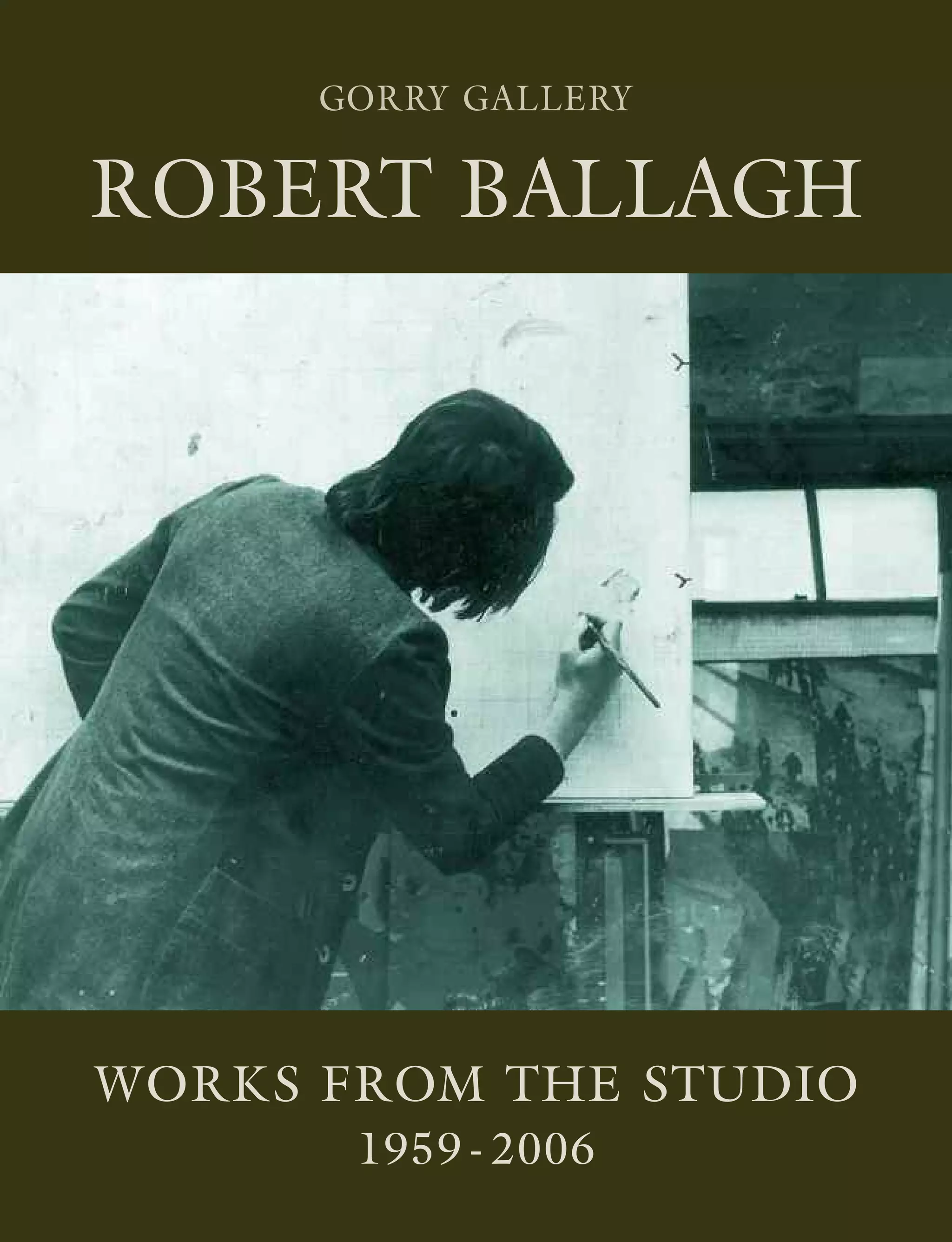
WORKS FROM THE STUDIO
1959 - 2006
ROBERTBALLAGHWorksfromtheStudio1959-2006
GORRY GALLERY
20 Molesworth Street, Dublin 2
Tel/Fax 01 6795319
www.gorrygallery.ie
GORRY GALLERY
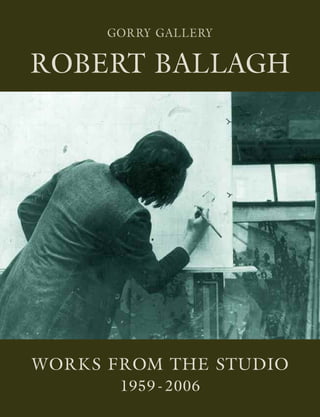
ROBERT BALLAGH
ROBERT BALLAGH
WORKS FROM THE STUDIO
1959-2006
THE GORRY GALLERY
in Association with
DAMIEN MATTHEWS FINE ART
Presents
ROBERT BALLAGH
Works from the Studio
1959 - 2006
at
The Gorry Gallery
20 Molesworth Street Dublin 2
Tel/Fax: 01 6795319
www.gorrygallery.ie
20 September - 5 October 2006
DAMIEN MATTHEWS FINE ART
14 Brechin Place, London, SW7 4QA
UK 00 44 207 373 9337
IRL 00 353 86 841 4421
matthewsfineart@aol.com
4
DAMIEN MATTHEWS FINE ART
14 Brechin Place
London
SW7 4QA
Telephone 00 44 207 373 9337
00 353 86 841 4421
Email matthewsfineart@aol.com
THE GORRY GALLERY
20 Molesworth Street
Dublin 2
Tel/Fax 00 353 1 6795319
Web www.gorrygallery.ie
All rights reserved. No part of this publication may be used or reproduced
in any form whatsoever without prior written permission from the publisher.
Copyright © 2006 Damien Matthews Fine Art Publications.
All artwork by Robert Ballagh. Copyright © Robert Ballagh 2006.
Designed and produced by Damien Matthews Fine Art Publications.
5
Contents
Foreword
James & Thérèse Gorry and Damien Matthews page 6
Overview
Philip Vann page 9
Catalogue
Part I page 25
Conversation
Karim White page 62
Catalogue
Part II page 76
Chronology of Paintings page 107
6
Foreword
It may be argued that artists have an obligation to observe and chronicle the world
they live in, which, in Robert Ballagh’s case, is predominantly that of urban Ireland –
although there are, increasingly, radical rural allusions in his work.
Throughout his career, his work has movingly and ingeniously reflected many facets of
modern Ireland, its politics, culture, history and potential future developments. His art is
marked throughout by an unerringly fresh and often innovative exploration of ideas and
concepts, however controversial they may be. Ballagh is a pioneer in this regard.
This exhibition of work from his studio - ranging from 1959 to 2006, and encompassing
photographs, preliminary studies and finished pieces in an ambitious range of media –
bears witness to his spirit of free and fearless philosophical enquiry, and gives an intimate
insight into his distinctive political psyche and unique artistic development.
We are delighted to have this opportunity to stage this exhibition and trust it will
complement his Retrospective at the Royal Hibernian Academy.
James and Thérèse Gorry & Damien Matthews.
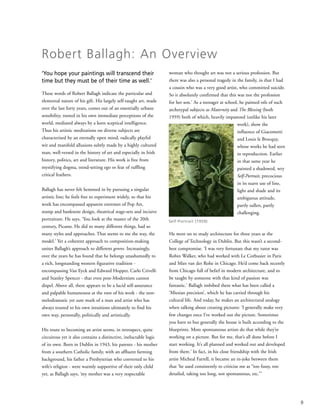
‘You hope your paintings will transcend their
time but they must be of their time as well.’
These words of Robert Ballagh indicate the particular and
elemental nature of his gift. His largely self-taught art, made
over the last forty years, comes out of an essentially urbane
sensibility, rooted in his own immediate perceptions of the
world, mediated always by a keen sceptical intelligence.
Thus his artistic meditations on diverse subjects are
characterised by an eternally open mind, radically playful
wit and manifold allusions subtly made by a highly cultured
man, well-versed in the history of art and especially in Irish
history, politics, art and literature. His work is free from
mystifying dogma, trend-setting ego or fear of ruffling
critical feathers.
Ballagh has never felt hemmed in by pursuing a singular
artistic line; he feels free to experiment widely, so that his
work has encompassed apparent extremes of Pop Art,
stamp and banknote design, theatrical stage-sets and incisive
portraiture. He says, ‘You look at the master of the 20th
century, Picasso. He did so many different things, had so
many styles and approaches. That seems to me the way, the
model.’ Yet a coherent approach to composition-making
unites Ballagh’s approach to different genres. Increasingly,
over the years he has found that he belongs unashamedly to
a rich, longstanding western figurative tradition -
encompassing Van Eyck and Edward Hopper, Carlo Crivelli
and Stanley Spencer - that even post-Modernism cannot
dispel. Above all, there appears to be a lucid self-assurance
and palpable humaneness at the root of his work - the non-
melodramatic yet sure mark of a man and artist who has
always trusted to his own intuitions ultimately to find his
own way, personally, politically and artistically.
His route to becoming an artist seems, in retrospect, quite
circuitous yet it also contains a distinctive, ineluctable logic
of its own. Born in Dublin in 1943, his parents - his mother
from a southern Catholic family, with an affluent farming
background, his father a Presbyterian who converted to his
wife’s religion - were warmly supportive of their only child
yet, as Ballagh says, ‘my mother was a very respectable
woman who thought art was not a serious profession. But
there was also a personal tragedy in the family, in that I had
a cousin who was a very good artist, who committed suicide.
So it absolutely confirmed that this was not the profession
for her son.’ As a teenager at school, he painted oils of such
archetypal subjects as Maternity and The Blessing (both
1959) both of which, heavily impastoed (unlike his later
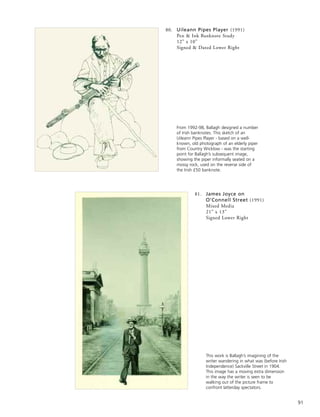
work), show the
influence of Giacometti
and Louis le Brocquy,
whose works he had seen
in reproduction. Earlier
in that same year he
painted a shadowed, wry
Self-Portrait, precocious
in its suave use of line,
light and shade and its
ambiguous attitude,
partly sullen, partly
challenging.
He went on to study architecture for three years at the
College of Technology in Dublin. But this wasn’t a second-
best compromise. ‘I was very fortunate that my tutor was
Robin Walker, who had worked with Le Corbusier in Paris
and Mies van der Rohe in Chicago. He’d come back recently
from Chicago full of belief in modern architecture, and to
be taught by someone with that kind of passion was
fantastic.’ Ballagh imbibed there what has been called a
‘Miesian precision’, which he has carried through his
cultural life. And today, he makes an architectural analogy
when talking about creating pictures: ‘I generally make very
few changes once I’ve worked out the picture. Sometimes
you have to but generally the house is built according to the
blueprints. More spontaneous artists do that while they’re
working on a picture. But for me, that’s all done before I
start working. It’s all planned and worked out and developed
from there.’ In fact, in his close friendship with the Irish
artist Micheal Farrell, it became an in-joke between them
that ‘he used consistently to criticise me as “too fussy, too
detailed, taking too long, not spontaneous, etc.”’
Robert Ballagh: An Overview
Self-Portrait (1959)
9
At College, his inventiveness - ‘designing buildings that were
outlandish’ - got him into repeated rows with some of his
tutors, and he realised that it would be many ‘years before I
got to create beautiful buildings - if ever!’ So what he calls
‘an easy choice’ was made - he jettisoned architecture to play
bass guitar in a professional showband, which toured the
avid market of rural Irish village dance halls. Lucrative and
exciting at first, after three years or so this became tedious.
So he gave it up, spent time in London, and then worked in
Dublin for a time as an engineering draughtsman and a
postman. He acquired a useful ‘art education on the hoof’
by doing what he calls some ‘crass commercial work, like
labels for supermarkets, where you inevitably pick up skills,
learning about typography and layout, for example.’
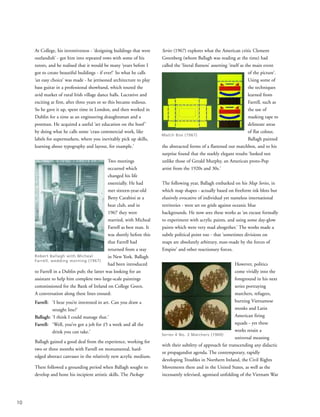
Two meetings
occurred which
changed his life
essentially. He had
met sixteen-year-old
Betty Carabini at a
beat club, and in
1967 they were
married, with Micheal
Farrell as best man. It
was shortly before this
that Farrell had
returned from a stay
in New York. Ballagh
had been introduced
to Farrell in a Dublin pub; the latter was looking for an
assistant to help him complete two large-scale paintings
commissioned for the Bank of Ireland on College Green.
A conversation along these lines ensued:
Farrell: ‘I hear you’re interested in art. Can you draw a
straight line?’
Ballagh: ‘I think I could manage that.’
Farrell: ‘Well, you’ve got a job for £5 a week and all the
drink you can take.’
Ballagh gained a good deal from the experience, working for
two or three months with Farrell on monumental, hard-
edged abstract canvases in the relatively new acrylic medium.
There followed a grounding period when Ballagh sought to
develop and hone his incipient artistic skills. The Package
Series (1967) explores what the American critic Clement
Greenberg (whom Ballagh was reading at the time) had
called the ‘literal flatness’ asserting ‘itself as the main event
of the picture’.
Using some of
the techniques
learned from
Farrell, such as
the use of
masking tape to
delineate areas
of flat colour,
Ballagh painted
the abstracted forms of a flattened out matchbox, and to his
surprise found that the starkly elegant results ‘looked not
unlike those of Gerald Murphy, an American proto-Pop
artist from the 1920s and 30s.’
The following year, Ballagh embarked on his Map Series, in
which map shapes - actually based on freeform ink blots but
elusively evocative of individual yet nameless international
territories - were set on grids against oceanic blue
backgrounds. He now sees these works as ‘an excuse formally
to experiment with acrylic paints, and using some day-glow
paints which were very mad altogether.’ The works made a
subtle political point too - that ‘sometimes divisions on
maps are absolutely arbitrary, man-made by the forces of
Empire’ and other reactionary forces.
However, politics
come vividly into the
foreground in his next
series portraying
marchers, refugees,
burning Vietnamese
monks and Latin
American firing
squads - yet these
works retain a
universal meaning
with their subtlety of approach far transcending any didactic
or propagandist agenda. The contemporary, rapidly
developing Troubles in Northern Ireland, the Civil Rights
Movements there and in the United States, as well as the
incessantly televised, agonised unfolding of the Vietnam War
10
Robert Ballagh with Micheal
Farrell, wedding morning (1967)
Match Box (1967)
Series 4 No. 3 Marchers (1969)
all were part of the impetus behind these imposing works
whose forms movingly yet coolly abstract the newsprint-
photo forms of protesters and victims of war and civil strife.
‘A terrible beauty is born’ indeed out of these abstracted
snapshots of life in the media-snatched front line.
The garish, rather sickly sweetness of the modernising Irish
economy, with its burgeoning consumer culture, that had
emerged in the 1960s is the subject of a series of paintings
made in 1971. The trite empty-headedness of a society
aiming for purely materialistic ends is hinted at in portrayals
of iced cakes and dolly mixtures set with deliberate,
discomforting vapidness against collaged, kitsch materials
redolent, for example, of fake leopard skin.
‘It is impossible, thirty years later, to appreciate the impact
of this first major onslaught of international art on an
unsuspecting Irish public’, the critic Dorothy Walker wrote
in 1997. She was referring to the first two ground-breaking
ROSC exhibitions that took place in Dublin in 1967 and
1971. These showed the most famous living artists from
around the world - including Picasso, Bacon, Barnett
Newman, Rothko, Tapies and some of the younger
American Pop artists like Rauschenberg, Lichtenstein and
Jim Dine - though modern Irish art was excluded. Seeing
work by the American Pop artists in particular confirmed to
Ballagh that he was on the right track, having quite
independently come to many similar artistic conclusions.
In an article (published in The Dubliner, November 2004),
Ballagh recalls the 1967 ROSC exhibition, ‘washed up on
Irish shores… the fields of bright acrylic primary colours,
the razor sharp outlines and the hopelessly ironic comic
book content all overwhelmed me.’ He found ‘gaining access
to the modern art scene [in Ireland] was not difficult’, and
‘within a relatively short period I became Ireland’s best-
known Pop artist. To be frank, I was probably Ireland’s only
Pop artist.’ Yet even at such an early stage in his career,
Ballagh could not help contemplating the potential impasse
of much contemporary avant-garde art. ‘When I looked at
the work of, say, Roy Lichtenstein, an incredibly intelligent
artist, I couldn’t help speculating that his chosen technique
would inevitably restrict his full development, and sadly,
such has been the case. Lichtenstein remained trapped in a
prison of Ben Day dots for the rest of his life, and let’s face
it, he is not unique. Many other modern artists have
suffered the same stylistic incarceration.’
In the late 1960s, Ballagh’s attention was drawn in two
apparently disparate directions - researching and
contemplating great classical artists, and watching the state
of national emergency unfolding in Northern Ireland as
Civil Rights marchers were attacked by the B-Special police.
Actually, there was no divergence at all in these two aspects,
as Ballagh went on make a series of innovative paintings
based on Goya’s The Third of May, David’s The Rape of the
Sabines and Delacroix’s Liberty at the Barricades. Just as
these late 18th and 19th masterpieces convey thoughtful yet
viscerally charged responses to contemporaneous political
repression, so Ballagh’s Pop Art adaptations - with a stinging
succinctness of their own, as in his juxtaposition of a
simplified version of Delacroix’s painting with a glimpse of
a current Irish newspaper headline reporting events
‘(RIOTS) IN DERRY’ - reflect his own response to events
of his own time.
In his 1986 book, Robert Ballagh, Ciaran Carty has written:
‘Seamus Heaney made a similar connection in terms of
poetry. In August 1969 he saw the Goya painting The Third
of May at the Prado in Madrid. That night he turned on the
TV in his hotel room to see the B-Specials rampaging up the
Catholic Falls Road. For a while he toyed with
counterpointing the two images of violence in a poem.
Some months later he came across Ballagh’s painting… He
thought it intriguing that two Irish artists in two different
disciplines had thought of using the same Spanish image of
oppression in exactly the same association.’ Carty quotes
Ballagh’s comment: ‘Seamus understood very early on what
my painting was about - that it wasn’t just a classical
pastiche.’
The question of how artists could respond to the
increasingly violent situation became an urgent one. Louis
le Brocquy painted semi-occluded images where anguished
faces are helplessly shielded behind outstretched hands with
plaintive palms. Oisín Kelly made a cast aluminium
sculpture in 1969 of poignantly vulnerable rows of nearly
faceless Marchers. The artist Brian O’Doherty made a public
performance in which he changed his name by deed poll to
Patrick Ireland (all his subsequent artwork, though not his
11
art criticism, being made under that name) ‘until such time
as the British military presence is removed from Northern
Ireland and all citizens are granted their civil rights’. Micheal
Farrell has spoken of the changed direction of his work as a
consequence of events in Northern Ireland: ‘In 1969, the
Bogside in Derry was ablaze. I made a speech at the opening
of the Living Art exhibition in Cork when I was accepting
my prize-money, but those assembled did not think much of
it. I believed that we could not stand by and let the series of
events unfold. The only ones who supported me were Leo
Smith, my art dealer, and Robert Ballagh. I donated the
prize-money as part of the artists’ fund for refugees who
were streaming across the border.’
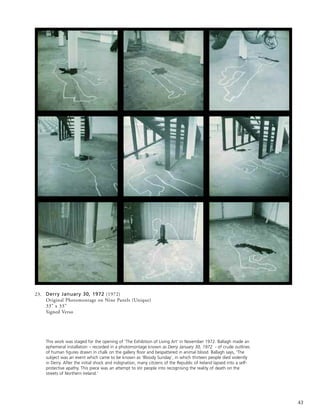
The traumatic events of January 30 1972, known as Bloody
Sunday, when British soldiers opened fire indiscriminately
on peaceful demonstrators in the Bogside, Derry, killing
thirteen and wounding others, were the spur for Ballagh’s
installation at the Irish Exhibition of Living Art in Dublin
later that year. He chalked out the rough outline of thirteen
figures on the gallery floor, pouring animal blood onto
them. This commemoration of victims of the Bloody
Sunday atrocities was made as a response to the ‘self-
protective apathy’ that, ‘after the initial shock and
indignation, many citizens of the Republic of Ireland [felt].’
Now preserved only in the form of a photomontage of nine
panels, this ephemeral artwork still has a raw power to
disquiet and move.
Ballagh’s 1973 painting of the so-called Winchester Eight -
IRA members on trial in England - is seen by the artist ‘on
one level as simply an early attempt to use oil paint’,
reproducing the sepia tones of police file photos of the
group. But on another level, the effect is sinister and
surreally mundane in the way its attenuated palette, pitifully
economical portrayals and mournful mugshot solemnity
help implicitly conjure up something of the sufferings and
violence of the period.
In 1972 Ballagh began an extensive series of pictures
depicting people observed looking at paintings by artists
such as Mondrian, Warhol, Stella, Jasper Johns, Barnett
Newman, Pollock, Motherwell, Soulages and, from Ireland,
Farrell and Cecil King. A vast polyptych canvas (1972) of
back views of simplified gallery-going figures - often based
on his own photos of standing and crouching spectators -
peering at modern masterpieces on the museum wall was
purchased for the Bank of Ireland Collection. His exhibition
of these paintings at the prestigious David Hendriks Gallery
in Dublin in 1972 was a sell-out. A series of successful
selling exhibitions followed abroad, based on similar themes.
(He showed with Hendriks for fifteen years, and later
recalled that ‘in the often fractious world of Irish art’
Hendriks offered him ‘generosity, support and
encouragement during the difficult beginnings of a career in
the arts.’) A 1977 painting, The Conversation, interposes the
sunglasses-wearing Ballagh into a Vermeer-like domestic
interior, where he appears to ruminate on advice from an
admonitory Old Master. This speculatively humourous
example of cultural time travel shows how increasingly
Ballagh was going beyond Modernist and contemporary
influences to contemplate examples of earlier, classical
western art - the antithesis perhaps of the instantaneous
modern approach. He says, ‘As my career developed, I found
myself wandering into the National Gallery rather than the
Tate Gallery.’
In 1973, he painted a picture Inside No. 3, set in his inner-
city Dublin family home. ‘The nude is such a predominant
theme for western painting, I just said I had to have a crack
at this. The only model I had was my wife.’ His wife is
seen nude, descending a spiral staircase - a reference to
Duchamps’ seminal image, and there is a Pop Art reprise of
Delacroix’s Liberty over the fireplace. Ballagh had in mind
12
Derry January 30, 1972 (Part View)
Two People and a Michael Farrell, 1972
here questioning what John Berger in his influential 1972
book Ways of Seeing had characterised as, traditionally in
western art, the proprietorial glance of the male spectator
towards the female nude. In Ballagh’s picture, all we see of
the artist himself are his trouser bottoms and white shoes as
he lounges on a chair or sofa. His wife’s face is averted from
him towards either the implicitly feminist image of a
resurgent Liberty or to Ballagh’s own face in black-and-white
grinning on the far corner TV screen.
Having painted his wife, Ballagh realised that ‘so as not to
be a male chauvinist pig, I had to do a male nude. If I did
my wife as the female nude, I didn’t have much choice.’ So
in the companion Upstairs Inside No. 3, the artist (wearing
only a white tee-shirt and white socks) gazes directly at the
spectator, and somewhat obliquely at his wife. Though he
initially found portraying himself so ‘a bit tricky and
embarrassing’, it is in fact a dignified self-image, wittily
subverting any notion of the ‘superior’ male gaze. Two
further artistic images within the painting - one of Gustave
Caillebotte’s famous 1877 painting of a Parisian street scene
in the rain, another of a Japanese erotic print which his wife
is perusing - are characteristically allusive. From the early
1970s onwards, Ballagh found himself increasingly admiring
and being inspired by the realist tradition in western art -
ranging from the gorgeous scrutiny of humanity and the
natural world in early Renaissance altar pieces by Carlo
Crivelli through the acute seeing of Vermeer and what he
has called ‘the meticulous precision of Jan van Eyck’ and
other 15th century Flemish painters to the photographically-
inspired realism of Caillebotte and the unnervingly honest
acerbity of German Neue Sachlikeit art - and, in this context,
the Caillebotte representation here is telling.
In mid-70s Catholic Ireland, this painting of himself semi-
clothed caused mild controversies. What Ballagh himself
found ‘hugely ironic’ was the way that, by way of contrast,
not one single person remarked on ‘the fiercely rude
Japanese print’ - with its dramatically heightened sexual
encounter explicit on the pages which his wife is
contemplating.
Through the open window in this painting, with its view of
the King’s Inns, the splendid 18th century headquarters of
Dublin’s barristers, we see a helicopter hovering. For Ballagh
at the time, this vehicle was emblematic of a more and more
militarised world, one intruding inescapably into the state of
domestic happiness. This proved to be a somewhat ominous
portrayal too, since, as Ballagh notes, a few years later the
skies around his home - located near the Special Criminal
Courts, which were used for non-jury trials of political
prisoners - were buzzing with helicopters whenever there was
a trial.
Another painting entitled Inside No. 3 after Modernisation
intermingles a plethora of artistic styles - Realism, Pop, even
Abstract Expressionism - to make a cuttingly amusing
comment on a contemporary post-Modernist tendency that
encourages artists to be uninihibitedly stylistically liberal
and, perhaps, as a result, unfocussed.
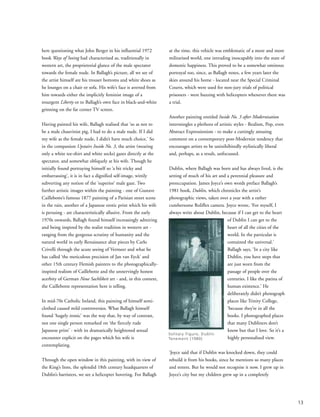
Dublin, where Ballagh was born and has always lived, is the
setting of much of his art and a perennial pleasure and
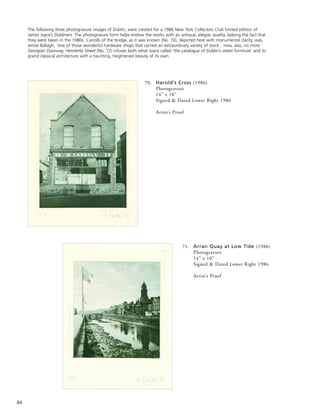
preoccupation. James Joyce’s own words preface Ballagh’s
1981 book, Dublin, which chronicles the artist’s
photographic views, taken over a year with a rather
cumbersome Roliflex camera. Joyce wrote, ‘For myself, I
always write about Dublin, because if I can get to the heart
of Dublin I can get to the
heart of all the cities of the
world. In the particular is
contained the universal.’
Ballagh says, ‘In a city like
Dublin, you have steps that
are just worn from the
passage of people over the
centuries. I like the patina of
human existence.’ He
deliberately didn’t photograph
places like Trinity College,
‘because they’re in all the
books. I photographed places
that many Dubliners don’t
know but that I love. So it’s a
highly personalised view.
‘Joyce said that if Dublin was knocked down, they could
rebuild it from his books, since he mentions so many places
and streets. But he would not recognise it now. I grew up in
Joyce’s city but my children grew up in a completely
13
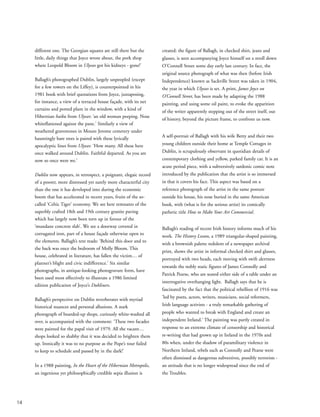
Solitary Figure, Dublin
Tenement (1980)
different one. The Georgian squares are still there but the
little, daily things that Joyce wrote about, the pork shop
where Leopold Bloom in Ulysses got his kidneys - gone!’
Ballagh’s photographed Dublin, largely unpeopled (except
for a few rowers on the Liffey), is counterpointed in his
1981 book with brief quotations from Joyce, juxtaposing,
for instance, a view of a terraced house façade, with its net
curtains and potted plant in the window, with a kind of
Hibernian haiku from Ulysses: ‘an old woman peeping. Nose
whiteflattened against the pane.’ Similarly a view of
weathered gravestones in Mount Jerome cemetery under
hauntingly bare trees is paired with these lyrically
apocalyptic lines from Ulysses: ‘How many. All these here
once walked around Dublin. Faithful departed. As you are
now so once were we.’
Dublin now appears, in retrospect, a poignant, elegaic record
of a poorer, more distressed yet surely more characterful city
than the one it has developed into during the economic
boom that has accelerated in recent years, fruits of the so-
called ‘Celtic Tiger’ economy. We see here remnants of the
superbly crafted 18th and 19th century granite paving
which has largely now been torn up in favour of the
‘mundane concrete slab’. We see a doorway covered in
corrugated iron, part of a house façade otherwise open to
the elements. Ballagh’s text reads: ‘Behind this door and to
the back was once the bedroom of Molly Bloom. This
house, celebrated in literature, has fallen the victim… of
planner’s blight and civic indifference.’ Six similar
photographs, in antique-looking photogravure form, have
been used most effectively to illustrate a 1986 limited
edition publication of Joyce’s Dubliners.
Ballagh’s perspective on Dublin reverberates with myriad
historical nuances and personal allusions. A stark
photograph of boarded-up shops, curiously white-washed all
over, is accompanied with the comment: ‘These two facades
were painted for the papal visit of 1979. All the vacant…
shops looked so shabby that it was decided to brighten them
up. Ironically it was to no purpose as the Pope’s tour failed
to keep to schedule and passed by in the dark!’
In a 1988 painting, In the Heart of the Hibernian Metropolis,
an ingenious yet philosophically credible sepia illusion is
created: the figure of Ballagh, in checked shirt, jeans and
glasses, is seen accompanying Joyce himself on a stroll down
O’Connell Street some day early last century. In fact, the
original source photograph of what was then (before Irish
Independence) known as Sackville Street was taken in 1904,
the year in which Ulysses is set. A print, James Joyce on
O’Connell Street, has been made by adapting the 1988
painting, and using some oil paint, to evoke the apparition
of the writer apparently stepping out of the street itself, out
of history, beyond the picture frame, to confront us now.
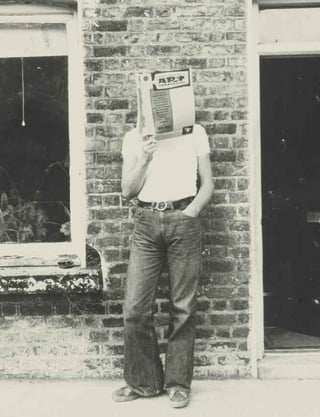
A self-portrait of Ballagh with his wife Betty and their two
young children outside their home at Temple Cottages in
Dublin, is scrupulously observant in quotidian details of
contemporary clothing and yellow, parked family car. It is an
acute period piece, with a subversively sardonic comic note
introduced by the publication that the artist is so immersed
in that it covers his face. This aspect was based on a
reference photograph of the artist in the same posture
outside his house, his nose buried in the same American
book, with (what is for the serious artist) its comically
pathetic title How to Make Your Art Commercial.
Ballagh’s reading of recent Irish history informs much of his
work. The History Lesson, a 1989 triangular-shaped painting,
with a brownish palette redolent of a newspaper archival
print, shows the artist in informal checked shirt and glasses,
portrayed with two heads, each moving with swift alertness
towards the nobly static figures of James Connolly and
Patrick Pearse, who are seated either side of a table under an
interrogative overhanging light. Ballagh says that he is
fascinated by the fact that the political rebellion of 1916 was
‘led by poets, actors, writers, musicians, social reformers,
Irish language activists - a truly remarkable gathering of
people who wanted to break with England and create an
independent Ireland.’ The painting was partly created in
response to an extreme climate of censorship and historical
re-writing that had grown up in Ireland in the 1970s and
80s when, under the shadow of paramilitary violence in
Northern Ireland, rebels such as Connolly and Pearse were
often dismissed as dangerous subversives, possibly terrorists -
an attitude that is no longer widespread since the end of
the Troubles.
14
Frequently Ballagh is described as a photo-realist painter.
The limitations of such a label are shown by pictures like
The History Lesson, which keenly demonstrates the
thoughtful playfulness with which the artist selects and
transfigures his original source material. In some respects,
Ballagh would be better described as at times a photo-
surrealist. His deep appreciation of Magritte’s art - itself
delineated with such precise clarity and so rich in visual
puns, humourous pastiche and literary and cinematic
references, yet retaining an ultimate degree of enigma - is
relevant here. When visiting Brussels in the early 1970s for
his show there, Ballagh was initially disappointed not to
encounter any Magrittes in public galleries. By chance, he
was invited back to a private home - that of Louis
Scutinaire, a close friend of Magritte’s - where he was
delighted and felt privileged to see dozens of paintings by
the artist.
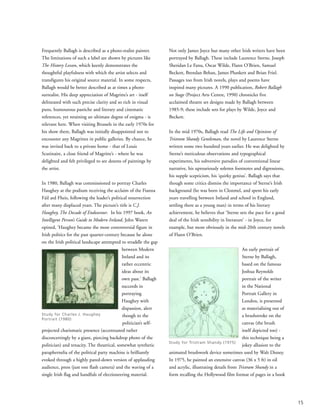
In 1980, Ballagh was commissioned to portray Charles
Haughey at the podium receiving the acclaim of the Fianna
Fáil ard Fheis, following the leader’s political resurrection
after many displaced years. The picture’s title is C.J.
Haughey, The Decade of Endeavour. In his 1997 book, An
Intelligent Person’s Guide to Modern Ireland, John Waters
opined, ‘Haughey became the most controversial figure in
Irish politics for the past quarter-century because he alone
on the Irish political landscape attempted to straddle the gap
between Modern
Ireland and its
rather eccentric
ideas about its
own past.’ Ballagh
succeeds in
portraying
Haughey with
dispassion, alert
though to the
politician’s self-
projected charismatic presence (accentuated rather
disconcertingly by a giant, piercing backdrop photo of the
politician) and tenacity. The theatrical, somewhat synthetic
paraphernelia of the political party machine is brilliantly
evoked through a highly pared-down version of applauding
audience, press (just one flash camera) and the waving of a
single Irish flag and handfuls of electioneering material.
Not only James Joyce but many other Irish writers have been
portrayed by Ballagh. These include Laurence Sterne, Joseph
Sheridan Le Fanu, Oscar Wilde, Flann O’Brien, Samuel
Beckett, Brendan Behan, James Plunkett and Brian Friel.
Passages too from Irish novels, plays and poems have
inspired many pictures. A 1990 publication, Robert Ballagh
on Stage (Project Arts Centre, 1990) chronicles five
acclaimed theatre set designs made by Ballagh between
1985-9; these include sets for plays by Wilde, Joyce and
Beckett.
In the mid 1970s, Ballagh read The Life and Opinions of
Tristram Shandy Gentleman, the novel by Laurence Sterne
written some two hundred years earlier. He was delighted by
Sterne’s meticulous observations and typographical
experiments, his subversive parodies of conventional linear
narrative, his uproariously solemn footnotes and digressions,
his supple scepticism, his ‘quirky genius’. Ballagh says that
though some critics dismiss the importance of Sterne’s Irish
background (he was born in Clonmel, and spent his early
years travelling between Ireland and school in England,
settling there as a young man) in terms of his literary
achievement, he believes that ‘Sterne sets the pace for a good
deal of the Irish sensibility in literature’ - in Joyce, for
example, but more obviously in the mid-20th century novels
of Flann O’Brien.
An early portrait of
Sterne by Ballagh,
based on the famous
Joshua Reynolds
portrait of the writer
in the National
Portrait Gallery in
London, is presented
as materialising out of
a brushstroke on the
canvas (the brush
itself depicted too) -
this technique being a
jokey allusion to the
animated brushwork device sometimes used by Walt Disney.
In 1975, he painted an extensive canvas (36 x 5 ft) in oil
and acrylic, illustrating details from Tristram Shandy in a
form recalling the Hollywood film format of pages in a book
15
Study for Charles J. Haughey
Portrait (1980)
Study for Tristram Shandy (1975)
flipping away to denote the passage of time. Tristram
Shandy himself has become a faceless adult male figure in
20th century suit-and-tie. In one episode, Ballagh portrays
Shandy at an open window (alluding to Sterne’s ruminations
on windows to the human soul residing in each human
breast), his disillusioned countenance appearing surreally as
a warping clockface. This is a reference to the novel’s
opening, when the author laments his life of misfortune
arising from the fact that his mother delayed his moment of
conception by asking if his father had wound up the clock.
In 1977, Ballagh made a series of paintings and a silkscreen
print based on Flann O’Brien’s The Third Policeman (which
the author’s own publishers had declined on submission in
1940; it was published posthumously to critical acclaim in
1967). The novel’s hilarious inventiveness and subtle
admixture of straightforward observation (as a deadpan
murder mystery), fantastically pedantic logic (especially in
the endless footnotes, somewhat reminiscent of Sterne) and
absurd fantasy, its chilling preoccupation with eternal
human guilt (elsewhere the author wrote, ‘Hell goes round
and round… it is interminable, repetitive and very nearly
unbearable’), inspired six paintings. One of these, The
Atomic Theory - a delightfully uncomfortable painting in all
respects - showing naked buttocks resting on a saddle-bar,
evokes the unrequited love affair between the novel’s
protagonist and his bicycle (clearly marked here as a Brooks
model) - ‘Her saddle seemed to spread invitingly into the
most enchanting of all seats…’ The Atomic Theory itself
refers to ‘the queer behaviour of bicycles in these parts’ -
‘when a man let things go far… he is half or more than half
a bicycle.’
Ballagh’s impeccably rendered 1990 portrait of Oscar Wilde,
the thinner, greying Wilde of later years, is dominated by
variegated, quietly modulated blue tones - permeating the
writer’s modest, no longer dandified clothes and the
swirling, leafy ornamentation of the high-aesthetic wallpaper
backdrop. This colour scheme alludes to Wilde’s love of this
colour - as, for example, when his rooms as an Oxford
undergraduate were filled with blue-and-white china - but
does not convey here the exuberant, questing, sparkling wit
of his worldly career but rather an air of sad yearning and
loss. This air perhaps retains, however, something of the
paradoxical sting of such earlier Wildean aphorisms as ‘Life
is a mauvais quart d’heure made up of exquisite moments’
(from A Woman of No Importance). His face, beautifully in
profile, is wanly abstracted, one clearly marked by suffering
and self-knowledge. Brian O’Doherty has written of the
‘William Morris wallpaper design which frames his head in
an eccentric halo (his halo has slipped).’
Ballagh designed the stage sets for the 1987 production of
Wilde’s The Importance of Being Earnest and the 1988
production of his Salome, both for Dublin’s Gate Theatre.
He never sought to become a theatrical stage designer; rather
the theatre world sought him out. He has written, ‘If there
has been a guiding principle in my approach to stage design
it has been my total belief in the primacy of both the text
and the performance and, as a consequence, an acceptance
that the setting should be both supportive yet, on the other
hand, subordinate. When I was studying architecture way
back in the 60s, I remember hearing Mies van der Rohe’s
famous dictum, “less is more”, it seems to me that this is
just as valid today.’
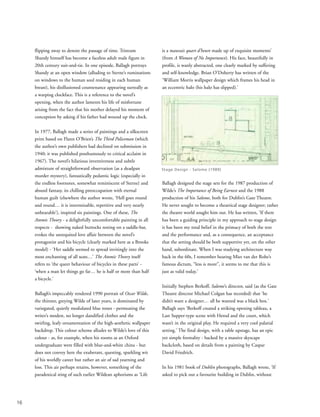
Initially Stephen Berkoff, Salome’s director, said (as the Gate
Theatre director Michael Colgan has recorded) that ‘he
didn’t want a designer… all he wanted was a black box.’
Ballagh says ‘Berkoff created a striking opening tableau, a
Last Supper-type scene with Herod and the court, which
wasn’t in the original play. He required a very cool palatial
setting.’ The final design, with a table upstage, has an epic
yet simple formality - backed by a massive skyscape
backcloth, based on details from a painting by Caspar
David Friedrich.
In his 1981 book of Dublin photographs, Ballagh wrote, ‘If
asked to pick out a favourite building in Dublin, without
16
Stage Design - Salome (1989)
hesitation I would nominate the Broadstone Station,
designed by John Skipton Mulvany.’ The façade of this
sublime building built in 1850 as one of Dublin’s four rail
termini, became a source of inspiration for the austerely
architectonic form that made up the stage-set of The
Importance of Being Earnest, itself overlooked by a gigantic
reproduction of a painting of Queen Victoria (in an earlier
model, Ballagh had proposed a huge copy of the famous
photograph of those star-crossed lovers, Oscar and Bosie).
Since the drama was acted in modern dress, the looming
regal image reinforced the audience’s awareness of the tragic-
comic hypocrisy of so-called (Thatcherite) ‘Victorian Values’
that permeate the play.
For the second act of I’ll Go On, a drama based on Samuel
Beckett’s novels which opened at the Gate in 1986, a clinical
setting was required. Ballagh initially made a quick sketch
rather resembling his jacket design for a book on the H-
Block hunger strikes - a blanketed figure on a catafalque.
This severe image had been partly inspired by The Stone of
Remembrance, in the Memorial Park at Islandbridge,
designed by Edwin Lutyens to commemorate some 50,000
Irishmen who died as British Army volunteers in the First
World War. Ballagh’s set had moving resonances for a play
dealing with the bleak, sorrowful stream of consciousness of
an old dying man.
At an early production meeting for the Dublin Theatre
Festival production of The Wake (a necessarily and vastly
compressed adaptation of Joyce’s Finnegan’s Wake), Ballagh
audaciously displayed an array of assorted children’s building
blocks. The play itself utilised seven large marbled blocks in
various geometric forms (corresponding to Joyce’s own
notion of sigla, coded aspects of human character)
complemented by a length of coloured material associated
with the fluid, archetypally feminine presence of Anna Livia
Plurabelle. The imaginative versatility of Ballagh’s set - where
blocks ‘became … monuments, streetscapes, tracts of the
human anatomy, Finnegan’s corpse’, etc., helped make this
production (in the words of the Irish Times critic) ‘accessible
and memorable’.
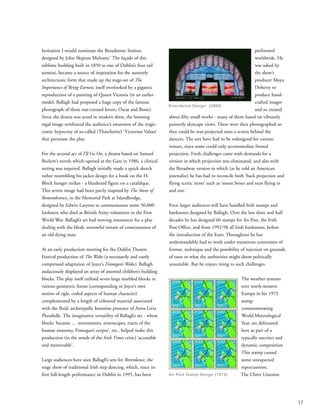
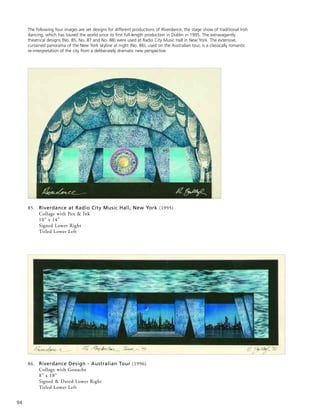
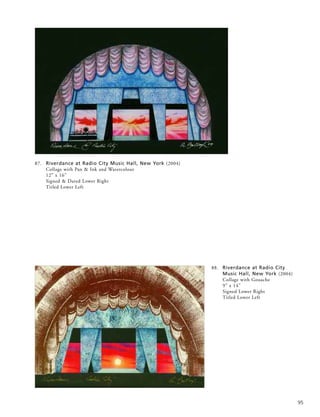
Large audiences have seen Ballagh’s sets for Riverdance, the
stage show of traditional Irish step dancing, which, since its
first full-length performance in Dublin in 1995, has been
performed
worldwide. He
was asked by
the show’s
producer Moya
Doherty to
produce hand-
crafted images
and so created
about fifty small works - many of them based on vibrantly
painterly skyscape views. These were then photographed so
they could be rear-projected onto a screen behind the
dancers. The sets have had to be redesigned for various
venues, since some could only accommodate frontal
projection. Fresh challenges came with demands for a
version in which projection was eliminated, and also with
the Broadway version in which (as he told an American
journalist) he has had to reconcile both ‘back projection and
flying scenic items’ such as ‘moon boxes and suns flying in
and out.’
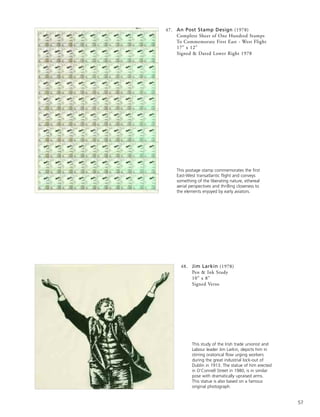
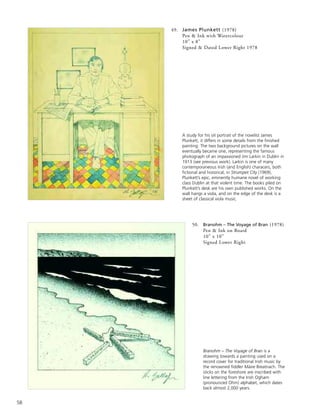
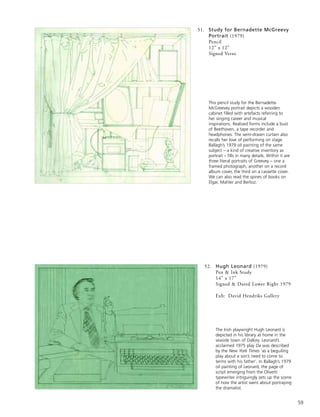
Even larger audiences will have handled Irish stamps and
banknotes designed by Ballagh. Over the last three and half
decades he has designed 66 stamps for An Post, the Irish
Post Office, and from 1992-98 all Irish banknotes, before
the introduction of the Euro. Throughout he has
understandably had to work under numerous constraints of
format, technique and the possibility of rejection on grounds
of taste or what the authorities might deem politically
unsuitable. But he enjoys rising to such challenges.
The weather systems
over north-western
Europe in his 1973
stamp
commemorating
World Meterological
Year, are delineated
here as part of a
typically succinct and
dynamic composition.
This stamp caused
some unexpected
repercussions.
The Ulster Unionist
17
Riverdance Design (2004)
An Post Stamp Design (1973)
politician Dr. Ian Paisley complained to Sir Alec Douglas-
Hume in the House of Commons about the absence of an
Irish border in the design. The British Foreign Secretary
reminded Paisley it was a weather map, not a political one.
The way that Ballagh’s artistic and political interests can
sympathetically interfuse to make a powerfully original
postal image is shown in his 1979 stamp commemorating
the anniversary of the birthdate of the revolutionary Patrick
Pearse (Pádraig Mac Piarais 1879-1916, as is written on the
stamp itself). The left-hand side shows Pearse in black-and-
white profile. To the right is the figure of Liberty in the
same format as in Ballagh’s earlier Pop Art painting based on
Delacroix’s Liberty at the Barricades. The Parisian barricades
have been surplanted here by the GPO building in Dublin,
headquarters of the 1916 uprising. The French tricolour
which Liberty brandishes has been replaced by the Irish flag
- a most telling transposition.
Early on in this overview, Ballagh was characterised as a
quintessentially urbane artist. That has remained true
throughout his career. However, as a young man, a bit of ‘a
young hell-raiser’ as he has said, he saw himself pretty much
as an exclusively urban artist, internationalist in outlook,
who eschewed any interest in depicting the Irish landscape.
Interviewed in 1980, he said, ‘I never had any access to the
culture that many people think is the Irish culture, the rural
Gaelic tradition. I can’t paint Connemara fishermen. My
experience of Ireland is an urban one. It would be dishonest
of me to paint anything else.’ Re-considering this ‘statement’
in 2001, Ballagh wrote, ‘Oh! The certainty of youth!’
As a progressive young Irishman, Ballagh rejected the kind
of Catholic conservatism typified at its reactionary extreme
by the now (in)famous 1943 radio broadcast made by
Eamon de Valera as Taoiseach, in which he said, ‘That
Ireland which we dreamed of would be the home of a
people who valued material wealth only as the basis of right
living… a land whose countryside would be bright with cosy
homesteads, whose fields and villages would be joyous with
the sounds of industry, with the romping of sturdy children,
the contests of athletic youths, and the laughter of happy
maidens, whose firesides would be forums for the wisdom of
serene old age.’ Ireland under de Valera, who steadfastly
resisted modernising tendencies, became desperately
impoverished in many areas and increasingly depopulated as
many of the younger generation emigrated. By the early
1960s, when a more internationally outgoing, modernising
government helped bring about an economic upturn, avant-
garde younger Irish artists like Ballagh tended to reject what
they viewed as the stifling backwardness of Irish rural life
and traditional culture.
By the late 1970s, Ballagh had begun to question his
previously somewhat clearcut views which had starkly
polarised notions of urban modernism and rural insularity.
He found himself becoming more sympathetic to what (in
the 2002 catalogue for his exhibition, Land and Language)
he later called ‘another approach, in line with the Irish
bardic tradition, described by Declan Kiberd in Irish
Classics… “the effect of the Penal Laws against Catholics
after 1691 was that a conservative, even aristocratic longing
on the lips of the Poets acquired a radical, even populist
purchase, because of the extensive repression: and ever since
the Irish have produced a strongly traditionalist radicalism
which looked back in order to look forward.”’
Hints of this new
approach - of ’a
strongly traditionalist
radicalism which
looked back in order
to look forward’ -
had emerged in a
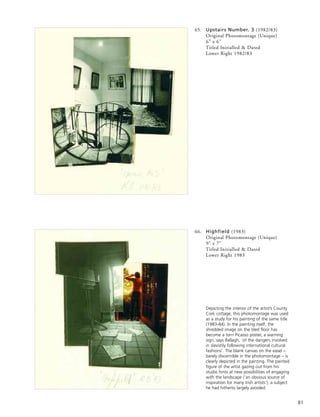
1983/84 painting
entitled Highfield, in
which, he has
written, ‘the artist
[looks] out from the
studio to the
landscape, an
obvious source of
inspiration for many Irish artists, yet the interior canvas
remains curiously blank. In addition, the torn Picasso poster
on the floor warns of the dangers involved in slavishly
following international cultural fashions.’
A 1997 painting, The Bogman, shows the artist in
Wellington boots doing something he has never done in his
life - digging for turf in a bog. There is more than a note of
18
Highfield (1983)
ironic humour in this truly revolutionary state of affairs yet
there is an air of fierce dedication as the artist - his face
reflecting or indeed emanating an earthy glow - attends to
the task in hand, a raven, the bird of prophesy in Celtic
mythology, flying above. Ballagh admires Seamus Heaney’s
poem Digging (from his 1966 volume, Death of a
Naturalist), which makes an intuitive analogy between his
own creativity as a poet and his father and grandfather
cutting turf:
Between my finger and my thumb
The squat pen rests; snug as a gun.
………
My grandfather cut more turf in a day
Than any other man on Toner’s bog.
………
Nicking and slicing neatly, heaving sods
Over his shoulder, going down and down
For the good turf. Digging.
The Bogman painting is framed literally and literary-wise
with an Irish proverb: “Briseann an dúchas tré súilibh an
chait” which Ballagh says could be liberally translated as,
‘you can take the man from the bog, but you can’t take the
bog from the man.’
At the approach of the millennium, ‘after just thirty five
years of painting, I decided to try to paint some landscapes’
(as he noted in the Land and Language catalogue). His usual
painstaking technique of ‘layering the oil paint with under-
painting and glazing’ was replaced by the more spontaneous
method of applying a single layer of paint to the ground.
With some exceptions, these landscapes were not based
on ‘recognisable locations but rather a non-specific sense
of place’.
The titles of the ten landscapes are in Gaelic, and each
sensually incorporates (in a lower panel beneath the painted
panels themselves) actual or metaphorical elements evoked
in the landscape. So for the picture entitled Púróga (pebbles),
on the lower panel a layer of stones is held behind frosted
glass, which has been partly etched with words of an Irish
proverb: ‘Is beag an rud is buaine ná an duine’ (‘the smallest
of things outlives the human being’). Ballagh here seems to
be reclaiming not only elements of the Irish language itself
(in his catalogue essay, he quotes stage directions from Brian
Friel’s 1981 play Translations: ‘Yolland’s official task… is to
take each of the Gaelic names - every hill, stream, rock… -
and Anglicise it.’) but also wide elemental aspects of the
island’s sky/landscape and ancient culture. He seems to be
acknowledging (in the words of Douglas Hyde) ‘Every crag
and gnarled tree and lonely valley has its own strange and
graceful legend attached to it’.
For many years Ballagh had strongly reacted against the
romanticising escapism of much 20th century Irish
landscape art. ‘It excluded people. There’s very little of the
really brutal life of the ordinary people who are inhabiting
that landscape. Jack Yeats would be the exception. He was
quite a political person. There is a fairly recent essay by
David Lloyd about the republicanism and politics of Yeats.
Nobody talks about that. They just talk about the swirls of
colour and the beautiful expression. His pictures have a lot
more to them than just that. I think there’s a tendency here
to romanticise Yeats - who wasn’t a romantic in that sense at
all. His subject matter was poor people, tinkers, et al.’
The juxtaposition of
landscape and, with
material literalness,
natural elements such as
pebbles and sand -
supremely represented by
Ballagh’s millennial series
- was also explored in a
major earlier painting,
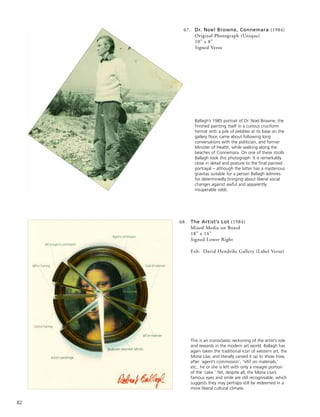
Portrait of Dr. Noel
Browne (1985), now in
the collection of the National Gallery in Dublin. Here, in a
large cruciform composition, an elderly man in a white Aran
sweater is portrayed on a pebbly Connemara beach, white-
washed cottages either side of him, fields and sea in the far
distance. At his feet, a pile of real pebbles seems to spill out
from the canvas to accumulate on the gallery floor. To the
right of this material accumulation is a pile of three books
(actually dummy artefacts though three-dimensional). On
the spines of two are names of Samuel Beckett and Karl
19
Dr. Noel Browne, Connemara
Marx (Ballagh had asked Browne to nominate two authors
who had especially influenced him). On the third spine is
written the artist’s name alongside the painting’s title: An
Doctúir Nollaig de Brún.
Here, the element of landscape is subordinate to the inscape
of portraiture yet landscape insistently makes its presence
felt as it literally accumulates at both our and the subject’s
feet. Yet, as the books piled next to the pebbles show, for
Ballagh landscape and human culture cannot ultimately be
separated. The dignified upstanding figure of Browne,
elusively ruminative in mien, looks integrally at home in the
Connemara scene. The pebbles at his feet may suggest his
rocky beginnings in life but also a solid, lifelong, beautifully
worn piling up of experience. In fact, when Ballagh initially
decided to paint the portrait (it was not a commission), he
visited Browne at his home in a Dublin suburb, did some
sketching yet hadn’t a clue how to proceed. It was Browne’s
‘out of the blue’ question - ‘why don’t you come down and
stay with us in Connemara?’ - that provided the leap of
inspiration that the artist needed.
Ballagh had decided he wanted to paint someone ‘who won’t
be commemorated by the State or banks. Dr. Noel Browne
came to my mind very quickly. His early life was like a
Dickensian story - one of poverty and deprivation. Most of
his family was destroyed by TB. He was introduced to an
affluent Irish family in England, and they sent him to an
English public school. He went to university. Returning to
Ireland, he became interested in politics, and joined a new
party of the left. In the 1940s, he was elected as a T.D. and
Minister of Health on the same day. He tried to introduce a
scheme for free medical care for mothers and children. The
medical profession didn’t like this at all, and the Catholic
Church saw it as the thin end of the wedge of Communism
coming into Ireland. So he was basically driven out of office.
He continued in politics until he was nearly 70, and retired.
That was about the time I got the idea of doing his portrait.’
Strolling on the stony beaches of Connemara and talking
with Browne (‘I would say, “how did you find de Valera?” -
and he knew all these people’) was, for Ballagh, an
illuminating experience. When Ballagh set about making the
picture, he felt overwhelmed by the amount of painting of
natural details that would be involved - acres of sky and
stoniness. So, while making an introductory sketch, he
began to reduce the shape so that eventually, to his great
surprise, the cruciform design emerged - ‘a fairly powerful
shape, which everyone thinks I came up with first -
particularly in regard to Browne’s clash with the Catholic
Church - and then the picture afterwards. In fact, when the
picture was first shown, one critic said, “Noel Browne
crucified by Robert Ballagh!” Some people are disappointed
when I tell the truth. It was a formal consideration which
turned into a great iconic image.’
Over the last 20 years or so, Ballagh has painted other
impressively humane portraits of older men - such as the
playwright John B. Keane – The Kerryman (1992), his
posthumous Portrait of the Artist Micheal Farrell (2003), the
Irish writer and journalist Sean MacReamon (2004), the
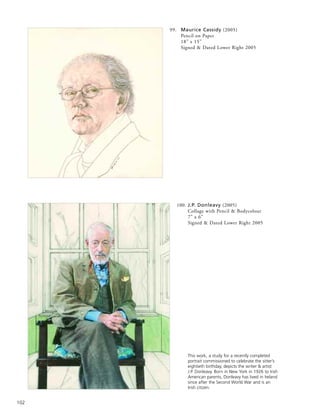
writer J.P. Donleavy (2005), and Michael O’Riordan (1989),
a bus driver and socialist activist who had fought in the
Spanish Civil war. He says he never set out deliberately ‘to
paint portraits of old men but there’s something in their
faces of a life lived.’
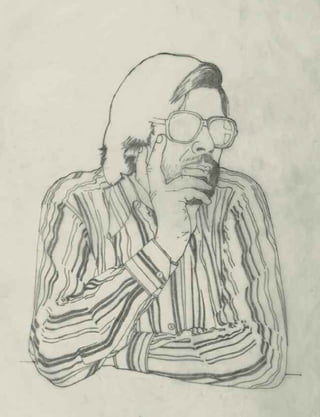
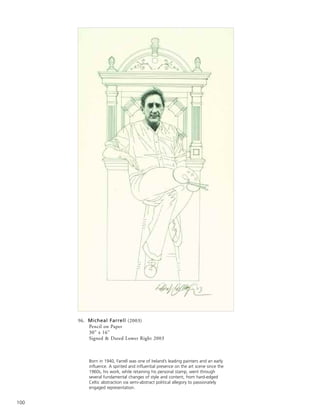
The 2003 mixed-media portrait of Micheal Farrell, who had
died in France in 2000, is a vividly moving and literally
multi-layered, multi-media evocation of the man and his
close friendship with Ballagh. The face itself is painted with
a naturalistic fluency worthy of Ballagh’s love of and respect
for painters like Van Eyck, Caillebotte, Pre-Raphaelites and
Schad. Wrinkles, folds of skin, areas of stubble, eyebrows,
flecks of greying hair are all conveyed with an immaculate
precision. Yet this is by no means photo-realism; Ballagh has
been most carefully selective in how he has painted the face
in all its manifold aspects. Nor is this at all an academic
exercise: every mark, every line ‘bespeaks experience and
a life lived’.
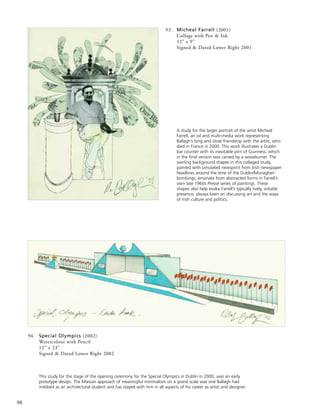
Farrell in his electric blue shirt is seen seated at the counter
of a typically Irish pub, a full pint of Guinness to his right
awaiting him. Ballagh went to a woodturner, who made the
pint and bar counter. ‘I looked at the carved pint and
thought, how can I paint over all that beautiful wood-
graining. I stained it so the woodgrain creates this bubbling
effect under the black.’ The artist’s thumb, holding his literal
palette is a three-dimensional painted plaster-cast; the
brushes are real; and the three spots of paint on the palette
20
are the French tricolour (since Farrell spent most of his life
as an artist in France), while the brushes are dabbed with the
Irish green, white and orange - conveying Farrell’s consistent
concern for his native country.
The picture’s background
shapes - curvilinear cut-
outs covered in blown-up
Irish newspaper headlines
referring to the worst
atrocity of the troubles,
the Dublin/Monaghan
bombings - pay homage
to Farrell’s own Pressé
series, his response to the
Troubles. (The series’ title
had derived from the
French citron pressé drink,
juice squirting out from between two pestles.) But these
shapes in Ballagh’s portrait also express the sheer noisy
exuberance of Farrell’s presence ‘because Micheal was a very
verbose man; there was never silence when he was around.’
The final element - Farrell’s crossed legs portrayed in the
flourishing, shorthand style of his own drawings and
etchings - was ‘a kind of in-joke’ since Farrell was always
amicably telling Ballagh ‘to loosen up’ his style of painting.
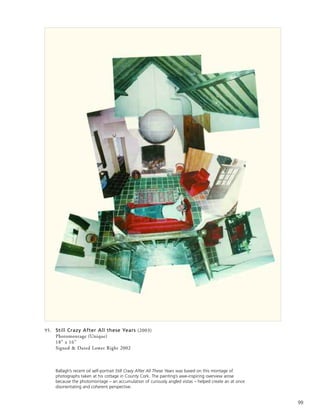
Throughout his
career, Ballagh has
returned to self-
portraits. In Still
Crazy after all these
Years’ (2004), he
shows himself
from a high,
church-like
perspective, in
repose in the Cork
cottage which for
many years has
been a bolt-hole, a
place ‘to relax and
walk on beach and cliff, think and ruminate’, though not to
paint. The strikingly heightened composition (which infuses
the atmosphere of quiet respose with a sense of somewhat
vertiginous awe) came about from the way he built up the
composition. He took many photographs of the room
‘from all kinds of mad angles’. The photographs were then
assembled together in the manner made famous by David
Hockney. He then made a drawing of this collage which
was later worked up into a larger circular oil painting. ‘The
trick is to try and make it look as if someone could see like
that. There are no curves in the room’s form, only straight
lines’ - yet the overall effect of this orb-shaped work is
illusorily curvilinear.
On one wall we see Ballagh’s painting of the Third of May
after Goya. In this peaceful Cork cottage, modern Irish
history - as restated through Ballagh’s own Pop Art
treatment of Goya’s masterpiece depicting the execution of
Spanish rebels by a French firing squad at night - is intoned.
The hearth burns, a vast circular paper lampshade looms
overhead. The strange, generous perspective of the antique,
vaulted, timbered ceiling over the (by comparison) rather
diminutive reclining figure in informal contemporary dress
helps give this picture its curious contemplative atmosphere
- one of resounding emptiness and stillness. Amusingly and
stirringly, Ballagh’s tee-shirt bears the motto, ‘Fuck the
begrudgers’, a favourite phrase of Brendan Behan’s when
people would attack or challenge him. This is also a verbal
play on the FCUK (French Connection clothing chain)
motto so popular at the turn of this century - ‘which
everyone thought was very daring. If you’re trying to base
everything on shock, people are very quickly unshocked.’
This painting is a recent summation of key qualities which
make Ballagh’s painting unique: unending preoccupation
with irrevocable individuality within a wider context of
society, politics and history; a belief in expressing himself in
clear, original, authentic terms, without compromise to
artistic fashion and extraneous opinion; and a radically
exploratory, spacious perspective on the human condition.
Philip Vann
A writer on the visual arts, Philip Vann is based in Cambridge and London. Since
1984, he has written on art for many publications, including The Economist, RA
Magazine, Resurgence and Interiors. His book on the painter Dora Holzhandler was
published in 1997 by Lund Humphries, London and in 1998 by The Overlook
Press, New York. His critically acclaimed book Face to Face: Self-Portraits in the
Twentieth Century was published by Sansom & Co. in 2004.
21
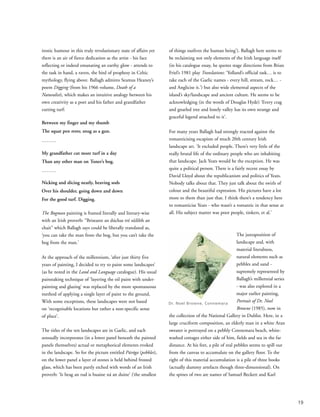
Micheal Farrell (2001)
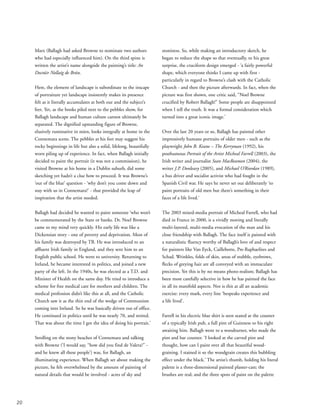
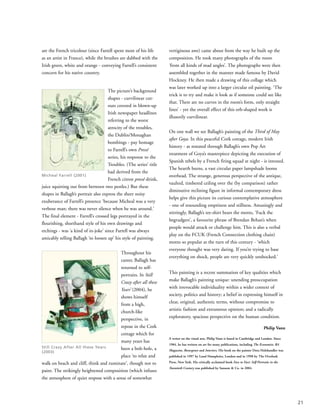
Still Crazy After All these Years
(2003)
ROBERT BALLAGH
Works from the Studio
Part I
1959 - 1979
25
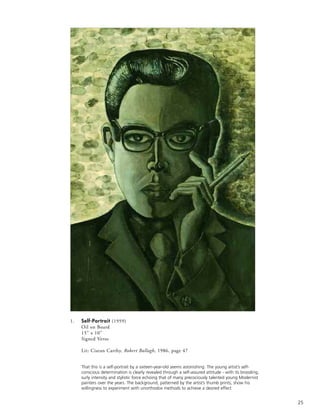
1. Self-Portrait (1959)
Oil on Board
15” x 10”
Signed Verso
Lit: Ciaran Carthy, Robert Ballagh, 1986, page 47
That this is a self-portrait by a sixteen-year-old seems astonishing. The young artist’s self-
conscious determination is clearly revealed through a self-assured attitude - with its brooding,
surly intensity and stylistic force echoing that of many precociously talented young Modernist
painters over the years. The background, patterned by the artist’s thumb prints, show his
willingness to experiment with unorthodox methods to achieve a desired effect
26
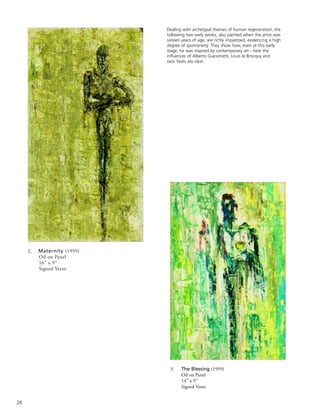
2. Maternity (1959)
Oil on Panel
16” x 9”
Signed Verso
3. The Blessing (1959)
Oil on Panel
14” x 9”
Signed Verso
Dealing with archetypal themes of human regeneration, the
following two early works, also painted when the artist was
sixteen years of age, are richly impastoed, evidencing a high
degree of spontaneity. They show how, even at this early
stage, he was inspired by contemporary art - here the
influences of Alberto Giacometti, Louis le Brocquy and
Jack Yeats are clear.
27
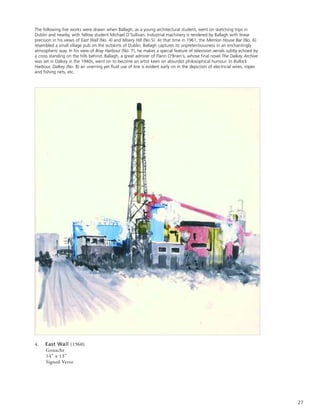
4. East Wall (1960)
Gouache
14” x 13”
Signed Verso
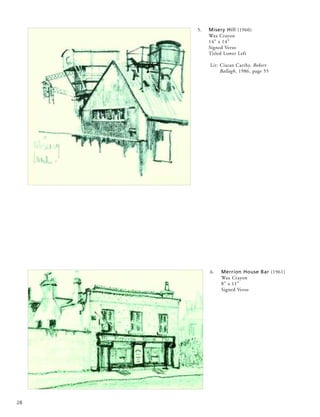
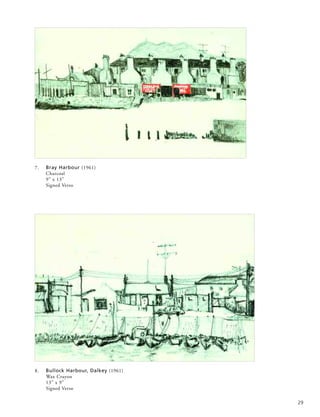
The following five works were drawn when Ballagh, as a young architectural student, went on sketching trips in
Dublin and nearby, with fellow student Michael O’Sullivan. Industrial machinery is rendered by Ballagh with linear
precision in his views of East Wall (No. 4) and Misery Hill (No.5). At that time in 1961, the Merrion House Bar (No. 6)
resembled a small village pub on the outskirts of Dublin; Ballagh captures its unpretentiousness in an enchantingly
atmospheric way. In his view of Bray Harbour (No. 7), he makes a special feature of television aerials subtly echoed by
a cross standing on the hills behind. Ballagh, a great admirer of Flann O'Brien's, whose final novel The Dalkey Archive
was set in Dalkey in the 1940s, went on to become an artist keen on absurdist philosophical humour. In Bullock
Harbour, Dalkey (No. 8) an unerring yet fluid use of line is evident early on in the depiction of electricial wires, ropes
and fishing nets, etc.
28
6. Merrion House Bar (1961)
Wax Crayon
8” x 11”
Signed Verso
5. Misery Hill (1960)
Wax Crayon
14” x 14”
Signed Verso
Titled Lower Left
Lit: Ciaran Carthy, Robert
Ballagh, 1986, page 55
29
7. Bray Harbour (1961)
Charcoal
9” x 13”
Signed Verso
8. Bullock Harbour, Dalkey (1961)
Wax Crayon
13” x 9”
Signed Verso
30
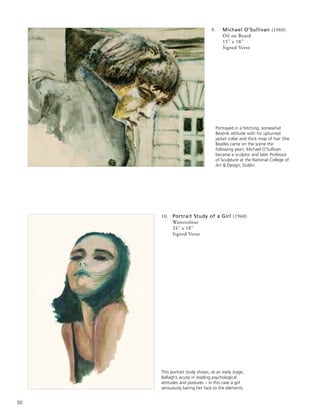
9. Michael O’Sullivan (1960)
Oil on Board
15” x 18”
Signed Verso
10. Portrait Study of a Girl (1960)
Watercolour
24” x 18”
Signed Verso
Portrayed in a fetching, somewhat
Beatnik attitude with his upturned
jacket collar and thick mop of hair (the
Beatles came on the scene the
following year), Michael O’Sullivan
became a sculptor and later Professor
of Sculpture at the National College of
Art & Design, Dublin.
This portrait study shows, at an early stage,
Ballagh’s acuity in reading psychological
attitudes and postures – in this case a girl
sensuously baring her face to the elements.
31
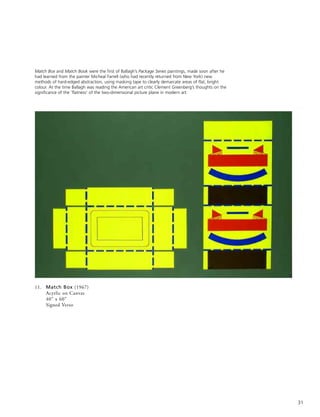
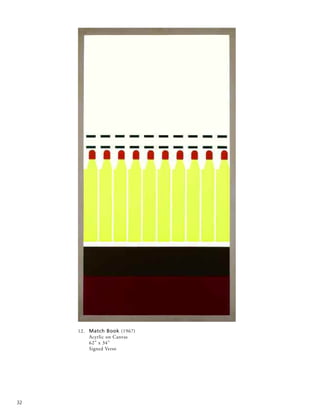
11. Match Box (1967)
Acyrlic on Canvas
40” x 60”
Signed Verso
Match Box and Match Book were the first of Ballagh’s Package Series paintings, made soon after he
had learned from the painter Micheal Farrell (who had recently returned from New York) new
methods of hard-edged abstraction, using masking tape to clearly demarcate areas of flat, bright
colour. At the time Ballagh was reading the American art critic Clement Greenberg’s thoughts on the
significance of the ‘flatness’ of the two-dimensional picture plane in modern art.
32
12. Match Book (1967)
Acyrlic on Canvas
62” x 34”
Signed Verso
33
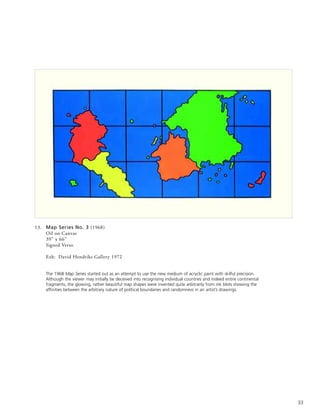
13. Map Series No. 3 (1968)
Oil on Canvas
39” x 66”
Signed Verso
Exh: David Hendriks Gallery 1972
The 1968 Map Series started out as an attempt to use the new medium of acryclic paint with skilful precision.
Although the viewer may initially be deceived into recognising individual countries and indeed entire continental
fragments, the glowing, rather beautiful map shapes were invented quite arbitrarily from ink blots showing the
affinities between the arbitrary nature of political boundaries and randomness in an artist’s drawings.
34
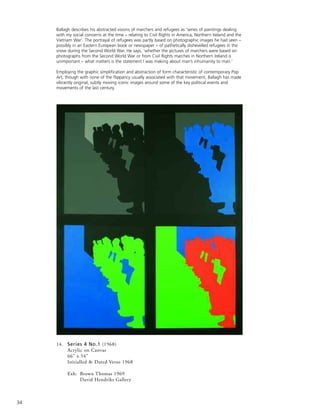
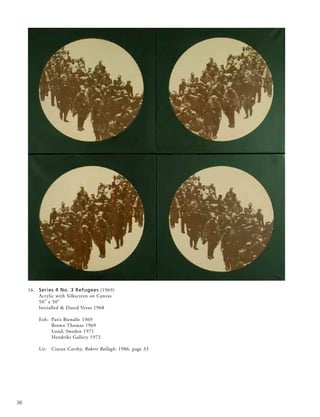
14. Series 4 No.1 (1968)
Acrylic on Canvas
66” x 54”
Initialled & Dated Verso 1968
Exh: Brown Thomas 1969
David Hendriks Gallery
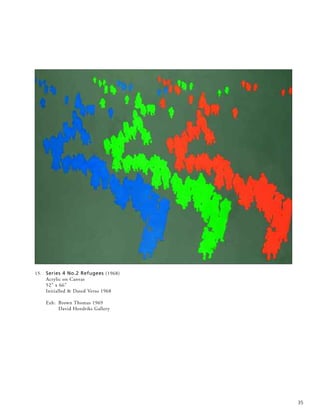
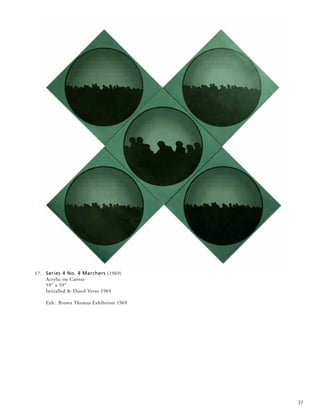
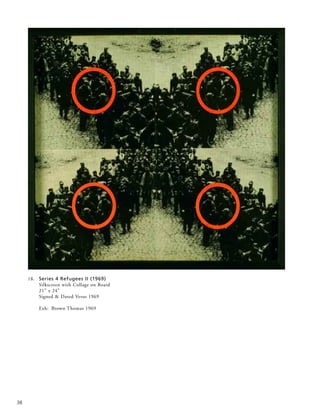
Ballagh describes his abstracted visions of marchers and refugees as ‘series of paintings dealing
with my social concerns at the time – relating to Civil Rights in America, Northern Ireland and the
Vietnam War’. The portrayal of refugees was partly based on photographic images he had seen –
possibly in an Eastern European book or newspaper – of pathetically dishevelled refugees in the
snow during the Second World War. He says, ‘whether the pictures of marchers were based on
photographs from the Second World War or from Civil Rights marches in Northern Ireland is
unimportant – what matters is the statement I was making about man’s inhumanity to man.’
Employing the graphic simplification and abstraction of form characteristic of contemporary Pop
Art, though with none of the flippancy usually associated with that movement, Ballagh has made
vibrantly original, subtly moving iconic images around some of the key political events and
movements of the last century.
35
15. Series 4 No.2 Refugees (1968)
Acrylic on Canvas
52” x 66”
Initialled & Dated Verso 1968
Exh: Brown Thomas 1969
David Hendriks Gallery
36
16. Series 4 No. 3 Refugees (1969)
Acrylic with Silkscreen on Canvas
50” x 50”
Initialled & Dated Verso 1968
Exh: Paris Bienalle 1969
Brown Thomas 1969
Lund, Sweden 1971
Hendriks Gallery 1972
Lit: Ciaran Carthy, Robert Ballagh, 1986, page 33
37
17. Series 4 No. 4 Marchers (1969)
Acrylic on Canvas
59” x 59”
Initialled & Dated Verso 1969
Exh: Brown Thomas Exhibition 1969
38
18. Series 4 Refugees II (1969)
Silkscreen with Collage on Board
21” x 24”
Signed & Dated Verso 1969
Exh: Brown Thomas 1969
39
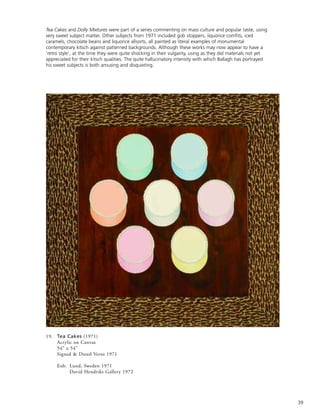
19. Tea Cakes (1971)
Acrylic on Canvas
54” x 54”
Signed & Dated Verso 1971
Exh: Lund, Sweden 1971
David Hendriks Gallery 1972
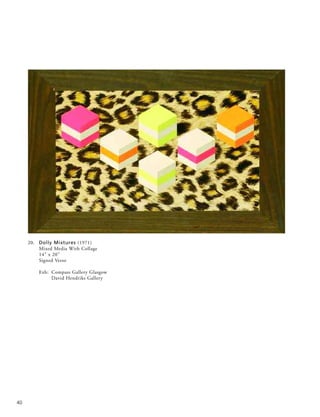
Tea Cakes and Dolly Mixtures were part of a series commenting on mass culture and popular taste, using
very sweet subject matter. Other subjects from 1971 included gob stoppers, liquorice comfits, iced
caramels, chocolate beans and liquorice allsorts, all painted as literal examples of monumental
contemporary kitsch against patterned backgrounds. Although these works may now appear to have a
‘retro style’, at the time they were quite shocking in their vulgarity, using as they did materials not yet
appreciated for their kitsch qualities. The quite hallucinatory intensity with which Ballagh has portrayed
his sweet subjects is both amusing and disquieting.
40
20. Dolly Mixtures (1971)
Mixed Media With Collage
14” x 20”
Signed Verso
Exh: Compass Gallery Glasgow
David Hendriks Gallery
41
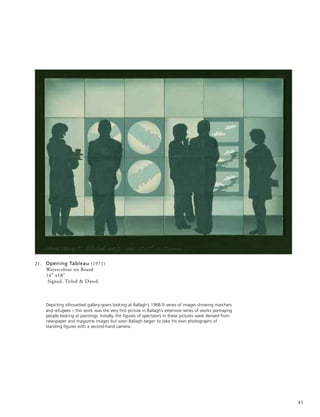
21. Opening Tableau (1971)
Watercolour on Board
14” x18”
Signed, Titled & Dated
Depicting silhouetted gallery-goers looking at Ballagh’s 1968-9 series of images showing marchers
and refugees – this work was the very first picture in Ballagh’s extensive series of works portraying
people looking at paintings. Initially, the figures of spectators in these pictures were derived from
newspaper and magazine images but soon Ballagh began to take his own photographs of
standing figures with a second-hand camera.
42
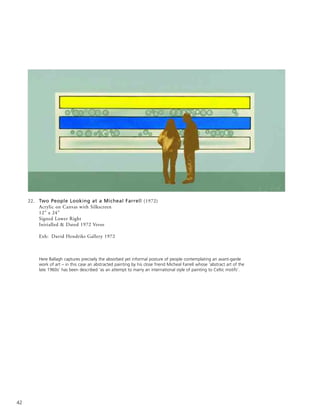
22. Two People Looking at a Micheal Farrell (1972)
Acrylic on Canvas with Silkscreen
12” x 24”
Signed Lower Right
Initialled & Dated 1972 Verso
Exh: David Hendriks Gallery 1972
Here Ballagh captures precisely the absorbed yet informal posture of people contemplating an avant-garde
work of art – in this case an abstracted painting by his close friend Micheal Farrell whose ‘abstract art of the
late 1960s’ has been described ‘as an attempt to marry an international style of painting to Celtic motifs’.
43
23. Derry January 30, 1972 (1972)
Original Photomontage on Nine Panels (Unique)
33” x 33”
Signed Verso
This work was staged for the opening of ‘The Exhibition of Living Art’ in November 1972. Ballagh made an
ephemeral installation – recorded in a photomontage known as Derry January 30, 1972 - of crude outlines
of human figures drawn in chalk on the gallery floor and bespattered in animal blood. Ballagh says, ‘The
subject was an event which came to be known as ‘Bloody Sunday’, in which thirteen people died violently
in Derry. After the initial shock and indignation, many citizens of the Republic of Ireland lapsed into a self-
protective apathy. This piece was an attempt to stir people into recognising the reality of death on the
streets of Northern Ireland.’
44
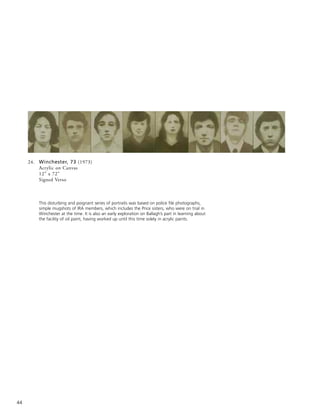
24. Winchester, 73 (1973)
Acrylic on Canvas
12” x 72”
Signed Verso
This disturbing and poignant series of portraits was based on police file photographs,
simple mugshots of IRA members, which includes the Price sisters, who were on trial in
Winchester at the time. It is also an early exploration on Ballagh’s part in learning about
the facility of oil paint, having worked up until this time solely in acrylic paints.
45
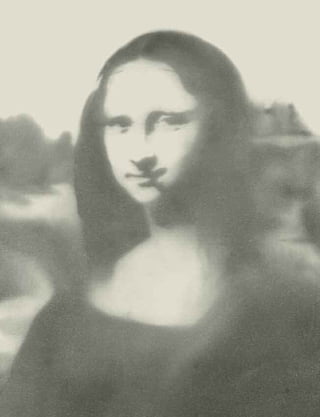
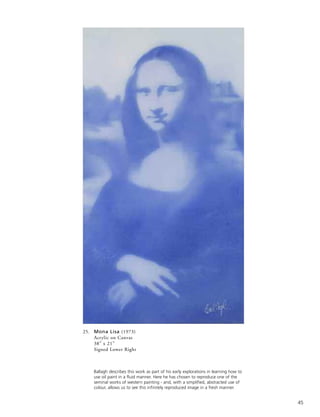
25. Mona Lisa (1973)
Acrylic on Canvas
38” x 21”
Signed Lower Right
Ballagh describes this work as part of his early explorations in learning how to
use oil paint in a fluid manner. Here he has chosen to reproduce one of the
seminal works of western painting - and, with a simplified, abstracted use of
colour, allows us to see this infinitely reproduced image in a fresh manner.
46
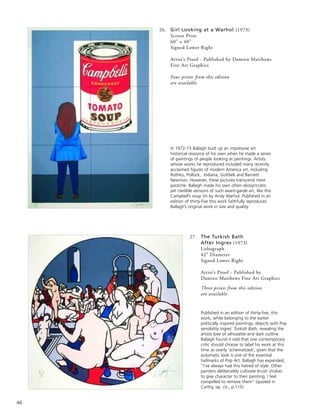
26. Girl Looking at a Warhol (1973)
Screen Print
60” x 40”
Signed Lower Right
Artist’s Proof - Published by Damien Matthews
Fine Art Graphics
Four prints from this edition
are available
In 1972-73 Ballagh built up an impressive art
historical resource of his own when he made a series
of paintings of people looking at paintings. Artists
whose works he reproduced included many recently
acclaimed figures of modern America art, including
Rothko, Pollock, Indiana, Gottlieb and Barnett
Newman. However, these pictures transcend mere
pastiche. Ballagh made his own often idiosyncratic
yet credible versions of such avant-garde art, like this
Campbell’s soup tin by Andy Warhol. Published in an
edition of thirty-five this work faithfully reproduces
Ballagh’s original work in size and quality.
27. The Turkish Bath
After Ingres (1973)
Lithograph
42” Diameter
Signed Lower Right
Artist’s Proof - Published by
Damien Matthews Fine Art Graphics
Three prints from this edition
are available
Published in an edition of thirty-five, this
work, while belonging to the earlier
politically inspired paintings, depicts with Pop
sensibility Ingres’ Turkish Bath, revealing the
artists love of silhouette and dark outline.
Ballagh found it odd that one contemporary
critic should choose to label his work at this
time as overly ‘schematized’, given that the
automatic look is one of the essential
hallmarks of Pop Art. Ballagh has expanded,
“I’ve always had this hatred of style. Other
painters deliberately cultivate brush strokes
to give character to their painting, I feel
compelled to remove them” (quoted in
Carthy, op. cit., p.115)
47
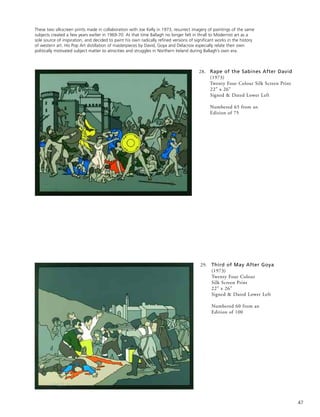
28. Rape of the Sabines After David
(1973)
Twenty Four Colour Silk Screen Print
22” x 26”
Signed & Dated Lower Left
Numbered 65 from an
Edition of 75
These two silkscreen prints made in collaboration with Joe Kelly in 1973, resurrect imagery of paintings of the same
subjects created a few years earlier in 1969-70. At that time Ballagh no longer felt in thrall to Modernist art as a
sole source of inspiration, and decided to paint his own radically refined versions of significant works in the history
of western art. His Pop Art distillation of masterpieces by David, Goya and Delacroix especially relate their own
politically motivated subject matter to atrocities and struggles in Northern Ireland during Ballagh’s own era.
29. Third of May After Goya
(1973)
Twenty Four Colour
Silk Screen Print
22” x 26”
Signed & Dated Lower Left
Numbered 60 from an
Edition of 100
48
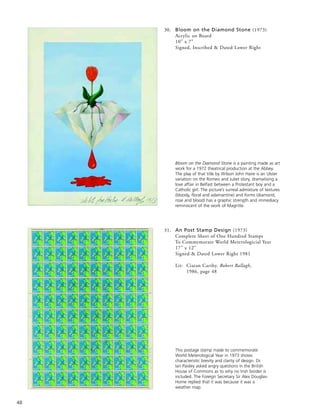
30. Bloom on the Diamond Stone (1973)
Acrylic on Board
10” x 7”
Signed, Inscribed & Dated Lower Right
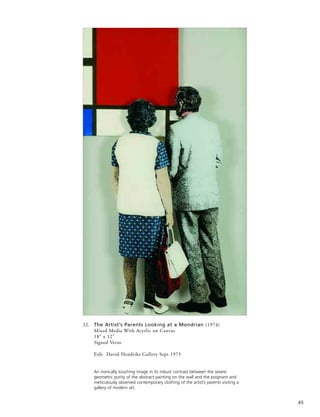
31. An Post Stamp Design (1973)
Complete Sheet of One Hundred Stamps
To Commemorate World Meterologicial Year
17” x 12”
Signed & Dated Lower Right 1981
Lit: Ciaran Carthy, Robert Ballagh,
1986, page 48
Bloom on the Diamond Stone is a painting made as art
work for a 1972 theatrical production at the Abbey.
The play of that title by Wilson John Haire is an Ulster
variation on the Romeo and Juliet story, dramatising a
love affair in Belfast between a Protestant boy and a
Catholic girl. The picture’s surreal admixture of textures
(bloody, floral and adamantine) and forms (diamond,
rose and blood) has a graphic strength and immediacy
reminiscent of the work of Magritte.
This postage stamp made to commemorate
World Meterological Year in 1973 shows
characteristic brevity and clarity of design. Dr.
Ian Paisley asked angry questions in the British
House of Commons as to why no Irish border is
included. The Foreign Secretary Sir Alex Douglas-
Home replied that it was because it was a
weather map.
49
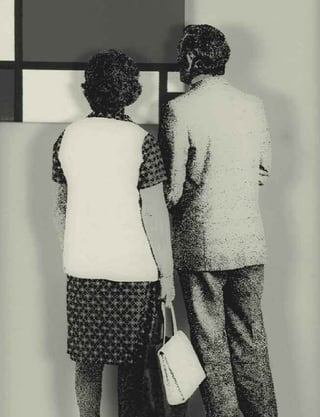
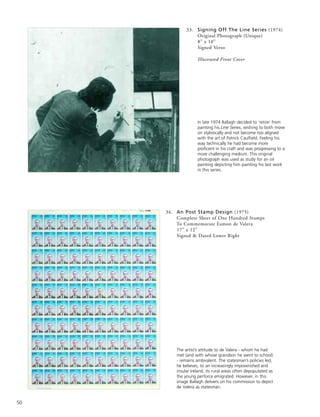
32. The Artist’s Parents Looking at a Mondrian (1974)
Mixed Media With Acyrlic on Canvas
18” x 12”
Signed Verso
Exh: David Hendriks Gallery Sept 1975
An ironically touching image in its robust contrast between the severe
geometric purity of the abstract painting on the wall and the poignant and
meticulously observed contemporary clothing of the artist’s parents visiting a
gallery of modern art.
50
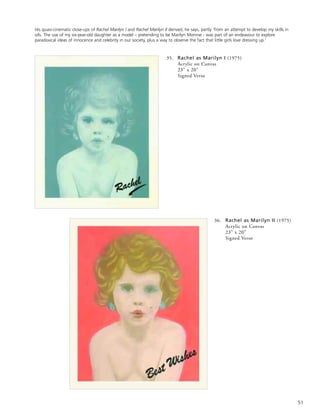
33. Signing Off The Line Series (1974)
Original Photograph (Unique)
8” x 10”
Signed Verso
Illustrated Front Cover
34. An Post Stamp Design (1975)
Complete Sheet of One Hundred Stamps
To Commemorate Eamon de Valera
17” x 12”
Signed & Dated Lower Right
In late 1974 Ballagh decided to ‘retire’ from
painting his Line Series, wishing to both move
on stylistically and not become too aligned
with the art of Patrick Caulfield. Feeling his
way technically he had become more
proficent in his craft and was progressing to a
more challenging medium. This original
photograph was used as study for an oil
painting depicting him painting his last work
in this series.
The artist’s attitude to de Valera - whom he had
met (and with whose grandson he went to school)
- remains ambivalent. The statesman’s policies led,
he believes, to an increasingly impoverished and
insular Ireland, its rural areas often depopulated as
the young perforce emigrated. However, in this
image Ballagh delivers on his commission to depict
de Valera as statesman.
51
35. Rachel as Marilyn I (1975)
Acrylic on Canvas
23” x 20”
Signed Verso
36. Rachel as Marilyn II (1975)
Acrylic on Canvas
23” x 20”
Signed Verso
His quasi-cinematic close-ups of Rachel Marilyn I and Rachel Marilyn II derived, he says, partly ‘from an attempt to develop my skills in
oils. The use of my six-year-old daughter as a model – pretending to be Marilyn Monroe - was part of an endeavour to explore
paradoxical ideas of innocence and celebrity in our society, plus a way to observe the fact that little girls love dressing up.’
52
37. Study for Tristram Shandy (1975)
Pencil
8” x 7”
Initialled & Dated Lower Right 1975
38. My Studio 1969 (1976)
Collage
8” x 10”
Signed Verso
A preparatory work for the
larger painting My Studio
1969 created in 1976 ‘as a
comment’, says Ballagh ‘on
earlier works [in which he
had made his own
simplified, hard-edged
versions of classical paintings
by Goya, Delacroix and
David] I had made in
1969/70 concerning events
in Northern Ireland. Few
people got the message at
the time so I created this
painting to make my
intentions clear.’
This pencil sketch was a study towards a large
canvas depicting key events in The Life and
Opinions of Tristram Shandy, Gentleman. Ballagh
had greatly enjoyed reading Laurence Sterne’s
novel (written in instalments between 1759 and
1767), relishing its sceptical wit, non-linear
narrative and deliberately absurd philosophical
digressions. This image - portraying Tristram in
modern dress and, surreally, with a fluid clockface
as his countenance - refers to the catastrophic
moment at the novel’s start when his mother
delays his conception by asking his father, ‘Pray, my
dear… have you not forgot to wind up the clock?’
53
39. My Studio 1969 (1976)
Giclée Print
40” x 50”
Signed Lower Right
Artist’s Proof - Published by
Damien Matthews Fine
Art Graphics
Seven prints from this edition
are available
40. How to Make Your Art
Commercial (1977)
Original Photograph (Unique)
8” x 8”
Signed Verso
This photograph was used as a
mordantly ironic reference source for
the artist’s self-portrait with his wife
Betty and their children outside their
home at Temple Cottages, Dublin - the
first in a series of figurative paintings
based at their home. Here his face is
covered by an American book titled
somewhat dispiritingly How to Make
Your Art Commercial. At this time
Ballagh was still signing on the dole,
as a sometimes unemployed self-
employed artist, as he once described
himself at the time. The original
painting hangs in the The Dublin City
Gallery, The Hugh Lane.
Published in an edition of
seventy-five, this work
faithfully reproduces Ballaghs
earlier painting of 1976. In
the background we see
Ballagh’s Pop Art version of
Delacroix’s Liberty at the
Barricades; the studio setting
is made clear by the inclusion
of collaged photographs of
various art materials - an ironic
usage as redolent of Pop Art
as his original version of
Delacroix’s masterpiece.
54
41. Oh Mona! (1977)
Oileograph on Canvas
11” x 10”
Signed Lower Right
Numbered Nine of Ten
A mischievous attempt to subvert the attitude
of reverence with which this icon of western
art is usually treated. Created in a series of
ten, this piece is number nine.
42. Cell Window (1977)
Silkscreen on Mirror
23” x 20”
Signed Lower Right
Numbered Four of Six
Exh: David Hendricks Gallery
In 1977 Ballagh made a series of six pictures based
on Flann O’Brien’s absurdist allegory, The Third
Policeman. He relates O’Brien’s comical wordplay
and bizarre blend of logic and fantasy to a
longstanding Irish literary tradition, stemming partly
from Laurence Sterne. Cell Window evokes a
disorientating episode in The Third Policeman,
when the protagonist finds himself ‘standing in a
tiny police station… inside the walls of it.’ The
work here conveys the sensation of an eery
moment when, says Ballagh, ‘you look in the cell
and see yourself looking out of it.’
55
43. Study for The Conversation I -
Self Portrait (1977)
Pencil
10” x 8”
Signed Verso
The following two fluent pencil studies were for Ballagh’s 1977 painting The Conversation, in which the artist,
wearing sunglasses and a colourful striped shirt, listens, head in hand, as opposite him the painter Vermeer – in an
admonitory gesture or one of friendly advice, it is not clear - wags his finger at him. The painterly clarity of
the finished painting’s setting - transposed from the Dutch Master’s art – is indicative of the increasingly
realistic yet poetic style Ballagh was now discovering for himself.
44. Study for The Conversation II -
Self Portrait (1977)
Pencil
11” x 10”
Signed Verso
56
46. Ice Cream Cone (1977)
Pen & Ink on Board
9” x 5”
Dated Verso
Signed Lower Right
Over more than three decades
Ballagh has designed sixty-six
stamps for An Post. He brings to
the genre an ability to make taut,
original designs suitable for such
an economical format, a deep
awareness of Irish culture, politics
and history and a transfiguring
imagination. His stamps have
depicted many Irish politicians,
revolutionaries, thinkers, artists,
musicians and poets.
Ice Cream Cone is an illustration for a long poem,
Immram by leading Northern Irish poet Paul
Muldoon (b.1951). The poem takes the form of a
modern version of a ninth-century Irish poem about
a once literal and universal voyage undertaken,
updated here in slangy American vernacular. In a
1980 publication of Immram, Ballagh’s ice cream
cone image is repeated five-fold in a fan-like format.
45. An Post Stamp Design
(1977)
Complete Sheet of One
Hundred Stamps
To Celebrate The Electricity
Supply Board
12” x 17”
Signed & Dated
Lower Right 1977
Lit: Ciaran Carthy, Robert
Ballagh,1986, page 48
57
48. Jim Larkin (1978)
Pen & Ink Study
10” x 8”
Signed Verso
This postage stamp commemorates the first
East-West transatlantic flight and conveys
something of the liberating nature, ethereal
aerial perspectives and thrilling closeness to
the elements enjoyed by early aviators.
This study of the Irish trade unionist and
Labour leader Jim Larkin, depicts him in
stirring oratorical flow urging workers
during the great industrial lock-out of
Dublin in 1913. The statue of him erected
in O’Connell Street in 1980, is in similar
pose with dramatically upraised arms.
This statue is also based on a famous
original photograph.
47. An Post Stamp Design (1978)
Complete Sheet of One Hundred Stamps
To Commemorate First East - West Flight
17” x 12”
Signed & Dated Lower Right 1978
58
50. Branohm – The Voyage of Bran (1978)
Pen & Ink on Board
10” x 10”
Signed Lower Right
A study for his oil portrait of the novelist James
Plunkett, it differs in some details from the finished
painting. The two background pictures on the wall
eventually became one, representing the famous
photograph of an impassioned Jim Larkin in Dublin in
1913 (see previous work). Larkin is one of many
contemporaneous Irish (and English) characers, both
fictional and historical, in Strumpet City (1969),
Plunkett’s epic, eminently humane novel of working
class Dublin at that violent time. The books piled on
Plunkett’s desk are his own published works. On the
wall hangs a viola, and on the edge of the desk is a
sheet of classical viola music.
Branohm – The Voyage of Bran is a
drawing towards a painting used on a
record cover for traditional Irish music by
the renowned fiddler Máire Breatnach. The
sticks on the foreshore are inscribed with
line lettering from the Irish Ogham
(pronounced Ohm) alphabet, which dates
back almost 2,000 years.
49. James Plunkett (1978)
Pen & Ink with Watercolour
10” x 8”
Signed & Dated Lower Right 1978
59
52. Hugh Leonard (1979)
Pen & Ink Study
14” x 17”
Signed & Dated Lower Right 1979
Exh: David Hendriks Gallery
The Irish playwright Hugh Leonard is
depicted in his library at home in the
seaside town of Dalkey. Leonard’s
acclaimed 1975 play Da was described
by the New York Times ‘as a beguiling
play about a son’s need to come to
terms with his father’. In Ballagh’s 1979
oil painting of Leonard, the page of
script emerging from the Olivetti
typewriter intriguingly sets up the scene
of how the artist went about portraying
the dramatist.
This pencil study for the Bernadette
McGreevey portrait depicts a wooden
cabinet filled with artefacts referring to
her singing career and musical
inspirations. Realised forms include a bust
of Beethoven, a tape recorder and
headphones. The semi-drawn curtain also
recalls her love of performing on stage.
Ballagh’s 1979 oil painting of the same
subject – a kind of creative inventory as
portrait – fills in many details. Within it are
three literal portraits of Greevey – one a
framed photograph, another on a record
album cover, the third on a cassette cover.
We can also read the spines of books on
Elgar, Mahler and Berlioz.
51. Study for Bernadette McGreevy
Portrait (1979)
Pencil
12” x 12”
Signed Verso
Conversation between Robert Ballagh
and Karim White
20th August 2006
62
KARIM : So you have these two big shows in Dublin
documenting your career this year, both large retrospectives.
The show at the RHA is vast, ambitious and designed by
you but this show has a similar scope, doesn’t it?
BALLAGH : Yes, in fact, this show goes back even further.
The earliest pictures in the RHA are from 1968-9 whereas
this show goes back to the 1950s.
KARIM : I expect that Damien Matthews just rummaged
through your files and said “Right, I’ll have that, that, that,
that…”
BALLAGH : Oh yes, yes, to use the phrase, “he went
through my drawers.” And at one point, he picked up
something and said, “This is nice!” and I said, “I know, it’s
by my daughter!”
KARIM : Hm, well that aside, it’s just as well really because
the show does build up a good picture of your total output
and practice.
BALLAGH : Yes, this show is probably more accurate
because for the RHA show I had to impose a sort of
narrative and when you do that you inevitably make
sacrifices. In the RHA the early work has just one or two
rooms whereas there’s a much wider selection here.
KARIM : After the early pictures, we can clearly see how
your work has developed, with the various influences of art
movements, politics but also by individual commissions.
BALLAGH : Yes, that’s something that Ciaran Carty picked
up on too, how several key developments in my work were
driven by commissions in that I found myself going in
directions that I probably would never have thought of
myself. Obviously stage design is an example. Michael
Colgan called me up in 1985 and asked if I would design
this one-man show that Barry McGovern was doing on
Beckett, and actually it’s coming back this year coinciding
with my retrospective. So my involvement with theatre
started with that. I would never have thought of working in
theatre otherwise.
KARIM : But then you became very visible in the theatre
world where you always maintained a very good reputation.
BALLAGH : Yes, and that is because working in the theatre
is an entirely collaborative activity as opposed to being a
painter in a studio which is often quite lonely. And I’ve been
enormously privileged to have worked with some of the best
directors, actors and lighting designers. But you know, my
early involvement was hysterical because it was all a bit of an
accident and yes, I’m visually literate but I’m nearly
innumerate and can never remember a phone number or
anything like that. So that led to all sorts of confusion when
it came to dimensions and stage directions and that sort of
thing, even though now it all seems very simple.
KARIM : And the cross-fertilisation that has occurred has
been beneficial both personally and artistically?
BALLAGH : Oh yes, it has been fantastic that way and one
of the reasons why the RHA show has such an enormous
theatrical element to it, the skills I have picked up have
definitely crossed over. I’d like to think that people have
found me to be a pleasant collaborator. I’ve been able to
develop these professional relationships all over the world.
I’ve worked in every continent in the world except Africa
and I imagine that the promoters of Riverdance are working
on that!
63
KARIM : And yet, despite all, you’ve always remained
committed to Dublin. Why?
BALLAGH : Well I did briefly live in London but then I
made this very conscious decision to come home. A lot of it
is that I understand Ireland and my work is not abstract, it
deals with concepts of place, history and people, all sorts of
things, which by and large are related to the country I have
grown up in. I know when I quote something or someone
that I understand the relevance. If I was living elsewhere and
was commissioned to paint some big wallah in that country,
I would feel intellectually restricted. You know, history and
context, that all comes free for me in Ireland. But I wouldn’t
say that it has not been frustrating, you know, living in a
country that at an administrative level is so uninterested in
art and culture.
KARIM : Didn’t Joyce say that if he could get to the heart
of Dublin, he could get to the heart of all the cities of the
world?
BALLAGH : Yes, he did and I use that quotation at the
beginning of my book of photographs of Dublin, the
important phrase is for “in the particular is contained the
universal” because that is certainly true. When you tell the
truth about something particular, it will resonate beyond
that one thing. Great art has always done that.
KARIM: Since you mentioned those Dublin photographs,
let’s consider them. Your photographs are not ironic, they’re
not political things either, they’re sort of deadpan and yet
demonstrate this strong emotional link.
BALLAGH : Yes, well they’re highly nostalgic things and
with the Dublin photographs I had some very strong models
for them such as Atget and Robert French’s photographs of
Dublin taken at the turn of the century. Berenice Abbott
had written about the Atget photographs and she said that
they were rather like stage-sets before the actors arrived. One
of the reasons why those photographs excluded people was
because the long exposure times meant that people would
often come out blurred but the fact that they’re unpeopled
does give a certain quality, a surreal aspect to the work and I
really liked that and it certainly influenced my approach.
And other things too, I was trying to make them a bit
timeless so I had to leave out cars, which was just about
possible to do then but you couldn’t do it in Dublin now.
Even then, I had to wait and wait in the middle of the street
for the cars to zoom by and for the roads to be clear before I
could take the empty shot. So they are contrived in terms of
trying to create that look, just the stark architecture.
KARIM : In remaining committed to Dublin, did you sense
that it was all about to change?
BALLAGH : Well I think what they’re building now is
better on the whole but I’m old enough to remember what
they were tearing down. The destruction of Georgian
Dublin was scandalous, I mean I did support the sit-ins in
Hume Street to try to stop them pulling that street down.
We’ve lost so much and now the destruction is more subtle
and it’s very hard to monitor it changing. The replacements,
by and large, are better than what they built in the sixties
and seventies which were mostly appalling buildings. But
you know my father grew up in a city identical to James
Joyce’s. I grew up in the fifties and actually there was no
change. More dilapidated but no development. When I read
Ulysses, which I do from time to time, I know all the shops
and all the streets. But my children know a completely
different city, the rate of change has been absolutely
phenomenal. So much of it is driven simply by greed, which
is fearful. Other cities are protected, you know Paris and
Rome have largely survived but I suppose similar destruction
has happened in London too.
64
KARIM : When we see how much of yourself there is in
the work, it appears that you’re engaged in a semi-
autobiographical painting which is situated often at this
crossroads between art, life and politics.
BALLAGH : Yes, and I’ll have to paraphrase Antony Cronin
now, he said this of poets but it’s true of painters too! ‘If the
poet tells the truth about his position in society then he’s
doing as great a political act as any politician.’ You know,
you don’t have to man the barricades or anything like that,
simply by telling the truth you are making these political
statements.
KARIM : Yes, and yet many people seem to retreat from
this idea of themselves as political creatures but you’ve
always been aware of this idea that the personal is political.
BALLAGH : I can deal with anyone who is telling the
truth. Okay I’m on the left but I can have a discourse with
someone from the right as long as they’re truthful about
where they’re coming from. But I cannot understand people
who say they are non-political and then they proceed to
voice extremely political opinions. People forget that politics
is about what they themselves do. I work political ideas out
intellectually through my work but it happens the other way
too. I think Picasso said there are times when it can be
dishonest of the artist not to take a stand but then I suppose
those times are rare. He was probably referring to the
Spanish Civil War or something like that. In my own life
there have been these things which I have felt very strongly
about, say the Troubles and that of course has ended up in
the work.
KARIM : That puts me in mind of The History Lesson. Tell
me about that painting.
BALLAGH : The date of the picture is important because it
was painted when what became known as Revisionism
began, although I’ve difficulty with the phrase because I
think if new information comes to hand, then of course you
should revise history but what I think it means in the Irish
context is an attempt to rewrite Irish history from a non-
nationalist perspective or to put it in stronger political
terms, a non-anti-imperialist analysis. This is why a lot of
the revisionist efforts went into downplaying the British role
in the Famine, that it was a tragic accident and that the
Imperial masters were not so much at fault. I think certainly
contemporary historians of that bent had enormous
difficulty with the surge of nationalist violence in the North.
They saw it as wrong and immoral and feeding back from
that you couldn’t be praising the insurgents of 1916 and
demolishing the insurgents of 1970. So it created enormous
difficulty and as a consequence the movement known as
Revisionism was born.
In fact, Irish Revisionism began in the 1930s in Cambridge
University with this idea that history can be written from a
neutral, non-prejudicial point of view but of course that is
rubbish. Everybody has a point of view, you’re not human if
you don’t. It’s nonsense to talk about history as being
anything else, the important thing is to declare those points
of view. Anyway, because of the Troubles, 1916 became
difficult to absorb particularly because the Northern
Republicans were claiming Pearse and Connolly as their
figureheads. So 1916 then came to be seen as violent and
undemocratic, really by using the politics of the North and
telescoping them backwards which I thought was inaccurate.
What really concerned me as an artist was that this
revisionism was seeping into so many other areas of cultural
life. For example, RTE would no longer play rebel songs,
they now belonged to the Provisional IRA. And then an
actor friend from the North was turned down for a role by
RTE, and when he asked why was told that his Northern
accent sounded threatening. I thought then that we’d
reached a sorry state of affairs. And then the Section 31
thing that Thatcher saw as depriving the paramilitaries of
the oxygen of publicity, I mean, I believe in freedom of
speech so I thought it was wrong but as if that wasn’t bad
enough, the legislation was only supposed to prevent
spokesmen from proscribed organisations from speaking and
yet it began to be extended to any or all members of these
organisations. We ended up with this ludicrous situation on
RTE when they had to have an investigation after they had
televised a member of Sinn Fein reading from the Gospel at
Mass in Clonard Monastery in Belfast. So in the midst of all
65
this madness I decided to make a painting that would, well,
challenge is the wrong word, but do what was not permitted
– engage in dialogue. So I did it with two of the leaders of
the 1916 Rising and then the picture evolved into this
triangular shape to sort of play up the idea of a
conspiratorial dialogue. You know, to engage in any of this
was seen as subversive and dangerous at the time. So there
they are hiding in a back room somewhere illuminated by
the pendant light.
KARIM : And many of your peers would have sidestepped
outright political engagement of that kind. You know,
preferring to develop an abstract language of introspection
or an emotional field of pure aesthetics.
BALLAGH : Yes, that’s true but I would never criticise
anyone for going down that particular road. And even then,
the political stand may still have been made but not
necessarily through the work. I know artists here whose
work cannot pictorially or otherwise accommodate political
comment but they’re never shy of supporting, say, Amnesty
International or something like that because generally, as a
rule, most artists are fuelled by human concern in some
shape or form. Even if they cannot articulate it through their
work, when they are called upon they have nevertheless been
supportive of whatever the good cause was.
KARIM : What do you think happens to politics when you
give it the pop treatment in your pictures?
BALLAGH : Well, in the past critics have talked about ‘the
cool look’, an unemotional, detached way of treating events
and subjects. But actually that is very much a formal
treatment because I had no formal training as an artist and
the cool look is also a minimal look to reflect the minimal
skills I had at the time! But also you could say that this cool
look was really the defining aesthetic of the sixties. I mean
Warhol, Lichtenstein, Indiana, all these people were using
very slick, minimal images so apart from this issue of
technique, or lack thereof, this was the way of the sixties.
And I was consciously trying to emulate that because it was
coupled to anti-bourgeois thinking, you know, the
brushstroke was the enemy, it was indulgent and so I went
to great lengths to eradicate any traces of the brushstroke in
my work. And I would have subscribed to that way of
thinking. You’ll notice in those works that there’s no sign of
a signature because that was seen as pretentious and
pretentiousness was to be avoided.
KARIM : And then all those paintings ended up in the
bourgeois galleries!
BALLAGH : Yes, well that’s the irony. And so it was with
the museum paintings, you know the paintings of people
observing modern art. There would have been a huge
amount of irony at work. That is more about me however, I
have always enjoyed being ironic. I remember once going to
the States to give a lecture in the eighties and the university
sent me a little note which said “In the course of your
lecture, try to avoid the use of irony, American audiences
find this concept difficult to apprehend.” They’ve kind of
caught up since but in those days it was only Jewish
Americans like Woody Allen who knew how to use it. Being
self-deflating is not a typical American characteristic.
KARIM : Perhaps that capacity for self-deflation protects
you from the critical fallout you’ve incurred from a small
elitist artistic class by working creatively across traditional
categories as a painter, a set designer, a graphic designer and
so on but always with this very graphic style.
BALLAGH : Yes, but you know I think that old snobbery is
at an end thankfully and in any case, I never made any of
those sorts of distinctions. It is all just what I do. Every
morning I go to the studio at 8.30 or 9 and I work until
5.30 or 6. And the way I paint lends itself to me working on
a number of different projects simultaneously because I use a
very old-fashioned technique that goes back to early days of
oil painting. I’ll paint the ground on and then I’ll add
transparent glazes or whatever the next layer is and then I
have to leave them for a day or two before I can do anything
else. So then I find something to do in the graphic or the
66
theatre area. I recognise that this is a very different way of
working from most contemporary painters whose work
tends to be very spontaneous. They work in, to use that
great Italian phrase, the ‘alla prima’ method, which is
basically painting wet into wet and kind of scooshing the
paint around. And of course there’s nothing wrong with that
and some of these painters’ work I enjoy very much but
that’s not me, I work in a slow and considered way.
Generally, the creativity in my work tends to be in the whole
thinking stage when I’m working things out, composing,
designing, solving problems. Once it’s all squared out, it’s
plodding time. And yes a lot of my critics have said it’s all
just colouring in and painting by numbers.
KARIM : How do you answer that kind of criticism or are
you glad not to be caught up in trends?
BALLAGH : Well I think you have to avoid that situation
of thinking that only one artistic approach is valid and the
rest are invalid. I absolutely disagree with that kind of
tyranny. I’ve developed my approach over the years but it’s
not an approach that would have seemed strange to many
artists of the past from Holbein to Van Eyck. I mean, it’s
self-evident when you look at those paintings that they
weren’t splashed out on a wet afternoon. There’s a fair bit of
plodding going on there too.
KARIM : But your style has sort of isolated you from your
critical peers.
BALLAGH : Yes, well my work is considered unfashionable
by a small clique of people but actually not the vast majority
of people. What has isolated me more is not my style but
certain personal decisions I made. When my agent David
Hendriks died in 1982 – David and I had a very special
relationship, I have to say he was enormously supportive in
very difficult times and I never begrudged him his
percentage because I actually thought he’d more than earned
it – but when he died, I was kind of loathe to give someone
else that I didn’t know 50% of my sales. And by then, my
career was not too bad and I could sell work myself. That
was very satisfying in that I obviously kept 100% of the sale
price of every work. But in the art world in Ireland,
everything revolves around the private gallery system and
solo exhibitions. In a very short time, even though all the
time I was selling more work, I was becoming invisible. The
critics were not seeing my work and I wasn’t being picked
up for the biennials and all my work was going straight into
private collections. So I was isolated and in a sort of double-
bind. By the end of the eighties and early nineties, my work
was unfashionable and I was invisible to the galleries. So you
know it was a bizarre situation. I joked once by saying “How
is it that I am the most popular painter in Ireland and
nobody knows who I am?” And that was true in the art
world anyway.
KARIM : Looking at the various portrait commissions you
have undertaken, it strikes me as interesting that some of the
subjects would have been representative of political views
quite different, even antagonistic, to your own.
BALLAGH : Yes, well I don’t see that as a contradiction if
you think again about Cronin’s comment but even where
there has been no dialogue as such, I mean I think about
artists like, and I’m not making any comparisons here but if
you think about an artist like Goya you see that he painted
searing indictments of man’s inhumanity to man in The
Disasters of War and the Third Of May and many other
paintings and yet he also painted portraits of the Spanish
ruling classes and I don’t see a contradiction in the work.
In fact I’m quite amazed that his clients were happy with the
works but I think Cronin’s theory is correct because I really
think Goya painted the reality of these people and they look
like the venal, corrupt people that they were! I would like to
think that the portraits I have done of the rich and
powerful, the few that I’ve done, they’re not quite warts and
all but I think that if they survive those portraits will say to
future generations how these people really were. And I think
that that is a political role. Of course I hope people will say,
yes that’s a good painting but also that the paintings will
convey these other values and attitudes of the time.
67
KARIM : Yes, values which perhaps we’re too close to see
objectively now. I am thinking specifically of the Haughey
portrait now that you’ve said that.
BALLAGH : Well yes and that was a very specific
commission. It was to convey his return from the political
wilderness, his first great moment of triumph as the leader
of Fianna Fail and his first Ard Fheis as Taoiseach. It is
obviously a portrait of him on the platform receiving the
acclaim of the multitudes but above all, I think, that
painting says a lot about the time and the way in which the
cult of personality became all important in Irish politics at
that time. I hope that picture will help future generations to
understand what life was like in Ireland at the time.
KARIM : It doesn’t have any of the cool irony of the Pop
Art works though, does it?
BALLAGH : No. I think those sort of pictures are really
about remaining true to the times.
KARIM : Do you have to think quite carefully about what
to include in these images which are almost like allegories
really in the way that they build up a full sense of who the
subject is.
BALLAGH : Well, when I get a commission, I can’t stop
thinking about it and sometimes the idea comes quickly but
sometimes it can take a couple of months or more. Lord
only knows how many different ideas pop in and out. Again,
there’s not a lot of spontaneity but a lot of rumination. And
then this allegorical idea as you call it, where I’m including
everything that I see as significant about the person goes
back to the Flemish masters, I’m thinking of people like Van
Eyck and Campin although their project was largely
religious and all the paraphernalia included in the paintings
were all symbolic references. In say a painting of the Virgin
there will be a mousetrap and to us today, it’s just a
mousetrap, but all the people then saw the mousetrap as a
symbol of the Passion of Christ and there are many other
examples. And in the Nineteenth Century, this tradition
surfaced in portrait painting to show you everything that the
sitter was interested in and that would be the tradition I
followed since the 1970s. One of the very early commissions
was the portrait of Gordon Lambert, you know, holding the
Albers. It was a terrifying and daunting prospect. I mean it
was an exciting prospect too, but I had to do this portrait
when I knew in my heart of hearts at the time I couldn’t
paint a face to save my life.
KARIM : So how did you get round that small technical
difficulty?
BALLAGH : Well exactly! Courtesy of Andy Warhol and
company. I used a very pop solution and silkscreened his
image onto the canvas! Well, I could get away with it then
but obviously as time moved on I realised that I had to
catch up and I think one of the reasons why I opted to
include so many items that belonged to the sitter was that I
was concerned that my skills as a portraitist might not be
enough to carry the day but if all of these other things were
included then, well, people would definitely know who it
was. And then I came to enjoy doing that and now, I hope,
my skills as a portraitist have improved over the years.
Nevertheless I find the inclusion of different things an
enriching process in the course of painting the picture. I
always ask the sitter if there’s anything they’d like me to
include. I remember for the Michael O’Riordan portrait –
he was the leader of the Irish Communist Party for forty
years – I asked him to sit for the portrait but then I asked
him what he’d like to include and he said “Well I’ve been
awarded forty medals by the Soviet Union” and I thought
“Oh God” but then he said he just wanted one and the one
he chose was for Veterans of the Spanish Civil War.
68
KARIM : So you’ve commissioned people to sit for you
too!
BALLAGH : Oh yes. The Noel Browne painting in the
National Gallery was one I chose to do. I wanted to paint
Noel Browne specifically because I knew he would otherwise
not be recognised by the establishment in a formal way. I
had completed a year’s worth of portraits and there was a bit
of money in the bank so I sat down and drew up a list of
people I’d like to paint, Noel Browne very quickly emerged
at the top of the list. When I asked him, he was kind of
reticent at first and said he wanted to meet me first. So I got
out some examples of work and he came around and we
chatted for maybe a couple of hours and at the end of it, I
realised that he hadn’t looked at any of it. He was more
interested in what kind of guy I was.
KARIM : So it came down to trust.
BALLAGH : Yeah, absolutely. He was living half the year in
Malahide and half the year in Connemara. But Malahide
wasn’t working for me, so we went down to Connemara.
And the weather was just beautiful and we were walking by
the sea and I knew the portrait had to be there. Of course, I
found out very quickly that Noel Browne was interested in a
lot more than just politics. He was tremendously interested
in literature and art and I had this idea of including books
in the portrait so I asked him for the names of two writers
who had influenced him and he chose Karl Marx and
Samuel Beckett.
KARIM : Good match for you!
BALLAGH : Aha, so anyway, I wasn’t really sure if he liked
the portrait but some weeks later he sent me a first edition
of En Attendant Godot in the post. And when he had his
autobiography published about a year later, he asked to have
the portrait on the front cover. So it was a successful portrait
in the end.
KARIM : And again another example of a personal and
political act on your part.
BALLAGH : Oh yes absolutely. And do you know what
stimulated it? I was listening to Mike Murphy on the radio
and he had some businessman on who said that if we as a
nation had any sense we’d tear down the statues on
O’Connell Street, and he was talking about Parnell and
O’Connell, and replace them with the true patriots of
Ireland today, Tony O’Reilly and Michael Smurfit and Ben
Dunne! And I thought, isn’t that interesting, this new game
of choosing new heroes. So I decided to choose one of my
own.
KARIM : And when that portrait ended up in the National
Gallery, did it make you aware of the power of your politics
and other political images you may be capable of making?
BALLAGH : Erm, Oh. I think first of all it’s all about being
honest with yourself and I don’t want to say anything
presumptuous about educating the nation or anything like
that but I have been fortunate in that some of the images I
have produced have resonated with people and of course I
feel that as a source of pride. I know for example from
talking to people at the National Gallery that the Noel
Browne portrait is one of the most popular contemporary
images in the gallery. And similarly my painting based on
Goya’s Third Of May in the Hugh Lane is very popular with
the public – and I stress that this is the public that I’m
talking about here. And naturally that is a source of pride
but no, you can’t set out to make those kinds of images but
if you do succeed it does give you great pleasure.
69
KARIM : But you really are in a minority in terms of being
an artist producing these kinds of engaged images. Why do
you think that is?
BALLAGH : I think there are sociological reasons for it. Art
is a minority interest in this country and the visual arts
tends to be a minority of a minority and I think one of the
disadvantages of being in a minority is that you tend to talk
to yourselves. So artists make art and their audience tends to
be people from their own circle of experience, which tends
towards exclusivity and elitism, in the best sense, there’s
nothing wrong with elitism of this kind but it tends not to
be democratic. I’ve always joked when I hear artists
complaining that their great works go unnoticed by the
general public that it’s a bit like someone writing an
important treatise in Urdu and then complaining that
ordinary people haven’t got the message. I mean, if you
choose a language that is inaccessible, you can’t give out
about having no audience. Maybe it’s because of my political
leanings, I’ve always tried to choose a language that is
accessible. I would be disappointed if people didn’t
understand my work even though I’m not surprised if
people don’t like it.
KARIM : That’s interesting because many contemporary
artists prize this more sophisticated language that requires a
greater level of engagement and effort on the part of the
viewer.
BALLAGH : Yes but I think great art is layered like an
onion. The surface layer is the accessible layer that
communicates something of what it is to the broadest
section of people. The next layer carries more subtle
information that requires a greater level of knowledge or
involvement from the viewer and etc, etc. But then it
follows that the more you bring to a work of art, the more
you’ll take away. So I suppose I can’t really lecture people
about painting pictures in Urdu or whatever but people
have a lot more in life to do apart from becoming amateur
art historians.
KARIM : Well for whose side are you playing the devil’s
advocate, which do you really believe?
BALLAGH : Well Great Art does pass that test, the onion
test. It’s perverse to simply say that the hoi polloi are failing
because they don’t speak Urdu. Certainly all the great artists
from the past that I admire pass the test. I mean, take Goya’s
Third Of May, there’s a huge amount going on in that
picture both in terms of Spanish and French history and as a
meditation on the human condition but I challenge
anybody to walk past that painting and not know something
of what it is about. It’s a classic argument for my point of
view in that it works on that simple level but then historians
have written books on it, so it’s not a simple painting at all.
KARIM : Do you have similar ambitions for your own
paintings?
BALLAGH : Well I work much more modestly than that!
I’ve never sat down to paint the Great Irish History Painting
but maybe I’ll slip one out without me knowing! I’d love to,
I admire people who attempt that sort of thing or a painter
like Diego Rivera who has done fantastic things but I don’t
think that way.
KARIM : It sounds like you prefer to keep yourself at the
centre of things so as to remain grounded, to convey what
you believe.
BALLAGH : Yes, I think so. I mean, in conjunction with
the portrait works there’s this parallel series of
autobiographical works and they’re there to deal with things
and issues which don’t readily crop up in the portrait
paintings.
70
KARIM : Like personal life changes?
BALLAGH : Yes and certain concerns and also humour
which I think is fairly unusual in art in general. I think
humour is hugely important in my work and I don’t know if
clients want to pay big money for visual jokes to hang on
their walls. So I certainly feel liberated when it comes to my
own work to be able to engage in some humour. And
humour can be subversive too.
KARIM : But also highly personal.
BALLAGH : Oh yes, one person’s joke is someone else’s
insult. But I’ll be interested to see how – because it is very
definitely intended to be humorous – the recent, I don’t
know if you can technically call it a nude self-portrait, will
be received. The gestation of that was quite interesting
because it came out so differently. It started with seeing
Lucian Freud’s wonderful self-portrait, which has him naked
in a pair of boots for some reason and he’s holding a palette
and some brushes I think. And, you know, he’s eighty or
something and he seems to be saying “I may be eighty but
I’m still doing it” and I like that, I really like that. I’m not
eighty of course but I have on a few occasions slipped into
the Nude Self-Portrait Area usually to great controversy with
police removing prints and so forth.
KARIM : Really? Here?
BALLAGH : Yes, in a gallery in Galway. A policeman
removed a print of the Upstairs No. 3 painting from the
window. And I did a ‘flasher’ kite for an exhibition in
Kilkenny, this was a lifesize kite for a show that Barrie
Cooke curated. Barrie said to me, “You’re a figurative
painter, I want at least one figurative kite in the show”
because all the others were these beautiful abstract pieces by
artists like Patrick Scott and I thought, well, kites are sort of
diamond shaped and, I don’t know, I just thought of
someone opening their coat….but you know I did it in a
cartoonish way so as not to be offensive. But anyway the
exhibition was hung and the Protestant dean of Kilkenny
went in and personally removed it and it became a cause
célèbre over censorship in the papers and all.
KARIM : Oh no!
BALLAGH : Yes, so when it came to this painting, I had
the intellectual impetus to do something but I didn’t need
all that fuss again. But then friends of mine, Jackie Stanley
and Campbell Bruce came back from Italy with these jokey
underpants which have the genitalia of Michelangelo’s David
printed on them and I thought, well not immediately, it
dawned on me that this was the way around it, it’s a nude
self-portrait that isn’t. You know so it was a bit of fun and
hopefully there won’t be any deans, Protestant or Catholic,
getting upset.
KARIM : Of course, you are used to stirring up controversy
when you have acted as a sort of spokesman over the years,
most recently over the Droit de Suite campaign but on other
occasions too. Do you find this publicity or this notoriety
helpful in your evolution as an artist or has it become more
of a hindrance?
BALLAGH : I certainly don’t think it has been a career
boost because it annoys an awful lot of people, particularly
as some of those people could be considered important in
terms of career building but I just felt very strongly in the
early eighties that one of the reasons why artists were
neglected was because we weren’t organised. Other
professions may have problems organising themselves but
compared to them, we were totally disorganised. So when it
was mooted that an artists association be established, I
certainly was very keen to get involved and ended up being
elected as the first Chairperson and began lobbying on lots
of different issues, some of which have since become policy.
The percentage-for-art scheme, for example, was one that
was taken up and now many artists have benefited from that
and resale rights too. That campaign began way back in the
eighties and is now law. One aspect of it that was really
interesting for me was that through the Artist Association
71
for Ireland I became involved with the International
Association of Artists which was a UNESCO affiliate and
over a six year period I served on the international executive
of that and attended meetings all over the world which was a
huge opportunity to move on a different level. It is usual for
artists to move around the world to show work and all the
grants available are to aid that but this was a totally different
thing, this was about becoming involved with artists from all
over the world to benefit all artists. There was very little
discussion about art at our conferences, it was about
legislation to improve the status of the artist. And I found it
all very enriching. And extraordinary things happened to me
too. I became quite friendly with the First Secretary of the
Union of Artists of the Soviet Union and I got invited to
some really interesting conferences. One in Moscow I
remember was on the theme of peace. Gorbachev was
hosting it and I was invited by the Soviets to represent
Ireland. There were a thousand guests from all sectors but
the list from the cultural sector was amazing. We were all
staying in the Cosmos Hotel, which was built in the eighties
for the Moscow Olympics and on the first morning the
Maître D’ showed me to my table and I sat down and then
looked up and I was sitting beside Gregory Peck, and later
had lunch with Yoko Ono. Then I met the First Secretary of
the Writers Union and he asked me, more for my ability to
speak English than any kind of intellectual weight, to chair a
session for writers so I sat down and discovered the speakers
were Gore Vidal, Graham Greene and Norman Mailer!
KARIM : My goodness!
BALLAGH : That was truly a great experience and a
wonderful opportunity. But you’re right to say that it has
been and continues to be neither profitable or helpful.
People - and I don’t know why they read the wrong thing
into it every time - but when I took the court case against
the government, even colleagues said things like ‘Oh he’s
only doing it for the money, has he not got enough money?’
or ‘he’s just after the publicity’ and just one colleague wrote
me a postcard to say thanks when we won. Only one, which
was a bit disappointing. Not that you do these things for
praise however. But essentially resale rights are not really of
much benefit to me at all, I mean, okay I’ll make a few bob
out of it, but why I did this was because it’s a right and
artists have so few rights that I felt I had to go for it. But
engaging in that kind of activity probably isn’t very clever
because you do alienate the people who might be thinking
of buying from you but I just had to do it. Actually I’ve
been very lucky with my career because I haven’t done the
most sensible things in terms of building that career but
nevertheless it has worked out okay.
KARIM : Hmm, well pulling away from the gallery system
in the eighties was pretty brave or maybe reckless…
BALLAGH : Well it was just stupid really. Not really
thought out. But in the end it kind of worked out.
KARIM : But then you were an angry young man.
BALLAGH : Well, obviously things change as you get older
but my core beliefs haven’t changed that radically. Before
David Hendriks died I also had a very good dealer. I used to
annoy him I know by writing essays which criticised the
gallery system but he was such a gentleman, he never took
an objection. I wrote those essays saying there must be a
better way but what do you do when there isn’t? I remember
reading this interview with Carl Andre and I never knew he
was a Marxist but someone was criticising him for showing
with Leo Castelli in New York saying he’d sold out on his
anti-capitalist politics. But he just said something like “I’m
still an anti-capitalist but I have to sell my work to survive
and for that you may as well have the best capitalist” and I
think that’s true.
72
KARIM : Okay. Let me ask you about your use of the
canon of art history as it were. You seem to like to
reinterpret the Great Masters. Is that partly because, not
having been formally trained, you have been on a voyage of
discovery? Or is it about appropriation and subversion?
BALLAGH : Well, the first time I started doing that I
suppose was in the early seventies with Goya, Delacroix and
David and the reason I started doing it was very simple. In
1969 the Irish Exhibition of Living Art was going to be on
in Cork and in Belfast because believe it or not there was no
gallery space available in Dublin at that time. There was
nowhere, because the exhibition had always been held in
what is now Government Buildings in Kildare Street (but
before then used to be the College of Art) but they had been
booted out and so there was nowhere. The RHA had no
premises then. Anyway, this was the decision and the Living
Art had organised a train to go down to Cork from Dublin
for the opening. Micheal Farrell had won the overall prize
that year and I had won the prize for the best artist under
thirty five. And of course the Troubles had just broken out
in the North and Farrell got up to receive his cheque and
announced that he could not allow his works to travel north
whilst human rights did not obtain etc, etc. And this created
an awful big hubbub and some people were revolted and
some people applauded and blah blah blah.
KARIM : And what was your response?
BALLAGH : Micheal gave his prize money away to people
in the north who had been driven out of their homes, and I
was thinking “Oh god,” you know, “what do we do now?”
So of course everybody in the exhibition had to think about
it because once something’s let out of the hat you have to
deal with it. At the heel of the hunt, I think about twelve
artists decided to withdraw from the exhibition going north
to Belfast and I was one of those. We actually staged a kind
of Salon de Refusé of those works which were withdrawn.
And then the exhibition didn’t go to Belfast after all.
Anyway shortly afterwards I was invited to submit for an
exhibition called The Celtic Triangle which was made up of
artists chosen from Ireland, Scotland and Wales and the
exhibition was going to Belfast and Derry as well as
Edinburgh, Dublin, Cardiff and Cork. I had to choose
between either continuing the boycott – I thought boycotts
could be successful but it didn’t look like this one was going
to catch on – or to try and do works that would comment
on the situation. And I chose the latter. So I accepted the
invitation and then set trying to, well maybe I was trying to
make the Great Irish History Painting. I went to the library
and picked out Goya’s Third Of May and I thought that I
couldn’t do better so I decided to reinterpret it instead. You
know, retain the composition and layout but just reactivate
it in a modern way which is what I did. But the funny thing
is that no-one got the connection at the time! I even made
up a little pamphlet to explain it but the Arts Council
wouldn’t let me hand it out.
So having been thwarted as a pamphleteer and an activist, I
decided that I could not let this go and a couple of years
later painted My Studio 1969 which tried to spell it out to
people because it has the Derry headline in it and the figure
of Liberty carrying the Starry Plough which is the Irish
Labour flag so I thought, “people will definitely get this”
and it went into the window of the gallery on Bedford Street
in Belfast which Brian Ferren used to run and which
eventually had the title of the ‘Most Bombed Gallery in
Western Europe’ but that was yet to come. I thought this
painting would really make an impact and that there would
be hell to pay. But when the exhibition was over all that had
happened was one DUP councillor had complained about
the naked breasts. Now it’s so funny because particularly the
Hugh Lane’s Third Of May is continually used to illustrate
what happened in the north but in the beginning nobody
got it. I think that’s the difference between art and
journalism, art needs time to sink in.
73
KARIM : In Goya’s day, the art was the journalism.
BALLAGH : Yes and no and that’s another interesting
thing. Do you know how accurate that painting is? The
BBC made this programme all about Goya’s Third Of May
and using census forms and all sorts of other information
were able to show the exact square in Madrid where it
happened and could identify the actual figures in the
painting. The priest for example was a real person. So it’s
close to journalism but even then it was painted ten years
after the event, it didn’t come out the next day. Goya didn’t
paint it until he was sixty-eight, well after the uprising had
finished and all the Francophiles had been driven out of
Spain. But you see they had been the ruling class and Goya
was left clientless so he wrote a letter to the authorities for
support to make pictures showing the struggle against the
great tyrant of the World, i.e. France and he was actually
given an allowance by the new Spanish regime, who were a
far worse bunch of bastards as it turned out. But it is
interesting.
KARIM : In your version however, you keep the figures very
non-specific by contrast to Goya’s specificity.
BALLAGH : Well yes and I think that’s very effective but I
was also at a very early stage in my career and I knew I was
incapable of doing anything more sophisticated. I’ll tell you
a funny story about that. Eighteen years ago they held the
first West Belfast Festival to commemorate in August the
anniversary of internment. Basically Sinn Féin decided to
have an Arts Festival instead of having a situation where
young people were throwing stones at British troops. I
thought this was a good idea and actually Gerry Adams
asked me to do something for the first year and I said
“Okay.” I gave a lecture on Irish Art and judged a mural
competition in West Belfast. I remember we were looking at
this mural that these three young fellows had done of three
I.R.A gunmen with their big Kalashnikovs, you know, and
balaclavas on. The three young fellows were standing very
proud beside their mural and Adams was saying to them
“Now tell me why did you paint the men with balaclavas
on? Did you not know that you’re denying the people their
humanity?” And the boys looked bewildered at each other
and then one of them said “We can’t do faces”. Ha ha ha.
So I’m afraid my excuse was the same.
KARIM : Fair enough. But you're right too in that some of
your most powerful works have been powerful precisely
because of their non-specificity. I'm thinking of the outline
of dead body shapes with blood that you produced as a
response to Bloody Sunday for the Living Art Exhibition
in 1972.
BALLAGH : Oh yes and I actually think that for a lot of
reasons they were the most effective form of political
statement I ever made in art. Also, nowadays that artists are
using all kinds of media and installation it is not so strange,
but in 1972 people were really baffled by this kind of thing.
Did you know that the Health Authority was called in
because I used real blood which I got from the abattoir.
People were outraged but I thought it was very powerful but
also non-exploitative of the Troubles because the great thing
about that approach is that it was unsaleable and ephemeral
too – gone the next day. You know with something like
Bloody Sunday, everybody knows the names of the people
who were killed. You can’t piggyback on suffering of that
kind just to make art, I’m uncomfortable with that.
KARIM : Those pieces have something in common with
today’s Street Art, with artists like Banksy.
BALLAGH : Oh yes indeed. I really like his Gallery
Interventions, have you heard about those? When he hangs
fakes on gallery walls? Actually he’s a good example of an
artist using humour, I really like that. Do you know who has
just bought one of Banksy’s works? Christina Aguilera. She
bought the one of Queen Victoria sitting on a woman’s face!
Heheh!
KARIM : Heheh, okay Robert I think we’ll stop there.
ROBERT BALLAGH
Works from the Studio
Part II
1980 - 2006
76
54. O’Connell Bridge Dublin (1980)
Original Photograph
14” x 10”
Signed & Titled Lower Right
Dated Lower Right 1980
53. South Wall Dublin (1980)
Original Photograph
14” x 10”
Signed & Titled Lower Right
Dated Lower Right 1980
The following five photographs (excepting O’Connell Bridge Dublin) were illustrated in Ballagh’s 1981 book Dublin and
each taken using a Roliflex camera. The book eschews depicting people in the city streets and along the Liffey and by the
sea, and avoids signs of intruding modernity. Therefore, Number 54, a poignant image showing a rather worn-looking
man on O’Connell Bridge, purveying his trade – ironically enough - of taking ‘INSTANT PHOTOS,’ is not in the book,
although the old photographer’s image of Ballagh is included. Ballagh’s supporting text, which makes clear that here is the
city that James Joyce knew, movingly juxtaposes extracts from Joyce’s prose next to highly succinct images of a partly
ravaged, partly resilient (at times hauntingly grand) environment, permeated with melancholy.
55. High Street Dublin (1980)
Original Photograph
14” x 10”
Signed & Titled Lower Right
Dated Lower Right 1980
77
58. Self-Portrait - Study for Winter
in Ronda (1980)
Original Photograph
12” x 8”
Signed Verso
This photograph, itself a study towards a
larger oil painting, shows the artist seated
reading a book outside the house he and
his family wintered at in Ronda, near
Malaga, in Spain, 1978. The book in
question, a monograph on Velásquez, was
purchased by the artist en route at the
Prado in Madrid.
57. River Liffey with The Four Courts (1980)
Original Photograph
14” x 10”
Signed & Titled Lower Right
Dated Lower Right 1980
56. St. Mary’s Place, Dublin (1980)
Original Photograph
14” x 10”
Signed & Titled Lower Right
Dated Lower Right 1980
78
60. Study for Charles J. Haughey
Portrait (1980)
Pen & Ink with Collage
4” x 6”
Signed & Dated Lower Right 1980
59. Winter in Ronda (1980)
Silkscreen
20” x 26
Signed & Dated Lower Right 1980
Artists Proof
Inspired by Velásquez’ Las Meninas, Ballagh painted this family scene outside their winter
house in Ronda. At his feet is a copy of Joyce’s Ulysses, reaffirming awareness of his Irish
cultural background. The contrasting effects of fierce winter sun on the house façade is
beautifully handled and in a far mirror in the cool of the room is the paradoxical image of
Ballagh himself reflected - apparently captured photographing the entire scene.
A preliminary study for Ballagh’s 1980
painting, C.J. Haughey, The Decade of
Endeavour. The subject is depicted at
party conference during the first of his
three terms as Taoiseach. In the larger oil
painting, Haughey is at the podium, with
a gigantic photograph of himself as a
somewhat intimidating backdrop. But in
this personal study, there is just a single
collaged photographic image of the
politician in the frenetic media spotlight.
79
62. Study for Inside No. 3 After
Modernisation - Self-Portrait (1982)
Pencil
11” x 8”
Signed And Dated Lower Right 1982
This original photograph was used as a study
towards the large self-portrait of the same
name, 1982. The radical premise here being
Ballagh’s increasing rejection of the notion
that an artist should adhere to one fixed
style in art.
A pencil study for the 1982 oil painting, Inside No. 3
After Modernisation (‘Inside No.3’ referring to his
Dublin home). Elements of Cubism, Art Deco and
Abstract Expressionism abound in the finished work.
The canvas on the wall would eventually become
Ballagh’s own perfectly believable version of an
Abstract Expressionist painting by Jackson Pollock
(see catalogue No. 63).
61. Study for Inside No. 3 After
Modernisation - Self-Portrait (1982)
Photograph (Unique)
7” x 8”
Signed Verso
80
64. Inside Number. 3 (1982)
Original Photomontage (Unique)
6” x 6”
Titled Initialled & Dated
Lower Right 1982
From an edition of 150, this print was published
especially to commemorate this exhibition and the
current Retrospective at The Royal Hibernian
Academy. This image intermingles a plethora of
artistic styles to make a cuttingly amusing comment
on the contemporary post-Modernist tendency that
encourages artists to be uninhibitedly stylistically
liberal and, perhaps, as a result, unfocused.
This and the following photomontages were
used, respectively, as studies towards a pair
of oil paintings of the same titles. In the first
painting, we see Ballagh’s wife Betty
descending the spiral staircase in the nude
(an allusion here to Duchamps’ controversial
1912 picture Nude Descending a Staircase).
In the second, Ballagh depicts himself
virtually nude at the top of the staircase.
These photographic studies helped construct
vivid domestic settings for paintings that
went on to include a number of challenging,
quite unhomely elements.
63. Inside No. 3 After Modernisation (1982)
Giclée
42” x 36”
Inscribed Lower Left & Signed Lower Right
Artist’s Proof - Published by
Damien Matthews Fine Art Graphics
Full Edition Available
81
65. Upstairs Number. 3 (1982/83)
Original Photomontage (Unique)
6” x 6”
Titled Initialled & Dated
Lower Right 1982/83
66. Highfield (1983)
Original Photomontage (Unique)
9” x 7”
Titled Initialled & Dated
Lower Right 1983
Depicting the interior of the artist’s County
Cork cottage, this photomontage was used
as a study for his painting of the same title
(1983-84). In the painting itself, the
shredded image on the tiled floor has
become a torn Picasso poster, a warning
sign, says Ballagh, ‘of the dangers involved
in slavishly following international cultural
fashions’. The blank canvas on the easel –
barely discernible in the photomontage – is
clearly depicted in the painting. The painted
figure of the artist gazing out from his
studio hints at new possibilities of engaging
with the landscape (‘an obvious source of
inspiration for many Irish artists’), a subject
he had hitherto largely avoided.
82
67. Dr. Noel Browne, Connemara (1984)
Original Photograph (Unique)
10” x 8”
Signed Verso
68. The Artist’s Lot (1984)
Mixed Media on Board
18” x 14”
Signed Lower Right
Exh: David Hendriks Gallery (Label Verso)
Ballagh’s 1985 portrait of Dr. Noel Browne, the
finished painting itself in a curious cruciform
format with a pile of pebbles at its base on the
gallery floor, came about following long
conversations with the politician, and former
Minister of Health, while walking along the
beaches of Connemara. On one of these strolls
Ballagh took this photograph. It is remarkably
close in detail and posture to the final painted
portrayal – although the latter has a mysterious
gravitas suitable for a person Ballagh admires
for determinedly bringing about liberal social
changes against awful and apparently
insuperable odds.
This is an iconoclastic reckoning of the artist’s role
and rewards in the modern art world. Ballagh has
again taken the traditional icon of western art, the
Mona Lisa, and literally carved it up to show how,
after ‘agent’s commission’, ‘VAT on materials,’
etc., he or she is left with only a meagre portion
of the ‘cake.’ Yet, despite all, the Mona Lisa’s
famous eyes and smile are still recognisable, which
suggests they may perhaps still be redeemed in a
more liberal cultural climate.
83
69. Silicon Suite I, II & III (1986)
Silkscreen and Etching on Copper Plate
24” x 38” Each
Signed Lower Right
The Plough and the Stars
The Global Embrace
The Ambidextrous Paradigm
Innovatively silk-screened on etched copper board (taken from computer circuit board components), Silicon Suite is a threefold
meditation on the potentially destructive imbalance in western culture between science and creativity but also a reflection of Ireland’s
contribution to Technology and Art. The Ambidextrous Paradigm (Suite III), whose somewhat tongue-in-cheek title alludes to the so-
called opposition of functions in the left and right sides of the human brain, ingeniously and provocatively juxtaposes images such as
Einstein’s head, a music sheet by Bach and a nuclear mushroom cloud seen at the end of a series of classical, Piranesian arches.
84
70. Harold’s Cross (1986)
Photogravure
14” x 10”
Signed & Dated Lower Right 1986
Artist’s Proof
71. Arran Quay at Low Tide (1986)
Photogravure
14” x 10”
Signed & Dated Lower Right 1986
Artist’s Proof
The following three photogravure images of Dublin, were created for a 1986 New York Collectors Club limited edition of
James Joyce’s Dubliners. The photogravure form helps endow the works with an antique, elegiac quality, belying the fact that
they were taken in the 1980s. Carrolls of the bridge, as it was known (No. 70), depicted here with monumental clarity, was,
wrote Ballagh, ‘one of those wonderful hardware shops that carried an extraordinary variety of stock…now, alas, no more.’
Georgian Doorway, Henrietta Street (No. 72) infuses both what Joyce called ‘the catalogue of Dublin’s street furniture’ and its
grand classical architecture with a haunting, heightened beauty of its own.
85
72. Georgian Doorway, Henrietta Street (1986)
Photogravure
14” x 10”
Signed & Dated Lower Right 1986
Artist’s Proof
Lit: Ciaran Carthy, Robert Ballagh, 1986, page 203
73. Castletown House (1987)
Pen & Ink on Board
25” x 13”
Titled Lower Left
Signed Lower Right & Dated 1987
This pen-and-ink drawing of a colonnaded interior
at Castletown, the grand Palladian country house in
County Kildare built for William Connolly (1662-
1729), the Speaker of the Irish House of Commons,
with architectural advice from the philosopher
Bishop Berkeley, conveys the setting’s graceful
decorative elegance with exquisite refinement.
86
74. King’s Inns (1987)
Lithograph
25” x 13”
Signed Titled & Dated Lower Right 1986
Artist’s Proof
Impressive double doors open to reveal an imposingly empty, chandeliered interior at the King’s Inns, the
Georgian building commissioned in 1800 from the architect James Gandon as headquarters for ‘benchers’,
including judges, barristers and students of law. Ballagh lives near this building and is daily impressed by its
grandeur, beauty and notable history in establishing the Irish legal framework.
87
76. Stage Design - Salome (1989)
Pen & Ink
18” x 30”
Signed & Dated Lower Right 1989
Ballagh designed the stage set for the 1988 production of Oscar Wilde’s Salome at Dublin’s Gate
Theatre. This work is a 1:25 scaled design for the play, when it was staged in 1989 at the National
Theatre, London. It was directed by Stephen Berkoff, who had initially said he didn’t want a stage set
– only a black box. However, realising that Berkoff ‘required a very cool palatial setting’, Ballagh rose
to the occasion, creating a powerfully stark design, which incorporated a table upstage against a
backdrop based on skyscape details from a painting by Caspar David Friedrich.
75. Viva Nicaragua (1987)
Mixed Media on Silkscreen
19” x 25”
Signed & Dated
Lower Right 1986
Written graffiti-style in sand against
a silk-screened horizon of glowing
red, this piece was made to support
the Irish Nicaraguan Support Group
at the time of the conflict between
the Sandinista government and the
Contra rebels.
88
77. Irish Tableau (1989)
Watercolour with Collage
9” x 12”
Signed & Dated Lower Right 1989
A study for a painting commissioned by the French company Pernod Ricard. Bottles of Pernod and Paddy whiskey
are set side by side on a table with a photographed vista beyond of Irish hills. The Cubist-inspired reorientation of
reality here is jokily matched, for Ballagh, by the knowledge that a French drinks’ group had taken over the Irish
Distillers company, makers of Paddy, which is itself integrally part of the Irish landscape.
89
78. A Safe Investment (1989)
Watercolour
11” x 14”
Signed & Dated Lower Right 1989
Here, Ballagh parodies the increasingly commonplace notion of art as a purely ‘alternative’ investment.
He carries the idea to its bizarrely logical conclusion, with the portrayal of an exhibition simply of gilt-
framed safes displayed on the wall, and miniature safes on centre pedestals. The deadpan absurdist
humour here is worthy of the novels of Flann O’Brien.
90
79. Bobby Sands Mural (1990)
Pen & Ink with Watercolour
18” x 12”
Signed Lower Right
A study for a Belfast mural that never came to fruition. The main constituent is an immaculate
watercolour of an Eire postage stamp (painted here large-scale, indicative of its mural
possibilities) featuring a smiling image of Bobby Sands (1954-1981), the Irish Republican –
elected as a British MP – who died on hunger strike in the Maze Prison, previously known as
Long Kesh. This is an especially thought-provoking image since the idea that the Irish
government of the time would produce a stamp commemorating Sands was an outlandish one.
91
81. James Joyce on
O’Connell Street (1991)
Mixed Media
21” x 13”
Signed Lower Right
From 1992-98, Ballagh designed a number
of Irish banknotes. This sketch of an
Uileann Pipes Player - based on a well-
known, old photograph of an elderly piper
from Country Wicklow - was the starting
point for Ballagh’s subsequent image,
showing the piper informally seated on a
mossy rock, used on the reverse side of
the Irish £50 banknote.
This work is Ballagh’s imagining of the
writer wandering in what was (before Irish
Independence) Sackville Street in 1904.
This image has a moving extra dimension
in the way the writer is seen to be
walking out of the picture frame to
confront latterday spectators.
80. Uileann Pipes Player (1991)
Pen & Ink Banknote Study
12” x 10”
Signed & Dated Lower Right
92
82. 1916 (1991)
Pen & Ink on Board
16” x 23”
Signed Lower Right
Commissioned to commemorate the 75th anniversary of the 1916 Easter Rising, this work graphically depicts the seven
signatories of the Proclamation of the Irish Republic: Thomas Clarke, Pádraig Pearse, Seán Mac Diarmada, Thomas
MacDonagh, Eamonn Ceannt, James Connolly and Joseph Plunkett. There is a far view of the GPO building, which was to
be virtually destroyed during the fighting. Ballagh says he ‘got into trouble’ for including the figure of Countess Constant
Markievicz – a revolutionary but not one of the seven signatories. He included her on the grounds that the female
contribution to Irish politics at that time was absurdly neglected.
93
84. Liberty (1994)
Watercolour
6” x 9”
Signed & Dated Lower Right
1994
This powerful watercolour, a
design for an Irish postage stamp,
was in fact never used by An Post.
It depicts the revolutionary
prospect of the figure of Liberty
brandishing a torch whose flames
of freedom, made from colours of
the Irish flag, are transformed into
those of the French tricolour. This
unmistakeable identification of
French and Irish republicanism was
perhaps too challenging for the
authorities in Dublin.
83. John B. Keane - The Kerryman (1992)
Mixed Media with Bodycolour
9” x 8”
Signed & Dated Lower Right 1992
A study for a portrait of the popular Irish
playwright, John B. Keane (1928-2002), whose
plays, notably the brutally frank and naturalistic
The Field, are perceptive and often humourous
debunkings of stifling pomposity in Irish life. Given
that he had a countryman’s appreciation of a
traditional way of life (whilst aware of its potential
insularity), it is fitting that he is seen here ebulliently
emerging from a beautiful Irish landscape, out of
the picture frame, to meet his public.
94
86. Riverdance Design - Australian Tour (1996)
Collage with Gouache
8” x 18”
Signed & Dated Lower Right
Titled Lower Left
85. Riverdance at Radio City Music Hall, New York (1995)
Collage with Pen & Ink
10” x 14”
Signed Lower Right
Titled Lower Left
The following four images are set designs for different productions of Riverdance, the stage show of traditional Irish
dancing, which has toured the world since its first full-length production in Dublin in 1995. The extravagantly
theatrical designs (No. 85, No. 87 and No. 88) were used at Radio City Music Hall in New York. The extensive,
curtained panorama of the New York skyline at night (No. 86), used on the Australian tour, is a classically romantic
re-interpretation of the city from a deliberately dramatic new perspective.
95
88. Riverdance at Radio City
Music Hall, New York (2004)
Collage with Gouache
9” x 14”
Signed Lower Right
Titled Lower Left
87. Riverdance at Radio City Music Hall, New York (2004)
Collage with Pan & Ink and Watercolour
12” x 16”
Signed & Dated Lower Right
Titled Lower Left
96
89. Starburst (1999)
Acrylic on Card
11” x 4”
Signed & Dated Lower Right
A sparkingly playful study of a star-filled sky.
For use as a possible enlarged backdrop to the
successful Riverdance stage show.
97
Part of a series of ten innovative paintings, these works are the artist’s first full-scale meditation on the Irish landscape,
a subject he had avoided for many years because of what he perceived to be its often reactionary or escapist artistic
overtones. This multi-media series melds painted vistas of a harbour, a mountain, fog, night, a tree, an island, a fort
and the ocean with panels incorporating literal elements from nature – gold leaf on pebbles and a limestone panel. By
using Gaelic titles, and inscribing traditional Irish proverbs in Gaelic onto a section of each work, Ballagh is reclaiming
an essential part of the Irish inscape.
91. Cloch (2001)
Giclée Print
16” x 36”
Signed Lower Right
Artist’s Proof
90. Oileán (2001)
Giclée Print
16” x 36”
Signed Lower Right
Artist’s Proof
92. Cuan (2001)
Giclée Print
18” x 36”
Signed Lower Right
Artist’s Proof
98
94. Special Olympics (2002)
Watercolour with Pencil
12” x 23”
Signed & Dated Lower Right 2002
This study for the stage of the opening ceremony for the Special Olympics in Dublin in 2000, was an early
prototype design. The Miesian approach of meaningful minimalism on a grand scale was one Ballagh had
imbibed as an architectural student and has stayed with him in all aspects of his career as artist and designer.
93. Micheal Farrell (2001)
Collage with Pen & Ink
12” x 9”
Signed & Dated Lower Right 2001
A study for the larger portrait of the artist Micheal
Farrell, an oil and multi-media work representing
Ballagh’s long and close friendship with the artist, who
died in France in 2000. This work illustrates a Dublin
bar counter with its inevitable pint of Guinness, which
in the final version was carved by a woodturner. The
swirling background shapes in this collaged study,
painted with simulated newsprint from Irish newspaper
headlines around the time of the Dublin/Monaghan
bombings, emanate from abstracted forms in Farrell’s
own late 1960s Pressé series of paintings. These
shapes also help evoke Farrell’s typically lively, voluble
presence, always keen on discussing art and the ways
of Irish culture and politics.
99
95. Still Crazy After All these Years (2003)
Photomontage (Unique)
18” x 16”
Signed & Dated Lower Right 2002
Ballagh’s recent oil self-portrait Still Crazy After All These Years was based on this montage of
photographs taken at his cottage in County Cork. The painting’s awe-inspiring overview arose
because the photomontage – an accumulation of curiously angled vistas – helped create an at once
disorientating and coherent perspective.
100
96. Micheal Farrell (2003)
Pencil on Paper
30” x 16”
Signed & Dated Lower Right 2003
Born in 1940, Farrell was one of Ireland’s leading painters and an early
influence. A spirited and influential presence on the art scene since the
1960s, his work, while retaining his personal stamp, went through
several fundamental changes of style and content, from hard-edged
Celtic abstraction via semi-abstract political allegory to passionately
engaged representation.
101
97. Monetary Memories (2004)
Watercolour
6” x 12”
Signed & Dated Lower Right 2002
Conceived as a watercolour sketch for a commissioned painting, this work depicts Irish banknotes Ballagh
has designed, along with the new Euro notes, all of which flutter endlessly in a cloudy blue sky – an
ethereal symbol perhaps of monetary transience and life’s ultimate immateriality.
98. Sean MacReamon (2004)
Pencil on Paper
13” x 10”
Signed & Dated Lower Right 2004
The following two studies are in turn portraits of the Irish
journalist & writer Sean MacReamon and the theatrical
impresario & art collector Maurice Cassidy. Each
demonstrates Ballagh’s impressively subtle draughtsman’s
skills and his perceptiveness regarding human character.
He says he likes to evoke ‘something in [people’s] faces
that bespeaks experience and a life lived.’
102
99. Maurice Cassidy (2005)
Pencil on Paper
18” x 15”
Signed & Dated Lower Right 2005
100. J.P. Donleavy (2005)
Collage with Pencil & Bodycolour
7” x 6”
Signed & Dated Lower Right 2005
This work, a study for a recently completed
portrait commissioned to celebrate the sitter’s
eightieth birthday, depicts the writer & artist
J.P. Donleavy. Born in New York in 1926 to Irish
American parents, Donleavy has lived in Ireland
since after the Second World War and is an
Irish citizen.
103
101. Number Five (2006)
Acrylic on Canvas
9” x 9”
Signed Verso
Ballagh first encountered the work of Robert Indiana in 1972 while researching his People looking at
Paintings series. Born in 1920, Indiana was a leading figure in the New York Pop Art movement and this
work, with its audacious directness and symmetrical arrangement of colour and form, is Ballagh’s later
homage to this master.
104
102. J.P. Donleavy (2006)
Giclée Print
34” x 26”
Signed by Artist Lower Right
Signed by Sitter Lower Left
Artist’s Proof - Published by Damien Matthews
Fine Art Graphics
Five prints from this edition
are available
Published in a Limited Edition of one hundred prints, this image of J.P. Donleavy, the writer
of literary classics such as The Ginger Man and A Fairy Tale of New York, depicts him at his
home in Westmeath, elegantly dressed and framed by symmetrical window shutters. The
keen look of sceptical intelligence on the subject’s face is counterpointed by the background
view, through the window, of flourishing plants, emblems perhaps of the novelist’s
vigorously fertile imagination.
105
103. Louis le Brocquy (2006)
Watercolour
16” x 12”
Signed Lower Right
An early influence, le Brocquy is a personal friend of the artist and this watercolour, a preliminary
study for a soon-to-be-completed larger oil painting to celebrate the sitter’s ninetieth year, is a
personal record of their friendship. An important figure in Irish art, le Brocquy has exhibited
internationally for over sixty years.
104. Vanitas (2006)
Watercolour & Acrylic on Paper
28” x 22”
Signed & Dated Lower Right 2006
Titled Lower Left
With this image of a grinning, broken human skull wreathed with the laurel classically awarded to poets and
painters, Ballagh has created some striking, original painterly effects by using masking fluid to demarcate lines
and boundaries between expanses of watercolour. Here he explores the longstanding western tradition of
Vanitas painting, the record of the ultimate emptiness of all human endeavours.
106
107
Measurements given in inches. Listing does not include
drawings, prints or photographs.
1967
Torso.
Metal construction, 24 x 18. Destroyed.
Pinball.
Metal construction, 24 x 18. Destroyed.
Match Box.
Acrylic on canvas, 40 x 60. From the artist’s studio.
Match Book.
Acrylic on canvas, 62 x 34. From the artist’s studio.
Blade.
Acrylic on canvas, 72 x 36. Collection Arts Council of Ireland.
Ice Cream. Acrylic on canvas, 60 x 53. Private Collection.
1968
Brillo Box.
Acrylic on canvas, 60 x 60. Destroyed.
Diamond No. 1.
Acrylic on canvas, 48 x 48. Collection Forte Group.
Diamond No. 2.
Acrylic on canvas, 48 x 48. Collection Arts Council of Ireland.
Diamond No. 3.
Acrylic on canvas, 48 x 48. Collection Bank of Ireland.
Map Series No. 1.
Acrylic on canvas, 48 x 48. From the artist’s studio.
Map Series No. 2.
Acrylic on canvas, 48 x 48. From the artist’s studio.
Map Series No. 3.
Acrylic on canvas, 48 x 48. From the artist’s studio.
Marchers Series 4, No. 1.
Acrylic on canvas, 66 x 54. From the artist’s studio.
Refugees Series 4, No. 2.
Acrylic on canvas, 52 x 66. From the artist’s studio.
Marchers.
Acrylic with silkscreen on canvas, 50 x 50. From the artist’s studio.
1969
Map murals commissioned by Fitzwilton Ltd.
Acrylic on canvas. Three murals, 84 x 196 each.
Trinity College, Dublin.
Marchers.
Acrylic on four canvases, 72 x 72. Collection Bank of Ireland.
Marchers.
Acrylic on five canvases, 60 x 60. Private Collection.
Marchers. Acrylic on canvas, 59 x 59. From the artist’s studio.
Refugees II.
Silkscreen with collage on canvas, 21 x 24. From the artist’s studio.
Marchers.
Acrylic and silkscreen on plywood, 48 x 36.
From the artist’s studio.
Marchers.
Acrylic on canvas, 66 x 36. Collection Trinity College, Dublin.
Marchers.
Silkscreen and acrylic on plywood, 48 x 37.
Collection Córas Tráchtála, the Irish Trade Board.
Marchers.
Acrylic and silkscreen on plywood, 34 x 30. Private Collection.
Marchers.
Acrylic and silkscreen on canvas, 48 x 43.
Collection Hugh Lane Municipal Gallery of Modern Art, Dublin.
Burning Monk.
Acrylic on three canvases, 24 x 72. Private Collection.
Firing Squad.
Acrylic on canvas, 66 x 54. From the artist’s studio.
Firing Squad 2.
Acrylic on canvas, 50 x 70. From the artist’s studio.
Refugees.
Acrylic on canvas, 20 x 20. From the artist’s studio.
1969-1970
Rape of the Sabines after David.
Acrylic on canvas, 72 x 96. Collection Crawford Municipal Art
Gallery, Cork.
Liberty at the Barricades after David.
Acrylic on canvas, 72 x 96. Collection Bank of Ireland.
The Third of May after Goya.
Acrylic on canvas, 72 x 96. Dublin City Gallery The Hugh Lane.
1970
Homage to David.
Acrylic on canvas, 60 x 48. Private Collection.
Turkish Bath after Ingres.
Acrylic on Canvas, 72 x 72. Private Collection.
1970-1971
Dolly Mixtures.
Acrylic on canvas, 60 x 60. Private Collection.
Dolly Mixtures.
Mixed media with collage, 14 x 20. Private Collection.
Gob Stoppers.
Acrylic on canvas, 56 x 56. Collection Gulf Oil Corporation.
Liquorice Comfits 1.
Acrylic on canvas, 26 x 26. Private Collection.
Liquorice Comfits 2.
Acrylic on canvas, 56 x 56. Destroyed.
Liquorice Comfits 3.
Acrylic on canvas, 62 x 40. Private Collection.
Liquorice Allsorts.
Acrylic on canvas, 44 x 72. Destroyed.
Iced Caramels.
Acrylic on canvas, 40 x 56. Dublin City Gallery The Hugh Lane.
Chocolate Beans.
Acrylic on canvas, 30 x 56.
Collection Christian Medical College, Vellore, India.
Liquorice Allsorts 1.
Acrylic on canvas, 60 x 35. Private Collection.
Selected Works by Robert Ballagh,
1967-2006
108
Tea Cakes.
Acrylic on canvas, 54 x 54. From the artist’s studio.
Three Cakes.
Acrylic on canvas, 60 x 36. Destroyed.
Two Cakes.
Acrylic on canvas, 60 x 60. From the artist’s studio.
One Cake.
Acrylic on canvas, 18 x 18. From the artist’s studio.
Ducks.
Acrylic on canvas, 42 wide. Private Collection.
Deer and Faun.
Acrylic on canvas, 52 x 38. Destroyed.
Stag.
Acrylic on canvas, 52 x 38. Destroyed.
Faun.
Acrylic on canvas, 20 wide. Private Collection.
1971
James Connolly.
Acrylic on canvas, 60 x 40. Private Collection.
Mural for ESB.
Acrylic on canvas, 84 x 204. Collection ESB, Dublin.
Portrait of Gordon Lambert.
Acrylic and silkscreen on canvas, 72 x 36. Gordon Lambert Trust
Collection, Irish Museum of Modern Art, Dublin.
1972
Portait of David Hendriks.
Acrylic and silkscreen on canvas, 72 x 36. Private Collection.
Three People with a Jackson Pollock.
Acrylic on canvas, 96 x 144. Collection Trinity College, Dublin.
Three People with a Robert Ballagh.
Acrylic on canvas, 96 x 96. Collection Bank of Ireland.
Girl with a Barnett Newman.
Acrylic on canvas, 96 x 48.
Collection Bank of Ireland.
Man with a Cecil King.
Acrylic on canvas, 96 x 48.
Collection Bank of Ireland.
Woman with a Giuseppe Capogrossi.
Acrylic on canvas, 96 x 48. Collection Bank of Ireland.
Woman with a Pierre Soulages.
Acrylic on canvas, 96 x 48.
Collection Bank of Ireland.
Two People with an Adolphe Gottlieb.
Acrylic on canvas, 96 x 48. Collection Bank of Ireland.
Man with a Lucio Fontana.
Acrylic on canvas, 84 x 28. Private Collection. Gordon Lambert
Trust Collection, Irish Museum of Modern Art, Dublin.
Man with a Piet Mondrian.
Acrylic on canvas, 96 x 48.
Collection Louisiana Museum of Modern Art, Denmark.
Girl and a Mark Rothko.
Acrylic on canvas, 96 x 48. Private Collection.
Two People with a Jackson Pollock.
Acrylic on canvas, 96 x 96.
Private Collection.
Two People with a Robert Indiana.
Acrylic on canvas, 96 x 96. Private Collection.
Two People with a Micheal Farrell.
Acrylic on canvas, 12 x 24. Private Collection.
1973
Man with a Frank Stella.
Acrylic on canvas, 96 x 96. Collection Bank of Ireland.
Two Men and a Roy Lichtenstein.
Acrylic on canvas, 96 x 96. Collection P.J. Carroll & Co., Dublin.
Girl with an Andy Warhol.
Acrylic on canvas, 72 x 48. Private Collection.
Man with a René Magritte.
Acrylic on canvas, 92 x 48. Private Collection.
Man and a Morris Louis.
Acrylic on canvas, 40 x 32. Private Collection.
Child with an Andy Warhol.
Acrylic on canvas, 32 x 40. Private Collection.
Two People with an Ellsworth Kelly.
Acrylic on canvas, 32 x 40. Private Collection.
Couple with a Clyfford Still.
Acrylic on canvas, 92 x 92. Private Collection.
Boy and Girl with a Roy Lichtenstein.
Acrylic on canvas, 96 x 72. Private Collection.
Woman and Jackson Pollock.
Acrylic on canvas, 96 x 72. Private Collection.
1973-1975
Winchester 73.
Oil on canvas, 12 x 72. From the artist’s studio.
Portrait in Green, Hans Hoffman.
Oil on canvas. Private Collection.
Blue Mona Lisa.
Oil on canvas, 38 x 21. From the artist’s studio.
Silver Painting, Andy Warhol.
Oil on canvas. Private Collection.
St. Patrick.
Oil on canvas. Private Collection.
Rachel/Marilyn.
Oil on canvas. Private Collection.
Portraits of James Joyce, Sean O’Casey, G.B. Shaw, Oscar Wilde,
Brendan Behan.
Acrylic on canvas, 36 x 36 each. Collection Aer Lingus.
1974
Man with an Adolphe Gottlieb.
Acrylic on canvas, 92 x 92. From the artist’s studio.
People with a Frank Stella.
Acrylic on canvas, 96 x 48. Private Collection.
The Artist’s Parents with a Mondrian.
Acrylic on canvas, 18 x 12. From the artist’s studio.
Woman and a Fernand Leger.
Acrylic on canvas, 72 x 48. Private Collection.
Woman and a Francis Bacon.
Acrylic on canvas, 96 x72. Private Collection.
Woman and a Victor Vasarely.
Acrylic on canvas, 96 x 48. Private Collection.
Woman and a Jasper Johns.
Acrylic on canvas, 96 x 48. Private Collection.
Man and a René Magritte.
Acrylic on canvas, 96 x 48. Private Collection.
Girl and a Pablo Picasso.
Acrylic on canvas, 96 x 48. Private Collection.
Man and a Piet Mondrian.
Acrylic on canvas, 32 x 16. Private Collection.
109
Man and a Tom Wesselman.
Acrylic on canvas, 32 x 16. Private Collection.
Woman and a Kumi Sugai.
Acrylic on canvas, 32 x 16. Private Collection.
Man with a Frank Stella.
Acrylic on canvas, 32 x 16. Private Collection.
Two Boys and a Roy Lichtenstein.
Acrylic on canvas, 96 x 48. Private Collection.
Woman and a Fernand Leger.
Acrylic on canvas, 24 x 18. Private Collection.
Figures and a Michelangelo Pistoletto.
Acrylic on canvas and mixed media, 96 x 72.
From the artist’s studio.
Man and a René Magritte with Cut-out Standing Boy.
Acrylic on canvas, life-size. Private Collection.
Cut-out with a Robert Morris.
Acrylic on canvas, life-size. From the artist’s studio.
Cut-out with a Josef Albers.
Acrylic on canvas, life-size.
Collection Crawford Municipal Art Gallery, Cork.
Cut-out with an Alexander Calder.
Acrylic on canvas with painted construction, life-size.
Private Collection.
Cut-out with a Dan Flavin.
Acrylic on canvas with a neon construction, life-size.
Collection Ulster Museum, Belfast.
Cut-out with a Piet Mondrian.
Acrylic on canvas, life-size. From the artist’s studio.
Cut-out with a David Smith.
Acrylic on canvas, life-size. Private Collection.
Cut-out with a Roy Lichstenstein.
Acrylic on canvas, life-size. Private Collection.
Cut-out with a Bridget Riley.
Acrylic on canvas, life-size. From the artist’s studio.
Cut-out with a Kumi Sugai.
Acrylic on canvas, life-size. Private Collection.
1975
People and a Leger.
Acrylic and oil on canvas, 62 x 50. Private Collection.
Two Men and a Picasso.
Acrylic and oil on canvas, 30 x 30. Private Collection.
People and a Matisse.
Acrylic and oil on canvas, 51 x 32. Private Collection.
Two People with a Robert Indiana.
Acrylic and oil on canvas, 51 x 32. Private Collection.
Three People with a Morris Louis.
Acrylic and oil on canvas. Private Collection.
Man and a Tom Wesselman.
Acrylic and oil on canvas. From the artist’s studio.
Two Men and a Robert Ballagh.
Acrylic and oil on canvas, 42 x 24. Private Collection.
Portrait of the late M. Smadja. Acrylic and oil on canvas.
From the artist’s studio.
People and a Modern Painting.
Plastic laminate, 120 x 912. Collection South Tipperary Museum.
Laurence Sterne (study).
Oil and acrylic on canvas, 72 x 34.
Collection Elizabeth Ballagh, Dublin.
The Life and Opinions of Tristram Shandy, Gentleman (study).
Oil and acrylic on canvas, 25 x 180. Private Collection.
Portrait of Laurence Sterne.
Oil and acrylic on canvas, 58 x 144.
Collection South Tipperary Museum.
The Life and Opinions of T. Shandy, Gentleman.
Oil and acrylic on canvas, 60 x 432.
Collection South Tipperary Museum.
1976
Joseph Sheridan Le Fanu.
Oil and acrylic on canvas, 60 x 48.
Collection Arts Council of Ireland.
The Art Lover.
Acrylic and oil on canvas, 30 x 24. Private Collection.
Screen for Gordon Lambert.
Four canvas panels, painted both sides, 60 x 18 each. Gordon
Lambert Trust Collection, Irish Museum of Modern Art, Dublin.
Studio with Modigliani Print.
Oil and acrylic on canvas, 24 x 24. Private Collection.
My Studio, 1969.
Oil and acrylic on canvas, 96 x 72. From the artist’s studio.
My Studio, 1969 (study).
Oil and acrylic on canvas. Private Collection.
1977
The Barracks (from the series “The Third Policeman”).
Mixed media, 42 x 42. Private Collection.
Cell Window (from the series “Third Policeman”).
Mixed media, 30 x 24. Private Collection.
Room (from the series “The Third Policeman”).
Acrylic and oil on canvas, 30 x 24. Private Collection.
Day and Night (from the series “The Third Policeman”).
Acrylic and oil on canvas, 30 x 24. Private Collection.
The Atomic Theory (from the series “The Third Policeman”).
Acrylic and oil on canvas, 30 x 24. Private Collection.
Mathers (from the series “The Third Policeman”).
Mixed media, 30 x 24. Private Collection.
Oh, Mona.
Oil and acrylic on canvas, 38 x 24.
Collection House of Humour and Satire, Gabravo, Bulgaria.
People and a Kenneth Noland and Ellsworth Kelly.
Mixed media, 2 x 2.
Collection Museum of Drawers, Berne, Switzerland.
No. 3.
Oil and acrylic on canvas, 72 x 96.
Dublin City Gallery The Hugh Lane.
The Conversation.
Acrylic and oil on canvas, 72 x 96. Private Collection.
Kite for Kilkenny (Study).
Mixed media. Collection Butler House, Kilkenny.
Kite for Kilkenny.
Mixed media. From the artist’s studio.
Portrait of Walter Curley, former US Ambassador, and Mrs. Curley.
Mixed media. Private Collection.
1978
Dawn at Platin.
Acrylic and oil on canvas, 36 x 24.
Collection Minister for Transport, Dublin.
Portrait of James Plunkett.
Acrylic and oil on canvas, 60 x 48. Private Collection.
Portrait of Brendan Smith.
Oil on canvas, 60 x 60. Collection Olympia Theatre, Dublin.
110
1979
Portrait of Bernadette Greevy.
Oil on canvas, 48 x 48. Gordon Lambert Trust Collection,
Irish Museum of Modern Art, Dublin.
Bernadette Greevy and Family.
Oil on canvas, 24 x 18. Private Collection.
Portrait of Hugh Leonard.
Oil on canvas, 48 x 60. Private Collection.
Oh, Not Again.
Oil and acrylic on canvas, 24 x 36.
Collection House of Humour and Satire, Gabravo, Bulgaria.
Inside No. 3.
Oil and acrylic on canvas, 72 x 72.
Collection Ulster Museum, Belfast.
No. 53, Winter in Ronda.
Acrylic and oil on canvas, 72 x 96.
Collection Central Bank of Ireland, Dublin.
The Distant Past.
Oil and acrylic on canvas, painting for book cover, 30 x 29.
Call My Brother Back.
Oil and acrylic on canvas, painting for book cover,
30 x 29. Private Collection.
Body and Soul.
Oil and acrylic on canvas, painting for book cover, 16 x 12.
Private Collection.
A Life of Her Own.
Oil and acrylic on canvas, painting for book cover, 24 x 26.
Collection Beaufield Mews, Dublin.
Jack Lynch.
Oil and acrylic on canvas, painting for magazine cover, 28 x 22.
From the artist’s studio.
1980
Portrait of Michael Scott.
Oil on canvas, 36 x 36. Private Collection.
C.J. Haughey, The Decade of Endeavour.
Oil on canvas, 60 x 48. Private Collection.
Dublin Theatre Festival,
Oil and acrylic on canvas, painting for poster. Private Collection.
1981
The Downes Family at Knockatillane.
Oil on canvas, 48 x 60. Private Collection.
Page from an Irish Manuscript.
Acrylic and oil on canvas on canvas, 24 x 18.
Collection House of Humour and Satire, Gabravo, Bulgaria.
The Mallin Family.
Oil on canvas. 48 x 48. Private Collection.
Handy When People Don’t Die.
Oil on canvas, painting for book cover. 24 x 36. Private Collection.
Is This Thy Day.
Oil and acrylic on canvas, painting for book cover. 12 x 8.
Private Collection.
Black and White.
Oil on canvas, painting for book cover, 18 x 12. Private Collection.
1982
Inside No.3 After Modernisation.
Acrylic and oil on canvas, 84 x 60. From the artist’s studio.
Upstairs No. 3.
Acrylic and oil on canvas, 72 x 96. From the artist’s studio.
Gay Byrne
(commissioned by Irish Biscuits Ltd.). Oil on canvas, 16 x 16.
Private Collection.
The Three Brothers.
Oil and acrylic on canvas, painting for book cover, 8 x 12.
Private Collection.
Eamon de Valera.
Oil on canvas, painting for postage stamp, 12 x 8.
Collection An Post.
1983
Andrew Jackson.
Oil on canvas, painting for postage stamp, 12 x 8.
Collection An Post.
Sean MacDiarmada.
Oil on canvas, painting for postage stamp, 12 x 8.
Collection An Post.
94 St. Stephen’s Green.
Oil on canvas, 48 x 36. Smurfit Collection.
World Communications Year I.
Acrylic on canvas, painting for postage stamp, 12 x 8.
Collection An Post.
World Communications Year II. Acrylic on canvas, painting for
postage stamp, 12 x 8. Collection An Post.
1984
Highfield (originally titled The Pause that Refreshes).
Oil on canvas, 73 x 54. From the artist’s studio.
Portrait of District Justice Ó hUadhaigh.
Oil on canvas, 42 x 30.
Commissioned by the Association of Criminal Lawyers.
I See Red, Self-Portrait.
Oil on canvas, 12 x 8. Private Collection.
Man Drawing a Recumbent Woman.
Oil on canvas, 48 x 24.
Collection Albrecht Dürer Haus,. Nuremberg, Germany.
Peace.
Oil on canvas, design for poster, 30 x 30.
Collection Union of Russian Artists.
1985
Dr. Noel Browne.
Oil on canvas, 72 x 54. Dublin City Gallery The Hugh Lane.
Lost Innocence.
Oil on canvas. 18 x 24, painting for book cover. Private Collection.
Dunsink Observatory.
Oil on Canvas, 12 x 8, painting for postage stamp.
Collection An Post.
First Flight by an Irishman.
Oil on canvas, 12 x 8. Collection An Post.
Thomas Ashe.
Oil on canvas, 12 x 8, painting for postage stamp.
Collection An Post.
1986
Aer Lingus.
Oil on canvas, 12 x 8,
painting for postage stamp. Collection An Post.
Barry McGuigan.
Oil on canvas, 18 x 12.
Collection Independent News and Media Group.
The Advertising Book.
Oil on canvas, painting for book cover. Private Collection.
The Fastnet Lighhouse.
Oil on canvas, 12 x 8,
painting for postage stamp. Collection An Post.
The Kish Lighthouse.
Oil on canvas, 12 x 8, painting for postage stamp.
Collection An Post.
Innovation.
Oil on canvas, 16 x 20. Collection CARA Computers.
The School Show.
Oil on canvas, 30 x 20. Collection Arts Council of Ireland.
The Mood is Kaliber.
Oil on canvas, 30 x 24. Private Collection.
The Dance of Life.
Oil and acrylic on canvas, 30 x 24.
Collection Arts Council of Ireland.
1987
The Quinn Family.
Oil on canvas, 30 x 24. Private Collection.
Ballycotton Bay.
Oil on canvas, 24 x 24. Collection Bank of Nova Scotia.
Painted in Smolian.
Oil on canvas, 18 x 24.
Collection District Art Gallery, Smolian, Bulgaria.
Window on the Rodope Mountains.
Oil on canvas, 18 x 24.
Collection District Art Gallery, Smolian, Bulgaria.
1988
Caremcita Hederman, Lord Mayor of Dublin.
Oil on canvas, 30 x 30. Collection Dublin City Council.
The Reiner Family.
Oil on canvas, 30 x 24. Private Collection, Austria.
The Citizen.
Oil on canvas, 12 x 8.
Collection District Art Gallery, Smolian, Bulgaria.
In the Heart of the Hibernian Metropolis.
Oil on canvas, 23 x 31. Collection New Artists, Amsterdam.
1989
The History Lesson.
Oil on canvas, 48 x 48 x 48 (triangular format). Private Collection.
Upstairs No. 4, The Studio.
Oil on canvas, 78 x 60. Private Collection.
Spike and the Professor.
Oil on canvas, 12 x 8. Private Collection.
Irish Still Life.
Oil on canvas, 24 x 36. Collection Groupe Pernod Ricard.
Chink.
Oil on canvas, 12 x 8. Private Collection.
Michael O’Riordan.
Oil on canvas, 36 x 48. From the artist’s studio.
Bobby Sands M.P.
Oil on canvas, 30 x 24. Private Collection.
Dublin City University.
Oil on canvas, 24 x 62.
Collection Dublin City University.
1990
Charles Stuart Parnell
Oil on canvas, 54 x 22. Private Collection.
Oscar Wilde.
Oil on canvas, 36 x 24. Collection Gate Theatre, Dublin.
Three Sisters.
Oil on canvas, 24 x 24. Collection Gate Theatre, Dublin.
Faith Healer.
Oil on canvas, 30 x 18. Collection Abbey Theatre, Dublin.
Le Fenêtre.
Oil on canvas, 40 x 40. Private Collection.
The Origin of Language.
Oil on canvas, 54 x 66. Private Collection.
The Playboy of the Western World.
Oil on canvas, 8 x 12,
painting for postage stamp. Collection An Post.
Waiting for Godot.
Oil on canvas, 8 x 12, painting for postage stamp.
Collection An Post.
Juno and the Paycock.
Oil on canvas, 8 x 12, painting for postage stamp.
Collection An Post.
The Field.
Oil on canvas, 8 x 12, painting for postage stamp.
Collection An Post.
1991
La Nuit Américaine.
Oil on canvas, 30 x 36. Collection Velux Group.
Liam McCormack, Architect.
Oil on canvas, 48 x 36, Collection Ulster Museum, Belfast.
John Medlycott, Headmaster.
Oil on canvas, 46 x 62.
Collection Mount Temple Comprehensive School, Dublin.
1992
Niall Tobin, Actor.
Oil on canvas, 18 x 12. Private Collection.
Sean Dowling.
Oil on canvas, 31 x 19. Collection Kilmainham Jail, Dublin.
Out of the Blue.
Oil on canvas, 30 x 20. Collection John Player & Sons Ltd.
Cell.
Oil on canvas, 12 x 8. Collection Kilmainham Jail, Dublin.
Dolmen and Stars.
Oil on canvas, 8 x 12, painting for postage stamp.
Collection An Post.
1993
Féile an Phobal.
Oil on canvas. 19 x 14. Private Collection.
Douglas Hyde.
Oil on canvas, 15 x 14. Private Collection.
J.B. Keane, Playwright.
Oil on canvas, 66 x 36. Private Collection.
1994
Irish Nobel Prize Winners: G.B. Shaw, Samuel Beckett, W.B. Yeats
and Séan MacBride.
Oil on four canvases, paintings for postage stamps, each 8 x 12.
Collection An Post.
1995
Europa, Peace and Freedom.
Oil on two canvases, paintings for postage stamps, 8 x 12.
Collection An Post.
1996
Ruairi Rapple.
Oil on canvas, 30 x 24. Private Collection.
111
Moya Doherty.
Oil on canvas, 18 x 12. Private Collection.
Michael Davitt.
Oil on canvas, painting for postage stamp, 12 x 8.
Collection An Post.
L’imaginaire Irlandais.
Oil on canvas, painting for postage stamp, 8 x 12.
Collection An Post.
The Bogman.
Oil on canvas, 79 x 48. Private Collection.
Jean Butler.
Oil on canvas, 24 x 18. Private Collection.
View from Cave Hill – Portrait of Gerry Adams, M.P.
Oil on canvas, 30 x 60. Collection Andersonstown News Group.
1998
Brian Friel,
Playwright. Oil on canvas, 12 x 12. Private Collection.
Neil T. Blaney, M.E.P. and T.D.
Oil on canvas, 61 x 31.
Collection Letterkenny Institute of Technology, Donegal.
1999
Battle of the Bogside – Bernadette Devlin M.P.
Oil on canvas, 24 x 36. Private Collection.
Eoin O’Brien – Chairman, Dublin City University.
Oil on canvas, 30 x 24. Collection Dublin City University.
Rosemary Nelson, Human Rights Lawyer.
Oil on canvas, 16 x 16. Private Collection.
2000
The Orchard of Nostalgia.
Oil on canvas, 30 x 72. Private Collection.
Legacy.
Oil on canvas. 24 x 18. Private Collection.
Oiléan / Island.
Oil on canvas, gold leaf on pebbles, 18 x 48.
Collection Dermot Desmond.
Crann / Tree.
Oil on canvas, gold leaf on leaves, 18 x 48.
Collection Dermot Desmond.
Cloch / Stone.
Oil on canvas, limestone panel, 18 x 48.
Collection Dermot Desmond.
Cuan /Harbour.
Oil on canvas, sand on panel, 18 x 48.
Collection Dermot Desmond.
Muir / Ocean.
Oil on canvas, silver-plated bronze on mirrored panel, 30 x 48.
Collection Dermot Desmond.
Dún / Fort.
Oil on canvas, bronze panel, 16 x 48.
Collection Dermot Desmond.
Sliabh / Mountain.
Oil on canvas, gold leaf and peat on panel, 12 x 48.
Collection Dermot Desmond.
Ceo / Fog.
Oil on canvas, etched glass, 18 x 48.
Collection Dermot Desmond.
Oíche / Night.
Oil on canvas, sand on panel, 17 x 48.
Collection Dermot Desmond.
Púróga / Pebbles.
Oil on canvas, stones and frosted glass, 12 x 24.
Private Collection.
Riverrun. Oil on canvas, stones and etched glass panel, 42 x 60.
Private Collection
Yola.
Oil on canvas, stones and etched glass panel, 18 x 30.
Collection Mick O’Gorman and Eleanor McEvoy.
2001
Lánseol / Fullsail.
Oil on canvas, sand and shells on panel, 48 x 17.
Private Collection.
Portrait of the Artist Micheal Farrell.
Oil on canvas, mixed media, 90 x 75.
Collection Dermot Desmond.
King of Spades.
Oil on canvas, 15 x 10. Private Collection.
2002
Christy Ring – Hurling Legend.
Oil on paper, 38 x 48. Private Collection.
2004
Alex Maskey, MLA, Lord Mayor of Belfast.
Oil on canvas, 54 x 48. Collection City Hall, Belfast
Still Crazy after all these Years.
Oil on canvas, 48 diameter. Private Collection.
2005
Behind the Scenes – Portrait of Maurice Cassidy.
Oil on canvas, 54 x 54. Private Collection.
2006
Number 5.
Acrylic on canvas, 9 x 9. From the artist’s studio.
J.P. Donleavy,Writer.
Oil on canvas, 36 x 30. Private Collection.
Self-Portrait in the Italian Style.
Oil on canvas, 80 x 38. Collection Dermot Desmond.
112

Robert ballagh

  • 1.
    WORKS FROM THESTUDIO 1959 - 2006 ROBERTBALLAGHWorksfromtheStudio1959-2006 GORRY GALLERY 20 Molesworth Street, Dublin 2 Tel/Fax 01 6795319 www.gorrygallery.ie GORRY GALLERY ROBERT BALLAGH
  • 2.
    ROBERT BALLAGH WORKS FROMTHE STUDIO 1959-2006
  • 4.
    THE GORRY GALLERY inAssociation with DAMIEN MATTHEWS FINE ART Presents ROBERT BALLAGH Works from the Studio 1959 - 2006 at The Gorry Gallery 20 Molesworth Street Dublin 2 Tel/Fax: 01 6795319 www.gorrygallery.ie 20 September - 5 October 2006 DAMIEN MATTHEWS FINE ART 14 Brechin Place, London, SW7 4QA UK 00 44 207 373 9337 IRL 00 353 86 841 4421 matthewsfineart@aol.com
  • 5.
    4 DAMIEN MATTHEWS FINEART 14 Brechin Place London SW7 4QA Telephone 00 44 207 373 9337 00 353 86 841 4421 Email matthewsfineart@aol.com THE GORRY GALLERY 20 Molesworth Street Dublin 2 Tel/Fax 00 353 1 6795319 Web www.gorrygallery.ie All rights reserved. No part of this publication may be used or reproduced in any form whatsoever without prior written permission from the publisher. Copyright © 2006 Damien Matthews Fine Art Publications. All artwork by Robert Ballagh. Copyright © Robert Ballagh 2006. Designed and produced by Damien Matthews Fine Art Publications.
  • 6.
    5 Contents Foreword James & ThérèseGorry and Damien Matthews page 6 Overview Philip Vann page 9 Catalogue Part I page 25 Conversation Karim White page 62 Catalogue Part II page 76 Chronology of Paintings page 107
  • 7.
    6 Foreword It may beargued that artists have an obligation to observe and chronicle the world they live in, which, in Robert Ballagh’s case, is predominantly that of urban Ireland – although there are, increasingly, radical rural allusions in his work. Throughout his career, his work has movingly and ingeniously reflected many facets of modern Ireland, its politics, culture, history and potential future developments. His art is marked throughout by an unerringly fresh and often innovative exploration of ideas and concepts, however controversial they may be. Ballagh is a pioneer in this regard. This exhibition of work from his studio - ranging from 1959 to 2006, and encompassing photographs, preliminary studies and finished pieces in an ambitious range of media – bears witness to his spirit of free and fearless philosophical enquiry, and gives an intimate insight into his distinctive political psyche and unique artistic development. We are delighted to have this opportunity to stage this exhibition and trust it will complement his Retrospective at the Royal Hibernian Academy. James and Thérèse Gorry & Damien Matthews.
  • 10.
    ‘You hope yourpaintings will transcend their time but they must be of their time as well.’ These words of Robert Ballagh indicate the particular and elemental nature of his gift. His largely self-taught art, made over the last forty years, comes out of an essentially urbane sensibility, rooted in his own immediate perceptions of the world, mediated always by a keen sceptical intelligence. Thus his artistic meditations on diverse subjects are characterised by an eternally open mind, radically playful wit and manifold allusions subtly made by a highly cultured man, well-versed in the history of art and especially in Irish history, politics, art and literature. His work is free from mystifying dogma, trend-setting ego or fear of ruffling critical feathers. Ballagh has never felt hemmed in by pursuing a singular artistic line; he feels free to experiment widely, so that his work has encompassed apparent extremes of Pop Art, stamp and banknote design, theatrical stage-sets and incisive portraiture. He says, ‘You look at the master of the 20th century, Picasso. He did so many different things, had so many styles and approaches. That seems to me the way, the model.’ Yet a coherent approach to composition-making unites Ballagh’s approach to different genres. Increasingly, over the years he has found that he belongs unashamedly to a rich, longstanding western figurative tradition - encompassing Van Eyck and Edward Hopper, Carlo Crivelli and Stanley Spencer - that even post-Modernism cannot dispel. Above all, there appears to be a lucid self-assurance and palpable humaneness at the root of his work - the non- melodramatic yet sure mark of a man and artist who has always trusted to his own intuitions ultimately to find his own way, personally, politically and artistically. His route to becoming an artist seems, in retrospect, quite circuitous yet it also contains a distinctive, ineluctable logic of its own. Born in Dublin in 1943, his parents - his mother from a southern Catholic family, with an affluent farming background, his father a Presbyterian who converted to his wife’s religion - were warmly supportive of their only child yet, as Ballagh says, ‘my mother was a very respectable woman who thought art was not a serious profession. But there was also a personal tragedy in the family, in that I had a cousin who was a very good artist, who committed suicide. So it absolutely confirmed that this was not the profession for her son.’ As a teenager at school, he painted oils of such archetypal subjects as Maternity and The Blessing (both 1959) both of which, heavily impastoed (unlike his later work), show the influence of Giacometti and Louis le Brocquy, whose works he had seen in reproduction. Earlier in that same year he painted a shadowed, wry Self-Portrait, precocious in its suave use of line, light and shade and its ambiguous attitude, partly sullen, partly challenging. He went on to study architecture for three years at the College of Technology in Dublin. But this wasn’t a second- best compromise. ‘I was very fortunate that my tutor was Robin Walker, who had worked with Le Corbusier in Paris and Mies van der Rohe in Chicago. He’d come back recently from Chicago full of belief in modern architecture, and to be taught by someone with that kind of passion was fantastic.’ Ballagh imbibed there what has been called a ‘Miesian precision’, which he has carried through his cultural life. And today, he makes an architectural analogy when talking about creating pictures: ‘I generally make very few changes once I’ve worked out the picture. Sometimes you have to but generally the house is built according to the blueprints. More spontaneous artists do that while they’re working on a picture. But for me, that’s all done before I start working. It’s all planned and worked out and developed from there.’ In fact, in his close friendship with the Irish artist Micheal Farrell, it became an in-joke between them that ‘he used consistently to criticise me as “too fussy, too detailed, taking too long, not spontaneous, etc.”’ Robert Ballagh: An Overview Self-Portrait (1959) 9
  • 11.
    At College, hisinventiveness - ‘designing buildings that were outlandish’ - got him into repeated rows with some of his tutors, and he realised that it would be many ‘years before I got to create beautiful buildings - if ever!’ So what he calls ‘an easy choice’ was made - he jettisoned architecture to play bass guitar in a professional showband, which toured the avid market of rural Irish village dance halls. Lucrative and exciting at first, after three years or so this became tedious. So he gave it up, spent time in London, and then worked in Dublin for a time as an engineering draughtsman and a postman. He acquired a useful ‘art education on the hoof’ by doing what he calls some ‘crass commercial work, like labels for supermarkets, where you inevitably pick up skills, learning about typography and layout, for example.’ Two meetings occurred which changed his life essentially. He had met sixteen-year-old Betty Carabini at a beat club, and in 1967 they were married, with Micheal Farrell as best man. It was shortly before this that Farrell had returned from a stay in New York. Ballagh had been introduced to Farrell in a Dublin pub; the latter was looking for an assistant to help him complete two large-scale paintings commissioned for the Bank of Ireland on College Green. A conversation along these lines ensued: Farrell: ‘I hear you’re interested in art. Can you draw a straight line?’ Ballagh: ‘I think I could manage that.’ Farrell: ‘Well, you’ve got a job for £5 a week and all the drink you can take.’ Ballagh gained a good deal from the experience, working for two or three months with Farrell on monumental, hard- edged abstract canvases in the relatively new acrylic medium. There followed a grounding period when Ballagh sought to develop and hone his incipient artistic skills. The Package Series (1967) explores what the American critic Clement Greenberg (whom Ballagh was reading at the time) had called the ‘literal flatness’ asserting ‘itself as the main event of the picture’. Using some of the techniques learned from Farrell, such as the use of masking tape to delineate areas of flat colour, Ballagh painted the abstracted forms of a flattened out matchbox, and to his surprise found that the starkly elegant results ‘looked not unlike those of Gerald Murphy, an American proto-Pop artist from the 1920s and 30s.’ The following year, Ballagh embarked on his Map Series, in which map shapes - actually based on freeform ink blots but elusively evocative of individual yet nameless international territories - were set on grids against oceanic blue backgrounds. He now sees these works as ‘an excuse formally to experiment with acrylic paints, and using some day-glow paints which were very mad altogether.’ The works made a subtle political point too - that ‘sometimes divisions on maps are absolutely arbitrary, man-made by the forces of Empire’ and other reactionary forces. However, politics come vividly into the foreground in his next series portraying marchers, refugees, burning Vietnamese monks and Latin American firing squads - yet these works retain a universal meaning with their subtlety of approach far transcending any didactic or propagandist agenda. The contemporary, rapidly developing Troubles in Northern Ireland, the Civil Rights Movements there and in the United States, as well as the incessantly televised, agonised unfolding of the Vietnam War 10 Robert Ballagh with Micheal Farrell, wedding morning (1967) Match Box (1967) Series 4 No. 3 Marchers (1969)
  • 12.
    all were partof the impetus behind these imposing works whose forms movingly yet coolly abstract the newsprint- photo forms of protesters and victims of war and civil strife. ‘A terrible beauty is born’ indeed out of these abstracted snapshots of life in the media-snatched front line. The garish, rather sickly sweetness of the modernising Irish economy, with its burgeoning consumer culture, that had emerged in the 1960s is the subject of a series of paintings made in 1971. The trite empty-headedness of a society aiming for purely materialistic ends is hinted at in portrayals of iced cakes and dolly mixtures set with deliberate, discomforting vapidness against collaged, kitsch materials redolent, for example, of fake leopard skin. ‘It is impossible, thirty years later, to appreciate the impact of this first major onslaught of international art on an unsuspecting Irish public’, the critic Dorothy Walker wrote in 1997. She was referring to the first two ground-breaking ROSC exhibitions that took place in Dublin in 1967 and 1971. These showed the most famous living artists from around the world - including Picasso, Bacon, Barnett Newman, Rothko, Tapies and some of the younger American Pop artists like Rauschenberg, Lichtenstein and Jim Dine - though modern Irish art was excluded. Seeing work by the American Pop artists in particular confirmed to Ballagh that he was on the right track, having quite independently come to many similar artistic conclusions. In an article (published in The Dubliner, November 2004), Ballagh recalls the 1967 ROSC exhibition, ‘washed up on Irish shores… the fields of bright acrylic primary colours, the razor sharp outlines and the hopelessly ironic comic book content all overwhelmed me.’ He found ‘gaining access to the modern art scene [in Ireland] was not difficult’, and ‘within a relatively short period I became Ireland’s best- known Pop artist. To be frank, I was probably Ireland’s only Pop artist.’ Yet even at such an early stage in his career, Ballagh could not help contemplating the potential impasse of much contemporary avant-garde art. ‘When I looked at the work of, say, Roy Lichtenstein, an incredibly intelligent artist, I couldn’t help speculating that his chosen technique would inevitably restrict his full development, and sadly, such has been the case. Lichtenstein remained trapped in a prison of Ben Day dots for the rest of his life, and let’s face it, he is not unique. Many other modern artists have suffered the same stylistic incarceration.’ In the late 1960s, Ballagh’s attention was drawn in two apparently disparate directions - researching and contemplating great classical artists, and watching the state of national emergency unfolding in Northern Ireland as Civil Rights marchers were attacked by the B-Special police. Actually, there was no divergence at all in these two aspects, as Ballagh went on make a series of innovative paintings based on Goya’s The Third of May, David’s The Rape of the Sabines and Delacroix’s Liberty at the Barricades. Just as these late 18th and 19th masterpieces convey thoughtful yet viscerally charged responses to contemporaneous political repression, so Ballagh’s Pop Art adaptations - with a stinging succinctness of their own, as in his juxtaposition of a simplified version of Delacroix’s painting with a glimpse of a current Irish newspaper headline reporting events ‘(RIOTS) IN DERRY’ - reflect his own response to events of his own time. In his 1986 book, Robert Ballagh, Ciaran Carty has written: ‘Seamus Heaney made a similar connection in terms of poetry. In August 1969 he saw the Goya painting The Third of May at the Prado in Madrid. That night he turned on the TV in his hotel room to see the B-Specials rampaging up the Catholic Falls Road. For a while he toyed with counterpointing the two images of violence in a poem. Some months later he came across Ballagh’s painting… He thought it intriguing that two Irish artists in two different disciplines had thought of using the same Spanish image of oppression in exactly the same association.’ Carty quotes Ballagh’s comment: ‘Seamus understood very early on what my painting was about - that it wasn’t just a classical pastiche.’ The question of how artists could respond to the increasingly violent situation became an urgent one. Louis le Brocquy painted semi-occluded images where anguished faces are helplessly shielded behind outstretched hands with plaintive palms. Oisín Kelly made a cast aluminium sculpture in 1969 of poignantly vulnerable rows of nearly faceless Marchers. The artist Brian O’Doherty made a public performance in which he changed his name by deed poll to Patrick Ireland (all his subsequent artwork, though not his 11
  • 13.
    art criticism, beingmade under that name) ‘until such time as the British military presence is removed from Northern Ireland and all citizens are granted their civil rights’. Micheal Farrell has spoken of the changed direction of his work as a consequence of events in Northern Ireland: ‘In 1969, the Bogside in Derry was ablaze. I made a speech at the opening of the Living Art exhibition in Cork when I was accepting my prize-money, but those assembled did not think much of it. I believed that we could not stand by and let the series of events unfold. The only ones who supported me were Leo Smith, my art dealer, and Robert Ballagh. I donated the prize-money as part of the artists’ fund for refugees who were streaming across the border.’ The traumatic events of January 30 1972, known as Bloody Sunday, when British soldiers opened fire indiscriminately on peaceful demonstrators in the Bogside, Derry, killing thirteen and wounding others, were the spur for Ballagh’s installation at the Irish Exhibition of Living Art in Dublin later that year. He chalked out the rough outline of thirteen figures on the gallery floor, pouring animal blood onto them. This commemoration of victims of the Bloody Sunday atrocities was made as a response to the ‘self- protective apathy’ that, ‘after the initial shock and indignation, many citizens of the Republic of Ireland [felt].’ Now preserved only in the form of a photomontage of nine panels, this ephemeral artwork still has a raw power to disquiet and move. Ballagh’s 1973 painting of the so-called Winchester Eight - IRA members on trial in England - is seen by the artist ‘on one level as simply an early attempt to use oil paint’, reproducing the sepia tones of police file photos of the group. But on another level, the effect is sinister and surreally mundane in the way its attenuated palette, pitifully economical portrayals and mournful mugshot solemnity help implicitly conjure up something of the sufferings and violence of the period. In 1972 Ballagh began an extensive series of pictures depicting people observed looking at paintings by artists such as Mondrian, Warhol, Stella, Jasper Johns, Barnett Newman, Pollock, Motherwell, Soulages and, from Ireland, Farrell and Cecil King. A vast polyptych canvas (1972) of back views of simplified gallery-going figures - often based on his own photos of standing and crouching spectators - peering at modern masterpieces on the museum wall was purchased for the Bank of Ireland Collection. His exhibition of these paintings at the prestigious David Hendriks Gallery in Dublin in 1972 was a sell-out. A series of successful selling exhibitions followed abroad, based on similar themes. (He showed with Hendriks for fifteen years, and later recalled that ‘in the often fractious world of Irish art’ Hendriks offered him ‘generosity, support and encouragement during the difficult beginnings of a career in the arts.’) A 1977 painting, The Conversation, interposes the sunglasses-wearing Ballagh into a Vermeer-like domestic interior, where he appears to ruminate on advice from an admonitory Old Master. This speculatively humourous example of cultural time travel shows how increasingly Ballagh was going beyond Modernist and contemporary influences to contemplate examples of earlier, classical western art - the antithesis perhaps of the instantaneous modern approach. He says, ‘As my career developed, I found myself wandering into the National Gallery rather than the Tate Gallery.’ In 1973, he painted a picture Inside No. 3, set in his inner- city Dublin family home. ‘The nude is such a predominant theme for western painting, I just said I had to have a crack at this. The only model I had was my wife.’ His wife is seen nude, descending a spiral staircase - a reference to Duchamps’ seminal image, and there is a Pop Art reprise of Delacroix’s Liberty over the fireplace. Ballagh had in mind 12 Derry January 30, 1972 (Part View) Two People and a Michael Farrell, 1972
  • 14.
    here questioning whatJohn Berger in his influential 1972 book Ways of Seeing had characterised as, traditionally in western art, the proprietorial glance of the male spectator towards the female nude. In Ballagh’s picture, all we see of the artist himself are his trouser bottoms and white shoes as he lounges on a chair or sofa. His wife’s face is averted from him towards either the implicitly feminist image of a resurgent Liberty or to Ballagh’s own face in black-and-white grinning on the far corner TV screen. Having painted his wife, Ballagh realised that ‘so as not to be a male chauvinist pig, I had to do a male nude. If I did my wife as the female nude, I didn’t have much choice.’ So in the companion Upstairs Inside No. 3, the artist (wearing only a white tee-shirt and white socks) gazes directly at the spectator, and somewhat obliquely at his wife. Though he initially found portraying himself so ‘a bit tricky and embarrassing’, it is in fact a dignified self-image, wittily subverting any notion of the ‘superior’ male gaze. Two further artistic images within the painting - one of Gustave Caillebotte’s famous 1877 painting of a Parisian street scene in the rain, another of a Japanese erotic print which his wife is perusing - are characteristically allusive. From the early 1970s onwards, Ballagh found himself increasingly admiring and being inspired by the realist tradition in western art - ranging from the gorgeous scrutiny of humanity and the natural world in early Renaissance altar pieces by Carlo Crivelli through the acute seeing of Vermeer and what he has called ‘the meticulous precision of Jan van Eyck’ and other 15th century Flemish painters to the photographically- inspired realism of Caillebotte and the unnervingly honest acerbity of German Neue Sachlikeit art - and, in this context, the Caillebotte representation here is telling. In mid-70s Catholic Ireland, this painting of himself semi- clothed caused mild controversies. What Ballagh himself found ‘hugely ironic’ was the way that, by way of contrast, not one single person remarked on ‘the fiercely rude Japanese print’ - with its dramatically heightened sexual encounter explicit on the pages which his wife is contemplating. Through the open window in this painting, with its view of the King’s Inns, the splendid 18th century headquarters of Dublin’s barristers, we see a helicopter hovering. For Ballagh at the time, this vehicle was emblematic of a more and more militarised world, one intruding inescapably into the state of domestic happiness. This proved to be a somewhat ominous portrayal too, since, as Ballagh notes, a few years later the skies around his home - located near the Special Criminal Courts, which were used for non-jury trials of political prisoners - were buzzing with helicopters whenever there was a trial. Another painting entitled Inside No. 3 after Modernisation intermingles a plethora of artistic styles - Realism, Pop, even Abstract Expressionism - to make a cuttingly amusing comment on a contemporary post-Modernist tendency that encourages artists to be uninihibitedly stylistically liberal and, perhaps, as a result, unfocussed. Dublin, where Ballagh was born and has always lived, is the setting of much of his art and a perennial pleasure and preoccupation. James Joyce’s own words preface Ballagh’s 1981 book, Dublin, which chronicles the artist’s photographic views, taken over a year with a rather cumbersome Roliflex camera. Joyce wrote, ‘For myself, I always write about Dublin, because if I can get to the heart of Dublin I can get to the heart of all the cities of the world. In the particular is contained the universal.’ Ballagh says, ‘In a city like Dublin, you have steps that are just worn from the passage of people over the centuries. I like the patina of human existence.’ He deliberately didn’t photograph places like Trinity College, ‘because they’re in all the books. I photographed places that many Dubliners don’t know but that I love. So it’s a highly personalised view. ‘Joyce said that if Dublin was knocked down, they could rebuild it from his books, since he mentions so many places and streets. But he would not recognise it now. I grew up in Joyce’s city but my children grew up in a completely 13 Solitary Figure, Dublin Tenement (1980)
  • 15.
    different one. TheGeorgian squares are still there but the little, daily things that Joyce wrote about, the pork shop where Leopold Bloom in Ulysses got his kidneys - gone!’ Ballagh’s photographed Dublin, largely unpeopled (except for a few rowers on the Liffey), is counterpointed in his 1981 book with brief quotations from Joyce, juxtaposing, for instance, a view of a terraced house façade, with its net curtains and potted plant in the window, with a kind of Hibernian haiku from Ulysses: ‘an old woman peeping. Nose whiteflattened against the pane.’ Similarly a view of weathered gravestones in Mount Jerome cemetery under hauntingly bare trees is paired with these lyrically apocalyptic lines from Ulysses: ‘How many. All these here once walked around Dublin. Faithful departed. As you are now so once were we.’ Dublin now appears, in retrospect, a poignant, elegaic record of a poorer, more distressed yet surely more characterful city than the one it has developed into during the economic boom that has accelerated in recent years, fruits of the so- called ‘Celtic Tiger’ economy. We see here remnants of the superbly crafted 18th and 19th century granite paving which has largely now been torn up in favour of the ‘mundane concrete slab’. We see a doorway covered in corrugated iron, part of a house façade otherwise open to the elements. Ballagh’s text reads: ‘Behind this door and to the back was once the bedroom of Molly Bloom. This house, celebrated in literature, has fallen the victim… of planner’s blight and civic indifference.’ Six similar photographs, in antique-looking photogravure form, have been used most effectively to illustrate a 1986 limited edition publication of Joyce’s Dubliners. Ballagh’s perspective on Dublin reverberates with myriad historical nuances and personal allusions. A stark photograph of boarded-up shops, curiously white-washed all over, is accompanied with the comment: ‘These two facades were painted for the papal visit of 1979. All the vacant… shops looked so shabby that it was decided to brighten them up. Ironically it was to no purpose as the Pope’s tour failed to keep to schedule and passed by in the dark!’ In a 1988 painting, In the Heart of the Hibernian Metropolis, an ingenious yet philosophically credible sepia illusion is created: the figure of Ballagh, in checked shirt, jeans and glasses, is seen accompanying Joyce himself on a stroll down O’Connell Street some day early last century. In fact, the original source photograph of what was then (before Irish Independence) known as Sackville Street was taken in 1904, the year in which Ulysses is set. A print, James Joyce on O’Connell Street, has been made by adapting the 1988 painting, and using some oil paint, to evoke the apparition of the writer apparently stepping out of the street itself, out of history, beyond the picture frame, to confront us now. A self-portrait of Ballagh with his wife Betty and their two young children outside their home at Temple Cottages in Dublin, is scrupulously observant in quotidian details of contemporary clothing and yellow, parked family car. It is an acute period piece, with a subversively sardonic comic note introduced by the publication that the artist is so immersed in that it covers his face. This aspect was based on a reference photograph of the artist in the same posture outside his house, his nose buried in the same American book, with (what is for the serious artist) its comically pathetic title How to Make Your Art Commercial. Ballagh’s reading of recent Irish history informs much of his work. The History Lesson, a 1989 triangular-shaped painting, with a brownish palette redolent of a newspaper archival print, shows the artist in informal checked shirt and glasses, portrayed with two heads, each moving with swift alertness towards the nobly static figures of James Connolly and Patrick Pearse, who are seated either side of a table under an interrogative overhanging light. Ballagh says that he is fascinated by the fact that the political rebellion of 1916 was ‘led by poets, actors, writers, musicians, social reformers, Irish language activists - a truly remarkable gathering of people who wanted to break with England and create an independent Ireland.’ The painting was partly created in response to an extreme climate of censorship and historical re-writing that had grown up in Ireland in the 1970s and 80s when, under the shadow of paramilitary violence in Northern Ireland, rebels such as Connolly and Pearse were often dismissed as dangerous subversives, possibly terrorists - an attitude that is no longer widespread since the end of the Troubles. 14
  • 16.
    Frequently Ballagh isdescribed as a photo-realist painter. The limitations of such a label are shown by pictures like The History Lesson, which keenly demonstrates the thoughtful playfulness with which the artist selects and transfigures his original source material. In some respects, Ballagh would be better described as at times a photo- surrealist. His deep appreciation of Magritte’s art - itself delineated with such precise clarity and so rich in visual puns, humourous pastiche and literary and cinematic references, yet retaining an ultimate degree of enigma - is relevant here. When visiting Brussels in the early 1970s for his show there, Ballagh was initially disappointed not to encounter any Magrittes in public galleries. By chance, he was invited back to a private home - that of Louis Scutinaire, a close friend of Magritte’s - where he was delighted and felt privileged to see dozens of paintings by the artist. In 1980, Ballagh was commissioned to portray Charles Haughey at the podium receiving the acclaim of the Fianna Fáil ard Fheis, following the leader’s political resurrection after many displaced years. The picture’s title is C.J. Haughey, The Decade of Endeavour. In his 1997 book, An Intelligent Person’s Guide to Modern Ireland, John Waters opined, ‘Haughey became the most controversial figure in Irish politics for the past quarter-century because he alone on the Irish political landscape attempted to straddle the gap between Modern Ireland and its rather eccentric ideas about its own past.’ Ballagh succeeds in portraying Haughey with dispassion, alert though to the politician’s self- projected charismatic presence (accentuated rather disconcertingly by a giant, piercing backdrop photo of the politician) and tenacity. The theatrical, somewhat synthetic paraphernelia of the political party machine is brilliantly evoked through a highly pared-down version of applauding audience, press (just one flash camera) and the waving of a single Irish flag and handfuls of electioneering material. Not only James Joyce but many other Irish writers have been portrayed by Ballagh. These include Laurence Sterne, Joseph Sheridan Le Fanu, Oscar Wilde, Flann O’Brien, Samuel Beckett, Brendan Behan, James Plunkett and Brian Friel. Passages too from Irish novels, plays and poems have inspired many pictures. A 1990 publication, Robert Ballagh on Stage (Project Arts Centre, 1990) chronicles five acclaimed theatre set designs made by Ballagh between 1985-9; these include sets for plays by Wilde, Joyce and Beckett. In the mid 1970s, Ballagh read The Life and Opinions of Tristram Shandy Gentleman, the novel by Laurence Sterne written some two hundred years earlier. He was delighted by Sterne’s meticulous observations and typographical experiments, his subversive parodies of conventional linear narrative, his uproariously solemn footnotes and digressions, his supple scepticism, his ‘quirky genius’. Ballagh says that though some critics dismiss the importance of Sterne’s Irish background (he was born in Clonmel, and spent his early years travelling between Ireland and school in England, settling there as a young man) in terms of his literary achievement, he believes that ‘Sterne sets the pace for a good deal of the Irish sensibility in literature’ - in Joyce, for example, but more obviously in the mid-20th century novels of Flann O’Brien. An early portrait of Sterne by Ballagh, based on the famous Joshua Reynolds portrait of the writer in the National Portrait Gallery in London, is presented as materialising out of a brushstroke on the canvas (the brush itself depicted too) - this technique being a jokey allusion to the animated brushwork device sometimes used by Walt Disney. In 1975, he painted an extensive canvas (36 x 5 ft) in oil and acrylic, illustrating details from Tristram Shandy in a form recalling the Hollywood film format of pages in a book 15 Study for Charles J. Haughey Portrait (1980) Study for Tristram Shandy (1975)
  • 17.
    flipping away todenote the passage of time. Tristram Shandy himself has become a faceless adult male figure in 20th century suit-and-tie. In one episode, Ballagh portrays Shandy at an open window (alluding to Sterne’s ruminations on windows to the human soul residing in each human breast), his disillusioned countenance appearing surreally as a warping clockface. This is a reference to the novel’s opening, when the author laments his life of misfortune arising from the fact that his mother delayed his moment of conception by asking if his father had wound up the clock. In 1977, Ballagh made a series of paintings and a silkscreen print based on Flann O’Brien’s The Third Policeman (which the author’s own publishers had declined on submission in 1940; it was published posthumously to critical acclaim in 1967). The novel’s hilarious inventiveness and subtle admixture of straightforward observation (as a deadpan murder mystery), fantastically pedantic logic (especially in the endless footnotes, somewhat reminiscent of Sterne) and absurd fantasy, its chilling preoccupation with eternal human guilt (elsewhere the author wrote, ‘Hell goes round and round… it is interminable, repetitive and very nearly unbearable’), inspired six paintings. One of these, The Atomic Theory - a delightfully uncomfortable painting in all respects - showing naked buttocks resting on a saddle-bar, evokes the unrequited love affair between the novel’s protagonist and his bicycle (clearly marked here as a Brooks model) - ‘Her saddle seemed to spread invitingly into the most enchanting of all seats…’ The Atomic Theory itself refers to ‘the queer behaviour of bicycles in these parts’ - ‘when a man let things go far… he is half or more than half a bicycle.’ Ballagh’s impeccably rendered 1990 portrait of Oscar Wilde, the thinner, greying Wilde of later years, is dominated by variegated, quietly modulated blue tones - permeating the writer’s modest, no longer dandified clothes and the swirling, leafy ornamentation of the high-aesthetic wallpaper backdrop. This colour scheme alludes to Wilde’s love of this colour - as, for example, when his rooms as an Oxford undergraduate were filled with blue-and-white china - but does not convey here the exuberant, questing, sparkling wit of his worldly career but rather an air of sad yearning and loss. This air perhaps retains, however, something of the paradoxical sting of such earlier Wildean aphorisms as ‘Life is a mauvais quart d’heure made up of exquisite moments’ (from A Woman of No Importance). His face, beautifully in profile, is wanly abstracted, one clearly marked by suffering and self-knowledge. Brian O’Doherty has written of the ‘William Morris wallpaper design which frames his head in an eccentric halo (his halo has slipped).’ Ballagh designed the stage sets for the 1987 production of Wilde’s The Importance of Being Earnest and the 1988 production of his Salome, both for Dublin’s Gate Theatre. He never sought to become a theatrical stage designer; rather the theatre world sought him out. He has written, ‘If there has been a guiding principle in my approach to stage design it has been my total belief in the primacy of both the text and the performance and, as a consequence, an acceptance that the setting should be both supportive yet, on the other hand, subordinate. When I was studying architecture way back in the 60s, I remember hearing Mies van der Rohe’s famous dictum, “less is more”, it seems to me that this is just as valid today.’ Initially Stephen Berkoff, Salome’s director, said (as the Gate Theatre director Michael Colgan has recorded) that ‘he didn’t want a designer… all he wanted was a black box.’ Ballagh says ‘Berkoff created a striking opening tableau, a Last Supper-type scene with Herod and the court, which wasn’t in the original play. He required a very cool palatial setting.’ The final design, with a table upstage, has an epic yet simple formality - backed by a massive skyscape backcloth, based on details from a painting by Caspar David Friedrich. In his 1981 book of Dublin photographs, Ballagh wrote, ‘If asked to pick out a favourite building in Dublin, without 16 Stage Design - Salome (1989)
  • 18.
    hesitation I wouldnominate the Broadstone Station, designed by John Skipton Mulvany.’ The façade of this sublime building built in 1850 as one of Dublin’s four rail termini, became a source of inspiration for the austerely architectonic form that made up the stage-set of The Importance of Being Earnest, itself overlooked by a gigantic reproduction of a painting of Queen Victoria (in an earlier model, Ballagh had proposed a huge copy of the famous photograph of those star-crossed lovers, Oscar and Bosie). Since the drama was acted in modern dress, the looming regal image reinforced the audience’s awareness of the tragic- comic hypocrisy of so-called (Thatcherite) ‘Victorian Values’ that permeate the play. For the second act of I’ll Go On, a drama based on Samuel Beckett’s novels which opened at the Gate in 1986, a clinical setting was required. Ballagh initially made a quick sketch rather resembling his jacket design for a book on the H- Block hunger strikes - a blanketed figure on a catafalque. This severe image had been partly inspired by The Stone of Remembrance, in the Memorial Park at Islandbridge, designed by Edwin Lutyens to commemorate some 50,000 Irishmen who died as British Army volunteers in the First World War. Ballagh’s set had moving resonances for a play dealing with the bleak, sorrowful stream of consciousness of an old dying man. At an early production meeting for the Dublin Theatre Festival production of The Wake (a necessarily and vastly compressed adaptation of Joyce’s Finnegan’s Wake), Ballagh audaciously displayed an array of assorted children’s building blocks. The play itself utilised seven large marbled blocks in various geometric forms (corresponding to Joyce’s own notion of sigla, coded aspects of human character) complemented by a length of coloured material associated with the fluid, archetypally feminine presence of Anna Livia Plurabelle. The imaginative versatility of Ballagh’s set - where blocks ‘became … monuments, streetscapes, tracts of the human anatomy, Finnegan’s corpse’, etc., helped make this production (in the words of the Irish Times critic) ‘accessible and memorable’. Large audiences have seen Ballagh’s sets for Riverdance, the stage show of traditional Irish step dancing, which, since its first full-length performance in Dublin in 1995, has been performed worldwide. He was asked by the show’s producer Moya Doherty to produce hand- crafted images and so created about fifty small works - many of them based on vibrantly painterly skyscape views. These were then photographed so they could be rear-projected onto a screen behind the dancers. The sets have had to be redesigned for various venues, since some could only accommodate frontal projection. Fresh challenges came with demands for a version in which projection was eliminated, and also with the Broadway version in which (as he told an American journalist) he has had to reconcile both ‘back projection and flying scenic items’ such as ‘moon boxes and suns flying in and out.’ Even larger audiences will have handled Irish stamps and banknotes designed by Ballagh. Over the last three and half decades he has designed 66 stamps for An Post, the Irish Post Office, and from 1992-98 all Irish banknotes, before the introduction of the Euro. Throughout he has understandably had to work under numerous constraints of format, technique and the possibility of rejection on grounds of taste or what the authorities might deem politically unsuitable. But he enjoys rising to such challenges. The weather systems over north-western Europe in his 1973 stamp commemorating World Meterological Year, are delineated here as part of a typically succinct and dynamic composition. This stamp caused some unexpected repercussions. The Ulster Unionist 17 Riverdance Design (2004) An Post Stamp Design (1973)
  • 19.
    politician Dr. IanPaisley complained to Sir Alec Douglas- Hume in the House of Commons about the absence of an Irish border in the design. The British Foreign Secretary reminded Paisley it was a weather map, not a political one. The way that Ballagh’s artistic and political interests can sympathetically interfuse to make a powerfully original postal image is shown in his 1979 stamp commemorating the anniversary of the birthdate of the revolutionary Patrick Pearse (Pádraig Mac Piarais 1879-1916, as is written on the stamp itself). The left-hand side shows Pearse in black-and- white profile. To the right is the figure of Liberty in the same format as in Ballagh’s earlier Pop Art painting based on Delacroix’s Liberty at the Barricades. The Parisian barricades have been surplanted here by the GPO building in Dublin, headquarters of the 1916 uprising. The French tricolour which Liberty brandishes has been replaced by the Irish flag - a most telling transposition. Early on in this overview, Ballagh was characterised as a quintessentially urbane artist. That has remained true throughout his career. However, as a young man, a bit of ‘a young hell-raiser’ as he has said, he saw himself pretty much as an exclusively urban artist, internationalist in outlook, who eschewed any interest in depicting the Irish landscape. Interviewed in 1980, he said, ‘I never had any access to the culture that many people think is the Irish culture, the rural Gaelic tradition. I can’t paint Connemara fishermen. My experience of Ireland is an urban one. It would be dishonest of me to paint anything else.’ Re-considering this ‘statement’ in 2001, Ballagh wrote, ‘Oh! The certainty of youth!’ As a progressive young Irishman, Ballagh rejected the kind of Catholic conservatism typified at its reactionary extreme by the now (in)famous 1943 radio broadcast made by Eamon de Valera as Taoiseach, in which he said, ‘That Ireland which we dreamed of would be the home of a people who valued material wealth only as the basis of right living… a land whose countryside would be bright with cosy homesteads, whose fields and villages would be joyous with the sounds of industry, with the romping of sturdy children, the contests of athletic youths, and the laughter of happy maidens, whose firesides would be forums for the wisdom of serene old age.’ Ireland under de Valera, who steadfastly resisted modernising tendencies, became desperately impoverished in many areas and increasingly depopulated as many of the younger generation emigrated. By the early 1960s, when a more internationally outgoing, modernising government helped bring about an economic upturn, avant- garde younger Irish artists like Ballagh tended to reject what they viewed as the stifling backwardness of Irish rural life and traditional culture. By the late 1970s, Ballagh had begun to question his previously somewhat clearcut views which had starkly polarised notions of urban modernism and rural insularity. He found himself becoming more sympathetic to what (in the 2002 catalogue for his exhibition, Land and Language) he later called ‘another approach, in line with the Irish bardic tradition, described by Declan Kiberd in Irish Classics… “the effect of the Penal Laws against Catholics after 1691 was that a conservative, even aristocratic longing on the lips of the Poets acquired a radical, even populist purchase, because of the extensive repression: and ever since the Irish have produced a strongly traditionalist radicalism which looked back in order to look forward.”’ Hints of this new approach - of ’a strongly traditionalist radicalism which looked back in order to look forward’ - had emerged in a 1983/84 painting entitled Highfield, in which, he has written, ‘the artist [looks] out from the studio to the landscape, an obvious source of inspiration for many Irish artists, yet the interior canvas remains curiously blank. In addition, the torn Picasso poster on the floor warns of the dangers involved in slavishly following international cultural fashions.’ A 1997 painting, The Bogman, shows the artist in Wellington boots doing something he has never done in his life - digging for turf in a bog. There is more than a note of 18 Highfield (1983)
  • 20.
    ironic humour inthis truly revolutionary state of affairs yet there is an air of fierce dedication as the artist - his face reflecting or indeed emanating an earthy glow - attends to the task in hand, a raven, the bird of prophesy in Celtic mythology, flying above. Ballagh admires Seamus Heaney’s poem Digging (from his 1966 volume, Death of a Naturalist), which makes an intuitive analogy between his own creativity as a poet and his father and grandfather cutting turf: Between my finger and my thumb The squat pen rests; snug as a gun. ……… My grandfather cut more turf in a day Than any other man on Toner’s bog. ……… Nicking and slicing neatly, heaving sods Over his shoulder, going down and down For the good turf. Digging. The Bogman painting is framed literally and literary-wise with an Irish proverb: “Briseann an dúchas tré súilibh an chait” which Ballagh says could be liberally translated as, ‘you can take the man from the bog, but you can’t take the bog from the man.’ At the approach of the millennium, ‘after just thirty five years of painting, I decided to try to paint some landscapes’ (as he noted in the Land and Language catalogue). His usual painstaking technique of ‘layering the oil paint with under- painting and glazing’ was replaced by the more spontaneous method of applying a single layer of paint to the ground. With some exceptions, these landscapes were not based on ‘recognisable locations but rather a non-specific sense of place’. The titles of the ten landscapes are in Gaelic, and each sensually incorporates (in a lower panel beneath the painted panels themselves) actual or metaphorical elements evoked in the landscape. So for the picture entitled Púróga (pebbles), on the lower panel a layer of stones is held behind frosted glass, which has been partly etched with words of an Irish proverb: ‘Is beag an rud is buaine ná an duine’ (‘the smallest of things outlives the human being’). Ballagh here seems to be reclaiming not only elements of the Irish language itself (in his catalogue essay, he quotes stage directions from Brian Friel’s 1981 play Translations: ‘Yolland’s official task… is to take each of the Gaelic names - every hill, stream, rock… - and Anglicise it.’) but also wide elemental aspects of the island’s sky/landscape and ancient culture. He seems to be acknowledging (in the words of Douglas Hyde) ‘Every crag and gnarled tree and lonely valley has its own strange and graceful legend attached to it’. For many years Ballagh had strongly reacted against the romanticising escapism of much 20th century Irish landscape art. ‘It excluded people. There’s very little of the really brutal life of the ordinary people who are inhabiting that landscape. Jack Yeats would be the exception. He was quite a political person. There is a fairly recent essay by David Lloyd about the republicanism and politics of Yeats. Nobody talks about that. They just talk about the swirls of colour and the beautiful expression. His pictures have a lot more to them than just that. I think there’s a tendency here to romanticise Yeats - who wasn’t a romantic in that sense at all. His subject matter was poor people, tinkers, et al.’ The juxtaposition of landscape and, with material literalness, natural elements such as pebbles and sand - supremely represented by Ballagh’s millennial series - was also explored in a major earlier painting, Portrait of Dr. Noel Browne (1985), now in the collection of the National Gallery in Dublin. Here, in a large cruciform composition, an elderly man in a white Aran sweater is portrayed on a pebbly Connemara beach, white- washed cottages either side of him, fields and sea in the far distance. At his feet, a pile of real pebbles seems to spill out from the canvas to accumulate on the gallery floor. To the right of this material accumulation is a pile of three books (actually dummy artefacts though three-dimensional). On the spines of two are names of Samuel Beckett and Karl 19 Dr. Noel Browne, Connemara
  • 21.
    Marx (Ballagh hadasked Browne to nominate two authors who had especially influenced him). On the third spine is written the artist’s name alongside the painting’s title: An Doctúir Nollaig de Brún. Here, the element of landscape is subordinate to the inscape of portraiture yet landscape insistently makes its presence felt as it literally accumulates at both our and the subject’s feet. Yet, as the books piled next to the pebbles show, for Ballagh landscape and human culture cannot ultimately be separated. The dignified upstanding figure of Browne, elusively ruminative in mien, looks integrally at home in the Connemara scene. The pebbles at his feet may suggest his rocky beginnings in life but also a solid, lifelong, beautifully worn piling up of experience. In fact, when Ballagh initially decided to paint the portrait (it was not a commission), he visited Browne at his home in a Dublin suburb, did some sketching yet hadn’t a clue how to proceed. It was Browne’s ‘out of the blue’ question - ‘why don’t you come down and stay with us in Connemara?’ - that provided the leap of inspiration that the artist needed. Ballagh had decided he wanted to paint someone ‘who won’t be commemorated by the State or banks. Dr. Noel Browne came to my mind very quickly. His early life was like a Dickensian story - one of poverty and deprivation. Most of his family was destroyed by TB. He was introduced to an affluent Irish family in England, and they sent him to an English public school. He went to university. Returning to Ireland, he became interested in politics, and joined a new party of the left. In the 1940s, he was elected as a T.D. and Minister of Health on the same day. He tried to introduce a scheme for free medical care for mothers and children. The medical profession didn’t like this at all, and the Catholic Church saw it as the thin end of the wedge of Communism coming into Ireland. So he was basically driven out of office. He continued in politics until he was nearly 70, and retired. That was about the time I got the idea of doing his portrait.’ Strolling on the stony beaches of Connemara and talking with Browne (‘I would say, “how did you find de Valera?” - and he knew all these people’) was, for Ballagh, an illuminating experience. When Ballagh set about making the picture, he felt overwhelmed by the amount of painting of natural details that would be involved - acres of sky and stoniness. So, while making an introductory sketch, he began to reduce the shape so that eventually, to his great surprise, the cruciform design emerged - ‘a fairly powerful shape, which everyone thinks I came up with first - particularly in regard to Browne’s clash with the Catholic Church - and then the picture afterwards. In fact, when the picture was first shown, one critic said, “Noel Browne crucified by Robert Ballagh!” Some people are disappointed when I tell the truth. It was a formal consideration which turned into a great iconic image.’ Over the last 20 years or so, Ballagh has painted other impressively humane portraits of older men - such as the playwright John B. Keane – The Kerryman (1992), his posthumous Portrait of the Artist Micheal Farrell (2003), the Irish writer and journalist Sean MacReamon (2004), the writer J.P. Donleavy (2005), and Michael O’Riordan (1989), a bus driver and socialist activist who had fought in the Spanish Civil war. He says he never set out deliberately ‘to paint portraits of old men but there’s something in their faces of a life lived.’ The 2003 mixed-media portrait of Micheal Farrell, who had died in France in 2000, is a vividly moving and literally multi-layered, multi-media evocation of the man and his close friendship with Ballagh. The face itself is painted with a naturalistic fluency worthy of Ballagh’s love of and respect for painters like Van Eyck, Caillebotte, Pre-Raphaelites and Schad. Wrinkles, folds of skin, areas of stubble, eyebrows, flecks of greying hair are all conveyed with an immaculate precision. Yet this is by no means photo-realism; Ballagh has been most carefully selective in how he has painted the face in all its manifold aspects. Nor is this at all an academic exercise: every mark, every line ‘bespeaks experience and a life lived’. Farrell in his electric blue shirt is seen seated at the counter of a typically Irish pub, a full pint of Guinness to his right awaiting him. Ballagh went to a woodturner, who made the pint and bar counter. ‘I looked at the carved pint and thought, how can I paint over all that beautiful wood- graining. I stained it so the woodgrain creates this bubbling effect under the black.’ The artist’s thumb, holding his literal palette is a three-dimensional painted plaster-cast; the brushes are real; and the three spots of paint on the palette 20
  • 22.
    are the Frenchtricolour (since Farrell spent most of his life as an artist in France), while the brushes are dabbed with the Irish green, white and orange - conveying Farrell’s consistent concern for his native country. The picture’s background shapes - curvilinear cut- outs covered in blown-up Irish newspaper headlines referring to the worst atrocity of the troubles, the Dublin/Monaghan bombings - pay homage to Farrell’s own Pressé series, his response to the Troubles. (The series’ title had derived from the French citron pressé drink, juice squirting out from between two pestles.) But these shapes in Ballagh’s portrait also express the sheer noisy exuberance of Farrell’s presence ‘because Micheal was a very verbose man; there was never silence when he was around.’ The final element - Farrell’s crossed legs portrayed in the flourishing, shorthand style of his own drawings and etchings - was ‘a kind of in-joke’ since Farrell was always amicably telling Ballagh ‘to loosen up’ his style of painting. Throughout his career, Ballagh has returned to self- portraits. In Still Crazy after all these Years’ (2004), he shows himself from a high, church-like perspective, in repose in the Cork cottage which for many years has been a bolt-hole, a place ‘to relax and walk on beach and cliff, think and ruminate’, though not to paint. The strikingly heightened composition (which infuses the atmosphere of quiet respose with a sense of somewhat vertiginous awe) came about from the way he built up the composition. He took many photographs of the room ‘from all kinds of mad angles’. The photographs were then assembled together in the manner made famous by David Hockney. He then made a drawing of this collage which was later worked up into a larger circular oil painting. ‘The trick is to try and make it look as if someone could see like that. There are no curves in the room’s form, only straight lines’ - yet the overall effect of this orb-shaped work is illusorily curvilinear. On one wall we see Ballagh’s painting of the Third of May after Goya. In this peaceful Cork cottage, modern Irish history - as restated through Ballagh’s own Pop Art treatment of Goya’s masterpiece depicting the execution of Spanish rebels by a French firing squad at night - is intoned. The hearth burns, a vast circular paper lampshade looms overhead. The strange, generous perspective of the antique, vaulted, timbered ceiling over the (by comparison) rather diminutive reclining figure in informal contemporary dress helps give this picture its curious contemplative atmosphere - one of resounding emptiness and stillness. Amusingly and stirringly, Ballagh’s tee-shirt bears the motto, ‘Fuck the begrudgers’, a favourite phrase of Brendan Behan’s when people would attack or challenge him. This is also a verbal play on the FCUK (French Connection clothing chain) motto so popular at the turn of this century - ‘which everyone thought was very daring. If you’re trying to base everything on shock, people are very quickly unshocked.’ This painting is a recent summation of key qualities which make Ballagh’s painting unique: unending preoccupation with irrevocable individuality within a wider context of society, politics and history; a belief in expressing himself in clear, original, authentic terms, without compromise to artistic fashion and extraneous opinion; and a radically exploratory, spacious perspective on the human condition. Philip Vann A writer on the visual arts, Philip Vann is based in Cambridge and London. Since 1984, he has written on art for many publications, including The Economist, RA Magazine, Resurgence and Interiors. His book on the painter Dora Holzhandler was published in 1997 by Lund Humphries, London and in 1998 by The Overlook Press, New York. His critically acclaimed book Face to Face: Self-Portraits in the Twentieth Century was published by Sansom & Co. in 2004. 21 Micheal Farrell (2001) Still Crazy After All these Years (2003)
  • 24.
    ROBERT BALLAGH Works fromthe Studio Part I 1959 - 1979
  • 26.
    25 1. Self-Portrait (1959) Oilon Board 15” x 10” Signed Verso Lit: Ciaran Carthy, Robert Ballagh, 1986, page 47 That this is a self-portrait by a sixteen-year-old seems astonishing. The young artist’s self- conscious determination is clearly revealed through a self-assured attitude - with its brooding, surly intensity and stylistic force echoing that of many precociously talented young Modernist painters over the years. The background, patterned by the artist’s thumb prints, show his willingness to experiment with unorthodox methods to achieve a desired effect
  • 27.
    26 2. Maternity (1959) Oilon Panel 16” x 9” Signed Verso 3. The Blessing (1959) Oil on Panel 14” x 9” Signed Verso Dealing with archetypal themes of human regeneration, the following two early works, also painted when the artist was sixteen years of age, are richly impastoed, evidencing a high degree of spontaneity. They show how, even at this early stage, he was inspired by contemporary art - here the influences of Alberto Giacometti, Louis le Brocquy and Jack Yeats are clear.
  • 28.
    27 4. East Wall(1960) Gouache 14” x 13” Signed Verso The following five works were drawn when Ballagh, as a young architectural student, went on sketching trips in Dublin and nearby, with fellow student Michael O’Sullivan. Industrial machinery is rendered by Ballagh with linear precision in his views of East Wall (No. 4) and Misery Hill (No.5). At that time in 1961, the Merrion House Bar (No. 6) resembled a small village pub on the outskirts of Dublin; Ballagh captures its unpretentiousness in an enchantingly atmospheric way. In his view of Bray Harbour (No. 7), he makes a special feature of television aerials subtly echoed by a cross standing on the hills behind. Ballagh, a great admirer of Flann O'Brien's, whose final novel The Dalkey Archive was set in Dalkey in the 1940s, went on to become an artist keen on absurdist philosophical humour. In Bullock Harbour, Dalkey (No. 8) an unerring yet fluid use of line is evident early on in the depiction of electricial wires, ropes and fishing nets, etc.
  • 29.
    28 6. Merrion HouseBar (1961) Wax Crayon 8” x 11” Signed Verso 5. Misery Hill (1960) Wax Crayon 14” x 14” Signed Verso Titled Lower Left Lit: Ciaran Carthy, Robert Ballagh, 1986, page 55
  • 30.
    29 7. Bray Harbour(1961) Charcoal 9” x 13” Signed Verso 8. Bullock Harbour, Dalkey (1961) Wax Crayon 13” x 9” Signed Verso
  • 31.
    30 9. Michael O’Sullivan(1960) Oil on Board 15” x 18” Signed Verso 10. Portrait Study of a Girl (1960) Watercolour 24” x 18” Signed Verso Portrayed in a fetching, somewhat Beatnik attitude with his upturned jacket collar and thick mop of hair (the Beatles came on the scene the following year), Michael O’Sullivan became a sculptor and later Professor of Sculpture at the National College of Art & Design, Dublin. This portrait study shows, at an early stage, Ballagh’s acuity in reading psychological attitudes and postures – in this case a girl sensuously baring her face to the elements.
  • 32.
    31 11. Match Box(1967) Acyrlic on Canvas 40” x 60” Signed Verso Match Box and Match Book were the first of Ballagh’s Package Series paintings, made soon after he had learned from the painter Micheal Farrell (who had recently returned from New York) new methods of hard-edged abstraction, using masking tape to clearly demarcate areas of flat, bright colour. At the time Ballagh was reading the American art critic Clement Greenberg’s thoughts on the significance of the ‘flatness’ of the two-dimensional picture plane in modern art.
  • 33.
    32 12. Match Book(1967) Acyrlic on Canvas 62” x 34” Signed Verso
  • 34.
    33 13. Map SeriesNo. 3 (1968) Oil on Canvas 39” x 66” Signed Verso Exh: David Hendriks Gallery 1972 The 1968 Map Series started out as an attempt to use the new medium of acryclic paint with skilful precision. Although the viewer may initially be deceived into recognising individual countries and indeed entire continental fragments, the glowing, rather beautiful map shapes were invented quite arbitrarily from ink blots showing the affinities between the arbitrary nature of political boundaries and randomness in an artist’s drawings.
  • 35.
    34 14. Series 4No.1 (1968) Acrylic on Canvas 66” x 54” Initialled & Dated Verso 1968 Exh: Brown Thomas 1969 David Hendriks Gallery Ballagh describes his abstracted visions of marchers and refugees as ‘series of paintings dealing with my social concerns at the time – relating to Civil Rights in America, Northern Ireland and the Vietnam War’. The portrayal of refugees was partly based on photographic images he had seen – possibly in an Eastern European book or newspaper – of pathetically dishevelled refugees in the snow during the Second World War. He says, ‘whether the pictures of marchers were based on photographs from the Second World War or from Civil Rights marches in Northern Ireland is unimportant – what matters is the statement I was making about man’s inhumanity to man.’ Employing the graphic simplification and abstraction of form characteristic of contemporary Pop Art, though with none of the flippancy usually associated with that movement, Ballagh has made vibrantly original, subtly moving iconic images around some of the key political events and movements of the last century.
  • 36.
    35 15. Series 4No.2 Refugees (1968) Acrylic on Canvas 52” x 66” Initialled & Dated Verso 1968 Exh: Brown Thomas 1969 David Hendriks Gallery
  • 37.
    36 16. Series 4No. 3 Refugees (1969) Acrylic with Silkscreen on Canvas 50” x 50” Initialled & Dated Verso 1968 Exh: Paris Bienalle 1969 Brown Thomas 1969 Lund, Sweden 1971 Hendriks Gallery 1972 Lit: Ciaran Carthy, Robert Ballagh, 1986, page 33
  • 38.
    37 17. Series 4No. 4 Marchers (1969) Acrylic on Canvas 59” x 59” Initialled & Dated Verso 1969 Exh: Brown Thomas Exhibition 1969
  • 39.
    38 18. Series 4Refugees II (1969) Silkscreen with Collage on Board 21” x 24” Signed & Dated Verso 1969 Exh: Brown Thomas 1969
  • 40.
    39 19. Tea Cakes(1971) Acrylic on Canvas 54” x 54” Signed & Dated Verso 1971 Exh: Lund, Sweden 1971 David Hendriks Gallery 1972 Tea Cakes and Dolly Mixtures were part of a series commenting on mass culture and popular taste, using very sweet subject matter. Other subjects from 1971 included gob stoppers, liquorice comfits, iced caramels, chocolate beans and liquorice allsorts, all painted as literal examples of monumental contemporary kitsch against patterned backgrounds. Although these works may now appear to have a ‘retro style’, at the time they were quite shocking in their vulgarity, using as they did materials not yet appreciated for their kitsch qualities. The quite hallucinatory intensity with which Ballagh has portrayed his sweet subjects is both amusing and disquieting.
  • 41.
    40 20. Dolly Mixtures(1971) Mixed Media With Collage 14” x 20” Signed Verso Exh: Compass Gallery Glasgow David Hendriks Gallery
  • 42.
    41 21. Opening Tableau(1971) Watercolour on Board 14” x18” Signed, Titled & Dated Depicting silhouetted gallery-goers looking at Ballagh’s 1968-9 series of images showing marchers and refugees – this work was the very first picture in Ballagh’s extensive series of works portraying people looking at paintings. Initially, the figures of spectators in these pictures were derived from newspaper and magazine images but soon Ballagh began to take his own photographs of standing figures with a second-hand camera.
  • 43.
    42 22. Two PeopleLooking at a Micheal Farrell (1972) Acrylic on Canvas with Silkscreen 12” x 24” Signed Lower Right Initialled & Dated 1972 Verso Exh: David Hendriks Gallery 1972 Here Ballagh captures precisely the absorbed yet informal posture of people contemplating an avant-garde work of art – in this case an abstracted painting by his close friend Micheal Farrell whose ‘abstract art of the late 1960s’ has been described ‘as an attempt to marry an international style of painting to Celtic motifs’.
  • 44.
    43 23. Derry January30, 1972 (1972) Original Photomontage on Nine Panels (Unique) 33” x 33” Signed Verso This work was staged for the opening of ‘The Exhibition of Living Art’ in November 1972. Ballagh made an ephemeral installation – recorded in a photomontage known as Derry January 30, 1972 - of crude outlines of human figures drawn in chalk on the gallery floor and bespattered in animal blood. Ballagh says, ‘The subject was an event which came to be known as ‘Bloody Sunday’, in which thirteen people died violently in Derry. After the initial shock and indignation, many citizens of the Republic of Ireland lapsed into a self- protective apathy. This piece was an attempt to stir people into recognising the reality of death on the streets of Northern Ireland.’
  • 45.
    44 24. Winchester, 73(1973) Acrylic on Canvas 12” x 72” Signed Verso This disturbing and poignant series of portraits was based on police file photographs, simple mugshots of IRA members, which includes the Price sisters, who were on trial in Winchester at the time. It is also an early exploration on Ballagh’s part in learning about the facility of oil paint, having worked up until this time solely in acrylic paints.
  • 46.
    45 25. Mona Lisa(1973) Acrylic on Canvas 38” x 21” Signed Lower Right Ballagh describes this work as part of his early explorations in learning how to use oil paint in a fluid manner. Here he has chosen to reproduce one of the seminal works of western painting - and, with a simplified, abstracted use of colour, allows us to see this infinitely reproduced image in a fresh manner.
  • 47.
    46 26. Girl Lookingat a Warhol (1973) Screen Print 60” x 40” Signed Lower Right Artist’s Proof - Published by Damien Matthews Fine Art Graphics Four prints from this edition are available In 1972-73 Ballagh built up an impressive art historical resource of his own when he made a series of paintings of people looking at paintings. Artists whose works he reproduced included many recently acclaimed figures of modern America art, including Rothko, Pollock, Indiana, Gottlieb and Barnett Newman. However, these pictures transcend mere pastiche. Ballagh made his own often idiosyncratic yet credible versions of such avant-garde art, like this Campbell’s soup tin by Andy Warhol. Published in an edition of thirty-five this work faithfully reproduces Ballagh’s original work in size and quality. 27. The Turkish Bath After Ingres (1973) Lithograph 42” Diameter Signed Lower Right Artist’s Proof - Published by Damien Matthews Fine Art Graphics Three prints from this edition are available Published in an edition of thirty-five, this work, while belonging to the earlier politically inspired paintings, depicts with Pop sensibility Ingres’ Turkish Bath, revealing the artists love of silhouette and dark outline. Ballagh found it odd that one contemporary critic should choose to label his work at this time as overly ‘schematized’, given that the automatic look is one of the essential hallmarks of Pop Art. Ballagh has expanded, “I’ve always had this hatred of style. Other painters deliberately cultivate brush strokes to give character to their painting, I feel compelled to remove them” (quoted in Carthy, op. cit., p.115)
  • 48.
    47 28. Rape ofthe Sabines After David (1973) Twenty Four Colour Silk Screen Print 22” x 26” Signed & Dated Lower Left Numbered 65 from an Edition of 75 These two silkscreen prints made in collaboration with Joe Kelly in 1973, resurrect imagery of paintings of the same subjects created a few years earlier in 1969-70. At that time Ballagh no longer felt in thrall to Modernist art as a sole source of inspiration, and decided to paint his own radically refined versions of significant works in the history of western art. His Pop Art distillation of masterpieces by David, Goya and Delacroix especially relate their own politically motivated subject matter to atrocities and struggles in Northern Ireland during Ballagh’s own era. 29. Third of May After Goya (1973) Twenty Four Colour Silk Screen Print 22” x 26” Signed & Dated Lower Left Numbered 60 from an Edition of 100
  • 49.
    48 30. Bloom onthe Diamond Stone (1973) Acrylic on Board 10” x 7” Signed, Inscribed & Dated Lower Right 31. An Post Stamp Design (1973) Complete Sheet of One Hundred Stamps To Commemorate World Meterologicial Year 17” x 12” Signed & Dated Lower Right 1981 Lit: Ciaran Carthy, Robert Ballagh, 1986, page 48 Bloom on the Diamond Stone is a painting made as art work for a 1972 theatrical production at the Abbey. The play of that title by Wilson John Haire is an Ulster variation on the Romeo and Juliet story, dramatising a love affair in Belfast between a Protestant boy and a Catholic girl. The picture’s surreal admixture of textures (bloody, floral and adamantine) and forms (diamond, rose and blood) has a graphic strength and immediacy reminiscent of the work of Magritte. This postage stamp made to commemorate World Meterological Year in 1973 shows characteristic brevity and clarity of design. Dr. Ian Paisley asked angry questions in the British House of Commons as to why no Irish border is included. The Foreign Secretary Sir Alex Douglas- Home replied that it was because it was a weather map.
  • 50.
    49 32. The Artist’sParents Looking at a Mondrian (1974) Mixed Media With Acyrlic on Canvas 18” x 12” Signed Verso Exh: David Hendriks Gallery Sept 1975 An ironically touching image in its robust contrast between the severe geometric purity of the abstract painting on the wall and the poignant and meticulously observed contemporary clothing of the artist’s parents visiting a gallery of modern art.
  • 51.
    50 33. Signing OffThe Line Series (1974) Original Photograph (Unique) 8” x 10” Signed Verso Illustrated Front Cover 34. An Post Stamp Design (1975) Complete Sheet of One Hundred Stamps To Commemorate Eamon de Valera 17” x 12” Signed & Dated Lower Right In late 1974 Ballagh decided to ‘retire’ from painting his Line Series, wishing to both move on stylistically and not become too aligned with the art of Patrick Caulfield. Feeling his way technically he had become more proficent in his craft and was progressing to a more challenging medium. This original photograph was used as study for an oil painting depicting him painting his last work in this series. The artist’s attitude to de Valera - whom he had met (and with whose grandson he went to school) - remains ambivalent. The statesman’s policies led, he believes, to an increasingly impoverished and insular Ireland, its rural areas often depopulated as the young perforce emigrated. However, in this image Ballagh delivers on his commission to depict de Valera as statesman.
  • 52.
    51 35. Rachel asMarilyn I (1975) Acrylic on Canvas 23” x 20” Signed Verso 36. Rachel as Marilyn II (1975) Acrylic on Canvas 23” x 20” Signed Verso His quasi-cinematic close-ups of Rachel Marilyn I and Rachel Marilyn II derived, he says, partly ‘from an attempt to develop my skills in oils. The use of my six-year-old daughter as a model – pretending to be Marilyn Monroe - was part of an endeavour to explore paradoxical ideas of innocence and celebrity in our society, plus a way to observe the fact that little girls love dressing up.’
  • 53.
    52 37. Study forTristram Shandy (1975) Pencil 8” x 7” Initialled & Dated Lower Right 1975 38. My Studio 1969 (1976) Collage 8” x 10” Signed Verso A preparatory work for the larger painting My Studio 1969 created in 1976 ‘as a comment’, says Ballagh ‘on earlier works [in which he had made his own simplified, hard-edged versions of classical paintings by Goya, Delacroix and David] I had made in 1969/70 concerning events in Northern Ireland. Few people got the message at the time so I created this painting to make my intentions clear.’ This pencil sketch was a study towards a large canvas depicting key events in The Life and Opinions of Tristram Shandy, Gentleman. Ballagh had greatly enjoyed reading Laurence Sterne’s novel (written in instalments between 1759 and 1767), relishing its sceptical wit, non-linear narrative and deliberately absurd philosophical digressions. This image - portraying Tristram in modern dress and, surreally, with a fluid clockface as his countenance - refers to the catastrophic moment at the novel’s start when his mother delays his conception by asking his father, ‘Pray, my dear… have you not forgot to wind up the clock?’
  • 54.
    53 39. My Studio1969 (1976) Giclée Print 40” x 50” Signed Lower Right Artist’s Proof - Published by Damien Matthews Fine Art Graphics Seven prints from this edition are available 40. How to Make Your Art Commercial (1977) Original Photograph (Unique) 8” x 8” Signed Verso This photograph was used as a mordantly ironic reference source for the artist’s self-portrait with his wife Betty and their children outside their home at Temple Cottages, Dublin - the first in a series of figurative paintings based at their home. Here his face is covered by an American book titled somewhat dispiritingly How to Make Your Art Commercial. At this time Ballagh was still signing on the dole, as a sometimes unemployed self- employed artist, as he once described himself at the time. The original painting hangs in the The Dublin City Gallery, The Hugh Lane. Published in an edition of seventy-five, this work faithfully reproduces Ballaghs earlier painting of 1976. In the background we see Ballagh’s Pop Art version of Delacroix’s Liberty at the Barricades; the studio setting is made clear by the inclusion of collaged photographs of various art materials - an ironic usage as redolent of Pop Art as his original version of Delacroix’s masterpiece.
  • 55.
    54 41. Oh Mona!(1977) Oileograph on Canvas 11” x 10” Signed Lower Right Numbered Nine of Ten A mischievous attempt to subvert the attitude of reverence with which this icon of western art is usually treated. Created in a series of ten, this piece is number nine. 42. Cell Window (1977) Silkscreen on Mirror 23” x 20” Signed Lower Right Numbered Four of Six Exh: David Hendricks Gallery In 1977 Ballagh made a series of six pictures based on Flann O’Brien’s absurdist allegory, The Third Policeman. He relates O’Brien’s comical wordplay and bizarre blend of logic and fantasy to a longstanding Irish literary tradition, stemming partly from Laurence Sterne. Cell Window evokes a disorientating episode in The Third Policeman, when the protagonist finds himself ‘standing in a tiny police station… inside the walls of it.’ The work here conveys the sensation of an eery moment when, says Ballagh, ‘you look in the cell and see yourself looking out of it.’
  • 56.
    55 43. Study forThe Conversation I - Self Portrait (1977) Pencil 10” x 8” Signed Verso The following two fluent pencil studies were for Ballagh’s 1977 painting The Conversation, in which the artist, wearing sunglasses and a colourful striped shirt, listens, head in hand, as opposite him the painter Vermeer – in an admonitory gesture or one of friendly advice, it is not clear - wags his finger at him. The painterly clarity of the finished painting’s setting - transposed from the Dutch Master’s art – is indicative of the increasingly realistic yet poetic style Ballagh was now discovering for himself. 44. Study for The Conversation II - Self Portrait (1977) Pencil 11” x 10” Signed Verso
  • 57.
    56 46. Ice CreamCone (1977) Pen & Ink on Board 9” x 5” Dated Verso Signed Lower Right Over more than three decades Ballagh has designed sixty-six stamps for An Post. He brings to the genre an ability to make taut, original designs suitable for such an economical format, a deep awareness of Irish culture, politics and history and a transfiguring imagination. His stamps have depicted many Irish politicians, revolutionaries, thinkers, artists, musicians and poets. Ice Cream Cone is an illustration for a long poem, Immram by leading Northern Irish poet Paul Muldoon (b.1951). The poem takes the form of a modern version of a ninth-century Irish poem about a once literal and universal voyage undertaken, updated here in slangy American vernacular. In a 1980 publication of Immram, Ballagh’s ice cream cone image is repeated five-fold in a fan-like format. 45. An Post Stamp Design (1977) Complete Sheet of One Hundred Stamps To Celebrate The Electricity Supply Board 12” x 17” Signed & Dated Lower Right 1977 Lit: Ciaran Carthy, Robert Ballagh,1986, page 48
  • 58.
    57 48. Jim Larkin(1978) Pen & Ink Study 10” x 8” Signed Verso This postage stamp commemorates the first East-West transatlantic flight and conveys something of the liberating nature, ethereal aerial perspectives and thrilling closeness to the elements enjoyed by early aviators. This study of the Irish trade unionist and Labour leader Jim Larkin, depicts him in stirring oratorical flow urging workers during the great industrial lock-out of Dublin in 1913. The statue of him erected in O’Connell Street in 1980, is in similar pose with dramatically upraised arms. This statue is also based on a famous original photograph. 47. An Post Stamp Design (1978) Complete Sheet of One Hundred Stamps To Commemorate First East - West Flight 17” x 12” Signed & Dated Lower Right 1978
  • 59.
    58 50. Branohm –The Voyage of Bran (1978) Pen & Ink on Board 10” x 10” Signed Lower Right A study for his oil portrait of the novelist James Plunkett, it differs in some details from the finished painting. The two background pictures on the wall eventually became one, representing the famous photograph of an impassioned Jim Larkin in Dublin in 1913 (see previous work). Larkin is one of many contemporaneous Irish (and English) characers, both fictional and historical, in Strumpet City (1969), Plunkett’s epic, eminently humane novel of working class Dublin at that violent time. The books piled on Plunkett’s desk are his own published works. On the wall hangs a viola, and on the edge of the desk is a sheet of classical viola music. Branohm – The Voyage of Bran is a drawing towards a painting used on a record cover for traditional Irish music by the renowned fiddler Máire Breatnach. The sticks on the foreshore are inscribed with line lettering from the Irish Ogham (pronounced Ohm) alphabet, which dates back almost 2,000 years. 49. James Plunkett (1978) Pen & Ink with Watercolour 10” x 8” Signed & Dated Lower Right 1978
  • 60.
    59 52. Hugh Leonard(1979) Pen & Ink Study 14” x 17” Signed & Dated Lower Right 1979 Exh: David Hendriks Gallery The Irish playwright Hugh Leonard is depicted in his library at home in the seaside town of Dalkey. Leonard’s acclaimed 1975 play Da was described by the New York Times ‘as a beguiling play about a son’s need to come to terms with his father’. In Ballagh’s 1979 oil painting of Leonard, the page of script emerging from the Olivetti typewriter intriguingly sets up the scene of how the artist went about portraying the dramatist. This pencil study for the Bernadette McGreevey portrait depicts a wooden cabinet filled with artefacts referring to her singing career and musical inspirations. Realised forms include a bust of Beethoven, a tape recorder and headphones. The semi-drawn curtain also recalls her love of performing on stage. Ballagh’s 1979 oil painting of the same subject – a kind of creative inventory as portrait – fills in many details. Within it are three literal portraits of Greevey – one a framed photograph, another on a record album cover, the third on a cassette cover. We can also read the spines of books on Elgar, Mahler and Berlioz. 51. Study for Bernadette McGreevy Portrait (1979) Pencil 12” x 12” Signed Verso
  • 62.
    Conversation between RobertBallagh and Karim White 20th August 2006
  • 63.
    62 KARIM : Soyou have these two big shows in Dublin documenting your career this year, both large retrospectives. The show at the RHA is vast, ambitious and designed by you but this show has a similar scope, doesn’t it? BALLAGH : Yes, in fact, this show goes back even further. The earliest pictures in the RHA are from 1968-9 whereas this show goes back to the 1950s. KARIM : I expect that Damien Matthews just rummaged through your files and said “Right, I’ll have that, that, that, that…” BALLAGH : Oh yes, yes, to use the phrase, “he went through my drawers.” And at one point, he picked up something and said, “This is nice!” and I said, “I know, it’s by my daughter!” KARIM : Hm, well that aside, it’s just as well really because the show does build up a good picture of your total output and practice. BALLAGH : Yes, this show is probably more accurate because for the RHA show I had to impose a sort of narrative and when you do that you inevitably make sacrifices. In the RHA the early work has just one or two rooms whereas there’s a much wider selection here. KARIM : After the early pictures, we can clearly see how your work has developed, with the various influences of art movements, politics but also by individual commissions. BALLAGH : Yes, that’s something that Ciaran Carty picked up on too, how several key developments in my work were driven by commissions in that I found myself going in directions that I probably would never have thought of myself. Obviously stage design is an example. Michael Colgan called me up in 1985 and asked if I would design this one-man show that Barry McGovern was doing on Beckett, and actually it’s coming back this year coinciding with my retrospective. So my involvement with theatre started with that. I would never have thought of working in theatre otherwise. KARIM : But then you became very visible in the theatre world where you always maintained a very good reputation. BALLAGH : Yes, and that is because working in the theatre is an entirely collaborative activity as opposed to being a painter in a studio which is often quite lonely. And I’ve been enormously privileged to have worked with some of the best directors, actors and lighting designers. But you know, my early involvement was hysterical because it was all a bit of an accident and yes, I’m visually literate but I’m nearly innumerate and can never remember a phone number or anything like that. So that led to all sorts of confusion when it came to dimensions and stage directions and that sort of thing, even though now it all seems very simple. KARIM : And the cross-fertilisation that has occurred has been beneficial both personally and artistically? BALLAGH : Oh yes, it has been fantastic that way and one of the reasons why the RHA show has such an enormous theatrical element to it, the skills I have picked up have definitely crossed over. I’d like to think that people have found me to be a pleasant collaborator. I’ve been able to develop these professional relationships all over the world. I’ve worked in every continent in the world except Africa and I imagine that the promoters of Riverdance are working on that!
  • 64.
    63 KARIM : Andyet, despite all, you’ve always remained committed to Dublin. Why? BALLAGH : Well I did briefly live in London but then I made this very conscious decision to come home. A lot of it is that I understand Ireland and my work is not abstract, it deals with concepts of place, history and people, all sorts of things, which by and large are related to the country I have grown up in. I know when I quote something or someone that I understand the relevance. If I was living elsewhere and was commissioned to paint some big wallah in that country, I would feel intellectually restricted. You know, history and context, that all comes free for me in Ireland. But I wouldn’t say that it has not been frustrating, you know, living in a country that at an administrative level is so uninterested in art and culture. KARIM : Didn’t Joyce say that if he could get to the heart of Dublin, he could get to the heart of all the cities of the world? BALLAGH : Yes, he did and I use that quotation at the beginning of my book of photographs of Dublin, the important phrase is for “in the particular is contained the universal” because that is certainly true. When you tell the truth about something particular, it will resonate beyond that one thing. Great art has always done that. KARIM: Since you mentioned those Dublin photographs, let’s consider them. Your photographs are not ironic, they’re not political things either, they’re sort of deadpan and yet demonstrate this strong emotional link. BALLAGH : Yes, well they’re highly nostalgic things and with the Dublin photographs I had some very strong models for them such as Atget and Robert French’s photographs of Dublin taken at the turn of the century. Berenice Abbott had written about the Atget photographs and she said that they were rather like stage-sets before the actors arrived. One of the reasons why those photographs excluded people was because the long exposure times meant that people would often come out blurred but the fact that they’re unpeopled does give a certain quality, a surreal aspect to the work and I really liked that and it certainly influenced my approach. And other things too, I was trying to make them a bit timeless so I had to leave out cars, which was just about possible to do then but you couldn’t do it in Dublin now. Even then, I had to wait and wait in the middle of the street for the cars to zoom by and for the roads to be clear before I could take the empty shot. So they are contrived in terms of trying to create that look, just the stark architecture. KARIM : In remaining committed to Dublin, did you sense that it was all about to change? BALLAGH : Well I think what they’re building now is better on the whole but I’m old enough to remember what they were tearing down. The destruction of Georgian Dublin was scandalous, I mean I did support the sit-ins in Hume Street to try to stop them pulling that street down. We’ve lost so much and now the destruction is more subtle and it’s very hard to monitor it changing. The replacements, by and large, are better than what they built in the sixties and seventies which were mostly appalling buildings. But you know my father grew up in a city identical to James Joyce’s. I grew up in the fifties and actually there was no change. More dilapidated but no development. When I read Ulysses, which I do from time to time, I know all the shops and all the streets. But my children know a completely different city, the rate of change has been absolutely phenomenal. So much of it is driven simply by greed, which is fearful. Other cities are protected, you know Paris and Rome have largely survived but I suppose similar destruction has happened in London too.
  • 65.
    64 KARIM : Whenwe see how much of yourself there is in the work, it appears that you’re engaged in a semi- autobiographical painting which is situated often at this crossroads between art, life and politics. BALLAGH : Yes, and I’ll have to paraphrase Antony Cronin now, he said this of poets but it’s true of painters too! ‘If the poet tells the truth about his position in society then he’s doing as great a political act as any politician.’ You know, you don’t have to man the barricades or anything like that, simply by telling the truth you are making these political statements. KARIM : Yes, and yet many people seem to retreat from this idea of themselves as political creatures but you’ve always been aware of this idea that the personal is political. BALLAGH : I can deal with anyone who is telling the truth. Okay I’m on the left but I can have a discourse with someone from the right as long as they’re truthful about where they’re coming from. But I cannot understand people who say they are non-political and then they proceed to voice extremely political opinions. People forget that politics is about what they themselves do. I work political ideas out intellectually through my work but it happens the other way too. I think Picasso said there are times when it can be dishonest of the artist not to take a stand but then I suppose those times are rare. He was probably referring to the Spanish Civil War or something like that. In my own life there have been these things which I have felt very strongly about, say the Troubles and that of course has ended up in the work. KARIM : That puts me in mind of The History Lesson. Tell me about that painting. BALLAGH : The date of the picture is important because it was painted when what became known as Revisionism began, although I’ve difficulty with the phrase because I think if new information comes to hand, then of course you should revise history but what I think it means in the Irish context is an attempt to rewrite Irish history from a non- nationalist perspective or to put it in stronger political terms, a non-anti-imperialist analysis. This is why a lot of the revisionist efforts went into downplaying the British role in the Famine, that it was a tragic accident and that the Imperial masters were not so much at fault. I think certainly contemporary historians of that bent had enormous difficulty with the surge of nationalist violence in the North. They saw it as wrong and immoral and feeding back from that you couldn’t be praising the insurgents of 1916 and demolishing the insurgents of 1970. So it created enormous difficulty and as a consequence the movement known as Revisionism was born. In fact, Irish Revisionism began in the 1930s in Cambridge University with this idea that history can be written from a neutral, non-prejudicial point of view but of course that is rubbish. Everybody has a point of view, you’re not human if you don’t. It’s nonsense to talk about history as being anything else, the important thing is to declare those points of view. Anyway, because of the Troubles, 1916 became difficult to absorb particularly because the Northern Republicans were claiming Pearse and Connolly as their figureheads. So 1916 then came to be seen as violent and undemocratic, really by using the politics of the North and telescoping them backwards which I thought was inaccurate. What really concerned me as an artist was that this revisionism was seeping into so many other areas of cultural life. For example, RTE would no longer play rebel songs, they now belonged to the Provisional IRA. And then an actor friend from the North was turned down for a role by RTE, and when he asked why was told that his Northern accent sounded threatening. I thought then that we’d reached a sorry state of affairs. And then the Section 31 thing that Thatcher saw as depriving the paramilitaries of the oxygen of publicity, I mean, I believe in freedom of speech so I thought it was wrong but as if that wasn’t bad enough, the legislation was only supposed to prevent spokesmen from proscribed organisations from speaking and yet it began to be extended to any or all members of these organisations. We ended up with this ludicrous situation on RTE when they had to have an investigation after they had televised a member of Sinn Fein reading from the Gospel at Mass in Clonard Monastery in Belfast. So in the midst of all
  • 66.
    65 this madness Idecided to make a painting that would, well, challenge is the wrong word, but do what was not permitted – engage in dialogue. So I did it with two of the leaders of the 1916 Rising and then the picture evolved into this triangular shape to sort of play up the idea of a conspiratorial dialogue. You know, to engage in any of this was seen as subversive and dangerous at the time. So there they are hiding in a back room somewhere illuminated by the pendant light. KARIM : And many of your peers would have sidestepped outright political engagement of that kind. You know, preferring to develop an abstract language of introspection or an emotional field of pure aesthetics. BALLAGH : Yes, that’s true but I would never criticise anyone for going down that particular road. And even then, the political stand may still have been made but not necessarily through the work. I know artists here whose work cannot pictorially or otherwise accommodate political comment but they’re never shy of supporting, say, Amnesty International or something like that because generally, as a rule, most artists are fuelled by human concern in some shape or form. Even if they cannot articulate it through their work, when they are called upon they have nevertheless been supportive of whatever the good cause was. KARIM : What do you think happens to politics when you give it the pop treatment in your pictures? BALLAGH : Well, in the past critics have talked about ‘the cool look’, an unemotional, detached way of treating events and subjects. But actually that is very much a formal treatment because I had no formal training as an artist and the cool look is also a minimal look to reflect the minimal skills I had at the time! But also you could say that this cool look was really the defining aesthetic of the sixties. I mean Warhol, Lichtenstein, Indiana, all these people were using very slick, minimal images so apart from this issue of technique, or lack thereof, this was the way of the sixties. And I was consciously trying to emulate that because it was coupled to anti-bourgeois thinking, you know, the brushstroke was the enemy, it was indulgent and so I went to great lengths to eradicate any traces of the brushstroke in my work. And I would have subscribed to that way of thinking. You’ll notice in those works that there’s no sign of a signature because that was seen as pretentious and pretentiousness was to be avoided. KARIM : And then all those paintings ended up in the bourgeois galleries! BALLAGH : Yes, well that’s the irony. And so it was with the museum paintings, you know the paintings of people observing modern art. There would have been a huge amount of irony at work. That is more about me however, I have always enjoyed being ironic. I remember once going to the States to give a lecture in the eighties and the university sent me a little note which said “In the course of your lecture, try to avoid the use of irony, American audiences find this concept difficult to apprehend.” They’ve kind of caught up since but in those days it was only Jewish Americans like Woody Allen who knew how to use it. Being self-deflating is not a typical American characteristic. KARIM : Perhaps that capacity for self-deflation protects you from the critical fallout you’ve incurred from a small elitist artistic class by working creatively across traditional categories as a painter, a set designer, a graphic designer and so on but always with this very graphic style. BALLAGH : Yes, but you know I think that old snobbery is at an end thankfully and in any case, I never made any of those sorts of distinctions. It is all just what I do. Every morning I go to the studio at 8.30 or 9 and I work until 5.30 or 6. And the way I paint lends itself to me working on a number of different projects simultaneously because I use a very old-fashioned technique that goes back to early days of oil painting. I’ll paint the ground on and then I’ll add transparent glazes or whatever the next layer is and then I have to leave them for a day or two before I can do anything else. So then I find something to do in the graphic or the
  • 67.
    66 theatre area. Irecognise that this is a very different way of working from most contemporary painters whose work tends to be very spontaneous. They work in, to use that great Italian phrase, the ‘alla prima’ method, which is basically painting wet into wet and kind of scooshing the paint around. And of course there’s nothing wrong with that and some of these painters’ work I enjoy very much but that’s not me, I work in a slow and considered way. Generally, the creativity in my work tends to be in the whole thinking stage when I’m working things out, composing, designing, solving problems. Once it’s all squared out, it’s plodding time. And yes a lot of my critics have said it’s all just colouring in and painting by numbers. KARIM : How do you answer that kind of criticism or are you glad not to be caught up in trends? BALLAGH : Well I think you have to avoid that situation of thinking that only one artistic approach is valid and the rest are invalid. I absolutely disagree with that kind of tyranny. I’ve developed my approach over the years but it’s not an approach that would have seemed strange to many artists of the past from Holbein to Van Eyck. I mean, it’s self-evident when you look at those paintings that they weren’t splashed out on a wet afternoon. There’s a fair bit of plodding going on there too. KARIM : But your style has sort of isolated you from your critical peers. BALLAGH : Yes, well my work is considered unfashionable by a small clique of people but actually not the vast majority of people. What has isolated me more is not my style but certain personal decisions I made. When my agent David Hendriks died in 1982 – David and I had a very special relationship, I have to say he was enormously supportive in very difficult times and I never begrudged him his percentage because I actually thought he’d more than earned it – but when he died, I was kind of loathe to give someone else that I didn’t know 50% of my sales. And by then, my career was not too bad and I could sell work myself. That was very satisfying in that I obviously kept 100% of the sale price of every work. But in the art world in Ireland, everything revolves around the private gallery system and solo exhibitions. In a very short time, even though all the time I was selling more work, I was becoming invisible. The critics were not seeing my work and I wasn’t being picked up for the biennials and all my work was going straight into private collections. So I was isolated and in a sort of double- bind. By the end of the eighties and early nineties, my work was unfashionable and I was invisible to the galleries. So you know it was a bizarre situation. I joked once by saying “How is it that I am the most popular painter in Ireland and nobody knows who I am?” And that was true in the art world anyway. KARIM : Looking at the various portrait commissions you have undertaken, it strikes me as interesting that some of the subjects would have been representative of political views quite different, even antagonistic, to your own. BALLAGH : Yes, well I don’t see that as a contradiction if you think again about Cronin’s comment but even where there has been no dialogue as such, I mean I think about artists like, and I’m not making any comparisons here but if you think about an artist like Goya you see that he painted searing indictments of man’s inhumanity to man in The Disasters of War and the Third Of May and many other paintings and yet he also painted portraits of the Spanish ruling classes and I don’t see a contradiction in the work. In fact I’m quite amazed that his clients were happy with the works but I think Cronin’s theory is correct because I really think Goya painted the reality of these people and they look like the venal, corrupt people that they were! I would like to think that the portraits I have done of the rich and powerful, the few that I’ve done, they’re not quite warts and all but I think that if they survive those portraits will say to future generations how these people really were. And I think that that is a political role. Of course I hope people will say, yes that’s a good painting but also that the paintings will convey these other values and attitudes of the time.
  • 68.
    67 KARIM : Yes,values which perhaps we’re too close to see objectively now. I am thinking specifically of the Haughey portrait now that you’ve said that. BALLAGH : Well yes and that was a very specific commission. It was to convey his return from the political wilderness, his first great moment of triumph as the leader of Fianna Fail and his first Ard Fheis as Taoiseach. It is obviously a portrait of him on the platform receiving the acclaim of the multitudes but above all, I think, that painting says a lot about the time and the way in which the cult of personality became all important in Irish politics at that time. I hope that picture will help future generations to understand what life was like in Ireland at the time. KARIM : It doesn’t have any of the cool irony of the Pop Art works though, does it? BALLAGH : No. I think those sort of pictures are really about remaining true to the times. KARIM : Do you have to think quite carefully about what to include in these images which are almost like allegories really in the way that they build up a full sense of who the subject is. BALLAGH : Well, when I get a commission, I can’t stop thinking about it and sometimes the idea comes quickly but sometimes it can take a couple of months or more. Lord only knows how many different ideas pop in and out. Again, there’s not a lot of spontaneity but a lot of rumination. And then this allegorical idea as you call it, where I’m including everything that I see as significant about the person goes back to the Flemish masters, I’m thinking of people like Van Eyck and Campin although their project was largely religious and all the paraphernalia included in the paintings were all symbolic references. In say a painting of the Virgin there will be a mousetrap and to us today, it’s just a mousetrap, but all the people then saw the mousetrap as a symbol of the Passion of Christ and there are many other examples. And in the Nineteenth Century, this tradition surfaced in portrait painting to show you everything that the sitter was interested in and that would be the tradition I followed since the 1970s. One of the very early commissions was the portrait of Gordon Lambert, you know, holding the Albers. It was a terrifying and daunting prospect. I mean it was an exciting prospect too, but I had to do this portrait when I knew in my heart of hearts at the time I couldn’t paint a face to save my life. KARIM : So how did you get round that small technical difficulty? BALLAGH : Well exactly! Courtesy of Andy Warhol and company. I used a very pop solution and silkscreened his image onto the canvas! Well, I could get away with it then but obviously as time moved on I realised that I had to catch up and I think one of the reasons why I opted to include so many items that belonged to the sitter was that I was concerned that my skills as a portraitist might not be enough to carry the day but if all of these other things were included then, well, people would definitely know who it was. And then I came to enjoy doing that and now, I hope, my skills as a portraitist have improved over the years. Nevertheless I find the inclusion of different things an enriching process in the course of painting the picture. I always ask the sitter if there’s anything they’d like me to include. I remember for the Michael O’Riordan portrait – he was the leader of the Irish Communist Party for forty years – I asked him to sit for the portrait but then I asked him what he’d like to include and he said “Well I’ve been awarded forty medals by the Soviet Union” and I thought “Oh God” but then he said he just wanted one and the one he chose was for Veterans of the Spanish Civil War.
  • 69.
    68 KARIM : Soyou’ve commissioned people to sit for you too! BALLAGH : Oh yes. The Noel Browne painting in the National Gallery was one I chose to do. I wanted to paint Noel Browne specifically because I knew he would otherwise not be recognised by the establishment in a formal way. I had completed a year’s worth of portraits and there was a bit of money in the bank so I sat down and drew up a list of people I’d like to paint, Noel Browne very quickly emerged at the top of the list. When I asked him, he was kind of reticent at first and said he wanted to meet me first. So I got out some examples of work and he came around and we chatted for maybe a couple of hours and at the end of it, I realised that he hadn’t looked at any of it. He was more interested in what kind of guy I was. KARIM : So it came down to trust. BALLAGH : Yeah, absolutely. He was living half the year in Malahide and half the year in Connemara. But Malahide wasn’t working for me, so we went down to Connemara. And the weather was just beautiful and we were walking by the sea and I knew the portrait had to be there. Of course, I found out very quickly that Noel Browne was interested in a lot more than just politics. He was tremendously interested in literature and art and I had this idea of including books in the portrait so I asked him for the names of two writers who had influenced him and he chose Karl Marx and Samuel Beckett. KARIM : Good match for you! BALLAGH : Aha, so anyway, I wasn’t really sure if he liked the portrait but some weeks later he sent me a first edition of En Attendant Godot in the post. And when he had his autobiography published about a year later, he asked to have the portrait on the front cover. So it was a successful portrait in the end. KARIM : And again another example of a personal and political act on your part. BALLAGH : Oh yes absolutely. And do you know what stimulated it? I was listening to Mike Murphy on the radio and he had some businessman on who said that if we as a nation had any sense we’d tear down the statues on O’Connell Street, and he was talking about Parnell and O’Connell, and replace them with the true patriots of Ireland today, Tony O’Reilly and Michael Smurfit and Ben Dunne! And I thought, isn’t that interesting, this new game of choosing new heroes. So I decided to choose one of my own. KARIM : And when that portrait ended up in the National Gallery, did it make you aware of the power of your politics and other political images you may be capable of making? BALLAGH : Erm, Oh. I think first of all it’s all about being honest with yourself and I don’t want to say anything presumptuous about educating the nation or anything like that but I have been fortunate in that some of the images I have produced have resonated with people and of course I feel that as a source of pride. I know for example from talking to people at the National Gallery that the Noel Browne portrait is one of the most popular contemporary images in the gallery. And similarly my painting based on Goya’s Third Of May in the Hugh Lane is very popular with the public – and I stress that this is the public that I’m talking about here. And naturally that is a source of pride but no, you can’t set out to make those kinds of images but if you do succeed it does give you great pleasure.
  • 70.
    69 KARIM : Butyou really are in a minority in terms of being an artist producing these kinds of engaged images. Why do you think that is? BALLAGH : I think there are sociological reasons for it. Art is a minority interest in this country and the visual arts tends to be a minority of a minority and I think one of the disadvantages of being in a minority is that you tend to talk to yourselves. So artists make art and their audience tends to be people from their own circle of experience, which tends towards exclusivity and elitism, in the best sense, there’s nothing wrong with elitism of this kind but it tends not to be democratic. I’ve always joked when I hear artists complaining that their great works go unnoticed by the general public that it’s a bit like someone writing an important treatise in Urdu and then complaining that ordinary people haven’t got the message. I mean, if you choose a language that is inaccessible, you can’t give out about having no audience. Maybe it’s because of my political leanings, I’ve always tried to choose a language that is accessible. I would be disappointed if people didn’t understand my work even though I’m not surprised if people don’t like it. KARIM : That’s interesting because many contemporary artists prize this more sophisticated language that requires a greater level of engagement and effort on the part of the viewer. BALLAGH : Yes but I think great art is layered like an onion. The surface layer is the accessible layer that communicates something of what it is to the broadest section of people. The next layer carries more subtle information that requires a greater level of knowledge or involvement from the viewer and etc, etc. But then it follows that the more you bring to a work of art, the more you’ll take away. So I suppose I can’t really lecture people about painting pictures in Urdu or whatever but people have a lot more in life to do apart from becoming amateur art historians. KARIM : Well for whose side are you playing the devil’s advocate, which do you really believe? BALLAGH : Well Great Art does pass that test, the onion test. It’s perverse to simply say that the hoi polloi are failing because they don’t speak Urdu. Certainly all the great artists from the past that I admire pass the test. I mean, take Goya’s Third Of May, there’s a huge amount going on in that picture both in terms of Spanish and French history and as a meditation on the human condition but I challenge anybody to walk past that painting and not know something of what it is about. It’s a classic argument for my point of view in that it works on that simple level but then historians have written books on it, so it’s not a simple painting at all. KARIM : Do you have similar ambitions for your own paintings? BALLAGH : Well I work much more modestly than that! I’ve never sat down to paint the Great Irish History Painting but maybe I’ll slip one out without me knowing! I’d love to, I admire people who attempt that sort of thing or a painter like Diego Rivera who has done fantastic things but I don’t think that way. KARIM : It sounds like you prefer to keep yourself at the centre of things so as to remain grounded, to convey what you believe. BALLAGH : Yes, I think so. I mean, in conjunction with the portrait works there’s this parallel series of autobiographical works and they’re there to deal with things and issues which don’t readily crop up in the portrait paintings.
  • 71.
    70 KARIM : Likepersonal life changes? BALLAGH : Yes and certain concerns and also humour which I think is fairly unusual in art in general. I think humour is hugely important in my work and I don’t know if clients want to pay big money for visual jokes to hang on their walls. So I certainly feel liberated when it comes to my own work to be able to engage in some humour. And humour can be subversive too. KARIM : But also highly personal. BALLAGH : Oh yes, one person’s joke is someone else’s insult. But I’ll be interested to see how – because it is very definitely intended to be humorous – the recent, I don’t know if you can technically call it a nude self-portrait, will be received. The gestation of that was quite interesting because it came out so differently. It started with seeing Lucian Freud’s wonderful self-portrait, which has him naked in a pair of boots for some reason and he’s holding a palette and some brushes I think. And, you know, he’s eighty or something and he seems to be saying “I may be eighty but I’m still doing it” and I like that, I really like that. I’m not eighty of course but I have on a few occasions slipped into the Nude Self-Portrait Area usually to great controversy with police removing prints and so forth. KARIM : Really? Here? BALLAGH : Yes, in a gallery in Galway. A policeman removed a print of the Upstairs No. 3 painting from the window. And I did a ‘flasher’ kite for an exhibition in Kilkenny, this was a lifesize kite for a show that Barrie Cooke curated. Barrie said to me, “You’re a figurative painter, I want at least one figurative kite in the show” because all the others were these beautiful abstract pieces by artists like Patrick Scott and I thought, well, kites are sort of diamond shaped and, I don’t know, I just thought of someone opening their coat….but you know I did it in a cartoonish way so as not to be offensive. But anyway the exhibition was hung and the Protestant dean of Kilkenny went in and personally removed it and it became a cause célèbre over censorship in the papers and all. KARIM : Oh no! BALLAGH : Yes, so when it came to this painting, I had the intellectual impetus to do something but I didn’t need all that fuss again. But then friends of mine, Jackie Stanley and Campbell Bruce came back from Italy with these jokey underpants which have the genitalia of Michelangelo’s David printed on them and I thought, well not immediately, it dawned on me that this was the way around it, it’s a nude self-portrait that isn’t. You know so it was a bit of fun and hopefully there won’t be any deans, Protestant or Catholic, getting upset. KARIM : Of course, you are used to stirring up controversy when you have acted as a sort of spokesman over the years, most recently over the Droit de Suite campaign but on other occasions too. Do you find this publicity or this notoriety helpful in your evolution as an artist or has it become more of a hindrance? BALLAGH : I certainly don’t think it has been a career boost because it annoys an awful lot of people, particularly as some of those people could be considered important in terms of career building but I just felt very strongly in the early eighties that one of the reasons why artists were neglected was because we weren’t organised. Other professions may have problems organising themselves but compared to them, we were totally disorganised. So when it was mooted that an artists association be established, I certainly was very keen to get involved and ended up being elected as the first Chairperson and began lobbying on lots of different issues, some of which have since become policy. The percentage-for-art scheme, for example, was one that was taken up and now many artists have benefited from that and resale rights too. That campaign began way back in the eighties and is now law. One aspect of it that was really interesting for me was that through the Artist Association
  • 72.
    71 for Ireland Ibecame involved with the International Association of Artists which was a UNESCO affiliate and over a six year period I served on the international executive of that and attended meetings all over the world which was a huge opportunity to move on a different level. It is usual for artists to move around the world to show work and all the grants available are to aid that but this was a totally different thing, this was about becoming involved with artists from all over the world to benefit all artists. There was very little discussion about art at our conferences, it was about legislation to improve the status of the artist. And I found it all very enriching. And extraordinary things happened to me too. I became quite friendly with the First Secretary of the Union of Artists of the Soviet Union and I got invited to some really interesting conferences. One in Moscow I remember was on the theme of peace. Gorbachev was hosting it and I was invited by the Soviets to represent Ireland. There were a thousand guests from all sectors but the list from the cultural sector was amazing. We were all staying in the Cosmos Hotel, which was built in the eighties for the Moscow Olympics and on the first morning the Maître D’ showed me to my table and I sat down and then looked up and I was sitting beside Gregory Peck, and later had lunch with Yoko Ono. Then I met the First Secretary of the Writers Union and he asked me, more for my ability to speak English than any kind of intellectual weight, to chair a session for writers so I sat down and discovered the speakers were Gore Vidal, Graham Greene and Norman Mailer! KARIM : My goodness! BALLAGH : That was truly a great experience and a wonderful opportunity. But you’re right to say that it has been and continues to be neither profitable or helpful. People - and I don’t know why they read the wrong thing into it every time - but when I took the court case against the government, even colleagues said things like ‘Oh he’s only doing it for the money, has he not got enough money?’ or ‘he’s just after the publicity’ and just one colleague wrote me a postcard to say thanks when we won. Only one, which was a bit disappointing. Not that you do these things for praise however. But essentially resale rights are not really of much benefit to me at all, I mean, okay I’ll make a few bob out of it, but why I did this was because it’s a right and artists have so few rights that I felt I had to go for it. But engaging in that kind of activity probably isn’t very clever because you do alienate the people who might be thinking of buying from you but I just had to do it. Actually I’ve been very lucky with my career because I haven’t done the most sensible things in terms of building that career but nevertheless it has worked out okay. KARIM : Hmm, well pulling away from the gallery system in the eighties was pretty brave or maybe reckless… BALLAGH : Well it was just stupid really. Not really thought out. But in the end it kind of worked out. KARIM : But then you were an angry young man. BALLAGH : Well, obviously things change as you get older but my core beliefs haven’t changed that radically. Before David Hendriks died I also had a very good dealer. I used to annoy him I know by writing essays which criticised the gallery system but he was such a gentleman, he never took an objection. I wrote those essays saying there must be a better way but what do you do when there isn’t? I remember reading this interview with Carl Andre and I never knew he was a Marxist but someone was criticising him for showing with Leo Castelli in New York saying he’d sold out on his anti-capitalist politics. But he just said something like “I’m still an anti-capitalist but I have to sell my work to survive and for that you may as well have the best capitalist” and I think that’s true.
  • 73.
    72 KARIM : Okay.Let me ask you about your use of the canon of art history as it were. You seem to like to reinterpret the Great Masters. Is that partly because, not having been formally trained, you have been on a voyage of discovery? Or is it about appropriation and subversion? BALLAGH : Well, the first time I started doing that I suppose was in the early seventies with Goya, Delacroix and David and the reason I started doing it was very simple. In 1969 the Irish Exhibition of Living Art was going to be on in Cork and in Belfast because believe it or not there was no gallery space available in Dublin at that time. There was nowhere, because the exhibition had always been held in what is now Government Buildings in Kildare Street (but before then used to be the College of Art) but they had been booted out and so there was nowhere. The RHA had no premises then. Anyway, this was the decision and the Living Art had organised a train to go down to Cork from Dublin for the opening. Micheal Farrell had won the overall prize that year and I had won the prize for the best artist under thirty five. And of course the Troubles had just broken out in the North and Farrell got up to receive his cheque and announced that he could not allow his works to travel north whilst human rights did not obtain etc, etc. And this created an awful big hubbub and some people were revolted and some people applauded and blah blah blah. KARIM : And what was your response? BALLAGH : Micheal gave his prize money away to people in the north who had been driven out of their homes, and I was thinking “Oh god,” you know, “what do we do now?” So of course everybody in the exhibition had to think about it because once something’s let out of the hat you have to deal with it. At the heel of the hunt, I think about twelve artists decided to withdraw from the exhibition going north to Belfast and I was one of those. We actually staged a kind of Salon de Refusé of those works which were withdrawn. And then the exhibition didn’t go to Belfast after all. Anyway shortly afterwards I was invited to submit for an exhibition called The Celtic Triangle which was made up of artists chosen from Ireland, Scotland and Wales and the exhibition was going to Belfast and Derry as well as Edinburgh, Dublin, Cardiff and Cork. I had to choose between either continuing the boycott – I thought boycotts could be successful but it didn’t look like this one was going to catch on – or to try and do works that would comment on the situation. And I chose the latter. So I accepted the invitation and then set trying to, well maybe I was trying to make the Great Irish History Painting. I went to the library and picked out Goya’s Third Of May and I thought that I couldn’t do better so I decided to reinterpret it instead. You know, retain the composition and layout but just reactivate it in a modern way which is what I did. But the funny thing is that no-one got the connection at the time! I even made up a little pamphlet to explain it but the Arts Council wouldn’t let me hand it out. So having been thwarted as a pamphleteer and an activist, I decided that I could not let this go and a couple of years later painted My Studio 1969 which tried to spell it out to people because it has the Derry headline in it and the figure of Liberty carrying the Starry Plough which is the Irish Labour flag so I thought, “people will definitely get this” and it went into the window of the gallery on Bedford Street in Belfast which Brian Ferren used to run and which eventually had the title of the ‘Most Bombed Gallery in Western Europe’ but that was yet to come. I thought this painting would really make an impact and that there would be hell to pay. But when the exhibition was over all that had happened was one DUP councillor had complained about the naked breasts. Now it’s so funny because particularly the Hugh Lane’s Third Of May is continually used to illustrate what happened in the north but in the beginning nobody got it. I think that’s the difference between art and journalism, art needs time to sink in.
  • 74.
    73 KARIM : InGoya’s day, the art was the journalism. BALLAGH : Yes and no and that’s another interesting thing. Do you know how accurate that painting is? The BBC made this programme all about Goya’s Third Of May and using census forms and all sorts of other information were able to show the exact square in Madrid where it happened and could identify the actual figures in the painting. The priest for example was a real person. So it’s close to journalism but even then it was painted ten years after the event, it didn’t come out the next day. Goya didn’t paint it until he was sixty-eight, well after the uprising had finished and all the Francophiles had been driven out of Spain. But you see they had been the ruling class and Goya was left clientless so he wrote a letter to the authorities for support to make pictures showing the struggle against the great tyrant of the World, i.e. France and he was actually given an allowance by the new Spanish regime, who were a far worse bunch of bastards as it turned out. But it is interesting. KARIM : In your version however, you keep the figures very non-specific by contrast to Goya’s specificity. BALLAGH : Well yes and I think that’s very effective but I was also at a very early stage in my career and I knew I was incapable of doing anything more sophisticated. I’ll tell you a funny story about that. Eighteen years ago they held the first West Belfast Festival to commemorate in August the anniversary of internment. Basically Sinn Féin decided to have an Arts Festival instead of having a situation where young people were throwing stones at British troops. I thought this was a good idea and actually Gerry Adams asked me to do something for the first year and I said “Okay.” I gave a lecture on Irish Art and judged a mural competition in West Belfast. I remember we were looking at this mural that these three young fellows had done of three I.R.A gunmen with their big Kalashnikovs, you know, and balaclavas on. The three young fellows were standing very proud beside their mural and Adams was saying to them “Now tell me why did you paint the men with balaclavas on? Did you not know that you’re denying the people their humanity?” And the boys looked bewildered at each other and then one of them said “We can’t do faces”. Ha ha ha. So I’m afraid my excuse was the same. KARIM : Fair enough. But you're right too in that some of your most powerful works have been powerful precisely because of their non-specificity. I'm thinking of the outline of dead body shapes with blood that you produced as a response to Bloody Sunday for the Living Art Exhibition in 1972. BALLAGH : Oh yes and I actually think that for a lot of reasons they were the most effective form of political statement I ever made in art. Also, nowadays that artists are using all kinds of media and installation it is not so strange, but in 1972 people were really baffled by this kind of thing. Did you know that the Health Authority was called in because I used real blood which I got from the abattoir. People were outraged but I thought it was very powerful but also non-exploitative of the Troubles because the great thing about that approach is that it was unsaleable and ephemeral too – gone the next day. You know with something like Bloody Sunday, everybody knows the names of the people who were killed. You can’t piggyback on suffering of that kind just to make art, I’m uncomfortable with that. KARIM : Those pieces have something in common with today’s Street Art, with artists like Banksy. BALLAGH : Oh yes indeed. I really like his Gallery Interventions, have you heard about those? When he hangs fakes on gallery walls? Actually he’s a good example of an artist using humour, I really like that. Do you know who has just bought one of Banksy’s works? Christina Aguilera. She bought the one of Queen Victoria sitting on a woman’s face! Heheh! KARIM : Heheh, okay Robert I think we’ll stop there.
  • 76.
    ROBERT BALLAGH Works fromthe Studio Part II 1980 - 2006
  • 77.
    76 54. O’Connell BridgeDublin (1980) Original Photograph 14” x 10” Signed & Titled Lower Right Dated Lower Right 1980 53. South Wall Dublin (1980) Original Photograph 14” x 10” Signed & Titled Lower Right Dated Lower Right 1980 The following five photographs (excepting O’Connell Bridge Dublin) were illustrated in Ballagh’s 1981 book Dublin and each taken using a Roliflex camera. The book eschews depicting people in the city streets and along the Liffey and by the sea, and avoids signs of intruding modernity. Therefore, Number 54, a poignant image showing a rather worn-looking man on O’Connell Bridge, purveying his trade – ironically enough - of taking ‘INSTANT PHOTOS,’ is not in the book, although the old photographer’s image of Ballagh is included. Ballagh’s supporting text, which makes clear that here is the city that James Joyce knew, movingly juxtaposes extracts from Joyce’s prose next to highly succinct images of a partly ravaged, partly resilient (at times hauntingly grand) environment, permeated with melancholy. 55. High Street Dublin (1980) Original Photograph 14” x 10” Signed & Titled Lower Right Dated Lower Right 1980
  • 78.
    77 58. Self-Portrait -Study for Winter in Ronda (1980) Original Photograph 12” x 8” Signed Verso This photograph, itself a study towards a larger oil painting, shows the artist seated reading a book outside the house he and his family wintered at in Ronda, near Malaga, in Spain, 1978. The book in question, a monograph on Velásquez, was purchased by the artist en route at the Prado in Madrid. 57. River Liffey with The Four Courts (1980) Original Photograph 14” x 10” Signed & Titled Lower Right Dated Lower Right 1980 56. St. Mary’s Place, Dublin (1980) Original Photograph 14” x 10” Signed & Titled Lower Right Dated Lower Right 1980
  • 79.
    78 60. Study forCharles J. Haughey Portrait (1980) Pen & Ink with Collage 4” x 6” Signed & Dated Lower Right 1980 59. Winter in Ronda (1980) Silkscreen 20” x 26 Signed & Dated Lower Right 1980 Artists Proof Inspired by Velásquez’ Las Meninas, Ballagh painted this family scene outside their winter house in Ronda. At his feet is a copy of Joyce’s Ulysses, reaffirming awareness of his Irish cultural background. The contrasting effects of fierce winter sun on the house façade is beautifully handled and in a far mirror in the cool of the room is the paradoxical image of Ballagh himself reflected - apparently captured photographing the entire scene. A preliminary study for Ballagh’s 1980 painting, C.J. Haughey, The Decade of Endeavour. The subject is depicted at party conference during the first of his three terms as Taoiseach. In the larger oil painting, Haughey is at the podium, with a gigantic photograph of himself as a somewhat intimidating backdrop. But in this personal study, there is just a single collaged photographic image of the politician in the frenetic media spotlight.
  • 80.
    79 62. Study forInside No. 3 After Modernisation - Self-Portrait (1982) Pencil 11” x 8” Signed And Dated Lower Right 1982 This original photograph was used as a study towards the large self-portrait of the same name, 1982. The radical premise here being Ballagh’s increasing rejection of the notion that an artist should adhere to one fixed style in art. A pencil study for the 1982 oil painting, Inside No. 3 After Modernisation (‘Inside No.3’ referring to his Dublin home). Elements of Cubism, Art Deco and Abstract Expressionism abound in the finished work. The canvas on the wall would eventually become Ballagh’s own perfectly believable version of an Abstract Expressionist painting by Jackson Pollock (see catalogue No. 63). 61. Study for Inside No. 3 After Modernisation - Self-Portrait (1982) Photograph (Unique) 7” x 8” Signed Verso
  • 81.
    80 64. Inside Number.3 (1982) Original Photomontage (Unique) 6” x 6” Titled Initialled & Dated Lower Right 1982 From an edition of 150, this print was published especially to commemorate this exhibition and the current Retrospective at The Royal Hibernian Academy. This image intermingles a plethora of artistic styles to make a cuttingly amusing comment on the contemporary post-Modernist tendency that encourages artists to be uninhibitedly stylistically liberal and, perhaps, as a result, unfocused. This and the following photomontages were used, respectively, as studies towards a pair of oil paintings of the same titles. In the first painting, we see Ballagh’s wife Betty descending the spiral staircase in the nude (an allusion here to Duchamps’ controversial 1912 picture Nude Descending a Staircase). In the second, Ballagh depicts himself virtually nude at the top of the staircase. These photographic studies helped construct vivid domestic settings for paintings that went on to include a number of challenging, quite unhomely elements. 63. Inside No. 3 After Modernisation (1982) Giclée 42” x 36” Inscribed Lower Left & Signed Lower Right Artist’s Proof - Published by Damien Matthews Fine Art Graphics Full Edition Available
  • 82.
    81 65. Upstairs Number.3 (1982/83) Original Photomontage (Unique) 6” x 6” Titled Initialled & Dated Lower Right 1982/83 66. Highfield (1983) Original Photomontage (Unique) 9” x 7” Titled Initialled & Dated Lower Right 1983 Depicting the interior of the artist’s County Cork cottage, this photomontage was used as a study for his painting of the same title (1983-84). In the painting itself, the shredded image on the tiled floor has become a torn Picasso poster, a warning sign, says Ballagh, ‘of the dangers involved in slavishly following international cultural fashions’. The blank canvas on the easel – barely discernible in the photomontage – is clearly depicted in the painting. The painted figure of the artist gazing out from his studio hints at new possibilities of engaging with the landscape (‘an obvious source of inspiration for many Irish artists’), a subject he had hitherto largely avoided.
  • 83.
    82 67. Dr. NoelBrowne, Connemara (1984) Original Photograph (Unique) 10” x 8” Signed Verso 68. The Artist’s Lot (1984) Mixed Media on Board 18” x 14” Signed Lower Right Exh: David Hendriks Gallery (Label Verso) Ballagh’s 1985 portrait of Dr. Noel Browne, the finished painting itself in a curious cruciform format with a pile of pebbles at its base on the gallery floor, came about following long conversations with the politician, and former Minister of Health, while walking along the beaches of Connemara. On one of these strolls Ballagh took this photograph. It is remarkably close in detail and posture to the final painted portrayal – although the latter has a mysterious gravitas suitable for a person Ballagh admires for determinedly bringing about liberal social changes against awful and apparently insuperable odds. This is an iconoclastic reckoning of the artist’s role and rewards in the modern art world. Ballagh has again taken the traditional icon of western art, the Mona Lisa, and literally carved it up to show how, after ‘agent’s commission’, ‘VAT on materials,’ etc., he or she is left with only a meagre portion of the ‘cake.’ Yet, despite all, the Mona Lisa’s famous eyes and smile are still recognisable, which suggests they may perhaps still be redeemed in a more liberal cultural climate.
  • 84.
    83 69. Silicon SuiteI, II & III (1986) Silkscreen and Etching on Copper Plate 24” x 38” Each Signed Lower Right The Plough and the Stars The Global Embrace The Ambidextrous Paradigm Innovatively silk-screened on etched copper board (taken from computer circuit board components), Silicon Suite is a threefold meditation on the potentially destructive imbalance in western culture between science and creativity but also a reflection of Ireland’s contribution to Technology and Art. The Ambidextrous Paradigm (Suite III), whose somewhat tongue-in-cheek title alludes to the so- called opposition of functions in the left and right sides of the human brain, ingeniously and provocatively juxtaposes images such as Einstein’s head, a music sheet by Bach and a nuclear mushroom cloud seen at the end of a series of classical, Piranesian arches.
  • 85.
    84 70. Harold’s Cross(1986) Photogravure 14” x 10” Signed & Dated Lower Right 1986 Artist’s Proof 71. Arran Quay at Low Tide (1986) Photogravure 14” x 10” Signed & Dated Lower Right 1986 Artist’s Proof The following three photogravure images of Dublin, were created for a 1986 New York Collectors Club limited edition of James Joyce’s Dubliners. The photogravure form helps endow the works with an antique, elegiac quality, belying the fact that they were taken in the 1980s. Carrolls of the bridge, as it was known (No. 70), depicted here with monumental clarity, was, wrote Ballagh, ‘one of those wonderful hardware shops that carried an extraordinary variety of stock…now, alas, no more.’ Georgian Doorway, Henrietta Street (No. 72) infuses both what Joyce called ‘the catalogue of Dublin’s street furniture’ and its grand classical architecture with a haunting, heightened beauty of its own.
  • 86.
    85 72. Georgian Doorway,Henrietta Street (1986) Photogravure 14” x 10” Signed & Dated Lower Right 1986 Artist’s Proof Lit: Ciaran Carthy, Robert Ballagh, 1986, page 203 73. Castletown House (1987) Pen & Ink on Board 25” x 13” Titled Lower Left Signed Lower Right & Dated 1987 This pen-and-ink drawing of a colonnaded interior at Castletown, the grand Palladian country house in County Kildare built for William Connolly (1662- 1729), the Speaker of the Irish House of Commons, with architectural advice from the philosopher Bishop Berkeley, conveys the setting’s graceful decorative elegance with exquisite refinement.
  • 87.
    86 74. King’s Inns(1987) Lithograph 25” x 13” Signed Titled & Dated Lower Right 1986 Artist’s Proof Impressive double doors open to reveal an imposingly empty, chandeliered interior at the King’s Inns, the Georgian building commissioned in 1800 from the architect James Gandon as headquarters for ‘benchers’, including judges, barristers and students of law. Ballagh lives near this building and is daily impressed by its grandeur, beauty and notable history in establishing the Irish legal framework.
  • 88.
    87 76. Stage Design- Salome (1989) Pen & Ink 18” x 30” Signed & Dated Lower Right 1989 Ballagh designed the stage set for the 1988 production of Oscar Wilde’s Salome at Dublin’s Gate Theatre. This work is a 1:25 scaled design for the play, when it was staged in 1989 at the National Theatre, London. It was directed by Stephen Berkoff, who had initially said he didn’t want a stage set – only a black box. However, realising that Berkoff ‘required a very cool palatial setting’, Ballagh rose to the occasion, creating a powerfully stark design, which incorporated a table upstage against a backdrop based on skyscape details from a painting by Caspar David Friedrich. 75. Viva Nicaragua (1987) Mixed Media on Silkscreen 19” x 25” Signed & Dated Lower Right 1986 Written graffiti-style in sand against a silk-screened horizon of glowing red, this piece was made to support the Irish Nicaraguan Support Group at the time of the conflict between the Sandinista government and the Contra rebels.
  • 89.
    88 77. Irish Tableau(1989) Watercolour with Collage 9” x 12” Signed & Dated Lower Right 1989 A study for a painting commissioned by the French company Pernod Ricard. Bottles of Pernod and Paddy whiskey are set side by side on a table with a photographed vista beyond of Irish hills. The Cubist-inspired reorientation of reality here is jokily matched, for Ballagh, by the knowledge that a French drinks’ group had taken over the Irish Distillers company, makers of Paddy, which is itself integrally part of the Irish landscape.
  • 90.
    89 78. A SafeInvestment (1989) Watercolour 11” x 14” Signed & Dated Lower Right 1989 Here, Ballagh parodies the increasingly commonplace notion of art as a purely ‘alternative’ investment. He carries the idea to its bizarrely logical conclusion, with the portrayal of an exhibition simply of gilt- framed safes displayed on the wall, and miniature safes on centre pedestals. The deadpan absurdist humour here is worthy of the novels of Flann O’Brien.
  • 91.
    90 79. Bobby SandsMural (1990) Pen & Ink with Watercolour 18” x 12” Signed Lower Right A study for a Belfast mural that never came to fruition. The main constituent is an immaculate watercolour of an Eire postage stamp (painted here large-scale, indicative of its mural possibilities) featuring a smiling image of Bobby Sands (1954-1981), the Irish Republican – elected as a British MP – who died on hunger strike in the Maze Prison, previously known as Long Kesh. This is an especially thought-provoking image since the idea that the Irish government of the time would produce a stamp commemorating Sands was an outlandish one.
  • 92.
    91 81. James Joyceon O’Connell Street (1991) Mixed Media 21” x 13” Signed Lower Right From 1992-98, Ballagh designed a number of Irish banknotes. This sketch of an Uileann Pipes Player - based on a well- known, old photograph of an elderly piper from Country Wicklow - was the starting point for Ballagh’s subsequent image, showing the piper informally seated on a mossy rock, used on the reverse side of the Irish £50 banknote. This work is Ballagh’s imagining of the writer wandering in what was (before Irish Independence) Sackville Street in 1904. This image has a moving extra dimension in the way the writer is seen to be walking out of the picture frame to confront latterday spectators. 80. Uileann Pipes Player (1991) Pen & Ink Banknote Study 12” x 10” Signed & Dated Lower Right
  • 93.
    92 82. 1916 (1991) Pen& Ink on Board 16” x 23” Signed Lower Right Commissioned to commemorate the 75th anniversary of the 1916 Easter Rising, this work graphically depicts the seven signatories of the Proclamation of the Irish Republic: Thomas Clarke, Pádraig Pearse, Seán Mac Diarmada, Thomas MacDonagh, Eamonn Ceannt, James Connolly and Joseph Plunkett. There is a far view of the GPO building, which was to be virtually destroyed during the fighting. Ballagh says he ‘got into trouble’ for including the figure of Countess Constant Markievicz – a revolutionary but not one of the seven signatories. He included her on the grounds that the female contribution to Irish politics at that time was absurdly neglected.
  • 94.
    93 84. Liberty (1994) Watercolour 6”x 9” Signed & Dated Lower Right 1994 This powerful watercolour, a design for an Irish postage stamp, was in fact never used by An Post. It depicts the revolutionary prospect of the figure of Liberty brandishing a torch whose flames of freedom, made from colours of the Irish flag, are transformed into those of the French tricolour. This unmistakeable identification of French and Irish republicanism was perhaps too challenging for the authorities in Dublin. 83. John B. Keane - The Kerryman (1992) Mixed Media with Bodycolour 9” x 8” Signed & Dated Lower Right 1992 A study for a portrait of the popular Irish playwright, John B. Keane (1928-2002), whose plays, notably the brutally frank and naturalistic The Field, are perceptive and often humourous debunkings of stifling pomposity in Irish life. Given that he had a countryman’s appreciation of a traditional way of life (whilst aware of its potential insularity), it is fitting that he is seen here ebulliently emerging from a beautiful Irish landscape, out of the picture frame, to meet his public.
  • 95.
    94 86. Riverdance Design- Australian Tour (1996) Collage with Gouache 8” x 18” Signed & Dated Lower Right Titled Lower Left 85. Riverdance at Radio City Music Hall, New York (1995) Collage with Pen & Ink 10” x 14” Signed Lower Right Titled Lower Left The following four images are set designs for different productions of Riverdance, the stage show of traditional Irish dancing, which has toured the world since its first full-length production in Dublin in 1995. The extravagantly theatrical designs (No. 85, No. 87 and No. 88) were used at Radio City Music Hall in New York. The extensive, curtained panorama of the New York skyline at night (No. 86), used on the Australian tour, is a classically romantic re-interpretation of the city from a deliberately dramatic new perspective.
  • 96.
    95 88. Riverdance atRadio City Music Hall, New York (2004) Collage with Gouache 9” x 14” Signed Lower Right Titled Lower Left 87. Riverdance at Radio City Music Hall, New York (2004) Collage with Pan & Ink and Watercolour 12” x 16” Signed & Dated Lower Right Titled Lower Left
  • 97.
    96 89. Starburst (1999) Acrylicon Card 11” x 4” Signed & Dated Lower Right A sparkingly playful study of a star-filled sky. For use as a possible enlarged backdrop to the successful Riverdance stage show.
  • 98.
    97 Part of aseries of ten innovative paintings, these works are the artist’s first full-scale meditation on the Irish landscape, a subject he had avoided for many years because of what he perceived to be its often reactionary or escapist artistic overtones. This multi-media series melds painted vistas of a harbour, a mountain, fog, night, a tree, an island, a fort and the ocean with panels incorporating literal elements from nature – gold leaf on pebbles and a limestone panel. By using Gaelic titles, and inscribing traditional Irish proverbs in Gaelic onto a section of each work, Ballagh is reclaiming an essential part of the Irish inscape. 91. Cloch (2001) Giclée Print 16” x 36” Signed Lower Right Artist’s Proof 90. Oileán (2001) Giclée Print 16” x 36” Signed Lower Right Artist’s Proof 92. Cuan (2001) Giclée Print 18” x 36” Signed Lower Right Artist’s Proof
  • 99.
    98 94. Special Olympics(2002) Watercolour with Pencil 12” x 23” Signed & Dated Lower Right 2002 This study for the stage of the opening ceremony for the Special Olympics in Dublin in 2000, was an early prototype design. The Miesian approach of meaningful minimalism on a grand scale was one Ballagh had imbibed as an architectural student and has stayed with him in all aspects of his career as artist and designer. 93. Micheal Farrell (2001) Collage with Pen & Ink 12” x 9” Signed & Dated Lower Right 2001 A study for the larger portrait of the artist Micheal Farrell, an oil and multi-media work representing Ballagh’s long and close friendship with the artist, who died in France in 2000. This work illustrates a Dublin bar counter with its inevitable pint of Guinness, which in the final version was carved by a woodturner. The swirling background shapes in this collaged study, painted with simulated newsprint from Irish newspaper headlines around the time of the Dublin/Monaghan bombings, emanate from abstracted forms in Farrell’s own late 1960s Pressé series of paintings. These shapes also help evoke Farrell’s typically lively, voluble presence, always keen on discussing art and the ways of Irish culture and politics.
  • 100.
    99 95. Still CrazyAfter All these Years (2003) Photomontage (Unique) 18” x 16” Signed & Dated Lower Right 2002 Ballagh’s recent oil self-portrait Still Crazy After All These Years was based on this montage of photographs taken at his cottage in County Cork. The painting’s awe-inspiring overview arose because the photomontage – an accumulation of curiously angled vistas – helped create an at once disorientating and coherent perspective.
  • 101.
    100 96. Micheal Farrell(2003) Pencil on Paper 30” x 16” Signed & Dated Lower Right 2003 Born in 1940, Farrell was one of Ireland’s leading painters and an early influence. A spirited and influential presence on the art scene since the 1960s, his work, while retaining his personal stamp, went through several fundamental changes of style and content, from hard-edged Celtic abstraction via semi-abstract political allegory to passionately engaged representation.
  • 102.
    101 97. Monetary Memories(2004) Watercolour 6” x 12” Signed & Dated Lower Right 2002 Conceived as a watercolour sketch for a commissioned painting, this work depicts Irish banknotes Ballagh has designed, along with the new Euro notes, all of which flutter endlessly in a cloudy blue sky – an ethereal symbol perhaps of monetary transience and life’s ultimate immateriality. 98. Sean MacReamon (2004) Pencil on Paper 13” x 10” Signed & Dated Lower Right 2004 The following two studies are in turn portraits of the Irish journalist & writer Sean MacReamon and the theatrical impresario & art collector Maurice Cassidy. Each demonstrates Ballagh’s impressively subtle draughtsman’s skills and his perceptiveness regarding human character. He says he likes to evoke ‘something in [people’s] faces that bespeaks experience and a life lived.’
  • 103.
    102 99. Maurice Cassidy(2005) Pencil on Paper 18” x 15” Signed & Dated Lower Right 2005 100. J.P. Donleavy (2005) Collage with Pencil & Bodycolour 7” x 6” Signed & Dated Lower Right 2005 This work, a study for a recently completed portrait commissioned to celebrate the sitter’s eightieth birthday, depicts the writer & artist J.P. Donleavy. Born in New York in 1926 to Irish American parents, Donleavy has lived in Ireland since after the Second World War and is an Irish citizen.
  • 104.
    103 101. Number Five(2006) Acrylic on Canvas 9” x 9” Signed Verso Ballagh first encountered the work of Robert Indiana in 1972 while researching his People looking at Paintings series. Born in 1920, Indiana was a leading figure in the New York Pop Art movement and this work, with its audacious directness and symmetrical arrangement of colour and form, is Ballagh’s later homage to this master.
  • 105.
    104 102. J.P. Donleavy(2006) Giclée Print 34” x 26” Signed by Artist Lower Right Signed by Sitter Lower Left Artist’s Proof - Published by Damien Matthews Fine Art Graphics Five prints from this edition are available Published in a Limited Edition of one hundred prints, this image of J.P. Donleavy, the writer of literary classics such as The Ginger Man and A Fairy Tale of New York, depicts him at his home in Westmeath, elegantly dressed and framed by symmetrical window shutters. The keen look of sceptical intelligence on the subject’s face is counterpointed by the background view, through the window, of flourishing plants, emblems perhaps of the novelist’s vigorously fertile imagination.
  • 106.
    105 103. Louis leBrocquy (2006) Watercolour 16” x 12” Signed Lower Right An early influence, le Brocquy is a personal friend of the artist and this watercolour, a preliminary study for a soon-to-be-completed larger oil painting to celebrate the sitter’s ninetieth year, is a personal record of their friendship. An important figure in Irish art, le Brocquy has exhibited internationally for over sixty years.
  • 107.
    104. Vanitas (2006) Watercolour& Acrylic on Paper 28” x 22” Signed & Dated Lower Right 2006 Titled Lower Left With this image of a grinning, broken human skull wreathed with the laurel classically awarded to poets and painters, Ballagh has created some striking, original painterly effects by using masking fluid to demarcate lines and boundaries between expanses of watercolour. Here he explores the longstanding western tradition of Vanitas painting, the record of the ultimate emptiness of all human endeavours. 106
  • 108.
    107 Measurements given ininches. Listing does not include drawings, prints or photographs. 1967 Torso. Metal construction, 24 x 18. Destroyed. Pinball. Metal construction, 24 x 18. Destroyed. Match Box. Acrylic on canvas, 40 x 60. From the artist’s studio. Match Book. Acrylic on canvas, 62 x 34. From the artist’s studio. Blade. Acrylic on canvas, 72 x 36. Collection Arts Council of Ireland. Ice Cream. Acrylic on canvas, 60 x 53. Private Collection. 1968 Brillo Box. Acrylic on canvas, 60 x 60. Destroyed. Diamond No. 1. Acrylic on canvas, 48 x 48. Collection Forte Group. Diamond No. 2. Acrylic on canvas, 48 x 48. Collection Arts Council of Ireland. Diamond No. 3. Acrylic on canvas, 48 x 48. Collection Bank of Ireland. Map Series No. 1. Acrylic on canvas, 48 x 48. From the artist’s studio. Map Series No. 2. Acrylic on canvas, 48 x 48. From the artist’s studio. Map Series No. 3. Acrylic on canvas, 48 x 48. From the artist’s studio. Marchers Series 4, No. 1. Acrylic on canvas, 66 x 54. From the artist’s studio. Refugees Series 4, No. 2. Acrylic on canvas, 52 x 66. From the artist’s studio. Marchers. Acrylic with silkscreen on canvas, 50 x 50. From the artist’s studio. 1969 Map murals commissioned by Fitzwilton Ltd. Acrylic on canvas. Three murals, 84 x 196 each. Trinity College, Dublin. Marchers. Acrylic on four canvases, 72 x 72. Collection Bank of Ireland. Marchers. Acrylic on five canvases, 60 x 60. Private Collection. Marchers. Acrylic on canvas, 59 x 59. From the artist’s studio. Refugees II. Silkscreen with collage on canvas, 21 x 24. From the artist’s studio. Marchers. Acrylic and silkscreen on plywood, 48 x 36. From the artist’s studio. Marchers. Acrylic on canvas, 66 x 36. Collection Trinity College, Dublin. Marchers. Silkscreen and acrylic on plywood, 48 x 37. Collection Córas Tráchtála, the Irish Trade Board. Marchers. Acrylic and silkscreen on plywood, 34 x 30. Private Collection. Marchers. Acrylic and silkscreen on canvas, 48 x 43. Collection Hugh Lane Municipal Gallery of Modern Art, Dublin. Burning Monk. Acrylic on three canvases, 24 x 72. Private Collection. Firing Squad. Acrylic on canvas, 66 x 54. From the artist’s studio. Firing Squad 2. Acrylic on canvas, 50 x 70. From the artist’s studio. Refugees. Acrylic on canvas, 20 x 20. From the artist’s studio. 1969-1970 Rape of the Sabines after David. Acrylic on canvas, 72 x 96. Collection Crawford Municipal Art Gallery, Cork. Liberty at the Barricades after David. Acrylic on canvas, 72 x 96. Collection Bank of Ireland. The Third of May after Goya. Acrylic on canvas, 72 x 96. Dublin City Gallery The Hugh Lane. 1970 Homage to David. Acrylic on canvas, 60 x 48. Private Collection. Turkish Bath after Ingres. Acrylic on Canvas, 72 x 72. Private Collection. 1970-1971 Dolly Mixtures. Acrylic on canvas, 60 x 60. Private Collection. Dolly Mixtures. Mixed media with collage, 14 x 20. Private Collection. Gob Stoppers. Acrylic on canvas, 56 x 56. Collection Gulf Oil Corporation. Liquorice Comfits 1. Acrylic on canvas, 26 x 26. Private Collection. Liquorice Comfits 2. Acrylic on canvas, 56 x 56. Destroyed. Liquorice Comfits 3. Acrylic on canvas, 62 x 40. Private Collection. Liquorice Allsorts. Acrylic on canvas, 44 x 72. Destroyed. Iced Caramels. Acrylic on canvas, 40 x 56. Dublin City Gallery The Hugh Lane. Chocolate Beans. Acrylic on canvas, 30 x 56. Collection Christian Medical College, Vellore, India. Liquorice Allsorts 1. Acrylic on canvas, 60 x 35. Private Collection. Selected Works by Robert Ballagh, 1967-2006
  • 109.
    108 Tea Cakes. Acrylic oncanvas, 54 x 54. From the artist’s studio. Three Cakes. Acrylic on canvas, 60 x 36. Destroyed. Two Cakes. Acrylic on canvas, 60 x 60. From the artist’s studio. One Cake. Acrylic on canvas, 18 x 18. From the artist’s studio. Ducks. Acrylic on canvas, 42 wide. Private Collection. Deer and Faun. Acrylic on canvas, 52 x 38. Destroyed. Stag. Acrylic on canvas, 52 x 38. Destroyed. Faun. Acrylic on canvas, 20 wide. Private Collection. 1971 James Connolly. Acrylic on canvas, 60 x 40. Private Collection. Mural for ESB. Acrylic on canvas, 84 x 204. Collection ESB, Dublin. Portrait of Gordon Lambert. Acrylic and silkscreen on canvas, 72 x 36. Gordon Lambert Trust Collection, Irish Museum of Modern Art, Dublin. 1972 Portait of David Hendriks. Acrylic and silkscreen on canvas, 72 x 36. Private Collection. Three People with a Jackson Pollock. Acrylic on canvas, 96 x 144. Collection Trinity College, Dublin. Three People with a Robert Ballagh. Acrylic on canvas, 96 x 96. Collection Bank of Ireland. Girl with a Barnett Newman. Acrylic on canvas, 96 x 48. Collection Bank of Ireland. Man with a Cecil King. Acrylic on canvas, 96 x 48. Collection Bank of Ireland. Woman with a Giuseppe Capogrossi. Acrylic on canvas, 96 x 48. Collection Bank of Ireland. Woman with a Pierre Soulages. Acrylic on canvas, 96 x 48. Collection Bank of Ireland. Two People with an Adolphe Gottlieb. Acrylic on canvas, 96 x 48. Collection Bank of Ireland. Man with a Lucio Fontana. Acrylic on canvas, 84 x 28. Private Collection. Gordon Lambert Trust Collection, Irish Museum of Modern Art, Dublin. Man with a Piet Mondrian. Acrylic on canvas, 96 x 48. Collection Louisiana Museum of Modern Art, Denmark. Girl and a Mark Rothko. Acrylic on canvas, 96 x 48. Private Collection. Two People with a Jackson Pollock. Acrylic on canvas, 96 x 96. Private Collection. Two People with a Robert Indiana. Acrylic on canvas, 96 x 96. Private Collection. Two People with a Micheal Farrell. Acrylic on canvas, 12 x 24. Private Collection. 1973 Man with a Frank Stella. Acrylic on canvas, 96 x 96. Collection Bank of Ireland. Two Men and a Roy Lichtenstein. Acrylic on canvas, 96 x 96. Collection P.J. Carroll & Co., Dublin. Girl with an Andy Warhol. Acrylic on canvas, 72 x 48. Private Collection. Man with a René Magritte. Acrylic on canvas, 92 x 48. Private Collection. Man and a Morris Louis. Acrylic on canvas, 40 x 32. Private Collection. Child with an Andy Warhol. Acrylic on canvas, 32 x 40. Private Collection. Two People with an Ellsworth Kelly. Acrylic on canvas, 32 x 40. Private Collection. Couple with a Clyfford Still. Acrylic on canvas, 92 x 92. Private Collection. Boy and Girl with a Roy Lichtenstein. Acrylic on canvas, 96 x 72. Private Collection. Woman and Jackson Pollock. Acrylic on canvas, 96 x 72. Private Collection. 1973-1975 Winchester 73. Oil on canvas, 12 x 72. From the artist’s studio. Portrait in Green, Hans Hoffman. Oil on canvas. Private Collection. Blue Mona Lisa. Oil on canvas, 38 x 21. From the artist’s studio. Silver Painting, Andy Warhol. Oil on canvas. Private Collection. St. Patrick. Oil on canvas. Private Collection. Rachel/Marilyn. Oil on canvas. Private Collection. Portraits of James Joyce, Sean O’Casey, G.B. Shaw, Oscar Wilde, Brendan Behan. Acrylic on canvas, 36 x 36 each. Collection Aer Lingus. 1974 Man with an Adolphe Gottlieb. Acrylic on canvas, 92 x 92. From the artist’s studio. People with a Frank Stella. Acrylic on canvas, 96 x 48. Private Collection. The Artist’s Parents with a Mondrian. Acrylic on canvas, 18 x 12. From the artist’s studio. Woman and a Fernand Leger. Acrylic on canvas, 72 x 48. Private Collection. Woman and a Francis Bacon. Acrylic on canvas, 96 x72. Private Collection. Woman and a Victor Vasarely. Acrylic on canvas, 96 x 48. Private Collection. Woman and a Jasper Johns. Acrylic on canvas, 96 x 48. Private Collection. Man and a René Magritte. Acrylic on canvas, 96 x 48. Private Collection. Girl and a Pablo Picasso. Acrylic on canvas, 96 x 48. Private Collection. Man and a Piet Mondrian. Acrylic on canvas, 32 x 16. Private Collection.
  • 110.
    109 Man and aTom Wesselman. Acrylic on canvas, 32 x 16. Private Collection. Woman and a Kumi Sugai. Acrylic on canvas, 32 x 16. Private Collection. Man with a Frank Stella. Acrylic on canvas, 32 x 16. Private Collection. Two Boys and a Roy Lichtenstein. Acrylic on canvas, 96 x 48. Private Collection. Woman and a Fernand Leger. Acrylic on canvas, 24 x 18. Private Collection. Figures and a Michelangelo Pistoletto. Acrylic on canvas and mixed media, 96 x 72. From the artist’s studio. Man and a René Magritte with Cut-out Standing Boy. Acrylic on canvas, life-size. Private Collection. Cut-out with a Robert Morris. Acrylic on canvas, life-size. From the artist’s studio. Cut-out with a Josef Albers. Acrylic on canvas, life-size. Collection Crawford Municipal Art Gallery, Cork. Cut-out with an Alexander Calder. Acrylic on canvas with painted construction, life-size. Private Collection. Cut-out with a Dan Flavin. Acrylic on canvas with a neon construction, life-size. Collection Ulster Museum, Belfast. Cut-out with a Piet Mondrian. Acrylic on canvas, life-size. From the artist’s studio. Cut-out with a David Smith. Acrylic on canvas, life-size. Private Collection. Cut-out with a Roy Lichstenstein. Acrylic on canvas, life-size. Private Collection. Cut-out with a Bridget Riley. Acrylic on canvas, life-size. From the artist’s studio. Cut-out with a Kumi Sugai. Acrylic on canvas, life-size. Private Collection. 1975 People and a Leger. Acrylic and oil on canvas, 62 x 50. Private Collection. Two Men and a Picasso. Acrylic and oil on canvas, 30 x 30. Private Collection. People and a Matisse. Acrylic and oil on canvas, 51 x 32. Private Collection. Two People with a Robert Indiana. Acrylic and oil on canvas, 51 x 32. Private Collection. Three People with a Morris Louis. Acrylic and oil on canvas. Private Collection. Man and a Tom Wesselman. Acrylic and oil on canvas. From the artist’s studio. Two Men and a Robert Ballagh. Acrylic and oil on canvas, 42 x 24. Private Collection. Portrait of the late M. Smadja. Acrylic and oil on canvas. From the artist’s studio. People and a Modern Painting. Plastic laminate, 120 x 912. Collection South Tipperary Museum. Laurence Sterne (study). Oil and acrylic on canvas, 72 x 34. Collection Elizabeth Ballagh, Dublin. The Life and Opinions of Tristram Shandy, Gentleman (study). Oil and acrylic on canvas, 25 x 180. Private Collection. Portrait of Laurence Sterne. Oil and acrylic on canvas, 58 x 144. Collection South Tipperary Museum. The Life and Opinions of T. Shandy, Gentleman. Oil and acrylic on canvas, 60 x 432. Collection South Tipperary Museum. 1976 Joseph Sheridan Le Fanu. Oil and acrylic on canvas, 60 x 48. Collection Arts Council of Ireland. The Art Lover. Acrylic and oil on canvas, 30 x 24. Private Collection. Screen for Gordon Lambert. Four canvas panels, painted both sides, 60 x 18 each. Gordon Lambert Trust Collection, Irish Museum of Modern Art, Dublin. Studio with Modigliani Print. Oil and acrylic on canvas, 24 x 24. Private Collection. My Studio, 1969. Oil and acrylic on canvas, 96 x 72. From the artist’s studio. My Studio, 1969 (study). Oil and acrylic on canvas. Private Collection. 1977 The Barracks (from the series “The Third Policeman”). Mixed media, 42 x 42. Private Collection. Cell Window (from the series “Third Policeman”). Mixed media, 30 x 24. Private Collection. Room (from the series “The Third Policeman”). Acrylic and oil on canvas, 30 x 24. Private Collection. Day and Night (from the series “The Third Policeman”). Acrylic and oil on canvas, 30 x 24. Private Collection. The Atomic Theory (from the series “The Third Policeman”). Acrylic and oil on canvas, 30 x 24. Private Collection. Mathers (from the series “The Third Policeman”). Mixed media, 30 x 24. Private Collection. Oh, Mona. Oil and acrylic on canvas, 38 x 24. Collection House of Humour and Satire, Gabravo, Bulgaria. People and a Kenneth Noland and Ellsworth Kelly. Mixed media, 2 x 2. Collection Museum of Drawers, Berne, Switzerland. No. 3. Oil and acrylic on canvas, 72 x 96. Dublin City Gallery The Hugh Lane. The Conversation. Acrylic and oil on canvas, 72 x 96. Private Collection. Kite for Kilkenny (Study). Mixed media. Collection Butler House, Kilkenny. Kite for Kilkenny. Mixed media. From the artist’s studio. Portrait of Walter Curley, former US Ambassador, and Mrs. Curley. Mixed media. Private Collection. 1978 Dawn at Platin. Acrylic and oil on canvas, 36 x 24. Collection Minister for Transport, Dublin. Portrait of James Plunkett. Acrylic and oil on canvas, 60 x 48. Private Collection. Portrait of Brendan Smith. Oil on canvas, 60 x 60. Collection Olympia Theatre, Dublin.
  • 111.
    110 1979 Portrait of BernadetteGreevy. Oil on canvas, 48 x 48. Gordon Lambert Trust Collection, Irish Museum of Modern Art, Dublin. Bernadette Greevy and Family. Oil on canvas, 24 x 18. Private Collection. Portrait of Hugh Leonard. Oil on canvas, 48 x 60. Private Collection. Oh, Not Again. Oil and acrylic on canvas, 24 x 36. Collection House of Humour and Satire, Gabravo, Bulgaria. Inside No. 3. Oil and acrylic on canvas, 72 x 72. Collection Ulster Museum, Belfast. No. 53, Winter in Ronda. Acrylic and oil on canvas, 72 x 96. Collection Central Bank of Ireland, Dublin. The Distant Past. Oil and acrylic on canvas, painting for book cover, 30 x 29. Call My Brother Back. Oil and acrylic on canvas, painting for book cover, 30 x 29. Private Collection. Body and Soul. Oil and acrylic on canvas, painting for book cover, 16 x 12. Private Collection. A Life of Her Own. Oil and acrylic on canvas, painting for book cover, 24 x 26. Collection Beaufield Mews, Dublin. Jack Lynch. Oil and acrylic on canvas, painting for magazine cover, 28 x 22. From the artist’s studio. 1980 Portrait of Michael Scott. Oil on canvas, 36 x 36. Private Collection. C.J. Haughey, The Decade of Endeavour. Oil on canvas, 60 x 48. Private Collection. Dublin Theatre Festival, Oil and acrylic on canvas, painting for poster. Private Collection. 1981 The Downes Family at Knockatillane. Oil on canvas, 48 x 60. Private Collection. Page from an Irish Manuscript. Acrylic and oil on canvas on canvas, 24 x 18. Collection House of Humour and Satire, Gabravo, Bulgaria. The Mallin Family. Oil on canvas. 48 x 48. Private Collection. Handy When People Don’t Die. Oil on canvas, painting for book cover. 24 x 36. Private Collection. Is This Thy Day. Oil and acrylic on canvas, painting for book cover. 12 x 8. Private Collection. Black and White. Oil on canvas, painting for book cover, 18 x 12. Private Collection. 1982 Inside No.3 After Modernisation. Acrylic and oil on canvas, 84 x 60. From the artist’s studio. Upstairs No. 3. Acrylic and oil on canvas, 72 x 96. From the artist’s studio. Gay Byrne (commissioned by Irish Biscuits Ltd.). Oil on canvas, 16 x 16. Private Collection. The Three Brothers. Oil and acrylic on canvas, painting for book cover, 8 x 12. Private Collection. Eamon de Valera. Oil on canvas, painting for postage stamp, 12 x 8. Collection An Post. 1983 Andrew Jackson. Oil on canvas, painting for postage stamp, 12 x 8. Collection An Post. Sean MacDiarmada. Oil on canvas, painting for postage stamp, 12 x 8. Collection An Post. 94 St. Stephen’s Green. Oil on canvas, 48 x 36. Smurfit Collection. World Communications Year I. Acrylic on canvas, painting for postage stamp, 12 x 8. Collection An Post. World Communications Year II. Acrylic on canvas, painting for postage stamp, 12 x 8. Collection An Post. 1984 Highfield (originally titled The Pause that Refreshes). Oil on canvas, 73 x 54. From the artist’s studio. Portrait of District Justice Ó hUadhaigh. Oil on canvas, 42 x 30. Commissioned by the Association of Criminal Lawyers. I See Red, Self-Portrait. Oil on canvas, 12 x 8. Private Collection. Man Drawing a Recumbent Woman. Oil on canvas, 48 x 24. Collection Albrecht Dürer Haus,. Nuremberg, Germany. Peace. Oil on canvas, design for poster, 30 x 30. Collection Union of Russian Artists. 1985 Dr. Noel Browne. Oil on canvas, 72 x 54. Dublin City Gallery The Hugh Lane. Lost Innocence. Oil on canvas. 18 x 24, painting for book cover. Private Collection. Dunsink Observatory. Oil on Canvas, 12 x 8, painting for postage stamp. Collection An Post. First Flight by an Irishman. Oil on canvas, 12 x 8. Collection An Post. Thomas Ashe. Oil on canvas, 12 x 8, painting for postage stamp. Collection An Post. 1986 Aer Lingus. Oil on canvas, 12 x 8, painting for postage stamp. Collection An Post. Barry McGuigan. Oil on canvas, 18 x 12. Collection Independent News and Media Group. The Advertising Book. Oil on canvas, painting for book cover. Private Collection. The Fastnet Lighhouse. Oil on canvas, 12 x 8, painting for postage stamp. Collection An Post.
  • 112.
    The Kish Lighthouse. Oilon canvas, 12 x 8, painting for postage stamp. Collection An Post. Innovation. Oil on canvas, 16 x 20. Collection CARA Computers. The School Show. Oil on canvas, 30 x 20. Collection Arts Council of Ireland. The Mood is Kaliber. Oil on canvas, 30 x 24. Private Collection. The Dance of Life. Oil and acrylic on canvas, 30 x 24. Collection Arts Council of Ireland. 1987 The Quinn Family. Oil on canvas, 30 x 24. Private Collection. Ballycotton Bay. Oil on canvas, 24 x 24. Collection Bank of Nova Scotia. Painted in Smolian. Oil on canvas, 18 x 24. Collection District Art Gallery, Smolian, Bulgaria. Window on the Rodope Mountains. Oil on canvas, 18 x 24. Collection District Art Gallery, Smolian, Bulgaria. 1988 Caremcita Hederman, Lord Mayor of Dublin. Oil on canvas, 30 x 30. Collection Dublin City Council. The Reiner Family. Oil on canvas, 30 x 24. Private Collection, Austria. The Citizen. Oil on canvas, 12 x 8. Collection District Art Gallery, Smolian, Bulgaria. In the Heart of the Hibernian Metropolis. Oil on canvas, 23 x 31. Collection New Artists, Amsterdam. 1989 The History Lesson. Oil on canvas, 48 x 48 x 48 (triangular format). Private Collection. Upstairs No. 4, The Studio. Oil on canvas, 78 x 60. Private Collection. Spike and the Professor. Oil on canvas, 12 x 8. Private Collection. Irish Still Life. Oil on canvas, 24 x 36. Collection Groupe Pernod Ricard. Chink. Oil on canvas, 12 x 8. Private Collection. Michael O’Riordan. Oil on canvas, 36 x 48. From the artist’s studio. Bobby Sands M.P. Oil on canvas, 30 x 24. Private Collection. Dublin City University. Oil on canvas, 24 x 62. Collection Dublin City University. 1990 Charles Stuart Parnell Oil on canvas, 54 x 22. Private Collection. Oscar Wilde. Oil on canvas, 36 x 24. Collection Gate Theatre, Dublin. Three Sisters. Oil on canvas, 24 x 24. Collection Gate Theatre, Dublin. Faith Healer. Oil on canvas, 30 x 18. Collection Abbey Theatre, Dublin. Le Fenêtre. Oil on canvas, 40 x 40. Private Collection. The Origin of Language. Oil on canvas, 54 x 66. Private Collection. The Playboy of the Western World. Oil on canvas, 8 x 12, painting for postage stamp. Collection An Post. Waiting for Godot. Oil on canvas, 8 x 12, painting for postage stamp. Collection An Post. Juno and the Paycock. Oil on canvas, 8 x 12, painting for postage stamp. Collection An Post. The Field. Oil on canvas, 8 x 12, painting for postage stamp. Collection An Post. 1991 La Nuit Américaine. Oil on canvas, 30 x 36. Collection Velux Group. Liam McCormack, Architect. Oil on canvas, 48 x 36, Collection Ulster Museum, Belfast. John Medlycott, Headmaster. Oil on canvas, 46 x 62. Collection Mount Temple Comprehensive School, Dublin. 1992 Niall Tobin, Actor. Oil on canvas, 18 x 12. Private Collection. Sean Dowling. Oil on canvas, 31 x 19. Collection Kilmainham Jail, Dublin. Out of the Blue. Oil on canvas, 30 x 20. Collection John Player & Sons Ltd. Cell. Oil on canvas, 12 x 8. Collection Kilmainham Jail, Dublin. Dolmen and Stars. Oil on canvas, 8 x 12, painting for postage stamp. Collection An Post. 1993 Féile an Phobal. Oil on canvas. 19 x 14. Private Collection. Douglas Hyde. Oil on canvas, 15 x 14. Private Collection. J.B. Keane, Playwright. Oil on canvas, 66 x 36. Private Collection. 1994 Irish Nobel Prize Winners: G.B. Shaw, Samuel Beckett, W.B. Yeats and Séan MacBride. Oil on four canvases, paintings for postage stamps, each 8 x 12. Collection An Post. 1995 Europa, Peace and Freedom. Oil on two canvases, paintings for postage stamps, 8 x 12. Collection An Post. 1996 Ruairi Rapple. Oil on canvas, 30 x 24. Private Collection. 111
  • 113.
    Moya Doherty. Oil oncanvas, 18 x 12. Private Collection. Michael Davitt. Oil on canvas, painting for postage stamp, 12 x 8. Collection An Post. L’imaginaire Irlandais. Oil on canvas, painting for postage stamp, 8 x 12. Collection An Post. The Bogman. Oil on canvas, 79 x 48. Private Collection. Jean Butler. Oil on canvas, 24 x 18. Private Collection. View from Cave Hill – Portrait of Gerry Adams, M.P. Oil on canvas, 30 x 60. Collection Andersonstown News Group. 1998 Brian Friel, Playwright. Oil on canvas, 12 x 12. Private Collection. Neil T. Blaney, M.E.P. and T.D. Oil on canvas, 61 x 31. Collection Letterkenny Institute of Technology, Donegal. 1999 Battle of the Bogside – Bernadette Devlin M.P. Oil on canvas, 24 x 36. Private Collection. Eoin O’Brien – Chairman, Dublin City University. Oil on canvas, 30 x 24. Collection Dublin City University. Rosemary Nelson, Human Rights Lawyer. Oil on canvas, 16 x 16. Private Collection. 2000 The Orchard of Nostalgia. Oil on canvas, 30 x 72. Private Collection. Legacy. Oil on canvas. 24 x 18. Private Collection. Oiléan / Island. Oil on canvas, gold leaf on pebbles, 18 x 48. Collection Dermot Desmond. Crann / Tree. Oil on canvas, gold leaf on leaves, 18 x 48. Collection Dermot Desmond. Cloch / Stone. Oil on canvas, limestone panel, 18 x 48. Collection Dermot Desmond. Cuan /Harbour. Oil on canvas, sand on panel, 18 x 48. Collection Dermot Desmond. Muir / Ocean. Oil on canvas, silver-plated bronze on mirrored panel, 30 x 48. Collection Dermot Desmond. Dún / Fort. Oil on canvas, bronze panel, 16 x 48. Collection Dermot Desmond. Sliabh / Mountain. Oil on canvas, gold leaf and peat on panel, 12 x 48. Collection Dermot Desmond. Ceo / Fog. Oil on canvas, etched glass, 18 x 48. Collection Dermot Desmond. Oíche / Night. Oil on canvas, sand on panel, 17 x 48. Collection Dermot Desmond. Púróga / Pebbles. Oil on canvas, stones and frosted glass, 12 x 24. Private Collection. Riverrun. Oil on canvas, stones and etched glass panel, 42 x 60. Private Collection Yola. Oil on canvas, stones and etched glass panel, 18 x 30. Collection Mick O’Gorman and Eleanor McEvoy. 2001 Lánseol / Fullsail. Oil on canvas, sand and shells on panel, 48 x 17. Private Collection. Portrait of the Artist Micheal Farrell. Oil on canvas, mixed media, 90 x 75. Collection Dermot Desmond. King of Spades. Oil on canvas, 15 x 10. Private Collection. 2002 Christy Ring – Hurling Legend. Oil on paper, 38 x 48. Private Collection. 2004 Alex Maskey, MLA, Lord Mayor of Belfast. Oil on canvas, 54 x 48. Collection City Hall, Belfast Still Crazy after all these Years. Oil on canvas, 48 diameter. Private Collection. 2005 Behind the Scenes – Portrait of Maurice Cassidy. Oil on canvas, 54 x 54. Private Collection. 2006 Number 5. Acrylic on canvas, 9 x 9. From the artist’s studio. J.P. Donleavy,Writer. Oil on canvas, 36 x 30. Private Collection. Self-Portrait in the Italian Style. Oil on canvas, 80 x 38. Collection Dermot Desmond. 112