Gothic Architecture
1150 A.D – c.1400 A.D.
What is ‘Gothic’?
 The Gothic period was progressionary step
from the preceding Romanesque period.
 The word ‘Gothic’ was a derogatory term
coined during the Renaissance to describe
the old-fashioned and unenlightened of the
period.
Influences on the Period
 The ever increasing wealth and power of the
Catholic Church.
 Significant advances in structural engineering.
 The combination of rib-vaulting and pointed
arches.
 The importance given to biblical & local saints.
Gothic Beginnings
 Gothic Architecture began with the construction
of the Benedictine Abbey of St. Denis, in the Ile-
de France, just north of Paris in 1144.
 The Abbey was build under the stewardship of
Abbot Suger.
 Abbot Suger is known as the ‘creator of Gothic’.
Gothic Churches
 They became an important status symbol for
a town.
 Churches began to get significantly bigger
and as a result we began to call these larger
buildings cathedrals.
Gothic Stages
 The Experimental Stage
- Roughly the period from the building of the Abbey
Church at St. Denis to the opening decades of the
thirteenth century.
 The Classical Stage
- Spans the entire thirteenth century
 The Flamboyant Stage
- Extends into the end of the fifteenth century
http://klimtlover.files.wordpress.com/2012/11/cluny-iii.png
A Typical Gothic Cathedral
Gothic Architectural Features
 Pointed Arches
 Flying Buttresses
 Thin walls
 Cruciform Shape
 High Pointed Spires
 Stained Glass Windows
 Rib-Vaulting
 High Relief Sculpture
Gothic Architectural Features
Pointed
Arches
The most obvious
difference between
Gothic and
Romanesque
architecture is the
shape of the arches.
Pointed arches were
stronger than the
rounded
Romanesque arch.http://classconnection.s3.amazonaws.com/252/flashcards/825252/png/untitled1323743639824.png
Gothic Architectural Features
Rib Vaulting
• A ribbed vault is criss-crossed
by ribs of solid stone that
provide a skeletal frame to
support the vault.
• Ribbed Vaults were much
lighter and did not need
massive stone walls to support
them.
• As a direct result it was
possible to open large spaces
in the walls for windows.
http://en.wikipedia.org/wiki/File:Gotic3d2.jpg
Gothic Architectural Features
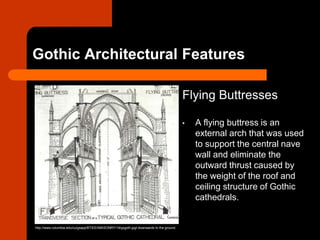
Flying Buttresses
• A flying buttress is an
external arch that was used
to support the central nave
wall and eliminate the
outward thrust caused by
the weight of the roof and
ceiling structure of Gothic
cathedrals.
http://www.columbia.edu/cu/gsapp/BT/EEI/MASONRY/14typgoth.jpgt downwards to the ground.
Gothic Architectural Features
Stone Tracery
Tracery are the stonework
elements that support the
glass in a Gothic Window.
Gothic tracery began as
simple geometric patterns
but evolved into the very
elaborate and complex
‘Rayonnant’ style.
http://www.victorianweb.org/art/architecture/gothic/11.jpg
Gothic Architectural Features
Stained Glass
With the advent of Gothic
architecture, stained glass
flourished with the
expansion of immense
window spaces in Gothic
cathedrals.
The windows of the period
depicted complex ideas,
with embellished biblical
narrative being the main
focus.
http://d1ezg6ep0f8pmf.cloudfront.net/images/slides/a5/12735-chartres-cathedral-blue-virgin-window-detail.jpg
http://www.polycount.com/forum/showthread.php?t=66834
Cluny Abbey
Acknowledgements
Art Associates
Maria Moore
Margaret O’Shea
Local Facilitator Team
Aine Andrews
Joe Caslin
Jane Campbell
Siobhan Campbell
Niamh O’Donoghue
Niamh O’Neill
Keith O’Rahilly
Sheena McKeon
Tony Morrissey
Monica White
Many thanks to the following for their invaluable contribution to the European
Art History and Appreciation series of workshops and resource materials.
PDST Professional Development Service for Teachers
The PDST is funded by the
Department of Education and
Skills under the National
Development Plan 2007 -
2013
Cultural & Environmental Education
Professional Development Service for Teachers (PDST)
Dublin West Education Centre,
Old Blessington Road,
Tallaght,
Dublin 24
National Co-ordinator
Conor Harrison
Mobile: 087 240 5710
E-mail: conorharrison@pdst.ie
Administrator
Angie Grogan
Tel: 014528018 Fax: 014528010
E-mail: angiegrogan@pdst.ie.

3. gothic architecture

  • 1.
  • 2.
    What is ‘Gothic’? The Gothic period was progressionary step from the preceding Romanesque period.  The word ‘Gothic’ was a derogatory term coined during the Renaissance to describe the old-fashioned and unenlightened of the period.
  • 3.
    Influences on thePeriod  The ever increasing wealth and power of the Catholic Church.  Significant advances in structural engineering.  The combination of rib-vaulting and pointed arches.  The importance given to biblical & local saints.
  • 4.
    Gothic Beginnings  GothicArchitecture began with the construction of the Benedictine Abbey of St. Denis, in the Ile- de France, just north of Paris in 1144.  The Abbey was build under the stewardship of Abbot Suger.  Abbot Suger is known as the ‘creator of Gothic’.
  • 5.
    Gothic Churches  Theybecame an important status symbol for a town.  Churches began to get significantly bigger and as a result we began to call these larger buildings cathedrals.
  • 6.
    Gothic Stages  TheExperimental Stage - Roughly the period from the building of the Abbey Church at St. Denis to the opening decades of the thirteenth century.  The Classical Stage - Spans the entire thirteenth century  The Flamboyant Stage - Extends into the end of the fifteenth century
  • 7.
  • 8.
    Gothic Architectural Features Pointed Arches  Flying Buttresses  Thin walls  Cruciform Shape  High Pointed Spires  Stained Glass Windows  Rib-Vaulting  High Relief Sculpture
  • 9.
    Gothic Architectural Features Pointed Arches Themost obvious difference between Gothic and Romanesque architecture is the shape of the arches. Pointed arches were stronger than the rounded Romanesque arch.http://classconnection.s3.amazonaws.com/252/flashcards/825252/png/untitled1323743639824.png
  • 10.
    Gothic Architectural Features RibVaulting • A ribbed vault is criss-crossed by ribs of solid stone that provide a skeletal frame to support the vault. • Ribbed Vaults were much lighter and did not need massive stone walls to support them. • As a direct result it was possible to open large spaces in the walls for windows. http://en.wikipedia.org/wiki/File:Gotic3d2.jpg
  • 11.
    Gothic Architectural Features FlyingButtresses • A flying buttress is an external arch that was used to support the central nave wall and eliminate the outward thrust caused by the weight of the roof and ceiling structure of Gothic cathedrals. http://www.columbia.edu/cu/gsapp/BT/EEI/MASONRY/14typgoth.jpgt downwards to the ground.
  • 12.
    Gothic Architectural Features StoneTracery Tracery are the stonework elements that support the glass in a Gothic Window. Gothic tracery began as simple geometric patterns but evolved into the very elaborate and complex ‘Rayonnant’ style. http://www.victorianweb.org/art/architecture/gothic/11.jpg
  • 13.
    Gothic Architectural Features StainedGlass With the advent of Gothic architecture, stained glass flourished with the expansion of immense window spaces in Gothic cathedrals. The windows of the period depicted complex ideas, with embellished biblical narrative being the main focus. http://d1ezg6ep0f8pmf.cloudfront.net/images/slides/a5/12735-chartres-cathedral-blue-virgin-window-detail.jpg
  • 14.
  • 15.
    Acknowledgements Art Associates Maria Moore MargaretO’Shea Local Facilitator Team Aine Andrews Joe Caslin Jane Campbell Siobhan Campbell Niamh O’Donoghue Niamh O’Neill Keith O’Rahilly Sheena McKeon Tony Morrissey Monica White Many thanks to the following for their invaluable contribution to the European Art History and Appreciation series of workshops and resource materials. PDST Professional Development Service for Teachers
  • 16.
    PDST Professional DevelopmentService for Teachers The PDST is funded by the Department of Education and Skills under the National Development Plan 2007 - 2013 Cultural & Environmental Education Professional Development Service for Teachers (PDST) Dublin West Education Centre, Old Blessington Road, Tallaght, Dublin 24 National Co-ordinator Conor Harrison Mobile: 087 240 5710 E-mail: conorharrison@pdst.ie Administrator Angie Grogan Tel: 014528018 Fax: 014528010 E-mail: angiegrogan@pdst.ie.