

Register Loan request
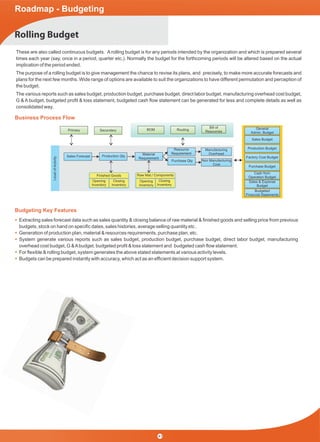
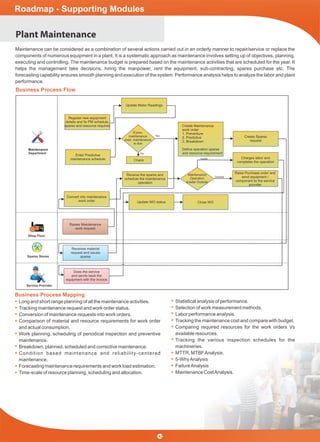
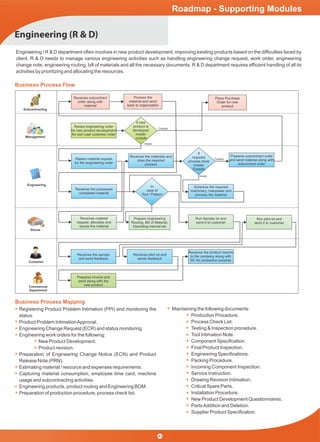
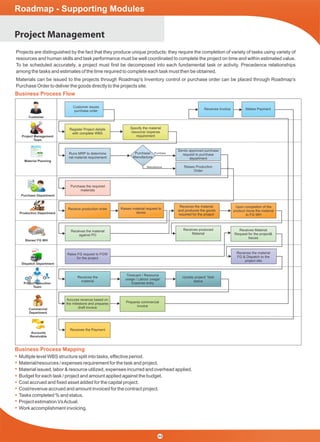
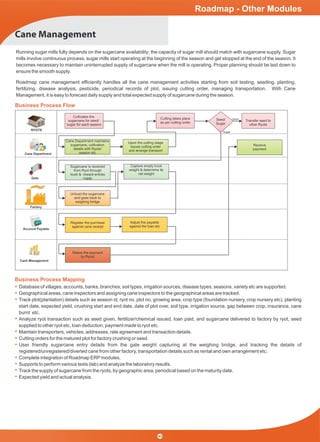
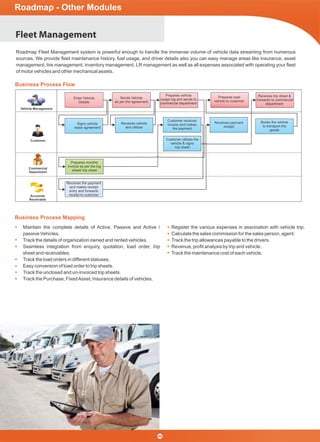
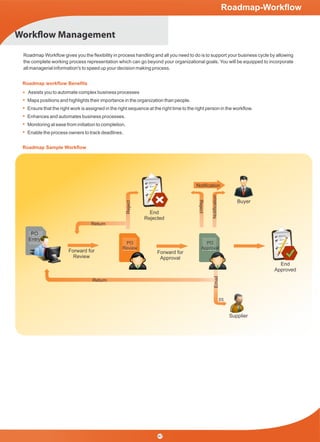
and forwards for approval
Verify the payroll
If
feasibility Study
Required
Register feasibility
Study
If feasible
Send Regret Letter
to Customer
Register Sales
Order
If Costing
Required
RFQ/
PO
Prepare Costing
Sheet
Prepare Quote &
Send it to Customer
If Quote
accepted
Marketing
Prepares Sales
Forecast for make
to Stock Item
Identifies Opportunity
for the Product
Sub-Contracting Department
Receives Quote enter details
& prepare comparison chart
Places Purchase Order
Purchase
Request
Receives Supplier Schedule
Request & converts into
Supplier Sch. Order
Converts the process into
subcontract order & generate
the issuance to the stores
Purchase Department
Planning Department
Shop Floor
Gate Entry
Customer
Supplier
Request Quote for
the Item
Request Item Quote
for the Item Processes
Run MRP & releases
planned Order
Consolidate demand
from Sales Order,
Customer Schedule
Sales Forecast
Production
Order
Detail Product
Process
Material Inward
Signs open PO /
Rate Contract
Receives RFQ &
Sends Quote
Register Open PO
Amendment
Receives Schedule
Sends Material,
DC & Invoice
Receive RFQ
and sends Quote
Supplier receives
the PaymentReceives PO
Sends Processed
Material along with
DC & Invoice
Material Type
Purchase/
Supplier Schedule
Compares the Quote
& places Open PO
Compares Quote
& Places Open PO
Receives Open PO
for the Prices
Signs PO
Amendment
Material Request
to Stores
Material Receipts Process Completion QC Is Last Process
If
Calibration
due
If
Study Due
Loop Process
1....n
Inside / Outside
Approved
Pay
option
If
Payroll is ok
Register PO
Amendment
Receive Subcontract
Order & Material
Sub-Contractor
Receives RFQ &
Sends Quote
Receives Open PO
for the Process Rates
Request for Price
Revision
Send Order
Amendment after
approval
Send Order
Amendment after
approval
Register Customer
Schedule
Prepares Standard
Invoice
Commercial Department
Register open sales
Order for the FG
Prices
Request Price
Revision
Register Open SO
Amendment
Request for Price
Revision
Customer Places
Monthly Schedule
for the FG
Receives Material
DC & Invoice
Sends Payment
Prepares Debit Memo
for Rejection/Excess
Qty & deviation Invoice
Receives Accepted
/ Rejected Goods Material Issuance
Stores/ FG
Quality Control
Cash Management
Payables
Accounts Receivable
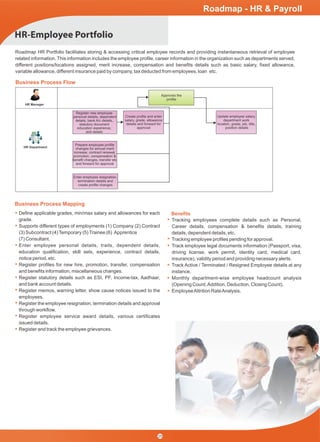
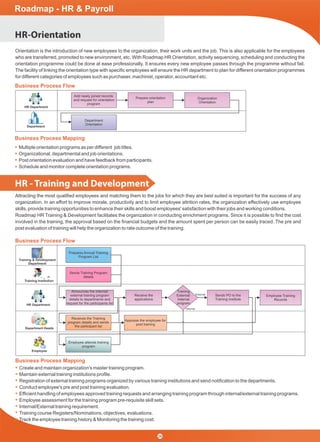
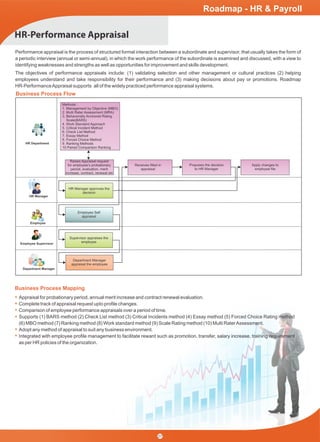
HR Manager
HR Department
Employee
Payroll Department
Prepare GRN
Receives FG/
Sub Assembly
Rework Completion
Receives Mat. along
with the Inspection
Request
Open NCR for all
Rejection
Update NCR
Details department
wise
Close NCR
Gauges Entry with
Calibration due
details
Create Calibration
record &
update details
Register Study
details for the
Gauges
Create Study
Record & update
details
Prepares Inspection Doc.
enters Accepted/Rejected
Qty & forward to stores
Prepare Bank/Cash
Payment Voucher
1. Advance Payment
Request against PO
2. Pending Payable Due
3. Payment for Expenses
4. Statutory Due Payment
5. Processed Payroll
Registers Debit Memo/
Invoice from the Customer
for the Sales Return
Receives the Invoice from
Commercial Department
Process Bank/Cash
Receipt Voucher
Sends the Receipt to
the customer
1. Receivable Due
2. Advance Receivables
against SO/PI
Approves the profile
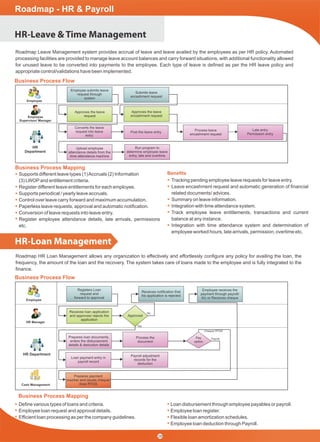
Employee submits
leave request through
system
Prepare the payroll considering
Employee salary & allowance
adjust file, leave file,
overtime file, later arrivals
Approves the
leave request
Process the payroll
Submits leave
encashment request
Receives loan
application & approves/
rejects the application
Converts the leave
request into leave entry
Post the leave entry
Process leave
encashment request
Late entry/
Permission entry
Upload emp. attendance
details from the time
attendance machine
Run program to
determine employee leave
entry, late and overtime
Prepares loan document,
enter the disbursement
and deduction details &
process the document
Loan payment entry
in payroll record
Payroll adjustment
records for the deduction
Register Bill, deducts
TDS / ESI
Forward GRN to
Quality
Prepare Cheque /
RTGS Payment
Send Payment adv.
along with cheque/
RTGS details
Purchase
Yes
No
Purchase
Manufacture
Sup. Sch.
Outside
Inside
Re-Prepare No
Yes
Yes
PO
RFQ
Yes
No
Yes
Accepted
Rejected
Repair
Cheque/ RTGS
Payroll
Yes
No
No
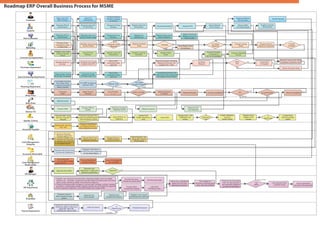
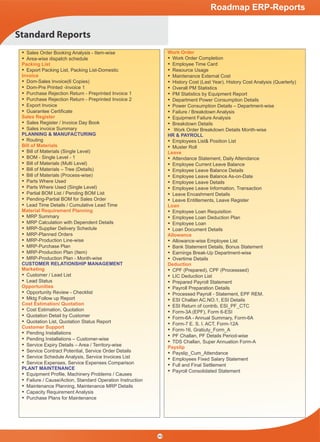
Roadmap ERP Overall Business Process for MSME
Sends RFQ
to Supplier
1.Register new employee personal detail, dependent details, bank A/c details,
statutory doc., education, experience and skill details & Create profile and enter
salary, grade, allowance details and forward for approval.
2.Prepare employee profile changes for annual merit, increase, contract, renewal,
promotion, compensation benefit changes, transfer etc and forward for approval.
3.Enter employee resignation, termination details and create profile.
Cash Management
Receivables
Accounts Payable
Prepares Packing
List based on
sch. & FG available
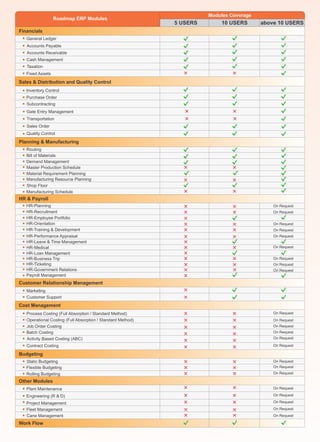
Roadmap ERP Modules
Modules Coverage
5 USERS 10 USERS above 10 USERS
Financials
Sales & Distribution and Quality Control
Planning & Manufacturing
HR & Payroll
Customer Relationship Management
Cost Management
Budgeting
Other Modules
Work Flow
General Ledger
Accounts Payable
Accounts Receivable
Cash Management
Taxation
Fixed Assets
Inventory Control
Purchase Order
Subcontracting
Quality Control
Transportation
Gate Entry Management
Sales Order
Routing
Bill of Materials
Demand Management
Master Production Schedule
Manufacturing Resource Planning
Material Requirement Planning
Shop Floor
Manufacturing Schedule
HR-Planning
HR-Recruitment
HR-Employee Portfolio
HR-Orientation
HR-Training & Development
HR-Performance Appraisal
HR-Leave & Time Management
HR-Medical
HR-Loan Management
HR-Business Trip
HR-Ticketing
Payroll Management
HR-Government Relations
Marketing
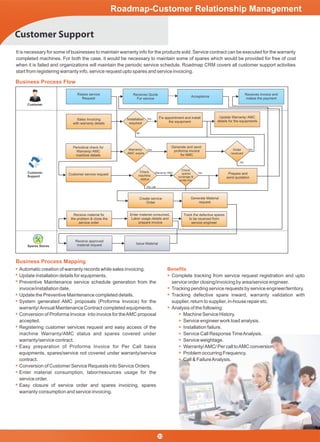
Customer Support
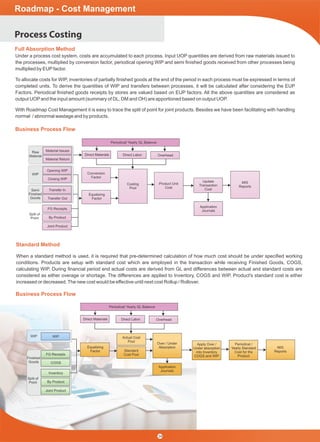
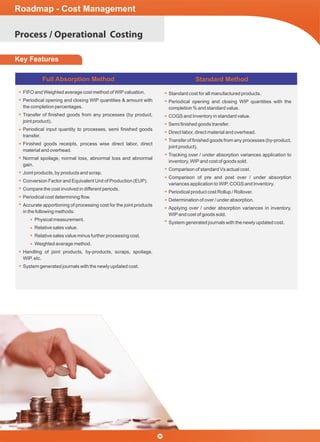
Process Costing (Full Absorption / Standard Method)
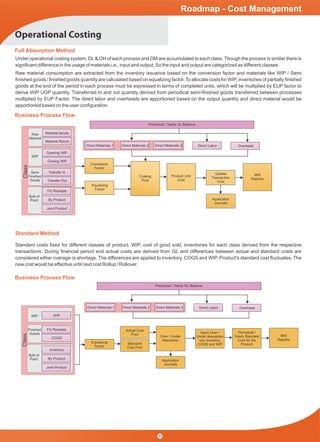
Operational Costing (Full Absorption / Standard Method)
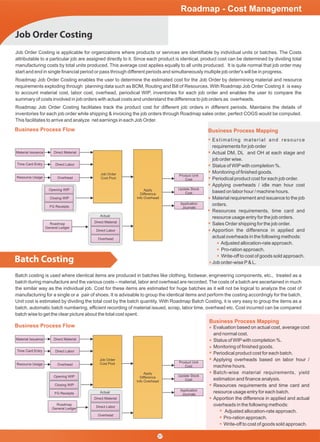
Job Order Costing
Batch Costing
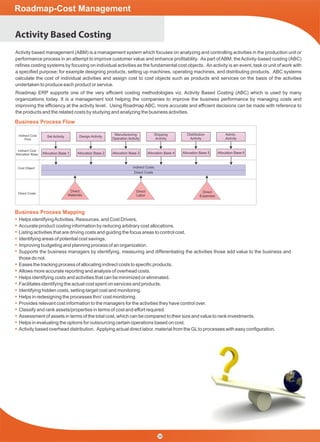
Activity Based Costing (ABC)
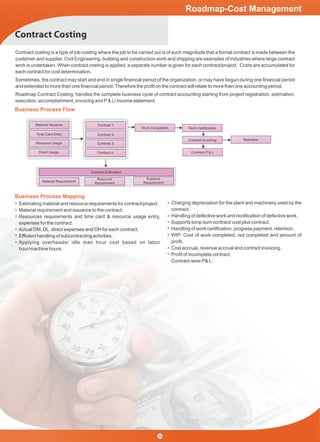
Contract Costing
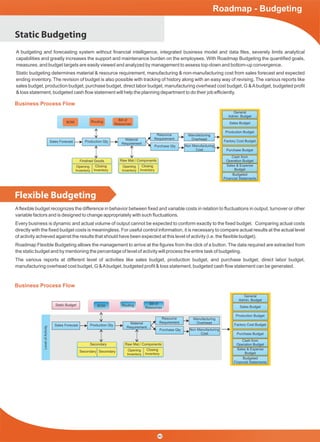
Static Budgeting
Flexible Budgeting
Rolling Budgeting
Engineering (R & D)
Project Management
Fleet Management
Cane Management
Plant Maintenance
On Request
On Request
On Request
On Request
On Request
On Request
On Request
On Request
On Request
On Request
On Request
On Request
On Request
On Request
On Request
On Request
On Request
On Request
On Request
On Request
On Request
On Request
On Request
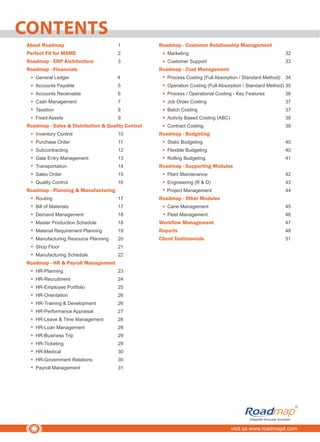
CONTENTS
visit us www.roadmapit.com
Integrate Innovate Succeed
R
About Roadmap 1
Perfect Fit for MSME 2
Roadmap - ERP Architecture 3
Roadmap - Financials
General Ledger 4
Accounts Payable 5
Accounts Receivable 6
Cash Management 7
Taxation 8
Fixed Assets 9
Roadmap - Sales & Distribution & Quality Control
Inventory Control 10
Purchase Order 11
Subcontracting 12
Gate Entry Management 13
Transportation 14
Sales Order 15
Quality Control 16
Roadmap - Planning & Manufacturing
Routing 17
Bill of Materials 17
Demand Management 18
Master Production Schedule 18
Material Requirement Planning 19
Manufacturing Resource Planning 20
Shop Floor 21
Manufacturing Schedule 22
Roadmap - HR & Payroll Management
HR-Planning 23
HR-Recruitment 24
HR-Employee Portfolio 25
HR-Orientation 26
HR-Training & Development 26
HR-Performance Appraisal 27
HR-Leave & Time Management 28
HR-Loan Management 28
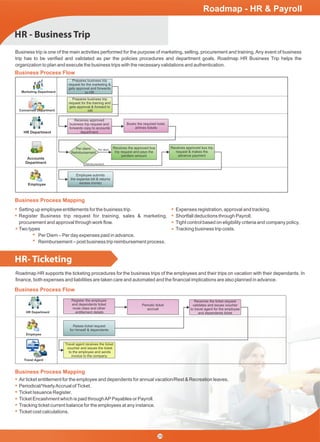
HR-Business Trip 29
HR-Ticketing 29
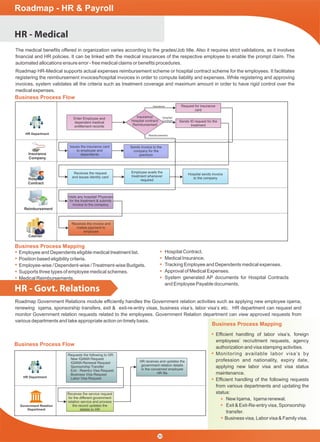
HR-Medical 30
HR-Government Relations 30
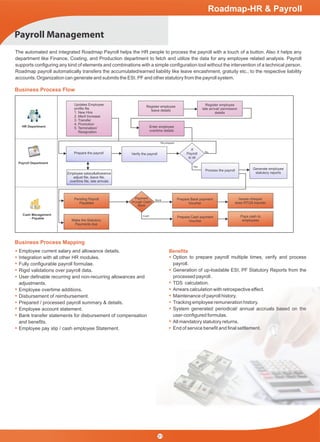
Payroll Management 31
Roadmap - Customer Relationship Management
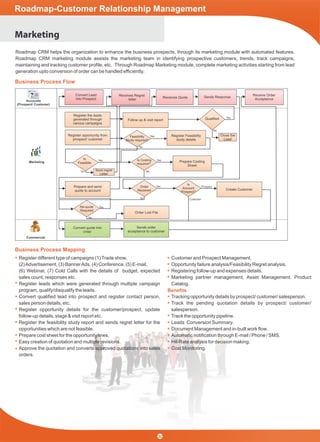
Marketing 32
Customer Support 33
Roadmap - Cost Management
Process Costing (Full Absorption / Standard Method) 34
Operation Costing (Full Absorption / Standard Method) 35
Process / Operational Costing - Key Features 36
Job Order Costing 37
Batch Costing 37
Activity Based Costing (ABC) 38
Contract Costing 39
Roadmap - Budgeting
Static Budgeting 40
Flexible Budgeting 40
Rolling Budgeting 41
Roadmap - Supporting Modules
Plant Maintenance 42
Engineering (R & D) 43
Project Management 44
Roadmap - Other Modules
Cane Management 45
Fleet Management 46
Workflow Management 47
Reports 48
Client Testimonials 51
A problem
solution tour now begins
Roadmap IT Solutions Private Limited is one of the fastest growing IT companies in India managed by team of highly qualified and
future visionary professionals having more than 3 decades of experience in various industry sectors both in India and overseas,
delivering cost effective business solutions by employing domain knowledge, applicable technologies and best practices. Roadmap
is an ISO 9001:2000 certified company.
As experts in ERP solutions and software development, Roadmap facilitates the customers increase their business values through
business process integration, transformation, cost reduction and process re-engineering. Roadmap offers “Ready Fit” world class
ERP System suitable for all kinds of industries like Electronics, Iron & Steel, Metal products, Cable, Paper, Building materials,
Chemicals, Textiles, Sugars, Ceramic, Agriculture, Automotive, Apparels & Footwear, Logistics Services, Pharmaceuticals,
Engineering & Constructions and service oriented industries.
It also provides consultancy and learning services in the areas of Information Security Management System, IT Service
Management, Business Continuity, Oracle DBASupport Services and Content Management.
Roadmap adopts proven practices & methodologies in all stages, right from requirement definition to final handover. We, at
Roadmap, continuously strive for excellence in all our operations and distinguish ourselves from competitors through quality
products, dedicated service, quick response to the clients' needs, domain expertise, methodology employed, affordability and
flexibility in working with the clients.
Roadmap follows a very rigorous recruitment process to bring in and nurture talented individuals. They are always encouraged to be
partners in the business for growth. Roadmap employees are well equipped to handle any type of projects and are trained
continuously on the latest technologies to expand their knowledge to offer effective solutions to the clients.
Roadmap is committed to go beyond the expectations of the clients by offering outstanding products, services and adding values.
Roadmap is associated with many reputed companies in offering right and appropriate business solutions to take their business
forward to the future. Exceptional functional and technical expertise coupled with extensive industry knowledge makes Roadmap IT
Solutions, an ideal choice for companies to rely upon.
OUR MOTTO:
GO BEYOND CUSTOMER EXPECTATIONS
About Roadmap
1
Roadmap ERP software is a fully integrated business solution for Micro Small and Medium Enterprise that gives a complete control
over the planning and management of all facets of operations. With real time and easy access to information, business can adapt to
rapidly changing circumstances, react quickly to customer demands, and reduce operating costs through streamlined processes
and workflow automation.
COSTS
MSMEs can start with minimum 5 user license pack and later can increase the number of license as required. With Roadmap proven
implementation methodology and Industry specific best practices makes possible to cut down the implementation costs as well to the
bare minimal level.
TIME
With Roadmap proven implementation plan and approach towards implementation of ERP Solutions to MSMEs reduces the overall
implementation time, there by cutting down the implementation costs. Right from the Business Process Study Stage to Go-Live
Stage through Configure/Customize, Training, Cut-Over, Roadmap has streamlined the processes so that the implementation is
effortless and simple for both client as well as the implementation teams.
PEOPLE
Roadmap ERP's pre-configured solutions for MSMEs allows organizations to align with their business processes, so that the solution
can be implemented with ease. With Roadmap user friendly system and step by step implementation approach, makes the
implementation easier for the core people and thereby getting effective involvement of the people. Due to simplicity and user
friendliness of Roadmap ERPSolutions, It makes it easier for a novice user to play upon.
USER TRAINING
User Training strategies are formulated and accordingly knowledge transfer sessions are planned and executed along with
necessary CBT(Computer Based Tutorials). User at the end of the training period will get a library of CBTs along with necessary
manuals so that any new user can effectively use Roadmap ERPSolution via the self-learning process.
USER FRIENDLINESS
Roadmap ERP system is designed in such a way that only minimal data entry is required at transaction levels, thereby eradicating
human errors. Since the entry is at minimal, Roadmap ERP is very user friendly prompting to punch in only the relevant information
as applicable. Most of the data is captured and internally calculated to get the required management information with accuracy.
BUSINESS PROCESS CONCLUSION
We optimized Roadmap ERP features, functions and options to meet the core business needs and elude usage complexity. This
system would lead to lesser time for training and system knowledge acquisition by enterprise staff and can concentrate more on their
objective.
IT DEPARTMENTAND IT INFRASTRUCTURE
Roadmap ERP System requires a low-end server to run the entire product. Roadmap ERP is a web enabled ERP solutions that is
readily available and can be easily accessed using standard web browsers. This addresses MSME's dependency of IT / EDP
Department or can have a lean IT department and infrastructure. This would save huge IT investment costs of ERP Systems
implementation. Now the total cost of ownership of Roadmap ERPSystems ownership is available to MSME at very lower costs.
BENEFITS
We understand that you stand in midst of tight competition and need greater efficiency and productivity to power your organization
ahead of your competitors. We value your time and money invested with us and reciprocates by creating a perfect ERP solution,
which will leverage your organization in following ways:
Provide greater visibility and transparency to enable stake holders to take right decisions at right time.
Replace diverse systems within organization with well lubricated, simple and uniform work flow mechanism.
Standardize global operations and achieve quality benchmarks.
Add value to your organization by infusing industry-specific capabilities.
Improve forecasting and eliminate losses to increase profitability
Seamless and Simple Integration of ERPapplications helps organization overcome operational, management and
performance challenges in a cost-effective manner.
Perfect Fit for MSME
2
Roadmap - ERP Architecture
Project Plan - Micro Industries
Pre-Requisite - Micro Industries
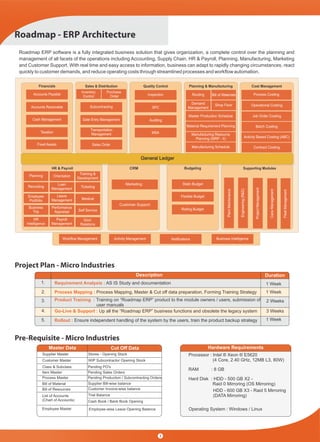
Roadmap ERP software is a fully integrated business solution that gives organization, a complete control over the planning and
management of all facets of the operations including Accounting, Supply Chain, HR & Payroll, Planning, Manufacturing, Marketing
and Customer Support. With real time and easy access to information, business can adapt to rapidly changing circumstances, react
quickly to customer demands, and reduce operating costs through streamlined processes and workflow automation.
Accounts Payable
Inventory
Control Inspection
Static Budget
Routing
Planning
Bill of Materials
Orientation
Training &
Development
Demand
Management
Recruiting
Employee
Portfolio
Business
Trip
HR
Intelligence
Master Production Schedule Job Order Costing
Operational Costing
Process Costing
Material Requirement Planning Batch Costing
Manufacturing Resource
Planning (MRP - II) Activity Based Costing (ABC)
Manufacturing Schedule Contract Costing
Shop Floor
Loan
Management Ticketing
Leave
Management Medical
Performance
Appraisal Self Service
Payroll
Management
Govt.
Relations
Purchase
Order
SPC
Flexible Budget
Engineering(R&D)
ProjectManagement
PlantMaintenance
FleetManagement
CaneManagement
Subcontracting
Gate Entry Management Auditing
Rolling Budget
Transportation
Management MSA
Sales Order
General Ledger
Accounts Receivable
Cash Management
Fixed Assets
Taxation
Marketing
Customer Support
Financials
CRM
Sales & Distribution Quality Control
Budgeting Supporting Modules
Planning & Manufacturing
HR & Payroll
Cost Management
Description
Master Data
Duration
1.
2.
3.
4.
5.
Requirement Analysis : AS IS Study and documentation
Process Mapping : Process Mapping, Master & Cut off data preparation, Forming Training Strategy
Product Training : Training on “Roadmap ERP” product to the module owners / users, submission of
user manuals
Go-Live & Support : Up all the “Roadmap ERP” business functions and obsolete the legacy system
Rollout : Ensure independent handling of the system by the users, train the product backup strategy
1 Week
1 Week
2 Weeks
3 Weeks
1 Week
Cut Off Data Hardware Requirements
Stores - Opening StockSupplier Master
Customer Master
Class & Subclass
Item Master
Process Master
Bill of Material
Bill of Resources
Employee Master
List of Accounts
(Chart of Accounts)
Processor : Intel ® Xeon ® E5620
(4 Core, 2.40 GHz, 12MB L3, 80W)WIP Subcontractor Opening Stock
Pending PO's
RAM : 8 GB
Pending Sales Orders
Pending Production / Subcontracting Orders Hard Disk : HDD - 500 GB X2 -
Raid 0 Mirroring (OS Mirroring)Supplier Bill-wise balance
Customer Invoice-wise balance HDD - 600 GB X3 - Raid 5 Mirroring
(DATA Mirroring)Trial Balance
Cash Book / Bank Book Opening
Operating System : Windows / LinuxEmployee-wise Leave Opening Balance
Workflow Management Activity Management Notifications Business Intelligence
3
General Ledger
Roadmap - Financials
Respective
Department
Accounting &
Finance Department
GRN (Purchase)
GRN (Subcontract)
AP - Bill Booking
AP - Debit / Credit Note
AR Doc / Debit / Credit Note
Sales Invoice
Bank Payment / Receipt
Cash Payment / Receipt
Payroll
L
e
d
g
e
r
Trial Balance &
Ledgers
Budget
Prepares and
Fixes Budget
Distribution
Journal
Recurring
Journal
General
Journal
Financial Statements
P & L A/c
Balance Sheet
Cash Flow Statement
Fund Flow Statement
Ratio Analysis
Automatic Posting
Periodical Posting
On Approval
Budget
Verification
Business Process Mapping
Business Process Flow
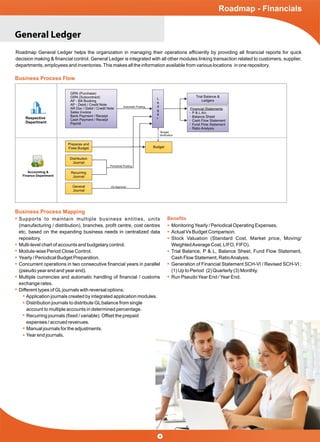
Roadmap General Ledger helps the organization in managing their operations efficiently by providing all financial reports for quick
decision making & financial control. General Ledger is integrated with all other modules linking transaction related to customers, supplier,
departments, employees and inventories.This makes all the information available from various locations in one repository.
Supports to maintain multiple business entities, units
(manufacturing / distribution), branches, profit centre, cost centres
etc. based on the expanding business needs in centralized data
repository.
Multi-level chart of accounts and budgetary control.
Module-wise Period Close Control.
Yearly / Periodical Budget Preparation.
Concurrent operations in two consecutive financial years in parallel
(pseudo year end and year end).
Multiple currencies and automatic handling of financial / customs
exchange rates.
Different types of GLjournals with reversal options;
Application journals created by integrated application modules.
Distribution journals to distribute GLbalance from single
account to multiple accounts in determined percentage.
Recurring journals (fixed / variable): Offset the prepaid
expenses / accrued revenues.
Manual journals for the adjustments.
Year end journals.
MonitoringYearly / Periodical Operating Expenses.
Actual Vs Budget Comparison.
Stock Valuation (Standard Cost, Market price, Moving/
WeightedAverage Cost, LIFO, FIFO).
Trial Balance, P & L, Balance Sheet, Fund Flow Statement,
Cash Flow Statement, RatioAnalysis.
Generation of Financial Statement SCH-VI / Revised SCH-VI ;
(1) Up to Period (2) Quarterly (3) Monthly.
Run PseudoYear End /Year End.
Benefits
4
Roadmap - Financials
Accounts Payable
Business Process Flow
Business Process Mapping
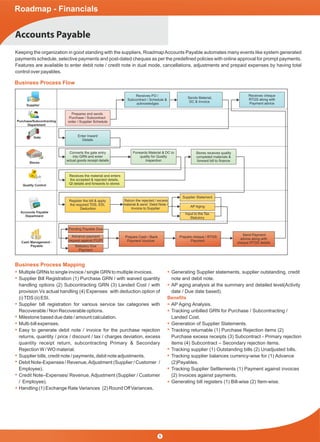
Multiple GRNs to single invoice / single GRN to multiple invoices.
Supplier Bill Registration (1) Purchase GRN / with waived quantity
handling options (2) Subcontracting GRN (3) Landed Cost / with
provision Vs actual handling (4) Expenses with deduction option of
(i)TDS (ii) ESI.
Supplier bill registration for various service tax categories with
Recoverable / Non Recoverable options.
Milestone based due date / amount calculation.
Multi-bill expenses.
Easy to generate debit note / invoice for the purchase rejection
returns, quantity / price / discount / tax / charges deviation, excess
quantity receipt return, subcontracting Primary & Secondary
Rejection W / WO material.
Supplier bills, credit note / payments, debit note adjustments.
Debit Note-Expenses / Revenue,Adjustment (Supplier / Customer /
Employee).
Credit Note–Expenses/ Revenue, Adjustment (Supplier / Customer
/ Employee).
Handling (1) Exchange Rate Variances (2) Round Off Variances.
Generating Supplier statements, supplier outstanding, credit
note and debit note.
AP aging analysis at the summary and detailed level(Activity
date / Due date based).
AP Aging Analysis.
Tracking unbilled GRN for Purchase / Subcontracting /
Landed Cost.
Generation of Supplier Statements.
Tracking returnable (1) Purchase Rejection items (2)
Purchase excess receipts (3) Subcontract - Primary rejection
items (4) Subcontract – Secondary rejection items.
Tracking supplier (1) Outstanding bills (2) Unadjusted bills.
Tracking supplier balances currency-wise for (1) Advance
(2)Payables.
Tracking Supplier Settlements (1) Payment against invoices
(2) Invoices against payments.
Generating bill registers (1) Bill-wise (2) Item-wise.
Supplier
Purchase/Subcontracting
Department
Stores
Quality Control
Accounts Payable
Department
Cash Management -
Payable
Receives PO /
Subcontract / Schedule &
acknowledges
Sends Material,
DC & Invoice
Receives cheque
RTGS along with
Payment advice
Enter Inward
Details
Converts the gate entry
into GRN and enter
actual goods receipt details
Forwards Material & DC to
quality for Quality
Inspection
Register the bill & apply
the required TDS, ESI,
Deduction
Prepare Cash / Bank
Payment Voucher
Prepare cheque / RTGS
Payment
Send Payment
advice along with
cheque RTGS details
Return the rejected / excess
material & send Debit Note /
Invoice to Supplier
Supplier Statement
Pending Payable Due
Advance payment
request against PO/PI
Statutory Due
Payment
AP Aging
Input to the Tax
Statutory
Stores receives quality
completed materials &
forward bill to finance
Receives the material and enters
the accepted & rejected details,
QI details and forwards to stores
Keeping the organization in good standing with the suppliers, RoadmapAccounts Payable automates many events like system generated
payments schedule, selective payments and post-dated cheques as per the predefined policies with online approval for prompt payments.
Features are available to enter debit note / credit note in dual mode, cancellations, adjustments and prepaid expenses by having total
control over payables.
Gate
Prepares and sends
Purchase / Subcontract
order / Supplier Schedule
Benefits
5
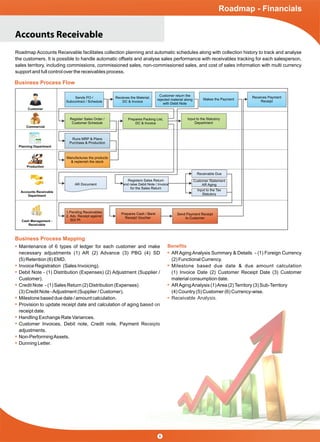
Business Process Flow
Business Process Mapping
Maintenance of 6 types of ledger for each customer and make
necessary adjustments (1) AR (2) Advance (3) PBG (4) SD
(5) Retention (6) EMD.
Invoice Registration (Sales Invoicing).
Debit Note - (1) Distribution (Expenses) (2) Adjustment (Supplier /
Customer).
Credit Note - (1) Sales Return (2) Distribution (Expenses)
(3) Credit Note -Adjustment (Supplier / Customer).
Milestone based due date / amount calculation.
Provision to update receipt date and calculation of aging based on
receipt date.
Handling Exchange Rate Variances.
Customer Invoices, Debit note, Credit note, Payment Receipts
adjustments.
Non-PerformingAssets.
Dunning Letter.
AR Aging Analysis Summary & Details - (1) Foreign Currency
(2) Functional Currency.
Milestone based due date & due amount calculation
(1) Invoice Date (2) Customer Receipt Date (3) Customer
material consumption date.
ARAgingAnalysis (1)Area (2)Territory (3) Sub-Territory
(4) Country (5) Customer (6) Currency-wise.
Receivable Analysis.
Accounts Receivable
Roadmap - Financials
Customer
Commercial
Planning Department
Production
Accounts Receivable
Department
Cash Management -
Receivable
Sends PO /
Subcontract / Schedule
Receives the Material,
DC & Invoice
Customer return the
rejected material along
with Debit Note
Makes the Payment
Receives Payment
Receipt
Register Sales Order /
Customer Schedule
Prepares Packing List,
DC & Invoice
Input to the Statutory
Department
Runs MRP & Plans
Purchase & Production
Manufactures the products
& replenish the stock
Registers Sales Return
and raise Debit Note / Invoice
for the Sales Return
AR Document
Prepares Cash / Bank
Receipt Voucher
Send Payment Receipt
to Customer
1.Pending Receivables
2. Adv. Receipt against
SO/ PI
Receivable Due
Customer Statement
AR Aging
Input to the Tax
Statutory
Roadmap Accounts Receivable facilitates collection planning and automatic schedules along with collection history to track and analyse
the customers. It is possible to handle automatic offsets and analyse sales performance with receivables tracking for each salesperson,
sales territory, including commissions, commissioned sales, non-commissioned sales, and cost of sales information with multi currency
support and full control over the receivables process.
Benefits
6
Cash Management
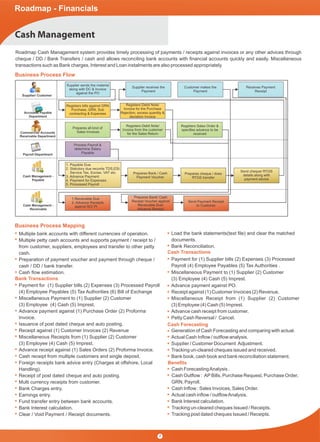
Business Process Flow
Roadmap - Financials
Supplier/ Customer
Accounts Payable
Department
Commercial/ Accounts
Receivable Department
Payroll Department
Cash Management -
Payable
Cash Management -
Receivable
Registers bills against GRN
Purchase, GRN, Sub
contracting & Expenses
Registers Debit Note/
Invoice for the Purchase
Rejection, excess quantity &
deviation Invoice
Supplier sends the material
along with DC & Invoice
against the PO
Receives Payment
Receipt
Supplier receives the
Payment
Customer makes the
Payment
Prepares all kind of
Sales Invoices
Registers Debit Note/
Invoice from the customer
for the Sales Return
Registers Sales Order &
specifies advance to be
received
Process Payroll &
determine Salary
Payable
Prepares Bank / Cash
Payment Voucher
Prepares Bank/ Cash
Receipt Voucher against
Receivable Due/
Advance Receipt
Send Payment Receipt
to Customer
Prepares cheque / does
RTGS transfer
Send cheque/ RTGS
details along with
payment advice
1. Payable Due
2. Statutory due records TDS,ESI,
Service Tax, Excise, VAT etc.
3. Advance Payment
4. Payment for Expenses
5. Processed Payroll
1.Receivable Due
2. Advance Receipts
against SO/ PI
Roadmap Cash Management system provides timely processing of payments / receipts against invoices or any other advices through
cheque / DD / Bank Transfers / cash and allows reconciling bank accounts with financial accounts quickly and easily. Miscellaneous
transactions such as Bank charges, Interest and Loan instalments are also processed appropriately.
Business Process Mapping
Multiple bank accounts with different currencies of operation.
Multiple petty cash accounts and supports payment / receipt to /
from customer, suppliers, employees and transfer to other petty
cash.
Preparation of payment voucher and payment through cheque /
cash / DD / bank transfer.
Cash flow estimation.
Payment for (1) Supplier bills (2) Expenses (3) Processed Payroll
(4) Employee Payables (5) Tax Authorities (6) Bill of Exchange
Miscellaneous Payment to (1) Supplier (2) Customer
(3) Employee (4) Cash (5) Imprest.
Advance payment against (1) Purchase Order (2) Proforma
Invoice.
Issuance of post dated cheque and auto posting.
Receipt against (1) Customer Invoices (2) Revenue
Miscellaneous Receipts from (1) Supplier (2) Customer
(3) Employee (4) Cash (5) Imprest.
Advance receipt against (1) Sales Orders (2) Proforma Invoice.
Cash receipt from multiple customers and single deposit.
Foreign receipts bank advice entry (Charges at offshore, Local
Handling).
Receipt of post dated cheque and auto posting.
Multi currency receipts from customer.
Bank Charges entry.
Earnings entry.
Fund transfer entry between bank accounts.
Bank Interest calculation.
Clear / Void Payment / Receipt documents.
Load the bank statements(text file) and clear the matched
documents.
Bank Reconciliation.
Payment for (1) Supplier bills (2) Expenses (3) Processed
Payroll (4) Employee Payables (5) Tax Authorities .
Miscellaneous Payment to (1) Supplier (2) Customer
(3) Employee (4) Cash (5) Imprest.
Advance payment against PO.
Receipt against (1) Customer Invoices (2) Revenue.
Miscellaneous Receipt from (1) Supplier (2) Customer
(3) Employee (4) Cash (5) Imprest.
Advance cash receipt from customer.
Petty Cash Reversal / Cancel.
Generation of Cash Forecasting and comparing with actual.
Actual Cash Inflow / outflow analysis.
Supplier / Customer Document Adjustment.
Tracking un-cleared cheques issued and received.
Bank book, cash book and bank reconciliation statement.
Cash ForecastingAnalysis .
Cash Outflow : APBills, Purchase Request, Purchase Order,
GRN, Payroll.
Cash Inflow : Sales Invoices, Sales Order.
Actual cash inflow / outflowAnalysis.
Bank Interest calculation.
Tracking un-cleared cheques Issued / Receipts.
Tracking post dated cheques Issued / Receipts.
Benefits
Cash Forecasting
Cash Transactions
Bank Transactions
7
Taxation
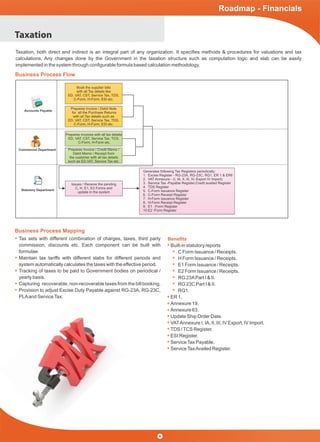
Business Process Flow
Business Process Mapping
Tax sets with different combination of charges, taxes, third party
commission, discounts etc. Each component can be built with
formulae.
Maintain tax tariffs with different slabs for different periods and
system automatically calculates the taxes with the effective period.
Tracking of taxes to be paid to Government bodies on periodical /
yearly basis.
Capturing recoverable, non-recoverable taxes from the bill booking.
Provision to adjust Excise Duty Payable against RG-23A, RG-23C,
PLAand ServiceTax.
Built-in statutory reports
C Form Issuance / Receipts.
H Form Issuance / Receipts.
E1 Form Issuance / Receipts.
E2 Form Issuance / Receipts.
RG 23APart I & II.
RG 23C Part I & II.
RG1.
ER 1.
Annexure 19.
Annexure 63.
Update Ship Order Date.
VATAnnexure I, IA, II, III, IV Export, IV Import.
TDS /TCS Register.
ESI Register.
ServiceTax Payable.
ServiceTaxAvailed Register.
Roadmap - Financials
Accounts Payable
Commercial Department
Statutory Department
Book the supplier bills
with all Tax details like
ED, VAT, CST, Service Tax, TDS,
C-Form, H-Form, ESI etc.
Prepares Invoice / Debit Note
for all the Purchase Returns
with all Tax details such as
ED, VAT, CST, Service Tax, TDS,
C-Form, H-Form, ESI etc.
Prepares invoices with all tax details
ED, VAT, CST, Service Tax, TCS,
C-Form, H-Form etc.
Issues / Receive the pending
C, H, E1, E2 Forms and
update in the system
Generates following Tax Registers periodically:
1. Excise Register - RG-23A, RG-23C, RG1, ER 1 & ER6
2. VAT Annexure - (I, IA, II, III, IV, Export IV Import)
3. Service Tax -Payable Register,Credit availed Register
4. TDS Register
5. C-Form Issuance Register
6. C-Form Receipt Register
7. H-Form Issuance Register
8. H-Form Receipt Register
9. E1 -Form Register
10.E2 -Form Register
Prepares Invoice / Credit Memo /
Debit Memo / Receipt from
the customer with all tax details
such as ED,VAT, Service Tax etc.
Taxation, both direct and indirect is an integral part of any organization. It specifies methods & procedures for valuations and tax
calculations. Any changes done by the Government in the taxation structure such as computation logic and slab can be easily
implemented in the system through configurable formula based calculation methodology.
Benefits
8
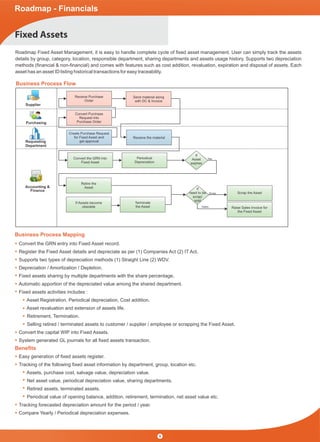
Roadmap Fixed Asset Management, it is easy to handle complete cycle of fixed asset management. User can simply track the assets
details by group, category, location, responsible department, sharing departments and assets usage history. Supports two depreciation
methods (financial & non-financial) and comes with features such as cost addition, revaluation, expiration and disposal of assets. Each
asset has an asset ID listing historical transactions for easy traceability.
Business Process Flow
Supplier
Purchasing
Requesting
Department
Accounting &
Finance
Convert Purchase
Request into
Purchase Order
Receive Purchase
Order
Send material along
with DC & Invoice
Create Purchase Request
for Fixed Asset and
get approval
Receive the material
Convert the GRN into
Fixed Asset
Periodical
Depreciation
If
Asset
expires
If
need to be
scrap/
sold
Retire the
Asset
Raise Sales Invoice for
the Fixed Asset
Scrap the Asset
If Assets become
obsolete
Terminate
the Asset
Scrap
Sales
Yes
Convert the GRN entry into Fixed Asset record.
Register the Fixed Asset details and depreciate as per (1) Companies Act (2) IT Act.
Supports two types of depreciation methods (1) Straight Line (2) WDV.
Depreciation / Amortization / Depletion.
Fixed assets sharing by multiple departments with the share percentage.
Automatic apportion of the depreciated value among the shared department.
Fixed assets activities includes :
Asset Registration, Periodical depreciation, Cost addition.
Asset revaluation and extension of assets life.
Retirement, Termination.
Selling retired / terminated assets to customer / supplier / employee or scrapping the Fixed Asset.
Convert the capital WIP into Fixed Assets.
System generated GL journals for all fixed assets transaction.
Easy generation of fixed assets register.
Tracking of the following fixed asset information by department, group, location etc.
Assets, purchase cost, salvage value, depreciation value.
Net asset value, periodical depreciation value, sharing departments.
Retired assets, terminated assets.
Periodical value of opening balance, addition, retirement, termination, net asset value etc.
Tracking forecasted depreciation amount for the period / year.
Compare Yearly / Periodical depreciation expenses.
Business Process Mapping
Benefits
Fixed Assets
Roadmap - Financials
9
Roadmap - Sales & Distribution and Quality Control
Inventory Control
Business Process Flow
Supplier
Purchase
Planning
Gate
Quality Control
Stores/ FG WH
Shop Floor
Subcontractor
Department
Receives Purchase
Order
Sends material
along with DC & Invoice
Purchase Request Generate
Purchase Order
Runs MRP, generates
and approves
Purchase Request
Enter material
inward details
Enter Accepted/ Rejected,
QI details
Convert the Gate Entry
into GRN & forward it to QC
for Quality Inspection
Receive QC completed
material
SFG/ Assembly
FG Completion
SFG Assembly
FG Completion
Raises material request for
production order
Material Request for
the subcontracting Order
Material Request
Material Request
against WO
Material Return
Material Return
Material Return
Material Return
Receives approved
material request &
Issue Material
Inventory Plan
ROL / Min-Max
Planning
SFG/ Assy
FG Receipt
Material
Receipts
Stock Count
enters
Compare
System Vs Physical
Update
Stock
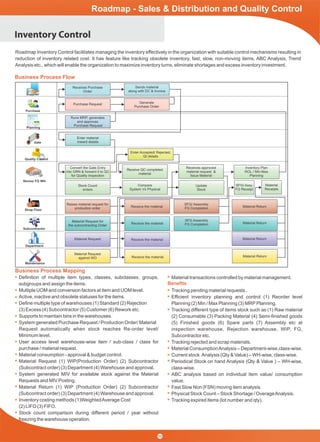
Roadmap Inventory Control facilitates managing the inventory effectively in the organization with suitable control mechanisms resulting in
reduction of inventory related cost. It has feature like tracking obsolete inventory, fast, slow, non-moving items, ABC Analysis, Trend
Analysis etc., which will enable the organization to maximize inventory turns, eliminate shortages and excess inventory investment.
Business Process Mapping
Definition of multiple item types, classes, subclasses, groups,
subgroups and assign the items.
Multiple UOM and conversion factors at item and UOM level.
Active, inactive and obsolete statuses for the items.
Define multiple type of warehouses (1) Standard (2) Rejection
(3) Excess (4) Subcontractor (5) Customer (6) Rework etc.
Supports to maintain bins in the warehouses.
System generated Purchase Request / Production Order/ Material
Request automatically when stock reaches Re-order level/
Minimum level.
User access level warehouse-wise item / sub-class / class for
purchase / material request.
Material consumption - approval & budget control.
Material Request (1) WIP(Production Order) (2) Subcontractor
(Subcontract order) (3) Department (4) Warehouse and approval.
System generated MIV for available stock against the Material
Requests and MIV Posting.
Material Return (1) WIP (Production Order) (2) Subcontractor
(Subcontract order) (3) Department (4) Warehouse and approval.
Inventory costing methods (1)WeightedAverage Cost
(2) LIFO (3) FIFO.
Stock count comparison during different period / year without
freezing the warehouse operation.
Material transactions controlled by material management.
Tracking pending material requests .
Efficient inventory planning and control (1) Reorder level
Planning (2) Min / Max Planning (3) MRPPlanning.
Tracking different type of items stock such as (1) Raw material
(2) Consumable (3) Packing Material (4) Semi-finished goods
(5) Finished goods (6) Spare parts (7) Assembly etc at
inspection warehouse, Rejection warehouse, WIP, FG,
Subcontractor etc.
Tracking rejected and scrap materials.
Material ConsumptionAnalysis – Department-wise,class-wise.
Current stock Analysis (Qty & Value) – WH-wise, class-wise.
Periodical Stock on hand Analysis (Qty & Value ) – WH-wise,
class-wise.
ABC analysis based on individual item value/ consumption
value.
Fast Slow Non (FSN) moving item analysis.
Physical Stock Count – Stock Shortage / OverageAnalysis.
Tracking expired items (lot number and qty).
Receive the material
Maintenance
Benefits
Quality
10
Purchase Order
Business Process Flow
Business Process Mapping
Roadmap - Sales & Distribution and Quality Control
Supplier
Planning Department
Purchase Department
Gate Entry
Stores
Quality Control
Accounts Payable
Receives RFQ
Prepare Purchase Request /
Supplier Schedule Request
based on MRP
Receive Approved
Purchase / Supplier
Schedule Request
Place Purchase Order /
Supplier Schedule
Generate RFQ and
send it to Supplier
Receives quote, enter
details and prepare
comparison chart
Purchase
/ Supplier
Schedule
RFQ/
PO
Receives the material
along with Inspection
Request
Registers the bill
against GRN
Prepares Debt Memo / Invoice
and return the rejected /
excess material along with
Invoice / Debit Memo
Inspects the materials
enter observation,accepted
& rejected qty
Forwards accepted /
rejected material to stores
Forwards the invoice to
Finance Department
Automatic creation of
purchase request
based on the Reorder /
Min / Max planning
Creates GRN manually
or convert the Gate
entry into GRN & sends to
QC for QI
Receives the Accepted /
Rejected material
Supplier Schedule
Purchase
RFQ
PO
Prepares and sends
quote against RFQ
Receives Purchase
Order / Supplier
Schedule
Supplier sends
material along with
DC & Invoice
Supplier receives
rejected material
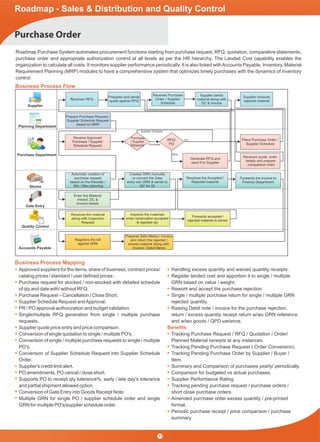
Roadmap Purchase System automates procurement functions starting from purchase request, RFQ, quotation, comparative statements,
purchase order and appropriate authorization control at all levels as per the HR hierarchy. The Landed Cost capability enables the
organization to calculate all costs. It monitors supplier performance periodically. It is also linked withAccounts Payable, Inventory, Material
Requirement Planning (MRP) modules to have a comprehensive system that optimizes timely purchases with the dynamics of inventory
control.
Approved suppliers for the items, share of business, contract prices/
catalog prices / standard / user defined prices .
Purchase request for stocked / non-stocked with detailed schedule
of qty and date with/ without RFQ.
Purchase Request – Cancellation / Close Short.
Supplier Schedule Request andApproval.
PR / PO approval authorization and budget validation.
Single/multiple RFQ generation from single / multiple purchase
requests.
Supplier quote price entry and price comparison.
Conversion of single quotation to single / multiple PO's.
Conversion of single / multiple purchase requests to single / multiple
PO's.
Conversion of Supplier Schedule Request into Supplier Schedule
Order.
Supplier's credit limit alert.
PO amendments, PO cancel / close short.
Supports PO to receipt qty tolerance%, early / late day's tolerance
and partial shipment allowed option.
Conversion of Gate Entry into Goods Receipt Note.
Multiple GRN for single PO / supplier schedule order and single
GRN for multiple PO's/supplier schedule order.
Handling excess quantity and waived quantity receipts.
Register landed cost and apportion it to single / multiple
GRN based on value / weight.
Rework and accept the purchase rejection.
Single / multiple purchase return for single / multiple GRN
rejected quantity.
Raising Debit note / invoice for the purchase rejection.
return / excess quantity receipt return w/wo GRN reference
and w/wo goods / QPD variance.
Tracking Purchase Request / RFQ / Quotation / Order/
Planned Material receipts at any instances.
Tracking Pending Purchase Request ( Order Conversion).
Tracking Pending Purchase Order by Supplier / Buyer /
Item.
Summary and Comparison of purchases yearly/ periodically.
Comparison for budgeted vs actual purchases.
Supplier Performance Rating.
Tracking pending purchase request / purchase orders /
short close purchase orders.
Amended purchase order excess quantity / pre-printed
format.
Periodic purchase receipt / price comparison / purchase
summary.
Enter the Material
Inward, DC &
Invoice details
Benefits
Quality
11
Subcontracting
Business Process Mapping
Planning Department
Gate Entry
Stores
Quality Control
Accounts Payable
Prepares RFQ for item
process and forward to
sub contractor
Receives quote prepare
open PO/ Amendment
List of pending outside
processes
Convert into sub contractor
order & approves
Prepares production order
and copies the processes
from product routing
Inspects the material
enter the QI observation,
accepted & rejected details
and sends back to the store
Register the bill
against GRN
Prepare Debt Memo / Invoice
and return the Primary /
Secondary rejection item
W/ WO material
Enter the material inward details in 7 categories
1. Processed 5. End Bits
2. Unprocessed 6. Cut Samples
3. Declared scrap 7. Partially Processed
4. Scrap
Material request &
allocation
Material Issuance
to subcontractor
with DC
Convert the gate entry
into GRN, generates
material consumption
against DC & forward to
QC Department
Stores department
receives the material,
stock decreased
at subcontractor location
Forward the GRN
details along with
bill to finance
department
Receives RFQ for Item
processes and prepares
quotation & forward
to the organisation
Receives open PO/
Amendment
Receives sub
contractor order
along with material
& DC
Process the Material
and sends along
with DC & Invoice
Receives Debit
Memo for the
Primary/ Secondary
rejection item
Roadmap - Sales & Distribution and Quality Control
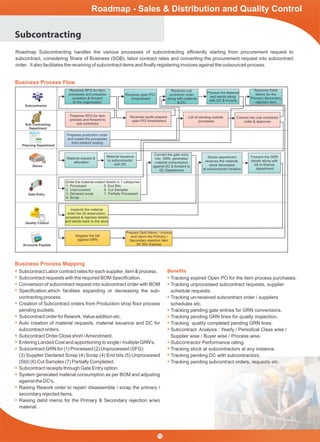
Roadmap Subcontracting handles the various processes of subcontracting efficiently starting from procurement request to
subcontract, considering Share of Business (SOB), labor contract rates and converting the procurement request into subcontract
order. It also facilitates the receiving of subcontract items and finally registering invoices against the outsourced process.
Business Process Flow
Subcontract Labor contract rates for each supplier, item & process.
Subcontract requests with the required BOM Specification.
Conversion of subcontract request into subcontract order with BOM
Specification,which facilities expanding or decreasing the sub-
contracting process.
Creation of Subcontract orders from Production shop floor process
pending buckets.
Subcontract order for Rework, Value addition etc.
Auto creation of material requests, material issuance and DC for
subcontract orders.
Subcontract Order Close short /Amendment.
Entering Landed Cost and apportioning to single / multiple GRN's.
Subcontract GRN for (1) Processed (2) Unprocessed (SFG)
(3) Supplier Declared Scrap (4) Scrap (4) End bits (5) Unprocessed
(Std) (6) Cut Samples (7) Partially Completed.
Subcontract receipts through Gate Entry option.
System generated material consumption as per BOM and adjusting
against the DC's.
Raising Rework order to repair/ disassemble / scrap the primary /
secondary rejected items.
Raising debit memo for the Primary & Secondary rejection w/wo
material.
Tracking expired Open PO for the item process purchases.
Tracking unprocessed subcontract requests, supplier
schedule requests.
Tracking un-received subcontract order / suppliers
schedules etc.
Tracking pending gate entries for GRN conversions.
Tracking pending GRN lines for quality inspection.
Tracking quality completed pending GRN lines.
Subcontract Analysis : Yearly / Periodical Class wise /
Supplier wise / Buyer wise / Process wise.
Subcontractor Performance rating.
Tracking stock at subcontractors at any instance.
Tracking pending DC with subcontractors.
Tracking pending subcontract orders, requests etc.
Subcontractor
Sub Contracting
Department
Benefits
Quality
12
Gate Entry Management
Roadmap - Sales & Distribution and Quality Control
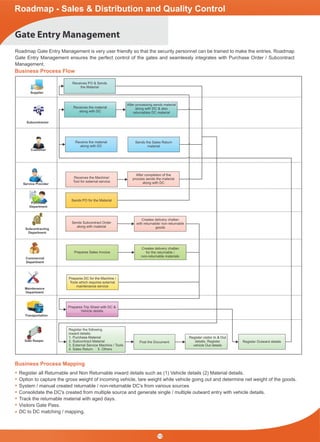
Roadmap Gate Entry Management is very user friendly so that the security personnel can be trained to make the entries. Roadmap
Gate Entry Management ensures the perfect control of the gates and seamlessly integrates with Purchase Order / Subcontract
Management.
Business Process Flow
Supplier
Subcontractor
Receives PO & Sends
the Material
Register visitor In & Out
details, Register
vehicle Out details
Receives the material
along with DC
After processing sends material
along with DC & also
returnables DC material
Register the following
inward details:
1. Purchase Material
2. Subcontract Material
3. External Service Machine / Tools
4. Sales Return 5. Others
Receive the material
along with DC
Sends the Sales Return
material
After completion of the
process sends the material
along with DC
Receives the Machine/
Tool for external service
Sends PO for the Material
Sends Subcontract Order
along with material
Prepares Sales Invoice
Prepares DC for the Machine /
Tools which requires external
maintenance service
Prepares Trip Sheet with DC &
Vehicle details
Register Outward details
Creates delivery challan
with returnable/ non-returnable
goods
Creates delivery challan
for the returnable /
non-returnable materials
Customer
Post the Document
Subcontracting
Department
Commercial
Department
Maintenance
Department
Transportation
Service Provider
Business Process Mapping
Register all Returnable and Non Returnable inward details such as (1) Vehicle details (2) Material details.
Option to capture the gross weight of incoming vehicle, tare weight while vehicle going out and determine net weight of the goods.
System / manual created returnable / non-returnable DC's from various sources
Consolidate the DC's created from multiple source and generate single / multiple outward entry with vehicle details.
Track the returnable material with aged days.
Visitors Gate Pass.
DC to DC matching / mapping.
Purchase
Department
Gate Keeper
13
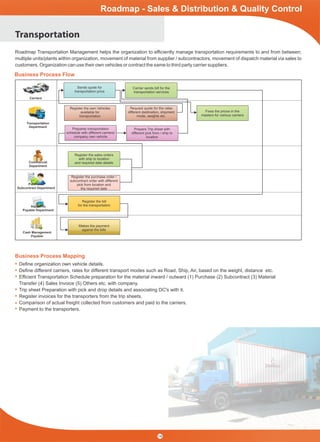
Business Process Mapping
Define organization own vehicle details.
Define different carriers, rates for different transport modes such as Road, Ship, Air, based on the weight, distance etc.
Efficient Transportation Schedule preparation for the material inward / outward (1) Purchase (2) Subcontract (3) Material
Transfer (4) Sales Invoice (5) Others etc. with company.
Trip sheet Preparation with pick and drop details and associating DC's with it.
Register invoices for the transporters from the trip sheets.
Comparison of actual freight collected from customers and paid to the carriers.
Payment to the transporters.
Roadmap - Sales & Distribution & Quality Control
Roadmap Transportation Management helps the organization to efficiently manage transportation requirements to and from between;
multiple units/plants within organization, movement of material from supplier / subcontractors, movement of dispatch material via sales to
customers. Organization can use their own vehicles or contract the same to third party carrier suppliers.
Business Process Flow
Carriers
Transportation
Department
Sends quote for
transportation price
Prepare Trip sheet with
different pick from / ship to
location
Register the own Vehicles
available for
transportation
Request quote for the rates
different destination, shipment
mode, weights etc.
Fixes the prices in the
masters for various carriers
Register the sales orders
with ship to location
and required date details
Register the purchase order /
subcontract order with different
pick from location and
the required date
Register the bill
for the transportation
Carrier sends bill for the
transportation services
Makes the payment
against the bills
Commercial
Department
Transportation
Prepares transportation
schedule with different carriers/
company own vehicle
Accounts
Payable Department
Cash Management
Payable
Purchase/
Subcontract Department
14
Sales Order
Business Process Flow
Roadmap - Sales & Distribution & Quality Control
Customer
Planning Department
Accounts Receivable
Cash Management
Shop Floor
Books the sales order
or converts from sales
quotation into sales order /
register customer schedule
Prepares Packing list
and Invoice
Register
Sales Return
Runs MRP and determine
purchase and production
requirement
Produces FG as per
planning requirement
Register DN / Invoice
receivedReceives Invoice
Prepares Bank /
Cash receipt
voucher
Customer places
Purchase Order
Customer receives
material, invoice
& DC
Customer makes
the Payment
Customer returns
rejected material
Customer receives
the Payment
Receipt
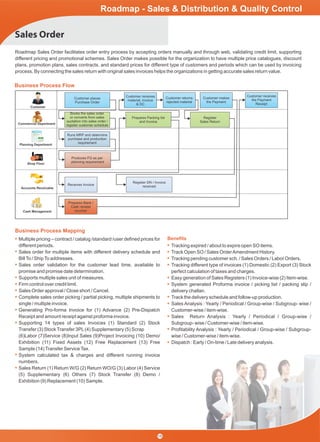
Roadmap Sales Order facilitates order entry process by accepting orders manually and through web, validating credit limit, supporting
different pricing and promotional schemes. Sales Order makes possible for the organization to have multiple price catalogues, discount
plans, promotion plans, sales contracts, and standard prices for different type of customers and periods which can be used by invoicing
process. By connecting the sales return with original sales invoices helps the organizations in getting accurate sales return value.
Business Process Mapping
Multiple pricing – contract / catalog /standard /user defined prices for
different periods.
Sales order for multiple items with different delivery schedule and
BillTo / ShipTo addresses.
Sales order validation for the customer lead time, available to
promise and promise date determination.
Supports multiple sales unit of measures.
Firm control over credit limit.
Sales Order approval / Close short / Cancel.
Complete sales order picking / partial picking, multiple shipments to
single / multiple invoice.
Generating Pro-forma Invoice for (1) Advance (2) Pre-Dispatch
Receipt and amount receipt against proforma invoice.
Supporting 14 types of sales Invoices (1) Standard (2) Stock
Transfer (3) StockTransfer 3PL(4) Supplementary (5) Scrap
(6)Labor (7)Service (8)Input Sales (9)Project Invoicing (10) Demo/
Exhibition (11) Fixed Assets (12) Free Replacement (13) Free
Sample (14)Transfer ServiceTax.
System calculated tax & charges and different running invoice
numbers.
Sales Return (1) Return W/G (2) Return WO/G (3) Labor (4) Service
(5) Supplementary (6) Others (7) Stock Transfer (8) Demo /
Exhibition (9) Replacement (10) Sample.
Tracking expired / about to expire open SO items.
Track Open SO / Sales OrderAmendment History.
Tracking pending customer sch. / Sales Orders / Labor Orders.
Tracking different type of invoices (1) Domestic (2) Export (3) Stock
perfect calculation of taxes and charges.
Easy generation of Sales Registers (1) Invoice-wise (2) Item-wise.
System generated Proforma invoice / picking list / packing slip /
delivery challan.
Track the delivery schedule and follow-up production.
Sales Analysis : Yearly / Periodical / Group-wise / Subgroup- wise /
Customer-wise / item-wise.
Sales Return Analysis : Yearly / Periodical / Group-wise /
Subgroup- wise / Customer-wise / item-wise.
Profitability Analysis : Yearly / Periodical / Group-wise / Subgroup-
wise / Customer-wise / item-wise.
Dispatch : Early / On-time / Late delivery analysis.
Commercial Department
Benefits
15
Quality Control
Business Process Flow
Business Process Mapping
Roadmap - Sales & Distribution & Quality Control
Stores Department
Shop Floor
Quality Department
Purchase, Subcontract,
GRN- Inspection Request
WIP Return, Pre-dispatch
Inspection Request
Accepted/ Rejected
details
Accepted/ Rejected
details
Accepted/ Rejected
details
Production process
completion, Final product
Inspection Request
Sales Return -
Inspection Request
Shop Floor in process
inspection
Gauges entry,
calibration due details
Open NCR & enter non
compliance details and
preventive action
can be taken
Enter action
taken details
Close NCR
Enter calibration
details
Update next
calibration due date
Enter quality
observation details
Receives
Inspection Request
Create Inspection document,
enter quality observation,
defect details, accepted,
rejected details
Complete the inspection
document & forwards back
the material & QC report
to originator
Is
calibration
due?
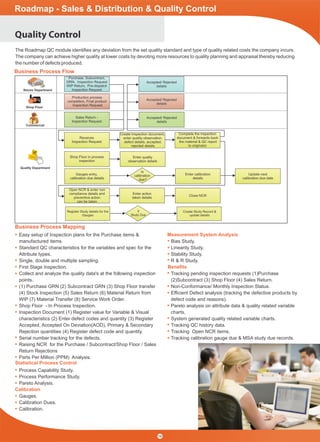
The Roadmap QC module identifies any deviation from the set quality standard and type of quality related costs the company incurs.
The company can achieve higher quality at lower costs by devoting more resources to quality planning and appraisal thereby reducing
the number of defects produced.
Easy setup of Inspection plans for the Purchase items &
manufactured items.
Standard QC characteristics for the variables and spec for the
Attribute types.
Single, double and multiple sampling.
First Stage Inspection.
Collect and analyze the quality data's at the following inspection
points.
(1) Purchase GRN (2) Subcontract GRN (3) Shop Floor transfer
(4) Stock Inspection (5) Sales Return (6) Material Return from
WIP (7) Material Transfer (8) Service Work Order.
Shop Floor - In Process Inspection.
Inspection Document (1) Register value for Variable & Visual
characteristics (2) Enter defect codes and quantity (3) Register
Accepted, Accepted On Deviation(AOD), Primary & Secondary
Rejection quantities (4) Register defect code and quantity.
Serial number tracking for the defects.
Raising NCR for the Purchase / Subcontract/Shop Floor / Sales
Return Rejections
Parts Per Million (PPM) Analysis.
Process Capability Study.
Process Performance Study.
Pareto Analysis.
Gauges.
Calibration Dues.
Calibration.
Bias Study.
Linearity Study.
Stability Study.
R & R Study.
Tracking pending inspection requests (1)Purchase
(2)Subcontract (3) Shop Floor (4) Sales Return.
Non-Conformance/ Monthly Inspection Status.
Efficient Defect analysis (tracking the defective products by
defect code and reasons).
Pareto analysis on attribute data & quality related variable
charts.
System generated quality related variable charts.
Tracking QC history data.
Tracking Open NCR items.
Tracking calibration gauge due & MSA study due records.
Commercial
Benefits
Measurement System Analysis
Statistical Process Control
Calibration
Quality
16
If
Study Due
Register Study details for the
Gauges
Create Study Record &
update details
Roadmap - Planning & Manufacturing
Routing
Bill of Materials
Business Process Flow
Business Process Mapping
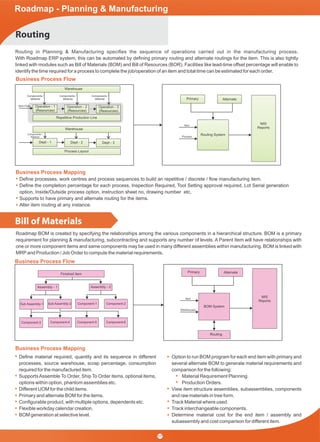
Define processes, work centres and process sequences to build an repetitive / discrete / flow manufacturing item.
Define the completion percentage for each process, Inspection Required, Tool Setting approval required, Lot Serial generation
option, Inside/Outside process option, instruction sheet no, drawing number etc.
Supports to have primary and alternate routing for the items.
Alter item routing at any instance.
Routing in Planning & Manufacturing specifies the sequence of operations carried out in the manufacturing process.
With Roadmap ERP system, this can be automated by defining primary routing and alternate routings for the item. This is also tightly
linked with modules such as Bill of Materials (BOM) and Bill of Resources (BOR). Facilities like lead-time offset percentage will enable to
identify the time required for a process to complete the job/operation of an item and total time can be estimated for each order.
Roadmap BOM is created by specifying the relationships among the various components in a hierarchical structure. BOM is a primary
requirement for planning & manufacturing, subcontracting and supports any number of levels. A Parent Item will have relationships with
one or more component items and same components may be used in many different assemblies within manufacturing. BOM is linked with
MRPand Production / Job Order to compute the material requirements.
Business Process Mapping
Define material required, quantity and its sequence in different
processes, source warehouse, scrap percentage, consumption
required for the manufactured item.
SupportsAssemble To Order, Ship To Order items, optional items,
options within option, phantom assemblies etc.
Different UOM for the child items.
Primary and alternate BOM for the items.
Configurable product, with multiple options, dependents etc.
Flexible workday calendar creation.
BOM generation at selective level.
Option to run BOM program for each end item with primary and
several alternate BOM to generate material requirements and
comparison for the following:
Material Requirement Planning.
Production Orders.
View item structure assemblies, subassemblies, components
and raw materials in tree form.
Track Material where used.
Track interchangeable components.
Determine material cost for the end item / assembly and
subassembly and cost comparison for different item.
17
Warehouse
Warehouse
Repetitive Production Line
Process Layout
Operation - 1
(Resources)
Finished Item
Assembly - 1
Sub Assembly-1
Component-3 Component-4
Component-1
Component-5
Component-2
Component-6
Assembly - 2
Dept - 1
Operation - 2
(Resources)
Dept - 2
Operation - 3
(Resources)
Primary
Primary
Routing
Alternate
Alternate
Routing System
BOM System
MIS
Reports
MIS
Reports
Dept - 3
Item Flow
Components /
Material
Components /
Material
Components /
Material
Components /
Material
Item
Item
Process
Warehouses
Sub Assembly-2
Demand Management
Business Process Flow
Marketing Department
Commercial Department /
Projects
Planning Department
Enter sales order /
customer schedule
details
Enter Material
request for the
projects
Demand Management
The total demand Input to MPS / MRP
Enter forecast for the Make to Stock items
both independent / dependent items or generate
forecasts from the historical value
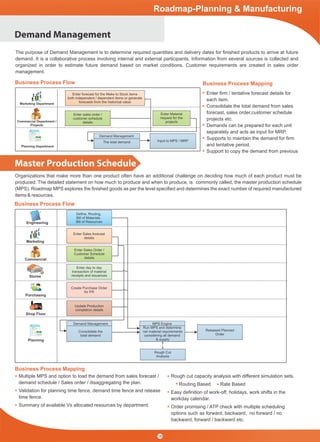
The purpose of Demand Management is to determine required quantities and delivery dates for finished products to arrive at future
demand. It is a collaborative process involving internal and external participants. Information from several sources is collected and
organized in order to estimate future demand based on market conditions. Customer requirements are created in sales order
management.
Roadmap-Planning & Manufacturing
Business Process Mapping
Enter firm / tentative forecast details for
each item.
Consolidate the total demand from sales
forecast, sales order,customer schedule
projects etc.
Demands can be prepared for each unit
separately and acts as input for MRP.
Supports to maintain the demand for firm
and tentative period.
Support to copy the demand from previous
Master Production Schedule
Business Process Flow
Business Process Mapping
Multiple MPS and option to load the demand from sales forecast /
demand schedule / Sales order / disaggregating the plan.
Validation for planning time fence, demand time fence and release
time fence.
Summary of available Vs allocated resources by department.
Rough cut capacity analysis with different simulation sets.
Routing Based Rate Based
Easy definition of work-off, holidays, work shifts in the
workday calendar.
Order promising / ATP check with multiple scheduling
options such as forward, backward, no forward / no
backward, forward / backward etc.
Engineering
Marketing
Commercial
Stores
Purchasing
Shop Floor
Planning
Define, Routing,
Bill of Materials,
Bill of Resources
Enter Sales forecast
details
Enter Sales Order /
Customer Schedule
details
Enter day to day
transaction of material
receipts and issuances
Create Purchase Order
for PR
Update Production
completion details
Demand Management
Consolidate the
total demand
MPS Engine
Run MPS and determine
net material requirements
considering all demand
& supply
Released Planned
Order
Rough Cut
Analysis
Organizations that make more than one product often have an additional challenge on deciding how much of each product must be
produced. The detailed statement on how much to produce and when to produce, is commonly called, the master production schedule
(MPS). Roadmap MPS explores the finished goods as per the level specified and determines the exact number of required manufactured
items & resources.
18
Roadmap - Planning & Manufacturing
19
Business Process Flow
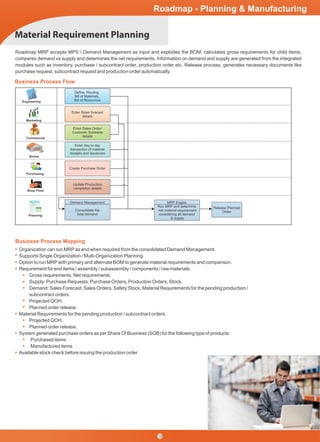
Roadmap MRP accepts MPS / Demand Management as input and explodes the BOM; calculates gross requirements for child items,
compares demand vs supply and determines the net requirements. Information on demand and supply are generated from the integrated
modules such as inventory, purchase / subcontract order, production order etc. Release process, generates necessary documents like
purchase request, subcontract request and production order automatically.
Engineering
Marketing
Commercial
Stores
Purchasing
Shop Floor
Planning
Define, Routing,
Bill of Materials,
Bill of Resources
Enter Sales forecast
details
Enter Sales Order/
Customer Schedule
details
Enter day to day
transaction of material
receipts and issuances
Create Purchase Order
Update Production
completion details
Demand Management
Consolidate the
total demand
MRP Engine
Run MRP and determine
net material requirement
considering all demand
& supply
Release Planned
Order
Material Requirement Planning
Business Process Mapping
Organization can run MRPas and when required from the consolidated Demand Management.
Supports Single Organization / Multi-Organization Planning.
Option to run MRPwith primary and alternate BOM to generate material requirements and comparison.
Requirement for end items / assembly / subassembly / components / raw materials.
Gross requirements, Net requirements.
Supply: Purchase Requests, Purchase Orders, Production Orders, Stock.
Demand: Sales Forecast, Sales Orders, Safety Stock, Material Requirements for the pending production /
subcontract orders.
Projected QOH.
Planned order release.
Material Requirements for the pending production / subcontract orders.
Projected QOH.
Planned order release.
System generated purchase orders as per Share Of Business (SOB) for the following type of products:
Purchased items
Manufactured items
Available stock check before issuing the production order
Manufacturing Resource Planning
Roadmap-Planning & Manufacturing
Business Process Flow
Planning
Department
Shop Floor
Run MPS
Determine resource
required for the planned
order release qty
Run MRP
Update Resource
available details
Enter preventive
maintenance schedule
Updates available
capacity
Demand Management consolidate
the total demand from
1. Sales Forecast
2. Sales Order
3. Project
Rough cut capacity
analysis
Compare Resource required
Vs Resource availability
Capacity requirement
Planning
Compare Resource required
Vs Resource availability
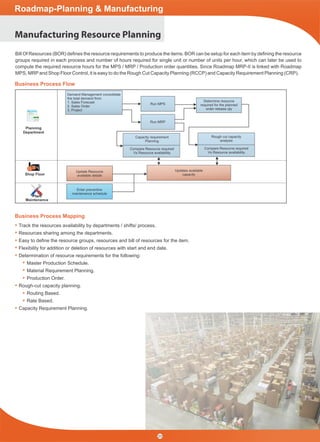
Bill Of Resources (BOR) defines the resource requirements to produce the items. BOR can be setup for each item by defining the resource
groups required in each process and number of hours required for single unit or number of units per hour, which can later be used to
compute the required resource hours for the MPS / MRP / Production order quantities. Since Roadmap MRP-II is linked with Roadmap
MPS, MRPand Shop Floor Control, it is easy to do the Rough Cut Capacity Planning (RCCP) and Capacity Requirement Planning (CRP).
Plant
Maintenance
20
Business Process Mapping
Track the resources availability by departments / shifts/ process.
Resources sharing among the departments.
Easy to define the resource groups, resources and bill of resources for the item.
Flexibility for addition or deletion of resources with start and end date.
Determination of resource requirements for the following:
Master Production Schedule.
Material Requirement Planning.
Production Order.
Rough-cut capacity planning.
Routing Based.
Rate Based.
Capacity Requirement Planning.
Supports following manufacturing types:
Discrete manufacturing.
Repetitive Manufacturing.
Process / Flow Manufacturing.
Tracking production orders, material / resource requirement for the production order and statuses.
System generated material requests for the production order processes.
Monitoring day to day manufacturing activities such as resources / material used, scrap etc.
Reporting periodical Work In Progress (WIP) in production line / processes.
Tracking daily production status such as products completed, rejected, rework, scrap transferred, WIP etc.
Back-flush consumption of materials.
Production Analysis : Daily / Weekly / Monthly / Item-wise.
Productivity / Utilization / Efficiency Analysis.
Tracking actual at each production stage.
Idle Time Analysis.
Production Plan Vs Actual Analysis.
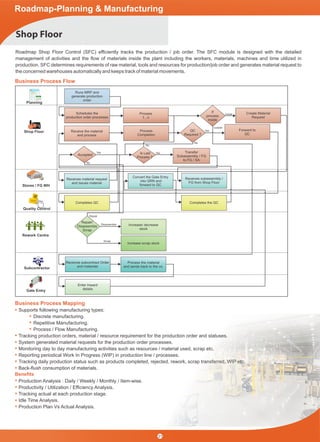
Shop Floor
Business Process Flow
Business Process Mapping
Roadmap-Planning & Manufacturing
Planning
Shop Floor
Stores / FG WH
Quality Control
Rework Centre
Gate Entry
Runs MRP and
generate production
order
Process
1...n
Create Material
Request
Process
Completion
Forward to
QC
Transfer
Subassembly / FG
to FG / SA
Schedules the
production order processes
Receive the material
and process
Completes QC
Disassemble
Repair
Scrap
Yes Yes
Yes
Inside
outside
No
No
No
Increase/ decrease
stock
Increase scrap stock
Receives subcontract Order
and materials
Process the material
and sends back to the co.
Enter Inward
details
Completes the QC
Receives material request
and issues material
Convert the Gate Entry
into GRN and
forward to QC
Receives subassembly /
FG from Shop Floor
Accepted
Roadmap Shop Floor Control (SFC) efficiently tracks the production / job order. The SFC module is designed with the detailed
management of activities and the flow of materials inside the plant including the workers, materials, machines and time utilized in
production. SFC determines requirements of raw material, tools and resources for production/job order and generates material request to
the concerned warehouses automatically and keeps track of material movements.
If
process
inside
QC
Required ?
Is Last
Process ?
Repair/
Disassemble
Scrap
Subcontractor
Quality
21
Benefits
Manufacturing Schedule
Business Process Flow
Planning
Shop Floor
Sequence the production
order based on:
1.Critical Ratio Rule
2.Earliest Due Date
3.Shortest Processing Time
4.Slack Time Remaining Rule
Set priority for the
resource
Load Resource non-available
details based on preventive
maintenance schedule
Run Schedule program
which will schedule
resources
Make it firm schedules
Released Production
order with process details
Scheduling is defined as task assignment and time allocation for the use of resources - such as personnel, equipment and facilities for
production activities or jobs. Many companies establish daily production and work schedules, but with change of customer demands and
with occurrence of other incidents, the scheduling may be revised one or more times during the day.
Roadmap Manufacturing Scheduling effectively allocates the resources for the production order based on the priority or user can
manually schedule the resources usage. Parallel the user has options to reallocate the resources for an alternative production order or
reschedule the production order.
Business Process Mapping
Track the scheduled orders, scheduled start date, end date, required hours for the process and order.
Support to sequence and schedule the production orders and resources in the following methods:
Critical Ratio Rule.
Earliest Due Date.
Shortest Processing Time.
Slack Time Remaining Rule.
User-defined priority.
Track the resource allocation for the job and allocated date.
Track the resources available hours and allocated hours for the jobs.
Easy to plot the chart to compare the available and required load on daily basis.
Supports scheduling for repetitive, discrete and batch production systems.
Effective tracking of rescheduling activity.
Roadmap-Planning & Manufacturing
22
Roadmap - HR & Payroll
HR-Planning
Roadmap HR planning gives long range, short range and departmental plan for the manpower requirements. It is an integral part of
corporate planning and budgeting process. The system will check for the available manpower as per the activities mentioned by the user
and finalizes the required manpower to generate the request instantly.
Long Range Plan/
Objectives
Short Range Plan/
Objectives
Department
Objectives
Determine required
Activity, Job Titles
Compare Plan Vs
Actual manpower
Generates manpower
request & forward to HR
Receives manpower
request
Business Process Flow
Top
Management
Middle
Management
HR Department
Define job titles, positions, organization chart, job description,
standards, qualifications, skill sets, specification.
Long term / short term / department plans and objectives.
Plan for manpower and compare with the available.
Planned manpower approval – Long and short term.
Manpower requests and approval.
Hierarchy of HR Planning is used for document forward and
approval in Roadmap ERP Modules.
View employees and their positions as well as vacant
positions, Planned Vs Actual Manpower.
System generated manpower requests.
Tree structure view of the hierarchy.
Business Functionality
Department
Manager
23
Today's demanding contracting and staffing environment requires a human capital management solution that enables rapid and
cost-effective recruiting and staffing. Roadmap HR-Recruitment handles the complete cycle of recruitment starting from manpower
request, advertisement, application receipts, scheduling & conducting different evaluation processes such as employment test, selection
tests, written tests, selection interviews, supervisory interviews, background check, reference check, issuing offer letter and upto
completion of including candidate into employees' master list.
HR - Recruitment
Business Process Flow
Department
Candidate
HR
Department
Candidate submits the
application Online
HR Department receives
the application for candidate
and upload it into
Resume Bank
Employee Test
Written Test
Interview
Reference Check
Background Check
Resume Bank Search
Resume Bank
Evaluation
Update the status in
Resume Bank
Make Advertisement /
through consultant and
collect CV
Employee Master
Update Status in
Employee application
Create Batch with set of
application for each job
Define the test for Batch
Sends man power request
to HR Department
Fetch
Suitable
application
If
Qualified
Yes
Yes
No
No
Handling of approved manpower requests, forming batches based on the job titles, positions etc.
Automatic matching of selection criteria.
Tracking of manpower request batches, tests, job titles and applicants.
Managing advertisement and preliminary application receipts.
Online job application submission.
Maintaining all details related to applicants (Huge volume of resume bank support).
Formation of multiple question sets based on job titles.
On-line written tests (objective & descriptive).
Scheduling of written test, employment test, medical test, interview, reference check, background check etc.
On-line evaluation, selection interviews, supervisory interviews, realistic job previews.
Track all operations of recruiting.
Issue / track offer letters and contractual agreements.
Online messaging (Alerts).
Business Functionality
Roadmap - HR & Payroll
24
Roadmap - HR & Payroll
HR-Employee Portfolio
Business Process Flow
HR Department
HR Manager
Register new employee
personal details, dependent
details, bank A/c details,
statutory document
education experience,
skill details
Prepare employee profile
changes for annual merit
increase, contract renewal,
promotion, compensation &
benefit changes, transfer etc
and forward for approval
Create profile and enter
salary, grade, allowance
details and forward for
approval
Update employee salary,
department work
location, grade, job, title,
position details
Approves the
profile
Enter employee resignation,
termination details and
create profile changes
Roadmap HR Portfolio facilitates storing & accessing critical employee records and providing instantaneous retrieval of employee
related information. This information includes the employee profile, career information in the organization such as departments served,
different positions/locations assigned, merit increase, compensation and benefits details such as basic salary, fixed allowance,
variable allowance, different insurance paid by company, tax deducted from employees, loan etc.
Business Process Mapping
Tracking employees complete details such as Personal,
Career details, compensation & benefits details, training
details, dependent details, etc.
Tracking employee profiles pending for approval.
Track employee legal documents information (Passport, visa,
driving license, work permit, identity card, medical card,
insurance), validity period and providing necessary alerts.
Track Active / Terminated / Resigned Employee details at any
instance.
Monthly department-wise employee headcount analysis
(Opening Count,Addition, Deduction, Closing Count).
EmployeeAttrition RateAnalysis.
Define applicable grades, min/max salary and allowances for each
grade.
Supports different types of employments (1) Company (2) Contract
(3) Subcontract (4)Temporary (5)Trainee (6) Apprentice
(7) Consultant.
Enter employee personal details, traits, dependent details,
education qualification, skill sets, experience, contract details,
notice period, etc.
Register profiles for new hire, promotion, transfer, compensation
and benefits information, miscellaneous changes.
Register statutory details such as ESI, PF, Income-tax, Aadhaar,
and bank account details.
Register memos, warning letter, show cause notices issued to the
employees.
Register the employee resignation, termination details and approval
through workflow.
Register employee service award details, various certificates
issued details.
Register and track the employee grievances.
Benefits
25
HR-Orientation
Orientation is the introduction of new employees to the organization, their work units and the job. This is also applicable for the employees
who are transferred, promoted to new environment, etc. With Roadmap HR Orientation, activity sequencing, scheduling and conducting the
orientation programme could be done at ease professionally. It ensures every new employee passes through the programme without fail.
The facility of linking the orientation type with specific employees will ensure the HR department to plan for different orientation programmes
for different categories of employees such as purchaser, machinist, operator, accountant etc.
Business Process Flow
HR Department
Department
Add newly joined records
and request for orientation
program
Department
Orientation
Prepare orientation
plan
Organization
Orientation
Business Process Mapping
Multiple orientation programs as per different job titles.
Organizational, departmental and job orientations.
Post orientation evaluation and have feedback from participants.
Schedule and monitor complete orientation programs.
Roadmap - HR & Payroll
HR - Training and Development
Business Process Flow
Training & Development
Department
Training Institution
HR Department
Department Heads
Employee
Prepares Annual Training
Program List
Sends Training Program
details
Announces the internal/
external training program
details to departments and
request for the participants list
Receive the
applications
Sends PO to the
Training Institute
Employee Training
Records
Appraise the employee for
post training
Receives the Training
program details and sends
the participant list
Employee attends training
program
Attracting the most qualified employees and matching them to the jobs for which they are best suited is important for the success of any
organization. In an effort to improve morale, productivity and to limit employee attrition rates, the organization effectively use employee
skills, provide training opportunities to enhance their skills and boost employees' satisfaction with their jobs and working conditions.
Roadmap HR Training & Development facilitates the organization in conducting enrichment programs. Since it is possible to find the cost
involved in the training, the approval based on the financial budgets and the amount spent per person can be easily traced. The pre and
post evaluation of training will help the organization to rate outcome of the training.
Training
External/
Internal
program
External
Internal
Business Process Mapping
Create and maintain organization's master training program.
Maintain external training institutions profile.
Registration of external training programs organized by various training institutions and send notification to the departments.
Conduct employee's pre and post training evaluation.
Efficient handling of employees approved training requests and arranging training program through internal/external training programs.
Employee assessment for the training program pre-requisite skill sets.
Internal/External training requirement.
Training course Registers/Nominations, objectives, evaluations.
Track the employee training history & Monitoring the training cost.
26
HR-Performance Appraisal
Business Process Flow
HR Department
HR Manager
Employee
Employee Supervisor
Department Manager
Methods :
1. Management by Objective (MBO)
2. Multi Rater Assessment (MRA)
3. Behaviorally Anchored Rating
Scale(BARS)
4. Work Standard Approach
5. Critical Incident Method
6. Check List Method
7. Essay Method
8. Forced Choice Method
9. Ranking Methods
10.Paired Comparison Ranking
HR Manager approves the
decision
Employee Self
appraisal
Supervisor appraises the
employee
Department Manager
appraisal the employee
Raises Appraisal request
for employee’s probationary
period, evaluation, merit
increase, contract, renewal etc
Receives filled in
appraisal
Proposes the decision
to HR Manager
Apply changes to
employee file
Performance appraisal is the process of structured formal interaction between a subordinate and supervisor, that usually takes the form of
a periodic interview (annual or semi-annual), in which the work performance of the subordinate is examined and discussed, with a view to
identifying weaknesses and strengths as well as opportunities for improvement and skills development.
The objectives of performance appraisals include: (1) validating selection and other management or cultural practices (2) helping
employees understand and take responsibility for their performance and (3) making decisions about pay or promotions. Roadmap
HR-PerformanceAppraisal supports all of the widely practiced performance appraisal systems.
Business Process Mapping
Appraisal for probationary period, annual merit increase and contract renewal evaluation.
Complete track of appraisal request upto profile changes.
Comparison of employee performance appraisals over a period of time.
Supports (1) BARS method (2) Check List method (3) Critical Incidents method (4) Essay method (5) Forced Choice Rating method
(6) MBO method (7) Ranking method (8) Work standard method (9) Scale Rating method (10) Multi RaterAssessment.
Adopt any method of appraisal to suit any business environment.
Integrated with employee profile management to facilitate reward such as promotion, transfer, salary increase, training requirement
as per HR policies of the organization.
Roadmap - HR & Payroll
27
Employee
HR-Leave & Time Management
Business Process Flow
Employee
Supervisor/ Manager
HR
Department
Employee submits leave
request through
system
Submits leave
encashment request
Approves the leave
request
Approves the leave
encashment request
Converts the leave
request into leave
entry
Post the leave entry
Late entry
Permission entry
Process leave
encashment request
Upload employee
attendance details from the
time attendance machine
Run program to
determine employee leave
entry, late and overtime
Roadmap Leave Management system provides accrual of leave and leave availed by the employees as per HR policy. Automated
processing facilities are provided to manage leave account balances and carry forward situations, with additional functionality allowed
for unused leave to be converted into payments to the employee. Each type of leave is defined as per the HR leave policy and
appropriate control/validations have been implemented.
Tracking pending employee leave requests for leave entry.
Leave encashment request and automatic generation of financial
related documents/ advices.
Summary on leave information.
Integration with time attendance system.
Track employee leave entitlements, transactions and current
balance at any instance.
Integration with time attendance system and determination of
employee worked hours, late arrivals, permission, overtime etc.
Supports different leave types (1)Accruals (2) Information
(3) LWOPand entitlement criteria.
Register different leave entitlements for each employee.
Supports periodical / yearly leave accruals.
Control over leave carry forward and maximum accumulation.
Paperless leave requests, approval and automatic notification.
Conversion of leave requests into leave entry.
Register employee attendance details, late arrivals, permissions
etc.
Business Process Mapping
Business Process Flow
Employee
HR Manager
Cash Management
Registers Loan
request and
forward to approval
Receives notification that
his application is rejected
Employee receives the
payment through payroll/
A/c or Receives cheque
Process the
document
Receives loan application
and approves/ rejects the
application
Prepares loan documents,
enters the disbursement
details & deduction details
Loan payment entry in
payroll record
Prepares payment
voucher and issues cheque/
does RTGS
Payroll adjustment
records for the
deduction
No
Yes
Cheque/ RTGS
Payroll
Roadmap HR Loan Management allows any organization to effectively and effortlessly configure any policy for availing the loan, the
frequency, the amount of the loan and the recovery. The system takes care of loans made to the employee and is fully integrated to the
finance.
Approved
Pay
option
Define various types of loans and criteria.
Employee loan request and approval details.
Efficient loan processing as per the company guidelines.
Loan disbursement through employee payables or payroll.
Employee loan register.
Flexible loan amortization schedules.
Employee loan deduction through Payroll.
Business Process Mapping
HR-Loan Management
HR Department
Benefits
Roadmap - HR & Payroll
28
HR - Business Trip
Business Process Flow
Business trip is one of the main activities performed for the purpose of marketing, selling, procurement and training.Any event of business
trip has to be verified and validated as per the policies procedures and department goals. Roadmap HR Business Trip helps the
organization to plan and execute the business trips with the necessary validations and authentication.
Marketing Department
Concerned Department
HR Department
Accounts
Department
Employee
Prepares business trip
request for the marketing &
gets approval and forwards
to HR
Prepares business trip
request for the training and
gets approval & forward to
HR
Receives approved
business trip request and
forwards copy to accounts
department
Books the required hotel,
airlines tickets
Receives approved bus trip
request & makes the
advance payment
Receives the approved bus
trip request and pays the
perdiem amount
Employee submits
the expense bill & returns
excess money
Per diem/
Reimbursement
Per diem
Reimbursement
Business Process Mapping
Setting up employee entitlements for the business trip.
Register Business trip request for training, sales & marketing,
procurement and approval through work flow.
Two types
Per Diem – Per day expenses paid in advance.
Reimbursement – post business trip reimbursement process.
Expenses registration, approval and tracking.
Shortfall deductions through Payroll.
Tight control based on eligibility criteria and company policy.
Tracking business trip costs.
Roadmap - HR & Payroll
Employee
Travel Agent
Business Process Mapping
Air ticket entitlement for the employee and dependents for annual vacation/Rest & Recreation leaves.
Periodical/YearlyAccrual ofTicket.
Ticket Issuance Register.
Ticket Encashment which is paid throughAPPayables or Payroll.
Tracking ticket current balance for the employees at any instance.
Ticket cost calculations.
Business Process Flow
HR Department
Register the employee
and dependents ticket
route class and other
entitlement details
Periodic ticket
accrual
Receives the ticket request
validates and issues voucher
to travel agent for the employee
and dependents ticket
Raises ticket request
for himself & dependents
Travel agent receives the ticket
voucher and issues the ticket
to the employee and sends
invoice to the company
Roadmap HR supports the ticketing procedures for the business trips of the employees and their trips on vacation with their dependants. In
finance, both expenses and liabilities are taken care and automated and the financial implications are also planned in advance.
HR- Ticketing
29
HR - Medical
The medical benefits offered in organization varies according to the grades/Job title. Also it requires strict validations, as it involves
financial and HR policies. It can be linked with the medical insurances of the respective employee to enable the prompt claim. The
automated allocations ensure error - free medical claims or benefits procedures.
Roadmap HR-Medical supports actual expenses reimbursement scheme or hospital contract scheme for the employees. It facilitates
registering the reimbursement invoices/hospital invoices in order to compute liability and expenses. While registering and approving
invoices, system validates all the criteria such as treatment coverage and maximum amount in order to have rigid control over the
medical expenses.
Business Process Flow
HR Department
Insurance
Company
Hospital
Contract
Reimbursement
Cashier
Enter Employee and
dependent medical
entitlement records
Request for insurance
card
Sends ID request for the
treatment
Issues the insurance card
to employee and
dependents
Sends invoice to the
company for the
premium
Receives the request
and issues identity card
Employee avails the
treatment whenever
required
Hospital sends invoice
to the company
Visits any hospital/ Physician
for the treatment & submits
invoice to the company
Receives the invoice and
makes payment to
employee
Insurance/
Hospital contract/
Reimbursement
Reimbursement
Hospital
Contract
Insurance
Business Process Mapping
Employee and Dependents eligible medical treatment list.
Position based eligibility criteria.
Employee-wise / Dependent-wise /Treatment-wise Budgets.
Supports three types of employee medical schemes.
Medical Reimbursements.
Hospital Contract.
Medical Insurance.
Tracking Employee and Dependents medical expenses.
Approval of Medical Expenses.
System generated AP documents for Hospital Contracts
and Employee Payable documents.
Roadmap - HR & Payroll
Business Process Flow
Roadmap Government Relations module efficiently handles the Government relation activities such as applying new employee iqama,
renewing iqama, sponsorship transfers, exit & exit-re-entry visas, business visa’s, labor visa’s etc. HR department can request and
monitor Government relation requests related to the employees. Government Relation department can view approved requests from
various departments and take appropriate action on timely basis.
HR Department
Government Relation
Department
Requests the following to GR:
New IQAMA Request
IQAMA Renewal Request
Sponsorship Transfer
Exit - Reentry Visa Request
Business Visa Request
Labor Visa Request
HR receives and updates the
government relation details
in the concerned employee
HR file
Receives the service request
for the different government
relation service and process
the record updates the
details to HR
HR - Govt. Relations
Business Process Mapping
Efficient handling of labor visa’s, foreign
employees’ recruitment requests, agency
authorization and visa stamping activities.
Monitoring available labor visa’s by
profession and nationality, expiry date,
applying new labor visa and visa status
maintenance.
Efficient handling of the following requests
from various departments and updating the
status:
New Iqama, Iqama renewal.
Exit & Exit-Re-entry visa, Sponsorship
transfer.
Business visa, Labor visa & Family visa.
30
Payroll Management
Business Process Flow
HR Department
Payroll Department
Cash Management
- Payable
Updates Employee
profile file
1. New Hire
2. Merit Increase
3. Transfer
4. Promotion
5. Termination/
Resignation
Register employee
leave details
Enter employee
overtime details
Register employee
late arrival/ permission
details
Process the payroll Generate employee
statutory reports
Prepare the payroll Verify the payroll
Employee salary&allowance
adjust file, leave file,
overtime file, late arrivals
Prepare Cash payment
Voucher
Pending Payroll
Payables
Make the Statutory
Payments due
Issues cheque/
does RTGS transfer
Prepare Bank payment
Voucher
Pays cash to
employees
The automated and integrated Roadmap Payroll helps the HR people to process the payroll with a touch of a button. Also it helps any
department like Finance, Costing, and Production department to fetch and utilize the data for any employee related analysis. Payroll
supports configuring any kind of elements and combinations with a simple configuration tool without the intervention of a technical person.
Roadmap payroll automatically transfers the accumulated/earned liability like leave encashment, gratuity etc., to the respective liability
accounts. Organization can generate and submits the ESI, PF and other statutory from the payroll system.
Bank
Yes
No
Re-prepare
Cash
Payment
through Cash/
Bank
If
Payroll
is ok
Option to prepare payroll multiple times, verify and process
payroll.
Generation of up-loadable ESI, PF Statutory Reports from the
processed payroll .
TDS calculation.
Arrears calculation with retrospective effect.
Maintenance of payroll history.
Tracking employee remuneration history.
System generated periodical/ annual accruals based on the
user-configured formulas.
All mandatory statutory returns.
End of service benefit and final settlement.
Employee current salary and allowance details.
Integration with all other HR modules.
Fully configurable payroll formulae.
Rigid validations over payroll data.
User definable recurring and non-recurring allowances and
adjustments.
Employee overtime additions.
Disbursement of reimbursement.
Prepared / processed payroll summary & details.
Employee account statement.
Bank transfer statements for disbursement of compensation
and benefits.
Employee pay slip / cash employee Statement.
Business Process Mapping
Benefits
Roadmap-HR & Payroll
31
Roadmap-Customer Relationship Management
Marketing
Business Process Flow
Accounts
(Prospect/ Customer)
Marketing
Commercial
Convert Lead
into Prospect
Receives Regret
letter
Receives Quote Sends Response
Receive Order
Acceptance
Follow up & visit report
Register Feasibility
study details
Prepare Costing
Sheet
Send regret
Letter
Close the
Lead
Register the leads
generated through
various campaigns
Register opportunity from
prospect/ customer
Convert quote into
order
Sends order
acceptance to customer
Order Lost File
Yes Yes
Yes
Yes Prospect
Customer
Yes
Yes
No
No No
No
No
No
Prepare and send
quote to account Create Customer
Roadmap CRM helps the organization to enhance the business prospects, through its marketing module with automated features.
Roadmap CRM marketing module assists the marketing team in identifying prospective customers, trends, track campaigns,
maintaining and tracking customer profile, etc. Through Roadmap Marketing module, complete marketing activities starting from lead
generation upto conversion of order can be handled efficiently.
Business Process Mapping
Customer and Prospect Management.
Opportunity failure analysis/Feasibility Regret analysis.
Registering follow-up and expenses details.
Marketing partner management, Asset Management, Product
Catalog.
Tracking opportunity details by prospect/ customer/ salesperson.
Track the pending quotation details by prospect/ customer/
salesperson.
Track the opportunity pipeline.
Leads Conversion Summary.
Document Management and in-built work flow.
Automatic notification through E-mail / Phone / SMS.
Hit-Rate analysis for decision making.
Cost Monitoring.
Register different type of campaigns (1)Trade show,
(2)Advertisement, (3) BannerAds, (4) Conference, (5) E-mail,
(6) Webinar, (7) Cold Calls with the details of budget, expected
sales count, responses etc.
Register leads which were generated through multiple campaign
program, qualify/disqualify the leads.
Convert qualified lead into prospect and register contact person,
sales person details, etc.
Register opportunity details for the customer/prospect, update
follow-up details, stage & visit report etc.
Register the feasibility study report and sends regret letter for the
opportunities which are not feasible.
Prepare cost sheet for the opportunity lines.
Easy creation of quotation and multiple revisions.
Approve the quotation and converts approved quotations into sales
orders.
Is
Feasible
Re-quote
Required
Order
Received
Is
Account
Prospect?
Is Costing
required?
Feasibility
Study required?
Qualified
Benefits
32
Customer Support
Business Process Flow
Roadmap-Customer Relationship Management
Customer
Customer
Support
Spares Stores
Raises service
Request
Receives Quote
For service
Acceptance
Receives invoice and
makes the payment
Generate and send
proforma invoice
for AMC
Prepare and
send quotation
Sales Invoicing
with warranty details
Fix appointment and install
the equipment
Update Warranty/ AMC
details for the equipments
Periodical check for
Warranty/ AMC
machine details
Customer service request
Receive material fix
the problem & close the
service order
Enter material consumed,
Labor usage details and
prepare invoice
Track the defective spares
to be received from
service engineer
Receive approved
material request Issue Material
Warranty/ AMC
Per call
Yes
Yes
Yes
No
No
Yes
Create service
Order
Generate Material
request
It is necessary for some of businesses to maintain warranty info for the products sold. Service contract can be executed for the warranty
completed machines. For both the case, it would be necessary to maintain some of spares which would be provided for free of cost
when it is failed and organizations will maintain the periodic service schedule. Roadmap CRM covers all customer support activities
start from registering warranty info, service request upto spares and service invoicing.
Business Process Mapping
Complete tracking from service request registration and upto
service order closing/invoicing by area/service engineer.
Tracking pending service requests by service engineer/territory.
Tracking defective spare inward, warranty validation with
supplier, return to supplier, in-house repair etc.
Analysis of the following:
Machine Service History.
Service engineer work load analysis.
Installation failure.
Service Call ResponseTimeAnalysis.
Service weightage.
Warranty/AMC/ Per call toAMC conversion.
Problem occurring Frequency.
Call & FailureAnalysis.
Automatic creation of warranty records while sales invoicing.
Update installation details for equipments.
Preventive Maintenance service schedule generation from the
invoice/installation date.
Update the Preventive Maintenance completed details.
System generated AMC proposals (Proforma Invoice) for the
warranty/Annual Maintenance Contract completed equipments.
Conversion of Proforma Invoice into invoice for theAMC proposal
accepted.
Registering customer services request and easy access of the
machine Warranty/AMC status and spares covered under
warranty/service contract.
Easy preparation of Proforma Invoice for Per Call basis
equipments, spares/service not covered under warranty/service
contract.
Conversion of Customer Service Requests into Service Orders
Enter material consumption, labor/resources usage for the
service order.
Easy closure of service order and spares invoicing, spares
warranty consumption and service invoicing.
Check
machine
status
Warranty/
AMC expire
Check
spares
coverage &
quote req.
Order
received
Installation
required
Benefits
33
Roadmap - Cost Management
Process Costing
Full Absorption Method
Material Issues
Opening WIP
Transfer In
Material Return
Closing WIP
Transfer Out
FG Receipts
Direct Materials
Periodical/ Yearly GL Balance
Conversion
Factor
Equalizing
Factor
Costing
Pool
Product Unit
Cost
Update
Transaction
Cost
MIS
Reports
Application
Journals
Direct Labor Overhead
By Product
Joint Product
Under a process cost system, costs are accumulated to each process. Input UOP quantities are derived from raw materials issued to
the processes, multiplied by conversion factor, periodical opening WIP and semi finished goods received from other processes being
multiplied by EUPfactor.
To allocate costs for WIP, inventories of partially finished goods at the end of the period in each process must be expressed in terms of
completed units. To derive the quantities of WIP and transfers between processes, it will be calculated after considering the EUP
Factors. Periodical finished goods receipts by stores are valued based on EUP factors. All the above quantities are considered as
output UOPand the input amount (summary of DL, DM and OH) are apportioned based on output UOP.
With Roadmap Cost Management it is easy to trace the split of point for joint products. Besides we have been facilitating with handling
normal / abnormal wastage and by products.
Raw
Material
WIP
Semi
Finished
Goods
Split of
Point
34
Business Process Flow
Standard Method
WIP
FG Receipts
COGS
Inventory
Direct Materials
Periodical/ Yearly GL Balance
Equalizing
Factor
Actual Cost
Pool
Standard
Cost Pool
Application
Journals
Over / Under
Absorption
Apply Over /
Under absorption
into Inventory
COGS and WIP
Periodical /
Yearly Standard
Cost for the
Product
MIS
Reports
Direct Labor Overhead
By Product
Joint Product
When a standard method is used, it is required that pre-determined calculation of how much cost should be under specified working
conditions. Products are setup with standard cost which are employed in the transaction while receiving Finished Goods, COGS,
calculating WIP. During financial period end actual costs are derived from GL and differences between actual and standard costs are
considered as either overage or shortage. The differences are applied to Inventory, COGS and WIP. Product's standard cost is either
increased or decreased.The new cost would be effective until next cost Rollup / Rollover.
WIP
Finished
Goods
Split of
Point
Operational Costing
Business Process Flow
Full Absorption Method
Standard Method
Material Issues
Opening WIP
WIP
Transfer In
FG Receipts
Material Return
Closing WIP
Transfer Out
COGS
FG Receipts
Inventory
Direct Materials 1 Direct Labor Overhead
Periodical / Yearly GL Balance
Conversion
Factor
Equalizing
Factor
Costing
Pool
Product Unit
Cost
Update
Transaction
Cost
MIS
Reports
Application
Journals
Direct Materials 2 Direct Materials 3
By Product
By Product
Joint Product
Joint Product
Under operational costing system, DL& OH of each process and DM are accumulated to each class. Though the process is similar there is
significant difference in the usage of materials i.e., input and output. So the input and output are categorized as different classes.
Raw material consumption are extracted from the inventory issuance based on the conversion factor and materials like WIP / Semi
finished goods / finished goods quantity are calculated based on equalizing factor. To allocate costs for WIP, inventories of partially finished
goods at the end of the period in each process must be expressed in terms of completed units, which will be multiplied by EUP factor to
derive WIP UOP quantity. Transferred In and out quantity derived from periodical semi-finished goods transferred between processes
multiplied by EUP Factor. The direct labor and overheads are apportioned based on the output quantity and direct material would be
apportioned based on the user configuration.
Standard costs fixed for different classes of product. WIP, cost of good sold, inventories for each class derived from the respective
transactions. During financial period end actual costs are derived from GL and differences between actual and standard costs are
considered either overage or shortage. The differences are applied to Inventory, COGS and WIP. Product's standard cost fluctuates. The
new cost would be effective until next cost Rollup / Rollover.
Raw
Material
WIP
WIP
Semi
Finished
Goods
Finished
Goods
Split of
Point
Split of
Point
ClassClass
Equalizing
Factor
Actual Cost
Pool
Standard
Cost Pool
Application
Journals
Over / Under
Absorption
Apply Over /
Under absorption
into Inventory
COGS and WIP
Periodical /
Yearly Standard
Cost for the
Product
MIS
Reports
Roadmap - Cost Management
Direct Materials 1 Direct Labor OverheadDirect Materials 2 Direct Materials 3
35
Process / Operational Costing
Roadmap - Cost Management
36
Key Features
Full Absorption Method Standard Method
FIFO and Weighted average cost method of WIPvaluation.
Periodical opening and closing WIP quantities & amount with
the completion percentages.
Transfer of finished goods from any processes (by product,
joint product).
Periodical input quantity to processes, semi finished goods
transfer.
Finished goods receipts, process wise direct labor, direct
material and overhead.
Normal spoilage, normal loss, abnormal loss and abnormal
gain.
Joint products, by products and scrap.
Conversion Factor and Equivalent Unit of Production (EUP).
Compare the cost involved in different periods.
Periodical cost determining flow.
Accurate apportioning of processing cost for the joint products
in the following methods:
Physical measurement.
Relative sales value.
Relative sales value minus further processing cost.
Weighted average method.
Handling of joint products, by-products, scraps, spoilage,
WIP, etc.
System generated journals with the newly updated cost.
Standard cost for all manufactured products.
Periodical opening and closing WIP quantities with the
completion % and standard value.
COGS and Inventory in standard value.
Semi finished goods transfer.
Direct labor, direct material and overhead.
Transfer of finished goods from any processes (by-product,
joint product).
Tracking over / under absorption variances application to
inventory, WIPand cost of goods sold.
Comparison of standard Vs actual cost.
Comparison of pre and post over / under absorption
variances application to WIP, COGS and Inventory.
Periodical product cost Rollup / Rollover.
Determination of over / under absorption.
Applying over / under absorption variances in inventory,
WIPand cost of goods sold.
System generated journals with the newly updated cost.
Job Order Costing
Batch Costing
Business Process Flow
Opening WIP
Opening WIP
Direct Material
Direct Material
Closing WIP
Closing WIP
Direct Labor
Direct Labor
FG Receipts
FG Receipts
Overhead
Overhead
Material Issuance
Material Issuance
Direct Labor
Direct Labor
Job Order
Cost Pool
Job Order
Cost Pool
Apply
Difference
Info Overhead
Apply
Difference
Info Overhead
Overhead
Overhead
Product Unit
Cost
Product Unit
Cost
Roadmap
General Ledger
Roadmap
General Ledger
Application
Journals
Application
Journals
Update Stock
Cost
Update Stock
Cost
Direct Material
Direct Material
Time Card Entry
Time Card Entry
Resource Usage
Resource Usage
Job Order Costing is applicable for organizations where products or services are identifiable by individual units or batches. The Costs
attributable to a particular job are assigned directly to it. Since each product is identical, product cost can be determined by dividing total
manufacturing costs by total units produced. This average cost applies equally to all units produced. It is quite normal that job order may
start and end in single financial period or pass through different periods and simultaneously multiple job order's will be in progress.
Roadmap Job Order Costing enables the user to determine the estimated cost for the Job Order by determining material and resource
requirements exploding through planning data such as BOM, Routing and Bill of Resources. With Roadmap Job Order Costing it is easy
to account material cost, labor cost, overhead, periodical WIP, inventories for each job order and enables the user to compare the
summary of costs involved in job orders with actual costs and understand the difference to job orders as overheads.
Roadmap Job Order Costing facilitates track the product cost for different job orders in different periods. Maintains the details of
inventories for each job order while shipping & invoicing the job orders through Roadmap sales order, perfect COGS would be computed.
This facilitates to arrive and analyze net earnings in each Job Order.
Batch costing is used where identical items are produced in batches like clothing, footwear, engineering components, etc., treated as a
batch during manufacture and the various costs – material, labor and overhead are recorded. The costs of a batch are ascertained in much
the similar way as the individual job. Cost for these items are estimated for huge batches as it will not be logical to analyze the cost of
manufacturing for a single or a pair of shoes. It is advisable to group the identical items and perform the costing accordingly for the batch.
Unit cost is estimated by dividing the total cost by the batch quantity. With Roadmap Batch Costing, it is very easy to group the items as a
batch, automatic batch numbering, efficient recording of material issued, scrap, labor time, overhead etc. Cost incurred can be compared
batch wise to get the clear picture about the total cost spent.
Actual
Actual
Business Process Mapping
Estimating material and resource
requirements for job order
Actual DM, DL and OH at each stage and
job order wise.
Status of WIPwith completion %.
Monitoring of finished goods.
Periodical product cost for each job order.
Applying overheads / idle man hour cost
based on labor hour / machine hours.
Material requirement and issuance to the job
orders.
Resources requirements, time card and
resource usage entry for the job orders.
Sales Order shipping for the job order.
Apportion the difference in applied and
actual overheads in the following methods:
Adjusted allocation-rate approach.
Pro-ration approach.
Write-off to cost of goods sold approach.
Job order-wise P& L.
Evaluation based on actual cost, average cost
and normal cost.
Status of WIPwith completion %.
Monitoring of finished goods.
Periodical product cost for each batch.
Applying overheads based on labor hour /
machine hours.
Batch-wise material requirements, yield
estimation and finance analysis.
Resources requirements and time card and
resource usage entry for each batch.
Apportion the difference in applied and actual
overheads in the following methods:
Adjusted allocation-rate approach.
Pro-ration approach.
Write-off to cost of goods sold approach.
Roadmap - Cost Management
37
Activity Based Costing
Activity based management (ABM) is a management system which focuses on analyzing and controlling activities in the production unit or
performance process in an attempt to improve customer value and enhance profitability. As part ofABM, theActivity-based costing (ABC)
refines costing systems by focusing on individual activities as the fundamental cost objects. An activity is an event, task or unit of work with
a specified purpose; for example designing products, setting up machines, operating machines, and distributing products. ABC systems
calculate the cost of individual activities and assign cost to cost objects such as products and services on the basis of the activities
undertaken to produce each product or service.
Roadmap ERP supports one of the very efficient costing methodologies viz. Activity Based Costing (ABC) which is used by many
organizations today. It is a management tool helping the companies to improve the business performance by managing costs and
improving the efficiency at the activity level. Using Roadmap ABC, more accurate and efficient decisions can be made with reference to
the products and the related costs by studying and analyzing the business activities.
Set ActivityIndirect Cost
Pool
Indirect Cost
Allocation Base
Cost Object
Direct Costs
Allocation Base 1
Design Activity
Allocation Base 2
Manufacturing
Operation Activity
Allocation Base 3
Shipping
Activity
Allocation Base 4 Allocation Base 5
Distribution
Activity
Allocation Base 6
Direct Costs
Indirect Costs
Admin.
Activity
Direct
Materials
Direct
Labor
Direct
Expenses
Business Process Mapping
Business Process Flow
Helps identifyingActivities, Resources, and Cost Drivers.
Accurate product costing information by reducing arbitrary cost allocations.
Listing activities that are driving costs and guiding the focus areas to control cost.
Identifying areas of potential cost savings.
Improving budgeting and planning process of an organization.
Supports the business managers by identifying, measuring and differentiating the activities those add value to the business and
those do not.
Eases the tracking process of allocating indirect costs to specific products.
Allows more accurate reporting and analysis of overhead costs.
Helps identifying costs and activities that can be minimized or eliminated.
Facilitates identifying the actual cost spent on services and products.
Identifying hidden costs, setting target cost and monitoring.
Helps in redesigning the processes thro' cost monitoring.
Provides relevant cost information to the managers for the activities they have control over.
Classify and rank assets/properties in terms of cost and effort required.
Assessment of assets in terms of the total cost, which can be compared to their size and value to rank investments.
Helps in evaluating the options for outsourcing certain operations based on cost.
Activity based overhead distribution. Applying actual direct labor, material from the GLto processes with easy configuration.
Roadmap-Cost Management
38
Contract Costing
Contract costing is a type of job costing where the job to be carried out is of such magnitude that a formal contract is made between the
customer and supplier. Civil Engineering, building and construction work and shipping are examples of industries where large contract
work is undertaken. When contract costing is applied, a separate number is given for each contract/project. Costs are accumulated for
each contract for cost determination.
Sometimes, the contract may start and end in single financial period of the organization, or may have begun during one financial period
and extended to more than one financial period.Therefore the profit on the contract will relate to more than one accounting period.
Roadmap Contract Costing, handles the complete business cycle of contract accounting starting from project registration, estimation,
execution, accomplishment, invoicing and P& L/ Income statement.
Material Issuance Contract 1
Contract Estimation
Time Card Entry Contract 2
Material Requirement
Work Completion Work Certification
Contract Invoicing
Contract P & L
Retention
Resource Usage Contract 3
Resource
Requirement
Direct Usage Contract n
Expense
Requirement
Business Process Mapping
Estimating material and resource requirements for contract/project.
Material requirement and issuance to the contract.
Resources requirements and time card & resource usage entry,
expenses for the contract.
Actual DM, DL, direct expenses and OH for each contract.
Efficient handling of subcontracting activities.
Applying overheads/ idle man hour cost based on labor
hour/machine hours.
Charging depreciation for the plant and machinery used by the
contract.
Handling of defective work and rectification of defective work.
Supports lump sum contract/ cost plus contract.
Handling of work certification, progress payment, retention.
WIP: Cost of work completed, not completed and amount of
profit.
Cost accrual, revenue accrual and contract invoicing.
Profit of incomplete contract.
Contract-wise P& L.
Roadmap-Cost Management
Business Process Flow
39
Static Budgeting
Flexible Budgeting
A budgeting and forecasting system without financial intelligence, integrated business model and data files, severely limits analytical
capabilities and greatly increases the support and maintenance burden on the employees. With Roadmap Budgeting the quantified goals,
measures, and budget targets are easily viewed and analyzed by management to assess top-down and bottom-up convergence.
Static budgeting determines material & resource requirement, manufacturing & non-manufacturing cost from sales forecast and expected
ending inventory. The revision of budget is also possible with tracking of history along with an easy way of revising. The various reports like
sales budget, production budget, purchase budget, direct labor budget, manufacturing overhead cost budget, G &Abudget, budgeted profit
& loss statement, budgeted cash flow statement will help the planning department to do their job efficiently.
Aflexible budget recognizes the difference in behavior between fixed and variable costs in relation to fluctuations in output, turnover or other
variable factors and is designed to change appropriately with such fluctuations.
Every business is dynamic and actual volume of output cannot be expected to conform exactly to the fixed budget. Comparing actual costs
directly with the fixed budget costs is meaningless. For useful control information, it is necessary to compare actual results at the actual level
of activity achieved against the results that should have been expected at this level of activity (i.e. the flexible budget).
Roadmap Flexible Budgeting allows the management to arrive at the figures from the click of a button. The data required are extracted from
the static budget and by mentioning the percentage of level of activity will process the entire task of budgeting.
The various reports at different level of activities like sales budget, production budget, and purchase budget, direct labor budget,
manufacturing overhead cost budget, G &Abudget, budgeted profit & loss statement, budgeted cash flow statement can be generated.
BOM
BOM
Routing
Routing
Bill of
Resources
Bill of
Resources
Sales Forecast
Sales Forecast
Static Budget
Production Qty
Production Qty
Material
Requirement
Material
Requirement
Resource
Requirement
Resource
Requirement
Manufacturing
Overhead
Manufacturing
Overhead
Purchase Qty
Purchase Qty
Non Manufacturing
Cost
Non Manufacturing
Cost
Finished Goods
Secondary
Raw Mat./ Components
Opening
Inventory
Secondary
Opening
Inventory
Opening
Inventory
Closing
Inventory
Secondary
Closing
Inventory
Closing
Inventory
Business Process Flow
LevelofActivity
Roadmap - Budgeting
40
Production Budget
Purchase Budget
Sales & Expense
Budget
Sales Budget
General
Admin. Budget
Factory Cost Budget
Cash from
Operation Budget
Budgeted
Financial Statements
Production Budget
Purchase Budget
Sales & Expense
Budget
Sales Budget
General
Admin. Budget
Factory Cost Budget
Cash from
Operation Budget
Budgeted
Financial Statements
Rolling Budget
These are also called continuous budgets. A rolling budget is for any periods intended by the organization and which is prepared several
times each year (say, once in a period, quarter etc.). Normally the budget for the forthcoming periods will be altered based on the actual
implication of the period ended.
The purpose of a rolling budget is to give management the chance to revise its plans, and precisely, to make more accurate forecasts and
plans for the next few months. Wide range of options are available to suit the organizations to have different permutation and perception of
the budget.
The various reports such as sales budget, production budget, purchase budget, direct labor budget, manufacturing overhead cost budget,
G & A budget, budgeted profit & loss statement, budgeted cash flow statement can be generated for less and complete details as well as
consolidated way.
Primary Secondary BOM Routing
Bill of
Resources
Sales Forecast Production Qty
Material
Requirement
Resource
Requirement
Manufacturing
Overhead
Purchase Qty Non Manufacturing
Cost
Finished Goods Raw Mat./ Components
Opening
Inventory
Opening
Inventory
Closing
Inventory
Closing
Inventory
Production Budget
Purchase Budget
Sales & Expense
Budget
Sales Budget
General
Admin. Budget
Factory Cost Budget
Cash from
Operation Budget
Budgeted
Financial Statements
LevelofActivity
Business Process Flow
Budgeting Key Features
Extracting sales forecast data such as sales quantity & closing balance of raw material & finished goods and selling price from previous
budgets, stock on hand on specific dates, sales histories, average selling quantity etc .
Generation of production plan, material & resources requirements, purchase plan, etc.
System generate various reports such as sales budget, production budget, purchase budget, direct labor budget, manufacturing
overhead cost budget, G &Abudget, budgeted profit & loss statement and budgeted cash flow statement.
For flexible & rolling budget, system generates the above stated statements at various activity levels.
Budgets can be prepared instantly with accuracy, which act as an efficient decision support system.
41
Roadmap - Budgeting
Plant Maintenance
Business Process Flow
Maintenance
Department
Register new equipment
details and fix PM schedule,
spares and resource required
Check
Update Meter Readings
Create Maintenance
work order
1. Preventure
2. Predictive
3. Breakdown
Define operation spares
and resource requirement
Create Spares
request
Enter Predictive
maintenance schedule
Convert into maintenance
work order
Receive the spares and
schedule the maintenance
operation
Charges labor and
completes the operation
Raise Purchase order and
send equipment /
component to the service
provider
Close WO
Raises Maintenance
work request
Receives material
request and issues
spares
Does the service
and sends back the
equipment with the invoice
Update WO status
Maintenance can be considered as a combination of several actions carried out in an orderly manner to repair/service or replace the
components of numerous equipment in a plant. It is a systematic approach as maintenance involves setting up of objectives, planning,
executing and controlling. The maintenance budget is prepared based on the maintenance activities that are scheduled for the year. It
helps the management take decisions, hiring the manpower, rent the equipment, sub-contracting, spares purchase etc. The
forecasting capability ensures smooth planning and execution of the system. Performance analysis helps to analyze the labor and plant
performance.
No
Yes
Inside
Outside
If prev.
maintenance
pred. maintenance
is due
Maintenance
Operation
Inside/ Outside
Maintenance
Shop Floor
Spares Stores
Service Provider
Business Process Mapping
Long and short range planning of all the maintenance activities.
Tracking maintenance request and work order status.
Conversion of maintenance requests into work orders.
Comparison of material and resource requirements for work order
and actual consumption.
Work planning, scheduling of periodical inspection and preventive
maintenance.
Breakdown, planned, scheduled and corrective maintenance.
Condition based maintenance and reliability-centered
maintenance.
Forecasting maintenance requirements and work load estimation.
Time-scale of resource planning, scheduling and allocation.
Statistical analysis of performance.
Selection of work measurement methods.
Labor performance analysis.
Tracking the maintenance cost and compare with budget.
Comparing required resources for the work orders Vs
available resources.
Tracking the various inspection schedules for the
machineries.
MTTR, MTBFAnalysis.
5-WhyAnalysis
FailureAnalysis
Maintenance CostAnalysis.
Roadmap - Supporting Modules
42
Engineering (R & D)
Engineering / R & D department often involves in new product development, improving existing products based on the difficulties faced by
client. R & D needs to manage various engineering activities such as handling engineering change request, work order, engineering
change note, engineering routing, bill of materials and all the necessary documents. R & D department requires efficient handling of all its
activities by prioritizing and allocating the resources.
Business Process Flow
Subcontracting
Management
Engineering
Stores
Customer
Commercial
Department
Receives subcontract
order along with
material
Process the
material and send
back to organization
Place Purchase
Order for new
product
Raises engineering order
for new product development
for own use/ customer order
Raises material request
for the engineering order
Receives the materials and
does the required
process
Prepares subcontract order
and send material along with
subcontract order
Schedule the required
machinery, manpower and
process the material
Receives the processed
completed material
Receives material
request, allocates and
issues the material
Prepare engineering
Routing, Bill of Material,
Operating manual etc
Run Sample lot and
send it to customer
Run pilot lot and
send it to customer
Receives the sample
and send feedback
Prepares invoice and
send along with the
new product
Receives pilot lot and
sends feedback
Receives the product returns
to the company along with
DC for production purpose
if new
product is
developed
inside/
outside
If
required
process done
Inside/
Outside
In
case of
Tool / Pattern
Business Process Mapping
Registering Product Problem Intimation (PPI) and monitoring the
status.
Product Problem IntimationApproval.
Engineering Change Request (ECR) and status monitoring
Engineering work orders for the following:
New Product Development.
Product revision.
Preparation of Engineering Change Notice (ECN) and Product
Release Note (PRN).
Estimating material / resource and expenses requirements.
Capturing material consumption, employee time card, machine
usage and subcontracting activities.
Engineering products, product routing and Engineering BOM.
Preparation of production procedure, process check list.
Maintaining the following documents:
Production Procedure.
Process Check List.
Testing & Inspection procedure.
Tool Intimation Note.
Component Specification.
Final Product Inspection.
Engineering Specifications.
Packing Procedure.
Incoming Component Inspection.
Service Instruction.
Drawing Revision Intimation.
Critical Spare Parts.
Installation Procedure.
New Product Development Questionnaires.
PartsAddition and Deletion.
Supplier Product Specification.
Inside
Inside
Outside
Outside
43
Roadmap - Supporting Modules
Project Management
Projects are distinguished by the fact that they produce unique products; they require the completion of variety of tasks using variety of
resources and human skills and task performance must be well coordinated to complete the project on time and within estimated value.
To be scheduled accurately, a project must first be decomposed into each fundamental task or activity. Precedence relationships
among the tasks and estimates of the time required to complete each task must then be obtained.
Materials can be issued to the projects through Roadmap's Inventory control or purchase order can be placed through Roadmap's
Purchase Order to deliver the goods directly to the projects site.
Business Process Flow
Customer
Project Management
Team
Material Planning
Purchase Department
Production Department
Stores/ FG WH
Dispatch Department
Commercial
Department
Accounts
Receivable
Customer issues
purchase order
Receives Invoice Makes Payment
Specify the material
resource/ expense
requirement
Register Project details
with complete WBS
Runs MRP to determine
net material requirement
Purchase the required
materials
Receive production order
Receives the material
and produces the goods
required for the project
Upon completion of the
product move the material
to FG WH
Receives the material
against PO
Receives produced
Material
Raise FG request to FGW
for the project
Receives the
material
Update project/ Task
status
Receives the Payment
Accures revenue based on
the milestone and prepares
draft invoice
Receives Material
Request for the project&
Issues
Receives the material
FG & Dispatch to the
project site
Timecard / Resource
usage / Labour usage/
Expense entry
Prepares commercial
invoice
Raises material request to
stores
Sends approved purchase
request to purchase
department
Raises Production
Order
Purchase
Manufacture
Purchase/
Manufacture
Business Process Mapping
Multiple level WBS structure split into tasks, effective period.
Material/resources / expenses requirement for the task and project.
Material issued, labor & resource utilized, expenses incurred and overhead applied.
Budget for each task / project and amount applied against the budget.
Cost accrued and fixed asset added for the capital project.
Cost/revenue accrued and amount invoiced for the contract project.
Tasks completed % and status.
Project estimation VsActual.
Work accomplishment invoicing.
Project Execution
Team
44
Roadmap - Supporting Modules
Cane Management
Running sugar mills fully depends on the sugarcane availability; the capacity of sugar mill should match with sugarcane supply. Sugar
mills involve continuous process, sugar mills start operating at the beginning of the season and get stopped at the end of the season. It
becomes necessary to maintain uninterrupted supply of sugarcane when the mill is operating. Proper planning should be laid down to
ensure the smooth supply.
Roadmap cane management efficiently handles all the cane management activities starting from soil testing, seeding, planting,
fertilizing, disease analysis, pesticide, periodical records of plot, issuing cutting order, managing transportation. With Cane
Management, it is easy to forecast daily supply and total expected supply of sugarcane during the season.
Business Process Flow
RYOTS
Cane Department
Gate
Factory
Account Payable
Cash Management
Cultivates the
sugarcane for seed/
sugar for each season
Cutting takes place
as per cutting order
Transfer seed to
other Ryots
Upon the cutting stage
issues cutting order
and arrange transport
Cane Department maintains
sugarcane, cultivation
details with Ryots/
season etc
Sugarcane is received
from Ryot through
truck & inward entries
made
Capture empty truck
weight & determine its
net weight
Unload the sugarcane
and goes back to
weighing bridge
Register the purchase
against cane receipt
Makes the payment
by Ryots
Adjust the payable
against the loan etc
Receive
payment
Seed/
Sugar
Business Process Mapping
Database of villages, accounts, banks, branches, soil types, irrigation sources, disease types, seasons, variety etc are supported.
Geographical areas, cane inspectors and assigning cane inspectors to the geographical areas are tracked.
Track plot(plantation) details such as season id, ryot no, plot no, growing area, crop type (foundation nursery, crop nursery etc), planting
start date, expected yield, crushing start and end date, date of plot over, soil type, irrigation source, gap between crop, insurance, cane
burnt etc.
Analyze ryot transaction such as seed given, fertilizer/chemical issued, loan paid, and sugarcane delivered to factory by ryot, seed
supplied to other ryot etc, loan deduction, payment made to ryot etc.
Maintain transporters, vehicles, addresses, rate agreement and transaction details.
Cutting orders for the matured plot for factory crushing or seed.
User friendly sugarcane entry details from the gate weight capturing at the weighing bridge, and tracking the details of
registered/unregistered/diverted cane from other factory, transportation details such as rental and own arrangement etc.
Complete integration of Roadmap ERPmodules.
Supports to perform various tests (lab) and analyze the laboratory results.
Track the supply of sugarcane from the ryots, by geographic area, periodical based on the maturity date.
Expected yield and actual analysis.
Roadmap - Other Modules
Seed
Sugar
45
Fleet Management
Maintain the complete details of Active, Passive and Active /
passive Vehicles.
Track the details of organization owned and rented vehicles.
Seamless integration from enquiry, quotation, load order, trip
sheet and receivables.
Track the load orders in different statuses.
Easy conversion of load order to trip sheets.
Track the unclosed and un-invoiced trip sheets.
Track the Purchase, FixedAsset, Insurance details of vehicles.
Register the various expenses in association with vehicle trip.
Calculate the sales commission for the sales person, agent.
Track the trip allowances payable to the drivers.
Revenue, profit analysis by trip and vehicle.
Track the maintenance cost of each vehicle.
Business Process Flow
Business Process Mapping
Vehicle Management
Customer
Commercial
Department
Accounts
Receivable
Enter Vehicle
Details
Sends Vehicle
as per the agreement
Prepares vehicle
usage log and sends to
commercial department
Receives vehicle
and utilizes
Customer receives
invoice and makes
the payment
Receives payment
receipt
Books the vehicle
to transport the
goods
Customer utilizes the
vehicle & signs
trip sheet
Prepares monthly
invoice as per the log
sheet/ trip sheet
Receives the payment
and makes receipt
entry and forwards
receipt to customer
Prepares load
vehicle to customer
Receives trip sheet &
forwards to commercial
department
Signs vehicle
lease agreement
46
Roadmap Fleet Management system is powerful enough to handle the immense volume of vehicle data streaming from numerous
sources. We provide fleet maintenance history, fuel usage, and driver details also you can easy manage areas like insurance, asset
management, tire management, inventory management, LR management as well as all expenses associated with operating your fleet
of motor vehicles and other mechanical assets.
Roadmap - Other Modules
Work ow Management
End
Rejected
Buyer
End
Approved
Supplier
Notification
Forward for
Review
Forward for
Approval
Notification
Reject
Reject
Email
Return
Return
Roadmap Workflow gives you the flexibility in process handling and all you need to do is to support your business cycle by allowing
the complete working process representation which can go beyond your organizational goals. You will be equipped to incorporate
all managerial information's to speed up your decision making process.
Assists you to automate complex business processes
Maps positions and highlights their importance in the organization than people.
Ensure that the right work is assigned in the right sequence at the right time to the right person in the workflow.
Enhances and automates business processes.
Monitoring at ease from initiation to completion.
Enable the process owners to track deadlines.
PO
Review
PO
Approval
PO
Entry
Roadmap workflow Benefits
Roadmap Sample Workflow
47
Roadmap-Workflow
Standard Reports
FINANCIALS
 Chart of Accounts
 Recurring Journals - Fixed / Variable
 Distribution Journal
 General Journal
 Account Statement
 Operating Expenses (Matrix)
 Fund Flow Statement
 Yearly Budget Vs Actual
 Periodic Budget Vs Actual
 Supplier/ Customer Ledger Balances
 Trial Balance - Main & Subsidiary - (2 Col)
 Trial Balance - Subsidiary & Class - (2 Col)
 Trial Balance - Main & Subsidiary - (4 Col)
 Profit and Loss Account
 Balance sheet with Schedule
 Profit and Loss Schedule
 Balance sheet Sub schedule
Accounts Payable
 Supplier List, Ledger
 Supplier Ledger 2C (upto Date)
 Supplier Settlement (Invoice, Payment)
 Hold Payment List
 Forecasted Payment Summary
 Forecasted Payment & Details (BC)
 AP Aging Summary & Details (BC)
Accounts Receivable
 Credit / Debit Memo
 Customer Ledger (As-on-Date)
 Collection Statement - Area-wise Details
 AR Aging Summary & Details (BC)
Cash Management
 Cash / Bank Payment, Receipt Voucher
 Cash / Bank Book, Daily Break-up
 Cash / Bank Balance Summary
 Bank Reconciliation, Exchange Rate variance
Taxation
 Annexure C-A Stuffing Report, Appendix III
 ARE - 1 & 3, Dec. of Exporters
 Form JJ, Form SDF
 Pending C-Form - Issued, Received
 C-Form Issuance / Receipt, H-Form Issuance
Excise Reports, VAT, TDS & ESI
 RG23A - Part I & II, RG23C - Part I & II, Service Tax
 VAT - ANNEXURE I, II, III, IV, IA, EXP, IV IMP
 TDS Statement, Sales Tax TDS Statement
 ESI Statement
SALES & DISTRIBUTION
 Item Profile
 Product Obsolete Analysis, Material Request
 Pending Material Request, MR Issue Status
 Pending Material Request Summary
 Material Issuance Voucher
 Stock Adjustment, Stock Transaction Analysis
 Stock Transaction Summary - Group
 Delivery Challan, Current Stock
 Closing Stock Summary (Class)
 Stock Count Comparison (Qty & Value)
 Stock Count Comparison (Qty)
 Inventory Aging
Purchase Order
 Approved Supplier List, Open Purchase Order
 Open Purchase Order Amendment
 Open Subcontract / Job Order
 Open Subcontract / Job Order - Amendment
 Purchase Requisition
 Pending Purchase Request
 Purchase Request to GRN Tracking
 Subcontract Material Request / Stock at Subcontractor
 Supplier Schedule, Quotation Price Comparison
 Purchase Order, Pending Purchase Orders
 PO Delay and rejection chart, Pending PO(Supplier Wise)
 Short closed PO, Subcontract Order
Gate Entry
 Gate Entry Details, Discrepancy GE Vs GRN
 Gate Entry - Purchase Receipt
Goods Receipt Note
 Purchase & Subcontract Approved Schedules
 Periodic Purchase Receipts, Planned Purchase Receipt
 Goods Receipt Note, Receipt Day Book (Qty & Cost)
 Material Inward List
 MIR Details, Pending MIR List
 GRN - QC Completed
 Purchase Return Invoice Details
 Purchase Order Format
 Pending Purchase Receipts(Item-wise)
 Supplier Rating Delivery, Supplier Performance Rating
 Supplier Performance Letter
Quality Management
 Defect Item Analysis (Month-wise)
 Deviation Concession Report
 Incoming Inspection Status - Item-wise
 Incoming Inspection Summary - Purchase (Supplier-wise)
 Inward Inspection Report - Purchase
 Inward Rejection Statement - Purchase
 Monthly Status Report
NCR Reports
 NCR Report - 1, Pareto Analysis
 Pending Inspection, Supplier Quality Rating
 Supplier-wise Defect Analysis
Shop Floor
Production Order
 Pending Production Order, Production Completion Details
 Production Order Pending Material
 Production Pending Request
 Resource Usage Details, Work-in-Progress Status
 Inprocess & Daily - Rejection Report, Inprocess Report
 Monthly Production, Weekly Production, Scrap-Note
 Production Loading chart
Costing
 Cost Sheet - Summary, Cost Sheet
 RMC Details, Item Group RMC
 RMC Comparison, Item RMC (Assembly-wise)
Productivity Reports
 Productivity – Daily / Monthly(Actual – Qty)
 Productivity Report Daily / Shift-wise
 Productivity B/A Idle Hours - Daily
 Productivity before/ after Idle Time - Daily
Sales Order
 Order Acceptance Form, Sales Order - Format 1
 Pending Sales Order Details
 Pending Sales Order summary
48
Roadmap ERP-Reports
Standard Reports
 Sales Order Booking Analysis - Item-wise
 Area-wise dispatch schedule
Packing List
 Export Packing List, Packing List-Domestic
Invoice
 Dom-Sales Invoice(6 Copies)
 Dom-Pre Printed -Invoice 1
 Purchase Rejection Return - Preprinted Invoice 1
 Purchase Rejection Return - Preprinted Invoice 2
 Export Invoice
 Guarantee Certificate
Sales Register
 Sales Register / Invoice Day Book
 Sales invoice Summary
PLANNING & MANUFACTURING
 Routing
Bill of Materials
 Bill of Materials (Single Level)
 BOM - Single Level - 1
 Bill of Materials (Multi Level)
 Bill of Materials – Tree (Details)
 Bill of Materials (Process-wise)
 Parts Where Used
 Parts Where Used (Single Level)
 Partial BOM List / Pending BOM List
 Pending-Partial BOM for Sales Order
 Lead Time Details / Cumulative Lead Time
Material Requirement Planning
 MRP Summary
 MRP Calculation with Dependent Details
 MRP-Supplier Delivery Schedule
 MRP-Planned Orders
 MRP-Production Line-wise
 MRP-Purchase Plan
 MRP-Production Plan (Item)
 MRP-Production Plan - Month-wise
CUSTOMER RELATIONSHIP MANAGEMENT
Marketing
 Customer / Lead List
 Lead Status
Opportunities
 Opportunity Review - Checklist
 Mktg Follow up Report
Cost Estimation/ Quotation
 Cost Estimation, Quotation
 Quotation Detail by Customer
 Quotation List, Quotation Status Report
Customer Support
 Pending Installations
 Pending Installations – Customer-wise
 Service Expiry Details – Area / Territory-wise
 Service Contract Potential, Service Order Details
 Service Schedule Analysis, Service Invoices List
 Service Expenses, Service Expenses Comparison
PLANT MAINTENANCE
 Equipment Profile, Machinery Problems / Causes
 Failure / Cause/Action, Standard Operation Instruction
 Maintenance Planning, Maintenance MRP Details
 Capacity Requirement Analysis
 Purchase Plans for Maintenance
Work Order
 Work Order Completion
 Employee Time Card
 Resource Usage
 Maintenance External Cost
 History Cost (Last Year), History Cost Analysis (Quarterly)
 Overall PM Statistics
 PM Statistics by Equipment Report
 Department Power Consumption Details
 Power Consumption Details – Department-wise
 Failure / Breakdown Analysis
 Equipment Failure Analysis
 Breakdown Details
 Work Order Breakdown Details Month-wise
HR & PAYROLL
 Employees List& Position List
 Muster Roll
Leave
 Attendance Statement, Daily Attendance
 Employee Current Leave Balance
 Employee Leave Balance Details
 Employee Leave Balance As-on-Date
 Employee Leave Details
 Employee Leave Information, Transaction
 Leave Encashment Details
 Leave Entitlements, Leave Register
Loan
 Employee Loan Requisition
 Employee Loan Deduction Plan
 Employee Loan
 Loan Document Details
Allowance
 Allowance-wise Employee List
 Bank Statement Details, Bonus Statement
 Earnings Break-Up Department-wise
 Overtime Details
Deduction
 CPF (Prepared), CPF (Processsed)
 LIC Deduction List
 Prepared Payroll Statement
 Payroll Preparation Details
 Processed Payroll - Statement, EPF REM.
 ESI Challan AC.NO.1, ESI Details
 ESI Return of contrib, ESI_PF_CTC
 Form-3A (EPF), Form 6-ESI
 Form-6A - Annual Summary, Form-6A
 Form-7 E. S. I. ACT, Form-12A
 Form-16, Gratiuty_Form_A
 PF Challan, PF Details Period-wise
 TDS Challan, Super Annuation Form-A
Payslip
 Payslip_Cum_Attendance
 Employees Fixed Salary Statement
 Full and Final Settlement
 Payroll Consolidated Statement
49
Roadmap ERP-Reports
MIS Reports
General Ledger
 Yearly Budget Vs Actual Analysis
 Monthly Budget Vs Actual Analysis
 Monthly Operation Expenses Report (A/C-wise)
 Monthly Operation Expenses Report (Unit-wise,A/C-wise)
 Monthly P & L Account
 Comparative P & L and Balance Sheet
 Ratio Analysis
Accounts Payable
 AP - Aging Analysis (BC / FC)
 Discount Analysis, Payable Analysis
 Letter of Credit - Issued List
 Bank Guarantee Receipts List
Accounts Receivable
 AR Aging Analysis (BC / FC)
 Discount Report, Interest Report
 Letter of Credit Receipts List
 Bank Guarantee - Issued List, Payment Analysis
Cash Management
Collection Analysis
 Collection Analysis - Area-wise
 Collection Analysis - Territory / Sub-Territory / Country-wise
Cash & Bank Balance Analysis
 Cash & Bank Balances Status
Cash Forecasting
 Cash Forecasting Analysis - Daily / Weekly / Monthly
 Cash Forecasting Vs Actual Analysis-Daily/ Weekly/ Monthly
Purchase Order
Purchase Analysis
 Monthly Purchase Statement (Supplier-wise)
 Monthly Purchase Analysis (Class-wise, Subclass-wise )
 Monthly Purchase Analysis (Product-wise, Buyer-wise)
 Monthly Purchase Analysis (Unit-wise, Group-wise)
 Yearly Purchase Summary
 Yearly Purchase Value Different Currency
 Yearly Purchase (Unit-wise)
 Yearly Purchase (Sub Group-wise,Sub Class-wise )
 Monthly Purchase Statement
 Purchase Control Chart
Purchase Return Analysis
 Monthly Purchase Return Analysis (Supplier-wise)
 Monthly Purchase Return Analysis (Product-wise)
 Monthly Purchase Return Analysis (Buyer-wise)
Supplier Performance Rating
 Supplier Performance Rating(Delivery,Price,Quality,Service)
Subcontracting
 Monthly Subcontract Analysis (Supplier-wise, Product-wise)
 Monthly Subcontract Analysis (Process-wise, Buyer-wise)
 Cost of Subcontract Rejection
Inventory Control Management
 Department-wise Material Consumption
 Monthly Raw Material Consumption
 Monthly Packing Material Consumption
 Monthly Consumables Consumption
 Inventory Aging Analysis (Fast Moving/Slow Moving)
 Stock As-on-Date Analysis
 Stock Summary by Warehouse
 Stock Summary by ABC Class
Shop Floor
 Production Plan Vs Actual - Monthly
 Production Plan Vs Actual - Weekly
 Production Plan Vs Actual - Daily
 Idle Time Analysis
 Productivity Analysis
 Utilization Rate Analysis
 Efficiency Analysis
Sales Order Management
Order Booking Analysis
 Sales Order Booking Analysis - Area-wise, Territory-wise
 Sales Order Booking Analysis - Sub-Territory-wise
 Sales Order Booking Analysis - Customer-wise
 Sales order Booking Analysis - Salesperson-wise
 Sales Order Booking Analysis - Product-wise
Sales Analysis
 Sales Analysis- Area-wise, Territory-wise, Sub-Territory-wise
 Sales Analysis - Customer-wise, Salesperson-wise
 Sales Analysis - Product-wise
Sales Volume Analysis
 Sales Volume Analysis - Area-wise, Territory-wise
 Sales Volume Analysis - Sub-Territory-wise
 Sales Volume Analysis - Customer-wise, Salesperson-wise
 Sales Volume Analysis - Product-wise
Sales Return Analysis
 Sales Return Analysis - Area-wise, Territory-wise
 Sales Return Analysis - Sub-Territory-wise
 Sales Return Analysis - Customer-wise, Salesperson-wise
 Sales Return Analysis - Product-wise
Net Sales Analysis
 Net Sales Analysis - Area-wise, Territory-wise
 Net Sales Analysis - Sub-Territory-wise
 Net Sales Analysis - Customer-wise, Salesperson-wise
 Net Sales Analysis - Product-wise
Profit Analysis
 Profit Analysis - Area-wise
 Profit Analysis - Territory-wise
 Profit Analysis - Sub-Territory-wise
 Profit Analysis - Customer-wise
 Profit Analysis - Salesperson-wise
 Profit Analysis - Product-wise
 Despatch Plan Vs Actual Analysis (Ontime, Late, Early)
 Production Vs Depatch Analysis
Plant Maintenance
 Monthly Spares Requirement Plan
 Maintenance Cost by Equipment & Group
 Monthly Spares Consumption
 Maintenance Cost Analysis (Spares, Labor, Ext. services)
 Machine Failure Analysis, Work Order Summary
 Open Work Orders, MTTR Analysis, MTBF Analysis
Marketing
 Opportunities List, Quotations List
 Open APQP Project List,
 Marketing Monthwise Performance(Territory / Zone /
All over India)
 Marketing Performance (Zone / All over India)
 Marketing Engineer Performance
HR & Payroll
 Monthly Headcount Report
 Salary Cost Analysis - Departmentwise
Customer Support
 Customer Complaints Analysis
50
Roadmap ERP-Reports
57
Roadmap took lesser time for Implementation and integration of all modules including R&D, production, vendor development,
multilevel production process management, exports, imports, after sales was handled in professional way. Our challenges in
spare parts management were efficiently addressed by the system. We are very impressed with the ability to deliver what was
promised, on budget, and ahead of schedule.
“Roadmap ERP is user friendly and well-structured for our industrial operations. Roadmap's instant MRP generation is
extraordinary, helps us reduce our business cycles. We were able to plan our raw materials 3 months ahead. I strongly recommend
roadmap to tier 1, tier 2 and tier 3 especially for QCD performance. We would recommend and encourage all prospects to
implement Roadmap ERPto remain at par with the competition in such a depressed market.”
Roadmap ERP had all modules that we needed from procurement, manufacture, central excise, import, export and to integrated all
14 branches of ours. Automated voucher generation is impressive and it reduced a lot of our human labor. One of the things we
really like about Roadmap is that it has put together by people who listened to their customers on what they wanted to see and how
they wanted the software to behave. Our open statement is that, we have complete control of the functioning of each and every
section and department of our organization.
Roadmap ERP has given us the ability to
improve our bottom line and productivity with
company's wide financial information at the click
of a button. Roadmap has all features already
available and no customization was practically
required. MRPs, including the reverse planning
could be run on-demand at shortest time based
on the existing stock at all levels, although we
had complicated methods of manufacture.
Inventory control was perfectly balanced in
system against the ones at warehouse.
Roadmap's workflow architecture with value
based flow helped us in carrying out multi-level
functions at a click of a button.
Our MRP generation is strong and accurate in
controlling purchases and sales, plus no
transaction could be done without proper
authorization which gave us complete revenue
control and visibility of our functions. Roadmap
ERP is user friendly and has provided
outstanding solution for our unique needs.
Specifically, their Smart Security tool and
workflow process were high-value additions to
our Industry. My thanks to Roadmap Team in
assisting our esteemed, with successful
implementation and giving ongoing support for
our complete and successful functionality.
Roadmap ERP is scalable and has given an
acceptable response time for transactions,
provides real time data across organization and
has helped in ensuring a smooth functionality flow.
After a preliminary study, they are thorough and
flexible in providing a solution that suited our
unique needs. The team is extremely professional
and is always willing to accommodate the changes
suggested and came out with innovative solutions
for many of our requirements. We are now better
able to track transactions through the system and
can take timely decisions.
Roadmap has greatly improved our business
efficiency, especially the speed and accuracy of order
processing and the ability to communicate more
swiftly with all our customers. We found the process
of installing Roadmap ERP and customizing it to our
needs very smooth and professionally handled.
Roadmap threw a number of people at our project,
analyzed our documentation, learned our business
processes, and provided us a comprehensive
analysis and recommendation for the ERP system
that we ultimately selected.
Roadmap's selection methodology was structured
and all appropriate elements required for a successful
selection process were considered and effectively
executed. Our entire business process and best
practices is now connected on a centralized System;
with which we are now a process driven company. All
our plants are connected to the system, enabling us
to render support on time, on target and at the location
parameter. We are certainly happy that we made the
Enterprise Implementing decision and now we have a
fantastic result.
I was most impressed with Roadmap's flexibility in
adapting to our specific needs and occasional
variations in project pacing. The cost is much lesser
than the other global ERP competitors in market. Part
Numbering system enabled by Roadmap is very
impressive in terms of its speedy and result.
Roadmap threw a number of people at our project,
analyzed our documentation, learned our business
processes, and provided us a comprehensive
analysis and recommendation for the ERP system
that we ultimately selected.
Mr. R.Mananathan,
Chairman
Manatec Electronics Pvt Ltd.
Mr. S.Chandra Mohan,GM
Mitsuba Sical India Ltd.
Mr. K.N.Raja, MD
Consul Consolidated Pvt Ltd
Mr. Jeyaraman, Director
Autotech Industries
India Pvt Ltd
Mr. Rajarathinam, Director
Autotech Industries
India Pvt Ltd
Mr. R.Ganeshan, VP
VAAS Industries Private Limited
Mr. G.D.Rajkumar, MD
GEDEE WEILER
Mr. Sunil Haridass, MD
APM United Group
Mr. Subramaniyan,
Director Operation
SAC Engine
Components Pvt. Ltd.
Client Testimonials
51
s
s
s
s
s
c
s
@
A hub of
Innovative business
solutions
c
s
RoadmapERP Brochure

RoadmapERP Brochure

  • 2.
    Register Loan request andforwards for approval Verify the payroll If feasibility Study Required Register feasibility Study If feasible Send Regret Letter to Customer Register Sales Order If Costing Required RFQ/ PO Prepare Costing Sheet Prepare Quote & Send it to Customer If Quote accepted Marketing Prepares Sales Forecast for make to Stock Item Identifies Opportunity for the Product Sub-Contracting Department Receives Quote enter details & prepare comparison chart Places Purchase Order Purchase Request Receives Supplier Schedule Request & converts into Supplier Sch. Order Converts the process into subcontract order & generate the issuance to the stores Purchase Department Planning Department Shop Floor Gate Entry Customer Supplier Request Quote for the Item Request Item Quote for the Item Processes Run MRP & releases planned Order Consolidate demand from Sales Order, Customer Schedule Sales Forecast Production Order Detail Product Process Material Inward Signs open PO / Rate Contract Receives RFQ & Sends Quote Register Open PO Amendment Receives Schedule Sends Material, DC & Invoice Receive RFQ and sends Quote Supplier receives the PaymentReceives PO Sends Processed Material along with DC & Invoice Material Type Purchase/ Supplier Schedule Compares the Quote & places Open PO Compares Quote & Places Open PO Receives Open PO for the Prices Signs PO Amendment Material Request to Stores Material Receipts Process Completion QC Is Last Process If Calibration due If Study Due Loop Process 1....n Inside / Outside Approved Pay option If Payroll is ok Register PO Amendment Receive Subcontract Order & Material Sub-Contractor Receives RFQ & Sends Quote Receives Open PO for the Process Rates Request for Price Revision Send Order Amendment after approval Send Order Amendment after approval Register Customer Schedule Prepares Standard Invoice Commercial Department Register open sales Order for the FG Prices Request Price Revision Register Open SO Amendment Request for Price Revision Customer Places Monthly Schedule for the FG Receives Material DC & Invoice Sends Payment Prepares Debit Memo for Rejection/Excess Qty & deviation Invoice Receives Accepted / Rejected Goods Material Issuance Stores/ FG Quality Control Cash Management Payables Accounts Receivable HR Manager HR Department Employee Payroll Department Prepare GRN Receives FG/ Sub Assembly Rework Completion Receives Mat. along with the Inspection Request Open NCR for all Rejection Update NCR Details department wise Close NCR Gauges Entry with Calibration due details Create Calibration record & update details Register Study details for the Gauges Create Study Record & update details Prepares Inspection Doc. enters Accepted/Rejected Qty & forward to stores Prepare Bank/Cash Payment Voucher 1. Advance Payment Request against PO 2. Pending Payable Due 3. Payment for Expenses 4. Statutory Due Payment 5. Processed Payroll Registers Debit Memo/ Invoice from the Customer for the Sales Return Receives the Invoice from Commercial Department Process Bank/Cash Receipt Voucher Sends the Receipt to the customer 1. Receivable Due 2. Advance Receivables against SO/PI Approves the profile Employee submits leave request through system Prepare the payroll considering Employee salary & allowance adjust file, leave file, overtime file, later arrivals Approves the leave request Process the payroll Submits leave encashment request Receives loan application & approves/ rejects the application Converts the leave request into leave entry Post the leave entry Process leave encashment request Late entry/ Permission entry Upload emp. attendance details from the time attendance machine Run program to determine employee leave entry, late and overtime Prepares loan document, enter the disbursement and deduction details & process the document Loan payment entry in payroll record Payroll adjustment records for the deduction Register Bill, deducts TDS / ESI Forward GRN to Quality Prepare Cheque / RTGS Payment Send Payment adv. along with cheque/ RTGS details Purchase Yes No Purchase Manufacture Sup. Sch. Outside Inside Re-Prepare No Yes Yes PO RFQ Yes No Yes Accepted Rejected Repair Cheque/ RTGS Payroll Yes No No Roadmap ERP Overall Business Process for MSME Sends RFQ to Supplier 1.Register new employee personal detail, dependent details, bank A/c details, statutory doc., education, experience and skill details & Create profile and enter salary, grade, allowance details and forward for approval. 2.Prepare employee profile changes for annual merit, increase, contract, renewal, promotion, compensation benefit changes, transfer etc and forward for approval. 3.Enter employee resignation, termination details and create profile. Cash Management Receivables Accounts Payable Prepares Packing List based on sch. & FG available
  • 3.
    Roadmap ERP Modules ModulesCoverage 5 USERS 10 USERS above 10 USERS Financials Sales & Distribution and Quality Control Planning & Manufacturing HR & Payroll Customer Relationship Management Cost Management Budgeting Other Modules Work Flow General Ledger Accounts Payable Accounts Receivable Cash Management Taxation Fixed Assets Inventory Control Purchase Order Subcontracting Quality Control Transportation Gate Entry Management Sales Order Routing Bill of Materials Demand Management Master Production Schedule Manufacturing Resource Planning Material Requirement Planning Shop Floor Manufacturing Schedule HR-Planning HR-Recruitment HR-Employee Portfolio HR-Orientation HR-Training & Development HR-Performance Appraisal HR-Leave & Time Management HR-Medical HR-Loan Management HR-Business Trip HR-Ticketing Payroll Management HR-Government Relations Marketing Customer Support Process Costing (Full Absorption / Standard Method) Operational Costing (Full Absorption / Standard Method) Job Order Costing Batch Costing Activity Based Costing (ABC) Contract Costing Static Budgeting Flexible Budgeting Rolling Budgeting Engineering (R & D) Project Management Fleet Management Cane Management Plant Maintenance On Request On Request On Request On Request On Request On Request On Request On Request On Request On Request On Request On Request On Request On Request On Request On Request On Request On Request On Request On Request On Request On Request On Request
  • 4.
    CONTENTS visit us www.roadmapit.com IntegrateInnovate Succeed R About Roadmap 1 Perfect Fit for MSME 2 Roadmap - ERP Architecture 3 Roadmap - Financials General Ledger 4 Accounts Payable 5 Accounts Receivable 6 Cash Management 7 Taxation 8 Fixed Assets 9 Roadmap - Sales & Distribution & Quality Control Inventory Control 10 Purchase Order 11 Subcontracting 12 Gate Entry Management 13 Transportation 14 Sales Order 15 Quality Control 16 Roadmap - Planning & Manufacturing Routing 17 Bill of Materials 17 Demand Management 18 Master Production Schedule 18 Material Requirement Planning 19 Manufacturing Resource Planning 20 Shop Floor 21 Manufacturing Schedule 22 Roadmap - HR & Payroll Management HR-Planning 23 HR-Recruitment 24 HR-Employee Portfolio 25 HR-Orientation 26 HR-Training & Development 26 HR-Performance Appraisal 27 HR-Leave & Time Management 28 HR-Loan Management 28 HR-Business Trip 29 HR-Ticketing 29 HR-Medical 30 HR-Government Relations 30 Payroll Management 31 Roadmap - Customer Relationship Management Marketing 32 Customer Support 33 Roadmap - Cost Management Process Costing (Full Absorption / Standard Method) 34 Operation Costing (Full Absorption / Standard Method) 35 Process / Operational Costing - Key Features 36 Job Order Costing 37 Batch Costing 37 Activity Based Costing (ABC) 38 Contract Costing 39 Roadmap - Budgeting Static Budgeting 40 Flexible Budgeting 40 Rolling Budgeting 41 Roadmap - Supporting Modules Plant Maintenance 42 Engineering (R & D) 43 Project Management 44 Roadmap - Other Modules Cane Management 45 Fleet Management 46 Workflow Management 47 Reports 48 Client Testimonials 51
  • 5.
    A problem solution tournow begins Roadmap IT Solutions Private Limited is one of the fastest growing IT companies in India managed by team of highly qualified and future visionary professionals having more than 3 decades of experience in various industry sectors both in India and overseas, delivering cost effective business solutions by employing domain knowledge, applicable technologies and best practices. Roadmap is an ISO 9001:2000 certified company. As experts in ERP solutions and software development, Roadmap facilitates the customers increase their business values through business process integration, transformation, cost reduction and process re-engineering. Roadmap offers “Ready Fit” world class ERP System suitable for all kinds of industries like Electronics, Iron & Steel, Metal products, Cable, Paper, Building materials, Chemicals, Textiles, Sugars, Ceramic, Agriculture, Automotive, Apparels & Footwear, Logistics Services, Pharmaceuticals, Engineering & Constructions and service oriented industries. It also provides consultancy and learning services in the areas of Information Security Management System, IT Service Management, Business Continuity, Oracle DBASupport Services and Content Management. Roadmap adopts proven practices & methodologies in all stages, right from requirement definition to final handover. We, at Roadmap, continuously strive for excellence in all our operations and distinguish ourselves from competitors through quality products, dedicated service, quick response to the clients' needs, domain expertise, methodology employed, affordability and flexibility in working with the clients. Roadmap follows a very rigorous recruitment process to bring in and nurture talented individuals. They are always encouraged to be partners in the business for growth. Roadmap employees are well equipped to handle any type of projects and are trained continuously on the latest technologies to expand their knowledge to offer effective solutions to the clients. Roadmap is committed to go beyond the expectations of the clients by offering outstanding products, services and adding values. Roadmap is associated with many reputed companies in offering right and appropriate business solutions to take their business forward to the future. Exceptional functional and technical expertise coupled with extensive industry knowledge makes Roadmap IT Solutions, an ideal choice for companies to rely upon. OUR MOTTO: GO BEYOND CUSTOMER EXPECTATIONS About Roadmap 1
  • 6.
    Roadmap ERP softwareis a fully integrated business solution for Micro Small and Medium Enterprise that gives a complete control over the planning and management of all facets of operations. With real time and easy access to information, business can adapt to rapidly changing circumstances, react quickly to customer demands, and reduce operating costs through streamlined processes and workflow automation. COSTS MSMEs can start with minimum 5 user license pack and later can increase the number of license as required. With Roadmap proven implementation methodology and Industry specific best practices makes possible to cut down the implementation costs as well to the bare minimal level. TIME With Roadmap proven implementation plan and approach towards implementation of ERP Solutions to MSMEs reduces the overall implementation time, there by cutting down the implementation costs. Right from the Business Process Study Stage to Go-Live Stage through Configure/Customize, Training, Cut-Over, Roadmap has streamlined the processes so that the implementation is effortless and simple for both client as well as the implementation teams. PEOPLE Roadmap ERP's pre-configured solutions for MSMEs allows organizations to align with their business processes, so that the solution can be implemented with ease. With Roadmap user friendly system and step by step implementation approach, makes the implementation easier for the core people and thereby getting effective involvement of the people. Due to simplicity and user friendliness of Roadmap ERPSolutions, It makes it easier for a novice user to play upon. USER TRAINING User Training strategies are formulated and accordingly knowledge transfer sessions are planned and executed along with necessary CBT(Computer Based Tutorials). User at the end of the training period will get a library of CBTs along with necessary manuals so that any new user can effectively use Roadmap ERPSolution via the self-learning process. USER FRIENDLINESS Roadmap ERP system is designed in such a way that only minimal data entry is required at transaction levels, thereby eradicating human errors. Since the entry is at minimal, Roadmap ERP is very user friendly prompting to punch in only the relevant information as applicable. Most of the data is captured and internally calculated to get the required management information with accuracy. BUSINESS PROCESS CONCLUSION We optimized Roadmap ERP features, functions and options to meet the core business needs and elude usage complexity. This system would lead to lesser time for training and system knowledge acquisition by enterprise staff and can concentrate more on their objective. IT DEPARTMENTAND IT INFRASTRUCTURE Roadmap ERP System requires a low-end server to run the entire product. Roadmap ERP is a web enabled ERP solutions that is readily available and can be easily accessed using standard web browsers. This addresses MSME's dependency of IT / EDP Department or can have a lean IT department and infrastructure. This would save huge IT investment costs of ERP Systems implementation. Now the total cost of ownership of Roadmap ERPSystems ownership is available to MSME at very lower costs. BENEFITS We understand that you stand in midst of tight competition and need greater efficiency and productivity to power your organization ahead of your competitors. We value your time and money invested with us and reciprocates by creating a perfect ERP solution, which will leverage your organization in following ways: Provide greater visibility and transparency to enable stake holders to take right decisions at right time. Replace diverse systems within organization with well lubricated, simple and uniform work flow mechanism. Standardize global operations and achieve quality benchmarks. Add value to your organization by infusing industry-specific capabilities. Improve forecasting and eliminate losses to increase profitability Seamless and Simple Integration of ERPapplications helps organization overcome operational, management and performance challenges in a cost-effective manner. Perfect Fit for MSME 2
  • 7.
    Roadmap - ERPArchitecture Project Plan - Micro Industries Pre-Requisite - Micro Industries Roadmap ERP software is a fully integrated business solution that gives organization, a complete control over the planning and management of all facets of the operations including Accounting, Supply Chain, HR & Payroll, Planning, Manufacturing, Marketing and Customer Support. With real time and easy access to information, business can adapt to rapidly changing circumstances, react quickly to customer demands, and reduce operating costs through streamlined processes and workflow automation. Accounts Payable Inventory Control Inspection Static Budget Routing Planning Bill of Materials Orientation Training & Development Demand Management Recruiting Employee Portfolio Business Trip HR Intelligence Master Production Schedule Job Order Costing Operational Costing Process Costing Material Requirement Planning Batch Costing Manufacturing Resource Planning (MRP - II) Activity Based Costing (ABC) Manufacturing Schedule Contract Costing Shop Floor Loan Management Ticketing Leave Management Medical Performance Appraisal Self Service Payroll Management Govt. Relations Purchase Order SPC Flexible Budget Engineering(R&D) ProjectManagement PlantMaintenance FleetManagement CaneManagement Subcontracting Gate Entry Management Auditing Rolling Budget Transportation Management MSA Sales Order General Ledger Accounts Receivable Cash Management Fixed Assets Taxation Marketing Customer Support Financials CRM Sales & Distribution Quality Control Budgeting Supporting Modules Planning & Manufacturing HR & Payroll Cost Management Description Master Data Duration 1. 2. 3. 4. 5. Requirement Analysis : AS IS Study and documentation Process Mapping : Process Mapping, Master & Cut off data preparation, Forming Training Strategy Product Training : Training on “Roadmap ERP” product to the module owners / users, submission of user manuals Go-Live & Support : Up all the “Roadmap ERP” business functions and obsolete the legacy system Rollout : Ensure independent handling of the system by the users, train the product backup strategy 1 Week 1 Week 2 Weeks 3 Weeks 1 Week Cut Off Data Hardware Requirements Stores - Opening StockSupplier Master Customer Master Class & Subclass Item Master Process Master Bill of Material Bill of Resources Employee Master List of Accounts (Chart of Accounts) Processor : Intel ® Xeon ® E5620 (4 Core, 2.40 GHz, 12MB L3, 80W)WIP Subcontractor Opening Stock Pending PO's RAM : 8 GB Pending Sales Orders Pending Production / Subcontracting Orders Hard Disk : HDD - 500 GB X2 - Raid 0 Mirroring (OS Mirroring)Supplier Bill-wise balance Customer Invoice-wise balance HDD - 600 GB X3 - Raid 5 Mirroring (DATA Mirroring)Trial Balance Cash Book / Bank Book Opening Operating System : Windows / LinuxEmployee-wise Leave Opening Balance Workflow Management Activity Management Notifications Business Intelligence 3
  • 8.
    General Ledger Roadmap -Financials Respective Department Accounting & Finance Department GRN (Purchase) GRN (Subcontract) AP - Bill Booking AP - Debit / Credit Note AR Doc / Debit / Credit Note Sales Invoice Bank Payment / Receipt Cash Payment / Receipt Payroll L e d g e r Trial Balance & Ledgers Budget Prepares and Fixes Budget Distribution Journal Recurring Journal General Journal Financial Statements P & L A/c Balance Sheet Cash Flow Statement Fund Flow Statement Ratio Analysis Automatic Posting Periodical Posting On Approval Budget Verification Business Process Mapping Business Process Flow Roadmap General Ledger helps the organization in managing their operations efficiently by providing all financial reports for quick decision making & financial control. General Ledger is integrated with all other modules linking transaction related to customers, supplier, departments, employees and inventories.This makes all the information available from various locations in one repository. Supports to maintain multiple business entities, units (manufacturing / distribution), branches, profit centre, cost centres etc. based on the expanding business needs in centralized data repository. Multi-level chart of accounts and budgetary control. Module-wise Period Close Control. Yearly / Periodical Budget Preparation. Concurrent operations in two consecutive financial years in parallel (pseudo year end and year end). Multiple currencies and automatic handling of financial / customs exchange rates. Different types of GLjournals with reversal options; Application journals created by integrated application modules. Distribution journals to distribute GLbalance from single account to multiple accounts in determined percentage. Recurring journals (fixed / variable): Offset the prepaid expenses / accrued revenues. Manual journals for the adjustments. Year end journals. MonitoringYearly / Periodical Operating Expenses. Actual Vs Budget Comparison. Stock Valuation (Standard Cost, Market price, Moving/ WeightedAverage Cost, LIFO, FIFO). Trial Balance, P & L, Balance Sheet, Fund Flow Statement, Cash Flow Statement, RatioAnalysis. Generation of Financial Statement SCH-VI / Revised SCH-VI ; (1) Up to Period (2) Quarterly (3) Monthly. Run PseudoYear End /Year End. Benefits 4
  • 9.
    Roadmap - Financials AccountsPayable Business Process Flow Business Process Mapping Multiple GRNs to single invoice / single GRN to multiple invoices. Supplier Bill Registration (1) Purchase GRN / with waived quantity handling options (2) Subcontracting GRN (3) Landed Cost / with provision Vs actual handling (4) Expenses with deduction option of (i)TDS (ii) ESI. Supplier bill registration for various service tax categories with Recoverable / Non Recoverable options. Milestone based due date / amount calculation. Multi-bill expenses. Easy to generate debit note / invoice for the purchase rejection returns, quantity / price / discount / tax / charges deviation, excess quantity receipt return, subcontracting Primary & Secondary Rejection W / WO material. Supplier bills, credit note / payments, debit note adjustments. Debit Note-Expenses / Revenue,Adjustment (Supplier / Customer / Employee). Credit Note–Expenses/ Revenue, Adjustment (Supplier / Customer / Employee). Handling (1) Exchange Rate Variances (2) Round Off Variances. Generating Supplier statements, supplier outstanding, credit note and debit note. AP aging analysis at the summary and detailed level(Activity date / Due date based). AP Aging Analysis. Tracking unbilled GRN for Purchase / Subcontracting / Landed Cost. Generation of Supplier Statements. Tracking returnable (1) Purchase Rejection items (2) Purchase excess receipts (3) Subcontract - Primary rejection items (4) Subcontract – Secondary rejection items. Tracking supplier (1) Outstanding bills (2) Unadjusted bills. Tracking supplier balances currency-wise for (1) Advance (2)Payables. Tracking Supplier Settlements (1) Payment against invoices (2) Invoices against payments. Generating bill registers (1) Bill-wise (2) Item-wise. Supplier Purchase/Subcontracting Department Stores Quality Control Accounts Payable Department Cash Management - Payable Receives PO / Subcontract / Schedule & acknowledges Sends Material, DC & Invoice Receives cheque RTGS along with Payment advice Enter Inward Details Converts the gate entry into GRN and enter actual goods receipt details Forwards Material & DC to quality for Quality Inspection Register the bill & apply the required TDS, ESI, Deduction Prepare Cash / Bank Payment Voucher Prepare cheque / RTGS Payment Send Payment advice along with cheque RTGS details Return the rejected / excess material & send Debit Note / Invoice to Supplier Supplier Statement Pending Payable Due Advance payment request against PO/PI Statutory Due Payment AP Aging Input to the Tax Statutory Stores receives quality completed materials & forward bill to finance Receives the material and enters the accepted & rejected details, QI details and forwards to stores Keeping the organization in good standing with the suppliers, RoadmapAccounts Payable automates many events like system generated payments schedule, selective payments and post-dated cheques as per the predefined policies with online approval for prompt payments. Features are available to enter debit note / credit note in dual mode, cancellations, adjustments and prepaid expenses by having total control over payables. Gate Prepares and sends Purchase / Subcontract order / Supplier Schedule Benefits 5
  • 10.
    Business Process Flow BusinessProcess Mapping Maintenance of 6 types of ledger for each customer and make necessary adjustments (1) AR (2) Advance (3) PBG (4) SD (5) Retention (6) EMD. Invoice Registration (Sales Invoicing). Debit Note - (1) Distribution (Expenses) (2) Adjustment (Supplier / Customer). Credit Note - (1) Sales Return (2) Distribution (Expenses) (3) Credit Note -Adjustment (Supplier / Customer). Milestone based due date / amount calculation. Provision to update receipt date and calculation of aging based on receipt date. Handling Exchange Rate Variances. Customer Invoices, Debit note, Credit note, Payment Receipts adjustments. Non-PerformingAssets. Dunning Letter. AR Aging Analysis Summary & Details - (1) Foreign Currency (2) Functional Currency. Milestone based due date & due amount calculation (1) Invoice Date (2) Customer Receipt Date (3) Customer material consumption date. ARAgingAnalysis (1)Area (2)Territory (3) Sub-Territory (4) Country (5) Customer (6) Currency-wise. Receivable Analysis. Accounts Receivable Roadmap - Financials Customer Commercial Planning Department Production Accounts Receivable Department Cash Management - Receivable Sends PO / Subcontract / Schedule Receives the Material, DC & Invoice Customer return the rejected material along with Debit Note Makes the Payment Receives Payment Receipt Register Sales Order / Customer Schedule Prepares Packing List, DC & Invoice Input to the Statutory Department Runs MRP & Plans Purchase & Production Manufactures the products & replenish the stock Registers Sales Return and raise Debit Note / Invoice for the Sales Return AR Document Prepares Cash / Bank Receipt Voucher Send Payment Receipt to Customer 1.Pending Receivables 2. Adv. Receipt against SO/ PI Receivable Due Customer Statement AR Aging Input to the Tax Statutory Roadmap Accounts Receivable facilitates collection planning and automatic schedules along with collection history to track and analyse the customers. It is possible to handle automatic offsets and analyse sales performance with receivables tracking for each salesperson, sales territory, including commissions, commissioned sales, non-commissioned sales, and cost of sales information with multi currency support and full control over the receivables process. Benefits 6
  • 11.
    Cash Management Business ProcessFlow Roadmap - Financials Supplier/ Customer Accounts Payable Department Commercial/ Accounts Receivable Department Payroll Department Cash Management - Payable Cash Management - Receivable Registers bills against GRN Purchase, GRN, Sub contracting & Expenses Registers Debit Note/ Invoice for the Purchase Rejection, excess quantity & deviation Invoice Supplier sends the material along with DC & Invoice against the PO Receives Payment Receipt Supplier receives the Payment Customer makes the Payment Prepares all kind of Sales Invoices Registers Debit Note/ Invoice from the customer for the Sales Return Registers Sales Order & specifies advance to be received Process Payroll & determine Salary Payable Prepares Bank / Cash Payment Voucher Prepares Bank/ Cash Receipt Voucher against Receivable Due/ Advance Receipt Send Payment Receipt to Customer Prepares cheque / does RTGS transfer Send cheque/ RTGS details along with payment advice 1. Payable Due 2. Statutory due records TDS,ESI, Service Tax, Excise, VAT etc. 3. Advance Payment 4. Payment for Expenses 5. Processed Payroll 1.Receivable Due 2. Advance Receipts against SO/ PI Roadmap Cash Management system provides timely processing of payments / receipts against invoices or any other advices through cheque / DD / Bank Transfers / cash and allows reconciling bank accounts with financial accounts quickly and easily. Miscellaneous transactions such as Bank charges, Interest and Loan instalments are also processed appropriately. Business Process Mapping Multiple bank accounts with different currencies of operation. Multiple petty cash accounts and supports payment / receipt to / from customer, suppliers, employees and transfer to other petty cash. Preparation of payment voucher and payment through cheque / cash / DD / bank transfer. Cash flow estimation. Payment for (1) Supplier bills (2) Expenses (3) Processed Payroll (4) Employee Payables (5) Tax Authorities (6) Bill of Exchange Miscellaneous Payment to (1) Supplier (2) Customer (3) Employee (4) Cash (5) Imprest. Advance payment against (1) Purchase Order (2) Proforma Invoice. Issuance of post dated cheque and auto posting. Receipt against (1) Customer Invoices (2) Revenue Miscellaneous Receipts from (1) Supplier (2) Customer (3) Employee (4) Cash (5) Imprest. Advance receipt against (1) Sales Orders (2) Proforma Invoice. Cash receipt from multiple customers and single deposit. Foreign receipts bank advice entry (Charges at offshore, Local Handling). Receipt of post dated cheque and auto posting. Multi currency receipts from customer. Bank Charges entry. Earnings entry. Fund transfer entry between bank accounts. Bank Interest calculation. Clear / Void Payment / Receipt documents. Load the bank statements(text file) and clear the matched documents. Bank Reconciliation. Payment for (1) Supplier bills (2) Expenses (3) Processed Payroll (4) Employee Payables (5) Tax Authorities . Miscellaneous Payment to (1) Supplier (2) Customer (3) Employee (4) Cash (5) Imprest. Advance payment against PO. Receipt against (1) Customer Invoices (2) Revenue. Miscellaneous Receipt from (1) Supplier (2) Customer (3) Employee (4) Cash (5) Imprest. Advance cash receipt from customer. Petty Cash Reversal / Cancel. Generation of Cash Forecasting and comparing with actual. Actual Cash Inflow / outflow analysis. Supplier / Customer Document Adjustment. Tracking un-cleared cheques issued and received. Bank book, cash book and bank reconciliation statement. Cash ForecastingAnalysis . Cash Outflow : APBills, Purchase Request, Purchase Order, GRN, Payroll. Cash Inflow : Sales Invoices, Sales Order. Actual cash inflow / outflowAnalysis. Bank Interest calculation. Tracking un-cleared cheques Issued / Receipts. Tracking post dated cheques Issued / Receipts. Benefits Cash Forecasting Cash Transactions Bank Transactions 7
  • 12.
    Taxation Business Process Flow BusinessProcess Mapping Tax sets with different combination of charges, taxes, third party commission, discounts etc. Each component can be built with formulae. Maintain tax tariffs with different slabs for different periods and system automatically calculates the taxes with the effective period. Tracking of taxes to be paid to Government bodies on periodical / yearly basis. Capturing recoverable, non-recoverable taxes from the bill booking. Provision to adjust Excise Duty Payable against RG-23A, RG-23C, PLAand ServiceTax. Built-in statutory reports C Form Issuance / Receipts. H Form Issuance / Receipts. E1 Form Issuance / Receipts. E2 Form Issuance / Receipts. RG 23APart I & II. RG 23C Part I & II. RG1. ER 1. Annexure 19. Annexure 63. Update Ship Order Date. VATAnnexure I, IA, II, III, IV Export, IV Import. TDS /TCS Register. ESI Register. ServiceTax Payable. ServiceTaxAvailed Register. Roadmap - Financials Accounts Payable Commercial Department Statutory Department Book the supplier bills with all Tax details like ED, VAT, CST, Service Tax, TDS, C-Form, H-Form, ESI etc. Prepares Invoice / Debit Note for all the Purchase Returns with all Tax details such as ED, VAT, CST, Service Tax, TDS, C-Form, H-Form, ESI etc. Prepares invoices with all tax details ED, VAT, CST, Service Tax, TCS, C-Form, H-Form etc. Issues / Receive the pending C, H, E1, E2 Forms and update in the system Generates following Tax Registers periodically: 1. Excise Register - RG-23A, RG-23C, RG1, ER 1 & ER6 2. VAT Annexure - (I, IA, II, III, IV, Export IV Import) 3. Service Tax -Payable Register,Credit availed Register 4. TDS Register 5. C-Form Issuance Register 6. C-Form Receipt Register 7. H-Form Issuance Register 8. H-Form Receipt Register 9. E1 -Form Register 10.E2 -Form Register Prepares Invoice / Credit Memo / Debit Memo / Receipt from the customer with all tax details such as ED,VAT, Service Tax etc. Taxation, both direct and indirect is an integral part of any organization. It specifies methods & procedures for valuations and tax calculations. Any changes done by the Government in the taxation structure such as computation logic and slab can be easily implemented in the system through configurable formula based calculation methodology. Benefits 8
  • 13.
    Roadmap Fixed AssetManagement, it is easy to handle complete cycle of fixed asset management. User can simply track the assets details by group, category, location, responsible department, sharing departments and assets usage history. Supports two depreciation methods (financial & non-financial) and comes with features such as cost addition, revaluation, expiration and disposal of assets. Each asset has an asset ID listing historical transactions for easy traceability. Business Process Flow Supplier Purchasing Requesting Department Accounting & Finance Convert Purchase Request into Purchase Order Receive Purchase Order Send material along with DC & Invoice Create Purchase Request for Fixed Asset and get approval Receive the material Convert the GRN into Fixed Asset Periodical Depreciation If Asset expires If need to be scrap/ sold Retire the Asset Raise Sales Invoice for the Fixed Asset Scrap the Asset If Assets become obsolete Terminate the Asset Scrap Sales Yes Convert the GRN entry into Fixed Asset record. Register the Fixed Asset details and depreciate as per (1) Companies Act (2) IT Act. Supports two types of depreciation methods (1) Straight Line (2) WDV. Depreciation / Amortization / Depletion. Fixed assets sharing by multiple departments with the share percentage. Automatic apportion of the depreciated value among the shared department. Fixed assets activities includes : Asset Registration, Periodical depreciation, Cost addition. Asset revaluation and extension of assets life. Retirement, Termination. Selling retired / terminated assets to customer / supplier / employee or scrapping the Fixed Asset. Convert the capital WIP into Fixed Assets. System generated GL journals for all fixed assets transaction. Easy generation of fixed assets register. Tracking of the following fixed asset information by department, group, location etc. Assets, purchase cost, salvage value, depreciation value. Net asset value, periodical depreciation value, sharing departments. Retired assets, terminated assets. Periodical value of opening balance, addition, retirement, termination, net asset value etc. Tracking forecasted depreciation amount for the period / year. Compare Yearly / Periodical depreciation expenses. Business Process Mapping Benefits Fixed Assets Roadmap - Financials 9
  • 14.
    Roadmap - Sales& Distribution and Quality Control Inventory Control Business Process Flow Supplier Purchase Planning Gate Quality Control Stores/ FG WH Shop Floor Subcontractor Department Receives Purchase Order Sends material along with DC & Invoice Purchase Request Generate Purchase Order Runs MRP, generates and approves Purchase Request Enter material inward details Enter Accepted/ Rejected, QI details Convert the Gate Entry into GRN & forward it to QC for Quality Inspection Receive QC completed material SFG/ Assembly FG Completion SFG Assembly FG Completion Raises material request for production order Material Request for the subcontracting Order Material Request Material Request against WO Material Return Material Return Material Return Material Return Receives approved material request & Issue Material Inventory Plan ROL / Min-Max Planning SFG/ Assy FG Receipt Material Receipts Stock Count enters Compare System Vs Physical Update Stock Roadmap Inventory Control facilitates managing the inventory effectively in the organization with suitable control mechanisms resulting in reduction of inventory related cost. It has feature like tracking obsolete inventory, fast, slow, non-moving items, ABC Analysis, Trend Analysis etc., which will enable the organization to maximize inventory turns, eliminate shortages and excess inventory investment. Business Process Mapping Definition of multiple item types, classes, subclasses, groups, subgroups and assign the items. Multiple UOM and conversion factors at item and UOM level. Active, inactive and obsolete statuses for the items. Define multiple type of warehouses (1) Standard (2) Rejection (3) Excess (4) Subcontractor (5) Customer (6) Rework etc. Supports to maintain bins in the warehouses. System generated Purchase Request / Production Order/ Material Request automatically when stock reaches Re-order level/ Minimum level. User access level warehouse-wise item / sub-class / class for purchase / material request. Material consumption - approval & budget control. Material Request (1) WIP(Production Order) (2) Subcontractor (Subcontract order) (3) Department (4) Warehouse and approval. System generated MIV for available stock against the Material Requests and MIV Posting. Material Return (1) WIP (Production Order) (2) Subcontractor (Subcontract order) (3) Department (4) Warehouse and approval. Inventory costing methods (1)WeightedAverage Cost (2) LIFO (3) FIFO. Stock count comparison during different period / year without freezing the warehouse operation. Material transactions controlled by material management. Tracking pending material requests . Efficient inventory planning and control (1) Reorder level Planning (2) Min / Max Planning (3) MRPPlanning. Tracking different type of items stock such as (1) Raw material (2) Consumable (3) Packing Material (4) Semi-finished goods (5) Finished goods (6) Spare parts (7) Assembly etc at inspection warehouse, Rejection warehouse, WIP, FG, Subcontractor etc. Tracking rejected and scrap materials. Material ConsumptionAnalysis – Department-wise,class-wise. Current stock Analysis (Qty & Value) – WH-wise, class-wise. Periodical Stock on hand Analysis (Qty & Value ) – WH-wise, class-wise. ABC analysis based on individual item value/ consumption value. Fast Slow Non (FSN) moving item analysis. Physical Stock Count – Stock Shortage / OverageAnalysis. Tracking expired items (lot number and qty). Receive the material Receive the material Receive the material Receive the material Maintenance Benefits Quality 10
  • 15.
    Purchase Order Business ProcessFlow Business Process Mapping Roadmap - Sales & Distribution and Quality Control Supplier Planning Department Purchase Department Gate Entry Stores Quality Control Accounts Payable Receives RFQ Prepare Purchase Request / Supplier Schedule Request based on MRP Receive Approved Purchase / Supplier Schedule Request Place Purchase Order / Supplier Schedule Generate RFQ and send it to Supplier Receives quote, enter details and prepare comparison chart Purchase / Supplier Schedule RFQ/ PO Receives the material along with Inspection Request Registers the bill against GRN Prepares Debt Memo / Invoice and return the rejected / excess material along with Invoice / Debit Memo Inspects the materials enter observation,accepted & rejected qty Forwards accepted / rejected material to stores Forwards the invoice to Finance Department Automatic creation of purchase request based on the Reorder / Min / Max planning Creates GRN manually or convert the Gate entry into GRN & sends to QC for QI Receives the Accepted / Rejected material Supplier Schedule Purchase RFQ PO Prepares and sends quote against RFQ Receives Purchase Order / Supplier Schedule Supplier sends material along with DC & Invoice Supplier receives rejected material Roadmap Purchase System automates procurement functions starting from purchase request, RFQ, quotation, comparative statements, purchase order and appropriate authorization control at all levels as per the HR hierarchy. The Landed Cost capability enables the organization to calculate all costs. It monitors supplier performance periodically. It is also linked withAccounts Payable, Inventory, Material Requirement Planning (MRP) modules to have a comprehensive system that optimizes timely purchases with the dynamics of inventory control. Approved suppliers for the items, share of business, contract prices/ catalog prices / standard / user defined prices . Purchase request for stocked / non-stocked with detailed schedule of qty and date with/ without RFQ. Purchase Request – Cancellation / Close Short. Supplier Schedule Request andApproval. PR / PO approval authorization and budget validation. Single/multiple RFQ generation from single / multiple purchase requests. Supplier quote price entry and price comparison. Conversion of single quotation to single / multiple PO's. Conversion of single / multiple purchase requests to single / multiple PO's. Conversion of Supplier Schedule Request into Supplier Schedule Order. Supplier's credit limit alert. PO amendments, PO cancel / close short. Supports PO to receipt qty tolerance%, early / late day's tolerance and partial shipment allowed option. Conversion of Gate Entry into Goods Receipt Note. Multiple GRN for single PO / supplier schedule order and single GRN for multiple PO's/supplier schedule order. Handling excess quantity and waived quantity receipts. Register landed cost and apportion it to single / multiple GRN based on value / weight. Rework and accept the purchase rejection. Single / multiple purchase return for single / multiple GRN rejected quantity. Raising Debit note / invoice for the purchase rejection. return / excess quantity receipt return w/wo GRN reference and w/wo goods / QPD variance. Tracking Purchase Request / RFQ / Quotation / Order/ Planned Material receipts at any instances. Tracking Pending Purchase Request ( Order Conversion). Tracking Pending Purchase Order by Supplier / Buyer / Item. Summary and Comparison of purchases yearly/ periodically. Comparison for budgeted vs actual purchases. Supplier Performance Rating. Tracking pending purchase request / purchase orders / short close purchase orders. Amended purchase order excess quantity / pre-printed format. Periodic purchase receipt / price comparison / purchase summary. Enter the Material Inward, DC & Invoice details Benefits Quality 11
  • 16.
    Subcontracting Business Process Mapping PlanningDepartment Gate Entry Stores Quality Control Accounts Payable Prepares RFQ for item process and forward to sub contractor Receives quote prepare open PO/ Amendment List of pending outside processes Convert into sub contractor order & approves Prepares production order and copies the processes from product routing Inspects the material enter the QI observation, accepted & rejected details and sends back to the store Register the bill against GRN Prepare Debt Memo / Invoice and return the Primary / Secondary rejection item W/ WO material Enter the material inward details in 7 categories 1. Processed 5. End Bits 2. Unprocessed 6. Cut Samples 3. Declared scrap 7. Partially Processed 4. Scrap Material request & allocation Material Issuance to subcontractor with DC Convert the gate entry into GRN, generates material consumption against DC & forward to QC Department Stores department receives the material, stock decreased at subcontractor location Forward the GRN details along with bill to finance department Receives RFQ for Item processes and prepares quotation & forward to the organisation Receives open PO/ Amendment Receives sub contractor order along with material & DC Process the Material and sends along with DC & Invoice Receives Debit Memo for the Primary/ Secondary rejection item Roadmap - Sales & Distribution and Quality Control Roadmap Subcontracting handles the various processes of subcontracting efficiently starting from procurement request to subcontract, considering Share of Business (SOB), labor contract rates and converting the procurement request into subcontract order. It also facilitates the receiving of subcontract items and finally registering invoices against the outsourced process. Business Process Flow Subcontract Labor contract rates for each supplier, item & process. Subcontract requests with the required BOM Specification. Conversion of subcontract request into subcontract order with BOM Specification,which facilities expanding or decreasing the sub- contracting process. Creation of Subcontract orders from Production shop floor process pending buckets. Subcontract order for Rework, Value addition etc. Auto creation of material requests, material issuance and DC for subcontract orders. Subcontract Order Close short /Amendment. Entering Landed Cost and apportioning to single / multiple GRN's. Subcontract GRN for (1) Processed (2) Unprocessed (SFG) (3) Supplier Declared Scrap (4) Scrap (4) End bits (5) Unprocessed (Std) (6) Cut Samples (7) Partially Completed. Subcontract receipts through Gate Entry option. System generated material consumption as per BOM and adjusting against the DC's. Raising Rework order to repair/ disassemble / scrap the primary / secondary rejected items. Raising debit memo for the Primary & Secondary rejection w/wo material. Tracking expired Open PO for the item process purchases. Tracking unprocessed subcontract requests, supplier schedule requests. Tracking un-received subcontract order / suppliers schedules etc. Tracking pending gate entries for GRN conversions. Tracking pending GRN lines for quality inspection. Tracking quality completed pending GRN lines. Subcontract Analysis : Yearly / Periodical Class wise / Supplier wise / Buyer wise / Process wise. Subcontractor Performance rating. Tracking stock at subcontractors at any instance. Tracking pending DC with subcontractors. Tracking pending subcontract orders, requests etc. Subcontractor Sub Contracting Department Benefits Quality 12
  • 17.
    Gate Entry Management Roadmap- Sales & Distribution and Quality Control Roadmap Gate Entry Management is very user friendly so that the security personnel can be trained to make the entries. Roadmap Gate Entry Management ensures the perfect control of the gates and seamlessly integrates with Purchase Order / Subcontract Management. Business Process Flow Supplier Subcontractor Receives PO & Sends the Material Register visitor In & Out details, Register vehicle Out details Receives the material along with DC After processing sends material along with DC & also returnables DC material Register the following inward details: 1. Purchase Material 2. Subcontract Material 3. External Service Machine / Tools 4. Sales Return 5. Others Receive the material along with DC Sends the Sales Return material After completion of the process sends the material along with DC Receives the Machine/ Tool for external service Sends PO for the Material Sends Subcontract Order along with material Prepares Sales Invoice Prepares DC for the Machine / Tools which requires external maintenance service Prepares Trip Sheet with DC & Vehicle details Register Outward details Creates delivery challan with returnable/ non-returnable goods Creates delivery challan for the returnable / non-returnable materials Customer Post the Document Subcontracting Department Commercial Department Maintenance Department Transportation Service Provider Business Process Mapping Register all Returnable and Non Returnable inward details such as (1) Vehicle details (2) Material details. Option to capture the gross weight of incoming vehicle, tare weight while vehicle going out and determine net weight of the goods. System / manual created returnable / non-returnable DC's from various sources Consolidate the DC's created from multiple source and generate single / multiple outward entry with vehicle details. Track the returnable material with aged days. Visitors Gate Pass. DC to DC matching / mapping. Purchase Department Gate Keeper 13
  • 18.
    Business Process Mapping Defineorganization own vehicle details. Define different carriers, rates for different transport modes such as Road, Ship, Air, based on the weight, distance etc. Efficient Transportation Schedule preparation for the material inward / outward (1) Purchase (2) Subcontract (3) Material Transfer (4) Sales Invoice (5) Others etc. with company. Trip sheet Preparation with pick and drop details and associating DC's with it. Register invoices for the transporters from the trip sheets. Comparison of actual freight collected from customers and paid to the carriers. Payment to the transporters. Roadmap - Sales & Distribution & Quality Control Roadmap Transportation Management helps the organization to efficiently manage transportation requirements to and from between; multiple units/plants within organization, movement of material from supplier / subcontractors, movement of dispatch material via sales to customers. Organization can use their own vehicles or contract the same to third party carrier suppliers. Business Process Flow Carriers Transportation Department Sends quote for transportation price Prepare Trip sheet with different pick from / ship to location Register the own Vehicles available for transportation Request quote for the rates different destination, shipment mode, weights etc. Fixes the prices in the masters for various carriers Register the sales orders with ship to location and required date details Register the purchase order / subcontract order with different pick from location and the required date Register the bill for the transportation Carrier sends bill for the transportation services Makes the payment against the bills Commercial Department Transportation Prepares transportation schedule with different carriers/ company own vehicle Accounts Payable Department Cash Management Payable Purchase/ Subcontract Department 14
  • 19.
    Sales Order Business ProcessFlow Roadmap - Sales & Distribution & Quality Control Customer Planning Department Accounts Receivable Cash Management Shop Floor Books the sales order or converts from sales quotation into sales order / register customer schedule Prepares Packing list and Invoice Register Sales Return Runs MRP and determine purchase and production requirement Produces FG as per planning requirement Register DN / Invoice receivedReceives Invoice Prepares Bank / Cash receipt voucher Customer places Purchase Order Customer receives material, invoice & DC Customer makes the Payment Customer returns rejected material Customer receives the Payment Receipt Roadmap Sales Order facilitates order entry process by accepting orders manually and through web, validating credit limit, supporting different pricing and promotional schemes. Sales Order makes possible for the organization to have multiple price catalogues, discount plans, promotion plans, sales contracts, and standard prices for different type of customers and periods which can be used by invoicing process. By connecting the sales return with original sales invoices helps the organizations in getting accurate sales return value. Business Process Mapping Multiple pricing – contract / catalog /standard /user defined prices for different periods. Sales order for multiple items with different delivery schedule and BillTo / ShipTo addresses. Sales order validation for the customer lead time, available to promise and promise date determination. Supports multiple sales unit of measures. Firm control over credit limit. Sales Order approval / Close short / Cancel. Complete sales order picking / partial picking, multiple shipments to single / multiple invoice. Generating Pro-forma Invoice for (1) Advance (2) Pre-Dispatch Receipt and amount receipt against proforma invoice. Supporting 14 types of sales Invoices (1) Standard (2) Stock Transfer (3) StockTransfer 3PL(4) Supplementary (5) Scrap (6)Labor (7)Service (8)Input Sales (9)Project Invoicing (10) Demo/ Exhibition (11) Fixed Assets (12) Free Replacement (13) Free Sample (14)Transfer ServiceTax. System calculated tax & charges and different running invoice numbers. Sales Return (1) Return W/G (2) Return WO/G (3) Labor (4) Service (5) Supplementary (6) Others (7) Stock Transfer (8) Demo / Exhibition (9) Replacement (10) Sample. Tracking expired / about to expire open SO items. Track Open SO / Sales OrderAmendment History. Tracking pending customer sch. / Sales Orders / Labor Orders. Tracking different type of invoices (1) Domestic (2) Export (3) Stock perfect calculation of taxes and charges. Easy generation of Sales Registers (1) Invoice-wise (2) Item-wise. System generated Proforma invoice / picking list / packing slip / delivery challan. Track the delivery schedule and follow-up production. Sales Analysis : Yearly / Periodical / Group-wise / Subgroup- wise / Customer-wise / item-wise. Sales Return Analysis : Yearly / Periodical / Group-wise / Subgroup- wise / Customer-wise / item-wise. Profitability Analysis : Yearly / Periodical / Group-wise / Subgroup- wise / Customer-wise / item-wise. Dispatch : Early / On-time / Late delivery analysis. Commercial Department Benefits 15
  • 20.
    Quality Control Business ProcessFlow Business Process Mapping Roadmap - Sales & Distribution & Quality Control Stores Department Shop Floor Quality Department Purchase, Subcontract, GRN- Inspection Request WIP Return, Pre-dispatch Inspection Request Accepted/ Rejected details Accepted/ Rejected details Accepted/ Rejected details Production process completion, Final product Inspection Request Sales Return - Inspection Request Shop Floor in process inspection Gauges entry, calibration due details Open NCR & enter non compliance details and preventive action can be taken Enter action taken details Close NCR Enter calibration details Update next calibration due date Enter quality observation details Receives Inspection Request Create Inspection document, enter quality observation, defect details, accepted, rejected details Complete the inspection document & forwards back the material & QC report to originator Is calibration due? The Roadmap QC module identifies any deviation from the set quality standard and type of quality related costs the company incurs. The company can achieve higher quality at lower costs by devoting more resources to quality planning and appraisal thereby reducing the number of defects produced. Easy setup of Inspection plans for the Purchase items & manufactured items. Standard QC characteristics for the variables and spec for the Attribute types. Single, double and multiple sampling. First Stage Inspection. Collect and analyze the quality data's at the following inspection points. (1) Purchase GRN (2) Subcontract GRN (3) Shop Floor transfer (4) Stock Inspection (5) Sales Return (6) Material Return from WIP (7) Material Transfer (8) Service Work Order. Shop Floor - In Process Inspection. Inspection Document (1) Register value for Variable & Visual characteristics (2) Enter defect codes and quantity (3) Register Accepted, Accepted On Deviation(AOD), Primary & Secondary Rejection quantities (4) Register defect code and quantity. Serial number tracking for the defects. Raising NCR for the Purchase / Subcontract/Shop Floor / Sales Return Rejections Parts Per Million (PPM) Analysis. Process Capability Study. Process Performance Study. Pareto Analysis. Gauges. Calibration Dues. Calibration. Bias Study. Linearity Study. Stability Study. R & R Study. Tracking pending inspection requests (1)Purchase (2)Subcontract (3) Shop Floor (4) Sales Return. Non-Conformance/ Monthly Inspection Status. Efficient Defect analysis (tracking the defective products by defect code and reasons). Pareto analysis on attribute data & quality related variable charts. System generated quality related variable charts. Tracking QC history data. Tracking Open NCR items. Tracking calibration gauge due & MSA study due records. Commercial Benefits Measurement System Analysis Statistical Process Control Calibration Quality 16 If Study Due Register Study details for the Gauges Create Study Record & update details
  • 21.
    Roadmap - Planning& Manufacturing Routing Bill of Materials Business Process Flow Business Process Flow Business Process Mapping Define processes, work centres and process sequences to build an repetitive / discrete / flow manufacturing item. Define the completion percentage for each process, Inspection Required, Tool Setting approval required, Lot Serial generation option, Inside/Outside process option, instruction sheet no, drawing number etc. Supports to have primary and alternate routing for the items. Alter item routing at any instance. Routing in Planning & Manufacturing specifies the sequence of operations carried out in the manufacturing process. With Roadmap ERP system, this can be automated by defining primary routing and alternate routings for the item. This is also tightly linked with modules such as Bill of Materials (BOM) and Bill of Resources (BOR). Facilities like lead-time offset percentage will enable to identify the time required for a process to complete the job/operation of an item and total time can be estimated for each order. Roadmap BOM is created by specifying the relationships among the various components in a hierarchical structure. BOM is a primary requirement for planning & manufacturing, subcontracting and supports any number of levels. A Parent Item will have relationships with one or more component items and same components may be used in many different assemblies within manufacturing. BOM is linked with MRPand Production / Job Order to compute the material requirements. Business Process Mapping Define material required, quantity and its sequence in different processes, source warehouse, scrap percentage, consumption required for the manufactured item. SupportsAssemble To Order, Ship To Order items, optional items, options within option, phantom assemblies etc. Different UOM for the child items. Primary and alternate BOM for the items. Configurable product, with multiple options, dependents etc. Flexible workday calendar creation. BOM generation at selective level. Option to run BOM program for each end item with primary and several alternate BOM to generate material requirements and comparison for the following: Material Requirement Planning. Production Orders. View item structure assemblies, subassemblies, components and raw materials in tree form. Track Material where used. Track interchangeable components. Determine material cost for the end item / assembly and subassembly and cost comparison for different item. 17 Warehouse Warehouse Repetitive Production Line Process Layout Operation - 1 (Resources) Finished Item Assembly - 1 Sub Assembly-1 Component-3 Component-4 Component-1 Component-5 Component-2 Component-6 Assembly - 2 Dept - 1 Operation - 2 (Resources) Dept - 2 Operation - 3 (Resources) Primary Primary Routing Alternate Alternate Routing System BOM System MIS Reports MIS Reports Dept - 3 Item Flow Components / Material Components / Material Components / Material Components / Material Item Item Process Warehouses Sub Assembly-2
  • 22.
    Demand Management Business ProcessFlow Marketing Department Commercial Department / Projects Planning Department Enter sales order / customer schedule details Enter Material request for the projects Demand Management The total demand Input to MPS / MRP Enter forecast for the Make to Stock items both independent / dependent items or generate forecasts from the historical value The purpose of Demand Management is to determine required quantities and delivery dates for finished products to arrive at future demand. It is a collaborative process involving internal and external participants. Information from several sources is collected and organized in order to estimate future demand based on market conditions. Customer requirements are created in sales order management. Roadmap-Planning & Manufacturing Business Process Mapping Enter firm / tentative forecast details for each item. Consolidate the total demand from sales forecast, sales order,customer schedule projects etc. Demands can be prepared for each unit separately and acts as input for MRP. Supports to maintain the demand for firm and tentative period. Support to copy the demand from previous Master Production Schedule Business Process Flow Business Process Mapping Multiple MPS and option to load the demand from sales forecast / demand schedule / Sales order / disaggregating the plan. Validation for planning time fence, demand time fence and release time fence. Summary of available Vs allocated resources by department. Rough cut capacity analysis with different simulation sets. Routing Based Rate Based Easy definition of work-off, holidays, work shifts in the workday calendar. Order promising / ATP check with multiple scheduling options such as forward, backward, no forward / no backward, forward / backward etc. Engineering Marketing Commercial Stores Purchasing Shop Floor Planning Define, Routing, Bill of Materials, Bill of Resources Enter Sales forecast details Enter Sales Order / Customer Schedule details Enter day to day transaction of material receipts and issuances Create Purchase Order for PR Update Production completion details Demand Management Consolidate the total demand MPS Engine Run MPS and determine net material requirements considering all demand & supply Released Planned Order Rough Cut Analysis Organizations that make more than one product often have an additional challenge on deciding how much of each product must be produced. The detailed statement on how much to produce and when to produce, is commonly called, the master production schedule (MPS). Roadmap MPS explores the finished goods as per the level specified and determines the exact number of required manufactured items & resources. 18
  • 23.
    Roadmap - Planning& Manufacturing 19 Business Process Flow Roadmap MRP accepts MPS / Demand Management as input and explodes the BOM; calculates gross requirements for child items, compares demand vs supply and determines the net requirements. Information on demand and supply are generated from the integrated modules such as inventory, purchase / subcontract order, production order etc. Release process, generates necessary documents like purchase request, subcontract request and production order automatically. Engineering Marketing Commercial Stores Purchasing Shop Floor Planning Define, Routing, Bill of Materials, Bill of Resources Enter Sales forecast details Enter Sales Order/ Customer Schedule details Enter day to day transaction of material receipts and issuances Create Purchase Order Update Production completion details Demand Management Consolidate the total demand MRP Engine Run MRP and determine net material requirement considering all demand & supply Release Planned Order Material Requirement Planning Business Process Mapping Organization can run MRPas and when required from the consolidated Demand Management. Supports Single Organization / Multi-Organization Planning. Option to run MRPwith primary and alternate BOM to generate material requirements and comparison. Requirement for end items / assembly / subassembly / components / raw materials. Gross requirements, Net requirements. Supply: Purchase Requests, Purchase Orders, Production Orders, Stock. Demand: Sales Forecast, Sales Orders, Safety Stock, Material Requirements for the pending production / subcontract orders. Projected QOH. Planned order release. Material Requirements for the pending production / subcontract orders. Projected QOH. Planned order release. System generated purchase orders as per Share Of Business (SOB) for the following type of products: Purchased items Manufactured items Available stock check before issuing the production order
  • 24.
    Manufacturing Resource Planning Roadmap-Planning& Manufacturing Business Process Flow Planning Department Shop Floor Run MPS Determine resource required for the planned order release qty Run MRP Update Resource available details Enter preventive maintenance schedule Updates available capacity Demand Management consolidate the total demand from 1. Sales Forecast 2. Sales Order 3. Project Rough cut capacity analysis Compare Resource required Vs Resource availability Capacity requirement Planning Compare Resource required Vs Resource availability Bill Of Resources (BOR) defines the resource requirements to produce the items. BOR can be setup for each item by defining the resource groups required in each process and number of hours required for single unit or number of units per hour, which can later be used to compute the required resource hours for the MPS / MRP / Production order quantities. Since Roadmap MRP-II is linked with Roadmap MPS, MRPand Shop Floor Control, it is easy to do the Rough Cut Capacity Planning (RCCP) and Capacity Requirement Planning (CRP). Plant Maintenance 20 Business Process Mapping Track the resources availability by departments / shifts/ process. Resources sharing among the departments. Easy to define the resource groups, resources and bill of resources for the item. Flexibility for addition or deletion of resources with start and end date. Determination of resource requirements for the following: Master Production Schedule. Material Requirement Planning. Production Order. Rough-cut capacity planning. Routing Based. Rate Based. Capacity Requirement Planning.
  • 25.
    Supports following manufacturingtypes: Discrete manufacturing. Repetitive Manufacturing. Process / Flow Manufacturing. Tracking production orders, material / resource requirement for the production order and statuses. System generated material requests for the production order processes. Monitoring day to day manufacturing activities such as resources / material used, scrap etc. Reporting periodical Work In Progress (WIP) in production line / processes. Tracking daily production status such as products completed, rejected, rework, scrap transferred, WIP etc. Back-flush consumption of materials. Production Analysis : Daily / Weekly / Monthly / Item-wise. Productivity / Utilization / Efficiency Analysis. Tracking actual at each production stage. Idle Time Analysis. Production Plan Vs Actual Analysis. Shop Floor Business Process Flow Business Process Mapping Roadmap-Planning & Manufacturing Planning Shop Floor Stores / FG WH Quality Control Rework Centre Gate Entry Runs MRP and generate production order Process 1...n Create Material Request Process Completion Forward to QC Transfer Subassembly / FG to FG / SA Schedules the production order processes Receive the material and process Completes QC Disassemble Repair Scrap Yes Yes Yes Inside outside No No No Increase/ decrease stock Increase scrap stock Receives subcontract Order and materials Process the material and sends back to the co. Enter Inward details Completes the QC Receives material request and issues material Convert the Gate Entry into GRN and forward to QC Receives subassembly / FG from Shop Floor Accepted Roadmap Shop Floor Control (SFC) efficiently tracks the production / job order. The SFC module is designed with the detailed management of activities and the flow of materials inside the plant including the workers, materials, machines and time utilized in production. SFC determines requirements of raw material, tools and resources for production/job order and generates material request to the concerned warehouses automatically and keeps track of material movements. If process inside QC Required ? Is Last Process ? Repair/ Disassemble Scrap Subcontractor Quality 21 Benefits
  • 26.
    Manufacturing Schedule Business ProcessFlow Planning Shop Floor Sequence the production order based on: 1.Critical Ratio Rule 2.Earliest Due Date 3.Shortest Processing Time 4.Slack Time Remaining Rule Set priority for the resource Load Resource non-available details based on preventive maintenance schedule Run Schedule program which will schedule resources Make it firm schedules Released Production order with process details Scheduling is defined as task assignment and time allocation for the use of resources - such as personnel, equipment and facilities for production activities or jobs. Many companies establish daily production and work schedules, but with change of customer demands and with occurrence of other incidents, the scheduling may be revised one or more times during the day. Roadmap Manufacturing Scheduling effectively allocates the resources for the production order based on the priority or user can manually schedule the resources usage. Parallel the user has options to reallocate the resources for an alternative production order or reschedule the production order. Business Process Mapping Track the scheduled orders, scheduled start date, end date, required hours for the process and order. Support to sequence and schedule the production orders and resources in the following methods: Critical Ratio Rule. Earliest Due Date. Shortest Processing Time. Slack Time Remaining Rule. User-defined priority. Track the resource allocation for the job and allocated date. Track the resources available hours and allocated hours for the jobs. Easy to plot the chart to compare the available and required load on daily basis. Supports scheduling for repetitive, discrete and batch production systems. Effective tracking of rescheduling activity. Roadmap-Planning & Manufacturing 22
  • 27.
    Roadmap - HR& Payroll HR-Planning Roadmap HR planning gives long range, short range and departmental plan for the manpower requirements. It is an integral part of corporate planning and budgeting process. The system will check for the available manpower as per the activities mentioned by the user and finalizes the required manpower to generate the request instantly. Long Range Plan/ Objectives Short Range Plan/ Objectives Department Objectives Determine required Activity, Job Titles Compare Plan Vs Actual manpower Generates manpower request & forward to HR Receives manpower request Business Process Flow Top Management Middle Management HR Department Define job titles, positions, organization chart, job description, standards, qualifications, skill sets, specification. Long term / short term / department plans and objectives. Plan for manpower and compare with the available. Planned manpower approval – Long and short term. Manpower requests and approval. Hierarchy of HR Planning is used for document forward and approval in Roadmap ERP Modules. View employees and their positions as well as vacant positions, Planned Vs Actual Manpower. System generated manpower requests. Tree structure view of the hierarchy. Business Functionality Department Manager 23
  • 28.
    Today's demanding contractingand staffing environment requires a human capital management solution that enables rapid and cost-effective recruiting and staffing. Roadmap HR-Recruitment handles the complete cycle of recruitment starting from manpower request, advertisement, application receipts, scheduling & conducting different evaluation processes such as employment test, selection tests, written tests, selection interviews, supervisory interviews, background check, reference check, issuing offer letter and upto completion of including candidate into employees' master list. HR - Recruitment Business Process Flow Department Candidate HR Department Candidate submits the application Online HR Department receives the application for candidate and upload it into Resume Bank Employee Test Written Test Interview Reference Check Background Check Resume Bank Search Resume Bank Evaluation Update the status in Resume Bank Make Advertisement / through consultant and collect CV Employee Master Update Status in Employee application Create Batch with set of application for each job Define the test for Batch Sends man power request to HR Department Fetch Suitable application If Qualified Yes Yes No No Handling of approved manpower requests, forming batches based on the job titles, positions etc. Automatic matching of selection criteria. Tracking of manpower request batches, tests, job titles and applicants. Managing advertisement and preliminary application receipts. Online job application submission. Maintaining all details related to applicants (Huge volume of resume bank support). Formation of multiple question sets based on job titles. On-line written tests (objective & descriptive). Scheduling of written test, employment test, medical test, interview, reference check, background check etc. On-line evaluation, selection interviews, supervisory interviews, realistic job previews. Track all operations of recruiting. Issue / track offer letters and contractual agreements. Online messaging (Alerts). Business Functionality Roadmap - HR & Payroll 24
  • 29.
    Roadmap - HR& Payroll HR-Employee Portfolio Business Process Flow HR Department HR Manager Register new employee personal details, dependent details, bank A/c details, statutory document education experience, skill details Prepare employee profile changes for annual merit increase, contract renewal, promotion, compensation & benefit changes, transfer etc and forward for approval Create profile and enter salary, grade, allowance details and forward for approval Update employee salary, department work location, grade, job, title, position details Approves the profile Enter employee resignation, termination details and create profile changes Roadmap HR Portfolio facilitates storing & accessing critical employee records and providing instantaneous retrieval of employee related information. This information includes the employee profile, career information in the organization such as departments served, different positions/locations assigned, merit increase, compensation and benefits details such as basic salary, fixed allowance, variable allowance, different insurance paid by company, tax deducted from employees, loan etc. Business Process Mapping Tracking employees complete details such as Personal, Career details, compensation & benefits details, training details, dependent details, etc. Tracking employee profiles pending for approval. Track employee legal documents information (Passport, visa, driving license, work permit, identity card, medical card, insurance), validity period and providing necessary alerts. Track Active / Terminated / Resigned Employee details at any instance. Monthly department-wise employee headcount analysis (Opening Count,Addition, Deduction, Closing Count). EmployeeAttrition RateAnalysis. Define applicable grades, min/max salary and allowances for each grade. Supports different types of employments (1) Company (2) Contract (3) Subcontract (4)Temporary (5)Trainee (6) Apprentice (7) Consultant. Enter employee personal details, traits, dependent details, education qualification, skill sets, experience, contract details, notice period, etc. Register profiles for new hire, promotion, transfer, compensation and benefits information, miscellaneous changes. Register statutory details such as ESI, PF, Income-tax, Aadhaar, and bank account details. Register memos, warning letter, show cause notices issued to the employees. Register the employee resignation, termination details and approval through workflow. Register employee service award details, various certificates issued details. Register and track the employee grievances. Benefits 25
  • 30.
    HR-Orientation Orientation is theintroduction of new employees to the organization, their work units and the job. This is also applicable for the employees who are transferred, promoted to new environment, etc. With Roadmap HR Orientation, activity sequencing, scheduling and conducting the orientation programme could be done at ease professionally. It ensures every new employee passes through the programme without fail. The facility of linking the orientation type with specific employees will ensure the HR department to plan for different orientation programmes for different categories of employees such as purchaser, machinist, operator, accountant etc. Business Process Flow HR Department Department Add newly joined records and request for orientation program Department Orientation Prepare orientation plan Organization Orientation Business Process Mapping Multiple orientation programs as per different job titles. Organizational, departmental and job orientations. Post orientation evaluation and have feedback from participants. Schedule and monitor complete orientation programs. Roadmap - HR & Payroll HR - Training and Development Business Process Flow Training & Development Department Training Institution HR Department Department Heads Employee Prepares Annual Training Program List Sends Training Program details Announces the internal/ external training program details to departments and request for the participants list Receive the applications Sends PO to the Training Institute Employee Training Records Appraise the employee for post training Receives the Training program details and sends the participant list Employee attends training program Attracting the most qualified employees and matching them to the jobs for which they are best suited is important for the success of any organization. In an effort to improve morale, productivity and to limit employee attrition rates, the organization effectively use employee skills, provide training opportunities to enhance their skills and boost employees' satisfaction with their jobs and working conditions. Roadmap HR Training & Development facilitates the organization in conducting enrichment programs. Since it is possible to find the cost involved in the training, the approval based on the financial budgets and the amount spent per person can be easily traced. The pre and post evaluation of training will help the organization to rate outcome of the training. Training External/ Internal program External Internal Business Process Mapping Create and maintain organization's master training program. Maintain external training institutions profile. Registration of external training programs organized by various training institutions and send notification to the departments. Conduct employee's pre and post training evaluation. Efficient handling of employees approved training requests and arranging training program through internal/external training programs. Employee assessment for the training program pre-requisite skill sets. Internal/External training requirement. Training course Registers/Nominations, objectives, evaluations. Track the employee training history & Monitoring the training cost. 26
  • 31.
    HR-Performance Appraisal Business ProcessFlow HR Department HR Manager Employee Employee Supervisor Department Manager Methods : 1. Management by Objective (MBO) 2. Multi Rater Assessment (MRA) 3. Behaviorally Anchored Rating Scale(BARS) 4. Work Standard Approach 5. Critical Incident Method 6. Check List Method 7. Essay Method 8. Forced Choice Method 9. Ranking Methods 10.Paired Comparison Ranking HR Manager approves the decision Employee Self appraisal Supervisor appraises the employee Department Manager appraisal the employee Raises Appraisal request for employee’s probationary period, evaluation, merit increase, contract, renewal etc Receives filled in appraisal Proposes the decision to HR Manager Apply changes to employee file Performance appraisal is the process of structured formal interaction between a subordinate and supervisor, that usually takes the form of a periodic interview (annual or semi-annual), in which the work performance of the subordinate is examined and discussed, with a view to identifying weaknesses and strengths as well as opportunities for improvement and skills development. The objectives of performance appraisals include: (1) validating selection and other management or cultural practices (2) helping employees understand and take responsibility for their performance and (3) making decisions about pay or promotions. Roadmap HR-PerformanceAppraisal supports all of the widely practiced performance appraisal systems. Business Process Mapping Appraisal for probationary period, annual merit increase and contract renewal evaluation. Complete track of appraisal request upto profile changes. Comparison of employee performance appraisals over a period of time. Supports (1) BARS method (2) Check List method (3) Critical Incidents method (4) Essay method (5) Forced Choice Rating method (6) MBO method (7) Ranking method (8) Work standard method (9) Scale Rating method (10) Multi RaterAssessment. Adopt any method of appraisal to suit any business environment. Integrated with employee profile management to facilitate reward such as promotion, transfer, salary increase, training requirement as per HR policies of the organization. Roadmap - HR & Payroll 27
  • 32.
    Employee HR-Leave & TimeManagement Business Process Flow Employee Supervisor/ Manager HR Department Employee submits leave request through system Submits leave encashment request Approves the leave request Approves the leave encashment request Converts the leave request into leave entry Post the leave entry Late entry Permission entry Process leave encashment request Upload employee attendance details from the time attendance machine Run program to determine employee leave entry, late and overtime Roadmap Leave Management system provides accrual of leave and leave availed by the employees as per HR policy. Automated processing facilities are provided to manage leave account balances and carry forward situations, with additional functionality allowed for unused leave to be converted into payments to the employee. Each type of leave is defined as per the HR leave policy and appropriate control/validations have been implemented. Tracking pending employee leave requests for leave entry. Leave encashment request and automatic generation of financial related documents/ advices. Summary on leave information. Integration with time attendance system. Track employee leave entitlements, transactions and current balance at any instance. Integration with time attendance system and determination of employee worked hours, late arrivals, permission, overtime etc. Supports different leave types (1)Accruals (2) Information (3) LWOPand entitlement criteria. Register different leave entitlements for each employee. Supports periodical / yearly leave accruals. Control over leave carry forward and maximum accumulation. Paperless leave requests, approval and automatic notification. Conversion of leave requests into leave entry. Register employee attendance details, late arrivals, permissions etc. Business Process Mapping Business Process Flow Employee HR Manager Cash Management Registers Loan request and forward to approval Receives notification that his application is rejected Employee receives the payment through payroll/ A/c or Receives cheque Process the document Receives loan application and approves/ rejects the application Prepares loan documents, enters the disbursement details & deduction details Loan payment entry in payroll record Prepares payment voucher and issues cheque/ does RTGS Payroll adjustment records for the deduction No Yes Cheque/ RTGS Payroll Roadmap HR Loan Management allows any organization to effectively and effortlessly configure any policy for availing the loan, the frequency, the amount of the loan and the recovery. The system takes care of loans made to the employee and is fully integrated to the finance. Approved Pay option Define various types of loans and criteria. Employee loan request and approval details. Efficient loan processing as per the company guidelines. Loan disbursement through employee payables or payroll. Employee loan register. Flexible loan amortization schedules. Employee loan deduction through Payroll. Business Process Mapping HR-Loan Management HR Department Benefits Roadmap - HR & Payroll 28
  • 33.
    HR - BusinessTrip Business Process Flow Business trip is one of the main activities performed for the purpose of marketing, selling, procurement and training.Any event of business trip has to be verified and validated as per the policies procedures and department goals. Roadmap HR Business Trip helps the organization to plan and execute the business trips with the necessary validations and authentication. Marketing Department Concerned Department HR Department Accounts Department Employee Prepares business trip request for the marketing & gets approval and forwards to HR Prepares business trip request for the training and gets approval & forward to HR Receives approved business trip request and forwards copy to accounts department Books the required hotel, airlines tickets Receives approved bus trip request & makes the advance payment Receives the approved bus trip request and pays the perdiem amount Employee submits the expense bill & returns excess money Per diem/ Reimbursement Per diem Reimbursement Business Process Mapping Setting up employee entitlements for the business trip. Register Business trip request for training, sales & marketing, procurement and approval through work flow. Two types Per Diem – Per day expenses paid in advance. Reimbursement – post business trip reimbursement process. Expenses registration, approval and tracking. Shortfall deductions through Payroll. Tight control based on eligibility criteria and company policy. Tracking business trip costs. Roadmap - HR & Payroll Employee Travel Agent Business Process Mapping Air ticket entitlement for the employee and dependents for annual vacation/Rest & Recreation leaves. Periodical/YearlyAccrual ofTicket. Ticket Issuance Register. Ticket Encashment which is paid throughAPPayables or Payroll. Tracking ticket current balance for the employees at any instance. Ticket cost calculations. Business Process Flow HR Department Register the employee and dependents ticket route class and other entitlement details Periodic ticket accrual Receives the ticket request validates and issues voucher to travel agent for the employee and dependents ticket Raises ticket request for himself & dependents Travel agent receives the ticket voucher and issues the ticket to the employee and sends invoice to the company Roadmap HR supports the ticketing procedures for the business trips of the employees and their trips on vacation with their dependants. In finance, both expenses and liabilities are taken care and automated and the financial implications are also planned in advance. HR- Ticketing 29
  • 34.
    HR - Medical Themedical benefits offered in organization varies according to the grades/Job title. Also it requires strict validations, as it involves financial and HR policies. It can be linked with the medical insurances of the respective employee to enable the prompt claim. The automated allocations ensure error - free medical claims or benefits procedures. Roadmap HR-Medical supports actual expenses reimbursement scheme or hospital contract scheme for the employees. It facilitates registering the reimbursement invoices/hospital invoices in order to compute liability and expenses. While registering and approving invoices, system validates all the criteria such as treatment coverage and maximum amount in order to have rigid control over the medical expenses. Business Process Flow HR Department Insurance Company Hospital Contract Reimbursement Cashier Enter Employee and dependent medical entitlement records Request for insurance card Sends ID request for the treatment Issues the insurance card to employee and dependents Sends invoice to the company for the premium Receives the request and issues identity card Employee avails the treatment whenever required Hospital sends invoice to the company Visits any hospital/ Physician for the treatment & submits invoice to the company Receives the invoice and makes payment to employee Insurance/ Hospital contract/ Reimbursement Reimbursement Hospital Contract Insurance Business Process Mapping Employee and Dependents eligible medical treatment list. Position based eligibility criteria. Employee-wise / Dependent-wise /Treatment-wise Budgets. Supports three types of employee medical schemes. Medical Reimbursements. Hospital Contract. Medical Insurance. Tracking Employee and Dependents medical expenses. Approval of Medical Expenses. System generated AP documents for Hospital Contracts and Employee Payable documents. Roadmap - HR & Payroll Business Process Flow Roadmap Government Relations module efficiently handles the Government relation activities such as applying new employee iqama, renewing iqama, sponsorship transfers, exit & exit-re-entry visas, business visa’s, labor visa’s etc. HR department can request and monitor Government relation requests related to the employees. Government Relation department can view approved requests from various departments and take appropriate action on timely basis. HR Department Government Relation Department Requests the following to GR: New IQAMA Request IQAMA Renewal Request Sponsorship Transfer Exit - Reentry Visa Request Business Visa Request Labor Visa Request HR receives and updates the government relation details in the concerned employee HR file Receives the service request for the different government relation service and process the record updates the details to HR HR - Govt. Relations Business Process Mapping Efficient handling of labor visa’s, foreign employees’ recruitment requests, agency authorization and visa stamping activities. Monitoring available labor visa’s by profession and nationality, expiry date, applying new labor visa and visa status maintenance. Efficient handling of the following requests from various departments and updating the status: New Iqama, Iqama renewal. Exit & Exit-Re-entry visa, Sponsorship transfer. Business visa, Labor visa & Family visa. 30
  • 35.
    Payroll Management Business ProcessFlow HR Department Payroll Department Cash Management - Payable Updates Employee profile file 1. New Hire 2. Merit Increase 3. Transfer 4. Promotion 5. Termination/ Resignation Register employee leave details Enter employee overtime details Register employee late arrival/ permission details Process the payroll Generate employee statutory reports Prepare the payroll Verify the payroll Employee salary&allowance adjust file, leave file, overtime file, late arrivals Prepare Cash payment Voucher Pending Payroll Payables Make the Statutory Payments due Issues cheque/ does RTGS transfer Prepare Bank payment Voucher Pays cash to employees The automated and integrated Roadmap Payroll helps the HR people to process the payroll with a touch of a button. Also it helps any department like Finance, Costing, and Production department to fetch and utilize the data for any employee related analysis. Payroll supports configuring any kind of elements and combinations with a simple configuration tool without the intervention of a technical person. Roadmap payroll automatically transfers the accumulated/earned liability like leave encashment, gratuity etc., to the respective liability accounts. Organization can generate and submits the ESI, PF and other statutory from the payroll system. Bank Yes No Re-prepare Cash Payment through Cash/ Bank If Payroll is ok Option to prepare payroll multiple times, verify and process payroll. Generation of up-loadable ESI, PF Statutory Reports from the processed payroll . TDS calculation. Arrears calculation with retrospective effect. Maintenance of payroll history. Tracking employee remuneration history. System generated periodical/ annual accruals based on the user-configured formulas. All mandatory statutory returns. End of service benefit and final settlement. Employee current salary and allowance details. Integration with all other HR modules. Fully configurable payroll formulae. Rigid validations over payroll data. User definable recurring and non-recurring allowances and adjustments. Employee overtime additions. Disbursement of reimbursement. Prepared / processed payroll summary & details. Employee account statement. Bank transfer statements for disbursement of compensation and benefits. Employee pay slip / cash employee Statement. Business Process Mapping Benefits Roadmap-HR & Payroll 31
  • 36.
    Roadmap-Customer Relationship Management Marketing BusinessProcess Flow Accounts (Prospect/ Customer) Marketing Commercial Convert Lead into Prospect Receives Regret letter Receives Quote Sends Response Receive Order Acceptance Follow up & visit report Register Feasibility study details Prepare Costing Sheet Send regret Letter Close the Lead Register the leads generated through various campaigns Register opportunity from prospect/ customer Convert quote into order Sends order acceptance to customer Order Lost File Yes Yes Yes Yes Prospect Customer Yes Yes No No No No No No Prepare and send quote to account Create Customer Roadmap CRM helps the organization to enhance the business prospects, through its marketing module with automated features. Roadmap CRM marketing module assists the marketing team in identifying prospective customers, trends, track campaigns, maintaining and tracking customer profile, etc. Through Roadmap Marketing module, complete marketing activities starting from lead generation upto conversion of order can be handled efficiently. Business Process Mapping Customer and Prospect Management. Opportunity failure analysis/Feasibility Regret analysis. Registering follow-up and expenses details. Marketing partner management, Asset Management, Product Catalog. Tracking opportunity details by prospect/ customer/ salesperson. Track the pending quotation details by prospect/ customer/ salesperson. Track the opportunity pipeline. Leads Conversion Summary. Document Management and in-built work flow. Automatic notification through E-mail / Phone / SMS. Hit-Rate analysis for decision making. Cost Monitoring. Register different type of campaigns (1)Trade show, (2)Advertisement, (3) BannerAds, (4) Conference, (5) E-mail, (6) Webinar, (7) Cold Calls with the details of budget, expected sales count, responses etc. Register leads which were generated through multiple campaign program, qualify/disqualify the leads. Convert qualified lead into prospect and register contact person, sales person details, etc. Register opportunity details for the customer/prospect, update follow-up details, stage & visit report etc. Register the feasibility study report and sends regret letter for the opportunities which are not feasible. Prepare cost sheet for the opportunity lines. Easy creation of quotation and multiple revisions. Approve the quotation and converts approved quotations into sales orders. Is Feasible Re-quote Required Order Received Is Account Prospect? Is Costing required? Feasibility Study required? Qualified Benefits 32
  • 37.
    Customer Support Business ProcessFlow Roadmap-Customer Relationship Management Customer Customer Support Spares Stores Raises service Request Receives Quote For service Acceptance Receives invoice and makes the payment Generate and send proforma invoice for AMC Prepare and send quotation Sales Invoicing with warranty details Fix appointment and install the equipment Update Warranty/ AMC details for the equipments Periodical check for Warranty/ AMC machine details Customer service request Receive material fix the problem & close the service order Enter material consumed, Labor usage details and prepare invoice Track the defective spares to be received from service engineer Receive approved material request Issue Material Warranty/ AMC Per call Yes Yes Yes No No Yes Create service Order Generate Material request It is necessary for some of businesses to maintain warranty info for the products sold. Service contract can be executed for the warranty completed machines. For both the case, it would be necessary to maintain some of spares which would be provided for free of cost when it is failed and organizations will maintain the periodic service schedule. Roadmap CRM covers all customer support activities start from registering warranty info, service request upto spares and service invoicing. Business Process Mapping Complete tracking from service request registration and upto service order closing/invoicing by area/service engineer. Tracking pending service requests by service engineer/territory. Tracking defective spare inward, warranty validation with supplier, return to supplier, in-house repair etc. Analysis of the following: Machine Service History. Service engineer work load analysis. Installation failure. Service Call ResponseTimeAnalysis. Service weightage. Warranty/AMC/ Per call toAMC conversion. Problem occurring Frequency. Call & FailureAnalysis. Automatic creation of warranty records while sales invoicing. Update installation details for equipments. Preventive Maintenance service schedule generation from the invoice/installation date. Update the Preventive Maintenance completed details. System generated AMC proposals (Proforma Invoice) for the warranty/Annual Maintenance Contract completed equipments. Conversion of Proforma Invoice into invoice for theAMC proposal accepted. Registering customer services request and easy access of the machine Warranty/AMC status and spares covered under warranty/service contract. Easy preparation of Proforma Invoice for Per Call basis equipments, spares/service not covered under warranty/service contract. Conversion of Customer Service Requests into Service Orders Enter material consumption, labor/resources usage for the service order. Easy closure of service order and spares invoicing, spares warranty consumption and service invoicing. Check machine status Warranty/ AMC expire Check spares coverage & quote req. Order received Installation required Benefits 33
  • 38.
    Roadmap - CostManagement Process Costing Full Absorption Method Material Issues Opening WIP Transfer In Material Return Closing WIP Transfer Out FG Receipts Direct Materials Periodical/ Yearly GL Balance Conversion Factor Equalizing Factor Costing Pool Product Unit Cost Update Transaction Cost MIS Reports Application Journals Direct Labor Overhead By Product Joint Product Under a process cost system, costs are accumulated to each process. Input UOP quantities are derived from raw materials issued to the processes, multiplied by conversion factor, periodical opening WIP and semi finished goods received from other processes being multiplied by EUPfactor. To allocate costs for WIP, inventories of partially finished goods at the end of the period in each process must be expressed in terms of completed units. To derive the quantities of WIP and transfers between processes, it will be calculated after considering the EUP Factors. Periodical finished goods receipts by stores are valued based on EUP factors. All the above quantities are considered as output UOPand the input amount (summary of DL, DM and OH) are apportioned based on output UOP. With Roadmap Cost Management it is easy to trace the split of point for joint products. Besides we have been facilitating with handling normal / abnormal wastage and by products. Raw Material WIP Semi Finished Goods Split of Point 34 Business Process Flow Business Process Flow Standard Method WIP FG Receipts COGS Inventory Direct Materials Periodical/ Yearly GL Balance Equalizing Factor Actual Cost Pool Standard Cost Pool Application Journals Over / Under Absorption Apply Over / Under absorption into Inventory COGS and WIP Periodical / Yearly Standard Cost for the Product MIS Reports Direct Labor Overhead By Product Joint Product When a standard method is used, it is required that pre-determined calculation of how much cost should be under specified working conditions. Products are setup with standard cost which are employed in the transaction while receiving Finished Goods, COGS, calculating WIP. During financial period end actual costs are derived from GL and differences between actual and standard costs are considered as either overage or shortage. The differences are applied to Inventory, COGS and WIP. Product's standard cost is either increased or decreased.The new cost would be effective until next cost Rollup / Rollover. WIP Finished Goods Split of Point
  • 39.
    Operational Costing Business ProcessFlow Business Process Flow Full Absorption Method Standard Method Material Issues Opening WIP WIP Transfer In FG Receipts Material Return Closing WIP Transfer Out COGS FG Receipts Inventory Direct Materials 1 Direct Labor Overhead Periodical / Yearly GL Balance Periodical / Yearly GL Balance Conversion Factor Equalizing Factor Costing Pool Product Unit Cost Update Transaction Cost MIS Reports Application Journals Direct Materials 2 Direct Materials 3 By Product By Product Joint Product Joint Product Under operational costing system, DL& OH of each process and DM are accumulated to each class. Though the process is similar there is significant difference in the usage of materials i.e., input and output. So the input and output are categorized as different classes. Raw material consumption are extracted from the inventory issuance based on the conversion factor and materials like WIP / Semi finished goods / finished goods quantity are calculated based on equalizing factor. To allocate costs for WIP, inventories of partially finished goods at the end of the period in each process must be expressed in terms of completed units, which will be multiplied by EUP factor to derive WIP UOP quantity. Transferred In and out quantity derived from periodical semi-finished goods transferred between processes multiplied by EUP Factor. The direct labor and overheads are apportioned based on the output quantity and direct material would be apportioned based on the user configuration. Standard costs fixed for different classes of product. WIP, cost of good sold, inventories for each class derived from the respective transactions. During financial period end actual costs are derived from GL and differences between actual and standard costs are considered either overage or shortage. The differences are applied to Inventory, COGS and WIP. Product's standard cost fluctuates. The new cost would be effective until next cost Rollup / Rollover. Raw Material WIP WIP Semi Finished Goods Finished Goods Split of Point Split of Point ClassClass Equalizing Factor Actual Cost Pool Standard Cost Pool Application Journals Over / Under Absorption Apply Over / Under absorption into Inventory COGS and WIP Periodical / Yearly Standard Cost for the Product MIS Reports Roadmap - Cost Management Direct Materials 1 Direct Labor OverheadDirect Materials 2 Direct Materials 3 35
  • 40.
    Process / OperationalCosting Roadmap - Cost Management 36 Key Features Full Absorption Method Standard Method FIFO and Weighted average cost method of WIPvaluation. Periodical opening and closing WIP quantities & amount with the completion percentages. Transfer of finished goods from any processes (by product, joint product). Periodical input quantity to processes, semi finished goods transfer. Finished goods receipts, process wise direct labor, direct material and overhead. Normal spoilage, normal loss, abnormal loss and abnormal gain. Joint products, by products and scrap. Conversion Factor and Equivalent Unit of Production (EUP). Compare the cost involved in different periods. Periodical cost determining flow. Accurate apportioning of processing cost for the joint products in the following methods: Physical measurement. Relative sales value. Relative sales value minus further processing cost. Weighted average method. Handling of joint products, by-products, scraps, spoilage, WIP, etc. System generated journals with the newly updated cost. Standard cost for all manufactured products. Periodical opening and closing WIP quantities with the completion % and standard value. COGS and Inventory in standard value. Semi finished goods transfer. Direct labor, direct material and overhead. Transfer of finished goods from any processes (by-product, joint product). Tracking over / under absorption variances application to inventory, WIPand cost of goods sold. Comparison of standard Vs actual cost. Comparison of pre and post over / under absorption variances application to WIP, COGS and Inventory. Periodical product cost Rollup / Rollover. Determination of over / under absorption. Applying over / under absorption variances in inventory, WIPand cost of goods sold. System generated journals with the newly updated cost.
  • 41.
    Job Order Costing BatchCosting Business Process Flow Business Process Flow Opening WIP Opening WIP Direct Material Direct Material Closing WIP Closing WIP Direct Labor Direct Labor FG Receipts FG Receipts Overhead Overhead Material Issuance Material Issuance Direct Labor Direct Labor Job Order Cost Pool Job Order Cost Pool Apply Difference Info Overhead Apply Difference Info Overhead Overhead Overhead Product Unit Cost Product Unit Cost Roadmap General Ledger Roadmap General Ledger Application Journals Application Journals Update Stock Cost Update Stock Cost Direct Material Direct Material Time Card Entry Time Card Entry Resource Usage Resource Usage Job Order Costing is applicable for organizations where products or services are identifiable by individual units or batches. The Costs attributable to a particular job are assigned directly to it. Since each product is identical, product cost can be determined by dividing total manufacturing costs by total units produced. This average cost applies equally to all units produced. It is quite normal that job order may start and end in single financial period or pass through different periods and simultaneously multiple job order's will be in progress. Roadmap Job Order Costing enables the user to determine the estimated cost for the Job Order by determining material and resource requirements exploding through planning data such as BOM, Routing and Bill of Resources. With Roadmap Job Order Costing it is easy to account material cost, labor cost, overhead, periodical WIP, inventories for each job order and enables the user to compare the summary of costs involved in job orders with actual costs and understand the difference to job orders as overheads. Roadmap Job Order Costing facilitates track the product cost for different job orders in different periods. Maintains the details of inventories for each job order while shipping & invoicing the job orders through Roadmap sales order, perfect COGS would be computed. This facilitates to arrive and analyze net earnings in each Job Order. Batch costing is used where identical items are produced in batches like clothing, footwear, engineering components, etc., treated as a batch during manufacture and the various costs – material, labor and overhead are recorded. The costs of a batch are ascertained in much the similar way as the individual job. Cost for these items are estimated for huge batches as it will not be logical to analyze the cost of manufacturing for a single or a pair of shoes. It is advisable to group the identical items and perform the costing accordingly for the batch. Unit cost is estimated by dividing the total cost by the batch quantity. With Roadmap Batch Costing, it is very easy to group the items as a batch, automatic batch numbering, efficient recording of material issued, scrap, labor time, overhead etc. Cost incurred can be compared batch wise to get the clear picture about the total cost spent. Actual Actual Business Process Mapping Business Process Mapping Estimating material and resource requirements for job order Actual DM, DL and OH at each stage and job order wise. Status of WIPwith completion %. Monitoring of finished goods. Periodical product cost for each job order. Applying overheads / idle man hour cost based on labor hour / machine hours. Material requirement and issuance to the job orders. Resources requirements, time card and resource usage entry for the job orders. Sales Order shipping for the job order. Apportion the difference in applied and actual overheads in the following methods: Adjusted allocation-rate approach. Pro-ration approach. Write-off to cost of goods sold approach. Job order-wise P& L. Evaluation based on actual cost, average cost and normal cost. Status of WIPwith completion %. Monitoring of finished goods. Periodical product cost for each batch. Applying overheads based on labor hour / machine hours. Batch-wise material requirements, yield estimation and finance analysis. Resources requirements and time card and resource usage entry for each batch. Apportion the difference in applied and actual overheads in the following methods: Adjusted allocation-rate approach. Pro-ration approach. Write-off to cost of goods sold approach. Roadmap - Cost Management 37
  • 42.
    Activity Based Costing Activitybased management (ABM) is a management system which focuses on analyzing and controlling activities in the production unit or performance process in an attempt to improve customer value and enhance profitability. As part ofABM, theActivity-based costing (ABC) refines costing systems by focusing on individual activities as the fundamental cost objects. An activity is an event, task or unit of work with a specified purpose; for example designing products, setting up machines, operating machines, and distributing products. ABC systems calculate the cost of individual activities and assign cost to cost objects such as products and services on the basis of the activities undertaken to produce each product or service. Roadmap ERP supports one of the very efficient costing methodologies viz. Activity Based Costing (ABC) which is used by many organizations today. It is a management tool helping the companies to improve the business performance by managing costs and improving the efficiency at the activity level. Using Roadmap ABC, more accurate and efficient decisions can be made with reference to the products and the related costs by studying and analyzing the business activities. Set ActivityIndirect Cost Pool Indirect Cost Allocation Base Cost Object Direct Costs Allocation Base 1 Design Activity Allocation Base 2 Manufacturing Operation Activity Allocation Base 3 Shipping Activity Allocation Base 4 Allocation Base 5 Distribution Activity Allocation Base 6 Direct Costs Indirect Costs Admin. Activity Direct Materials Direct Labor Direct Expenses Business Process Mapping Business Process Flow Helps identifyingActivities, Resources, and Cost Drivers. Accurate product costing information by reducing arbitrary cost allocations. Listing activities that are driving costs and guiding the focus areas to control cost. Identifying areas of potential cost savings. Improving budgeting and planning process of an organization. Supports the business managers by identifying, measuring and differentiating the activities those add value to the business and those do not. Eases the tracking process of allocating indirect costs to specific products. Allows more accurate reporting and analysis of overhead costs. Helps identifying costs and activities that can be minimized or eliminated. Facilitates identifying the actual cost spent on services and products. Identifying hidden costs, setting target cost and monitoring. Helps in redesigning the processes thro' cost monitoring. Provides relevant cost information to the managers for the activities they have control over. Classify and rank assets/properties in terms of cost and effort required. Assessment of assets in terms of the total cost, which can be compared to their size and value to rank investments. Helps in evaluating the options for outsourcing certain operations based on cost. Activity based overhead distribution. Applying actual direct labor, material from the GLto processes with easy configuration. Roadmap-Cost Management 38
  • 43.
    Contract Costing Contract costingis a type of job costing where the job to be carried out is of such magnitude that a formal contract is made between the customer and supplier. Civil Engineering, building and construction work and shipping are examples of industries where large contract work is undertaken. When contract costing is applied, a separate number is given for each contract/project. Costs are accumulated for each contract for cost determination. Sometimes, the contract may start and end in single financial period of the organization, or may have begun during one financial period and extended to more than one financial period.Therefore the profit on the contract will relate to more than one accounting period. Roadmap Contract Costing, handles the complete business cycle of contract accounting starting from project registration, estimation, execution, accomplishment, invoicing and P& L/ Income statement. Material Issuance Contract 1 Contract Estimation Time Card Entry Contract 2 Material Requirement Work Completion Work Certification Contract Invoicing Contract P & L Retention Resource Usage Contract 3 Resource Requirement Direct Usage Contract n Expense Requirement Business Process Mapping Estimating material and resource requirements for contract/project. Material requirement and issuance to the contract. Resources requirements and time card & resource usage entry, expenses for the contract. Actual DM, DL, direct expenses and OH for each contract. Efficient handling of subcontracting activities. Applying overheads/ idle man hour cost based on labor hour/machine hours. Charging depreciation for the plant and machinery used by the contract. Handling of defective work and rectification of defective work. Supports lump sum contract/ cost plus contract. Handling of work certification, progress payment, retention. WIP: Cost of work completed, not completed and amount of profit. Cost accrual, revenue accrual and contract invoicing. Profit of incomplete contract. Contract-wise P& L. Roadmap-Cost Management Business Process Flow 39
  • 44.
    Static Budgeting Flexible Budgeting Abudgeting and forecasting system without financial intelligence, integrated business model and data files, severely limits analytical capabilities and greatly increases the support and maintenance burden on the employees. With Roadmap Budgeting the quantified goals, measures, and budget targets are easily viewed and analyzed by management to assess top-down and bottom-up convergence. Static budgeting determines material & resource requirement, manufacturing & non-manufacturing cost from sales forecast and expected ending inventory. The revision of budget is also possible with tracking of history along with an easy way of revising. The various reports like sales budget, production budget, purchase budget, direct labor budget, manufacturing overhead cost budget, G &Abudget, budgeted profit & loss statement, budgeted cash flow statement will help the planning department to do their job efficiently. Aflexible budget recognizes the difference in behavior between fixed and variable costs in relation to fluctuations in output, turnover or other variable factors and is designed to change appropriately with such fluctuations. Every business is dynamic and actual volume of output cannot be expected to conform exactly to the fixed budget. Comparing actual costs directly with the fixed budget costs is meaningless. For useful control information, it is necessary to compare actual results at the actual level of activity achieved against the results that should have been expected at this level of activity (i.e. the flexible budget). Roadmap Flexible Budgeting allows the management to arrive at the figures from the click of a button. The data required are extracted from the static budget and by mentioning the percentage of level of activity will process the entire task of budgeting. The various reports at different level of activities like sales budget, production budget, and purchase budget, direct labor budget, manufacturing overhead cost budget, G &Abudget, budgeted profit & loss statement, budgeted cash flow statement can be generated. BOM BOM Routing Routing Bill of Resources Bill of Resources Sales Forecast Sales Forecast Static Budget Production Qty Production Qty Material Requirement Material Requirement Resource Requirement Resource Requirement Manufacturing Overhead Manufacturing Overhead Purchase Qty Purchase Qty Non Manufacturing Cost Non Manufacturing Cost Finished Goods Secondary Raw Mat./ Components Raw Mat./ Components Opening Inventory Secondary Opening Inventory Opening Inventory Closing Inventory Secondary Closing Inventory Closing Inventory Business Process Flow Business Process Flow LevelofActivity Roadmap - Budgeting 40 Production Budget Purchase Budget Sales & Expense Budget Sales Budget General Admin. Budget Factory Cost Budget Cash from Operation Budget Budgeted Financial Statements Production Budget Purchase Budget Sales & Expense Budget Sales Budget General Admin. Budget Factory Cost Budget Cash from Operation Budget Budgeted Financial Statements
  • 45.
    Rolling Budget These arealso called continuous budgets. A rolling budget is for any periods intended by the organization and which is prepared several times each year (say, once in a period, quarter etc.). Normally the budget for the forthcoming periods will be altered based on the actual implication of the period ended. The purpose of a rolling budget is to give management the chance to revise its plans, and precisely, to make more accurate forecasts and plans for the next few months. Wide range of options are available to suit the organizations to have different permutation and perception of the budget. The various reports such as sales budget, production budget, purchase budget, direct labor budget, manufacturing overhead cost budget, G & A budget, budgeted profit & loss statement, budgeted cash flow statement can be generated for less and complete details as well as consolidated way. Primary Secondary BOM Routing Bill of Resources Sales Forecast Production Qty Material Requirement Resource Requirement Manufacturing Overhead Purchase Qty Non Manufacturing Cost Finished Goods Raw Mat./ Components Opening Inventory Opening Inventory Closing Inventory Closing Inventory Production Budget Purchase Budget Sales & Expense Budget Sales Budget General Admin. Budget Factory Cost Budget Cash from Operation Budget Budgeted Financial Statements LevelofActivity Business Process Flow Budgeting Key Features Extracting sales forecast data such as sales quantity & closing balance of raw material & finished goods and selling price from previous budgets, stock on hand on specific dates, sales histories, average selling quantity etc . Generation of production plan, material & resources requirements, purchase plan, etc. System generate various reports such as sales budget, production budget, purchase budget, direct labor budget, manufacturing overhead cost budget, G &Abudget, budgeted profit & loss statement and budgeted cash flow statement. For flexible & rolling budget, system generates the above stated statements at various activity levels. Budgets can be prepared instantly with accuracy, which act as an efficient decision support system. 41 Roadmap - Budgeting
  • 46.
    Plant Maintenance Business ProcessFlow Maintenance Department Register new equipment details and fix PM schedule, spares and resource required Check Update Meter Readings Create Maintenance work order 1. Preventure 2. Predictive 3. Breakdown Define operation spares and resource requirement Create Spares request Enter Predictive maintenance schedule Convert into maintenance work order Receive the spares and schedule the maintenance operation Charges labor and completes the operation Raise Purchase order and send equipment / component to the service provider Close WO Raises Maintenance work request Receives material request and issues spares Does the service and sends back the equipment with the invoice Update WO status Maintenance can be considered as a combination of several actions carried out in an orderly manner to repair/service or replace the components of numerous equipment in a plant. It is a systematic approach as maintenance involves setting up of objectives, planning, executing and controlling. The maintenance budget is prepared based on the maintenance activities that are scheduled for the year. It helps the management take decisions, hiring the manpower, rent the equipment, sub-contracting, spares purchase etc. The forecasting capability ensures smooth planning and execution of the system. Performance analysis helps to analyze the labor and plant performance. No Yes Inside Outside If prev. maintenance pred. maintenance is due Maintenance Operation Inside/ Outside Maintenance Shop Floor Spares Stores Service Provider Business Process Mapping Long and short range planning of all the maintenance activities. Tracking maintenance request and work order status. Conversion of maintenance requests into work orders. Comparison of material and resource requirements for work order and actual consumption. Work planning, scheduling of periodical inspection and preventive maintenance. Breakdown, planned, scheduled and corrective maintenance. Condition based maintenance and reliability-centered maintenance. Forecasting maintenance requirements and work load estimation. Time-scale of resource planning, scheduling and allocation. Statistical analysis of performance. Selection of work measurement methods. Labor performance analysis. Tracking the maintenance cost and compare with budget. Comparing required resources for the work orders Vs available resources. Tracking the various inspection schedules for the machineries. MTTR, MTBFAnalysis. 5-WhyAnalysis FailureAnalysis Maintenance CostAnalysis. Roadmap - Supporting Modules 42
  • 47.
    Engineering (R &D) Engineering / R & D department often involves in new product development, improving existing products based on the difficulties faced by client. R & D needs to manage various engineering activities such as handling engineering change request, work order, engineering change note, engineering routing, bill of materials and all the necessary documents. R & D department requires efficient handling of all its activities by prioritizing and allocating the resources. Business Process Flow Subcontracting Management Engineering Stores Customer Commercial Department Receives subcontract order along with material Process the material and send back to organization Place Purchase Order for new product Raises engineering order for new product development for own use/ customer order Raises material request for the engineering order Receives the materials and does the required process Prepares subcontract order and send material along with subcontract order Schedule the required machinery, manpower and process the material Receives the processed completed material Receives material request, allocates and issues the material Prepare engineering Routing, Bill of Material, Operating manual etc Run Sample lot and send it to customer Run pilot lot and send it to customer Receives the sample and send feedback Prepares invoice and send along with the new product Receives pilot lot and sends feedback Receives the product returns to the company along with DC for production purpose if new product is developed inside/ outside If required process done Inside/ Outside In case of Tool / Pattern Business Process Mapping Registering Product Problem Intimation (PPI) and monitoring the status. Product Problem IntimationApproval. Engineering Change Request (ECR) and status monitoring Engineering work orders for the following: New Product Development. Product revision. Preparation of Engineering Change Notice (ECN) and Product Release Note (PRN). Estimating material / resource and expenses requirements. Capturing material consumption, employee time card, machine usage and subcontracting activities. Engineering products, product routing and Engineering BOM. Preparation of production procedure, process check list. Maintaining the following documents: Production Procedure. Process Check List. Testing & Inspection procedure. Tool Intimation Note. Component Specification. Final Product Inspection. Engineering Specifications. Packing Procedure. Incoming Component Inspection. Service Instruction. Drawing Revision Intimation. Critical Spare Parts. Installation Procedure. New Product Development Questionnaires. PartsAddition and Deletion. Supplier Product Specification. Inside Inside Outside Outside 43 Roadmap - Supporting Modules
  • 48.
    Project Management Projects aredistinguished by the fact that they produce unique products; they require the completion of variety of tasks using variety of resources and human skills and task performance must be well coordinated to complete the project on time and within estimated value. To be scheduled accurately, a project must first be decomposed into each fundamental task or activity. Precedence relationships among the tasks and estimates of the time required to complete each task must then be obtained. Materials can be issued to the projects through Roadmap's Inventory control or purchase order can be placed through Roadmap's Purchase Order to deliver the goods directly to the projects site. Business Process Flow Customer Project Management Team Material Planning Purchase Department Production Department Stores/ FG WH Dispatch Department Commercial Department Accounts Receivable Customer issues purchase order Receives Invoice Makes Payment Specify the material resource/ expense requirement Register Project details with complete WBS Runs MRP to determine net material requirement Purchase the required materials Receive production order Receives the material and produces the goods required for the project Upon completion of the product move the material to FG WH Receives the material against PO Receives produced Material Raise FG request to FGW for the project Receives the material Update project/ Task status Receives the Payment Accures revenue based on the milestone and prepares draft invoice Receives Material Request for the project& Issues Receives the material FG & Dispatch to the project site Timecard / Resource usage / Labour usage/ Expense entry Prepares commercial invoice Raises material request to stores Sends approved purchase request to purchase department Raises Production Order Purchase Manufacture Purchase/ Manufacture Business Process Mapping Multiple level WBS structure split into tasks, effective period. Material/resources / expenses requirement for the task and project. Material issued, labor & resource utilized, expenses incurred and overhead applied. Budget for each task / project and amount applied against the budget. Cost accrued and fixed asset added for the capital project. Cost/revenue accrued and amount invoiced for the contract project. Tasks completed % and status. Project estimation VsActual. Work accomplishment invoicing. Project Execution Team 44 Roadmap - Supporting Modules
  • 49.
    Cane Management Running sugarmills fully depends on the sugarcane availability; the capacity of sugar mill should match with sugarcane supply. Sugar mills involve continuous process, sugar mills start operating at the beginning of the season and get stopped at the end of the season. It becomes necessary to maintain uninterrupted supply of sugarcane when the mill is operating. Proper planning should be laid down to ensure the smooth supply. Roadmap cane management efficiently handles all the cane management activities starting from soil testing, seeding, planting, fertilizing, disease analysis, pesticide, periodical records of plot, issuing cutting order, managing transportation. With Cane Management, it is easy to forecast daily supply and total expected supply of sugarcane during the season. Business Process Flow RYOTS Cane Department Gate Factory Account Payable Cash Management Cultivates the sugarcane for seed/ sugar for each season Cutting takes place as per cutting order Transfer seed to other Ryots Upon the cutting stage issues cutting order and arrange transport Cane Department maintains sugarcane, cultivation details with Ryots/ season etc Sugarcane is received from Ryot through truck & inward entries made Capture empty truck weight & determine its net weight Unload the sugarcane and goes back to weighing bridge Register the purchase against cane receipt Makes the payment by Ryots Adjust the payable against the loan etc Receive payment Seed/ Sugar Business Process Mapping Database of villages, accounts, banks, branches, soil types, irrigation sources, disease types, seasons, variety etc are supported. Geographical areas, cane inspectors and assigning cane inspectors to the geographical areas are tracked. Track plot(plantation) details such as season id, ryot no, plot no, growing area, crop type (foundation nursery, crop nursery etc), planting start date, expected yield, crushing start and end date, date of plot over, soil type, irrigation source, gap between crop, insurance, cane burnt etc. Analyze ryot transaction such as seed given, fertilizer/chemical issued, loan paid, and sugarcane delivered to factory by ryot, seed supplied to other ryot etc, loan deduction, payment made to ryot etc. Maintain transporters, vehicles, addresses, rate agreement and transaction details. Cutting orders for the matured plot for factory crushing or seed. User friendly sugarcane entry details from the gate weight capturing at the weighing bridge, and tracking the details of registered/unregistered/diverted cane from other factory, transportation details such as rental and own arrangement etc. Complete integration of Roadmap ERPmodules. Supports to perform various tests (lab) and analyze the laboratory results. Track the supply of sugarcane from the ryots, by geographic area, periodical based on the maturity date. Expected yield and actual analysis. Roadmap - Other Modules Seed Sugar 45
  • 50.
    Fleet Management Maintain thecomplete details of Active, Passive and Active / passive Vehicles. Track the details of organization owned and rented vehicles. Seamless integration from enquiry, quotation, load order, trip sheet and receivables. Track the load orders in different statuses. Easy conversion of load order to trip sheets. Track the unclosed and un-invoiced trip sheets. Track the Purchase, FixedAsset, Insurance details of vehicles. Register the various expenses in association with vehicle trip. Calculate the sales commission for the sales person, agent. Track the trip allowances payable to the drivers. Revenue, profit analysis by trip and vehicle. Track the maintenance cost of each vehicle. Business Process Flow Business Process Mapping Vehicle Management Customer Commercial Department Accounts Receivable Enter Vehicle Details Sends Vehicle as per the agreement Prepares vehicle usage log and sends to commercial department Receives vehicle and utilizes Customer receives invoice and makes the payment Receives payment receipt Books the vehicle to transport the goods Customer utilizes the vehicle & signs trip sheet Prepares monthly invoice as per the log sheet/ trip sheet Receives the payment and makes receipt entry and forwards receipt to customer Prepares load vehicle to customer Receives trip sheet & forwards to commercial department Signs vehicle lease agreement 46 Roadmap Fleet Management system is powerful enough to handle the immense volume of vehicle data streaming from numerous sources. We provide fleet maintenance history, fuel usage, and driver details also you can easy manage areas like insurance, asset management, tire management, inventory management, LR management as well as all expenses associated with operating your fleet of motor vehicles and other mechanical assets. Roadmap - Other Modules
  • 51.
    Work ow Management End Rejected Buyer End Approved Supplier Notification Forwardfor Review Forward for Approval Notification Reject Reject Email Return Return Roadmap Workflow gives you the flexibility in process handling and all you need to do is to support your business cycle by allowing the complete working process representation which can go beyond your organizational goals. You will be equipped to incorporate all managerial information's to speed up your decision making process. Assists you to automate complex business processes Maps positions and highlights their importance in the organization than people. Ensure that the right work is assigned in the right sequence at the right time to the right person in the workflow. Enhances and automates business processes. Monitoring at ease from initiation to completion. Enable the process owners to track deadlines. PO Review PO Approval PO Entry Roadmap workflow Benefits Roadmap Sample Workflow 47 Roadmap-Workflow
  • 52.
    Standard Reports FINANCIALS  Chartof Accounts  Recurring Journals - Fixed / Variable  Distribution Journal  General Journal  Account Statement  Operating Expenses (Matrix)  Fund Flow Statement  Yearly Budget Vs Actual  Periodic Budget Vs Actual  Supplier/ Customer Ledger Balances  Trial Balance - Main & Subsidiary - (2 Col)  Trial Balance - Subsidiary & Class - (2 Col)  Trial Balance - Main & Subsidiary - (4 Col)  Profit and Loss Account  Balance sheet with Schedule  Profit and Loss Schedule  Balance sheet Sub schedule Accounts Payable  Supplier List, Ledger  Supplier Ledger 2C (upto Date)  Supplier Settlement (Invoice, Payment)  Hold Payment List  Forecasted Payment Summary  Forecasted Payment & Details (BC)  AP Aging Summary & Details (BC) Accounts Receivable  Credit / Debit Memo  Customer Ledger (As-on-Date)  Collection Statement - Area-wise Details  AR Aging Summary & Details (BC) Cash Management  Cash / Bank Payment, Receipt Voucher  Cash / Bank Book, Daily Break-up  Cash / Bank Balance Summary  Bank Reconciliation, Exchange Rate variance Taxation  Annexure C-A Stuffing Report, Appendix III  ARE - 1 & 3, Dec. of Exporters  Form JJ, Form SDF  Pending C-Form - Issued, Received  C-Form Issuance / Receipt, H-Form Issuance Excise Reports, VAT, TDS & ESI  RG23A - Part I & II, RG23C - Part I & II, Service Tax  VAT - ANNEXURE I, II, III, IV, IA, EXP, IV IMP  TDS Statement, Sales Tax TDS Statement  ESI Statement SALES & DISTRIBUTION  Item Profile  Product Obsolete Analysis, Material Request  Pending Material Request, MR Issue Status  Pending Material Request Summary  Material Issuance Voucher  Stock Adjustment, Stock Transaction Analysis  Stock Transaction Summary - Group  Delivery Challan, Current Stock  Closing Stock Summary (Class)  Stock Count Comparison (Qty & Value)  Stock Count Comparison (Qty)  Inventory Aging Purchase Order  Approved Supplier List, Open Purchase Order  Open Purchase Order Amendment  Open Subcontract / Job Order  Open Subcontract / Job Order - Amendment  Purchase Requisition  Pending Purchase Request  Purchase Request to GRN Tracking  Subcontract Material Request / Stock at Subcontractor  Supplier Schedule, Quotation Price Comparison  Purchase Order, Pending Purchase Orders  PO Delay and rejection chart, Pending PO(Supplier Wise)  Short closed PO, Subcontract Order Gate Entry  Gate Entry Details, Discrepancy GE Vs GRN  Gate Entry - Purchase Receipt Goods Receipt Note  Purchase & Subcontract Approved Schedules  Periodic Purchase Receipts, Planned Purchase Receipt  Goods Receipt Note, Receipt Day Book (Qty & Cost)  Material Inward List  MIR Details, Pending MIR List  GRN - QC Completed  Purchase Return Invoice Details  Purchase Order Format  Pending Purchase Receipts(Item-wise)  Supplier Rating Delivery, Supplier Performance Rating  Supplier Performance Letter Quality Management  Defect Item Analysis (Month-wise)  Deviation Concession Report  Incoming Inspection Status - Item-wise  Incoming Inspection Summary - Purchase (Supplier-wise)  Inward Inspection Report - Purchase  Inward Rejection Statement - Purchase  Monthly Status Report NCR Reports  NCR Report - 1, Pareto Analysis  Pending Inspection, Supplier Quality Rating  Supplier-wise Defect Analysis Shop Floor Production Order  Pending Production Order, Production Completion Details  Production Order Pending Material  Production Pending Request  Resource Usage Details, Work-in-Progress Status  Inprocess & Daily - Rejection Report, Inprocess Report  Monthly Production, Weekly Production, Scrap-Note  Production Loading chart Costing  Cost Sheet - Summary, Cost Sheet  RMC Details, Item Group RMC  RMC Comparison, Item RMC (Assembly-wise) Productivity Reports  Productivity – Daily / Monthly(Actual – Qty)  Productivity Report Daily / Shift-wise  Productivity B/A Idle Hours - Daily  Productivity before/ after Idle Time - Daily Sales Order  Order Acceptance Form, Sales Order - Format 1  Pending Sales Order Details  Pending Sales Order summary 48 Roadmap ERP-Reports
  • 53.
    Standard Reports  SalesOrder Booking Analysis - Item-wise  Area-wise dispatch schedule Packing List  Export Packing List, Packing List-Domestic Invoice  Dom-Sales Invoice(6 Copies)  Dom-Pre Printed -Invoice 1  Purchase Rejection Return - Preprinted Invoice 1  Purchase Rejection Return - Preprinted Invoice 2  Export Invoice  Guarantee Certificate Sales Register  Sales Register / Invoice Day Book  Sales invoice Summary PLANNING & MANUFACTURING  Routing Bill of Materials  Bill of Materials (Single Level)  BOM - Single Level - 1  Bill of Materials (Multi Level)  Bill of Materials – Tree (Details)  Bill of Materials (Process-wise)  Parts Where Used  Parts Where Used (Single Level)  Partial BOM List / Pending BOM List  Pending-Partial BOM for Sales Order  Lead Time Details / Cumulative Lead Time Material Requirement Planning  MRP Summary  MRP Calculation with Dependent Details  MRP-Supplier Delivery Schedule  MRP-Planned Orders  MRP-Production Line-wise  MRP-Purchase Plan  MRP-Production Plan (Item)  MRP-Production Plan - Month-wise CUSTOMER RELATIONSHIP MANAGEMENT Marketing  Customer / Lead List  Lead Status Opportunities  Opportunity Review - Checklist  Mktg Follow up Report Cost Estimation/ Quotation  Cost Estimation, Quotation  Quotation Detail by Customer  Quotation List, Quotation Status Report Customer Support  Pending Installations  Pending Installations – Customer-wise  Service Expiry Details – Area / Territory-wise  Service Contract Potential, Service Order Details  Service Schedule Analysis, Service Invoices List  Service Expenses, Service Expenses Comparison PLANT MAINTENANCE  Equipment Profile, Machinery Problems / Causes  Failure / Cause/Action, Standard Operation Instruction  Maintenance Planning, Maintenance MRP Details  Capacity Requirement Analysis  Purchase Plans for Maintenance Work Order  Work Order Completion  Employee Time Card  Resource Usage  Maintenance External Cost  History Cost (Last Year), History Cost Analysis (Quarterly)  Overall PM Statistics  PM Statistics by Equipment Report  Department Power Consumption Details  Power Consumption Details – Department-wise  Failure / Breakdown Analysis  Equipment Failure Analysis  Breakdown Details  Work Order Breakdown Details Month-wise HR & PAYROLL  Employees List& Position List  Muster Roll Leave  Attendance Statement, Daily Attendance  Employee Current Leave Balance  Employee Leave Balance Details  Employee Leave Balance As-on-Date  Employee Leave Details  Employee Leave Information, Transaction  Leave Encashment Details  Leave Entitlements, Leave Register Loan  Employee Loan Requisition  Employee Loan Deduction Plan  Employee Loan  Loan Document Details Allowance  Allowance-wise Employee List  Bank Statement Details, Bonus Statement  Earnings Break-Up Department-wise  Overtime Details Deduction  CPF (Prepared), CPF (Processsed)  LIC Deduction List  Prepared Payroll Statement  Payroll Preparation Details  Processed Payroll - Statement, EPF REM.  ESI Challan AC.NO.1, ESI Details  ESI Return of contrib, ESI_PF_CTC  Form-3A (EPF), Form 6-ESI  Form-6A - Annual Summary, Form-6A  Form-7 E. S. I. ACT, Form-12A  Form-16, Gratiuty_Form_A  PF Challan, PF Details Period-wise  TDS Challan, Super Annuation Form-A Payslip  Payslip_Cum_Attendance  Employees Fixed Salary Statement  Full and Final Settlement  Payroll Consolidated Statement 49 Roadmap ERP-Reports
  • 54.
    MIS Reports General Ledger Yearly Budget Vs Actual Analysis  Monthly Budget Vs Actual Analysis  Monthly Operation Expenses Report (A/C-wise)  Monthly Operation Expenses Report (Unit-wise,A/C-wise)  Monthly P & L Account  Comparative P & L and Balance Sheet  Ratio Analysis Accounts Payable  AP - Aging Analysis (BC / FC)  Discount Analysis, Payable Analysis  Letter of Credit - Issued List  Bank Guarantee Receipts List Accounts Receivable  AR Aging Analysis (BC / FC)  Discount Report, Interest Report  Letter of Credit Receipts List  Bank Guarantee - Issued List, Payment Analysis Cash Management Collection Analysis  Collection Analysis - Area-wise  Collection Analysis - Territory / Sub-Territory / Country-wise Cash & Bank Balance Analysis  Cash & Bank Balances Status Cash Forecasting  Cash Forecasting Analysis - Daily / Weekly / Monthly  Cash Forecasting Vs Actual Analysis-Daily/ Weekly/ Monthly Purchase Order Purchase Analysis  Monthly Purchase Statement (Supplier-wise)  Monthly Purchase Analysis (Class-wise, Subclass-wise )  Monthly Purchase Analysis (Product-wise, Buyer-wise)  Monthly Purchase Analysis (Unit-wise, Group-wise)  Yearly Purchase Summary  Yearly Purchase Value Different Currency  Yearly Purchase (Unit-wise)  Yearly Purchase (Sub Group-wise,Sub Class-wise )  Monthly Purchase Statement  Purchase Control Chart Purchase Return Analysis  Monthly Purchase Return Analysis (Supplier-wise)  Monthly Purchase Return Analysis (Product-wise)  Monthly Purchase Return Analysis (Buyer-wise) Supplier Performance Rating  Supplier Performance Rating(Delivery,Price,Quality,Service) Subcontracting  Monthly Subcontract Analysis (Supplier-wise, Product-wise)  Monthly Subcontract Analysis (Process-wise, Buyer-wise)  Cost of Subcontract Rejection Inventory Control Management  Department-wise Material Consumption  Monthly Raw Material Consumption  Monthly Packing Material Consumption  Monthly Consumables Consumption  Inventory Aging Analysis (Fast Moving/Slow Moving)  Stock As-on-Date Analysis  Stock Summary by Warehouse  Stock Summary by ABC Class Shop Floor  Production Plan Vs Actual - Monthly  Production Plan Vs Actual - Weekly  Production Plan Vs Actual - Daily  Idle Time Analysis  Productivity Analysis  Utilization Rate Analysis  Efficiency Analysis Sales Order Management Order Booking Analysis  Sales Order Booking Analysis - Area-wise, Territory-wise  Sales Order Booking Analysis - Sub-Territory-wise  Sales Order Booking Analysis - Customer-wise  Sales order Booking Analysis - Salesperson-wise  Sales Order Booking Analysis - Product-wise Sales Analysis  Sales Analysis- Area-wise, Territory-wise, Sub-Territory-wise  Sales Analysis - Customer-wise, Salesperson-wise  Sales Analysis - Product-wise Sales Volume Analysis  Sales Volume Analysis - Area-wise, Territory-wise  Sales Volume Analysis - Sub-Territory-wise  Sales Volume Analysis - Customer-wise, Salesperson-wise  Sales Volume Analysis - Product-wise Sales Return Analysis  Sales Return Analysis - Area-wise, Territory-wise  Sales Return Analysis - Sub-Territory-wise  Sales Return Analysis - Customer-wise, Salesperson-wise  Sales Return Analysis - Product-wise Net Sales Analysis  Net Sales Analysis - Area-wise, Territory-wise  Net Sales Analysis - Sub-Territory-wise  Net Sales Analysis - Customer-wise, Salesperson-wise  Net Sales Analysis - Product-wise Profit Analysis  Profit Analysis - Area-wise  Profit Analysis - Territory-wise  Profit Analysis - Sub-Territory-wise  Profit Analysis - Customer-wise  Profit Analysis - Salesperson-wise  Profit Analysis - Product-wise  Despatch Plan Vs Actual Analysis (Ontime, Late, Early)  Production Vs Depatch Analysis Plant Maintenance  Monthly Spares Requirement Plan  Maintenance Cost by Equipment & Group  Monthly Spares Consumption  Maintenance Cost Analysis (Spares, Labor, Ext. services)  Machine Failure Analysis, Work Order Summary  Open Work Orders, MTTR Analysis, MTBF Analysis Marketing  Opportunities List, Quotations List  Open APQP Project List,  Marketing Monthwise Performance(Territory / Zone / All over India)  Marketing Performance (Zone / All over India)  Marketing Engineer Performance HR & Payroll  Monthly Headcount Report  Salary Cost Analysis - Departmentwise Customer Support  Customer Complaints Analysis 50 Roadmap ERP-Reports
  • 55.
    57 Roadmap took lessertime for Implementation and integration of all modules including R&D, production, vendor development, multilevel production process management, exports, imports, after sales was handled in professional way. Our challenges in spare parts management were efficiently addressed by the system. We are very impressed with the ability to deliver what was promised, on budget, and ahead of schedule. “Roadmap ERP is user friendly and well-structured for our industrial operations. Roadmap's instant MRP generation is extraordinary, helps us reduce our business cycles. We were able to plan our raw materials 3 months ahead. I strongly recommend roadmap to tier 1, tier 2 and tier 3 especially for QCD performance. We would recommend and encourage all prospects to implement Roadmap ERPto remain at par with the competition in such a depressed market.” Roadmap ERP had all modules that we needed from procurement, manufacture, central excise, import, export and to integrated all 14 branches of ours. Automated voucher generation is impressive and it reduced a lot of our human labor. One of the things we really like about Roadmap is that it has put together by people who listened to their customers on what they wanted to see and how they wanted the software to behave. Our open statement is that, we have complete control of the functioning of each and every section and department of our organization. Roadmap ERP has given us the ability to improve our bottom line and productivity with company's wide financial information at the click of a button. Roadmap has all features already available and no customization was practically required. MRPs, including the reverse planning could be run on-demand at shortest time based on the existing stock at all levels, although we had complicated methods of manufacture. Inventory control was perfectly balanced in system against the ones at warehouse. Roadmap's workflow architecture with value based flow helped us in carrying out multi-level functions at a click of a button. Our MRP generation is strong and accurate in controlling purchases and sales, plus no transaction could be done without proper authorization which gave us complete revenue control and visibility of our functions. Roadmap ERP is user friendly and has provided outstanding solution for our unique needs. Specifically, their Smart Security tool and workflow process were high-value additions to our Industry. My thanks to Roadmap Team in assisting our esteemed, with successful implementation and giving ongoing support for our complete and successful functionality. Roadmap ERP is scalable and has given an acceptable response time for transactions, provides real time data across organization and has helped in ensuring a smooth functionality flow. After a preliminary study, they are thorough and flexible in providing a solution that suited our unique needs. The team is extremely professional and is always willing to accommodate the changes suggested and came out with innovative solutions for many of our requirements. We are now better able to track transactions through the system and can take timely decisions. Roadmap has greatly improved our business efficiency, especially the speed and accuracy of order processing and the ability to communicate more swiftly with all our customers. We found the process of installing Roadmap ERP and customizing it to our needs very smooth and professionally handled. Roadmap threw a number of people at our project, analyzed our documentation, learned our business processes, and provided us a comprehensive analysis and recommendation for the ERP system that we ultimately selected. Roadmap's selection methodology was structured and all appropriate elements required for a successful selection process were considered and effectively executed. Our entire business process and best practices is now connected on a centralized System; with which we are now a process driven company. All our plants are connected to the system, enabling us to render support on time, on target and at the location parameter. We are certainly happy that we made the Enterprise Implementing decision and now we have a fantastic result. I was most impressed with Roadmap's flexibility in adapting to our specific needs and occasional variations in project pacing. The cost is much lesser than the other global ERP competitors in market. Part Numbering system enabled by Roadmap is very impressive in terms of its speedy and result. Roadmap threw a number of people at our project, analyzed our documentation, learned our business processes, and provided us a comprehensive analysis and recommendation for the ERP system that we ultimately selected. Mr. R.Mananathan, Chairman Manatec Electronics Pvt Ltd. Mr. S.Chandra Mohan,GM Mitsuba Sical India Ltd. Mr. K.N.Raja, MD Consul Consolidated Pvt Ltd Mr. Jeyaraman, Director Autotech Industries India Pvt Ltd Mr. Rajarathinam, Director Autotech Industries India Pvt Ltd Mr. R.Ganeshan, VP VAAS Industries Private Limited Mr. G.D.Rajkumar, MD GEDEE WEILER Mr. Sunil Haridass, MD APM United Group Mr. Subramaniyan, Director Operation SAC Engine Components Pvt. Ltd. Client Testimonials 51
  • 56.