
By
Dr. Sushma Singh
How safe is individual on the
roads
How safe individual users are
on some particular road, or
on the roads belonging to
some area.
Danger: Likelihood of a
traffic collision.
World Data
More than 1.2 million people are killed in
road accident every year (worldwide).
Approximately 4% of the Gross National
Product is lost in road accidents.
In the world, every three minutes: one
child is killed.
2.1% of the all deaths globally.
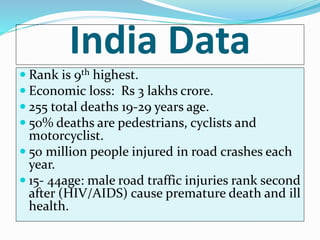
India Data
 Rank is 9th highest.
 Economic loss: Rs 3 lakhs crore.
 255 total deaths 19-29 years age.
 50% deaths are pedestrians, cyclists and
motorcyclist.
 50 million people injured in road crashes each
year.
 15- 44age: male road traffic injuries rank second
after (HIV/AIDS) cause premature death and ill
health.
WHO Report
 T he level of road traffic injury is largely avoidable.
 Majority of road injuries in low and middle income
countries.
 Developed countries people follow traffic rules
because penalty is very high.
 In developing country no penalty and or control by the
traffic police.
 In developed countries: 6 cases of violations-
cancelation of license for 2 years.
Causes
Over speeding
Drunk driving
Use of Mobile phones
Irresponsible driving
Ignoring safety precautions
Helmets and seat belts
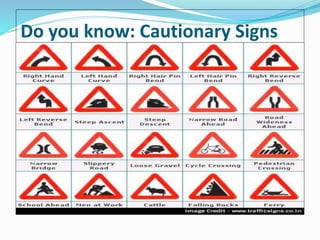
Do you know: Cautionary Signs
Do you Know: Informatory Signs
Do you Know: Mandatory Signs
 White cars are most visible and least likely to be
involved in an accident.
 Black cars have 125 high crash risks than white car,
grey- 11% more, and silver-10% more.
 Black consumes more fuel to maintain the AC cooling
(black absorbs more heat from the atmosphere.).
 Front and back of the bus and trucks should be yellow
to increase the visibility. It helps to prevent collisions.
Monash University (Melbourne
Research Centre) color study - 1
Monash University (Melbourne
Research Centre) color study -2
 Bus and trucks parked on the road side
should be with parking lights switched on.
 Reflectors should be made compulsory on
the front and back of the trucks and buses.
 Accident statics; periodically reviewed to
understand the effect of actions taken and
for corrective steps required.
Driving License in developed nations -1
 Very difficult and lengthy procedure it takes 3-4
months.
 To teach all traffic rules- they make perfect drivers.
 Written test (online rules test: 15 out of 20 questions
should be correct). Test fee is 40$. One week 50 page
rule handbook. To memorize 80 traffic signs.
Remember Do’s and Don’ts.
 Driving lessons: Minimum 10 driving rides with
instructor (each ride $25). Instructor teaches you how
to read all signs and take action as per requirement.
Driving License in developed nations -2
 Apply for road driving test and get appointment after
2-3 months. Pay 150$ for road test
 Traffic inspector will sit beside you in the car. 20 to 30
minutes drive in the city. Every person fails in first 2-3
tests. During test-check mirrors (if you do not –he will
ask you to take new date.
 Stop sign- 30-60 seconds at stop sign. At no signal
crossing (if someone allows you to proceed first at
crossing you should thank him by waving). See back
mirror every two minutes.
Traffic Rules in developed nations -1
Hitting pedestrian gets 6 months
jail.
 Speed near school is 25 km/h.
School bus in front- 100 ft distance
violation 6 months jail.
Below 12 years always sit on back
seat with child seat.
Traffic Rules in developed nations -2
Move in one lane only (overtake if
enough space is available).
No road rage (respect other drivers).
5 to 10 minutes time cushion for daily
office/school travel.
Head light should be in working
condition.
Traffic Rules in developed nations -3
Emergency flash light should be on (if
parked on highways).
No high beam light.
Subject of traffic safety: at 8th standard
in the schools.
Motorcycles: protective clothing
leather jackets, gloves, boots pants,
protects from injury.
Traffic Rules in developed nations -4
Pregnant women are safer at rear seat.
Vehicles should be equipped with air
bags.
Left or right signal- 15 feet ahead of
crossing turn over takes only from right
side (no left side over taking).
No use of mobile while driving (no
head set).
Cost of a person at 20 years of age- 1
School fee –Rs 1.44 lacs (Rs
1000/month)
College fee – Rs 4.8 lacs (Rs 1000 per
month)
Clothing Rs 1 lakh (Rs 500 per month)
Food Rs 100/day – Rs 7.3 lacs
Separate room Rs 3 lacs
Cost of a person at 20 years of age- 2
Motorcycle/ scooter- Rs 50000/-
Miscellaneous- Rs 5 lacs
Time of parents- 8yrs/ X 5
hours/day X 365 days X Rs
100/h/yr = 14.6 lacs
Total= Rs 37 lacs
Cost of a person at 20 years of age- 3
If the age of a person at time of
accident is 40 years then 20 years of
remaining active life are left. Let
us consider Rs 2 lakhs/year income.
8% annual growth in income is also
considered.
Total loss in income is Rs 1 crore.
Drink driving
Legal alcohol limit-
(breathalyzer test:
0.05g/dt). loses of
license on the spot
Prevention-1
Speed: Strict enforcement of speed
limits.
90% accidents can be avoided by speed
limits.
Existing speed limit should bring down
in the area.
Heavy penalty: (on over speeding).
Prevention-2
 Heavy penalty: (for those who cause accidents.)
 Temper proof speed controllers mandatory for heavy
vehicles.
 Motor cycle design- maximum speed 50/60 km/hour.
 New gadgets to be developed for collision prevention
on all vehicles (research Unit can develop).
Test and Enforcement of traffic
rules
 Driving tests to be made more stringent and
fool proof.
 Age limit for two wheeler and heavy vehicle
license should be 21 years.
 Children below certain age (should not
permitted to do cycling in busy roads/where
heavy vehicles are plying).
Helmet
Helmet- compulsory (by law in all
the states) speed limit should be
lower if not using helmet.
Chin step of helmet. Good quality
of helmet only (in market).
Law Modification
Accident maker has to bear
0 to 10 % of the insurance
claims, depending on the
severity of negligence.
Compensations should be
huge.
Safety awareness-1
Road safety project should be
mandatory topic for all the students
every year.
 Completely rectification of A small
pool of water hanging branches of trees
on roadside, obstructions/ pedestrians/
drivers to take sudden lateral (cross)
movements.
Safety awareness-2
Black and dark colors (not
permitted for cycles/cars).
Default color (yellow).
Bright color school dress is
recommended for children.
Safety Awareness-3
 From childhood (habit): for Grown up human (it is
difficult to make habit).
 Simulating race Video and computer games should be
banned by the government/parents.
 Racing/over speeding/risky riding, by Heroes (not be
filmed in cinemas and TV serial. Government should
censor such scenes.
Safety awareness-4
Safety day/week should be organized in
all the schools.
Schools or NGOs should organize
Competitions; give tips, slogans, essay
and painting etc, for various categories
of students.
School buses: – paint in bright yellow
color.
Thank You
For
Your Attention

Road safety session for teacher workshop

  • 1.
  • 2.
    How safe isindividual on the roads How safe individual users are on some particular road, or on the roads belonging to some area. Danger: Likelihood of a traffic collision.
  • 3.
    World Data More than1.2 million people are killed in road accident every year (worldwide). Approximately 4% of the Gross National Product is lost in road accidents. In the world, every three minutes: one child is killed. 2.1% of the all deaths globally.
  • 4.
    India Data  Rankis 9th highest.  Economic loss: Rs 3 lakhs crore.  255 total deaths 19-29 years age.  50% deaths are pedestrians, cyclists and motorcyclist.  50 million people injured in road crashes each year.  15- 44age: male road traffic injuries rank second after (HIV/AIDS) cause premature death and ill health.
  • 5.
    WHO Report  The level of road traffic injury is largely avoidable.  Majority of road injuries in low and middle income countries.  Developed countries people follow traffic rules because penalty is very high.  In developing country no penalty and or control by the traffic police.  In developed countries: 6 cases of violations- cancelation of license for 2 years.
  • 6.
    Causes Over speeding Drunk driving Useof Mobile phones Irresponsible driving Ignoring safety precautions Helmets and seat belts
  • 7.
    Do you know:Cautionary Signs
  • 8.
    Do you Know:Informatory Signs
  • 9.
    Do you Know:Mandatory Signs
  • 10.
     White carsare most visible and least likely to be involved in an accident.  Black cars have 125 high crash risks than white car, grey- 11% more, and silver-10% more.  Black consumes more fuel to maintain the AC cooling (black absorbs more heat from the atmosphere.).  Front and back of the bus and trucks should be yellow to increase the visibility. It helps to prevent collisions. Monash University (Melbourne Research Centre) color study - 1
  • 11.
    Monash University (Melbourne ResearchCentre) color study -2  Bus and trucks parked on the road side should be with parking lights switched on.  Reflectors should be made compulsory on the front and back of the trucks and buses.  Accident statics; periodically reviewed to understand the effect of actions taken and for corrective steps required.
  • 12.
    Driving License indeveloped nations -1  Very difficult and lengthy procedure it takes 3-4 months.  To teach all traffic rules- they make perfect drivers.  Written test (online rules test: 15 out of 20 questions should be correct). Test fee is 40$. One week 50 page rule handbook. To memorize 80 traffic signs. Remember Do’s and Don’ts.  Driving lessons: Minimum 10 driving rides with instructor (each ride $25). Instructor teaches you how to read all signs and take action as per requirement.
  • 13.
    Driving License indeveloped nations -2  Apply for road driving test and get appointment after 2-3 months. Pay 150$ for road test  Traffic inspector will sit beside you in the car. 20 to 30 minutes drive in the city. Every person fails in first 2-3 tests. During test-check mirrors (if you do not –he will ask you to take new date.  Stop sign- 30-60 seconds at stop sign. At no signal crossing (if someone allows you to proceed first at crossing you should thank him by waving). See back mirror every two minutes.
  • 14.
    Traffic Rules indeveloped nations -1 Hitting pedestrian gets 6 months jail.  Speed near school is 25 km/h. School bus in front- 100 ft distance violation 6 months jail. Below 12 years always sit on back seat with child seat.
  • 15.
    Traffic Rules indeveloped nations -2 Move in one lane only (overtake if enough space is available). No road rage (respect other drivers). 5 to 10 minutes time cushion for daily office/school travel. Head light should be in working condition.
  • 16.
    Traffic Rules indeveloped nations -3 Emergency flash light should be on (if parked on highways). No high beam light. Subject of traffic safety: at 8th standard in the schools. Motorcycles: protective clothing leather jackets, gloves, boots pants, protects from injury.
  • 17.
    Traffic Rules indeveloped nations -4 Pregnant women are safer at rear seat. Vehicles should be equipped with air bags. Left or right signal- 15 feet ahead of crossing turn over takes only from right side (no left side over taking). No use of mobile while driving (no head set).
  • 18.
    Cost of aperson at 20 years of age- 1 School fee –Rs 1.44 lacs (Rs 1000/month) College fee – Rs 4.8 lacs (Rs 1000 per month) Clothing Rs 1 lakh (Rs 500 per month) Food Rs 100/day – Rs 7.3 lacs Separate room Rs 3 lacs
  • 19.
    Cost of aperson at 20 years of age- 2 Motorcycle/ scooter- Rs 50000/- Miscellaneous- Rs 5 lacs Time of parents- 8yrs/ X 5 hours/day X 365 days X Rs 100/h/yr = 14.6 lacs Total= Rs 37 lacs
  • 20.
    Cost of aperson at 20 years of age- 3 If the age of a person at time of accident is 40 years then 20 years of remaining active life are left. Let us consider Rs 2 lakhs/year income. 8% annual growth in income is also considered. Total loss in income is Rs 1 crore.
  • 21.
    Drink driving Legal alcohollimit- (breathalyzer test: 0.05g/dt). loses of license on the spot
  • 22.
    Prevention-1 Speed: Strict enforcementof speed limits. 90% accidents can be avoided by speed limits. Existing speed limit should bring down in the area. Heavy penalty: (on over speeding).
  • 23.
    Prevention-2  Heavy penalty:(for those who cause accidents.)  Temper proof speed controllers mandatory for heavy vehicles.  Motor cycle design- maximum speed 50/60 km/hour.  New gadgets to be developed for collision prevention on all vehicles (research Unit can develop).
  • 24.
    Test and Enforcementof traffic rules  Driving tests to be made more stringent and fool proof.  Age limit for two wheeler and heavy vehicle license should be 21 years.  Children below certain age (should not permitted to do cycling in busy roads/where heavy vehicles are plying).
  • 25.
    Helmet Helmet- compulsory (bylaw in all the states) speed limit should be lower if not using helmet. Chin step of helmet. Good quality of helmet only (in market).
  • 26.
    Law Modification Accident makerhas to bear 0 to 10 % of the insurance claims, depending on the severity of negligence. Compensations should be huge.
  • 27.
    Safety awareness-1 Road safetyproject should be mandatory topic for all the students every year.  Completely rectification of A small pool of water hanging branches of trees on roadside, obstructions/ pedestrians/ drivers to take sudden lateral (cross) movements.
  • 28.
    Safety awareness-2 Black anddark colors (not permitted for cycles/cars). Default color (yellow). Bright color school dress is recommended for children.
  • 29.
    Safety Awareness-3  Fromchildhood (habit): for Grown up human (it is difficult to make habit).  Simulating race Video and computer games should be banned by the government/parents.  Racing/over speeding/risky riding, by Heroes (not be filmed in cinemas and TV serial. Government should censor such scenes.
  • 30.
    Safety awareness-4 Safety day/weekshould be organized in all the schools. Schools or NGOs should organize Competitions; give tips, slogans, essay and painting etc, for various categories of students. School buses: – paint in bright yellow color.
  • 31.