Right to
Information
Empowering citizensthrough the Right to Information fosters transparency,
accountability, and active participation in governance, leading to a more informed and
engaged society.
3.
Promotes informed citizenry
Accessto information empowers citizens to make educated decisions and participate in governance effectively.
Enhances government accountability
When citizens can access information, it holds authorities accountable for their actions and decisions.
Fosters participatory democracy
RTI encourages active citizen involvement, making democracy more vibrant and responsive to public needs.
Importance of Right to Information
Transparency and accountability are essential for a functioning democracy and informed public.
01
02
03
4.
Key Features of
Rightto
Information
Essential Components of Transparency and
Accessibility
The Right to Information (RTI) laws promote transparency in
governance by ensuring access to information. Key features include
easy accessibility for the public and requirements for timely
responses from authorities, fostering an environment of
accountability and informed citizen participation.
5.
History of
Right to
Information
Evolutionof Right to Information Laws
Across the Globe
The right to information has evolved significantly, tracing
its origins back to the early 18th century. Over time, it has
gained momentum, with many countries adopting RTI laws to
promote transparency and accountability, ensuring citizens
can access vital information.
6.
Implementation of RTI
Understandingthe mechanisms of Right to Information and its varying effectiveness in practice.
Effective Implementation
Clear processes and strong
awareness campaigns.
Ineffective Implementation
Bureaucratic hurdles and
lack of transparency.
Partial Success
Some awareness but
insufficient follow-through.
7.
These images illustrate
thecommon obstacles
faced by citizens trying
to access information
through RTI: long queues,
complicated forms, and
lack of awareness.
8.
Case Studies: SuccessStories
of Right to Information
Landmark Case 1
In a landmark case, citizens used RTI to
expose corruption in local government,
leading to the prosecution of several
officials and improved transparency in public
funds management.
Landmark Case 2
Another notable instance involved a
journalist uncovering discrepancies in
government contracts, resulting in policy
reforms and increased accountability for
public expenditure in the region.
Landmark Case 3
A grassroots organization utilized RTI to
demand access to environmental data,
ultimately influencing local policies on
sustainable development and enhancing
community engagement in decision-making
processes.
9.
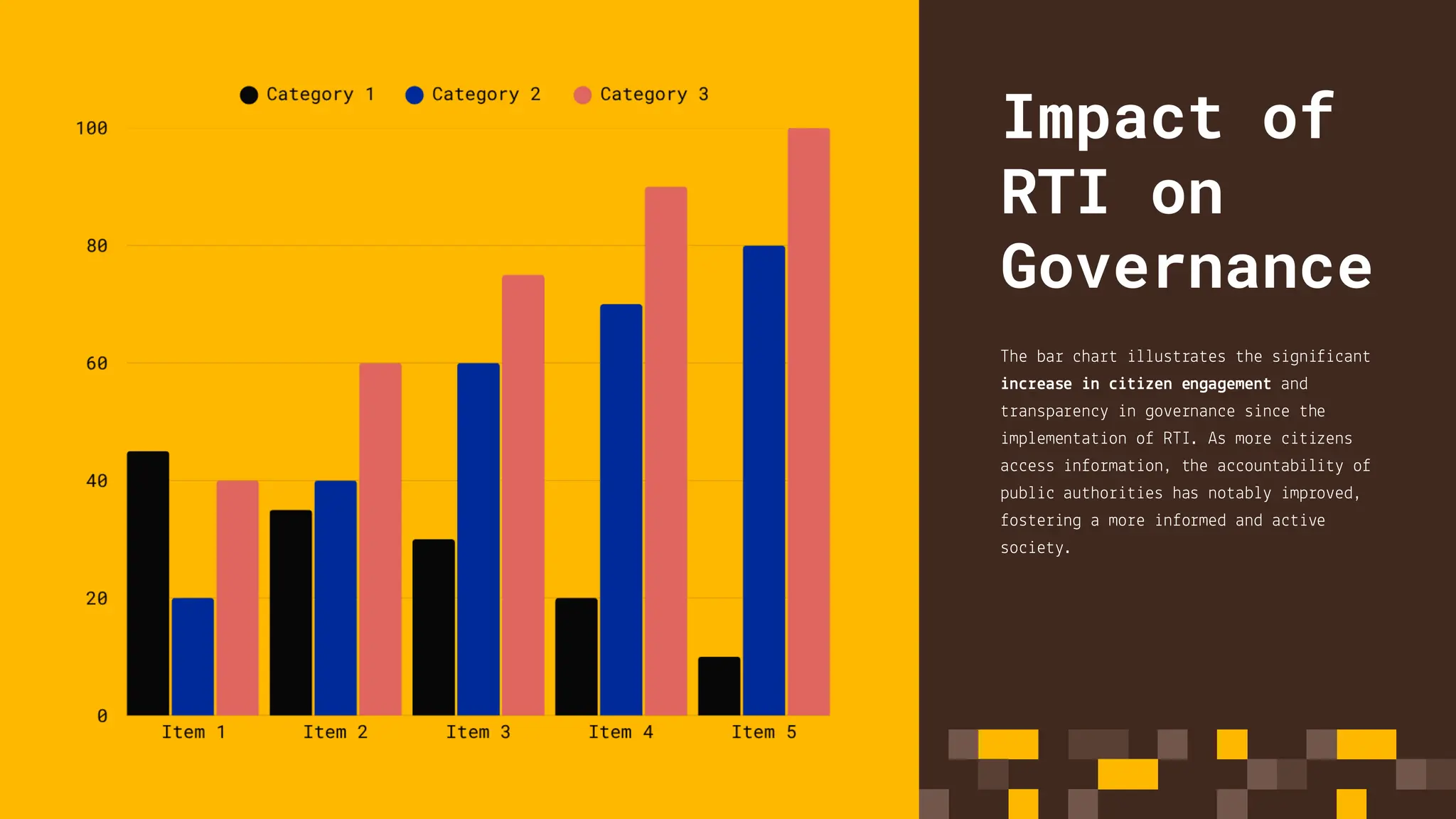
Impact of
RTI on
Governance
Thebar chart illustrates the significant
increase in citizen engagement and
transparency in governance since the
implementation of RTI. As more citizens
access information, the accountability of
public authorities has notably improved,
fostering a more informed and active
society.
10.
Both countries prioritizecitizen
empowerment through access to
information
Country B emphasizes transparency but
lacks robust enforcement measures
Strong legislative backing in country A
with rigorous enforcement mechanisms
Comparative
Analysis of
RTI Laws: A
Global
Perspective
Exploring the similarities
and differences in RTI
frameworks across various
nations