Purpose: An introduction to some of the
general responsibilities associated with
driving, the meaning of a drivers
license, the importance of driver
education.
Having a driver license is a
privilege, not a right. All drivers
must have a drivers license to
operate a vehicle of any kind on
a public highway.
Other drivers and pedestrians
will expect that you will follow
the laws and rules of the road,
be courteous, and not be under
the influence of alcohol or
drugs, or otherwise impaired
while you are driving.
If you are a minor, your parent(s)
or guardian are responsible for
the financial consequences of
your driving. If you have a
drivers license, they will expect
you to drive safely.
Passengers in your car have put
their safety in your hands, and
expect that because you have a
drivers license, you will drive
safely.
A vehicle is capable of causing
extensive property damage,
injury, and death, and should be
handled with the caution you
would show a dangerous
weapon such as a gun.
Becoming a competent driver is
a life-long learning experience,
your Driver Education is just a
beginning.
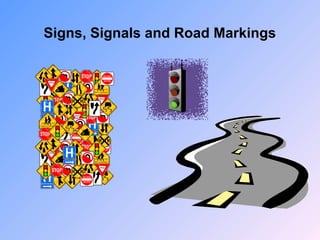
Signs, Signals and Road Markings
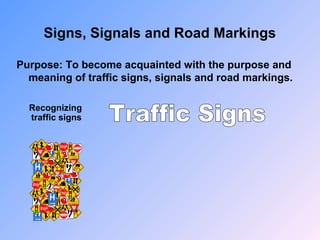
Purpose: To become acquainted with the purpose and
meaning of traffic signs, signals and road markings.
Recognizing
traffic signs
Signs, Signals and Road Markings
Purpose: To become acquainted with the purpose and
meaning of traffic signs, signals and road markings.
Recognizing
traffic signs
Traffic signs are devices placed along, beside,
or above a highway, roadway, pathway, or
other routes to guide, warn, and regulate the
flow of traffic, including motor vehicles,
bicycles, pedestrians, equestrians, and other
travelers.
They serve 3 different purposes:
(a) regulate traffic, movement, or parking
(b) to warn of potential dangers or changes in
road condition
(c) to provide information and guidance
Recognizing
traffic signs
Traffic signs have shapes that denote specific meaning. The
shapes allows you to know if you are faced with a regulation,
a warning, information or guidance and sometimes the
specific meaning of the sign.
This eight-sided octagon-shape is used exclusively for stop signs
STOP
The driver should immediately
recognize that it means stop.
4 - W A Y
Some may have this small
supplemental plate which
indicates whether other
traffic must also stop.
Signs, Signals,
and Road markings
Is it necessary to stop completely at a stop sign?
If you want to pass your drivers’ license test it is!
You will often fail at the exam station if you “roll” a stop sign!
Is it necessary to stop completely at a stop sign?
If you want to pass your drivers’ license test it is!
You will often fail at the exam station if you “roll” a stop sign!
Stopping Points
Signs, Signals,
and Road markings
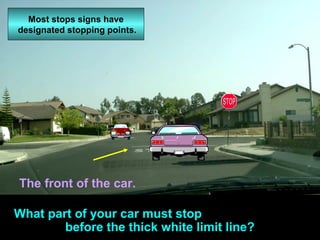
The front of the car.
What part of your car must stop
before the thick white limit line?
Most stops signs have
designated stopping points.
Any ideas on WHY this sign is placed here?
The curve and tree is obscuring the stop sign.
Get in the habit of
“saying the signs”
to yourself as you see them.
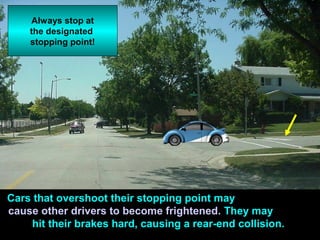
Cars that overshoot their stopping point may
cause other drivers to become frightened. They may
hit their brakes hard, causing a rear-end collision.
Always stop at
the designated
stopping point!
Traffic signs have shapes that denote specific meaning.
The shapes allows you to know if you are faced with a regulation,
a warning, information or guidance and sometimes the specific
meaning of the sign.
Signs, Signals,
and Road markings
This shape is used exclusively for Railroad Signs
The driver should immediately
recognize that a railroad crossing
is ahead and be prepared to stop
if necessary.
This cross buck warns that
the crossing is imminent.
You need to be in the habit of slowing down and
checking the tracks every time you cross them.
Eventually you’ll drive in areas where
crossings do not have gates, bells and lights!
When approaching a railroad crossing
with no lights or gates and poor visibility (less than 400 feet)
to either side, you must reduce you speed to
to properly check the tracks enabling you to stop if necessary.
Signs, Signals,
and Road markings
This shape is used exclusively for No Passing Zone
This type of sign
is rare in some
states, but is used
in others. Passing
is not allowed.
NO
PASSING
ZONE
Signs, Signals,
and Road markings
This shape is used exclusively for Warning Signs
The driver should immediately
recognize that there is a potentially
dangerous situation ahead.
Some examples would be
intersections ahead, divided road
ahead, merging traffic, winding road,
and construction ahead.
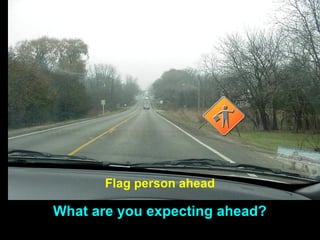
What are you expecting ahead?
Flag person ahead
Signs, Signals,
and Road markings
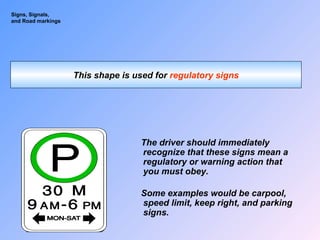
This shape is used for regulatory signs
The driver should immediately
recognize that these signs mean a
regulatory or warning action that
you must obey.
Some examples would be carpool,
speed limit, keep right, and parking
signs.
You’ve noticed this regulatory sign and are completing
your left turn, what else must you quickly do up ahead?
Lane change right
Signs, Signals,
and Road markings
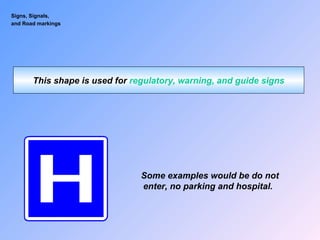
This shape is used for regulatory, warning, and guide signs
Some examples would be do not
enter, no parking and hospital.
There’s no road to the left.
After stopping, what must you do?
TURN RIGHT
This sign means danger ahead
because you are going the wrong
way. The WRONG WAY sign tells
you that you are traveling the
opposite the direction of traffic.
You must stop and go back to the
road you were originally on,
when safe to do so.
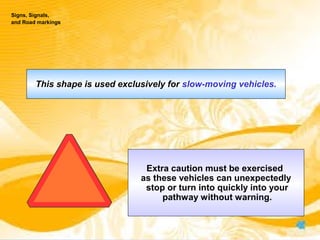
This shape is used exclusively for slow-moving vehicles.
Extra caution must be exercised
as these vehicles can unexpectedly
stop or turn into quickly into your
pathway without warning.
Signs, Signals,
and Road markings
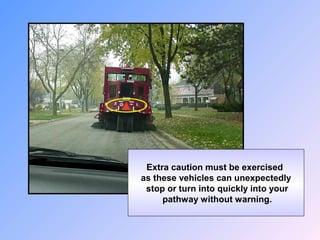
Extra caution must be exercised
as these vehicles can unexpectedly
stop or turn into quickly into your
pathway without warning.
What are the three D’s of green color signs?
Distance DirectionDestination
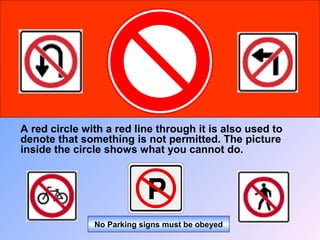
A red circle with a red line through it is also used to
denote that something is not permitted. The picture
inside the circle shows what you cannot do.
No Parking signs must be obeyed
BLACK COLOR
Black is used as a background for ONE WAY, night
speed limits (in other states) and inspection station signs,
and as a message color on signs with white, yellow,
or orange backgrounds.
Only travel in
this direction
ONE
WAY
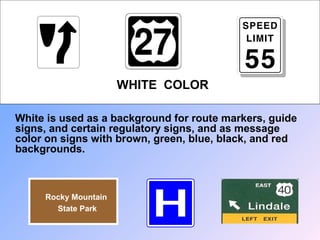
WHITE COLOR
White is used as a background for route markers, guide
signs, and certain regulatory signs, and as message
color on signs with brown, green, blue, black, and red
backgrounds.
Rocky Mountain
State Park
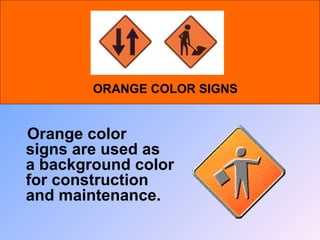
ORANGE COLOR SIGNS
Orange color
signs are used as
a background color
for construction
and maintenance.
Yellow signs are used as a background color
for warning signs and some school signs.
(except construction and
maintenance signs)
YELLOW COLOR SIGNS
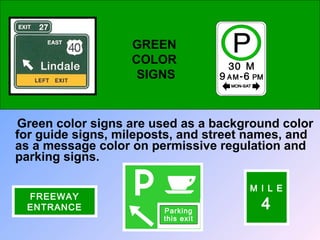
Green color signs are used as a background color
for guide signs, mileposts, and street names, and
as a message color on permissive regulation and
parking signs.
GREEN
COLOR
SIGNS
Parking
this exit
M I L E
4
FREEWAY
ENTRANCE
Rocky Mountain
State Park
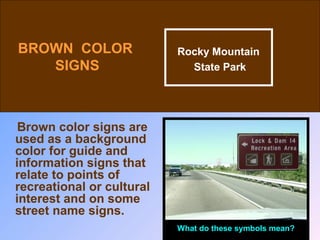
Brown color signs are
used as a background
color for guide and
information signs that
relate to points of
recreational or cultural
interest and on some
street name signs.
BROWN COLOR
SIGNS
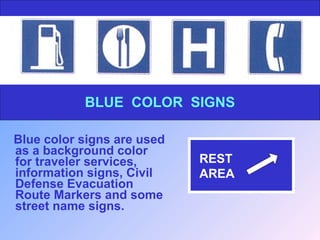
What do these symbols mean?
Blue color signs are used
as a background color
for traveler services,
information signs, Civil
Defense Evacuation
Route Markers and some
street name signs.
BLUE COLOR SIGNS
REST
AREA
FLOURESCENT YELLOW-GREEN SIGNS
Fluorescent Yellow
Green is also used
as a background for
pedestrian, bicycle,
and school warning
signs.
FLOURESCENT YELLOW-GREEN SIGNS
Causes of road accidents
• Fault of pedestrian
• Fault of Passenger
• Fault of coworker like conductor or
cleaner
• Fault of two wheeler driver
• Fault of our vehicle driver
• Fault of other vehicle driver
Insufficient Light
• Dawn and dusk (The time at which
daylight first begins The darker stage
of twilight(diffused light), especially in
the evening)
• Raining time
• Night driving without head light
Causes of road accidents
Bad weather condition
• Rainy season
• Mist and fog
Causes of road accidents
Defect in the road
• A curve where we are not able to see
the vehicle coming in the opposite
direction
• Defect in road surface
• Road repair materials stacked on the
road side
• Platforms are occupied by shopkeepers
and pedestrians have to come to road
When the vehicle is parked
• The vehicle should be parked on the
extreme left side of the road.
• The indicator lights may be switched on
to show that the vehicle is parked.
• Some indication board or stones may
be kept at the rear side of the vehicle
KEEP LEFT on a two-way road to allow traffic from the
opposite direction to pass on your right and on a one-way
road to allow vehicles behind you to overtake from your right.
WHEN TURNING LEFT, keep to the left side of the road you
are leaving as well as the one you are entering. When turning
right, move to the centre of the road you are leaving and
arrive near the left side of road you are entering.
SLOW DOWN at road junctions, intersections, pedestrian
crossings and road corners and wait until you are sure of a
clear passage ahead. if you are entering a main road where
traffic is not being regulated, give way to vehicles passing on
your right.
GENERAL RULES
HAND SIGNALS are necessary at certain times. When
slowing down, extend your right arm palm down and swing
it up and down; when stopping, raise your forearm
vertically outside the vehicle; when turning right or
changing lane to the right hand side, extend your right arm
straight out, palm to the front; when turning left or changing
lane to the left hand side, extend your right arm and rotate
it in an anti-clockwise direction.
To allow the vehicle behind you to overtake, swing your
right arm backward and forward in a semi circular motion.
DIRECTION INDICATORS Better use directions
indicstors instead of hands singlals and both in case of
any emergancy.
WEARING A HELMET FOR TWO WHEELER DRIVERS is
a statutory requirement. The helmet must conform to the ISI
standards and should bear the ISI mark. Helmet works as a
shield for your head in case of a mishap. It is designed for
your individual safety and not as a cover to avoid legal
prosecution. For complete safety tie the strap properly
otherwise the helmet may slip from your head in case of an
accident head injury. (Turban wearing Sikhs are exempted
from using a helmet).
• Road safety tips for drivers while driving
• Avoid any distractions
• Avoid eating and drinking
• Avoid using cell phone
• Avoid looking at maps or directions
• Avoid looking at navigation system
• Avoid listening to too loud music
• Avoid having an unleashed petFollow the traffic rules
• Maintain speed limits
Road safety tips for others
• Follow the road signs and traffic rules
• Cross the road at the right time
• Follow the traffic lights
• Wear helmets if on a two wheeler
• Maintain the right speed
• Move carefully on the congested roads
• If with children and pets, be all the more
careful
Road safety tips for others
ROAD SAFETY
ROAD SAFETY
ROAD SAFETY
ROAD SAFETY
ROAD SAFETY

ROAD SAFETY

  • 1.
    Purpose: An introductionto some of the general responsibilities associated with driving, the meaning of a drivers license, the importance of driver education.
  • 2.
    Having a driverlicense is a privilege, not a right. All drivers must have a drivers license to operate a vehicle of any kind on a public highway. Other drivers and pedestrians will expect that you will follow the laws and rules of the road, be courteous, and not be under the influence of alcohol or drugs, or otherwise impaired while you are driving.
  • 3.
    If you area minor, your parent(s) or guardian are responsible for the financial consequences of your driving. If you have a drivers license, they will expect you to drive safely. Passengers in your car have put their safety in your hands, and expect that because you have a drivers license, you will drive safely.
  • 4.
    A vehicle iscapable of causing extensive property damage, injury, and death, and should be handled with the caution you would show a dangerous weapon such as a gun. Becoming a competent driver is a life-long learning experience, your Driver Education is just a beginning.
  • 5.
    Signs, Signals andRoad Markings
  • 6.
    Signs, Signals andRoad Markings Purpose: To become acquainted with the purpose and meaning of traffic signs, signals and road markings. Recognizing traffic signs
  • 7.
    Signs, Signals andRoad Markings Purpose: To become acquainted with the purpose and meaning of traffic signs, signals and road markings. Recognizing traffic signs Traffic signs are devices placed along, beside, or above a highway, roadway, pathway, or other routes to guide, warn, and regulate the flow of traffic, including motor vehicles, bicycles, pedestrians, equestrians, and other travelers. They serve 3 different purposes: (a) regulate traffic, movement, or parking (b) to warn of potential dangers or changes in road condition (c) to provide information and guidance
  • 8.
    Recognizing traffic signs Traffic signshave shapes that denote specific meaning. The shapes allows you to know if you are faced with a regulation, a warning, information or guidance and sometimes the specific meaning of the sign. This eight-sided octagon-shape is used exclusively for stop signs STOP The driver should immediately recognize that it means stop. 4 - W A Y Some may have this small supplemental plate which indicates whether other traffic must also stop. Signs, Signals, and Road markings
  • 9.
    Is it necessaryto stop completely at a stop sign? If you want to pass your drivers’ license test it is! You will often fail at the exam station if you “roll” a stop sign!
  • 10.
    Is it necessaryto stop completely at a stop sign? If you want to pass your drivers’ license test it is! You will often fail at the exam station if you “roll” a stop sign!
  • 11.
  • 12.
    The front ofthe car. What part of your car must stop before the thick white limit line? Most stops signs have designated stopping points.
  • 13.
    Any ideas onWHY this sign is placed here? The curve and tree is obscuring the stop sign. Get in the habit of “saying the signs” to yourself as you see them.
  • 14.
    Cars that overshoottheir stopping point may cause other drivers to become frightened. They may hit their brakes hard, causing a rear-end collision. Always stop at the designated stopping point!
  • 15.
    Traffic signs haveshapes that denote specific meaning. The shapes allows you to know if you are faced with a regulation, a warning, information or guidance and sometimes the specific meaning of the sign. Signs, Signals, and Road markings This shape is used exclusively for Railroad Signs The driver should immediately recognize that a railroad crossing is ahead and be prepared to stop if necessary. This cross buck warns that the crossing is imminent.
  • 16.
    You need tobe in the habit of slowing down and checking the tracks every time you cross them. Eventually you’ll drive in areas where crossings do not have gates, bells and lights! When approaching a railroad crossing with no lights or gates and poor visibility (less than 400 feet) to either side, you must reduce you speed to to properly check the tracks enabling you to stop if necessary.
  • 17.
    Signs, Signals, and Roadmarkings This shape is used exclusively for No Passing Zone This type of sign is rare in some states, but is used in others. Passing is not allowed. NO PASSING ZONE
  • 18.
    Signs, Signals, and Roadmarkings This shape is used exclusively for Warning Signs The driver should immediately recognize that there is a potentially dangerous situation ahead. Some examples would be intersections ahead, divided road ahead, merging traffic, winding road, and construction ahead.
  • 19.
    What are youexpecting ahead? Flag person ahead
  • 20.
    Signs, Signals, and Roadmarkings This shape is used for regulatory signs The driver should immediately recognize that these signs mean a regulatory or warning action that you must obey. Some examples would be carpool, speed limit, keep right, and parking signs.
  • 21.
    You’ve noticed thisregulatory sign and are completing your left turn, what else must you quickly do up ahead? Lane change right
  • 22.
    Signs, Signals, and Roadmarkings This shape is used for regulatory, warning, and guide signs Some examples would be do not enter, no parking and hospital.
  • 23.
    There’s no roadto the left. After stopping, what must you do? TURN RIGHT This sign means danger ahead because you are going the wrong way. The WRONG WAY sign tells you that you are traveling the opposite the direction of traffic. You must stop and go back to the road you were originally on, when safe to do so.
  • 24.
    This shape isused exclusively for slow-moving vehicles. Extra caution must be exercised as these vehicles can unexpectedly stop or turn into quickly into your pathway without warning. Signs, Signals, and Road markings
  • 25.
    Extra caution mustbe exercised as these vehicles can unexpectedly stop or turn into quickly into your pathway without warning.
  • 26.
    What are thethree D’s of green color signs? Distance DirectionDestination
  • 27.
    A red circlewith a red line through it is also used to denote that something is not permitted. The picture inside the circle shows what you cannot do. No Parking signs must be obeyed
  • 28.
    BLACK COLOR Black isused as a background for ONE WAY, night speed limits (in other states) and inspection station signs, and as a message color on signs with white, yellow, or orange backgrounds. Only travel in this direction ONE WAY
  • 29.
    WHITE COLOR White isused as a background for route markers, guide signs, and certain regulatory signs, and as message color on signs with brown, green, blue, black, and red backgrounds. Rocky Mountain State Park
  • 30.
    ORANGE COLOR SIGNS Orangecolor signs are used as a background color for construction and maintenance.
  • 31.
    Yellow signs areused as a background color for warning signs and some school signs. (except construction and maintenance signs) YELLOW COLOR SIGNS
  • 32.
    Green color signsare used as a background color for guide signs, mileposts, and street names, and as a message color on permissive regulation and parking signs. GREEN COLOR SIGNS Parking this exit M I L E 4 FREEWAY ENTRANCE
  • 33.
    Rocky Mountain State Park Browncolor signs are used as a background color for guide and information signs that relate to points of recreational or cultural interest and on some street name signs. BROWN COLOR SIGNS What do these symbols mean?
  • 34.
    Blue color signsare used as a background color for traveler services, information signs, Civil Defense Evacuation Route Markers and some street name signs. BLUE COLOR SIGNS REST AREA
  • 35.
    FLOURESCENT YELLOW-GREEN SIGNS FluorescentYellow Green is also used as a background for pedestrian, bicycle, and school warning signs. FLOURESCENT YELLOW-GREEN SIGNS
  • 36.
    Causes of roadaccidents • Fault of pedestrian • Fault of Passenger • Fault of coworker like conductor or cleaner • Fault of two wheeler driver • Fault of our vehicle driver • Fault of other vehicle driver
  • 37.
    Insufficient Light • Dawnand dusk (The time at which daylight first begins The darker stage of twilight(diffused light), especially in the evening) • Raining time • Night driving without head light Causes of road accidents
  • 38.
    Bad weather condition •Rainy season • Mist and fog Causes of road accidents
  • 39.
    Defect in theroad • A curve where we are not able to see the vehicle coming in the opposite direction • Defect in road surface • Road repair materials stacked on the road side • Platforms are occupied by shopkeepers and pedestrians have to come to road
  • 40.
    When the vehicleis parked • The vehicle should be parked on the extreme left side of the road. • The indicator lights may be switched on to show that the vehicle is parked. • Some indication board or stones may be kept at the rear side of the vehicle
  • 41.
    KEEP LEFT ona two-way road to allow traffic from the opposite direction to pass on your right and on a one-way road to allow vehicles behind you to overtake from your right. WHEN TURNING LEFT, keep to the left side of the road you are leaving as well as the one you are entering. When turning right, move to the centre of the road you are leaving and arrive near the left side of road you are entering. SLOW DOWN at road junctions, intersections, pedestrian crossings and road corners and wait until you are sure of a clear passage ahead. if you are entering a main road where traffic is not being regulated, give way to vehicles passing on your right. GENERAL RULES
  • 42.
    HAND SIGNALS arenecessary at certain times. When slowing down, extend your right arm palm down and swing it up and down; when stopping, raise your forearm vertically outside the vehicle; when turning right or changing lane to the right hand side, extend your right arm straight out, palm to the front; when turning left or changing lane to the left hand side, extend your right arm and rotate it in an anti-clockwise direction. To allow the vehicle behind you to overtake, swing your right arm backward and forward in a semi circular motion.
  • 43.
    DIRECTION INDICATORS Betteruse directions indicstors instead of hands singlals and both in case of any emergancy. WEARING A HELMET FOR TWO WHEELER DRIVERS is a statutory requirement. The helmet must conform to the ISI standards and should bear the ISI mark. Helmet works as a shield for your head in case of a mishap. It is designed for your individual safety and not as a cover to avoid legal prosecution. For complete safety tie the strap properly otherwise the helmet may slip from your head in case of an accident head injury. (Turban wearing Sikhs are exempted from using a helmet).
  • 44.
    • Road safetytips for drivers while driving • Avoid any distractions • Avoid eating and drinking • Avoid using cell phone • Avoid looking at maps or directions • Avoid looking at navigation system • Avoid listening to too loud music • Avoid having an unleashed petFollow the traffic rules • Maintain speed limits Road safety tips for others
  • 45.
    • Follow theroad signs and traffic rules • Cross the road at the right time • Follow the traffic lights • Wear helmets if on a two wheeler • Maintain the right speed • Move carefully on the congested roads • If with children and pets, be all the more careful Road safety tips for others