Prue Holmes (Durham University)
Richard Fay (The University of Manchester)
Jane Andrews (University of the West of England)
Mariam Attia (Durham University)
Languages, Refugees and Migration: Research Roundtable Event
University of Glasgow, Glasgow
7 December, 2015
Researching multilingually at borders:
Methodological insights
Outline
1. Researching in the community – some issues
2. “Researching Multilingually” – our research work
3. Emerging Insights – from three areas:
a) language choices
b) flexible language use (translingual practice)
c) emergent ethical issues
4. Concluding thoughts
1. Researching in the community:
Some issues
Some questions for researchers
undertaking community research
• Who are the funders? What languages do they prioritise?
• Who are the researchers? What linguistic resources do they
bring to the research context?
• In what languages will they collect the data?
• How will the researchers build trust?
• What issues emerge in the transcription of the data?
• How should the data be (re)presented (in workshops to the
participants, in a report to funders and their end-users)?
(Ganassin & Holmes, 2013)
• What type of research gets prioritised?
– Evidence-based, quantitative data sets, measured improvements
=> Utilitarian approach to research?
Challenges in the current context
• Sets of principles & codes of ethics => “illogical” and “stale” are adopted
by professional and academic associations to ensure “value-free” social
science (Christians, 2011, p. 66).
• Constraints on multilingual research practice vary across institutions,
across fields of research, disciplines and paradigms.
• The symbolic & regulatory power of institutions [e.g., governmental,
educational] . . . is not fixed or monolithic: it is always possible to create
spaces for alternative ways of working and for different voices to be
heard.
• Creating these spaces depends on the agency of individual researchers . . .
and principal investigators on research projects.
(Andrews & Martin-Jones, 2012)
2. Researching multilingually:
Our research work
Background – 2 studies
1. AHRC network grant – Researching Multilingually
www.researchingmultilingually.com
2. AHRC large grant – Researching Multilingually at the Borders
of Language, the Body, Law and the State
www.researching-multilingually-at-borders.com
What is “Researching
Multilingually”
A definition . . .
The process and practice of using, or accounting for the
use of, more than one language in the research
process, e.g. from the initial design of the project, to
engaging with different literatures, to developing the
methodology and considering all possible ethical
issues, to generating and analyzing the data, to issues
of representation and reflexivity when writing up and
publishing.
(Holmes, Fay, Andrews, Attia, 2016, p. 101, in press)
Our focus
1. How do researchers generate, translate, interpret and write up
data (dialogic, mediated, textual, performance) from one
language to another?
2. What ethical issues emerge in a research project where multiple
languages are present?
3. What approaches , methods and techniques improve processes
of researching multilingually?
=> How can researchers develop their researcher awareness in
their researcher practice by drawing on their own linguistic
resources (especially in sites where languages are under
pressure and pain).
3a. Researcher and participant
language choices
‘Building capacity for culturally appropriate
psychosocial interventions in Northern Uganda’
•DIME (Design, Implementation, Monitoring and Evaluation)
developed at John Hopkins University by Applied Mental Health
Research Group (AMHR)
•A multiphasic approach developed to assist with the
development of psychosocial interventions for mental health
difficulties in low and middle-income countries (LMIC).
•…. the process is based on the principles of community-based
participatory research (CBCR)
Uganda fieldwork
• Over 40 different languages are spoken in Uganda.
• There has been a tendency to translate local language
understanding about distress into English (as a step to providing
local people with access to pre-existing, or new developed,
forms of treatment often offered by international NGOs).
• The textbooks used to train mental health professionals in
Uganda tend to come from US/UK.
• English language descriptions of forms of psychopathology
predominate in training.
• This has created a context where the global and the local
dynamically interact.
https://rosswhiteblog.wordpress.com/2015/03/29/working-multilingually-to-
promote-wellbeing-in-northern-uganda/
Uganda fieldwork
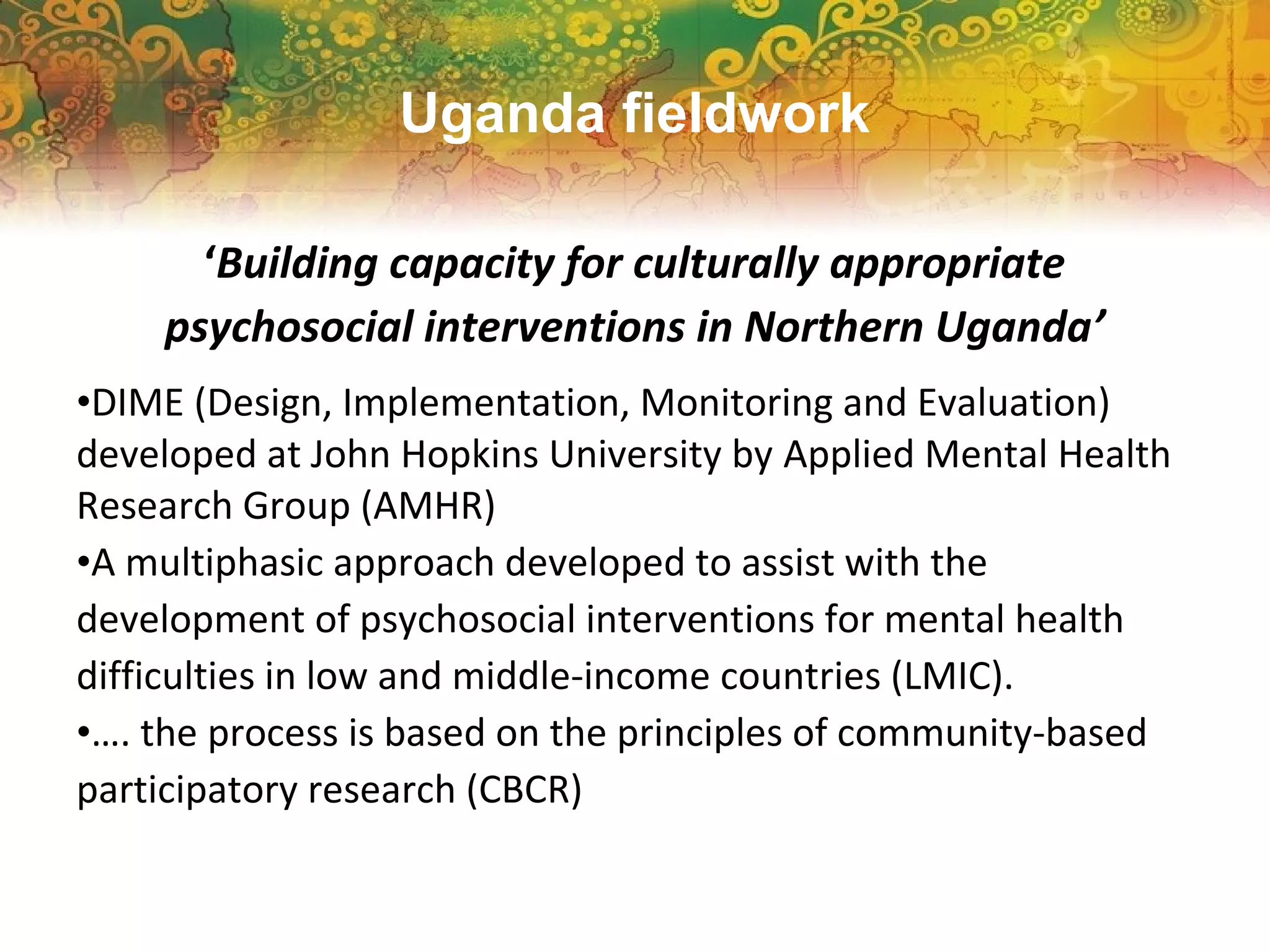
• Ross’ Blog: “It is important to note that the school that we visited
yesterday and the University we visited today only teach students using
English. This highlights the challenges that health professionals might
have [having been] taught in a language that is not necessarily the first
language of the people that they subsequently treat. I think this serves
to highlight the ecological validity and potential utility of the research
that we are conducting.”
• “Discussions with both Richard and Katja have also allowed me to reflect
critically on the methodology that we have been employing and
sharpened my awareness around the points in the process where the
use of English language training has juxtaposed with the use of Lango in
the delivery of interviews and the recording of associated information. I
also have to concede that having Richard and Katja in the team has
increased the amount of Lango that I have been able to pick up.”
https://rosswhiteblog.wordpress.com/
Reflections about methodology
• Pragmatic attempt to inform the development of
psychosocial interventions in humanitarian crises. Not a
substitute for detailed ethnographic work.
• The DIME manual is in English. The training for Research
Assistants was delivered in English. All data collection was
conducted in Lango.
• The participant inclusion criteria purposely excluded people
who were not long-term residents in the Lira district.
• No audio recording device to be used – the scribe is expected
to record verbatim summary statements that the participants
make.
• The methodology insists that the research should be
conducted in one language only.
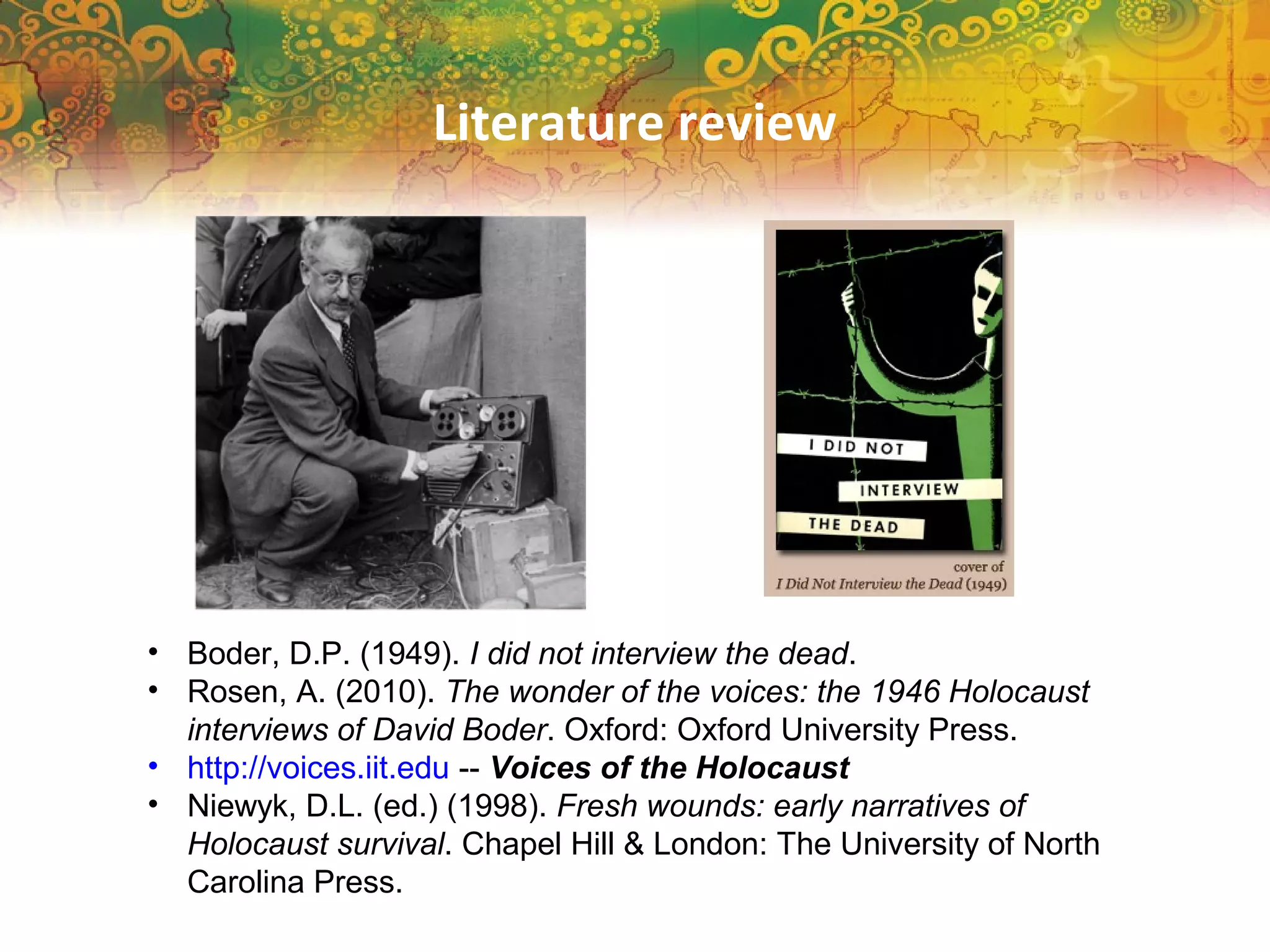
Literature review
• Boder, D.P. (1949). I did not interview the dead.
• Rosen, A. (2010). The wonder of the voices: the 1946 Holocaust
interviews of David Boder. Oxford: Oxford University Press.
• http://voices.iit.edu -- Voices of the Holocaust
• Niewyk, D.L. (ed.) (1998). Fresh wounds: early narratives of
Holocaust survival. Chapel Hill & London: The University of North
Carolina Press.
intentionally multilingual:
-- case for neutral language (e.g. English) to minimise relived trauma
-- Boder: survivors use “their own language” to avoid “curtailment,
straining and oversimplification of the content” using a foreign tongue
-- “Since that is her language in which she can talk freely without any
difficulty or artificiality, I will endeavor to understand her”
-- However, given US-audience, sometimes English as shared lingua franca
-- Thus, ‘tension’ between storyteller comfort and audience-reach.
(1998) Niewyk edited / presented 36 of Boder's interviews
Literature review
3b. Languages used flexibly:
Translingual practice
The value of linguistic incompetence?
From the literature . . .
•Phipps (2013) the potential
value of linguistic
incompetence in contexts of
pressure and pain
“…I have found myself open to
important ethical dimensions
and have experienced research
from a position of considerable
humility, lack, limitation,
wound and partiality”
(Phipps, 2013, p. 336)
Your experiences/thoughts?
What does multilingualism mean
in today’s world?
From the literature . . .
•Heller (2012, pp. 30-31)
circulating people, entering a
mobile, multilingual global
economy
Multilingualism “not as a
property of individuals or of
groups, or even as a
characteristic of spaces, but
rather as sets of circulating,
constructible and
deconstructible resources”
Your experiences/thoughts?
Flexible multilingualism
From the literature . . .
•Feminist approach to research with
migrant women in NE England
•Women translating and interpreting
for each other
•Researchers did not make assumptions
or direct participants to sit with certain
language speakers
•Languages in common were
discovered
•Geographical origins and languages
preferred did not always correlate
(Ganassin & Holmes, 2013)
Your experiences/thoughts?
Translingual practice
From the literature . . .
•Canagarajah (2013, p. 202)
“mobile semiotic resources are
negotiated for meaning in
global contact zones”
•Everyone has linguistic
resources
•We can all negotiate the uses
of those resources
•Will there be a “correct”
language for a certain
situation?
Your experiences/thoughts?
The arts as a language
• Using the arts helps us to get to “deeper meanings”
(Gameli Tordzro, 2015)
3c. Ethical issues
Developing trust in the research
context
• Who will benefit from the research?
– “We are the most researched group in the world” (Smith,
2013)
– “We don’t want any more research! We want outcomes!”
(Ethnic groups using the Migrant Resource Centre,
Hamilton, New Zealand)
• What about the importance of relationships and
building trust?
– “Don’t believe what I told you in the first 6 months” (a
participant in Prue’s ethnographic doctoral research).
The researcher’s role
• The researcher’s double role—as both the translator
and interpreter—who can mediate between
different linguist worlds, identify areas of
methodological concern, and develop higher levels
of ethical sensitivity (Shklarov, 2007).
• Flexible multilingualism – making strategic use of the
multilingual skills naturally present in the research
context to accommodate participants’ and
researchers’ asymmetric multilingual practices
(Ganassin & Holmes, 2013).
Multilingualism and
Research Ethics
• Ethics - A domain where researcher agency relating to
multilingualism can be exerted!
• Universities’ practices and organisations’ ethics codes could
act as constraints
• There is a need for a diversity of practices regarding research
ethics relating to multilingualism
Multilingualism and
Research Ethics (2)
Project Experience 1
- The multilingual elements of researcher praxis
were/are excluded in university/organisational codes of
research practice
Project Experience 2
- Input to ethical approval processes -
a) Are any participants likely to require special consideration in
the preparation of the Participant Information Sheet/Plain
Language Statement to ensure informed consent (e.g. the use of
child friendly language, English as a second language)? (Section 5.1c. )
b) PhD student (Judith Reynolds) highlighted the risks of
researching in the presence of participants who were vulnerable
because they did not speak the language of the powerful
Languages and ethical practice
From the literature . . .
There is a need to recognise
the role of languages and how
they are brought into being by
all concerned as researchers
“join with,” and “learn from”
rather than “speak for” or
“intervene into” others’ lives
(Cannella & Lincoln, 2011, p. 83)
Your experiences/thoughts?
4) Concluding Thoughts
Concluding thoughts
• (Community) researchers need to be aware of simplistic
principles for avoiding deception, rules about managing
privacy and confidentiality, and the quest for accuracy
• Ecological approach – looking across contexts, experiences,
encounters, relationships, representations
• Reflection – encourages “noticing” and creating
opportunities for expression of multilingualism
• “Linguistic hospitality” (Phipps, 2012) in today’s world where
languages are key to understanding – of self and other
References
Andrews, J. & Martin-Jones, M. (2012) Developing multilingual research practice for new
times: A challenge to the status quo. Paper presented at BAAL Annual Meeting, Southampton,
September, 2012.
Canagarah, S. (2013). Translingual practice: Global Englishes and cosmopolitan relations.
London: Routledge.
Cannella, G.S., & Lincoln, Y.S. (2011). Ethics, research regulations and critical social science.
In N. Denzin and Y.S. Lincoln (Eds.), The Sage handbook of qualitative research (4th
ed., pp.
81-89). Thousand Oaks, CA: Sage.
Christians, C.G. (2011). Ethics and politics in qualitative research. In N. Denzin and Y.S.
Lincoln (Eds.), The Sage handbook of qualitative research (4th
ed., pp. 61-80). Thousand Oaks,
CA: Sage.
Ganassin, S., & Holmes, P. (2013). Multilingual research practices in community research:
The case of migrant/refugee women in North-East England. International Journal of Applied
Linguistics, 23(3), 342–356.
Heller, M. (2012). Rethinking sociolinguistic ethnography: From community and identity to
process and practice. In S. Gardner and M. Martin-Jones (Eds.), Multilingualism, discourse and
ethnography. London: Routledge.
Holmes, P., Fay, R., Andrews, J. and Attia, M. (2013). Researching multilingually: New
theoretical and methodological directions. International Journal of Applied Linguistics, 23(3),
285–299.
Holmes, P., Fay, R., Andrews, J., & Attia, M. (2016, in press). How to research multilingually:
Possibilities and complexities. In H. Zhu (Ed.) Research methods in intercultural
communication (pp. 88-102). London: Wiley.
References
Perry, K. (2011) Ethics, vulnerability, and speakers of other languages: How university
IRBs (do not) speak to research involving refugee participants. Qualitative Inquiry,
17(10), 899-912.
Phipps, A. (2011) Travelling languages? Land, languaging and translation. Language
and Intercultural Communication, 11(4), 364-376.
Phipps, A. (2013) Voicing solidarity: Linguistic hospitality and poststructuralism in the
real world. Applied Linguistics, 33(5), 582-602.
Phipps, A. (2013) Linguistic incompetence: Giving an account of researching
multilingually. International Journal of Applied Linguistics, 23(3), 329-341.
Shklarov, S (2007). Double vision uncertainty: The bilingual researcher and the ethics
of cross-language research. Qualitative Health Research, 17(4), 529-538.
Smith, L.T. (2012). Decolonizing methodologies: Research and indigenous peoples (2nd
ed.). London: Zed Books.
Tordzro, G. (2015) personal communication

RMTC Hub Presentation (P. Holmes)

  • 1.
    Prue Holmes (DurhamUniversity) Richard Fay (The University of Manchester) Jane Andrews (University of the West of England) Mariam Attia (Durham University) Languages, Refugees and Migration: Research Roundtable Event University of Glasgow, Glasgow 7 December, 2015 Researching multilingually at borders: Methodological insights
  • 2.
    Outline 1. Researching inthe community – some issues 2. “Researching Multilingually” – our research work 3. Emerging Insights – from three areas: a) language choices b) flexible language use (translingual practice) c) emergent ethical issues 4. Concluding thoughts
  • 3.
    1. Researching inthe community: Some issues
  • 4.
    Some questions forresearchers undertaking community research • Who are the funders? What languages do they prioritise? • Who are the researchers? What linguistic resources do they bring to the research context? • In what languages will they collect the data? • How will the researchers build trust? • What issues emerge in the transcription of the data? • How should the data be (re)presented (in workshops to the participants, in a report to funders and their end-users)? (Ganassin & Holmes, 2013) • What type of research gets prioritised? – Evidence-based, quantitative data sets, measured improvements => Utilitarian approach to research?
  • 5.
    Challenges in thecurrent context • Sets of principles & codes of ethics => “illogical” and “stale” are adopted by professional and academic associations to ensure “value-free” social science (Christians, 2011, p. 66). • Constraints on multilingual research practice vary across institutions, across fields of research, disciplines and paradigms. • The symbolic & regulatory power of institutions [e.g., governmental, educational] . . . is not fixed or monolithic: it is always possible to create spaces for alternative ways of working and for different voices to be heard. • Creating these spaces depends on the agency of individual researchers . . . and principal investigators on research projects. (Andrews & Martin-Jones, 2012)
  • 6.
  • 7.
    Background – 2studies 1. AHRC network grant – Researching Multilingually www.researchingmultilingually.com 2. AHRC large grant – Researching Multilingually at the Borders of Language, the Body, Law and the State www.researching-multilingually-at-borders.com
  • 8.
    What is “Researching Multilingually” Adefinition . . . The process and practice of using, or accounting for the use of, more than one language in the research process, e.g. from the initial design of the project, to engaging with different literatures, to developing the methodology and considering all possible ethical issues, to generating and analyzing the data, to issues of representation and reflexivity when writing up and publishing. (Holmes, Fay, Andrews, Attia, 2016, p. 101, in press)
  • 9.
    Our focus 1. Howdo researchers generate, translate, interpret and write up data (dialogic, mediated, textual, performance) from one language to another? 2. What ethical issues emerge in a research project where multiple languages are present? 3. What approaches , methods and techniques improve processes of researching multilingually? => How can researchers develop their researcher awareness in their researcher practice by drawing on their own linguistic resources (especially in sites where languages are under pressure and pain).
  • 10.
    3a. Researcher andparticipant language choices
  • 12.
    ‘Building capacity forculturally appropriate psychosocial interventions in Northern Uganda’ •DIME (Design, Implementation, Monitoring and Evaluation) developed at John Hopkins University by Applied Mental Health Research Group (AMHR) •A multiphasic approach developed to assist with the development of psychosocial interventions for mental health difficulties in low and middle-income countries (LMIC). •…. the process is based on the principles of community-based participatory research (CBCR) Uganda fieldwork
  • 13.
    • Over 40different languages are spoken in Uganda. • There has been a tendency to translate local language understanding about distress into English (as a step to providing local people with access to pre-existing, or new developed, forms of treatment often offered by international NGOs). • The textbooks used to train mental health professionals in Uganda tend to come from US/UK. • English language descriptions of forms of psychopathology predominate in training. • This has created a context where the global and the local dynamically interact. https://rosswhiteblog.wordpress.com/2015/03/29/working-multilingually-to- promote-wellbeing-in-northern-uganda/ Uganda fieldwork
  • 14.
    • Ross’ Blog:“It is important to note that the school that we visited yesterday and the University we visited today only teach students using English. This highlights the challenges that health professionals might have [having been] taught in a language that is not necessarily the first language of the people that they subsequently treat. I think this serves to highlight the ecological validity and potential utility of the research that we are conducting.” • “Discussions with both Richard and Katja have also allowed me to reflect critically on the methodology that we have been employing and sharpened my awareness around the points in the process where the use of English language training has juxtaposed with the use of Lango in the delivery of interviews and the recording of associated information. I also have to concede that having Richard and Katja in the team has increased the amount of Lango that I have been able to pick up.” https://rosswhiteblog.wordpress.com/
  • 15.
    Reflections about methodology •Pragmatic attempt to inform the development of psychosocial interventions in humanitarian crises. Not a substitute for detailed ethnographic work. • The DIME manual is in English. The training for Research Assistants was delivered in English. All data collection was conducted in Lango. • The participant inclusion criteria purposely excluded people who were not long-term residents in the Lira district. • No audio recording device to be used – the scribe is expected to record verbatim summary statements that the participants make. • The methodology insists that the research should be conducted in one language only.
  • 16.
    Literature review • Boder,D.P. (1949). I did not interview the dead. • Rosen, A. (2010). The wonder of the voices: the 1946 Holocaust interviews of David Boder. Oxford: Oxford University Press. • http://voices.iit.edu -- Voices of the Holocaust • Niewyk, D.L. (ed.) (1998). Fresh wounds: early narratives of Holocaust survival. Chapel Hill & London: The University of North Carolina Press.
  • 17.
    intentionally multilingual: -- casefor neutral language (e.g. English) to minimise relived trauma -- Boder: survivors use “their own language” to avoid “curtailment, straining and oversimplification of the content” using a foreign tongue -- “Since that is her language in which she can talk freely without any difficulty or artificiality, I will endeavor to understand her” -- However, given US-audience, sometimes English as shared lingua franca -- Thus, ‘tension’ between storyteller comfort and audience-reach. (1998) Niewyk edited / presented 36 of Boder's interviews Literature review
  • 18.
    3b. Languages usedflexibly: Translingual practice
  • 19.
    The value oflinguistic incompetence? From the literature . . . •Phipps (2013) the potential value of linguistic incompetence in contexts of pressure and pain “…I have found myself open to important ethical dimensions and have experienced research from a position of considerable humility, lack, limitation, wound and partiality” (Phipps, 2013, p. 336) Your experiences/thoughts?
  • 20.
    What does multilingualismmean in today’s world? From the literature . . . •Heller (2012, pp. 30-31) circulating people, entering a mobile, multilingual global economy Multilingualism “not as a property of individuals or of groups, or even as a characteristic of spaces, but rather as sets of circulating, constructible and deconstructible resources” Your experiences/thoughts?
  • 21.
    Flexible multilingualism From theliterature . . . •Feminist approach to research with migrant women in NE England •Women translating and interpreting for each other •Researchers did not make assumptions or direct participants to sit with certain language speakers •Languages in common were discovered •Geographical origins and languages preferred did not always correlate (Ganassin & Holmes, 2013) Your experiences/thoughts?
  • 22.
    Translingual practice From theliterature . . . •Canagarajah (2013, p. 202) “mobile semiotic resources are negotiated for meaning in global contact zones” •Everyone has linguistic resources •We can all negotiate the uses of those resources •Will there be a “correct” language for a certain situation? Your experiences/thoughts?
  • 23.
    The arts asa language • Using the arts helps us to get to “deeper meanings” (Gameli Tordzro, 2015)
  • 24.
  • 25.
    Developing trust inthe research context • Who will benefit from the research? – “We are the most researched group in the world” (Smith, 2013) – “We don’t want any more research! We want outcomes!” (Ethnic groups using the Migrant Resource Centre, Hamilton, New Zealand) • What about the importance of relationships and building trust? – “Don’t believe what I told you in the first 6 months” (a participant in Prue’s ethnographic doctoral research).
  • 26.
    The researcher’s role •The researcher’s double role—as both the translator and interpreter—who can mediate between different linguist worlds, identify areas of methodological concern, and develop higher levels of ethical sensitivity (Shklarov, 2007). • Flexible multilingualism – making strategic use of the multilingual skills naturally present in the research context to accommodate participants’ and researchers’ asymmetric multilingual practices (Ganassin & Holmes, 2013).
  • 27.
    Multilingualism and Research Ethics •Ethics - A domain where researcher agency relating to multilingualism can be exerted! • Universities’ practices and organisations’ ethics codes could act as constraints • There is a need for a diversity of practices regarding research ethics relating to multilingualism
  • 28.
    Multilingualism and Research Ethics(2) Project Experience 1 - The multilingual elements of researcher praxis were/are excluded in university/organisational codes of research practice Project Experience 2 - Input to ethical approval processes - a) Are any participants likely to require special consideration in the preparation of the Participant Information Sheet/Plain Language Statement to ensure informed consent (e.g. the use of child friendly language, English as a second language)? (Section 5.1c. ) b) PhD student (Judith Reynolds) highlighted the risks of researching in the presence of participants who were vulnerable because they did not speak the language of the powerful
  • 29.
    Languages and ethicalpractice From the literature . . . There is a need to recognise the role of languages and how they are brought into being by all concerned as researchers “join with,” and “learn from” rather than “speak for” or “intervene into” others’ lives (Cannella & Lincoln, 2011, p. 83) Your experiences/thoughts?
  • 30.
  • 31.
    Concluding thoughts • (Community)researchers need to be aware of simplistic principles for avoiding deception, rules about managing privacy and confidentiality, and the quest for accuracy • Ecological approach – looking across contexts, experiences, encounters, relationships, representations • Reflection – encourages “noticing” and creating opportunities for expression of multilingualism • “Linguistic hospitality” (Phipps, 2012) in today’s world where languages are key to understanding – of self and other
  • 32.
    References Andrews, J. &Martin-Jones, M. (2012) Developing multilingual research practice for new times: A challenge to the status quo. Paper presented at BAAL Annual Meeting, Southampton, September, 2012. Canagarah, S. (2013). Translingual practice: Global Englishes and cosmopolitan relations. London: Routledge. Cannella, G.S., & Lincoln, Y.S. (2011). Ethics, research regulations and critical social science. In N. Denzin and Y.S. Lincoln (Eds.), The Sage handbook of qualitative research (4th ed., pp. 81-89). Thousand Oaks, CA: Sage. Christians, C.G. (2011). Ethics and politics in qualitative research. In N. Denzin and Y.S. Lincoln (Eds.), The Sage handbook of qualitative research (4th ed., pp. 61-80). Thousand Oaks, CA: Sage. Ganassin, S., & Holmes, P. (2013). Multilingual research practices in community research: The case of migrant/refugee women in North-East England. International Journal of Applied Linguistics, 23(3), 342–356. Heller, M. (2012). Rethinking sociolinguistic ethnography: From community and identity to process and practice. In S. Gardner and M. Martin-Jones (Eds.), Multilingualism, discourse and ethnography. London: Routledge. Holmes, P., Fay, R., Andrews, J. and Attia, M. (2013). Researching multilingually: New theoretical and methodological directions. International Journal of Applied Linguistics, 23(3), 285–299. Holmes, P., Fay, R., Andrews, J., & Attia, M. (2016, in press). How to research multilingually: Possibilities and complexities. In H. Zhu (Ed.) Research methods in intercultural communication (pp. 88-102). London: Wiley.
  • 33.
    References Perry, K. (2011)Ethics, vulnerability, and speakers of other languages: How university IRBs (do not) speak to research involving refugee participants. Qualitative Inquiry, 17(10), 899-912. Phipps, A. (2011) Travelling languages? Land, languaging and translation. Language and Intercultural Communication, 11(4), 364-376. Phipps, A. (2013) Voicing solidarity: Linguistic hospitality and poststructuralism in the real world. Applied Linguistics, 33(5), 582-602. Phipps, A. (2013) Linguistic incompetence: Giving an account of researching multilingually. International Journal of Applied Linguistics, 23(3), 329-341. Shklarov, S (2007). Double vision uncertainty: The bilingual researcher and the ethics of cross-language research. Qualitative Health Research, 17(4), 529-538. Smith, L.T. (2012). Decolonizing methodologies: Research and indigenous peoples (2nd ed.). London: Zed Books. Tordzro, G. (2015) personal communication

Editor's Notes

  • #10 I’ve used our first 2 RQs, simplified the 3rd, and left out 4 and 5 for this presentation.