Researching in Multilingual Communities
  — An Act to Balance the Paradigms


                Dr Anwei Feng
            Bangor University, UK
       Email: Anwei.Feng@bangor.ac.uk
The Paradigm Shift
 Is RM simply a matter of translation accuracy?
    A supervisor’s reflection (‘Only a few words or terms have no
     equivalents. In such a case, use the original in La and give it a best
     explanation in Lb’.)
    Traditional literature (translation, back-translation, …) (Fink, 1963;
     Werner & Campbell, 1970) – positivist paradigm.

 In real world research,
    Due to dynamics of the language-culture relationship and the notion
     of cultural untranslatability (Snell-Hornby, 2006), theorists in
     translation have long agreed that meaning should be contextualised
     in the broader field of language, culture, and power. There has been
     a shift to interpretivist paradigm (Jagosh & Boudreau, 2009).
Under-Discussed Essential
   Experience in trilingualism-in-China project suggests that language issues
    have been present during the whole process of the research
       Who to contact? (Should they be necessarily trilinguals?)
       Which regions to focus on? (Should the highly linguistically assimilated regions
        included?)
       What language should we use for designing research tools? (L1, L2, or L3?)
       What language should we use at the symposia? (majority mother tongue, or
        English?)
       What language should we use for interviews?
       Would validity and reliability be affected during data collection, transcription
        translation, data analysis and presentation?
       Are unbalanced trilinguals necessarily weaker researchers?
       How do we editors make the research results publishable without affecting
        original meaning or valid arguments in authors’ L1 (or L2)
       …
Unforgettable Anecdotes
 A visit to Xining, Qinghai
    Kumbum Monastery (Ta’ersi) – Panchen Lama
    Longwu Temple – Dalai Lama

 A visit to the Butterfly Spring in Dali, Yunnan
    A dancer in the performing group, ‘I’m Bai.’ (for
     commercial reasons?). Is she?

 Group interview: (Let’s discuss it among ourselves
  first!)
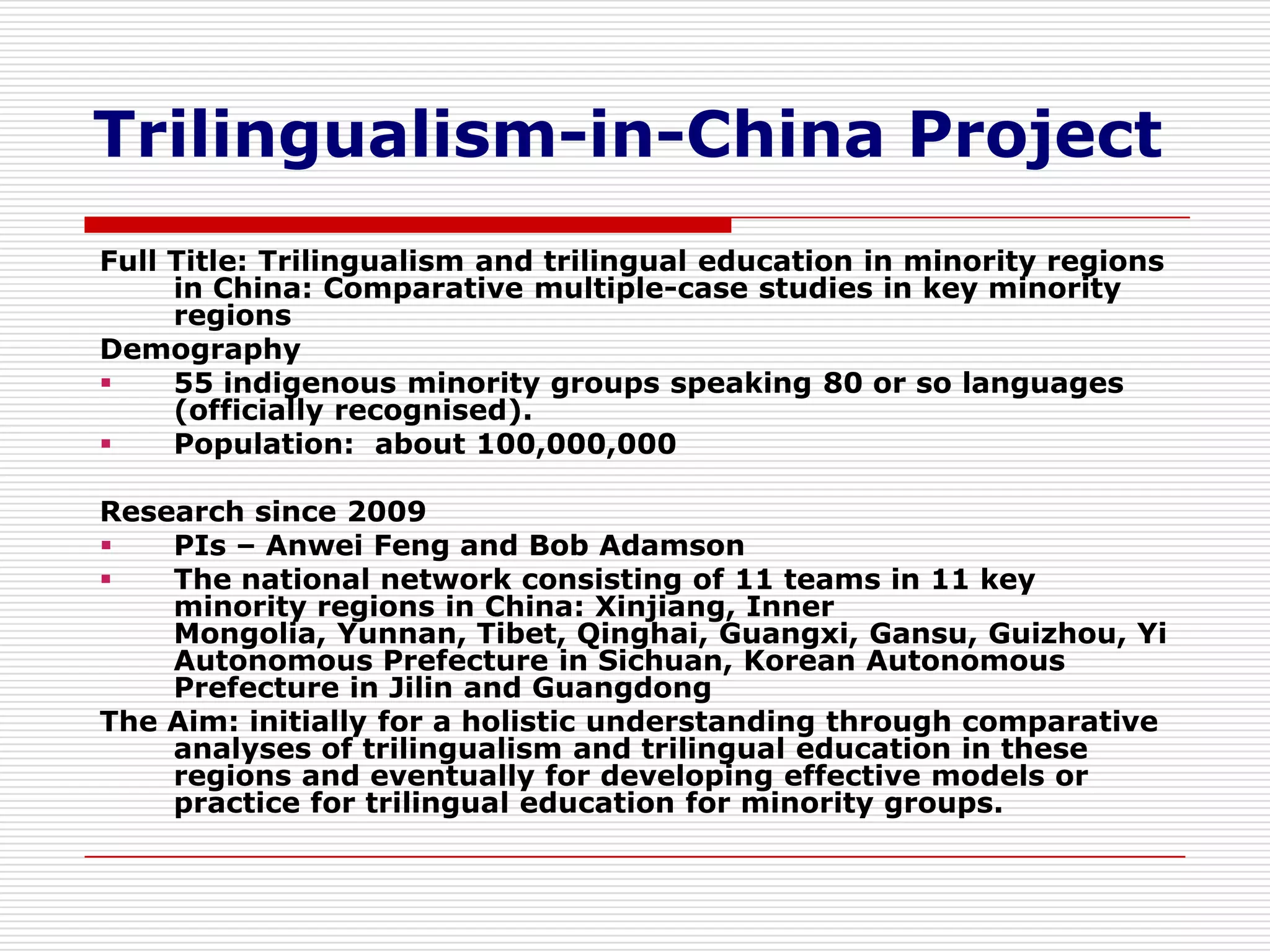
Trilingualism-in-China Project
Full Title: Trilingualism and trilingual education in minority regions
     in China: Comparative multiple-case studies in key minority
     regions
Demography
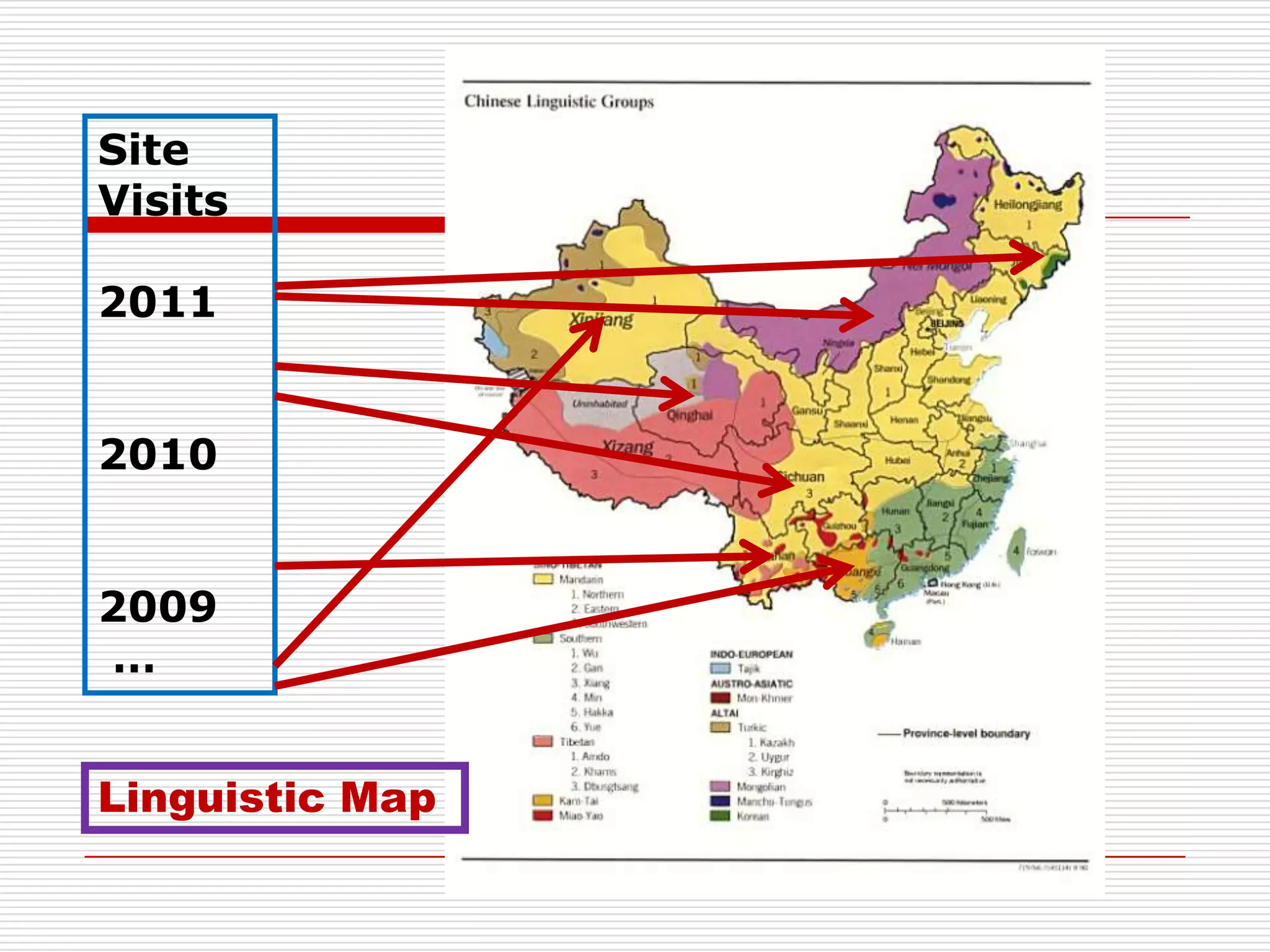
    55 indigenous minority groups speaking 80 or so languages
     (officially recognised).
    Population: about 100,000,000

Research since 2009
   PIs – Anwei Feng and Bob Adamson
   The national network consisting of 11 teams in 11 key
    minority regions in China: Xinjiang, Inner
    Mongolia, Yunnan, Tibet, Qinghai, Guangxi, Gansu, Guizhou, Yi
    Autonomous Prefecture in Sichuan, Korean Autonomous
    Prefecture in Jilin and Guangdong
The Aim: initially for a holistic understanding through comparative
    analyses of trilingualism and trilingual education in these
    regions and eventually for developing effective models or
    practice for trilingual education for minority groups.
Site
Visits

2011


2010


2009
…


Linguistic Map
Questions on RM
 How do the researchers deal with the language issues in the
  field?
 How does a researcher feel when he/she speaks all the three
  and can move freely across the languages?
 What if they do not speak the home language, L1, of the
  informants?
 What if they don’t even speak their L2?
 How do they cope with the situation when they conduct empirical
  study in an unfamiliar language and present the findings in
  another unfamiliar language?
 What issues are there in conducting research in these minority
  dominated regions?
Stories from Individuals (1)
Case 1 – A (balanced) trilingual leading the research team in a Korean
      speech community. She is professor in TESOL and speaks L1 and
      L2 equally fluently, and speaks some Japanese.

She strongly believes:
1.    To research in trilingual areas, the researcher ‘should be trilingual’, so that she/he is
      in the position to allow subjects to choose their strongest language to communicate.
     a.   Minority groups in the countryside, in mountainous regions and the aged are more
          likely to speak L1… it is difficult to conduct research if you don’t speak it.
     b.   Also, if you don’t speak their L1, you are unlikely to understand their culture and
          your understanding of their views, feelings and attitudes will be shallow.
     c.   However, not necessarily all Koreans speak L1 fluently. Some prefer L2.
2.    She said she functions equally well in any of the three languages. ‘No issues’ are felt
      concerning validity and reliability of data collection, analysis and dissemination.

     Most confident-sounding researcher with clear-cut views!
Stories from Individuals (2)

Case 2 – A native speaker of Chinese with strong competence in English
      but limited knowledge of the L1 (Yi) used in the region where he led
      a team to conduct research

He has the following to say:
1.    We research in a team in which two speak L1, so they provide us with translation.
     a.   The crucial role of the two members was most evident in remote, mountainous regions
          where people’s L2 competence was evidently weaker.
     b.   Importance in L1competence is not only evident during interviews, but more so before
          interviews or in casual conversations. Without establishing a good rapport, data would
          be shallow or inaccurate.
     c.   Questionnaires in both languages, but (strangely) the one in L1 was rarely used as few
          could read in L1. If anyone had difficulty in reading L2 questions, help was offered by
          the two members who speak L1.
Stories from Individuals (3)

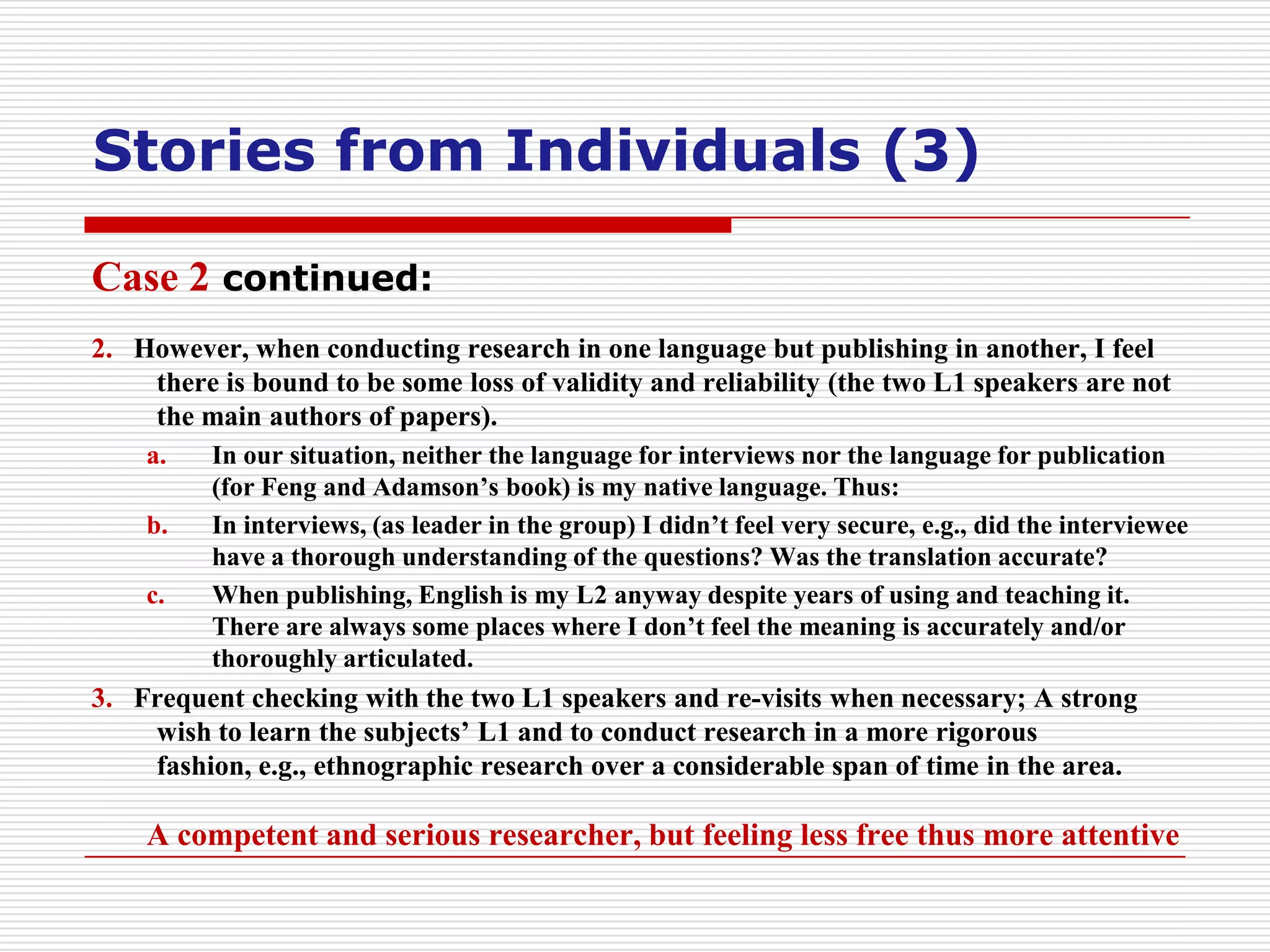
Case 2 continued:
2. However, when conducting research in one language but publishing in another, I feel
    there is bound to be some loss of validity and reliability (the two L1 speakers are not
    the main authors of papers).
    a.    In our situation, neither the language for interviews nor the language for publication
          (for Feng and Adamson’s book) is my native language. Thus:
    b.    In interviews, (as leader in the group) I didn’t feel very secure, e.g., did the interviewee
          have a thorough understanding of the questions? Was the translation accurate?
    c.    When publishing, English is my L2 anyway despite years of using and teaching it.
          There are always some places where I don’t feel the meaning is accurately and/or
          thoroughly articulated.
3. Frequent checking with the two L1 speakers and re-visits when necessary; A strong
    wish to learn the subjects’ L1 and to conduct research in a more rigorous
    fashion, e.g., ethnographic research over a considerable span of time in the area.

    A competent and serious researcher, but feeling less free thus more attentive
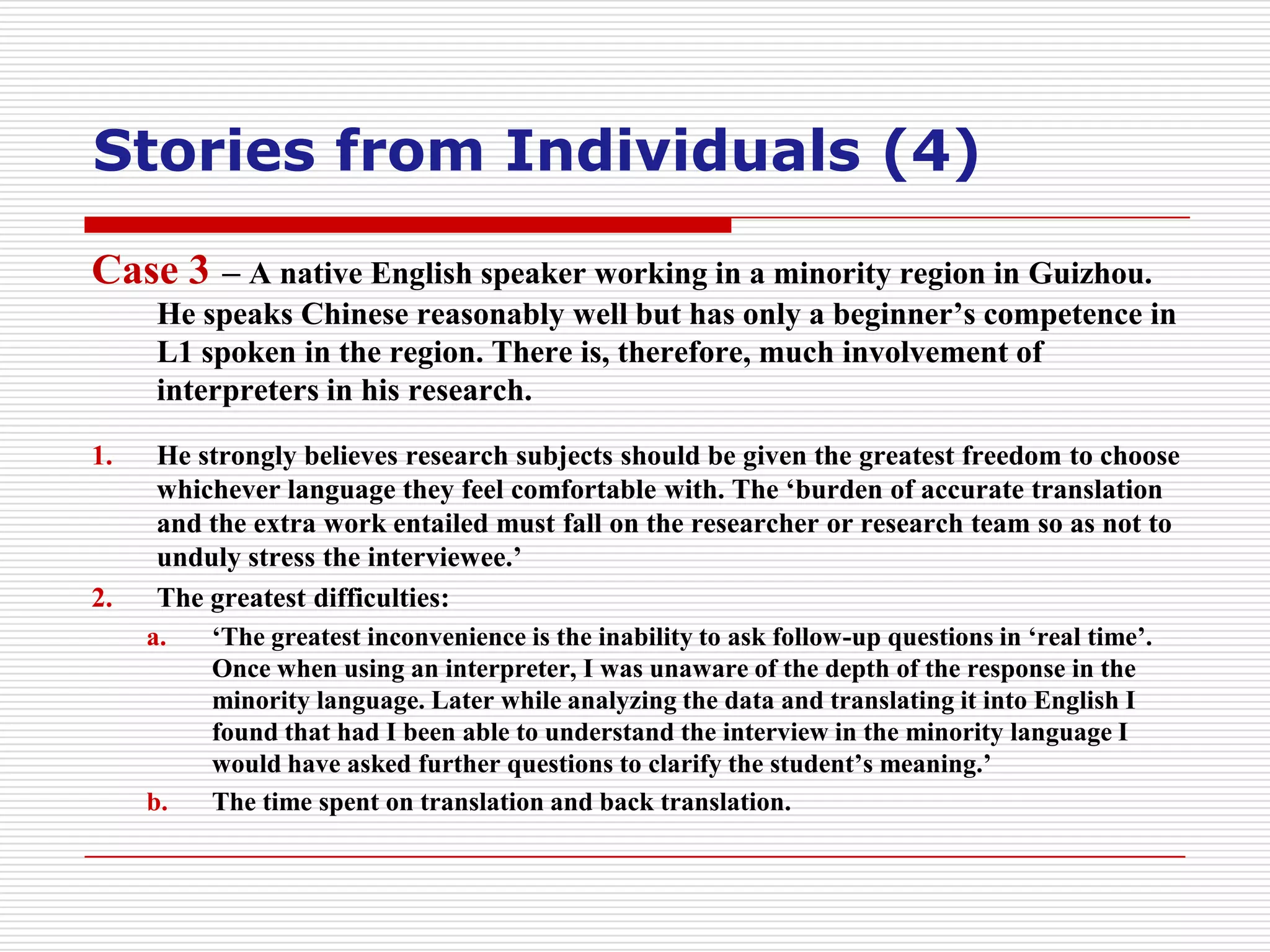
Stories from Individuals (4)
Case 3 – A native English speaker working in a minority region in Guizhou.
      He speaks Chinese reasonably well but has only a beginner’s competence in
      L1 spoken in the region. There is, therefore, much involvement of
      interpreters in his research.

1.    He strongly believes research subjects should be given the greatest freedom to choose
      whichever language they feel comfortable with. The ‘burden of accurate translation
      and the extra work entailed must fall on the researcher or research team so as not to
      unduly stress the interviewee.’
2.    The greatest difficulties:
     a.   ‘The greatest inconvenience is the inability to ask follow-up questions in ‘real time’.
          Once when using an interpreter, I was unaware of the depth of the response in the
          minority language. Later while analyzing the data and translating it into English I
          found that had I been able to understand the interview in the minority language I
          would have asked further questions to clarify the student’s meaning.’
     b.   The time spent on translation and back translation.
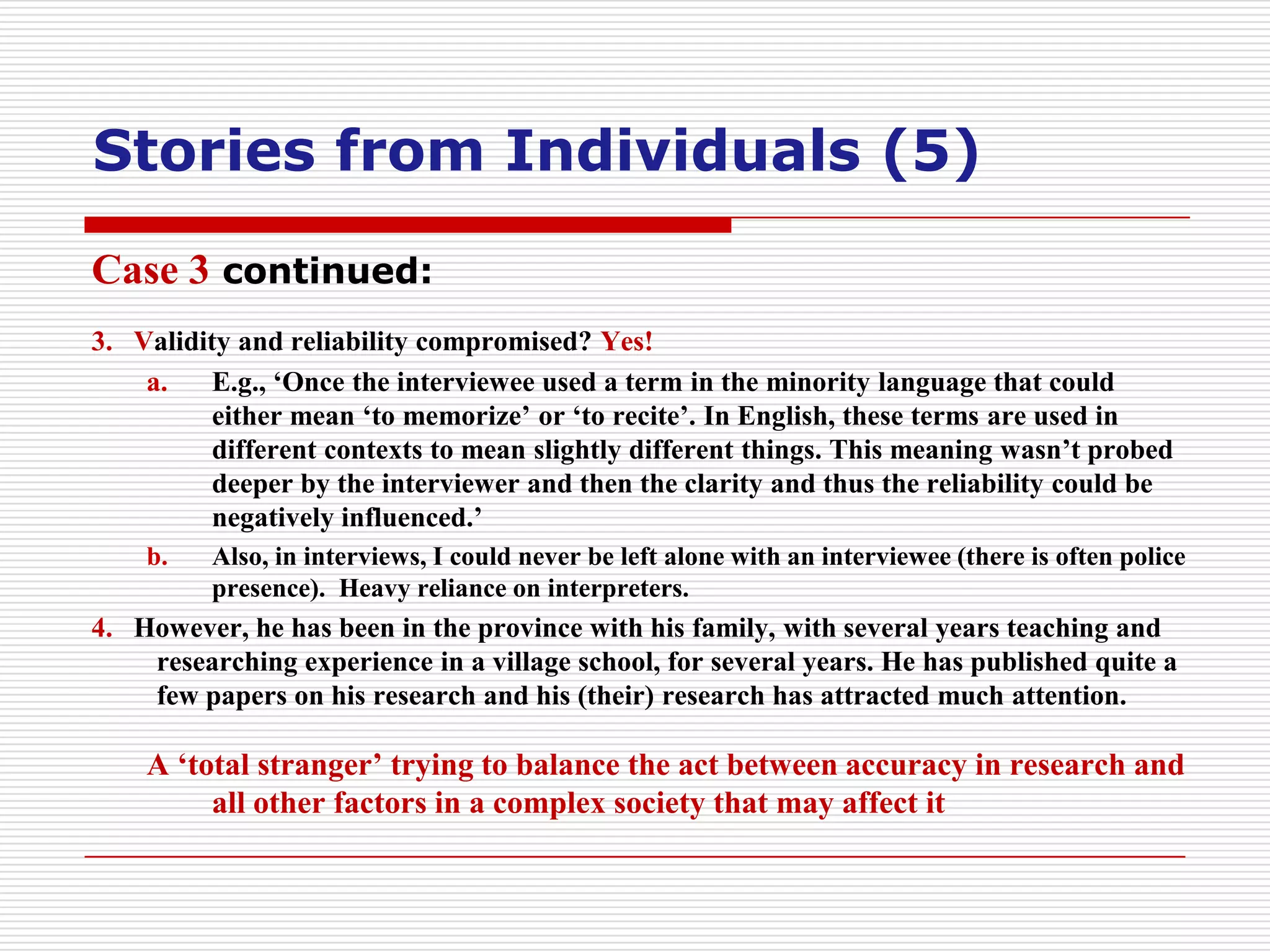
Stories from Individuals (5)
Case 3 continued:
3. Validity and reliability compromised? Yes!
    a.    E.g., ‘Once the interviewee used a term in the minority language that could
          either mean ‘to memorize’ or ‘to recite’. In English, these terms are used in
          different contexts to mean slightly different things. This meaning wasn’t probed
          deeper by the interviewer and then the clarity and thus the reliability could be
          negatively influenced.’
    b.    Also, in interviews, I could never be left alone with an interviewee (there is often police
          presence). Heavy reliance on interpreters.
4. However, he has been in the province with his family, with several years teaching and
    researching experience in a village school, for several years. He has published quite a
    few papers on his research and his (their) research has attracted much attention.

    A ‘total stranger’ trying to balance the act between accuracy in research and
         all other factors in a complex society that may affect it
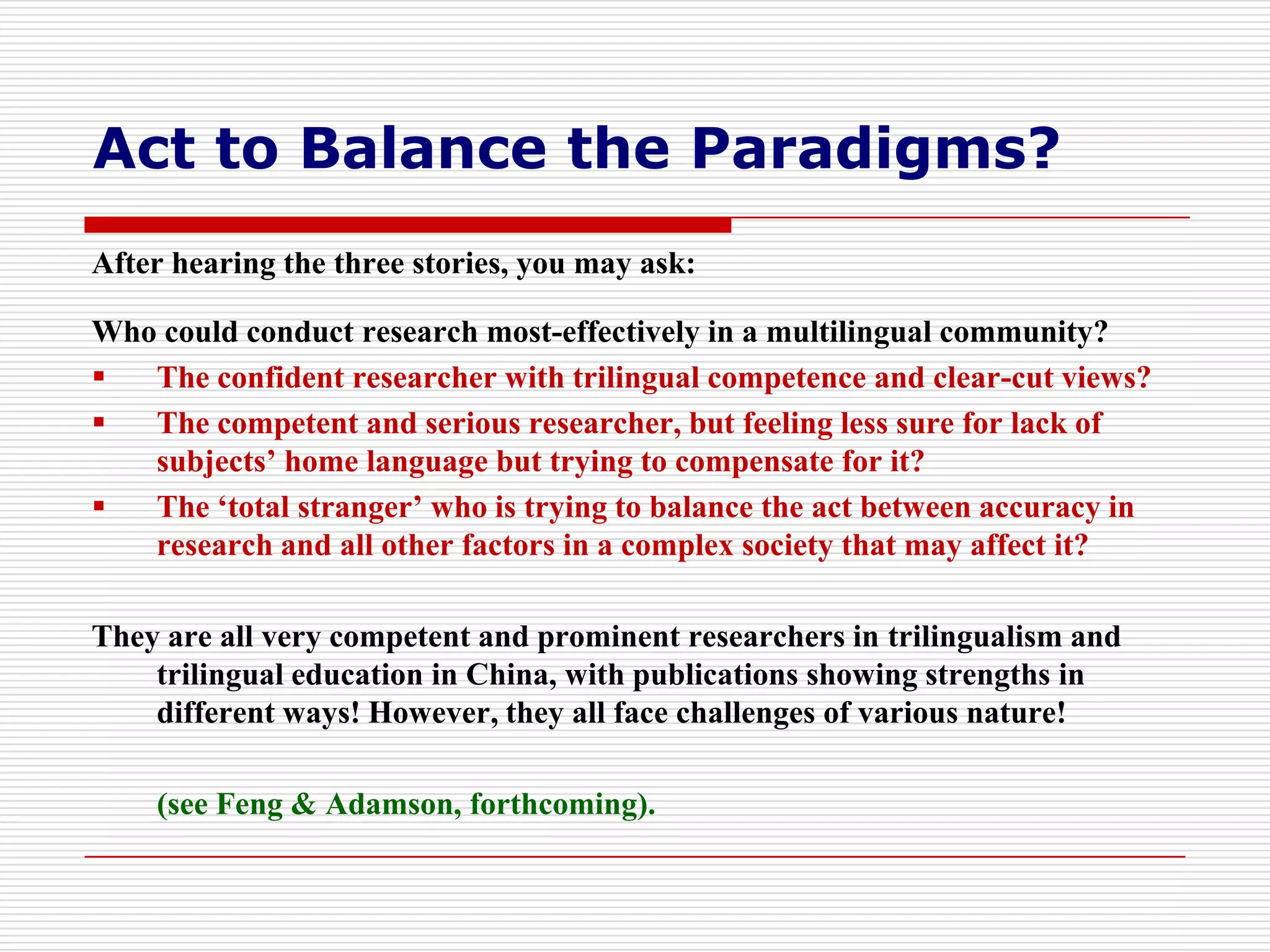
Act to Balance the Paradigms?
After hearing the three stories, you may ask:

Who could conduct research most-effectively in a multilingual community?
  The confident researcher with trilingual competence and clear-cut views?
  The competent and serious researcher, but feeling less sure for lack of
   subjects’ home language but trying to compensate for it?
  The ‘total stranger’ who is trying to balance the act between accuracy in
   research and all other factors in a complex society that may affect it?

They are all very competent and prominent researchers in trilingualism and
    trilingual education in China, with publications showing strengths in
    different ways! However, they all face challenges of various nature!

    (see Feng & Adamson, forthcoming).
C&Q


Comments?
Questions?

Thanks! 多谢!Diolch!

Email: Anwei.Feng@bangor.ac.uk

Anwei Feng

  • 1.
    Researching in MultilingualCommunities — An Act to Balance the Paradigms Dr Anwei Feng Bangor University, UK Email: Anwei.Feng@bangor.ac.uk
  • 2.
    The Paradigm Shift Is RM simply a matter of translation accuracy?  A supervisor’s reflection (‘Only a few words or terms have no equivalents. In such a case, use the original in La and give it a best explanation in Lb’.)  Traditional literature (translation, back-translation, …) (Fink, 1963; Werner & Campbell, 1970) – positivist paradigm.  In real world research,  Due to dynamics of the language-culture relationship and the notion of cultural untranslatability (Snell-Hornby, 2006), theorists in translation have long agreed that meaning should be contextualised in the broader field of language, culture, and power. There has been a shift to interpretivist paradigm (Jagosh & Boudreau, 2009).
  • 3.
    Under-Discussed Essential  Experience in trilingualism-in-China project suggests that language issues have been present during the whole process of the research  Who to contact? (Should they be necessarily trilinguals?)  Which regions to focus on? (Should the highly linguistically assimilated regions included?)  What language should we use for designing research tools? (L1, L2, or L3?)  What language should we use at the symposia? (majority mother tongue, or English?)  What language should we use for interviews?  Would validity and reliability be affected during data collection, transcription translation, data analysis and presentation?  Are unbalanced trilinguals necessarily weaker researchers?  How do we editors make the research results publishable without affecting original meaning or valid arguments in authors’ L1 (or L2)  …
  • 4.
    Unforgettable Anecdotes  Avisit to Xining, Qinghai  Kumbum Monastery (Ta’ersi) – Panchen Lama  Longwu Temple – Dalai Lama  A visit to the Butterfly Spring in Dali, Yunnan  A dancer in the performing group, ‘I’m Bai.’ (for commercial reasons?). Is she?  Group interview: (Let’s discuss it among ourselves first!)
  • 5.
    Trilingualism-in-China Project Full Title:Trilingualism and trilingual education in minority regions in China: Comparative multiple-case studies in key minority regions Demography  55 indigenous minority groups speaking 80 or so languages (officially recognised).  Population: about 100,000,000 Research since 2009  PIs – Anwei Feng and Bob Adamson  The national network consisting of 11 teams in 11 key minority regions in China: Xinjiang, Inner Mongolia, Yunnan, Tibet, Qinghai, Guangxi, Gansu, Guizhou, Yi Autonomous Prefecture in Sichuan, Korean Autonomous Prefecture in Jilin and Guangdong The Aim: initially for a holistic understanding through comparative analyses of trilingualism and trilingual education in these regions and eventually for developing effective models or practice for trilingual education for minority groups.
  • 6.
  • 7.
    Questions on RM How do the researchers deal with the language issues in the field?  How does a researcher feel when he/she speaks all the three and can move freely across the languages?  What if they do not speak the home language, L1, of the informants?  What if they don’t even speak their L2?  How do they cope with the situation when they conduct empirical study in an unfamiliar language and present the findings in another unfamiliar language?  What issues are there in conducting research in these minority dominated regions?
  • 8.
    Stories from Individuals(1) Case 1 – A (balanced) trilingual leading the research team in a Korean speech community. She is professor in TESOL and speaks L1 and L2 equally fluently, and speaks some Japanese. She strongly believes: 1. To research in trilingual areas, the researcher ‘should be trilingual’, so that she/he is in the position to allow subjects to choose their strongest language to communicate. a. Minority groups in the countryside, in mountainous regions and the aged are more likely to speak L1… it is difficult to conduct research if you don’t speak it. b. Also, if you don’t speak their L1, you are unlikely to understand their culture and your understanding of their views, feelings and attitudes will be shallow. c. However, not necessarily all Koreans speak L1 fluently. Some prefer L2. 2. She said she functions equally well in any of the three languages. ‘No issues’ are felt concerning validity and reliability of data collection, analysis and dissemination. Most confident-sounding researcher with clear-cut views!
  • 9.
    Stories from Individuals(2) Case 2 – A native speaker of Chinese with strong competence in English but limited knowledge of the L1 (Yi) used in the region where he led a team to conduct research He has the following to say: 1. We research in a team in which two speak L1, so they provide us with translation. a. The crucial role of the two members was most evident in remote, mountainous regions where people’s L2 competence was evidently weaker. b. Importance in L1competence is not only evident during interviews, but more so before interviews or in casual conversations. Without establishing a good rapport, data would be shallow or inaccurate. c. Questionnaires in both languages, but (strangely) the one in L1 was rarely used as few could read in L1. If anyone had difficulty in reading L2 questions, help was offered by the two members who speak L1.
  • 10.
    Stories from Individuals(3) Case 2 continued: 2. However, when conducting research in one language but publishing in another, I feel there is bound to be some loss of validity and reliability (the two L1 speakers are not the main authors of papers). a. In our situation, neither the language for interviews nor the language for publication (for Feng and Adamson’s book) is my native language. Thus: b. In interviews, (as leader in the group) I didn’t feel very secure, e.g., did the interviewee have a thorough understanding of the questions? Was the translation accurate? c. When publishing, English is my L2 anyway despite years of using and teaching it. There are always some places where I don’t feel the meaning is accurately and/or thoroughly articulated. 3. Frequent checking with the two L1 speakers and re-visits when necessary; A strong wish to learn the subjects’ L1 and to conduct research in a more rigorous fashion, e.g., ethnographic research over a considerable span of time in the area. A competent and serious researcher, but feeling less free thus more attentive
  • 11.
    Stories from Individuals(4) Case 3 – A native English speaker working in a minority region in Guizhou. He speaks Chinese reasonably well but has only a beginner’s competence in L1 spoken in the region. There is, therefore, much involvement of interpreters in his research. 1. He strongly believes research subjects should be given the greatest freedom to choose whichever language they feel comfortable with. The ‘burden of accurate translation and the extra work entailed must fall on the researcher or research team so as not to unduly stress the interviewee.’ 2. The greatest difficulties: a. ‘The greatest inconvenience is the inability to ask follow-up questions in ‘real time’. Once when using an interpreter, I was unaware of the depth of the response in the minority language. Later while analyzing the data and translating it into English I found that had I been able to understand the interview in the minority language I would have asked further questions to clarify the student’s meaning.’ b. The time spent on translation and back translation.
  • 12.
    Stories from Individuals(5) Case 3 continued: 3. Validity and reliability compromised? Yes! a. E.g., ‘Once the interviewee used a term in the minority language that could either mean ‘to memorize’ or ‘to recite’. In English, these terms are used in different contexts to mean slightly different things. This meaning wasn’t probed deeper by the interviewer and then the clarity and thus the reliability could be negatively influenced.’ b. Also, in interviews, I could never be left alone with an interviewee (there is often police presence). Heavy reliance on interpreters. 4. However, he has been in the province with his family, with several years teaching and researching experience in a village school, for several years. He has published quite a few papers on his research and his (their) research has attracted much attention. A ‘total stranger’ trying to balance the act between accuracy in research and all other factors in a complex society that may affect it
  • 13.
    Act to Balancethe Paradigms? After hearing the three stories, you may ask: Who could conduct research most-effectively in a multilingual community?  The confident researcher with trilingual competence and clear-cut views?  The competent and serious researcher, but feeling less sure for lack of subjects’ home language but trying to compensate for it?  The ‘total stranger’ who is trying to balance the act between accuracy in research and all other factors in a complex society that may affect it? They are all very competent and prominent researchers in trilingualism and trilingual education in China, with publications showing strengths in different ways! However, they all face challenges of various nature! (see Feng & Adamson, forthcoming).
  • 14.