Researching Multilingually at the
Borders of Language, the Body, Law
and the State
Funded by the Arts and Humanities Research Council (UK) through the Translating Cultures Programme
[grant reference AH/L006936/1]
Case Study 3 Presentation
Working and Researching Multilingually in
Bulgaria and Romania
Drs. Julien Danero Iglesias and Robert Gibb
(University of Glasgow)
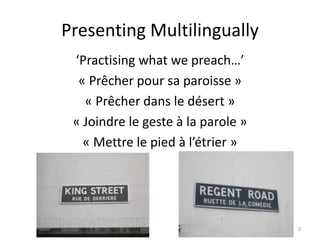
Presenting Multilingually
‘Practising what we preach…’
« Prêcher pour sa paroisse »
« Prêcher dans le désert »
« Joindre le geste à la parole »
« Mettre le pied à l’étrier »
2
Case Study Themes
Working
Multi-
lingually
Researching
Multi-
lingually
StateandEUBorders
StateandEUBorders
Border(s) and Identity(ies)
Influence of borders on identity:
- Acknowledged and implicit (Anderson, Gellner)
- But not studied much (Newman, 2006)
Two main approaches to the issue:
- International relations (Lapid, Albert, Jacobson)
- “Border Anthropology” influenced by Barth (1969):
Wilson and Donnan (1998) and individual case
studies (Ackleson, Paassi, Berdhal)
4
Selected Case
Influence of the EU border on the identity of those on the
‘wrong’ side: Moldova, Serbia, Ukraine.
Starting point: bordering and mainly “re-bordering” (Albert and
Brock, 1996)
Influence of research by Arambasa, Iordachi, Michalon,
Tomescu-Hatto, Sikimic and Jozwiak
Border: Separation, Resource and Symbol
5
Researching Multilingually
Initial Question
What sorts of issues are raised when more than
one language is used in a sociological or
anthropological research project?
Possible ‘Researching Multilingually’ Puzzles
1. How do researchers learn new languages (or use ‘old’
ones) for the purpose of conducting research (in particular,
ethnographic research)?
2. Why should researchers reflect continuously and critically
on the process of language learning (or use) in fieldwork
(and other types of research), and how can they actually do
this in practice?
3. How can music, poetry and film be used to facilitate
language learning (or use) for research purposes (in
addition to being methods of research in themselves)?

Cs3 presentation durham symposium

  • 1.
    Researching Multilingually atthe Borders of Language, the Body, Law and the State Funded by the Arts and Humanities Research Council (UK) through the Translating Cultures Programme [grant reference AH/L006936/1] Case Study 3 Presentation Working and Researching Multilingually in Bulgaria and Romania Drs. Julien Danero Iglesias and Robert Gibb (University of Glasgow)
  • 2.
    Presenting Multilingually ‘Practising whatwe preach…’ « Prêcher pour sa paroisse » « Prêcher dans le désert » « Joindre le geste à la parole » « Mettre le pied à l’étrier » 2
  • 3.
  • 4.
    Border(s) and Identity(ies) Influenceof borders on identity: - Acknowledged and implicit (Anderson, Gellner) - But not studied much (Newman, 2006) Two main approaches to the issue: - International relations (Lapid, Albert, Jacobson) - “Border Anthropology” influenced by Barth (1969): Wilson and Donnan (1998) and individual case studies (Ackleson, Paassi, Berdhal) 4
  • 5.
    Selected Case Influence ofthe EU border on the identity of those on the ‘wrong’ side: Moldova, Serbia, Ukraine. Starting point: bordering and mainly “re-bordering” (Albert and Brock, 1996) Influence of research by Arambasa, Iordachi, Michalon, Tomescu-Hatto, Sikimic and Jozwiak Border: Separation, Resource and Symbol 5
  • 6.
    Researching Multilingually Initial Question Whatsorts of issues are raised when more than one language is used in a sociological or anthropological research project?
  • 7.
    Possible ‘Researching Multilingually’Puzzles 1. How do researchers learn new languages (or use ‘old’ ones) for the purpose of conducting research (in particular, ethnographic research)? 2. Why should researchers reflect continuously and critically on the process of language learning (or use) in fieldwork (and other types of research), and how can they actually do this in practice? 3. How can music, poetry and film be used to facilitate language learning (or use) for research purposes (in addition to being methods of research in themselves)?

Editor's Notes

  • #2 Handout – RQs Table -