DILLI HAAT-JANAKPURI
SUBMITTED BY-VARUN GOYAL
ARC268
11504750
C1501
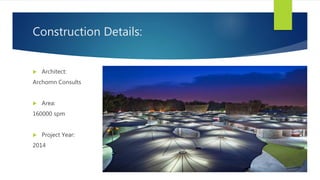
Construction Details:
 Architect:
Archomn Consults
 Area:
160000 spm
 Project Year:
2014
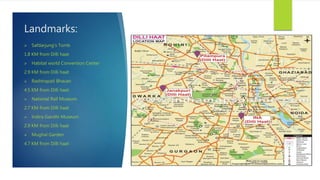
Landmarks:
 Safdarjung’s Tomb
1.8 KM from Dilli haat
 Habitat world Convention Center
2.9 KM from Dilli haat
 Rashtrapati Bhavan
4.5 KM from Dilli haat
 National Rail Museum
2.7 KM from Dilli haat
 Indira Gandhi Museum
2.9 KM from Dilli haat
 Mughal Garden
4.7 KM from Dilli haat
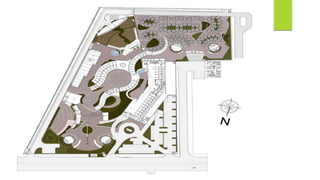
Planning :
SHOPS
AMBI-
THEATRE
PARK
FOOD
COURT
PARKINGENTRY
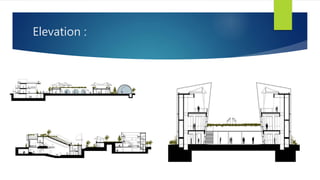
Elevation :
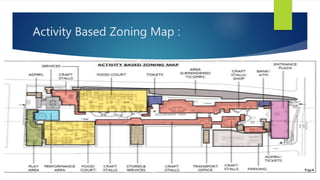
Activity Based Zoning Map :
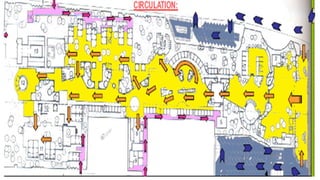
Circulation :
Concept :
 Conception of the program is as Large a design intervention as its physical ,manifestation.
The final functionality found an indoor, well equipped 800 capacity auditorium for formal
concerts and an informal similar capacity open-air mphitheater that works simultaneously
with independent spaces and support services.
 A multipurpose , multi scaled exposition hall for exhibitions and seminars is proposed.
 A set of four baskets houses a music museum, a music store and music workshop space.
 A large ,air conditioned food court extends into shaded courtyards and expansive greens for
the basic needs of spill overs.
 Formal , informal and open shop spaces are created to bring in the required sensitive
adaptions of malls markets and bazaars into this haat .
Material :
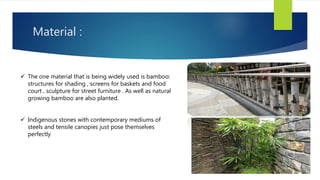
 The one material that is being widely used is bamboo:
structures for shading , screens for baskets and food
court , sculpture for street furniture . As well as natural
growing bamboo are also planted.
 Indigenous stones with contemporary mediums of
steels and tensile canopies just pose themselves
perfectly
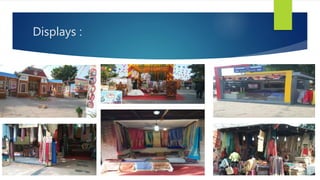
Displays :
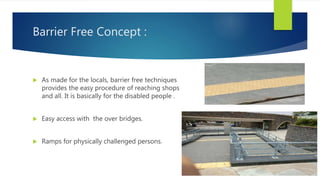
Barrier Free Concept :
 As made for the locals, barrier free techniques
provides the easy procedure of reaching shops
and all. It is basically for the disabled people .
 Easy access with the over bridges.
 Ramps for physically challenged persons.
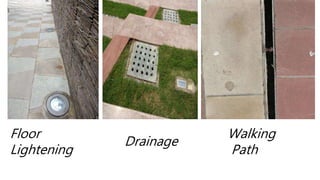
Floor
Lightening
Walking
Path
Drainage
Efficiency :
 Evolved from an open left over space with storm water drain, garbage dump
and a line of some vegetation, Dilli Haat has emerged as an active and engaging
public space with an over growing demand and high footfalls.
 The chosen site of 100 x 300m comprised of a 23m wide storm water drain
(‘Nallah’ in local language), a garbage dumping ground often used for outdoor
defecation and sanitation purposes.
 Along the site were number of trees lining both sides of the drain, giving it a
linear flowing character but with an identity of a left over space.
 It witnesses up to 7000 people on weekends or holidays and about 3000 on
weekdays.
Inference :
 Green space is provided at relevant spaces.
 Consist of many negative spaces which are a place of dust collection.
 Unauthorised stalls have been setup.
 Location of drinking water is not appropriate i.e. near to the washrooms.
 Number of ramps to reach different level are less are at far distances.
 Not all service entries are used.
 The placement system of stalls is convincing.
 Temporary stalls structure can be improvised.
 Every kitchen has its own gas and water supply.
Thank
You

Dilli haat - Janakpuri

  • 1.
    DILLI HAAT-JANAKPURI SUBMITTED BY-VARUNGOYAL ARC268 11504750 C1501
  • 2.
    Construction Details:  Architect: ArchomnConsults  Area: 160000 spm  Project Year: 2014
  • 3.
    Landmarks:  Safdarjung’s Tomb 1.8KM from Dilli haat  Habitat world Convention Center 2.9 KM from Dilli haat  Rashtrapati Bhavan 4.5 KM from Dilli haat  National Rail Museum 2.7 KM from Dilli haat  Indira Gandhi Museum 2.9 KM from Dilli haat  Mughal Garden 4.7 KM from Dilli haat
  • 4.
  • 5.
  • 6.
  • 7.
  • 8.
  • 9.
    Concept :  Conceptionof the program is as Large a design intervention as its physical ,manifestation. The final functionality found an indoor, well equipped 800 capacity auditorium for formal concerts and an informal similar capacity open-air mphitheater that works simultaneously with independent spaces and support services.  A multipurpose , multi scaled exposition hall for exhibitions and seminars is proposed.  A set of four baskets houses a music museum, a music store and music workshop space.  A large ,air conditioned food court extends into shaded courtyards and expansive greens for the basic needs of spill overs.  Formal , informal and open shop spaces are created to bring in the required sensitive adaptions of malls markets and bazaars into this haat .
  • 10.
    Material :  Theone material that is being widely used is bamboo: structures for shading , screens for baskets and food court , sculpture for street furniture . As well as natural growing bamboo are also planted.  Indigenous stones with contemporary mediums of steels and tensile canopies just pose themselves perfectly
  • 11.
  • 12.
    Barrier Free Concept:  As made for the locals, barrier free techniques provides the easy procedure of reaching shops and all. It is basically for the disabled people .  Easy access with the over bridges.  Ramps for physically challenged persons.
  • 13.
  • 14.
    Efficiency :  Evolvedfrom an open left over space with storm water drain, garbage dump and a line of some vegetation, Dilli Haat has emerged as an active and engaging public space with an over growing demand and high footfalls.  The chosen site of 100 x 300m comprised of a 23m wide storm water drain (‘Nallah’ in local language), a garbage dumping ground often used for outdoor defecation and sanitation purposes.  Along the site were number of trees lining both sides of the drain, giving it a linear flowing character but with an identity of a left over space.  It witnesses up to 7000 people on weekends or holidays and about 3000 on weekdays.
  • 15.
    Inference :  Greenspace is provided at relevant spaces.  Consist of many negative spaces which are a place of dust collection.  Unauthorised stalls have been setup.  Location of drinking water is not appropriate i.e. near to the washrooms.  Number of ramps to reach different level are less are at far distances.  Not all service entries are used.  The placement system of stalls is convincing.  Temporary stalls structure can be improvised.  Every kitchen has its own gas and water supply.
  • 16.