Alignment by Design Risk-Based Quality Auditing Going Beyond Compliance In Pursuit of Effectiveness Thomas Bradley, PhD [email_address] Alignment by Design, Inc.
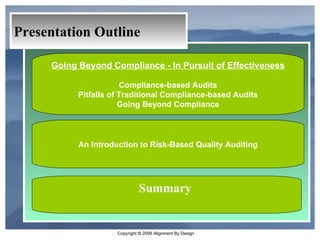
An Introduction to Risk-Based Quality Auditing Summary   Going Beyond Compliance - In Pursuit of Effectiveness Compliance-based Audits Pitfalls of Traditional Compliance-based Audits Going Beyond Compliance Presentation Outline
Going Beyond Compliance - In Pursuit of Effectiveness Compliance-based Audits Pitfalls of Traditional Compliance-based Audits Going Beyond Compliance
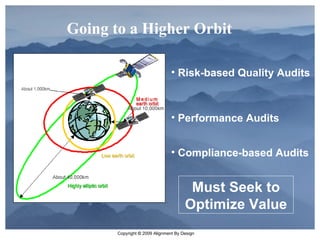
Going to a Higher Orbit Compliance-based Audits Performance Audits Risk-based Quality Audits Must Seek to Optimize Value
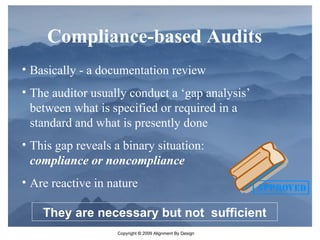
Basically - a documentation review The auditor usually conduct a ‘gap analysis’ between what is specified or required in a standard and what is presently done This gap reveals a binary situation:  compliance or noncompliance Are reactive in nature Compliance-based Audits They are necessary but not  sufficient
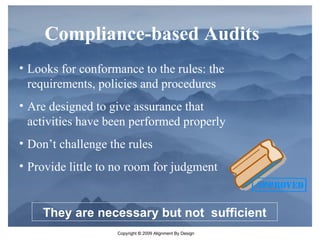
Looks for conformance to the rules: the requirements, policies and procedures Are designed to give assurance that activities have been performed properly Don’t challenge the rules Provide little to no room for judgment Compliance-based Audits They are necessary but not  sufficient
Pitfalls of Traditional Compliance-based Audits Only determines compliance to a set of policies or requirements. Reactive versus proactive Provides a static versus dynamic  perspective Compliance don’t mean effective They have their limits
Pitfalls of Traditional Compliance-based Audits Don’t identify risks associated with the QMS achieving objectives Don’t assess performance or effectiveness of the QMS Compliance don’t correlate to customer satisfaction or business results They have their limits
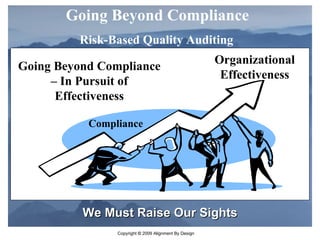
Organizational Effectiveness Going Beyond Compliance – In Pursuit of Effectiveness Compliance We Must Raise Our Sights Going Beyond Compliance Risk-Based Quality Auditing
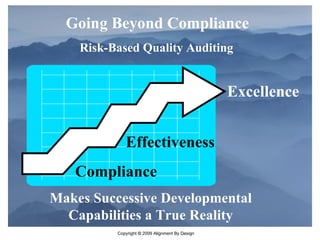
Going Beyond Compliance Risk-Based Quality Auditing   Makes Successive Developmental Capabilities a True Reality Compliance Effectiveness Excellence
An Introduction to  Risk-Based Quality Auditing
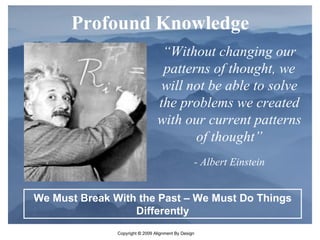
“ Without changing our patterns of thought, we will not be able to solve the problems we created with our current patterns of thought” - Albert Einstein Profound Knowledge  We Must Break With the Past – We Must Do Things Differently
In a  Risk Based Quality Audit   the rules are challenged.  A fundamental goal of a  Risk Based Quality Audits  is to be proactive – it consistently asks the question,  “can the enterprise get from here to there with the controls its has in place.” It takes a much closer look at the organization Interworkings Risk Based Quality Audits
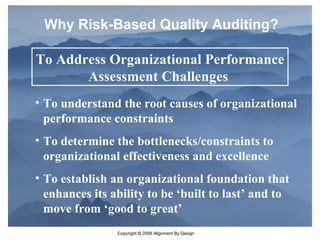
To Address Organizational Performance Assessment Challenges  To understand the root causes of organizational performance constraints To determine the bottlenecks/constraints to organizational effectiveness and excellence To establish an organizational foundation that enhances its ability to be ‘built to last’ and to move from ‘good to great’  Why Risk-Based Quality Auditing?
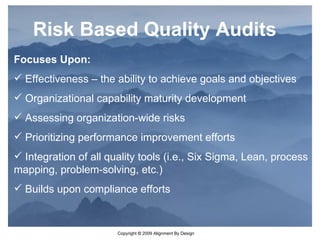
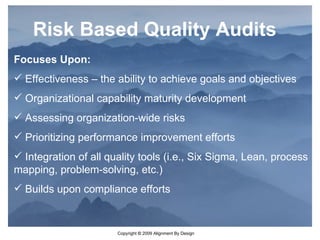
Focuses Upon: Effectiveness – the ability to achieve goals and objectives Organizational capability maturity development Assessing organization-wide risks Prioritizing performance improvement efforts Integration of all quality tools (i.e., Six Sigma, Lean, process mapping, problem-solving, etc.) Builds upon compliance efforts Risk Based Quality Audits
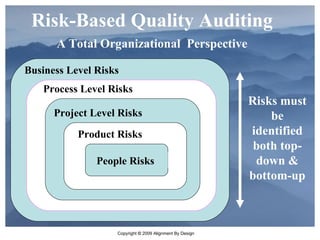
Risk-Based Quality Auditing A Total Organizational  Perspective Business Level Risks Process Level Risks Risks must be identified both top-down & bottom-up Project Level Risks Product Risks People Risks
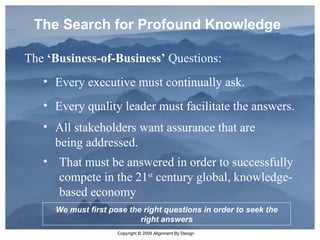
That must be answered in order to successfully compete in the 21 st  century global, knowledge-based economy The  ‘Business-of-Business’  Questions: Every executive must continually ask. Every quality leader must facilitate the answers. All stakeholders want assurance that are being addressed. The Search for Profound Knowledge We must first pose the right questions in order to seek the right answers
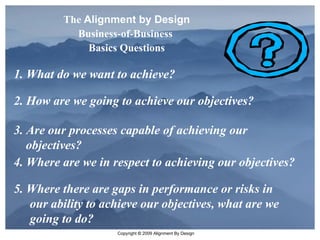
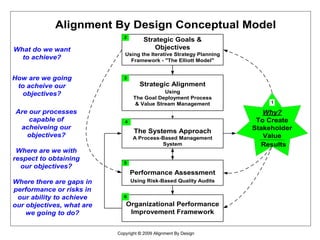
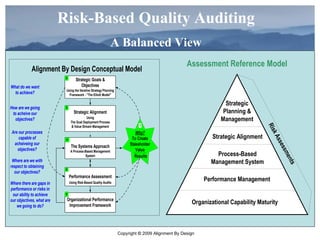
The  Alignment by Design Business-of-Business  Basics Questions 5. Where there are gaps in performance or risks in our ability to achieve our objectives, what are we going to do? 1. What do we want to achieve? 2. How are we going to achieve our objectives? 3. Are our processes capable of achieving our objectives? 4. Where are we in respect to achieving our objectives?
 
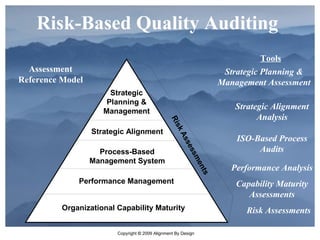
Risk-Based Quality Auditing Strategic Planning & Management Assessment Strategic Alignment Analysis ISO-Based Process Audits Performance Analysis Capability Maturity Assessments Risk Assessments Tools Assessment Reference Model
Risk-Based Quality Auditing A Balanced View
Summary
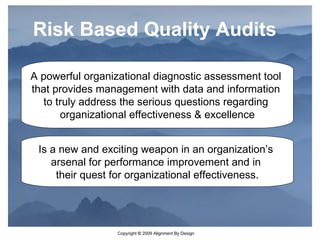
Risk Based Quality Audits Is a new and exciting weapon in an organization’s  arsenal for performance improvement and in  their quest for organizational effectiveness. A powerful organizational diagnostic assessment tool  that provides management with data and information  to truly address the serious questions regarding  organizational effectiveness & excellence
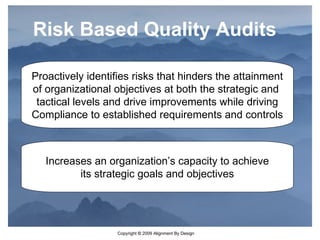
Risk Based Quality Audits Proactively identifies risks that hinders the attainment of organizational objectives at both the strategic and  tactical levels and drive improvements while driving Compliance to established requirements and controls Increases an organization’s capacity to achieve its strategic goals and objectives
For more information on This exciting and powerful methodology Visit our web site at www.alignmentbydesign.com or,   Contact Tom Bradley, PhD via email at [email_address]

Risk Based Quality Audit Part 1

  • 1.
    Alignment by DesignRisk-Based Quality Auditing Going Beyond Compliance In Pursuit of Effectiveness Thomas Bradley, PhD [email_address] Alignment by Design, Inc.
  • 2.
    An Introduction toRisk-Based Quality Auditing Summary Going Beyond Compliance - In Pursuit of Effectiveness Compliance-based Audits Pitfalls of Traditional Compliance-based Audits Going Beyond Compliance Presentation Outline
  • 3.
    Going Beyond Compliance- In Pursuit of Effectiveness Compliance-based Audits Pitfalls of Traditional Compliance-based Audits Going Beyond Compliance
  • 4.
    Going to aHigher Orbit Compliance-based Audits Performance Audits Risk-based Quality Audits Must Seek to Optimize Value
  • 5.
    Basically - adocumentation review The auditor usually conduct a ‘gap analysis’ between what is specified or required in a standard and what is presently done This gap reveals a binary situation: compliance or noncompliance Are reactive in nature Compliance-based Audits They are necessary but not sufficient
  • 6.
    Looks for conformanceto the rules: the requirements, policies and procedures Are designed to give assurance that activities have been performed properly Don’t challenge the rules Provide little to no room for judgment Compliance-based Audits They are necessary but not sufficient
  • 7.
    Pitfalls of TraditionalCompliance-based Audits Only determines compliance to a set of policies or requirements. Reactive versus proactive Provides a static versus dynamic perspective Compliance don’t mean effective They have their limits
  • 8.
    Pitfalls of TraditionalCompliance-based Audits Don’t identify risks associated with the QMS achieving objectives Don’t assess performance or effectiveness of the QMS Compliance don’t correlate to customer satisfaction or business results They have their limits
  • 9.
    Organizational Effectiveness GoingBeyond Compliance – In Pursuit of Effectiveness Compliance We Must Raise Our Sights Going Beyond Compliance Risk-Based Quality Auditing
  • 10.
    Going Beyond ComplianceRisk-Based Quality Auditing Makes Successive Developmental Capabilities a True Reality Compliance Effectiveness Excellence
  • 11.
    An Introduction to Risk-Based Quality Auditing
  • 12.
    “ Without changingour patterns of thought, we will not be able to solve the problems we created with our current patterns of thought” - Albert Einstein Profound Knowledge We Must Break With the Past – We Must Do Things Differently
  • 13.
    In a Risk Based Quality Audit the rules are challenged. A fundamental goal of a Risk Based Quality Audits is to be proactive – it consistently asks the question, “can the enterprise get from here to there with the controls its has in place.” It takes a much closer look at the organization Interworkings Risk Based Quality Audits
  • 14.
    To Address OrganizationalPerformance Assessment Challenges To understand the root causes of organizational performance constraints To determine the bottlenecks/constraints to organizational effectiveness and excellence To establish an organizational foundation that enhances its ability to be ‘built to last’ and to move from ‘good to great’ Why Risk-Based Quality Auditing?
  • 15.
    Focuses Upon: Effectiveness– the ability to achieve goals and objectives Organizational capability maturity development Assessing organization-wide risks Prioritizing performance improvement efforts Integration of all quality tools (i.e., Six Sigma, Lean, process mapping, problem-solving, etc.) Builds upon compliance efforts Risk Based Quality Audits
  • 16.
    Focuses Upon: Effectiveness– the ability to achieve goals and objectives Organizational capability maturity development Assessing organization-wide risks Prioritizing performance improvement efforts Integration of all quality tools (i.e., Six Sigma, Lean, process mapping, problem-solving, etc.) Builds upon compliance efforts Risk Based Quality Audits
  • 17.
    Risk-Based Quality AuditingA Total Organizational Perspective Business Level Risks Process Level Risks Risks must be identified both top-down & bottom-up Project Level Risks Product Risks People Risks
  • 18.
    That must beanswered in order to successfully compete in the 21 st century global, knowledge-based economy The ‘Business-of-Business’ Questions: Every executive must continually ask. Every quality leader must facilitate the answers. All stakeholders want assurance that are being addressed. The Search for Profound Knowledge We must first pose the right questions in order to seek the right answers
  • 19.
    The Alignmentby Design Business-of-Business Basics Questions 5. Where there are gaps in performance or risks in our ability to achieve our objectives, what are we going to do? 1. What do we want to achieve? 2. How are we going to achieve our objectives? 3. Are our processes capable of achieving our objectives? 4. Where are we in respect to achieving our objectives?
  • 20.
  • 21.
    Risk-Based Quality AuditingStrategic Planning & Management Assessment Strategic Alignment Analysis ISO-Based Process Audits Performance Analysis Capability Maturity Assessments Risk Assessments Tools Assessment Reference Model
  • 22.
  • 23.
  • 24.
    Risk Based QualityAudits Is a new and exciting weapon in an organization’s arsenal for performance improvement and in their quest for organizational effectiveness. A powerful organizational diagnostic assessment tool that provides management with data and information to truly address the serious questions regarding organizational effectiveness & excellence
  • 25.
    Risk Based QualityAudits Proactively identifies risks that hinders the attainment of organizational objectives at both the strategic and tactical levels and drive improvements while driving Compliance to established requirements and controls Increases an organization’s capacity to achieve its strategic goals and objectives
  • 26.
    For more informationon This exciting and powerful methodology Visit our web site at www.alignmentbydesign.com or, Contact Tom Bradley, PhD via email at [email_address]