INTERNAL AUDITING
(BASICS AND BEST PRACTICES)
2
3
4
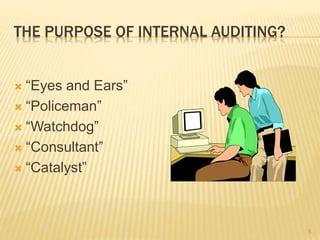
THE PURPOSE OF INTERNAL AUDITING?
 “Eyes and Ears”
 “Policeman”
 “Watchdog”
 “Consultant”
 “Catalyst”
5
STATEMENT OF RESPONSIBILITIES
Purpose:
 Internal auditing is an independent appraisal
function established within an organization to
examine and evaluate its activities as a service to
the organization.
 The objective of internal auditing is to assist
members of the organization in the effective
discharge of their responsibilities.
 The audit objective includes promoting control at a
reasonable cost.
6
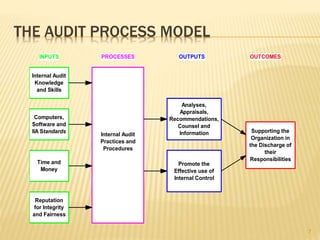
THE AUDIT PROCESS MODEL
7
Internal Audit
Knowledge
and Skills
Computers,
Software and
IIA Standards
Time and
Money
Reputation
for Integrity
and Fairness
Internal Audit
Practices and
Procedures
Analyses,
Appraisals,
Recommendations,
Counsel and
Information
Promote the
Effective use of
Internal Control
Supporting the
Organization in
the Discharge of
their
Responsibilities
INPUTS PROCESSES OUTPUTS OUTCOMES
STATEMENT OF RESPONSIBILITIES
Scope:
 The scope of internal auditing should
encompass the examination of the adequacy
and effectiveness of the organization’s system
of internal control and the quality of
performance in carrying out assigned
responsibilities.
 Assessment (adequacy and effectiveness).
 Enhancement (measuring performance quality
improvement).
8
THE NATURE OF BUSINESS RISK
Risk is a concept used by
auditors and managers
to express concerns about
the probable effects of an
uncertain environment.
9
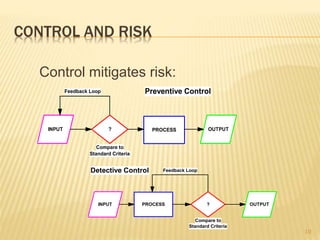
CONTROL AND RISK
Control mitigates risk:
10
INPUT OUTPUT? PROCESS
Feedback Loop
Compare to
Standard Criteria
Preventive Control
INPUT OUTPUT?PROCESS
Feedback Loop
Compare to
Standard Criteria
Detective Control
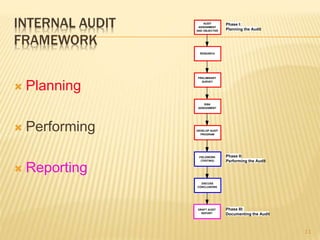
INTERNAL AUDIT
FRAMEWORK
 Planning
 Performing
 Reporting
11
AUDIT
ASSIGNMENT
AND OBJECTIVE
RESEARCH
PRELIMINARY
SURVEY
RISK
ASSESSMENT
DEVELOP AUDIT
PROGRAM
FIELDWORK
(TESTING)
DISCUSS
CONCLUSIONS
DRAFT AUDIT
REPORT
Phase I:
Planning the Audit
Phase II:
Performing the Audit
Phase III:
Documenting the Audit
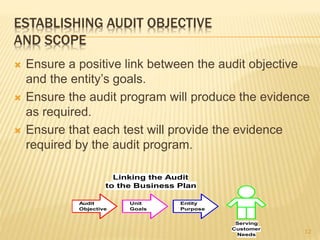
ESTABLISHING AUDIT OBJECTIVE
AND SCOPE
 Ensure a positive link between the audit objective
and the entity’s goals.
 Ensure the audit program will produce the evidence
as required.
 Ensure that each test will provide the evidence
required by the audit program.
12
Audit
Objective
Unit
Goals
Entity
Purpose
Linking the Audit
to the Business Plan
Serving
Customer
Needs
PLANNING THE AUDIT
 Research
 Risk Assessment
 Audit Strategy
 Preliminary Survey
 Policies and Procedures
 Inputs and Outputs
 Control Steps
 People
13
PLANNING STEP #1
Perform Research on Area under Audit
Research is important for understanding, but we must
be able to recognize when “enough is enough”
Research tells us define the historical issues, current
issues, marketing issues, pervasive risks,
personnel issues, and future issues.
14
PLANNING STEP #2
Prepare Your Hypothesis
1. The activity is operating normally
What is = What should Be
2. The activity is not operating as it should in
some significant way
What is does not = What should be
3. Some value in between
There are minor differences between
What is and What should be
15
PLANNING STEP #3
Send Engagement Memo
1. To executive management
2. Include the name of the audit effort and the
initiation date
3. Request the name of a contact person
16
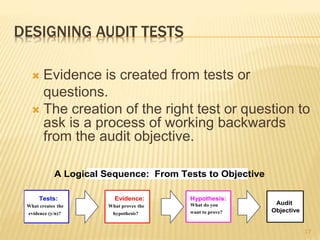
DESIGNING AUDIT TESTS
 Evidence is created from tests or
questions.
 The creation of the right test or question to
ask is a process of working backwards
from the audit objective.
17
Evidence:
What proves the
hypothesis?
Tests:
What creates the
evidence (y/n)?
Hypothesis:
What do you
A Logical Sequence: From Tests to Objective
Audit
Objectivewant to prove?
DOCUMENTING THE AUDIT
Automated Work Papers provide
 A framework to guide the audit process.
 Support for the conclusions reached by the
audit.
 A record of the audit process and its
conformance to standards.
18
WORK PAPERS –
GOOD PRACTICES
 Use electronic templates to capture data:
* Background & Scope Document
* Risk
* Control
* Test
* Audit Point Sheet
 Structure your work paper documents as carefully
as you would the final audit report.
19
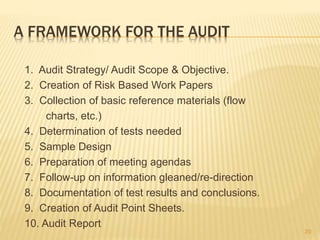
A FRAMEWORK FOR THE AUDIT
1. Audit Strategy/ Audit Scope & Objective.
2. Creation of Risk Based Work Papers
3. Collection of basic reference materials (flow
charts, etc.)
4. Determination of tests needed
5. Sample Design
6. Preparation of meeting agendas
7. Follow-up on information gleaned/re-direction
8. Documentation of test results and conclusions.
9. Creation of Audit Point Sheets.
10. Audit Report
20
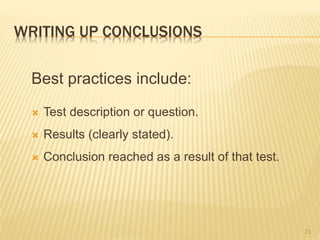
WRITING UP CONCLUSIONS
Best practices include:
 Test description or question.
 Results (clearly stated).
 Conclusion reached as a result of that test.
21
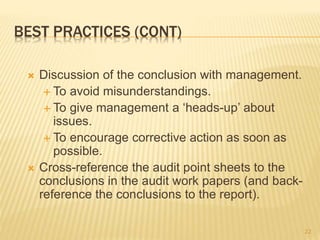
BEST PRACTICES (CONT)
 Discussion of the conclusion with management.
 To avoid misunderstandings.
 To give management a ‘heads-up’ about
issues.
 To encourage corrective action as soon as
possible.
 Cross-reference the audit point sheets to the
conclusions in the audit work papers (and back-
reference the conclusions to the report).
22
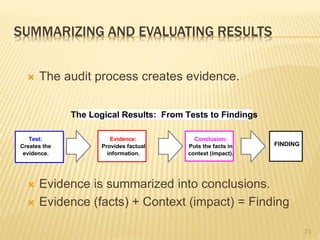
SUMMARIZING AND EVALUATING RESULTS
 The audit process creates evidence.
 Evidence is summarized into conclusions.
 Evidence (facts) + Context (impact) = Finding
23
Evidence:
Provides factual
information.
Test:
Creates the
evidence.
Conclusion:
Puts the facts in
context (impact).
The Logical Results: From Tests to Findings
FINDING
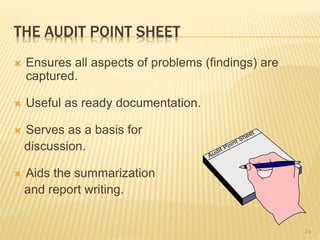
THE AUDIT POINT SHEET
 Ensures all aspects of problems (findings) are
captured.
 Useful as ready documentation.
 Serves as a basis for
discussion.
 Aids the summarization
and report writing.
24
WRITING EFFECTIVE AUDIT REPORTS
Reports are important because they:
 Provide documented communication and
assurance to senior management.
 Provide operating management with
assessments of operations and corrective
action.
 Provide the auditor with records for follow-up
of audit results.
 Provide the audit group with marketing
opportunities to demonstrate added value.
25
FOLLOWING UP – CORRECTIVE ACTIONS
The control aspect of auditing is not
complete until corrective action is taken (or
the risk formally assumed by senior
management).
Effective statements of corrective action
include:
 The specific steps to be taken,
 The completion date and
 The person responsible for completion.
26
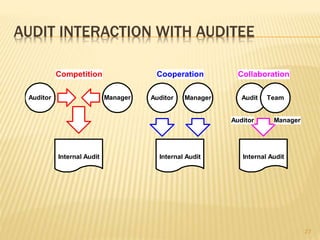
AUDIT INTERACTION WITH AUDITEE
27
Auditor Manager
Internal Audit
Competition
Auditor Manager
Internal Audit
Cooperation
Audit Team
Internal Audit
Collaboration
Auditor Manager
BUILDING TRUST WITH AUDITEE
 The slow way- Making and
keeping commitments
 The faster way -
Collaboration.
28

Basic internal auditing

  • 1.
  • 2.
  • 3.
  • 4.
  • 5.
    THE PURPOSE OFINTERNAL AUDITING?  “Eyes and Ears”  “Policeman”  “Watchdog”  “Consultant”  “Catalyst” 5
  • 6.
    STATEMENT OF RESPONSIBILITIES Purpose: Internal auditing is an independent appraisal function established within an organization to examine and evaluate its activities as a service to the organization.  The objective of internal auditing is to assist members of the organization in the effective discharge of their responsibilities.  The audit objective includes promoting control at a reasonable cost. 6
  • 7.
    THE AUDIT PROCESSMODEL 7 Internal Audit Knowledge and Skills Computers, Software and IIA Standards Time and Money Reputation for Integrity and Fairness Internal Audit Practices and Procedures Analyses, Appraisals, Recommendations, Counsel and Information Promote the Effective use of Internal Control Supporting the Organization in the Discharge of their Responsibilities INPUTS PROCESSES OUTPUTS OUTCOMES
  • 8.
    STATEMENT OF RESPONSIBILITIES Scope: The scope of internal auditing should encompass the examination of the adequacy and effectiveness of the organization’s system of internal control and the quality of performance in carrying out assigned responsibilities.  Assessment (adequacy and effectiveness).  Enhancement (measuring performance quality improvement). 8
  • 9.
    THE NATURE OFBUSINESS RISK Risk is a concept used by auditors and managers to express concerns about the probable effects of an uncertain environment. 9
  • 10.
    CONTROL AND RISK Controlmitigates risk: 10 INPUT OUTPUT? PROCESS Feedback Loop Compare to Standard Criteria Preventive Control INPUT OUTPUT?PROCESS Feedback Loop Compare to Standard Criteria Detective Control
  • 11.
    INTERNAL AUDIT FRAMEWORK  Planning Performing  Reporting 11 AUDIT ASSIGNMENT AND OBJECTIVE RESEARCH PRELIMINARY SURVEY RISK ASSESSMENT DEVELOP AUDIT PROGRAM FIELDWORK (TESTING) DISCUSS CONCLUSIONS DRAFT AUDIT REPORT Phase I: Planning the Audit Phase II: Performing the Audit Phase III: Documenting the Audit
  • 12.
    ESTABLISHING AUDIT OBJECTIVE ANDSCOPE  Ensure a positive link between the audit objective and the entity’s goals.  Ensure the audit program will produce the evidence as required.  Ensure that each test will provide the evidence required by the audit program. 12 Audit Objective Unit Goals Entity Purpose Linking the Audit to the Business Plan Serving Customer Needs
  • 13.
    PLANNING THE AUDIT Research  Risk Assessment  Audit Strategy  Preliminary Survey  Policies and Procedures  Inputs and Outputs  Control Steps  People 13
  • 14.
    PLANNING STEP #1 PerformResearch on Area under Audit Research is important for understanding, but we must be able to recognize when “enough is enough” Research tells us define the historical issues, current issues, marketing issues, pervasive risks, personnel issues, and future issues. 14
  • 15.
    PLANNING STEP #2 PrepareYour Hypothesis 1. The activity is operating normally What is = What should Be 2. The activity is not operating as it should in some significant way What is does not = What should be 3. Some value in between There are minor differences between What is and What should be 15
  • 16.
    PLANNING STEP #3 SendEngagement Memo 1. To executive management 2. Include the name of the audit effort and the initiation date 3. Request the name of a contact person 16
  • 17.
    DESIGNING AUDIT TESTS Evidence is created from tests or questions.  The creation of the right test or question to ask is a process of working backwards from the audit objective. 17 Evidence: What proves the hypothesis? Tests: What creates the evidence (y/n)? Hypothesis: What do you A Logical Sequence: From Tests to Objective Audit Objectivewant to prove?
  • 18.
    DOCUMENTING THE AUDIT AutomatedWork Papers provide  A framework to guide the audit process.  Support for the conclusions reached by the audit.  A record of the audit process and its conformance to standards. 18
  • 19.
    WORK PAPERS – GOODPRACTICES  Use electronic templates to capture data: * Background & Scope Document * Risk * Control * Test * Audit Point Sheet  Structure your work paper documents as carefully as you would the final audit report. 19
  • 20.
    A FRAMEWORK FORTHE AUDIT 1. Audit Strategy/ Audit Scope & Objective. 2. Creation of Risk Based Work Papers 3. Collection of basic reference materials (flow charts, etc.) 4. Determination of tests needed 5. Sample Design 6. Preparation of meeting agendas 7. Follow-up on information gleaned/re-direction 8. Documentation of test results and conclusions. 9. Creation of Audit Point Sheets. 10. Audit Report 20
  • 21.
    WRITING UP CONCLUSIONS Bestpractices include:  Test description or question.  Results (clearly stated).  Conclusion reached as a result of that test. 21
  • 22.
    BEST PRACTICES (CONT) Discussion of the conclusion with management.  To avoid misunderstandings.  To give management a ‘heads-up’ about issues.  To encourage corrective action as soon as possible.  Cross-reference the audit point sheets to the conclusions in the audit work papers (and back- reference the conclusions to the report). 22
  • 23.
    SUMMARIZING AND EVALUATINGRESULTS  The audit process creates evidence.  Evidence is summarized into conclusions.  Evidence (facts) + Context (impact) = Finding 23 Evidence: Provides factual information. Test: Creates the evidence. Conclusion: Puts the facts in context (impact). The Logical Results: From Tests to Findings FINDING
  • 24.
    THE AUDIT POINTSHEET  Ensures all aspects of problems (findings) are captured.  Useful as ready documentation.  Serves as a basis for discussion.  Aids the summarization and report writing. 24
  • 25.
    WRITING EFFECTIVE AUDITREPORTS Reports are important because they:  Provide documented communication and assurance to senior management.  Provide operating management with assessments of operations and corrective action.  Provide the auditor with records for follow-up of audit results.  Provide the audit group with marketing opportunities to demonstrate added value. 25
  • 26.
    FOLLOWING UP –CORRECTIVE ACTIONS The control aspect of auditing is not complete until corrective action is taken (or the risk formally assumed by senior management). Effective statements of corrective action include:  The specific steps to be taken,  The completion date and  The person responsible for completion. 26
  • 27.
    AUDIT INTERACTION WITHAUDITEE 27 Auditor Manager Internal Audit Competition Auditor Manager Internal Audit Cooperation Audit Team Internal Audit Collaboration Auditor Manager
  • 28.
    BUILDING TRUST WITHAUDITEE  The slow way- Making and keeping commitments  The faster way - Collaboration. 28