1
INSTITUTE OF COST AND MANAGEMENT
ACCOUNTANTS OF INDIA
Presentation on :
Internal Audit in Indian Scenario
Presenter : Malay Paul
Dtd. 29.06.2016 (06.00 p.m– 08.00 p.m)
2
Acknowledgement
The author acknowledges use of freely available graphics in this
presentation with the objective of propagating knowledge and clearer
understanding.
The views expressed herein are not having any bearing on the past and
present professional engagement of the author.
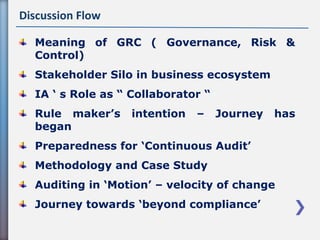
Discussion Flow
Meaning of GRC ( Governance, Risk &
Control)
Stakeholder Silo in business ecosystem
IA ‘ s Role as “ Collaborator “
Rule maker’s intention – Journey has
began
Preparedness for ‘Continuous Audit’
Methodology and Case Study
Auditing in ‘Motion’ – velocity of change
Journey towards ‘beyond compliance’
4
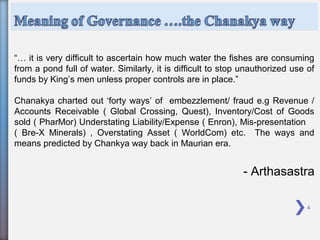
“… it is very difficult to ascertain how much water the fishes are consuming
from a pond full of water. Similarly, it is difficult to stop unauthorized use of
funds by King’s men unless proper controls are in place.”
Chanakya charted out ‘forty ways’ of embezzlement/ fraud e.g Revenue /
Accounts Receivable ( Global Crossing, Quest), Inventory/Cost of Goods
sold ( PharMor) Understating Liability/Expense ( Enron), Mis-presentation
( Bre-X Minerals) , Overstating Asset ( WorldCom) etc. The ways and
means predicted by Chankya way back in Maurian era.
- Arthasastra
5
““Corporate governance is concernedCorporate governance is concerned
with holding the balance betweenwith holding the balance between
economic and social goals and betweeneconomic and social goals and between
individual and communal goals…… Theindividual and communal goals…… The
aim is to align as nearly as possible theaim is to align as nearly as possible the
interests of individuals, corporations andinterests of individuals, corporations and
society.”society.”
Sir Adrian Cadbury
Corporate Governance Overview, 1999
[World Bank Report]
6
““ The conduct of business in accordanceThe conduct of business in accordance
with shareholders’ desires, which generallywith shareholders’ desires, which generally
is to make as much money as possible ,is to make as much money as possible ,
while conforming to the basic rules of thewhile conforming to the basic rules of the
society embodied in law and local customs“society embodied in law and local customs“
Noble Laurate Milton FriedmanNoble Laurate Milton Friedman
7
The art of Corporate Governance is a parallel consign
of ‘Dharma (nature)’ in human existence. Logically,
‘Fire’ has a ‘Dharma’ to burn; ‘Air’ has ‘Dharma’ to
blow; signifying the quintessence of ‘Code of Conduct
(COC)’. Rapid transformation in stakeholder
expectation’, stipulate corporations universally to
pursue self-ordained COC. As per the OECD
(Organization for Economic Cooperation and
Development) documents published in 1999,
Corporate Governance is the system by which
organizations are directed and controlled.
8
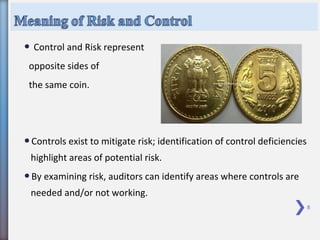
 Control and Risk represent
opposite sides of
the same coin.
Controls exist to mitigate risk; identification of control deficiencies
highlight areas of potential risk.
By examining risk, auditors can identify areas where controls are
needed and/or not working.
9
IIA definition of Auditing, Assurance and our focus :
“It is an independent, objective assurance and consulting activity
designed to add value and improve an organisation’s operations. It
helps an organisation accomplish its objectives by bringing a
systematic, disciplined approach to evaluate and improve effectiveness
of risk management, control and governance process.”
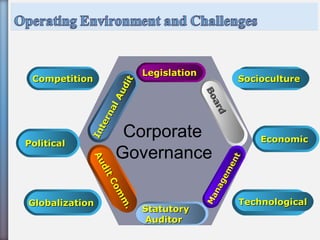
Corporate
Governance
CompetitionCompetition
PoliticalPolitical
GlobalizationGlobalization TechnologicalTechnological
EconomicEconomic
SociocultureSocioculture
InternalAudit
InternalAudit
LegislationLegislation
Board
Board
StatutoryStatutory
AuditorAuditor
AuditCom
m
.
AuditCom
m
.
Managem
ent
Managem
ent
11
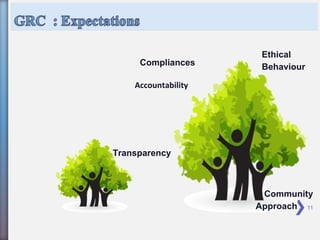
Compliances
Accountability
Transparency
Ethical
Behaviour
Community
Approach
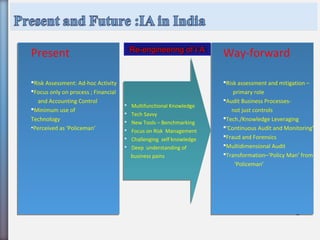
Present
Risk Assessment: Ad-hoc Activity
Focus only on process ; Financial
and Accounting Control
Minimum use of
Technology
•Perceived as ‘Policeman’
Present
Risk Assessment: Ad-hoc Activity
Focus only on process ; Financial
and Accounting Control
Minimum use of
Technology
•Perceived as ‘Policeman’
Way-forward
Risk assessment and mitigation –
primary role
Audit Business Processes-
not just controls
Tech./Knowledge Leveraging
‘Continuous Audit and Monitoring’
Fraud and Forensics
Multidimensional Audit
Transformation–‘Policy Man’ from
‘Policeman’
Way-forward
Risk assessment and mitigation –
primary role
Audit Business Processes-
not just controls
Tech./Knowledge Leveraging
‘Continuous Audit and Monitoring’
Fraud and Forensics
Multidimensional Audit
Transformation–‘Policy Man’ from
‘Policeman’
 Multifunctional Knowledge
 Tech Savvy
 New Tools – Benchmarking
 Focus on Risk Management
 Challenging self knowledge
 Deep understanding of
business pains
 Multifunctional Knowledge
 Tech Savvy
 New Tools – Benchmarking
 Focus on Risk Management
 Challenging self knowledge
 Deep understanding of
business pains
Re-engineering of I ARe-engineering of I A
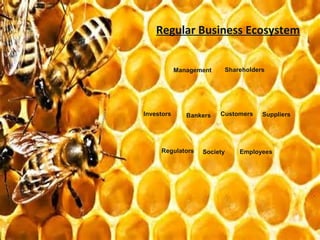
Regular Business EcosystemRegular Business Ecosystem
Investors Bankers
Management
Society Employees
Customers Suppliers
Regulators
Shareholders
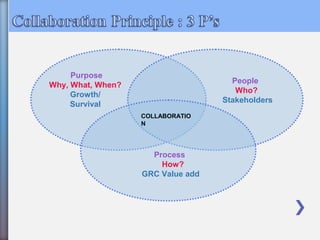
Purpose
Why, What, When?
Growth/
Survival
People
Who?
Stakeholders
Process
How?
GRC Value add
COLLABORATIO
N
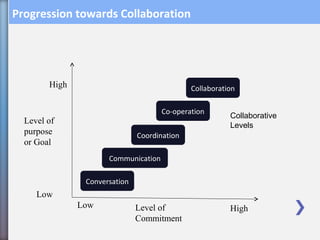
Low
High
Level of
Commitment
HighLow
Conversation
Communication
Coordination
Co-operation
Collaboration
Level of
purpose
or Goal
Collaborative
Levels
Progression towards Collaboration
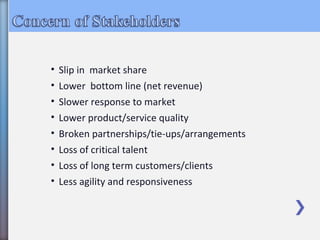
• Slip in market share
• Lower bottom line (net revenue)
• Slower response to market
• Lower product/service quality
• Broken partnerships/tie-ups/arrangements
• Loss of critical talent
• Loss of long term customers/clients
• Less agility and responsiveness
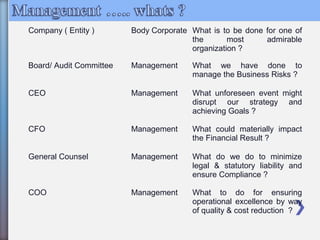
Company ( Entity ) Body Corporate What is to be done for one of
the most admirable
organization ?
Board/ Audit Committee Management What we have done to
manage the Business Risks ?
CEO Management What unforeseen event might
disrupt our strategy and
achieving Goals ?
CFO Management What could materially impact
the Financial Result ?
General Counsel Management What do we do to minimize
legal & statutory liability and
ensure Compliance ?
COO Management What to do for ensuring
operational excellence by way
of quality & cost reduction ?
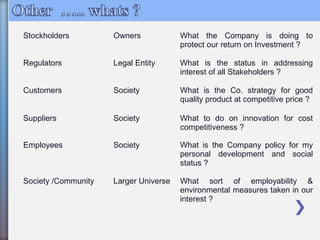
Stockholders Owners What the Company is doing to
protect our return on Investment ?
Regulators Legal Entity What is the status in addressing
interest of all Stakeholders ?
Customers Society What is the Co. strategy for good
quality product at competitive price ?
Suppliers Society What to do on innovation for cost
competitiveness ?
Employees Society What is the Company policy for my
personal development and social
status ?
Society /Community Larger Universe What sort of employability &
environmental measures taken in our
interest ?
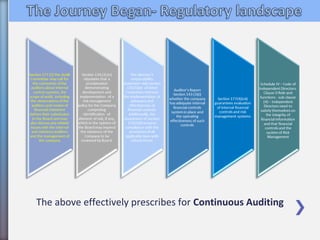
The above effectively prescribes for Continuous Auditing
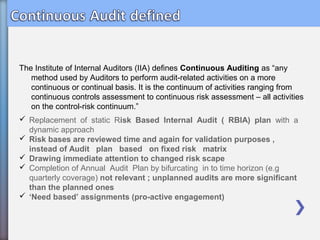
The Institute of Internal Auditors (IIA) defines Continuous Auditing as “any
method used by Auditors to perform audit-related activities on a more
continuous or continual basis. It is the continuum of activities ranging from
continuous controls assessment to continuous risk assessment – all activities
on the control-risk continuum.”
 Replacement of static Risk Based Internal Audit ( RBIA) plan with a
dynamic approach
 Risk bases are reviewed time and again for validation purposes ,
instead of Audit plan based on fixed risk matrix
 Drawing immediate attention to changed risk scape
 Completion of Annual Audit Plan by bifurcating in to time horizon (e.g
quarterly coverage) not relevant ; unplanned audits are more significant
than the planned ones
 ‘Need based’ assignments (pro-active engagement)
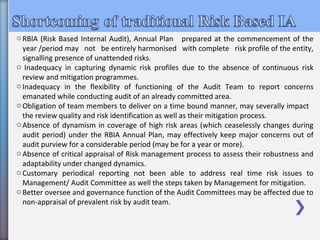
oRBIA (Risk Based Internal Audit), Annual Plan prepared at the commencement of the
year /period may not be entirely harmonised with complete risk profile of the entity,
signalling presence of unattended risks.
o Inadequacy in capturing dynamic risk profiles due to the absence of continuous risk
review and mitigation programmes.
oInadequacy in the flexibility of functioning of the Audit Team to report concerns
emanated while conducting audit of an already committed area.
oObligation of team members to deliver on a time bound manner, may severally impact
the review quality and risk identification as well as their mitigation process.
oAbsence of dynamism in coverage of high risk areas (which ceaselessly changes during
audit period) under the RBIA Annual Plan, may effectively keep major concerns out of
audit purview for a considerable period (may be for a year or more).
oAbsence of critical appraisal of Risk management process to assess their robustness and
adaptability under changed dynamics.
oCustomary periodical reporting not been able to address real time risk issues to
Management/ Audit Committee as well the steps taken by Management for mitigation.
oBetter oversee and governance function of the Audit Committees may be affected due to
non-appraisal of prevalent risk by audit team.
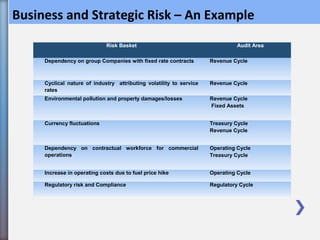
Risk Basket Audit Area
Dependency on group Companies with fixed rate contracts Revenue Cycle
Cyclical nature of industry attributing volatility to service
rates
Revenue Cycle
Environmental pollution and property damages/losses Revenue Cycle
Fixed Assets
Currency fluctuations Treasury Cycle
Revenue Cycle
Dependency on contractual workforce for commercial
operations
Operating Cycle
Treasury Cycle
Increase in operating costs due to fuel price hike Operating Cycle
Regulatory risk and Compliance Regulatory Cycle
Business and Strategic Risk – An Example
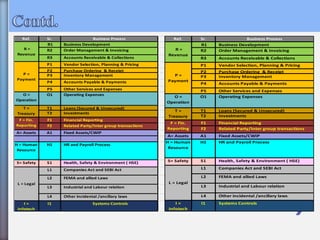
Ref. Sr. Business Process
R1 Business Development
R2 Order Management & Invoicing
R3 Accounts Receivable & Collections
P1 Vendor Selection, Planning & Pricing
P2 Purchase Ordering & Receipt
P3 Inventory Management
P4 Accounts Payable & Payments
P5 Other Services and Expenses
O =
Operation
O1 Operating Expenses
T1 Loans (Secured & Unsecured)
T2 Investments
F1 Financial Reporting
F2 Related Party/Inter group transactions
A= Assets A1 Fixed Assets/CWIP
H = Human
Resource
H1 HR and Payroll Process
S= Safety S1 Health, Safety & Environment ( HSE)
L1 Companies Act and SEBI Act
L2 FEMA and allied Laws
L3 Industrial and Labour relation
L4 Other incidental /ancillary laws
I =
Infotech
I1 Systems Controls
L = Legal
R =
Revenue
P =
Payment
T =
Treasury
F = Fin.
Reporting
Ref. Sr. Business Process
R1 Business Development
R2 Order Management & Invoicing
R3 Accounts Receivable & Collections
P1 Vendor Selection, Planning & Pricing
P2 Purchase Ordering & Receipt
P3 Inventory Management
P4 Accounts Payable & Payments
P5 Other Services and Expenses
O =
Operation
O1 Operating Expenses
T1 Loans (Secured & Unsecured)
T2 Investments
F1 Financial Reporting
F2 Related Party/Inter group transactions
A= Assets A1 Fixed Assets/CWIP
H = Human
Resource
H1 HR and Payroll Process
S= Safety S1 Health, Safety & Environment ( HSE)
L1 Companies Act and SEBI Act
L2 FEMA and allied Laws
L3 Industrial and Labour relation
L4 Other incidental /ancillary laws
I =
Infotech
I1 Systems Controls
L = Legal
R =
Revenue
P =
Payment
T =
Treasury
F = Fin.
Reporting
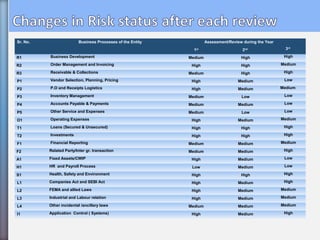
Sr. No. Business Processes of the Entity Assessment/Review during the Year
1st
2nd 3rd
R1 Business Development Medium High High
R2 Order Management and Invoicing High High Medium
R3 Receivable & Collections Medium High High
P1 Vendor Selection, Planning, Pricing High Medium Low
P2 P.O and Receipts Logistics High Medium Medium
P3 Inventory Management Medium Low Low
P4 Accounts Payable & Payments Medium Medium Low
P5 Other Service and Expenses Medium Low Low
O1 Operating Expenses High Medium Medium
T1 Loans (Secured & Unsecured) High High High
T2 Investments High High High
F1 Financial Reporting Medium Medium Medium
F2 Related Party/Inter gr. transaction Medium Medium High
A1 Fixed Assets/CWIP High Medium Low
H1 HR and Payroll Process Low Medium Low
S1 Health, Safety and Environment High High High
L1 Companies Act and SEBI Act High Medium High
L2 FEMA and allied Laws High Medium Medium
L3 Industrial and Labour relation High Medium Medium
L4 Other incidental /ancillary laws Medium Medium Medium
I1 Application Control ( Systems) High Medium High
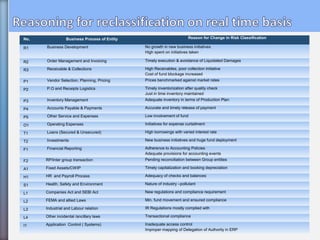
No. Business Process of Entity Reason for Change in Risk Classification
R1 Business Development No growth in new business initiatives
High spent on initiatives taken
R2 Order Management and Invoicing Timely execution & avoidance of Liquidated Damages
R3 Receivable & Collections High Receivables, poor collection initiative
Cost of fund blockage increased
P1 Vendor Selection, Planning, Pricing Prices benchmarked against market rates
P2 P.O and Receipts Logistics Timely inventorization after quality check
Just in time inventory maintained
P3 Inventory Management Adequate inventory in terms of Production Plan
P4 Accounts Payable & Payments Accurate and timely release of payment
P5 Other Service and Expenses Low involvement of fund
O1 Operating Expenses Initiatives for expense curtailment
T1 Loans (Secured & Unsecured) High borrowings with varied interest rate
T2 Investments New business initiatives and huge fund deployment
F1 Financial Reporting Adherence to Accounting Policies
Adequate provisions for accounting events
F2 RP/Inter group transaction Pending reconciliation between Group entities
A1 Fixed Assets/CWIP Timely capitalization and booking depreciation
H1 HR and Payroll Process Adequacy of checks and balances
S1 Health, Safety and Environment Nature of industry –pollutant
L1 Companies Act and SEBI Act New regulations and compliance requirement
L2 FEMA and allied Laws Min. fund movement and ensured compliance
L3 Industrial and Labour relation IR Regulations mostly complied with
L4 Other incidental /ancillary laws Transactional compliance
I1 Application Control ( Systems) Inadequate access control
Improper mapping of Delegation of Authority in ERP
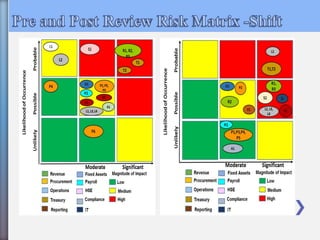
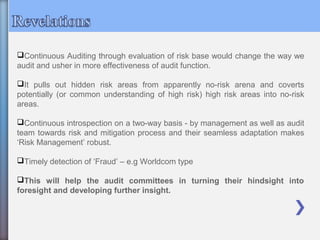
Continuous Auditing through evaluation of risk base would change the way we
audit and usher in more effectiveness of audit function.
It pulls out hidden risk areas from apparently no-risk arena and coverts
potentially (or common understanding of high risk) high risk areas into no-risk
areas.
Continuous introspection on a two-way basis - by management as well as audit
team towards risk and mitigation process and their seamless adaptation makes
‘Risk Management’ robust.
Timely detection of ‘Fraud’ – e.g Worldcom type
This will help the audit committees in turning their hindsight into
foresight and developing further insight.
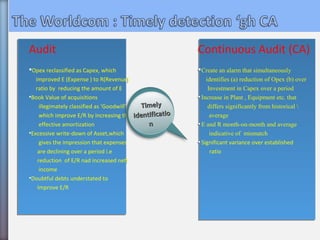
Audit
Opex reclassified as Capex, which
improved E (Expense ) to R(Revenue)
ratio by reducing the amount of E
•Book Value of acquisitions
illegimately classified as ‘Goodwill’,
which improve E/R by increasing the
effective amortization
•Excessive write-down of Asset,which
gives the impression that expenses
are declining over a period i.e
reduction of E/R nad increased nett
income
•Doubtful debts understated to
Improve E/R
Audit
Opex reclassified as Capex, which
improved E (Expense ) to R(Revenue)
ratio by reducing the amount of E
•Book Value of acquisitions
illegimately classified as ‘Goodwill’,
which improve E/R by increasing the
effective amortization
•Excessive write-down of Asset,which
gives the impression that expenses
are declining over a period i.e
reduction of E/R nad increased nett
income
•Doubtful debts understated to
Improve E/R
Continuous Audit (CA)
Create an alarm that simultaneously
identifies (a) reduction of Opex (b) over
Investment in Capex over a period
• Increase in Plant , Equipment etc. that
differs significantly from historical 
average
• E and R month-on-month and average
indicative of mismatch
• Significant variance over established
ratio
Continuous Audit (CA)
Create an alarm that simultaneously
identifies (a) reduction of Opex (b) over
Investment in Capex over a period
• Increase in Plant , Equipment etc. that
differs significantly from historical 
average
• E and R month-on-month and average
indicative of mismatch
• Significant variance over established
ratio
TimelyTimely
IdentificatioIdentificatio
nn
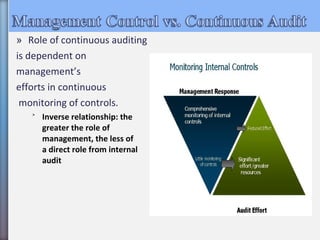
» Role of continuous auditing
is dependent on
management’s
efforts in continuous
monitoring of controls.
˃ Inverse relationship: the
greater the role of
management, the less of
a direct role from internal
audit
30
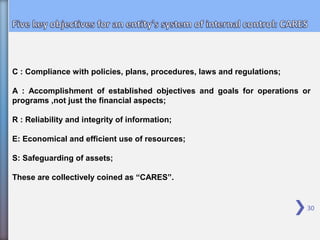
C : Compliance with policies, plans, procedures, laws and regulations;
A : Accomplishment of established objectives and goals for operations or
programs ,not just the financial aspects;
R : Reliability and integrity of information;
E: Economical and efficient use of resources;
S: Safeguarding of assets;
These are collectively coined as “CARES”.
31
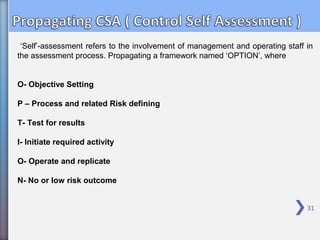
‘Self’-assessment refers to the involvement of management and operating staff in
the assessment process. Propagating a framework named ‘OPTION’, where
O- Objective Setting
P – Process and related Risk defining
T- Test for results
I- Initiate required activity
O- Operate and replicate
N- No or low risk outcome
32
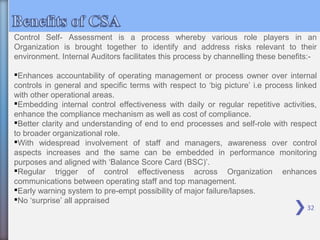
Control Self- Assessment is a process whereby various role players in an
Organization is brought together to identify and address risks relevant to their
environment. Internal Auditors facilitates this process by channelling these benefits:-
Enhances accountability of operating management or process owner over internal
controls in general and specific terms with respect to ‘big picture’ i.e process linked
with other operational areas.
Embedding internal control effectiveness with daily or regular repetitive activities,
enhance the compliance mechanism as well as cost of compliance.
Better clarity and understanding of end to end processes and self-role with respect
to broader organizational role.
With widespread involvement of staff and managers, awareness over control
aspects increases and the same can be embedded in performance monitoring
purposes and aligned with ‘Balance Score Card (BSC)’.
Regular trigger of control effectiveness across Organization enhances
communications between operating staff and top management.
Early warning system to pre-empt possibility of major failure/lapses.
No ‘surprise’ all appraised
33
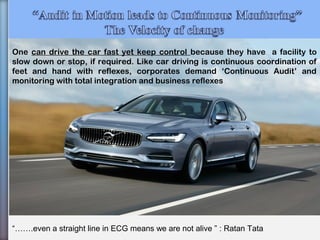
“…….even a straight line in ECG means we are not alive ” : Ratan Tata
One can drive the car fast yet keep control because they have a facility to
slow down or stop, if required. Like car driving is continuous coordination of
feet and hand with reflexes, corporates demand ‘Continuous Audit’ and
monitoring with total integration and business reflexes
34
» ‘Customer is the King’ , to satisfy his unending requirements
business landscapes is changing universally.
» Significant changes forcing businesses to constantly transform.
» Internal Audit ought to renovate to dwell forward of these
changes and to maximize it’s impact with a faster pace.
» Corporate leaders demanding Internal Audit to improve visibility
across the enterprise and provide strategic insights that can
deliver lasting value for the organization.
» Auditors around the universe are contemporizing the Internal
Audit (IA) profession through technology-enabled methodologies.
» As the business environment grows increasingly complex, IA is
being asked to support the organization by delivering deeper
insight and greater value more efficiently and effectively,
necessitating IA functions to turn for business analytics.
» Integration of IA function with the entity’s strategic initiatives.
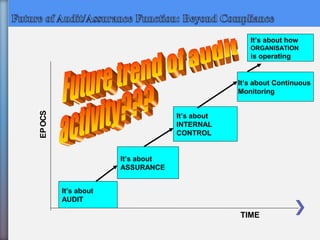
SCOPE
It’s about
AUDIT
It’s about
ASSURANCE
It’s about
INTERNAL
CONTROL
It’s about Continuous
Monitoring
TIME
It’s about how
ORGANISATION
.is operating
36
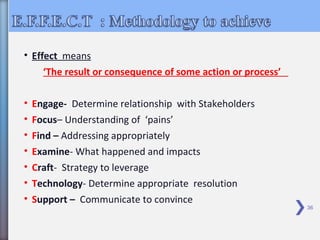
• Effect means
‘The result or consequence of some action or process’
• Engage- Determine relationship with Stakeholders
• Focus– Understanding of ‘pains’
• Find – Addressing appropriately
• Examine- What happened and impacts
• Craft- Strategy to leverage
• Technology- Determine appropriate resolution
• Support – Communicate to convince
37

GRCICMAI

  • 1.
    1 INSTITUTE OF COSTAND MANAGEMENT ACCOUNTANTS OF INDIA Presentation on : Internal Audit in Indian Scenario Presenter : Malay Paul Dtd. 29.06.2016 (06.00 p.m– 08.00 p.m)
  • 2.
    2 Acknowledgement The author acknowledgesuse of freely available graphics in this presentation with the objective of propagating knowledge and clearer understanding. The views expressed herein are not having any bearing on the past and present professional engagement of the author.
  • 3.
    Discussion Flow Meaning ofGRC ( Governance, Risk & Control) Stakeholder Silo in business ecosystem IA ‘ s Role as “ Collaborator “ Rule maker’s intention – Journey has began Preparedness for ‘Continuous Audit’ Methodology and Case Study Auditing in ‘Motion’ – velocity of change Journey towards ‘beyond compliance’
  • 4.
    4 “… it isvery difficult to ascertain how much water the fishes are consuming from a pond full of water. Similarly, it is difficult to stop unauthorized use of funds by King’s men unless proper controls are in place.” Chanakya charted out ‘forty ways’ of embezzlement/ fraud e.g Revenue / Accounts Receivable ( Global Crossing, Quest), Inventory/Cost of Goods sold ( PharMor) Understating Liability/Expense ( Enron), Mis-presentation ( Bre-X Minerals) , Overstating Asset ( WorldCom) etc. The ways and means predicted by Chankya way back in Maurian era. - Arthasastra
  • 5.
    5 ““Corporate governance isconcernedCorporate governance is concerned with holding the balance betweenwith holding the balance between economic and social goals and betweeneconomic and social goals and between individual and communal goals…… Theindividual and communal goals…… The aim is to align as nearly as possible theaim is to align as nearly as possible the interests of individuals, corporations andinterests of individuals, corporations and society.”society.” Sir Adrian Cadbury Corporate Governance Overview, 1999 [World Bank Report]
  • 6.
    6 ““ The conductof business in accordanceThe conduct of business in accordance with shareholders’ desires, which generallywith shareholders’ desires, which generally is to make as much money as possible ,is to make as much money as possible , while conforming to the basic rules of thewhile conforming to the basic rules of the society embodied in law and local customs“society embodied in law and local customs“ Noble Laurate Milton FriedmanNoble Laurate Milton Friedman
  • 7.
    7 The art ofCorporate Governance is a parallel consign of ‘Dharma (nature)’ in human existence. Logically, ‘Fire’ has a ‘Dharma’ to burn; ‘Air’ has ‘Dharma’ to blow; signifying the quintessence of ‘Code of Conduct (COC)’. Rapid transformation in stakeholder expectation’, stipulate corporations universally to pursue self-ordained COC. As per the OECD (Organization for Economic Cooperation and Development) documents published in 1999, Corporate Governance is the system by which organizations are directed and controlled.
  • 8.
    8  Control andRisk represent opposite sides of the same coin. Controls exist to mitigate risk; identification of control deficiencies highlight areas of potential risk. By examining risk, auditors can identify areas where controls are needed and/or not working.
  • 9.
    9 IIA definition ofAuditing, Assurance and our focus : “It is an independent, objective assurance and consulting activity designed to add value and improve an organisation’s operations. It helps an organisation accomplish its objectives by bringing a systematic, disciplined approach to evaluate and improve effectiveness of risk management, control and governance process.”
  • 10.
  • 11.
  • 12.
    Present Risk Assessment: Ad-hocActivity Focus only on process ; Financial and Accounting Control Minimum use of Technology •Perceived as ‘Policeman’ Present Risk Assessment: Ad-hoc Activity Focus only on process ; Financial and Accounting Control Minimum use of Technology •Perceived as ‘Policeman’ Way-forward Risk assessment and mitigation – primary role Audit Business Processes- not just controls Tech./Knowledge Leveraging ‘Continuous Audit and Monitoring’ Fraud and Forensics Multidimensional Audit Transformation–‘Policy Man’ from ‘Policeman’ Way-forward Risk assessment and mitigation – primary role Audit Business Processes- not just controls Tech./Knowledge Leveraging ‘Continuous Audit and Monitoring’ Fraud and Forensics Multidimensional Audit Transformation–‘Policy Man’ from ‘Policeman’  Multifunctional Knowledge  Tech Savvy  New Tools – Benchmarking  Focus on Risk Management  Challenging self knowledge  Deep understanding of business pains  Multifunctional Knowledge  Tech Savvy  New Tools – Benchmarking  Focus on Risk Management  Challenging self knowledge  Deep understanding of business pains Re-engineering of I ARe-engineering of I A
  • 13.
    Regular Business EcosystemRegularBusiness Ecosystem Investors Bankers Management Society Employees Customers Suppliers Regulators Shareholders
  • 14.
  • 15.
  • 16.
    • Slip inmarket share • Lower bottom line (net revenue) • Slower response to market • Lower product/service quality • Broken partnerships/tie-ups/arrangements • Loss of critical talent • Loss of long term customers/clients • Less agility and responsiveness
  • 17.
    Company ( Entity) Body Corporate What is to be done for one of the most admirable organization ? Board/ Audit Committee Management What we have done to manage the Business Risks ? CEO Management What unforeseen event might disrupt our strategy and achieving Goals ? CFO Management What could materially impact the Financial Result ? General Counsel Management What do we do to minimize legal & statutory liability and ensure Compliance ? COO Management What to do for ensuring operational excellence by way of quality & cost reduction ?
  • 18.
    Stockholders Owners Whatthe Company is doing to protect our return on Investment ? Regulators Legal Entity What is the status in addressing interest of all Stakeholders ? Customers Society What is the Co. strategy for good quality product at competitive price ? Suppliers Society What to do on innovation for cost competitiveness ? Employees Society What is the Company policy for my personal development and social status ? Society /Community Larger Universe What sort of employability & environmental measures taken in our interest ?
  • 19.
    The above effectivelyprescribes for Continuous Auditing
  • 20.
    The Institute ofInternal Auditors (IIA) defines Continuous Auditing as “any method used by Auditors to perform audit-related activities on a more continuous or continual basis. It is the continuum of activities ranging from continuous controls assessment to continuous risk assessment – all activities on the control-risk continuum.”  Replacement of static Risk Based Internal Audit ( RBIA) plan with a dynamic approach  Risk bases are reviewed time and again for validation purposes , instead of Audit plan based on fixed risk matrix  Drawing immediate attention to changed risk scape  Completion of Annual Audit Plan by bifurcating in to time horizon (e.g quarterly coverage) not relevant ; unplanned audits are more significant than the planned ones  ‘Need based’ assignments (pro-active engagement)
  • 21.
    oRBIA (Risk BasedInternal Audit), Annual Plan prepared at the commencement of the year /period may not be entirely harmonised with complete risk profile of the entity, signalling presence of unattended risks. o Inadequacy in capturing dynamic risk profiles due to the absence of continuous risk review and mitigation programmes. oInadequacy in the flexibility of functioning of the Audit Team to report concerns emanated while conducting audit of an already committed area. oObligation of team members to deliver on a time bound manner, may severally impact the review quality and risk identification as well as their mitigation process. oAbsence of dynamism in coverage of high risk areas (which ceaselessly changes during audit period) under the RBIA Annual Plan, may effectively keep major concerns out of audit purview for a considerable period (may be for a year or more). oAbsence of critical appraisal of Risk management process to assess their robustness and adaptability under changed dynamics. oCustomary periodical reporting not been able to address real time risk issues to Management/ Audit Committee as well the steps taken by Management for mitigation. oBetter oversee and governance function of the Audit Committees may be affected due to non-appraisal of prevalent risk by audit team.
  • 22.
    Risk Basket AuditArea Dependency on group Companies with fixed rate contracts Revenue Cycle Cyclical nature of industry attributing volatility to service rates Revenue Cycle Environmental pollution and property damages/losses Revenue Cycle Fixed Assets Currency fluctuations Treasury Cycle Revenue Cycle Dependency on contractual workforce for commercial operations Operating Cycle Treasury Cycle Increase in operating costs due to fuel price hike Operating Cycle Regulatory risk and Compliance Regulatory Cycle Business and Strategic Risk – An Example
  • 24.
    Ref. Sr. BusinessProcess R1 Business Development R2 Order Management & Invoicing R3 Accounts Receivable & Collections P1 Vendor Selection, Planning & Pricing P2 Purchase Ordering & Receipt P3 Inventory Management P4 Accounts Payable & Payments P5 Other Services and Expenses O = Operation O1 Operating Expenses T1 Loans (Secured & Unsecured) T2 Investments F1 Financial Reporting F2 Related Party/Inter group transactions A= Assets A1 Fixed Assets/CWIP H = Human Resource H1 HR and Payroll Process S= Safety S1 Health, Safety & Environment ( HSE) L1 Companies Act and SEBI Act L2 FEMA and allied Laws L3 Industrial and Labour relation L4 Other incidental /ancillary laws I = Infotech I1 Systems Controls L = Legal R = Revenue P = Payment T = Treasury F = Fin. Reporting Ref. Sr. Business Process R1 Business Development R2 Order Management & Invoicing R3 Accounts Receivable & Collections P1 Vendor Selection, Planning & Pricing P2 Purchase Ordering & Receipt P3 Inventory Management P4 Accounts Payable & Payments P5 Other Services and Expenses O = Operation O1 Operating Expenses T1 Loans (Secured & Unsecured) T2 Investments F1 Financial Reporting F2 Related Party/Inter group transactions A= Assets A1 Fixed Assets/CWIP H = Human Resource H1 HR and Payroll Process S= Safety S1 Health, Safety & Environment ( HSE) L1 Companies Act and SEBI Act L2 FEMA and allied Laws L3 Industrial and Labour relation L4 Other incidental /ancillary laws I = Infotech I1 Systems Controls L = Legal R = Revenue P = Payment T = Treasury F = Fin. Reporting
  • 25.
    Sr. No. BusinessProcesses of the Entity Assessment/Review during the Year 1st 2nd 3rd R1 Business Development Medium High High R2 Order Management and Invoicing High High Medium R3 Receivable & Collections Medium High High P1 Vendor Selection, Planning, Pricing High Medium Low P2 P.O and Receipts Logistics High Medium Medium P3 Inventory Management Medium Low Low P4 Accounts Payable & Payments Medium Medium Low P5 Other Service and Expenses Medium Low Low O1 Operating Expenses High Medium Medium T1 Loans (Secured & Unsecured) High High High T2 Investments High High High F1 Financial Reporting Medium Medium Medium F2 Related Party/Inter gr. transaction Medium Medium High A1 Fixed Assets/CWIP High Medium Low H1 HR and Payroll Process Low Medium Low S1 Health, Safety and Environment High High High L1 Companies Act and SEBI Act High Medium High L2 FEMA and allied Laws High Medium Medium L3 Industrial and Labour relation High Medium Medium L4 Other incidental /ancillary laws Medium Medium Medium I1 Application Control ( Systems) High Medium High
  • 26.
    No. Business Processof Entity Reason for Change in Risk Classification R1 Business Development No growth in new business initiatives High spent on initiatives taken R2 Order Management and Invoicing Timely execution & avoidance of Liquidated Damages R3 Receivable & Collections High Receivables, poor collection initiative Cost of fund blockage increased P1 Vendor Selection, Planning, Pricing Prices benchmarked against market rates P2 P.O and Receipts Logistics Timely inventorization after quality check Just in time inventory maintained P3 Inventory Management Adequate inventory in terms of Production Plan P4 Accounts Payable & Payments Accurate and timely release of payment P5 Other Service and Expenses Low involvement of fund O1 Operating Expenses Initiatives for expense curtailment T1 Loans (Secured & Unsecured) High borrowings with varied interest rate T2 Investments New business initiatives and huge fund deployment F1 Financial Reporting Adherence to Accounting Policies Adequate provisions for accounting events F2 RP/Inter group transaction Pending reconciliation between Group entities A1 Fixed Assets/CWIP Timely capitalization and booking depreciation H1 HR and Payroll Process Adequacy of checks and balances S1 Health, Safety and Environment Nature of industry –pollutant L1 Companies Act and SEBI Act New regulations and compliance requirement L2 FEMA and allied Laws Min. fund movement and ensured compliance L3 Industrial and Labour relation IR Regulations mostly complied with L4 Other incidental /ancillary laws Transactional compliance I1 Application Control ( Systems) Inadequate access control Improper mapping of Delegation of Authority in ERP
  • 27.
    Continuous Auditing throughevaluation of risk base would change the way we audit and usher in more effectiveness of audit function. It pulls out hidden risk areas from apparently no-risk arena and coverts potentially (or common understanding of high risk) high risk areas into no-risk areas. Continuous introspection on a two-way basis - by management as well as audit team towards risk and mitigation process and their seamless adaptation makes ‘Risk Management’ robust. Timely detection of ‘Fraud’ – e.g Worldcom type This will help the audit committees in turning their hindsight into foresight and developing further insight.
  • 28.
    Audit Opex reclassified asCapex, which improved E (Expense ) to R(Revenue) ratio by reducing the amount of E •Book Value of acquisitions illegimately classified as ‘Goodwill’, which improve E/R by increasing the effective amortization •Excessive write-down of Asset,which gives the impression that expenses are declining over a period i.e reduction of E/R nad increased nett income •Doubtful debts understated to Improve E/R Audit Opex reclassified as Capex, which improved E (Expense ) to R(Revenue) ratio by reducing the amount of E •Book Value of acquisitions illegimately classified as ‘Goodwill’, which improve E/R by increasing the effective amortization •Excessive write-down of Asset,which gives the impression that expenses are declining over a period i.e reduction of E/R nad increased nett income •Doubtful debts understated to Improve E/R Continuous Audit (CA) Create an alarm that simultaneously identifies (a) reduction of Opex (b) over Investment in Capex over a period • Increase in Plant , Equipment etc. that differs significantly from historical average • E and R month-on-month and average indicative of mismatch • Significant variance over established ratio Continuous Audit (CA) Create an alarm that simultaneously identifies (a) reduction of Opex (b) over Investment in Capex over a period • Increase in Plant , Equipment etc. that differs significantly from historical average • E and R month-on-month and average indicative of mismatch • Significant variance over established ratio TimelyTimely IdentificatioIdentificatio nn
  • 29.
    » Role ofcontinuous auditing is dependent on management’s efforts in continuous monitoring of controls. ˃ Inverse relationship: the greater the role of management, the less of a direct role from internal audit
  • 30.
    30 C : Compliancewith policies, plans, procedures, laws and regulations; A : Accomplishment of established objectives and goals for operations or programs ,not just the financial aspects; R : Reliability and integrity of information; E: Economical and efficient use of resources; S: Safeguarding of assets; These are collectively coined as “CARES”.
  • 31.
    31 ‘Self’-assessment refers tothe involvement of management and operating staff in the assessment process. Propagating a framework named ‘OPTION’, where O- Objective Setting P – Process and related Risk defining T- Test for results I- Initiate required activity O- Operate and replicate N- No or low risk outcome
  • 32.
    32 Control Self- Assessmentis a process whereby various role players in an Organization is brought together to identify and address risks relevant to their environment. Internal Auditors facilitates this process by channelling these benefits:- Enhances accountability of operating management or process owner over internal controls in general and specific terms with respect to ‘big picture’ i.e process linked with other operational areas. Embedding internal control effectiveness with daily or regular repetitive activities, enhance the compliance mechanism as well as cost of compliance. Better clarity and understanding of end to end processes and self-role with respect to broader organizational role. With widespread involvement of staff and managers, awareness over control aspects increases and the same can be embedded in performance monitoring purposes and aligned with ‘Balance Score Card (BSC)’. Regular trigger of control effectiveness across Organization enhances communications between operating staff and top management. Early warning system to pre-empt possibility of major failure/lapses. No ‘surprise’ all appraised
  • 33.
    33 “…….even a straightline in ECG means we are not alive ” : Ratan Tata One can drive the car fast yet keep control because they have a facility to slow down or stop, if required. Like car driving is continuous coordination of feet and hand with reflexes, corporates demand ‘Continuous Audit’ and monitoring with total integration and business reflexes
  • 34.
    34 » ‘Customer isthe King’ , to satisfy his unending requirements business landscapes is changing universally. » Significant changes forcing businesses to constantly transform. » Internal Audit ought to renovate to dwell forward of these changes and to maximize it’s impact with a faster pace. » Corporate leaders demanding Internal Audit to improve visibility across the enterprise and provide strategic insights that can deliver lasting value for the organization. » Auditors around the universe are contemporizing the Internal Audit (IA) profession through technology-enabled methodologies. » As the business environment grows increasingly complex, IA is being asked to support the organization by delivering deeper insight and greater value more efficiently and effectively, necessitating IA functions to turn for business analytics. » Integration of IA function with the entity’s strategic initiatives.
  • 35.
    SCOPE It’s about AUDIT It’s about ASSURANCE It’sabout INTERNAL CONTROL It’s about Continuous Monitoring TIME It’s about how ORGANISATION .is operating
  • 36.
    36 • Effect means ‘Theresult or consequence of some action or process’ • Engage- Determine relationship with Stakeholders • Focus– Understanding of ‘pains’ • Find – Addressing appropriately • Examine- What happened and impacts • Craft- Strategy to leverage • Technology- Determine appropriate resolution • Support – Communicate to convince
  • 37.