IT AUDIT 
METHODOLOGIES
IT Audit Methodologies 
• CobiT 
• BS 7799 - Code of Practice (CoP) 
• BSI - IT Baseline Protection Manual 
• ITSEC 
• Common Criteria (CC)
Main Areas of Use 
• IT Audits 
• Risk Analysis 
• Health Checks (Security Benchmarking) 
• Security Concepts 
• Security Manuals / Handbooks
Security Definition 
• Confidentiality 
• Integrity 
– Correctness 
– Completeness 
• Availability
CobiT 
• Governance, Control & Audit for IT 
• Developed by ISACA 
• Releases 
– CobiT 1: 1996 
• 32 Processes 
• 271 Control Objectives 
– CobiT 2: 1998 
• 34 Processes 
• 302 Control Objectives
CobiT - Model for IT Governance 
• 36 Control models used as basis: 
– Business control models (e.g. COSO) 
– IT control models (e.g. DTI‘s CoP) 
• CobiT control model covers: 
– Security (Confidentiality, Integrity, Availability) 
– Fiduciary (Effectiveness, Efficiency, Compliance, 
Reliability of Information) 
– IT Resources (Data, Application Systems, 
Technology, Facilities, People)
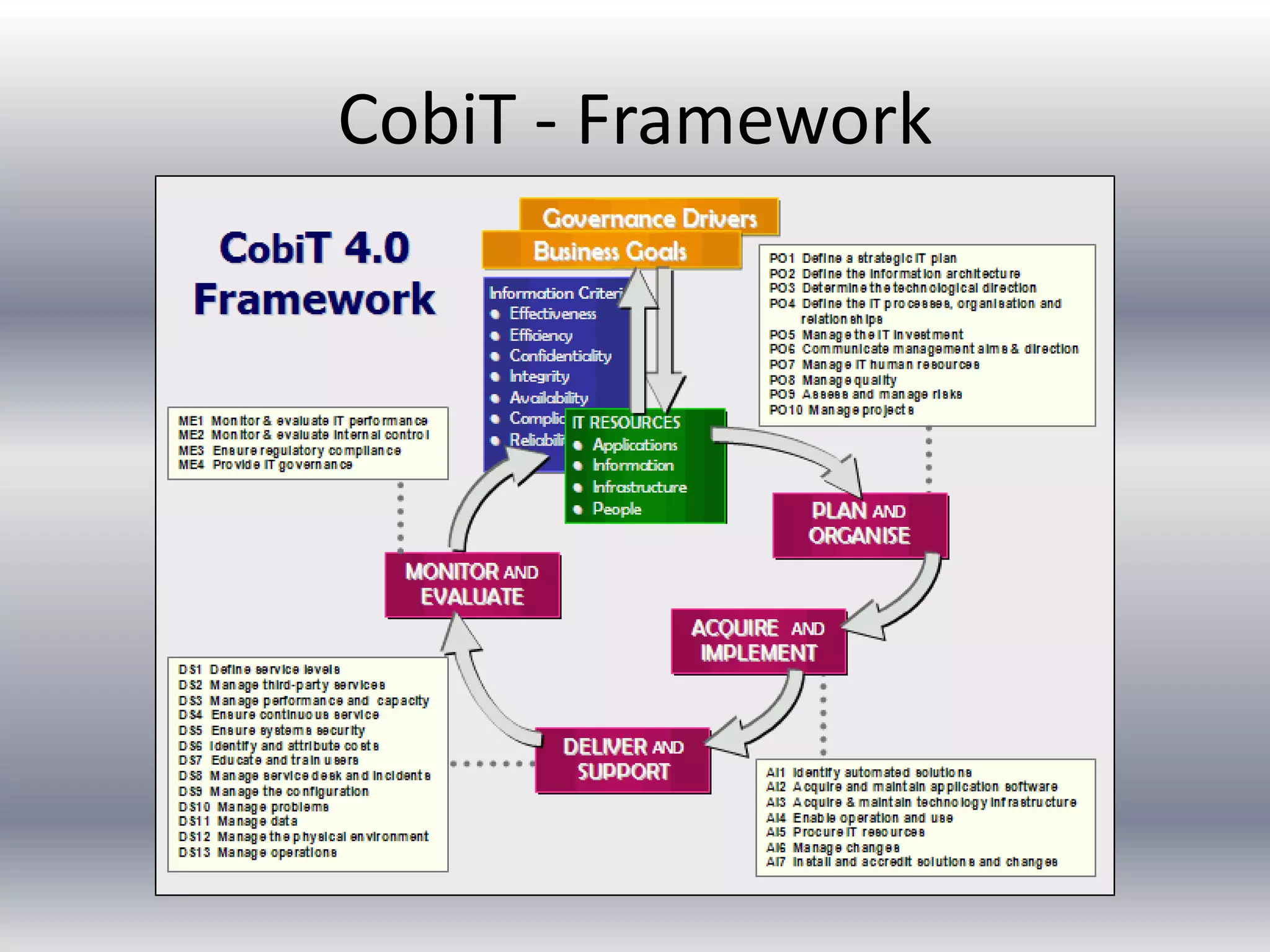
CobiT - Framework
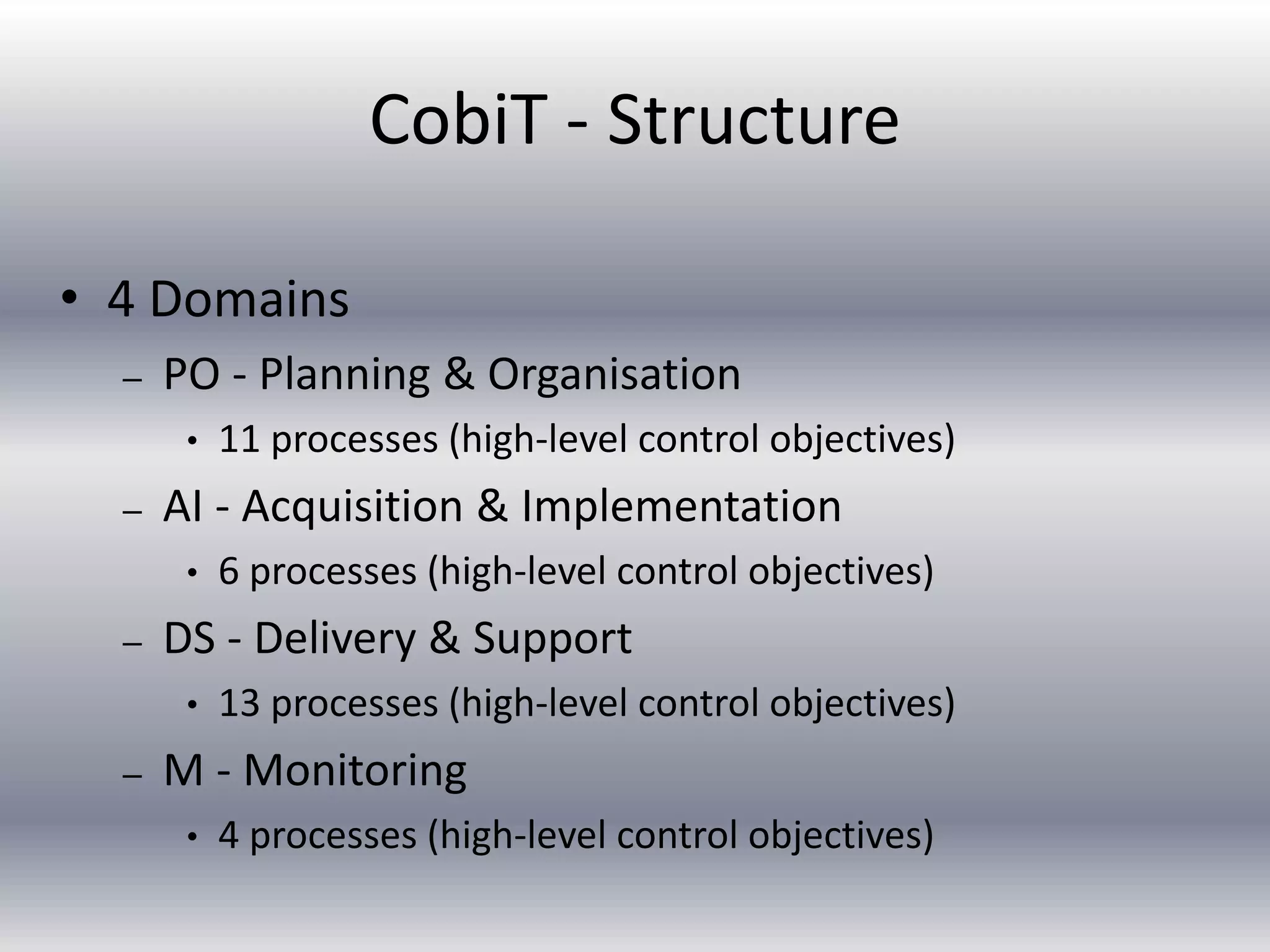
CobiT - Structure 
• 4 Domains 
– PO - Planning & Organisation 
• 11 processes (high-level control objectives) 
– AI - Acquisition & Implementation 
• 6 processes (high-level control objectives) 
– DS - Delivery & Support 
• 13 processes (high-level control objectives) 
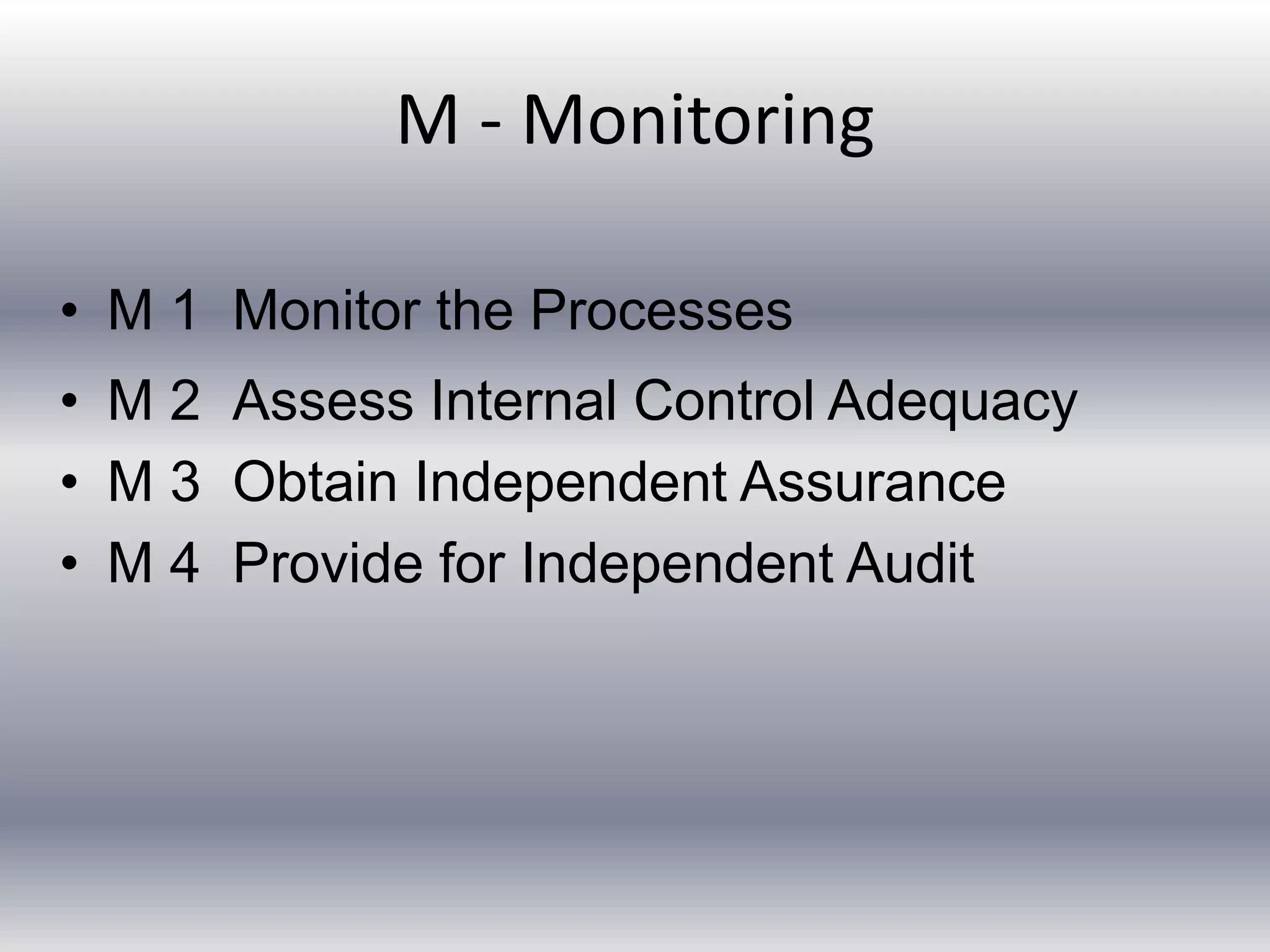
– M - Monitoring 
• 4 processes (high-level control objectives)
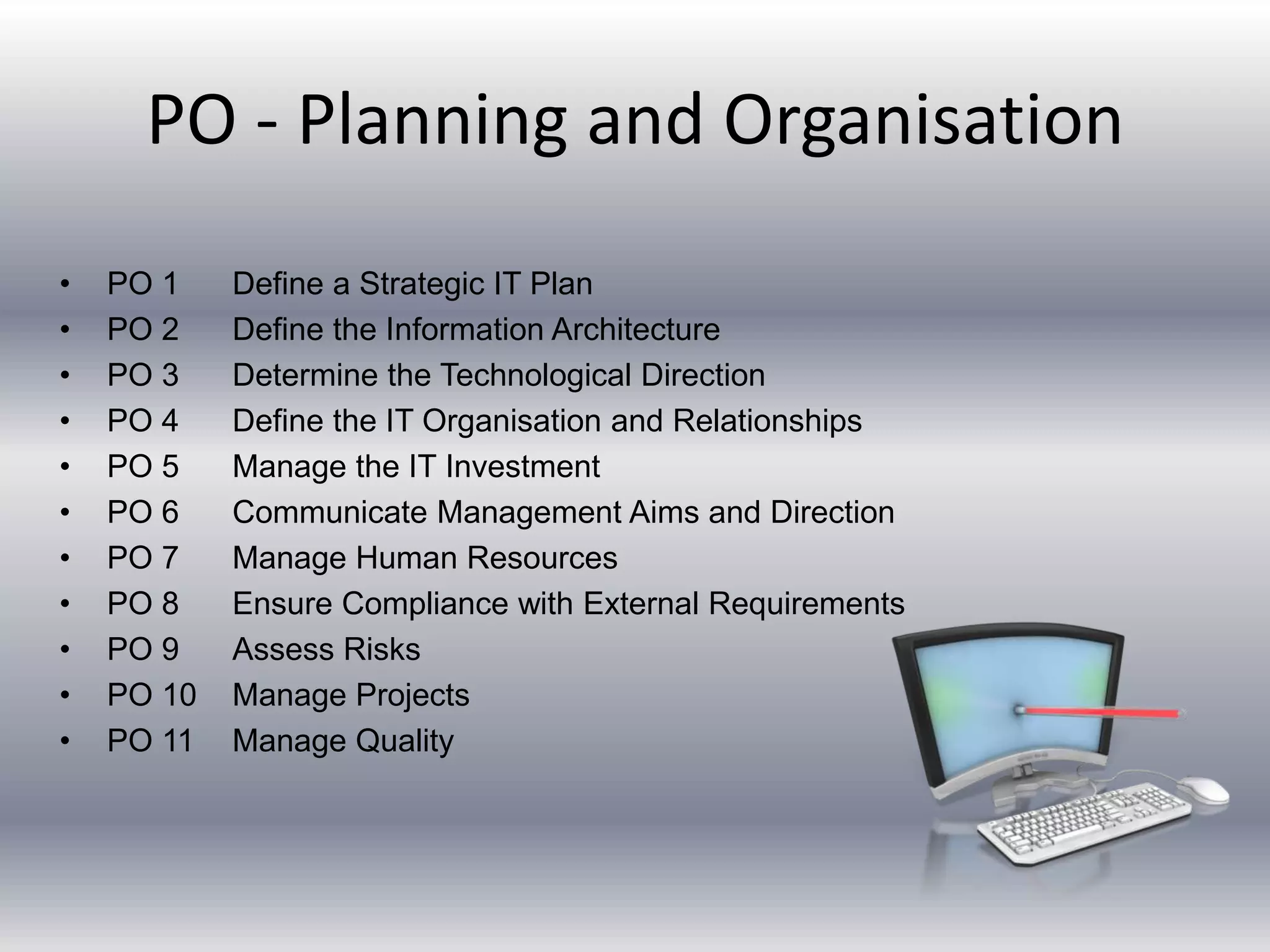
PO - Planning and Organisation 
• PO 1 Define a Strategic IT Plan 
• PO 2 Define the Information Architecture 
• PO 3 Determine the Technological Direction 
• PO 4 Define the IT Organisation and Relationships 
• PO 5 Manage the IT Investment 
• PO 6 Communicate Management Aims and Direction 
• PO 7 Manage Human Resources 
• PO 8 Ensure Compliance with External Requirements 
• PO 9 Assess Risks 
• PO 10 Manage Projects 
• PO 11 Manage Quality
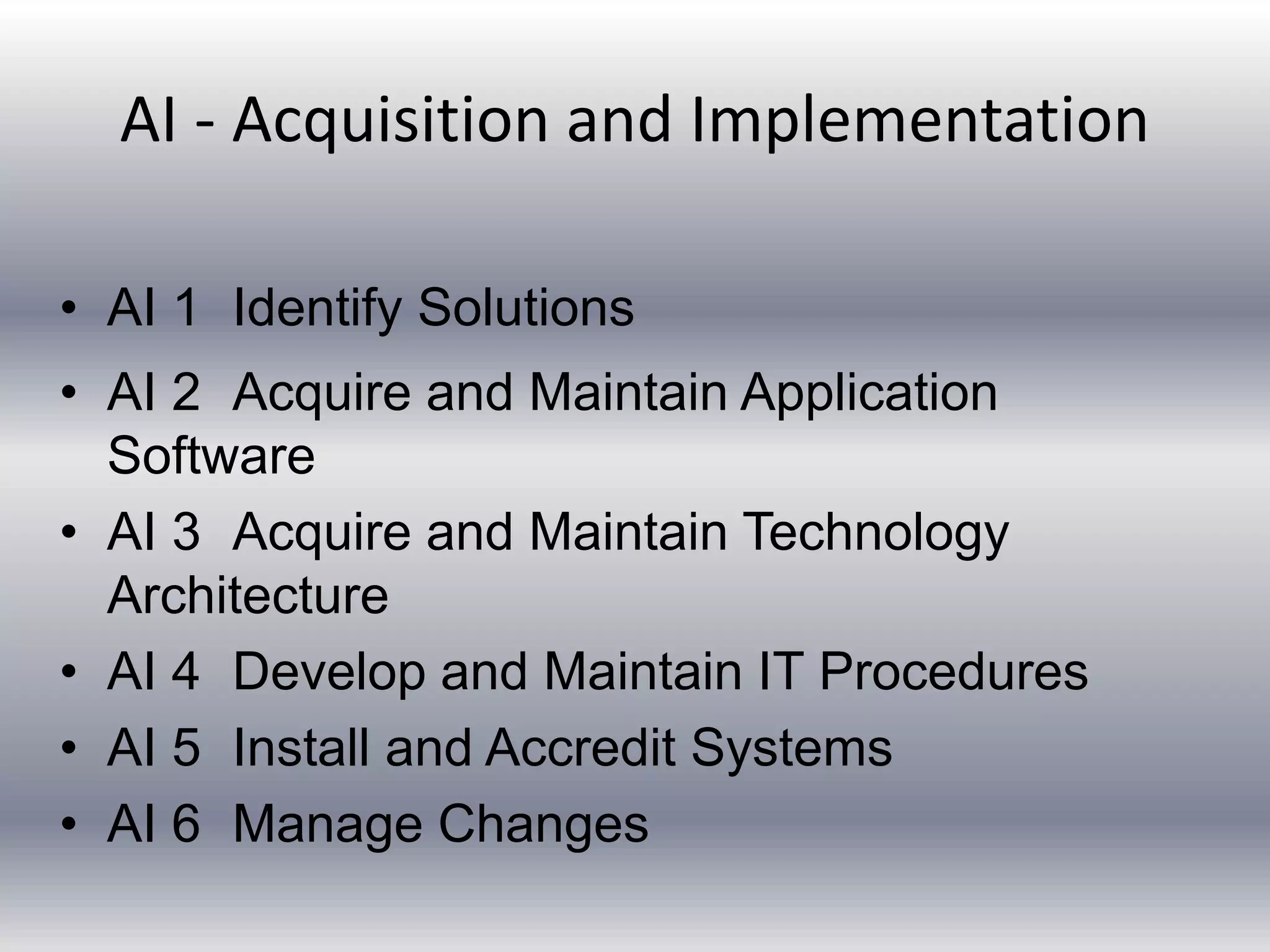
AI - Acquisition and Implementation 
• AI 1 Identify Solutions 
• AI 2 Acquire and Maintain Application 
Software 
• AI 3 Acquire and Maintain Technology 
Architecture 
• AI 4 Develop and Maintain IT Procedures 
• AI 5 Install and Accredit Systems 
• AI 6 Manage Changes
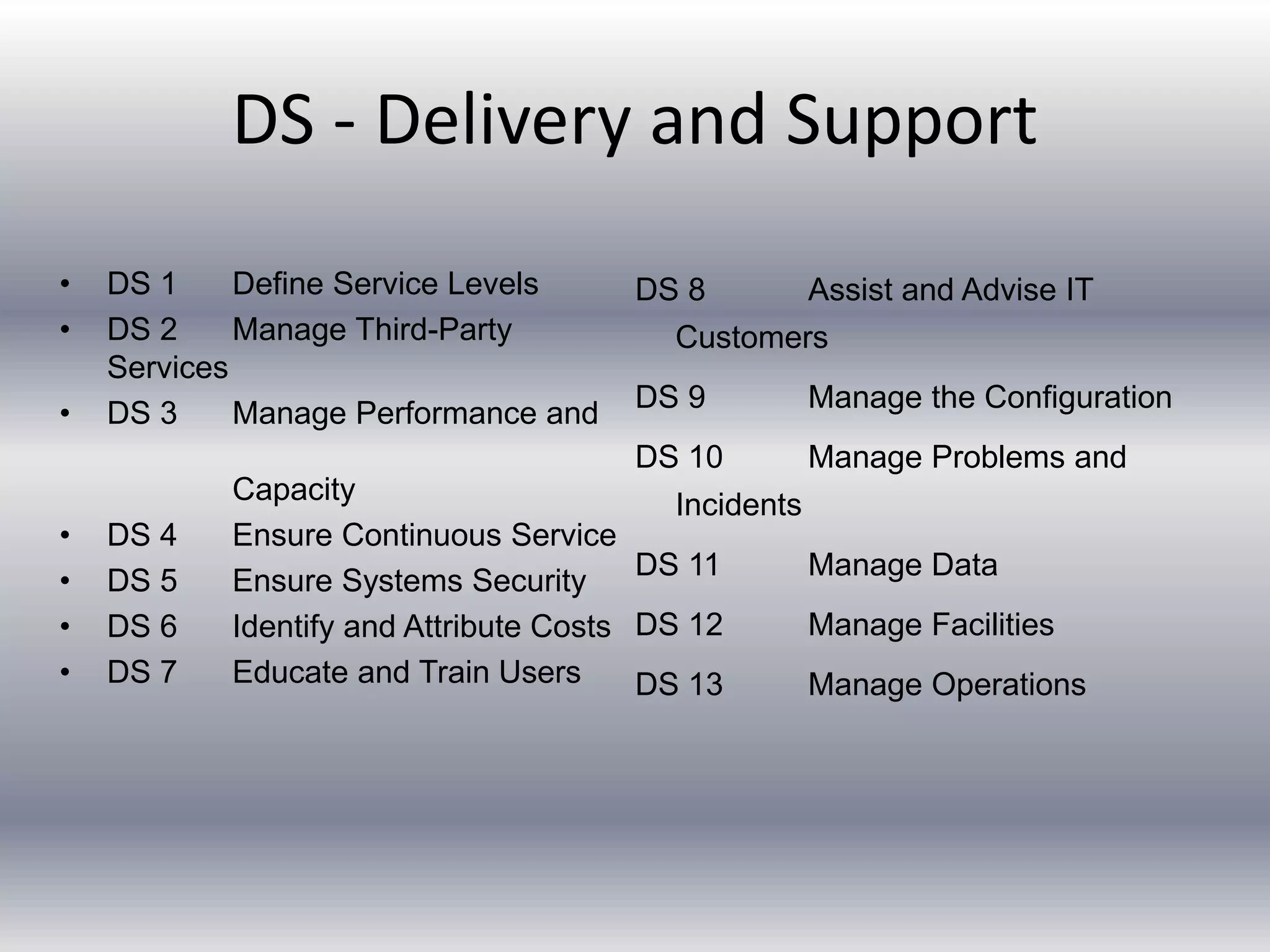
DS - Delivery and Support 
• DS 1 Define Service Levels 
• DS 2 Manage Third-Party 
Services 
• DS 3 Manage Performance and 
Capacity 
• DS 4 Ensure Continuous Service 
• DS 5 Ensure Systems Security 
• DS 6 Identify and Attribute Costs 
• DS 7 Educate and Train Users 
DS 8 Assist and Advise IT 
Customers 
DS 9 Manage the Configuration 
DS 10 Manage Problems and 
Incidents 
DS 11 Manage Data 
DS 12 Manage Facilities 
DS 13 Manage Operations
M - Monitoring 
• M 1 Monitor the Processes 
• M 2 Assess Internal Control Adequacy 
• M 3 Obtain Independent Assurance 
• M 4 Provide for Independent Audit
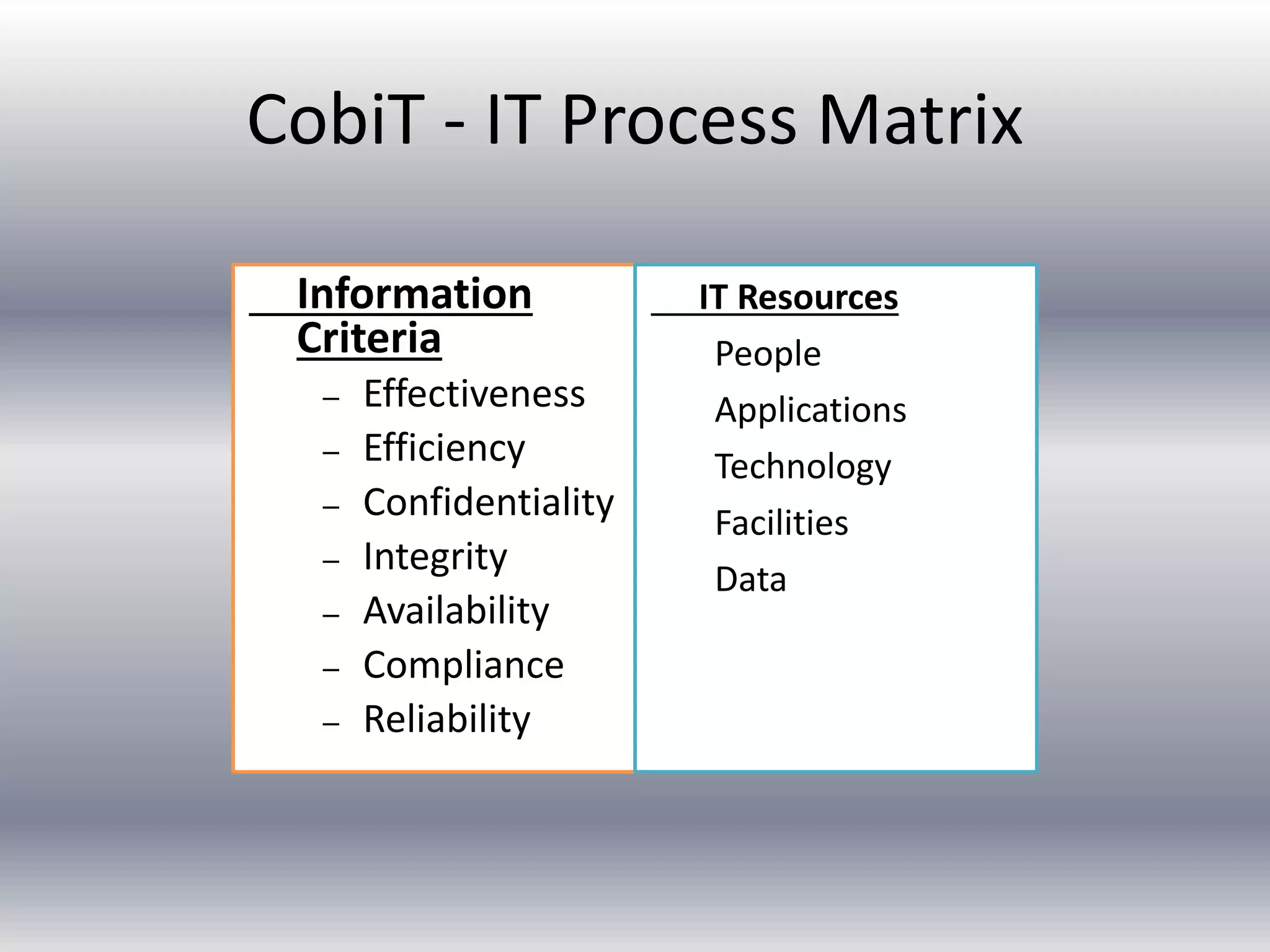
CobiT - IT Process Matrix 
Information 
Criteria 
– Effectiveness 
– Efficiency 
– Confidentiality 
– Integrity 
– Availability 
– Compliance 
– Reliability 
IT Resources 
People 
Applications 
Technology 
Facilities 
Data
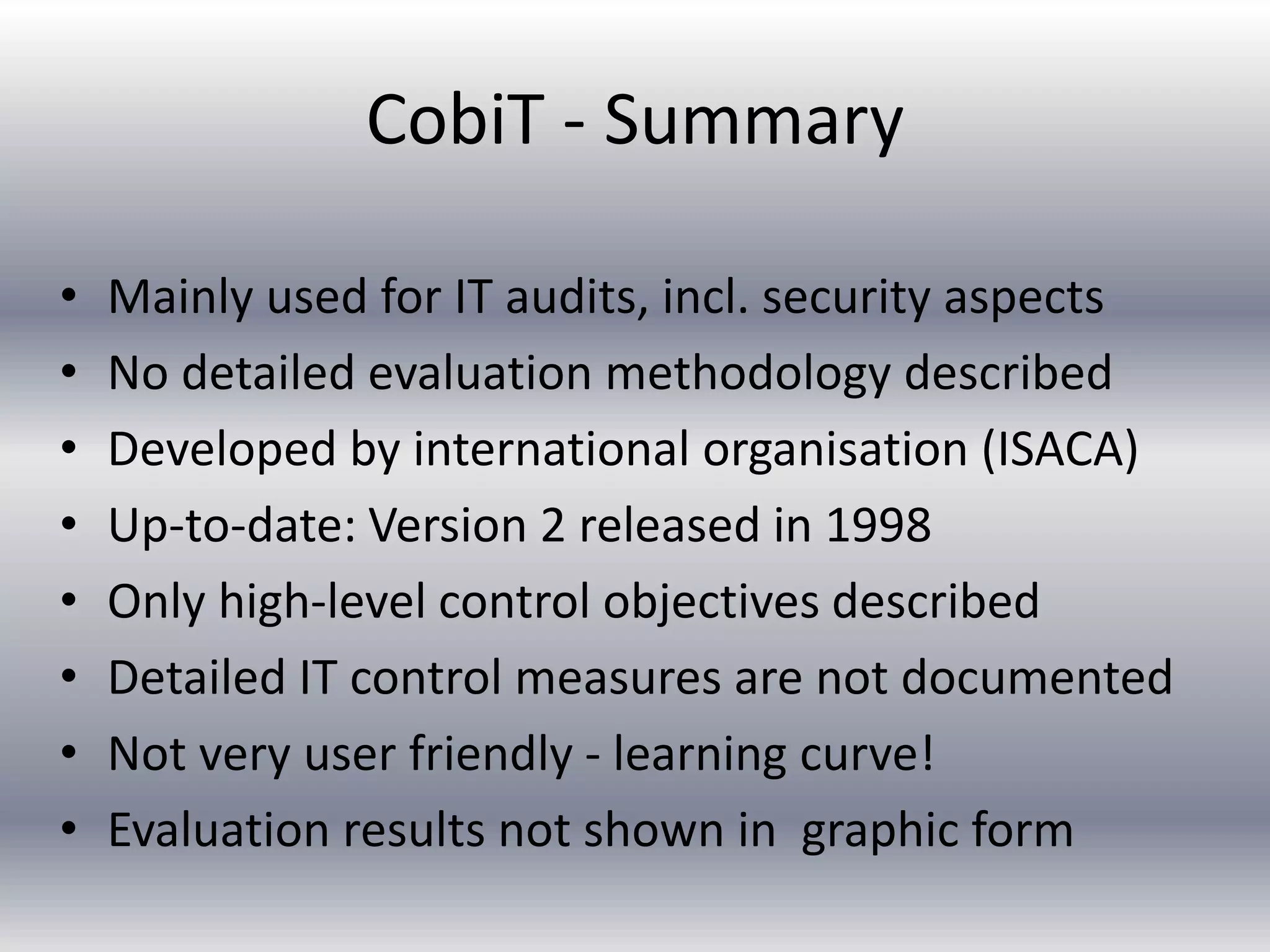
CobiT - Summary 
• Mainly used for IT audits, incl. security aspects 
• No detailed evaluation methodology described 
• Developed by international organisation (ISACA) 
• Up-to-date: Version 2 released in 1998 
• Only high-level control objectives described 
• Detailed IT control measures are not documented 
• Not very user friendly - learning curve! 
• Evaluation results not shown in graphic form
BS 7799 - Security Baseline Controls 
• 10 control categories 
• 32 control groups 
• 109 security controls 
• 10 security key controls
BS 7799 - Control Categories 
• Information security policy 
• Security organisation 
• Assets classification & control 
• Personnel security 
• Physical & environmental security 
• Computer & network management
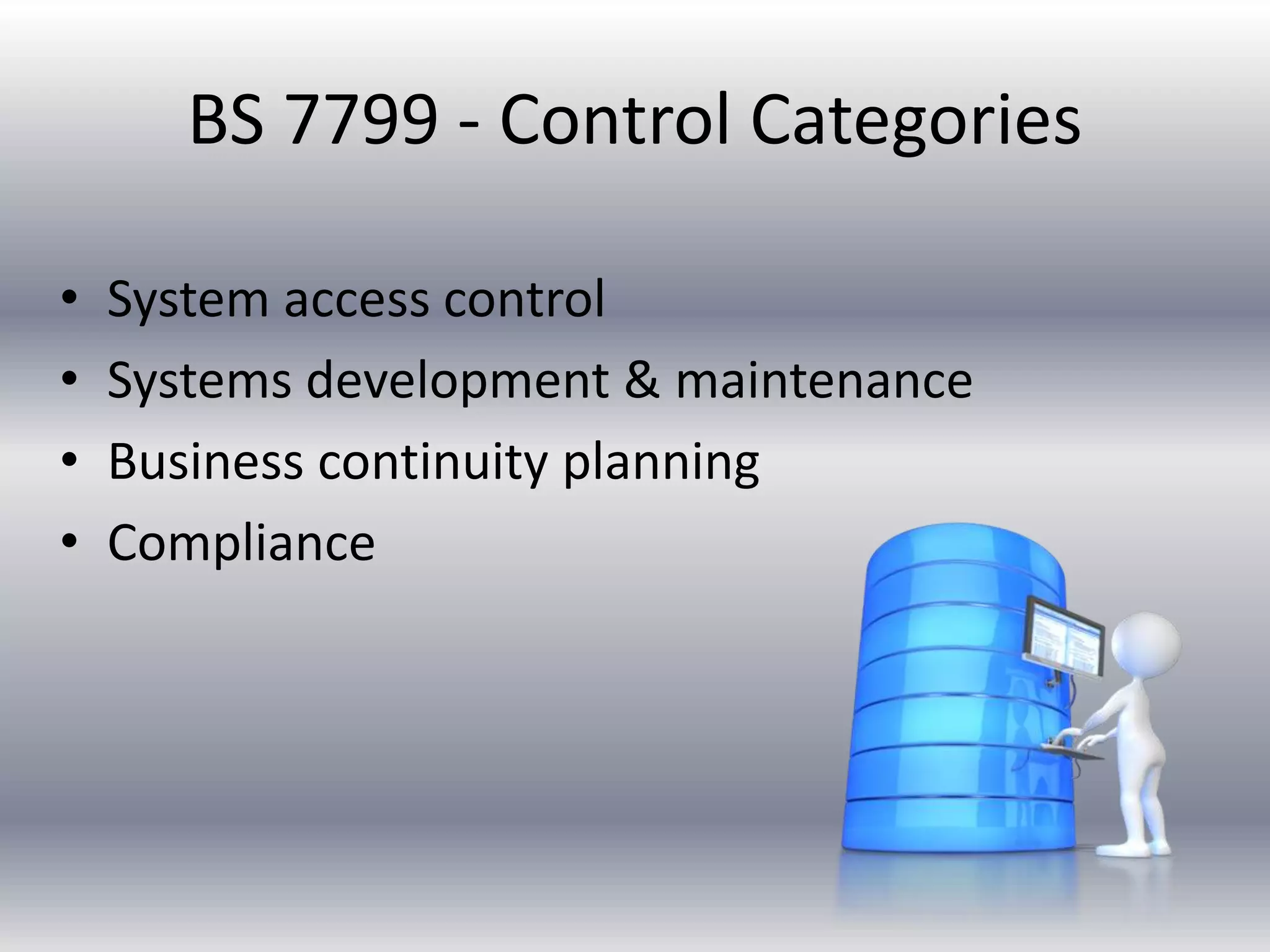
BS 7799 - Control Categories 
• System access control 
• Systems development & maintenance 
• Business continuity planning 
• Compliance
BS7799 - 10 Key Controls 
• Information security policy document 
• Allocation of information security 
responsibilities 
• Information security education and training 
• Reporting of security incidents 
• Virus controls
BS7799 - 10 Key Controls 
• Business continuity planning process 
• Control of proprietary software copying 
• Safeguarding of organizational records 
• Data protection 
• Compliance with security policy
BS7799 - Summary 
• Main use: Security Concepts & Health Checks 
• No evaluation methodology described 
• British Standard, developed by UK DTI 
• Certification scheme in place (c:cure) 
• BS7799, Part1, 1995 is being revised in 1999 
• Lists 109 ready-to-use security controls 
• No detailed security measures described 
• Very user friendly - easy to learn
BSI - Structure 
• IT security measures 
– 7 areas 
– 34 modules (building blocks) 
• Safeguards catalogue 
– 6 categories of security measures 
• Threats catalogue 
– 5 categories of threats
BSI - Security Measures (Modules) 
• Protection for generic components 
• Infrastructure 
• Non-networked systems 
• LANs 
• Data transfer systems 
• Telecommunications 
• Other IT components
BSI - Generic Components 
• 3.1 Organisation 
• 3.2 Personnel 
• 3.3 Contingency Planning 
• 3.4 Data Protection
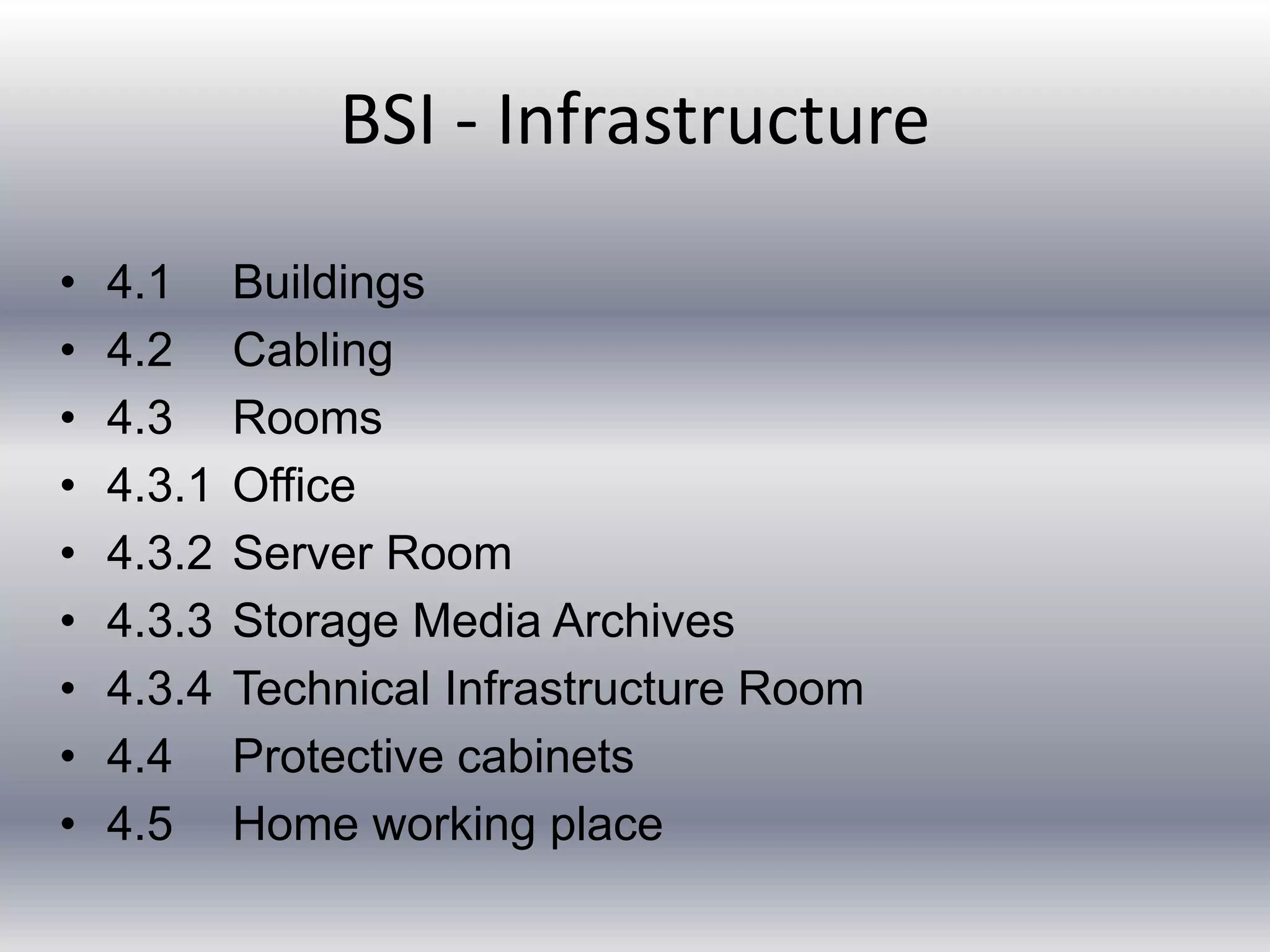
BSI - Infrastructure 
• 4.1 Buildings 
• 4.2 Cabling 
• 4.3 Rooms 
• 4.3.1 Office 
• 4.3.2 Server Room 
• 4.3.3 Storage Media Archives 
• 4.3.4 Technical Infrastructure Room 
• 4.4 Protective cabinets 
• 4.5 Home working place
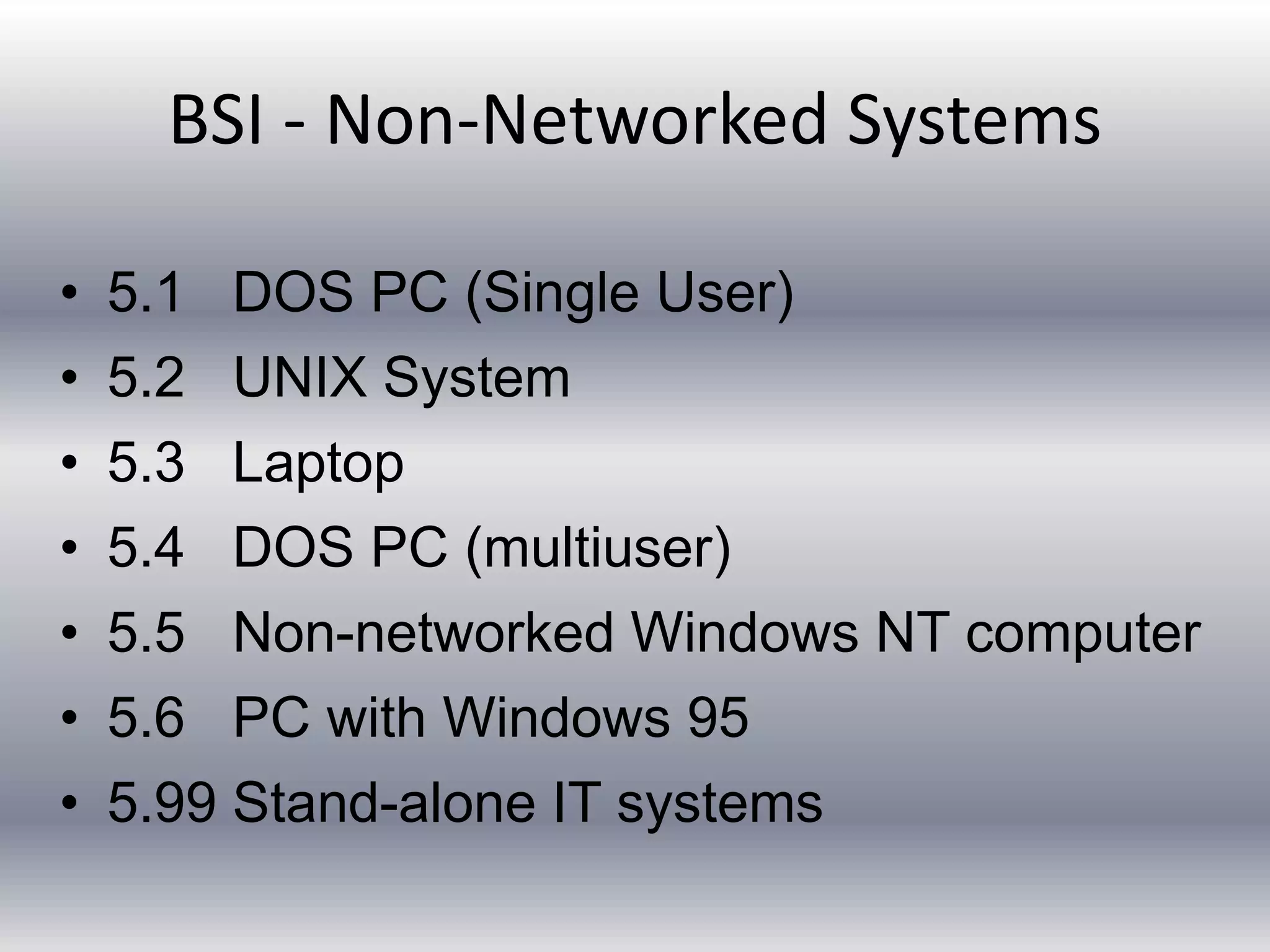
BSI - Non-Networked Systems 
• 5.1 DOS PC (Single User) 
• 5.2 UNIX System 
• 5.3 Laptop 
• 5.4 DOS PC (multiuser) 
• 5.5 Non-networked Windows NT computer 
• 5.6 PC with Windows 95 
• 5.99 Stand-alone IT systems
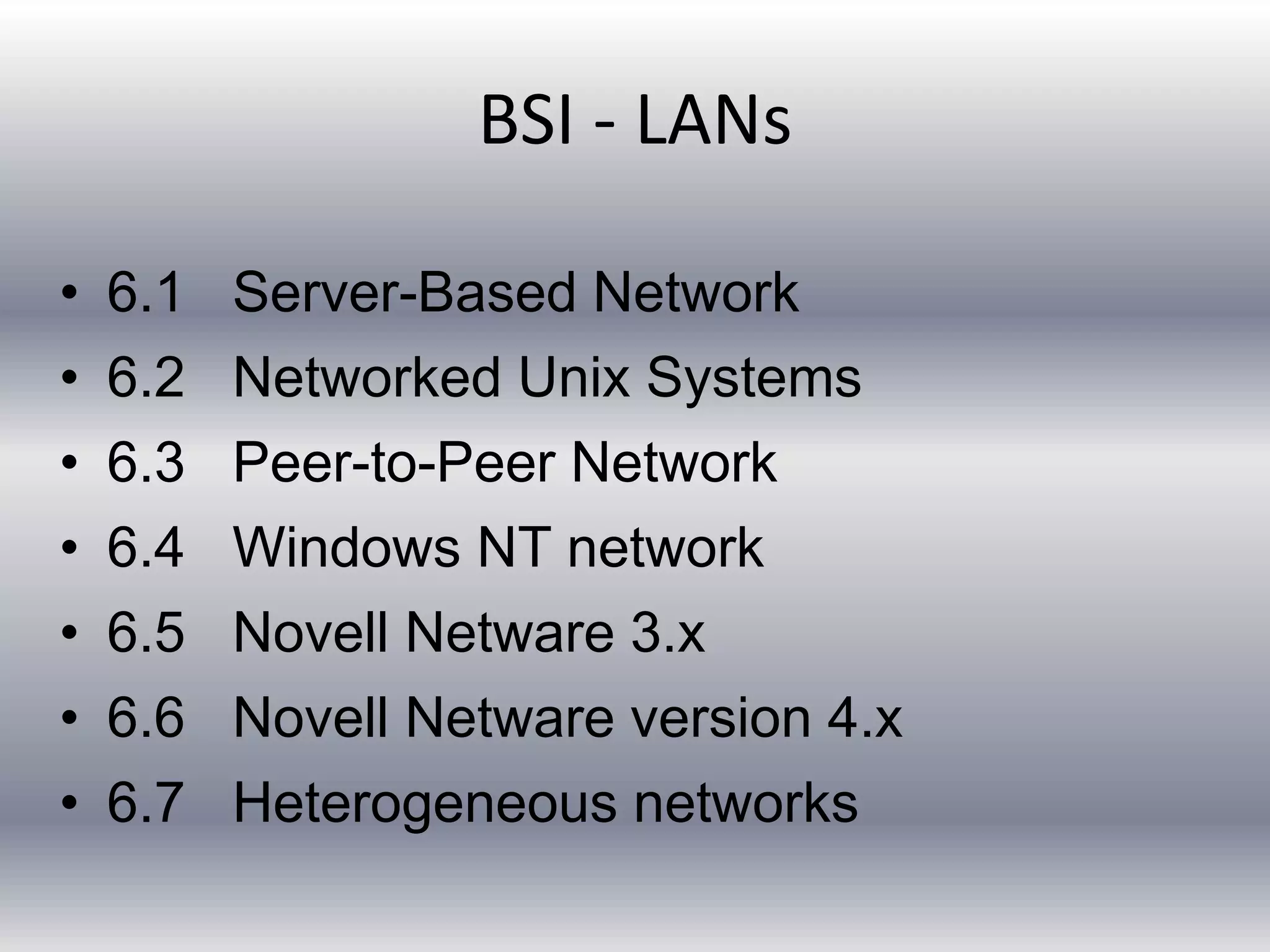
BSI - LANs 
• 6.1 Server-Based Network 
• 6.2 Networked Unix Systems 
• 6.3 Peer-to-Peer Network 
• 6.4 Windows NT network 
• 6.5 Novell Netware 3.x 
• 6.6 Novell Netware version 4.x 
• 6.7 Heterogeneous networks
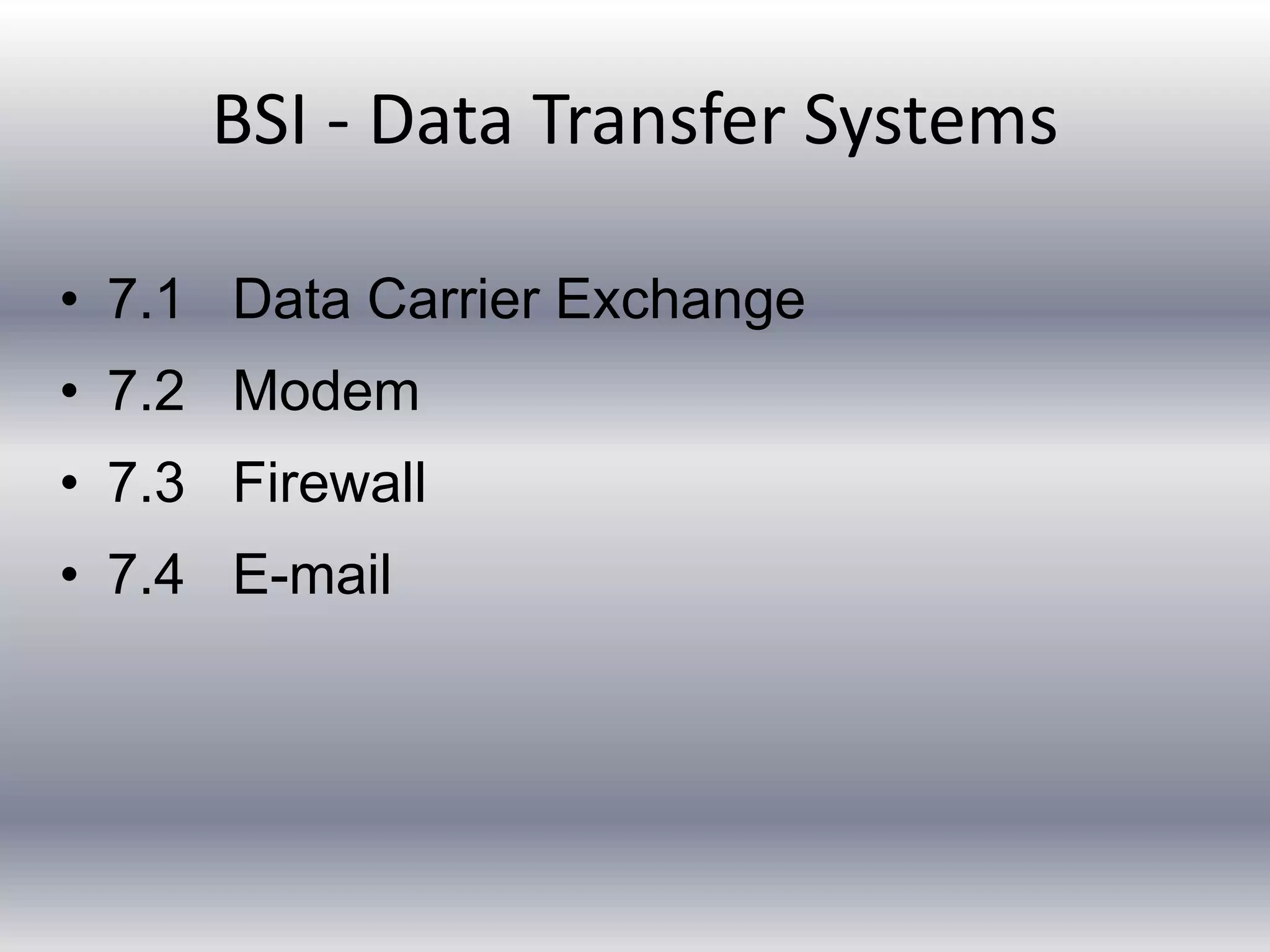
BSI - Data Transfer Systems 
• 7.1 Data Carrier Exchange 
• 7.2 Modem 
• 7.3 Firewall 
• 7.4 E-mail
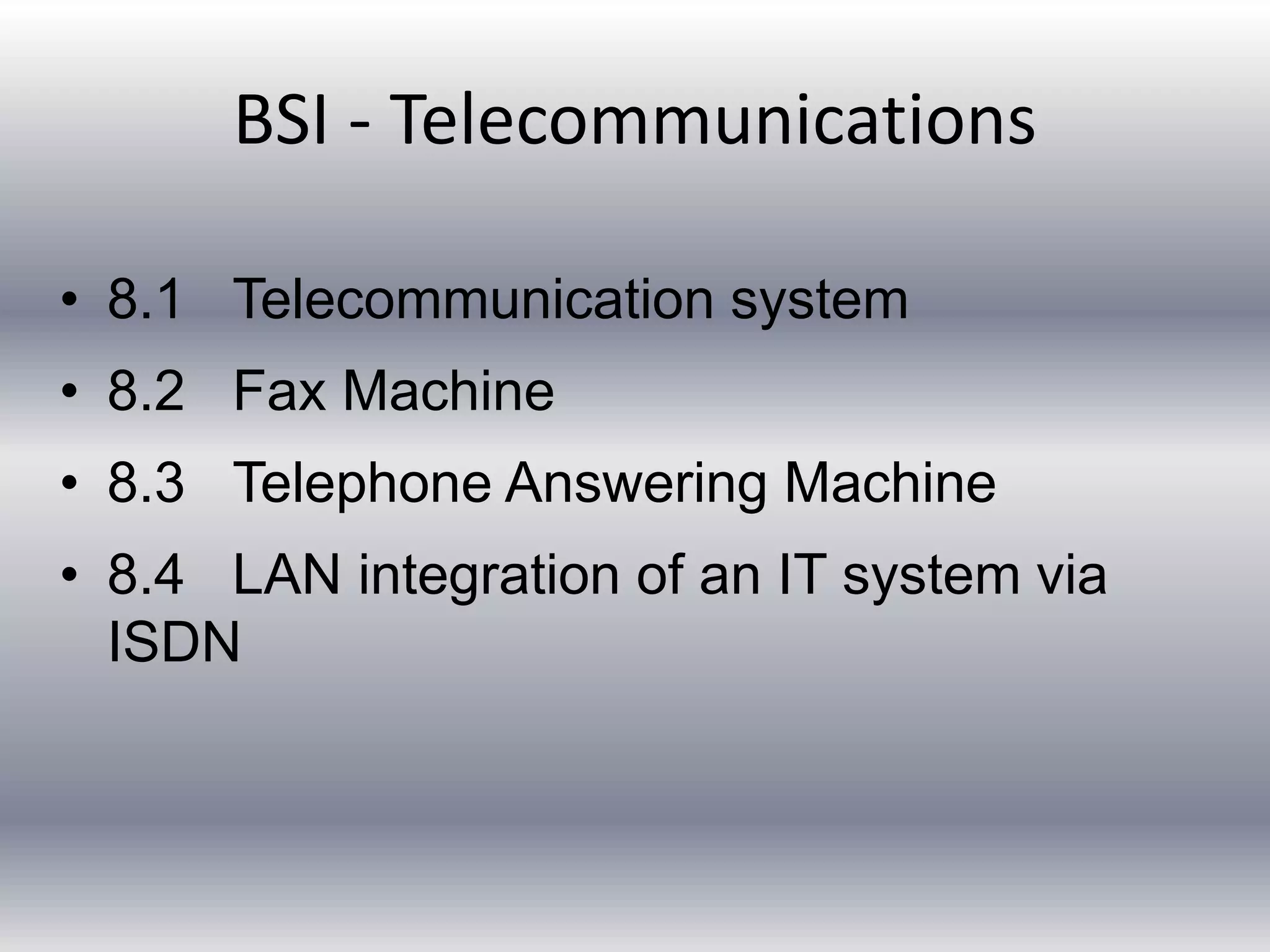
BSI - Telecommunications 
• 8.1 Telecommunication system 
• 8.2 Fax Machine 
• 8.3 Telephone Answering Machine 
• 8.4 LAN integration of an IT system via 
ISDN
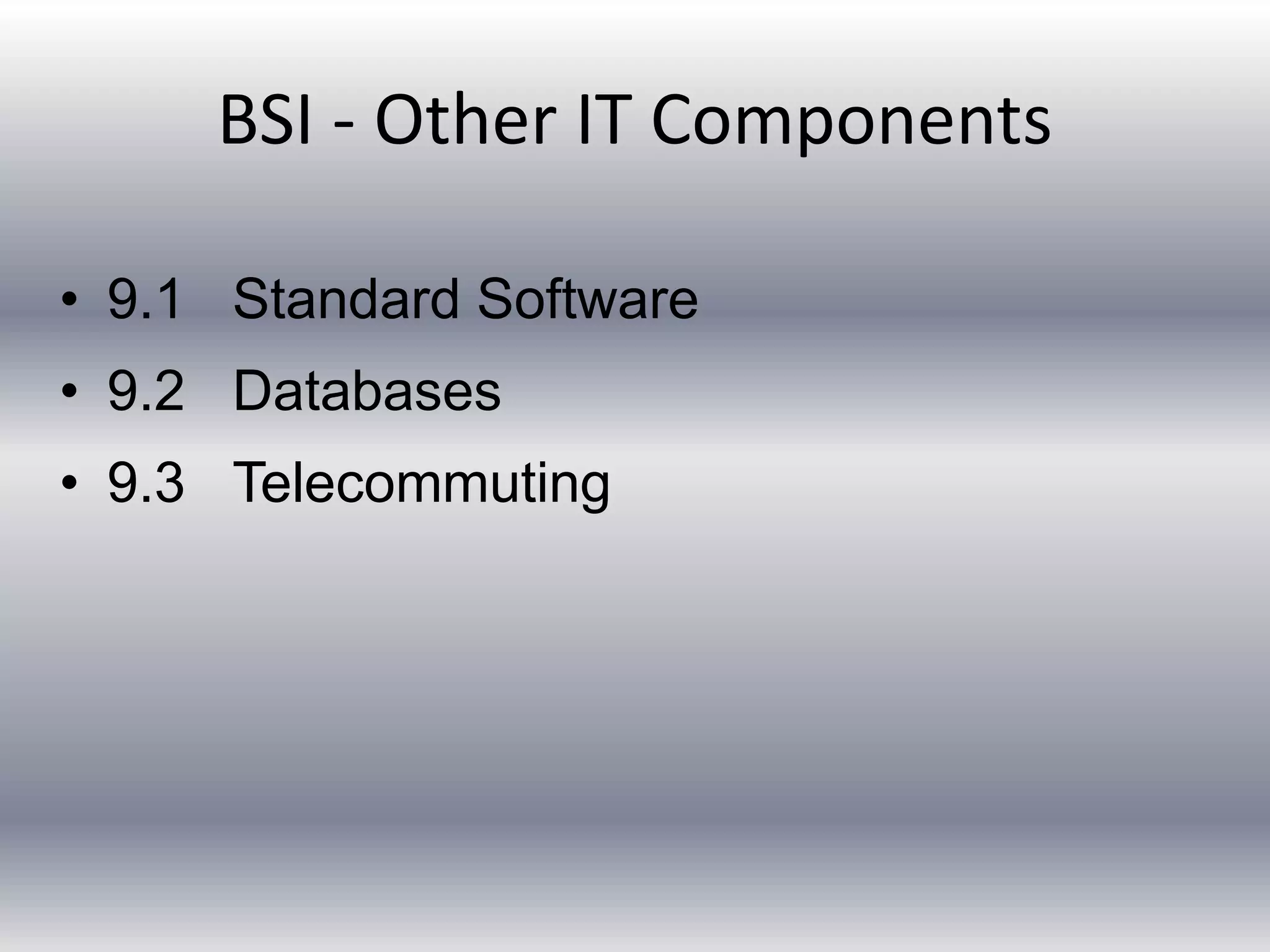
BSI - Other IT Components 
• 9.1 Standard Software 
• 9.2 Databases 
• 9.3 Telecommuting
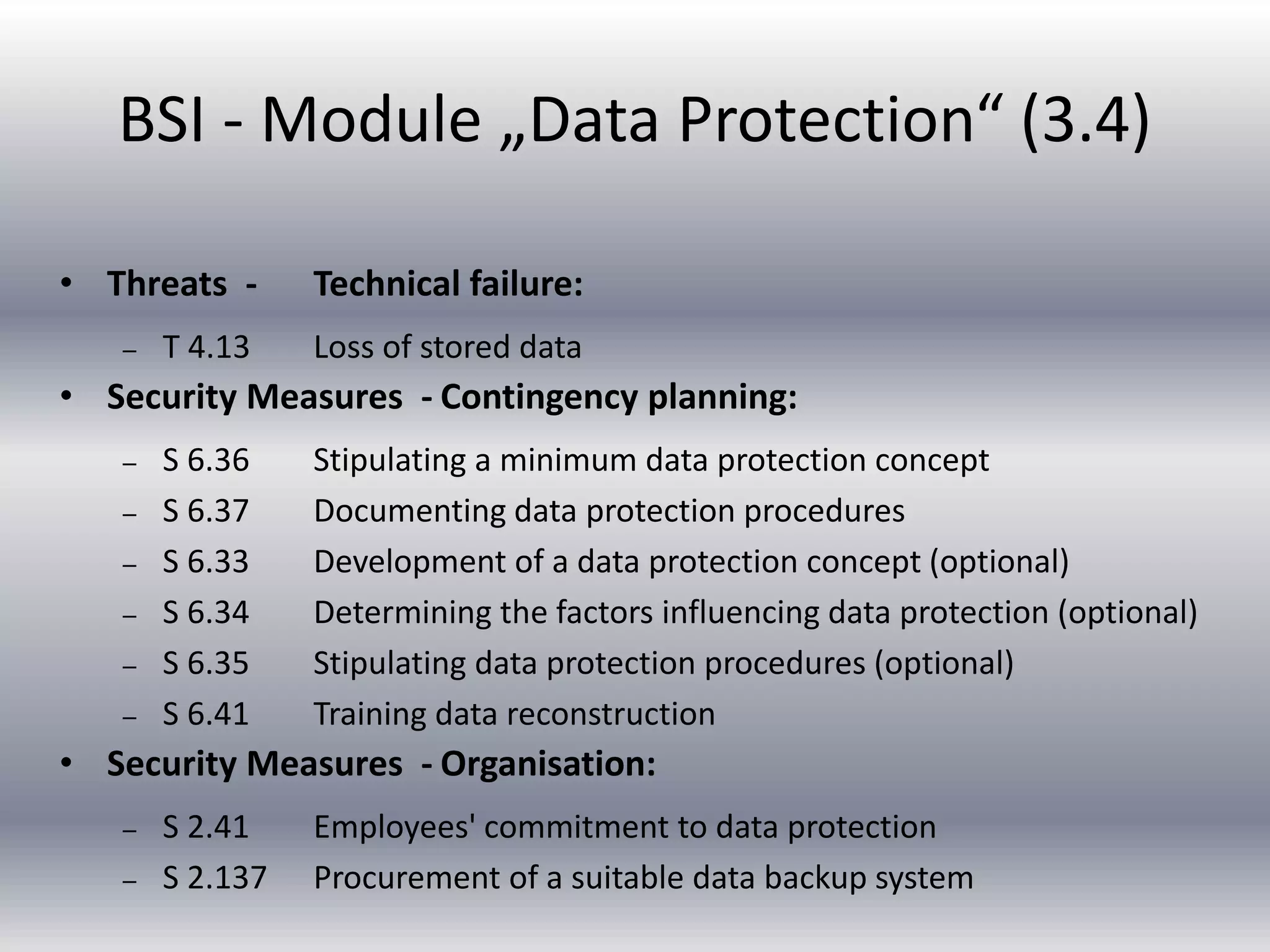
BSI - Module „Data Protection“ (3.4) 
• Threats - Technical failure: 
– T 4.13 Loss of stored data 
• Security Measures - Contingency planning: 
– S 6.36 Stipulating a minimum data protection concept 
– S 6.37 Documenting data protection procedures 
– S 6.33 Development of a data protection concept (optional) 
– S 6.34 Determining the factors influencing data protection (optional) 
– S 6.35 Stipulating data protection procedures (optional) 
– S 6.41 Training data reconstruction 
• Security Measures - Organisation: 
– S 2.41 Employees' commitment to data protection 
– S 2.137 Procurement of a suitable data backup system
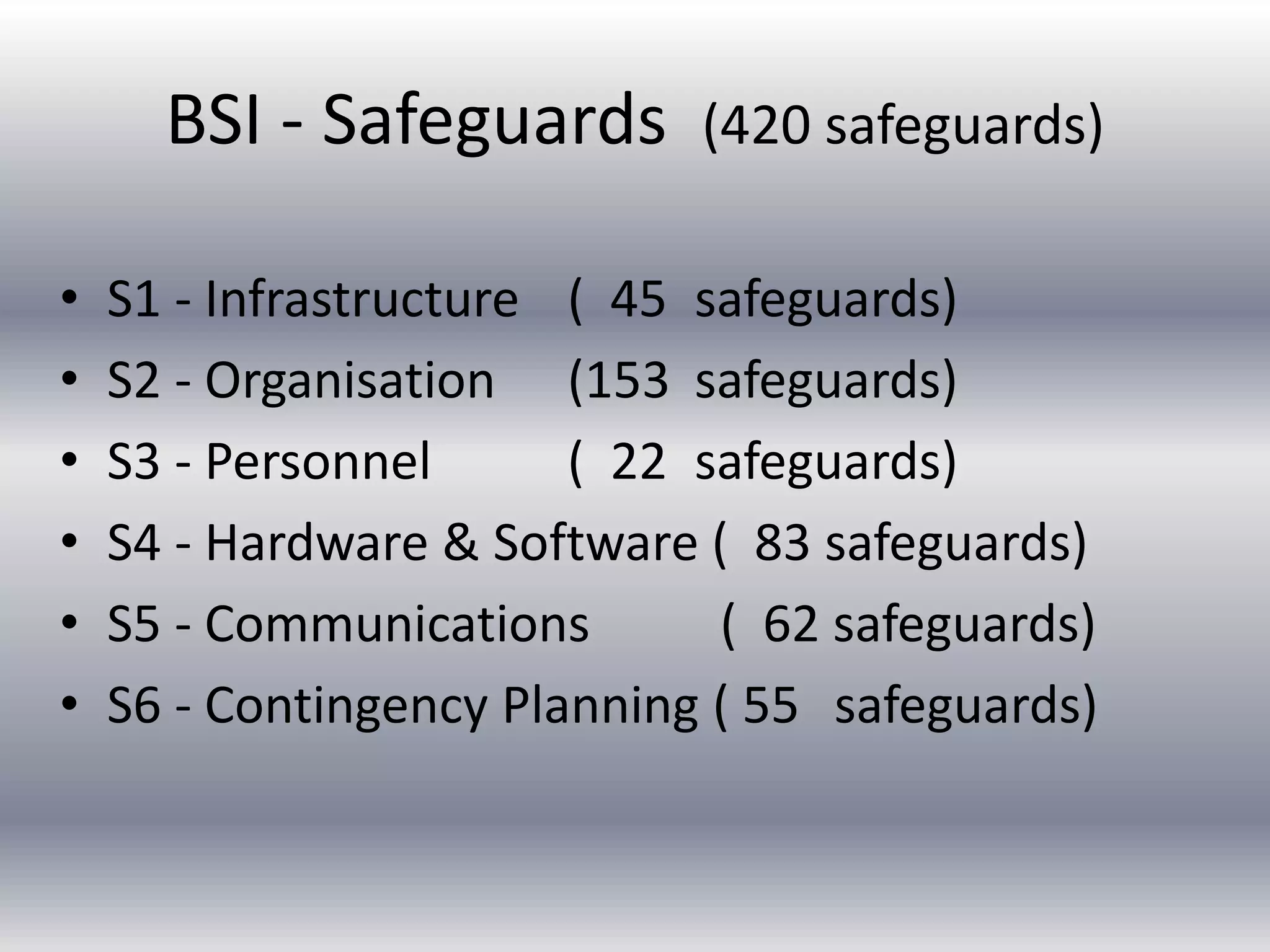
BSI - Safeguards (420 safeguards) 
• S1 - Infrastructure ( 45 safeguards) 
• S2 - Organisation (153 safeguards) 
• S3 - Personnel ( 22 safeguards) 
• S4 - Hardware & Software ( 83 safeguards) 
• S5 - Communications ( 62 safeguards) 
• S6 - Contingency Planning ( 55 safeguards)
BSI - S1-Infrastructure (45 safeguards) 
• S 1.7 Hand-held fire extinguishers 
• S 1.10 Use of safety doors 
• S 1.17 Entrance control service 
• S 1.18 Intruder and fire detection devices 
• S 1.27 Air conditioning 
• S 1.28 Local uninterruptible power supply [UPS] 
• S 1.36 Safekeeping of data carriers before and 
after dispatch
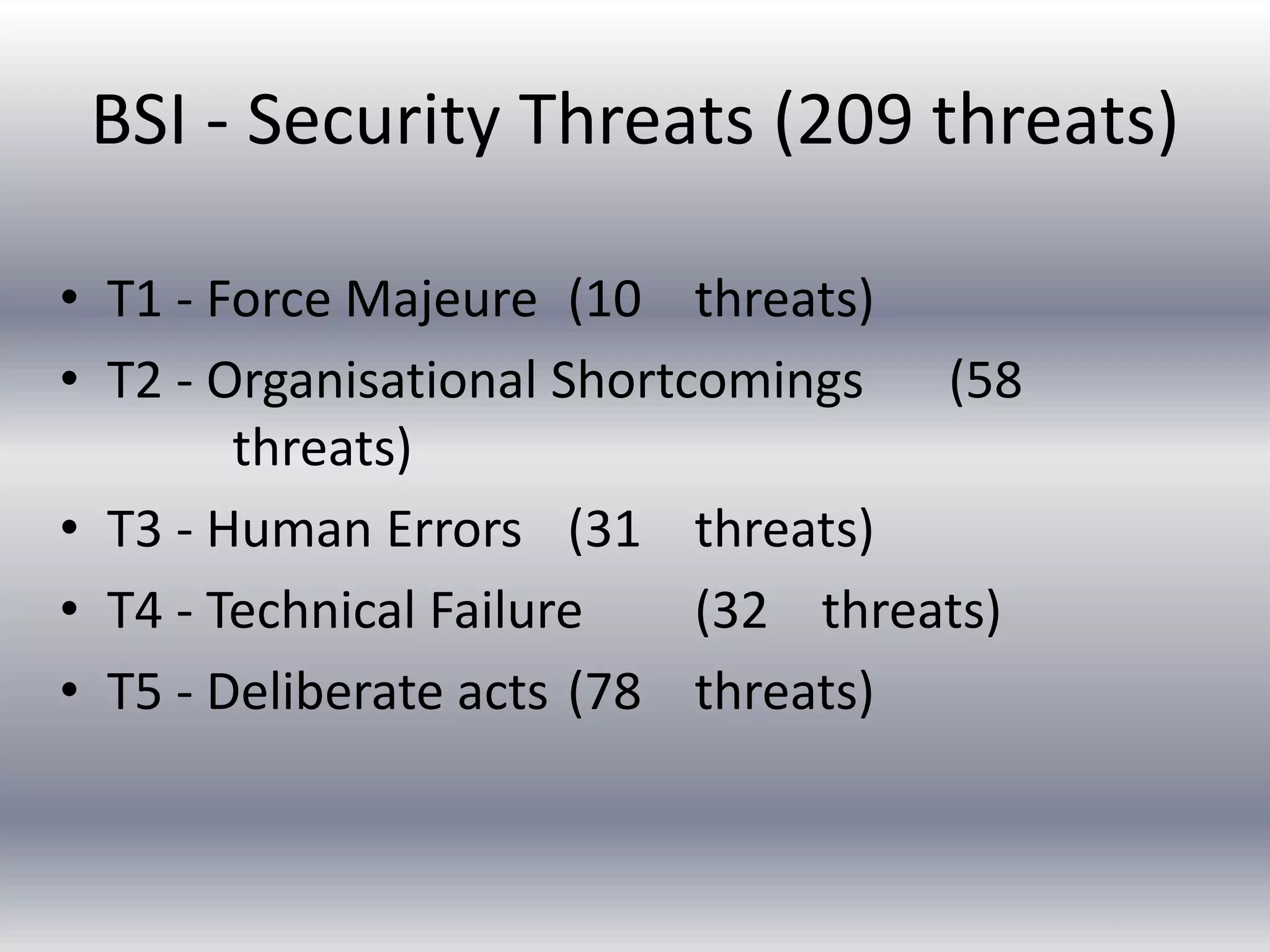
BSI - Security Threats (209 threats) 
• T1 - Force Majeure (10 threats) 
• T2 - Organisational Shortcomings (58 
threats) 
• T3 - Human Errors (31 threats) 
• T4 - Technical Failure (32 threats) 
• T5 - Deliberate acts (78 threats)
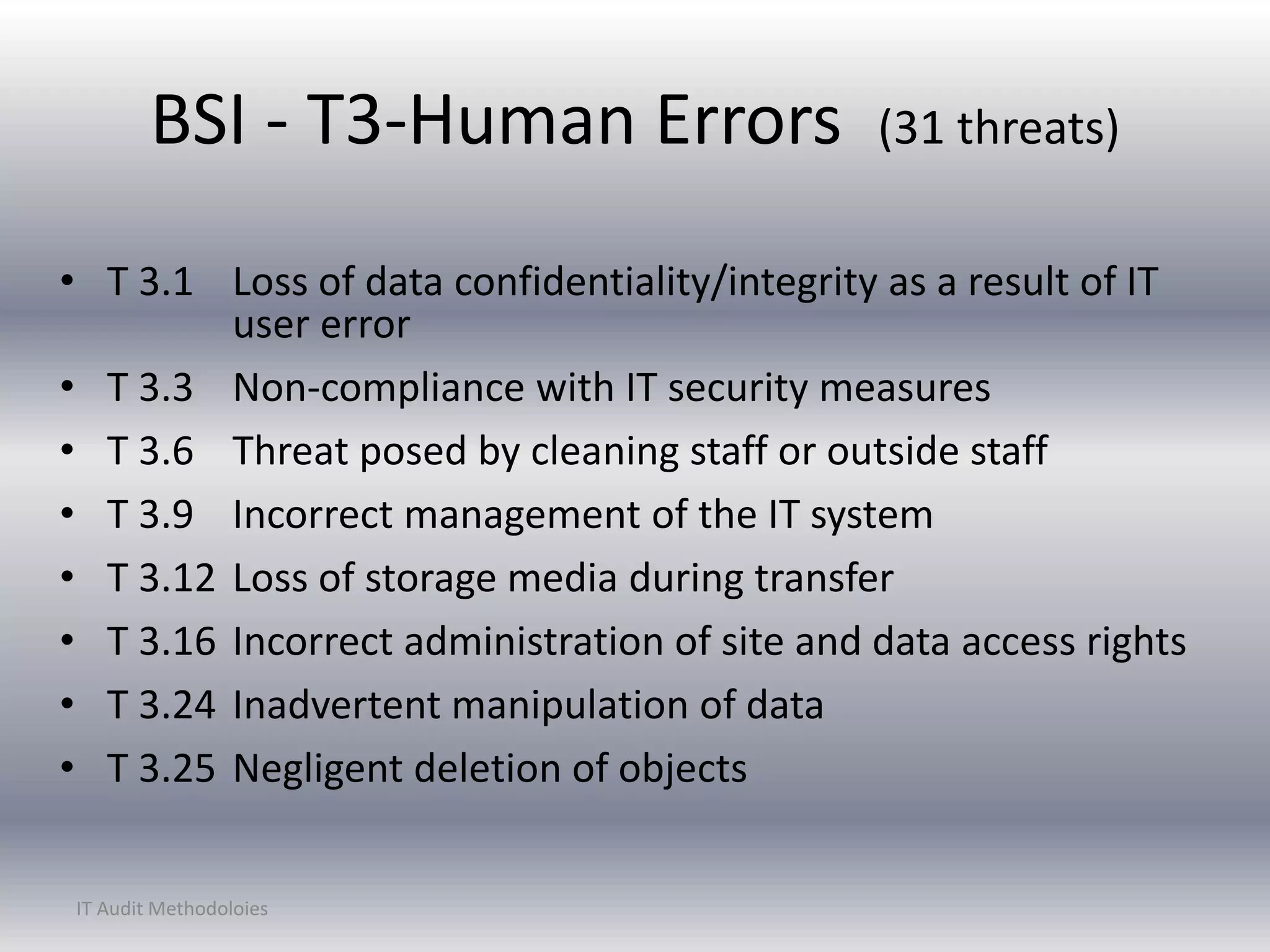
BSI - T3-Human Errors (31 threats) 
• T 3.1 Loss of data confidentiality/integrity as a result of IT 
user error 
• T 3.3 Non-compliance with IT security measures 
• T 3.6 Threat posed by cleaning staff or outside staff 
• T 3.9 Incorrect management of the IT system 
• T 3.12 Loss of storage media during transfer 
• T 3.16 Incorrect administration of site and data access rights 
• T 3.24 Inadvertent manipulation of data 
• T 3.25 Negligent deletion of objects 
IT Audit Methodoloies
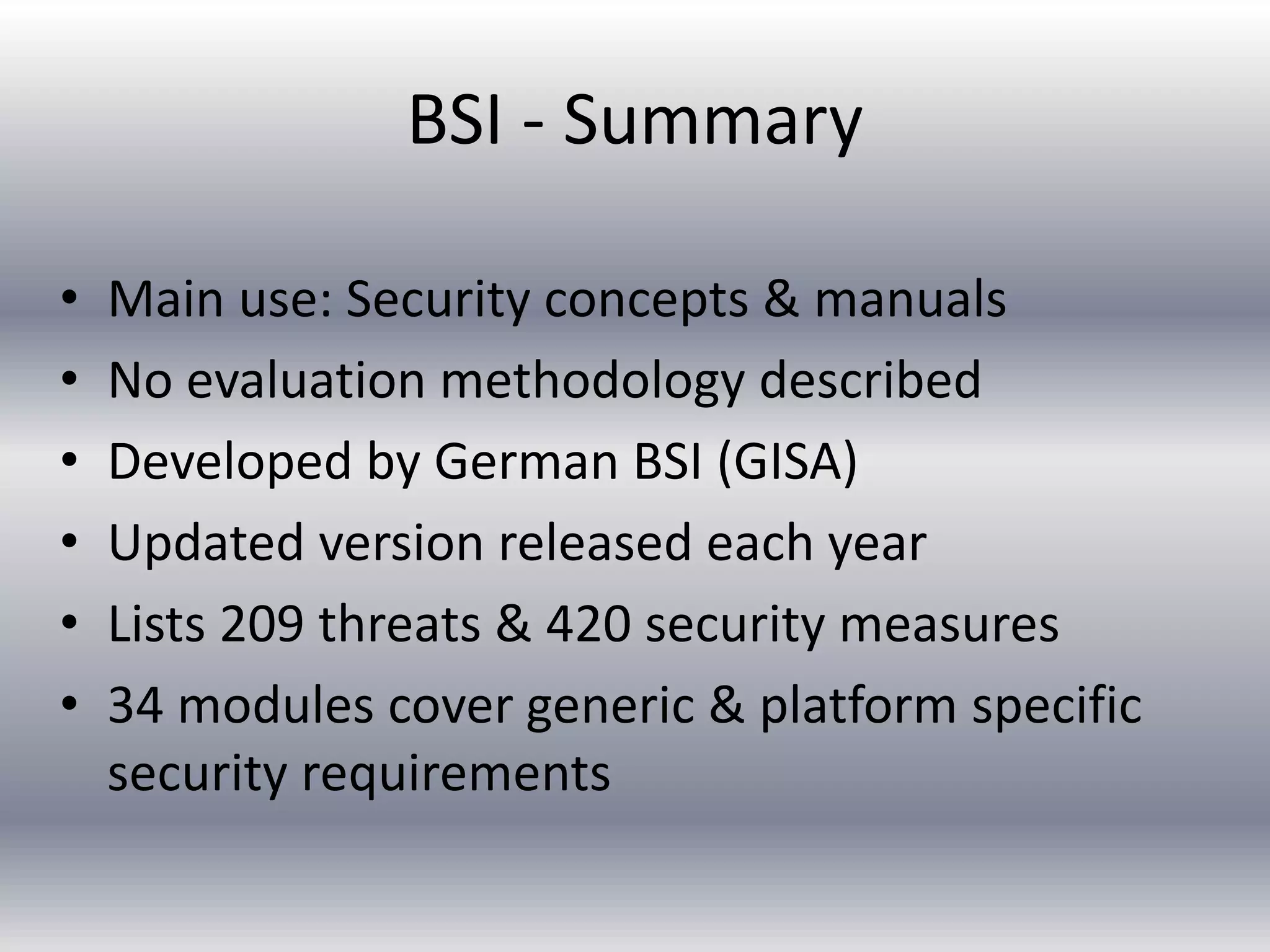
BSI - Summary 
• Main use: Security concepts & manuals 
• No evaluation methodology described 
• Developed by German BSI (GISA) 
• Updated version released each year 
• Lists 209 threats & 420 security measures 
• 34 modules cover generic & platform specific 
security requirements
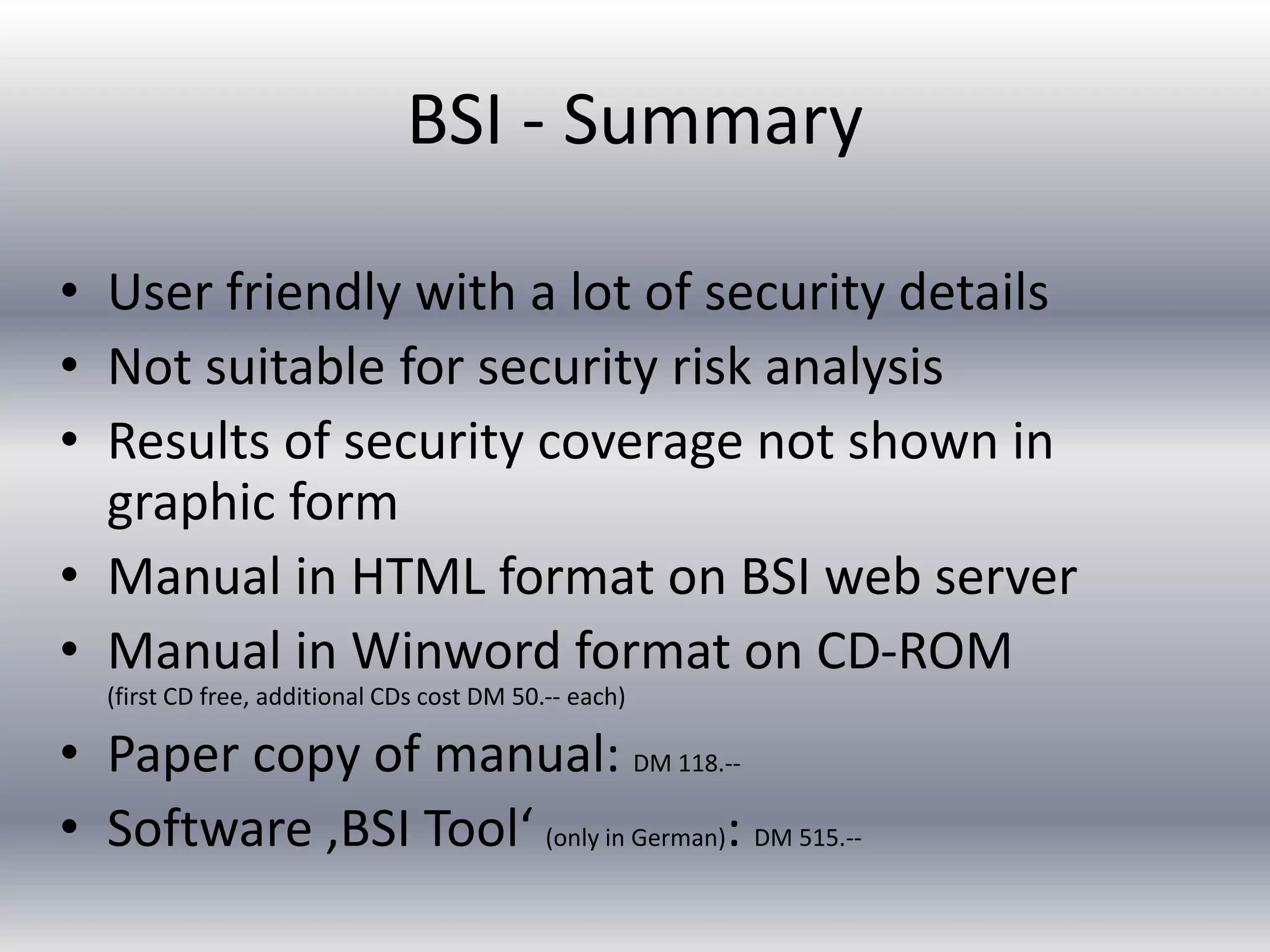
BSI - Summary 
• User friendly with a lot of security details 
• Not suitable for security risk analysis 
• Results of security coverage not shown in 
graphic form 
• Manual in HTML format on BSI web server 
• Manual in Winword format on CD-ROM 
(first CD free, additional CDs cost DM 50.-- each) 
• Paper copy of manual: DM 118.-- 
• Software ‚BSI Tool‘ (only in German): DM 515.--
ITSEC, Common Criteria 
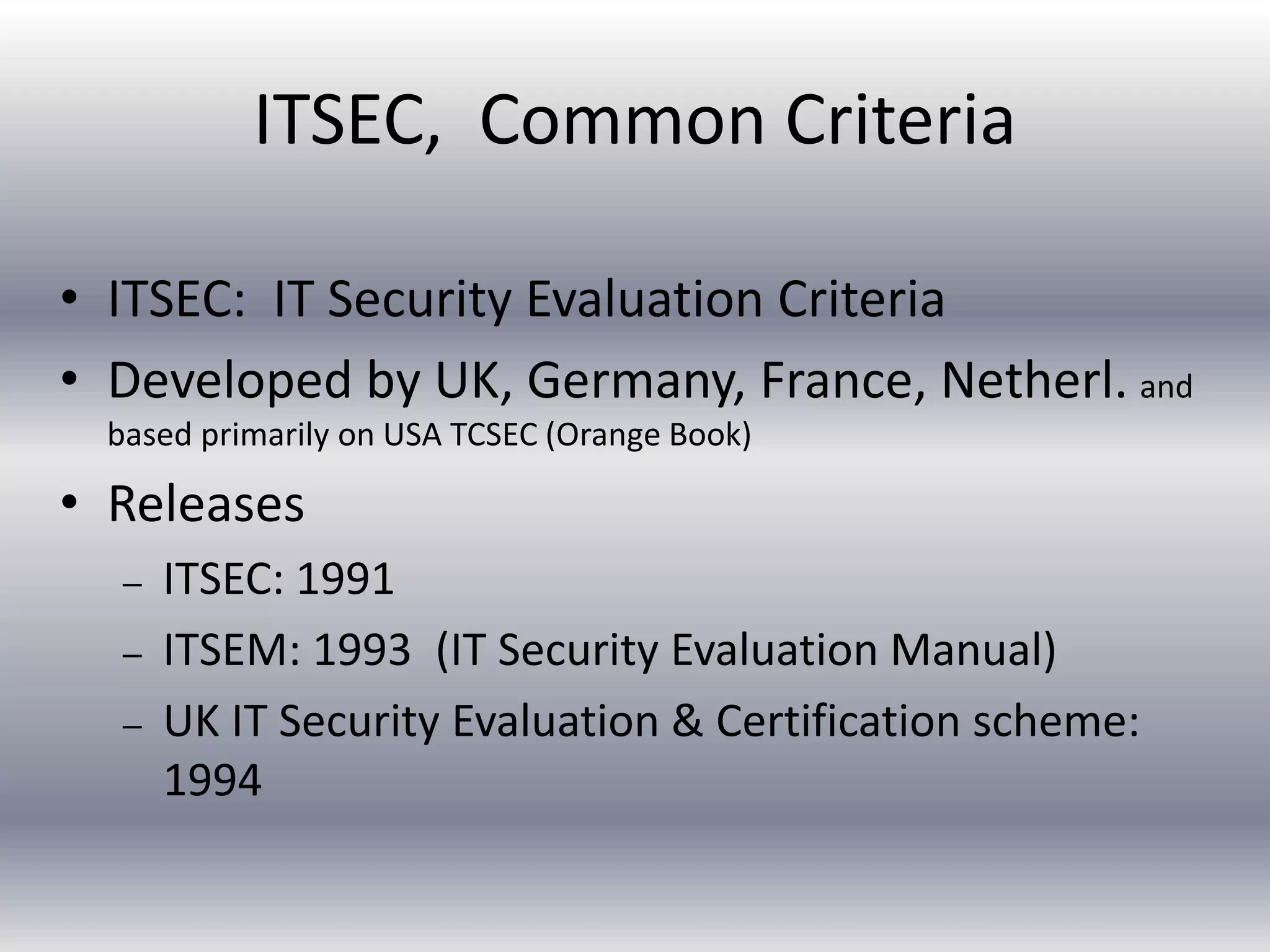
• ITSEC: IT Security Evaluation Criteria 
• Developed by UK, Germany, France, Netherl. and 
based primarily on USA TCSEC (Orange Book) 
• Releases 
– ITSEC: 1991 
– ITSEM: 1993 (IT Security Evaluation Manual) 
– UK IT Security Evaluation & Certification scheme: 
1994
ITSEC, Common Criteria 
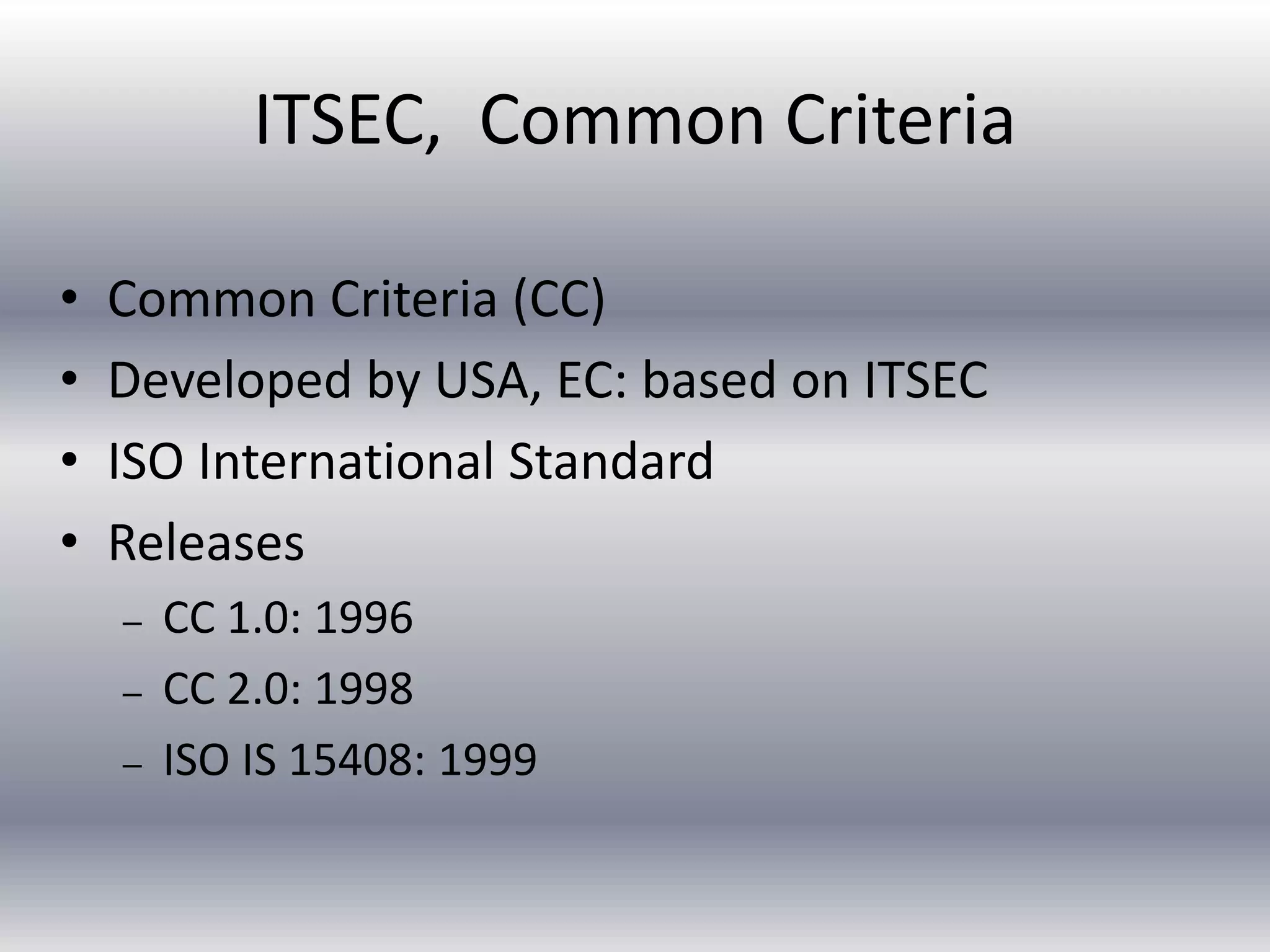
• Common Criteria (CC) 
• Developed by USA, EC: based on ITSEC 
• ISO International Standard 
• Releases 
– CC 1.0: 1996 
– CC 2.0: 1998 
– ISO IS 15408: 1999
ITSEC - Methodology 
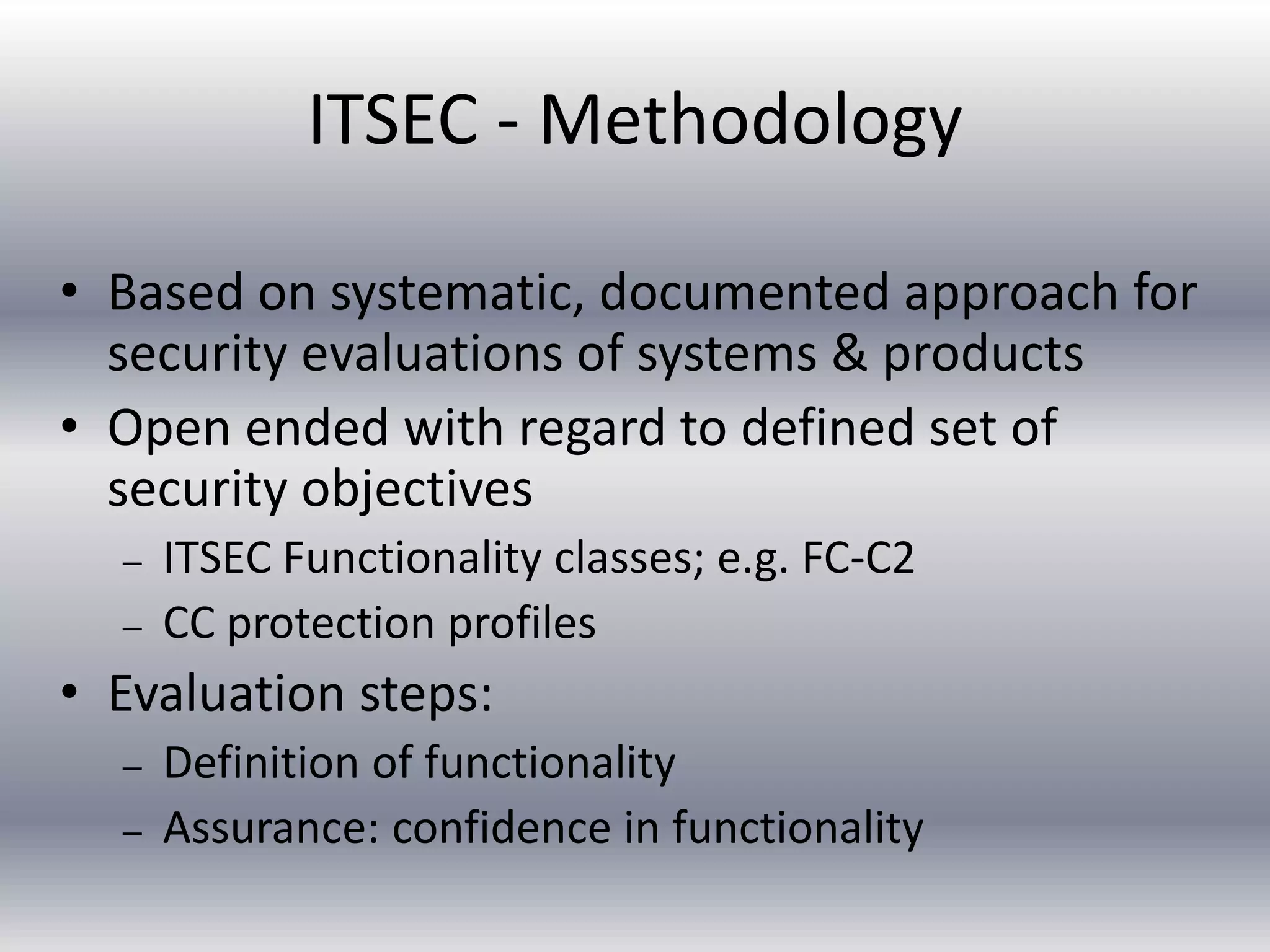
• Based on systematic, documented approach for 
security evaluations of systems & products 
• Open ended with regard to defined set of 
security objectives 
– ITSEC Functionality classes; e.g. FC-C2 
– CC protection profiles 
• Evaluation steps: 
– Definition of functionality 
– Assurance: confidence in functionality
ITSEC - Functionality 
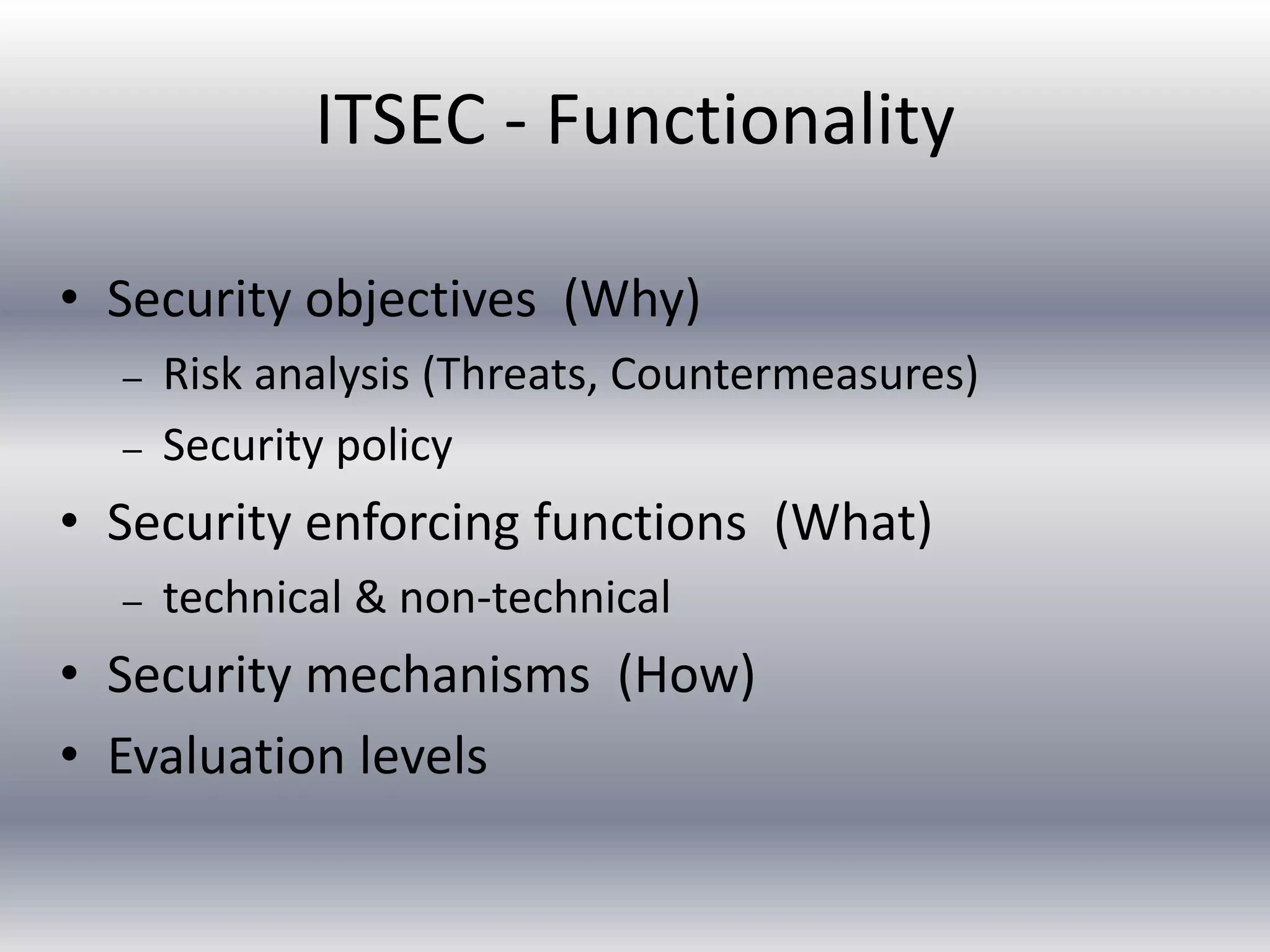
• Security objectives (Why) 
– Risk analysis (Threats, Countermeasures) 
– Security policy 
• Security enforcing functions (What) 
– technical & non-technical 
• Security mechanisms (How) 
• Evaluation levels
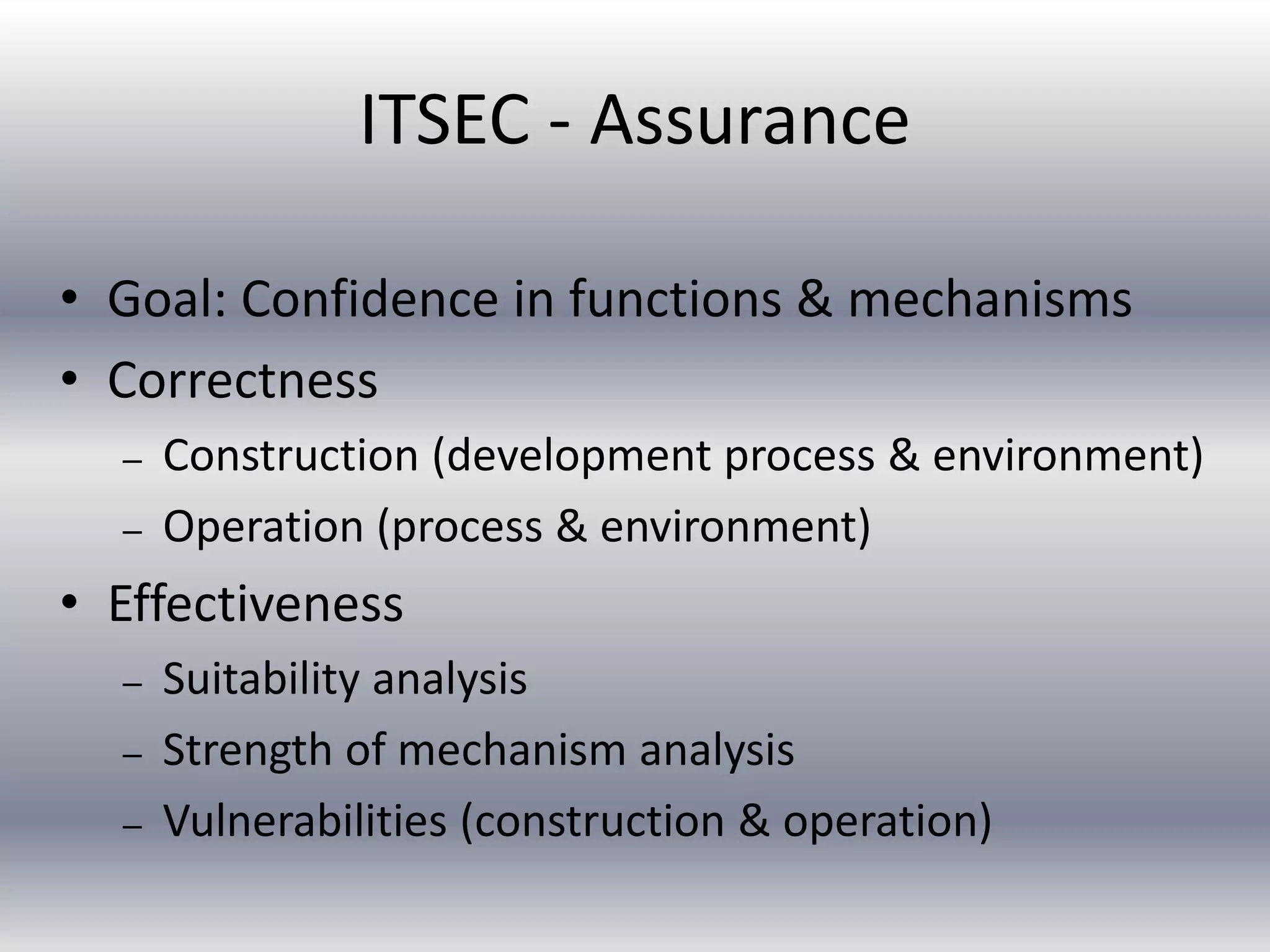
ITSEC - Assurance 
• Goal: Confidence in functions & mechanisms 
• Correctness 
– Construction (development process & environment) 
– Operation (process & environment) 
• Effectiveness 
– Suitability analysis 
– Strength of mechanism analysis 
– Vulnerabilities (construction & operation)
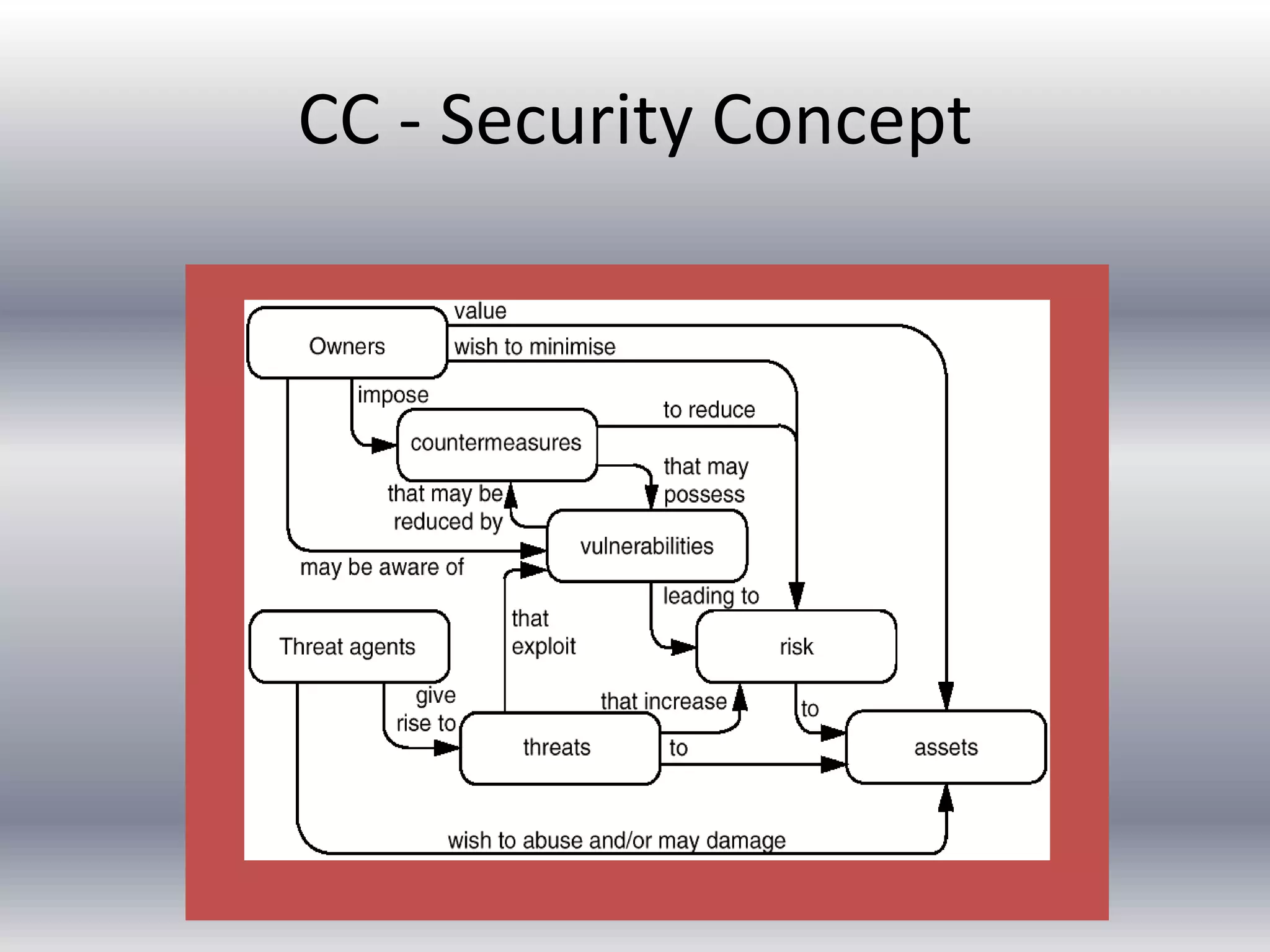
CC - Security Concept
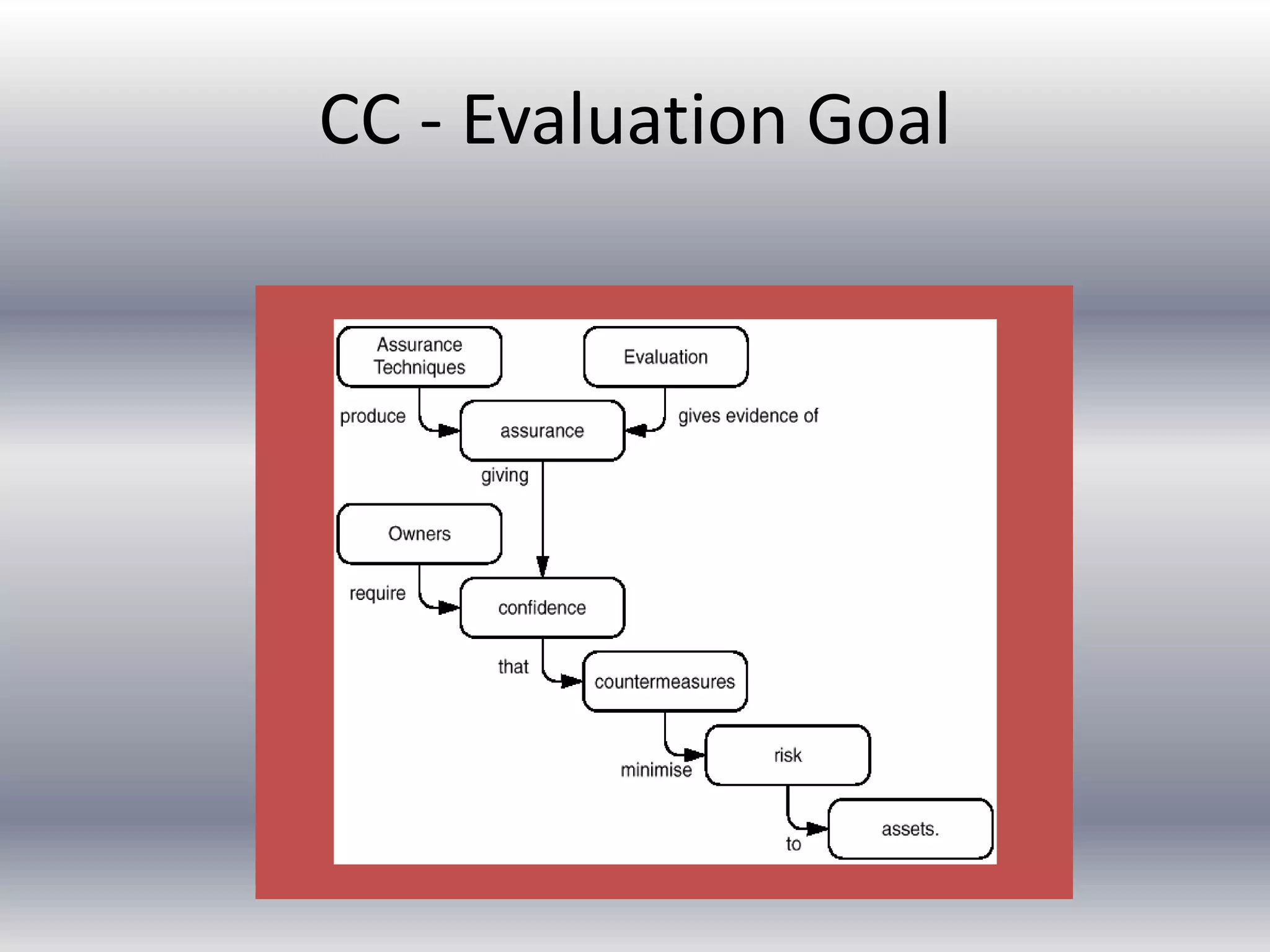
CC - Evaluation Goal
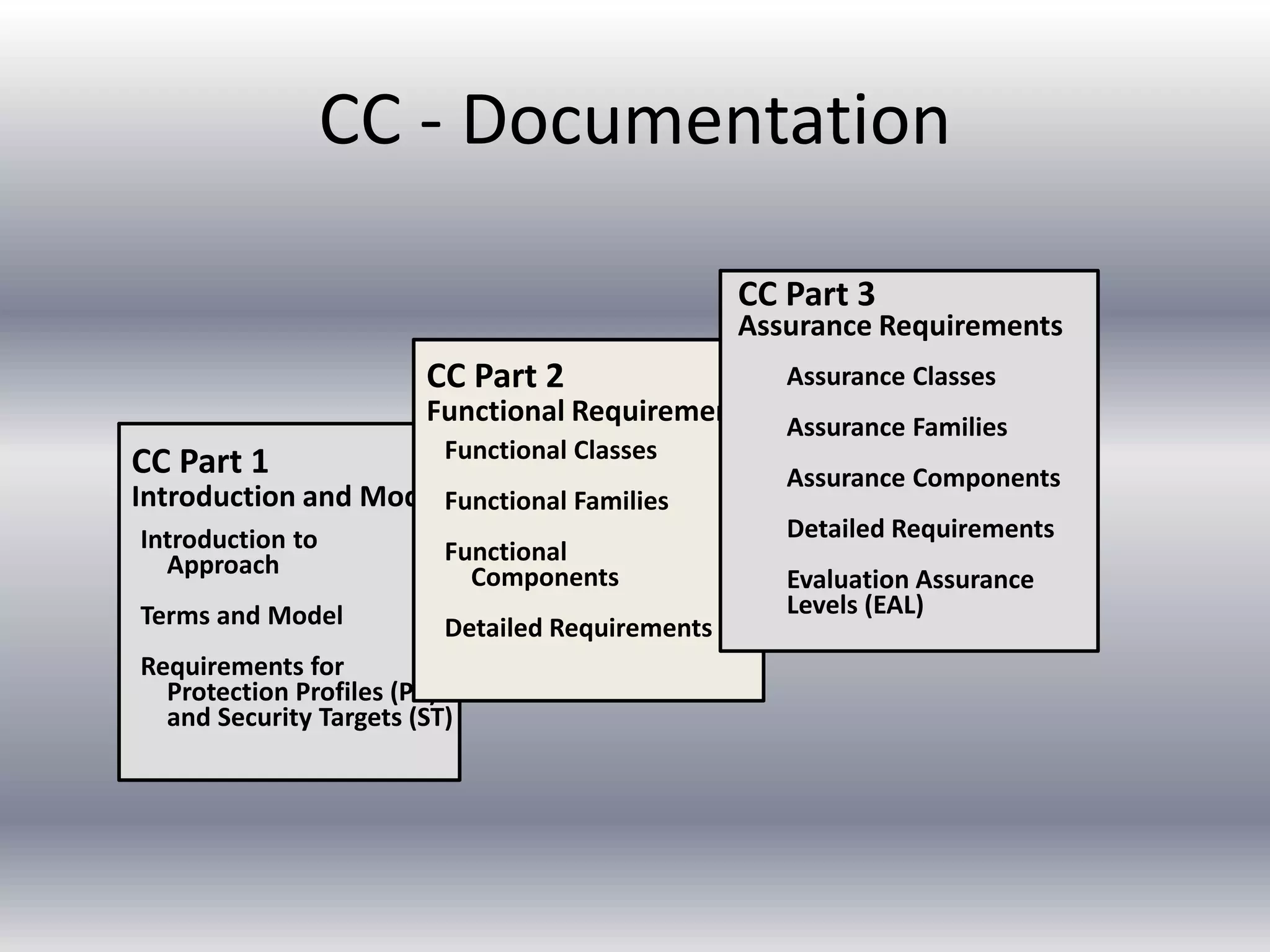
CC - Documentation 
CC Part 2 
Functional Requirements 
Functional Classes 
Functional Families 
Functional 
CC Part 1 
Introduction and Model 
Introduction to 
Approach 
Terms and Model 
Requirements for 
Protection Profiles (PP) 
and Security Targets (ST) 
Components 
Detailed Requirements 
CC Part 3 
Assurance Requirements 
Assurance Classes 
Assurance Families 
Assurance Components 
Detailed Requirements 
Evaluation Assurance 
Levels (EAL)
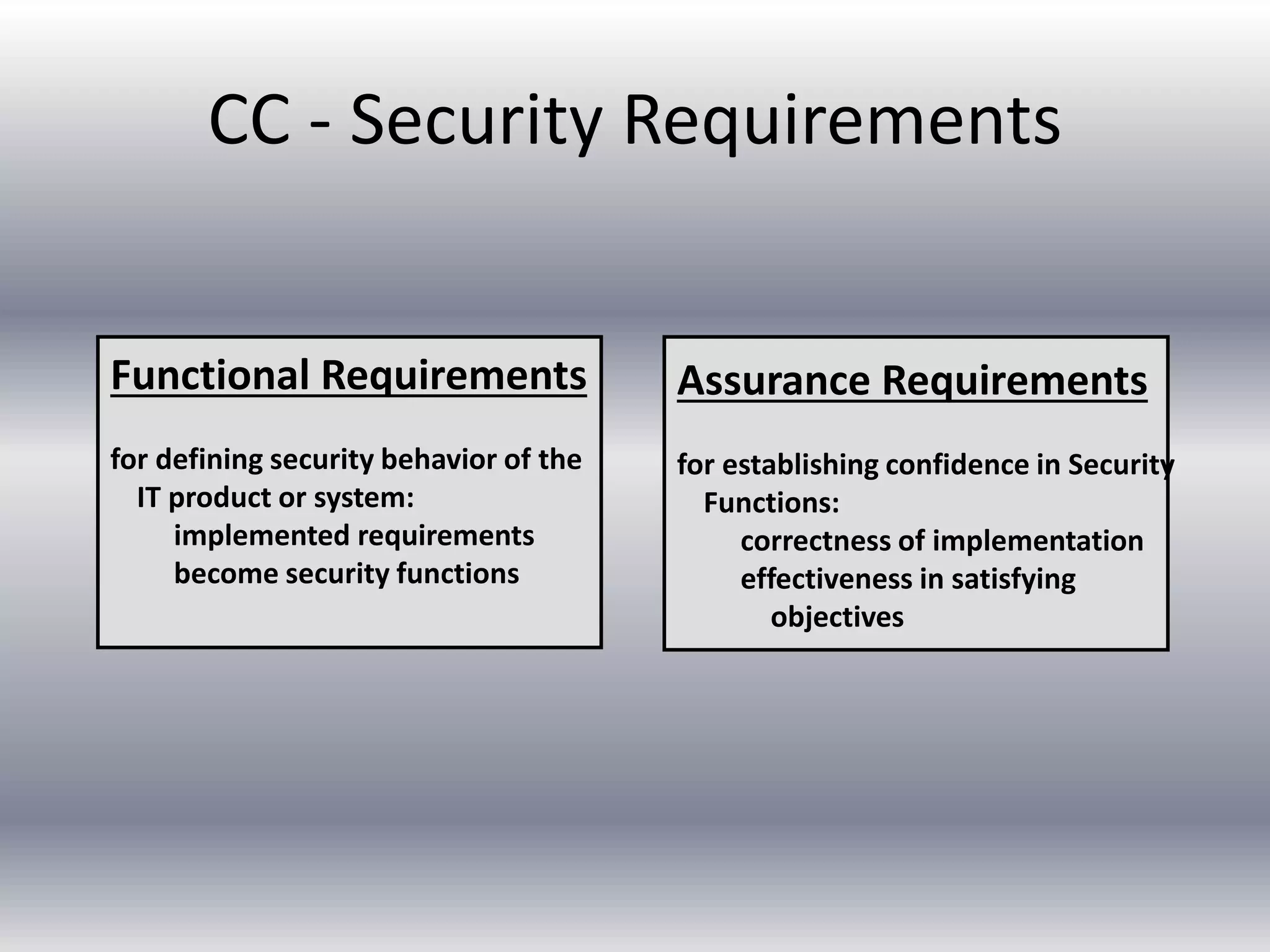
CC - Security Requirements 
Functional Requirements 
for defining security behavior of the 
IT product or system: 
implemented requirements 
become security functions 
Assurance Requirements 
for establishing confidence in Security 
Functions: 
correctness of implementation 
effectiveness in satisfying 
objectives
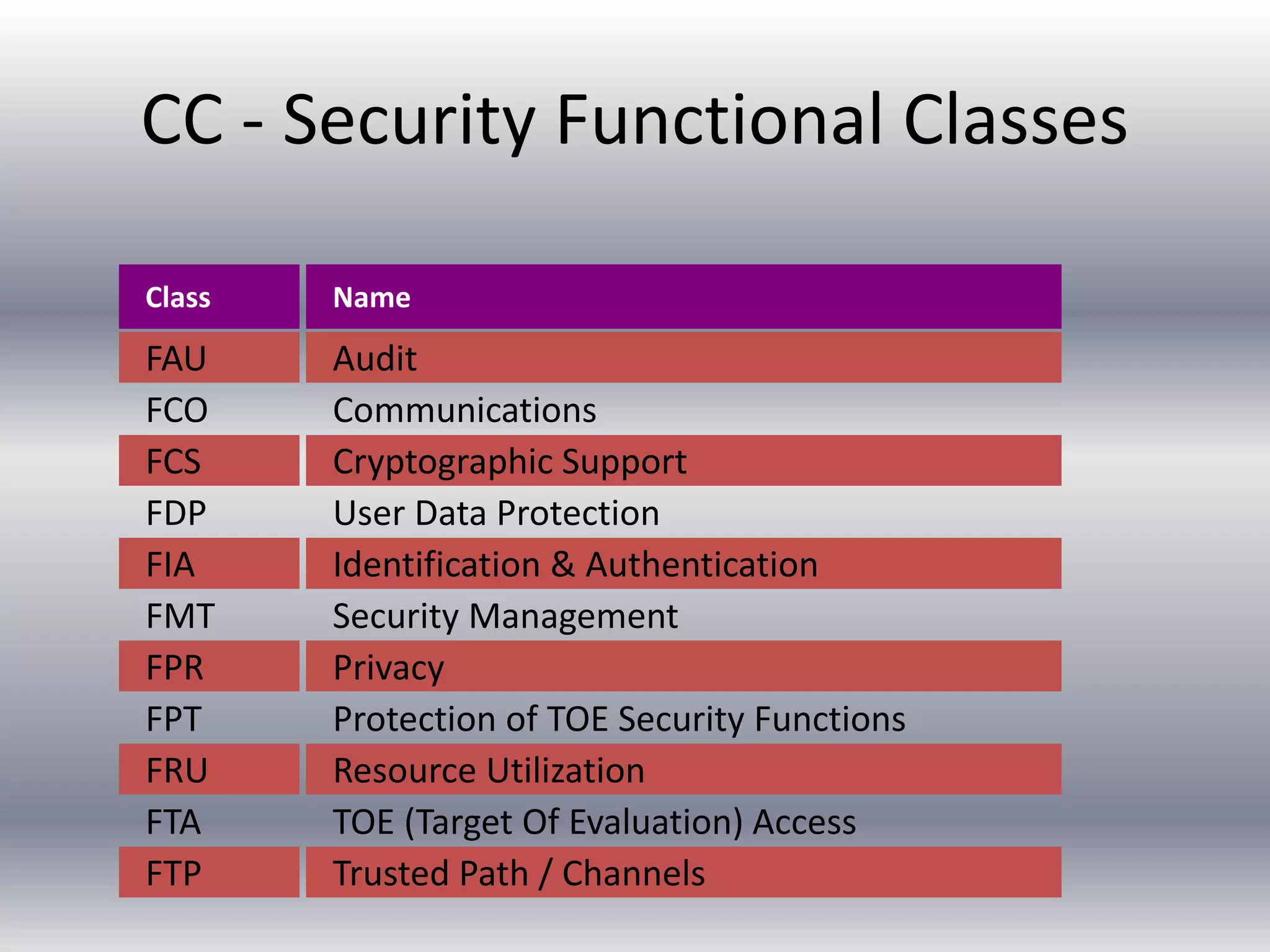
CC - Security Functional Classes 
Name 
Audit 
Communications 
Cryptographic Support 
User Data Protection 
Identification & Authentication 
Security Management 
Privacy 
Protection of TOE Security Functions 
Resource Utilization 
TOE (Target Of Evaluation) Access 
Trusted Path / Channels 
Class 
FAU 
FCO 
FCS 
FDP 
FIA 
FMT 
FPR 
FPT 
FRU 
FTA 
FTP
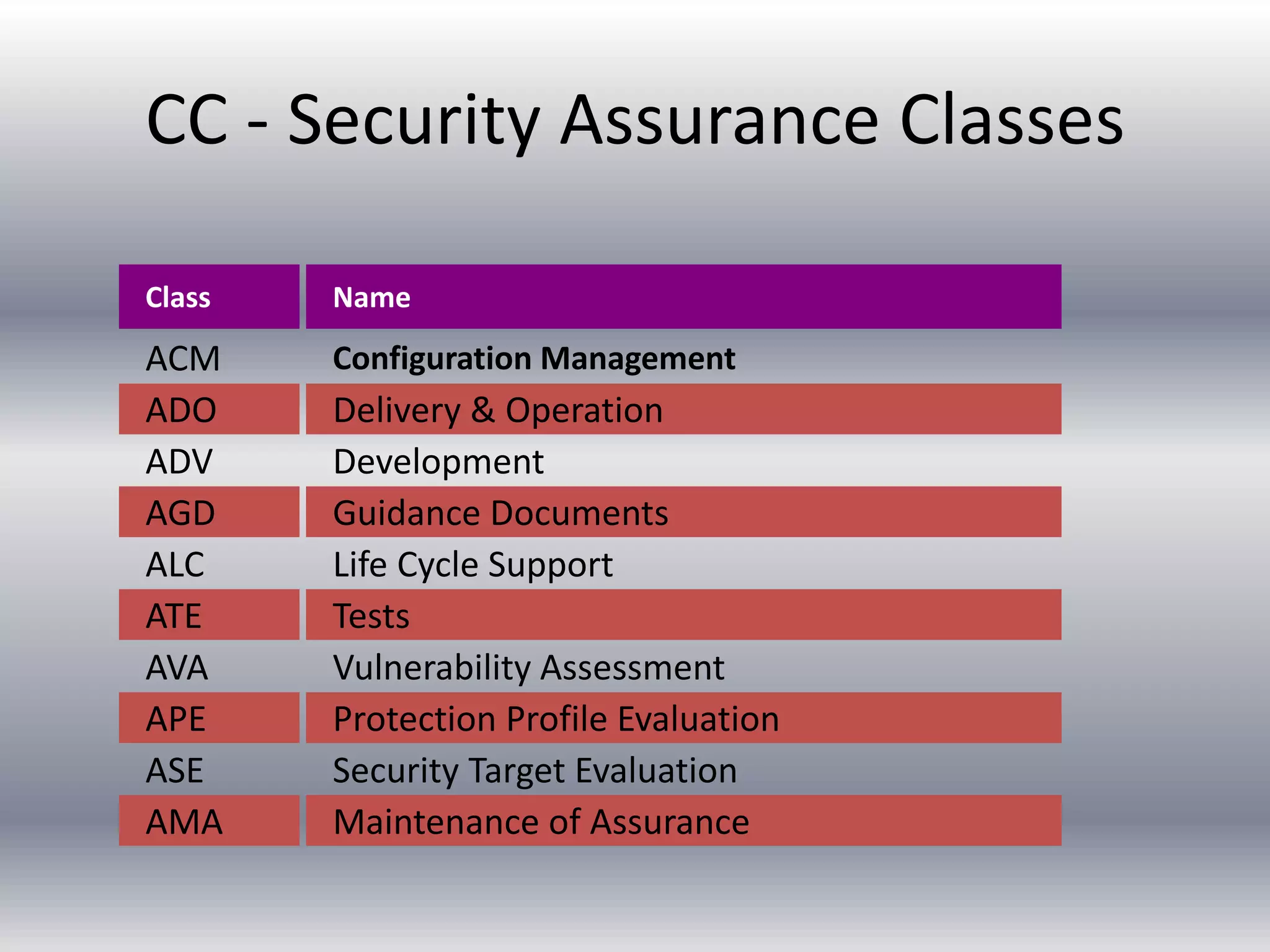
CC - Security Assurance Classes 
Name 
Configuration Management 
Delivery & Operation 
Development 
Guidance Documents 
Life Cycle Support 
Tests 
Vulnerability Assessment 
Protection Profile Evaluation 
Security Target Evaluation 
Maintenance of Assurance 
Class 
ACM 
ADO 
ADV 
AGD 
ALC 
ATE 
AVA 
APE 
ASE 
AMA
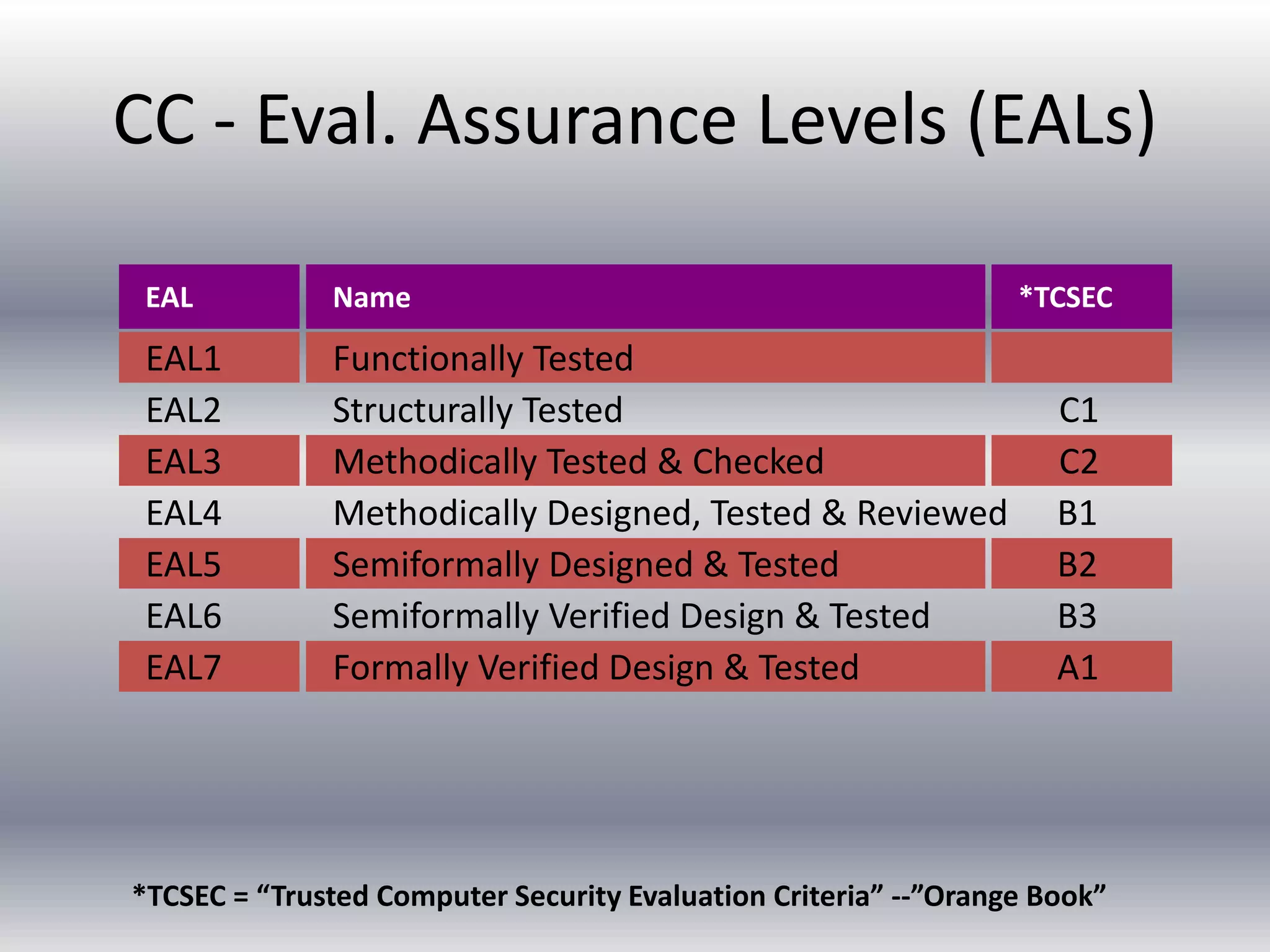
CC - Eval. Assurance Levels (EALs) 
Name 
Functionally Tested 
Structurally Tested 
Methodically Tested & Checked 
Methodically Designed, Tested & Reviewed 
Semiformally Designed & Tested 
Semiformally Verified Design & Tested 
Formally Verified Design & Tested 
EAL 
EAL1 
EAL2 
EAL3 
EAL4 
EAL5 
EAL6 
EAL7 
*TCSEC 
C1 
C2 
B1 
B2 
B3 
A1 
*TCSEC = “Trusted Computer Security Evaluation Criteria” --”Orange Book”
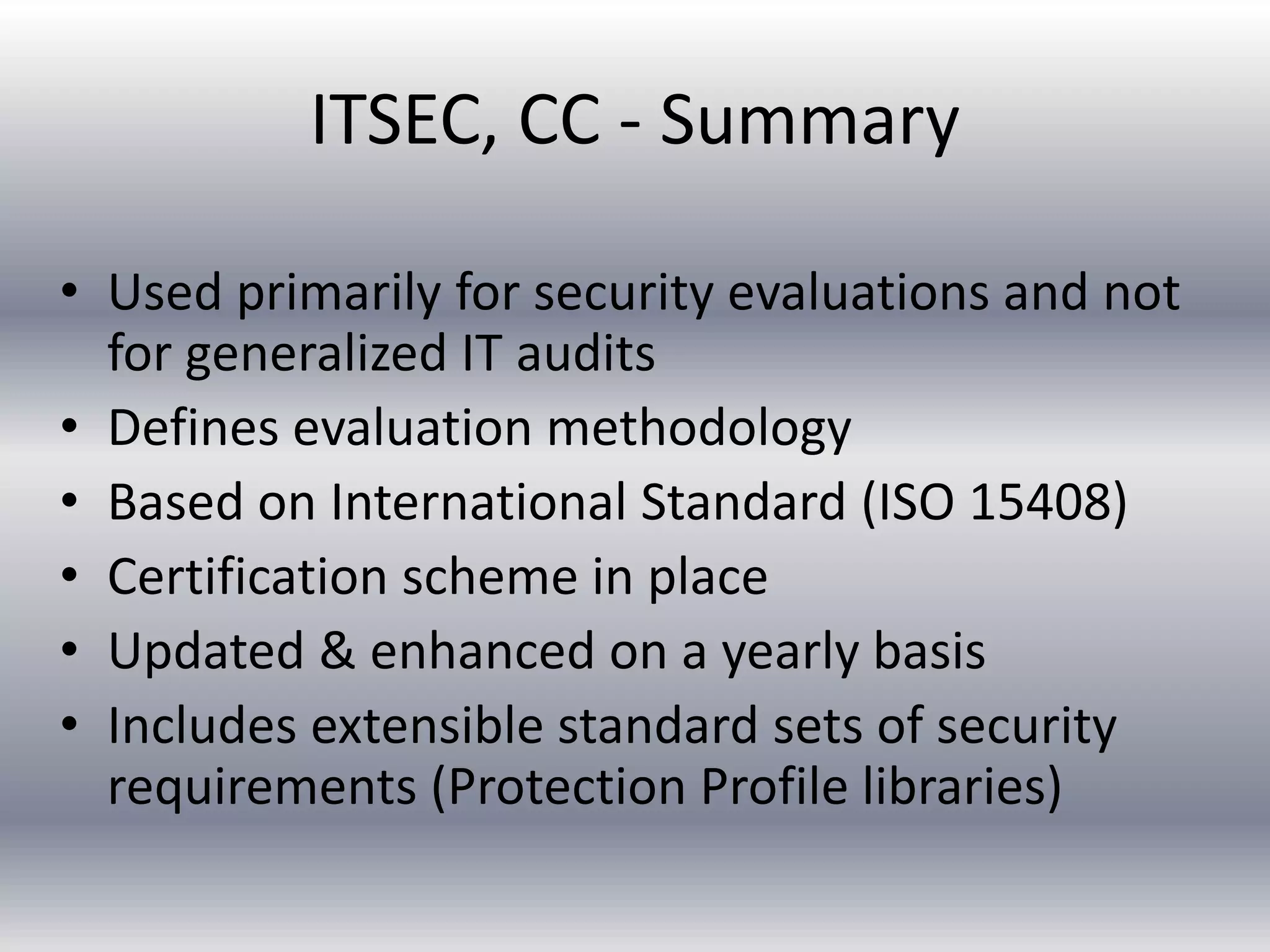
ITSEC, CC - Summary 
• Used primarily for security evaluations and not 
for generalized IT audits 
• Defines evaluation methodology 
• Based on International Standard (ISO 15408) 
• Certification scheme in place 
• Updated & enhanced on a yearly basis 
• Includes extensible standard sets of security 
requirements (Protection Profile libraries)
Comparison of Methods - Criteria 
• Standardisation 
• Independence 
• Certifiability 
• Applicability in practice 
• Adaptability
Comparison of Methods - Criteria 
• Extent of Scope 
• Presentation of Results 
• Efficiency 
• Update frequency 
• Ease of Use
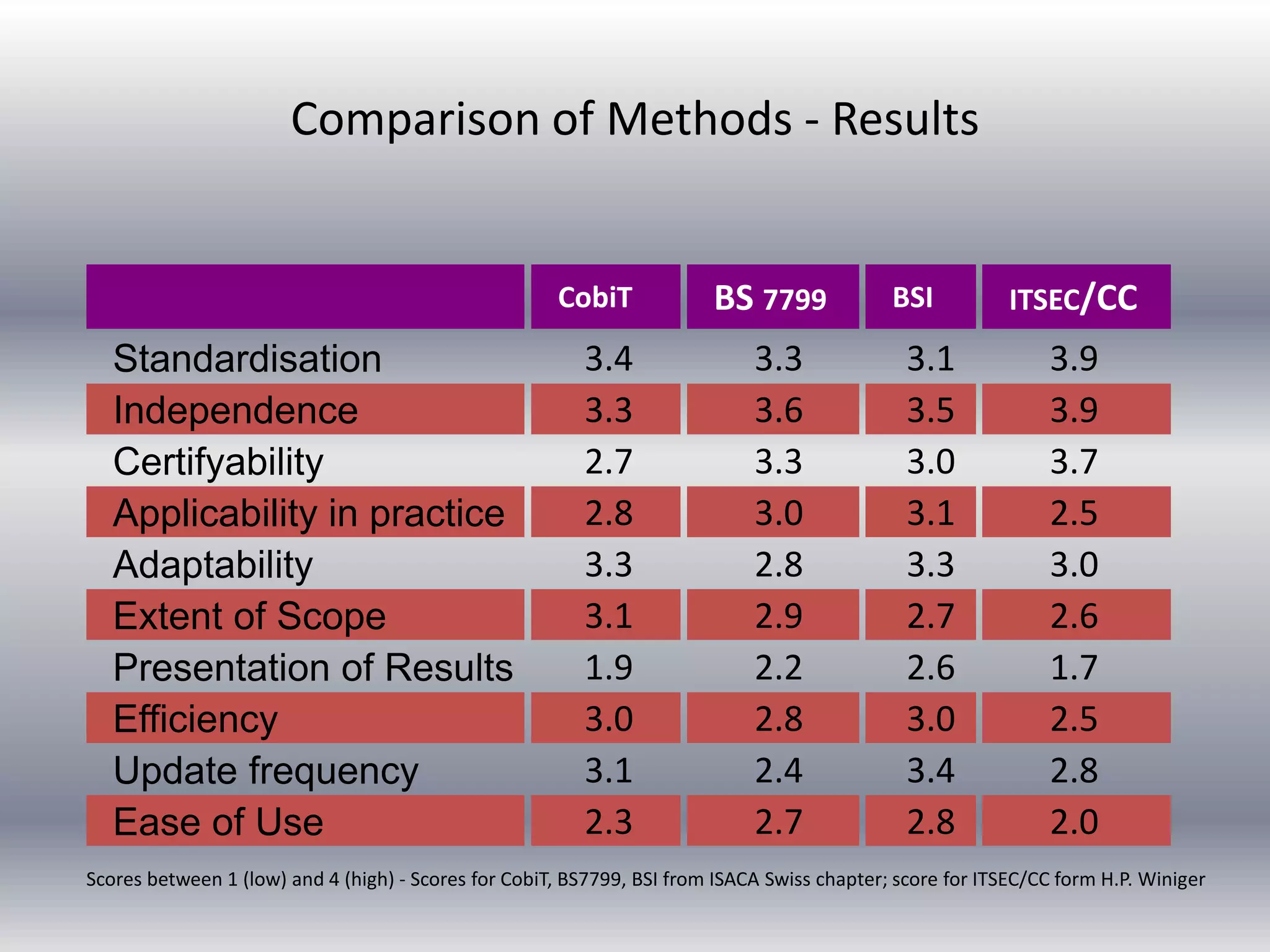
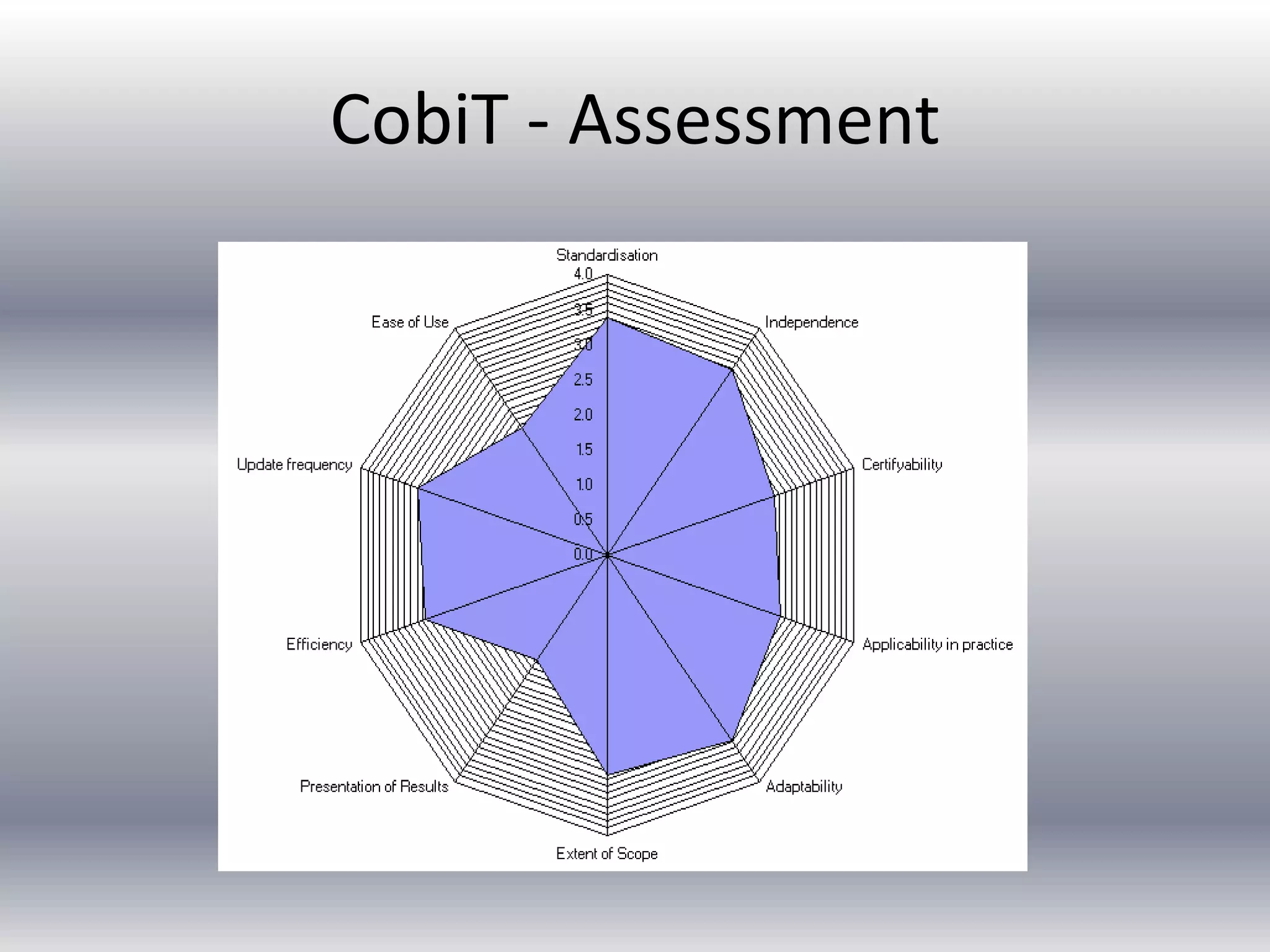
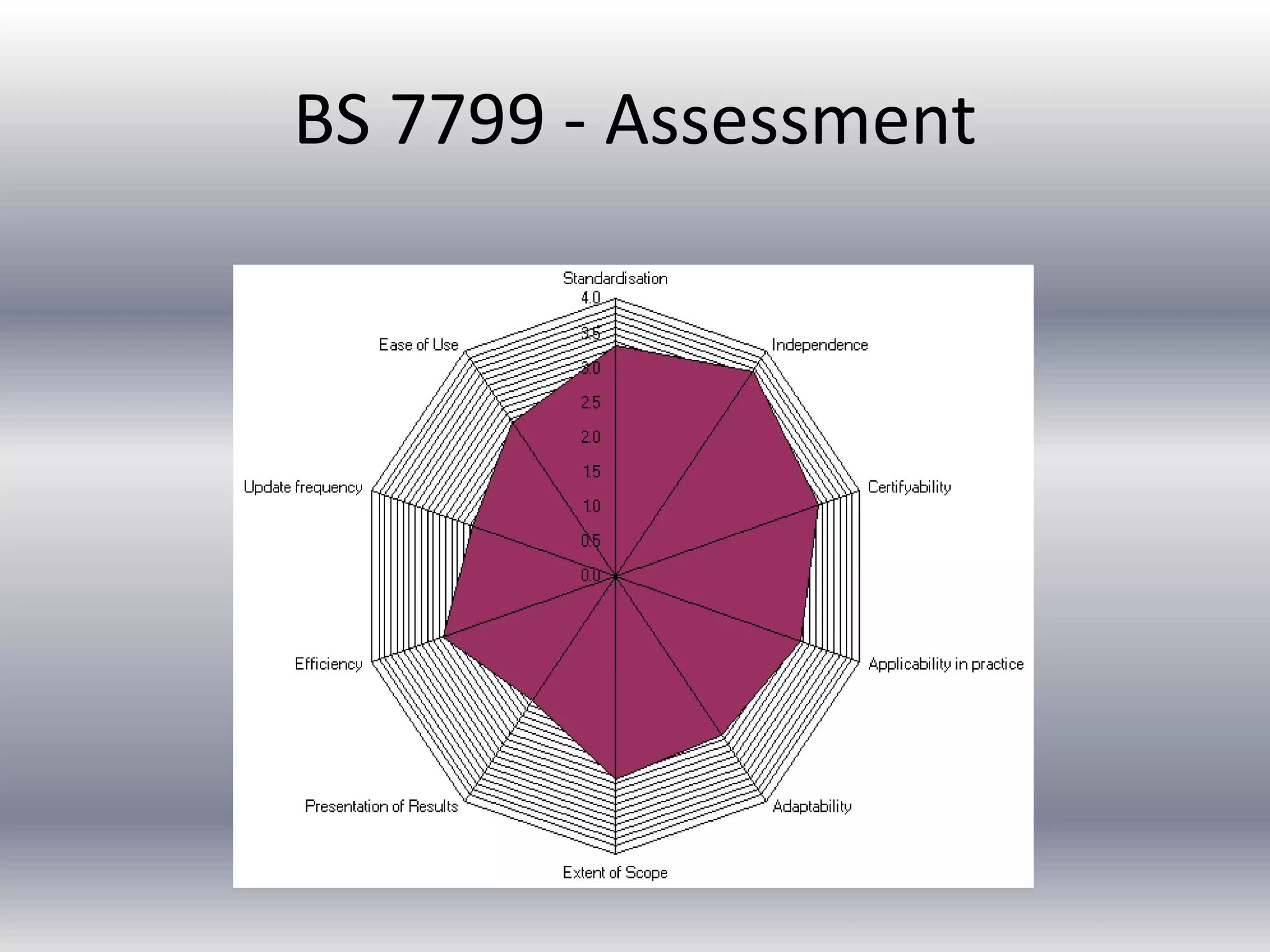
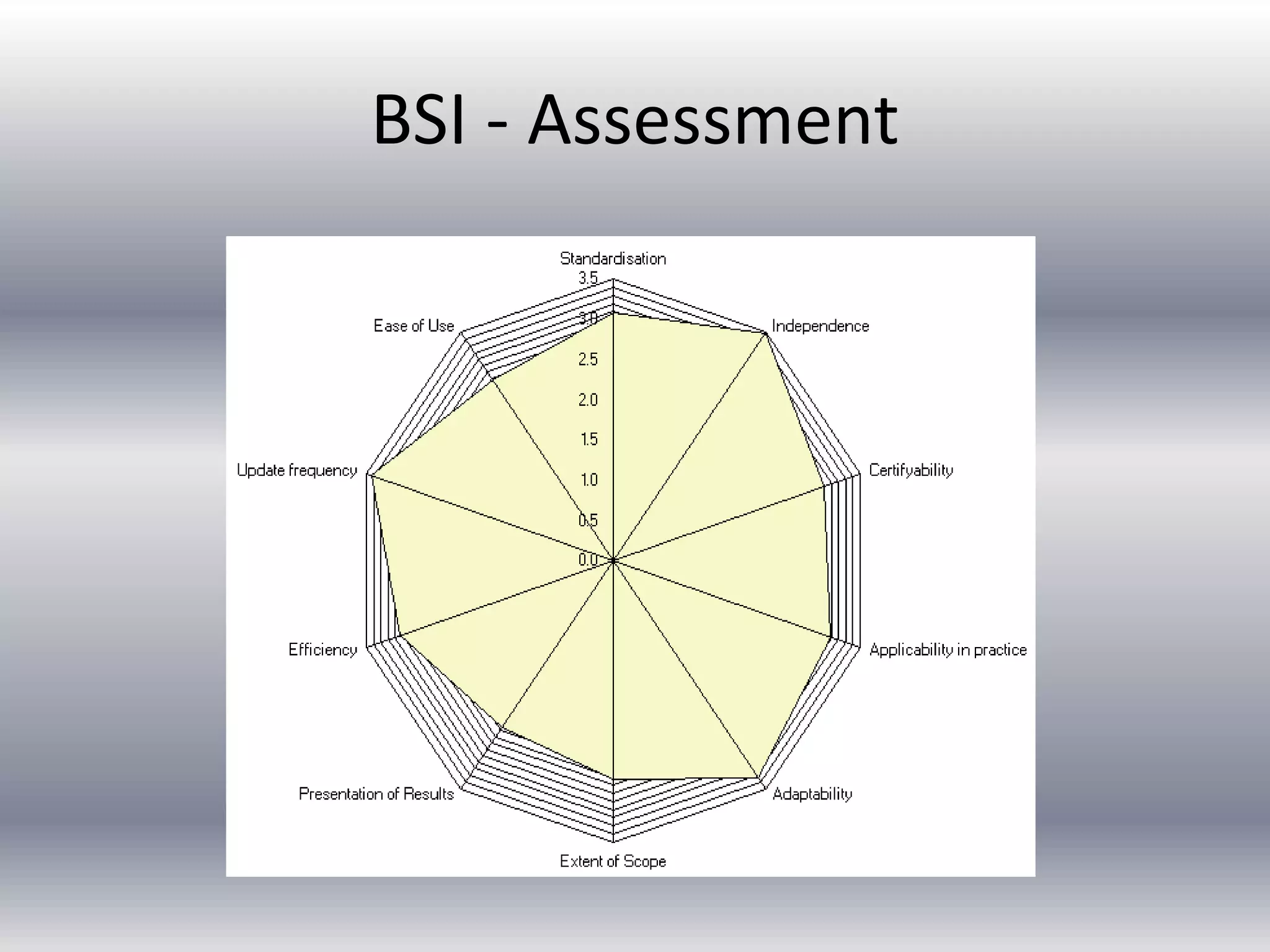
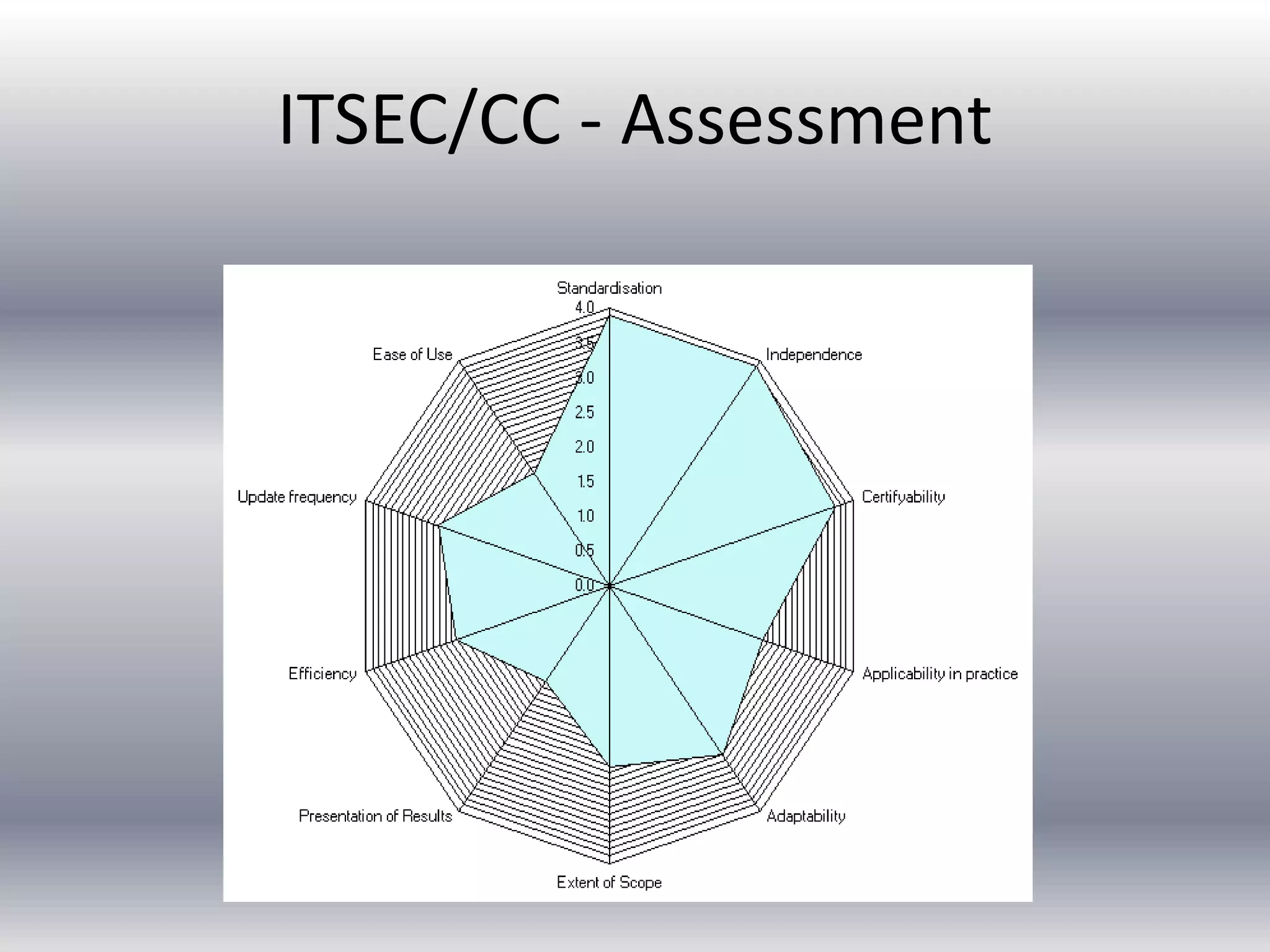
Comparison of Methods - Results 
CobiT 
3.4 
3.3 
2.7 
2.8 
3.3 
3.1 
1.9 
3.0 
3.1 
2.3 
Standardisation 
Independence 
Certifyability 
Applicability in practice 
Adaptability 
Extent of Scope 
Presentation of Results 
Efficiency 
Update frequency 
Ease of Use 
BS 7799 
3.3 
3.6 
3.3 
3.0 
2.8 
2.9 
2.2 
2.8 
2.4 
2.7 
BSI 
3.1 
3.5 
3.0 
3.1 
3.3 
2.7 
2.6 
3.0 
3.4 
2.8 
ITSEC/CC 
3.9 
3.9 
3.7 
2.5 
3.0 
2.6 
1.7 
2.5 
2.8 
2.0 
Scores between 1 (low) and 4 (high) - Scores for CobiT, BS7799, BSI from ISACA Swiss chapter; score for ITSEC/CC form H.P. Winiger
CobiT - Assessment
BS 7799 - Assessment
BSI - Assessment
ITSEC/CC - Assessment
Use of Methods for IT Audits 
• CobiT: Audit method for all IT processes 
• ITSEC, CC: Systematic approach for evaluations 
• BS7799, BSI: List of detailed security measures 
to be used as best practice documentation 
• Detailed audit plans, checklists, tools for 
technical audits (operating systems, LANs, etc.) 
• What is needed in addition: 
– Audit concept (general aspects, infrastructure 
audits, application audits)

It audit methodologies

  • 2.
  • 3.
    IT Audit Methodologies • CobiT • BS 7799 - Code of Practice (CoP) • BSI - IT Baseline Protection Manual • ITSEC • Common Criteria (CC)
  • 4.
    Main Areas ofUse • IT Audits • Risk Analysis • Health Checks (Security Benchmarking) • Security Concepts • Security Manuals / Handbooks
  • 5.
    Security Definition •Confidentiality • Integrity – Correctness – Completeness • Availability
  • 6.
    CobiT • Governance,Control & Audit for IT • Developed by ISACA • Releases – CobiT 1: 1996 • 32 Processes • 271 Control Objectives – CobiT 2: 1998 • 34 Processes • 302 Control Objectives
  • 7.
    CobiT - Modelfor IT Governance • 36 Control models used as basis: – Business control models (e.g. COSO) – IT control models (e.g. DTI‘s CoP) • CobiT control model covers: – Security (Confidentiality, Integrity, Availability) – Fiduciary (Effectiveness, Efficiency, Compliance, Reliability of Information) – IT Resources (Data, Application Systems, Technology, Facilities, People)
  • 8.
  • 9.
    CobiT - Structure • 4 Domains – PO - Planning & Organisation • 11 processes (high-level control objectives) – AI - Acquisition & Implementation • 6 processes (high-level control objectives) – DS - Delivery & Support • 13 processes (high-level control objectives) – M - Monitoring • 4 processes (high-level control objectives)
  • 10.
    PO - Planningand Organisation • PO 1 Define a Strategic IT Plan • PO 2 Define the Information Architecture • PO 3 Determine the Technological Direction • PO 4 Define the IT Organisation and Relationships • PO 5 Manage the IT Investment • PO 6 Communicate Management Aims and Direction • PO 7 Manage Human Resources • PO 8 Ensure Compliance with External Requirements • PO 9 Assess Risks • PO 10 Manage Projects • PO 11 Manage Quality
  • 11.
    AI - Acquisitionand Implementation • AI 1 Identify Solutions • AI 2 Acquire and Maintain Application Software • AI 3 Acquire and Maintain Technology Architecture • AI 4 Develop and Maintain IT Procedures • AI 5 Install and Accredit Systems • AI 6 Manage Changes
  • 12.
    DS - Deliveryand Support • DS 1 Define Service Levels • DS 2 Manage Third-Party Services • DS 3 Manage Performance and Capacity • DS 4 Ensure Continuous Service • DS 5 Ensure Systems Security • DS 6 Identify and Attribute Costs • DS 7 Educate and Train Users DS 8 Assist and Advise IT Customers DS 9 Manage the Configuration DS 10 Manage Problems and Incidents DS 11 Manage Data DS 12 Manage Facilities DS 13 Manage Operations
  • 13.
    M - Monitoring • M 1 Monitor the Processes • M 2 Assess Internal Control Adequacy • M 3 Obtain Independent Assurance • M 4 Provide for Independent Audit
  • 14.
    CobiT - ITProcess Matrix Information Criteria – Effectiveness – Efficiency – Confidentiality – Integrity – Availability – Compliance – Reliability IT Resources People Applications Technology Facilities Data
  • 15.
    CobiT - Summary • Mainly used for IT audits, incl. security aspects • No detailed evaluation methodology described • Developed by international organisation (ISACA) • Up-to-date: Version 2 released in 1998 • Only high-level control objectives described • Detailed IT control measures are not documented • Not very user friendly - learning curve! • Evaluation results not shown in graphic form
  • 16.
    BS 7799 -Security Baseline Controls • 10 control categories • 32 control groups • 109 security controls • 10 security key controls
  • 17.
    BS 7799 -Control Categories • Information security policy • Security organisation • Assets classification & control • Personnel security • Physical & environmental security • Computer & network management
  • 18.
    BS 7799 -Control Categories • System access control • Systems development & maintenance • Business continuity planning • Compliance
  • 19.
    BS7799 - 10Key Controls • Information security policy document • Allocation of information security responsibilities • Information security education and training • Reporting of security incidents • Virus controls
  • 20.
    BS7799 - 10Key Controls • Business continuity planning process • Control of proprietary software copying • Safeguarding of organizational records • Data protection • Compliance with security policy
  • 21.
    BS7799 - Summary • Main use: Security Concepts & Health Checks • No evaluation methodology described • British Standard, developed by UK DTI • Certification scheme in place (c:cure) • BS7799, Part1, 1995 is being revised in 1999 • Lists 109 ready-to-use security controls • No detailed security measures described • Very user friendly - easy to learn
  • 22.
    BSI - Structure • IT security measures – 7 areas – 34 modules (building blocks) • Safeguards catalogue – 6 categories of security measures • Threats catalogue – 5 categories of threats
  • 23.
    BSI - SecurityMeasures (Modules) • Protection for generic components • Infrastructure • Non-networked systems • LANs • Data transfer systems • Telecommunications • Other IT components
  • 24.
    BSI - GenericComponents • 3.1 Organisation • 3.2 Personnel • 3.3 Contingency Planning • 3.4 Data Protection
  • 25.
    BSI - Infrastructure • 4.1 Buildings • 4.2 Cabling • 4.3 Rooms • 4.3.1 Office • 4.3.2 Server Room • 4.3.3 Storage Media Archives • 4.3.4 Technical Infrastructure Room • 4.4 Protective cabinets • 4.5 Home working place
  • 26.
    BSI - Non-NetworkedSystems • 5.1 DOS PC (Single User) • 5.2 UNIX System • 5.3 Laptop • 5.4 DOS PC (multiuser) • 5.5 Non-networked Windows NT computer • 5.6 PC with Windows 95 • 5.99 Stand-alone IT systems
  • 27.
    BSI - LANs • 6.1 Server-Based Network • 6.2 Networked Unix Systems • 6.3 Peer-to-Peer Network • 6.4 Windows NT network • 6.5 Novell Netware 3.x • 6.6 Novell Netware version 4.x • 6.7 Heterogeneous networks
  • 28.
    BSI - DataTransfer Systems • 7.1 Data Carrier Exchange • 7.2 Modem • 7.3 Firewall • 7.4 E-mail
  • 29.
    BSI - Telecommunications • 8.1 Telecommunication system • 8.2 Fax Machine • 8.3 Telephone Answering Machine • 8.4 LAN integration of an IT system via ISDN
  • 30.
    BSI - OtherIT Components • 9.1 Standard Software • 9.2 Databases • 9.3 Telecommuting
  • 31.
    BSI - Module„Data Protection“ (3.4) • Threats - Technical failure: – T 4.13 Loss of stored data • Security Measures - Contingency planning: – S 6.36 Stipulating a minimum data protection concept – S 6.37 Documenting data protection procedures – S 6.33 Development of a data protection concept (optional) – S 6.34 Determining the factors influencing data protection (optional) – S 6.35 Stipulating data protection procedures (optional) – S 6.41 Training data reconstruction • Security Measures - Organisation: – S 2.41 Employees' commitment to data protection – S 2.137 Procurement of a suitable data backup system
  • 32.
    BSI - Safeguards(420 safeguards) • S1 - Infrastructure ( 45 safeguards) • S2 - Organisation (153 safeguards) • S3 - Personnel ( 22 safeguards) • S4 - Hardware & Software ( 83 safeguards) • S5 - Communications ( 62 safeguards) • S6 - Contingency Planning ( 55 safeguards)
  • 33.
    BSI - S1-Infrastructure(45 safeguards) • S 1.7 Hand-held fire extinguishers • S 1.10 Use of safety doors • S 1.17 Entrance control service • S 1.18 Intruder and fire detection devices • S 1.27 Air conditioning • S 1.28 Local uninterruptible power supply [UPS] • S 1.36 Safekeeping of data carriers before and after dispatch
  • 34.
    BSI - SecurityThreats (209 threats) • T1 - Force Majeure (10 threats) • T2 - Organisational Shortcomings (58 threats) • T3 - Human Errors (31 threats) • T4 - Technical Failure (32 threats) • T5 - Deliberate acts (78 threats)
  • 35.
    BSI - T3-HumanErrors (31 threats) • T 3.1 Loss of data confidentiality/integrity as a result of IT user error • T 3.3 Non-compliance with IT security measures • T 3.6 Threat posed by cleaning staff or outside staff • T 3.9 Incorrect management of the IT system • T 3.12 Loss of storage media during transfer • T 3.16 Incorrect administration of site and data access rights • T 3.24 Inadvertent manipulation of data • T 3.25 Negligent deletion of objects IT Audit Methodoloies
  • 36.
    BSI - Summary • Main use: Security concepts & manuals • No evaluation methodology described • Developed by German BSI (GISA) • Updated version released each year • Lists 209 threats & 420 security measures • 34 modules cover generic & platform specific security requirements
  • 37.
    BSI - Summary • User friendly with a lot of security details • Not suitable for security risk analysis • Results of security coverage not shown in graphic form • Manual in HTML format on BSI web server • Manual in Winword format on CD-ROM (first CD free, additional CDs cost DM 50.-- each) • Paper copy of manual: DM 118.-- • Software ‚BSI Tool‘ (only in German): DM 515.--
  • 38.
    ITSEC, Common Criteria • ITSEC: IT Security Evaluation Criteria • Developed by UK, Germany, France, Netherl. and based primarily on USA TCSEC (Orange Book) • Releases – ITSEC: 1991 – ITSEM: 1993 (IT Security Evaluation Manual) – UK IT Security Evaluation & Certification scheme: 1994
  • 39.
    ITSEC, Common Criteria • Common Criteria (CC) • Developed by USA, EC: based on ITSEC • ISO International Standard • Releases – CC 1.0: 1996 – CC 2.0: 1998 – ISO IS 15408: 1999
  • 40.
    ITSEC - Methodology • Based on systematic, documented approach for security evaluations of systems & products • Open ended with regard to defined set of security objectives – ITSEC Functionality classes; e.g. FC-C2 – CC protection profiles • Evaluation steps: – Definition of functionality – Assurance: confidence in functionality
  • 41.
    ITSEC - Functionality • Security objectives (Why) – Risk analysis (Threats, Countermeasures) – Security policy • Security enforcing functions (What) – technical & non-technical • Security mechanisms (How) • Evaluation levels
  • 42.
    ITSEC - Assurance • Goal: Confidence in functions & mechanisms • Correctness – Construction (development process & environment) – Operation (process & environment) • Effectiveness – Suitability analysis – Strength of mechanism analysis – Vulnerabilities (construction & operation)
  • 43.
  • 44.
  • 45.
    CC - Documentation CC Part 2 Functional Requirements Functional Classes Functional Families Functional CC Part 1 Introduction and Model Introduction to Approach Terms and Model Requirements for Protection Profiles (PP) and Security Targets (ST) Components Detailed Requirements CC Part 3 Assurance Requirements Assurance Classes Assurance Families Assurance Components Detailed Requirements Evaluation Assurance Levels (EAL)
  • 46.
    CC - SecurityRequirements Functional Requirements for defining security behavior of the IT product or system: implemented requirements become security functions Assurance Requirements for establishing confidence in Security Functions: correctness of implementation effectiveness in satisfying objectives
  • 47.
    CC - SecurityFunctional Classes Name Audit Communications Cryptographic Support User Data Protection Identification & Authentication Security Management Privacy Protection of TOE Security Functions Resource Utilization TOE (Target Of Evaluation) Access Trusted Path / Channels Class FAU FCO FCS FDP FIA FMT FPR FPT FRU FTA FTP
  • 48.
    CC - SecurityAssurance Classes Name Configuration Management Delivery & Operation Development Guidance Documents Life Cycle Support Tests Vulnerability Assessment Protection Profile Evaluation Security Target Evaluation Maintenance of Assurance Class ACM ADO ADV AGD ALC ATE AVA APE ASE AMA
  • 49.
    CC - Eval.Assurance Levels (EALs) Name Functionally Tested Structurally Tested Methodically Tested & Checked Methodically Designed, Tested & Reviewed Semiformally Designed & Tested Semiformally Verified Design & Tested Formally Verified Design & Tested EAL EAL1 EAL2 EAL3 EAL4 EAL5 EAL6 EAL7 *TCSEC C1 C2 B1 B2 B3 A1 *TCSEC = “Trusted Computer Security Evaluation Criteria” --”Orange Book”
  • 50.
    ITSEC, CC -Summary • Used primarily for security evaluations and not for generalized IT audits • Defines evaluation methodology • Based on International Standard (ISO 15408) • Certification scheme in place • Updated & enhanced on a yearly basis • Includes extensible standard sets of security requirements (Protection Profile libraries)
  • 51.
    Comparison of Methods- Criteria • Standardisation • Independence • Certifiability • Applicability in practice • Adaptability
  • 52.
    Comparison of Methods- Criteria • Extent of Scope • Presentation of Results • Efficiency • Update frequency • Ease of Use
  • 53.
    Comparison of Methods- Results CobiT 3.4 3.3 2.7 2.8 3.3 3.1 1.9 3.0 3.1 2.3 Standardisation Independence Certifyability Applicability in practice Adaptability Extent of Scope Presentation of Results Efficiency Update frequency Ease of Use BS 7799 3.3 3.6 3.3 3.0 2.8 2.9 2.2 2.8 2.4 2.7 BSI 3.1 3.5 3.0 3.1 3.3 2.7 2.6 3.0 3.4 2.8 ITSEC/CC 3.9 3.9 3.7 2.5 3.0 2.6 1.7 2.5 2.8 2.0 Scores between 1 (low) and 4 (high) - Scores for CobiT, BS7799, BSI from ISACA Swiss chapter; score for ITSEC/CC form H.P. Winiger
  • 54.
  • 55.
    BS 7799 -Assessment
  • 56.
  • 57.
  • 58.
    Use of Methodsfor IT Audits • CobiT: Audit method for all IT processes • ITSEC, CC: Systematic approach for evaluations • BS7799, BSI: List of detailed security measures to be used as best practice documentation • Detailed audit plans, checklists, tools for technical audits (operating systems, LANs, etc.) • What is needed in addition: – Audit concept (general aspects, infrastructure audits, application audits)