
INTRODUCTION & OVERVIEW RISK ASSESSMENT
What is risk assessment? The identification, assessment and prioritization of risk followed by an action to minimize, monitor or control the effects. To utilize pre-set plans or procedures to control situations that may be potentially harmful to your organization, program, volunteers or clients.
Clear, Consistent Volunteer Management Policies & Procedures Are the first and most important steps in risk reduction.
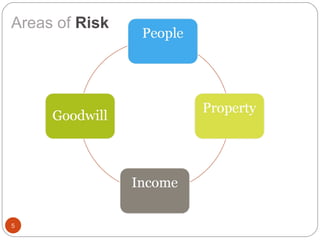
Areas of  Risk
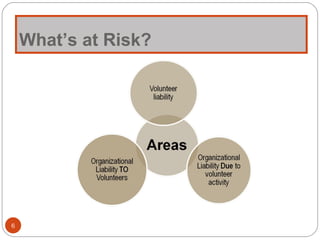
What’s at Risk?
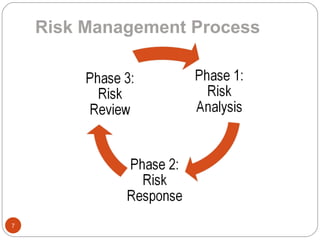
Risk Management Process
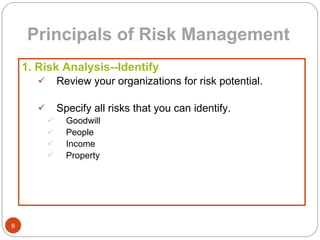
Principals of Risk Management 1. Risk Analysis--Identify Review your organizations for risk potential. Specify all risks that you can identify. Goodwill People Income Property
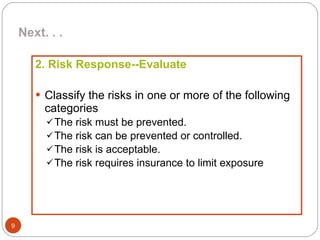
2. Risk Response--Evaluate Classify the risks in one or more of the following categories The risk must be prevented. The risk can be prevented or controlled. The risk is acceptable. The risk requires insurance to limit exposure Next. . .
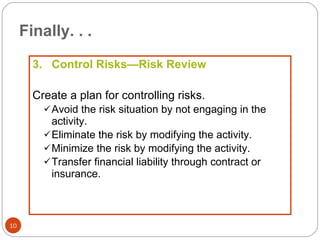
Finally. . . 3.  Control Risks—Risk Review   Create a plan for controlling risks. Avoid the risk situation by not engaging in the activity. Eliminate the risk by modifying the activity. Minimize the risk by modifying the activity. Transfer financial liability through contract or insurance.
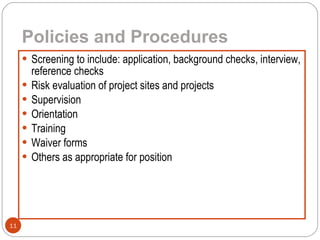
Policies and Procedures   Screening to include: application, background checks, interview, reference checks Risk evaluation of project sites and projects Supervision Orientation Training Waiver forms Others as appropriate for position
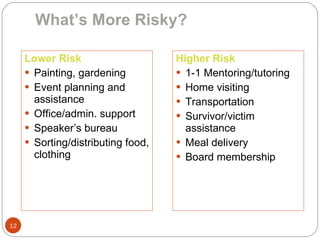
What’s More Risky? Lower Risk Painting, gardening Event planning and assistance Office/admin. support Speaker’s bureau Sorting/distributing food, clothing Higher Risk 1-1 Mentoring/tutoring Home visiting Transportation Survivor/victim assistance  Meal delivery Board membership
What are ways that risk can be mitigated particularly for those high risk volunteer positions and tasks? DISCUSSION
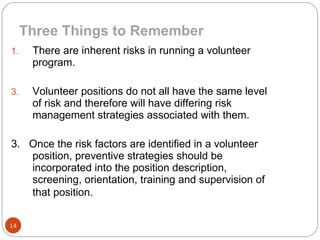
There are inherent risks in running a volunteer program. Volunteer positions do not all have the same level of risk and therefore will have differing risk management strategies associated with them. 3.  Once the risk factors are identified in a volunteer position, preventive strategies should be incorporated into the position description, screening, orientation, training and supervision of that position.   Three Things to Remember
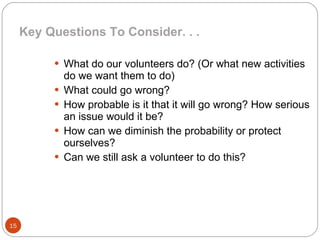
What do our volunteers do? (Or what new activities do we want them to do) What could go wrong? How probable is it that it will go wrong? How serious an issue would it be? How can we diminish the probability or protect ourselves? Can we still ask a volunteer to do this? Key Questions To Consider. . .
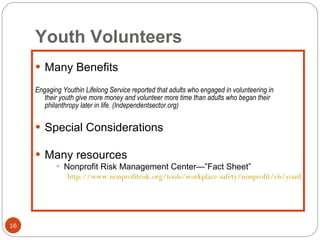
Youth Volunteers Many Benefits Engaging Youthin Lifelong Service reported that adults who engaged in volunteering in their youth give more money and volunteer more time than adults who began their philanthropy later in life. (Independentsector.org) Special Considerations Many resources Nonprofit Risk Management Center—”Fact Sheet”   http://www.nonprofitrisk.org/tools/workplace-safety/nonprofit/c6/youth.htm
Contact the experts Insurance Agent—check liability coverage Lawyer—review policies, procedures, and forms Identify special issues related to vulnerable populations, use of power tools, youth engagement, etc. Work with the organization’s Human Resources
Note: There are few overarching legal requirements when a group of people get together to do good work as long as appropriate steps are taken to: Identify Potential Risks Inform individuals involved of those risks Take steps to minimize risk i.e. provide appropriate equipment, tools, and training .
VOLUNTEER LIABILITY The Volunteer Protection Act of 1997  provides immunity for volunteers serving nonprofits or government for harm caused by their acts or omissions if: Acting within the scope of responsibilities Volunteer was appropriately and properly licensed, certified or authorized to act. Harm was not caused by willful, criminal, or reckless misconduct, gross negligence or a conscious, flagrant indifference to the rights or safety of the individual harmed.
Michigan Laws Provide some protected status to volunteers acting on behalf of governmental agencies.  Some examples include: Volunteer disaster worker Public school volunteers Medical Good Samaritan
Review—Appropriate Roles A volunteer position must: Meet the needs of the organization. Have an associated risk management strategy that the organization is comfortable with. Require a reasonable amount of training. Not replace a paid position.
Review the  “Fact Sheet—Volunteer Background Checks” Which has your organization used?  What are the pros/cons? Discuss which would be appropriate for various types of volunteer positions.  DISCUSSION
Summary Questions, Feedback Please complete and return your evaluation form.  Your input is appreciated.

Risk Assessment - Volunteer Engagement

  • 1.
    INTRODUCTION & OVERVIEWRISK ASSESSMENT
  • 3.
    What is riskassessment? The identification, assessment and prioritization of risk followed by an action to minimize, monitor or control the effects. To utilize pre-set plans or procedures to control situations that may be potentially harmful to your organization, program, volunteers or clients.
  • 4.
    Clear, Consistent VolunteerManagement Policies & Procedures Are the first and most important steps in risk reduction.
  • 5.
  • 6.
  • 7.
  • 8.
    Principals of RiskManagement 1. Risk Analysis--Identify Review your organizations for risk potential. Specify all risks that you can identify. Goodwill People Income Property
  • 9.
    2. Risk Response--EvaluateClassify the risks in one or more of the following categories The risk must be prevented. The risk can be prevented or controlled. The risk is acceptable. The risk requires insurance to limit exposure Next. . .
  • 10.
    Finally. . .3. Control Risks—Risk Review Create a plan for controlling risks. Avoid the risk situation by not engaging in the activity. Eliminate the risk by modifying the activity. Minimize the risk by modifying the activity. Transfer financial liability through contract or insurance.
  • 11.
    Policies and Procedures Screening to include: application, background checks, interview, reference checks Risk evaluation of project sites and projects Supervision Orientation Training Waiver forms Others as appropriate for position
  • 12.
    What’s More Risky?Lower Risk Painting, gardening Event planning and assistance Office/admin. support Speaker’s bureau Sorting/distributing food, clothing Higher Risk 1-1 Mentoring/tutoring Home visiting Transportation Survivor/victim assistance Meal delivery Board membership
  • 13.
    What are waysthat risk can be mitigated particularly for those high risk volunteer positions and tasks? DISCUSSION
  • 14.
    There are inherentrisks in running a volunteer program. Volunteer positions do not all have the same level of risk and therefore will have differing risk management strategies associated with them. 3. Once the risk factors are identified in a volunteer position, preventive strategies should be incorporated into the position description, screening, orientation, training and supervision of that position. Three Things to Remember
  • 15.
    What do ourvolunteers do? (Or what new activities do we want them to do) What could go wrong? How probable is it that it will go wrong? How serious an issue would it be? How can we diminish the probability or protect ourselves? Can we still ask a volunteer to do this? Key Questions To Consider. . .
  • 16.
    Youth Volunteers ManyBenefits Engaging Youthin Lifelong Service reported that adults who engaged in volunteering in their youth give more money and volunteer more time than adults who began their philanthropy later in life. (Independentsector.org) Special Considerations Many resources Nonprofit Risk Management Center—”Fact Sheet” http://www.nonprofitrisk.org/tools/workplace-safety/nonprofit/c6/youth.htm
  • 17.
    Contact the expertsInsurance Agent—check liability coverage Lawyer—review policies, procedures, and forms Identify special issues related to vulnerable populations, use of power tools, youth engagement, etc. Work with the organization’s Human Resources
  • 18.
    Note: There arefew overarching legal requirements when a group of people get together to do good work as long as appropriate steps are taken to: Identify Potential Risks Inform individuals involved of those risks Take steps to minimize risk i.e. provide appropriate equipment, tools, and training .
  • 19.
    VOLUNTEER LIABILITY TheVolunteer Protection Act of 1997 provides immunity for volunteers serving nonprofits or government for harm caused by their acts or omissions if: Acting within the scope of responsibilities Volunteer was appropriately and properly licensed, certified or authorized to act. Harm was not caused by willful, criminal, or reckless misconduct, gross negligence or a conscious, flagrant indifference to the rights or safety of the individual harmed.
  • 20.
    Michigan Laws Providesome protected status to volunteers acting on behalf of governmental agencies. Some examples include: Volunteer disaster worker Public school volunteers Medical Good Samaritan
  • 21.
    Review—Appropriate Roles Avolunteer position must: Meet the needs of the organization. Have an associated risk management strategy that the organization is comfortable with. Require a reasonable amount of training. Not replace a paid position.
  • 22.
    Review the “Fact Sheet—Volunteer Background Checks” Which has your organization used? What are the pros/cons? Discuss which would be appropriate for various types of volunteer positions. DISCUSSION
  • 23.
    Summary Questions, FeedbackPlease complete and return your evaluation form. Your input is appreciated.

Editor's Notes

  • #6 People—accidents/injury, discrimination. Property—damage, loss, theft. Income—law suits, theft, lost revenue, costs. Goodwill—public perception, consistency with mission.
  • #7 Volunteer liability—mitigaged by the volunteer protection act and Good Samaritan Act, Organization’s liability—breach of confidentiality, fraud, exploitation, creation of unsafe environment, discrimination, harassment, etc. Volunteer liability—unsafe working conditions, discriminatory practices,
  • #8 Phase 1: Identify the potential areas of risk Evaluate and rank the top 2 to 5 areas to work with Phase 2: Risk Control: Reduce, Avoid, Transfer or Assume Consider the financing issues including time, money and other resources Communicate the information to those who need to know Phase 3: Monitor your plan, evaluate and make changes to reduce future risks
  • #12 Note: Forms are no guarantee or even certain protection against litigation. Waiver Forms may include Informed Risk or Liability (example provided in resource packet), Confidentiality form, Acceptable Use Policies, Press Release forms, Acceptable Use Policies (internet), Youth Parent Permission Slips, Criminal Background Release Form, etc. See Volunteer Background Checks Fact Sheet.
  • #13 This is looking at risk to organization as well as volunteers.
  • #14 Discuss appropriate policies and procedures. In example, mentors should have training regarding confidentiality and appropriate vs. inappropriate behaviors such as hugging, time alone, etc. Even painting lower risks such as painting should discuss ladder safety, good ventilation, etc.
  • #17 Additional benefits to youth such as the connections that are made between learning and real life, increased sense of community, etc. As a rule, the greater the degree of control you maintain over the activities of young people, the greater your duty to protect them from harm. This duty encompasses your need to provide a safe environment and safe materials. You must also select the correct tasks, conduct proper training, and designate adequate and appropriate adult supervisory personnel. The Fact Sheet provides a number of other resources for information and tips.
  • #20 Often individuals are worried about their potential liability. Laws such as the Good Samaritan Act, the Volunteer protection Act of 1997, and individual state laws provide protection to those individuals.
  • #22 When assessing potential volunteer positions, there are 4 major considerations with risk management being one. However, others apply to other liability issues even if just goodwill.
  • #23 Provide examples as appropriate for your community and participants. Some examples may include: The volunteer leading & teaching a summer camp session Volunteers painting a mural at a school Volunteers doing home repairs for senior citizens Volunteers serving at a park clean up as a part of a National Day of Service