

Risk Assessment at Workplace
Sajid Ali
Department of environmental sciences
university of Gujrat ,Pakistan.
Outline
Introduction
Definition
Objectives
5 Steps of Risk Assessment
Table (Example of Risk Assessment)
Ranking of Risks
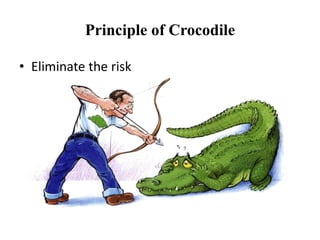
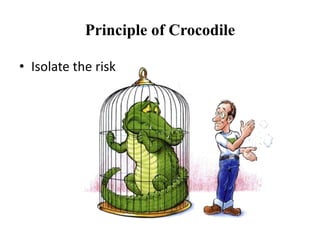
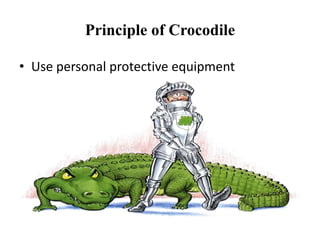
Principle of Crocodile
Conclusion
References
Introduction
Why is it important to carry out a risk assessment???
Legal reasons
• Carrying out a risk assessment, preparing a safety statement
and health management system, they are required by law.
• Health and Safety Authority inspectors visiting workplaces
will want to know how employers are managing safety and
health. If they investigate an accident, they will scrutinize the
risk assessment and safety statement, and the procedures and
work practices in use.
Introduction
Moral and ethical reasons
• The process of carrying out a risk assessment, preparing a
safety statement and implementing what you have written
down will help employers prevent injuries and ill-health at
work. Employers are ethically bound to do all they can to
ensure that employees do not suffer illness, a serious accident
or death.
Financial reasons
• There is considerable evidence, borne out by companies’
practical experiences, that effective safety and health
management in the workplace contributes to business success.
Risk Assessment
• A Risk Assessment is a systematic method of looking
at work activities, considering what could go wrong,
and deciding on suitable control measures to prevent
loss, damage or injury in the workplace.
• The Assessment should include the controls required
to eliminate, reduce or minimize the risks.
Objectives of Risk Assessment
• Risk Assessments are the fundamental requirement
for business. If we don’t know, or appreciate where
the risks are, we are putting our self, our employees,
our customers and our organization in danger.
• The aim should always be to reduce the risks as much
as is 'reasonably practicable'.
Objectives of Risk Assessment
• Risk Assessment should be Systematic
• It should follow a defined and logical methodology.
• It should systematically lead to evidence based
conclusions.
Five Steps of Risks Assessment
• Step 1: Identify hazards, i.e. anything that may cause harm.
• Step 2: Decide who may be harmed, and how.
• Step 3: Assess the risks and take action.
• Step 4: Make a record of the findings.
• Step 5: Review the risk assessment.
Step 1: Identify hazards, i.e. anything that may
cause harm
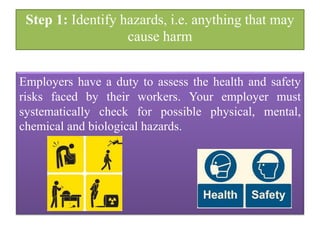
Employers have a duty to assess the health and safety
risks faced by their workers. Your employer must
systematically check for possible physical, mental,
chemical and biological hazards.
Step 1
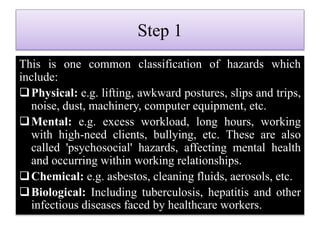
This is one common classification of hazards which
include:
Physical: e.g. lifting, awkward postures, slips and trips,
noise, dust, machinery, computer equipment, etc.
Mental: e.g. excess workload, long hours, working
with high-need clients, bullying, etc. These are also
called 'psychosocial' hazards, affecting mental health
and occurring within working relationships.
Chemical: e.g. asbestos, cleaning fluids, aerosols, etc.
Biological: Including tuberculosis, hepatitis and other
infectious diseases faced by healthcare workers.
Step 2: Decide who may be harmed, and how.
Identifying who is at risk starts with your organization's
own full and part-time employees. Employers must also
assess risks faced by agency and contract staff, visitors,
clients and other members of the public on their
premises.
Step 2
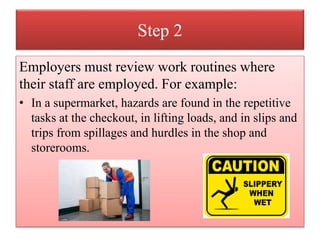
Employers must review work routines where
their staff are employed. For example:
• In a supermarket, hazards are found in the repetitive
tasks at the checkout, in lifting loads, and in slips and
trips from spillages and hurdles in the shop and
storerooms.
Step 3: Assess the risks and take action.
• This means employers must consider how likely it is
that each hazard could cause harm. This will
determine whether or not your employer should
reduce the level of risk.
• Even after all precautions have been taken, some risk
usually remains. Employers must decide for each
remaining hazard whether the risk remains high,
medium or low.
Step 4: Make a record of the findings
• Employers required to record in written form.
• This record should include details of any hazards
noted in the risk assessment, and action taken to
reduce or eliminate risk,
• That record will be used as the basis for a later review
of working practices.
Step 5: Review the risk assessment
• A risk assessment must be kept under review in order
to ensure that agreed safe working practices continue
to be applied and take account of any new working
practices, new machinery or more demanding work
targets.
Ranking
How do we rank or prioritize the risks?
Ranking or prioritizing hazards is one way to help
determine
• Which hazard is the most serious
And
• Which hazard to control first.
By assigning a priority to the hazards, we are creating a
ranking or an action list.
Ranking
The following factors play an important role:
• Percentage of workforce exposed.
• Frequency of exposure.
• Degree of harm likely to result from the exposure
• Probability of occurrence.
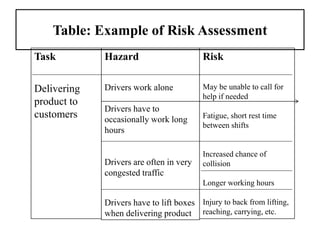
Table: Example of Risk Assessment
Hazard
Drivers work alone
Drivers have to
occasionally work long
hours
Drivers are often in very
congested traffic
Drivers have to lift boxes
when delivering product
Risk
May be unable to call for
help if needed
Fatigue, short rest time
between shifts
Increased chance of
collision
Longer working hours
Injury to back from lifting,
reaching, carrying, etc.
Task
Delivering
product to
customers
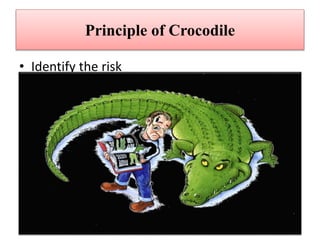
Principle of Crocodile
• Identify the risk
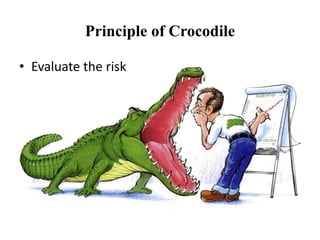
Principle of Crocodile
• Evaluate the risk
Principle of Crocodile
• Eliminate the risk
Principle of Crocodile
• Isolate the risk
Principle of Crocodile
• Use personal protective equipment
Conclusion
• Utilizing the results of this risk assessment, we will
begin the next steps in the Risk Reduction planning
process. This will start with the development of
strategies and policies to mitigate risks, followed by
the preparation and implementation of a risk
reduction plan.
• After implementation, we will monitor, evaluate and
modify the plan as necessary.
References
• http://www.hsa.ie/eng/Publications_and_Forms/Publications/S
afety_and_Health_Management/Guidelines_on_Risk_Assessm
ents_and_Safety_Statements.pdf
• https://www.ccohs.ca/oshanswers/hsprograms/risk_assessment
.html
• https://worksmart.org.uk/health-advice/health-and-
safety/hazards-and-risks/what-are-five-steps-risk-assessment
• http://www.hse.gov.uk/risk/controlling-risks.htm
• http://riskassessment.strategicfire.org/step-3-risk-assessment-
example/conclusion-notes/
contacts
• Email :ranasajidalikhan10000@gmail.com
• Mobile no:+923055790998
• Department :environmental sciences
university of gujrat ,Punjab, Pakistan.

Risk assessment at workplace

  • 2.
    Risk Assessment atWorkplace Sajid Ali Department of environmental sciences university of Gujrat ,Pakistan.
  • 3.
    Outline Introduction Definition Objectives 5 Steps ofRisk Assessment Table (Example of Risk Assessment) Ranking of Risks Principle of Crocodile Conclusion References
  • 4.
    Introduction Why is itimportant to carry out a risk assessment??? Legal reasons • Carrying out a risk assessment, preparing a safety statement and health management system, they are required by law. • Health and Safety Authority inspectors visiting workplaces will want to know how employers are managing safety and health. If they investigate an accident, they will scrutinize the risk assessment and safety statement, and the procedures and work practices in use.
  • 5.
    Introduction Moral and ethicalreasons • The process of carrying out a risk assessment, preparing a safety statement and implementing what you have written down will help employers prevent injuries and ill-health at work. Employers are ethically bound to do all they can to ensure that employees do not suffer illness, a serious accident or death. Financial reasons • There is considerable evidence, borne out by companies’ practical experiences, that effective safety and health management in the workplace contributes to business success.
  • 6.
    Risk Assessment • ARisk Assessment is a systematic method of looking at work activities, considering what could go wrong, and deciding on suitable control measures to prevent loss, damage or injury in the workplace. • The Assessment should include the controls required to eliminate, reduce or minimize the risks.
  • 7.
    Objectives of RiskAssessment • Risk Assessments are the fundamental requirement for business. If we don’t know, or appreciate where the risks are, we are putting our self, our employees, our customers and our organization in danger. • The aim should always be to reduce the risks as much as is 'reasonably practicable'.
  • 8.
    Objectives of RiskAssessment • Risk Assessment should be Systematic • It should follow a defined and logical methodology. • It should systematically lead to evidence based conclusions.
  • 9.
    Five Steps ofRisks Assessment • Step 1: Identify hazards, i.e. anything that may cause harm. • Step 2: Decide who may be harmed, and how. • Step 3: Assess the risks and take action. • Step 4: Make a record of the findings. • Step 5: Review the risk assessment.
  • 10.
    Step 1: Identifyhazards, i.e. anything that may cause harm Employers have a duty to assess the health and safety risks faced by their workers. Your employer must systematically check for possible physical, mental, chemical and biological hazards.
  • 11.
    Step 1 This isone common classification of hazards which include: Physical: e.g. lifting, awkward postures, slips and trips, noise, dust, machinery, computer equipment, etc. Mental: e.g. excess workload, long hours, working with high-need clients, bullying, etc. These are also called 'psychosocial' hazards, affecting mental health and occurring within working relationships. Chemical: e.g. asbestos, cleaning fluids, aerosols, etc. Biological: Including tuberculosis, hepatitis and other infectious diseases faced by healthcare workers.
  • 12.
    Step 2: Decidewho may be harmed, and how. Identifying who is at risk starts with your organization's own full and part-time employees. Employers must also assess risks faced by agency and contract staff, visitors, clients and other members of the public on their premises.
  • 13.
    Step 2 Employers mustreview work routines where their staff are employed. For example: • In a supermarket, hazards are found in the repetitive tasks at the checkout, in lifting loads, and in slips and trips from spillages and hurdles in the shop and storerooms.
  • 14.
    Step 3: Assessthe risks and take action. • This means employers must consider how likely it is that each hazard could cause harm. This will determine whether or not your employer should reduce the level of risk. • Even after all precautions have been taken, some risk usually remains. Employers must decide for each remaining hazard whether the risk remains high, medium or low.
  • 15.
    Step 4: Makea record of the findings • Employers required to record in written form. • This record should include details of any hazards noted in the risk assessment, and action taken to reduce or eliminate risk, • That record will be used as the basis for a later review of working practices.
  • 16.
    Step 5: Reviewthe risk assessment • A risk assessment must be kept under review in order to ensure that agreed safe working practices continue to be applied and take account of any new working practices, new machinery or more demanding work targets.
  • 17.
    Ranking How do werank or prioritize the risks? Ranking or prioritizing hazards is one way to help determine • Which hazard is the most serious And • Which hazard to control first. By assigning a priority to the hazards, we are creating a ranking or an action list.
  • 18.
    Ranking The following factorsplay an important role: • Percentage of workforce exposed. • Frequency of exposure. • Degree of harm likely to result from the exposure • Probability of occurrence.
  • 19.
    Table: Example ofRisk Assessment Hazard Drivers work alone Drivers have to occasionally work long hours Drivers are often in very congested traffic Drivers have to lift boxes when delivering product Risk May be unable to call for help if needed Fatigue, short rest time between shifts Increased chance of collision Longer working hours Injury to back from lifting, reaching, carrying, etc. Task Delivering product to customers
  • 20.
    Principle of Crocodile •Identify the risk
  • 21.
    Principle of Crocodile •Evaluate the risk
  • 22.
    Principle of Crocodile •Eliminate the risk
  • 23.
  • 24.
    Principle of Crocodile •Use personal protective equipment
  • 25.
    Conclusion • Utilizing theresults of this risk assessment, we will begin the next steps in the Risk Reduction planning process. This will start with the development of strategies and policies to mitigate risks, followed by the preparation and implementation of a risk reduction plan. • After implementation, we will monitor, evaluate and modify the plan as necessary.
  • 26.
    References • http://www.hsa.ie/eng/Publications_and_Forms/Publications/S afety_and_Health_Management/Guidelines_on_Risk_Assessm ents_and_Safety_Statements.pdf • https://www.ccohs.ca/oshanswers/hsprograms/risk_assessment .html •https://worksmart.org.uk/health-advice/health-and- safety/hazards-and-risks/what-are-five-steps-risk-assessment • http://www.hse.gov.uk/risk/controlling-risks.htm • http://riskassessment.strategicfire.org/step-3-risk-assessment- example/conclusion-notes/
  • 28.
    contacts • Email :ranasajidalikhan10000@gmail.com •Mobile no:+923055790998 • Department :environmental sciences university of gujrat ,Punjab, Pakistan.